



Abstract
How do community characteristics shape organizational responses to social issues? While existing research has focused primarily on firm-level attributes or issue characteristics, we argue that a community’s social structure systematically affects how external issues penetrate and resonate locally. We develop a theory of community permeability that links three structural features—network closure, segregation patterns, and issue connectedness—to both the local salience of social issues and subsequent firm responses. Our empirical analysis examines how thousands of locally owned CrossFit gyms in the U.S. responded to their CEO’s controversial statements following the death of George Floyd, a Black man, at the hands of a White police officer in 2020. Results show that issue salience was lower in communities characterized by stronger inward-focused ties and greater ethnic segregation but higher in communities more directly connected to populations affected by Floyd’s death. Firms operating in communities where the issue was more salient were more likely to respond, particularly when their dependence on community support was heightened by disruptions unrelated to the focal issue. Our study reveals how community social structure creates systematic variation in both issue salience and organizational responses, advancing understanding of when and why firms act on social issues.
Organizations increasingly face pressure to take stances on contentious social issues that extend beyond the organizations’ economic mission. On issues such as climate change, racial justice, LGBTQ rights, and abortion access, firms often navigate an expanding array of societal demands (Ipsos, 2021). In this article, we propose that firms’ responses to social issues vary based on the structural characteristics of their local communities, particularly how social ties are configured within and across community boundaries. That is, variation in firm responses may reflect how the social fabric of local communities, particularly their patterns of social connections and interactions, shapes how firms active in such communities process and act upon broader societal issues (Kassinis & Vafeas, 2006; King, 2008). Consider, for example, how thousands of Hong Kong businesses publicly declared, based on their local community ties, pro- or anti-democracy positions in 2020 (Beech & Fei, 2020) or how companies in Texas diverged in their responses to abortion restrictions in 2021 (Simon, 2022). Heterogeneous responses emerge because the structure of social ties within communities creates varying conditions for how external issues are processed and understood locally. This variance in local conditions is especially consequential for small- and medium-sized businesses, which are deeply embedded in their local communities and rely on them not just for resources but also for legitimacy and support (Freeman & Audia, 2006; Marquis & Battilana, 2009).
Understanding firm responses to social issues requires examining how community social structure shapes the salience of local issues (Sampson et al., 2005). Notably, communities vary systematically in their network configurations: Some feature dense, inward-focused ties that insulate them from broader debates (Coleman, 1988), others have permeable boundaries that facilitate external influence, and still others are internally divided by ethnic or economic segregation, which impedes shared understanding of social issues (Christ et al., 2014). While these structural variations likely affect organizational responses to social issues, existing research emphasizes firm-level attributes (Bundy et al., 2013) or issue characteristics (Mohliver et al., 2023). This focus leaves unexplored how community social structure shapes both issue salience and the responses of firms that are deeply embedded in such communities.
We develop novel theory linking three key features of community social structure—network closure, segregation, and issue connectedness—and firm responsiveness to social issues. We focus on these structural features as they are key determinants of a community’s permeability to social issues that originate outside of the community, and they affect how readily external issues gain resonance and become salient. Specifically, network closure affects overall openness to external influences, segregation shapes information flow across community segments, and social connections to affected communities create direct pathways for issues to resonate locally. We argue that the more permeable a local community is to broader social issues, the more salient a social issue will be, which, in turn, increases the likelihood that a locally embedded organization will respond to it.
We test our theory by studying how the social structure of different U.S. communities affected local CrossFit gyms’ responses to controversial statements about George Floyd’s death made by CrossFit’s CEO in June 2020. Floyd, who was Black, died in Minneapolis, Minnesota on May 25, 2020, after a White police officer knelt on his neck for nearly ten minutes while Floyd was handcuffed and lying face down in the street. In 2021, the death was ruled a homicide, and the police officer was convicted of murder and sentenced to prison. This incident created pressure on thousands of CrossFit-affiliated gyms nationwide to take a stance on the CEO’s statements and, by extension, on the broader issue of race relations in the United States. In response, hundreds of CrossFit-affiliated gyms serving different communities declared their intent to sever ties with CrossFit, while many others remained silent. CrossFit gyms are ideal for our purposes as they are small businesses that are both highly embedded in and highly dependent on the local communities they serve. Moreover, these gyms operate in over 1,100 different U.S. counties, whose social structural diversity allows us to examine how community characteristics shape firm responses to social issues. Finally, the dramatic disruption of gym operations caused by the COVID-19 pandemic created exogenous variation in gyms’ dependence on their local communities (Pfeffer & Salancik, 1978). We estimate a two-stage regression model to trace how community social structure shaped both local issue salience and subsequent firm responses to the social issue of race relations. We find that communities with stronger inward-focused ties showed lower issue salience and reduced receptivity to external issues. Similarly, community segregation dampened issue salience and subsequent firm responsiveness. Conversely, stronger social connections to the external communities that directly experienced the issue enhanced salience and firm responsiveness. Finally, firms that were more dependent on their communities because of disruptions unrelated to the issue were more responsive.
In three important ways, our study advances scholarship on how community-level attributes shape the behavior of organizations. First, we highlight how the structure of social ties in communities affects which social issues become locally salient and how firms respond to them, complementing existing perspectives that have focused primarily on firm-level attributes or issue characteristics (Bansal & Roth, 2000; Durand et al., 2019). This perspective enriches research on community embeddedness (Freeman & Audia, 2006; Marquis & Battilana, 2009) and advances the renewed interest in geography and place in organizational studies (Benischke et al., 2022; Lawrence & Dover, 2015; Muñoz et al., 2022). We build on research examining community influences on strategy (Lounsbury, 2007), corporate social action (Marquis et al., 2007), and responses to disruptions (Williams & Shepherd, 2021), while pushing stakeholder theory in new directions. Specifically, we move beyond stakeholder attributes and dyadic relationships (Mitchell et al., 1997; Wood et al., 2021) to show how community social structure shapes both issue salience and firm responses. In doing so, we answer calls to better incorporate stakeholder interconnections into research on this topic (Rowley, 1997, 2017).
Second, we show how different aspects of community structure—network closure, segregation, and issue connectedness—create varying conditions for the local resonance of external social issues (Almandoz et al., 2018; Tilcsik & Marquis, 2013). Our findings on structural determinants of issue salience complement existing research that has emphasized organizational infrastructure as the primary driver of collective action (Sampson et al., 2005). While prior research has shown that nonprofit density and institutional capacity matter for mobilization, our results reveal how community network structure shapes the specific issues around which mobilization may or may not occur. This structural perspective helps to explain why communities with similar organizational infrastructures, as well as firms facing similar social issues, may nonetheless exhibit varying patterns of issue salience and collective response.
Third, we demonstrate that a firm’s dependence on its local community critically shapes its response to social issues. In doing so, we contribute to resource dependence theory by showing how community-level issue salience and firm dependence interact to determine organizational action (Kassinis & Vafeas, 2006; Mohliver et al., 2023). This finding extends beyond traditional resource dependence perspectives by revealing how social structural dimensions create varying conditions for firm responsiveness even when resource dependencies appear similar. Our community permeability framework offers practical insights for understanding how firms navigate pressures to take stances on social issues that extend beyond the organizations’ economic mission.
Theoretical Background
Issue Salience and Firm Responsiveness to Social Issues
Understanding organizational responses to social issues requires examining how community-level attributes create variation in both issue salience and firm responsiveness. While existing research has identified various organization- and stakeholder-level factors that influence firm responses, we argue that the social structure of local communities systematically shapes how external issues become salient and how firms respond. This perspective views firms as embedded within networks of relationships encompassing not just shareholders but diverse stakeholders—employees, customers, suppliers, and crucially, the wider community (Freeman, 1984)—whose social connections create varying conditions for organizational action. The salience of social issues to these stakeholders creates varying pressures for organizational response. 1
Firm responsiveness—defined as willingness to act on stakeholder demands—emerges from the interplay between firm-level, stakeholder-level, and issue-level factors. Recent work highlights how firms may take different stances on the same social issue as stakeholders often disagree about both whether action is needed and what stance is appropriate (Mohliver et al., 2023). Taking positions on contentious social issues thus involves inherent risks of alienating stakeholders who may hold opposing views or prefer corporate neutrality (Hou & Poliquin, 2023; Melloni et al., 2023). This complexity has spurred scholars to develop more nuanced theories linking issue salience to firm responsiveness (Bundy et al., 2013) and showing how this varies based on stakeholder relationships (Durand et al., 2019). For example, Bansal and Roth (2000) linked environmental initiatives to issue characteristics, field-level pressure, and organizational concerns. Bundy et al. (2013) showed how issue salience affects firm responsiveness through alignment with organizational identity. Building on this, Durand and colleagues (2019) conceptualized responsiveness as a function of issue salience and action costs and benefits. Mohliver and colleagues (2023, p. 1199) examined how firms use “corporate social counterpositioning” when issue salience is high but consensus varies.
However, two important gaps remain in our understanding. First, existing approaches conceptualize salience primarily in terms of what matters to firms rather than how the salience varies among stakeholders themselves (Mitchell et al., 1997; Pache & Santos, 2010; Rowley & Moldoveanu, 2003). As Mohliver and colleagues (2023, p. 1202) noted, “issues vary in their salience, with some issues such as health care, climate change, gun control, etc. being very important to many people, while others . . . are less salient.” Understanding this variation in stakeholder-level salience is crucial for explaining organizational responses, yet the antecedents of the variation remain largely unexplored.
Second, existing approaches rarely consider how stakeholder interconnections affect the salience and influence of issues (Rowley, 1997, 2017). This gap is particularly notable given evidence that structural and organizational factors, beyond individual ties, drive civic engagement and collective response (Sampson et al., 2005). While traditional approaches emphasize the density of social connections, research increasingly shows that community infrastructure and organizational capacity are key in determining whether and how communities mobilize around social issues.
We address both these gaps by examining how network structure shapes issue salience within the local community and firms’ responsiveness to social issues. This approach allows us to theorize about both the antecedents of community-level issue salience and how it interacts with firms’ dependence on community support to shape firm responses to social issues.
The Community as a Focal Stakeholder
While communities have long been recognized as stakeholders (Dunham et al., 2006; Etzioni, 1999; Mitchell et al., 1997), recent scholarship has shown a renewed interest in how community embeddedness shapes firm behavior. 2 This revival stems from mounting evidence that local stakeholders influence organizations through multiple channels: They monitor firm behavior (Desai, 2018), shape firm reputation (Henriques & Sadorsky, 1999), and can mobilize to create significant consequences for firms (Dorobantu et al., 2017). The impact of community embeddedness is particularly pronounced when organizational leaders reside locally, as “physical proximity and colocation affect who one associates with, and these connections subsequently have a strong influence on norms” (Marquis & Battilana, 2009, p. 292). These effects are also especially salient for firms with primarily local operations, which are deeply enmeshed in their communities (Freeman & Audia, 2006; Marquis & Battilana, 2009).
But what shapes whether a social issue becomes salient within a given community? At the most basic level, salience reflects community composition and characteristics. For example, immigration policy tends to resonate more strongly in areas with larger immigrant populations, just as LGBTQ rights often gain greater traction in communities with more LGBTQ residents. This observation aligns with research showing how community makeup influences organizational behavior (Freeman & Audia, 2006), whether through ethnic composition (Aldrich & Reiss, 1976) or political orientation (Ingram & Simons, 2000; Simons & Ingram, 1997, 2003). Stakeholder theory further emphasizes how community composition shapes both stakeholder preferences and their influence on embedded organizations (Benischke et al., 2022; Donaldson & Preston, 1995; Mitchell et al., 1997). For instance, Kassinis and Vafeas (2006) showed that community sociopolitical characteristics can predict stakeholder pressure on firms’ environmental performance, presumably by affecting the local salience of environmental issues.
Beyond sociopolitical and demographic differences, however, communities also vary in their social structural characteristics, specifically in how their networks of social connections are configured. These network configurations shape how external issues penetrate and resonate within a given community. For instance, communities with dense, inward-focused networks tend to be more insulated from broader societal debates—particularly those originating outside local boundaries (Chetty et al., 2022)—relative to communities with less-dense, less-inward-focused networks. Internal segregation can further impede the development of shared understanding across community segments, as disconnected subgroups struggle to achieve common recognition of issues (Christ et al., 2014). However, direct exposure to relevant information can counteract these barriers by reducing psychological distance to external issues (Trope & Liberman, 2010). Thus, a community’s attributes—particularly its network configuration—affect both how information diffuses and how external issues achieve salience among its members, ultimately influencing the responses of locally embedded organizations.
Building on these insights, we develop theory on how the network structure of local communities shapes both issue salience and organizational responsiveness. Our approach moves beyond examining stakeholder demands in isolation (Eesley & Lenox, 2006) or in the aggregate (Bansal & Roth, 2000), to reveal how the underlying structure of community social ties systematically affects which issues resonate locally and how firms respond to them.
Hypotheses Development
Our theory centers on community permeability, defined as how readily external issues penetrate and resonate within local contexts. Permeability encompasses two related processes: penetration, the diffusion of information about an external issue into a community through boundary-spanning connections, and resonance, the extent to which the issue, once introduced, achieves meaning and significance within the community’s collective understanding. These components work in tandem to determine issue salience—information must first cross community boundaries and then achieve local significance through shared interpretation. We focus specifically on external issues because they must traverse community boundaries to achieve salience, unlike local issues, which may naturally command attention through social proximity and direct exposure. This movement renders external issues particularly dependent on a community’s social structural characteristics.
Three distinct but interrelated mechanisms shape community permeability. Network closure determines overall openness to external influences, primarily affecting penetration. Internal segregation affects how information and interpretations flow across community segments, influencing both penetration and resonance. Similarly, direct connections to affected communities provide dedicated channels through which external issues can achieve local salience. These mechanisms work together to create systematic variation in how communities process external issues and how organizations embedded in those communities respond to such issues.
Antecedents of Community-Level Issue Salience
Network closure shapes a community’s permeability to external issues (Chetty et al., 2022). We build on foundational work that distinguishes between bonding ties, which connect similar individuals within a group, and bridging ties, which link to external communities (Putnam, 2000). While dense internal networks can strengthen local cohesion, a predominance of bonding over bridging ties reduces a community’s permeability to external influences. In communities characterized by high network closure, limited bridging ties create structural barriers to the penetration of issues that originate from beyond community boundaries. Such communities, where social ties and interactions unfold largely within their borders, exhibit lower permeability to broader societal issues, compared to communities whose members routinely exchange information with external actors. The relative scarcity of bridging ties not only restricts information flow but also creates an echo chamber effect whereby local interpretations and concerns dominate. As a result, these less-permeable communities tend to focus on immediate local issues rather than on broader societal concerns, making external issues less likely to achieve salience among local stakeholders. 3
Accordingly, we predict that communities characterized by greater network closure (i.e., a higher prevalence of within-community social ties relative to cross-cutting, intercommunity social ties) are likely to perceive external social issues as less salient. More formally,
The second critical dimension of community permeability is the degree of internal segregation. While our empirical focus here is on ethnic segregation, structural segregation of various forms—whether ethnic, economic, or political—fundamentally shapes how effectively external issues can penetrate beyond specific segments to drive broader community salience (Abascal & Baldassarri, 2015). 4 In communities where segregation is prevalent, physical and social barriers reduce the flow of information and communication between segments, creating multiple isolated spheres of understanding rather than a cohesive community-wide response. Specifically, in segregated environments in which distinct subgroups predominate within different community segments (Massey & Denton, 1993), information and interpretations tend to circulate within rather than across groups. This fragmented structure reduces internal permeability, as limited cross-group interaction impedes the development of shared understanding across segments (Portes & Vickstrom, 2011; Stolle et al., 2008). Even when external issues penetrate one segment of the community, high levels of internal segregation can prevent them from achieving broader resonance, as diverse perspectives and experiences remain disconnected.
In communities where segregation is prevalent, the notion of a collective conscience becomes challenged, affecting the overall perception of what issues are deemed important or meaningful. Spatial divisions, leading to a lack of connectedness among residents, further exacerbate this issue (Wirth, 1938), and the absence of inclusive forums and spaces for cross-group interaction limits the development of a common understanding or shared sense of importance regarding broader issues (Putnam, 2000). Consequently, issues that may be significant within one subgroup often fail to gain recognition or perceived importance among others (Christ et al., 2014).
We therefore contend that the degree of segregation in a local community is inversely related to the salience of a given external social issue. The more segregated a community is, the more its segments tend to operate in isolation, each with its own unique set of priorities and concerns, often disconnected from those of other segments and the broader societal context. Consequently, social issues that might be of significant concern externally may not be recognized as important or relevant within a community’s isolated segments. 5 Therefore, we posit the following hypothesis:
The third dimension of community permeability operates through issue connectedness, defined as a community’s direct social connections to the specific communities most affected by the external issue in question. These issue-specific connections create dedicated channels through which external issues can more readily penetrate and resonate locally. The importance of such targeted permeability aligns with research on community collective efficacy—the combination of social cohesion and shared expectations for action (Sampson et al., 1997). Just as collective efficacy enables communities to mobilize around local challenges, direct social ties to affected communities enhance permeability by reducing both structural and psychological distance to the relevant issue. When communities lack these connections, external issues may struggle to penetrate local consciousness, appearing distant and less salient (Trope & Liberman, 2010). However, strong relational ties to affected communities create natural conduits for information flow and interpretation, increasing the permeability of local communities to external issues (Batson et al., 1997; Cialdini et al., 1997). These dedicated permeability channels operate through multiple mechanisms. Direct connections create pathways for perspective-taking and enhanced identification with affected communities (Barlow et al., 2010). When community members have personal connections to affected individuals, external issues transform from abstract concerns into immediate, personal matters (Dovidio et al., 2003). This enhanced permeability through direct ties facilitates emotional resonance and collective response (Petty & Cacioppo, 1986), allowing external issues to penetrate psychological and geographical barriers more effectively (Festinger, 1954).
Community permeability depends on the strength and extent of connections to communities directly affected by external issues. In communities lacking such connections, issues may remain abstract and distant, failing to resonate. However, when strong connections exist, they create natural pathways for external issues to penetrate local consciousness, fostering shared understanding and significance. These connections serve as dedicated conduits through which external issues can more readily achieve salience within the community. Therefore, we anticipate the following:
Firm Responsiveness to Community-Level Issue Salience
Social issues perceived as highly salient within a community likely create pressure on locally embedded organizations to respond. For instance, due to the nature of their value propositions, many firms (e.g., gyms, restaurants, plumbing services, HVAC services, etc.) are deeply integrated in their local communities, as they depend on the community for key resources, such as employees and supplies, while simultaneously serving local community members as their primary customers. Thus, when external social issues become salient in the local community, it logically follows that these organizations face increased pressure to demonstrate awareness and engagement. Therefore, we posit that firms located in areas where an external social issue has become a focal point of community discussion and activism will encounter heightened demands for a reaction, compared to firms in communities where such social issues are less salient:
Finally, while issue salience varies across communities, its effect on firm responsiveness is also unlikely to be uniform (at a given level of community-level issue salience). We theorize that the likelihood of firm responsiveness to external social issues that are salient within the local community will be greater when the firm’s dependence on its local community is higher. Resource dependence theory has long held that all organizations depend on external partners for essential resources they cannot produce internally (Pfeffer & Salancik, 1978). As a result, organizations that are embedded within their local environments and depend on them for access to critical resources will naturally be more sensitive to concerns that resonate within these communities. Therefore, the influence of issue salience on firm responsiveness is likely stronger when community dependence is high. This is especially true in situations in which standard market exchange relationships are under strain and when community support is paramount. This leads us to our final hypothesis:
Figure 1 summarizes our overall theoretical framework.
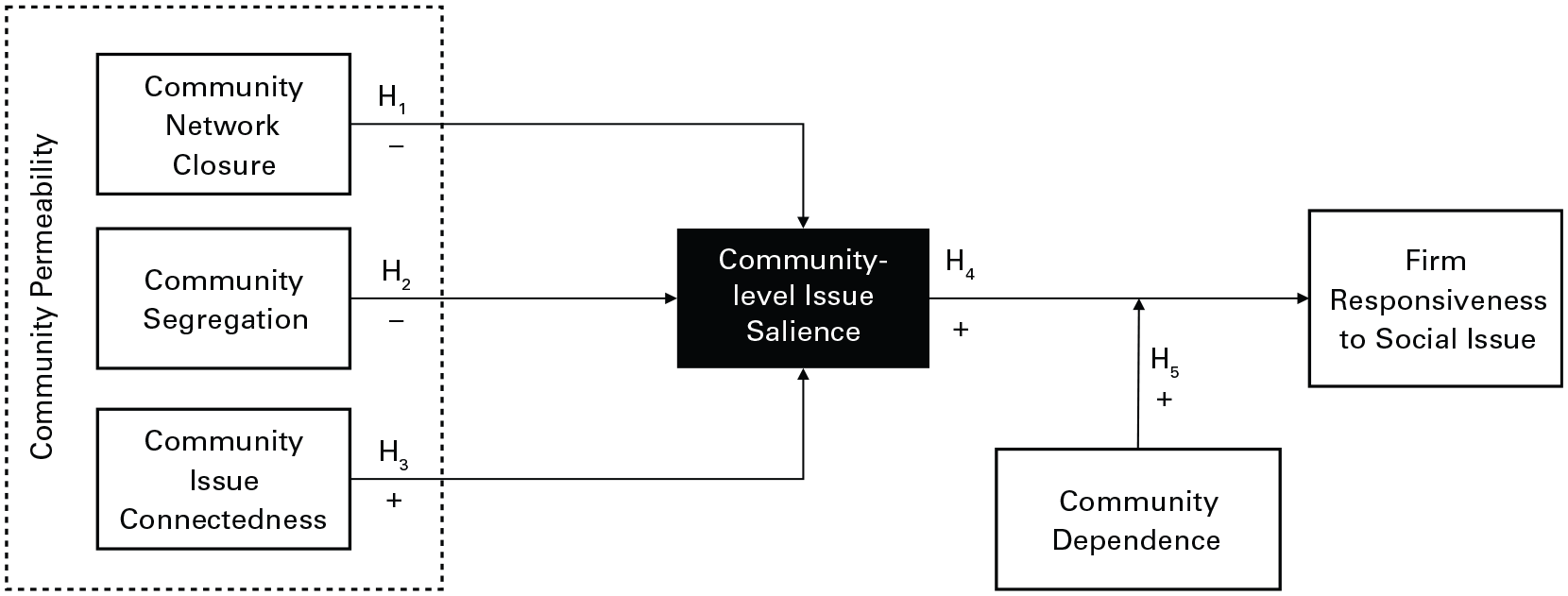
Theoretical Model: The Effects of Community Permeability on Local Issue Salience and Firm Responsiveness
Methods
Empirical Setting
To test our theory, we studied a population of highly comparable firms embedded within heterogeneous local communities. These firms were suddenly and collectively prompted to respond to the same social issue, and their responsiveness or lack thereof could be observed within a discrete time window. We centered our attention on events that unfolded in June 2020 surrounding thousands of locally owned and operated gyms in the United States affiliated with the franchising program of CrossFit LLC, a fitness company founded in 2000 in Santa Cruz, California.
The CrossFit methodology was developed in 1996 by CrossFit co-founder and CEO Greg Glassman, who described it as a “constantly varied, high-intensity functional movement” fitness program (Glassman, 2007, p. 1). CrossFit operates an affiliate model whereby the corporate office charges gym owners a $3,000 annual licensing fee to carry the CrossFit name and logo, but there is no revenue share, and gyms are individually owned and operated. Gym owners receive no territorial rights—there is no limit to the number of CrossFit gyms that can operate within a city, county, or ZIP code. Besides branding and name recognition, affiliate gyms can access additional resources in the form of legal protection and insurance, certification programs for coaches, and participation in CrossFit competitions. 6 The number of CrossFit-affiliated gyms around the world has grown rapidly, from 500 in 2008 to more than 10,000 in 2014. In the U.S., our empirical context, we observed 4,979 operational CrossFit gyms as of June 2020 (excluding military gyms).
On June 7, 2020, CrossFit CEO Greg Glassman posted on Twitter to comment on the then-ongoing protest wave sweeping across the United States after the death of George Floyd at the hands of police on May 25, 2020. In response to a Twitter post by a public health institute that featured a picture that stated, “Racism is a public health issue,” Glassman responded by tweeting, “It’s FLOYD-19,” referencing the still-ongoing COVID-19 pandemic (see Figure 2). Later, Glassman was reported to have spoken dismissively of the protests, saying during a Zoom call with gym owners that “we’re not mourning for George Floyd—I don’t think me or any of my staff are,” and “Can you tell me why I should mourn for him? Other than that it’s the White thing to do—other than that, give me another reason.” 7 Glassman further claimed during the call that George Floyd had been killed as part of an elaborate cover-up that was unrelated to racism.
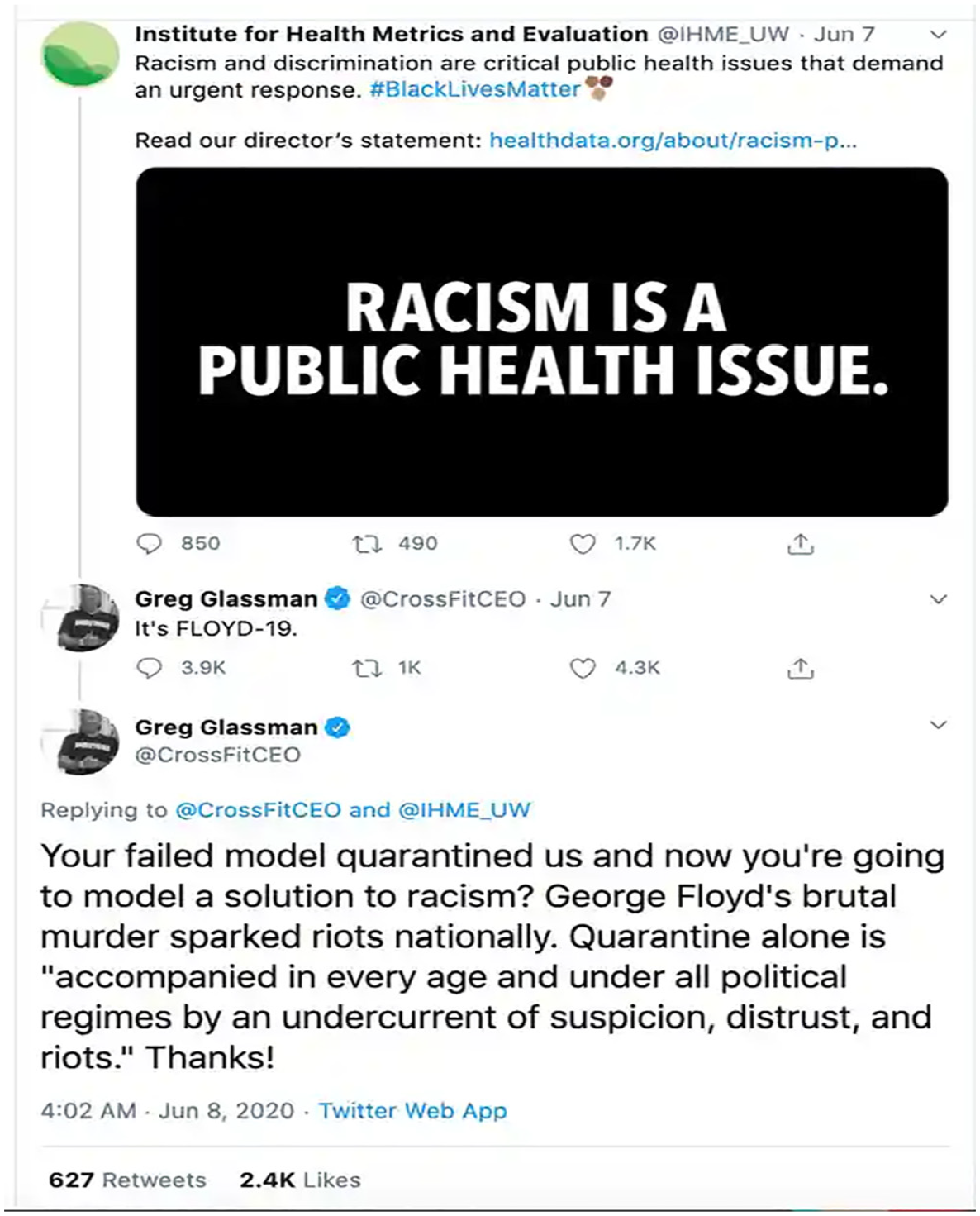
CrossFit CEO Greg Glassman’s Original Twitter Thread
The backlash against Glassman’s comments was swift and immediate. By June 9, 2020, at least 500 gyms worldwide had stated their intention to disaffiliate from CrossFit, renouncing their use of the logo and brand. By June 10, Glassman announced that he would step down from his role as CEO and retire. To many gym owners and corporate partners, this was still insufficient, and the pressure on CrossFit endured. By June 24, Glassman announced that he would sell CrossFit to affiliate gym owner Eric Roza for a reported $200 million. By that time, more than 1,300 gyms worldwide had announced that they would disaffiliate from CrossFit upon expiration of their existing licenses.
Data Sample, Variables, and Measures
Our sample covers the population of U.S. CrossFit-affiliated gyms, including both those that did declare their intention to disaffiliate from CrossFit and those that did not. We identified each gym in our sample by matching official data reported on the CrossFit.com website (retrieved from the Affiliate List as of June 7, 2020) with a manually verified list of U.S. gyms that publicly declared their intention to disaffiliate from CrossFit. We then determined the geographical location of each gym by using the Google Maps application programming interface to validate and standardize the physical address reported on CrossFit.com. We excluded any CrossFit gyms that were not located in the United States, military gyms in U.S. domestic or foreign military bases, and gyms that ceased operations before the start of our observation period. The final sample for analysis includes 4,979 CrossFit gyms.
We then identified, in three steps, the subset of gyms that publicly declared their intention to disaffiliate. First, we collected all disaffiliation announcements appearing on a public crowdsourced list maintained by Morning Chalk Up (www.morningchalkup.com), an online sports and media publication specializing in CrossFit. This yielded 1,354 public announcements by CrossFit gyms globally. Announcements were made on social media (e.g., Twitter, Instagram, Facebook, YouTube) between June 6 and June 26, 2020. Second, we employed a research assistant to perform data validation tasks (e.g., to filter out 434 gyms not based in the U.S., verify the disaffiliation announcements of the U.S.-based gyms, check for any naming inconsistencies and for gyms rebranding after disaffiliating). Third, we eliminated 166 U.S. firms listed in Morning Chalk Up but whose statements did not actually declare an intention to disaffiliate. 8 The final list includes verified disaffiliation announcements made by 754 U.S. CrossFit gyms.
Gyms strongly rely on customers and workers to be physically present in their local communities. We thus define the geographical boundaries of the community in which a gym is embedded as the county where it is located. To measure relevant demographic and institutional characteristics of each community, we used data from the 2019 five-year American Community Survey and the 2020 decennial census, both compiled by the U.S. Census Bureau. Additionally, to capture pandemic-related mobility restrictions in the local communities served by the firms in our sample, we exploited longitudinal county-level data from the Google Community Mobility Reports. Finally, to capture the structure of social ties among individuals in the local communities, we used public data from Meta on the entire population of Facebook users in the U.S. (Bailey et al., 2018).
Dependent Variables
Our proposed arguments and theory development revolve around two outcomes: community-level salience of a social issue (testing H1–H3) and firm responsiveness to community-level issue salience (testing H4 and H5). We discuss each of these in turn below.
Community-level issue salience
Glassman’s comments are unlikely to have resonated equally across all communities insofar as the social issue at play here—race relations in the aftermath of the death of George Floyd—is presumably not equally salient across all local communities in the U.S. To measure issue salience at the community level, we needed a reliable indicator of how prominently race relations featured in local community discourse and action. While media coverage is often used to measure issue salience, we opted to collect data on protest activity, for several reasons. First, protests represent organic expressions of community sentiment on the ground rather than being mediated through editorial decisions about what to cover in local newspapers. Second, protest data from the Demonstrations and Political Violence in America dataset (from the organization Armed Conflict Location & Event Data, or ACLED) provide comprehensive coverage across all U.S. counties, avoiding the selection bias inherent in media-based measures that typically cover only larger metropolitan areas. Third, ACLED’s thorough methodology gives us confidence that a lack of protests more likely reflects lower issue salience rather than missing data.
Following an approach similar to that of Zhang and colleagues (2023), we isolated those protest events that took place between May 26, 2020 (the day after George Floyd died) and June 6, 2020 (the day before Glassman’s comments were posted online) and were listed by ACLED as involving the Black Lives Matter (BLM) movement, which was broadly recognized as the main driving force behind the nationwide protests that followed Floyd’s death (Chotiner, 2020). We then created a count of protest events that met these criteria at the county level (plus 1) and took the natural logarithm to account for potential skewness. This approach allows us to separate the issue salience measure from any type of activity that could have more directly influenced firms to respond (besides issue salience).
The resulting tally shows that protests were widespread and geographically distributed, with over one in three counties having at least one protest. In these counties, there were 3.44 protests on average, and the top quartile of counties with protests had between four and 96 events, indicating that the salience of the issue varied widely across communities. Figure 3 depicts the distribution of BLM protest events for counties with at least one protest event.
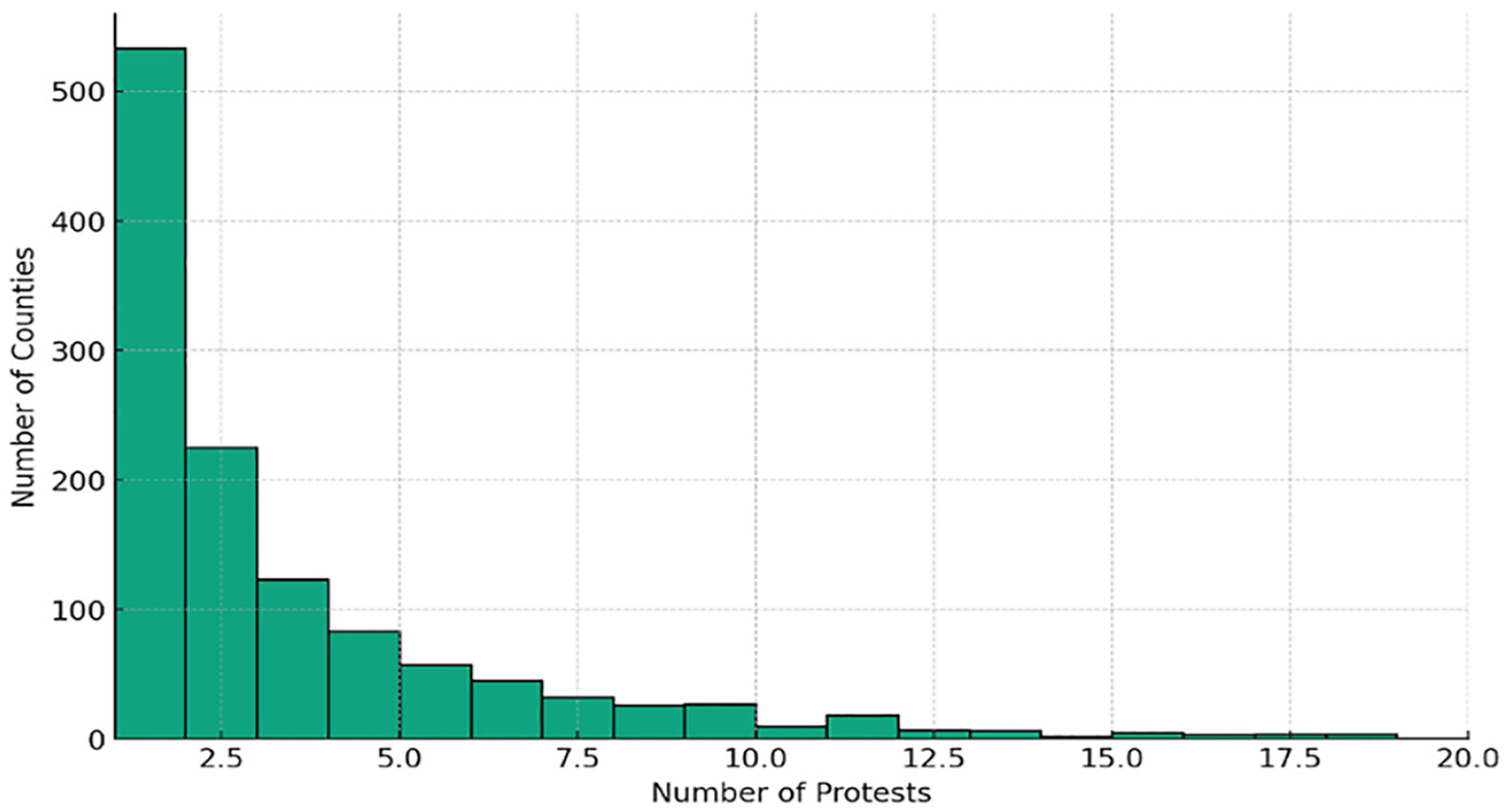
BLM Protests by U.S. County Between 5/26/2020 and 6/6/2020*
Firm disaffiliation announcement
Our measure for firm responsiveness to external social issues that are salient within the local community is an indicator variable that takes the value 1 if a gym publicly stated their intention to disaffiliate from CrossFit and 0 otherwise. Out of 4,979 U.S.-based CrossFit gyms, 754 firms declared their intention to disaffiliate (14.4 percent). Decisions to disaffiliate were made in direct response to Greg Glassman’s racially insensitive remarks and conduct. For example, one respondent in our survey of disaffiliated gym owners stated, “I was on that last Zoom call with Greg Glassman and his cronies where he spent the whole time spouting conspiracy theories and denying that racism is a problem. I knew right then I would never give CrossFit another dime.” Another one simply said, “We didn’t want the negative press and poor leadership to affect our business.” Public disaffiliation statements were typically made by gyms’ owners and were posted on gyms’ social media accounts and/or on their official websites. 9
Explanatory Variables
Community network closure
To gauge whether communities are relatively insular or connected to the rest of the country—and, by extension, to external social issues—we leveraged data from Meta to construct a novel measure of network closure.
10
In particular, we relied on the county-level Facebook Social Connectedness Index (Bailey et al., 2018), a measure of social connectedness between all dyads among U.S. counties (Bailey et al., 2020; Chetty et al., 2022). Meta built the index by mapping U.S. Facebook users to their respective counties of residence and thus captured friendship links among users located across various counties. Meta considers friendship links only among Facebook users who have interacted on Facebook over the 30 days prior to the snapshot. For each pair of counties

We used the Social Connectedness Index data as of August 2020, which was constructed using aggregated and anonymized data from the universe of friendship links among all Facebook users as of July 30, 2020. Community network closure then measures, for individuals in the county where the focal gym operates, the proportion of within-county ties to overall ties. Smaller values indicate local communities with social networks that span to other U.S. counties, while larger values indicate more insular networks that are confined to the focal local community where a gym operates. We take the natural log of the variable to account for the skewness of the raw measure.
Community ethnic segregation
To capture the degree of separation within local communities along ethnic lines, we relied on an established measure known as the Relative Diversity Index (Torrats-Espinosa, 2021). This measure relies on data at the county and census tract (in essence, a county subdivision) level and captures “the ratio of within-tract diversity to total diversity in the county” and “can take values from zero to one, with zero indicating that all tracts have the exact same diversity as the county as a whole (i.e., the shares of each racial group are the same across all tracts in the county), and one representing a county where tracts have no diversity” (Torrats-Espinosa, 2021, p. 2). Using data from the 2020 decennial census at both the county and the census tract level, we first counted non-Hispanic Asian, non-Hispanic Black, Hispanic, non-Hispanic White, and non-Hispanic Other individuals within each tract (Torrats-Espinosa, 2021). We used these counts to calculate the Simpson Interaction Index at the county and census tract levels, defined respectively as


where m is the ethnic group being considered, i is the focal census tract, c is the focal county, and p is the proportion of members of ethnic group m in each county or census tract.

where
Community issue connectedness
Stakeholders in different communities can have been exposed in distinct ways to the aftermath of the death of George Floyd (which took place in Hennepin County, Minnesota, where Minneapolis is located). 11 Personal connections with friends and acquaintances in the community affected by the social issue of interest can bring immediacy and evoke strong emotions, prompting action and solidarity. Learning about the event indirectly through media or social networks can also raise salience and generate support, but the impact may be weaker compared to socialization to the issue via personal connections and acquaintances, as the emotional connection and sense of urgency might be less pronounced.
To gauge the strength of a community’s social ties and direct exposure to those impacted by George Floyd’s murder, we constructed a novel measure, Community issue connectedness, which we computed by using the Meta Social Connectedness Index at the county-dyad level, focusing on connections between each county and Hennepin County, Minnesota. As before, the index reflects total normalized Facebook friendship links among county residents based on 30-day interaction cutoffs. Higher scores indicate stronger friendship links and a closer social connection to the community that was directly impacted. Lower scores suggest a more distant, indirect exposure, likely through media rather than direct community ties. This approach helps us to understand whether the issue had a more personal impact through known individuals in the community, as opposed to being just another news story. We took the natural logarithm to address the skewness of the data.
Community dependence
The COVID-19 pandemic provides an ideal test case for examining how community dependence affects firm responsiveness. Starting in March 2020, U.S. state and local authorities issued emergency orders restricting business operations to enforce social distancing. Gyms were particularly affected by these orders, as they faced mandatory closures and/or severe operational limitations. Going beyond these regulatory restrictions, many customers voluntarily reduced gym attendance, opting to exercise at home or outdoors (Alekseev et al., 2023). This dramatic decline in attendance forced gym owners to rely heavily on community goodwill. 12 Many gyms sought support through membership retention, merchandise sales, equipment rentals, virtual classes, and even GoFundMe campaigns. Our survey reveals how this disruption intensified gyms’ community dependence. One gym owner reported losing “40% of our membership at that time, mainly due to individuals being impacted by COVID-19 layoffs.” Another described struggling to maintain community connections: “We were unable to run workouts, although we did offer some on Zoom. We loaned out all of our equipment and posted [daily workouts]. People lost interest, and it was hard to keep the community feel.” Some gyms adapted by deepening their community focus, as one owner explained: “We created a brilliant community. We had to really focus on members not only physically but mentally. We received grants which helped support the gym.”
To measure pandemic-related disruptions, we used Google Community Mobility Reports data capturing county-level changes in daily movements. For each county, we calculated the mean percentage change in workplace mobility between March 14 and June 7, 2020 (when CrossFit’s CEO made controversial statements about George Floyd’s death), relative to January–February 2020 baseline levels. We took the absolute value of these changes for ease of interpretation, with larger values indicating greater mobility declines. 13
Control Variables
Population and income
We measured total population and median household income at the county level by using the American Community Survey (ACS) data compiled by the U.S. Census Bureau. These variables are likely to affect several potential confounders of interest, including the size of the local market, the purchasing power of individuals, and whether gym owners are more or less wealthy, all of which may relate to both community issue salience and a firm’s decision to announce its disaffiliation from CrossFit.
Community ethnic diversity
The ethnic makeup of a local community may affect firm responsiveness to the social issue we study. Hence, we created a county-level variable building on the 2019 five-year ACS carried out by the U.S. Census Bureau. The ethnic categories included in the census questionnaire are White, Black or African American, American Indian or Alaska Native, Asian, and Native Hawaiian or Other Pacific Islander. Following existing research on related topics (Alesina et al., 1999; Alesina & La Ferrara, 2000, 2014), we used a Herfindahl–Hirschman Index (HHI) measure (Hirschman, 1964). It is defined in the [0;1] range and takes a value of 0 when heterogeneity is greatest. Accordingly, we computed our measure of community ethnic diversity by subtracting the HHI for the relevant county from 1. As a result, values closer to 1 correspond to higher ethnic diversity in the county where the focal firm operates.
Community liberalism
To account for the fact that community members’ political orientation may affect both issue salience and gyms’ tendency to disaffiliate, we measured the share of the vote received by the Democratic Party during the 2016 presidential election. To this end, we leveraged county-level presidential election returns data provided by the MIT Election Data and Science Lab (2022). 14 This measure is defined in the [0;1] range and takes the value 1 when the Democratic Party received the full share of votes within a given county.
Competitive concerns
Competition from other gyms may also be a potential confounder affecting firms’ responsiveness to social issue salience: The variable Normalized gym density measures competition among local fitness providers through a count of the number of gym establishments within the focal county divided by the county population. We obtained this information from the 2019 County Business Patterns database made available by the U.S. Census Bureau; we identified gym establishments through NAICS code 713940.
Nearby prior disaffiliations
We additionally accounted for the possibility that firms may be influenced by the decisions of other CrossFit gyms close to them. For example, a gym owner might have felt pressured to announce a disaffiliation if several other CrossFit establishments locally had already done the same. Alternatively, a gym owner might have wanted to announce a disaffiliation to stand out and distinguish themselves when other local CrossFit gyms had failed to do so. We exploited the fact that the list of gyms that announced a disaffiliation maintained by Morning Chalk Up was time stamped and publicly available on the internet, meaning that gym owners had access to it and could consult it upon deciding whether to disaffiliate. For gyms that did disaffiliate, this variable is equal to a count of all CrossFit gyms within a 25-mile radius that announced their disaffiliation prior to the focal gym doing so. This avoids the possibility of backward causation. For gyms that did not announce their disaffiliation—that is, those that had not announced their disaffiliation at the end of our observation period—the variable is equal to a count of CrossFit gyms within a 25-mile radius that announced their disaffiliation at any point. 15
Availability of CrossFit instructors
CrossFit gyms often rely on a pool of qualified (freelance) instructors who likely reside in the local community where a gym operates. These individuals are fundamental to gym operations as they take specialized CrossFit courses and must pass the Certified CrossFit Trainer examination. It is, therefore, possible that gym owners’ decision to disaffiliate could have been partly contingent on the availability of CrossFit trainers. To account for this, we collected data on all licensed CrossFit trainers in the U.S. as reported by CrossFit in June 2020, their proficiency level (e.g., L1–L4), and self-reported geographical location. Using these data, we measured the availability of Certified CrossFit trainers in the county where a gym operates as the number of licensed CrossFit trainers divided by county population. 16
Social movement density
To account for the presence of organized activist groups that might have influenced both issue salience and protest activity (McVeigh et al., 2003), we included a county-level count of social movement organizations, using data from the National Center for Charitable Statistics. We focused on organizations classified under three relevant National Taxonomy of Exempt Entities codes: Civil Rights (R20), Minority Rights (R22), and Intergroup and Race Relations (R30). These categories include organizations that advocate civil and minority rights and promote understanding among different racial, ethnic, and cultural groups. We counted the number of active organizations falling under these classifications as of 2019. Counties with no organizations meeting these criteria received a count of 0.
Time-invariant community characteristics
Finally, to account for the fact that consumer habits and community values differ across rural and urban communities in the U.S. in ways that may not be fully captured based on population size alone, we included Rural–urban continuum dummies based on the 2013 Rural–Urban Continuum Codes developed and maintained by the U.S. Office of Management and Budget. This classification scheme distinguishes metropolitan counties by the population size of their metro area and nonmetropolitan counties by the degree of urbanization and adjacency to a metro area. We further included state-level fixed effects to account for any time-invariant heterogeneity among U.S. states.
Empirical Strategy
Our setting and data have several attractive features for the purpose of testing our hypotheses. They allow us to exploit the simultaneity of two unpredictable circumstances: (1) a social issue that suddenly emerged, forcing a well-defined population of firms to choose whether to act in response to it, in this case U.S. CrossFit gyms’ reactions to the events surrounding the CrossFit company and its CEO and co-founder Greg Glassman; and (2) the unexpected and heterogeneous levels of demand disruption that such firms faced due to the COVID-19 pandemic. This allowed us to study the complete population of at-risk firms, i.e., all U.S. CrossFit-affiliated gyms, including those that did declare their intention to disaffiliate from CrossFit and those that did not. Moreover, relevant community-level features are all exogenously determined. For example, the disruption to the local economy resulted from the exogenous shock of the pandemic, which affected consumer behavior and gym operations. This disruption to market relationships increased many gyms’ dependence on community support during this period. Similarly, the controversy surrounding Glassman’s comments broke out suddenly and unpredictably, affecting the entire population of CrossFit gyms in the U.S. at once. Furthermore, relevant demographic and institutional characteristics of the geographical area where a gym operates, such as the racial makeup of the local population, are also independent of the Glassman controversy.
To test our hypotheses, we estimated a two-stage least squares (2SLS) regression model that addresses potential endogeneity in the relationship between community-level issue salience and firm responsiveness (Shaver, 2005). This approach is necessary because unobserved factors may have simultaneously affected both a community’s response to the social issue (issue salience) and local firms’ decisions to disaffiliate from CrossFit. 17 Such correlation between error terms in the equations predicting issue salience and firm responsiveness could bias our estimates if we analyzed these relationships separately (Baron & Kenny, 1986). Our identification strategy relies on an instrumental variable, Community receptiveness to social issues, that affects community-level issue salience but should not directly influence gym owners’ disaffiliation decisions. Specifically, we measured this instrument as the number of protests in a county unrelated to Black Lives Matter or police brutality that occurred before the CrossFit controversy. The logic is that while a community’s general tendency toward protest activism should predict its level of BLM-related protests (our measure of issue salience), it should have no bearing on gym owners’ decisions to disaffiliate except through its influence on local issue salience (Fremeth et al., 2022). 18 This instrumental variable approach thus allowed us to isolate variation in community-level issue salience that is exogenous to potential confounds affecting both salience and firm responses.
In the first stage, we predicted community-level issue salience by using our instrument along with community structural characteristics and controls. In the second stage, we used these predicted values to estimate the effect of issue salience on firm disaffiliation decisions. The 2SLS estimation thus provided consistent estimates of how community-level issue salience affected firm responsiveness, even in the presence of correlated unobservables that might bias our results. We estimated both community-level issue salience and the likelihood of a specific gym announcing its disaffiliation from CrossFit by using ordinary least squares (OLS) regression. The use of OLS for predicting the likelihood of a disaffiliation announcement, which we employed for consistency with the first stage, de facto makes this an application of the linear probability model. 19 For ease of interpretation, we standardized and mean-centered all continuous covariates.
Main Results
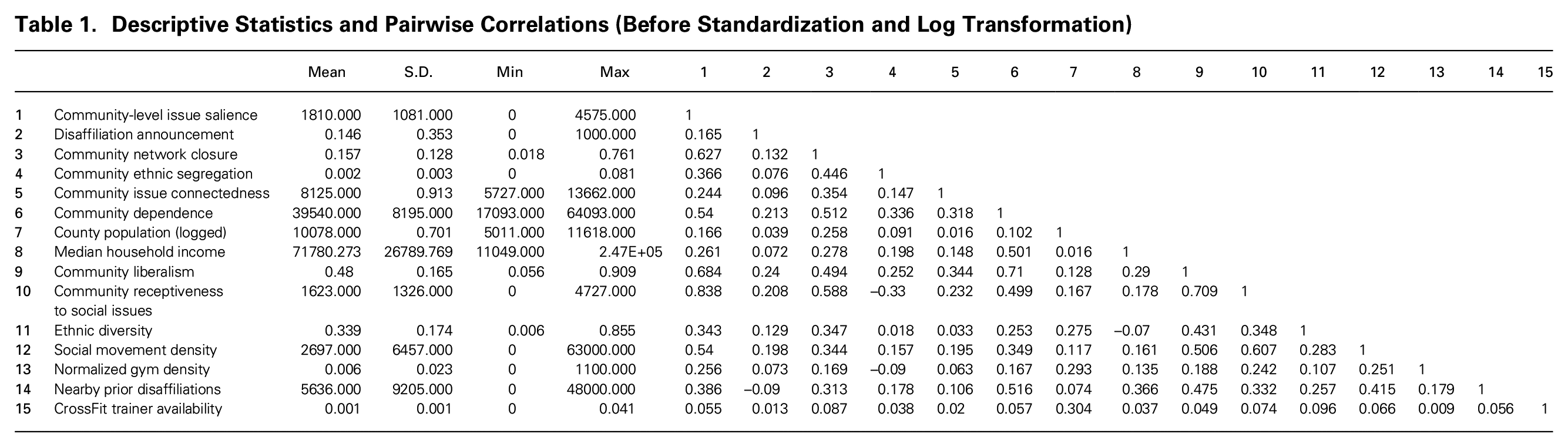
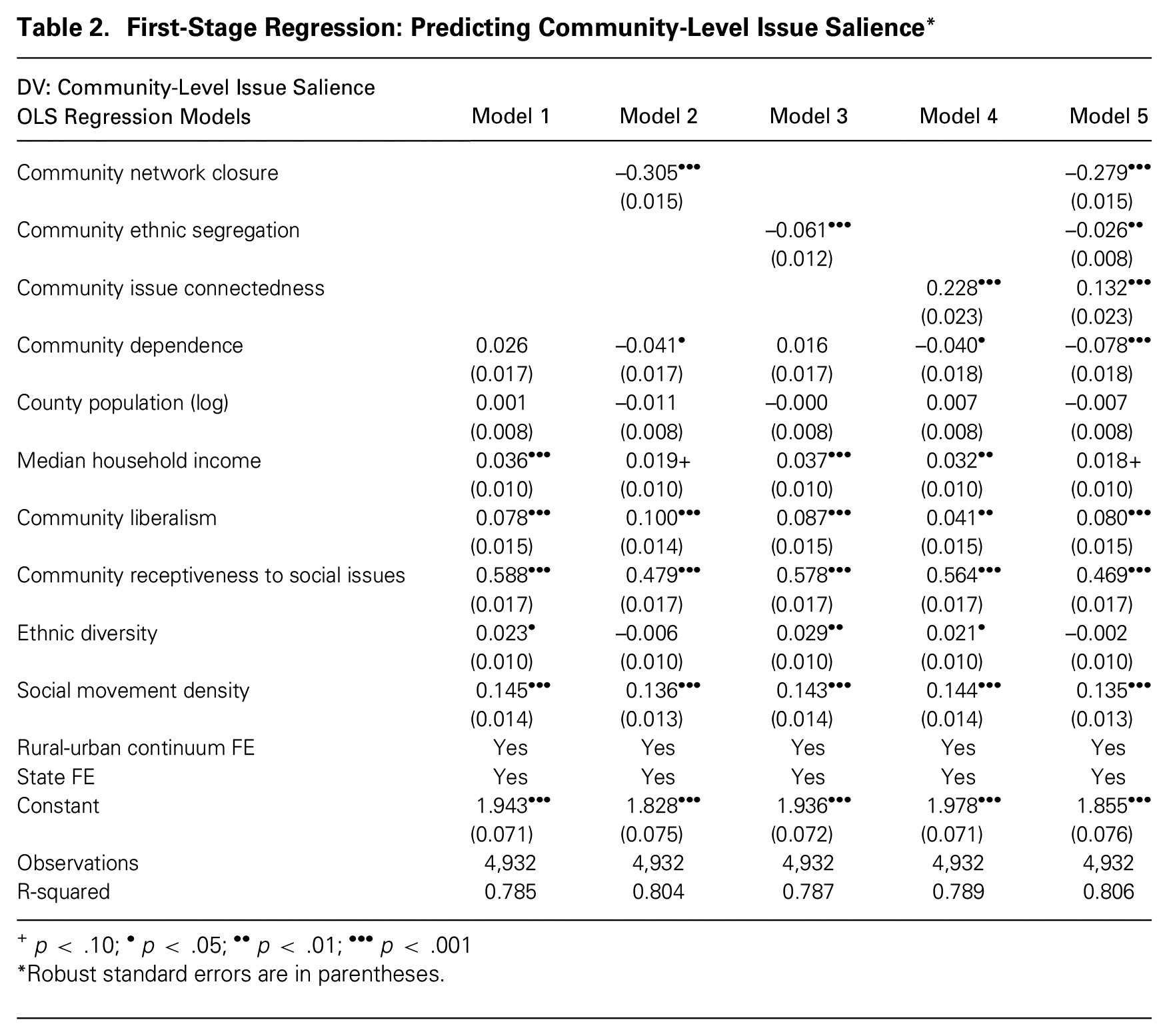
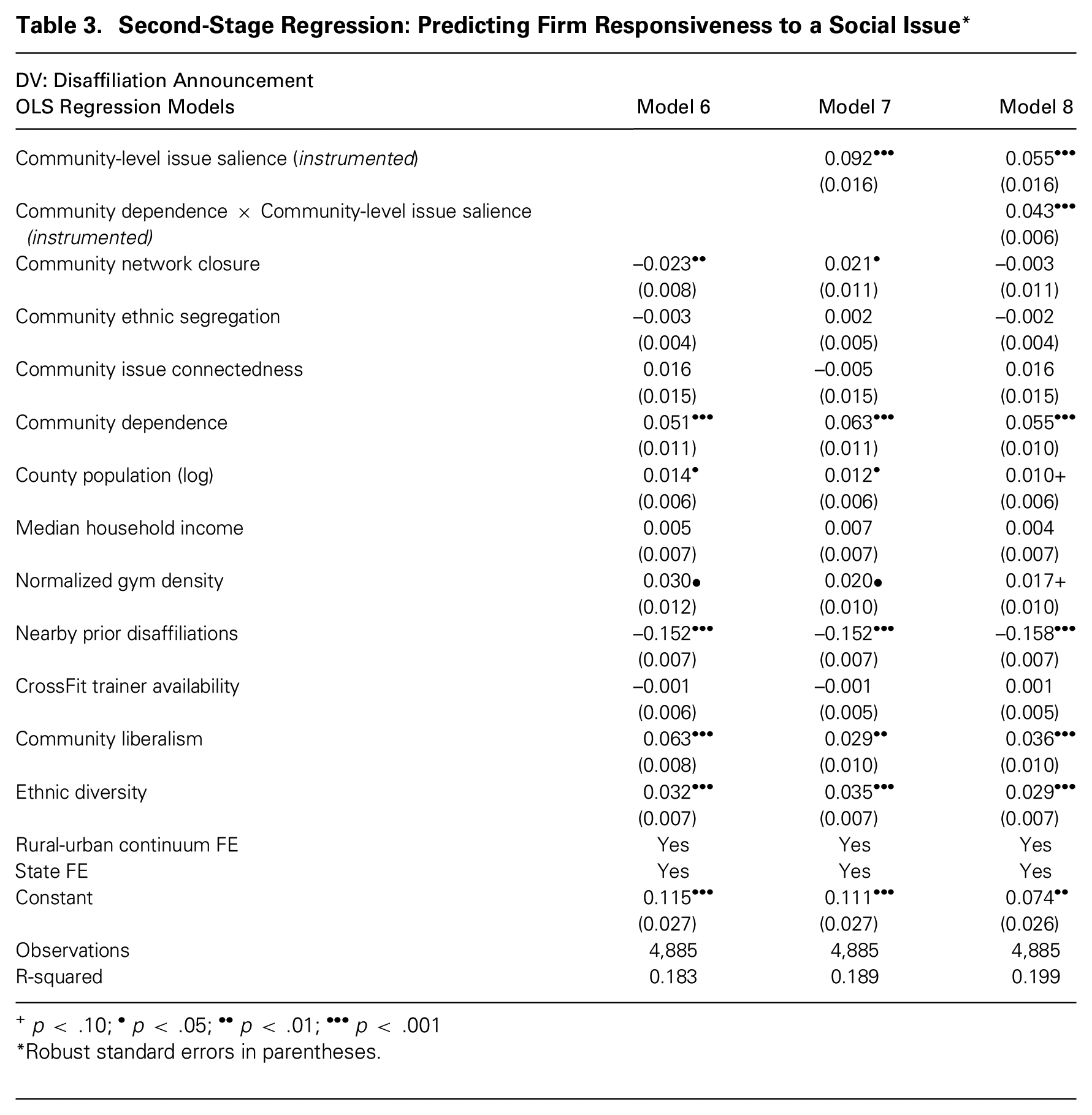
Table 1 reports descriptive statistics and correlations. Table 2 shows the results of the first-stage model with Community-level issue salience as the dependent variable (testing H1–H3). Table 3 presents the estimates from the second-stage model in which the dependent variable of interest is the likelihood of a disaffiliation announcement by a CrossFit gym (testing H4 and H5). 20
Descriptive Statistics and Pairwise Correlations (Before Standardization and Log Transformation)
First-Stage Regression: Predicting Community-Level Issue Salience*
p < .10; •p < .05; ••p < .01; •••p < .001
Robust standard errors are in parentheses.
Second-Stage Regression: Predicting Firm Responsiveness to a Social Issue*
p < .10; •p < .05; ••p < .01; •••p < .001
Robust standard errors in parentheses.
Model 1 in Table 2 includes control variables only. Here, we note that community-level issue salience is greater in communities that are relatively more liberal (b = 0.078; p < 0.001) and have higher median household income (b = 0.036; p < 0.001). It is also worth noting that Community receptiveness to social issues is strongly predictive of Community-level issue salience (b = 0.588; p < 0.001), corroborating the former’s strength as an instrument. Additionally, Social movement density positively affects community-level issue salience (b = 0.145; p < 0.001).
Model 2 adds our first key explanatory variable, Community network closure, whose effect on community-level issue salience is negative and precisely estimated (b = −0.305; p < 0.001), supporting Hypothesis 1. The interpretation is that a one-standard-deviation increase in the network closure of the focal community leads to a 30.5 percent drop in community-level issue salience. Model 3 adds Community ethnic segregation, which has a negative and precisely estimated effect on community-level issue salience (b = −0.061; p < 0.001), supporting Hypothesis 2. Here, the interpretation is that a one-standard-deviation increase in ethnic segregation in the focal community results in a 6.1 percent decrease in community-level issue salience. Model 4 adds Community issue connectedness, whose coefficient is, as predicted in Hypothesis 3, positive and precisely estimated (b = 0.228; p < 0.001). The interpretation is that a standard-deviation increase in issue connectedness is associated with a 23 percent increase in community-level issue salience.
Model 5 is the fully saturated model; here, the signs and magnitudes of the effects outlined above remain consistent and precisely estimated. Overall, these findings suggest that a community’s social structural features are broadly predictive of community-level issue salience, in line with our overall framework. Figure 4 depicts the main results presented in Table 2.
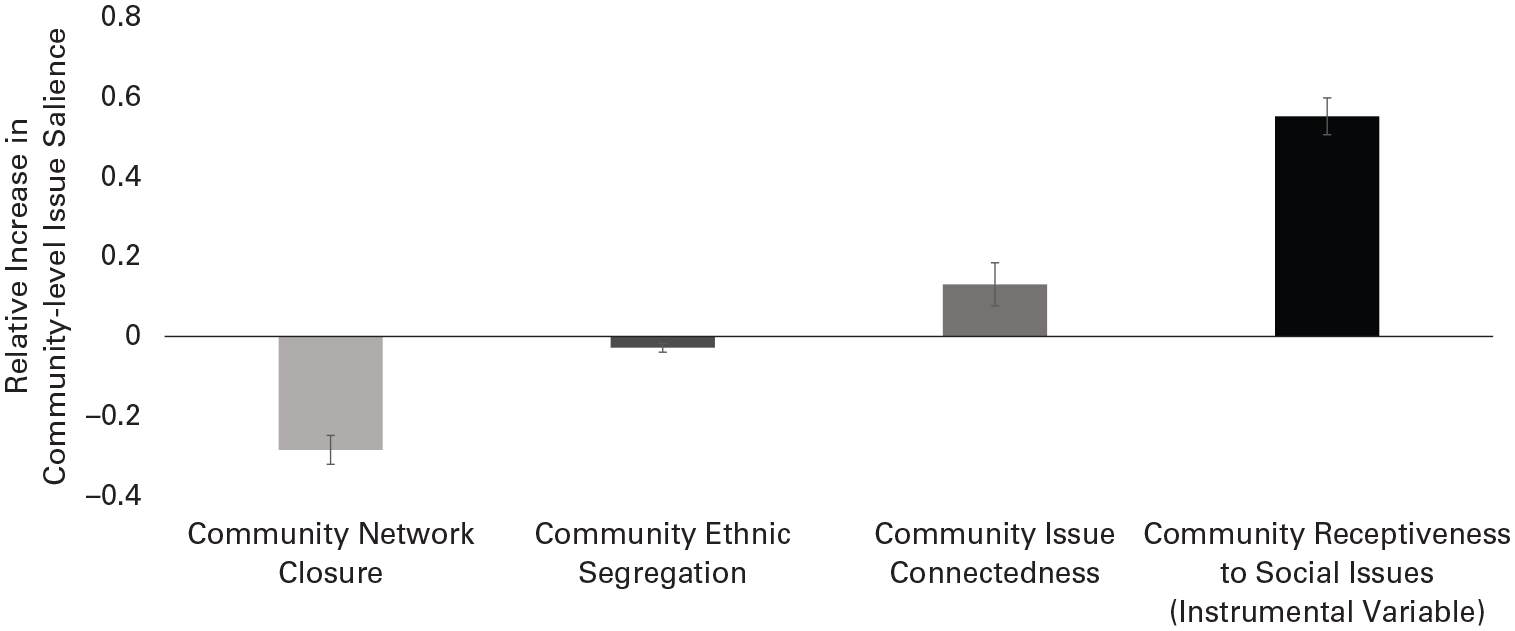
Predictors of Community-Level Issue Salience
This figure plots the coefficients reported in Table 2, Model 5, with twice the standard error bars. The vertical axis represents the relative increase in community-level issue salience in the focal community. A one-standard-deviation increase in the network closure of the focal community leads to a 28 percent drop in community-level issue salience, whereas a one-standard-deviation increase in ethnic segregation is associated with a 2.6 percent decrease in community-level issue salience, and a one-standard-deviation increase in issue connectedness leads to a 13 percent increase in community-level issue salience. Finally, a one-standard-deviation increase in the receptiveness to social issues in the focal community (instrumental variable) leads to a 47 percent increase in the community-level salience of the focal issue (i.e., racial relations in the U.S.). Overall, this pattern of findings suggests that the social structural features of communities are broadly predictive of community-level issue salience.
In Table 3, we included the predicted values of community-level issue salience from Table 2 (Model 5), omitting the instrument. Model 6, including only the control variables, shows that disaffiliation announcements were less likely in the presence of prior disaffiliation announcements by nearby gyms (b = −0.152; p < 0.001), indicating that competitive positioning concerns may drive, at least in part, firms’ responsiveness to the social issue of interest. This finding aligns with recent research on value signaling and CEO activism, which suggests that firms strategically position themselves on social issues to differentiate from competitors and to signal their values to key stakeholders (Melloni et al., 2023). Disaffiliation announcements were more likely in liberal communities (b = 0.063; p < 0.001) and more ethnically diverse communities (b = 0.032; p < 0.001), which indicates that the effects of these community characteristics did not solely unfold through community-level issue salience.
Model 7 adds the main independent variable of interest: Community-level issue salience. In line with Hypothesis 4, Community-level issue salience positively affects the likelihood of a disaffiliation announcement. This effect (b = 0.092; p < 0.05) has a meaningful economic magnitude: A one-standard-deviation increase in community-level issue salience translates to a 9.2 percent increase in the probability of a disaffiliation announcement.
In Model 8, we tested the moderating effect of firm community dependence by interacting it with the predicted values of community-level issue salience. The coefficient of this interaction term is positive and precisely estimated (b = 0.043; p < 0.001), supporting Hypothesis 5. The effect of community-level issue salience on the likelihood of a disaffiliation announcement was stronger when the firm was more dependent on the local community, i.e., when the COVID-induced demand disruption was greatest. Figure 5 presents further evidence in support of Hypothesis 5 based on the results reported in Table 3 (Model 8). The interpretation is that community-level issue salience and firm community dependence are complements for the likelihood of a disaffiliation announcement.
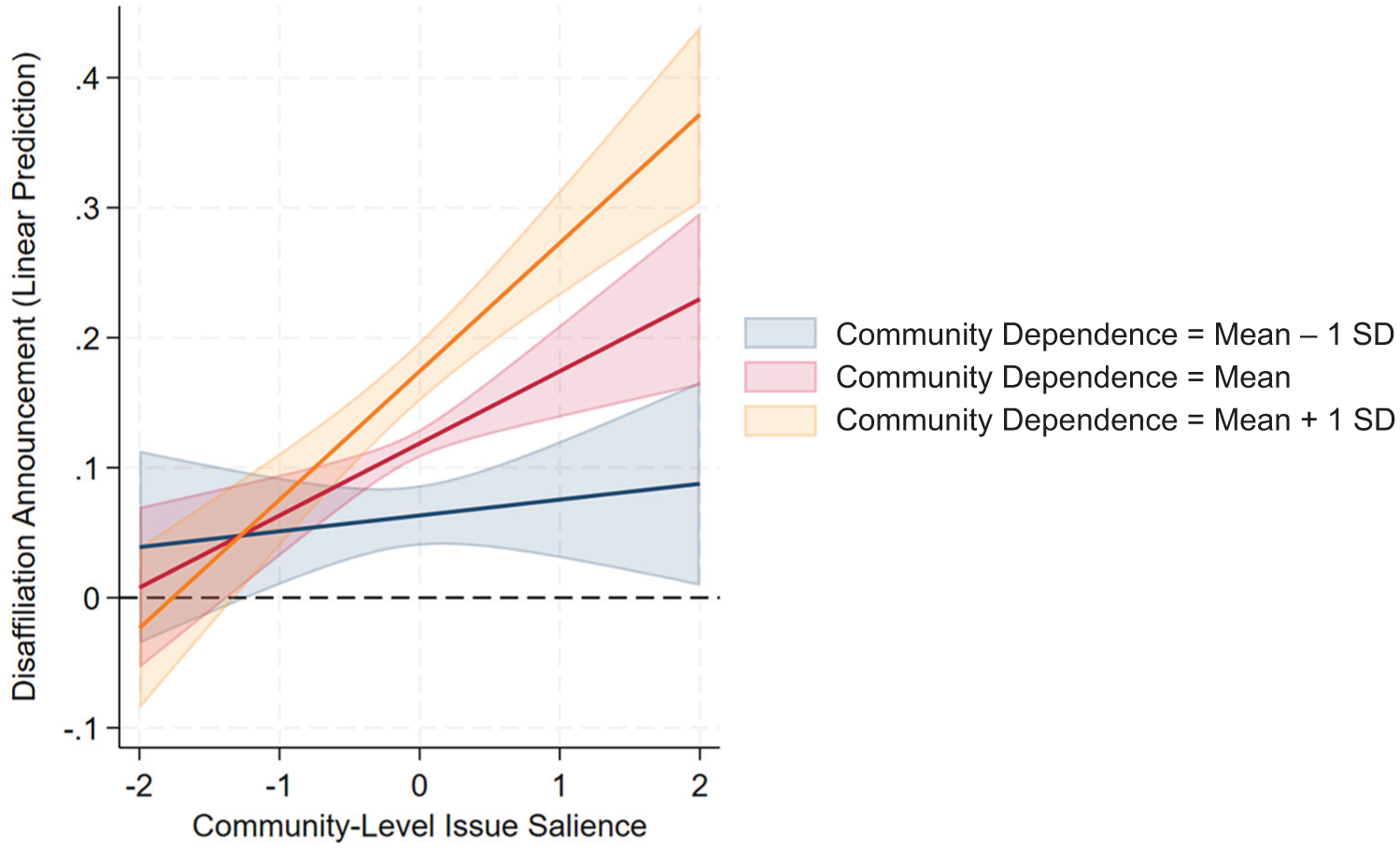
Firm Responsiveness to a Social Issue: The Moderating Effect of Firm Community Dependence
Robustness Checks and Extensions
We note strong support for all our hypotheses. To further validate our findings, we conducted several robustness checks and extensions, which are detailed in the Online Appendix. For example, we tested alternative measures of firm responsiveness to the focal issue, including an earlier cutoff date to exclude disaffiliation announcements after Glassman’s resignation (Table A1, Model A1); an expanded list incorporating all U.S. firms in the Morning Chalk Up database (Table A1, Model A2); and alternative measures of gym density, nearby prior disaffiliations at different radii (10 miles and 50 miles), and CrossFit affiliation duration (Table A1, Models A3–A8). To ensure that our results were not driven by potentially influential observations, we conducted analyses excluding gyms in Minneapolis and near the CrossFit headquarters (Table A1, Model A7; Table A2) and examined subsamples based on various other criteria. We also accounted for gym ownership groups and chains (Table A3) and re-estimated our second-stage regression models using a probit specification (Table A4). Additional analyses addressed potential multicollinearity through orthogonalization of correlated predictors (Table A5). To further validate our measures, we tested alternative operationalizations, including using the percentage of Black residents at the county level rather than ethnic diversity (Table A6); measuring issue salience through media coverage data (Table A7); analyzing pre- and post-Floyd media coverage separately (Tables A8–A9); and alternative protest-based measures of issue salience (Table A10). Across these various tests, our findings remained robust, providing confidence in the validity of our conclusions.
Discussion
Our study highlights how community social structure can shape firm responses to social issues. Examining CrossFit gyms’ reactions to their CEO’s controversial statements following George Floyd’s death, we found that three structural features—network closure, segregation patterns, and issue connectedness—systematically influenced how external issues penetrated and resonated within the local communities where the firms are embedded. These characteristics created varying conditions for issue salience through their effects on external influence pathways, internal information flows, and direct connections to affected populations. The empirical evidence shows distinct patterns: Communities with stronger inward-focused social ties demonstrated lower issue salience and reduced responsiveness to external social issues, while ethnic segregation dampened awareness and responsiveness by impeding intra-community information flow. In contrast, communities more directly connected to affected populations showed heightened issue salience and organizational responsiveness. Furthermore, firms were more responsive to locally salient issues when they more heavily depended on the community. By revealing how different structural features shaped both issue salience and firms’ responses, our findings demonstrate how the social fabric of communities creates predictable variation in how broader societal issues achieve local salience. 21
Theoretical Implications and Contributions
In several important ways, our study advances understanding of how community-level attributes shape firms’ actions. At the most fundamental level, we reveal how systematic differences in community social structure create predictable patterns in which social issues become salient and how firms respond. This insight complements existing perspectives that have focused primarily on firm-level attributes (Bundy et al., 2013; Durand et al., 2019), issue characteristics (Mohliver et al., 2023), or stakeholder features (Eesley & Lenox, 2006). By reconceptualizing issue salience as something not solely internal to the firm or that applies equally to all firms confronted with the same issue or the same type of stakeholders but in terms of what is salient to the community where a firm operates, we demonstrate how network closure, segregation, and issue connectedness affect how external issues penetrate and resonate locally (Almandoz et al., 2018; Tilcsik & Marquis, 2013).
This perspective enriches research on community embeddedness (Freeman & Audia, 2006; Marquis & Battilana, 2009) and advances the renewed interest in geography and place in organizational studies (Benischke et al., 2022; Lawrence & Dover, 2015; Muñoz et al., 2022). Our findings on disaffiliation patterns also connect to emerging research on anticipatory deviance (Mohliver & Oliver, 2024), showing how firms may preemptively break ties with controversial actors based on local community expectations rather than waiting for direct pressure. We build on studies examining community influences on strategy (Lounsbury, 2007), corporate social action (Marquis et al., 2007), and responses to disruptions (Williams & Shepherd, 2021), while pushing stakeholder theory in new directions. Specifically, we move beyond stakeholder attributes and dyadic relationships (Mitchell et al., 1997; Wood et al., 2021) to show how social structure shapes both issue salience and influence patterns, answering calls to better incorporate stakeholder interconnections into research on this topic (Rowley, 1997, 2017). Our community permeability framework can help firms to navigate stakeholder pressures to address social issues across distinct contexts.
Our study also contributes to social movement theory by showing how community structure shapes mobilization patterns. While prior research emphasizes organizational infrastructure for collective action (Sampson et al., 2005), we reveal how network structure determines which issues achieve the salience necessary for mobilization. Our findings help explain why communities with similar movement resources mobilize around different issues with varying intensity, extending the political mediation model (King, 2008) by identifying the structural conditions under which movement pressure translates into organizational action.
Limitations and Directions for Future Research
While our focus on locally owned CrossFit gyms provides strong comparability, it naturally raises broader questions about how community permeability shapes issue salience and firm responses in other contexts. Corporations with global footprints, for instance, are often embedded in multiple local and supranational communities, potentially creating complex patterns of stakeholder pressure and issue salience. Indeed, our theoretical framework and findings likely speak most directly to organizations whose activities unfold within well-defined geographic boundaries (Freeman & Audia, 2006; Marquis & Battilana, 2009). Future research could explore how different types of community structural characteristics matter across various types of issues. For example, while network closure might function as a general filter for most external issues, the effects of different types of segregation likely vary depending on the nature of the issue at hand. Similarly, the relevance of issue connectedness would naturally vary based on which communities are most directly affected by a given issue. Examining these contingencies would help to develop a more accurate understanding of when and how community structure shapes issue salience.
The boundary conditions of our theory also merit consideration. We examined a case in which social issues originated outside the focal community and suddenly gained national prominence. Yet, community structural characteristics might operate differently when issues originate locally. For example, network closure might amplify rather than dampen issue salience by focusing local attention more intensely. Similarly, segregation might be a driving force for issue salience when such issues originate locally and affect one subgroup more than others. Indeed, our observation of higher disaffiliation rates in Hennepin County, Minnesota, where George Floyd was killed, suggests that different dynamics may apply when communities process issues originating locally. 22
Beyond these scope conditions, our focus on disaffiliation announcements captures one type of firm response. Notably, the framework proposed by Mohliver and colleagues (2023, p. 1201) emphasizes a spectrum of firm responses, including “counterpositioning.” While our empirical setting was characterized by widespread consensus during the observation period immediately following George Floyd’s death, with no instances of gyms supporting the CEO’s controversial comments, other contexts might reveal more heterogeneous responses. The relationship between community structural characteristics and firms’ responses remains particularly intriguing, especially for issues that might resonate differently across the political spectrum (e.g., gun rights or immigration policy). In communities with lower permeability, firms might face less pressure for any response, while more-permeable communities might force choices between supporting or opposing predominant views.
Future research could explore whether the interplay between community social structure and stakeholder alignment shapes not just whether firms respond but also how they position themselves relative to both the focal issue and local perspectives. Future research could further explore the conditions under which connectivity dampens or amplifies ideological divides. While our study emphasizes the structural aspects of community networks, the interaction between these structures and the substantive content flowing through them remains an important area for future investigation. Experimental or mixed-methods studies that directly manipulate network structures and message content could help determine when physical connections serve primarily as neutral conduits for information penetration versus interpretive prisms that shape how issues resonate locally. Such studies would advance our understanding of the relative importance of pipes versus prisms (Podolny, 2001) in determining issue salience across different community contexts.
Our protest-based measure of community-level issue salience, while capturing organic mobilization, also raises questions about how community structural characteristics interact with local media coverage and social movement organizations to shape issue salience (Sampson et al., 2005). Building on agenda-setting theory, researchers could examine how communities with high network closure might be less influenced by external media coverage, while those with strong issue connectedness might amplify media attention to certain issues (Dorobantu et al., 2023; McCombs & Shaw, 1972). Additionally, our focus on ethnic segregation invites further exploration of how different types of segregation—economic, political, or cultural—might matter for different types of issues. For instance, economic segregation might be more relevant for issues related to income inequality or access to financial services, while political segregation could be more salient for issues like climate change or gun control. Cultural segregation, reflected in lifestyle differences or consumption patterns, might matter more for issues regarding consumer rights or environmental sustainability. Understanding how different types of community divisions affect issue salience and firm responses represents a promising avenue for future research.
Similarly, our reliance on Facebook data to measure community social connectedness, while offering comprehensive coverage and granular geographical information, raises important methodological considerations. Though these data capture over 58 percent of U.S. adults and 71 percent of online users (Bailey et al., 2018), with connections requiring mutual consent and primarily reflecting real-world friendships, demographic skews in platform usage—particularly across age, income, and racial groups—create representativeness concerns. Additionally, online interactions may not fully capture the extent of offline social relationships. Future research could triangulate multiple data sources to develop more-nuanced measures of community permeability that incorporate both online and offline social connections, perhaps combining social media data with traditional survey methods and large-scale machine vision studies of physical interaction patterns. This multi-method approach could help to address the demographic representation issues and better capture the full spectrum of social ties that shape community permeability.
Finally, lack of access to detailed information about individual gym owners and their employees prevented us from addressing whether community-level factors outweigh firm-level factors in driving responsiveness to social issues. Moreover, we can observe only announcements of intention to disaffiliate rather than actual disaffiliations, due to a lack of observability on follow-through. As one gym owner noted, “We disaffiliated because of the statements and actions of the former CEO—Greg Glassman—around the George Floyd murder. . . . Ultimately, we reaffiliated once the new CEO was named.” This feature represents an inherent tradeoff in our empirical setup: While we can observe a large population of comparable firms responding to a well-defined social issue, relying on announced rather than actual disaffiliations is a clear limitation.
Conclusion
Our analysis of U.S. CrossFit gyms’ responses to heightened racial issues demonstrates that three community structural characteristics—network closure, ethnic segregation, and issue connectedness—created predictable patterns in both issue salience and firm responses. Communities with stronger inward-focused social ties exhibited lower issue salience, while ethnic segregation dampened awareness and responsiveness by impeding information flow and collective sense-making. Conversely, communities with stronger connections to affected populations showed increased issue salience and firm responsiveness. These patterns are especially pronounced when firms depended more heavily on their communities—a condition we observed among gyms more severely impacted by COVID-19-related mobility restrictions. The study’s theory and findings open promising avenues for future research on how the structure of the community in which a firm is embedded affects its engagement with broader societal concerns.
Supplemental Material
sj-pdf-1-asq-10.1177_00018392251360671 – Supplemental material for CrossFit in the Crosshairs: A Community-Embedded Theory of Firm Responsiveness to Social Issues
Supplemental material, sj-pdf-1-asq-10.1177_00018392251360671 for CrossFit in the Crosshairs: A Community-Embedded Theory of Firm Responsiveness to Social Issues by Enrico Forti, Alessandro Piazza and Joost Rietveld in Administrative Science Quarterly
Footnotes
Acknowledgements
We are grateful to Associate Editor Greta Hsu and three anonymous reviewers for providing crucial and constructive guidance during the review process. We must also gratefully acknowledge helpful feedback from informal reading groups at the UCL School of Management and Rice University during the drafting of the manuscript, as well as comments from the audience at the 2022 SMS Annual Conference in London. Nicholas Bakewell, Johanna Burr, and Paige Kemp provided capable research assistance.
Data Availability Statement
1
Social movements scholars have shown how external pressure from activists influences organizational action through impacts on firm legitimacy and reputation (de Bakker & den Hond, 2007; King & Soule, 2007), and scholars have reported differences in firm responses, as some accommodate activists’ demands, while others resist (McDonnell et al., 2015; McDonnell & King, 2013). This variation reflects not only differences in stakeholder pressure but also firms’ varying resource dependencies and their relationships with different stakeholder groups.
2
The organizational literature has broadly defined a community as “a group of people bound together by meaningful relationships from which members can extract cultural and material resources” (Almandoz et al., 2018, p. 192). While communities need not be bounded by geography and can be grounded by affiliations that transcend geography (Brint, 2001), in this study we focus on the geographical community, which Marquis and Battilana (2009, p. 286) defined as the “local level of analysis corresponding to the populations, organizations, and markets located in a geographic territory and sharing, as a result of their common location, elements of local culture, norms, identity, and laws.”
3
As noted by Coleman (1988, p. S104), “a person who is not greatly interested in current events but who is interested in being informed about important developments can save the time of reading a newspaper by depending on spouse or friends who pay attention to such matters.” This observation suggests that strong within-community ties can result in community members often substituting external sources of information for interactions with trusted close ties, with implications for access to information and, by extension, exposure to broader social issues. Communities that have fewer boundary-spanning ties but dense within-group ties are associated with other benefits—notably, the development of trust—but are less permeable to knowledge originating from outside of their network cluster.
4
We focus on ethnic segregation due to its direct relevance to the issue at hand (i.e., race relations and, specifically, the death of George Floyd at the hands of police). In the Discussion section, we discuss how other forms of segregation, such as economic, political, or religious, may similarly influence community reactions to different social issues.
5
While racial segregation might heighten the salience of race-related issues within specific segregated segments of a community—particularly when those segments feel threatened or targeted—this heightened within-segment salience may paradoxically reduce community-wide issue salience by reinforcing existing social barriers and limiting cross-segment dialogue. In other words, even as certain segments of a segregated community may become more attuned to racial issues, the structural barriers to information flow and collective sense-making remain.
6
In an online survey with 73 disaffiliated gym owners that we conducted for context, four main benefits of being a CrossFit-affiliated gym were noted: increased demand from being associated with a major brand (including online visibility; 37 percent of respondents); community building and engagement through such events as The CrossFit Open and The CrossFit Games (both international fitness competitions; 28 percent); legal protection, including insurance and intellectual property protection (18 percent); and access to valuable information, including programming and staff development (12 percent).
8
We have taken a conservative approach in determining which CrossFit gyms announced their intention to disaffiliate, because the list reported by Morning Chalk Up originated from user-contributed data. For example, some U.S. CrossFit gyms condemned Glassman’s comments but did not go as far as to announce their disaffiliation. These gyms were excluded from our main analyses but included in robustness checks (see  ).
).
9
We measured disaffiliation announcements, rather than actual disaffiliations, because most gyms were likely unable to immediately act on their intentions of cutting ties with CrossFit due to the terms of their affiliate contracts. Some gyms stated they would disaffiliate at the end of their contract terms, which were unobservable to us. Nevertheless, anecdotal evidence and media reports suggest that these announcements affected subsequent decisions made by Greg Glassman (who first stepped down as CEO of CrossFit LLC and later decided to sell the company entirely).
11
In analyses reported in the Online Appendix, Table A2, we excluded gyms located in Hennepin County, Minnesota.
12
In our survey of CrossFit gym owners, several respondents indicated that pandemic-related restrictions had negatively affected their ability to do business with existing customers (87 percent) and to attract new customers (89 percent).
13
Importantly, in all counties the mobility drops resulted from exogenous changes in consumer behavior that can be attributed to the pandemic, not the statements about George Floyd’s death made by CrossFit’s CEO (which occurred later). The demand drops experienced by gyms are therefore exclusively connected to the mobility restrictions induced by COVID-19 and are unrelated to the protests sparked by the death of George Floyd that provide the backdrop to our case. Furthermore, gyms’ social media posts and our survey responses strongly suggest that gyms disaffiliated from CrossFit in response to the events surrounding the CrossFit company and its CEO rather than disaffiliation being driven by financial motivations (i.e., saving on affiliation fees in the wake of suppressed demand).
14
We used data from the 2016 rather than the 2020 U.S. presidential election to avoid the possibility of backward causation, since the latter election occurred several months after the CrossFit scandal unfolded. Unreported analyses that we carried out with the 2020 election results as an alternative measure show similar results.
15
Results are robust to using alternative measures based on 10- and 50-mile radii, as reported in our Online Appendix, Table A1.
16
We also tried to compute different variables accounting for subsets of trainers with specific credentials, but none of these alternative measures significantly affected the disaffiliation decision.
17
Examples include shared norms about corporate social responsibility, the presence of social movement organizations not fully captured in our data, and varying levels of media attention to racial issues.
18
Following Fremeth et al. (2022, p. 1175), we measured a community’s receptiveness to social issues as the number of protests unrelated to BLM within a county. Similar to the measure for community-level issue salience, here we use the ACLED data to isolate protest events that a) took place in the calendar year 2020 but before June 7 and b) did not involve BLM or pro-police groups. We used these data to create a county-level tally of protest events, of which we took the natural logarithm after adding 1. We empirically confirmed the validity of our instrumental variable: The number of protests unrelated to BLM explains 23.5 percent of the variation in the number of BLM protests with an F-statistic of 147, which is well above the threshold values recommended by .
19
In the Online Appendix we also implemented a probit model for the second stage, yielding consistent results ().
20
Note that the models reported in Table 3 exhibit a slightly smaller number of observations than those reported in (4,885 vs. 4,932). This is due to missing data in covariates that are included only in the second-stage models: Normalized gym density and CrossFit trainer availability. These were omitted from the first-stage models as they could not reasonably be assumed to be predictive of community-level issue salience. Estimating the first-stage models on this slightly reduced sample does not change the main results reported for H1–H3.
21
Our findings complement research on ethical decision-making under competitive pressure (Bennett et al., 2013), suggesting that community dependence can counterbalance competitive forces that might otherwise lead firms to prioritize economic considerations over social concerns. Our findings also complement recent research on organizational responses to scandal that emphasizes institutional affiliations (Stroube & Zavyalova, 2025).
22
Notably, the CrossFit-disaffiliation rate in Hennepin County was 33.3 percent, compared to 14.62 for the entire estimation sample and 12.5 percent in the nearby county of Ramsey, Minnesota.
Authors’ Biographies
References
Supplementary Material
Please find the following supplemental material available below.
For Open Access articles published under a Creative Commons License, all supplemental material carries the same license as the article it is associated with.
For non-Open Access articles published, all supplemental material carries a non-exclusive license, and permission requests for re-use of supplemental material or any part of supplemental material shall be sent directly to the copyright owner as specified in the copyright notice associated with the article.
