



Abstract
Even when anticipated strategic decisions or actions do not materialize, they can still set in motion emergent dynamics with collateral consequences that lead to profound strategic consequences. Adopting a microhistorical lens, we elucidate the dynamics of these processes by focusing on two largely dismissed near-history episodes in the relatively recent history of the Nokia Corporation. We develop a process model that elaborates on how anticipatory reactions, mobilization of networks, revision of expectations, and the emergence of a new strategic direction can eventually have significant strategic consequences. By focusing on this poorly understood but important form of strategy emergence, we contribute to a fuller understanding of strategy emergence and the role of strategic agency therein. Furthermore, we extend the conversation on near-histories from focusing on what could have happened to examining their concrete consequences. Our findings show that near-history episodes are not merely precursors or impediments to actualized events but productive forces shaping organizational trajectories in ways that realized events alone cannot explain. In so doing, our microhistorical analysis has major methodological implications for historically oriented strategy research and for our understanding of causal complexity in strategy emergence.
Research on strategy emergence has focused on how new strategies come about in long-term change processes and on trajectories of strategic change (Andriani & Cattani, 2024; Burgelman, 1994; Mirabeau & Maguire, 2014). This body of work has highlighted the importance of top-down and especially bottom-up processes whereby new ideas and initiatives eventually form the basis for new change trajectories (Burgelman, 1994; Mintzberg & Waters, 1985; Rindova & Martins, 2021). Although scholars have recognized the importance of unrealized and ephemeral strategies (Mirabeau & Maguire, 2014; Mirabeau et al., 2018), they have stopped short of developing a fuller account of how planned decisions or actions that ultimately do not occur may serve as turning points for strategy emergence. This is a major theoretical deficiency, as anticipation of major plans or decisions, even if they never materialize, may set in motion emergent dynamics with what March, Sproull, and Tamuz (1991, p. 1) called “collateral consequences” for the emergence of new strategies.
Making sense of the outcomes and consequences of unrealized plans or decisions is theoretically and empirically challenging. To address this challenge, scholars have used simulations to re-create realized and alternative histories of market emergence and industry evolution (Engler et al., 2020; Malerba et al., 1999, 2016), have focused on forward-looking counterfactual reasoning as a part of competitive sensemaking (Cattani et al., 2018; MacKay, 2007), and have studied cases in which actions not taken have important organizational consequences (Denis et al., 2011; Mantere et al., 2012). To dig deeper into the dynamics of emergence, we focus on near-histories, which are critical events that almost happen but do not (March et al., 1991). We adopt a process perspective, which helps us to move beyond the expected event itself to focus, instead, on the processes triggered by the anticipation and expectations. Thus, we concentrate on how anticipated plans or decisions that are not ultimately realized may serve as triggers of strategy emergence. We ask the following question: How can anticipated plans or decisions that are ultimately not realized trigger chains of action resulting in the emergence of new strategies?
We adopt a microhistorical approach (Hargadon & Wadhwani, 2023; Magnússon & Szijártó, 2013), which allows us to zoom in on the anticipation and expectations of key actors in such turning points. This approach helps us to focus on how actors experience the change processes and to link their actions to their emotions and relationships in situ. In our microhistorical study, we focus on the Nokia Corporation before it became a leading global information and communications technology (ICT) player in the 1990s. We compare two significant episodes in Nokia Corporation’s evolution in the 1970s and 1980s. First, we analyze top management’s responses to the Finnish government’s plans to establish a state-owned electronics conglomerate in the mid-1970s. Nokia’s managers succeeded in resisting this plan and turning it to their advantage. The episode had a decisive impact on Nokia’s new focus on the electronics industry, which had previously been peripheral to the company’s strategy. Second, we study the attempt by Nokia’s top management to establish a strategic joint venture in automotive electronics with the Swedish automobile producer Volvo in the late 1980s. Although this venture also failed to materialize, it paved the way for new, large-scale research and development projects, which led to major technological breakthroughs that eventually became key parts of Nokia’s strategic transformation.
This article’s main contribution is that it elucidates how and why near-history episodes generate process dynamics with collateral consequences that serve as a basis for strategy emergence. Such processes are distinctively different from the emergent processes captured in prior research: Near-history episodes may involve special forms of affective and political messiness that culminate in unpredictable reversals of strategic direction. Thus, our analysis helps to develop a fuller understanding of strategy emergence (Mintzberg & Waters, 1985; Mirabeau & Maguire, 2014; Rindova & Martins, 2021) and the strategic agency (Burgelman, 1983; Levinthal, 2011) therein. In addition, our analysis extends research on near-histories (Cattani et al., 2018; March et al., 1991) by moving the conversation from what could have happened to the tangible outcomes and consequences of near-history-induced strategy emergence. Rather than mere counterfactuals, near-history episodes may unleash productive forces that shape strategic priorities and may lead to fundamental organizational and strategic transformation. Finally, our analysis has methodological implications for historically oriented strategy research and for how microhistory can be used in processual analysis more generally (Argyres et al., 2020; Hargadon & Wadhwani, 2023; Vaara & Lamberg, 2016). In particular, it underscores the importance of micro-level analysis of causal complexity (Furnari et al., 2021; Misangyi et al., 2016) and highlights the inherent causal sensitivity characterizing emergence in historical micro-processes.
Theoretical Framework
Strategy Emergence
In general, emergence refers to “complex dynamical systems that display behavior that cannot be predicted from a full and complete description of the component units of the system” (Sawyer, 2001, p. 555). In strategy research, emergence has played a specific role in providing an alternative to the conventional views of strategy as formal planning or goal-oriented action (Burgelman, 1994; Mintzberg & Waters, 1985). The seminal works of Pettigrew (1985), Mintzberg (Mintzberg & Waters, 1985), and Burgelman (1983, 2002) have highlighted the complexity and unpredictability of strategy processes and have illustrated how new strategies come about.
A stream of research has focused on explaining how top managers influence strategy emergence (Burgelman, 1994; Burgelman & Grove, 2007; Csaszar & Levinthal, 2016). For instance, Burgelman’s work emphasized the significance of top managers in recognizing transitions (1994) and leading inductive strategy work (2002) to winnow out alternatives before a new strategy emerges. Yet, most of the literature associates emergence primarily with autonomous processes occurring below top management: how middle managers make sense of strategy work and generate strategic change (Taracki et al., 2023; Wolf & Floyd, 2017). Middle managers have been seen as the key agents whose actions determine whether new strategies emerge and are eventually implemented (Balogun & Johnson, 2004, 2005). These actions include sensemaking and sensegiving, whereby the ways in which issues are framed have a fundamental impact on strategy processes (Rouleau, 2005). Attention dynamics in the interactions between top and middle managers have also been singled out as key factors in strategy work (Splitter et al., 2023). The strategy-as-practice-oriented studies have, in turn, underscored the enabling and constraining effects on specific organizational and strategic practices (Jarzabkowski, 2008; Vaara & Whittington, 2012).
Most of the aforementioned studies have not, however, explicitly focused on the microdynamics of emergence. An important exception is the conceptual model by Mirabeau and Maguire (2014), which introduced a four-part typology to explain strategic change: deliberate (induced and realized), unrealized (induced and terminated), emergent (autonomous and realized), and ephemeral (autonomous and terminated) strategies. Expanding on this framework, Mirabeau, Maguire, and Hardy (2018) offered a methodology for trackingdifferent manifestations of strategy: intended, realized, deliberate, emergent, unrealized, and ephemeral. Their focus on unrealized and ephemeral strategies highlights how strategy-making can fail or remain transient. However, even they do not explore how such failed strategies might serve as triggers fornew processes of strategy emergence.
This work on strategy emergence can be juxtaposed with research on strategy evolution that has dealt with similar phenomena without using the concept of emergence per se (Eisenhardt & Bhatia, 2017; Thietart, 2016; Vergne & Durand, 2010). For instance, De Rond and Thietart (2007) offered a theoretical view that explains the interrelationships between choice and chance in processes of strategic change, Cattani (2006) focused on pre-adaptation to clarify the role of historical accidents and foresight in technology emergence, and MacKay and Chia (2013) elaborated on the role of chance, environmental uncertainty, and the unintended consequences of decisions. Serendipity (Winter, 2012) and luck (Liu & de Rond, 2016) also offer means for understanding what may lie behind the emergence of new strategies. A recurring thread running through many if not most of these studies is the striking sensitivity of strategic search processes, as elucidated for example by Levinthal (2021) and Engler et al. (2020), who explained how building up an array of alternative strategies is indispensable even if only a few strategic initiatives are eventually realized.
Despite these advances, our understanding of the microdynamics of strategy emergence has remained limited. First, a strong focus on middle managers and their autonomous strategy work has arguably restricted the analysis of emergence to the extent that events or actions triggered elsewhere have been largely neglected. Second, a lack of explicit theorizing of emergence in this body of research has constrained the potential of historically sensitive analysis. While analyses of luck and serendipity offer insights into the unpredictability of these processes, they have tended to discard the role of managerial agency in emergence. Third, and most important for our purposes, we lack theoretical understanding of the implications of unrealized strategic efforts—whether they are called unrealized or ephemeral (Mirabeau & Maguire, 2014)—even if they trigger actions and processes that have fundamental implications for strategic change. Yet, unless we follow these processes further, we consider merely a small fraction of what happens within and around corporations, which significantly limits our understanding of strategy emergence.
Near-Histories and Strategy Emergence
We focus on near-histories as processes that do not result in expected strategic outcomes but can nevertheless trigger chains of action that lead to new strategy emergence. We follow March et al. (1991), who introduced three forms of deviant histories. The first form, hypothetical history, refers to events that could have occurred under specific unrealized but plausible conditions. The second type, alternative histories, involves backward-looking counterfactual reasoning, which also operates via unrealized yet plausible conditions. Lastly, near-histories, the focus of our article, involve processes that do not unfold as expected but are still grounded in the real social world. Earlier, March (1981) emphasized that organizational scholars tend to overlook such phenomena, leading us to significantly simplify historical accounts of success and failure (Denrell, 2003). Overall, while March et al. (1991) underscored the role of near-histories for organizational learning, we use the concept to understand not only their hypothetical but also their concrete implications in triggering processes of new strategy emergence.
Prior research comprises three important streams that help us understand the role of near-histories in strategy emergence: history-friendly simulations based on alternative histories, research on the role of counterfactual reasoning in strategic sensemaking, and studies of specific decisions or events that did not happen but still led to various kinds of strategic outcomes and consequences. First, a stream of research on history-friendly simulations has focused on comparing realized and alternative histories. Malerba and colleagues (1999, 2016), for example, used non-realized histories to examine the development of the American computer industry, from transistor-based mainframes to microprocessors and PCs. This research elucidates the role of alternative industry trajectories, highlighting the nature of emergent evolutionary processes determined by the presence or absence of certain choices and processes in the early periods of market and technology evolution.
In a more recent study, Engler, Cattani, and Porac (2020) focused on how companies respond to changes in their competitive environment. They simulated new market emergence, focusing on the incubation period in the context of the development of the minivan, and they compared and contrasted unrealized and realized strategies by GM, Chrysler, and Ford. They identified multiple counterfactual histories from the same dataset and elaborated on the likelihood of various alternative scenarios. Hence, their analysis offers both a method and an illuminating example that help us place the realized history in the context of alternative histories that could have happened but did not.
Second, there is a body of research focused on counterfactual reasoning as an element of how managers make sense of their strategic realities. In this view, imagining alternative futures (Csaszar & Levinthal, 2016) and creating mental projections from unanticipated events (Byrne, 2017; Caglio, 2004; Girotto et al., 2007) are psychological processes related to individual decision makers’ or teams’ aims to reach decisions that culminate in realized, unrealized, ephemeral, or emergent strategies. The focus on psychological processes that result from unusual events or that precede difficult strategic choices (Andrevski & Miller, 2022) can help us understand why individuals and organizational coalitions make varying choices about support for or resistance to anticipated events. The overarching idea in these approaches is that by creating multiple mental projections, managers can evaluate the value-enhancing potential of their decisions (Cattani et al. 2018; Csaszar & Levinthal, 2016).
Third, in a more fragmented stream of research, strategy scholars have studied processes that, although canceled or delayed, produce identifiable short-term organizational outcomes. For instance, Denis et al. (2011, p. 229) showed how “networks of indecision” may characterize inability to move on with strategic change. In turn, Mantere et al. (2012) demonstrated how a negative process outcome does not stop or prevent continuation of organizational processes that are already underway.
All of these perspectives on near-history raise important questions about causal complexity (Furnari et al., 2021). These questions are particularly relevant to strategy emergence, which is not always based on a linear sequence of events or straightforward causality but, instead, is likely to involve complex combinations of factors and process dynamics. First, near-histories involve causal asymmetry, in which “both the presence and absence of attributes may be connected to the outcome” (Misangyi et al., 2016, p. 257). This asymmetry is the fundamental conundrum in near-histories: understanding the role of what is not happening vis-à-vis what is actually happening. Second, near-histories reflect conjunctive causation, wherein “the various micro-events associated with an event are interconnected” (March et al., 1991, p. 8). Or as March and colleagues (1991, p. 1) further explained, “long before an organization experiences the outcomes of a typical decision, it encounters various collateral consequences related to the decision-making and implementation process.” Third, near-histories are likely to involve equifinality (Misangyi et al., 2016), which means that multiple configurations of factors can lead to a similar outcome. These are intriguing methodological questions for any analysis of near-histories. As elaborated below, we approach these issues from a process perspective that links what actually happens to fluctuating, future-oriented anticipation and expectations and their consequences.
This fragmented body of research has illuminated the potential role of near-histories in strategy emergence, but our understanding of the actual strategic implications of near-histories has remained limited, specifically the outcomes and consequences of unrealized or ephemeral strategies. Thus, there is a need to develop our understanding of near-histories and to focus on how key decision makers experience and deal with critical moments in processes induced by near-history. We now turn to microhistory as an approach that can illuminate these dynamics.
A Microhistorical Approach
Microhistory is a form of historical analysis that promises to reveal previously unseen aspects of broader realities and to challenge existing understandings by employing intensive, small-scale investigations often focused on individual experiences and the interconnectedness of diverse contexts (Ginzburg, 2013; Magnússon & Szijártó, 2013). The use of microhistory has recently become increasingly popular among organization and strategy scholars (Hargadon & Wadhwani, 2023; Vaara & Lamberg, 2016) as it helps explain the interplay between micro-level decision making and macro-temporal trajectories. It does so by integrating insights from the older traditions of microhistory (Levi, 1991) and the so-called Annales school, which focuses on the long-term structural context of microhistories (Braudel, 1949/1976; Clemente et al., 2017).
As a theoretical and methodological perspective, microhistory offers a fruitful approach to enhance our understanding of strategy emergence in near-history episodes. In particular, microhistory helps us to connect the micro and the macro in emergence. As Szijártó (2002) argued, microhistory seeks answers through detailed micro-investigation, rather than merely illustrating predetermined conclusions. Ginzburg (2013) highlighted that social structures emerge through interactions and individual strategies and form a fabric that can be reconstructed only by close observation. Similarly, Levi (1991) asserted that all social action originates from negotiation, choices, and decisions at the individual level. This view aligns with strategy emergence, in which emergent properties arise from the interactions of individual elements and agents, which often result in unpredictable outcomes.
Microhistory also helps us to unravel the lived experience of the people involved in micro-processes. In fact, a key research strand in microhistory has dealt with the meaning-making of historical actors in context (Ginzburg, 2013; Magnússon & Szijártó, 2013; Turco, 2023). Among other things, this focus helps us to understand the ways in which actors make sense of and cope with environmental changes, by enabling nuanced analyses of emotional and sociopolitical dynamics in situ (Ericson et al., 2010; Hargadon & Wadhwani, 2023).
Furthermore, microhistorical analysis is especially useful for uncovering non-obvious interconnections between seemingly separate events and actors. According to Putnam (2006, p. 617), this analysis reveals “submarine unities,” hidden relationships that might otherwise remain undetected. This finding resonates with our focus on near-history episodes, in which understanding emergent patterns requires identification of the interdependencies and feedback loops that operate beneath the surface. By exposing these relationships, microhistory provides a deeper, more interconnected view of historical processes.
While microhistorical analysis can be conducted in several ways, we follow the example of Hargadon and Wadhwani (2023) by identifying specific parts of a microhistorical episode and elaborating on key outcomes and consequences. Thus, we distinguish the historical context, the focal episode, the evolving expectations and actions of key actors, and finally, the outcomes and consequences. This helps us to focus on the role of unrealized plans, the ambiguity surrounding them, and how they affect the expectations and actions of key actors.
Methods
Our empirical study is based on a microhistorical analysis of two near-history episodes that had major implications for Nokia Corporation’s strategy. Serving as revealing cases, these near-history episodes help to show how plans that never came to pass can trigger processes of strategy emergence. Furthermore, by focusing on near-history episodes involving distinct types of triggers—in this case a threat and an opportunity—we can compare two different types of strategy emergence cases.
Research Setting and Context
Nokia’s recent history has been studied extensively by historians and strategy scholars (e.g., Aspara et al., 2023; Doz & Wilson, 2018; Häikiö & Aunesluoma, 2001a, 2001b). On the one hand, this research has focused on explaining the rise of the corporation to one of the world’s leading ICT groups, often emphasizing strategic decisions made in the early 1990s. On the other hand, we have seen a proliferation of research focused on more-recent problems and failures in the 2000s (Vuori & Huy, 2016, 2022). Our perspective is different. We wish to understand the underpinnings of Nokia’s strategic transformation into a leading global ICT firm, by focusing on two important but largely forgotten historical episodes in the 1970s and the 1980s that contributed to the corporation’s rise to global dominance in cellular phones and telecom networks in the mid and late 1990s.
Empirical Material
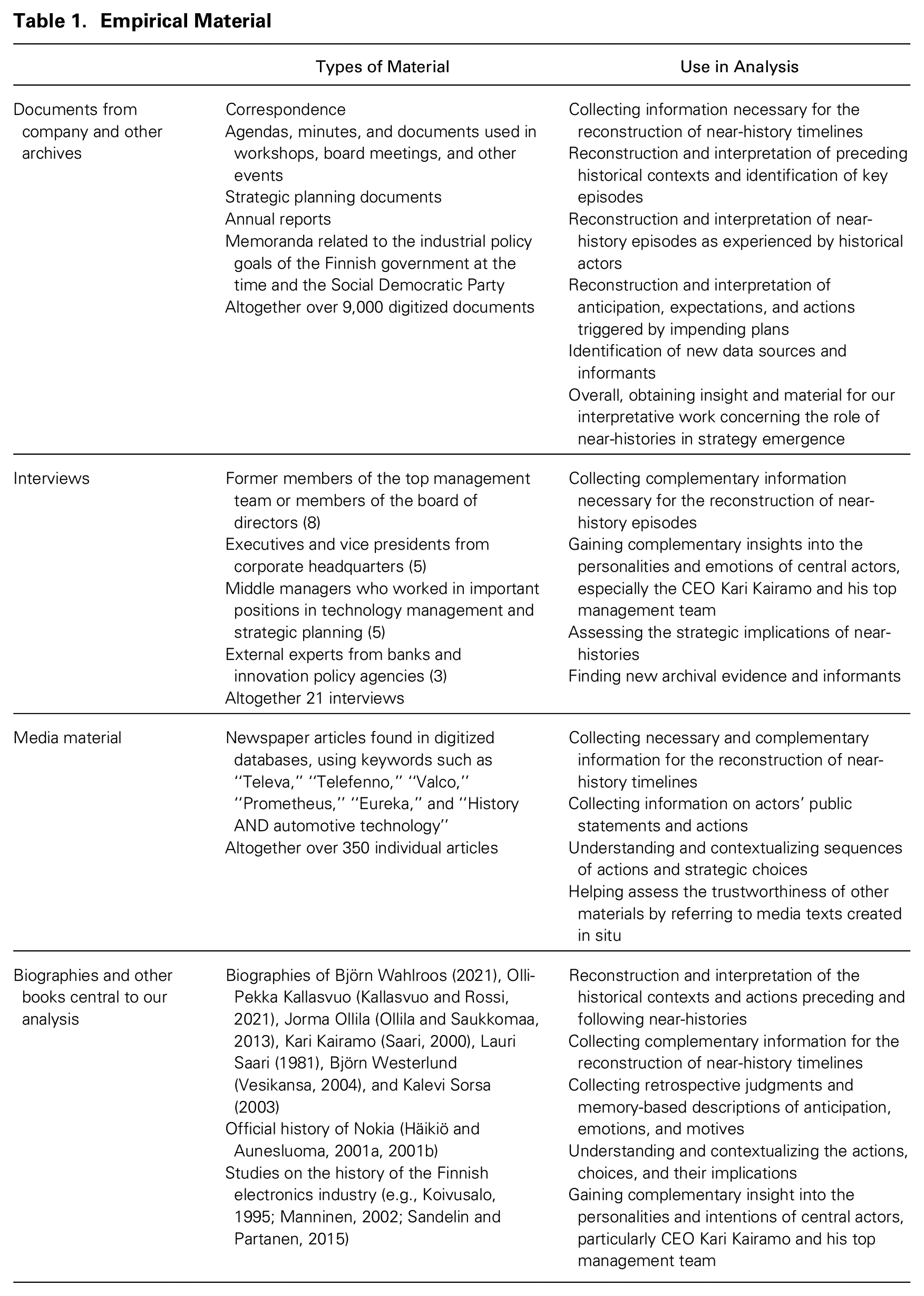
Our analysis is based on intensive historical work with archival material, complemented by interviews and other material. Table 1 offers an overview of the empirical material collected.
Empirical Material
Documents from company and other archives
We had access to Nokia’s corporate archives (covering the years 1967–2000) and gathered information from the private archives of former Nokia executives. Likewise, we used the archives of the state-owned company Valco, the private electronics company Salora, the Finnish Social Democratic Party (SDP), and Nokia’s competitor L.M. Ericsson (LME), Volvo, Saab, and Sverige Televerk in Sweden to obtain more detailed information on the episodes. Our archival work expanded during the research process. In the beginning, the digitalized materials of the Volvo negotiations, for example, consisted of fewer than 100 pages. We proceeded to identify key actors and events from this limited material and accessed new sources and collections until we reached a saturation point, after which additional materials did not contribute significantly to our understanding of the organizational processes related to the near-histories and their strategic implications. Overall, we collected over 9,000 pages of archival materials consisting mostly of confidential memoranda, correspondence, plans, presentations, and scenarios.
Interviews
Interviews with former Nokia executives and other actors we had identified from the archival materials as key writers, team members, and commentators were another important source of evidence. Altogether, we interviewed 21 former Nokia executives and experts from the telecommunications industry. Our informants included eight former members of the top management team or members of the board of directors, five executives and vice presidents from corporate headquarters, five middle managers who had worked in important positions in technology management, and three experts who had consulted or worked with Nokia before 1991. One of the interviewees became the CEO of the entire corporation in the 2000s. The interviews were semi-structured and lasted from 60 to 180 minutes. The interview material was supplementary regarding the two episodes; it supported or challenged our interpretations of the archival materials. The interviews were most useful in clarifying certain connections and providing information on the motivations, expectations, and emotions of individual actors.
Media material
As an important part of our research, we systematically collected and analyzed media material, focusing on the most important newspapers and magazines in Finland. This material served as a contextual source to support the historical research process. It helped us to understand what Nokia was doing at the time. The material was gathered in two ways. First, Nokia executives had collected newspaper clippings that interested them; these are still in the archive with the original comments and markings. Second, we used digitized newspapers and magazines. These included all issues of the largest Finnish newspaper, Helsingin Sanomat, and the magazine Suomen Kuvalehti. We conducted Nokia-related word searches in both publications during the research process, resulting in over 350 relevant articles.
Biographies and other books
Nokia has also generated a significant amount of both academic and non-academic literature. Much of it has sought to explain the company’s success story or the eventual failure of the smartphone business. The quality of these works varies, with some of the publications being based on memoirs later narrated by Nokia’s executives and others based on, for example, journalistic research. While caution should be exercised with this material, self-reported versions contain valuable information that cannot be found in any other source. For this study, we have read all available biographies, memoirs, and other publications related to Nokia’s history. The most relevant works for this study are listed in the bibliography.
Analysis
As is typical in historical strategy research (Argyres et al., 2020; Maclean et al., 2016), we went back and forth with our theoretical ideas and empirical findings to develop deeper understanding of the role of near-histories in strategy emergence.
Step 1: Analysis of the context and mapping of key decisions and actions
We started our analysis by focusing on the historical context of Nokia’s transformation in the 1970s and the 1980s. This step included developing a timeline that included the identification of key actors, their decisions and actions, and events, some of which played a central role in strategy emergence. We used both our extensive empirical material and existing historical research as a basis for this mapping. A key insight early on was that some of the historical episodes had not received adequate attention because they did not result in the expected outcomes. This made us zoom in on what could have happened but did not.
Step 2: Identification of the near-histories
This focus led us to turn our attention to two specific near-history episodes: Nokia’s responses to the Finnish government’s plans to establish a state-owned electronics conglomerate in the mid-1970s and Nokia’s attempt to establish a strategic joint venture in automotive electronics with Volvo in the late 1980s. Although these episodes did not lead to the anticipated outcomes, they nevertheless seemed to result in collateral consequences that had a fundamental effect on Nokia’s strategic change. This was the critical discovery (Locke et al., 2022) that led us to conceptualize these two episodes as near-histories that triggered strategy emergence.
In addition to serving as examples of largely forgotten strategic turning points, these two near-history episodes offered a comparative setting that allowed us to analyze two different kinds of scenarios: a threat and an opportunity. Furthermore, they enabled us to zoom in on the evolving expectations and actions of Nokia’s top management and other key actors and, thereby, to develop an understanding of the process dynamics involved. This involved going back to the archives and other empirical material and engaging in increasingly intensive microhistorical analysis.
It was not obvious that these two episodes were strategically important turning points. In fact, there is a risk of tautology in identifying episodes as strategically significant and then claiming their importance. To avoid this, as explained below, we focused on substantiating both the contextual significance of the expected events (which did not materialize) and their unanticipated yet consequential outcomes (what we call collateral consequences). On this basis, these two episodes can be considered strategically significant even if they are largely forgotten. However, this does not imply that they were the only such episodes in Nokia’s history during this period.
Step 3: Microhistorical analysis of process dynamics
To focus on the microdynamics at play, we conducted a microhistorical analysis. We concentrated on the anticipation and expectations of the key actors, including options and alternative paths that were not realized but that preceded what was realized. We started by placing the two episodes in their historical contexts. We then zoomed in on the evolving expectations and actions of the key people. We focused on how the processes opened a space for new strategic ideas and initiatives and how the actors mobilized networks to resist, support, and take advantage of the process. Finally, to understand the longitudinal macro-temporal implications of the near-history episodes (Hargadon & Wadhwani, 2023), we concentrated on both the more immediate outcomes of the unfolding processes and their longer-term consequences.
In our inductive analysis (Heller & Rowlinson, 2020), we realized that emotions played a central role in the evolution of expectations. Thus, we focused special attention on emotional responses such as fear, anger, enthusiasm, and frustration. This eventually led us to distinguish between the anticipatory reactions and the revision of expectations characterized by specific emotions. Then, we also discovered that these episodes were largely about social relations and networks. This led us to concentrate on the mobilization of networks as a key element explaining the unfolding dynamics both in the beginning of the process and in forming the basis for emergence of a new strategic direction.
Finally, we turned to the strategic implications. After iterations between theory and our theoretical findings, we distinguished between short-term outcomes and long-term consequences. Specifically, we compared the short-term outcomes to initial and evolving expectations. We then focused on the development of new capabilities and strategic focus areas as the key consequences of the two near-history episodes. We also reflected on how these consequences contributed to the corporation’s long-term strategic transformation from a conglomerate to an ICT giant. Table A1 in the Online Appendix provides a summary of the key constructs and our interpretations of the empirical material.
Step 4: Comparison of the two episodes and development of a process model
Finally, we compared the two episodes. We identified similarities in the process dynamics and explained the differences related to the threat and opportunity scenarios. This eventually led us to develop a process model explaining how the key process dynamics link the interplay of initial expectations and the mobilization of networks to strategy emergence and the eventual short-term outcomes and long-term consequences. We discovered that this interplay was characterized by increasing momentum, which is the main explanatory mechanism in our model. Thus, our comparative work and examination of the qualitative differences between the two episodes helped us to elaborate our theoretical understanding of the role of near-histories in strategy emergence and resulted in the process model described in the Discussion section.
At this point, we also went back to key issues concerning causality and equifinality. First, establishing causality in such near-history processes is complicated. It requires both conceptualization of what did not happen and identification of the key elements that play a causal role in a non-linear process model. Second, even if we could establish that these two near-history episodes had fundamental strategic implications, it would not imply that similar outcomes or consequences did not occur in another combination of factors (Misangyi et al., 2016).
To deal with these issues, we went back to the empirical evidence and conducted a series of plausibility tests, reported in the Online Appendix. Our reflections focused on what could have happened had the selected episodes not taken place or if they had happened differently. As a result, we can infer that even if the specific causal role of individual elements in our model can be a matter of interpretation, the key elements in our model are of overall causal significance. However, the processes at play are also characterized by causal sensitivity in the sense that specific changes in key players’ actions could have had a major impact on the outcomes and consequences.
We can also infer that these two near-history episodes did, indeed, play a fundamental role in Nokia’s strategy emergence and that it is difficult to see the same path emerging without these episodes. It is always possible that some other alternative paths could have produced relatively similar outcomes at some other time (significantly later, as we will argue), which is an issue we return to in the Discussion section. In any case, these specific episodes allow for theoretical generalization by demonstrating how near-histories can trigger processes of strategy emergence.
Findings
Episode #1: A Threat Scenario: Turning a Nationalization Threat into a New Strategic Orientation
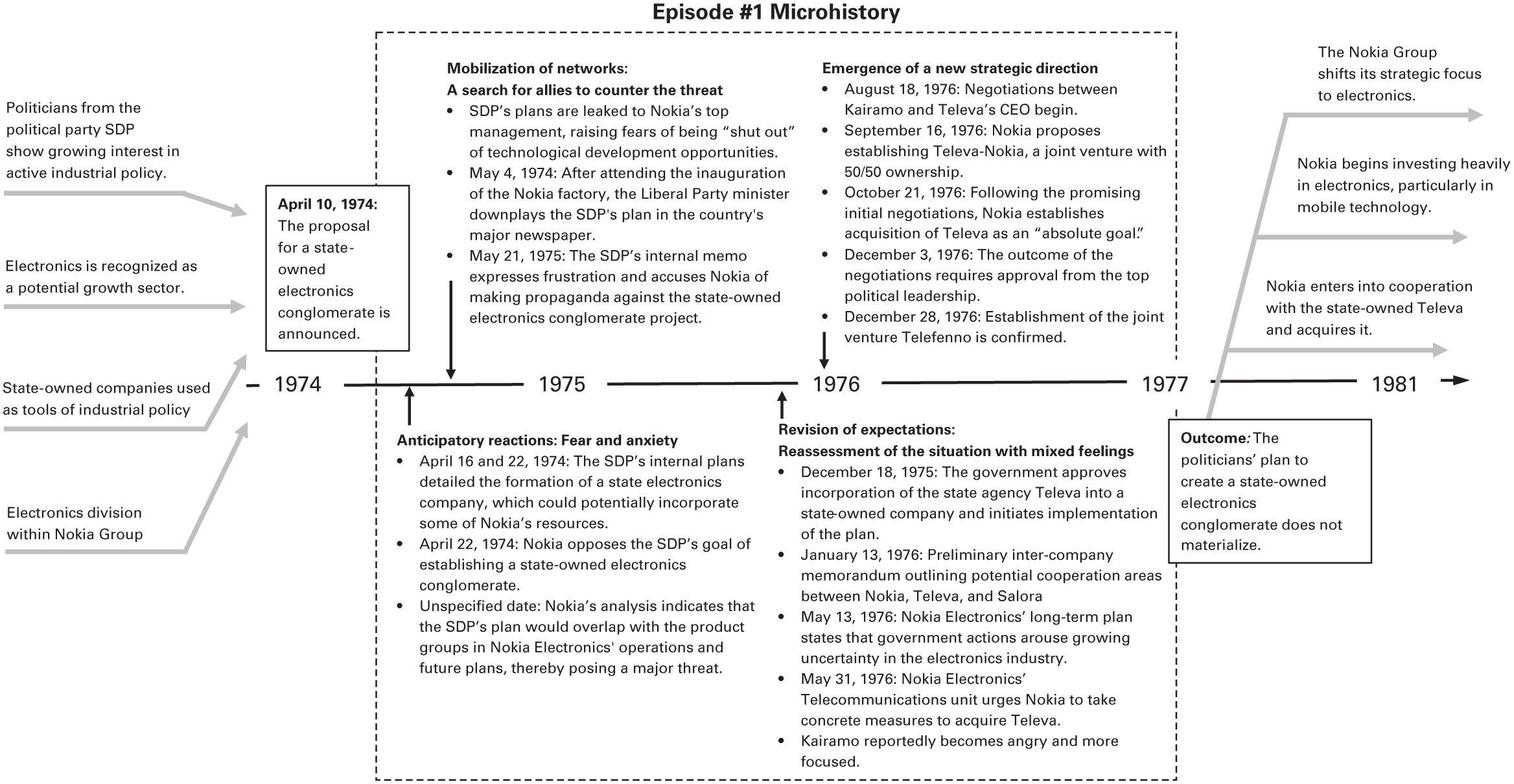
The first episode focuses on a threat faced by Nokia in the mid-1970s. In April 1974, the Finnish government unexpectedly announced a plan to establish a state-owned electronics conglomerate. Nokia’s top management opposed the plan, which it saw as a hostile takeover attempt. With skillful maneuvering, Nokia’s CEO, Kari Kairamo, and his team turned the threat into an opportunity for the company. Eventually, Nokia prevented realization of the politicians’ plan and took over the state-owned electronics company, Televa, thereby assuming the position of national champion in the electronics industry. With this strategic move, Nokia laid the foundation for its emerging strategy as a leading electronics company. Figure 1 offers a timeline of the episode.
Timeline of Episode 1
Historical context
The first episode was embedded in a macro environment characterized by rapid development in electronics, the organization of leading Finnish corporations as diversified conglomerates, and a national business system in which politicians sought more control over the private sector. In the mid-1970s, Nokia Corporation was a diversified company searching for a new growth strategy. Kairamo, who had previously overseen Nokia’s international operations, was appointed CEO in 1974, and it was expected that he would steer the company in a new direction. At the time, it was not at all clear that Nokia would eventually evolve into an electronics company. Nokia Electronics had become the conglomerate’s fourth division and had gained a reputation as a domestic pioneer in professional electronics, but it was still the smallest and least profitable part of the company (Koivusalo, 1995).
In the 1970s, the economy of Finland, where Nokia was based, relied on the forest and metal industries and was characterized by government regulation and interventionist economic policies (Fellman et al., 2008; Laine et al., 2019). As in many Western nations at that time (Toninelli, 2000), left-wing politicians in particular stressed the importance of state interventions and state-owned companies in driving industrialization. In this context, politicians started to see electronics as a promising new sector for modernization of the economy (Nevalainen, 2022).
Just a few years earlier, the relationship between the Finnish state and Nokia was based on positive collaboration, and Nokia Electronics’s long-term plans (e.g., July 7, 1971) identified good relations with the government as a source of competitive advantage. However, by 1974, the relationship between Nokia and the SDP, the leading party in the coalition government, had cooled. The SDP’s policy had taken a more left-wing tack that advocated a state-guided approach to industrial policy (Outinen, 2015). The idea of establishing a state-owned conglomerate in electronics, which would become the industry’s new national flagship, emerged in this context: “Success in the electronics industry requires formation of a sufficiently large national company, which can only succeed with clear governmental guidance” (SDP policy proposal, May 21, 1975).
Although the various versions of the SDP’s plan drawn up between 1974 and 1975 differ in detail, the fundamental principles remained consistent across all versions found in the archives. The proposed organizational structure comprised a parent company fully owned by the state, along with subsidiaries that included private minority shareholders. This conglomerate would have engaged in diverse electronics sectors, encompassing telecommunications, computers, industrial automation, and hospital electronics. Nokia’s role was envisaged at most as that of a minority owner and collaborative partner: “In the later stage, it can be imagined that Nokia and [the state-owned company] Televa will form a radio equipment unit in connection with the state electronics conglomerate” (Updated version of the SDP’s plan, April 1975).
Anticipatory reactions: Fear and anxiety
While Nokia had earlier welcomed the idea of government support for the electronics industry (Long-term plan, July 7, 1971), its top management became concerned about the rise of left-wing economic thinking in society (Häikiö & Aunesluoma, 2001a, p. 134). After the SDP’s plan was announced in April 1974, these concerns grew into increased anxiety. The primary sentiment was fear of being shut out of technological development opportunities.
According to Nokia’s analysis, the planned conglomerate would have operated in all three sectors in which Nokia Electronics was already engaged or planned to engage in the future: telecommunications, industrial automation, and data processing (Memorandum, unspecified date 1976). This alone posed a threat because the small domestic market could not accommodate multiple overlapping companies in these product groups. The industry was already suffering from a shortage of skilled labor and small unit size. Moreover, the proposed state-owned conglomerate was expected to dominate public sector procurements.
What was downright offensive from Nokia’s point of view was that some of the plans discussed its capabilities and involvement in the project as a minority shareholder at most, which would have limited the corporation’s independence as a private enterprise. In particular, the reference to the possible transfer of Nokia’s resources to a state-owned company caused anxiety: “If Nokia does not begin producing exchange equipment, Televa [state-owned] must seek to transfer all the work already done by Nokia to itself, including the French [technology] license and Nokia’s trained personnel” (Memo from Lauri Saari, a technology expert of the party, regarding SDP’s plan, April 1975).
Mobilization of networks: Search for allies to counter the threat
Nokia’s response was to resist the plans through a network of relationships. Kairamo was actively involved in several industry associations and had his own sources within the SDP, which allowed him to gather information that was useful in crafting a response to the threat. He was also well informed about the SDP’s plans for electronics, as evidenced by the presence of key documents, complete with his underlined notes, in his personal archive.
Publicly, Nokia criticized the SDP’s project, but it did so cautiously, adhering to the era’s typical approach of avoiding direct confrontation. Instead, the company focused on influencing the journalists covering the issue. A later account from a financial journalist offers insight into how Finland’s largest industrial company managed its public relations: It was typical for Mildh [Nokia’s head of public relations] to call and ask if there happened to be time for lunch today. If there was, they would go to the Pörssi Club restaurant, where Mildh would openly share information about Nokia. Once a year, key journalists and their spouses were invited to a crayfish dinner, which was also attended by the company’s top management. (Vesikansa, 2004, p. 150)
Nokia’s efforts seemed to bear fruit. As the SDP’s electronics industry project faced repeated delays, frustration became more evident in the party’s internal discussions. According to an internal SDP document, Nokia was specifically blamed for hampering the project: The basic reason is Nokia’s successful propaganda, which has been able to slow down the project to some extent. The primary arguments of this propaganda are as follows: The [planned state-owned] company is too multi-functional, [and] in the longer term, it will trample on other domestic industry interests [those of the private electronics sector]. (SDP’s memo, May 21, 1975)
The situation changed rapidly at the end of 1975 when the SDP successfully incorporated its political objectives into the new government program. Swift political actions were taken to establish a state-owned electronics conglomerate. In December, the government decided to incorporate the electronics unit Televa, which was to become the parent company of the state-owned conglomerate. In January, the government established a new state-owned factory to produce semi-finished electronics components, which would later be integrated into the same conglomerate structure (Nokia’s analysis, September 22, 1976). Thus, the plan’s practical implementation had begun, though not at the aggressive and rapid pace initially envisioned.
Revision of expectations: Reassessment of the situation with mixed feelings
Nokia’s leadership then reassessed the situation, as indicated by internal documents. Beyond the imminent threat of government intervention in the electronics industry, the key development was that Televa actively sought a business partner to support its planned expansion. This unexpected shift meant that the Nokia top management team’s initial fears transformed to new hope.
Forms of cooperation between the two [Nokia and Televa] had been sought [at the engineering level] throughout the 1970s. However, cooperation had so far been hindered by the fact that Nokia was a purely commercial enterprise, which had to generate profit, and all of its projects needed to be profitable. Televa, on the other hand, was a government agency. (Mäkinen, 1995, p. 138)
Nokia’s internal documents point to several reasons for its interest in collaboration. First, Televa had significant technological capabilities in the production of small telephone exchanges and radio communication systems. Second, it held a significant market position in Finland, particularly in public sector procurement, making it a key player despite its relatively small size. Third, and most important, Televa was actively seeking an international partner. If Televa had allied with a competitor other than Nokia, this would have kept Nokia from selling network equipment in its home market (Nokia’s analysis, September 22, 1976).
Televa’s evolving goals and choice of a strategic partner became a pressing concern for Nokia’s management. By early fall 1976, the combination of the SDP’s political plans, emerging opportunities in the electronics industry, and Nokia Electronics’s troubling analyses of industry trends in Finland had angered Kairamo. In response, he decided to actively defend Nokia’s interests in electronics (Häikiö and Aunesluoma, 2001a, p. 267) by focusing on securing Televa’s alignment with Nokia, supported by middle management at Nokia Electronics.
Emergence of a new strategic direction
To advance Nokia’s interest, Kairamo needed political support. Building a confidential relationship with the SDP’s leadership was initially challenging, as various internal documents in our data show. Kairamo, however, was able to leverage Nokia’s network of relationships and create new connections. An anonymous informant within the SDP’s inner circle, referred to as “Deep Throat,” indicated that the underlying issue was the party leadership’s lack of familiarity with Nokia and suspicion regarding the corporation’s intentions. The informant advised Kairamo that it would be beneficial to approach some key individuals directly and to discuss Nokia’s aims as openly as possible. This, they suggested, would be the most effective way to restore communication and build trust: “I suggest that you consider arranging a meeting between your young boss and our leader as soon as possible, where an honest discussion can clarify that there is no orchestrated action against the SDP within Nokia” (Memo, “Conversation with Deep Throat,” fall 1976).
Kairamo took the advice and privately approached SDP’s top leadership, initiating a series of private meetings starting in the autumn of 1976. These meetings typically took place at Nokia’s Båtvik villa, west of Helsinki. Although Nokia’s famous hospitality motto—“So much fun that the hosts also have a good time”—was generally taken as a joke, these events were meticulously planned. Minute-by-minute schedules ensured the guests’ comfort and afforded opportunities to explain Nokia’s interests and ideas. Detailed programs were prepared, along with backup plans, and in some cases, even backup plans for the backup plans. Kairamo personally ensured that all arrangements were “solid” (Saari, 2000, p. 101).
The events typically followed a pattern that began with a brief, relatively formal program, including a factory tour and a short presentation by Nokia’s top management. This was followed by lavish dinners and a sauna accompanied by drinks. In the Finnish negotiation culture of the time, the sauna was the most important part, as it provided an opportunity for free-form and highly confidential discussions. No one kept minutes at these sessions, thereby allowing an open exchange of ideas in a relaxed setting.
In meetings with politicians, Kairamo’s goal was to persuade his guests to consider the situation from Nokia’s perspective, that is, that Nokia was actively contributing to development of the electronics industry in Finland. A report about one such meeting describes Nokia’s unrelenting negotiation tactics, which appealed to the common interests of both parties: We made it clear that we are ready to use all available means to push for a solution that we consider to be right both nationally and from the perspective of the market economy, and that under no circumstances will we stand by silently if other parties push for a solution that deviates from our understanding of what is right [for the Finnish electronics industry]. (Internal Nokia memo, September 10, 1976)
When these confidential negotiations revealed the possibility of reaching an agreement with key SDP leaders, the acquisition of Televa became an “absolute objective,” as outlined in an internal memo (Internal Nokia memo, October 21, 1976). At the end of the year, negotiations continued primarily between Nokia Electronics and Televa. A breakthrough occurred dramatically during the Christmas holidays when Nokia and Televa agreed to establish Telefenno, a joint venture focused on product development and marketing for telecommunications equipment. This agreement paved the way for Nokia to gain control of Televa’s resources and to thwart the SDP’s original plan to concentrate domestic resources in a state-owned conglomerate.
From this point on, Nokia’s new strategic direction started to take shape. In January 1977, Telefenno started operations. By mid-1977, Nokia Electronics’s management recommended that Nokia would pursue full ownership of Telefenno (Nokia Electronics memo, June 20, 1977). Having addressed the SDP’s initial reservations, Kairamo resumed confidential discussions with party leaders, which soon led to favorable results. Politicians who had previously supported state ownership began to back Nokia both privately and publicly. This shift occurred alongside a broader change in the SDP’s economic policy (Outinen, 2015), as noted by the Prime Minister: “The SDP’s major issue has been the lack of business-level expertise . . . the SDP’s course has—at least by a fraction—moved closer to that of the [private] companies” (Interview with Prime Minister Sorsa, Kauppalehti, September 26, 1978). In 1981, Nokia finally acquired a majority stake in Televa, thereby achieving a significant shift in the industrial political landscape.
Outcome and consequences
The first episode began as a threat scenario when Finnish politicians proposed state intervention in the electronics industry, including the establishment of a state-owned conglomerate as the new industry flagship. As explained above, the proposed state-owned electronics conglomerate did not materialize. Although the initial scenario was never realized, the episode had far-reaching strategic consequences: Nokia acquired the state-owned company Televa with its capabilities, started to invest heavily in telecom technology, and thereby shifted its strategic focus to electronics.
Nokia’s opportunity to acquire the electronics company Televa arose immediately after politicians abandoned their plan to create a state-owned electronics conglomerate. The eventual acquisition transferred Televa’s resources—including its market position and expertise in digital exchanges and radio phone systems—to Nokia. Although Televa was not particularly large, its acquisition nearly doubled the number of employees at Nokia Electronics and, thus, significantly enhanced the company’s technological competence. This acquisition enabled Nokia to initiate new projects leveraging these capabilities. With Televa’s resources and market position, Nokia became a major equipment supplier to the Finnish IT market and emerged as the national flagship of Finland’s ICT industry. This provided Nokia with a privileged position in public procurement and access to various public subsidies for R&D. Additionally, Nokia secured an insider role in developing common Nordic mobile network standards in collaboration with Nordic telecom authorities (Manninen, 2002).
The technology acquired from Televa was crucial in establishing Nokia’s position as a pioneer in telecom technology. The digital switching equipment used by Nokia until the 2000s was based on product development that had begun at Televa in the early 1970s and continued under Nokia’s R&D (Sandelin and Partanen, 2015). Additionally, Televa’s expertise in radio phones was transferred to Nokia’s subsidiary Mobira, later Nokia Mobile Phones (NMP) (Koivusalo, 1995). The development of first- and second-generation mobile systems during this period was essential to the rapid expansion of mobile phones, initially creating a new product segment for professional use and, from the 1990s onward, more broadly for consumers.
Finally, and most important, all this made Nokia seek a new strategic focus in electronics. Beginning in the fall of 1976, Kairamo dedicated considerable time, energy, and networking skills to Nokia Electronics, a minor part of the company at the time. As he became more involved in the electronics sector, he grew increasingly convinced of its potential. Consequently, he began to emphasize electronics as a key avenue for Nokia’s future expansion: “Even though all electronic production has its own, often substantial risks . . . it appears that Nokia’s traditional industries do not, in every aspect, offer a solid foundation for future profitability or development” (Kairamo’s memo, June 8, 1978).
In the following years, Nokia’s top management pursued aggressive growth for the Nokia Electronics division. Whereas growth had previously been organic, it now came through acquisitions and diversification into new product groups. By the mid-1980s, Electronics had become Nokia’s largest and fastest-growing division, creating the basis for Nokia’s future transformation from a conglomerate to an electronics corporation.
Episode #2: An Opportunity Scenario: From a Canceled Joint Venture to Emergence of New Strategy
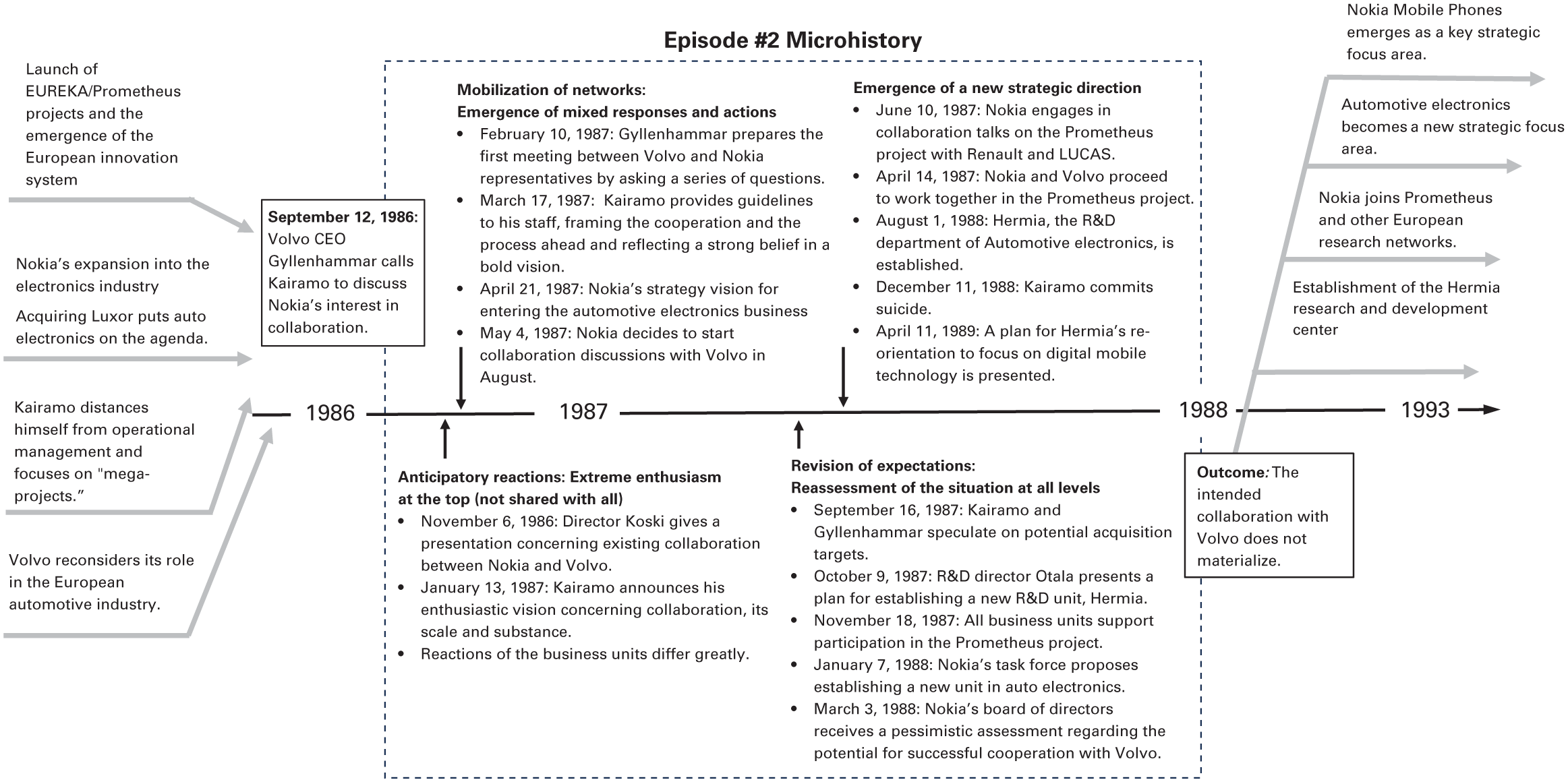
The second episode concentrates on a largely forgotten process, which began in 1986 when Volvo’s CEO, Pehr G. Gyllenhammar, approached Nokia’s Kairamo about a large-scale collaboration. Although Kairamo and his team perceived the idea as a unique opportunity, the joint venture did not work out, and the process ended in tragic circumstances when Kairamo committed suicide. While the plan to collaborate with Volvo never materialized, it triggered a process that laid the foundation for the emergence of new capability development and allowed NMP managers to secure resources for R&D that eventually made Nokia a world leader in new digital mobile technology. Figure 2 provides a timeline of the episode.
Timeline of Episode 2
Historical context
The second episode was embedded in a macro environment involving rapid technological development in electronics in general and in automotives in particular, internationalization of the Finnish and Nordic conglomerates, and major innovation programs initiated at the national and European levels. After Episode 1, Nokia had grown rapidly through a series of new acquisitions and had obtained a broad set of technological capabilities, especially in the developing ICT sector (see, e.g., Memorandum, February 6, 1987). By the latter half of the 1980s, the company had also expanded into consumer electronics (e.g., the manufacture of television sets and stereo equipment). The problem, however, was that these capabilities were dispersed in an organization in which numerous post-acquisition integration processes were proceeding.
At this point, CEO Kairamo had reached an unquestioned position of power in Nokia and more widely in Finnish society. This allowed him to focus on strategic “megaprojects,” as they were called in Nokia. Led by Kairamo, Nokia’s top management looked increasingly to Europe, outside Finland’s traditional business sphere. This was in line with a broader trend in which Finnish industrial policy programs sought increasing pan-European collaboration.
The first frontier in pan-European R&D collaboration was the automobile industry, in which Eureka Prometheus replaced national-level development programs in 1986. Prometheus, designed as a countermove by large European companies against U.S. and Japanese industrial expansion, brought universities, automobile manufacturers, and electronics companies together to build capabilities for developing and commercializing driverless, autonomous cars with extended navigation and communication capabilities (Williams, 1992). The rise of European R&D programs was recognized early on by the Finnish government, which established the technology accelerator Tekes (the Finnish equivalent of the Defense Advanced Research Projects Agency, or DARPA) in 1983. Tekes’s priority was to integrate Finnish companies into programs like Prometheus, and Nokia’s engagement became essential for this purpose: “[I]t is extremely important that Finnish companies already have the same opportunities as their competitors in joining projects that represent exceptionally large but necessary risks for us, during the initial phase of Eureka’s establishment” (Tekes Memorandum, February 13, 1986).
For companies like Volvo and Nokia, Prometheus represented an avenue to gain legitimacy and access to the industrial core, especially in Germany, where dominant corporations such as BMW, Daimler-Benz, and Bosch supported the program’s aims. Accordingly, there was widely shared interest in gaining access to such networks: “Numerous brands and market research suggest that automotive electronics will become increasingly important. Prometheus is one manifestation of this trend and provides a channel to advance in automotive electronics through research and development” (Nokia Memorandum, November 26, 1986).
Anticipatory reactions: Extreme enthusiasm at the top (not shared by all)
The episode started in 1986 when Gyllenhammar called Kairamo to inquire about Nokia’s willingness to explore various forms of collaboration, from mobile phone assembly to Volvo cars, joint ventures, and cross-ownership. Our material reveals that the plan was comprehensive and ambitious: [Nokia’s goal is to] build an attractive partnership in selected automotive electronics applications . . . building on Nokia’s skills in audio and visual communications, electrical systems, communication networks, and navigation systems, and Volvo’s skills in motor electronic applications, security and comfort applications, and instrumentation applications. (Memorandum, February 17, 1987)
Kairamo received Gyllenhammar’s proposal with great enthusiasm. As friends and members of the Scandinavian business elite, they knew each other from various interest groups and associations. These close personal relations also reflected a mutual understanding that their role was to integrate the Nordic countries with Europe. Their shared ideological understanding was evident in their correspondence: “I also believe that such collaboration between Sweden’s largest and Finland’s largest industrial companies . . . would increase Nordic self-confidence not only in the future of our industry but also in our customers’ confidence in Nordic competitiveness around the world” (Kairamo to Gyllenhammar, March 13, 1987).
Kairamo saw an opportunity that “certainly would support Nokia’s long-term goals” (Kairamo to management team, January 13, 1987), built on the integration of voice, image, and data based on the corporation’s technological capabilities (Strategy document, February 24, 1986). Early ideas envisaged embedding competencies in mobile phones, radio technology, electronics, personal computing, and cables to serve a shared business purpose in a growth market with huge global potential. Thus, proposed collaboration looked like an opportunity to realize long-term visions and to find automotive industry-related synergies across Nokia’s numerous business units, from tires to mobile phones.
Inside Nokia, Kairamo increasingly focused on his own projects while allowing the business units a great deal of freedom and independence. Collaboration with Volvo now became the most ambitious of these projects. Accordingly, Kairamo set up a task force—a small group of managers and specialists brought together to manage the project. The task force members shared Kairamo’s ambitions and enthusiasm, even if they had doubts about how realistic his vision was. According to a member of Nokia’s strategy team, “Kairamo’s vision stretched too far considering the de facto capabilities in the Nokia of the 1980s.” A planning officer called Kairamo’s vision “megalomaniac.”
The reactions from the business units were much more negative, especially among representatives from paper, rubber, and other old industrial groups within Nokia. Managers from Nokia Mobile Phones, in turn, saw more value in this collaboration, but they were a small minority. Accordingly, there was a mismatch between Kairamo’s promises to Gyllenhammar and Nokia’s de facto ability to collaborate. As one member of Nokia’s strategy team recalled, Kairamo kept showing newspaper clippings about Prometheus, but no one really picked up on it. And of course, it’s the industrial groups, the divisions, that are working in the market. No matter how much Kairamo talked about a business, if an industrial group didn’t take it up, it wouldn’t go anywhere.
Mobilization of networks: Emergence of mixed responses and actions
Kairamo and Gyllenhammar approached the project with great intensity, with their personal relationship playing a crucial role in advancing its ideas. Social events and informal practices became integral to this process. At the time, Kairamo was widely recognized as a skillful social architect: “[M]any of the events Kairamo organized, as well as his thank-you cards and gifts, had a purpose. He consciously, or perhaps sometimes unconsciously, cultivated his network” (Saari, 2000, p. 102). Thus, strategy work became embedded in social rituals, including Nordic crayfish dinners, sauna gatherings, fishing trips, singing, opera visits, and other elite events. These interactions not only deepened Kairamo’s and Gyllenhammar’s friendships but also reflected the prevailing social norms of the business elite at the time.
Our data reveal that the project became increasingly important for Kairamo and that he allocated excess resources to it—his own team of loyal executives at the corporate headquarters, some individuals from NMP, consultants, and a dedicated budget. Kairamo’s task force played a key role in this process and developed strategic analyses and concrete plans for a “Nokia Car,” through various forms of collaboration between Nokia and Volvo, which materialized in more than ten meetings in 1987 and 1988: We are seeking and establishing collaborations in a few other areas of electronics, automation, and automotive components related to future cars and/or the car design and manufacturing process. These will be selected sensibly so that we can quickly transition from product and business development cooperation to concrete production and commercial activities. (Kairamo to the executive team and internal board, March 17, 1987)
Although the process started top down, the idea and subsequent decisions rapidly divided various individuals and coalitions into those promoting and those resisting the plan. It soon became evident that there was no natural home for the project, as a task force member later described: And if you look at where it could have fit, there was the mobile phone unit with a hugely growing market—why complicate it with automotive electronics, of course. Jori Nieminen [vice president of Mobile Data division] had established the Mobile Data unit there, focusing on vehicle terminals, in a way. But Jori did what he wanted and didn’t want the corporate executive team or management interfering with his work. It was quite separate. And then, if it was Sakari Salminen’s [vice president of Networks division] telecommunications, there was no room for automotive electronics. Then there was consumer electronics, where they made TVs and other things, so there wasn’t room there either. Then there’s PC manufacturing, or well, everything they did—there was no room for a new unit. It would have had to be a completely new unit, which they later tried to create.
For the individuals working at the corporate headquarters, the situation was challenging, as the head of the strategic planning unit later complained: “[T]he units were quite independent. So, in fact, the corporate planning manager was pushing a string.” Nokia’s chief financial officer put it in a memo in July 1987 as follows: “The project seems to be brewing a bit all over the corporation. Would it be timely to sort things out internally and formalize them?”
Revision of expectations: Reassessment of the situation at all levels
It soon became clear that the original initiative for collaboration between Nokia and Volvo would not lead to the planned results. By the spring of 1987, Kairamo received information that Volvo’s business unit level was far less enthusiastic and engaged in collaboration than was Gyllenhammar himself (Letter to Kairamo, April 24, 1987). We can see from the correspondence that after a few meetings with the project teams, Gyllenhammar started to withdraw from the most advanced forms of collaboration—partly in response to skepticism among Volvo’s middle management: “I view it positively that you have already started considering different alternatives [to the initial collaboration plan]. Naturally, we need some time, you and I, to come up with the best solution” (Gyllenhammar to Kairamo, May 21, 1987).
By late 1987, Kairamo was increasingly frustrated due to most of the business units’ passive resistance. The only exception was NMP, especially its advanced technology experts, who had become enthusiastic about the new opportunities in R&D. From the beginning, all Volvo-related materials emphasized the importance of NMP’s participation in the Prometheus program. A small active group of executives and experts saw this collaboration as a way to gain a foothold in a promising new business segment and kept the issue on their agenda (e.g., Memorandum, June 10, 1987): “Both Volvo and Nokia need good references if we are to look at the great opportunities that the European digital GSM mobile network offers from 1991” (Meeting minutes, October 28, 1987).
Thus, collaboration via the Prometheus program was connected to various interests, ranging from factory-installed Nokia mobile phones, to cars, to the invention and sales of new polymer products. Particularly important was the NMP division’s plan to build an entirely new R&D unit in Tampere, Finland. Immediately after the first talks between Gyllenhammar and Kairamo, in November 1986, an R&D manager of NMP proposed establishing the technology park “Hermia” to develop automotive electronics: For these reasons, the idea of forming a new group focused on automotive electronics has emerged in connection with the Hermia technology park in Tampere. The main objective of this group would be to generate new business opportunities for Nokia in the field of automotive electronics primarily by leveraging Nokia’s existing capabilities. (Memorandum, November 26, 1986)
Accordingly, while the corporate management of Nokia grew increasingly pessimistic, the NMP managers pushed the project forward with increasing dedication, using collaboration with Volvo and the Prometheus program as strategic justifications for establishing Hermia.
Emergence of a new strategic direction
Toward the end of 1988, the Volvo project became increasingly less likely. For instance, in the fall Nokia’s main owners took a negative view of the Volvo negotiations. These and other developments made Kairamo depressed and increasingly less active. In daily operations, Kairamo’s depression resulted in swings between “good days and bad days”—on good days everything was possible, while on bad days only negative decisions resulted (Saari, 2000, pp. 206, 219). The end point was Kairamo’s suicide in December: “[T]he whole thing ended with Kairamo’s death” (interview, task force member). 1
After Kairamo’s suicide, Nokia was momentarily thrown into chaos as the project built around Kairamo’s visions lost its foundation. Nokia obtained anew CEO and a new corporate governance system without an internal board. Simultaneously, the new top management canceled most of Kairamo’s megaprojects and focused on resolving more acute issues.
At the same time, NMP managers seized the opportunity to continue their work on automotive-related technology, especially on new kinds of solutions in mobile phones, culminating in the decision to establish Hermia at the end of 1988. Internal documents and our interviews clearly show that NMP managers were able to use the resources gained from the project to their own advantage— to effectively hijack the process. As they could operate with relative independence, they were able to use the resources initially intended for automotive electronics for more general development of digital mobile phones. A technology expert commented later: Well, to put it briefly, there were various attempts related to mobile phones. At first, there was talk that the vision was to incorporate different kinds of electronics. And some of that did end up in cars, but Nokia wasn’t involved in it at all. Then the focus shifted to mobile phones, specifically the initial installation in cars. And in my opinion, it was elevated to a high priority at the corporate level, even though it wasn’t as significant as the overall development of the mobile phone.
Outcome and consequences
The second episode started as an opportunity scenario when Gyllenhammar approached Kairamo with a large-scale joint venture in mind. As we have elaborated above, the initial plan failed to materialize and ended in tragedy. Although the initial large-scale joint venture did not happen, the process had fundamental strategic consequences: The Hermia research and development center was established, Nokia joined Prometheus and other European research networks, automotive electronics became a new strategic focus area, and Nokia Mobile Phones emerged as a key strategic focus area based on advances in digital technology.
The establishment of the Hermia R&D unit in Tampere in December 1988, just before Kairamo’s suicide, was a direct consequence of the near-history episode. While most business unit leaders were not convinced by the CEO’s vision, NMP and its digital front seized the momentum to push their vision of Nokia’s future. As a result, they could use resources for various projects that were only loosely aligned with the original joint venture. Later, Hermia’s R&D capabilities became crucial for Nokia’s eventual global breakthrough in mobile phones. An executive later recalled the role of Hermia: “In modern language it was a bunch of propeller heads that had quite a lot of freedom to develop new products. And I believe that it has been of great importance for Nokia’s future” (Interview, task force member).
Gaining access to European research networks was another tangible consequence of the near-history episode. The Prometheus project had been a pivotal force behind the Volvo negotiations, and participation in European innovation programs and networks was one of the practical outcomes. The Prometheus project was closely related to Hermia’s activities, and in the early years it was especially useful in gaining access to new ideas, collaboration partners, and funding. For instance, in 1989 half of Hermia’s budget was covered by strategic “Volvo-related” funding provided by corporate headquarters, and half was covered by Prometheus funding from Tekes (Hermia budget, January 1, 1989). In the longer run, the networks established in the Prometheus project also helped to further strengthen Nokia’s position, especially NMP, at the forefront of R&D.
The near-history episode also resulted in the emergence of a new strategic focus area in Nokia: automotive electronics. While NMP may have strategically leveraged automotive electronics to justify its actions, the sector remained within Nokia’s portfolio. Before 1987, Nokia had already produced items for the automotive industry, such as radios and mobile phones. However, after 1987 key executives began to view Nokia as a strategic player in the global automotive industry. In retrospect, a business idea in 1998, for example, largely drew on concepts introduced to Volvo executives in 1987 and 1988, particularly the idea of a Nokia car. Regarding large-scale development programs, it is noteworthy that Volvo’s significance diminished shortly after Kairamo’s death. A Nokia executive noted in 1989, “As a customer, Volvo is relatively small, so the future cannot be built solely on its foundation” (Memorandum, Automotive Electronics Group, May 8, 1989). In 1989, automotive electronics gained independent R&D status with its own organization, budget, and initially 14 employees. By 1998, it had evolved into the Smart Traffic Products business unit, with a workforce of 270. By 2001, 1,600 employees were dedicated to executing the unit’s strategy, and as of 2025, automotive electronics remains a strategic focus for Nokia Corporation.
All these developments enabled allocation of resources to the revolutionary digital mobile data applications that formed the basis for Nokia’s subsequent growth and success in mobile phones, making it a key strategic focus area. At Hermia, Nokia Mobile Phones’ “propeller heads” developed digital mobile data technology, which then boomed in the mid-1990s when mobile networks turned digital. In hindsight, individuals from NMP not only effectively used the opportunities emerging from the earlier Volvo negotiations but also correctly identified the sources of Nokia’s future competitiveness. This included the hugely successful Nokia Communicator, the world’s first smart phone prototype in 1993, which was envisioned and built in Hermia in secrecy, isolated from Nokia’s other R&D units. Note also that from the perspective of 1987 or 1988, the digital front was not the obvious winner even inside NMP. Thus, the R&D done in Hermia played a crucial role in the rise of digital mobile phone technology, which then became the cornerstone of Nokia’s competitive advantage in the global mobile phone market.
Comparison of the Episodes
Our analysis of two near-history episodes elucidates how anticipation and expectations of events that ultimately do not take place can trigger the emergence of unforeseen strategy. While the process dynamics in both episodes are based on similar elements, the cases also exhibit distinctly different patterns. Table 2 offers an overview of the key elements of the process dynamics in the two near-history episodes.
Comparison of Process Dynamics
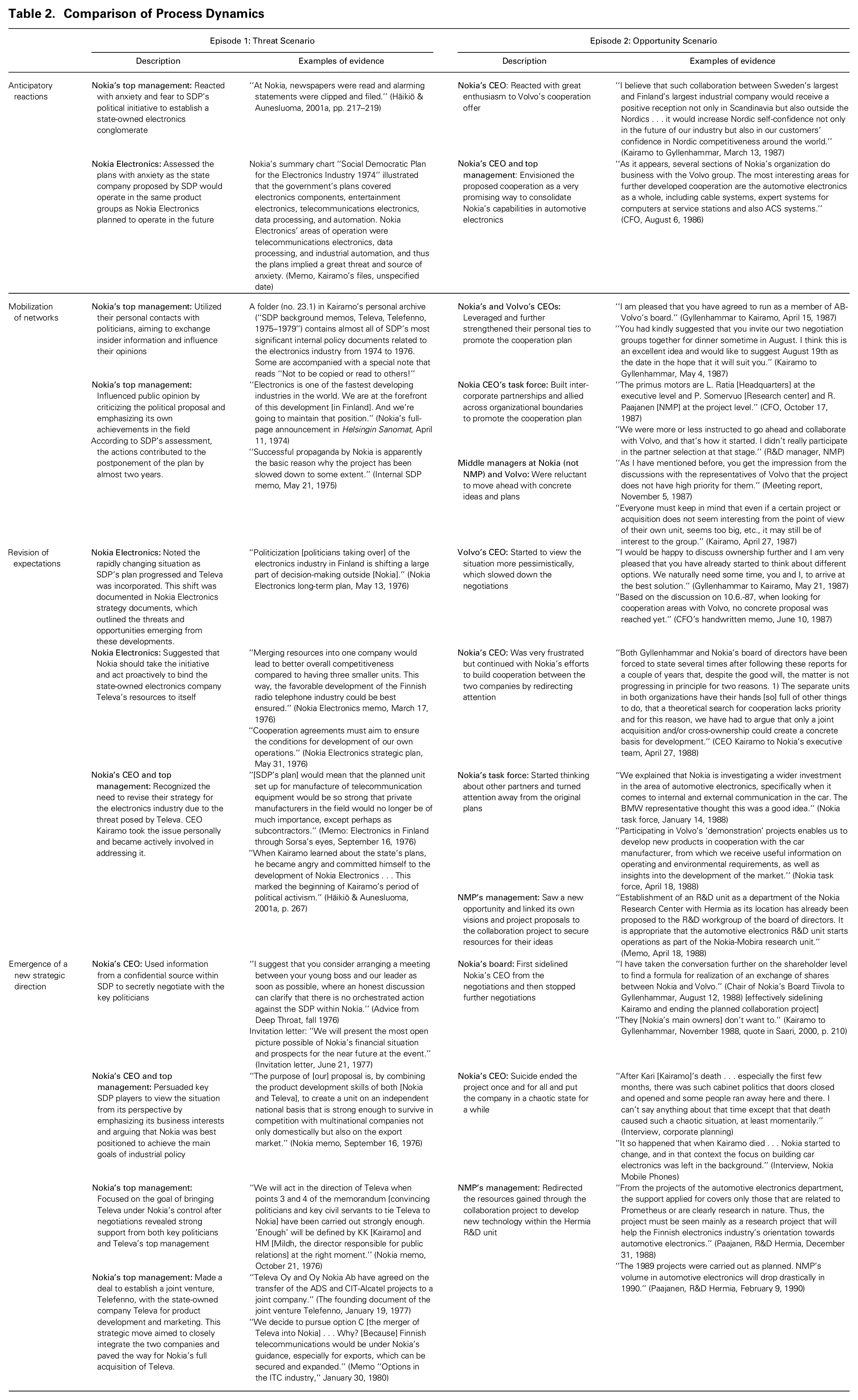
Both episodes illuminate the central role of anticipatory reactions in explaining what happened and did not happen. In the first episode, the threat resulted in reactions characterized by anxiety and fear on Nokia’s side. In the second episode, the reactions of Nokia’s top management showed extreme enthusiasm, while others’ responses were mixed. Although the patterns apparent in the episodes were different, strong emotional responses can be seen as key reasons for the action taken for or against the initial scenarios.
In both episodes, the initial reactions led to a mobilization of networks that moved the process forward in new directions. In the first episode, it was crucial that Kairamo and his team managed to find allies based on their existing social relations and to create new ones. This resulted in a set of actions paving the way for successful resistance to SDP’s plans but also to initiatives for more intense collaboration with Televa. In the second episode, the first actions were more about building upon and strengthening the ties between Kairamo and Gyllenhammar and their respective teams and creating interorganizational partnerships that were crucial to developing new business ideas and initiatives. If anything, both episodes underscore the central role of expanding networks of action as a basis for eventual new strategy emergence, even if the subsequent steps were very different.
As the new actions moved the process forward, they also led to a revision of expectations. Eventually, Nokia’s top management saw new hope in the unclear situation regarding Televa in the first episode, which was crucial for shifting their focus to an attempt to acquire the whole company. In the second episode, Kairamo and his team were frustrated by the lack of progress in the joint venture, whereas the middle managers at NMP became enthusiastic about the emerging opportunities.
Both episodes also culminated in a dramatic sequence of actions that led to the emergence of new strategic directions. In the first episode, carefully orchestrated meetings and political maneuvering enabled Nokia not only to block the realization of SDP’s plan but also to secure a commanding stake in Televa, which laid the foundation for a new strategic trajectory in telecommunications. In the second episode, although the joint venture plans failed when Kairamo took his own life, middle managers successfully hijacked the process to secure investments in Hermia and other key areas—investments that later became the cornerstones of Nokia’s competitive advantage.
In all, the two episodes illuminate the role of embedded agency in such near-history episodes. Unlike conventional historical narratives that emphasize linear causality, these near-history episodes unfolded as dynamic processes whereby shifts in expectations and the iterative interactions among actors resulted in reversal of strategic direction. Thus, both episodes illuminate a gradual buildup of networks of action, with cascading effects that ultimately resulted in new strategy emergence. However, they also show how this process can take place in distinctively different ways. In the first episode, Nokia’s top management under Kairamo’s leadership played an active role in the reversal, which was largely supported by the middle managers. In the second episode, the middle managers in NMP seized the opportunity to move Nokia’s strategy to a new direction.
Finally, it is important to emphasize that both episodes led to strategically significant outcomes and consequences. Table 3 provides a summary of the outcomes and consequences across the episodes.
Comparison of Strategic Outcomes and Consequences
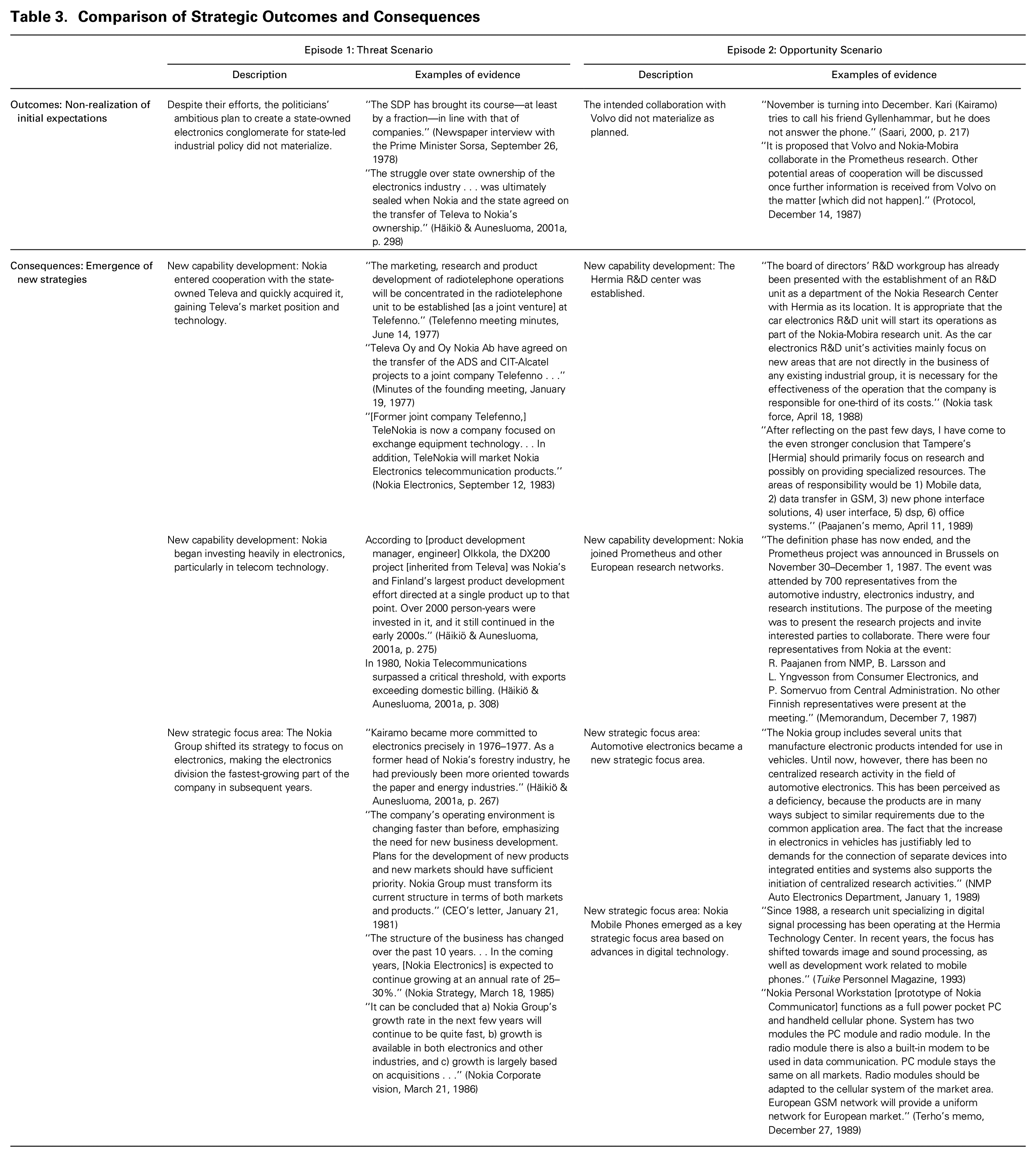
In both episodes, the immediate outcome was that the initial plans failed. In the first episode the threat scenario did not materialize, and in the second episode the initial expectations about a large-scale joint venture were never realized. However, both episodes serve as interesting examples of how a near-history episode can lead to initially unforeseen strategy emergence in the form of development of new capabilities and strategic focus areas. In the first episode, Nokia eventually acquired the state-owned company Televa and started to invest heavily in telecom technology, which were crucial steps in the company’s new capability development. This, in turn, laid the foundation for shifting the group’s focus to electronics. In the second episode, the process ultimately led to the establishment of the Hermia R&D center and Nokia’s participation in Prometheus and other European research networks, which served as the basis for the group’s new capability development. This development was, in turn, crucial for making automotive electronics and, most important, mobile phones the company’s new strategic focus areas.
These developments also ultimately contributed to the corporation’s strategic transformation. The first episode thus resulted in a dramatic, almost immediate change in the strategic orientation of the corporation, whereas strategy emergence in the second episode was a slower process that eventually provided the crucial foundations for Nokia’s competitive advantage in mobile phones. Overall, our findings highlight the magnitude of Nokia’s transformation, evolving from a manufacturer of tissue paper and rubber boots into a global leader in mobile phones and information technologies.
Discussion and Conclusion
Near-History Episodes as Triggers of Strategy Emergence
The key contribution of this article is that it elucidates how near-history episodes may generate process dynamics with collateral consequences that serve as a basis for new strategy emergence. While existing research on strategy emergence has pointed to unrealized or ephemeral (Mirabeau & Maguire, 2014; Mirabeau et al., 2018) strategies, we have lacked theoretical understanding of the implications of unrealized ideas or plans—even if they may trigger chains of actions that eventually result in the emergence of new strategies.
We explain how anticipation and expectations regarding strategic plans or decisions that are never realized have the potential to trigger processes that may result in strategy emergence. As our analysis shows, near-history episodes may involve special forms of affective and political messiness that culminate in an unpredictable reversal in strategic direction. In particular, in cases like ours, such episodes can result in affective reorientation and relationship generation that shape the emergence of new capabilities, strategic focus areas, and ultimately strategic transformation. Thus, our analysis digs deeper into the social dynamics of emergence in a manner that has been largely lacking in prior research on strategy emergence.
Our analysis of the two near-history episodes leads us to present an inductively derived process model that elucidates the role of near-histories in strategy emergence. Figure 3 provides a graphic illustration of the process model.
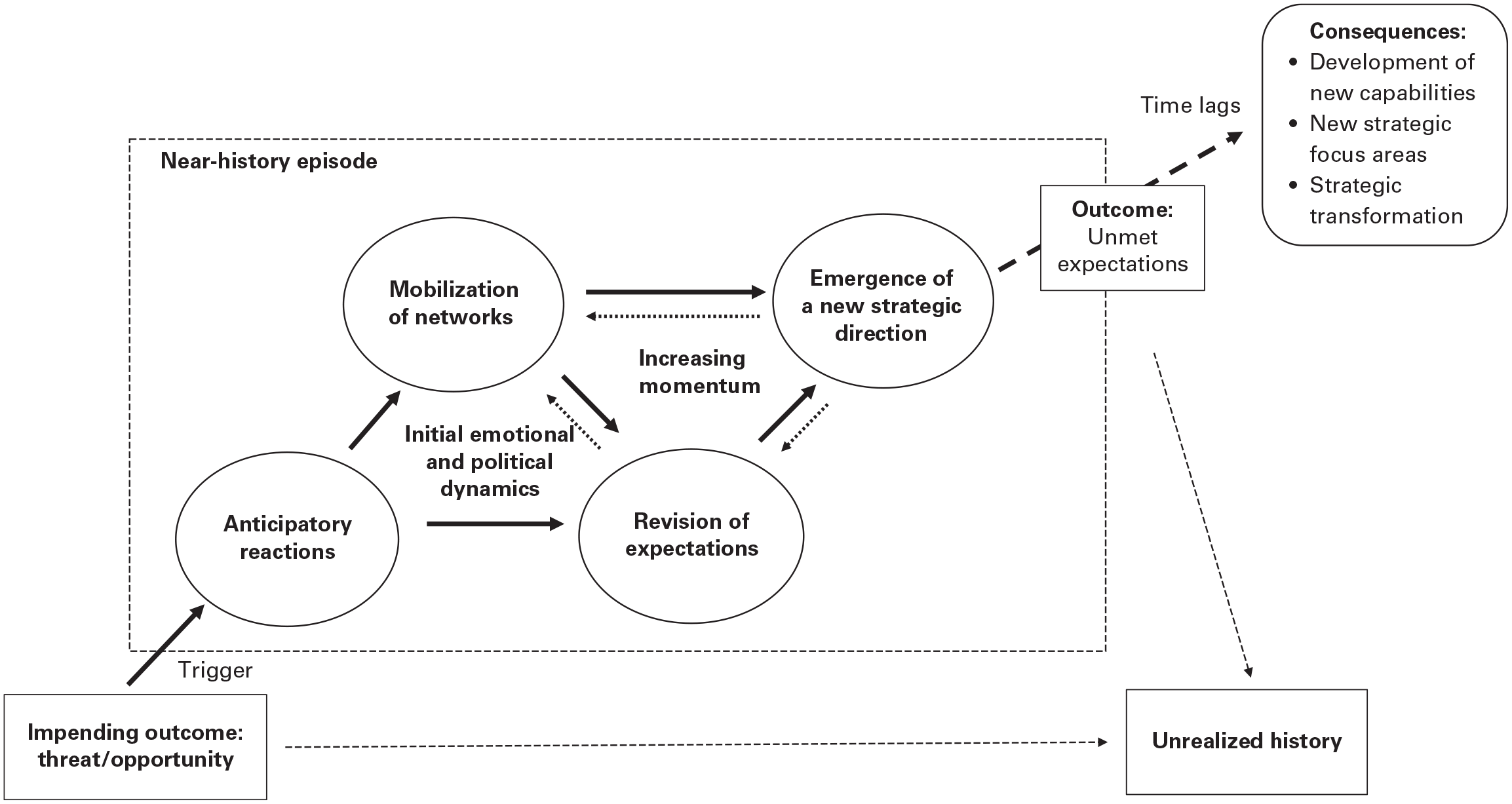
A Process Model of the Role of Near-Histories in Strategy Emergence
As our two episodes show, a process starts with a trigger—here a threat and an opportunity scenario—resulting in anticipation of an impending outcome. As our two episodes show, anticipatory reactions are emotion-laden—in our episodes this was apparent as a mix of fear and anxiety in the first episode and then as enthusiasm and even frenzy in the second one. Such strong emotions may be essential for getting people sufficiently engaged. Importantly, these initial reactions may then lead to a subsequent mobilization of networks. Thus, emergence becomes dependent on the actions of key people such as Kairamo and their ability to make the most of existing social capital and to skillfully mobilize people through more-formal practices, such as regular top management meetings, as well as through less-formal social interactions.
A revision of expectations among key actors forms the basis for a new strategic direction in this process. In our episodes, this played out in different ways. In the first episode, there was a strong consensus in the Nokia ranks in their joint struggle against the SDP-led threat—and a subsequent change of mood involving mixed emotions. In the second episode, the revised expectations, in turn, meant increasing division among the key people—and a change of mood characterized by more enthusiasm among some middle managers and increasing frustration and disappointment for the top managers, especially Kairamo himself. These revised expectations consequently feed back to the mobilization of networks, which in cases such as ours may result in increasing momentum that can be seen as the dynamic force behind the emergence of a new strategic direction. As it gathers force, the momentum moves expectations and actions toward a new trajectory (upper right-hand corner of Figure 3) that may differ substantially from the initial scenario depicted with the dotted line at the bottom of the figure.
All of this may also result in concrete shorter-term outcomes and longer-term consequences in the form of development of new capabilities and strategic focus areas, ultimately contributing to a fundamental strategic transformation. We emphasize that the actualization of this process is highly dependent on the precarious acts of key people in situ. Thus, our analysis highlights the context-specific nature and unpredictability of such instances of strategy emergence, which may at times nevertheless become key turning points that are easy to dismiss in conventional strategy research.
Our findings also illuminate the two sides of agency in strategy emergence. On the one hand, they reinforce the critique of managerial omnipotence and preoccupation with strategic decisions and related key events in research on strategy evolution (Hodgson, 2007; Thietart, 2016; Winter, 2012). Indeed, the two near-history episodes we focused on are not examples of deliberate strategic plans or decisions leading to strategic change but are, instead, cases of emergent strategies originating from complex interactions that took unpredictable turns. Even more than existing studies of strategy emergence (Burgelman, 1983, 1994; Mirabeau & Maguire, 2014; Mirabeau et al., 2018), our analysis underscores the precariousness and unpredictability of emergence and the often-surprising directions to which it can lead.
On the other hand, we also illuminate another side of strategic agency: how opportunistic strategic maneuvering affects the fabric of events, actions, and their outcomes and consequences. Our two episodes show how Kairamo and his team succeeded in turning a threat scenario to their strategic advantage and how middle managers at Nokia were able to make the most out of an emerging opportunity, even though the original strategic designs had failed to materialize as planned. By uncovering this side of strategic agency, our analysis complements research on luck and chance in strategic evolution (Aspara et al., 2023; De Rond and Thietart, 2007; MacKay and Chia, 2013). Thus, even if emergence is context-specific, precarious, and unpredictable, the people involved—navigating the more or less serendipitous conditions confronting them—play a crucial role in these processes.
Implications for Research on Near-Histories
Our analysis also adds to research on near-histories that has challenged organization and strategy scholars’ preoccupation with positively defined actions and realized events (Cattani et al., 2018; March et al., 1991). In particular, our analysis reframes the predominant perspective on near-histories by shifting the conversation from what could have happened to the material consequences that emerge from anticipation and expectations of unrealized futures. While March and colleagues’ (1991) seminal paper concentrated on organizational learning stemming from such episodes, we highlight the strategic implications of near-histories as active forces that shape decisions, mobilize actors, and redirect trajectories. In doing so, we add a new dimension to this strand of theoretical work.
Our analysis shows that rather than mere what-if scenarios, near-history episodes may serve as generative forces, capable of triggering strategic actions that reorganize priorities even when the anticipated event never materializes. In so doing, our analysis develops a more processual and dynamic understanding of near-histories, emphasizing their role in strategic emergence through cycles of anticipation, reaction, and mobilization. This is important as it complements ongoing research on alternative histories (Engler et al., 2020), counterfactual reasoning (Cattani et al., 2018; MacKay, 2007), and analysis of inaction (Denis et al. 2011; Mantere et al., 2012).
Our analysis also leads to important insights into causal complexity, moving beyond traditional linear causality (Furnari et al., 2021; Misangyi et al., 2016) by showing how chains of anticipatory reactions accumulate into new strategic directions. This highlights a core distinction between realized histories and near-histories: Whereas conventional historical narratives describe events that have unfolded, near-histories function as expected but unrealized events that generate alternative strategic trajectories, effectively shaping reality by their absence. Thus, strategic emergence is not simply a function of realized events but is also driven by the expectation of change itself, triggering mobilization even in cases in which the expected change does not materialize.
This perspective also raises critical questions about equifinality—whether similar outcomes could have emerged through alternative processes (Bennett, 2010; Meuer & Fiss, 2020; Misangyi et al., 2016). While it is difficult to determine whether exactly similar strategic shifts in Nokia’s case would have occurred under different circumstances, our findings suggest that near-histories create distinctive pathways for strategy emergence that differ fundamentally from realized histories. Unlike traditional causal sequences in which past actions determine future outcomes, near-histories generate strategic consequences through expectations, mobilization, and emotional intensity, leading to organizational shifts that would not have occurred otherwise.
Ultimately, our findings suggest that near-histories are not merely unrealized possibilities but a productive and generative force that actively reshapes organizational reality. Paraphrasing Scott (2018, p. 9), a near-history (originally a “non-performed action”) “is not like a black hole, destroying energy and matter; on the contrary, it has the power to generate an entire alternative trajectory in the organizational world, which would not have existed if the original (not-done) action had taken place.” This insight underscores the core value of processual microhistorical analysis—not only in capturing historical complexity but also in revealing how strategic change is shaped as much by imagined futures as by realized pasts.
Using Microhistory in Historically Oriented Strategy Research
Our analysis also adds to historically oriented strategy research by showing how microhistory can be used in a processual analysis of near-histories (Argyres et al., 2020; Hargadon & Wadhwani, 2023; Vaara & Lamberg, 2016). Following the seminal studies of Pettigrew (1985) and Burgelman (1994), we have seen revived interest in historical analysis for good reason: A fuller understanding of strategic change trajectories requires focus on the key turning points and the embeddedness of strategic decisions in their historical contexts (Argyres et al., 2020; Hargadon & Wadhwani, 2023). Nevertheless, our understanding of how to study the actual implications of what did not happen has remained underdeveloped.
Our microhistorical analysis adds to this understanding in four ways. First, by demonstrating the role of our two near-history episodes in strategy emergence at Nokia, our study shows the importance of focusing not only on concrete critical events but also on near-histories. Based on our analysis, it is easy to see how these two near-history episodes paved the way for the transformation of Nokia into a global ICT giant. This finding challenges prevailing narratives about the key turning points in Nokia’s history, which often focus solely on strategic decisions made in the 1990s (Doz & Wilson, 2018; Häikiö & Aunesluoma, 2001a, 2001b). However, it also suggests that similar historical episodes are likely to characterize other company cases. In fact, a close reading of corporate histories, such as Burgelman’s (1983, 1994, 2002) work on Intel, offers examples of such cases even if they have not been highlighted or theorized as significant turning points (Hernes & Feuls, 2024).
Second, our analysis shows that we should look at realized or unrealized strategies not only per se but also as part of microhistorical processes. The value of microhistorical analysis is that it allows us to understand how key actors make sense of situations they face in context (Ericson et al., 2010; Hargadon & Wadhwani, 2023; Maclean et al., 2016) and to pin down “ephemeral but distinct” phenomena (Hargadon, 2021, p. 226) such as strategy emergence. As a result, we can move beyond the dichotomy of unrealized and realized strategies and toward a more nuanced understanding of how plans and visions may not be realized per se but how they trigger interactions that can lead to new strategy emergence. As our analysis shows, zooming in on the lived experiences of key actors and how they navigate the intricate processes around anticipated events adds to our understanding of the origins of such emergence.
Third, our microhistorical analysis also highlights the historical embeddedness of the two episodes we studied, which is especially salient in terms of social relations and context-specific strategy practices. The social relations that form the basis for mobilization of action are, by their very nature, embedded in a sociohistorical context, and we cannot understand what happened in our episodes without considering, for instance, the relationships between Kairamo and the SDP, or Deep Throat, in the first episode or those between Kairamo and Gyllenhammar or Nokia’s increasingly independent middle managers in the second one. But there is more: These relationships were also embedded in the specific conditions of Cold War Finland and the networks of collaboration established between key actors in the Nordic business elite. The strategy practices, in turn, reflect not only what the Nokia managers did but what was typical in the 1970s and 1980s in Nordic countries, especially in Finland. By helping to uncover such relations and practices, we can see the value of microhistorical analysis in highlighting both what is more generally of theoretical interest (the role of social relations and strategy practices in general) and what is unique and interesting in a historical context (relations between corporate leaders and politicians in Finland and Sweden).
Fourth and finally, our analysis underscores the fundamental impact of emotional reactions on strategy emergence and the launching of new strategic directions. Microhistorical analysis here helps to unearth emotions such as fear, anger, enthusiasm, frustration, or frenzy. Such analysis is important as it shows the emotion-laden nature of expectations, which in turn may largely determine whether, when, and how people are mobilized. However, to uncover such emotions is not easy, and thus a careful microhistorical analysis—probably often based on multiple sources of rich individual-level data—is needed to make credible interpretations of the emotional states or moods of the key people in question (see also Vuori & Tushman, 2024).
By focusing on near-histories, our analysis also complements recent discussions about microhistory as a methodology more generally (Bourguignon & Floquet, 2019; Decker, 2013; Hargadon & Wadhwani, 2023; Magnússon & Szijártó, 2013). Microhistorical analysis has thus far focused on uncovering decisions and actions that did happen, while our analysis shows how it can also be used to study what did not happen in the case of near-histories. The point is not to engage in speculative projections of alternative, hypothetical histories but to extend the application of microhistory to near-histories and how expected events may trigger particularly interesting and important organizational processes. In this way, microhistory may serve a special purpose in helping us to develop a more comprehensive and nuanced understanding of key turning points that shape organizational and strategic change trajectories.
Limitations and Future Research
Our analysis has concentrated on a revealing case characterized by a particular cultural and institutional context that reflects unique features. Although we have developed a process model that can be generalized, with due caution, beyond this context, future studies should also study near-histories in other sociohistorical circumstances and compare the findings. We have focused on two specific types of near-histories based on a threat and an opportunity scenario. Other cases of near-histories may not fall neatly into these categories, and there are likely to be other types of near-histories that deserve special attention in future research.
As our episodes show, microhistory can help us understand historical embeddedness, the analysis of which is crucial to understand the enabling and constraining factors in strategy emergence or strategic change more generally (Burgelman et al., 2018; Suddaby et al., 2020; Vaara & Lamberg, 2016). Future studies could follow suit and examine different decision-making and strategy practices, also informal ones, in situ. Future research could focus on other sociohistorical settings and highlight the role of other types of historically embedded social practices at play.
A key theme arising from our analysis is the central role of emotions. On one hand, emotions are inextricably tied to expectations and thus play a key role in emergence. On the other hand, emotions are a key element in the creation and mobilization of networks. Although we have highlighted these connections, future studies could take additional steps to elaborate the micro-level processes at play, for instance by using insights from appraisal theory or emotion regulation (Bradley et al., 2024; Huy & Zott, 2019; Vuori & Huy, 2016, 2022).
While our analysis has highlighted the importance of social ties and networks, future studies could take additional steps by examining them in different settings. As our analysis has demonstrated, it is not only a question of social capital but how specific social relations are mobilized and new ones are developed in strategy emergence and strategic change more generally (Mintzberg & Waters, 1985; Mirabeau & Maguire, 2014; Rindova & Martins, 2021).
While we have studied near-histories, future studies could broaden the scope in analyzing what did not happen. This could involve microhistorical analysis of inaction (Andrevski & Miller, 2022) or struggles among key decision makers, middle managers, or other actors over alternative ideas or plans that never materialized. Such analysis would not only complement our understanding of the microdynamics of near-histories but also add to research on the micropolitics of strategic change more generally. It could specifically highlight the voices that are often marginalized or easily forgotten in retrospective historical analysis and could be used to challenge our prevailing conceptions of what is typical or normal, as microhistorical studies have called for (Ginzburg, 2013; Peltonen, 2001).
Finally, we have focused on largely forgotten near-histories but have not examined the processes of remembering and forgetting per se. It would be interesting to examine cases such as ours from a perspective of how the key actors selectively forget, remember, or manipulate memories of the past. Such analysis could be linked with research on organizational and historical memory (Mena et al., 2016) and how it impacts sensemaking or future decision making (Caglio, 2004; Csaszar & Levinthal, 2016; Hatch & Schultz, 2017; Suddaby et al., 2020). It could also have implications for broader discussions of temporality in organizational and strategic change.
Supplemental Material
sj-pdf-1-asq-10.1177_00018392251355283 – Supplemental material for Near-Histories and Strategy Emergence: A Microhistorical Perspective
Supplemental material, sj-pdf-1-asq-10.1177_00018392251355283 for Near-Histories and Strategy Emergence: A Microhistorical Perspective by Juha-Antti Lamberg, Eero Vaara, Pasi Nevalainen and Henrikki Tikkanen in Administrative Science Quarterly
Footnotes
Acknowledgements
We would like to extend our deepest gratitude to our editor, Christina Ahmadjian, and the three anonymous reviewers for their constructive comments and guidance throughout the review process. We also thank the participants of seminars at Aalto University, Lancaster University, Newcastle University, the University of Cambridge, the University of Helsinki, the University of Jyväskylä, and the University of Oxford for their insightful comments and feedback. We are especially grateful to Kushagra Bhatnagar, Zeerim Cheung, Juha Laurila, Antti Määttä, Kalle Pajunen, and Antti Sihvonen for their valuable feedback. Additionally, we appreciate the research assistance provided by Jan-Peter Gustafsson, Lorenzo Maulini, Akseli Saarinen, and Jarmo Taskinen.

1
After Kairamo’s suicide in December 1988, Gyllenhammar attended the funeral; he was the only person who was not a family member or Nokia executive, which underscored the significance of their personal relationship.
Authors’ Biographies
References
Supplementary Material
Please find the following supplemental material available below.
For Open Access articles published under a Creative Commons License, all supplemental material carries the same license as the article it is associated with.
For non-Open Access articles published, all supplemental material carries a non-exclusive license, and permission requests for re-use of supplemental material or any part of supplemental material shall be sent directly to the copyright owner as specified in the copyright notice associated with the article.
