



Abstract
Science is fundamental to the innovation process; however, not all scientific ideas significantly contribute to shaping technological developments. In this article, we argue that, despite having strong incentives to build on the most promising ideas, inventors rely more on research conducted by men than by women. We analyze the citations that scientific papers receive in patented inventions and find that the papers authored by women scientists receive fewer citations, both in a large sample of over 10 million papers and in a smaller sample of simultaneous discoveries. We systematically explore the mechanisms underlying this finding, including an online experiment conducted with 400 individuals holding science doctoral degrees. Our results suggest that the gender disparity in patent-to-paper citations is unlikely to stem entirely from supply-side mechanisms such as access to resources, networks, and scientific style. Instead, the results align with demand-side explanations, in particular the notion that inventors pay more attention to and place higher value on scientific publications authored by men. These findings have implications for our understanding of friction in science-based technology development, as well as for broader theories of how gender inequality shapes cumulative innovation.
Innovation results from combining old ideas into new ones (Leahey et al., 2017; Lingo & O’Mahony, 2010; Schumpeter, 1934). One of the most important sources of innovation is science-based invention, by which inventors build on scientific research to develop new technologies (Fleming & Sorenson, 2004; Murray, 2010; Stuart & Ding, 2006). Not all scientific ideas are recombined at the same rate, however. Some capture the spotlight and become the foundation for future generations of innovations. Others linger in the shadows (Murray & O’Mahony, 2007). In principle, inventors have strong incentives to rely on the most promising scientific ideas, since the quality of those ideas is directly related to the success of subsequent inventions (Fleming & Sorenson, 2004; Krieger et al., 2024; Poege et al., 2019). In other words, if innovation depends on “standing on the shoulders of giants,” one would naturally aim to stand on the tallest shoulders. 1 And yet, the challenge in staying abreast of scientific research is considerable. The landscape of science is vast, fast-changing, complex (Agrawal et al., 2016; Jones, 2009), and often unreliable (Bikard, 2018), and the visibility of scientific findings varies widely (Fry & MacGarvie, 2023; Merton, 1968). Examining why inventors rely more on some scientific ideas than others is thus essential for understanding the innovation process.
Most explanations for why inventors embrace certain scientific ideas focus on the nature of those ideas or the context in which they arise. An unexplored question in this literature is how scientists’ standing within the academic profession might influence the technological impact of their ideas—that is, inventors’ reliance on their research. This omission is surprising, since we know that social inequality among scientists has consequences for other important outcomes, such as the degree of recognition that these scientists receive from their peers, as well as their own propensity to engage in technology development (Azoulay et al., 2013; Merton, 1968; Zucker et al., 1998). Among the various factors contributing to social inequality among scientists, gender and its role in shaping academic rewards has been the focus of considerable research (Ding et al., 2006; Leahey et al., 2010; Lerman et al., 2022; Long, 1992). In particular, a large body of literature has shown that women’s research obtains less credit and recognition from their academic peers, with women-authored publications receiving fewer citations, on average, than those authored by men (Caplar et al., 2017; Dion et al., 2018; Dworkin et al., 2020; Ferber & Brün, 2011; Maliniak et al., 2013; Teich et al., 2022). Extant research, however, has yet to examine the possibility that gender inequality not only impacts scientists’ academic recognition but may also affect the extent to which inventors rely on their research in technology development and, thus, the technological impact of their ideas. This is the question that we examine in this article.
Understanding the role of gender inequality in shaping inventors’ reliance on scientific research is important for several reasons. First, it obviously matters for the scientists themselves. Differences in the integration of scientists’ research into the technology development process may affect their career opportunities, which could, in turn, play a role in the income disparity observed among academic scientists (see Ding et al., 2021). Second, it matters for our understanding of the interface between science and invention, as friction in the transfer of scientific ideas to inventors can hinder the development of new technologies. Finally, it matters for the direction of innovation. For example, recent work has shown that women scientists in biomedical research are more likely to concentrate on diseases predominantly affecting women, compared to their male counterparts (Koning et al., 2021). If reliance on women’s scientific contributions is lower among inventors, it could lead to reduced likelihood of developing treatments for diseases that disproportionately affect women.
We claim that gender inequality in the academic profession makes women’s research less likely to be at the forefront of inventors’ considerations when developing new technologies. Building on gender inequality research, we discuss the various supply-side and demand-side factors that might drive this phenomenon. Supply-side arguments suggest that women’s lower standing in academic science may make their work less salient for inventors, e.g., if women have less access to social networks or conduct different types of research (Lerchenmueller et al., 2019; Murray & Graham, 2007). Demand-side arguments imply that gendered status beliefs result in women’s contributions being granted both less attention and lower evaluations than similar contributions made by men (Correll & Benard, 2006; Tak et al., 2019). Hence, despite the strong incentives for inventors to build on the most promising science, we expect that they will rely less on scientific research conducted by women than that by men.
Testing this expectation is exceedingly difficult, for several reasons. First, we need to somehow capture the extent to which inventors rely on scientists’ research when developing new technologies. Second, since the potential of scientific ideas is largely unobservable, observed differences in inventors’ reliance on men’s and women’s ideas could be attributed to differences in the underlying value of the ideas themselves. Third, even when scientific ideas hold comparable potential, a range of factors from both the supply side (such as scientists’ own characteristics) and the demand side (including inventors’ attention to and evaluation of scientists’ work) can influence the extent to which inventors rely on these ideas in technology development. To address these challenges, we use four different and complementary approaches.
We follow recent literature using citations to papers in patents as a measure of the flow of academic research into new technologies (Bikard, 2018; Marx & Fuegi, 2020; Roach & Cohen, 2012). To better understand the process of science-based invention in general and to assess the validity of patent-to-paper citations as indicators of inventors’ reliance on research (as opposed to reflecting credit attribution or legal considerations), we first gained insights from 52 interviews with both scientists and inventors. Second, we established the broader relationship between scientists’ gender and inventors’ reliance on their publications, by analyzing patent citations to a sample of over 10 million scientific articles. Third, to account for general differences in the technological potential of men and women’s scientific ideas, we zoomed in on a sample of 185 scientists involved in “paper twins” (i.e., when different teams of scientists publish essentially the same ideas around the same time; Bikard, 2020, p. 1529). Finally, we further investigated the causality of the relationship and the underlying mechanism by conducting an online experiment with a sample of 400 science doctoral degree holders. In this experiment, we examined the impact of randomly assigning either a male or female first name to the (fictitious) main author of a scientific abstract on participants’ attention to and evaluations of the research.
To the best of our knowledge, our article is the first to focus on gender inequality in patent-to-paper citations. To gauge the existence of this inequality, we started by exploring over 60 million scientific papers published between 1980 and 2020. Summary statistics reveal a large gender gap in patent citations to papers that is consistent across fields and over time (see Figure 1). As we show in the results section, this gap remains significant after incorporating a wide range of controls in both our sample of over 10 million papers published in the top 5 percent of journals ranked by their commercial impact factor (JCIF) and in our paper twins dataset. We then examined whether the gender gap primarily arises from supply-side factors, such as access to resources, networks, and scientific style, or demand-side factors, namely inventors’ attention to and evaluation of those papers. Our results predominantly support the latter explanation. Nevertheless, because observational patent citation data are not ideally suited to infer causality or identify specific demand-side mechanisms, we concluded our study with an online experiment. We find that abstracts presumed to be authored by men attract more attention (as measured by reading time) and are deemed more important by the respondents.
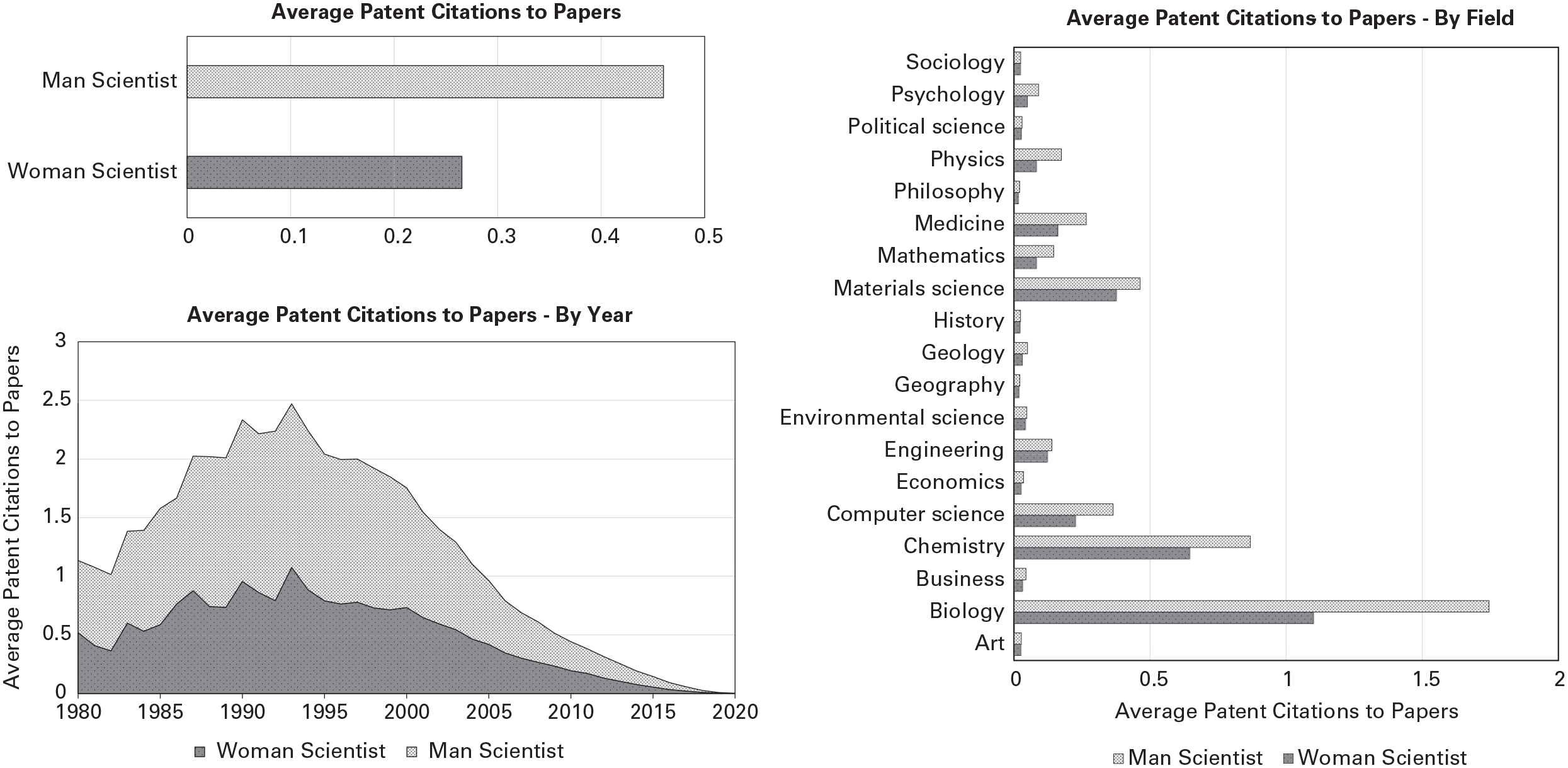
Summary Statistics: Gender and Patent-to-Paper Citations (N = 60,424,104)
The overall pattern of evidence suggests that gender inequality in academic science impacts inventors’ reliance on scientific ideas in the technology development process. Differences in attention to and evaluation of those ideas likely contribute to this phenomenon. We discuss the implications of these results for research on both innovation and gender inequality in science and technology.
Gender Inequality and the Technological Impact of Scientific Ideas
Inventors’ Reliance on Science
A large body of literature seeks to understand the process through which scientific ideas have technological impact, that is, are incorporated into new technologies (Ding et al., 2006; Murray & O’Mahony, 2007). Inventors have strong incentives to build on the most promising ideas, since relying on high-quality science to develop technology generates higher monetary and non-monetary value for their patents (Fleming & Sorenson, 2004; Krieger et al., 2024; Poege et al., 2019). Given these incentives, the intrinsic potential of an idea should be the most important determinant of its future exploitation. Yet, there are many anecdotes of breakthroughs that were ignored at first (Chai, 2017; Chesbrough & Rosenbloom, 2002) and many others of ideas that received much more attention than they deserved (Goldfarb & Kirsch, 2019).
A key reason hindering the exploitation of promising scientific ideas is the sheer challenge of identifying them. A deluge of scientific manuscripts are published each year (Agrawal et al., 2016; Jones, 2009; Pammolli et al., 2011), and inventors can build on academic research only if they are aware of it. Innovation scholars thus emphasize the role of attention and evaluation as first steps in science-based invention, leading them to investigate various contextual factors that shape those. For example, there is evidence that geographic location matters, as inventors are more likely to build on discoveries that are produced closer to them or in hubs of relevant industrial R&D (Bikard & Marx, 2020; Jaffe et al., 1993). Similarly, inventors use scientific papers’ institution of origin as a cue. They are less likely to pay attention to discoveries made by academic scientists than to those made by industrial scientists, due in part to concerns about the replicability of academic research (Bikard, 2018).
While much of this research has focused on the context surrounding the generation of scientific ideas, it is worth considering that the identity of the idea’s creator may also influence the extent to which it will be relied on for technology development. This is an unexplored question in the literature, yet it is pertinent to raise it because we know that scientists’ standing among the academic community has consequences for other critical outcomes. A long tradition of research shows that scientists’ status within the profession is an important source of career rewards, including publication rates (Simcoe & Waguespack, 2011), peer recognition (Azoulay et al., 2013; Merton, 1968), and participation in commercial science (Zucker et al., 1998). Status inequalities stem from various factors such as education (e.g., Polanyi, 1962), awards (e.g., Azoulay et al., 2013), and the prestige of one’s position (e.g., Sine et al., 2003). In this article, we focus on scientists’ gender, which is a key driver of inequality among them.
Gender Inequality and Science-Based Invention
A large body of literature has shown that women scientists face higher career obstacles than those faced by their counterparts who are men. A recent historical analysis of scientific careers across countries and disciplines found an increasing gender gap in productivity over time, with women having shorter publishing careers and higher dropout rates from the profession (Huang et al., 2020). On average, women scientists have lower productivity (Ceci et al., 2014; Long, 1992), are less likely to be promoted (Leahey et al., 2010), and have lower earnings than those of men scientists (Ding et al. 2021). They are also less likely to commercially exploit their own research, both in the form of patents and through other avenues such as participation in scientific advisory boards (Ding et al., 2006; Koffi & Marx, 2023; Koning et al., 2021; Murray, 2010; Owen-Smith & Powell, 2001). 2
Additionally, substantial evidence shows that women scientists obtain less recognition than men scientists obtain from their academic peers—often for comparable levels of achievement or for collaborative work (Ross et al., 2022; Sarsons, 2017). This phenomenon has been referred to as the Matilda Effect—named after American suffragist Matilda J. Gage—by analogy to Merton’s Matthew Effect (Knobloch-Westerwick et al., 2013; Rossiter, 1993). The most extensively analyzed form of recognition is the attribution of credit to scientists by referencing their work in paper citations. Besides functioning as a source of career rewards, academic citations are a way to honor the collective building of science through norms of appreciation and communalism (see Merton, 1973). When citing other scientists’ work, researchers inscribe into their own papers esteem for their peers (Azoulay et al., 2013). By this measure, women scientists, even those of the highest status, are systematically less likely than their male counterparts to be recognized (Lerman et al., 2022). This is the case across many fields, including economics (Ferber & Brün, 2011), science and medicine (Beaudry & Larivière, 2016), neuroscience (Dworkin et al., 2020), physics (Teich et al., 2022), and political science (Dion et al., 2018). These gender disparities in academic citations can stem from various factors. Some, like the representation of women in the focal field or gender differences in publication records, are relatively straightforward to analyze. Others, such as the inherent potential of men’s and women’s ideas, possible biases in scholars building on these ideas, or scholars’ impartiality when crediting the authors of these ideas, are extremely challenging to observe (see Dion et al., 2018).
We focus specifically on inventors’ greater reliance on some scientific ideas than on others, as apparent in patent-to-paper citations. As we explain below, in contrast to paper citations, credit attribution does not play a significant role in this context. Nonetheless, the theoretical mechanisms that plausibly account for disparities in inventors’ reliance on science are similarly informed by research on gender inequality, which considers both supply-side (scientists) and demand-side (inventors) factors. On the supply side, the underrepresentation and lower standing of female scientists in academia may lead to their work being less salient or visible to inventors. If, for instance, women have less access to resources or social networks (Meng, 2016; Murray & Graham, 2007) or conduct different types of research, their work may receive less exposure within the inventor community. It is also possible that men and women conduct similar research but in distinct ways, such as using different language (Lerchenmueller et al., 2019) or adopting research styles with differing visibility (see Barinaga, 1993). Any of these gender differences in scientists’ characteristics, resources, or behavior may contribute to inventors’ reduced reliance on women’s ideas.
On the demand side, inventors may respond differently to research authored by women compared to men. Gender is a powerful cultural frame that structures beliefs about the relative competence of individuals and, thus, audiences’ responses to men’s versus women’s work (Ridgeway & Correll, 2004). For example, according to status-beliefs theory, contemporary gender stereotypes in the U.S. incorporate beliefs that in many social and economic domains, men are more competent and worthier of status (Fiske et al., 2002; Ridgeway, 2011). These beliefs have important implications, as they shape the attention that women receive from audiences as well as those audiences’ evaluation of their work. People pay more attention to high-status actors in the sense that they notice their contributions more than those from lower-status actors, even to the extent that they look more at them during meetings (Foulsham et al., 2010; Masters-Waage et al., 2024). People also tend to implicitly devalue the work of lower-status actors, including women. This has been shown to damage women’s career outcomes in various contexts, such as executive positions, creative and professional work, and entrepreneurship (Botelho & Abraham, 2017; Brooks et al., 2014; Castilla & Benard, 2010; Proudfoot et al., 2015; Rivera & Tilcsik, 2019). Status beliefs about gender can also be transferred from the individual to their products. As Tak et al. (2019) have shown, products created by women received lower evaluations than the identical products created by men. This devaluation of women’s offerings has been shown in other settings such as entrepreneurship (Kanze et al., 2020) and science communication (Knobloch-Westerwick et al., 2013), while a recent study of managers’ evaluations of their employees’ ideas did not find a bias against women (Dahlander et al., 2023). If gendered status beliefs are present in science-based invention, this could result in inventors paying less attention to women’s scientific ideas and valuing them less favorably.
Thus, prior research leads us to expect that both supply- and demand-side mechanisms would result in inventors relying less on female-led research. Such lower reliance might have important implications for technology development. We next describe how our empirical context allows us to test this hypothesis.
Context: Patent-to-Paper Citations in Technology Development
Given the vast number of inventors working globally over decades, assessing how they rely on academic science when developing new technologies is a significant challenge. One possible approach is to conduct a large-scale survey (e.g., Cohen et al., 2002). However, this strategy has notable drawbacks: Its scale is limited, responses are susceptible to recall bias, and its practicality is constrained by the difficulty of obtaining contact information for inventors. Instead, a growing literature has taken advantage of the availability of citations to scientific publications in U.S. patents (Ahmadpoor & Jones, 2017; Bikard, 2018; Fleming & Sorenson, 2004; Gittelman & Kogut, 2003; Krieger et al., 2024; Marx & Fuegi, 2020; Narin et al., 1997). When inventors submit an application to the U.S. Patent and Trademark Office (USPTO), they are required to include citations to scientific publications that are relevant to their invention. This creates a paper trail for their reliance on the scientific literature at the time of invention. In comparison to patent-to-patent citations (e.g., Jaffe et al., 1993), patent-to-paper citations are advantageous because they are less likely to have been added by the patent examiner (Lemley & Sampat, 2011) and are a better measure of knowledge flow from academia to inventors (Roach & Cohen, 2012). Bikard and Marx (2020) conducted interviews with inventors to better understand the process leading to patent-to-paper citations. They found that these citations tended to be added by the inventors rather than by their attorneys. Importantly, the citations did not appear to be exhaustive. Rather, they primarily captured inventors’ general attention to and evaluation of the scientific literature related to their invention.
To further substantiate the relevance of patent-to-paper citations for the purposes of our study, we conducted a fresh analysis of the full transcripts of 52 interviews with scientists and inventors that were carried out by one member of our author team (see Online Appendix A1 for details). Our goal was to understand both the role that these citations play in the patenting process and the key factors that inventors consider when selecting which papers to cite in their patents. The interviews highlight that patent-to-paper citations are very different from paper-to-paper citations, as the former are not meant to acknowledge or give credit to all relevant work on the topic. 3 Our interviewees claimed to be conscientious when including citations in their academic papers. For example, one stated, “you absolutely know that careful attention is being paid to these references because it is a matter of etiquette, and it is a matter of working in a scientific community and acknowledging carefully the work of others.” The same is not true in patent-to-paper citations. In the words of one interviewee, “When you write a paper you’re going to be, I think, much more careful in terms of citing everything. A lot of people whose work you are citing are never going to read that patent application.”
Rather than being a venue for giving credit to prior work, patent-to-paper citations appear to reflect inventors’ reliance on the relevant scientific literature at the time. When asked about the non-inclusion in their patents of apparently relevant citations, interviewees repeated that they had not attempted to be exhaustive: There are papers that we know and other papers that we don’t know. And then unintentionally we then probably are citing a paper that we know better, or that we have been reading before, and then the second one we did not even read. I don’t know. It has not been a complete search of the literature to cite every paper that would have been relevant for this connection. This is how it is.
Overall, our qualitative evidence suggests that when applying for patents, inventors cite scientific publications that are top of mind and that they deem relevant.
Thus, following prior literature (e.g., Gittelman & Kogut, 2003; Krieger et al., 2024; Marx & Fuegi, 2020), we propose that these citations can be used as bibliometric fossils recording inventors’ reliance on men’s and women’s scientific ideas over time. If, as we posit, inventors rely relatively more on research authored by men, we should observe that scientific publications receive fewer citations in U.S. patents if their main author is a woman than if it is a man.
Empirical Design
In an ideal experiment, scientists would be randomly allocated a gender, and inventors’ reliance on those scientists’ ideas would subsequently be tracked. Random allocation would guarantee the internal validity of the findings, while access to the entire population of academic researchers would address any concerns regarding external validity. Of course, ideas do not randomly end up in the minds of men or women, and the proportion of women varies greatly across scientific fields (Ceci et al., 2014; Koning et al., 2021). Selection into scientific projects is a source of bias if unobserved differences in the potential of ideas are correlated with the unequal presence of men and women in those projects. To get as close as possible to the ideal experiment, our research design entails three different and complementary studies.
First, we used a large sample including millions of scientific articles, from which we correlated the gender of the main author with the article’s citations in patents. The key advantage of this approach is that the scale of the dataset allowed us to identify broad patterns that span fields and decades. Its main drawback is the challenge of establishing causality, complicated by the heterogeneity of individuals and projects within such large samples. In this analysis, we could not rule out the possibility that gender differences in patent citations to papers are influenced by variations in the nature of discoveries made by women and men or by unobserved differences between them. Next, we zoomed in on a set of paper twins: instances in which different teams of scientists led by women and led by men publish essentially the same idea around the same time. This approach was useful because it allowed us to control for the otherwise unobservable potential of ideas produced by men and women scientists (Bikard, 2020). Still, it is not as good as randomly assigning gender because even if their ideas are essentially the same, the men and women involved in the paper twins dataset might differ in ways that we could not observe. Finally, we conducted an online experiment in which participants assessed the value of a scientific idea, having been randomly assigned to read a paper abstract attributed to either a man or a woman author (following, e.g., Knobloch-Westerwick et al., 2013). The main benefit of this approach was its ability to establish the causal effect of scientists’ gender on how their research is perceived. Internal validity comes at the expense of external validity, however, as participants could not perfectly mirror our population of interest. Each of the three studies thus provided different advantages in terms of both generalizability and identification of the potential mechanisms driving inventors’ differential reliance on research authored by men and by women.
Large Sample Analysis
Empirical setup
Our goal was to assess the correlation between the gender of an article’s main author and the number of times it is cited in patents, using a large sample that represents a substantial share of the scientific literature relevant to technology development. For this analysis, we considered the Main author to be the last author listed in the paper, which in many fields is the “lab head” or principal investigator (see Koffi & Marx, 2023, for a similar approach). 4 We allocated a gender to all authors based on their first name. 5 Specifically, we used a cutoff of 0.9 for the likelihood score of the name being feminine, as per Van Buskirk et al. (2023). 6 We accounted for other potential individual differences beyond gender with controls used in prior studies (e.g., Bikard et al., 2018). These include main authors’ prior patents and publications, their experience, and whether they are based in the U.S. Since publications, patents, and experience are skewed in our data, we used the log of those variables in the analyses. We also included several team-level controls: the share of women authors, the share of authors based in the U.S., the number of authors, and whether the article includes at least one author based in a firm. Finally, the analysis incorporates journal-level controls, specifically the journal’s impact factor and its commercial impact factor (JCIF) (Bikard & Marx, 2020). Our dependent variable, patent-to-paper citations, is a count variable. Following established practice in studies of science and technology (Azoulay, Wahlen, et al., 2019; Azoulay, Fons-Rosen, et al., 2019; Reschke et al., 2018), we used a fixed effects Poisson model with conditional quasi-maximum likelihood estimates. This approach ensures consistent coefficient estimates provided that the dependent variable’s mean is specified correctly. Fixed effects at the field-year level account for differences in the accumulation of patent citations to scientific articles across field-years.
Dataset
We collected data from SciSciNet (Lin et al., 2023) on all research articles published between 1980 and 2020. Of these 74,525,452 articles, we dropped 14,101,348 for which the authors’ first name was unavailable, since we could not systematically establish gender in those cases. We were left with 60,424,104 articles, which we used to produce Figure 1. This sample includes a large variety of articles, the vast majority of which are published in low-quality outlets and/or investigate topics completely irrelevant to technological development. To focus on the more relevant research and to bring the sample to a computationally manageable size, we restricted our analysis to articles published in the 5 percent of journals with the highest JCIF (Bikard & Marx, 2020). This left us with 10,098,345 articles spanning 19 fields across the natural, applied, and social sciences. 7 Data on patent citations to papers stem from Reliance on Science (Marx & Fuegi, 2020). Our 10,098,345 articles were collectively cited 18,541,200 times in 1,174,608 U.S. patents, amounting to 47.9 percent of all U.S. patent citations to the academic literature. This sample includes 2,463,735 main authors, of which 427,250 are identified as women and 2,036,485 as men. We describe the main variables for our analysis in Online Appendix A2, which also includes a correlations table.
Results
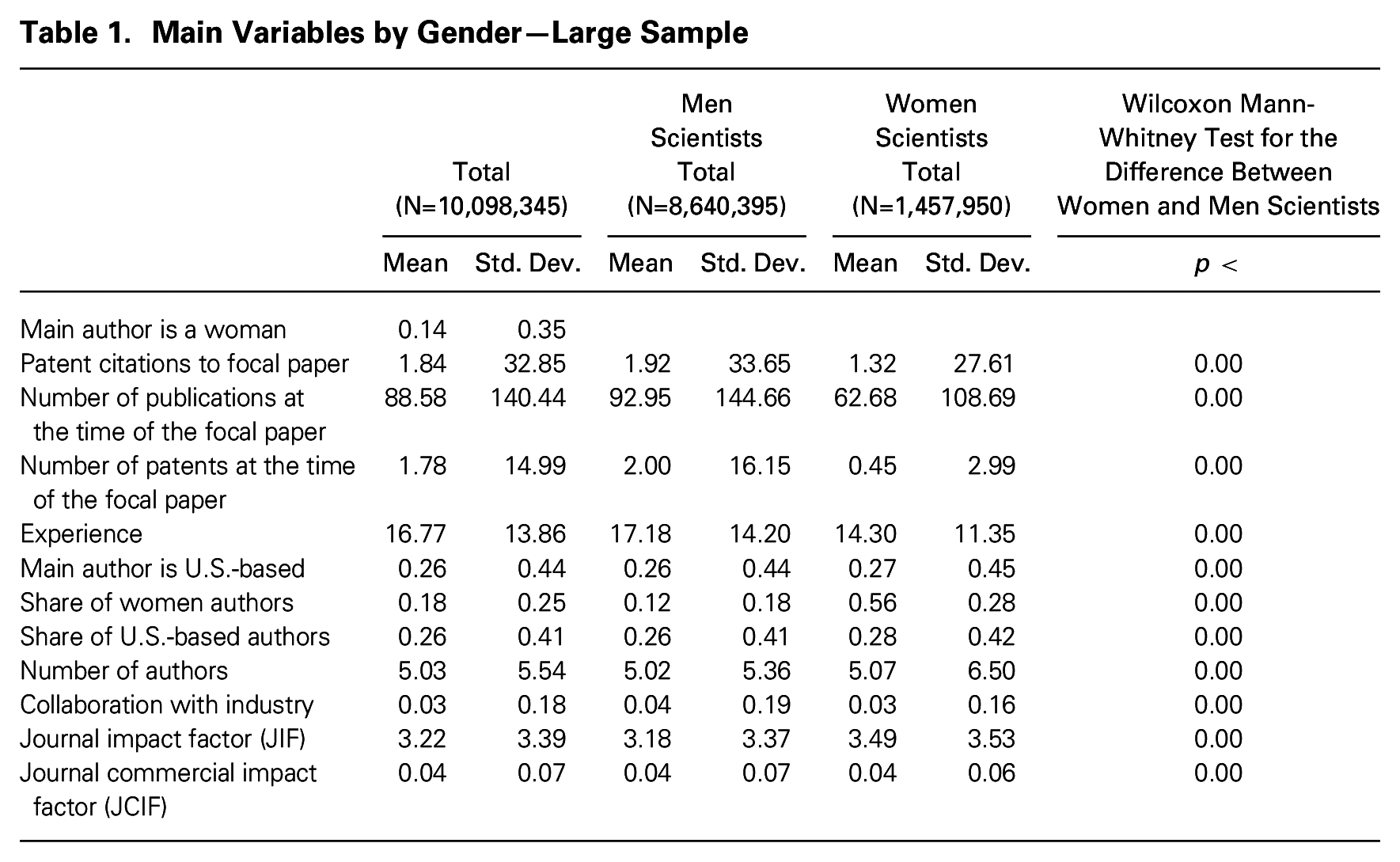
Descriptive statistics as well as difference of means tests are presented in Table 1. The papers in our sample received an average of 1.84 citations in U.S. patents. Articles whose main author is a woman received fewer patent citations, on average, than those whose main author is a man (1.32 vs. 1.92). We also observed other gender differences similar to those highlighted in previous literature. Compared to men, women authors have, on average, fewer publications (62.68 vs. 92.95), fewer patents (0.45 vs. 2.00), and fewer years of experience (14.30 vs. 17.18). They also work with more women: The share of women authors is 56 percent when the main author is a woman and only 12 percent when the main author is a man.
Main Variables by Gender—Large Sample
Models 1–6 in Table 2 present a series of Poisson regressions with field-year fixed effects and robust standard errors clustered at the level of field. Model 1 shows a simple correlation between Main author is a woman and the count of patent citations to the paper. The –0.256 coefficient (p < 0.001) corresponds to a 23 percent gender gap in patent citations to papers. Model 2 adds individual-level controls. Number of patents at the time of the focal paper and Main author is U.S.-based are positive predictors of patent citations to papers, whereas Number of publications at the time of the focal paper has a negative coefficient. Gender inequality is still visible after the inclusion of these controls: The –0.148 coefficient for Main author is a woman corresponds to a 14 percent gender gap in patent citations. Model 3 adds team-level and journal-level controls. Share of women authors is a negative predictor of patent citations, whereas Share of U.S.-based authors, Number of authors, and Collaboration with industry are positive predictors. Unsurprisingly, both the Journal impact factor and Journal commercial impact factor are strong predictors of patent citations to papers. Even after including these controls, the coefficient for Main author is a woman remains statistically significant (p < 0.01), amounting to a 7 percent gender gap in patent citations to papers.
Main Effect: Gender Differences in Patent Citations to Papers in the Large Sample*
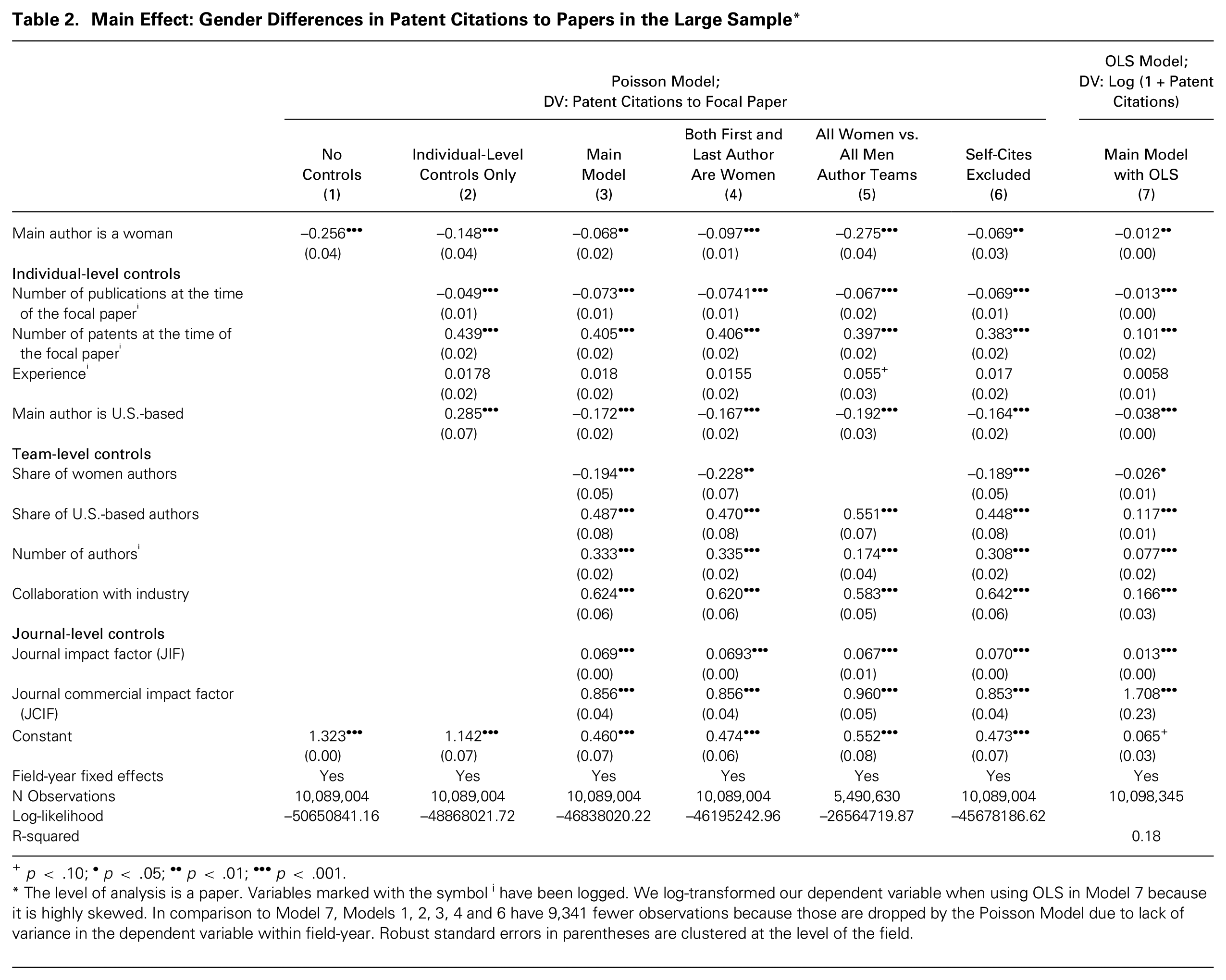
p < .10; • p < .05; •• p < .01; ••• p < .001.
The level of analysis is a paper. Variables marked with the symbol i have been logged. We log-transformed our dependent variable when using OLS in Model 7 because it is highly skewed. In comparison to Model 7, Models 1, 2, 3, 4 and 6 have 9,341 fewer observations because those are dropped by the Poisson Model due to lack of variance in the dependent variable within field-year. Robust standard errors in parentheses are clustered at the level of the field.
Models 4–7 examine the robustness of this main result. Models 4 and 5 use stricter criteria for determining authorship by women. In Model 4, Main author is a woman equals one if both the first and last authors on the focal paper are women. Model 5 limits the sample to papers with only men authors and papers with only women authors. In Models 4 and 5, we observed that the gender gap in patent citations persists and, in fact, increases to magnitudes of 9 and 27 percent, respectively. Since men patent more than women do (e.g., Ding et al., 2006), self-citations to their own papers in patents could be driving our effect (e.g., King et al., 2017). Model 6 shows that the coefficient for Main author is a woman remains essentially unchanged when we excluded self-citations. Finally, Model 7 replicates the main findings from Model 3 but uses OLS instead of a Poisson model. In sum, our large sample analysis indicates that women receive fewer patent citations to their scientific ideas than men do—even after accounting for a host of individual-level, team-level, and journal-level controls. In a separate set of analyses presented in Online Appendix A3, we found no clear evidence that this effect varies with the proportion of women in a subfield. However, we found evidence that the effect is stronger for scientific papers focusing on women’s health and weaker for older publications. Next, and to get a more granular understanding of the potential mechanisms underlying this phenomenon, we focus on instances in which women and men scientists made the same discovery.
Paper Twins Analysis
Empirical setup
We aimed to assess the correlation between the gender of an article’s main author and its citations in patents, in a sample in which men and women scientists published essentially the same scientific idea. Specifically, we used simultaneous discoveries, instantiated as sets of paper twins (Bikard, 2020), as a type of natural experiment, which allowed us to control precisely for the potential of men’s and women’s ideas (see Figure 2). Main author for this analysis is the corresponding author of the paper. 8 We manually collected detailed information about the main author of each publication. Each person’s publishing history (through September 2019) stems from ISI Web of Science. We checked affiliation, gender, and Ph.D. graduation year (or MD when the person did not have a Ph.D.) by hand. Scientists’ patenting records (also through September 2019) were obtained through the USPTO website by searching manually for each scientist and patent to ensure that we had identified the right match. We collected patent-to-paper citation data from Reliance on Science (Marx & Fuegi, 2020).
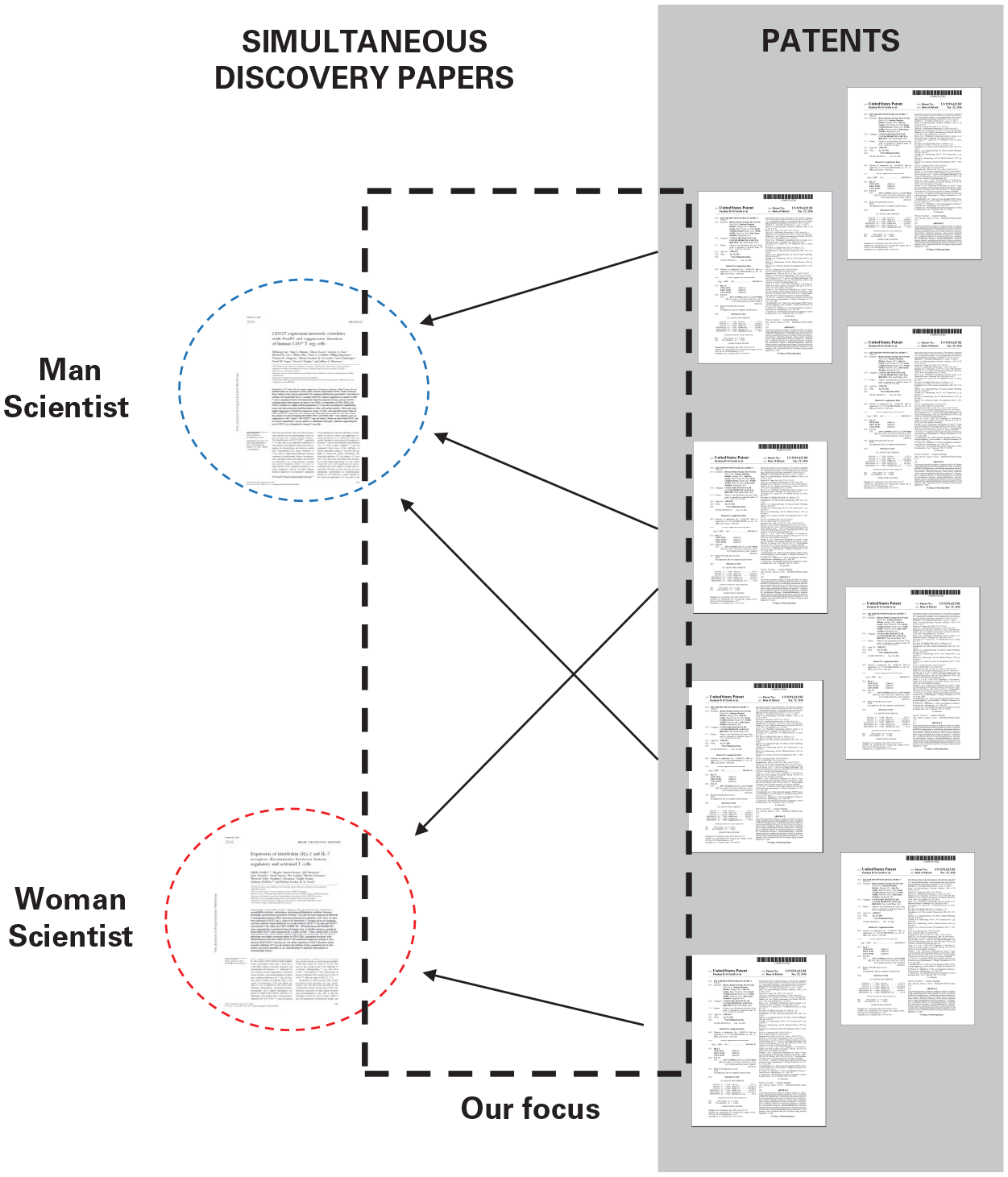
Paper Twins Study Design
We included the same individual- and team-level controls as in the large sample analysis (see variable description in Table A4-1a of Online Appendix A4). In addition, we collected data to examine potential mechanisms both on the supply side and on the demand side. On the supply side (i.e., scientists), we first attempted to capture “scientific style,” which is one of the explanations advanced for the existence of gender differences in innovation (Barinaga, 1993; Hengel, 2022; Lerchenmueller et al., 2019) and may affect inventors’ reliance on scientists’ research. We probed this using a novel approach, by implementing a survey of 44 postdoctoral researchers with expertise in the disciplines represented in our data, as described in Online Appendix A5. The researchers ranked sets of anonymized paper twins along eight dimensions: transparency, sample size, number of analyses, use of jargon, conciseness, clinical emphasis, emphasis on generalizability, and “claims understated.” Second, we measured scientists’ access to resources using the characteristics of their universities (i.e., each university’s prestige in the scientist’s field and its general patenting activity) and whether the scientists had funding from industry for the study. Third, we captured scientists’ networks by measuring the size of their coinventor network, the number of coauthors who are also inventors, and their number of industry collaborations at the time of the simultaneous discovery. In addition, we controlled for whether they worked in a geographic hub of industrial R&D. To examine potential demand-side (i.e., inventors) drivers of the effects, we obtained inventors’ gender via USPTO’s PatentsView data repository and assessed through manual coding whether patent assignees were academic or industrial institutions.
Dataset
Our sample of paper twins is composed of 185 papers disclosing 82 simultaneous discoveries wherein at least one team was led by a man and another was led by a woman. It consists of 68 sets of twins, 7 sets of triplets, and 7 sets of quadruplets. The papers were published between 1994 and 2009, and the average time gap of publication between paper twins of the same set is 1.65 months. The distribution of time differences between twins of the same set is presented in Figure 3. Except for one set of paper twins authored by physicists, every discovery in our dataset belongs to the life sciences, in particular, oncology, genetics, neurosciences, and immunology. This dataset was collected using a similar approach as that described in Bikard (2020), which we summarize in Online Appendix A4. The five-step method is based on the insight that two papers disclosing the same discovery will share the credit for the work, and credit sharing in science is visible in that the literature systematically cites both papers in the same parenthesis or adjacently. 9
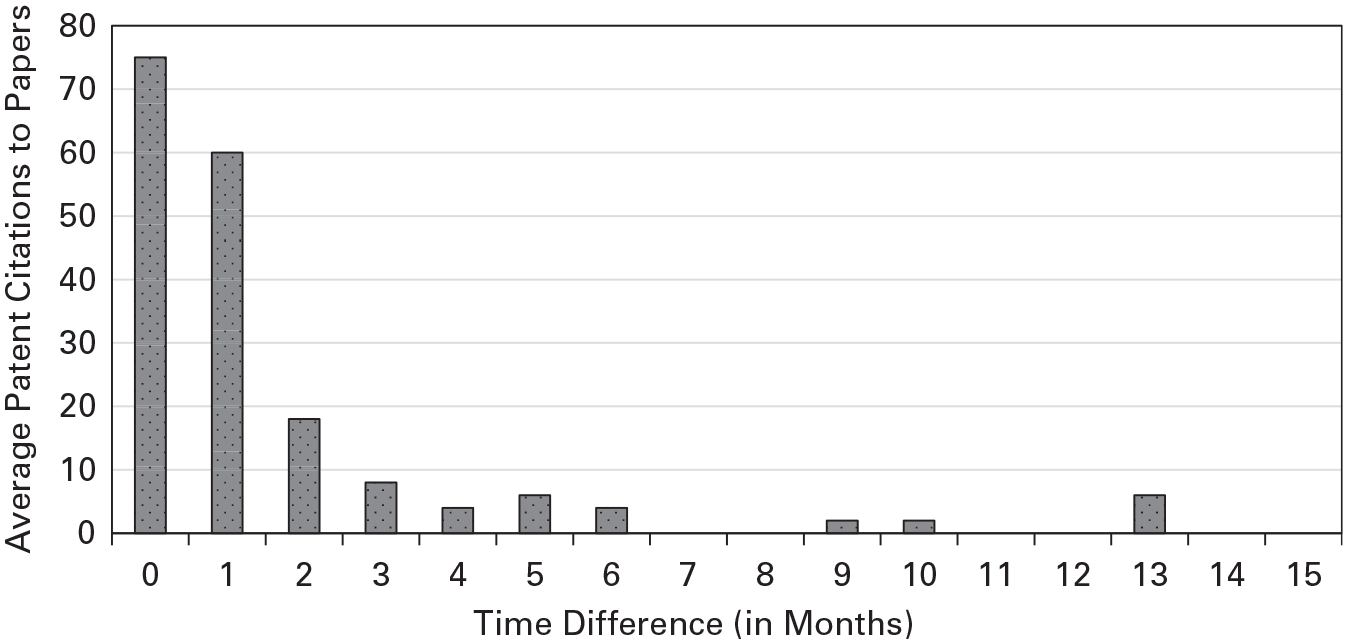
Time Difference Between the Publication of Paper Twins of the Same Set
Main results
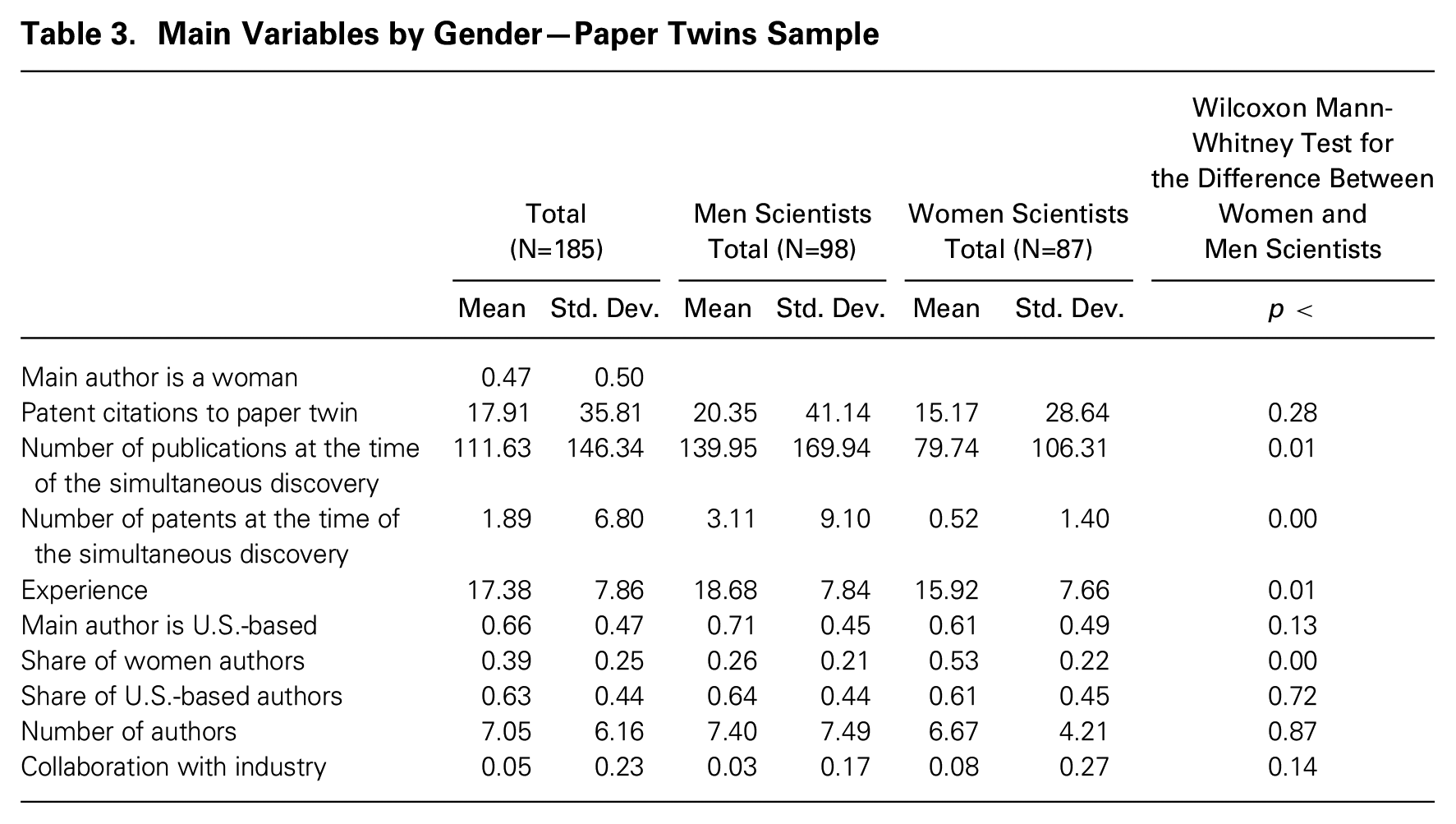
The summary statistics for the main variables are presented in Table 3. There is a non-statistically significant difference in patent citations to paper twins with men vs. women main authors (20.35 vs. 15.17). Even though all authors made essentially the same discoveries, we still observed gender differences similar to those observed in the large sample analysis. Women scientists have fewer years of experience (15.92 vs. 18.68 years), fewer publications (79.74 vs. 139.95), and fewer patents (0.52 vs. 3.11) at the time of the simultaneous discovery. Also, teams led by women include, on average, more women (53 percent versus 26 percent for teams led by men.). 10 Table A4-1b in Online Appendix A4 shows the correlations between our main variables.
Main Variables by Gender—Paper Twins Sample
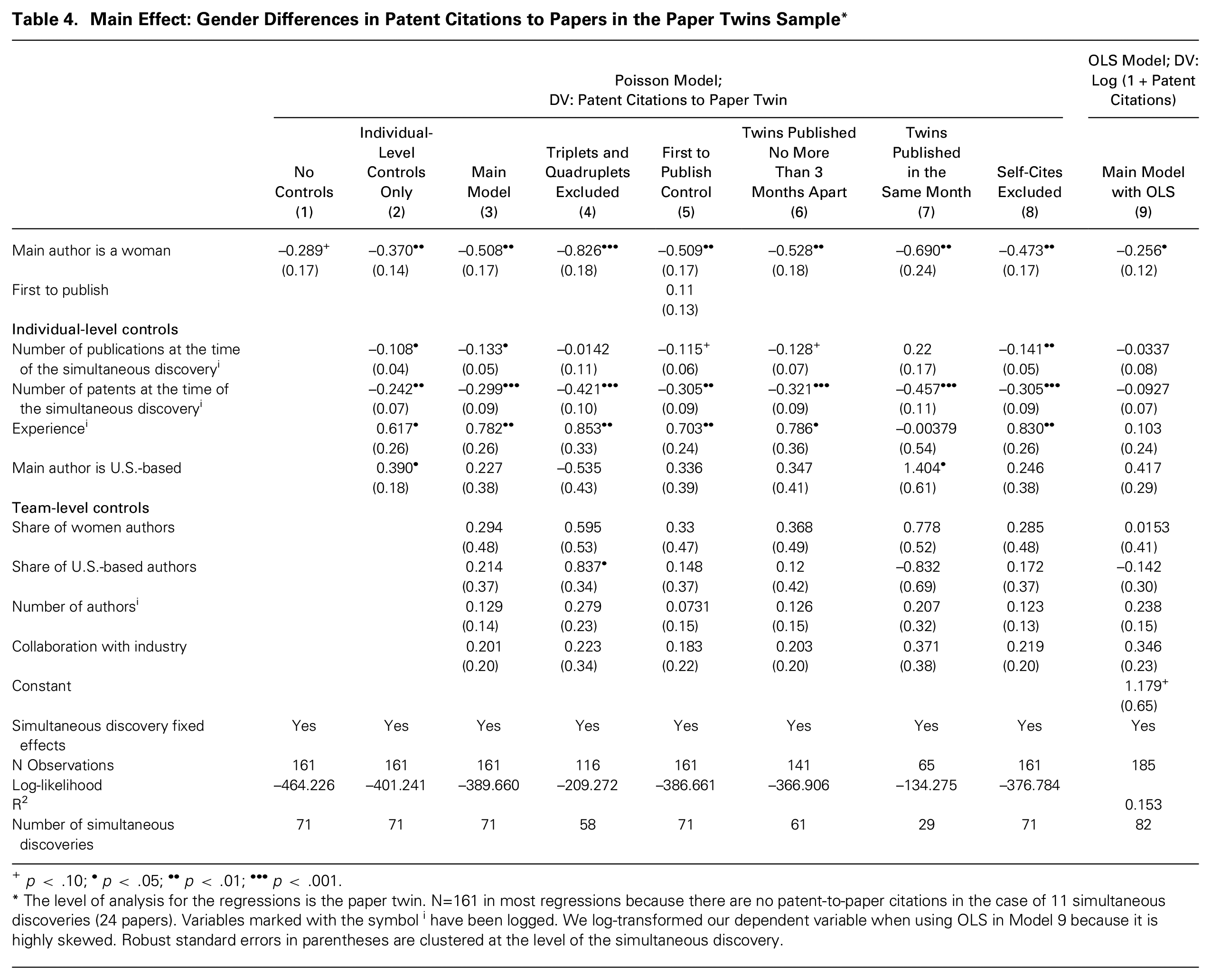
The main results of the paper twins analysis are presented in Table 4. Models 1–8 show a series of Poisson regressions with simultaneous discovery fixed effects and robust standard errors clustered at the level of the simultaneous discovery. Model 1 shows the correlation between Main author is a woman and the count of patent citations. We progressively introduced individual-level controls in Model 2 and team-level controls in Model 3. Model 3 is our main specification, which shows a strong, negative, and statistically significant correlation between women authorship and patent citations to papers. The coefficient for Main author is a woman is −0.508, which amounts to a 39.9 percent gender gap. Strikingly, this effect size is much larger than in the large sample analysis, suggesting that the fact that the same idea is disclosed in several papers might magnify the role of gender inequality. Models 4–9 test the robustness of this result. Model 4 excludes the four triplets and four quadruplets from the dataset to focus uniquely on 58 sets of paper twins made by one team led by a man and the other led by a woman. Model 5 examines the possibility that inventors rely more on men’s papers because those might get published first, by adding the variable First to publish, which takes the value 1 if the paper was published the first in its set of twins and 0 otherwise. 11 Model 6 excludes sets of twins in which papers were published more than three months apart, and Model 7 focuses only on cases in which paper twins were published in the same month. Finally, Model 8 excludes self-citations to papers in patents, and Model 9 uses OLS with a logged dependent variable instead of a Poisson estimator. Our key finding is consistent throughout, supporting the argument that inventors rely significantly less on scientific discoveries when they come from teams led by women scientists, even when the ideas are virtually the same. Additional robustness tests are presented in Online Appendix A7.
Main Effect: Gender Differences in Patent Citations to Papers in the Paper Twins Sample*
p < .10; • p < .05; •• p < .01; ••• p < .001.
The level of analysis for the regressions is the paper twin. N=161 in most regressions because there are no patent-to-paper citations in the case of 11 simultaneous discoveries (24 papers). Variables marked with the symbol i have been logged. We log-transformed our dependent variable when using OLS in Model 9 because it is highly skewed. Robust standard errors in parentheses are clustered at the level of the simultaneous discovery.
Mechanisms analysis
Two sets of mechanisms could drive the observed gender gap in reliance on scientists’ research reflected by differences in patent citations to their papers. On the supply side, women’s research may be less visible and, hence, less likely to be noticed by inventors. On the demand side, inventors may pay greater attention to some discoveries than others and evaluate them more positively.
Supply-side mechanisms
We examined three potential reasons that women’s papers might be less visible to inventors: research style (e.g., Lerchenmueller et al., 2019), access to resources (e.g., Meng, 2016), and social networks (e.g., Murray & Graham, 2007). First, prior work on research style has focused on gender differences in the use of language (Hengel, 2022; Lerchenmueller et al., 2019), but differences in style could also include other features of the research such as sample size or amount of methodological information. As described above, we drew on the expertise of postdoctoral researchers to code the “scientific style” of paper twins. 12 Second, women may have lower access to the type of resources that make research more visible to inventors. We used three indicators of resources studied in previous research (e.g., Bikard & Marx, 2020): the prestige of the university where the scientist worked at the time of the simultaneous discovery (University prestige), its general patenting activity (University patenting), and whether the scientist received funding from industry for the research reporting the simultaneous discovery (Funding from industry). Third, women may have less access to collaboration networks (Murray & Graham, 2007). To examine this possibility, we assessed each scientist’s ties to coinventors (Coinventor network), coauthors who are also inventors (Inventor-coauthor network), and firms (Prior collaborations with industry). We also measured their access to geographic hubs of relevant industrial R&D. Definitions for these variables, as well as a correlations table, are presented in Online Appendix A4.
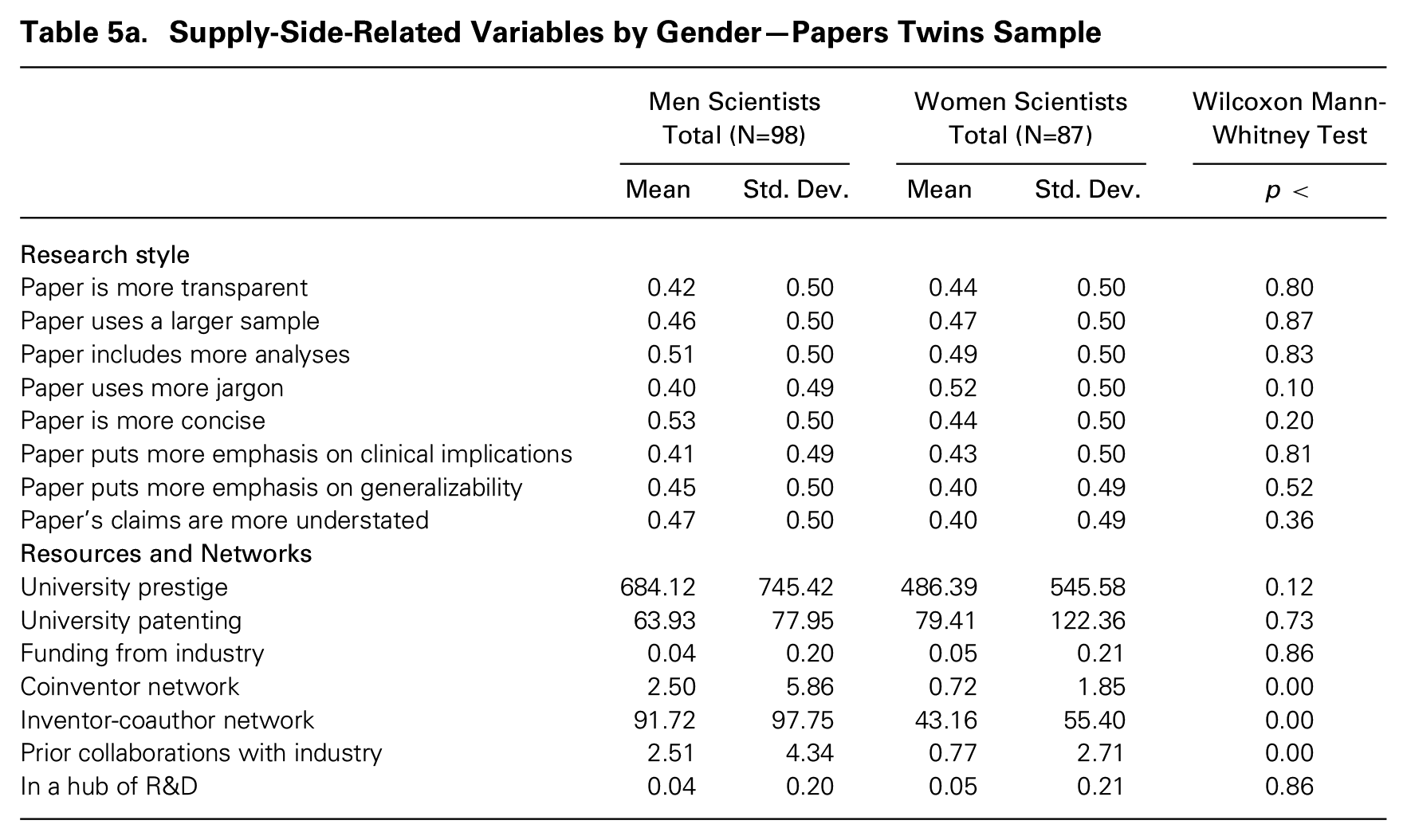
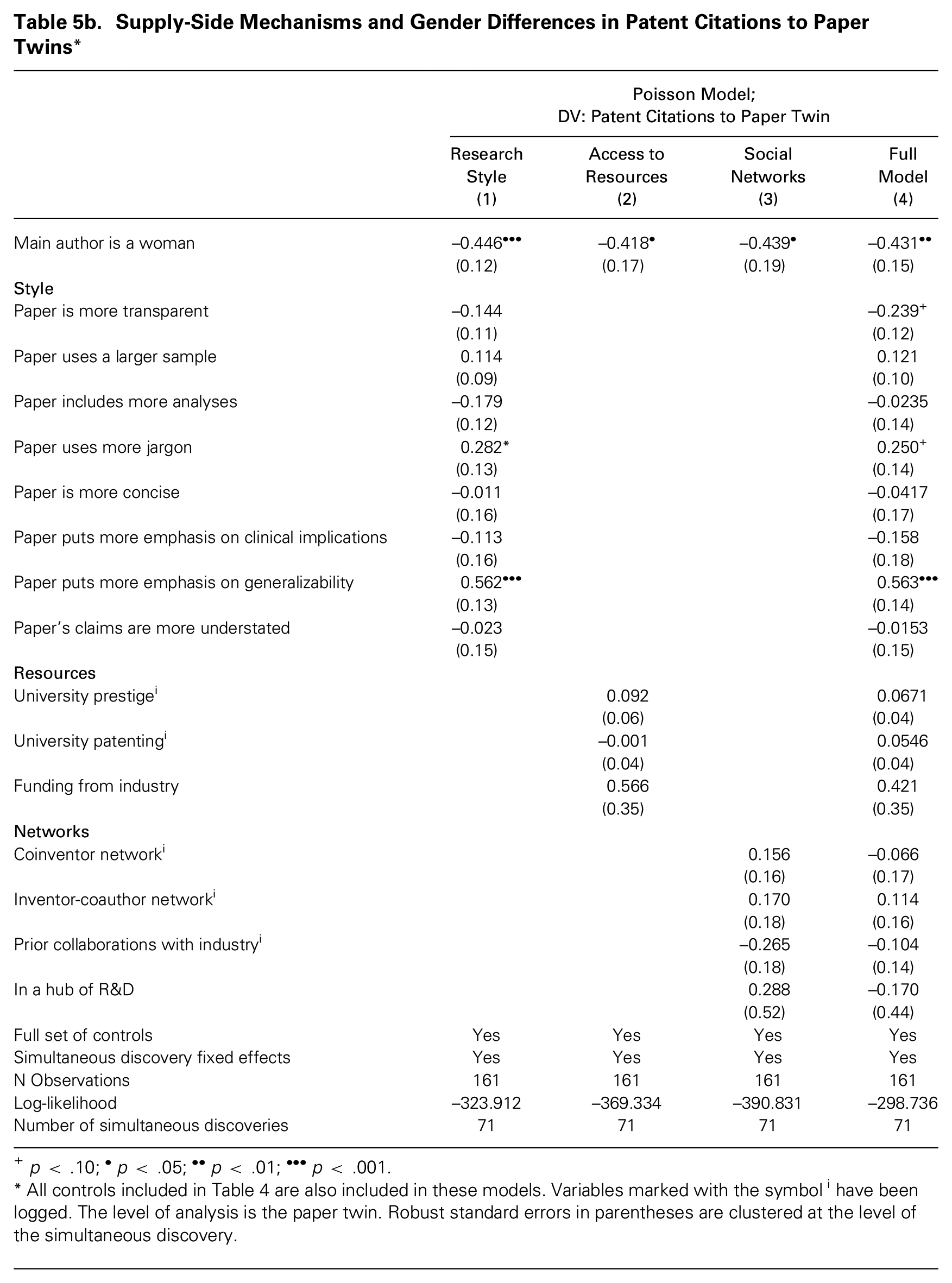
Table 5a presents summary statistics. Gender differences in research style are minor, with the exception that women’s papers use slightly more jargon. Similarly, we found no statistically significant gender differences in university prestige, university patenting, and funding from industry. In contrast, there are large differences in collaboration networks. On average, at the time of the simultaneous discovery, women had 0.72 unique coinventors, 43.16 inventor-coauthors, and 0.77 publications that were collaborations with industry, whereas their male colleagues had 2.50 unique coinventors, 91.72 inventor-coauthors, and 2.51 publications that were collaborations with industry. The propensity to work in a hub of industrial R&D at the time of the simultaneous discovery appears to be about the same for both genders.
Supply-Side-Related Variables by Gender—Papers Twins Sample
In Table 5b, we examined whether these variables might explain the gender differences in patent citations to papers observed in Table 4. Model 1 introduces the style measures into our main estimation of patent citations to paper twins (i.e., to Model 3 of Table 4). Model 2 introduces variables for resources, and Model 3 introduces variables for networks. Finally, Model 4 includes all variables at the same time. Overall, the results show that these factors contribute little to the gender gap that we documented in Table 4. The −0.431 coefficient for Main author is a woman in Model 4 corresponds to a gap in patent citations to papers of 35 percent. Thus, we did not find evidence that supply-side mechanisms drive the observed gender differences in inventors’ reliance on scientific ideas in these data.
Supply-Side Mechanisms and Gender Differences in Patent Citations to Paper Twins*
p < .10; • p < .05; •• p < .01; ••• p < .001.
All controls included in Table 4 are also included in these models. Variables marked with the symbol i have been logged. The level of analysis is the paper twin. Robust standard errors in parentheses are clustered at the level of the simultaneous discovery.
Demand-side mechanisms
The paper twins analysis cannot conclusively establish whether gender differences in patent citations to papers are driven by inventors’ greater attention to papers authored by men and/or their beliefs that men’s ideas are relatively more valuable. Nevertheless, we can still test the plausibility of these mechanisms by examining scenarios in which inventors may be more likely to use gender as a cue when assessing a paper’s value. This tendency tends to intensify when there is greater uncertainty regarding the scientist’s status and ability (Ridgeway, 2011). We examined two such situations.
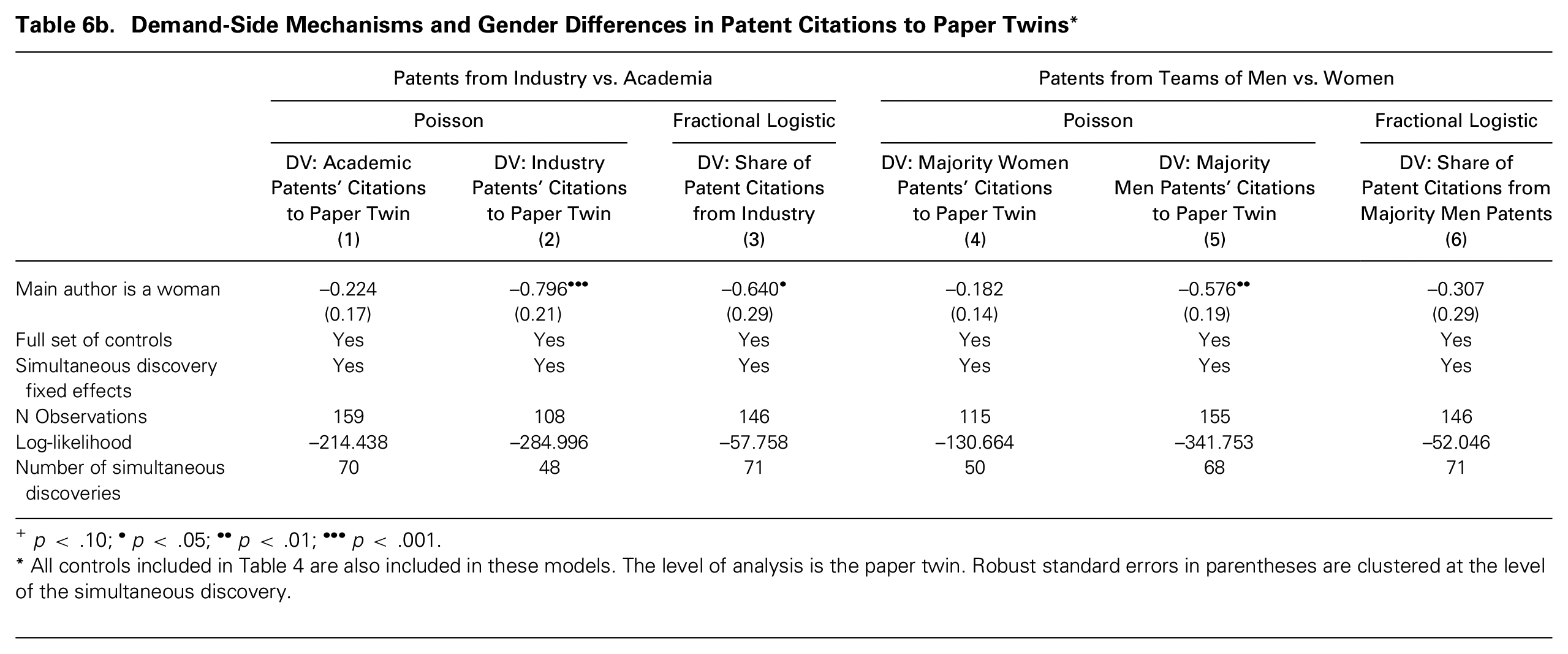
First, inventors may be more likely to rely on visible cues such as gender when they know less about the scientist, since this lack of knowledge would increase uncertainty about the paper’s value. All scientists in the sample are based in academia and are thus likely to be better known to inventors who are also in academia. Hence, we would expect that gender differences in patent citations to papers would be smaller for academic inventors as compared to industry inventors. The 185 paper twins in our dataset are cited 3,314 times in 2,077 patents. Using data from the USPTO’s PatentsView data repository, we coded each patent assignee by hand to assess whether they are an academic or an industrial organization. We created two variables: Academic patents’ citations to paper twin, which counts the number of patent citations to paper twins including only patents assigned exclusively to academic institutions; and Industry patents’ citations to paper twin, which counts the number of patent citations to paper twins including only patents assigned exclusively to firms (see Table 6a for summary statistics). We examined the gender gap in those patents’ citations to the paper twins in Models 1 and 2 of Table 6b. The coefficient for Main author is a woman in those two columns cannot be easily compared, since the models have different dependent variables, but it is noteworthy that this coefficient is statistically significant only when we focus on patents from industry inventors (the −0.796 coefficient corresponds to a gender gap of 54.9 percent). 13 Model 3 uses a fractional logistic regression to examine the relationship between Main author is a woman and the share of patent citations coming from industry (Industry patents’ citations to paper twin / Patent citations to paper twin) conditional on having at least one patent citation. We found a negative and statistically significant correlation (results are the same if we use an OLS model).
Demand-Side-Related Variables by Gender—Paper Twins Sample*
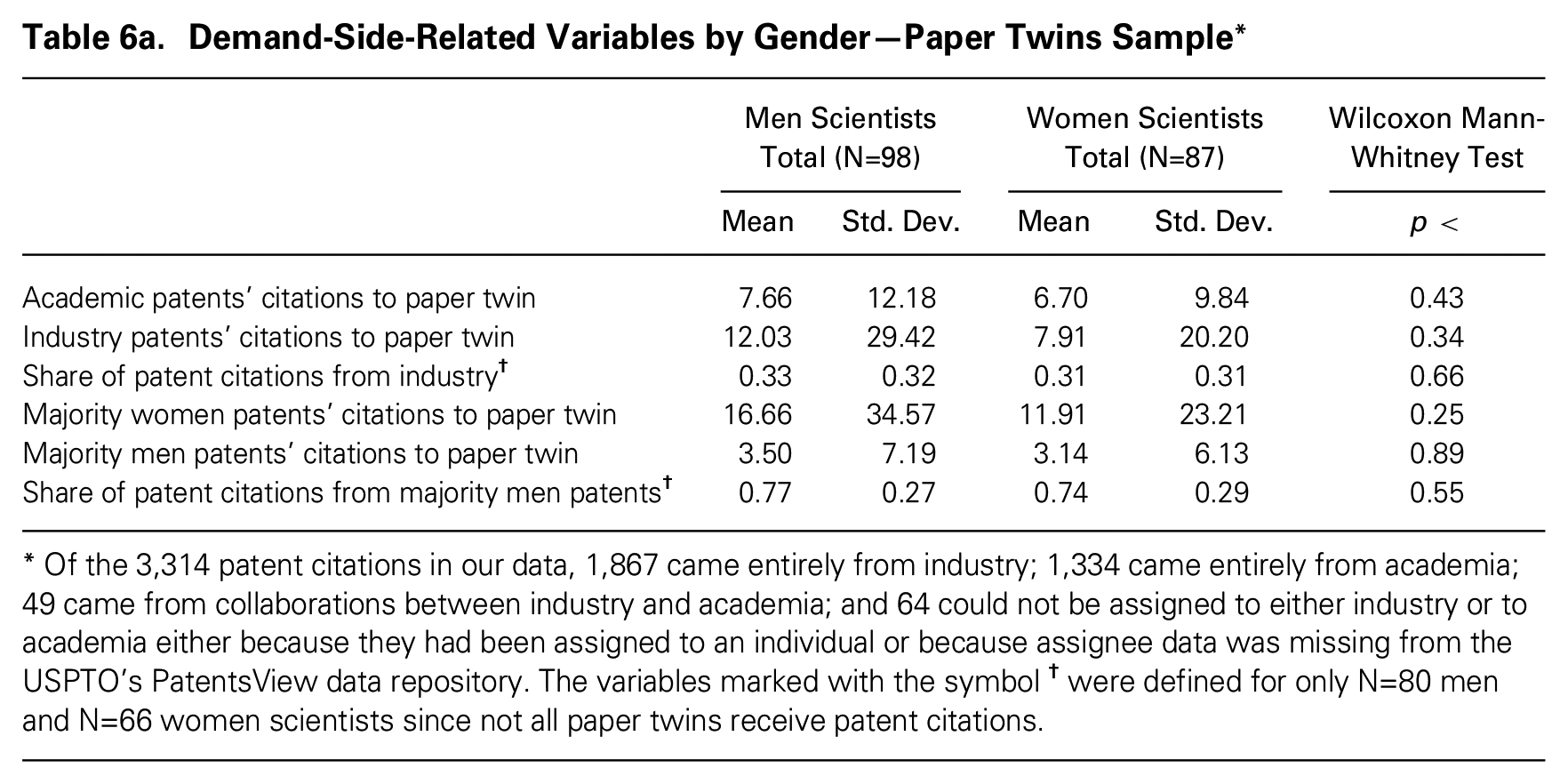
Of the 3,314 patent citations in our data, 1,867 came entirely from industry; 1,334 came entirely from academia; 49 came from collaborations between industry and academia; and 64 could not be assigned to either industry or to academia either because they had been assigned to an individual or because assignee data was missing from the USPTO’s PatentsView data repository. The variables marked with the symbol † were defined for only N=80 men and N=66 women scientists since not all paper twins receive patent citations.
Demand-Side Mechanisms and Gender Differences in Patent Citations to Paper Twins*
p < .10; • p < .05; •• p < .01; ••• p < .001.
All controls included in Table 4 are also included in these models. The level of analysis is the paper twin. Robust standard errors in parentheses are clustered at the level of the simultaneous discovery.
A second aspect that may shape inventors’ uncertainty about the scientist’s work is homophily (e.g., Greenberg & Mollick, 2017; Helmer et al., 2017), such that inventors may pay more attention to scientists who are more similar to them. Gender information was available for all inventors of 2,856 of the 3,314 patent citations to the paper twins. 14 We classified a patenting team as “majority women” if half or more of the inventors with available gender information were listed as women in the PatentsView database, and as “majority men” if more than half of the inventors with available gender information were listed as men.
We then created the variables Majority women patents’ citations to paper twin and Majority men patents’ citations to paper twin, which count those two sets of citations to the 185 paper twins. Summary statistics are shown in Table 6a, and those two measures are the dependent variables for Models 4 and 5 in Table 6b, respectively.
The results of this analysis should be interpreted carefully given the small number of majority women inventor teams. We nevertheless note that the coefficient for Main author is a woman is small and not statistically significant for patents by majority women teams in Model 4, but it is much larger and statistically significant for patents by majority men teams in Model 5 (the −0.576 coefficient corresponds to a gap of 43.8 percent). 15 Like Model 3, Model 6 examines potential differences in the proportion of patent citations coming from men inventors. We examined the relationship between Main author is a woman and Share of patent citations from majority men patents (i.e., Majority men patents’ citations to paper twin / Patent citations to paper twin) conditional on having received at least one patent citation. Using a fractional logistic model, we found a negative correlation that is not statistically significant (p < 0.291). We obtained the same results using OLS. Evidence that homophily between inventors and scientists contributes to inventors’ greater reliance on men’s scientific ideas is thus suggestive but inconclusive in these data.
Our paper twins analysis suggests that inventors rely more on scientific ideas published by men than on those published by women even when the papers describe the same discovery. This result confirms and reinforces the result from our large sample analysis. The paper twins sample also allowed us to investigate the potential role of supply- and demand-side mechanisms in driving the gender gap in patent citations to papers. We found little evidence in favor of supply-side drivers, which could stem from limitations with our data. At the same time, we did find suggestive evidence supporting demand-side mechanisms. To investigate this further and get a stronger hold on causality, we conducted an online experiment.
Experimental Test of the Demand-Side Mechanisms
Empirical setup
In a pre-registered online experiment, we asked participants to evaluate a scientific abstract for which we randomly allocated the main author’s gender. 16 This study builds on prior psychological research documenting a gender gap in the evaluation of science in experimental data (Handley et al., 2015; Hart et al., 2024; Knobloch-Westerwick et al., 2013; Thai et al., 2021). We extended this line of work by directly examining participants’ attention and their assessment of the technological potential of a scientific idea. The abstract was drawn from the J-Stage Japanese preprints database and was selected because of its focus on a life science topic that could plausibly inspire technology development. 17 The article’s title and abstract were translated into English. The main author’s name was a random draw of one of four names: two women’s names (Elizabeth or Sarah Anderson) and two men’s names (Robert or David Anderson). An example of the survey page, including the title, main author, and abstract, is presented in Figure A8-1 of Online Appendix A8.
We selected these first names in three steps. First, we gathered the ten most common men’s and women’s first names in the list of all authors of more than 90 million scientific articles in the SciSciNet database. 18 Second, we ran a survey on Prolific with 198 respondents, asking them to assess the gender (Female, Male, non-binary, transgender, or other), degree of femininity (from “least feminine” [1] to “most feminine” [7]), race (White, Black, or Hispanic), socioeconomic status (high, middle, or low income), and age group (<25, 25–44, 45–65, >65) most associated with those 20 names. Finally, we computed cosine similarity along those variables for each potential pair of masculine–feminine first names. Robert–Elizabeth and David–Sarah are the two pairs with the highest cosine score and for which agreement about the gender of each person in the pair was highest (over 97.5 percent). Using two pairs instead of one is useful because each pair evokes a slightly different socioeconomic status and age group. Online Appendix A8 presents further details on the experimental setup.
Dataset
We recruited 400 participants from Prolific. To select respondents who could most plausibly be involved in science-based invention, we focused on individuals who had completed a doctoral degree within the “Natural sciences” or “Health and welfare” categories. We excluded from the sample six respondents who failed a comprehension check question. The remaining participants spent two minutes (119.67 seconds) on average reading the abstract. We identified four outliers: three respondents who spent between 20 and 46 minutes on the abstract page and one who spent just 4.7 seconds. 19 Since time spent reading the abstract is a key measure in our study, we also excluded these four respondents from our analysis. Our final sample thus included 390 participants: 197 women, 187 men, and 6 participants who identify as non-binary or preferred not to disclose their gender. Countries of birth were the UK (143 participants), the U.S. (122 participants), Canada (16 participants), Germany (15 participants), and others (94 participants). The average year of graduation from most-advanced degree was 2011.
Variables
We collected four dependent variables. First, Time spent reading the abstract captures the amount of time that participants spent on the abstract page of the survey. The mean was 106.38 seconds. Second, we recorded their evaluation of the abstract by asking them to report on 7-point Likert scales their responses to three questions. “How would you assess the importance of the discovery described in this article?” had responses ranging from “Trivial” (1) to “Very important” (7) (variable name: Importance of the discovery, mean = 4.97). “How would you assess the quality of the research?” had responses ranging from “Poor” (1) to “Very high” (7) (variable name: Quality of the research, mean = 4.88). Finally, “How useful is this discovery for the development of new inventions (e.g., devices, technologies, or treatments)?” had responses ranging from “Not useful” (1) to “Very useful” (7) (variable name: Usefulness for invention, mean = 4.53).
In addition, we created two questions targeting active inventors. For those who declared being inventors (38 participants), we asked, “How likely is it that you would draw on this research in one of your future inventions?” with responses ranging from “Not likely” (1) to “Very likely” (7) (variable name: Likelihood of using in future invention, mean = 3.26). For those who declared having already applied for a U.S. patent (14 participants), we asked, “How likely is it that you cite this research in one of your future U.S. patents?” and again had the responses range from “Not likely” (1) to “Very likely” (7) (variable name: Likelihood of citing in future U.S. patent, mean = 2.71).
Results
Descriptive statistics are presented in Table 7, and regression results are shown in Table 8. Participants spent more time reading the abstract when they believed that its main author was a man (114.63 seconds vs. 98.22). This is consistent with the results of Model 1, in which the coefficient for Main author is a woman is −16.41 (p < 0.038). Similarly, Model 2 shows that participants felt that the discovery was more important when they believed that its main author was a man (p < 0.051). Models 3 to 5 indicate that participants’ assessments of the research quality, its usefulness for invention, or the likelihood of using it in future inventions show a non-statistically significant disadvantage for women. Finally, Model 6 shows that the few participants who declared having experience with the U.S. patent office felt that they would be more likely to cite this paper in future U.S. patents when they believed that it had been written by a man. Participants rated their likelihood of citing the paper in their patents 2.15 points lower when they believed it was authored by a woman, resulting in a large coefficient. However, this result is not statistically significant (p < 0.117), which might be attributed to the very small number of observations. Overall, the experimental results provide direct evidence that the gender gap in patent-to-paper citations in our first two studies is likely to be driven, at least in part, by the demand-side mechanisms of attention and evaluation.
Experimental Test: Descriptive Statistics
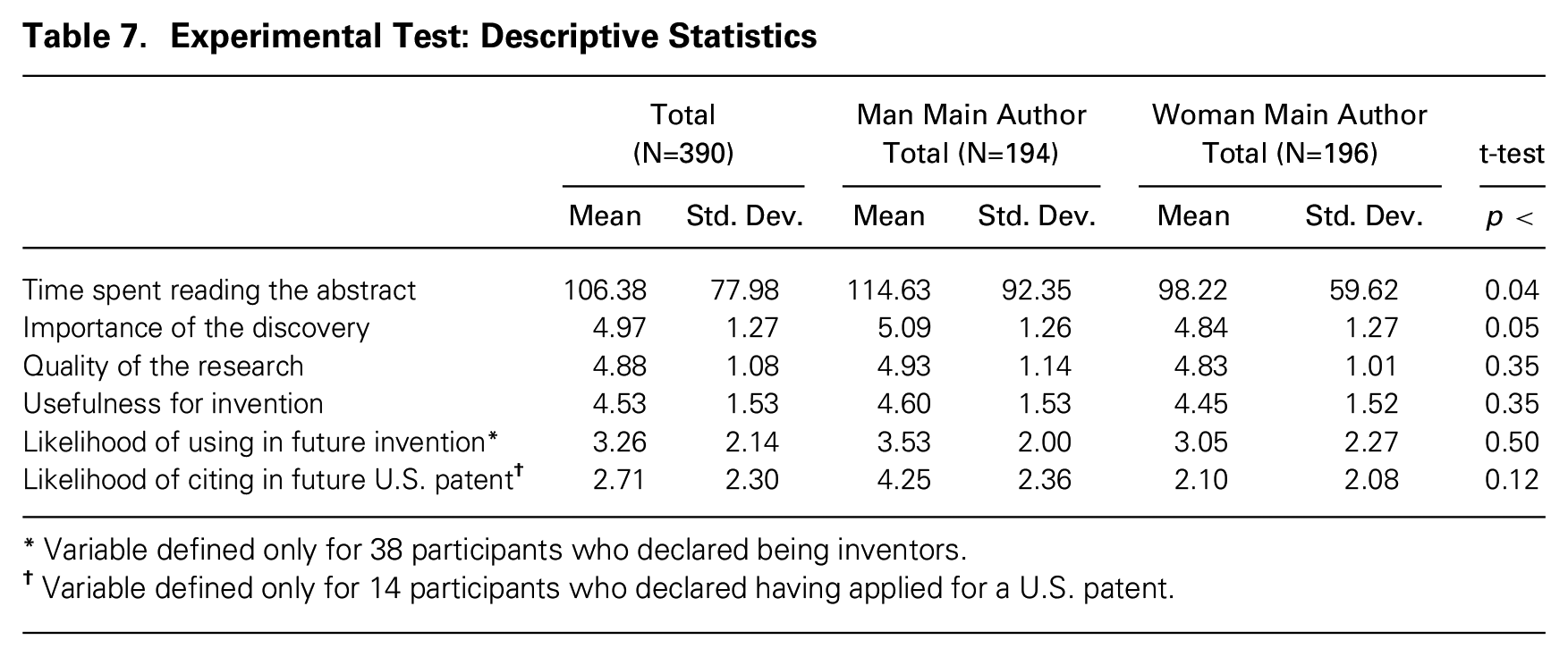
Variable defined only for 38 participants who declared being inventors.
Variable defined only for 14 participants who declared having applied for a U.S. patent.
Experimental Test of the Demand-Side Mechanisms
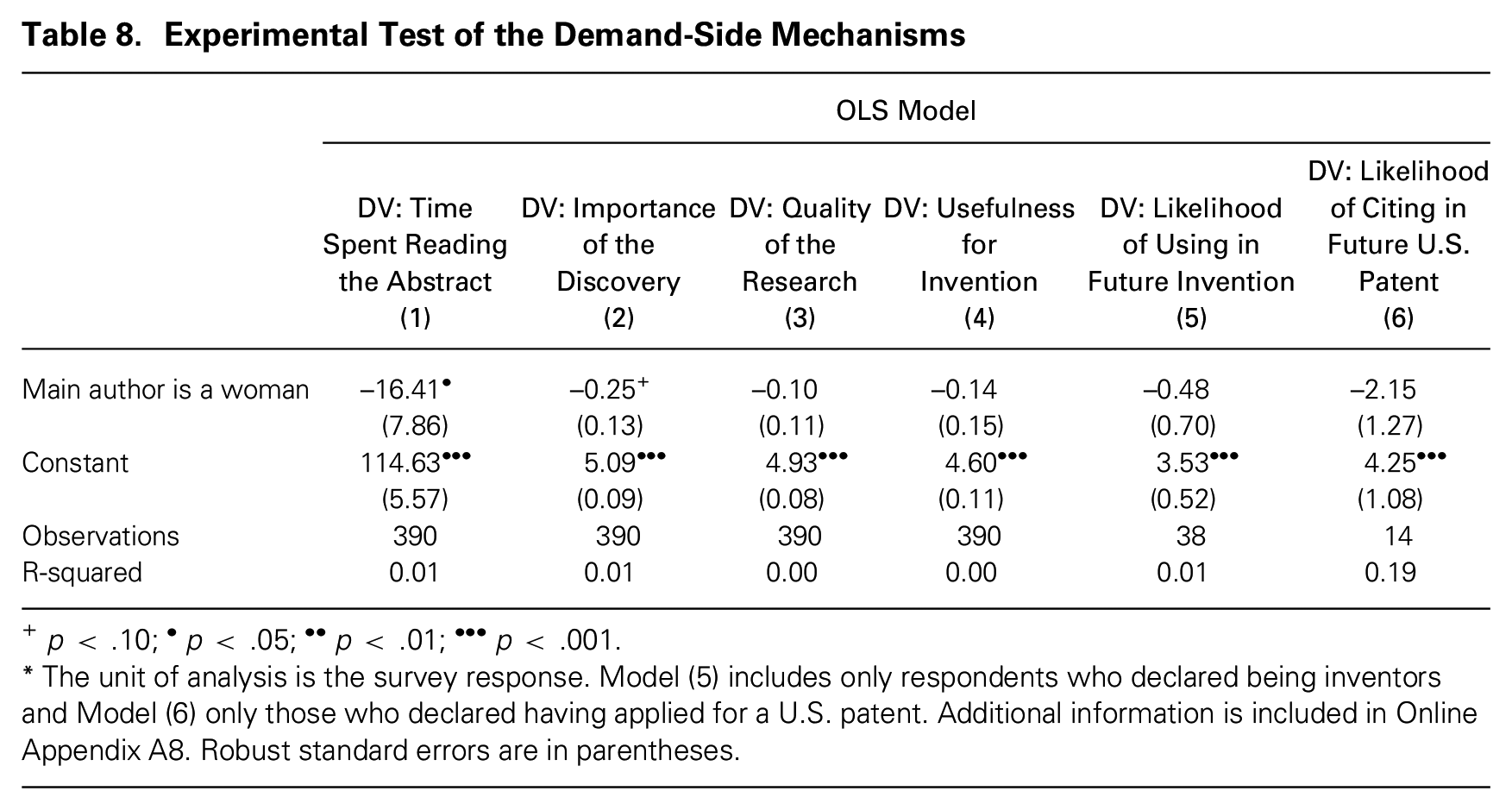
p < .10; • p < .05; •• p < .01; ••• p < .001.
The unit of analysis is the survey response. Model (5) includes only respondents who declared being inventors and Model (6) only those who declared having applied for a U.S. patent. Additional information is included in Online Appendix A8. Robust standard errors are in parentheses.
Discussion
When gender inequality meets innovation, it can create an uneven playing field for women’s ideas. Since innovations shape the future, overlooking women’s contributions risks creating a world predominantly envisioned by men. We argued that inventors working on science-based technology rely less on scientific ideas originating from women than on those originating from men, a disparity that may influence the technological impact of women’s ideas—specifically, their use in the development of new technologies. We leveraged the frequency of citations to scientific papers in patents to examine inventors’ reliance on science and employed several empirical methods to establish this phenomenon and investigate its underlying drivers. These methods included interviews with scientists and inventors, a large-scale analysis of more than 10 million scientific papers, a focused comparison of 185 paper twins in which men and women scientists published essentially the same discovery around the same time (see Bikard, 2020), and an experiment with a sample of 400 doctoral degree holders to assess the impact of randomly assigning the author’s gender on participants’ attention to and evaluation of a paper.
Our results show a clear gender gap in patent-to-paper citations. The large sample analysis reveals that this gap is consistent across fields and over time, while the paper twins study shows that it persists even when men and women scientists publish the same idea. We investigated the potential drivers of the gender gap by distinguishing between supply-side mechanisms, in which women’s ideas are less visible due to their lower standing in the profession, and demand-side mechanisms, in which (consistent with gendered status beliefs) women’s contributions receive less attention and lower evaluations compared to similar contributions by men. We find no clear evidence that our results are driven by supply-side mechanisms, including research style, scientists’ networks, or access to resources. Rather, our findings align more with the demand-side mechanisms. We directly examined these in our experimental test and find that participants paid more attention to a scientific abstract and rated it more positively when they thought the author was a man.
This article makes several contributions. To the best of our knowledge, this is the first study to document a significant gender gap in the frequency with which scientific papers are cited in patents. This novel empirical contribution has several theoretical implications. First, we contribute to literature on science-based invention by showing that inventors rely more on research produced by scientists who occupy positions of relatively higher standing in the academic profession. Rather than focusing on innovators and the tradeoffs they face, such as between local and distant search (e.g., Kneeland et al., 2020; Leahey et al., 2017), we focus on the ideas themselves and examine a social process by which these ideas capture the spotlight. The competition among ideas is not entirely shaped by their intrinsic potential. Social status matters (Azoulay et al., 2013; Podolny & Stuart, 1995; Simcoe & Waguespack, 2011), and gender is a crucial determinant of status, particularly in fields dominated by men (Ridgeway, 2011). Gendered status beliefs can thus shape the process of knowledge transfer from science to technology. This argument adds to a growing literature on the challenges that prevent potentially technologically impactful ideas to be built on by inventors, such as search difficulties or geography (Bikard & Marx, 2020; Furman & Stern, 2011; Jones, 2009).
Second, we contribute to research on gender inequality in career outcomes within science and technology. Prior research on this topic has focused on scientists’ and inventors’ ability to generate impactful ideas (Jensen et al., 2018; Leahey et al., 2017) or on the recognition they receive (Ross et al., 2022; Teich et al., 2022). Our study identifies a hitherto underappreciated challenge faced by women, i.e., that their scientific ideas are less likely than those of men to be relied on for technology development. Our focus on science-based invention is theoretically distinct from both productivity (e.g., publications) and recognition (e.g., academic citations). Previous research has documented significant gender inequality in citations (Cole & Zuckerman, 1984; Dion et al., 2018; Dworkin et al., 2020). These disparities could stem from various factors, such as differences in publication records, biases in attributing credit to women for work of equal quality, or lower propensity to build on their research. While studies on this topic generally take differences in publication records into account, distinguishing between biased credit attribution and a lower tendency to build on their work is difficult, particularly if we also aim to control for the nature of the underlying ideas. Focusing on patent-to-paper citations allows us to isolate the impact of gender inequality on cumulative innovation based on scientists’ ideas, with credit attribution playing a minimal role. Furthermore, by examining the underlying mechanisms contributing to disparities in reliance on men’s and women’s ideas, we highlight that differences in the attention and evaluation given to women’s ideas are crucial to understanding why those ideas may have less technological impact. Although these insights focus on the science–technology interface, we believe that they advance our understanding of how social inequality, particularly gender inequality, influences the dissemination of ideas in other contexts.
Third, we contribute to research on the impact of gender on the evaluation of creative work. Prior studies have demonstrated bias against women in the evaluation of creative work in fields such as music (Goldin & Rouse, 2000), architecture (Proudfoot et al., 2015), science (Handley et al., 2015; Knobloch-Westerwick et al., 2013), or entrepreneurship (Brooks et al. 2014; Kanze et al. 2020). We find similar dynamics in the context of science-based invention. Our findings are particularly noticeable and differ from prior studies because inventors inherently have a strong incentive to rely on the most valuable ideas regardless of whether they originate from men or from women. Developing new technologies entails a considerable investment of time, resources, and effort, which might be wasted if that investment is spent building on weak or shaky ideas. Yet, as we show, not only does this reliance on ideas vary based on the gender of the idea’s originator, but this difference is driven in part by the audience both giving less attention to and placing lower value on ideas from lower-status actors. Both attention and evaluation are important and can be viewed as manifestations of gender bias. While conceptually distinct, attention and evaluation are very difficult to separate in practice. That is, inventors are likely to pay less attention to papers that they deem less important and may also fail to appreciate the importance of an idea if they do not pay close attention to it. Future research could explore the relative influence of each of these mechanisms in generating unequal reliance on ideas from different people. Moreover, while we examine demand-side mechanisms separately from supply-side mechanisms, we recognize that these often interact to generate inequality (see Fernandez-Mateo & Kaplan, 2018). For instance, one might expect that inventors and other audiences are more likely to devalue research from scientists whose work is less visible potentially due to how they write or disseminate it. Similarly, scientists might engage in different types of research if they anticipate that their ideas will eventually be devalued, similar to how women might not apply for certain positions in anticipation of future discrimination (Barbulescu & Bidwell, 2013; Brands & Fernandez-Mateo, 2017). Investigating the dynamics between supply and demand in the long-term evaluation of scientific and creative work offers a fruitful avenue for future research.
Finally, our results have significant practical and policy implications. Most obviously, gender disparities in inventors’ reliance on scientific ideas ought to shape both the rate and direction of innovation. In fact, this mechanism might be one reason that “thousands of female-focused inventions [are] missing since 1976” (Koning et al., 2021, p. 1345). The findings also offer lessons for those seeking to incentivize innovation. Many people have rightly raised concerns that the underrepresentation of women in science and technology deprives our societies of valuable skills and knowledge (e.g., OECD, 2017). However, our findings suggest that fair representation alone may be insufficient to maximize innovation if women’s ideas are not given a fair chance. For firms and institutions looking to benefit from academic science, recognizing that valuable work from women (or other lower-status actors) may be overlooked can encourage a broader search to identify impactful ideas that might otherwise be missed.
This article presents some limitations, which open directions for future research. First, each of our studies has strengths and weaknesses. The large sample is advantageous in terms of external validity, but the observed gender differences could partly be driven by unobserved individual- or task-level heterogeneity. The sample of paper twins is small, simultaneous discoveries are special cases, and unobserved individual-level heterogeneity could still affect our results. One implication of these limitations is that we are unable to fully rule out the possibility that supply-side factors contribute to the gender gap in patent citations. Thus, neither the large sample nor the paper twins study can conclusively establish causality or precisely identify the mechanisms underlying the gender gap in patent-to-paper citations. Our experiment allows us to make progress on these two issues, but external validity is always a concern with this type of experiment. The fact that the findings are consistent across all three studies is reassuring. Nevertheless, our results should still be interpreted with caution, considering the limitations of each study.
Second, our setting allows us to examine citations to published scientific ideas in patented inventions. We do not observe ideas that were not published and inventions that were not patented. If—as some have argued—it is more difficult for women to publish than it is for men, then it is possible that, on average, women-authored publications describe slightly better scientific ideas than do papers authored by men. Although we cannot ascertain whether such a systematic quality difference is present in the scientific literature, the bias, if it exists, would make our results conservative.
Third, we focused exclusively on gender differences at the interface between science and technology. While gender inequality in innovation is a well-documented phenomenon, other sources of inequality exist beyond gender (e.g., Cook, 2014), which might also shape the process of science-based invention. Similarly, while the interface between science and technology is important for individuals, organizations, and nations interested in drawing economic value from scientific knowledge, unequal reliance on men’s and women’s ideas might exist in other settings. For example, similar dynamics might play out in curators’ selection of pieces for art galleries, of modules for courses, or of songs for albums. At the same time, it is possible that our results are related to the vast over-representation of men in science and technology and that the gender gap might disappear or even reverse in fields dominated by women (e.g., Stroube et al., 2024). A growing number of firms rely on scientific ideas to build new technologies (Arora et al., 2018), and one would hope that inventors would focus on the best ideas. Yet, our findings highlight that the interface between science and technology is shaped not only by the quality of ideas. At this critical frontier for innovators, gender inequality matters, too.
Supplemental Material
sj-pdf-1-asq-10.1177_00018392251331957 – Supplemental material for Standing on the Shoulders of (Male) Giants: Gender Inequality and the Technological Impact of Scientific Ideas*
Supplemental material, sj-pdf-1-asq-10.1177_00018392251331957 for Standing on the Shoulders of (Male) Giants: Gender Inequality and the Technological Impact of Scientific Ideas* by Michaël Bikard, Isabel Fernandez-Mateo and Ronak Mogra in Administrative Science Quarterly
Footnotes
Acknowledgements
We appreciate the helpful comments of Dana Kanze, Natalia Karelaia, Jasjit Singh, Victoria Sevcenko, Kaisa Snellman, Ithai Stern, Toby Stuart, Keyvan Vakili, Bart Vanneste, Hyejin Youn, and the “slump management” group. We are also thankful to the associate editor, Chris Rider, and four anonymous reviewers, as well as to the London Business School Institute for Innovation and Entrepreneurship and INSEAD for funding. Excellent research assistance was provided by Marcela Umana.
Supplementary Material
1
Isaac Newton famously wrote in his 1675 letter to Robert Hooke, “If I have seen further it is by standing on the shoulders of giants.”
2
A large body of literature on gender differences in patenting has shown that women scientists are much less likely to patent than their male counterparts are. Part of this difference may be explained by women’s lower academic productivity, since scientists with more publications produce more patents (Zucker et al., 1998). However, women encounter other obstacles that prevent them from engaging in the patenting process, such as reduced access to resources, networks, and institutional support (Meng, 2016; Whittington & Smith-Doerr, 2005). Ding et al. (2006) found a 60 percent patenting gap between men and women Ph.D.s in the life sciences, which is not explained by women working on less-important research (based on standard indicators of scientific impact, such as academic citations or journal impact factor). Recently, Koffi and Marx (2023) used 70 million scientific articles from Microsoft Academic Graph (including a sample of simultaneous discoveries) and found a double-digit gender gap in the extent to which women are awarded patents based on the discoveries that they publish as scientific articles. Although scientists’ own patenting activity plays an important role in science-based invention, a majority of scientists are not involved in patent production (Azoulay et al., 2007). Rather, inventors frequently rely on scientific discoveries they themselves have not made (Cohen et al., 2002). This highlights the significance of examining how inventors rely on scientists’ research when developing new technology, which is the focus of our investigation.
3
In Online Appendix A1, we also elaborate on the difference between patent-to-paper citations and patent-to-patent citations. The latter, which are not relevant for our purposes, have been extensively studied by innovation scholars (see, e.g.,  for evidence of gender differences in patent-to-patent citations). The interviews reveal that inventors perceive patent-to-patent citations primarily in terms of the patents’ legal claims. Conversely, the interviewees showed little concern regarding the potential legal consequences of citing specific papers but excluding others in their patent applications.
4
Ideally, one would like to also consider the identity of the corresponding author to fully determine who is the principal investigator in the team. As we explain below, we did this manually for the paper twins sample, but we did not have information on corresponding author for the large sample. Nevertheless, our results become stronger when we use stricter criteria for counting an article as woman-authored—i.e., when focusing on articles for which both the first and the last author are women, or for which all authors are women (see Models 4 and 5 in ).
5
We understand that coding gender as binary is a simplifying assumption for statistical purposes. Gender is not exclusively binary and, as nonbinary identification and data about it become available (e.g., Statistics Canada, 2022), more inclusive approaches to understanding gender inequality should be possible.
6
Our results are robust to using other thresholds, such as 75 or 99 percent.
7
The 19 fields are art, biology, business, chemistry, computer science, economics, engineering, environmental science, geography, geology, history, materials science, mathematics, medicine, philosophy, physics, political science, psychology, and sociology.
8
The innovation literature frequently describes the corresponding author as the main author (e.g., Furman & Stern, 2011). This author is generally the last on the list of authors and, in the life sciences, is typically the head of the lab. Unlike the larger sample, for this smaller sample we manually collected information to precisely determine the corresponding author. To avoid comparing a junior scientist with a head of a lab within a given pair of paper twins, we dropped 66 instances for which the corresponding author was also the first author.
9
Of the sample of 567 simultaneous discoveries produced following this approach, we excluded 43 sets of twins in which at least one of the team was based in a firm, and another 442 sets of paper twins in which both papers’ main authors were men, or both women, or one of the author’s gender could not be confirmed.
10
In separate analyses (Online Appendix A6), we explored the differences in the individual- and team-level characteristics of women and men main authors by predicting the likelihood that the main author of the paper is a woman and by including simultaneous discovery fixed effects. We estimated both a conditional logit and an OLS model and find two main differences. First, women main authors have less of a history of patenting than their men colleagues do. Second, teams led by women include more women. Other differences apparent in (e.g., in experience or in the number of past publications) are no longer statistically significant when we use simultaneous discovery fixed effects.
11
In our data, 52.8 percent of women’s papers were published first as compared to 36.7 percent for men’s papers.
12
Prior research on gender differences in scientific style has used automated, keyword-based tools to assess style, using the abstract of scientific publications. We also created the same style variables as in Lerchenmueller et al. (2019) and in our data on the articles’ full text. Using those variables decreased the sample size to 127 observations (63 sets of simultaneous discoveries) because 41 articles were available only as images and therefore not searchable. We found no statistically significant gender differences in these dimensions of style in our sample.
13
The results from Model 1 might appear to go against prior findings that women’s papers receive fewer academic citations by fellow academics than men’s papers do (e.g., Ferber & Brün, 2011). However, those studies do not necessarily imply that the same gap should exist in patent-to-paper citations, even when those come from academic inventors. It is important to keep in mind that our dependent variable is patent citations to papers, which is a different phenomenon from that of paper citations to papers (i.e., it reflects reliance on science rather than credit giving).
14
Gender information was missing for more than half of the inventors in six patents and was entirely missing for 29 patents. Results remain essentially unchanged when we exclude all 458 patent citations for which gender information is missing for at least one inventor.
15
In additional analyses, we examined other ways to categorize patenting teams, including men-only teams or women-only teams. When we use as dependent variable the count of citing patents in which all inventors were men, the coefficient for Main author is a woman is −0.529 (p < 0.016). In contrast, when we use as the dependent variable the count of citing patents in which all inventors are women, the coefficient for Main author is a woman is −0.228 (p < 0.484). Taken together, our analyses indicate that the tendency to cite the men-led paper instead of its women-led twin appears stronger among men inventors.
17
18
GenderAPI was used to assign gender. The 10 masculine names were John, David, Michael, Robert, James, William, Daniel, Thomas, Peter, Richard. The 10 feminine names were Anna, Mary, Laura, Sarah, Elizabeth, Jennifer, Susan, Patricia, Barbara, Sandra. We filtered out non-English versions of English names (e.g., Maria instead of Mary) as well as names with a GenderAPI score below 98 percent for which gender could be ambiguous (e.g., Andrea).
19
Twenty minutes corresponds to over six standard deviations above the mean, indicating significant interruptions or breaks. Similarly, 4.7 seconds suggests insufficient engagement, particularly since the respondent also rated their expertise with this type of research as (1) i.e., “No expertise.” While we exclude these outliers in the results presented here, using alternative exclusion criteria leads to marginal variations in magnitude and significance but does not meaningfully affect the main findings. For instance, if we include in the sample the respondent who spent 4.7 seconds, the coefficients for Main author is a woman in Model 1 (Time spent reading the abstract) and Model 2 (Importance of discovery) of are −15.85 (p < 0.045) and −.245 (p < 0.056), respectively.
Authors’ Biographies
References
Supplementary Material
Please find the following supplemental material available below.
For Open Access articles published under a Creative Commons License, all supplemental material carries the same license as the article it is associated with.
For non-Open Access articles published, all supplemental material carries a non-exclusive license, and permission requests for re-use of supplemental material or any part of supplemental material shall be sent directly to the copyright owner as specified in the copyright notice associated with the article.
