



Abstract
Why would a law-abiding occupational community support members engaged in legally prohibited actions? We propose that lawbreaking can elicit informal support when it is construed as a disinterested action—intended to serve the community rather than the perpetrator. We study how illegal remixing (“bootlegging”) affects an artist’s ability to secure opening act and other performance opportunities in the electronic dance music (EDM) community, whose members endorse the substance of copyright law but whose norms about bootlegging are ambiguous. Data on 38,784 disc jockeys (DJs) across 97 countries over 10 years reveal that producing bootlegs is associated with more opportunities to perform, compared to producing official remixes or original music. This effect disappears when community members view bootlegging as a self-serving action—primarily designed to benefit the perpetrator. An online experiment and an expert survey rule out the possibility that bootlegs are considered more creative, of higher quality, or better able to attract attention. We shed additional light on our proposed mechanism by analyzing data from 34 interviews with EDM professionals. This helps us to explain how a lawbreaker can paradoxically be perceived as serving the community, thereby eliciting active community support for their action.
Keywords
In 2019, a young bedroom DJ named Imanbek discovered the song “Roses” by the artist Saint Jhn. Taken with the song, he remixed it and shared his track online. He knew that doing so was illegal, as he did not hold the copyright: “I made an illegal remix. I didn’t know how to promote it, because I didn’t know how to clear it. I just put it online, and let it go” (Winkie, 2020). Despite advocating for artists’ intellectual property (IP) rights, the EDM community responded surprisingly well to Imanbek’s move, which effectively jump-started his career. The young man is now an established artist: He has undertaken several high-profile collaborations, including one with Saint Jhn, and has been invited to perform at top venues worldwide.
Few organizational scholars would expect an otherwise law-abiding occupation to tolerate members who break the law. Even fewer would expect such lawbreaking to contribute to the perpetrator’s career advancement, particularly when their actions could harm other community members. Instead, extant research suggests that whenever possible, occupational communities partner with legal institutions to establish the legitimacy and merit of their work (Abbott, 1988). Legal institutions have the distinct ability to safeguard an occupation’s integrity and to regulate potentially problematic behaviors. Members thus tend to embrace laws aimed at defending their distinctive skills. For instance, recent scholarship shows that photographers are active copyright advocates since it helps them build a professional reputation, protect their subjects, and preserve photography as a valuable medium of expression, and it confers a sense of professionalism on them (Silbey et al., 2019).
Extant research helps us understand why occupational members do not support—and sometimes even penalize—lawbreakers. This is evident in situations like that of Hardwell, an established DJ who was called out on social media after sharing a trio of illegal remixes online. Along with other DJs, the original artists accused Hardwell of stealing their work to build his own social media presence: “Giving away our music . . . for Facebook likes @Hardwell that’s the lowest I’ve seen!” While Hardwell argued that it was “all about the love for music,” he issued a public apology and took the bootlegs offline. 1 His experience contrasts sharply with Imanbek’s, which raises questions about the conditions under which an illegal action might elicit support within an occupation.
To address these questions, we begin with an observation: The law involves “a world that rejects the living complexity of professional life,” and its “insistence on rigid definition forces it to ignore . . . ambiguities” (Abbott, 1988, p. 64). This often results in regulations that are considered appropriate in some but not all situations. Ambiguity requires that occupational members make sense of a situation and assess whether compliance is desirable. Lawbreaking may be acceptable, even commendable, when the law protects one core occupational value but conflicts with another (Evans & Silbey, 2022) or when lawbreaking affirms a perpetrator’s belief in the primacy of community-specific values over formal legal requirements and other “pre-programmed or socially imposed values” (Hahl & Ha, 2020, p. 6). We theorize that, although occupational members welcome the regulator’s protection, they may support lawbreakers whose action they view as disinterested—an action pursued not to benefit the perpetrator but to honor core occupational values, ultimately serving the community. 2
Consider academic bioscience research. Patent law protects academic researchers’ right to their inventions but also conflicts with scientific communitarian values, which promote the free exchange of information and materials. While patents are largely overlooked for purely academic research projects (Walsh et al., 2005), this is not the case for projects with commercial implications: In such cases, patent holders are more inclined to enforce their rights, and researchers are more likely to cease activities that might infringe on peers’ patents (Walsh et al., 2005). We suspect that patent infringement is treated differently, at least in part, because of perceived differences in scientists’ intentions.
To test our theory, we focus on EDM artists who illegally remix others’ work. One advantage of this setting is that unlike acts of theft that are not formally regulated—such as chefs stealing recipes or comedians stealing jokes, as previously studied (e.g., Di Stefano et al., 2015; Fauchart & von Hippel, 2008; Reilly, 2018)—bootlegging is a clear violation of copyright law. EDM artists vigorously oppose music theft and welcome regulations that protect their IP. However, they have a more ambiguous view of bootlegging. Unlike legal authorities, they do not systematically equate this practice with music theft and rely, instead, on their discretionary judgment to make sense of the situation. We leverage these characteristics of our setting to investigate whether and when unlawful actions may paradoxically elicit informal community support for perpetrators.
We employ a mixed-method explanatory strategy: We start with quantitative analyses to ascertain the phenomenon of interest and to investigate potential explanations; we then draw on rich qualitative data to deepen our understanding of the mechanism (Kaplan, 2015). Combining quantitative and qualitative data allows us to develop a more complete and reliable explanation of the problem (Creswell & Clark, 2017). Our empirical approach is three-pronged. First, using hand-collected data on 38,784 DJs worldwide between 2007 and 2016, we examine how the illegality of a DJ’s music affects the number of gigs they obtain. Peer support plays a crucial role in securing these opportunities, as recommendations and invitations from other EDM DJs are the most common ways to obtain gigs. Our primary analyses focus on DJs getting invited to play opening acts, which particularly depend on community support. We also show analyses with consistent findings for all gigs, regardless of their type, across the full sample of DJs. We discover that producing illegal remixes results in more opportunities to perform than does producing otherwise similar but legal music.
Second, we investigate possible explanations for this surprising finding. One set of analyses aims to rule in our proposed mechanism by exploiting differences in the perceived motivations of bootleggers. That bootleggers receive more opportunities to perform reflects, we argue, support for perpetrators viewed as acting in the community’s interest. In contrast, free-riding on peers’ efforts and exploiting their work for personal gain is a self-serving action, which we would not expect to garner community support. We find that, consistent with our theory, bootleggers whose intentions are construed as self-serving do not secure more—and may even get fewer—opportunities to perform and to open for other artists.
Another set of analyses investigates plausible alternative explanations for our results: that bootlegs are superior to other tracks in their perceived creativity, quality, or ability to attract attention. Following Berg (2016), we run a consensual assessment study in which three EDM professionals blindly evaluate 150 tracks of different types (bootlegs, official remixes, and originals). We also run an online experiment in which 885 EDM enthusiasts evaluate the same track, whose type is randomized across conditions. The results rule out systematic differences across track types, suggesting that producing bootlegs is unlikely to result in more gigs simply because these tracks are seen as more creative, attention-grabbing, or of higher quality than others.
Given the inherent limitations of quantitative data, we then use qualitative data to enrich our interpretation of the statistical findings (see Creswell & Clark, 2017; Kaplan, 2015). We conduct 34 semi-structured interviews with EDM professionals to provide a fuller picture of the mechanism underpinning the relationship between bootlegging and gig opportunities (see Kaplan, 2015, for a detailed description of this approach). We analyze these data to flesh out the counterintuitive idea that lawbreaking can be viewed as a disinterested action. This analysis yields complementary insights: Bootlegging is seen as a community-building action when its goal is to uphold specific occupational values, such as pursuing one’s passion for music and fostering respect for other artists and their work. As a community-building action, bootlegging is worthy of community support, which shapes careers and the opportunity structure within the occupation. Together, these analyses paint a picture that is more consistent with our theory than plausible alternative explanations.
The article contributes to the literature on the formal and informal regulation of occupations. Recent work in this area argues that the relationship between these two forms of control is more nuanced than previously acknowledged. Occupational communities do not simply accept, ignore, or reject formal regulations. Instead, compliance can be discretionary in ambiguous situations, like when a regulation aligns with some core values but conflicts with others. This form of compliance requires professional judgment, yet how professionals resolve these ambiguities has received little attention (Evans & Silbey, 2022). Our article fills this gap and theorizes about a new form of discretionary compliance—one based not on the perpetrator’s occupational expertise (as in Evans & Silbey, 2022) but on interpretations of their intentions for breaking the law.
The following section reviews the literature on the formal and informal regulation of occupations. We then draw on research on ambiguous norms to theorize about how community members interpret a lawbreaker’s motivations and how their interpretation can shape their response to lawbreaking.
Regulating Behavior in Occupational Communities
Law-Based and Norm-Based Systems of Regulation
Occupations rely on legal institutions to control their activities, tasks, and skills (Abbott, 1988). Formal recognition and protection in the legal arena confer economic benefits and legitimacy on their members. Consider copyright law in creative occupations: It provides a “low-cost and immediate form of protection” for artists (Fauchart & von Hippel, 2008, p. 189); it also acknowledges original creative work as socially and economically valuable (Becker, 1978). Hence, in many creative occupations, members support copyright law and encourage compliance to protect their private economic returns and to defend their craft (e.g., Silbey et al., 2019).
Organizational scholars have examined how an occupation regulates problematic behaviors that legal institutions overlook (e.g., Di Stefano et al., 2015; Fauchart & von Hippel, 2008; Reilly, 2018). Studies have found that informal norm enforcement substitutes for the law to curb these behaviors, especially those that undermine collective welfare and generate costly externalities for community members (e.g., Coleman, 1990; Ullmann-Margalit, 1977). Informal norms are “moral standards surrounding what work is to be considered good and bad, what work is ‘real work’ and, therefore, in contrast to ‘shit work’ what formal and contextual rules of conduct are to be enforced” to preserve the community (Van Maanen & Barley, 1982, p. 303). Fauchart and von Hippel (2008), for instance, showed that French chefs take it on themselves to punish recipe theft, a formally unregulated behavior that nonetheless violates shared occupational values.
Organizational scholars have also examined situations in which formal regulations directly clash with a community’s values and norms. Research in this area suggests that under such circumstances, members tend to disregard formal regulations or engage in ceremonial compliance. For example, in professional cycling communities, doping is banned, but many people believe it remains prevalent and even encouraged by some (see Palmer, 2012, p. 18–19). Overall, this research suggests that the alignment between formal regulations and a community’s core values is key in determining whether members support compliance with the law (e.g., Posner, 2009).
However, recent studies paint a more complex picture by revealing that compliance can be discretionary in ambiguous situations, like when a regulation aligns with some occupational values but conflicts with others. In a recent ethnography, Evans and Silbey (2022) considered various safety laws that academic bioscience researchers must adhere to, including one mandating personal protection equipment for all laboratory tasks. This regulation aligns with scientific values that prioritize personal safety, but it also restricts researchers’ movement, potentially threatening their ability to perform fast and reliable experiments, which is another core occupational value. The authors find that while novices are expected to comply with the regulation, their more experienced peers are allowed to deviate (Evans & Silbey, 2022). This difference occurs because the experienced researchers’ expertise enables them to identify tasks that pose minimal risk to physical safety.
This work adds important nuance to our understanding of how occupations regulate behavior. It suggests that compliance can be discretionary and that expertise plays a key role in determining who can break the law and under what circumstances. Experts’ deviations from formal regulations are acceptable because knowledge allows these individuals to understand better and, in turn, navigate ambiguous situations. Our article expands on this idea by arguing that expert knowledge is not the only factor explaining differences in how an occupation deals with lawbreakers.
Interpreting a Lawbreaker’s Intentions
Research on ambiguous norms suggests that in complex situations in which it is up to community members to evaluate alleged transgressions, they will focus more on a perpetrator’s attributes than on the questionable behavior itself. This occurs perhaps because these attributes are more salient and clear-cut (Reilly, 2018) or because they guide how members interpret a perpetrator’s motivations (Ody-Brasier & Vermeulen, 2020). How members perceive the intentions behind an illegal action may thus play an essential but under-appreciated role in how the occupation manages ambiguous situations. Specifically, we propose that whether members believe an action is motivated by honorable intentions or self-interest can lead to significant differences in how various perpetrators are treated for violating the same regulation. Instead of focusing on the alignment between formal regulations and core occupational values, we thus emphasize the importance of how members interpret the motivations behind an illegal action.
We theorize that despite agreeing with the substance of the law, members may support unlawful actions if they perceive the perpetrator’s intentions as upholding core occupational values and serving the broader community. This argument is consistent with previous research showing that perceptions of an action as self-serving or “disinterested” influence people’s evaluation process (Hahl et al., 2017, p. 835). Scholars often contrast disinterested actions, i.e., prioritizing core occupational values over personal gain, with self-interested maneuvers, i.e., seeking extrinsic rewards and manipulating the audience (Child, 2021; Hahl et al., 2017). Disinterestedness involves living by one’s occupational values with minimal concern for one’s personal interest. Breaking the law, despite the personal risks involved, to serve the community’s interests can convey a principled stance and dedication to something greater than oneself. Disinterestedness is generally considered appropriate (Bourdieu, 1993) and likely to elicit support, whereas “perceived self-serving behavior triggers negative attributions leading to reduced social support” (Iorio, 2022, p. 774). We suspect that these dynamics influence how illegal actions are perceived and how community members respond to them.
Attributes Shaping Interpretations of a Lawbreaker’s Intentions
Intentions are not directly observable, so members rely on specific attributes of a perpetrator to gauge intentions and determine the appropriate response. Recent studies point to several attributes that shape whether a perpetrator’s motivations are perceived as more or less self-interested. One attribute that challenges perceptions of disinterested intentions is the degree to which perpetrators engage in interested self-promotion. Perpetrators involved in interested self-promotion actively try to sway the audience in their favor, working hard to catch the attention of community tastemakers (see Hahl et al., 2017). Their unlawful behavior should not garner community support as it tends to be seen as an attempt to increase their visibility for extrinsic and personal gain. Hence, the more oriented toward self-promotion they are, the less support we expect perpetrators to receive from the community.
A perpetrator’s privileged socioeconomic position within the community, which grants access to key resources, is another factor likely to cast doubt on their disinterested motivations (see Iorio, 2022, for a related argument). Because an individual’s social status is often linked to the pursuit of extrinsic rewards, like fame and money (Hahl & Zuckerman, 2014), observers tend to assume that high-status perpetrators prioritize their own interests. We thus expect that the higher the status of the perpetrators, the lower the community support will be for their unlawful behavior. By the same logic, access to critical community resources can make lawbreaking appear as a self-serving strategy. Specifically, when a perpetrator has easy access to legal knowledge or expert advice (e.g., legal counsel), their violation of the law can be seen as a calculated maneuver. Therefore, we anticipate that community support will wane for perpetrators with greater access to key community resources.
These factors will likely influence how community members interpret a lawbreaker’s intentions and, we argue, how much they choose to support the perpetrator. Support can take various forms in an occupation, such as providing mentorship, involving peers in collaborative projects, offering job recommendations, or sharing crucial information (e.g., hidden job market opportunities). For community members, offering support is often less costly than imposing penalties (Oliver, 1980), and it can significantly shape the perpetrator’s career. For instance, Reilly (2018, p. 938) observed that support from fellow stand-up comedians results in more bookings for comics and “unquestionably facilitates career development.” In the next section, we describe the EDM community, focusing on opportunities to perform live and to open for peers as forms of community support and examining the legal and normative frameworks that regulate behavior, especially regarding music theft.
The EDM Community
For this overview, we triangulated data from various secondary and primary sources. We began by reviewing the academic literature on club cultures alongside practitioner books, magazines, and articles dedicated to EDM. We also conducted fieldwork in Berlin, where the two authors attended shows in June 2019 and informally met with EDM professionals. 3 This allowed us to become familiar with this community, its specific values, norms, and gig-based employment practices. Insights from our fieldwork closely mirrored those found in the secondary data. Below, we integrate insights from both the primary and secondary data.
Characteristics and Values
EDM is a distinct music genre (e.g., Lizardo & Skiles, 2016) that traces its origins to the disco of the 1970s (McLeod, 2001; Van der Hoeven, 2014). It gained global recognition in the 1980s when two subgenres, house and techno, were brought to light by DJs in Detroit and Chicago (McLeod, 2001; Rietveld, 2011; Wiltsher, 2016). Created using electronic instruments, including synthesizers, samplers, and drum machines, the genre is characterized by a repetitive beat that prompts audiences to dance (Fraser, 2012; McLeod, 2001).
The popularity of EDM is attributable to the community of talented DJs who create the sound and present it to a crowd (Montano, 2009; Wiltsher, 2016). EDM DJs must possess superior capabilities in composition, musical selection, sequencing of tracks, and technical mixing, which jointly allow them to create a boundary-pushing sound (Clarke, 2012; Jaimangal-Jones, 2018). The EDM culture “celebrates ground-breaking artists whilst seeking to preserve the identities of genres from unscrupulous commercial exploitation” (Jaimangal-Jones, 2018, p. 225; see also Thornton, 1996, on club cultures).
Getting Gigs
With the rise of social networks and online platforms, reaching an audience has become easier. By contrast, opportunities to perform live are in short supply, and as veteran DJ Phil Morse (2016, p. 221) put it, “When we say ‘DJing success,’ we mean ‘DJ gigs’.” 4 In this competitive, gig-based labor market, peer support makes a tremendous difference, a reality widely acknowledged within the community. This support can manifest in at least three concrete ways.
The first is through private information sharing. As in other labor markets, jobs are usually found through informal contacts, and DJs can alert each other to hidden job opportunities. The second is through recommendations. Most bookings come from venue bookers and event promoters, whose role is to get heads through the door and curate an appropriate combination of DJs for their event (Ahmed et al., 2012). SoundCloud is the leading platform they use to assess whether a DJ sonically aligns with the event. However, a DJ’s ability to get the crowd dancing, a crucial aspect of any EDM event, depends on their skills behind the deck. This is harder to evaluate without attending live performances, which is time-consuming. For example, the founder and booker of a New York-based club explained, “I try to go to as many other clubs and parties as I can, but as I spend my whole weekends at [the club], it’s hard for me to find time to do that very often” (O’Connor, 2023). Hence, booking decisions are usually influenced by suggestions and recommendations from the artists with whom bookers and promoters already work. As Morse put it, if the promoter “who you want to get a gig from has got your mix, they ain’t gonna listen to it, unless someone has told them about it first.” 5 In sum, peer recommendations are a necessary, if not sufficient, condition to get booked.
A third form of support is when DJs invite peers to play a gig. This can occur through exchange bookings, whereby two DJs or promoters agree to book each other for gigs in their respective local scenes, and through gig swapping, a common practice due to the challenging temporal rhythm of EDM gig schedules. Furthermore, given their knowledge of the local nightlife, DJs often take up the role of bookers for their club(s), a responsibility typically shouldered by resident DJs. 6 Many DJs also work as promoters, organizing their own parties or club events series for which they book other DJs. Phil Morse (2016, p. 240–241) recalled such an experience: “I was lucky enough to have Dave Haslam, a key DJ at the famous Hacienda club in Manchester, as a mentor. He asked me to play a guest spot or two at a club night he ran . . . I eventually ended up taking over his Saturday night slot.”
Opening acts, whereby a DJ is invited to warm up the crowd and set the tone for other artists, exemplify the critical role of peer support. Gigs are often separated into main acts, around which the event is promoted, and support acts, which open for the headliners. Opening acts matter because they help energize the audience and build excitement for the main acts. Hence, headliners may handpick talent they believe in to open for them. A Dublin-based promoter explained: “We’d want someone who is well-equipped to do the right thing by the headline act and how we want to curate the night, and that varies. Sometimes, the headliner will want a say on it, and other times you might take a chance on someone.” 7 As in other musical genres, being invited to open for other artists is an endorsement because co-appearance can influence perceptions of an artist’s quality (Piazza et al., 2020). Other artists often act as gatekeepers: “They decide whether a newcomer gets to perform . . . as an opening act” and thus “have the power to offer or withhold career-building opportunities” (Sanders et al., 2022, p. 38). 8
Producing Music, Remixing, and Copyright Law
Before sharing music with an audience live or online, DJs must create a sound. They can produce original music or remix others’ work, a well-established practice (e.g., Lena, 2004). Remixing entails altering a sound recording to create a new version that clearly refers to the original. Recorded sounds are converted into binary units, stored, retrieved, and manipulated electronically (Vaidhyanathan, 2003). This manipulation can be accomplished via simple sonic adjustments to the mix, changes in track arrangement or structure, or creative reworking of the original’s aesthetic (Computer Music, 2022).
In EDM, remixing is an art form in its own right: “The remix is a legitimate way to create new art, culture, products, and ideas from old ones” (Mason, 2009, p. 102). In this sense, remixing is “an expression of appreciation, debt, or influence” (Vaidhyanathan, 2003, p. 137). Mason (2009, p. 71) elaborated: “Remixing is about taking something that already exists and redefining it in your own personal creative space, reinterpreting someone else’s work your way. It’s an industry standard.” In addition, remixing can be an effective way to attract the attention of community tastemakers. Because it appeals to an existing audience, it can generate additional visibility for the remixer and act as a quicker proof of concept than producing original music can.
Although remixing is a celebrated art form, artists often face legal challenges as they “struggle to prove they aren’t simply plagiarizing someone else’s concept by remixing it” (Mason, 2009, p. 72). To proceed legally, a remixer must secure the rights from the copyright owner, usually the original artist or label. The latter, upon agreement, supplies the original stems or MIDI files of the track. Sometimes, DJs are invited to remix a song as a strategy to extend its lifespan and broaden the demographics of the track’s audience (Computer Music, 2022). Either way, an agreement between the remixer and the copyright owner is a prerequisite for any official remix.
As Imanbek’s story illustrates, some remixes are shared without the copyright owner’s permission. From a legal standpoint, bootlegging is a clear case of music theft. 9 A bootlegger is someone “who broadcasts or copies someone else’s creative property without paying for it or obtaining permission” (Mason, 2009, p. 36). It is also known to all in the EDM community that, legally speaking, no music can be altered without the permission of the copyright owner. The legal implications of bootlegging include receiving cease-and-desist letters, copyright strikes, or even lawsuits. While copyright disputes are usually resolved outside of court, leading to an underestimation of their prevalence, bootleggers’ most frequent issues are legal complaints demanding the removal of infringing content. Account shutdowns on streaming platforms due to copyright strikes are far more common than lawsuits. In our fieldwork, some DJs discussed the highly stressful experience of facing a lawsuit worth millions, but most worried instead about copyright strikes on streaming platforms. A core issue they highlighted was that account bans often result in the permanent loss of their entire music library and mix archive. Given these implications, bootlegging is not a common behavior.
Normative Framework Regarding Music Theft
In some respects, copyright laws align with occupational values that emphasize an artist’s right to protect their work from the interference of others (Geiger, 2018). DJs want credit for their work and to benefit from their originality. They believe that their musical output deserves copyright protection and that file sharing should be regulated. 10 Within the community, there is a shared expectation that DJs will not free-ride on others’ work and will respect “the original innovator as the author of the recipe they had created” (Mason, 2009, p. 116). Therefore, bootleggers risk incurring penalties not only from legal institutions, as described above, but also from the community itself. Such penalties can include public shaming (as in the case of Hardwell), negative gossip, or even social ostracism.
In other respects, however, insiders acknowledge much ambiguity around the notions of stealing music and free-riding, which are not adequately captured by copyright law. Indeed, some ambiguity stems from the fact that, very much like official remixes, bootlegs involve something that overtly references the original. A seasoned booker and label owner we spoke with explained the dilemma: Everybody likes to see that you’re inspired by them. It’s flattering, but between inspired by and taken from, it’s very tricky. Kind of, where does that start, where does that end? So I think there’s a black, a white, and a grey version. What I’m saying is that the grey can become white or black. Usually, when you start doing music, there is a certain innocence of creation. You don’t mean harm. You just like it [the original track]. And you want to do something new with it, like a collage. So you’re taking a shot at it. Like, you are brave enough to try. This has always been part of making art, but obviously, it can also feel different. Every artist is fighting hard and struggling to get where they want to be. And it can also feel like “hey, he’s taking a shortcut by using my stuff!” (Gabriel)
11
As Gabriel’s quote suggests, bootlegging can be condemned as music theft (the “black version”), but it can also be viewed as an artist’s courageous effort to create something new and honor the work they admire (the “white version”). During our fieldwork, the latter was vividly described as “having a real connection” to a song and deserving credit for “following its vibe” (Liam). Given this ambiguity, occupational members often have reservations about the systematic applicability of copyright law (Mason, 2009). Instead, they engage in a more nuanced, case-specific evaluation of bootlegging acts. There is a shared belief that “grey cases,” to paraphrase Gabriel, “won’t be decided on the basis of logic alone [but] instead upon [community] practices and understandings . . . lines are drawn by the understanding of those within a community” (Lessig, 2008, p. 235). Next, we present the main quantitative data and statistical analyses, which examine whether bootlegging may generate community support in the form of opportunities to perform and to open for peers.
Phase 1: Exploring the Relationship Between Bootlegging and Getting Gigs
Quantitative Sample and Data Sources
Our primary data source is a leading online community platform and magazine promoting electronic dance music, artists, and events worldwide. This platform is ideal for our study because, besides offering editorial content, including news, reviews, and features, it functions as a prominent hub where EDM DJs manage their online profiles and showcase their work, and where venues list events and sell tickets. 12 Since its launch in 2001, over 60,000 DJs from over 120 countries have created personal pages on the platform, and over a half-million EDM events in 150 countries have been listed. Monthly unique visitors exceeded 1 million in 2011 and 2.5 million by 2015.
To create our sample, we manually gathered monthly information spanning a decade, between January 2007 and December 2016, on all events at which any registered DJ had performed. 13 A major benefit of selecting this time frame is that we can still observe illegal music tracks from before 2016 on the platform. 14 We thus collected data on the music tracks produced by each DJ and, of critical importance for the study, whether these were originals, official remixes (authorized by the copyright owner), or bootlegs (for which explicit permission was missing).
We used three additional data sources to create the final sample. First, we collected annual data on YouTube searches for the word “bootleg” in the country and the year of each gig in our sample. We used these to quantify the local demand for bootlegs over time. Second, we obtained the yearly Patent Enforcement Index (PEI) developed by Papageorgiadis and Sofka (2020). Based on international patent-litigation data, the PEI captures the transaction costs that patent owners anticipate incurring when enforcing IP rights in different countries. Third, because the PEI covers enforcement of IP rights across industries rather than in EDM specifically, we collected monthly data on the number of tweets discussing penalties for copyright infringement on SoundCloud, the leading streaming platform for EDM artists. This enabled us to capture real-time discussions among DJs about the perceived risk associated with bootlegging.
Overall, we assembled a sample of 38,784 EDM DJs from 97 countries who had played at least one gig over our ten-year observation window. To make sure that the DJs in our sample were truly active, for each DJ we captured only the period from the month when they first released a music track or played a gig to the month of their last music release or gig. Of these 38,784 DJs, 26,419 from 92 countries performed at least once as an opening act for other DJs while active. We focused on this subsample of DJs for our main analyses. Figures 1a and 1b map the geographic distribution of the DJs who played opening acts, including those who shared illegal bootlegs online during the study period.
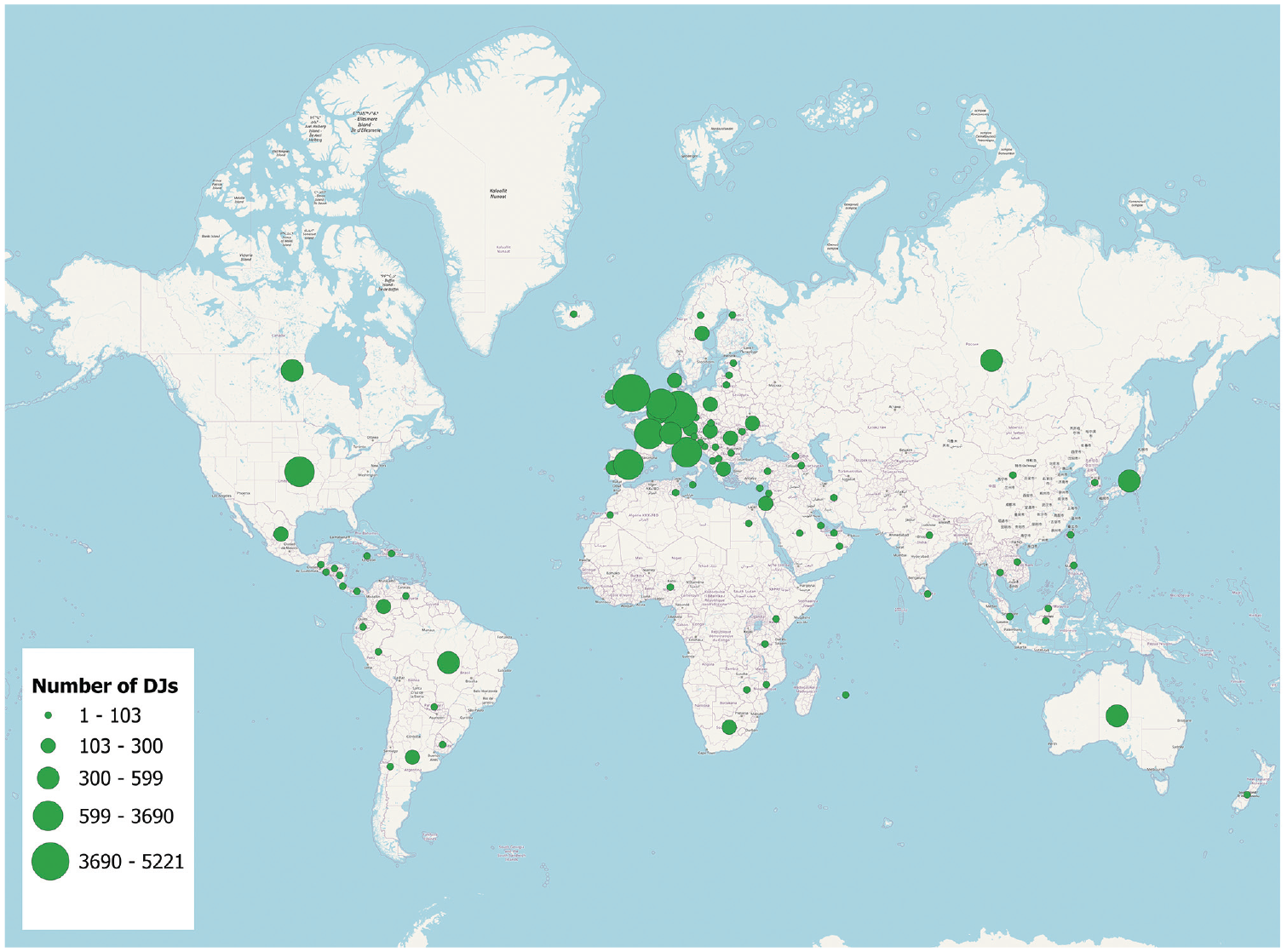
Geographic Distribution of DJs, 2007–2016
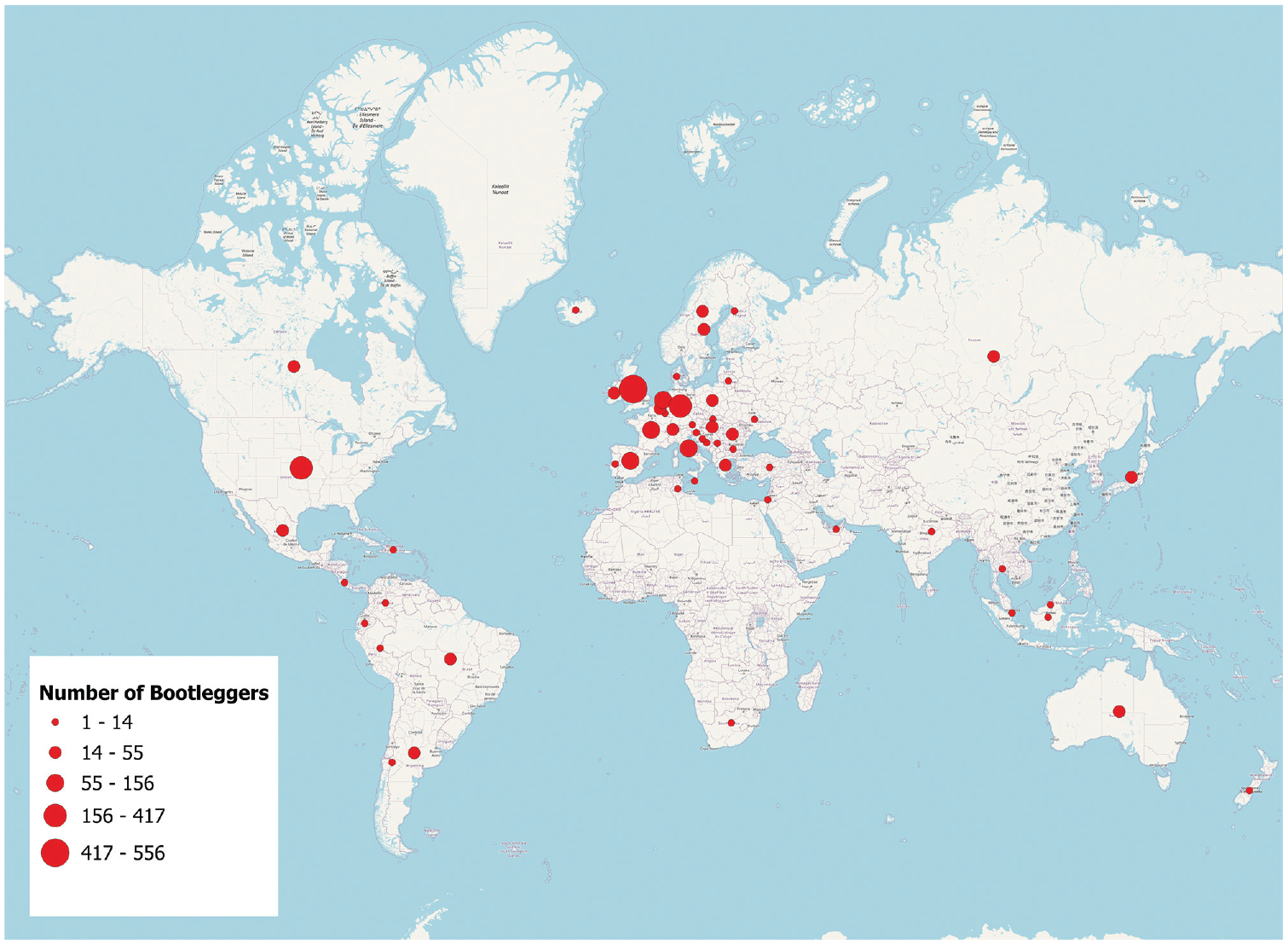
Geographic Distribution of Bootleggers, 2007–2016
Variable Description
In creating our variables, we were guided by insights from our fieldwork and secondary data sources.
Dependent variable
Measuring community support is challenging, especially when it involves support for an illegal practice (Stroope, 2015). In this article, we captured community support by focusing on a tangible outcome: the monthly number of opening acts for which a given DJ was invited to play. To create this variable, we started by identifying every gig recorded on our online community platform. We then hand-coded data detailing the artist lineup for each of these gigs. By looking at the order in which each DJ performed, we were able to compute and model the monthly number of gigs that each DJ played as an opening act for (an)other artist(s). This approach effectively restricts the analyses to gigs almost certainly obtained through peer support. Focusing on opening acts reduces our sample size, as those DJs who played only solo gigs or never opened for other artists were dropped from our conditional fixed effect analyses. For completeness, we also show the results for the full sample using all monthly gigs played by a DJ as the dependent variable.
Note that the results are robust if we use coarser measures for our dependent variables. These include dummies for whether a DJ was hired or not—as an opening act or in general—in a given month and the yearly numbers of opening acts or gigs for which a DJ was hired (please see Online Appendices 2 and 3 for these analyses). In further robustness checks, we also distinguished between different types of gigs and venues (see Online Appendices 4a and 4b).
Independent variables
Our key independent variables capture a DJ’s artistic output, the type of music produced and shared online. Because a three- to six-month lead time is typical between being hired for a gig and the actual performance date, we adopted a conservative approach to construct our variable and assumed a six-month lead time. For each DJ in month t, we then calculated the total number of Original tracks released and the total number of Official remixes released plus Bootleg remixes released between t-7 and t-18 (i.e., a one-year window). 15
We hand-collected detailed label information for each remix track to identify the legal status of all remixes released by the DJs in our sample. Commercial agreements with copyright owners typically specify that official remixes will be released either under the record labels of the original artists or under the labels that own the master recordings of the tracks being remixed. By contrast, bootleg remixes are posted online by DJs themselves, without the cooperation of record labels. For each DJ in month t, we separately counted the total number of Official remixes released (those cleared by the copyright owner) and the total number of Bootleg remixes released (those illegally shared online) between t-7 and t-18. Within the study period, 15,646 of our 26,419 DJs (59.2 percent) in our main sample released at least one original track, 5,495 (20.8 percent) released at least one official remix, and 2,426 (9.18 percent) released at least one bootleg. These numbers confirm that bootlegging is not normative in the sense of an empirical regularity.
Other variables
We assumed a six-month lead time in constructing most of our control variables, which is consistent with our independent variables. We began by creating a variable to capture a DJ’s orientation toward self-promotion. To this end, we identified the number of social media accounts a DJ chose to link to their personal page on our online EDM platform. Because we wanted to capture the extent of a DJ’s interested self-promotion, we distinguished between their social networking accounts, such as Facebook, Instagram, Twitter, and Tumblr, and their music-sharing accounts, such as SoundCloud, Discog, and Bandcamp. 16 Insiders often described the former (in contrast to the latter) as commercially oriented and mainly used for promotional purposes. We measured the ratio of social networking accounts to music-sharing accounts for each DJ. The higher this ratio, the more focused a DJ appeared to be on self-promotion. In contrast to our other measures, DJ’s self-promotion orientation is time-invariant because detailed data on the social media accounts linked to each DJ’s personal page are available only for our last year of observation.
Next, we created measures to capture a DJ’s privileged socioeconomic position in the community, which provides status and access to key resources. Status represents the social position of an actor relative to peers (Podolny, 1993). A source of status in cultural industries is the receipt of accolades or awards. On their personal pages, DJs publish a monthly chart of their top-10 favorite tracks by other DJs. The platform’s home page then features the 50 most-charted tracks in its “top-50 tracklist.” These rankings help to capture a DJ’s status because they stem from aggregated opinions (Sorenson, 2014). In the EDM community, our fieldwork revealed that the longer a DJ’s track is featured in the top 50, the higher their status. For each DJ in month t, we thus measured DJ’s status by calculating the number of months between t-7 and t-18 during which the DJ had a track featured in the top-50 tracklist.
Being signed with a record label also indicates a DJ’s position in the community, revealing they have gained access to critical community resources. It notably grants access to the label’s connections and funding, enabling the artist to reach a larger audience. Labels can give their artists many of the resources they need to further their careers. We collected detailed information on DJ’s label affiliation, which we used to capture access to these social and economic resources. For each DJ in month t, we created a dummy variable equal to 1 if the DJ was affiliated with a record label between t-7 and t-18, and 0 otherwise. Similarly, DJs who have released official remixes earlier in their careers are familiar with copyright issues. They understand the process of securing permission from copyright holders because they have often benefited from access to help and advice, such as guidance from legal experts. We expect prior consultation with legal experts and experience with the intricacies of clearing tracks to cast doubt on their motivations. We thus created a measure for a DJ’s prior release of official remixes over the previous 12 months (i.e., between t-19 and t-30).
We controlled for several other variables likely to correlate with our dependent and independent variables. First, we measured the popularity of musical tracks released by each DJ. Specifically, for all the tracks a DJ released between t-7 and t-18, we calculated the average frequency at which these tracks were charted by fellow DJs (i.e., selected as a top-10 favorite). Separate measures of popularity were constructed in the same manner for each type of track released between t-7 and t-18, including original tracks, (total) remixes, and then official remixes, and bootlegs. Interestingly, bootlegs appear to be less popular than original tracks or official remixes (0.04 vs. 1.10 and 0.53, respectively). As for other cultural products, the objective quality of an EDM track is often obscure and difficult to measure (Askin & Mauskapf, 2017). 17 However, decisions about the quality of artistic work are rarely formed independently and can be shaped by the opinions of others (e.g., Salganik et al., 2006). Since quality is, in part, socially constructed, we expect our measure of popularity to capture this social and subjective dimension of a track’s quality.
Local demand for bootlegs may also correlate with our key variables. We tracked the annual volume of YouTube searches for the word “bootleg” in the country and the year of each gig (YouTube searches for “bootleg” from gig location). These data are normalized on a scale from 0 to 100, with 100 representing the country that accounted for the highest proportion of such queries in a given year (Google.com, n.d.). Ireland, for instance, consistently showed the highest interest in bootlegs, whereas Argentina showed the lowest. We created this variable for each DJ–month in our data. 18
For each month, we further controlled for the strength of the local intellectual property protection regime (IP enforcement at gig location) by using the PEI index for the country where a DJ’s gigs occurred. This measure captures the perceived risk of bootlegging being punished by law. To capture risk perceptions, we also used the monthly number of Twitter posts discussing the penalties associated with copyright infringement on SoundCloud. 19 This number is specific to the EDM community and measures real-time discussions of copyright issues among artists. We chose SoundCloud because it is the leading music-sharing platform for EDM DJs; about 70 percent of DJs in our sample used it to showcase their work.
Finally, we included month–year dummy variables (e.g., August 2010, August 2011) to control for unobserved external factors that could have influenced DJ hiring in a specific month. Table 1 summarizes the descriptive statistics and correlations between variables.
Descriptive Statistics and Correlations*
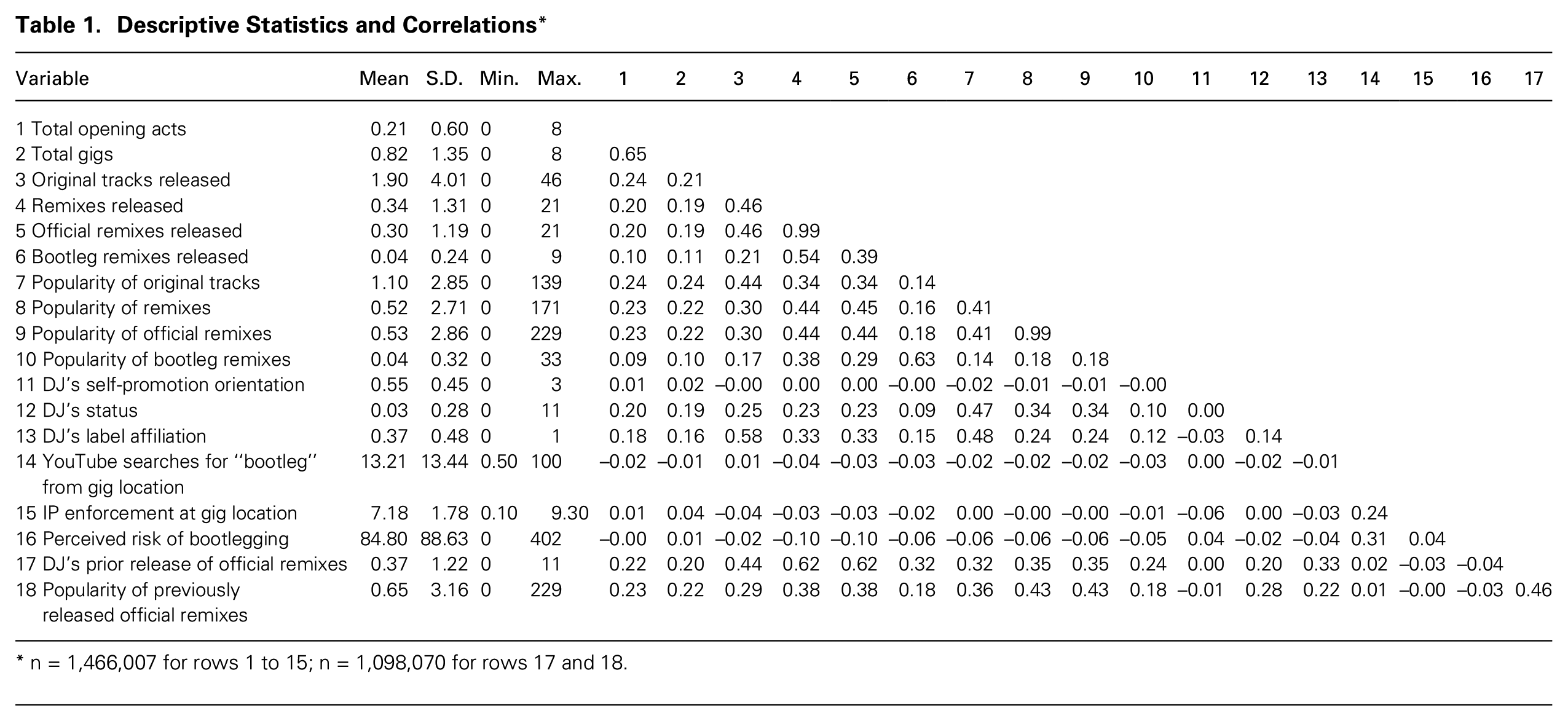
n = 1,466,007 for rows 1 to 15; n = 1,098,070 for rows 17 and 18.
Main Results
In Phase 1, we investigated the relationship between illegal remixing and opportunities to play gigs. Our main dependent variable is the monthly count of opening acts for each DJ in our sample, so we adopted Poisson regressions with DJ fixed effects. These models require fewer assumptions for count panel data and are more robust than fixed-effects negative binomial models (Guimarães, 2008; Wooldridge, 1999). Using negative binomial or OLS regressions with DJ fixed effects yields similar results.
While including DJ fixed effects allowed us to control for unobserved time-invariant heterogeneity among artists, some differences between DJs likely remain. We ran multinomial logit analyses to investigate this possibility. Reassuringly, bootleggers do not seem to differ on key observable characteristics in comparison to DJs who remix officially. These analyses and results are summarized in Online Appendix 10 and Table B1.
Table 2 summarizes the results of our main analyses. 20 In model 1, the regression includes the counts of original tracks and of all remixes, regardless of their legal status, that a DJ released between t-7 and t-18. The results show that releasing original music and remixes positively and significantly affected the number of monthly opening acts a DJ was invited to play. Compared with releasing no tracks, sharing one remix online increased a DJ’s number of opening acts by 2.6 percent; sharing one original track increased this number by 1.9 percent. A Wald test confirmed that the estimated effect of releasing remixes was significantly larger (p = 0.002) than that of releasing original tracks. This finding confirms industry insiders’ speculation that remixes more substantially boost a DJ’s chances of playing than original music does.
Poisson Regressions Predicting a DJ’s Monthly Opening Acts and All Gigs*
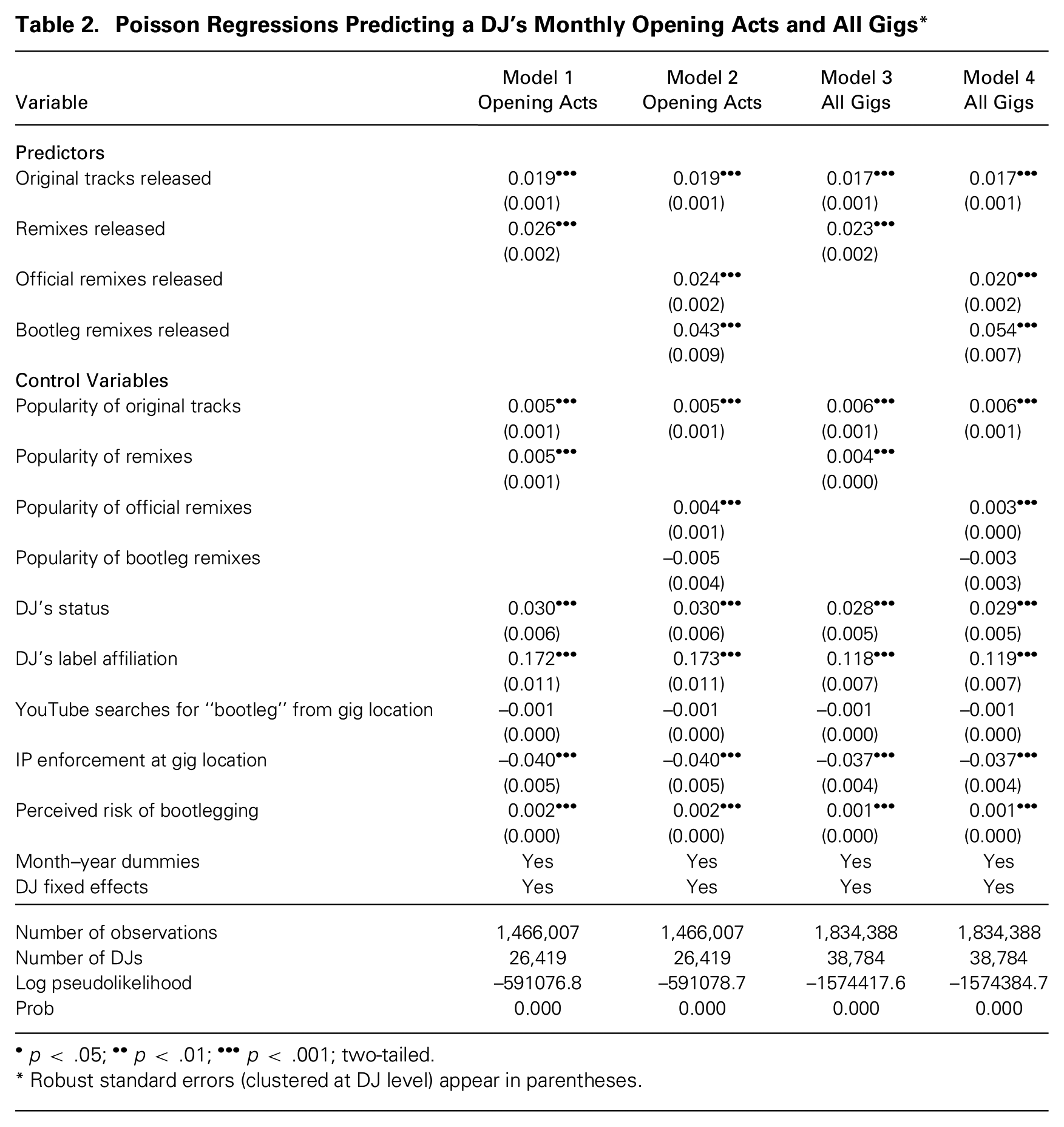
•p < .05; ••p < .01; •••p < .001; two-tailed.
* Robust standard errors (clustered at DJ level) appear in parentheses.
Next, we examined our key prediction that bootleggers may receive informal community support in the form of opportunities to open for other artists. In Table 2, model 2, we replaced the overall count of remixes that a DJ released between t-7 and t-18 with two separate count variables, one for official remixes and the other for bootlegs. Releasing original tracks, official remixes, and bootlegs all significantly enhanced the monthly number of opening acts a DJ was invited to play. Crucially, the estimated coefficient for releasing bootlegs was significantly larger (Wald tests p = 0.005, p = 0.025) than that for releasing original tracks or official remixes. Sharing one bootleg online increased the number of opening acts a DJ played per month by 4.4 percent; releasing one official remix or one original track increased this number by only 2.4 and 1.9 percent, respectively. These results indicate that DJs were given the most opportunities to open for other EDM artists after posting bootlegs online.
Although the magnitude of the effect may seem modest, recall that we measure how engaging in a clearly illegal behavior affected a DJ’s opportunities to open for peers. Contrary to what prior research would predict, we document a significant positive effect. This itself, we argue, is a surprising and important result (in fact, it would be concerning if we found that unlawful behaviors result in very large rewards for the perpetrators). Also consider the relative effect of producing illegal vs. legal music: The estimated effect of bootlegs is about twice that of official remixes and original music. Hence, our results reveal a clear advantage associated with producing illegal music.
Models 3 and 4 in Table 2 outline the results of the analyses using the total number of gigs a DJ played in a given month as the dependent variable. The results are entirely consistent. As shown in model 4, the estimated effect of releasing bootlegs on the total number of monthly gigs a DJ secures is not only positive and significant but also statistically greater than the effect of releasing official remixes or original tracks (Wald tests p = 0.000, p = 0.000).
Robustness check
We further examined whether the effect we uncovered is confined to specific types of venues or gigs. First, using the annual list of DJ Mag, we distinguished between the gigs (i.e., for both opening acts and all gigs) that DJs played at top-100 clubs and those played at ordinary clubs. 21 Second, using the dates of all EDM events in our sample, we subdivided the gigs each DJ was hired to perform into weekday gigs (relatively less demanding and competitive) and weekend gigs. Third, we used data on the locations of all gigs in our sample to distinguish between DJs’ performances in any of the 117 cities identified by our online platform as EDM destinations, like Berlin, London, and Ibiza, and those in other cities. Finally, for each gig that a DJ played, we identified whether it was recurrent, that is, whether the DJ had been hired at the club before, or new. These subsample analyses are available in Online Appendices 4a and 4b. They suggest that the support received by bootleggers was a generalized phenomenon, not one restricted to specific clubs or gigs. In sum, our main effect is not confined to a particular EDM subcommunity; it seems to encapsulate relatively widespread community support.
Phase 2: Investigating Possible Mechanisms
Disinterested or Self-Serving Strategy
Thus far, we have documented active community support for unlawful actions, as bootlegs surprisingly elicited the most opportunities to perform and open for peers, compared to legal music. We have argued that this support hinges on a perpetrator’s perceived motivation for breaking the law. Lawbreaking in the name of core community values may be commendable, but cutting corners for self-serving reasons (e.g., to garner attention) is not. Hence, to test the validity of our proposed mechanism, we leveraged variation in how a bootlegger is perceived, specifically, the degree to which they are viewed as driven by self-interest. Drawing on prior research, we expect that specific characteristics of the bootlegger will be associated with self-interested motivations: their focus on self-promotion, their status in the community, and their access to key resources. Should observers interpret a bootlegger’s motivation as self-serving based on these characteristics, they may refrain from offering opening act opportunities or even withdraw existing ones. Hence, we expect these DJ characteristics to moderate negatively the positive relationship between bootlegging and gig opportunities.
Self-promotion orientation
While interested self-promotion may generate visibility and sway consumption patterns favorably (e.g., Azoulay et al., 2019), it also suggests to community members that the perpetrator is primarily driven by extrinsic personal gains, namely, fame and recognition (Hahl et al., 2017). This perception hinders support, especially in occupations in which members are expected to live by their values without concern for personal gain, such as artistic occupations (Bourdieu, 1993). Bootleggers will appear to be motivated by extrinsic rewards when they actively work to attract attention to themselves. We thus expect that interested self-promotion will dampen community support for bootleggers. We examine this argument by including in our regression an interaction term between the number of bootlegs released and the perpetrator’s self-promotion orientation. Table 3, model 1, shows the results of this analysis.
Poisson Regressions Testing the Role of Bootlegger’s Motivation*
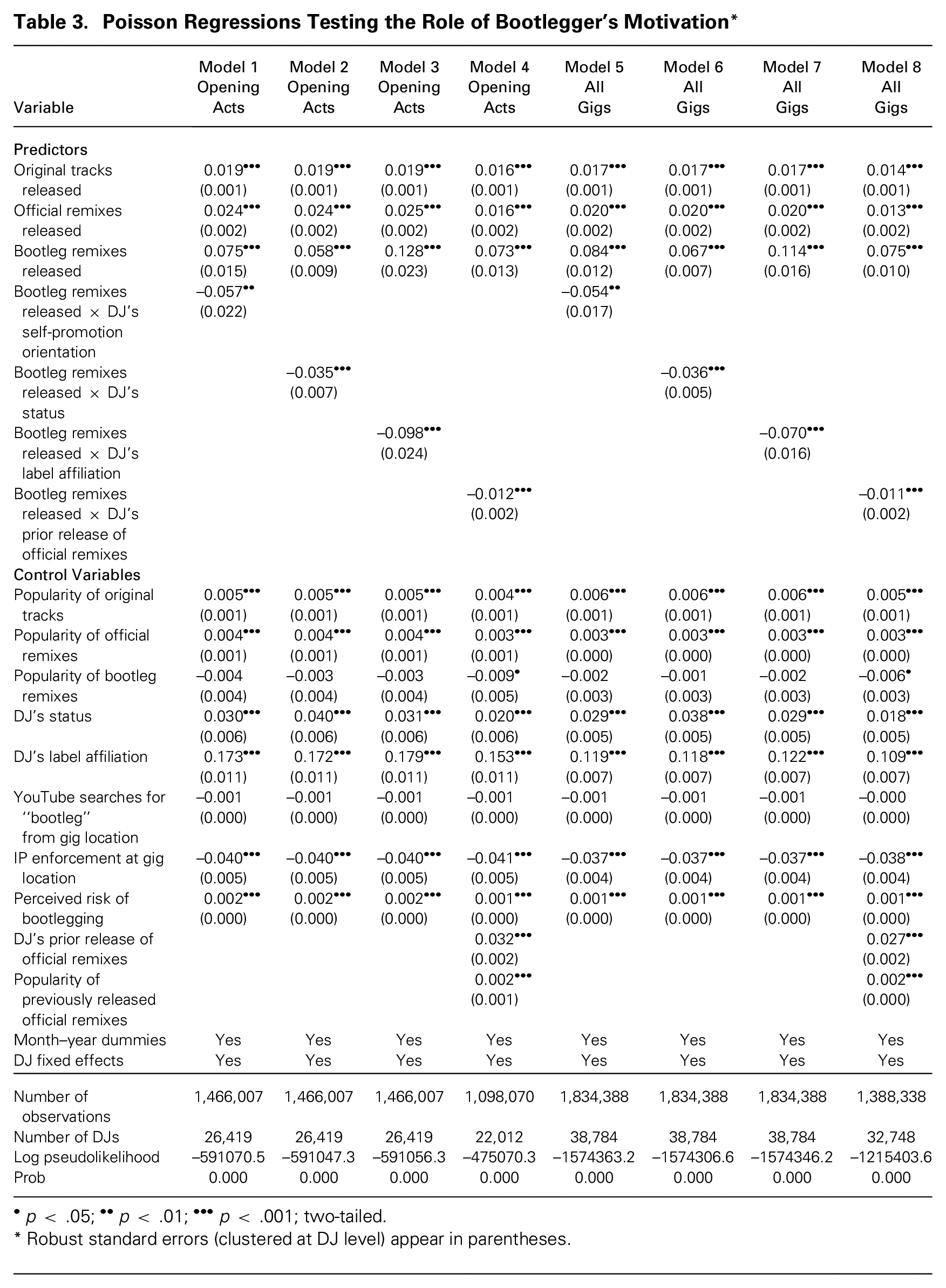
•p < .05; ••p < .01; •••p < .001; two-tailed.
* Robust standard errors (clustered at DJ level) appear in parentheses.
According to model 1, the estimated coefficient for the interaction term is negative and significant. Given the nonlinear nature of interaction effects in Poisson models (see Ai & Norton, 2003), we followed Mize (2019) and Hoetker (2007) and plotted the results in Figure 2a. It shows that compared to DJs focused more on self-promotion, DJs less focused on self-promotion experience a larger (positive) average marginal effect of bootlegging on the monthly number of opening acts they perform. 22 In fact, these results reveal that when a DJ’s orientation toward self-promotion equals 3, the highest possible value among DJs who played opening acts, the average marginal effect of bootlegging becomes negative (–0.098 p = 0.069). In other words, these DJs have fewer opportunities to open for other artists after releasing bootlegs than if they had not released any music. Thus, consistent with our expectations, the community does not support (and even penalizes) bootleggers whose orientation toward self-promotion is greater. 23 Note that our results, as shown in model 5 and Figure 2b, remain entirely consistent when we analyzed the full sample of gigs (rather than opening acts only).
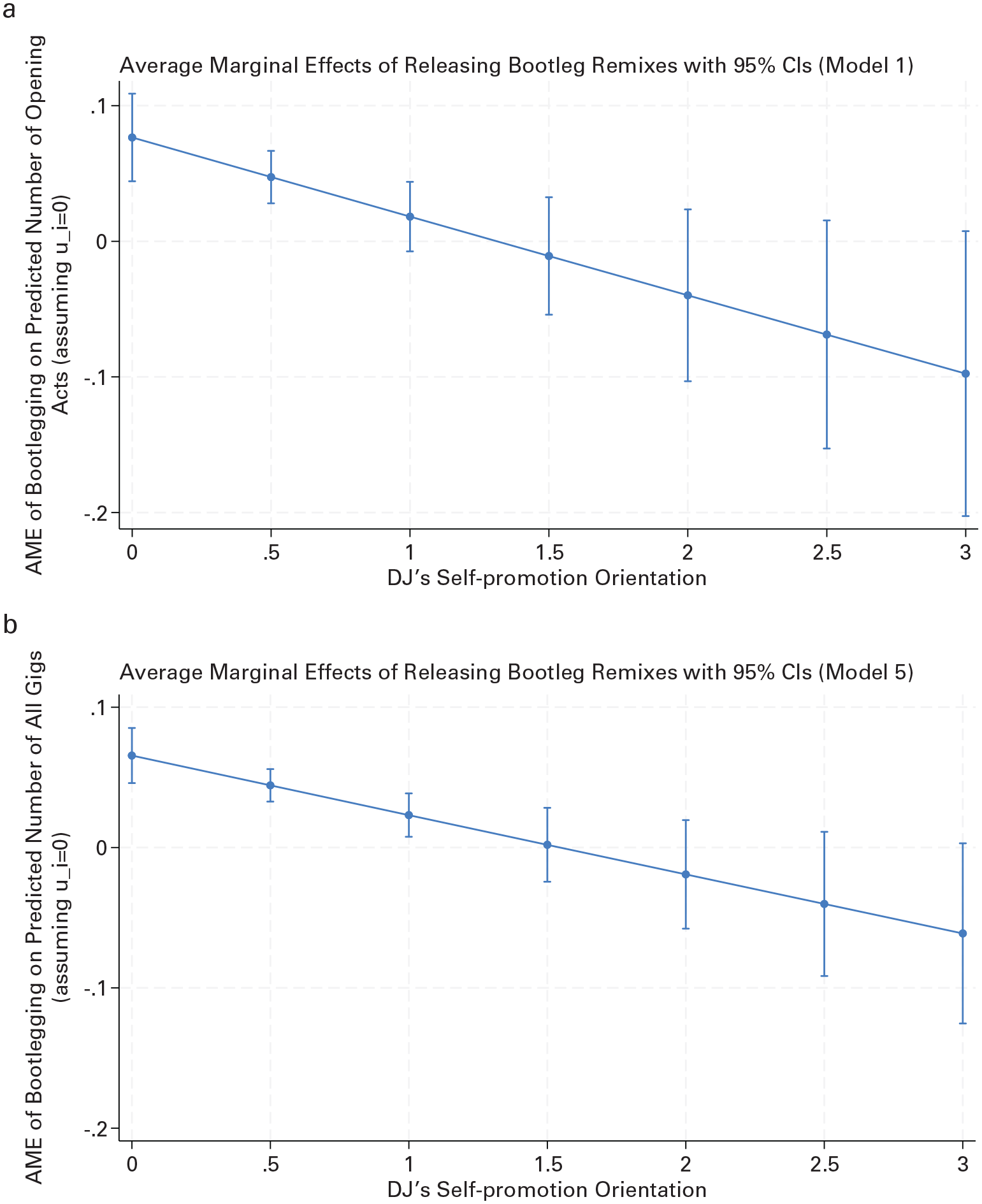
The Moderating Effect of a DJ’s Self-promotion Orientation (Table 3, Models 1 and 5)
Status
In addition to self-promotion orientation, we expect a privileged socioeconomic position in the community, which provides status and access to significant resources, to raise suspicion about a perpetrator’s motivation for breaking the law. Higher-status DJs benefit from a privileged position, which enables them to easily win over copyright owners, making it relatively simple for them to clear tracks. This privileged position raises questions about a bootlegger’s motivation, leading observers to assume they acted out of convenience, lack of consideration, or outright disregard for their peers. We investigate whether higher-status DJs benefit less from bootlegging, in Table 3, model 2, by including an interaction term between the number of bootlegs released by a DJ and their status.
As model 2 shows, the estimated coefficient for the interaction is negative and significant. Figure 3a shows that the (positive) estimated average marginal effects of bootlegging on a DJ’s monthly opening acts are significantly larger when the DJ’s status is lower than when it is higher. 24 Here again, note that when a DJ’s status reaches a value of 3 or more, which includes 424 DJs in our sample, the average marginal effect of bootlegging becomes negative and significant (–0.054, p = 0.022), suggesting that they experience a penalty for engaging in this illegal action. In other words, support for a bootlegger disappears as their status increases, even leading to fewer opportunities (than if they had not released any music) to open for peers. These results, as shown in Table 3, model 6 and in Figure 3b, remain consistent when we consider the full sample of gigs performed by a DJ.
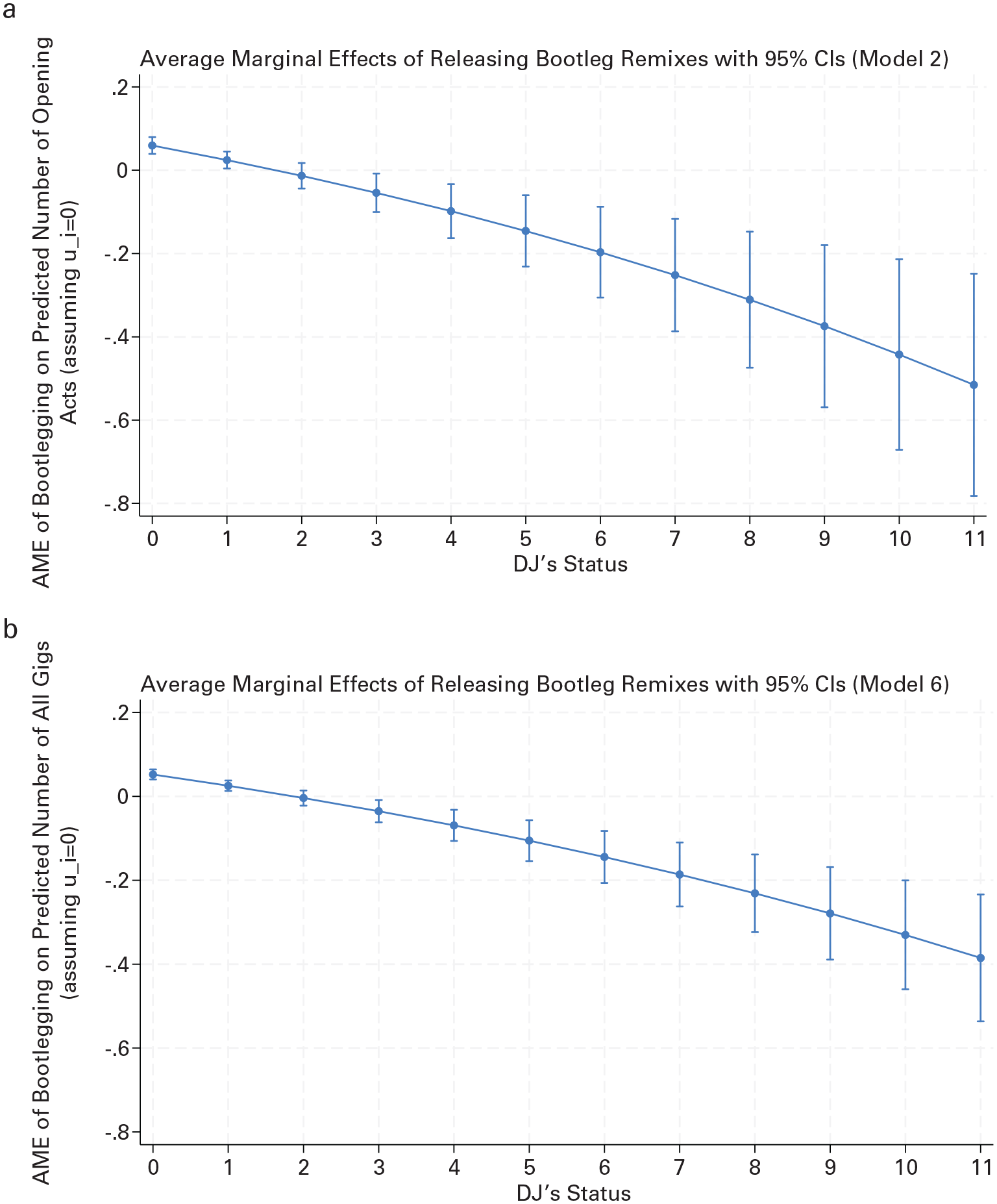
The Moderating Effect of a DJ’s Status (Table 3, Models 2 and 6)
Record label affiliation
A DJ signed with a record label can access its resources and have its experts handle partnership and copyright issues. During our fieldwork, bootlegging was thus described as suspect if one had access to a label’s legal team. Labels also have departments dedicated to shaping artists into something that will sell. Hence, being signed with a label likely suggests to observers that a bootlegger is motivated by economic considerations and is strategically seeking attention.
Table 3, model 3, includes the interaction between the bootlegs that a DJ released and whether the DJ was signed with a label. The estimated coefficient for our interaction term is negative and significant. Figure 4a shows that the (positive) estimated average marginal effect of bootlegging on a DJ’s monthly opening acts is significantly greater when the DJ is without a record label (i.e., DJ’s label affiliation = 0) than with a label (i.e., DJ’s label affiliation = 1). 25 While these results do not indicate a backlash for bootleggers who are backed by a label, we speculate that these DJs might incur penalties we cannot observe, such as social ostracizing or public shaming, and that their label affiliation may somehow help them maintain opportunities to play gigs. Nevertheless, the results confirm that support for releasing bootlegs wanes when DJs gain access to a label’s resources. As with the previous analyses, the effects, as shown in model 7 and Figure 4b, remain consistent when we analyze any gig a DJ performed rather than just the opening acts.
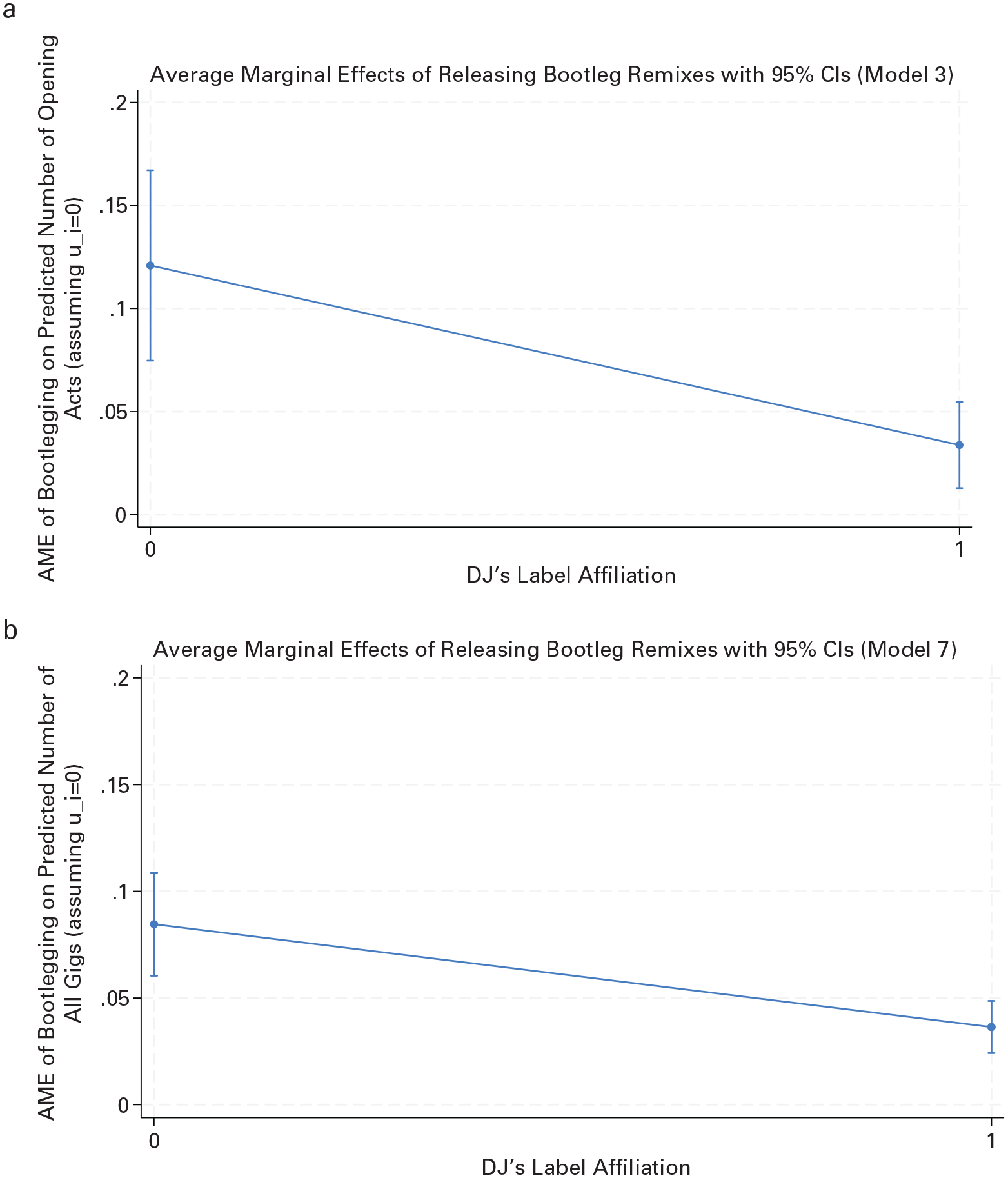
Moderating Effect of a DJ’s Label Affiliation (Table 3, Models 3 and 7)
Experience with the legal process
A DJ who has previously secured permission from copyright holders and released official remixes is likely familiar with the legal intricacies of clearing tracks. Given such experience, usually gained through collaboration and access to legal expertise, a bootlegger’s intent may seem questionable to community members. We thus expect this experience to raise questions about possible ulterior motives for bootlegging.
In Table 3, model 4, we included in our regression an interaction term with the number of official remixes the DJ released over the previous 12 months (i.e., between t-19 and t-30). Note that we also added a control for the popularity of the previously released official remixes. The estimated coefficient for the interaction term is negative and significant. This effect is plotted in Figure 5a, which shows that the (positive) estimated average marginal effects of bootlegging on monthly opening acts were significantly smaller when a DJ had previously released official remixes. 26 In particular, when a DJ had previously released more than nine official remixes, which includes 654 DJs in our sample, the average marginal effect of bootlegging turns negative and significant (–0.039, p = 0.021), suggesting that they encounter a penalty for releasing illegal bootlegs and are offered fewer opportunities (than if they had not released any music) to play opening acts. In keeping with our proposed mechanism, prior experience with the legal process thus played a role in the level of support a DJ elicited for bootlegging. Again, as shown in Table 3 model 8 and Figure 5b, these results remain consistent when we analyzed the full sample of gigs, instead.
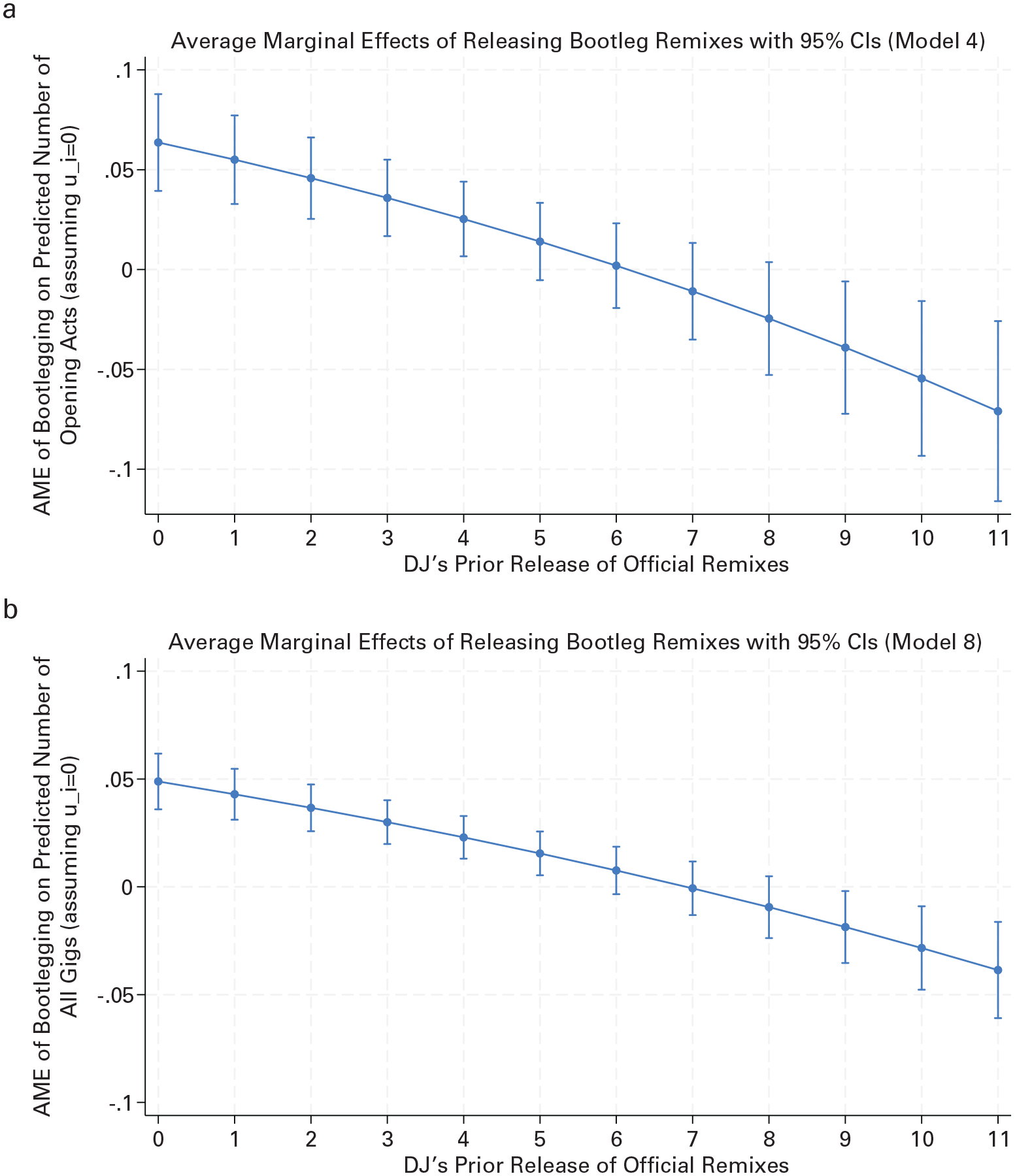
The Moderating Effect of a DJ’s Prior Release of Official Remixes (Table 3, Models 4 and 8)
Last, for robustness checks, we followed Shaver (2019) and tested all the proposed moderation effects by using segmented regressions both for the main sample (opening acts) and the full sample (all gigs). The results are entirely consistent and are summarized in Online Appendices 5a and 5b. 27
Differences in Perceived Creativity, Quality, and Visibility as Alternative Explanations
Our theory and evidence thus far suggest that the EDM community can interpret bootlegging as a disinterested action intended to serve the community, which generates support for perpetrators in the form of opportunities to open for peers. A different explanation could be that bootlegs are perceived as more novel, attention-grabbing, or of higher quality than other musical tracks. Perhaps this results in more opportunities to perform and to open for peers, especially for artists with a limited orientation toward self-promotion, lower status within the community, no affiliation with a music label, or minimal experience releasing official remixes. We conducted two studies to investigate this possibility.
First, we ran a consensual assessment survey to examine whether EDM professionals would view bootlegs as more novel or of higher quality than legal music (see Amabile, 1996; Berg, 2016). We recruited three professionals with an average of 10 years of experience producing EDM music, DJing, and booking DJs. Independently and blindly, they rated the novelty and quality of 150 tracks randomly selected from our sample (50 bootlegs, 50 official remixes, and 50 original tracks). Following Berg (2016, p. 444–445), we defined quality as “audience appeal” and novelty as the degree to which a track is “unique” among EDM tracks. With no information about the type of music track they were evaluating, raters were first asked to listen to 15 tracks (randomly selected from our sample and excluded from the 150 to be rated) to establish a means of comparison. These consisted of five bootlegs, five official remixes, and five original tracks, presented in randomized order (Amabile, 1996; Berg, 2016). Experts then rated the 150 tracks, in randomized order, on the items “This track is novel, compared to other EDM tracks” and “This track is appealing, compared to other EDM tracks,” using a 7-point Likert scale (i.e., 1 = strongly disagree to 7 = strongly agree). Online Appendix 7 provides a screenshot of the survey shared with our experts. We fielded the survey in December 2022 and obtained ratings that met standard cutoffs for both interrater reliability (ICC2 = 0.55 for novelty, 0.68 for quality) and agreement (average deviation = 0.91 for novelty, 0.87 for quality) (Fleiss, 1999; LeBreton & Senter, 2008).
The three professionals’ average novelty ratings were 3.89 (S.D. = 1.14) for bootlegs, 3.97 (S.D. = 1.12) for official remixes, and 4.15 (S.D. = 1.28) for original tracks. Using a one-way analysis of variance (ANOVA), we found no significant differences (p = 0.545) among the average novelty ratings for the three types of tracks. The average quality ratings were 3.68 (S.D. = 1.55) for bootlegs, 4.01 (S.D. = 1.35) for official remixes, and 4.21 (S.D. = 1.14) for original tracks. Again, a one-way ANOVA indicated no significant differences (p = 0.143) between the three track types. In summary, the bootlegs in our sample were not rated as superior in novelty or quality compared to official remixes and original tracks.
Although EDM professionals blindly rated bootlegs, official remixes, and original tracks as similar, perhaps knowing that a track is a bootleg influences the perception of its novelty and quality. Furthermore, though it is well established that remixes can attract audience attention more effectively than original tracks, perhaps an illegal remix attracts even more attention than an official remix. 28 Next, we conducted an online experiment to assess these possibilities. We started by surveying all U.S.-based participants who designated music as their hobby on Prolific.com. We asked them about their three favorite music genres from a list of the 11 most-streamed genres in the U.S. in 2021. 29 Of the 4,502 participants, 1,069 selected EDM as one of their three favorite genres. In 2023, we invited these 1,069 individuals to participate in our experiment, and 885 completed the study.
Randomly assigned to one of four conditions, participants listened to the same EDM track selected from our sample. 30 Participants in condition 1 (the baseline) were told that the track was an “EDM track by a DJ”; those in condition 2 were told it was an “original track composed and produced from scratch by a DJ”; those in condition 3 were told it was an “official remix produced by a DJ with the formal consent of the original’s copyright owner”; those in condition 4 were told it was a “bootleg produced by a DJ without the formal consent of the original’s copyright owner.” After listening to the track, all participants were asked to rate the track’s novelty, quality, and ability to attract audience attention on three items, using a 7-point Likert scale (i.e., 1 = strongly disagree to 7 = strongly agree). Online Appendix 8 provides screenshots of the experimental material. 31 Participants were paid £1.50 (approximately $1.89) for completing the study and further incentivized via a lottery with a 3 percent chance of earning a £3.0 (approximately $3.65) bonus payment (see Schaerer et al., 2018).
Among the 885 participants who finished the study, 52 failed the attention check. Thus, the final sample consisted of 833 EDM enthusiasts. Participants averaged 33.8 years of age (S.D. = 10.5); 47.7 percent were female, and 49.5 percent had been EDM fans for over 10 years. Table 4 summarizes the sample characteristics by condition; it shows that randomization across observable characteristics was successful, with no statistical differences among the four groups.
Sample Characteristics by Condition*
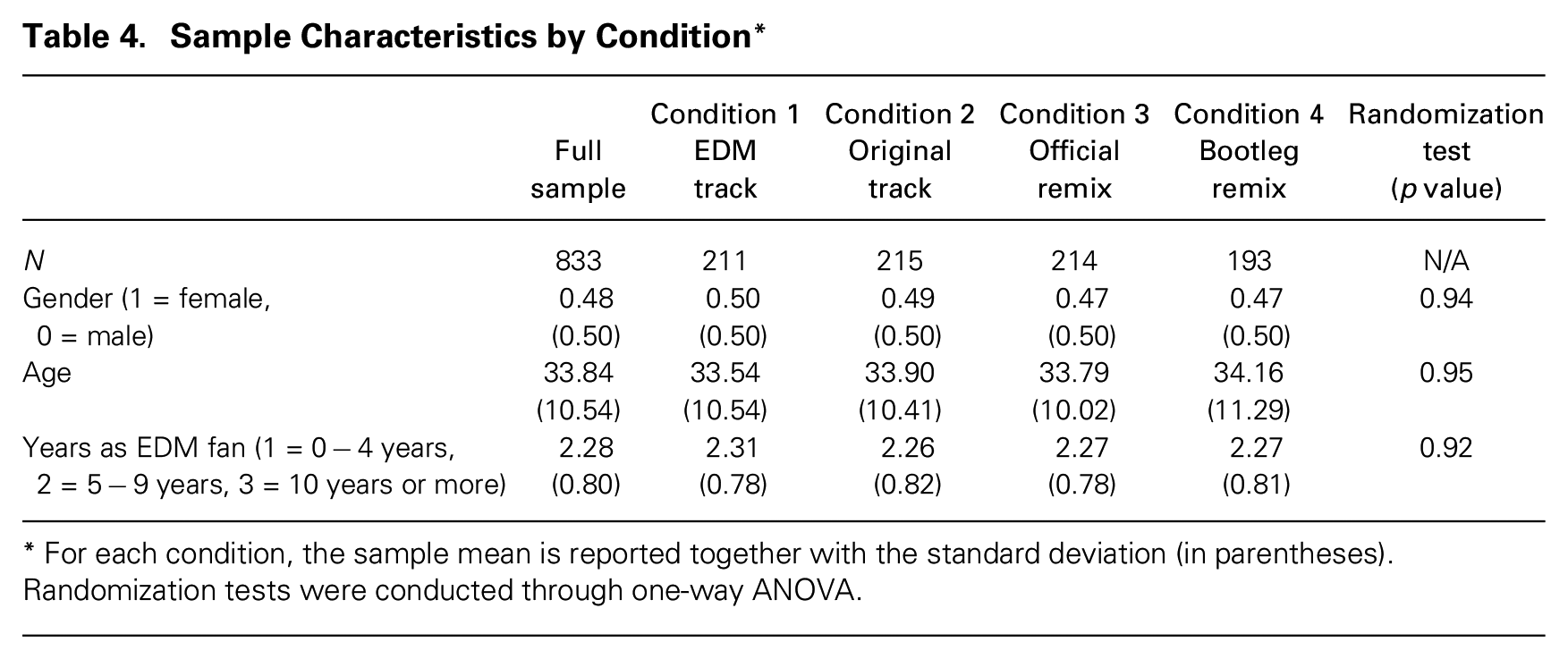
For each condition, the sample mean is reported together with the standard deviation (in parentheses). Randomization tests were conducted through one-way ANOVA.
The novelty of the track received an average rating of 3.24 (S.D. = 1.50) when it was described as an EDM track, 3.46 (S.D. = 1.49) when described as an original track, 3.27 (S.D. = 1.57) when described as an official remix, and 3.03 (S.D. = 1.61) when described as a bootleg remix. Adopting a one-way ANOVA with Bonferroni multiple-comparison tests, we found that the same EDM track was rated significantly less novel (p = 0.030) when described as a bootleg than as an original track; no significant difference (p > 0.699) was found in any other pairwise comparison of the track’s novelty ratings.
Regarding quality, the track’s ratings averaged 4.64 (S.D. = 1.48) when described as an EDM track, 4.40 (S.D. = 1.49) when described as an original track, 4.35 (S.D. = 1.46) when described as an official remix, and 4.31 (S.D. = 1.63) when described as a bootleg remix. A one-way ANOVA revealed no significant differences (p = 0.101) among the average quality ratings across the four conditions.
Last, we found that the track’s ability to capture attention received average ratings of 3.73 (S.D. = 1.68) when described as an EDM track, 3.65 (S.D. = 1.65) when described as an original track, 3.54 (S.D. = 1.54) when described as an official remix, and 3.53 (S.D. = 1.66) when described as a bootleg remix. Again, a one-way ANOVA showed no significant differences (p = 0.532) among those ratings.
Jointly, these additional survey and experimental data suggest that the benefits we document for bootleggers, in terms of opportunities to perform and to open for peers, are unlikely to be explained by differences in perceptions of quality, novelty, or ability to attract audience attention. This is likely to be true whether the audience consists of EDM professionals or EDM enthusiasts.
Phase 3: Elaborating on the Proposed Mechanism
Purpose, Sampling, and Analytical Approach for the Qualitative Data
Our study’s third and final phase consisted of analyzing qualitative data to shed more light on our surprising quantitative evidence (Creswell & Clark, 2017). Rather than building a new theory, we aimed to refine the interpretation of the “hard, objective facts” uncovered in the statistical analyses (Roth & Mehta, 2002, p. 138–139). Our original concern was to explore the face validity of our quantitative results and to uncover whether they made sense in the lived experience of people on the ground. However, the qualitative analysis also helped us to add depth to our proposed mechanism and to uncover complementary insights (Kaplan, 2015).
We chose to conduct interviews because private conversations allow respondents to be more open about their experience with and handling of unlawful actions. We focused on recruiting EDM professionals who had some experience, either direct or indirect, with bootlegging. For this reason, we used snowball chain sampling: We added interviewees referred to us until we concluded that we had reached saturation. 32 While we do not claim that the sample is representative of all EDM professionals, we note that our interviewees shared clear views on how bootlegging is understood and assessed within the community. The final sample includes a range of professionals—including DJ producers, bookers, and promoters—from ten countries, mainly in Europe, North America, and Asia. We conducted a total of 34 in-depth interviews, resulting in over 36 hours of audio recording. Respondents included ten professionals actively hiring DJs at the time of the interviews; the remaining 24 were DJs actively playing gigs and producing music (except for three DJs still honing their music production skills). Table 5 provides an overview of these respondents. All interviews were conducted two on one, in English, were recorded with the participant’s permission, and were transcribed. 33
Interview Respondents*
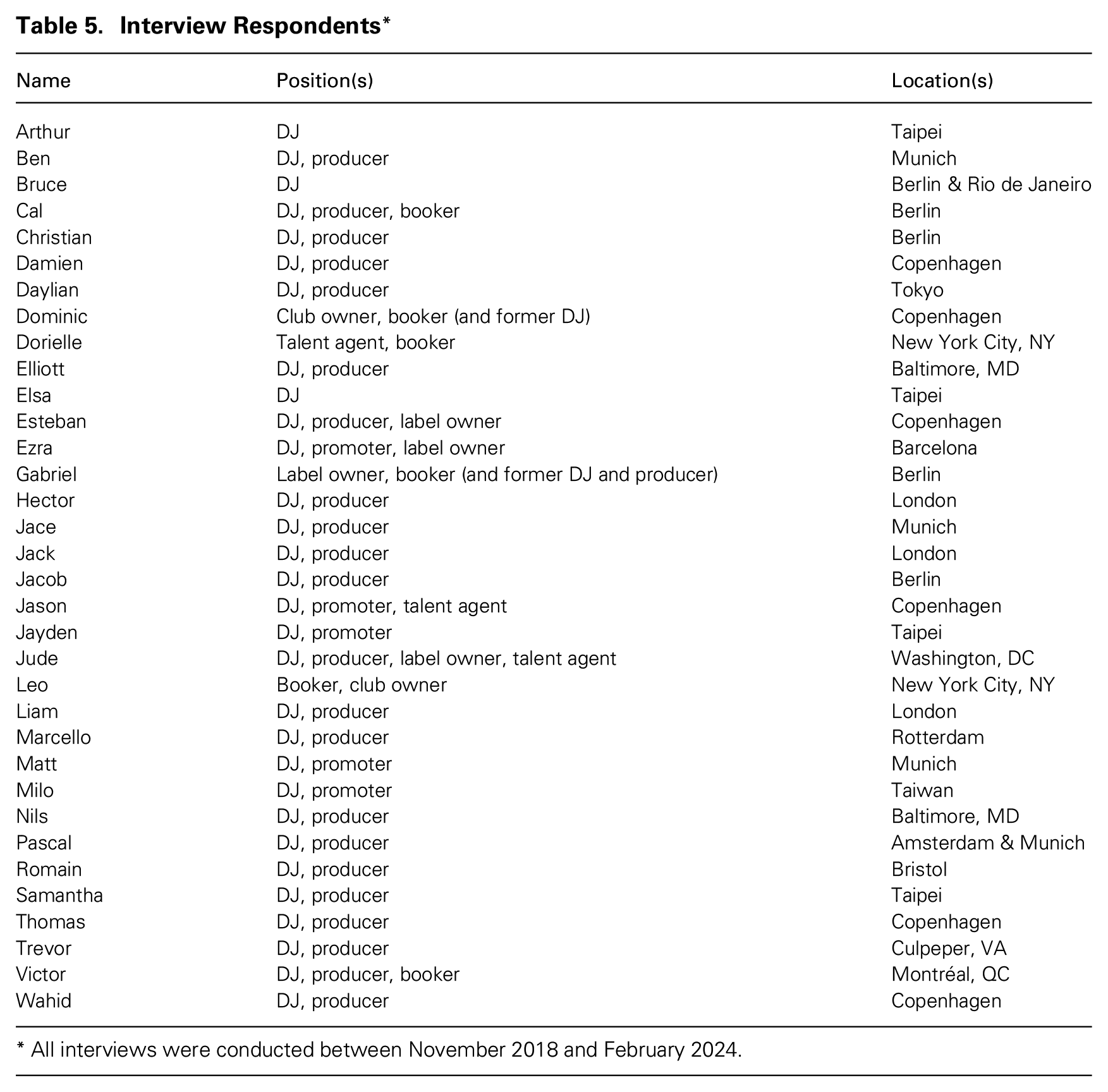
All interviews were conducted between November 2018 and February 2024.
The interview process was semi-structured and guided by open-ended questions that led to topical areas including respondents’ understanding of and reactions to bootlegging based on the attributions they assigned to this unlawful behavior (see the interview guide in Online Appendix 9). Initial responses to our questions (such as “Have you ever remixed someone’s music without their permission?” and “Can you tell us about it?”) were probed to allow increasingly detailed reflections from these professionals. The questions were tailored to the nature of the respondent’s activities.
We analyzed the interview transcripts, guided by expectations derived from the quantitative analysis and focusing on the following questions: (a) Under what circumstances may bootlegs be acceptable? (b) How would one distinguish between a more and less acceptable bootleg? (c) Would the community actively support bootleggers, and why? Our method involved a content analysis in which interview data were divided into categories to facilitate the comparison of themes. We manually tracked themes and patterns in Excel, focusing on how EDM professionals described bootlegging and responses to this illegal behavior. We coded each paragraph for recurrent themes to identify potential mechanisms contributing to variation in respondents’ perceptions.
To situate the conversation, we start by briefly summarizing, from the perspective of these professionals, when copyright infringement implies music theft and when it does not.
Bootlegging as Music Theft and/or Copyright Infringement
Over and over, our interviewees described copyright enforcement as necessary to protect the creative output of individual artists: “It [copyright law] is about protecting the sweat and the tears of the original producer!” (Christian, DJ and producer). The EDM professionals we spoke with all characterized music theft as a violation not just of the law but of the shared occupational norms of mutual respect. This word was mentioned on numerous occasions. “It’s not only that it’s a legal issue. You also don’t want to be disrespectful, disrespectful to other artists and labels . . . It’s not welcome in the scene” (Ben, DJ and producer). Pascal, a DJ and producer, outlined how music theft violates expectations of respect for original works: “We treat each other’s music with respect because we know how much work is behind it. Say a guy comes in, who steals your stuff, who cuts corners . . . This is a sign of disrespect.” Above and beyond upholding respect for original works, the law was credited with ensuring that artists respect each other in general, a point nicely summarized by DJ and producer Samantha: “Copyright laws are here to make sure artists show respect to one another.”
Yet, there was a sense that enforcing copyright law—and systematically penalizing bootlegging—is not always the best way to promote respect in a community in which borrowing and reinterpreting others’ work is a celebrated art form. Simply put, community norms regarding bootlegging were ambiguous. When probed on the issue, our interviewees questioned what several described as the law’s “blanket approach” to music theft. Regarding copyright law, the general view was that “the one-size-fits-all regulation doesn’t make sense” (Ezra, DJ, promoter, and label owner) and that community members understand better than the legislator subtle yet meaningful differences among bootleggers. This led our interviewees to advocate a more nuanced approach to evaluating each bootleg, though they exhibited much variation in terms of what they viewed as practical and viable alternatives to strict adherence to copyright law. 34 We now delve into these nuances.
Bootlegging as a Disinterested Community-Building Action
Our interviews revealed that EDM professionals considered bootlegging commendable—the “white” version of bootlegging—when the action conveyed a perpetrator’s willingness to follow their passion for music or promote respect for other EDM artists and their work. Table 6 provides sample quotes and summarizes the common themes detected from the interviews; we included any theme mentioned by more than one interviewee.
Summary of the Qualitative Data on “White” and “Black” Versions of Bootlegging
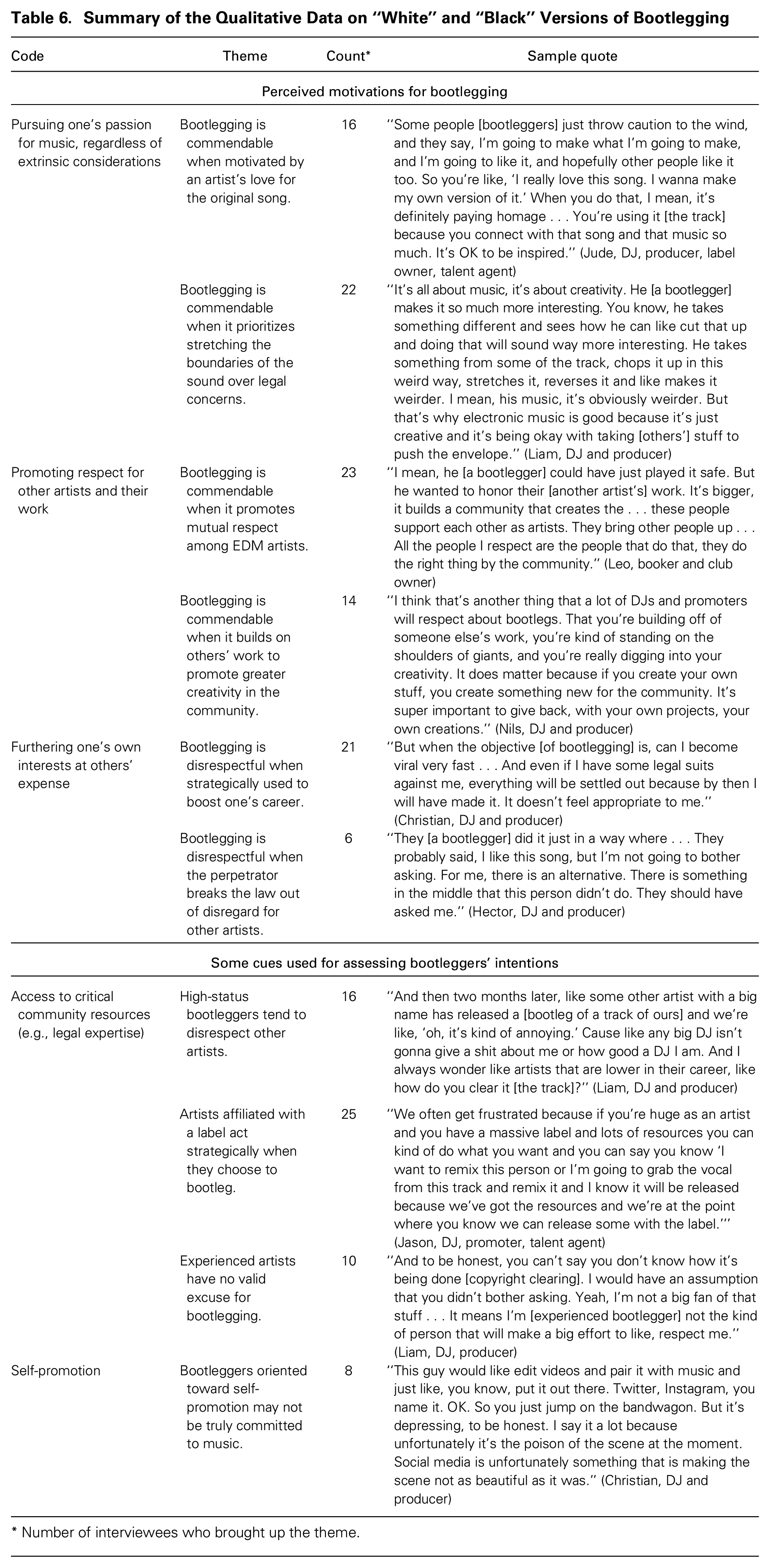
Number of interviewees who brought up the theme.
A first theme that emerged from our analysis is that bootlegs are commendable when they are motivated by an artist’s passion for a song and their desire to stretch the boundaries of EDM sound: “[You think,] ‘I can make this song better.’ You follow your gut” (Thomas, DJ and producer). Damien, a DJ and producer, explained: “It’s nice that people are inspired by your music to make more music. And it’s nice that they like your track and want to work with it. When that’s the motivation, it’s nice.” By contrast, Jayden, a DJ and promoter, summarized the essence of a self-serving motivation for bootlegging: “You’re not in it for the music . . . Like if you are a fakey. Not a fakey, but like if you’re just trying to make it, you know, to be cool and stuff like that, and you’re not in it for the art.”
A second dominant theme in respondents’ accounts—and a key insight from our qualitative analyses—was that commendable bootlegs are disinterested, community-building actions rather than strategic, career-boosting actions. Indeed, respondents continuously contrasted bootleggers who protect and strengthen the community’s values with those who act out of self-interested calculations. Unlike a disinterested action, the “black” version of bootlegging involved a calculated bet on the perpetrator’s part. Christian explained: “It’s a commercial thing that will boost my career immediately. And there are some artists that do that. I don’t like it.” This notion of a disinterested rather than strategic action is critical and helps explain a significant and surprising finding in our quantitative analyses: Bootlegs elicit more support, as measured by opportunities to perform and to open for peers, than official remixes do. A key insight gathered from our interviews is that an official remix involves a public partnership in which each party comes to a mutually beneficial agreement from a creative, strategic, and/or financial standpoint. As summarized by Matt, a DJ and promoter, “Official remixes are always a good way to give additional visibility to friends or also DJs in your network, to combine both of your brands. Then the other DJ is doing the promotion for the track, and you are doing the promotion for the track.” Similarly, label owner and booker Gabriel recalled his experience with an official remix when he used to DJ: “They [artists] did a nice [official] remix for me . . . It’s a partnership. Remixes are a good way to get additional visibility and to combine both of your brands. So, the official remix is strategic; a strategy that everybody understands and uses.” This strategic angle is absent when a DJ violates copyright law out of passion for music or to honor a peer’s work. The willingness to break the law to promote others’ work in the name of shared community values explains the greater support for bootleggers than for official remixers.
In addition to perceived disinterestedness, the overarching, critical characteristic of the “white” version of bootlegging is that it is understood as a contribution to the collective, a community-building action of some sort. There was a shared sense that serving rather than using the community was a key difference between honorable bootleggers and “fakeys.” To this point, Arthur, a DJ, described the distinction between the two versions of bootlegging: I’m not stealing your work and putting my name on it and then repackaging it. That’s not what I am doing. That is different. I’m making a remix, and yes, it’s illegal. But I’m respecting the original work. I’m not claiming it as my own; it’s an homage to your work, like standing on the shoulders of giants. It’s that rising tides mentality.
Jude, a DJ, producer, label owner, and talent agent, nicely summarized the theme of community building brought up by our interviewees: I think the generally accepted principle is to support the people, like . . . show you are not trying to profit from them but you like their work. Make sure that it’s not just all about you because at the end of the day, it’s a community effort and we are all like . . . we’re coming together with music . . . it’s just really important to be fostering a good community.
Daylian, a DJ and producer, described a similar experience after having produced a couple of bootlegs: “I don’t think I’ve ever received one message telling me that my bootlegs were not OK. Let’s put it that way: I’m pretty much in a grey area with these songs, but I think they [other DJs] don’t mind. In fact, they appreciate it, that I’m doing it, because it keeps the community strong.” In other words, these bootlegs were cast in a favorable light because they promote mutual respect. Note that 22 of 34 interviewees explicitly described respect as a pillar of the EDM community. This was usually tied to the idea that EDM celebrates remixing as an art form, which makes the need for mutual respect especially salient in this community. Christian concluded with a rhetorical question to distinguish possible motivations: “Does it feel a bit cheap, like something I do to boost my career. . .? Or am I stretching the boundaries of the sound? . . . Am I aware of the needs of my community?” Jude simply stated, “It’s just really important to be fostering a good community. Like showing respect to the people you work with, treating their work with that respect.”
Cues of a Bootlegger’s Intentions
In exchange for their community-building efforts, DJs engaged in “white” bootlegging were considered worthy of active support. Several interviewees on the demand side of the labor market mentioned the importance of motivations and community interest in their evaluations of DJs. Booker and club owner Leo explained why bootlegs can provide greater opportunities to play gigs: “You’ll often hear this, it’s not ‘you learn to make music, and then you’ll get gigs.’ No. It’s ‘You learn to make music, then you contribute to the community, and then you get gigs.’ When you’re doing good by the community, the community gives back.” He added, “I want to hire the right people, take the time to, to meet these artists who bring others up and who care about the community.”
As DJ and producer Trevor put it bluntly, “Sometimes it’s OK [to bootleg]. Sometimes it’s not. You know, it all depends on the artist that they are.” EDM professionals used several cues to evaluate a bootlegger’s motivation and whether they were, in Leo’s words, “the right people.” These cues include attributes like the artist’s standing in the community and access to key resources. Our interviewees indicated that access to legal advice—whether gained through social status, label affiliation, or experience with the copyright clearance process—raises suspicion about a bootlegger’s motives for violating copyright law. Wahid, a DJ and producer, explained that as a high-status artist, “You have the means [to clear a track]. You have a team that takes care of it.” He added, “Labels care about IP . . . . So they have the commercial set-up to handle it [and clear a track].” Similarly, Daylian concluded that “If you have the [label’s] legal team, it’s weird to bootleg.” Referring to experience with the copyright clearance process, Bruce, a DJ, added, “It’s always annoying for me when people don’t ask but they should know better, you know? It’s not a problem of inexperience . . . like, it’s not inexperience with the legal framework if you know the system.” The situation is different for lower-status DJs, who rarely enjoy access to such resources. As Damien summarized, “He [a bootlegger], he would have done it the right way if he knew how to . . . It’s so unclear for the common people what to do and they don’t have the resources, we don’t have the resources to get a lawyer or get some support in that kind of sense.”
As a result, the rationale for bootlegging appears more questionable and self-serving for high-status DJs and DJs who have access to knowledge and community resources. Daylian evoked a seasoned DJ whose bootleg he did not appreciate: “If they have the money to play around with, I don’t see a reason why they can’t just use a legal team. It is weird.” Thus, though sharing illegal remixes could elicit considerable support from the community, such support seemed to wane if the DJ in question enjoyed superior access to social, economic, and legal resources because the latter situation implied a less commendable motivation for bootlegging, one unrelated to the community’s interests.
A focus on boosting one’s visibility, notably through interested self-promotion, may also have acted as a cue for questionable motivations. Dominic, a club owner and booker, explained: At the moment, I think we have some artists in the mix that just, they’re not 100% committed to the art. They just found the easy way to make some quick money. If the artist only shows off, it’s just, like, “look at me,” if he’s just showing off on social media, then it’s like, okay, you’re not committed to the job.
He further argued, “[Social media] is very important. . . . But more important is how they [artists] are doing social media.” Specifically, our interviewees often differentiated between DJ-specific or music-sharing online platforms like SoundCloud and social networking platforms like Instagram or Facebook. On the demand side, there was notably a sense that considering how a DJ uses social media helps others assess how serious they are about EDM and DJing, compared to being an influencer. Matt put it this way: “Are you interested in DJing or is it a lifestyle thing?” This remark came up in several of our interviews, consistent with much secondary data on this topic. For example, the club BASEMENT’s booker also noted, Among a sea of trendy, TikTok type of influencer DJs who have thousands of followers, it’s clear that follower count and views do not mean that they’re good at what they do . . . I do check artist social media profiles to see how they present themselves, what they’re posting; you can see clearly if they take their job seriously or if this is just a side, temporary fun moment for them. Having a social media presence nowadays is essential for an artist; it’s one of the easiest ways to spread the word about yourself. What is very essential though, is to have a Soundcloud profile to upload your sets. (O’Connor, 2023)
Yet, our interviewees did not explicitly connect self-promotion on social media with an artist’s intentions when bootlegging. In light of our quantitative results and based on the qualitative evidence presented earlier, we suspect that bootleggers’ self-promotion orientation on social media influenced evaluations of their contribution to the community and, in turn, support for the artist, but our qualitative evidence in this regard is limited.
Discussion and Conclusion
Contribution and Future Research
Social scientists have paid considerable attention to how occupational communities use legal and normative regulatory frameworks to control their members’ behavior. It has long been recognized that formal laws and informal norms work as substitutes to ensure the smooth functioning of a community (e.g., McAdams & Rasmusen, 2007; Posner, 2009). In the absence of formal laws, community members enforce informal penalties for harmful behavior, aiming to deter future violations (Di Stefano et al., 2015; Fauchart & von Hippel, 2008; Reilly, 2018). When laws exist and align with community values, they are enforced and often replace informal sanctioning against violators (Horne, 2000; Horne, 2007). 35
Extant research suggests that the alignment between formal regulations and core occupational values determines whether a community actively promotes compliance with the law, discourages it, or supports only superficial, ceremonial compliance. However, recent studies point to a more complex reality. In ambiguous situations, compliance can be discretionary, allowing some community members—those with the most expertise—to deviate from formal regulations (Evans & Silbey, 2022). In this article, we built on this emerging body of research by emphasizing the role of members’ discretionary judgment. We proposed that ambiguous situations require members to interpret unlawful actions, leading to a distinct yet overlooked community response: the informal, active support of lawbreakers whose actions are interpreted as disinterested and aimed at benefiting the broader community. Focusing on remixing practices in the EDM community, we found that despite being illegal, bootlegging can elicit surprising community support. When bootleggers are seen as serving the community and promoting its core values, other members step in and provide them with more opportunities to perform and to open for peers. Hence, concerns about community welfare shape not only which behaviors an occupation chooses to regulate (Coleman, 1990; Ullmann-Margalit, 1977) but also its response to violations of formal regulations.
By providing a new rationale for discretionary compliance with the law in occupational communities, our theory sheds light on an apparent empirical anomaly: In an otherwise law-abiding community, members actively support lawbreakers. Understanding how disinterested motivations influence perceptions of illegal actions allows us to see why these lawbreakers are not merely excused for their behavior (Ody-Brasier & Vermeulen, 2020; Reilly, 2018). Reilly (2018) found that stand-up comics who steal a peer’s joke, which is legal but counter-normative, may be given the benefit of the doubt if they are respected for their craft expertise and backstage citizenship. Yet, joke theft is hardly ever seen as motivated by a concern for community welfare, and while this behavior may be excused, it is not actively supported in the ways outlined in this article. Unlike counter-normative (but legal) actions that are tolerated, unlawful actions driven by community-oriented motivations elicit active support. This finding also underscores the flip side of dynamics identified in recent research on how perceptions influence key economic outcomes: While structural positions linked to perceptions of self-serving behaviors often result in reduced social support and lower performance for an actor (Iorio, 2022), our findings suggest that perceptions of disinterested motivations and concern for the community’s welfare can lead to rewards and positively shape a perpetrator’s labor market opportunities.
Our theory contributes to the literature on how occupations use formal and informal regulations to control behavior. We shift the focus away from how well formal regulations align with core occupational values to illuminate the process by which members interpret unlawful behavior. We show that this assessment is not necessarily based on the perpetrator’s level of professional expertise, as recent studies have suggested (Evans & Silbey, 2022), but on the perpetrator’s perceived intentions. Hence, systematic differences in responses to lawbreaking may persist even when virtually all members of an occupation are experts (e.g., surgeons or airline pilots). This insight has important implications and raises intriguing questions for future research.
One question revolves around the relationship between a perpetrator’s expertise and how their intentions are perceived. Extant theory suggests that only experts are permitted to deviate from formal regulations. Yet, our theory suggests that if the less experienced members are perceived as more likely to act in the community’s interest, they may be the ones allowed to deviate. These two mechanisms could operate simultaneously within an occupation, potentially counterbalancing each other or one taking precedence over the other. Disentangling these processes would enable researchers to better assess their relative importance in shaping discretionary compliance. Alternatively, each mechanism may operate primarily in specific types of occupational communities. Understanding such differences would help to make sense of potential discrepancies across settings.
Another question relates to how our theory may help us understand variance in responses to compliance with, rather than violations of, formal regulations. For example, it is noteworthy that in their study of bioscience researchers, Evans and Silbey (2022) observed that complying only with individual safety regulations was criticized and sometimes even derided. This response could indicate potential penalties for members whose compliance prioritizes personal welfare over that of their community. Thus, the appropriateness of complying with formal regulations, much like the appropriateness of violating them, may be evaluated based on whether it appears motivated by individual rather than collective gain.
Last, we note an intriguing possibility that suggests another direction for future research: Aspiring DJs who engage in bootlegging and secure more opening gigs may gain significant attention from community tastemakers. As they build their career, these DJs may later leverage official remixes with other artists to demonstrate that they are now established. Assuming their bootlegs do not appear motivated by self-interest, a two-stage process may thus be at play. To investigate this possibility, one could compare the career trajectories of up-and-coming DJs who are invited to officially remix another artist’s track with those of similar DJs who engage in bootlegging. Although we cannot empirically investigate this possibility, we think it warrants careful consideration. 36
Generalizability and Scope Conditions
Our theory applies to a variety of regulations and occupations. First, we expect the dynamics we documented to apply to creative occupations, in which expectations of disinterestedness are well established and play a significant role. The ideal-typical artist is expected to prioritize core occupational values over extrinsic rewards. For example, take the illegal use of copyrighted material and private property in street art and consider the case of Banksy, who has faced increasing criticism from other street artists as he/she/they have gained prominence. We contend that these criticisms stem, at least partly, from the perception that self-interest rather than core community values increasingly drives Banksy’s sensationalist approach. Today, Banksy garners extensive media attention and frequently sells for substantial amounts at high-profile auctions, which are at odds with the collective nature of this art form and its non-commercial ideals.
We also speculate that the relevance of our theory extends beyond creative occupations or IP violations. Consider breaches of institutional review board (IRB) regulations in research. While these regulations are designed to uphold researchers’ concerns for scientific rigor, credibility, and integrity, they can also involve overly complex protocols and significant delays, even for studies that pose minimal risk (Friedman, 2022). The community’s response to such breaches may differ depending on whether the researcher’s intentions are seen as a commitment to advancing research rather than self-interest. A novice researcher at a public institution may be considered favorably if they violate IRB regulations, compared to an expert at a private elite institution.
Our theory could even apply to more-serious unlawful actions in highly regulated occupations. While some behaviors, such as manslaughter, might seem too severe to ever be construed as serving core values in a legitimate occupation, anecdotal evidence from the medical profession suggests otherwise. For instance, 60 percent of doctors do not view physician-assisted suicide, which is illegal in most U.S. states, as inappropriate when it aims to provide patients relief from unbearable pain, a core occupational value (Hetzler et al., 2019). In this sense, consistent with our argument, the offender’s intent rather than the severity of the act might influence the medical community’s response to lawbreaking. Testing our theory in the context of more-serious illegal actions would be insightful, though we anticipate significant challenges for researchers. Given the gravity of these actions and the associated penalties, we suspect that any form of active support from the community will remain concealed, making it extremely difficult for researchers to uncover.
Note that our theory applies specifically to unlawful actions that have the potential to either harm or benefit the community and its members; it does not apply to every unlawful action. For example, we would not expect an artist who uses illegal drugs in their personal life to receive active community support for this behavior. Additionally, we suspect that the relatively low cost of hiring a DJ for a night facilitates the provision of support in the form of employment opportunities. In occupations in which short-term contract work is the norm, as in EDM, this type of support may be prevalent. However, different dynamics may emerge in occupations in which more-traditional, long-term employment arrangements predominate. In other words, lower-cost opportunities may be extended to lawbreakers whose actions are viewed as serving the community in a disinterested manner. These could include mentoring or sharing private information. It would be valuable to explore how the patterns we document in this study might play out with alternative forms of support.
Limitations
An empirical limitation of our study is that we used DJ fixed effects, yet there are likely differences between DJs who remix and those who do not. Factors like age and career history may affect the likelihood of remixing, but our data do not allow us to explore this question fully. In Online Appendix 10, we present the results of multinomial logit analyses focused on the DJ characteristics we can observe, which help to alleviate concerns about stark and systematic differences between bootleggers and official remixers. That said, unobservable differences likely remain.
In addition, our data offer many advantages, allowing us to observe illegal practices, employment outcomes, creative output, status within the community, social media presence, and label affiliations on a global scale over a decade. However, we cannot analyze the musical content of the 400,000 tracks in our sample. The number of tracks affected and the degree of overlap between the original and the new track could shape perceptions of remixes. Remixes may be more prevalent in some subgenres, which we cannot observe. The objective musical quality of a track may also play a role, which we cannot account for in this article (Askin & Mauskapf, 2017). We have no reason to expect systematic differences favoring bootlegs over official remixes, but we recognize this possibility.
Last, we used a concrete outcome, a job, to measure the occupational community’s active support for lawbreakers. We provided substantial evidence that within this community, our variable effectively captures this fundamental construct, but we acknowledge that this is not a perfect measure. In general, measuring community support, particularly in relation to an illegal practice, is difficult (see Stroope, 2015, on measuring community support for the unlawful dowry practice in India). Recent sociological studies have measured community support through surveys in which participants reported how much they helped peers in various areas (e.g., Desmond & An, 2015). While more direct, such survey measures would be difficult to collect for our relatively large sample, and they have their own limitations (e.g., social desirability bias, recall bias). We view these limitations as especially likely when researchers aim to capture support for an unlawful behavior (see Stroope, 2015, on the use of indirect survey questions for sensitive subjects).
Overall, these limitations provide exciting opportunities for future research. We hope this article will encourage further exploration of the conditions under which breaking the law can paradoxically be interpreted as a disinterested, community-building action that helps perpetrators improve their positions within the community.
Supplemental Material
sj-pdf-1-asq-10.1177_00018392251320898 – Supplemental material for When Breaking the Law Gets You the Job: Evidence from the Electronic Dance Music Community
Supplemental material, sj-pdf-1-asq-10.1177_00018392251320898 for When Breaking the Law Gets You the Job: Evidence from the Electronic Dance Music Community by Xu Li and Amandine Ody-Brasier in Administrative Science Quarterly
Footnotes
Acknowledgements
We would like to thank Oliver Hahl, Johannes Luger, Louise Mors, and Vera Rocha for their feedback on early versions of this paper. We also thank seminar attendees at Columbia Business School, Rotman School of Management, Gies College of Business, INSEAD, London Business School, London School of Economics, SIE Seminar Series, Olin Business School, EM Lyon, and ESMT, and participants of the 2024 Creative Industries Conference and 2021 Authenticity Seminar Series for their valuable suggestions. Special thanks to Nel Dutt, Olga Hawn, Marlo Raveendran, and Elena Vidal for their comments on several versions of the paper. Lastly, we are truly indebted to Claudio Martay for introducing us to the fascinating world of EDM and for his continued support throughout the project.
2
 introduced the concept of disinterestedness to describe the disposition of an artist engaged with their work, not for extrinsic rewards but for the sake of the work itself. We build on this idea and define “disinterested” lawbreaking as an unlawful action motivated not by the perpetrator’s self-interest, such as the pursuit of personal and extrinsic gains, but by their prioritizing core occupational values over legal considerations.
3
Berlin is arguably the world capital of club culture, especially techno. In 2024 its scene was added to the Unesco cultural heritage list. Even outside techno, many EDM artists spend at least some time or cross paths in Berlin, a feature we used to our advantage for our fieldwork.
4
Phil Morse is the founder of Digital DJ Tips, a popular online platform, and his book Rock the Dancefloor! is a bestseller described by insiders as “a wealth of knowledge and practical information that will help boost any DJ’s career . . . both beginners and experienced DJs” (Mick Wilson, DJ Mag).
6
A resident DJ refers to an artist who, unlike a guest DJ, is a current, regular employee of the venue.
8
Please refer to Online Appendix 1 for sample quotes from our fieldwork, which outline the role that peer support played for the professionals we spoke with.
9
Even if a DJ does not sell their bootlegs, posting these tracks online (even for free) constitutes IP infringement, as it involves creating derivative works without the copyright holder's permission.
10
The case of Metallica vs. Napster nicely illustrates the specific problem of file sharing in the music industry. We thank an anonymous reviewer for highlighting this point.
11
All names from our fieldwork are pseudonyms.
12
A DJ’s personal page on the platform is connected to personal SoundCloud and other media platform pages. A DJ’s “track page,” which summarizes the DJ’s track-releasing history, will redirect one automatically to the music tracks posted on those media platforms. These links, embedded in the DJ’s page, allow fans to listen to a particular track instantly and for free.
13
We start in January 2007 because it was the first year that the platform opened its DJ Page system to all DJs, not just those selected by its editors.
14
Due to significant technological advancements, copyright algorithms were deployed more broadly around 2015–2016. As a result, bootlegs started to be automatically detected and removed from most online platforms.
15
Using a three-month lead time to construct our variables produced similar results. Analyses using either a two-year or a three-year window also produced consistent results.
16
To identify a DJ’s social networking accounts, we started by identifying all web pages that the DJ linked to their personal page on the online EDM platform. We then compared their web domains with those of the top-20 global social media platforms that had the most active users in 2016 (i.e., the end of our study period). See the list of social media platforms here:
17
Ideally, we would measure a track’s sonic quality by following . However, we were unable to do this because of our interest in illegal musical tracks, which are not part of the Echo Nest corpus. Thus, even if we constructed a track-level dataset, we would not be able to compute a reliable measure of sonic quality for bootlegs.
18
If a DJ performed in multiple countries in a given month, we weighted the YouTube search data of those countries by using the number of gigs played in each country. If a DJ did not perform in a given month, we assigned the home-country value of YouTube searches for “bootleg.”
19
We started by searching for the phrase “SoundCloud copyright” on Twitter. After manually inspecting the results and running sensitivity checks, we selected the following additional keywords: “infringement(s),”“violation(s),”“takedown(s),”“strike(s),”“remove(s),”“removing,”“removed,”“delete(s),”“deleting,”“deleted,”“terminate(s),”“terminating,” and “terminated.” The final measure is the total monthly number of posts (including replies) that include at least one of these keywords alongside the phrase “SoundCloud copyright.”
20
In all models presented in , the estimated effects of our control variables are intuitive and align with expectations. Interestingly, we note a small positive effect for the Perceived risk of bootlegging on a DJ’s monthly opening acts (and total gigs). We speculate that since this measure is based on the monthly number of Twitter posts discussing copyright infringement penalties in EDM, it may capture some of the public’s growing exposure to and/or interest in EDM. We also note that the estimated effect of IP enforcement at gig location on a DJ’s monthly opening acts (and total gigs) is negative and significant. We suspect this is attributable to the larger number of active DJs, and thus greater competition for gigs, in countries with higher IP enforcement (e.g., Germany or the UK). In our sample, the correlation between IP enforcement and the number of active DJs at a gig location is 0.523 (p = 0.000).
21
Each year, the magazine’s poll attracts up to a half-million votes from EDM DJs and fans worldwide; its final list of “top 100 clubs” is widely regarded within the community as the definitive guide to the world’s best dance floors.
22
We conducted pairwise comparisons between the magnitudes of the estimated average marginal effects for all seven data points shown in Figure 2a and ; all differences in 21 pairwise comparisons are statistically significant (p < 0.009 and p < 0.002 for all 21 pairwise comparisons).
23
Recall that this particular measure is time-invariant; hence, this result should be interpreted as between DJs.
24
We conducted pairwise comparisons between the magnitudes of the estimated average marginal effects for all 12 data points shown in Figures 3a and ; all differences in 66 pairwise comparisons are statistically significant (p = 0.000 and p = 0.000 for all 66 pairwise comparisons).
25
We also compared the magnitudes of the estimated average marginal effects for both data points in Figures 4a and and confirmed them to be statistically different (p = 0.000, p = 0.000).
26
We conducted pairwise comparisons between the magnitudes of the estimated average marginal effects for all 12 data points shown in Figures 5a and ; all differences in 66 pairwise comparisons are statistically significant (p = 0.000 and p = 0.000 for all 66 pairwise comparisons).
27
28
It is not entirely clear why this would be the case given that official bootlegs benefit from the promotional efforts of both the original and the remixing artist. Theoretically, the illegal nature of bootlegs should also make them less visible than official remixes to audience members.
29
These are R&B/hip-hop, rock, pop, country, Latin, dance/electronic (EDM), Christian/gospel, world, children, classical, jazz (Statista.com, ).
30
We randomly selected three tracks in our sample. We then considered the number of charts for each track so we could select the track that would be the least recognizable of the three.
31
The experimental material was approved by an institutional review board (ERB 2311026).
32
This sampling strategy facilitates access to respondents who are difficult to reach (in our case, EDM professionals willing to discuss their experience with illegal remixing). To mitigate concerns about homogeneity, we carefully selected our original network of seeds with particular attention to ensuring as much diversity as possible. We strived to capture a wide range of perspectives, leveraging a diverse network of seeds across geographic areas.
33
We adhered to institutional review board guidelines in selecting the respondents and conducting our interviews.
34
Few could describe what the alternative would look like concretely, but four respondents went as far as suggesting the possibility of an extra-legal, multi-stakeholder, community-based institution designed to solve the problem of music theft.
36
We thank an anonymous reviewer for suggesting this possibility.
Authors’ Biographies
References
Supplementary Material
Please find the following supplemental material available below.
For Open Access articles published under a Creative Commons License, all supplemental material carries the same license as the article it is associated with.
For non-Open Access articles published, all supplemental material carries a non-exclusive license, and permission requests for re-use of supplemental material or any part of supplemental material shall be sent directly to the copyright owner as specified in the copyright notice associated with the article.
