



Abstract
Organizations often claim that their actions benefit others, for example in social impact initiatives, eliciting positive legitimacy evaluations from a broad range of audiences even though such initiatives may produce limited or even harmful effects on target beneficiaries. While scholars have begun to examine relational dynamics between organizations and evaluators who render judgments about organizational legitimacy, target beneficiaries have been typically considered as the passive recipients of positive or negative impacts of organizational actions. Drawing on qualitative data from a corporate social responsibility project in Kenya, this study reveals a triadic relationship (organization–evaluators–target beneficiaries) that establishes organizational legitimacy in the eyes of evaluators while generating substantive benefits for target beneficiaries. Far from being passive, target beneficiaries actively participated in the organizational legitimation process by corroborating, in their communications with evaluators, the organization’s social impact claims. This corroboration provided leverage for the target beneficiaries to negotiate organizational support in order for them to redirect off-the-shelf practices toward contextualized practices that generated substantive benefits to themselves. Going beyond the organization–evaluator dyad, the study contributes a triadic perspective on social impact and reveals how target beneficiaries’ participation can reshape the processes and outcomes of social impact creation.
Many organizations claim that their actions benefit others, for instance, hospitals treating patients, schools and universities educating students, governments serving citizens, non-governmental organizations (NGOs) helping target beneficiaries, and corporations providing useful services and products for customers (Meyer, 2010; Bitektine et al., 2020). While the claim of benefiting others is common across a wide variety of organizational activities, such claims are particularly salient in organizational actions that include a stated goal of creating positive social impact (e.g., reducing poverty, improving access to education and health care), which are referred to as social impact initiatives (Thompson, Purdy, and Ventresca, 2018; Wry and Haugh, 2018). Through social impact initiatives, various types of organizations—from governments and NGOs to social enterprises and firms that implement corporate social responsibility (CSR) programs—establish their legitimacy in the eyes of diverse stakeholders, such as donors, funding agencies, ethically conscious consumers, and impact investors (Chiu and Sharfman, 2011; Battilana and Lee, 2014; Stephan et al., 2016). Legitimacy refers to a “generalized perception or assumption that the actions of an entity are desirable, proper, or appropriate within some socially constructed system of norms, values, beliefs, and definitions” (Suchman, 1995: 574).
Despite organizations’ claims of creating positive social impact, a growing body of research suggests that such actions primarily contribute to the legitimacy of organizations that implement social impact initiatives, while producing limited benefits or even harms to local communities (Fleming and Jones, 2013; Banerjee and Jackson, 2017; Jamali, Lund-Thomsen, and Khara, 2017). Reflecting these concerns, scholars have begun to investigate a discrepancy between the stated and actual outcomes of social impact initiatives and its underlying mechanisms (Bromley and Powell, 2012). 1 Notably, researchers suggest that social impact initiatives are particularly prone to divergence between stated and actual outcomes due to the highly opaque nature of the initiatives, that is, evaluators of organizational legitimacy (e.g., accreditation agencies, donors, customers) have difficulty understanding practices, outcomes, and the relationships between them (Wijen, 2014; Kuruvilla et al., 2020). This opacity can amplify further in the global context, as practices considered to be legitimate based on universalized principles and prescriptions (e.g., human rights, education) can easily become disconnected from local realities (Meyer, 2000, 2009) and even cause harm in different parts of the world (Jamali, Lund-Thomsen, and Khara, 2017; Kim, Bansal, and Haugh, 2019).
However, in the prior literature on social impact initiatives and organizational legitimacy, target beneficiaries are typically considered as passive recipients of the impacts of organizational actions whether the impacts are positive (e.g., successful social impact creation stories) or negative (e.g., critical studies). While scholars have recognized that individuals and groups in impoverished communities often have deep knowledge of social and ecological systems in their own context and take actions toward sustainable livelihoods (Whiteman and Cooper, 2000; Kim, Bansal, and Haugh, 2019), existing theories offer limited insight into how organizations, evaluators, and target beneficiaries may interact and play roles in creating social impact. Given that target beneficiaries are often marginalized populations in impoverished communities, it is not only theoretically interesting but also practically important (Tihanyi, 2020) to understand how these actors might play a role in securing substantive benefits under conditions prone to divergence between the stated and actual outcomes of social impact initiatives. Therefore, I investigate the following question in this study: What role, if any, do target beneficiaries play in influencing the processes and outcomes of social impact creation?
I explore this question through a qualitative study of interactions between a multinational corporation that implemented a CSR project (focal organization), tea farming communities in Kenya (target beneficiaries), and the corporation’s global audiences such as customers, media, and a funding agency (evaluators). Through a three-year CSR project, the corporation adopted off-the-shelf practices (e.g., cooperatives, Fairtrade certification) that were easily understood and appreciated by the global evaluators yet had limited relevance in the local context. Nevertheless, tea farmers actively supported off-the-shelf practices and corroborated the corporation’s social impact claims in communications with the evaluators, instead of undermining or questioning them. This ability to support or undermine the organization’s legitimation claims provided strong leverage for tea farmers in local negotiations, which resulted in off-the-shelf practices being redirected toward contextualized practices (e.g., land acquisition) that the evaluators found difficult to understand and appreciate but that were instrumental in achieving meaningful improvements in the farmers’ lives. In this regard, the organization’s social impact initiatives eventually produced substantive benefits for target beneficiaries, not through off-the-shelf practices as presented to the evaluators but through the work of target beneficiaries, who turned them into opportunities to negotiate for contextualized practices.
Drawing on the findings, I theorize target beneficiaries’ role in influencing the processes and outcomes of social impact creation. Specifically, I develop a triadic model of interactions (organization–evaluators–target beneficiaries) to unpack a process that establishes organizational legitimacy in the eyes of evaluators and generates substantive benefits for target beneficiaries over time. In doing so, I offer a multi-actor view of social impact creation and organizational legitimation that promotes a relational perspective for understanding organizational phenomena as shaped through ongoing interactions between various actors. I also present practical implications for ensuring positive effects of organizations’ social impact initiatives.
Theoretical Background
Organizations’ Social Impact Initiatives and Their Target Beneficiaries
In the face of major societal challenges such as poverty, inequality, and climate change, a growing number of organizations are engaging in social impact initiatives (Cronin and Dearing, 2017; Thompson, Purdy, and Ventresca, 2018). Reflecting the various types of organizations involved (e.g., social enterprises, nonprofits, corporations) and challenges they face, multiple streams of literature have investigated these initiatives, including social entrepreneurship (Dacin, Dacin, and Tracey, 2011; Hietschold et al., 2023), hybrid organizing (Battilana and Lee, 2014; Besharov and Mitzinneck, 2020), and corporate social responsibility (Barnett, Henriques, and Husted, 2020; Matten and Moon, 2020). Across diverse research streams, a common pattern of observations has emerged, which is that we understand much more about the outcomes of social impact initiatives for organizations or their participating employees than about whether and how such initiatives create positive social impact for target beneficiaries (Aguinis and Glavas, 2012; Stephan et al., 2016; Barnett, Henriques, and Husted, 2020; Bode, Rogan, and Singh, 2022).
Recognizing the need to investigate the actual impact of organizations’ social impact initiatives, research has increasingly reported cases in which such initiatives mainly serve organizational interests while creating limited benefits or even harms to target beneficiaries (Sylla, 2014; Bartley, 2018; Mayes, 2019). In a study of the football manufacturing industry in India (Jamali, Lund-Thomsen, and Khara, 2017), for example, firms sought to legitimize their activities by focusing on highly visible CSR issues (e.g., child labor), while the plight of marginalized workers remained unchanged. The negative impacts of microfinance on many communities in Africa, Asia, and Latin America have been widely documented, including the suicide of hundreds of borrowers under repayment pressure in India (Sinclair, 2012; van Rooyen, Stewart, and de Wet, 2012; Mader, 2013; Banerjee and Jackson, 2017). Other examples include the limited or negative effects of CSR initiatives and NGOs’ activities on the Rana Plaza disaster survivors and female garment workers in Bangladesh (Chowdhury, 2017; Ozkazanc-Pan, 2019) and the problematic rollout of the drinking-water technology PlayPumps in Southern Africa (Borland, 2011, 2014; Kim and Perreault-Henry, 2018).
With growing awareness that organizations’ social impact initiatives may primarily contribute to organizations’ legitimacy without much positive impact on target beneficiaries, researchers have begun to investigate the underlying mechanisms of the gap between such initiatives’ stated and actual outcomes. Some studies have pointed out that, particularly in the field of CSR, organizations’ primary motives are often to establish their own legitimacy rather than to create social impact (Banerjee, 2007, 2008; Fleming and Jones, 2013). In such cases, organizations seem to pursue win–win opportunities for business and society, but when there are trade-offs, they tend to prioritize their own interests over social impact (Karnani, 2011; King and Pucker, 2021). Other studies note that outcomes of organizational practices can become disconnected from the stated goals even when organizations have the best intentions to create positive social impact (Barnett, Henriques, and Husted, 2020; Vallely, 2020). This occurs as organizations pursue practices that are deemed normatively desirable (and hence legitimating) in their stakeholders’ eyes yet may not actually produce intended outcomes (Bromley and Powell, 2012; Wijen, 2014). For example, formalizing the work environment for eliminating child labor―a goal that on its face seems clearly desirable to many people―may actually reduce household income or drive women out of the workforce, ultimately worsening the poverty of farmers and workers in the Global South (Khan, Munir, and Willmott, 2007; Kim, Bansal, and Haugh, 2019). A consistent theme that emerges is that organizations’ pursuit of legitimacy, whether for their own interests or because they believe that legitimate practices will create positive social impact, constitutes an important mechanism behind the gap between stated and actual outcomes of social impact initiatives.
Organizational Legitimacy and Social Impact Initiatives
Organizational legitimacy research has investigated the relationship between focal organizations and their evaluators, who perceive the benefits of organizational actions (or lack thereof) and thus confer positive (or negative) legitimacy evaluations on the organizations. Emphasizing the dynamic, purposive process of legitimizing (Suddaby and Greenwood, 2005; Goodrick and Reay, 2010; David, Sine, and Haveman, 2013), prior research has highlighted the role of organizations that drive legitimation of their activities. For example, nonprofit consumer watchdog organizations have legitimized the rise of new organizational forms (Rao, 1998), and organizations have tried to create new markets for grass-fed meat and dairy products (Weber, Heinze, and DeSoucey, 2008). While such studies often assume that “audiences” play a relatively passive and reactive role, this assumption has been challenged by a more perceptual view highlighting the active role of individual and collective “evaluators” who render judgments about organizations’ legitimacy (Bitektine, 2011; Tost, 2011; Bitektine and Haack, 2015; Suddaby, Biketine, and Haack, 2017: 468).
However, previous studies have paid little attention to the agency of target beneficiaries who are distinct from the evaluators (e.g., target beneficiaries of NGO programs, separate from donors who evaluate the programs) in the process of organizational legitimation. Legitimacy researchers have long differentiated pragmatic legitimacy, which rests on the self-interested calculations of an organization’s evaluators, from moral legitimacy, which draws on the normative evaluations of whether an organization’s action is “the right thing to do” (Suchman, 1995: 579; Tost, 2011; Alexiou and Wiggins, 2019). Evaluators of pragmatic legitimacy can also be beneficiaries, such as firms that adopt sustainability certification programs based on expected benefits to themselves (Cashore, 2002). In contrast, evaluators of moral legitimacy are often separate from target beneficiaries, such as organizations and consumers who support sustainability certification initiatives in Europe or North America based on expected benefits for local communities in Africa, Asia, and Latin America (Huybrechts, Haugh, and Doherty, 2024). The evaluators often use cognitive shortcuts and heuristics (Kahneman and Tversky, 1979; Gigerenzer, 2008) to make quick judgments about the expected benefits (to evaluators themselves in the case of pragmatic legitimacy or to target beneficiaries of organizational actions in the case of moral legitimacy), under cognitive constraints and social influences (Bitektine, 2011; Bitektine and Haack, 2015). The legitimacy literature thus offers important insights into the dyadic relationship between legitimizing organizations and their evaluators, despite limited attention to the agency of target beneficiaries.
Opacity in legitimacy evaluations of social impact initiatives
The critical role of evaluators in organizational legitimation processes, as well as the cognitive limitations and biases that are inevitably part of their judgments, help us better understand the mechanisms driving the gap between the stated and actual outcomes of social impact initiatives. Researchers have noted the highly opaque nature of social impact initiatives as an important factor that gives rise to such divergence (Stål and Corvellec, 2018; Kuruvilla et al., 2020). Opacity exists when evaluators have difficulty fully understanding the characteristics of organizational practices, outcomes, and the relationships between practices and outcomes (Briscoe and Murphy, 2012; Wijen, 2014). In a conceptual article, Wijen (2014) theorized potential trade-offs between compliance and goal achievement in highly opaque fields such as sustainability standards. On one hand, the opacity of social impact initiatives (e.g., causal complexity, behavioral invisibility) creates the need for clarity for evaluators and thus propels organizations’ orientation toward compliance with sustainability standards. On the other hand, the causal complexity and context contingency of social issues underlying opacity also call for flexible approaches to achieve envisaged goals (i.e., social impact), which cannot be accommodated through rigid compliance. In a study of firms adopting labor standards for workers in their global supply chains, Kuruvilla and colleagues (2020) showed how the complex configuration of actors and practices resulted in opacity, which ultimately drove decoupling between the stated objective of firms’ practices (i.e., improving working conditions) and the actual outcomes for workers. Moreover, the opacity of social impact initiatives enables organizations to establish legitimacy in the eyes of evaluators even when the former’s actions produce limited or questionable outcomes for the claimed beneficiaries, whether the decoupling is intentional or not (Bromley and Powell, 2012; Whiteman and Cooper, 2016).
A growing body of empirical studies on this topic implies that the opacity of social impact initiatives might amplify further in the global context, in which the evaluators of such initiatives are often distant from the target beneficiaries. It is unlikely a coincidence that the gap between the stated and actual outcomes of social impact initiatives has been primarily observed in the activities of corporations and social enterprises that claim to benefit local communities and workers in the Global South while seeking to establish legitimacy among evaluators (e.g., customers, donors) in the Global North (Jamali, Lund-Thomsen, and Khara, 2017; Kim and Perreault-Henry, 2018; Kuruvilla et al., 2020). Not only does the complexity of global organizing generally increase the opacity of organizational practices and their outcomes (Levy, 2008; Kim and Davis, 2016), but also the universalized practices and principles considered to be legitimate across the globe often collide with local norms and practices (Meyer, 2000, 2009; Kostova and Roth, 2002). 2 These realities create conditions exacerbating the gap between the stated and actual outcomes of social impact initiatives, whether the gap results from the deliberate decoupling of irresponsible local practices from the global façade of legitimacy (Whiteman and Cooper, 2016; Jamali, Lund-Thomsen, and Khara, 2017) or the unanticipated consequences of well-intended actions that fail to address complex social issues in local contexts (Blowfield and Dolan, 2010; Wijen, 2014).
A blind spot: Triadic relationship and the role of target beneficiaries
Despite recognizing the active role of legitimizing organizations and their evaluators, previous research has treated target beneficiaries largely as passive recipients of organizational actions, whether as beneficiaries of positive impacts or victims of negative impacts. In a review article based on 319 articles and books on social innovation in management and other fields (e.g., public policy, sociology), Beckman and colleagues (2023) noted that only 4 percent of the studies discussed the community as a source of knowledge and impetus for social innovation. A few recent studies have begun to recognize that local communities participate in organizations’ social impact initiatives, such as East African tea producer organizations’ actions to address seasonal poverty through resources from Fairtrade (Kim, Bansal, and Haugh, 2019) and collaborations between corporate secondees and Indigenous partners in corporate–community investment programs in Australia (Gibson, 2022). While this emerging body of research sheds light on a dyadic relationship between organizations and target beneficiaries, the relational dynamics of organizations implementing social impact initiatives, their evaluators, and target beneficiaries remain underexplored.
The lack of attention to this triadic relationship represents an important blind spot in current research given that organizations increasingly seek to legitimize their actions based on claims of benefits for distant others across the globe (Meyer, 1996, 2010; Meyer and Jepperson, 2000). Sociologists have long recognized that triadic relationships are fundamentally different from dyadic relationships, as the third actor can play various roles such as strengthening, mediating, or disrupting the relationships between the two other actors, often benefiting from such roles and shaping group dynamics in radically different ways (Simmel, 1950; Burt, 1992; Yoon, Thye, and Lawler, 2013). Furthermore, considering the commonly observed divergence between stated and actual outcomes of social impact initiatives (Bromley and Powell, 2012; Wijen, 2014), it is important to explore how target beneficiaries—often marginalized individuals and groups who have important knowledge and wisdom rooted in the local context—may interact with organizations and their evaluators to meaningfully benefit from organizational activities. With this background, I delve into a process of interactions between an organization, its evaluators, and target beneficiaries to investigate target beneficiaries’ role in influencing the processes and outcomes of social impact creation.
Methods
Research Context
This research draws on an in-depth, qualitative study of the relationships between GlobalTea, a multinational beverage corporation (the organization), tea farming communities in Kenya (target beneficiaries), and GlobalTea’s audiences such as customers and NGOs (evaluators). Headquartered in the United Kingdom, GlobalTea is one of the largest tea traders in the world. The Kenyan subsidiary of GlobalTea and the communities are located in the highlands west of the Rift Valley, a major tea production area in Kenya. All names of the organizations are pseudonyms.
The most populous ethnic group in the research site is called Kipsigis. As a traditionally pastoral tribe, the Kipsigis have a history of communal land tenure, whereas cattle are private property (Manners, 1967; Krymkowski and Middleton, 1987). The Kipsigis people have become increasingly dependent on growing agricultural commodities, most importantly tea, which was introduced by British companies (including GlobalTea) in the 1920s (Manners, 1967; Swainson, 1980; Dinham and Hines, 1984). Despite changes in agricultural activities, the pastoral traditions and the history of collective land ownership continue to influence contemporary Kipsigis life.
The Kipsigis community of tea farmers comprises five sub-communities that formed a basis for five cooperatives, which I examined in the study. As the cooperatives were named after the sub-communities, I use the same set of pseudonyms to refer to the sub-communities and to the cooperatives: Tembo, Ndovu, Duma, Chui, and Simba. Other ethnic groups in the region include the Kikuyu, the largest ethnic group in Kenya, and the Kisii and Luo peoples from a neighboring province. Members of these ethic groups were employed in various roles at GlobalTea and other multinational corporations, from tea estate workers to office workers and managers, but were rarely part of the tea farming communities. This multi-ethnic region was deeply affected by the 2007–2008 post-election crisis in Kenya, the mass political and ethnic violence that led to the deaths of 1,300 to 2,000 people and the displacement of 400,000 to 600,000 people between the disputed presidential election in December 2007 and the establishment of a power-sharing agreement in February 2008 (Kagwanja, 2009; Kanyinga, 2009). Although the disputed election processes and results served as an immediate trigger, the intense violence was deeply rooted in the issues of land rights and ethnic rivalry over control of large farms in the former “White Highlands” since the country’s independence in 1963 (Kanyinga, 2009: 326). Thus, an important part of the post-election violence took the form of revenge attacks on those who own or control land that was believed to belong to another group, including attacks on multinational corporations, as I present in the findings in more detail.
In 2009, GlobalTea initiated a three-year CSR project, Hatua (a pseudonym), that had three objectives: (1) to support over 10,000 small-scale contract farmers (referred to as “outgrowers” in Kenya) to establish five cooperatives; (2) to assist the cooperatives in obtaining the Fairtrade certification, an ethical certification scheme seeking to contribute to sustainable development in the Global South; and (3) to empower farmers to diversify cash and food crops to reduce heavy dependence on tea. GlobalTea partnered with four organizations for the project: BritRetail (a food retailer in the U.K.), BritNGO (a British NGO that aims to support the cooperative sector in the U.K. and abroad), KENGO (a development NGO in Kenya), and KenEdu (an institution for cooperative education and training in Kenya). The CSR project was jointly funded by GlobalTea, BritRetail, and the U.K. government’s Department for International Development (DfID).
The Hatua project was implemented between October 2009 and October 2012, with a six-month extension until March 2013, while my research started in March 2010. Hence, I followed most of the project period, 36 out of 42 months, in real time. I reconstructed the events before March 2010 (e.g., the 2007–2008 post-election crisis, colonial history in the region) from the informants’ accounts and secondary data, combining the approaches of tracing backward and following forward the unfolding of processes (Langley and Tsoukas, 2010).
Data Sources
The data broadly fall into three categories: individual and group interviews, through which informants expressed their perceptions in verbal or visual forms; observations recorded in field notes and video clips; and secondary data, including relevant documents and videos.
Interviews
I conducted 64 semi-structured interviews (59 individual and five group interviews) with GlobalTea managers and employees, tea farmers across five sub-communities, and staff members of the project partners (i.e., BritRetail, BritNGO, KENGO, KenEdu) and other relevant organizations (e.g., governments, other NGOs). The length of each individual interview ranged from 30 minutes to two hours, with most lasting for about an hour. I also conducted five focus group interviews with 34 tea farmers to discuss some recurring themes in more depth. Each group interview lasted for two to three hours.
The interviews were conducted in English and Swahili (two official languages of Kenya), occasionally mixed with Kipsigis (a local language). As I had learned Swahili to prepare for my fieldwork (part-time language training for 14 months), I was able to conduct interviews in Swahili with farmers who were not comfortable speaking in English. Most farmers were comfortable speaking in Swahili, but two farmers occasionally mixed Kipsigis with Swahili to answer my questions. As I had limited knowledge of Kipsigis, other farmers helped me by translating the Kipsigis words and phrases into Swahili or English for the two interviews. The semi-structured interviews were complemented by informal conversations during the fieldwork, as well as email correspondence and telephone conversations throughout the research period.
The interview data also include 43 freehand drawings by 18 tea farmers. Researchers have combined drawings with interviews to understand informants’ experiences and interpretations beyond those provided in verbal descriptions (Meyer, 1991; Oborn et al., 2019). During the fieldwork, I noticed that many tea farmers were accustomed to communicating in visual forms (e.g., drawings of tea leaves to indicate quality standards) in the context of a high level of visual literacy and a relatively low level of textual literacy. Given these observations, I invited tea farmers to produce drawings about their experiences (e.g., changes in recent years) and explain them in their own words. The drawings often facilitated unexpected conversations, as a tea farmer’s drawings in Figure 1 illustrate. The farmer initially explained that she only picked tea leaves in the past but began to attend training as a cooperative board member. When I asked who would pick tea on those days, she responded, “family,” and described the challenges of women farmers in representative roles (i.e., meetings and training in addition to housework and farming), which helped me to better understand the impacts of gender quotas in the local context. Thus, the drawing method was important for facilitating in-depth verbal interviews and for exploring meanings expressed visually. Table 1 presents an overview of the interview data.
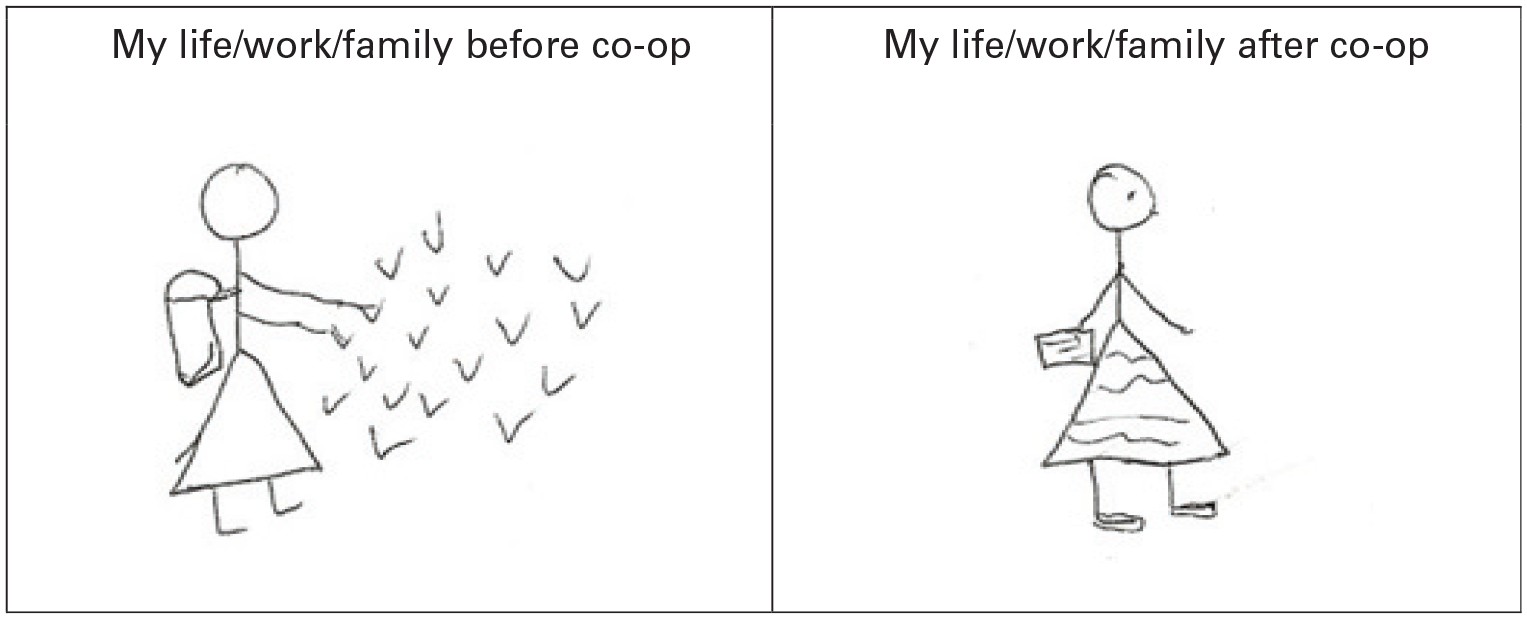
A Tea Farmer’s Drawings
Summary of Interview Data
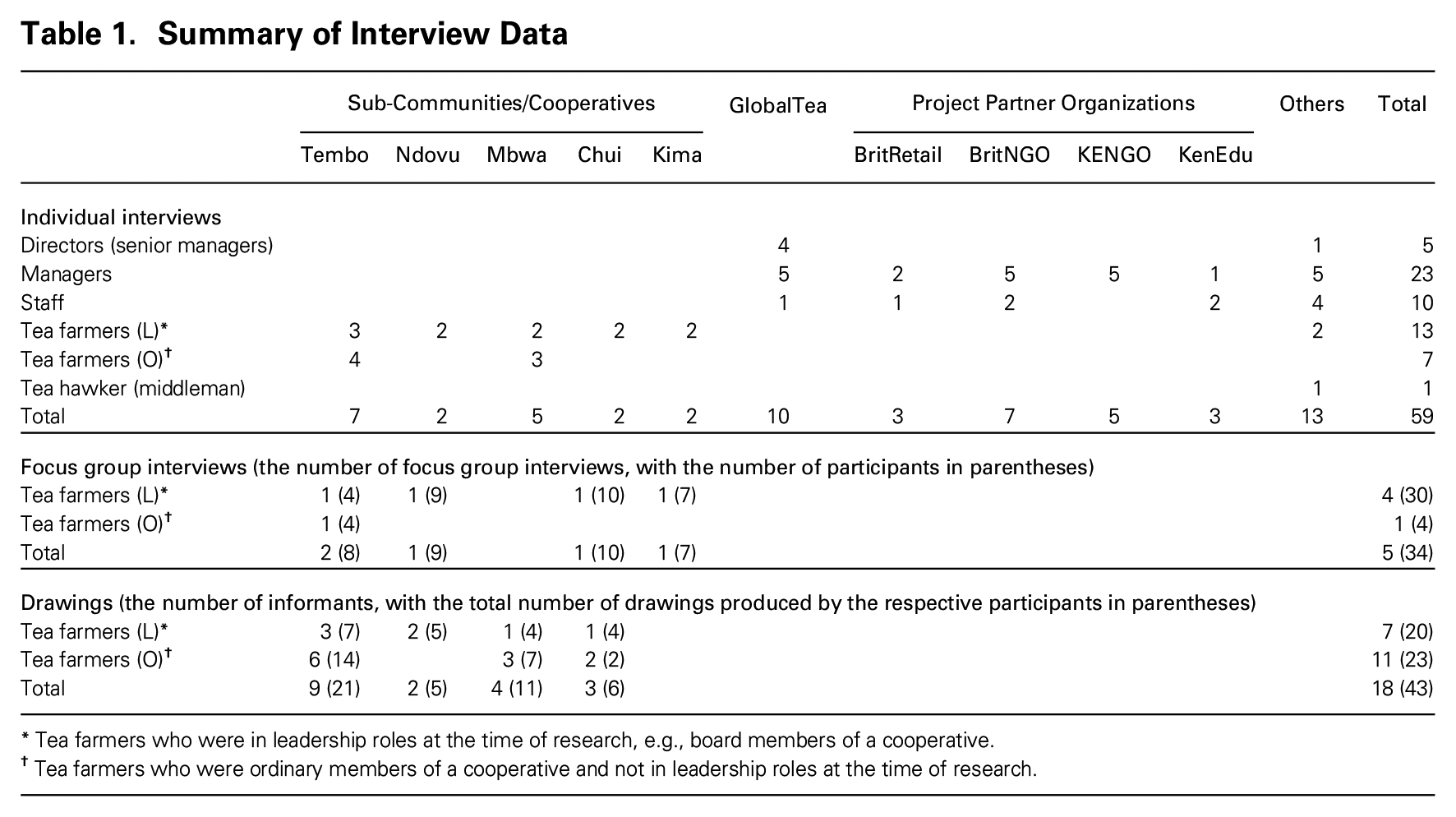
Tea farmers who were in leadership roles at the time of research, e.g., board members of a cooperative.
Tea farmers who were ordinary members of a cooperative and not in leadership roles at the time of research.
Observations
The second dataset consists of field notes and video clips from my observation of meetings and activities in Kenya and the U.K. I visited the Kipsigis community twice and stayed for three weeks, one week in September 2010 and two weeks in December 2011. The fieldwork was a part of my larger research project that was carried out for a total of five months in tea farming communities in Kenya, Tanzania, and Uganda. As such, the study indirectly benefited from my experience and knowledge from other tea farming communities in the region.
During my fieldwork in the Kipsigis community, I observed and participated in the everyday activities of tea farmers, such as picking tea leaves and delivering them to the collection points. On each day of my fieldwork, I had over 12 hours of interaction with tea farmers and other informants. For example, I would borrow a basket and pick tea leaves alongside tea farmers, carrying out informal conversations while helping with their work. I tried to experience local norms and practices as closely as possible, for instance by wearing long skirts as local women did, traveling in the cheapest mode of transport (matatu minibuses), and sharing—as well as skipping—meals together with tea farmers. The community leaders gave me a Kipsigis name, Cheruto, which is commonly given to a girl who was born while her mother was visiting a place or when a visitor arrived in the village. The name seemed to suggest that I was accepted by the community but, rightly, as an external visitor.
Furthermore, I observed five full-day meetings related to the Hatua project: the inaugural Annual General Meeting of the Ndovu cooperative (2010); three Special General Meetings at the Tembo, Duma, and Simba cooperatives (2011); and the GlobalTea Outgrowers Group (GTOG) Executive Meeting (2011). I also observed a half-day meeting of tea farmers and GlobalTea managers to prepare for the Special General Meeting at Simba (2011). At some of the meetings, most notably the GTOG executive meeting and the preparatory meeting at Simba, I directly observed intense negotiations between GlobalTea managers and tea farmers. Although conversations in these meetings occasionally featured English and Kipsigis, the majority of such conversations were carried out in Swahili, because some GlobalTea managers came from different regions and did not speak or understand Kipsigis. Thus, I was able to follow most of the conversations without translation.
I also conducted observations in other parts of Kenya (e.g., KENGO and KenEdu in Nairobi) and in Europe (e.g., BritRetail and BritNGO in the U.K.). Most notably, I participated in over 30 public events related to the Hatua project and Fairtrade in the U.K. between 2009 and 2013. As some of the events preceded my fieldwork in Kenya (e.g., a BritNGO manager’s presentation of the Hatua project in March 2010), I was able to gain firsthand experiences of how the Hatua project would be communicated to audiences in the U.K., before my exposure to local experiences in Kenya. I continued to participate in similar events between the two rounds of the fieldwork and afterward (e.g., a BritRetail manager’s presentation of the Hatua project in April 2012), which provided opportunities to compare the stories I heard in Kenya with those told in the U.K. I also experienced the research phenomenon as a consumer in the U.K, such as via shopping at BritRetail’s stores for Fairtrade products, including Fairtrade tea from the Kipsigis farmers’ cooperatives. The details of observations were recorded in 153 video clips and extensive field notes, which also included my own reflections.
Secondary data
I gathered a large volume of textual and visual materials to understand relevant issues and events in more detail and from different perspectives. The secondary data were particularly helpful for understanding the actors’ messages for different audiences, as documents and videos were often produced for specific purposes. For example, the Hatua project progress reports were submitted to the funding agency (DfID) on a quarterly basis, while BritRetail’s short films about the Hatua project were mainly for consumers in the U.K. The Kipsigis community also produced materials for audiences in Europe, such as tea farmers’ presentations and media interviews in France and the U.K., as well as their social media postings (in English) on Facebook and Twitter. The secondary data thus complemented and enriched the diverse perspectives and accounts I learned through interviews and observations.
The materials from the Hatua project include project reports, Gantt charts, press releases, training resources, presentation slides, video recordings of presentations and media interviews, project stories featured in the publications of GlobalTea and project partners, and short films produced by BritRetail. On the topics of post-election violence, ethnic conflicts, and colonial history in Kenya, I consulted newspaper articles (e.g., Daily Nation, The Standard, Financial Times, USA Today) from the Factiva database and media websites, as well as books and articles (e.g., Tignor, 1976; Meredith, 2005; Wrong, 2010; Lynch, 2011). For the history of GlobalTea and other tea companies in the region, I compared the official accounts of the corporations (e.g., websites, company magazines) with the work of academic researchers (e.g., Swainson, 1980; Dinham and Hines, 1984). The secondary data also include the Kenyan Tea Act and amendments, tea industry reports, area maps, and the Fairtrade certification standards and compliance criteria.
Data Analysis
While the analysis involved an iterative process of moving back and forth among data, interpretation, and relevant streams of literature (Miles and Huberman, 1994; Patton, 2015), the overall analytical process can be described as having occurred in four stages. In the first stage, I combined a temporal bracketing strategy with detailed descriptions of key events and issues to chronologically make sense of process data (Langley, 1999, 2009). I began the analysis by constructing a timeline of critical events from interviews, observations, and secondary data. Subsequently, I identified the six periods of interactions between GlobalTea and the Kipsigis community, based on key issues and outcomes marking the end of each period, and produced a description of corporate-community relations for each period. As I constructed the timeline and wrote detailed descriptions, it became clear that GlobalTea managers and Kipsigis tea farmers often provided radically different accounts of the same events. Furthermore, I recognized that the tea farmers’ narratives were deeply rooted in the history of the region, often going back to the community’s first encounter with GlobalTea in the 1920s, and these narratives challenged corporate interpretations of the past and influenced contemporary relationships between farmers and the corporation. These observations led me to focus on the uses of different narratives, which involved contested memories, in firm–stakeholder relationships.
In the second stage, I initially constructed two separate narratives of the corporation and the community by interpreting the stories of the informants (Czarniawska, 1998; Pentland, 1999; Pentland and Feldman, 2007). I combined thematic analysis of narrative data with a visual mapping approach to process data analysis (Langley and Truax, 1994; Langley, 1999), which resulted in two process flowcharts representing distinct narratives. This preliminary analysis helped me to see a sharp contrast between the main narrative of the corporation and that of the community but did not capture the full complexity of heterogeneity within each actor group. For example, some employees of GlobalTea partially acknowledged local history when they were in the local setting, and tea farmers endorsed the corporation’s narrative when they spoke to global audiences (e.g., NGOs, media). Recognizing the spatial dynamics, I re-analyzed the data to produce a two-by-two matrix that captured the global and local narratives of the corporation and the community across six periods. While this analysis was useful for understanding the strategic uses of the past (Suddaby, Foster, and Trank, 2010; Anteby and Molnár, 2012) in contemporary corporate–community relations, I realized that they were part of broader rhetorical strategies (Suddaby and Greenwood, 2005) that were ultimately related to the practices and outcomes of social impact initiatives.
Thus, in the third stage, I re-analyzed the data with a focus on how different practices of social impact initiatives were shaped by—and produced impacts on—different actors. I paid special attention to my observations of practices and their impacts (e.g., recorded in field notes), as well as how they were presented in different narratives (e.g., interviews, secondary data). To identify meaningful patterns, I produced tables by placing each specific practice adopted by GlobalTea that had a stated goal of creating social impact (e.g., crop diversification, gender quota) or that was pursued by the Kipsigis community (e.g., direct supply agreements, access to transport) in a row. I then created columns to summarize how different actors engaged in that practice, presented it to different audiences, and were impacted by the evolving practice. From this process, I noticed that the practices adopted by GlobalTea (e.g., cooperatives, Fairtrade) were globally recognized as legitimate social impact initiatives, whereas the practices pursued by tea farmers (e.g., land purchase, new pay structure) emerged from the local and historical context of corporate–community relations. I labeled the former as “off-the-shelf practices” because they were readily available for the corporation’s use and easily understood and appreciated by global audiences. I labeled the latter as “contextualized practices” given that they were deeply embedded in the local and historical context and, hence, difficult for global audiences to understand and appreciate.
By analyzing the evolution of each practice over the entire study period, I realized that the corporation’s adoption of off-the-shelf practices and the community’s pursuit of contextualized practices were initially separate yet gradually came together through the community’s redirection of off-the-shelf practices toward contextualized practices over time. The analysis further helped me to see the corporation’s global audiences as another important group of actors who evaluated social impact claims, influenced the corporate adoption of off-the-shelf practices, and interacted with local community members. As I reviewed the literature on organizations’ social impact initiatives, especially growing concerns that such actions may primarily contribute to organizational legitimacy without generating substantive benefits for target beneficiaries (Wijen, 2014; Barnett, Henriques, and Husted, 2020), I began to see that the actors in my study ensured both organizational legitimacy and social impact in ways that prior studies had not documented.
Therefore, in the fourth stage of data analysis, I focused on interactions among the three types of actors and their implications for organizational legitimation and social impact creation. In addition to the research on social impact initiatives, the literature on organizational legitimacy (Bitektine, 2011; Suddaby, Bitektine, and Haack, 2017) and local–global dynamics (Meyer, 2000, 2009; Massey, 2005) informed my analysis and theorizing of a triadic perspective on social impact. I recreated the timeline across six periods with a thematic analysis (see Table 2) by connecting key events and processes to the three types of actors, their engagement in different patterns of practices (i.e., off-the-shelf, contextualized, and redirected off-the-shelf practices), the outcomes, and the conditions that enabled those outcomes.
Timeline of Key Events
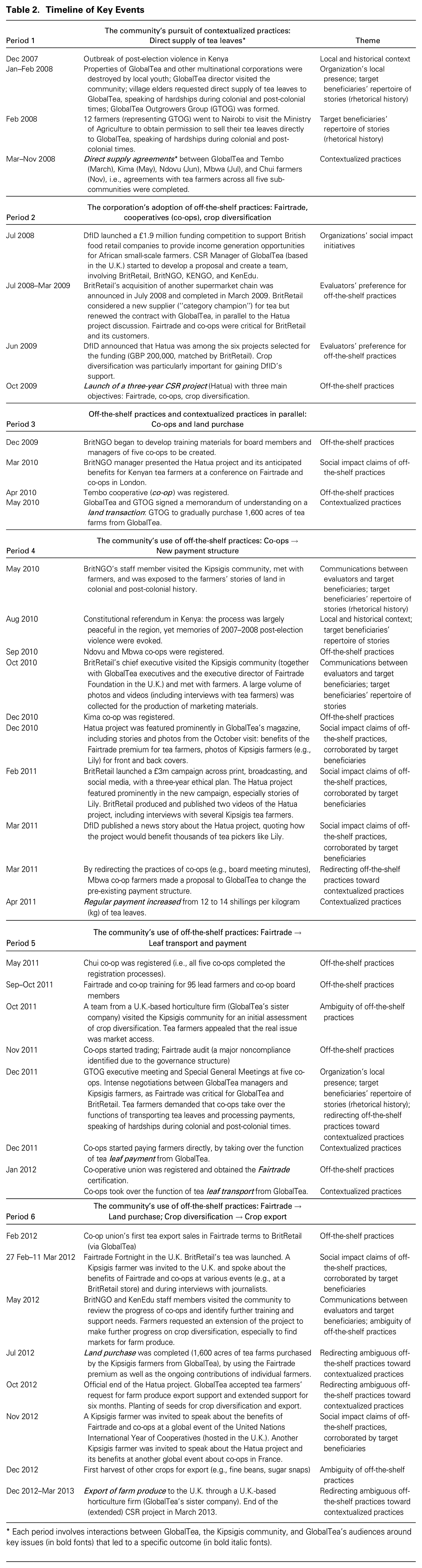
Each period involves interactions between GlobalTea, the Kipsigis community, and GlobalTea’s audiences around key issues (in bold fonts) that led to a specific outcome (in bold italic fonts).
I continued to analyze the patterns of practice changes, narratives, and outcomes associated with each specific off-the-shelf or contextualized practice shown in the tables, ultimately generating common patterns across practices in each category (summarized below in the Findings section). I also produced illustrations of interactions among the three types of actors over time, which I then developed into a figure (elaborated further in the section Theorizing a Triadic Perspective on Social Impact). Through this process, I developed explanations for how target beneficiaries’ active participation can radically reshape the processes and outcomes of social impact creation.
Findings
The findings are presented in three subsections. In the first, I describe how GlobalTea’s adoption of off-the shelf practices was critical for satisfying evaluators’ preferences yet produced limited benefits for the community. The second subsection presents the Kipsigis community’s pursuit of contextualized practices, which were important in the local and historical context yet had limited appeal to the evaluators (and hence to the corporation). The final subsection is at the heart of my theoretical contributions, as I describe how the community used off-the-shelf practices to negotiate for contextualized practices, ultimately shaping the processes and outcomes of social impact creation in unexpected ways.
The Corporation’s Adoption of Off-the-Shelf Practices
The three objectives of GlobalTea’s CSR project involved practices that were globally recognized as effective solutions to rural poverty in the Global South: creating cooperatives, obtaining the Fairtrade certification, and encouraging crop diversification. The project also mandated a gender quota for women to be represented in one-third of all representative roles, such as cooperative board members and Fairtrade premium committee members. I refer to these four practices as off-the-shelf practices as they were already well established and available for the corporation’s use.
Evaluators’ preference for off-the-shelf practices
From the outset, GlobalTea’s CSR project was designed with two important stakeholders in mind: BritRetail, GlobalTea’s major customer, which owns a nationwide chain of supermarkets, and the U.K. government’s Department for International Development (DfID), a funding agency. In 2009, GlobalTea’s three-year CSR project proposal (developed in partnership with BritRetail, BritNGO, KENGO, and KenEdu) was selected to receive GBP 200,000 from DfID, to be matched by BritRetail’s charitable fund and GlobalTea’s in-kind contributions, largely through staff time and other resources (e.g., offices, transport) of its Kenyan subsidiary. The relationship with BritRetail was particularly crucial for GlobalTea, as explained by a manager of BritNGO: GlobalTea is the tea supplier for BritRetail. . . . From their perspective, it’s a way of binding them to BritRetail, isn’t it? You have this project together. During the process, BritRetail took over [another supermarket chain], and at the same time, their contract with GlobalTea came up for renewal. For a number of months, it looked as if BritRetail would move to a different supplier for tea. . . . They have now sorted all this out, but I’d imagine, from GlobalTea’s point of view, of course [the Hatua project] is good for CSR, and it also helps you in terms of your relationship, strategic relationship, with BritRetail.
A staff member of BritRetail said that the Hatua project was a great fit with the retailer’s ongoing commitment to support Fairtrade and cooperatives: “Since it was a priority for us to support cooperatives’ development, [the project] sort of ticked a number of boxes . . . another part was developing our Fairtrade strategy.” Another BritRetail manager explained how the stories of cooperatives and Fairtrade appealed to their customers in the U.K., and in doing so the manager depicted tea farmers as unorganized individuals who only started coming together as a result of the CSR project: There are a lot of customers that shop with us because of our position on Fairtrade, and customers talk about not just Fairtrade but cooperatives now. . . . Because they were individual desperate farmers, they had to come together in a structure, so the whole project, Hatua, was born. We will send people like [name of a BritNGO staff member], he will train them and educate them into the co-op structure. We would then make KENGO, our development organization on the ground, to train them in the Fairtrade certification. They will be co-ops, Fairtrade-certified, they will supply to GlobalTea, GlobalTea will pack into BritRetail tea, and we would have this great story at the end of it, say—the tea leaves in boxes come from cooperatives we actually created. (emphasis added)
While cooperatives and Fairtrade were highlighted in the leaflets, posters, and videos addressed to the corporations’ customers and the public, crop diversification was featured prominently in the documents submitted to DfID. A BritRetail manager explained: In the applications to DfID, you’ve got to use their language and to put things in sort of their way. . . . To be honest with you, part of the reason that it [crop diversification] fits into the picture is because that was the requirement of the DfID funding. The message we got very clearly from DfID was that they were really much more interested in diversification. Because Fairtrade tea, there’s nothing particularly new about that. And everything DfID wants, DfID wants to be innovative. So, what’s innovation, what’s the change? Helping people diversify. That features very much in DfID. It was DfID’s push for that.
The funding agency’s priorities not only affected the CSR project’s initial design but also continued to shape the project during the three-year period because the total amount of GBP 200,000 was released in several installments upon the receipt of ongoing progress reports. For example, the project team presented a tabulated gender composition of board and supervisory members (i.e., one-third of all representative roles allocated to women) across five cooperatives in the quarterly progress reports, to demonstrate their attention to gender inequality as expected by DfID. Recognizing that such off-the-shelf practices were perceived positively by GlobalTea’s audiences, including BritRetail, customers in the U.K., and the funding agency (DfID), I now turn to their actual impacts on the lives of tea farmers in Kenya.
Limited benefits of off-the-shelf practices for the community
Before I first visited the Kipsigis community in September 2010, I had been exposed to the accounts of the Hatua project only in the U.K. Thus, I was surprised to learn that tea farmers seemed to have already been organized into a collective entity well before the start of the CSR project to establish cooperatives. Contradicting the image of “individual desperate farmers” I had heard about in the U.K., tea farmers proudly spoke about the creation of GlobalTea Outgrowers Group (GTOG), registered as a self-help group under the Ministry of Gender, Children and Social Development. While the formal registration was completed in September 2009 (i.e., one month before the launch of the Hatua project), farmers stressed that they had been acting as a collective entity since early 2008. For example, several tea farmers talked about their trip to Nairobi in February 2008 to visit the Ministry of Agriculture and obtain permission to sell their tea leaves directly to GlobalTea under the Kenyan Tea Act. The following conversations illustrate the active role of GTOG:
We are now approved as GlobalTea Outgrowers Group and they can now see what we are doing, not only in influencing GlobalTea, multinationals, but also in influencing the government, MPs and law. . . . As GlobalTea Outgrowers Group, we’ve been negotiating for quite a number of issues.
And maybe you can tell Cheruto [me] about these farmers, our group members who went to Nairobi to convince the Minister of Agriculture at that time.
Oh yes, I was part of that.
In this context, the need for cooperatives to organize individual farmers into collective entities seemed to be much less dramatic than how it was presented to GlobalTea’s audiences in the U.K.
Similarly, tea farmers explained that most of them had already been growing other crops or engaging in small-scale dairy farming in addition to tea farming well before the arrival of a White consultant who came to teach farming techniques for diversification as a part of the CSR project. A Chui farmer estimated that “about 85 percent of our members have kitchen gardens.” Another farmer agreed and elaborated on the largely redundant nature of crop diversification: Our people have very small farms like one acre, two acres, but they never plant tea in all the farms. You know, the Kalenjin [an ethnic group which includes the Kipsigis among other tribes] are pastoralists, they like the cattle very much. At least they have a small area for the cattle and other ones . . . maybe half an acre or a quarter acre to plant other crops. So, when we talk about diversification, it’s just an improvement. Nobody doesn’t have a kitchen garden in our homes. [Other farmers laugh.]
In addition, the gender quota had mixed effects on women farmers in the local context. Despite the potential opportunities for learning and development, participation in committees created an additional burden on women, as they struggled to carve out time to attend meetings and training sessions on top of their housework and farming. “I must attend trainings but it’s not easy, I have to pick tea,” said a female board member of Tembo. During my fieldwork, I observed that it was indeed mostly women who were picking tea leaves in farms and bringing them to the collection centers. As most women were also in charge of housework and taking care of children, very few women attended meetings, even when they were elected as representatives. When I observed various meetings, the vast majority of participants were male farmers, who often tried to explain why female farmers were absent, as a remark from a Chui board member reveals: “There are some problems which force them [women] to stay at home. Like now, one of our lady members has a sick child. She had to take her child to hospital.” In this context, the gender quota mandate simply became a box to tick, while most decisions continued to be made by men who were able to participate in meetings. The following excerpt from my field notes on an election day illustrates such a box-ticking exercise: The farmers were asked to elect chair, vice chair, secretary, and treasurer. When farmers were divided into three groups based on locations, I heard a GlobalTea employee saying, “if they don’t meet our criteria, we send them back.” How interesting! . . . Following group discussions that involved nominations and seconding, four people were eventually elected but they were all men. [A GlobalTea employee] intervened, saying “no, you need a lady!” Until that moment a small number of women were just silently present, but they were approached by several farmers and GlobalTea employees, and one woman was invited to replace a man. The roles of chair, secretary, and treasurer were discussed and divided among the three men. The woman was appointed as vice chair. It was a very quick process . . . it probably took less than five minutes to include a woman to meet the criteria.
Overall, the off-the-shelf practices created limited benefits for tea farmers because they largely duplicated pre-existing local practices (e.g., collective organizing, crop diversification) or were incongruous with them (e.g., gender-based practices). These on-the-ground observations sharply contrasted with the narratives of positive social impact resulting from the introduction of novel practices as communicated to the global audiences. The interventions did not appear to make the best use of resources, as shown in expenses such as the costs of hiring a crop diversification consultant to teach farmers who were already growing various crops. While tea farmers did not oppose these interventions, further findings suggest that they pursued very different kinds of practices.
The Community’s Pursuit of Contextualized Practices
In this part, I present the practices pursued by tea farmers to improve their lives (e.g., direct supply agreements, land purchase), which I refer to as contextualized practices because they were deeply embedded in the local and historical context. When I heard and read about the Hatua project in the U.K., the initiative was described as establishing cooperatives for over 10,000 farmers who were individually supplying tea leaves to GlobalTea, without mentioning when the individual contracts were established in the first place. I was therefore again surprised, during my fieldwork in Kenya, to learn that the direct supply agreements had been signed in 2008 (i.e., only one year before the launch of the CSR project) and that they were much more critical than any of the off-the-shelf practices for improving the lives of tea farmers.
In earlier times, GlobalTea had purchased tea leaves from small-scale farmers in surrounding communities through middlemen, who had trucks to transport tea leaves from villages to GlobalTea’s factories. Ideally, to produce high-quality tea, fresh tea leaves must be processed within 24 hours of plucking. “We didn’t have any vehicle to take tea, so we used bicycles, even donkeys [laughs], to take our tea to [a factory name],” recalled a farmer in Ndovu. For most tea farmers, the factories were too far away to even attempt their own delivery, so they sold tea leaves to middlemen who came to villages. An old farmer in Tembo described his experiences: “We got entrapped because they had lorries. You see, with these middlemen, the prices were very low . . . but when famine came, we needed cash to buy food. Then we got into that trap, we couldn’t escape.”
In 2008, GlobalTea began to buy smallholders’ tea leaves directly through agreements with individual tea farmers in five sub-communities: Tembo (March), Simba (May), Ndovu (June), Duma (July), and Chui (November). This change led to significant improvement in the tea farmers’ income because “middlemen used to buy tea at seven bob [Kenyan shillings] per kilo [kilogram of tea leaves] from farmers and sell to multinationals at 21 per kilo,” according to a farmer in Simba. Another farmer in Chui said that the price was even worse: “The middlemen came in and collected our leaves at a throwaway price, like two shillings, three shillings, five shillings [per kilogram of tea leaves].” Given that many farmers owned very small farms (e.g., one-quarter acre) and were able to sell only 100–200 kilograms of tea leaves per month, an entire family sometimes depended on a monthly income of 1,000 Kenyan shillings (approximately 10 U.S. dollars) or even less. “When GlobalTea came and said, now we’ll pay you 30 shillings per kilo, it was a sort of miracle,” a farmer in Ndovu said with laughter.
According to the tea farmers’ accounts, the most important source of transformation in their livelihoods seemed to be direct supply agreements rather than anything included in the CSR project, like cooperatives or Fairtrade. I was curious about why I had never heard of such transformational changes in the U.K. When I asked GlobalTea managers, they emphasized the continuity in their relationships with the community rather than any dramatic change in 2008, attributing the farmers’ past hardships to other factors such as low tea prices at the Mombasa tea auction: The outgrower project was actually there, even before 2007, just in a different model. We have been doing projects, like scholarship programs, with the community before 2007 . . . the scholarship programs started in 1988. (Manager, GlobalTea) We did buy leaves from outgrowers, through a different model. . . . Until 2008, tea prices weren’t good. Returns to farmers were not good. That’s why we look at things like Fairtrade, so that they can get better returns. (Senior manager, GlobalTea)
One staff member of BritNGO, who had visited the Kipsigis community for the project, cautiously shared her view that GlobalTea managers might be reluctant to say too much about changes in 2008 because of their connections to a complex and sensitive history in the region: Umm, I don’t know if you’re aware, but this region was really badly affected by the election violence. . . . You’ve got to check this out, do a little bit more research, but my understanding is that the people who were in the GlobalTea estates before GlobalTea bought them . . . there was some controversy about how they were obtained from the local people. So, some of the local people, I think, still sort of think that some of those estates should be theirs. I haven’t quite understood fully the history of it, but I think GlobalTea, when they inherited those estates, inherited some of those issues along with it.
During my fieldwork in Kenya, many tea farmers indeed asserted that GlobalTea started to listen to the community only after the post-election crisis. “Corporate social responsibility? It’s not in their blood. They were forced to think that way, because of the 2007–08 [crisis],” said a farmer in Simba. While several GlobalTea managers stated that “we were not much affected” by the crisis and were even “protected by the community,” tea farmers affirmed that GlobalTea was significantly affected by the violence, just like other corporations in the region were. This claim was further supported by several local newspaper articles published between January and February 2008, which reported that “mobs stormed some of GlobalTea’s factories,”“hundreds of residents invaded GlobalTea’s factory demanding that they be hired for manual tasks such as tea picking,” and “the marauding youths also burnt 11 vehicles at GlobalTea . . . the company had to charter airplanes to ferry the targeted workers.” A tea farmer in Tembo attributed the changes in GlobalTea’s outgrower relations to the firm’s loss of properties during the crisis: We had approached GlobalTea several times. Middlemen were buying our leaves at throwaway prices; however, GlobalTea was buying from only a few individuals. During the post-election violence, GlobalTea’s properties were destroyed at night. The former director visited the community and asked what we wanted. We said, “We want our tea to be processed at GlobalTea, because hawkers are buying our tea at throwaway prices.”
Despite the sensitivity of violence-related events, tea farmers cautiously justified the attack on multinational corporations by establishing a link between earlier history in colonial times and the prolonged poverty and suffering of the Kipsigis people: Tea first came in around 1925, and then more White people came with this Caterpillar, bulldozers. They cleared the land, and we were forcefully moved along the river. White people took the best land, green leaf land. (Farmer, Tembo) I know the story because my parents were coming from the inside [the land currently owned by GlobalTea]. These people chased us from that far end [pointing in the direction], and here they were taking away our cows and sheep. . . . They destroyed anything and everything. My grandfather died there. . . . So many people died of hunger. Other people even sold our children to Kisii to exchange with food. The Kisii people gave us wimbi [millet flour] and we gave children, especially girls. (Farmer, Ndovu) Back then, these multinationals didn’t recognize the neighbors. Watchmen in the barrier would block us to go into. . . . Even your cow, you can’t graze it inside. There you see land, very big land, and even if your sheep went to their farm, they counted a fine. . . . When they [local youth] found a loophole somewhere it was sort of an opportunity, so they rushed there . . . and they took their cows inside. They said, “Now we have to take our land, this is, this was our fathers’ land.” (Farmer, Ndovu, emphasis added)
In addition to direct supply agreements, another example of contextualized practice is that tea farmers purchased land from GlobalTea. In May 2010, GTOG signed a memorandum of understanding to gradually purchase 1,600 acres of tea farms from GlobalTea. Tea farmers emphasized that the collective land purchase had the symbolic significance of reclaiming the Kipsigis land, in addition to its function as an investment for income generation in the future: 10,000 members have been deducting 50 cents per every kilo [kilogram of tea leaves], even before the formation of cooperatives. We agreed on this at the AGM [of GTOG]. That’s how we purchased a three-story building in town. It was the contribution of two years and two months. GTOG is also purchasing land from GlobalTea, part of their tea estates. Kalenjin is after land, not money. We moved all the way from Mountain Elgon for good land. Now the average land size [per household] in Ndovu is a quarter acre, and it’s worse in Tembo. We’ll take the Kipsigis land back. (Farmer, Ndovu, emphasis added)
Unlike off-the-shelf practices that were promoted as novel and beneficial yet often duplicated or conflicted with pre-existing local practices, contextualized practices involved changing pre-existing practices (e.g., supplier relationships, land ownership) to more-beneficial ones from the farmers’ perspectives. Although tea farmers enthusiastically described the benefits of direct supply agreements and land purchase, stories of contextualized practices were almost completely absent in documents and videos produced for global audiences by GlobalTea and its partners. For example, I found only a brief reference to land transactions in GlobalTea’s publications: “In May, we announced the offer for sale of a portion of land to the local community. The offer was well received.” There was no reference to the complex local and historical context, nor acknowledgment of the community’s agency, which remained invisible to global audiences behind the image of a generous corporation.
The Community’s Use of Off-the-Shelf Practices to Negotiate for Contextualized Practices
Prior to and at the beginning of the Hatua project, the corporation’s adoption of off-the-shelf practices and the community’s pursuit of contextualized practices appeared to be largely separate processes running in parallel (see Table 2, Periods 1 to 3). Over time, however, the community became actively involved in corroborating GlobalTea’s social impact claims in communications with the corporation’s global audiences and redirected off-the-shelf practices (e.g., cooperatives, Fairtrade) toward contextualized practices (e.g., new payment structure, land purchase) by using their participation as leverage for local negotiations (Table 2, Periods 4 to 6).
Corroborating the corporation’s claims in communications with global audiences
GlobalTea and the Hatua project team collected verbal and visual materials from the Kipsigis tea farmers, such as interviews, photographs, and video clips, which were included in their messages to global audiences. For instance, the following quote from a female tea farmer was included in a report to DfID, with a description of how tea farmers benefited from the CSR project: “Since I joined the cooperative, we have seen a lot of revolution and we are getting a fairer deal.” In this quote, the farmer attributed improvements in her income to cooperatives but did not mention how tea farmers became organized as GTOG to sell tea leaves directly to GlobalTea, which increased their income much more dramatically than did the formation of cooperatives.
A particularly large volume of materials were collected during a visit of executives from GlobalTea, BritRetail, and Fairtrade Foundation (the licensor of the Fairtrade mark in the U.K.) in October 2010, which provided an opportunity for direct interactions between the Kipsigis community and GlobalTea’s major stakeholders, such as the chief executive of BritRetail. The tea farmers’ accounts were then used to support the corporations’ social impact claims. In two videos published by BritRetail in February 2011, for example, footage of interviews with several tea farmers was woven together with accounts of GlobalTea, BritRetail, and KENGO managers. Each theme introduced by a narrator or a corporate manager was immediately followed by one or two farmers’ quotes to illustrate the same theme, as the following excerpts reveal:
. . . around the largely privately owned plantations are thousands of marginalized farmers who struggled to support themselves and their families from the tea they grow on their smallholdings, in a sector where prices are unstable and access to market is often impossible.
I was married in 1994 and my husband passed away after living with me for five months. . . . I have only one acre of shamba [farm] . . . so I’ve been working in that one acre to educate my children, to feed my children, and to do everything! . . . I’ve been struggling up and down . . . and these teas, they were buying on a low price . . . so that’s why we wanted this [Fairtrade] premium, to help us continue living.
. . . The 11,000 members of the five cooperatives are undergoing Fairtrade training, which will lead to certification and a guarantee of better prices as well as the provision of the Fairtrade premium which can be invested democratically as the communities decide.
We’ve been trained in Fairtrade and beginning to understand how it can provide a cushion in case tea prices may fall. We’re also learning about the benefits that Fairtrade premium can offer, such as paying for school fees for our children and providing clean drinking water to communities.
When tea farmers were interviewed by corporate managers who traveled from the U.K., they talked about cooperatives and Fairtrade as solutions to poverty without referring to direct supply agreements, land purchase, post-election violence, or any other events and practices rooted in the local and historical context. In the interview quoted above, for example, the female farmer briefly mentioned low prices of tea in the past but quickly moved to the Fairtrade premium as a solution.
Tea farmers also praised the flagship practices of the CSR project (i.e., cooperatives, Fairtrade, crop diversification, and gender quota) when they had direct interactions with the corporation’s global audiences. When a Tembo farmer was invited to make a public presentation in France, he emphasized that “we have an average of 36 percent women representation at all levels of management” and highlighted diversification into “crop farming and animal husbandry” as important benefits of the project. Similarly, a Simba farmer focused on the benefits of cooperatives and Fairtrade when he was interviewed by a journalist for the British media: We have GlobalTea assisting us in forming groups, setting up cooperatives, to qualify to sell our tea under the Fairtrade mark. . . . When we sell our tea under the Fairtrade mark, we earn a premium. And the premium is very useful for our people, because we use it to improve education, improve the facilities, for medical purposes, and other social issues.
Although this farmer himself and other tea farmers expressed their strong desire to use the Fairtrade premium as additional resources to acquire land in the local setting, in front of a British journalist this farmer spoke only about using the premium for education and social welfare, in full accordance with GlobalTea’s messages: The farmers will be able to access earnings of an additional premium of US$ 0.50 per kg of tea sold as Fairtrade, money which they will be able to invest in local infrastructure, social welfare and education. (GlobalTea Magazine, Autumn/Winter 2010)
In addition, tea farmers opened the community’s social media accounts on Facebook and Twitter. Their postings consistently referred to the benefits of the CSR project: “I am able to meet the family needs, take my children to school and have a better life, thanks to Fairtrade.” Tea farmers also posted photos of women wearing traditional costumes and holding pieces of paper with handwritten messages such as “THANK YOU GlobalTea,”“THANK YOU BritRetail,” and “THANK YOU DfID.” The colonial history of land or the post-election violence was never mentioned in any of their postings, even though the accounts were managed primarily by individuals who otherwise frequently referred to those events in the local context.
Tea farmers’ active participation in supporting GlobalTea’s messages seemed to be appreciated by audiences like the chief executive of BritRetail, who visited the project site: This trip has opened my eyes. I clearly knew about Fairtrade and what it does and what it stands for before coming out here, but this is my first trip to see, on the ground, in practical terms, what Fairtrade means to people. . . . [It has] given me more determination and enthusiasm to, in any way I can, as head of BritRetail, to ensure that we keep on helping, via Fairtrade, and we encourage others to do the same.
When I met BritRetail and BritNGO managers in the U.K., they often asked whether I had watched a video about the Hatua project featuring a tea farmer named Lily (a pseudonym). I frequently heard about how much people in the U.K. appreciated learning about the impact of the project on Kenyan farmers’ lives in their own words, such as Lily’s testaments. A government official at DfID once commented that the project will “improve the lives of thousands of tea pickers like Lily in Kenya.” Through tea farmers’ corroboration, the messages of GlobalTea and the Hatua project team became much more effective in eliciting positive evaluations from global audiences.
Redirecting ambiguous off-the-shelf practices toward contextualized practices
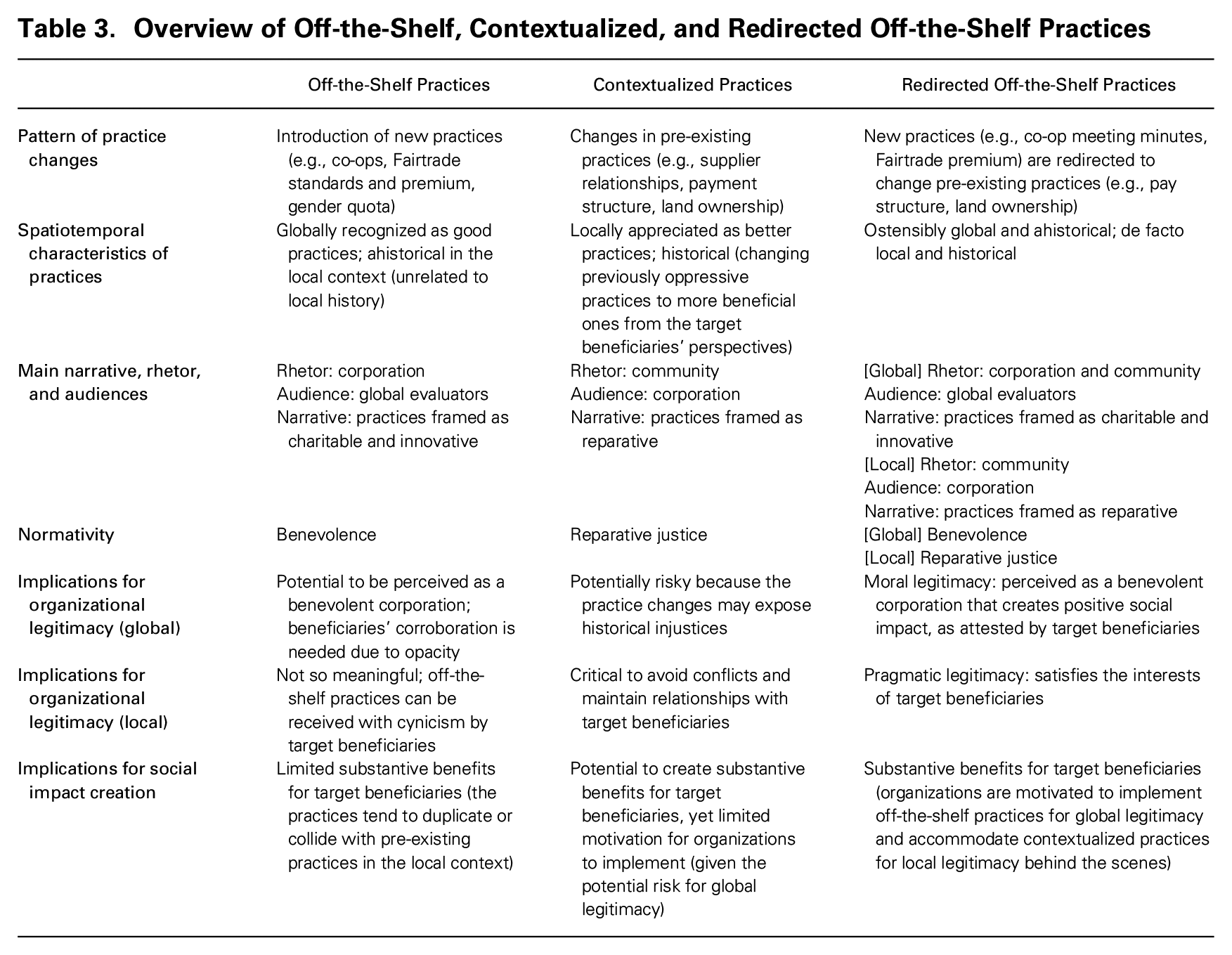
Tea farmers redirected three off-the-shelf practices—cooperatives, Fairtrade, and crop diversification—toward contextualized practices. Table 3 presents an overview of off-the-shelf practices, contextualized practices, and redirected off-the-shelf practices.
Overview of Off-the-Shelf, Contextualized, and Redirected Off-the-Shelf Practices
First, tea farmers used cooperative meetings as an opportunity to change the pre-existing payment structure, specifically to request an increase in the regular payment from 12 to 14 shillings per kg of tea leaves. In Kenya, tea leaf payment was commonly structured in two forms: a regular payment at a fixed rate and the remaining amount as a second payment, which was unpredictable because of many factors, including weekly auction prices and exchange rates. Thus, the proposal had important implications for securing a higher level of consistent and predictable income even though it did not affect the total amount of payments. An Duma farmer described how they used the practices of cooperatives, such as meeting minutes, to propose the change to GlobalTea: We made a proposal to GlobalTea to increase the advance payment from 12 to 14 per kilo. We went to the office in [an area] and met two managers there. We made a proposal and gave them minutes. Before you make any proposal in my cooperative, you have to sit down as the board. I don’t go alone and then start proposing something, no. We sit first, if anybody has an idea, we put it as an agenda [item], we discuss, we write our minutes and then we go ahead with the minutes. Our proposals are contained in our minutes. Even if you go there now, you will get those minutes which I was telling you. We made the case that GlobalTea should pay more than competitors to secure consistent supply. They accepted the proposal.
Second, tea farmers redirected the Fairtrade premium as additional resources for collective land purchase rather than building schools or health care facilities, as typically presented to the corporation’s global audiences. This was possible because of flexibility and ambiguity regarding the uses of the Fairtrade premium, broadly framed as funds for community development. A tea farmer in Simba explained that the idea first came from a visit to a neighboring community: I first went to [a neighboring community] in 2008, and that’s where I got information about Fairtrade. I was very impressed because they purchased a factory and over 2,900 acres [of land]. The factory purchase is still going on; I think they’ve almost . . . it should be 60–70% now. They did it with Fairtrade [premium].
The Kipsigis farmers completed the purchase of 1,600 acres of land from GlobalTea in July 2012 by using the Fairtrade premium and the ongoing contributions of individual farmers. In addition, tea farmers explored the possibility of gradually acquiring a tea factory from GlobalTea. Although the initiative did not result in any concrete outcome by the end of my research period, it shows the farmers’ attempts to use the Fairtrade premium to change the pre-existing ownership structure of land and other means of production in the local and historical context—in radically different ways from their own accounts to global audiences.
Third, tea farmers redirected the project’s focus on crop diversification, which was largely redundant as most farmers were already growing other crops, to find markets for selling various crops. A Chui farmer explained that “there are so many crops we are growing, but they don’t have a market. The problem is the market.” Therefore, tea farmers sought GlobalTea’s support for finding markets to sell other crops, beyond workshops and training programs to teach farming techniques as planned in the original scope of the Hatua project. The meaning of supporting crop diversification was sufficiently ambiguous to allow different interpretations, which helped the community to negotiate for a broader scope. According to a Tembo farmer, community leaders challenged GlobalTea managers by saying, “those trainings were not enough,” and asked, “we can diversify, but the challenge is, is there a market?” As a result of discussion between tea farmers and GlobalTea managers, a U.K.-based horticultural firm (GlobalTea’s sister company) became involved in the project and facilitated access to supermarkets in the U.K., eventually enabling Kipsigis farmers to export their farm produce, such as fine beans, sugar snaps, and snow peas.
Participation in off-the-shelf practices as leverage in local negotiations for contextualized practices
To illustrate how tea farmers used their participation in off-the-shelf practices as leverage for negotiations, I present a story of intense negotiations that I observed in December 2011. At this point, the Hatua project team faced a pressing need to obtain the Fairtrade certification, as BritRetail planned to launch Fairtrade tea from the Kipsigis cooperatives during the Fairtrade Fortnight (an annual campaign, February 27–March 11, 2012). BritRetail expected to attract media coverage and public support for its product launch in 2012, the United Nations International Year of Cooperatives. During a Fairtrade audit in November 2011, however, the auditors identified a major point of noncompliance. Thus, the Hatua project team needed to resolve it and obtain the certification under intense time pressure.
The issue was the lack of a formal link between GTOG and the five cooperatives, because the application was made by GTOG but its constitution did not refer to cooperatives. GlobalTea managers proposed to change GTOG’s constitution and drafted a memorandum of understanding between GTOG and the cooperatives, framing it as a simple change in a few clauses. However, tea farmers strongly objected and demanded that GTOG’s original constitution be maintained to protect existing initiatives, most important of which was the ongoing process of purchasing land and assets. The farmers insisted that a separate cooperative union be created for the purpose of Fairtrade even though this might delay the process. Intense negotiations occurred at a series of meetings I observed, most notably at an all-day GTOG executive meeting attended by five GlobalTea managers and 25 tea farmers from five cooperatives. The following excerpt from this meeting illustrates the tug of war:
We need to close noncompliance. We don’t have enough time.
[Stands up] So we want to change ourselves to suit the auditor! [Other tea farmers laugh]
Property belongs to 10,785 farmers, not five co-ops. Certification is disrupting GTOG businesses.
We’re not happy with it.
Let’s ignore small things and look at the big picture. We have a priority. We have disappointed many people. People in the U.K. are ready to buy our tea and waiting.
Let’s remain silent. We want to close this.
It should be the cooperative union, not GTOG. Chui refuse the MoU [memorandum of understanding].
[To Chui2] When you were elected, you were supposed to guide your members. Perhaps understanding was missing. Have you understood?
The way we saw this document there, we saw it negatively. The board members told us, “Go and refute.”
[Stands up and speaks in Kipsigis] I’d like to speak in our language for a moment. Our life was difficult for many years. We have worked hard for many years to build our group [GTOG] and five cooperatives. We know that we need a union to extend our activities. We’re committed to forming a cooperative union.
We’ll continue rather than collapse. We’ll keep the cooperatives running without Fairtrade. It’s better to fight with auditors than destroying cooperatives and GTOG.
The discussion reflects the different attitudes of GlobalTea and of tea farmers toward Fairtrade. For GlobalTea and its project partners, Fairtrade was critical. BritRetail had to launch a product, GlobalTea needed to supply tea for BritRetail, and Fairtrade was communicated as a key part of the Hatua project to the funding agency and other audiences who perceived it as beneficial for Kenyan farmers. While the tea farmers welcomed Fairtrade as an extra source of income that could be used for land or factory purchase, it was far less important than their efforts to reclaim Kipsigis land and increase their control over tea production. The farmers refused to compromise on any aspect of GTOG, the entity directly linked to land purchase, for Fairtrade.
At the same meeting, a Simba farmer reminded the group that GTOG was the most critical to them, whereas neither Fairtrade nor the cooperatives was essential: “Do you remember? When we had that meeting in [a venue], there was a man who said this: ‘You’ve done everything as GTOG. Why would you need cooperatives at all?’” During a break, GlobalTea managers expressed their frustration among themselves, asking, “How many meetings have we had with these people?” and lamenting, “For every step we move forward, we move three steps backward.” Still, GlobalTea managers tried to find a way to persuade the tea farmers because Fairtrade was, indeed, critical for them, and the farmers’ participation was vital in the process. “We should manage them, otherwise they can derail all these processes,” one manager cautiously said when no farmer was around. When the meeting resumed, a GlobalTea manager went through the memorandum of understanding clause by clause and concluded, “This MoU is only for six months or until the formation of a cooperative union, whichever comes first.” Another GlobalTea manager quickly supported, “It’s meant only to get a [Fairtrade] certificate, that’s why it’s six months only. It’s not meant for anything else.”
At this point, without giving any firm response, the tea farmers raised other issues, most notably their desire to extend the activities of cooperatives to various management functions such as weighing and transporting tea leaves. After extensive discussion, GlobalTea managers eventually agreed to hand over the functions of transporting tea leaves and processing their payments to the five cooperatives. Only after reaching these agreements did the tea farmers return to the memorandum of understanding discussion and invite GlobalTea managers to the cooperatives’ Special General Meetings. In doing so, the community leaders at least agreed to move to the next stage of discussing GlobalTea’s proposal, which was clarified as an interim measure to obtain the Fairtrade certification, with all the farmers.
After the meeting, I asked the tea farmers why they had brought up other issues in the midst of discussing Fairtrade. The farmers responded that taking over transportation was important because they previously had sold tea leaves to middlemen at low prices for a long time due to lack of access to transport. Explaining that the same individuals are now transporters, an Ndovu farmer expressed his excitement: “They’re still around, they’re now transporting our leaves, but now the cooperatives will weed those middlemen out.” The tea farmers also saw an opportunity to employ local youth by extending the scope of the cooperatives’ work, as described by a Duma farmer: We should employ our manpower. Not GlobalTea, we should employ our own clerks in the buying centers. We should interview the transporters, which GlobalTea used to do. . . . Farmers will feel that these children are now ours, and it is because we have formed these cooperatives and have employed our children [referring to the Kipsigis youth].
From these conversations and observations, I could see that tea farmers’ priorities continued to be set on issues deeply rooted in the local and historical context, such as youth unemployment, which the Kipsigis community had raised during the post-election crisis. GlobalTea’s initiatives, such as cooperatives and Fairtrade, were, in themselves, far less critical to tea farmers. But participating in those initiatives provided the farmers with strong leverage in local negotiations, as GlobalTea managers were afraid that farmers could “derail all these processes.”
The governance issue was eventually resolved through the creation of a cooperative union. In addition to negotiating with GlobalTea managers, tea farmers requested government officials’ support for speeding up the process. A cooperative officer committed his help, in large part because he had registered a fewer number of cooperatives than his annual target. With this serendipity, tea farmers established a cooperative union within an unusually short period and obtained the Fairtrade certification in January 2012. During the Fairtrade Fortnight, BritRetail launched their product and hosted a series of public events and media interviews, for which a tea farmer was invited to the U.K. The Simba farmer, the same individual who at various meetings with GlobalTea managers had emphasized how GTOG could manage without Fairtrade or cooperatives, gave passionate talks in front of the British media and public about the benefits of Fairtrade and cooperatives, praising the generosity of GlobalTea and BritRetail. Thus, while tea farmers achieved substantive benefits by negotiating for contextualized practices, the stories of local negotiations remained invisible to global audiences, thereby protecting and reinforcing GlobalTea’s social impact claims that were presented as resulting from off-the-shelf practices.
Theorizing a Triadic Perspective on Social Impact
This study explored the role of target beneficiaries in influencing the processes and outcomes of social impact creation. Grounded in the findings, I theorize a triadic perspective on social impact that recognizes target beneficiaries’ active role in addition to the agency of an organization and the evaluators of its social impact claims. Figure 2 visualizes this perspective.
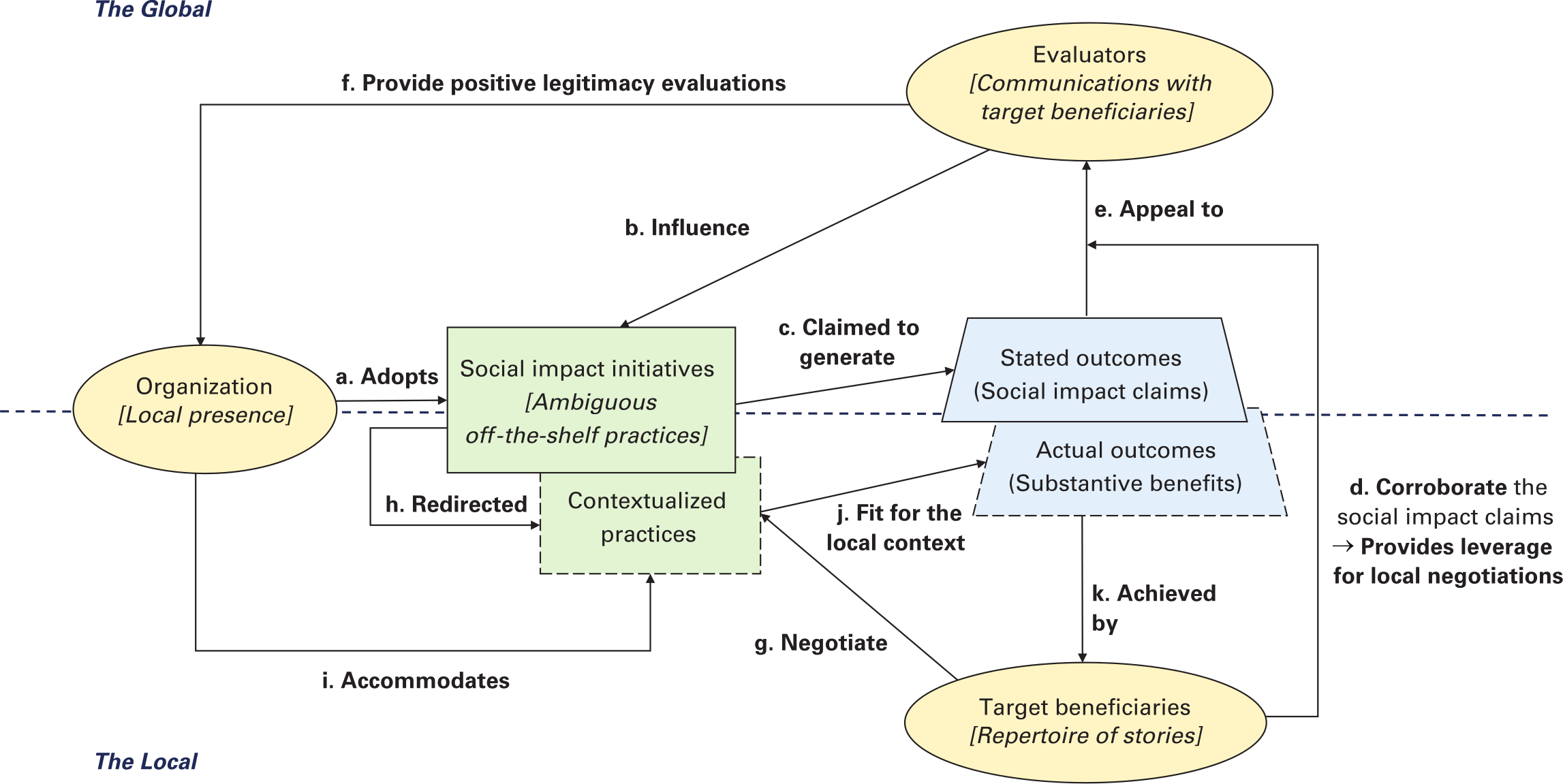
A Triadic Perspective on Social Impact
At the beginning of the process, an organization adopts off-the-shelf practices (e.g., cooperatives, Fairtrade) that are widely recognized as effective social impact initiatives (arrow a). The evaluators, who often have good intentions but limited understanding of the specific local context, influence the organization’s adoption of off-the-shelf practices (arrow b), as in how BritRetail and DfID shaped GlobalTea’s CSR activities in my study. The off-the-shelf practices are claimed to generate positive social impact (e.g., access to health care and education, women’s empowerment) for target beneficiaries (arrow c). In prior literature, critical studies have recognized that such initiatives may not fit in the local context and primarily contribute to the legitimacy of organizations rather than actual improvements in target beneficiaries’ lives (Whiteman and Cooper, 2016; Jamali, Lund-Thomsen, and Khara, 2017).
However, my findings show that the processes and outcomes of social impact initiatives can be radically reshaped through an active role of target beneficiaries, who may choose to corroborate social impact claims in communications with evaluators (arrow d). Their corroboration makes the organization’s claims more credible and appealing to evaluators (arrow e), who provide positive legitimacy evaluations of the organization (arrow f). Using their participation as leverage, target beneficiaries negotiate for organizational support of contextualized practices (arrow g), notably by redirecting ambiguous off-the-shelf practices toward contextualized practices (arrow h), which are accommodated by the organization in the local setting (arrow i).
The contextualized practices are deeply embedded in the local and historical context (e.g., the land purchase in the Kipsigis community) and thus have the potential to generate substantive benefits (arrow j), which are achieved by local communities rather than being given to them (arrow k). The contextualized practices that actually unfold in the local context are different yet redirected from the off-the-shelf practices initially adopted by the organization (visualized in the figure as overlapping rectangles). Similarly, the stated and actual outcomes of social impact initiatives are not exactly the same in all details yet are largely aligned (visualized in the figure as overlapping trapezoids). The contextualized practices and actual outcomes remain invisible to evaluators (represented by the dashed lines of the rectangle and trapezoid shapes), who can more easily understand and appreciate social impact claims based on the stated outcomes of off-the-shelf practices.
Dynamics of Decoupling and Recoupling
Scholars have long understood that organizations often decouple their activities and practices from the formal structures and policies they symbolically adopt to establish legitimacy (Meyer and Rowan, 1977; Boxenbaum and Jonsson, 2017). More recently, researchers have noted another common pattern of decoupling through which policies are implemented in practice yet loosely tied to outcomes (Bromley and Powell, 2012; Wijen, 2014). My findings from the early stage of the Hatua project show that the stated and actual outcomes of an organization’s social impact initiatives can indeed be decoupled when off-the-shelf practices are considered legitimate by evaluators yet are unfit for the local context.
In contrast, the triadic perspective theorized from observations during the entire study and depicted in Figure 2 reveals the relational dynamics of decoupling and recoupling that previous researchers have not understood. Through the active participation of target beneficiaries who redirect off-the-shelf practices toward contextualized practices, the stated and actual outcomes of an organization’s social impact initiatives can become recoupled, generating substantive benefits to target beneficiaries. Note also that these adaptations and modifications occur through complex interactions among an organization, evaluators, and target beneficiaries, well beyond an organization’s deliberate choice to decouple or not as typically understood (Meyer and Rowan, 1977; Boxenbaum and Jonsson, 2017).
The patterns of decoupling and recoupling observed in this study further reveal how the opacity of social impact initiatives, previously identified as an important condition aggravating the decoupling of social impact initiatives’ stated and actual outcomes (Bromley and Powell, 2012; Wijen, 2014), can have the opposite effect of facilitating their recoupling. While this opacity might be conducive to decoupling in the absence of target beneficiaries’ actions, it also provides an opportunity for target beneficiaries’ participation in the organizational legitimation process. As evaluators cannot easily verify organizations’ claims in fully transparent ways, the credibility of those claims partially depends on the target beneficiaries’ corroboration, providing opportunities for them to shape local negotiations. The opacity further helps local actors to adapt ambiguous off-the-shelf practices into contextualized variations without undermining evaluators’ perceptions and understandings, ultimately facilitating the recoupling of the initiatives’ stated and actual outcomes. While it is common to problematize opacity and call for more transparency to better align social impact initiatives’ stated and actual outcomes (Wijen, 2014; Kuruvilla et al., 2020), my study shows that opacity is a double-edged sword that can also help target beneficiaries to secure substantive benefits for themselves.
Unique Enablers for the Recoupling of Stated and Actual Outcomes of Social Impact Initiatives
The triadic perspective suggests that with target beneficiaries’ active participation, social impact initiatives can be reshaped in ways that produce satisfactory outcomes for all three parties. The organization establishes its legitimacy in the eyes of evaluators, target beneficiaries achieve substantive benefits, and evaluators are reassured of the social impact of their support in ways congruent with their cognitive frames. But the participation of target beneficiaries may not always lead to similar results. Drawing on patterns of interactions among GlobalTea, Kipsigis tea farmers, and the corporation’s global audiences, I identify four unique conditions (written in square brackets in Figure 2) that facilitate the processes and outcomes presented in the triadic model, in addition to the opacity of social impact initiatives: target beneficiaries’ repertoire of stories, an organization’s local presence, communications between evaluators and target beneficiaries, and the ambiguity of off-the-shelf practices. While the first two conditions are important for target beneficiaries’ pursuit of contextualized practices in general (Table 2, Periods 1–6 in my study), the last two conditions are specifically relevant for redirecting off-the-shelf practices toward contextualized practices (Table 2, Periods 4–6).
Target beneficiaries’ repertoire of stories
The study shows that target beneficiaries’ ability to corroborate, and potentially undermine, organizations’ social impact claims is critical for their negotiations. Having a rich repertoire of stories is particularly helpful for achieving these effects, including stories that can strengthen organizations’ claims (e.g., stories of improved livelihoods for single moms and their children) and stories that may undermine their claims (e.g., colonial history, stories of land disputes and middlemen in the past). In my study, tea farmers selectively presented stories in ways that supported organizational legitimation in the eyes of global evaluators and presented a different point of view in local negotiations. Most notably, tea farmers actively engaged in rhetorical history, “the strategic use of the past as a persuasive strategy” (Suddaby, Foster, and Trank, 2010: 157), by constantly referring to their hardships in the past and the historical responsibility of GlobalTea in redressing grievances. The farmers used these historical narratives to support their pursuit of contextualized practices, framing the changes in pre-existing practices as reparative justice (see Table 3). The Kipsigis community’s selective and strategic uses of the past and their outcomes suggest that rhetorical history is one way through which the recoupling of the stated and actual outcomes of social impact initiatives can occur. While the specific stories would vary across contexts, from historical to contemporary narratives, a strong narrative repertoire provides an important source of leverage for target beneficiaries, as the stories can be used either to support or to refute organizations’ legitimacy claims.
Organization’s local presence
The role of local staff or partners who implement organizations’ social impact initiatives and negotiate with target beneficiaries is also critical for producing satisfactory outcomes for all three parties. An organization’s local presence may take various forms in different contexts, such as subsidiaries of multinational corporations, affiliates of international NGOs, or local partners of social enterprises. Managers and staff members of GlobalTea’s Kenyan subsidiary accommodated tea farmers’ pursuit of contextualized practices in ways that were largely invisible not only to the corporation’s global audiences but often also to the head office of GlobalTea in the U.K. Although the process sometimes involved tension and conflicts, direct interactions and negotiations between the organization and target beneficiaries were critical for eventually reaching agreements in the local context.
Communications between evaluators and target beneficiaries
Target beneficiaries’ repertoire of stories can be particularly effective when target beneficiaries can communicate with the evaluators. In my study, tea farmers had opportunities to directly interact and communicate with the corporation’s global audiences, for example through occasional visits of BritRetail and BritNGO managers to the Kipsigis community, tea farmers’ presentations and media interviews in the U.K. and France, and the community’s social media accounts. My temporal analysis of process data shows that while the organization’s adoption of off-the-shelf practices (organization–evaluators dynamics) and the community’s pursuit of contextualized practices (organization–beneficiaries dynamics) were largely separate at the beginning (Table 2, Periods 1–3), the dynamics shifted to triadic relationships (organization–evaluators–beneficiaries) when communications between the evaluators and target beneficiaries began in Period 4 (Table 2). These communication opportunities allow target beneficiaries to engage in selective storytelling, which strengthens their position in local negotiations as the ongoing corroboration becomes important for organizational legitimation. Communications through infrequent, sporadic, and brief interactions might be particularly effective to fulfill evaluators’ desire to verify social impact claims in target beneficiaries’ own words without engaging with complex contextual information and experiences.
Ambiguity of off-the-shelf practices
Once the three types of actors begin to interact, the ambiguity of off-the-shelf practices provides opportunities for target beneficiaries to redirect them toward contextualized practices without undermining social impact claims intended for evaluators (Table 2, Periods 4–6). In my study, the ambiguity and flexibility regarding uses of the Fairtrade premium allowed tea farmers to redirect those resources to purchase land in the local context, while presenting stories of education and health care to the corporation’s global audiences. Similarly, supporting crop diversification was subject to different interpretations, which helped local communities to successfully extend the project’s scope from training in farming techniques to finding markets for various crops. Ambiguity is often seen as a driver of decoupling, such as the decoupling of practices from ambiguous policies (Kelly and Dobbin, 1998) and the decoupling of implemented practices from their intended outcomes in complex and ambiguous settings (Bromley and Powell, 2012). Yet, my study shows that ambiguous practices adopted for legitimacy provide an important opportunity to redirect them toward contextualized variations, thereby facilitating recoupling of social impact initiatives’ stated and actual outcomes. Overall, these enabling conditions help target beneficiaries to reshape the processes and outcomes of social impact initiatives, ultimately ensuring organizational legitimation and social impact creation in unexpected ways.
Contributions to Research and Implications for Practice
A Triadic Perspective on the Processes and Outcomes of Social Impact Initiatives
Table 4 presents how this study advances existing understanding of social impact initiatives beyond easily observable phenomena. The mainstream perspective of the win–win relationship (organization-centric perspective) has been criticized as a surface view—just like a tip of an iceberg—that relies on unrealistic assumptions and does not reflect the actual experiences of target beneficiaries (Banerjee, 2008; Whiteman and Cooper, 2016; King and Pucker, 2021). Recent studies provided a deeper and more critical view (dyadic perspective) by recognizing the gap between stated and actual outcomes of social impact initiatives and its underlying mechanisms, yet offered limited insights into how they can converge.
Three Perspectives on the Processes and Outcomes of Organizations’ Social Impact Initiatives
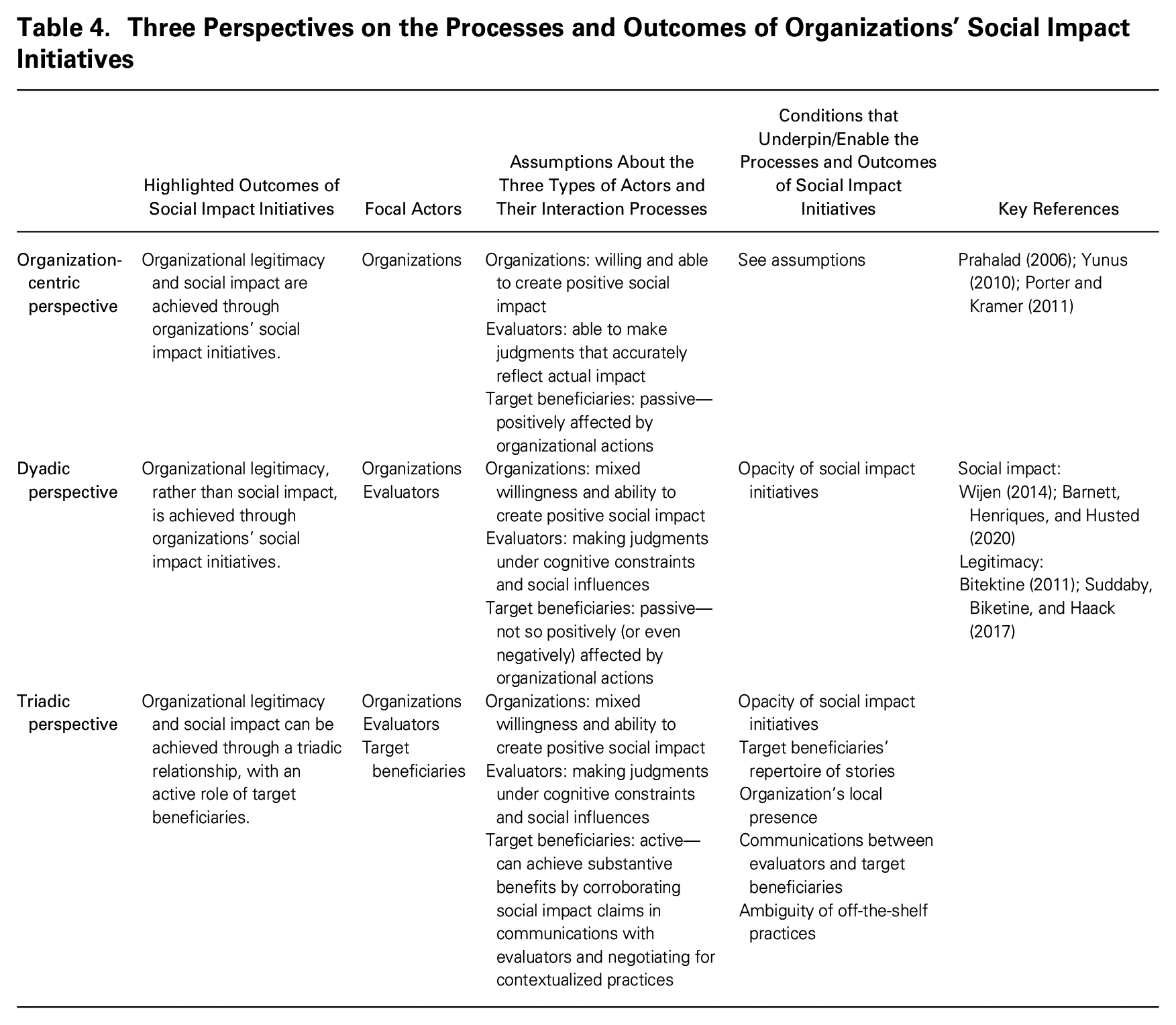
The novel triadic perspective theorized in this study exposes and challenges the prior literature’s prevalent assumption that target beneficiaries are affected by organizational actions either positively (in the mainstream view) or negatively (in critical perspectives). Even a small number of studies seeking to reduce the gap between stated and actual outcomes of social impact initiatives have maintained an organizational focus, for example by exploring how organizations can better design and implement such initiatives (Wijen, 2014). These approaches continue to assume or require the presence of organizations willing and able to close the gap by themselves, which may not always be realistic (Fleming and Jones, 2013; Whiteman and Cooper, 2016). Recognizing the agency of target beneficiaries, this study provides a new way of seeing how the processes and outcomes of social impact initiatives can be reshaped to ensure actual social impact. The multi-actor view also contributes a novel understanding of a triadic relationship in organizational legitimation processes when target beneficiaries of organizational actions are separate from the evaluators of organizational legitimacy. This understanding thus advances a relational view of legitimacy beyond the common focus on the organization–evaluators dyad (Suddaby, Biketine, and Haack, 2017).
Furthermore, this study offers an opportunity to rethink some of the vocabularies and terms used in social impact initiatives research and practice, which reflect deeply ingrained assumptions of agentic organizations and passive beneficiaries. In my study, I referred to two distinct sets of practices as “off-the-shelf practices” and “contextualized practices.” Although other researchers developed concepts such as “turnkey” and “tailored” CSR practices, their approaches focused on organizational agency by referring to “more customized” (i.e., tailored) or “less customized” (i.e., turnkey) solutions, designed and implemented by organizations for target beneficiaries (Raffaelli and Glynn, 2014: 541). My study shows that contextualized practices are often developed and pursued by target beneficiaries themselves, rather than tailored or customized by those who design the initiatives. I also highlight target beneficiaries’ agency in their efforts to repurpose off-the-shelf practices to create substantive benefits to themselves. In doing so, I provide concepts and frameworks that recognize the agency of target beneficiaries and its implications for social impact. 3
Recognizing the agency of target beneficiaries also has methodological implications. With longstanding focus on organizational practices, processes, and outcomes, many studies have drawn on information from organizations implementing social impact initiatives. In qualitative studies of social entrepreneurship, for example, researchers often conducted most interviews with managers, employees, and volunteers of social enterprises (e.g., Tracey, Phillips, and Jarvis, 2011; Lawrence and Dover, 2015; Smith and Besharov, 2019). Some studies relied on data from Western organizations even when they engaged in the themes of the Global North and South (e.g., Reinecke and Ansari, 2015), or they incorporated the voices of target beneficiaries recast by NGO employees (e.g., Mair, Wolf, and Seelos, 2016). Not surprisingly, these approaches depicted target beneficiaries as affected by organizational actions and have largely overlooked how their strategies and actions could shape the processes and outcomes of social impact initiatives. Through efforts to attend more closely to the voices of target beneficiaries (e.g., interviews in Swahili, freehand drawings, working in tea farms), this study highlights the importance of involving target beneficiaries as key informants in studies of social impact initiatives.
Implications for the Practice of Social Impact Initiatives
By recognizing the active role of all three types of actors involved in social impact initiatives, the triadic perspective offers practical implications not only for organizations designing and implementing such initiatives but also for their evaluators and target beneficiaries (see the enabling conditions connected to all three types of actors in Figure 2). For organizations, this research shows the importance of ambiguity and flexibility when they introduce off-the-shelf practices, which can later be redirected toward contextualized practices. The organizations’ local presence, such as through a subsidiary or partner, is also critical for closely working with target beneficiaries who can significantly shape the processes and outcomes of social impact creation.
This study also has important implications for evaluators such as donors, customers, and the public. It is easy to judge organizational actions as either positive or negative, yet the processes and outcomes of social impact initiatives are often much more complex. As much as seemingly effective initiatives may create limited benefits or even harms to target beneficiaries, seemingly ineffective interventions may provide resources and practices that can be redirected toward more-effective solutions. While social impact initiatives (e.g., Fairtrade) are often either glorified or condemned (cf. Bowes, 2011; Sylla, 2014), my findings encourage evaluators to seek first and foremost the target beneficiaries’ validation of social impact claims—not necessarily because target beneficiaries will always tell the truth but, rather, because they can use those corroboration opportunities to strengthen their position in negotiations and achieve benefits in their own ways. By providing opportunities for communications with target beneficiaries, evaluators can support the creation of substantive benefits even though they may not fully comprehend the actual practices that produce positive outcomes in the local context.
For local communities or other groups targeted as beneficiaries of organizations’ social impact initiatives, the study shows how they can shape the processes and outcomes of organizational actions to ensure substantive benefits. Given that target beneficiaries are often marginalized and underprivileged groups, it might be difficult for them to directly influence the decisions and actions of organizations and evaluators. Nevertheless, they can construct a rich repertoire of stories and selectively use them in everyday practices and negotiations (Scott, 1985, 1990; Tilly, 1991), ultimately creating substantive benefits for themselves.
Limitations and Future Research
Target beneficiaries’ using their own support to legitimize an organization and keeping local negotiations largely invisible to evaluators is one effective pathway for the target beneficiaries to gain leverage in negotiations and secure benefits in the local context, but there might be other types of strategies and actions that scholars can investigate. For example, some target beneficiaries in other contexts may attempt to undermine organizational legitimacy by communicating historical and contextualized narratives with the evaluators, thereby influencing the processes and outcomes of social impact initiatives in markedly different ways. Thus, there are opportunities to build on this study’s understanding of a triadic relationship and explore diverse patterns of interactions among the three types of actors and their implications for social impact.
Notably, I observed a triadic relationship in which there were clear distances between the global evaluators and the local context of target beneficiaries. While this phenomenon is important in the increasingly interconnected world, there are other circumstances in which evaluators might be distinct from yet relatively proximate to target beneficiaries. For example, public schools are evaluated by local residents and parents, whose evaluations may not always reflect actual benefits to the students. Organizations like Venture for America and some startup accelerators in the Rust Belt region have attracted evaluators’ support (e.g., government funding, private donation) on the promise of job creation in struggling American cities like Detroit, yet many of those businesses have either closed or moved to more affluent regions such as Silicon Valley, with questionable outcomes for the originally targeted communities (Rosenthal and Glueck, 2021; Kim and Kim, 2022). In these contexts, we may still see an active role for target beneficiaries in creating social impact but possibly in different patterns from what I observed in the global context. It will be important to investigate the relational dynamics of social impact creation in different cultural and geographical contexts across the world.
While my study focused on organizations’ social impact initiatives, the relational perspective has broader implications for rethinking organizational phenomena. Most organizations claim that their actions benefit others, such as corporations claiming to provide jobs for employees and useful products or services for customers (Ocasio, Kraatz, and Chandler, 2023). In this broad sense, many organizations, such as schools, hospitals, and corporations, interact with the stakeholders they claim to benefit (e.g., students, patients, customers), as well as stakeholders who evaluate their legitimacy based on their pro-social claims (e.g., parents, donors, regulators). However, some actors are commonly considered to be more agentic and influential than others, such as businesses compared to employees or other stakeholders (Bitektine et al., 2020), as reflected in organizational scholars’ tendency to focus on the strategies and practices of organizations and managers. The triadic model theorized in this study shows the value of appreciating the agency of those who are ostensibly less agentic (such as target beneficiaries) and attending to the relational dynamics of various actors, to understand organizational processes and outcomes in a new light. This study thus opens exciting future research avenues to explore how the ongoing interactions of organizations and various stakeholders, including evaluators and target beneficiaries, shape the processes and outcomes of organizational actions.
A Parting Image
Harambee is the national motto of Keyna, commonly translated as “all pull together” or “let us all pull together” (Musau, 2020; Weiss, Lounsbury, and Bruton, 2024). The word frequently refers to community-based activities, including rural development projects and fundraising events, with strong focus on self-help and collectively mobilizing local resources (Mbithi, 1972; Thomas, 1987; Ouko, 2018). Management scholars have begun to recognize Harambee as an indigenous institution that enables collaborative self-organizing in both rural and urban poverty contexts in Kenya, influencing contemporary phenomena such as entrepreneurship in important ways (Vershinina, Beta, and Murithi, 2018; Weiss, Lounsbury, and Bruton, 2024).
The triadic perspective on social impact theorized in this study resonates with the ethos of Harambee, notably its strong focus on self-help and working together. The creation of positive social impact involves multiple types of actors interacting and working together, including organizations implementing social impact initiatives, evaluators of organizational legitimacy, and target beneficiaries. Such multi-actor interactions may involve tensions and conflicts in real life, just as in my observations, given the complex historical and contemporary relationships common in many sites of organizations’ social impact initiatives. It is therefore important to note that social impact occurs through diverse actors interacting in complex and often unexpected ways, yet it still entails them working together. A triadic perspective is also strongly aligned with an emphasis on self-help by highlighting the crucial role of target beneficiaries in influencing the processes and outcomes of social impact initiatives to generate substantive benefits for themselves. I thus close this article with an image of Harambee, inviting researchers and practitioners to reflect on the importance of a relational, multi-actor view of social impact and to recognize the active role of target beneficiaries for achieving social impact.
Footnotes
Acknowledgements
I am deeply grateful to Kipsigis tea farmers and all my informants, without whom my study would not exist. This research significantly benefited from the extensive feedback and guidance of the associate editor Michael Pratt and three anonymous reviewers. Special thanks go to Alex Bitektine, Joel Bothello, and Suntae Kim, who generously reviewed multiple versions of the paper throughout the revision process. I also would like to thank Tima Bansal, Matthew Corritore, Daphne Demetry, Simon Dermarkar, Bernard Forgues, Helen Haugh, Matthew Jones, Arvind Karunakaran, EunJoo Koo, Wanda Orlikowski, Suzanne Rivard, Paul Tracey, Marc Ventresca, and Geoff Walsham for their helpful comments on earlier drafts. Lastly, I acknowledge the struggles and fights of my late grandparents as farmers in extreme poverty during colonial and post-colonial times, as these memories helped me to understand and connect with Kipsigis tea farmers’ experiences.
Correction (January 2025):
Article updated to correct the pseudonyms of the third and fifth cooperatives to “Duma” and “Simba,” respectively.

1
While I refer to relevant ideas presented in studies of “means–ends decoupling” (e.g., Bromley and Powell, 2012: 484; Wijen, 2014: 302), I do not use this term because I am writing about the stated outcomes, which may or may not reflect the truly intended outcomes (i.e., ends). My focus is on the gap between the stated and actual outcomes of social impact initiatives, which can be observed whether the stated goal of creating positive social impact is truly intended or not.
2
What is considered global is ultimately rooted in local (e.g., Western) practices, while what is considered local is constituted through the ongoing encounter of multiple local trajectories in the global and historical contexts (Robertson, 1995, 2018; Massey, 2005). Nevertheless, some local norms and practices are universalized and considered to be legitimate across the globe, while others are particularized and perceived to be exotic local norms and practices. From this perspective, it is possible to highlight the clash between what is perceived to be global and what is perceived to be local, while recognizing that they can also be understood as simultaneously local and global.
3
The term “beneficiaries” can also be problematized for at least two reasons. First, the word can imply that these actors benefit from organizational actions, whereas in reality they may or may not gain substantive benefits. Second, the use of the word in everyday life (e.g., insurance) may create an impression that these actors passively benefit from others’ actions rather than from their own. Practitioners in the international development sector have proposed the alternative word “constituent” (e.g., Ho, 2015) in the sense of “one who authorizes another to act as agent” (Merriam-Webster Dictionary, 2024). While calling these actors “constituents” can help to emphasize their agency and the constitutive nature of benefits, constituent is a generic term that refers to many different types of stakeholders without specific reference to actors who are targeted as beneficiaries of organizational actions and present themselves as such when they see the value of doing so. For conceptual clarity, I used the term “target beneficiaries” in this article and emphasized their active role in creating benefits for themselves.