



Abstract
Studies examining the impact of social movements on organizations have focused primarily on what leads to initial concessions in response to movement targeting. A key remaining question is what comes next, or how do movement priorities become institutionalized within organizations and across fields via downstream processes? We argue that central actors in these downstream efforts are members of occupations that have been created out of movement pressure on organizations. In this study, we examine the longitudinal evolution of a movement-backed occupation: recycling coordinators in higher education. By conducting historical, processual analyses of 25 years of online conversations among over 1,000 recycling coordinators, we identify three key tensions they faced in trying to embed practices and an ethos from the environmental movement and in trying to progress their organizations toward evolving movement concerns (from recycling to sustainability). We uncover how the coordinators navigated these tensions, finding that while they succeeded in institutionalizing recycling and expanding their organizations toward a new wave of movement concerns regarding sustainability, their occupation nonetheless experienced demise. Our findings set the foundation for future research on the downstream efforts and occupational actors that are vital for institutionalizing movement demands.
Most studies on how social movement–backed changes unfold within organizations have focused on how activists target organizations to gain concessions (Briscoe and Safford, 2008; King, 2008; McDonnell and King, 2013; McDonnell, King, and Soule, 2015), or on what we term the “upstream processes” of getting to yes. How things unfold from there—the longitudinal “downstream processes” (Georgallis and Lee, 2020; Hedberg and Lounsbury, 2021) to embed movement demands inside organizations—remains relatively less understood. This is despite numerous studies showing that the institutionalization of movement demands is not guaranteed post concession (Kalev, Dobbin, and Kelly, 2006; Wright and Nyberg, 2017). A focus on downstream efforts requires shifting our attention away from prototypical activists and toward actors who are best positioned to play a role in institutionalizing and routinizing movement priorities inside organizations. To understand downstream efforts, we need to examine the work of formal occupations that have been created in response to upstream social movement work, such as diversity managers (Kelly and Dobbin, 1998; Dobbin, Kalev, and Kelly, 2007), corporate social responsibility managers (Wright, Nyberg, and Grant, 2012; Risi and Wickert, 2017), and sustainability managers (Augustine, 2021). These occupations have an explicit mandate to pursue the implementation and institutionalization of movement priorities. However, despite the proliferation of these roles, we have a limited understanding of how members of these “movement-backed occupations” go about their work and the occupational constraints and consequences of conducting this work longitudinally within organizations and across organizational fields.
This lacuna is important because most studies of how employees pursue movement-backed changes inside organizations have focused on employees organizing as grassroots activists at work (Meyerson and Scully, 1995; Scully and Segal, 2002; Briscoe and Gupta, 2016; Sonenshein, 2016; DeJordy et al., 2020; Heucher et al., 2024). But movement-backed occupations are likely to face different challenges as they seek to alter the nature of organizations to align with broader movement values and goals by executing progressive operational practices inside bureaucracies that prioritize efficiency and financial value (Lounsbury, 2005; Buchter, 2021; Pamphile, 2022). Efforts to institutionalize movement goals may intersect (or potentially clash) with efforts to establish or advance an occupation (Risi and Wickert, 2017). Therefore, what we know about how occupational members shape their mandate (Hughes, 1958; Fayard, Stigliani, and Bechky, 2016), defend their work through a bounded jurisdiction (Abbott, 1988), justify their roles via claiming expertise (Eyal, 2013; Anteby and Holm, 2021; Evans, 2021), and even perceive their occupation as successful or not may differ for movement-backed occupations. This leads us to focus our research on how members of movement-backed occupations attempt to institutionalize movement demands over time and on how their efforts affect the advancement of both their occupation and of movement priorities within the organizational fields in which they work.
To investigate this question, we focus on the emergence, rise, and outcomes of the occupation of recycling coordinators in the field of higher education. The recycling coordinator occupation was created in response to grassroots student activism connected to the environmental movement that put pressure on colleges and universities to radically change how they dealt with their waste (Keniry, 1995; Lounsbury, 2001). In this study, we have analyzed 25 years of conversations involving over 1,000 recycling coordinators from an online forum set up by and for this occupational community. Our analyses uncover the tensions that recycling coordinators faced in their mission to embed lasting and substantive movement-related change into conventional organizational settings, as well as their strategies to overcome these tensions, some of which backfired.
Through our longitudinal case, we find that despite the occupation’s success in operationalizing the initial focus of the environmental movement (i.e., the practice of recycling) and laying the foundation for the subsequent movement wave (i.e., focused on sustainability), the occupation itself largely disappeared over time. Our analyses reveal that the reconciliation strategies that the recycling coordinators employed enabled them to successfully embed movement priorities within their organizations, but these strategies ran contrary to the existing theoretical understandings of how occupations should pursue occupational advancement. Our findings also show that because movements progress in waves, thereby shifting attention to new or expanded concerns (Tarrow, 1989; Downs, 2016), movement-backed occupations are at risk when the movement they are connected to moves on to a new area of concern. We find that when the environmental movement expanded from concerns about waste toward concerns about climate change, recycling coordinators, despite seeming well positioned to lead sustainability efforts, were instead passed over. Recycling coordinator roles largely disappeared as sustainability managers moved in to become the new environmental conscience of their organizations.
Our findings reveal how members of movement-backed occupations navigate the tensions they face among their movement ambitions, the constraints related to their work, and the reality of movements progressing to the next wave of concerns and leaving them in their wake. We shed light on the crucial ways that social movement priorities can be institutionalized across organizational fields, by revealing insights into the actors who pick up the baton, which was passed along from initial movement efforts, with the aim of embedding and expanding movement priorities in organizations. We also illustrate how occupations can achieve their objectives but experience demise, which raises questions about how we define or measure occupational success. We discuss the varied implications of our findings for scholarship at the interface of social movements and organizations, including the need to further unpack downstream movement processes to better understand how social movements infiltrate and alter the operations of organizations over time, long after a movement’s initial energy and impetus have dissipated.
Movement-Backed Occupations in Downstream Processes
The social movements literature has long acknowledged that organizational insiders matter in movement–organizational dynamics (Zald and Berger, 1978; Staggenborg, 1988; Briscoe and Gupta, 2016). Zald and Berger (1978: 825) considered middle managers and professionals to be key players in what they termed “bureaucratic insurgency,” writing that “social movements in organizations are often the situs for the working out of political issues and trends of social change.” Scholarship examining the role of insiders in pursuing movement-aligned changes has primarily embraced two central characteristics. First, whether studies have referred to employees pursuing these efforts as “tempered radicals” (Meyerson and Scully, 1995: 585), “insider activists” (Briscoe and Gupta, 2016: 671), or “insider social change agents” (Heucher et al., 2024: 295), they have primarily examined employees’ efforts as “grassroots” and outside of their formal roles and occupational jurisdictions. Second, most studies have focused on the upstream processes of movement-aligned pursuits inside organizations, which involve the initial recruitment and mobilization of employees who aim to achieve concessions from their employers as well as their efforts toward small wins in convincing their employers to make changes. As Briscoe and Gupta (2016: 691) wrote, “studies of insider activists mostly focus on their persuasion and educational efforts, which hinge on their ability to change the orientation of decision-makers and/or other members of their workplace.”
In line with both of these characteristics, prior research has illuminated how employees construct an identity as a movement insider (Meyerson and Scully, 1995; Wright, Nyberg, and Grant, 2012), recruit others to activism (Scully and Segal, 2002), collaborate with like-minded others within and across their organizations (Raeburn, 2004; DeJordy et al., 2020; Buchter, 2021; Schifeling and Soderstrom, 2022), and frame their concerns (Meyerson and Scully, 1995; Creed, Scully, and Austin, 2002; Briscoe and Safford, 2008) to try to get their employers to concede to their demands. This research has sparked numerous studies on issue-selling, whereby employees attempt to convince organizational leaders that movement-backed issues are legitimate and worthy of their attention and resources (Dutton and Ashford, 1993; Dutton et al., 2001; Howard-Grenville, 2007; Sonenshein, 2016; Wickert and de Bakker, 2018).
Following from this, most studies on insiders’ role in furthering movement priorities within organizations have emphasized persuasion and communication tactics and have seen discrete concessions, or getting to yes, as the end of the story. In contrast to this focus on upstream movement processes that involve the mobilization efforts that generate initial concessions, downstream movement processes refer to the implementation, operationalization, and scaling of movement demands, or the institutionalization of movement priorities (Georgallis and Lee, 2020; Hedberg and Lounsbury, 2021). While employees in various roles may play a part in downstream efforts, members of occupations set up in direct response to movement pressure are likely to be central actors in determining whether movement demands become institutionalized. For social movement change to endure, it must be built into the institutional fabric of organizations (Selznick, 1957). This not only requires activist ecologies built out of grassroots networks, but it also encompasses the inculcation of movement values into the routine operations of organizations. And we have reason to believe that movement-backed occupations can matter for ongoing movement efforts, as studies have found a relationship between organizations’ assigning responsibility for movement-backed issues (for example by establishing new corporate social responsibility manager roles in response to movement targeting) and later movement success in getting those same organizations to undertake further changes when targeted again (McDonnell, King, and Soule, 2015).
Extensive studies have focused on how individuals in different roles may resist (Kellogg, 2009) or enable (Hengst et al., 2020; Soderstrom and Weber, 2020) movement-backed changes, as well as on the outcomes for individuals who engage in protest activity at work (Rheinhardt, Poskanzer, and Briscoe, 2023). But an occupational lens is helpful for looking beyond the change efforts of individuals within single organizations. Occupations have the potential to change practices, standards, and policies across organizational fields (Van Maanen and Barley, 1984; Abbott, 1988; Scott et al., 2000; Abbott, 2005; Anteby, Chan, and DiBenigno, 2016; Schneiberg and Lounsbury, 2017), as they operate as “linked ecologies” (Abbott, 2005: 245). The expertise, jurisdiction, and mandate that occupational members carve out in one organization relate to their peers’ ability to be seen in a similar light across an organizational field. Moreover, members’ cross-organizational efforts to align their work, identity, and expertise within an occupational community (Van Maanen and Barley, 1984) create patterns of activities that become collectively seen as part of their legitimate domain to oversee an area of social and organizational life.
Finally, we note that the few studies examining how actors attempt to advance their own occupations while advancing movement-backed priorities in their organizations have reached different conclusions. For example, Dobbin (2009) found that personnel managers whose roles were largely established due to calls from the civil rights movement to address inequalities within organizations largely pursued a professionalization project that left their movement ambitions behind. This contrasts with a study by Risi and Wickert (2017), which found that corporate social responsibility managers put their professionalization aims aside in order to work toward institutionalizing social responsibility within their organizations. While these studies importantly highlight that members of movement-backed occupations face certain tensions (and possible tradeoffs) between movement ideals and occupational pursuits, their divergent conclusions leave us with a blurry picture of the strategies and outcomes for occupations working on downstream movement efforts.
Research Context
To expand existing literature toward greater understanding of the work and outcomes of movement-backed occupations over the long durée, in this study we examine the longitudinal trajectory of recycling coordinators in the U.S. higher education sector. Recycling coordinators emerged in this field in the late 1980s and early 1990s when student groups connected to the environmental movement mobilized to pressure colleges and universities to reduce their environmental impact by creating recycling programs (Eagan and Orr, 1992; Keniry and Trelstad, 1992; Keniry, 1995). This pressure was built on the environmental movement’s fundamental concern about waste at the time. Throughout the 1990s, many U.S. colleges and universities created recycling programs, either by establishing new full-time recycling coordinator positions (which were mainly staffed by former student activists) or by adding the responsibility on to the work of existing facilities management staff, who became part-time recycling coordinators (Lounsbury, 2001).
Regardless of how their positions were created, recycling coordinators generally lacked formal authority and support structures (Lounsbury, 1998, 2001). Although their roles represented an achievement of the environmental movement in higher education, recycling coordinators seemingly did not have the ideal set of conditions to easily enable them to either advance their occupation or engage in downstream movement efforts. The positions were primarily housed in facilities management departments, which do not necessarily prioritize the goals of the environmental movement. As these coordinators reported to researchers at the time, however, the occupation held an ambition “to bring the spirit of the environmental movement into the operations of the university” (Lounsbury, 1998: 58–59).
During the longitudinal evolution of their work, the coordinators were successful at much of this. Over the next three decades, recycling became largely institutionalized on U.S. campuses. Recycling bins became ubiquitous, programs collected an ever-expanding range of items (i.e., plastics, mattresses, batteries, electronic equipment), university departments increasingly prioritized the purchase of post-consumer recycled products (such as printer paper), and waste reduction and reuse strategies became widespread. Many institutions also participated in national recycling competitions. As recycling gained a foothold, the environmental movement shifted its attention to a different set of concerns—beyond waste and toward climate change. The movement began to advocate for an expanded set of practices around waste, water, food, and especially energy, under the umbrella of “sustainability.” This shift began around 2005–2010 and led to the creation of new “sustainability manager” positions in this field (Augustine, 2021; Augustine and King, 2022). When we dug into this case, we saw that when sustainability manager positions were created, recycling coordinators, who had dedicated years to environmental causes on campuses, were most often not chosen to fill these new roles, and their occupation experienced demise despite the expanded focus on movement-aligned priorities within their organizations. Faced with outstanding questions about these dual outcomes of how an occupation could overcome many barriers to embedding its priorities inside organizations but, in turn, fail to elevate its position or survive over time, we set out to explore the longitudinal progression of this movement-backed occupation from the perspective of its own members.
Methods
We have adopted an iterative, historical, processual approach to understand the efforts of this occupation over time. Our primary data comprise 25 years of conversations from an online forum in which recycling coordinators talked to one another about their work. We supplemented these data with interviews with key informants. Our inductive method relied on iterating between qualitative coding of forum conversations and considerations of how our emerging findings relate to relevant theories (Gioia, Corley, and Hamilton, 2013; Eisenhardt, Graebner, and Sonenshein, 2016). We adopted a historical approach because of our interest in the longitudinal unfolding of patterns of action (Lippmann and Aldrich, 2014; Maclean, Harvey, and Clegg, 2016; Vaara and Lamberg, 2016). We also chose an analytical approach that highlights the processual nature of our findings, which pushed us to consider the interconnectedness of contexts, content, and processes over time (Langley, 1999; Tilcsik, 2010; Langley et al., 2013).
Data
Our primary data are composed of conversations from an online forum that was established by and for recycling coordinators in higher education in June 1995 and was still in use at the time of our study. We gathered the full text of the conversations that occurred between 1995 and 2020, which totals 31,887 messages comprising 9,047 single-spaced pages of text. Figure 1 shows the number of messages on the forum by year.
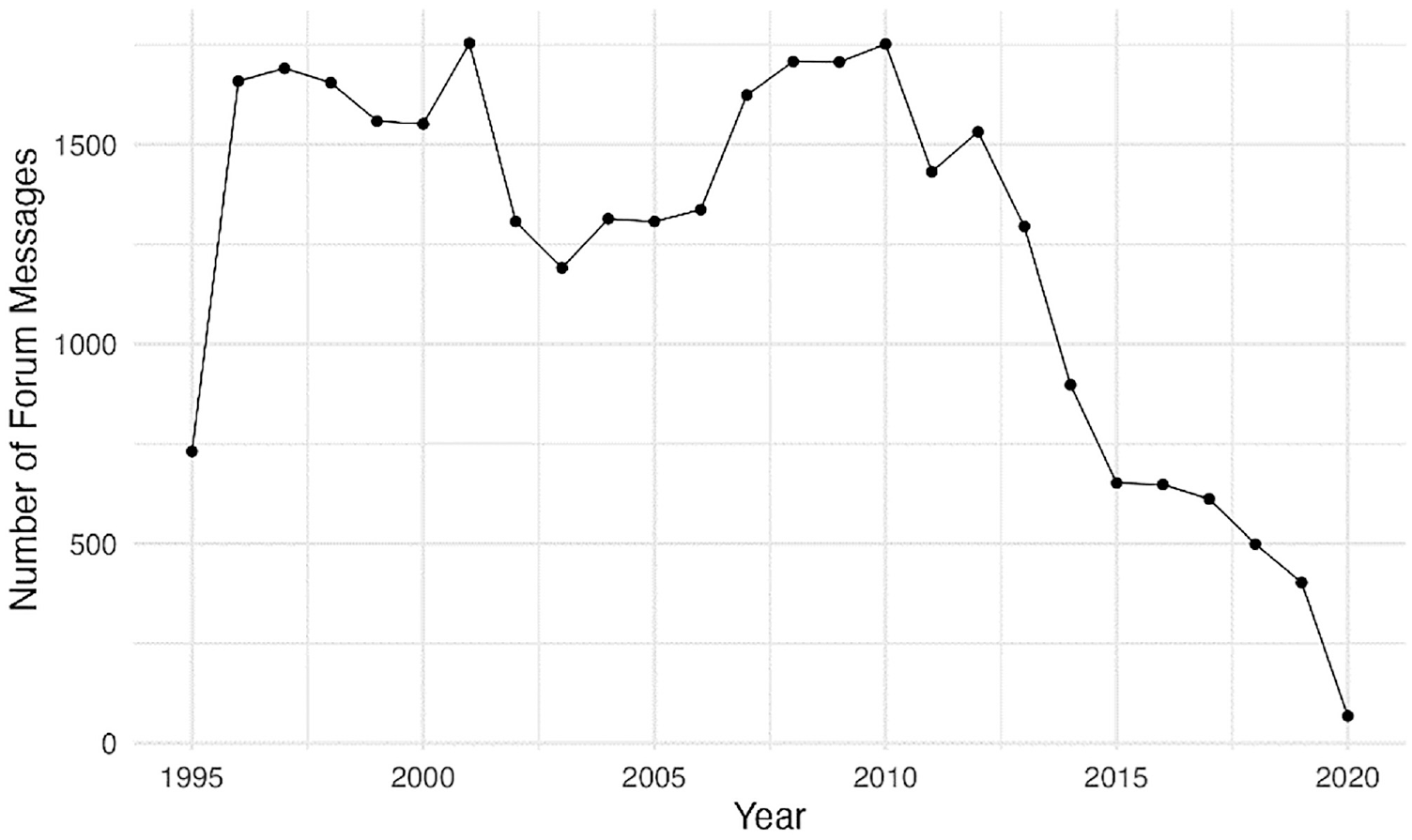
Number of Posts on the Recycling Forum over Time*
This forum is a window into recycling coordinators’ work, including their ambitions, the tensions they faced, their attempts to navigate those tensions, and their perceptions of their successes and failures. The discourse was produced in real time, which helps to avoid problems of retrospective bias, enabling us to cultivate a rich historical understanding of the actions and perspectives of recycling coordinators in situ. Archival data such as these are excellent for investigating events, meanings, and discourses over long periods of time (Langley et al., 2013). Furthermore, although our data are from an online community (as opposed to in-person observations of individuals), studying people via online platforms has increasingly gained legitimacy because social and work lives are increasingly digital, and online interactions structure offline interactions and vice versa (Murphy, Jerolmack, and Smith, 2021).
Forum data checks
We first set out to understand the contours and composition of this online forum, including who its members were, how their participation varied over time, and whether key individuals or groups dominated the conversation. We therefore carried out a set of checks to determine whether this forum could serve as a representative source for understanding the evolution of the occupation over time.
In our first check, we identified all the participants and the higher education institutions with which they were affiliated. We found that from 1995–2020, a total of 1,165 individuals from 445 higher education institutions posted on the forum. We examined the colleges and universities to ensure that they were not skewed by factors such as geographic region, institutional type (four-year vs. two-year; public vs. private), or size, and we saw that there was good representation of various institutions. Through our sampling strategies (which we explain in the following section), we eventually included directly quoted material in this article from 93 forum participants, as outlined in Table 1. As the table shows, we ensured that this sample represented a range of institutional locations and sizes.
Forum Participants Quoted in Article and in Online Appendix*
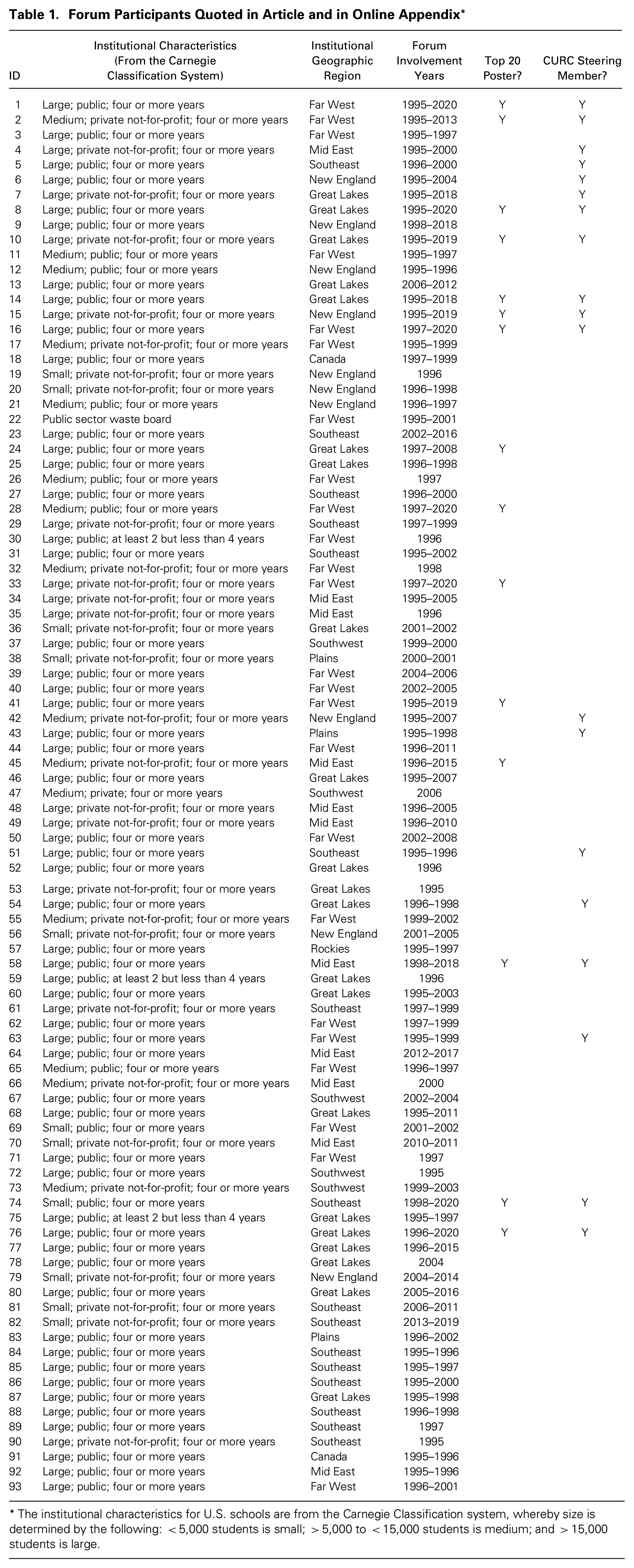
The institutional characteristics for U.S. schools are from the Carnegie Classification system, whereby size is determined by the following: <5,000 students is small; >5,000 to <15,000 students is medium; and >15,000 students is large.
Although we were happy to see this degree of representation across varied types of institutions, in order to use the forum as a platform for understanding the depth and range of recycling coordinators’ actions and reflections, we also wanted to ensure that the conversations included good representation of different individual voices over time. In checking this, we found that the number of individuals contributing to the forum fluctuated over time, but from 1995 to the early 2010s there were consistently over 1,000 messages posted each year from a range of 100 to 300 contributors. 1
In looking at whether a few key individuals dominated the conversations, we found that the top 20 contributors accounted for about 39 percent of the messages over the entire 25-year period. This raised some concerns, but when we looked at this in more detail, we saw that the top contributors changed over time. When dividing the time frame into three equal periods (1995–2003, 2004–2012, and 2013–2020), we found that while six individuals consistently appeared as top contributors, the forum continued to attract new members who participated as significant contributors in each period, so this was not a fixed vocal group. Therefore, these checks gave us confidence that the forum was not limited to a few outspoken individuals but, rather, engaged a wide range of voices, even among the more frequent contributors. As we show in Table 1, both the more- and less-frequent posters are included in our sample (shown in the column Top 20 Poster?).
For a final check, we wanted to understand the backgrounds of the individuals on the forum to see whether the conversations might be skewed either by full-time coordinators (who would be more likely to come from an activist background; Lounsbury, 2001) or part-timers for whom recycling had been added to their existing roles in facilities management. To look at this in more detail, we pulled out the full sample of messages posted by individuals affiliated with the 153 schools that one member of our author team had previously examined (Lounsbury, 2001). We accessed that author’s original coding of whether each school had appointed a full-time or part-time coordinator (Lounsbury, 2001). The period in which that author collected data corresponds to the start of the forum in 1995.
In the sample from that prior study (N=153), 36 schools had appointed full-time coordinators, and the remaining 117 institutions added recycling as an additional responsibility to individuals’ work. When we looked at the activity of these schools on the forum, we found that full-timers were more likely to join the forum (33 out of 36 full-timers joined, about 92 percent), and they also posted more frequently (on average three times more often than part-timers) and stayed active on the forum for longer (3.27 years on average versus 2.91 years on average for the part-timers). In turn, part-time coordinators were less likely to join the forum (43/117, about 37 percent). However, since a larger number of institutions had part-timers, among these schools there were more part-timers on the forum (43 part-timers versus 33 full-timers). These checks reveal that full-timers, who largely came from activist backgrounds, contributed more to the forum conversations, but part-timers were more present on the forum (as there were more of them in the occupation, especially at first), and their presence and contribution continued over time.
Overall, these checks gave us confidence that the online forum we identified represented the occupational community’s diversity in terms of geography, institutional type, and individuals’ backgrounds (activist full-timers versus facilities management part-timers). Although a core group contributed more than others, that core was dynamic, and the majority of messages were from individuals outside of a core group.
Analyses
With these checks complete, we began our inductive analyses of the forum messages with a set of empirical questions. What were recycling coordinators engaged in over time? What were they trying to achieve? What, if anything, got in the way of them trying to achieve these things? How did they try to navigate any challenges they faced? We set out to understand their experiences from their perspective. To investigate these questions, we adopted a qualitative approach to analyzing the forum conversations, with multiple members of the co-author team involved in hand-coding messages through multiple rounds of coding. We met regularly as a team, which helped to balance detachment and involvement while inhibiting any tendencies to over-identify with particular interpretations or interests (Pettigrew, 1990). Furthermore, one co-author did not analyze the data directly and served as an important insider–outsider in helping us interpret our analyses and connect emerging ideas to theory (Dwyer and Buckle, 2009). Our analyses evolved over two primary phases.
First-stage analysis
To get a sense of the discourse and try to answer our key empirical questions, we began with a grounded theory lens (Glaser and Strauss, 1967; Charmaz, 2014) and open coding. In line with theoretical sampling, or early analysis, which is often followed by a more focused period of data collection (Dey, 2004), we started with a random sampling approach, sampling 25 percent of the conversations between 1995 and 2006 (this totaled 293 conversations, which included 4,052 messages). We chose this period because it covers the emergence of the recycling coordinator occupation through the time in which universities began making sustainability commitments, which we initially thought might mark the end of our period of inquiry.
Three of the authors divided the 293 randomly sampled conversations evenly and engaged in open coding, which involved summarizing phrases or sentences with a succinct code linked to the text within the messages (Van Maanen, 1979). Codes that emerged from this analysis included “selecting recycling bins,”“placing recycling bins,”“finding manufacturers of recycling bins,” and “labelling recycling bins.” After open coding, we shifted from the case-centered concepts to researcher-centered concepts, which involved identifying natural groupings of codes and applying descriptive categories to those groupings (Glaser, 1978; Gioia, Corley, and Hamilton, 2013). For instance, we grouped those codes about recycling bins together under a higher-level code, “Designing and placing bins and containers.”
Our coding in this first stage was very important because it revealed that most forum conversations in the early years focused almost exclusively on concerns related to the operations of recycling. This insight informed a significant tension that the occupation encountered early on, which was the ambition to institutionalize recycling as a set of operational changes and the constraint of having no precedent for how to do this. Thus, this first round of coding was crucial to revealing the first significant tension in our findings: mission practice.
However, amidst the messages focused on this first tension, we could see that there were also conversations about recycling coordinators facing challenges in relational, structural, and cultural efforts that went beyond figuring out how to operationalize recycling. We saw, for example, that individuals spent considerable effort trying to promote a movement ethos in their organizations and broaden their work to align with sustainability. Moving iteratively between our data and existing theory, we found these messages to be of interest as they went beyond the operational challenges of collecting and processing materials. Where we could identify these messages, we coded them initially with codes such as “framing work as connected to an environmental ethos,”“expanding work in sustainability areas,” and “expanding practices through allies.”
However, because these types of conversations that went beyond operational problem-solving seemed less common in the forum—especially in the early years—we struggled to identify them among the more than 9,000 single-spaced pages of text. We attempted to identify them by using a keyword-driven sampling strategy based on a set of keywords related to the broader set of challenges that we saw recycling coordinators discussing (for example related to “students” and related to efforts to expand their work into areas such as “global warming”). However, this sampling approach was largely unhelpful for identifying the full range of challenges the coordinators faced and their efforts to navigate them. We therefore engaged in a radically different approach for qualitative sampling.
Second-stage analysis
In our next phase, we sought to identify a sample of messages over the entire corpus that went beyond operational troubleshooting, so we turned to machine learning for sampling. Because we are the first, to our knowledge, to employ machine learning for sampling in a qualitative project, we provide an in-depth, step-by-step overview of our process in Online Appendix A and summarize the process here.
We began by developing a training set for our machine learning classifier built on BERT (Bidirectional Encoder Representations from Transformers) (Devlin et al., 2018; Liu et al., 2019; Kim, 2023). We did so by hand-coding a sample of 1,238 messages as either “exclusively operations-focused” or “not exclusively operations-focused” (see Online Appendix A for more detail). To hand-code the training data, we met as an author team to identify the various types of solely or primarily operations-focused messages, as our goal was to use the machine learning classifier to exclude these types of messages because we had already hand-coded thousands of examples of operations-focused challenges and approaches in our first round of coding. To do this, we developed the coding structure shown in Online Appendix B to enable us to have a shared understanding of the types of messages that were “exclusively operations-focused.”
We then used our hand-coded set of 1,238 messages to fine-tune a BERT classifier to calculate the probability of the remaining forum messages being either “exclusively operations-focused” or “not exclusively operations-focused.” Following the process outlined in Online Appendix A, the machine learning classifier helped us identify a final sample of 5,245 messages that were least likely to be “exclusively operations-focused,” and we focused on this sample for our second round of in-depth qualitative hand-coding.
Through this round of coding, we drew out other key constraints beyond the consuming operational nature of the coordinators’ work, including trying to pursue movement work from within facilities management and working within an operations-focused mandate. We also gained greater visibility into how the coordinators attempted to overcome these constraints and the results of those attempts over time. The machine learning sampling approach thus helped us gain access to a sample of messages that elevated our insights by enabling a shift from seeing the data as largely static to seeing the data as a set of interrelated processes based on dynamic tensions (between the recycling coordinators’ ambitions and the constraints they faced in pursuing them) and their attempts to navigate their work in the face of these tensions. Temporal analysis within this final stage of coding revealed three primary missions of the recycling coordinator occupation: (1) figuring out how to operationalize recycling (mission practice), (2) embedding the ethos of the environmental movement into the organizations and field (mission ethos), and (3) expanding practices to encompass sustainability (mission expansion). We also revealed the constraints they faced and the navigation strategies they employed to try to overcome those constraints.
In this final round of coding, we were able to further our understanding of the empirical questions we set out to answer and make analytical generalizations regarding the longitudinal downstream efforts of movement-backed occupations. Our analyses moved from “what happened” to “why and how.”Van de Ven (2007) has called this the most critical move in theory building, while Langley et al. (2013: 8) described it as “climbing the ladder of abstraction by inferring the general theoretical phenomenon of which the observed particular is a part.” In the end, we were able to link the recycling coordinators’ efforts to the outcomes of these dynamic processes, which helped us to answer why what we have observed matters for movement-backed occupations and downstream movement efforts.
Additional analyses and triangulation
Although we had determined that the forum was a good representative source for understanding the occupational community of recycling coordinators, we also realized its limitations in representing only their views at the time. Therefore, when appropriate, we also drew on a range of archival sources, such as websites, newsletters, campus newspaper articles, professional association meeting minutes, conference brochures, and job descriptions to triangulate what the recycling coordinators were perceiving about their work and how others viewed it.
Finally, after we completed our coding of these materials, we also conducted semi-structured interviews with six expert informants who had been long-standing voices within this occupational community and leaders within its professional association, called the College and University Recycling Council (CURC). Together, these six individuals had a combined experience of 141 years in recycling coordinator positions in higher education. To triangulate the forum messages, we drew on their reflections of how and why things unfolded over time and of how they felt others saw them and their work.
Findings
Our analyses uncover how recycling coordinators worked within and across their organizations over time and how their efforts affected both their occupation and the institutionalization of environmental movement priorities in the field of higher education. As shown in Figure 2 and supported through additional data in Online Appendix C, we find that the recycling coordinator occupation faced three central tensions, which we term “mission practice,”“mission ethos,” and “mission expansion.” In the face of each tension, the recycling coordinators pursued “reconciliation strategies” to work toward realizing their ambitions.
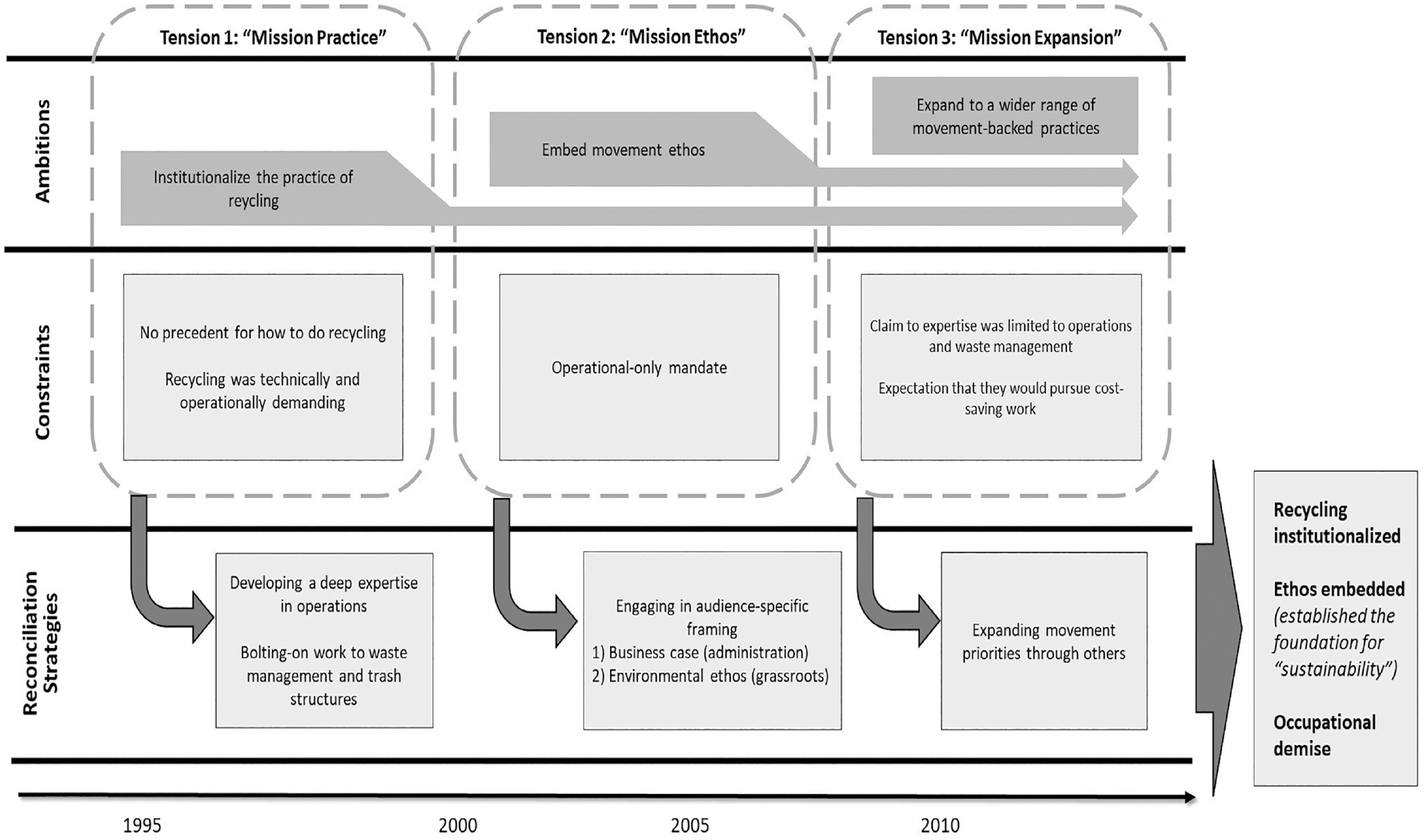
Visualization of Tensions
Overall, we find that the recycling coordinators’ efforts infused the practice of recycling into the field of higher education, and they also infused an ethos tied to the environmental movement, along with a network of actors, structures, and practices that set the foundation for expanding into the next wave of movement priorities regarding sustainability. However, we found that the occupation largely became obsolete in this field, and most recycling coordinators did not move into new roles as sustainability managers even though they were key actors in moving their organizations toward this expanded wave of movement concern. In the following section, we provide evidence for each of the tensions and reconciliation strategies, and then we show how these strategies inadvertently led to additional constraints for the recycling coordinators down the line, ultimately contributing to the demise of the occupation but the advancement of the environmental movement’s priorities across the field of higher education.
Tension 1: Mission Practice
The ambition of mission practice
The recycling coordinators’ first primary ambition was to institutionalize the practice of recycling as a set of standard operational changes across higher education. They aimed to make recycling mainstream and embed its practice in the everyday lives of organizational members, writing, for example, “I always wondered, what if the environmental movement was successful then what? Isn’t this what ALL of us want―integrating into mainstream?” (ID 1). The coordinators frequently mentioned the importance of institutionalization, stating, for example, “I am not so much concerned with numbers as I am having our efforts become a permanent part of our social infrastructure we cannot live without” (ID 2), and “We will make a presentation to the President’s cabinet for the purpose of institutionalizing our recycling program with their blessings” (ID 3).
The idea of a professional group being the central actors working to progress movement goals represented a shift in thinking in this field. Historically, students were seen as the drivers of environmental issues in higher education. But in the early 1990s, the environmental movement began to emphasize that staff could play a role in institutionalizing changes that activists had instigated. A new philosophy—one that focused on such downstream efforts—was promoted by the National Wildlife Federation, a key environmental movement organization. In 1995, the organization published a book titled Ecodemia, which emphasized, “Staff and administrators are accountable for most operational decisions. And it is they who implement most of the procedural changes behind environmental reforms” (Keniry, 1995: 1).
In 1995, the author of this book, Julian Keniry, delivered the keynote address to nascent recycling coordinators at one of their earliest annual conferences. In turn, recycling coordinators anchored their new occupation on the ambition of transitioning largely student-initiated programs to institutionalized programs. They expressed their shared “hope to have our environmentalism recognized as a true profession” (ID 4). As part of this aim, they viewed establishing recycling as key to leading the field of higher education to embrace environmentalism. One coordinator wrote, in 1996, Taken in isolation, campus recycling is mostly materials handling at the back door of university operations. But it is much more than this, of course. Recycling, and its connections to a variety of other campus operations, is fundamentally about the nature of education at “institutions of higher learning.” For recycling seeks to illustrate how universities and colleges can teach by example, as well as through rhetoric, in practice as well as in theory. (ID 5)
This individual was reflecting on notes from an early meeting of the nascent recycling coordinator professional association CURC, which concluded, “We are ultimately working to help restore relationship with the natural world by building a recycling program” (ID 5). Another individual concurred, writing, “recycling is ultimately here NOT as another garbage can, BUT as an ethical inroad to getting the world to see that ALL THINGS ARE CONNECTED” (ID 1). In sum, we find that recycling coordinators saw practice institutionalization as a primary ambition and a way to open the door for embedding the priorities of the environmental movement within the field of higher education.
The constraints of mission practice
We identify two primary constraints that made it difficult to achieve this first ambition of institutionalizing the practice of recycling. The first was that there was no precedent for how to do recycling. While we may find this strange today, as recycling is largely a taken-for-granted activity, the coordinators did not have a clear idea of either how recycling should work or what role they should play in the process. It was unclear what materials should be collected, who should collect them, where they should go for processing, or how much value they had. Should a recycling program require individuals to sort their own waste, or should students or coordinators or waste haulers separate waste behind the scenes? A mantra for the group became the phrase “The textbook hasn’t been written yet” (ID 6).
It was unclear how to even get started. Some coordinators advocated doing a “waste audit” as a first step, but this seemingly simple task lacked a shared understanding. As one person asked, “Regarding this waste audit, how do you define garbage?” (ID 7). Another tried to clarify what this process should look like: When you say “Waste Audit,” what level of your institution are you examining? (individual looks at buildings, examinations of entire sectors, such as residence halls or academic buildings, OR the entire campus as one “stream”)? For what purpose (e.g. to determine the amount of newspaper that could be recycled AND/OR To reduce the amount of solid waste disposed through changes in the processes that currently generate waste, etc.)? (ID 8)
The metrics for success were also unclear. One person asked, “What is the mission of the recycling manager? How do we decide priorities, constituencies? Is it lowest cost waste management, highest recycling rate, environmental footprint reduction―what?” (ID 9). Acknowledgments of this constraint continued, as shown in the following reflection of an in-person discussion in 1997 of what they should be working toward as an occupation: “The central definition of what makes a ‘successful recycling program’ was also the most murkily understood concept among us, ranging in contrast from ‘one that keeps my boss happy’ to ‘a component of a sustainable society’” (ID 2).
And even when metrics were established, such as “diversion rates,” they still required developing a shared understanding and approach. The same individual who commented above on divergent ideas of success was the head of the CURC standards committee. He responded to someone sharing their “diversion rates” by saying, “How on earth do you measure and quantify your Institution’s diversion rate?” (ID 2).
In addition to a lack of shared understanding of how to go about recycling, another constraint quickly became clear: recycling was technically and operationally demanding. The coordinators soon came to realize the reality of what tackling waste meant from an operational standpoint. They would need to grapple with logistics, expensive machinery, commodities markets, bin designs, haulage agreements, contracts, and so forth. It was not enough to just have a passion for the environment.
Operational intricacies dominated early conversations. According to our machine learning classification, in the first year of forum conversations, 88 percent of the conversations were primarily about operational challenges. This dropped over time to about 40 percent of the conversations on average. There were years-long debates over issues such as whether it was environmentally preferable to have hand dryers or paper towels in bathrooms. To address these tradeoffs, the coordinators attempted to compile data and shared experiences to guide their decisions: “Does anyone have any statistics on the amount of paper towels typically used in this setting?” (ID 10). Even years later, they acknowledged the technical complexity of these questions, writing, for example, “there has been much discussion about the paper towel vs electric hand dryer controversy” (ID 11). Similar intense “controversies” played out over issues such as reusable dishes versus biodegradable disposables in cafeterias, what they called the “so-called ‘aluminum/plastic’ wars” (regarding soda cans vs. bottles), and “single-stream” recycling approaches that collected recyclables all together in one bin versus separated streams that usually had lower participation rates but less contamination.
On top of this, the coordinators tried to find or create markets for an ever-increasing array of waste items, from batteries to mattresses to carpeting to light bulbs, furniture, clothing, books, and construction debris. As shown in the following call for help, many acknowledged that they had little to no knowledge about collecting and processing waste, even if they had to make large operational decisions: [We are] interested in acquiring as much information as possible from those schools which operate their own packer trucks. We believe that cab-over, single rear axle chassis, with a 20 yard, rear load packer and automatic transmission will meet our needs . . . We would like to hear about successes, what works for you, and horror stories about purchasing the wrong piece of $75,000 equipment. (ID 6)
Despite their lack of know-how about the practice of recycling and materials management, they agonized over operational issues such as optimizing logistics: “My fantasy is to find a rectangular plastic 1 or 1 1/2 yard bin with a lid and castors which is compatible with a ‘Bayne’ style cart tipper (we’ll have one on our new recycling truck). What do you use for cardboard?” (ID 12).
Overall, technical language, acronyms, and questions about commodities markets, contracts, and machinery proliferated in forum discussions in the early years, indicating that there were significant operational demands that would need to be overcome to institutionalize the practice of recycling.
Navigating the tension of mission practice
In the face of this first tension between the ambition to institutionalize the practice of recycling in higher education but having no precedent for how to go about establishing a successful program, coupled with the sheer operational challenge of the work, recycling coordinators pursued two reconciliation strategies. The first was that they worked to develop a deep expertise in operations. The coordinators set the mission for CURC, their new professional association, squarely around the pursuit of operational expertise and technical knowledge: To facilitate information exchange between institutions of higher education regarding integrated waste management practices by providing technical training, making information about institutional recycling operations and methods easily accessible, and by creating linkages with our academic resources. (ID 10)
While there were discussions about wider environmental concerns, the primary issues that came to dominate the conversations in this first phase were efforts to help one another overcome the operational burdens they faced. In planning their conferences, they emphasized that “We need a pre-conference workshop to deal with ‘NUTS & BOLTS’ issues geared for new recycling coordinators (i.e., how to write contracts, make a budget, procure equipment/bins and establish collection methods, education, etc.)” (ID 14). The online forum and the in-person CURC conferences in these early years focused extensively on the operational nuts and bolts of recycling. Their hope of what would come from this was articulated in the following message: “I hope in sharing our common frustrations and operational wrinkles―and occasional modest victories―we will gain some practical real-world know-how immediately applicable to our campuses” (ID 15).
Interestingly, this focus on operations was even present among a group of individuals who we know came into the role from an activism background. Even they became mired in the operational demands of this work and focused their efforts on developing this expertise in operations and, as we show in the following section, on waste management.
The second reconciliation strategy was to bolt their work on to waste management and trash structures―to try to infiltrate mainstream facilities management structures within their organizations by adding recycling on to trash. When the recycling coordinators were hired, they looked upon the waste management, or trash, departments of their organizations with some envy, as they were largely established, funded, taken-for-granted areas with numerous staff. While there was some debate at first about whether recycling should stand alone as a separate operation (and some good arguments put forth for both options), consensus grew over time that the best approach to institutionalizing recycling was to attempt to bolt it on to existing waste management processes and structures. Recycling coordinators discussed how they perceived the risks of trying to operate as a stand-alone operation, which was a point expressed even by a former student activist who had become a recycling coordinator: Administrators pay the trash bill no matter how high it is and then whenever we try to do recycling/composting they put us through the wringer as they see it as an extra cost. If we ever get to make this change, it would really help to have recycling/composting be part of the waste management structure and charge. (ID 1)
There were conversations about how to revise job descriptions for everyone who was involved in existing trash or garbage structures to make recycling part of their jobs: Do whatever it takes to change the language so that wherever the word “waste” or “trash” or “garbage” appears, the two additional words “and recycling” also appears. Thus, if a landscape services worker is responsible for removing trash from a building, after the language revision, s/he will also be responsible for removing recyclables from a building. (ID 15)
This was a bolt-on approach of adding recycling to existing structures rather than working to make it a viable stand-alone structure. The idea that “Recycling is but a single component of comprehensive solid waste management” (ID 2) was articulated and embraced over time. One of the pioneers of this approach advocated for it as follows: “Something I have pushed for years is that recycling and trash should not be looked at as two separate operations, but as part of the same integrated solid waste operation. I think that solves a lot of budget and administrative hassles” (ID 16).
Although there were numerous conversations arguing for the benefit of integrating recycling into existing waste or trash structures, we wondered whether the coordinators themselves came to see recycling as increasingly a part of waste management rather than a stand-alone area that stood in opposition to the dominant logic of waste. To answer this question, we examined the text of the forum conversations quantitatively, looking at mentions of recycling only (not including any keywords related to waste), waste only (not including any keywords related to recycling), and recycling and waste together in the same message. 2 Figure 3 shows the results of this analysis, which indicates that early on, recycling-only messages appeared on the forum about as frequently as those that discussed recycling and waste together. However, around 2008 the most frequent of these three types of messages became those that blended the discourse of recycling and waste. The results of this analysis provide evidence that this strategy was not only discussed; it became a reality as recycling coordinators increasingly talked about their work hand-in-hand with waste management.
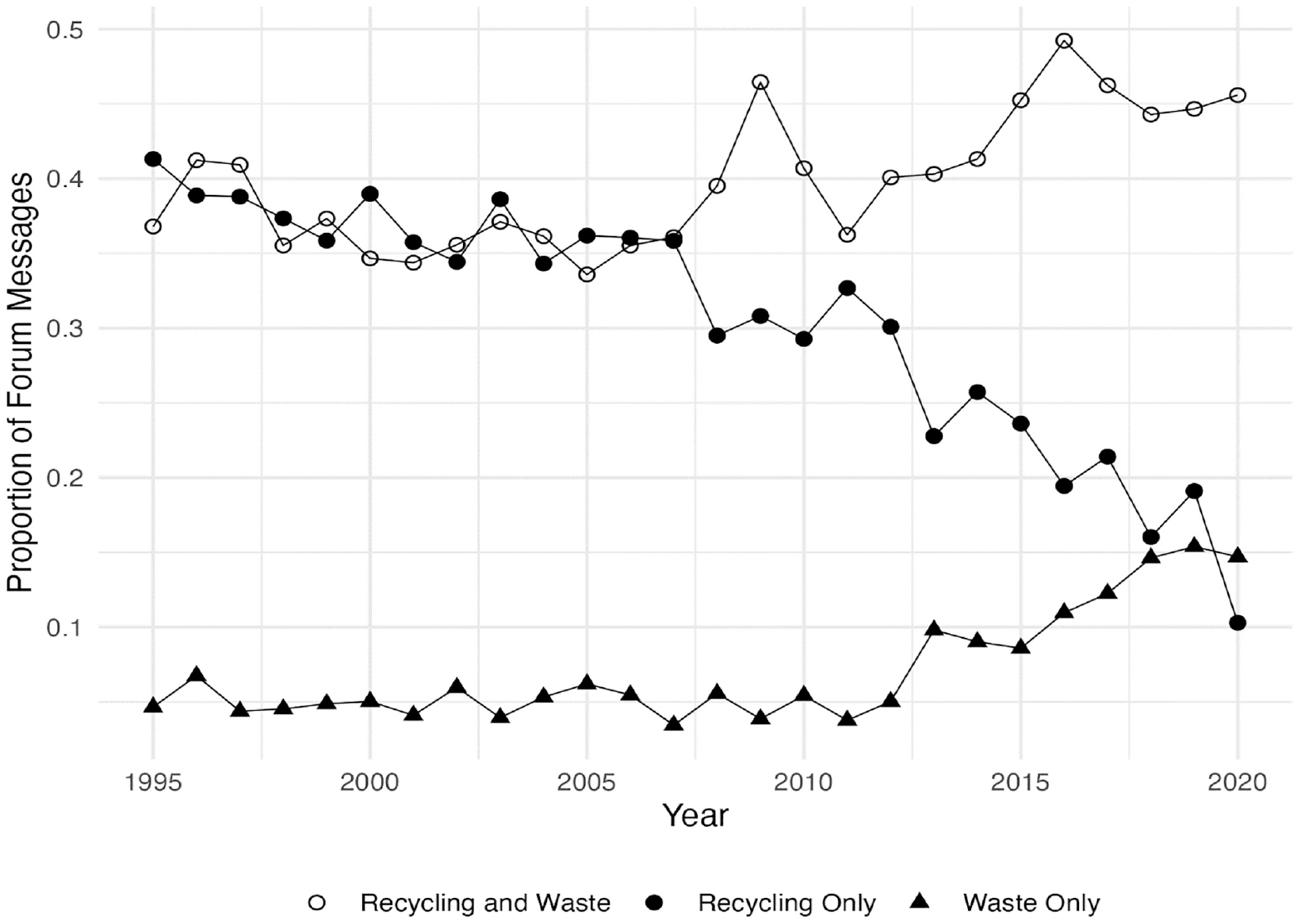
Proportion of Forum Posts with Keywords Related to Recycling and Waste
Tension 2: Mission Ethos
The ambition of mission ethos
It is reasonable to think that deepening the operational focus of recycling, along with bolting it on to existing facilities management structures, would be the end of the story. However, we find that the recycling coordinators also articulated an ambition to embed a movement ethos from the environmental movement within the field of higher education. We found through our hand-coding that although there were sporadic discussions of trying to embed a movement ethos from the beginning of the forum in 1995, the concentrated period when this ambition was discussed was between 2002 and 2006, peaking in 2005 and tailing off in the later 2000s.
During this period, the coordinators increasingly expressed that they did not feel that it was enough to institutionalize the practice of recycling. They wanted people in their organizations to understand the link between the act of recycling and the ethos of the environmental movement. As one person wrote, “Recycling of resources is unquestionably the right thing to do. However, I think everyone needs to know WHY we are doing so” (ID 17). Another echoed this ambition: “We have an opportunity not only to teach students how and why to recycle (like they learned in elementary school), but how recycling can actually be a tool in the larger goal of creating a sustainable society” (ID 2). They wanted people to feel that their everyday actions mattered for remedying environmental problems. They wanted to win hearts and minds, not just change behavior. One person described how coordinators needed to get everyone to recycle with their “heads” and their “hearts,” which they said would “UNLOCK THE FEELINGS OF OPTIMISM about the future!” (ID 15).
The recycling coordinators articulated their aims to change values as well as behaviors: “To my mind, there has to be a fundamental shift in the values and aspirations of people everywhere” (ID 18). They recognized that this ambition went beyond simply moving materials around and that it should inform the way they designed their programs and engaged others in their work: “Recycling is a broad ideology which is not only about conserving and using resources wisely, but about being reflective about who we are as human beings” (ID 19). The following quote emphasizes this ambition: Part of our mission is to prepare young people for responsible citizenship and we can do this by fostering a real-life connection to waste reduction, recycling and reuse. I would consider a program where trash is sorted behind the scenes to recover the recycling to be effective, but not successful in the realm of “higher education.” (ID 20)
Reaching organizational members with the ethos behind recycling became an ambition that was layered onto the initial ambition of institutionalizing the practice of recycling.
The constraint of mission ethos
When the coordinators discussed how they could go about fulfilling this ambition, they lamented that they had an operational-only mandate, which was to implement recycling, not to proselytize a movement ethos. They were hired to divert waste from landfills, and they discussed how they felt that their work was judged against this mandate. Recycling coordinators were primarily based in facilities management or plant operations, functional areas that are operational and behind the scenes, not strategic players in their organizations. One of our expert informants, looking back on this, told us, “I was kind of under the radar, you know, hidden away in this little weird pocket of plant operations which is not a department that does education and outreach” (Interviewee 1). The purpose of facilities management is to keep the lights on, construct buildings and roads, handle landscaping, and take the trash away. Furthermore, the way that recycling coordinators worked in the face of the first tension described above had deepened their connection to operations, particularly waste management.
Recycling coordinator job descriptions that were circulated on the forum provide evidence that the recycling coordinators’ mandates were focused primarily on operations, not ethos. Some descriptions did include an educational component, but they focused on education purely for getting more people to recycle (education as informing about how to recycle, as a means to an operational outcome) rather than education about why to recycle or spreading an environmental ethos. For example, one job description listed many required operational tasks, while the task of education was labeled as a “marginal function” to “maintain and increase awareness and participation in resource conservation and recovery, and waste minimization efforts” (ID 21). The educational components in another job description said, “Make presentations and work with departments to reduce waste and recycle” (ID 17). A third said that the employee would “train the campus community about the program and how to participate in it” (ID 22). In the face of this, coordinators described how they felt pressure to justify their ethos ambitions through measurable operational outcomes: Does anyone out there have good numbers or information on how their campus solid waste/recycling education program has improved recycling numbers, reduced trash, contamination, etc. I am trying to “prove” to the powers that be that education is a very important and vital aspect of a waste reduction/recycling program. (ID 23)
Another individual responded to this message with a shared frustration: “Doesn’t it seem odd that we have to make a case (make sales pitch) for the value of education, training and awareness programs at a university―a center for learning?” (ID 24). Overall, the coordinators discussed how they felt constrained from pursuing ethos work because their mandate was primarily operational, focused on the end goal of increasing recycling rates. It did not leave room, formally, for trying to embed an environmental ethos in their organizations.
Navigating the tension of mission ethos
Since embedding their organizations with an environmental ethos went well beyond operations, on which they had focused their expertise and grounded their work in the face of the first tension, we see that in the face of this second tension recycling coordinators pursued a strategy of framing their work differently depending on the audience. To their administrators and managers, they framed their work in terms of cost savings and on the business case for implementing recycling as part of an efficiency gain for facilities management. However, to students and others whom they tried to recruit as allies in their work, they framed recycling as stemming from environmentalism and as a vital component of resolving environmental problems.
In the forum conversations, we see that coordinators repeatedly encouraged one another to frame their work to anyone in a position of authority as aligned with the business case for recycling, via an efficiency and cost-savings argument. One person wrote, “Bring up money . . . How much money is being saved by recycling compared to landfilling. Administrators seem to like to hear about money more than they do about how you’re improving the environment” (ID 25). Another said that to get “an Administrator interested in the concept, tell them how much money it could save” (ID 26). A third counseled a peer before they had an upcoming meeting with a key representative of their administration: Hit ‘em with facts & figures. Talking about the environment (other than as regulatory compliance) is still for many career administrators an awkward conversation. Finances, however, is the natural language for all administrators. If you are able to couch your proposal in terms of numbers, and especially cost savings, you’re half-way home. (ID 27)
They even came to say, over time, that the business-case framing was a “mantra” for recycling coordinators, or a part of their well-established toolkit: As has been a mantra for recycling folks in general, it is about connecting the financial dots. Building a compelling case that shows where the revenue and savings comes from, what the local tipping and hauling fees are, researching the likely diversion tonnages, how that will affect the hauling schedule and associated costs. Administrators appreciate two things most when evaluating proposals; the bottom line and a well thought & reasoned analysis. (ID 28)
This was very different, however, from the way that they reported having framed recycling to students and other grassroots members of their organizations, which was based on instilling an ethos of environmentalism within the field of higher education. From an early point, many coordinators invested an enormous amount of effort in environmental campaigns, such as spearheading Earth Day activities, that went far beyond teaching people how to recycle. One person wrote, Earth Day is just around the corner and I was wondering what people will be doing on their campus. [We] will be hosting an event with scheduled speakers, food, bands, local environmental & social justice groups, etc. from our community. Our mission will be to bring the community together to honor those that bring positive change. (ID 30)
Another said, “Our campaign this year is going to focus a lot on involvement, empowerment, and education. Most importantly, we’re going to use recycling/waste issues as a rallying point. It’s the most tangible, readily grasped environmental action” (ID 29).
Recycling coordinators also emphasized to organizational members that their individual actions mattered for solving the environmental crisis. One person wrote this about a training they had designed for students and staff on recycling: The one area where I touch on morals and ethics is to say that in a time in our lives and in our collective history where we often feel powerless and not in control that recycling enables and empowers us to have a global impact through our seemingly small personal actions as we handle our “waste” each day. (ID 31)
They discussed the importance of educating others about environmentalism as key to their roles: “You may not get immediate results from your education efforts, but think of yourself as planting seeds. Regular, diverse education builds up in people’s subconscious over time” (ID 7). Additionally, they encouraged one another to “Educate the students on environmental issues as we go and we will quadruple our effects in the long term” (ID 32). These discussions show that coordinators felt it was important to frame their work to grassroots organizational members in a way that would help instill their organizations with an environmental ethos. This was education for values change, not education for behavior change.
Tension 3: Mission Expansion
The ambition of mission expansion
The final ambition of the recycling coordinator occupation was to progress a more expanded range of movement-backed practices within their organizations. This focus went on for more than a decade, reflected primarily in messages from 2004 on. And, we argue, this effort was driven partly by an expanding focus within the environmental movement itself. In the early 2000s, the environmental movement was increasingly raising concerns well beyond waste, about energy efficiency, renewables, water quality and scarcity, and food sourcing, with a central focus on climate change, which was supported by more awareness of the threat of greenhouse gas emissions. This shift in attention is reflected in the widespread success of the 2006 film An Inconvenient Truth, which featured Al Gore explaining the threat of climate change.
At the same time, the practice of recycling was becoming more institutionalized, and recycling coordinators began to discuss recycling more as a foot in the door, writing, for example, “recycling and solid waste prevention is only the beginning of the environmental impact-abating work that might be done on campuses” (ID 15). And, “I have always maintained that recycling is
Building on the recognition of recycling’s limited impact compared to the huge scope of environmental concerns that the movement backing their occupation now focused on, the coordinators began to discuss a range of new practices they wanted to usher in within the field of higher education, including composting, renewable energy, mass transportation, green building, and energy efficiency measures. For example, they started discussing green building well before campuses adopted green building certifications, with one coordinator asking, “Does anyone have information on grant money for green building?” (ID 38) and another writing, Does anyone know anything about green building? (Specifically on a university campus or in residence halls if possible.) How about green building with regards to energy conservation? water conservation? construction/demolition waste? recycled building materials? (ID 37)
Another person asked for help understanding biofuels: “I was wondering if any schools out there are using used vegetable oil as fuel. I would love to know which schools are doing this and how you got to the point you are at now” (ID 39). And as they had done with figuring out the technicalities of recycling, those with more experience provided advice and resources to help develop the community’s expertise about a range of potential new areas of work. Someone answered the question about biofuels by writing, We have received grants to manufacture biodiesel from used cooking oil on campus. We have been running our shuttle buses, campus utility carts and other diesel equipment on B20 (20% biodiesel/80% petroleum diesel) for a year and a half. We are building a unit to convert 20,000 gallons of cooking oil to biodiesel each year and will phase in the fleet to B50. (ID 40)
Over time, recycling coordinators shared information and became well versed in a much wider range of environmental issues. They also began to connect their work to an idea that they were helping to develop, “sustainability,” as shown in this post from 2002: “I like to use the term sustainability . . . The idea is to close the loop, making sure that we do not use more resources than can be created, thus sustaining the things we value for future generations. Sustainability is a term that is not used very much” (ID 36).
While these patterns emerged from our qualitative analyses, we again turned to quantitative analysis to triangulate what we were seeing as an increasing shift in discourse among the occupational community toward a range of environmental concerns and practices beyond recycling. This time, we compared the frequency of forum messages that included discussions of recycling alone, discussions of sustainability alone, and discussions of recycling and sustainability in the same message. 3 As shown in Figure 4, while recycling-only messages remained the predominant type on the forum, these messages steadily decreased over time, while both sustainability-only messages and messages about recycling and sustainability increased over time. This triangulation shows that over time the recycling coordinators increasingly discussed a wider range of environmental concerns and potential new areas of work.
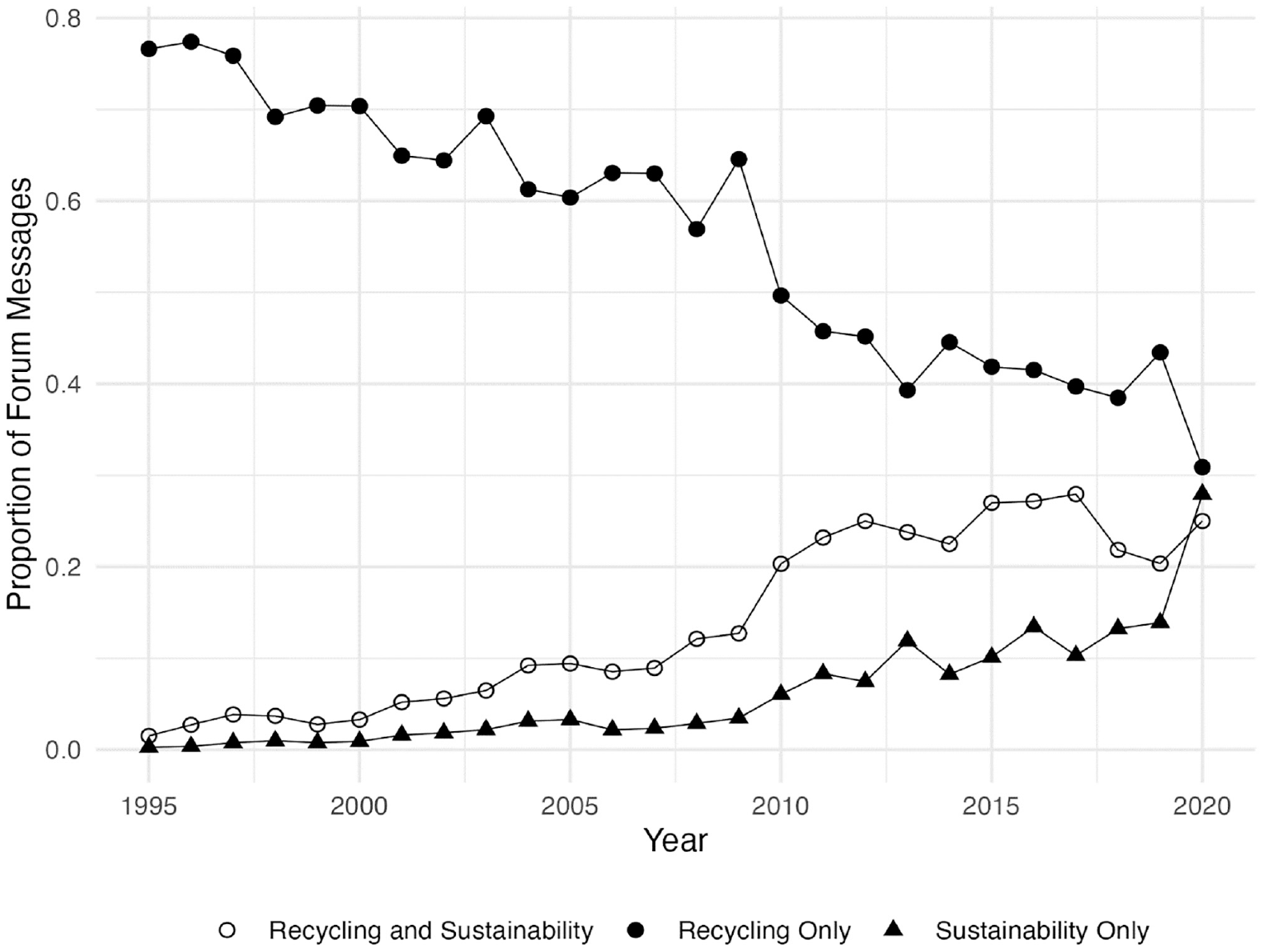
Proportion of Forum Posts with Keywords Related to Recycling and Sustainability
The constraints of mission expansion
When it comes to understanding what was holding recycling coordinators back from openly or formally pursuing a much larger expanse of movement-aligned work, we found that the reconciliation strategies they had employed in the face of the first two tensions generated constraints. In particular, efforts to expand their work beyond recycling were hindered by prior reconciliation strategies that had (1) solidified their claim to expertise squarely within operations and waste management and (2) set an expectation that they would focus primarily on achieving cost savings. These strategies constrained their ability to expand their roles in line with expanding movement concerns.
In response to the tension associated with mission practice, recycling coordinators deepened their operational expertise and bolted on recycling to waste management structures, which had the effect of limiting their claims to expertise solely to operations and waste management. As one person wrote in 2010, “I have been seen as more of an operations guy for the past decade or so” (ID 41). This person continued, lamenting that this restricted them from working on “policy” (ID 41). Another person felt their cumulative experience with environmental issues did not matter because they were seen as limited to an operational domain in which their knowledge did not stand up to knowledge accumulated in a more academic setting: Professors might just love that charming groundskeeper with the regional twang and the salty vocabulary, but they are less likely to respect the wisdom of his accumulated experience working with the campus ecosystem through the years than a controlled experiment published in a peer-reviewed journal. The path of operations is where most of us find ourselves walking today. (ID 15)
Others wrote that they felt that recycling coordinators were “perceived as just a bunch of eco-janitors by administrators” (ID 2) and that “waste management is not visionary” (ID 33). One wrote, “I’m tired of just being an alternative to a garbage can” (ID 1). They discussed how their operational embedding limited their abilities to work as a “researcher, innovator, or advocate” (ID 42) as they were too “caught up in the daily greasing of the squeaky wheels” (ID 42).
Recycling being a bolt-on to waste management ran contrary to the idea that the coordinators had something to offer the strategic or educational missions of their organizations, even as they now wanted to lead on a wider range of environmental movement concerns. By the time the coordinators wanted to expand their work beyond recycling, they were constrained by their prior efforts, which resulted largely in trading their potential expertise as environmental champions for becoming embedded in the operational core.
In response to the second tension of mission ethos, recycling coordinators had employed a communication strategy with administrators that emphasized business-case framing, which resulted in the second constraint they faced in expanding their work: the expectation that they would pursue cost-savings work. This became a barrier to pursuing a wider range of environmental concerns that did not fit a clear business case—efforts like purchasing local food, starting a composting program, running buses on biofuels, or investing in renewables. Experimentation into new areas of movement concern required up-front resources and did not always have clear or short-term savings. One person reflected on how recycling coordinators had spent years “masking” their “environmental ethics” through the language of cost savings: Many of us are all in a precarious balance as Recycling and or Waste management specialists . . . We must regularly swallow our environmental ethics to support the predetermined avalanche of bureaucratic established procedural resistance to progress . . . Well after all these years I still rebel and maintain a good portion of anarchistic tendencies which have somehow mutated into a financial analysis, full cost cycle accounting, environmental sales technique to mask them. (ID 4)
Another person discussed the difference between justifying something as “sustainability” versus “cost savings” and talked about how cost-savings framing had not had “staying power” for them in their recycling work: I am pushing our committee to roll this out as a sustainability initiative and not a cost saving measure. Cost saving measure may not have staying power especially with a change in the economy or a change in administration (as I learned the first time around). (ID 13)
Another said that in trying to get a position established to lead “greening efforts,” they ran up against the following: “The university likes the idea, but always asks the question ‘Where’s the money?’” (ID 47). This seemed to be a common response when they tried to further sustainability. Another person wrote, Does anyone have any figures they can share validating the expense of hiring a sustainability coordinator? Our president is willing to consider hiring someone if there is proof that it is worthwhile. For example: We saved ??% of budget in the first year after the expense of paying for the position, or any similar statistics that you have would be greatly appreciated. (ID 79)
Another coordinator said that they recognized the drawbacks of the strategy they had pursued, saying that to focus on other benefits, like health, was challenging because they had been “narrowly defining our roles as increasing recycling rates and saving schools money” (ID 9). Since they had justified their roles as providing cost savings or revenue generation (and had not communicated the ethos side of their work to most of their administrators), they felt that their occupation was now limited to working on issues that aligned with this value proposition.
Navigating the tension of mission expansion
In the face of this final tension, we saw that recycling coordinators predominantly worked by expanding movement priorities through others. To move their organizations toward addressing a much wider range of environmental concerns, coordinators built a network of allies for pursuing sustainability work. As one person wrote, “Since most of us cannot get our way simply by issuing orders, we must accomplish our ends through establishing partnerships and allies” (ID 05). To work through others, they spearheaded new “campus greening” and sustainability committees, writing, for example, “I pushed to get this Sustainability Committee moving” (ID 36). Another shared that they were “putting together a group of faculty and middle managers to create a committee that is charged with connecting food operations and curriculum as part of our campus sustainability initiative” (ID 45). They shared how these committees pursued concerns well beyond waste: “We have also been working very hard with our campus faculty/staff/student committee to rewrite the campus building code to incorporate green building criteria” (ID 46). Two years later, this same individual discussed their excitement at the outcome of this “Green Campus Council”: The biggest thrill was watching our administrators view a morning of power-point on green design and actually warm to the subject! We (i.e. our Green Campus Council) was even credited with bringing the topic repeatedly to the administration until something like this happened. (ID 46)
Recycling coordinators also designed “eco-rep” programs to mobilize students to work on issues like water conservation and energy efficiency on campus. One coordinator shared, “We have established a program of ‘Environmental Liaisons’ who are representatives in all of the buildings on campus . . . I recommend a network like this that you can tap into” (ID 20). Others tried to bring in outside experts, like speakers, facilitators, or consultants, to educate people within their organizations on how to move toward sustainability. One coordinator wrote, Oberlin College in Ohio has an Environmental Studies building that is green. We were so impressed with what we had heard about it that we got Dr. David Orr to come speak about it at a Sustainability Conference we hosted here yesterday. It gave our university president the opportunity to hear first-hand from one of the developers of this exemplary example of a living classroom. (ID 48)
Another coordinator wrote about working with dining services to start a reusable mug program even though they ultimately did not get credit for this work: “One way that we have had success in promoting reusable mugs is through special promotion days where all drinks are free if you bring your mug . . . Dining Services gets all the credit for these programs” (ID 87).
Others discussed efforts such as expanding into purchasing. This often started with trying to get traditional printer paper replaced with recycled paper. Coordinators discussed how they worked through other departments as “allies” in these efforts: The printing department sent recycled content photocopier paper to every department . . . Attached to the case was an educational piece notifying the customer that they had received recycled content paper, why they were receiving the paper, and who to call if they had any questions or concerns . . . Your printing and purchasing departments can be allies in your efforts to expand the use of recycled products! (ID 54)
Another coordinator talked about how a committee they had founded, the “Environmental Practices Committee,”“led the charge” on adopting recycled paper, and their purchasing department then instituted the change. In response, they celebrated, writing, “we changed most of the campus over to recycled content paper!” (ID 49).
The coordinators contrasted these wins of expanding movement practices through others with their frustrations in trying to do things from their positions directly. One coordinator discussed how she had “tried to ban bottled water at meetings (to save 10’s of thousands of dollars) and it went nowhere” (ID 1). Others who had been more successful at achieving the same goal shared that they had worked behind the scenes—“We worked with the caterers directly” (ID 48)—or had mobilized students around the issue: “The Office [of Recycling] has had a very successful and fruitful relationship with student environmental groups; there is a trust built on years of cooperative efforts . . . To a real extent, this campaign has been based on education and mobilization” (ID 49).
We found evidence that recycling coordinators even recommended to one another in a conference session to intentionally be “invisible” in some of their efforts: “Know when to be visible and when to be invisible” (ID 27). In this same message, the coordinator recommended to their peers to “Apply student leverage” by mobilizing and working through others but cautioned, “Be careful, however, not to be seen as the ‘behind the scenes’ advocate or fomenter of such tactics” (ID 27).
Overall, the recycling coordinators seemed to not mind working through others if doing so meant that they achieved their goals of furthering movement priorities, even if others got the credit. This puzzled us a bit, so we followed up with our key informants to triangulate what we were seeing on the forum, and we heard a similar story through the experience of one person who had worked as a recycling coordinator for 17 years: Let’s say you improved or expanded something for housing, like move-in and move-out efforts. Housing reports on that. For me, I love that. And I’m not saying like I’m this great person, that I never wanted that attention. But I knew that I did my job. I did it. I’d got this program going. But yeah, sure, Housing, you can take credit for it. (Interviewee 1)
One astute coordinator reflected on the forum on what their roles had become: “We are social architects quietly working behind the scenes to create a sustainable infrastructure which protects our environment and conserves our natural resources” (ID 43). What this left them with was summarized by another individual: “My only regret about the way this has developed in the last ten years is that the university and college (recycling) coordinators have not been recognized outside of their own circles as the potential resource they are” (ID 14). One of the most-established recycling coordinators discussed feeling that she had never achieved authority in the realm of sustainability despite the considerable work she was doing on these issues: “though I do a lot of sustainability and environmental issues/resource work, I can make recommendations, but I don’t have authority or ability to enforce or implement campus environmental and sustainable policies” (ID 1).
In the following section, we describe how the reconciliation strategies that recycling coordinators employed resulted in a set of mixed outcomes for their organizations, for the environmental movement, and for their occupation.
Mixed Outcomes for Movement-Backed Occupations
Institutionalizing the practice of recycling in higher education
Our case highlights several interrelated outcomes that unfolded over time. First, this occupation largely succeeded in institutionalizing recycling in higher education, which is no small feat considering the operational burden that the work presented. The university recycling contest RecycleMania began in 2001 with only two participating schools. By 2004, this grew to 16 schools. By 2008 (at the start of the focus on sustainability in higher education), 400 schools participated, and 630 schools participated in 2011. 4 Recycling efforts also expanded considerably within individual schools, eventually capturing a much wider range of materials.
Until approximately 2005, more and more schools were signing up to do recycling and employing recycling coordinators, and recycling increasingly became an established part of waste management. As one person wrote, “Recycling has become an institutional asset” (ID 2). Another shared how they had successfully institutionalized recycling via the bolt-on approach: “the collection of waste and recycling is integrated into each auxiliary unit’s custodial contract. This took years to negotiate as you can imagine, but it is institutionalized now” (ID 49). Others reflected on their journey in a similar way: “we have institutionalized recycling efforts by having existing staff incorporate recycling into their job duties” (ID 50). Finally, when coordinators looked back on their efforts, they also celebrated that they had embedded the ideals of recycling into the field of solid waste management, making this mainstream area less quick to view landfills as the first point of call for post-consumer material: “One of the big but unrecognized benefits of recycling―I think―is that it has pulled into the solid waste management profession a host of individuals from unorthodox backgrounds, who have been motivated by idealism (not just careerism)” (ID 5).
Embedding an ethos that set the foundation for sustainability
We find significant evidence that the occupation successfully embedded an environmental ethos within higher education. Organizational members attended thousands of Earth Day events that were organized by recycling coordinators, received education about the ethos behind recycling through inductions and trainings, and were taught to see their actions as meaningful in remedying environmental problems. Student clubs that formed around a range of environmental concerns often chose recycling coordinators to be their staff mentors, and grassroots organizational members and committees that recycling coordinators had started successfully promoted a wide range of environmental practices, from reducing greenhouse gases to constructing green buildings. The coordinators themselves also articulated the view that their efforts to embed an environmental ethos into their field had set the stage for the expansion into sustainability: “Recycling is the Trojan horse of sustainability. I honestly do not think the current rise and success of campus sustainability efforts would have been possible without all of our efforts opening the door in the first place” (ID 16).
While students are often credited with the rise of sustainability in higher education (Augustine, 2021), we have revealed that recycling coordinators played a key behind-the-scenes role in educating and mobilizing students to push their institutions toward sustainability. This powerful reflection further describes this finding: I see the work of college recyclers as having a huge impact on moving the world forward―we are the foundation that has created this opportunity to build sustainability into everything we do―and it’s working, the world is changing and I see us as the pioneers . . . [This] wouldn’t be possible unless we had laid this important foundation and created the catalyst, demonstrated the positive effects and inspired so many students to go out and do the right thing in the world. It’s definitely mainstream and I secretly see that recyclers, in the trenches, have stimulated this whole movement and change towards a better world and a new way of doing and looking at things. (ID 1)
We followed up with one of our expert informants to understand how they understood this, looking back on it. They discussed how embedding an environmental ethos had been a core aim of their work: The whole point of our work was not to become recycling kings, but it was to raise community awareness on environmental issues using solid waste as sort of the springboard to that . . . [It was] about how do we get this kind of sustainability ethic to be ingrained in the university culture . . . This whole idea of just starting out as this little thing and securing a place somewhere on the campus and then multiplying and bringing that idea and getting other people involved and getting their energy and having them bring their ideas and their knowledge and just having it grow exponentially. That was kind of the idea of how to infuse this ethic into the campuses. (Interviewee 2)
Occupational demise
Despite these successes, we find that the occupation experienced demise. Recycling coordinators helped higher education embrace the ethos of the environmental movement, but when the environmental movement shifted its focus to a broader set of concerns, it put recycling coordinators in jeopardy, as one of our interviewees told us: Climate change became a thing with An Inconvenient Truth. All of a sudden then it’s like, oh, well, we have this whole larger thing to worry about. And that’s what we were trying to do in the recycling realm was to say, yes, recycling will actually reduce your carbon outputs because the recycling actually reduces the amount of fossil fuels required to make new materials . . . but there was some question about, should we even bother with this recycling since we have this much bigger thing to think about, you know, climate change, global warming. (Interviewee 2)
Indeed, we see that shortly after sustainability manager positions took off (around 2008), the number of recycling coordinators in higher education substantially diminished. As shown in Figure 1, the online discussion forum showed a steady decline in activity, from an all-time high of 1,752 messages per year in 2010 to only 68 by 2020.
We realize that the diminished activity on this forum is not conclusive evidence that the occupation itself was decimated. So, we followed up on this by analyzing the contemporary websites of the 153 schools from Lounsbury’s (2001) original sample, to see how many schools still listed an individual in a recycling role (even in a part-time capacity). When we were unclear about whether a school had someone in a dedicated recycling role, we emailed them to ensure that we did not miss anyone. Overall, through this investigation we found that only 16 of the 153 schools (10 percent) still had a recycling coordinator in 2021, which provides more evidence that this occupation (at least in this field) has virtually disappeared. This was corroborated by interviews with expert informants as well as archival evidence showing that higher education sustainability managers have, in many cases, assumed oversight of recycling among a wide range of duties.
It is possible, we thought, that one explanation for the disappearance of the occupation is that individual recycling coordinators had expanded their roles to become sustainability managers. After all, recycling coordinators had worked to further a range of environmental practices, and they embraced the ethos of environmentalism; this seemed like an opportunity for occupational expansion. Furthermore, the forum conversations indicate that recycling coordinators also thought that they would expand into sustainability. In 2005 the organizer of the RecycleMania competition forecasted the following: Growth and enthusiasm for the [RecycleMania] contest has encouraged us to expand to include waste reduction and food composting this year. In future years we may also compete in water conservation, energy efficiency, greenhouse gas reduction and other criteria. Perhaps in another year or two the contest will be called “SustainoMania” or “EnviroMania!” (ID 15)
However, we found that most recycling coordinators did not, in fact, move into these new, expanded roles. We conducted an analysis to examine the professional backgrounds of sustainability managers in higher education on a sister forum, called the Green Schools forum, which comprises primarily sustainability managers. We found that only 7 percent of the sustainability managers on that forum came from a recycling coordinator background. Additionally, in reference to other empirical research that has investigated the backgrounds of sustainability managers in this sector (Augustine and King, 2022), we know that at first they were most likely to come from extensive work in environmental non-profit organizations, and later they were most likely to have specialized graduate degrees in an environmental area—neither background matching most recycling coordinators. In the end, we find that the occupation of recycling coordinator was largely replaced by sustainability managers and that this shift did not provide much of a career pathway for recycling coordinators to elevate or expand their positions.
As the final part of our findings, our key informants helped us understand this occupational demise and, importantly, to see that recycling coordinators found it surprising that they were not recognized for what they felt able to do in the realm of sustainability. We interviewed the person quoted above who had hoped that RecycleMania would become SustainoMania, asking him about why that pathway never unfolded for him at his very prominent, high-status university in the northeast. He said, When our first sustainability manager came along, that was a big adjustment for me. And in some ways, really a thumb in my eye. And I was really bitter that our vice president decided, you know, what, we need a sustainability manager to keep up with our energy reduction efforts and our climate commitments that we want to sign on to. You know, and the VP at the time told me when I went to him, I said, “Hey, what’s with this new sustainability person? How come I don’t know about it? You know, I’m not included on all these conversations about putting together a climate inventory, a greenhouse gas inventory and a climate protection plan and a commitment to green buildings and all this other stuff.” . . . And he said, “Well, number one, I want to make sure the trash keeps getting picked up. And number two, you know, this really is becoming a specialized thing of you know, greenhouse gas inventories and climate reduction profiles and dashboards and all this kind of thing.” (Interviewee 3)
This leader in the occupation felt he was seen by his administrators as just the trash guy; he continued, “I was disappointed that I was no longer Mr. Green.” Another informant told us that although she was “instrumental in getting an office for sustainability,” she was unsuccessful in moving into the role itself: In my case, I worked a couple times to upgrade the recycling coordinator position. It was difficult and in my case not necessarily beneficial. But I was happy to work behind the scenes to get things done . . . We all just did sustainability from whatever position we were in. (Interviewee 4)
Another lamented how she had been left behind: Once sustainability got sexy it was a mad dash to who was going to get that title and get in and be interviewed . . . I was very excited to take on different roles and try new things. I really enjoy novelty. But I was really kind of pushed like, “Nope, you. Nope. Nope, you do recycling. You just do recycling.” (Interviewee 1)
When we told this person, “You’re not alone, we see that a lot of recycling coordinators failed to progress into sustainability,” she teared up, telling us, “You know, I really appreciate that you’ve just shared that with me, because I have internalized that. That it is like a failing of mine. That I stagnated in my career” (Interviewee 1).
Discussion
Our investigation into the long-term efforts of a movement-backed occupation uncovered divergent outcomes in furthering movement goals versus furthering occupational advancement. The recycling coordinators’ efforts to institutionalize recycling within higher education were largely successful. They also managed to set the foundation, by cultivating and spreading an environmental ethos among organizational members, for the next wave of movement concern, which expanded into sustainability. However, despite their successes, when the environmental movement moved on to sustainability, recycling coordinators were largely left behind.
Our study reveals insights into the role of movement-backed occupations as key players in downstream processes to institutionalize movement priorities inside organizations. These insights add to the increasing recognition of employees’ role in affecting movement-aligned changes inside organizations (Briscoe and Gupta, 2016; Heucher et al., 2024). Our study extends existing research by emphasizing the need for more careful consideration of how the pursuit of movement work fits within and challenges formal organizational roles. While prior scholarship has noted that under such conditions, these types of occupations may initially pare back some of their movement aims due to concerns of being seen as political or biased in their work (Augustine, 2021), we find that over time, after deepening their operational expertise, recycling coordinators worked to embed an environmental ethos and orient their organizations toward expanded movement priorities.
Although the recycling coordinators’ downstream efforts successfully progressed movement priorities inside their organizations, their occupation experienced demise. Why was this? When we look at our findings in broader theoretical terms, we can begin to make sense of this. We see that the reconciliation strategies that the recycling coordinators employed deviated in important ways from what the literature traditionally emphasizes that occupational groups should do to succeed, which is to (1) carve out clear jurisdictional boundaries that are distinct from the work of others and (2) develop expertise that enables them to claim authority over a clear domain (Larson, 1977; Abbott, 1988; Freidson, 1988; Bechky, 2003). In this classic understanding, occupations are generally viewed as operating in a competitive system in which they need to construct boundaries that enable them to claim to be the sole legitimate actors to oversee a given area of work (Abbott, 1988; Anteby, Chan, and DiBenigno, 2016). As Anteby, Chan, and DiBenigno (2016: 205) wrote, “occupational communities can define themselves by means of jurisdictional struggles with competing groups over the tasks to which they lay claim.”
When more than one group lays claim over a given area of work, an occupation is more likely to succeed, theoretically, by proclaiming their distinctive ability to carry out a given area of work, as anatomists have done in claiming that the way they procure cadavers is more “honorable” than the way that entrepreneurs have done so (Anteby, 2010: 627), or as scientists have done in constructing moral authority over stem cell research (Evans, 2021). Nelsen and Barley’s (1997: 621) study of the emergence of emergency medical service workers emphasized how the fledgling occupation claimed expertise that was distinct from that of volunteers working in this space, which enabled the nascent occupational members to “claim that their activities are work, that they perform the work better than competitors, and that their skills warrant special status.” As Anteby (2013: 89) wrote, the prerogative of occupational groups is to “do what others don’t.” As we show, the way recycling coordinators went about their work, by bolting on their work to the existing domain of waste management, hiding their core ethos from their superiors, and expanding their work primarily through others, diverged from this prescription.
What we observe in our case also aligns with what Sandholtz, Chung, and Waisberg (2019: 1364) termed “jurisdictional entrenchment,” whereby an occupation may not be able to transition to new, more desirable, higher-status work due to their entrenchment in a set of tasks that they had pursued in the past. Future research on occupational demise could look at all of these factors and better consider variation in the outcome of demise across individuals and organizations. We are in the very early stages of understanding occupational demise and of interrogating our understanding of occupational success. Our article raises the important question of how we define occupational success: is it simply about survival or actually about occupations achieving what they set out to do?
In this study, we have uncovered key tensions for movement-backed occupations. One of the primary and persistent challenges that recycling coordinators faced was having an operational-only mandate. A mandate is the shared understanding of the purpose for an occupational group (Hughes, 1958), and while occupations can work to shape their mandate (Nelsen and Barley, 1997; Fayard, Stigliani, and Bechky, 2016), they may not succeed in getting audiences to see their mandate in the way they want it to be seen. We theorize that other movement-backed occupations likely face similar constraints. For example, a climate change manager may be tasked only with measuring and reporting emissions, not spreading an environmental ethos among employees. A diversity officer may be told that their mandate is only to increase the number of job applicants from a diverse background, instead of changing an organization’s culture to value diversity differently. The means of operational changes can inadvertently become the ends for occupations that are working to institutionalize and expand movement concerns that run counter to existing practices. Additionally, since movement-backed occupations often comprise idealistic individuals with little operational expertise (Lounsbury, 2001; Augustine and King, 2022) and no prior template on how to implement movement-related practices and structures, they may easily become mired in the technical and operational burdens of their work.
When we look at the consequences of this longitudinally, our case shows how a strictly operational mandate can restrict movement-backed occupations, especially when trying to expand their work in line with changing movement concerns. Again, we can theorize this to related contexts. For example, in the field of diversity, although the underlying movement toward greater inclusion and equality has expanded, the roles overseeing this work have gone through cycles of occupational replacement. What started with affirmative action officers and equal employment officers (Edelman et al., 1991), who largely had a mandate based on legal compliance in hiring, became diversity managers (Kelly and Dobbin, 1998), who had an expanded mandate to go beyond compliance but primarily into demographic representation. This role has since become diversity, equity, and inclusion managers, whose mandate has expanded into a range of voluntary efforts aimed at advancement, voice, and representation across a wider range of groups. We theorize from our case that individuals working in movement-backed occupations are therefore at risk of replacement when movements move on, even if those occupational members have enabled the movement to progress and welcome its expansion in their organizations.
Our insights regarding the operational constraints facing movement-backed occupations contribute to studies that have examined why and how movements might lose their ethos as they become institutionalized (Lounsbury, 2005; Munir, Ansari, and Brown, 2021). However, we provide empirical evidence that such narratives emphasizing that institutionalization spells demise for a movement may be short-sighted. While it may be that in the short run, the institutionalization of movement demands looks watered down, or deradicalized, from what movements envision, in our case those operational, on-the-ground practices carried out by a movement-backed occupation laid the foundation for later expansion into more-ambitious areas of movement concern.
Short-Term Versus Long-Term Tradeoffs for Movement-Backed Occupations
We observe that some of the reconciliation strategies that recycling coordinators engaged in to navigate the tensions they faced in the short term led to problems for them down the road, which further accounts for the occupational demise in our case. We think that these reconciliation strategies are important to expand upon theoretically, for multiple reasons. First, these reconciliation strategies could be tempting approaches for other movement-backed occupations. Second, our insights into what works longitudinally go beyond most empirical studies of what works in the short term. Finally, as movements progress in cycles or waves (Tarrow, 1989; Staggenborg, 1998), we need to consider how what is valued from a movement-backed occupation in the short term might not be valued in the long term.
One reconciliation strategy that seems to have worked in the short term but eventually backfired for recycling coordinators was their effort to frame their work as a cost-savings measure. Recent scholarship has highlighted where these pressures come from: Pamphile (2022) found that philanthropy officers wanted to pursue social and economic goals but felt that their leaders prioritized economic goals over social goals. Indeed, although the issue-selling and issue-framing literatures are distinct from each other in many important ways, both have emphasized the benefits of framing a message in terms of what you perceive your audience to value (Dutton and Ashford, 1993; Benford and Snow, 2000; Kaplan, 2008). This has been discussed in terms of frame resonance (Kaplan, 2008) and the tactic of “packaging” an issue (Dutton et al., 2001). In particular, one of the most common “packaging” techniques that Dutton et al. (2001: 721) emphasized for providing legitimacy to issues at work was the tactic of “using the logic of business plan.” Both within scholarship and among practitioners, it is often recommended to frame societal concerns in terms of business benefits (e.g., framing diversity initiatives as enhancing innovation, framing sustainability as improving efficiency, and framing human rights as supply chain risk mitigation). Additionally, significant scholarly effort has also gone into the business case for societal pursuits within organizations, for example, by investigating the link between corporate social responsibility and financial performance (Margolis and Walsh, 2003; Barnett and Salomon, 2006; Barnett, 2007).
We find, however, that when the recycling coordinators wanted to expand their work beyond cost-savings measures, they felt constrained. With this finding, we add empirical evidence to the nascent theorizing on how the business case for societal efforts within organizations might backfire, which has been articulated by Kaplan (2020). In Kaplan’s (2020) article, she raised many viable reasons for why the business case might not be the best framing for this work. Our study extends this theorizing with empirical evidence and adds new ideas about how occupations succeed or fail to establish moral authority (Anteby, 2013; Evans, 2021) or what tradeoffs they engage in as they attempt to demonstrate their value (Stice-Lusvardi, Hinds, and Valentine, 2024). We do so by demonstrating how business-case framing can restrict an occupation’s ability to move into a wider array of future work, and how it could also restrict efforts to embed movement priorities within organizations. By hiding the movement ethos underpinning certain work behind a business case, that work becomes judged through a lens of efficiency, cost savings, innovation, and so forth. If those outcomes are not achieved or not achieved quickly enough, it can put this work at greater risk.
Another reconciliation strategy that led to problems down the road for recycling coordinators was their approach of working largely through others. This finding comes as a bit of a surprise, as prior studies have shown relational work to be an asset for occupational survival (Kahl, King, and Liegel, 2016). Furthermore, there has been a “relational turn” in occupational studies (Anteby, Chan, and DiBenigno, 2016: 212), as more empirical cases have challenged traditional understandings of professions and occupations as primarily working in competition with other occupational groups. Our case demonstrates the effects of a relational approach to work in the extreme. The recycling coordinators carried out an extensive array of pursuits not just in collaboration with others but through others. As we have demonstrated, a range of other groups, such as students and other departments (housing, purchasing, dining), were seen as the changemakers, and recycling coordinators happily gave them the credit for nascent sustainability efforts.
We highlight this extreme relationality as a particular concern for movement-backed occupations, as they often aim to educate and empower others and change the way others work, instead of having their own clear domain. As we saw with the recycling coordinators, this can backfire in the long term as it fails to establish immutable areas of expertise or to construct jurisdictional boundaries (Abbott, 1988), which distinguishes the focal occupation from others. This issue is similar to broader collective action problems, for example, in market formation (Lee, Struben, and Bingham, 2018) and in markets for sustainable entrepreneurship (Lee, Georgallis, and Struben, 2022); although the aim in both settings is for systems change, it is often unclear when it is beneficial to act alone or to cooperate to work through others.
Fundamentally, all occupations face collective action challenges, but we argue that movement-backed occupations provide a more vivid case since they are particularly mired in trying to achieve this balance as they seek systemic change through their work. However, to the extent that occupations are undergirded by institutional logics that embrace ideals and practices that conflict with competing logics of organizing that are embraced by managers and other occupational actors (Stinchcombe, 1959; Thornton, Ocasio, and Lounsbury, 2012), our case highlights the need for a more systematic research agenda on the political ecology of occupations (Abbott, 1988). This would include more attention to the conditions under which new occupations emerge as well as how they die.
Toward a Broader Agenda for the Study of Downstream Social Movement Processes
Based on this study, we encourage more research on the downstream processes that enable the institutionalization of movement concerns (Georgallis and Lee, 2020; Hedberg and Lounsbury, 2021). Contentious tactics bring concentrated pressure on targets, yet attention to movement issues often dies down after direct attacks subside (Downs, 2016). Research has found that activists’ targeting of organizations (rather than working for regulatory change) primarily elicits impression management responses (McDonnell and King, 2013) rather than practice changes (Hiatt, Grandy, and Lee, 2015). We also have evidence from the domains of diversity (Kalev, Dobbin, and Kelly, 2006), climate change (Wright and Nyberg, 2017), and working conditions (Balsiger, 2018) showing that after organizations make concessions, they often fall short on implementation. Crilly, Zollo, and Hansen (2012: 1429) found that even when decoupling is not a strategic intent, organizations often resort to “muddling through” when attempting to pursue changes driven by societal concerns, largely resulting in the decoupling of stated intentions from actions. Overall, because existing scholarship focuses so heavily on upstream efforts, we know much less about how initial organizational responses play out over time and, importantly, whether they result in substantive and enduring changes or end up as more symbolic and temporary efforts to placate movement demands that quietly return to “business as usual” (Wright and Nyberg, 2017: 1633).
As a result, a more comprehensive research agenda on downstream efforts and their effects must go beyond examining grassroots activist networks to understand how they give rise to formalized roles and routines that advance movement ideals in more mundane ways that might seem disconnected from the hot emotions of activist ideology and protest. While this is often coded as cooptation, our case illustrates that progressive change can happen through such downstream processes, referred to by Hedberg and Lounsbury (2021) as strategic decoupling. And while we believe that occupations and professions are an important and understudied forward carrier of movement ideals, a thorough study of downstream processes should also examine the wider fields of actors who may also play this role, such as educational organizations, credentialing bodies, associations, and state agencies. Further attention to this wider network of actors in and across organizational fields will deepen our understanding of how movement ideals are translated into routine aspects of work and, ultimately, into the functioning of organizations. Such scholarship would also greatly enhance our understanding of how social movements contribute to institutional change, as well as how such wider institutional dynamics shape the sources and consequences of new social movements (Fligstein and McAdam, 2012; Schneiberg and Lounsbury, 2017).
Conclusion
Our longitudinal study of recycling coordinators in higher education has revealed how movement-backed occupations can be central players in the long durée to institutionalize movement ambitions within organizations and across organizational fields. Through our case, we uncovered tensions that movement-backed occupations face, which are driven by their aims to advance movement ambitions in the context of occupational, organizational, and structural constraints. We find that the ways in which they navigated these tensions helped to institutionalize the environmental movement’s initial priority of recycling in higher education and set the foundation for their organizations to expand into the wider domain of sustainability. Ultimately, however, the occupational group experienced demise. The flashpoint for this demise was the underlying environmental movement’s shifting concerns beyond waste. When this shift happened, some of the reconciliation strategies that had worked in the short term for recycling coordinators failed to help them persist in the longer term. We have abstracted from our case to discuss the commonalities between recycling coordinators and other movement-backed occupations, drawing attention to the importance of looking at the longitudinal outcomes for movement work inside organizations. Our hope is that this study can provide learning for scholarship and practice regarding how the aims of movements can advance through the conventional, mundane, everyday work of ordinary people.
Supplemental Material
sj-pdf-1-asq-10.1177_00018392241287523 – Supplemental material for Wasted? The Downstream Effects of Social Movement–Backed Occupations
Supplemental material, sj-pdf-1-asq-10.1177_00018392241287523 for Wasted? The Downstream Effects of Social Movement–Backed Occupations by Grace Augustine, Leanne Hedberg, Tae-Ung Choi and Michael Lounsbury in Administrative Science Quarterly
Footnotes
Acknowledgements
We received invaluable advice on this paper from Brayden King, Willie Ocasio, Henri Schildt, Lisa Cohen, Tina Dacin, Trish Reay, Taegyoon Kim, and Hang-Jun Cho. We also thank attendees at the 2020 EGOS Conference (Sub-theme 12: Institutions, Innovation, Impact), the 2021 Alberta Institutions Conference, the 2022 GRONEN Conference, and seminar participants from Cambridge University Judge Business School, Uppsala University, the University of Illinois Gies College of Business, Aalto Business School Department of Management Studies, the University of Vermont, the University of Virginia, and the Northwestern University Social Movements Workshop. In addition, we thank Deputy Editor András Tilcsik for his insights, guidance, and patience with us during the development of our manuscript. Thanks also to the three anonymous reviewers for their incredibly constructive critiques and to Joan Friedman and Ashleigh Imus for their excellent copyediting.
1
This is true except for 1995, as the forum was founded in June 1995 and therefore had only six months of activity that year.
2
Keywords for recycling: recycl* OR reus* OR reduc*; keywords for waste: waste OR trash OR landfill.
3
Recycling keywords: recycl* OR reus* OR reduc*; sustainability keywords: sustainab* OR sustain*
4
Source:  . Interestingly, by 2012 participation started to decrease year on year, which we attribute to (1) the loss of recycling coordinators in schools that were engaging in these competitions and reporting on recycling numbers, and (2) an understanding that recycling is largely institutionalized and does not need to be supported by these types of grassroots efforts.