



Abstract
According to the Carnegie School tradition of experiential learning, learning processes are driven by interpretations of experience relative to an observable goal. While prior research has considered how ambiguity may complicate interpretation, it has seldom considered how ambiguous experience emanating from the enactment of hidden goals may complicate the interpretive process. Drawing on a 13-month inductive study of CryptoTradingGroup (CTG), a distributed financial organization, and its interactions with MajorCryptoCommunity (MCC), a cryptocurrency investment community, we examine how actors engage in effective interpretation and learning when they face hidden goals and ambiguous experience. We examine how perpetrators in CTG plotted a hidden market manipulation goal in a backstage secret chatroom while simultaneously targeting MCC with invalid information enacted in the frontstage. Our analysis unpacks the dynamics of how MCC deciphered the hidden market manipulation goal and stopped the fraud through a process that we label inferential interpretation. In shifting away from a model of effective learning with statistical inference, in which interpretation is rarely examined, inferential interpretation shows how heterogeneous actors construct understandings from cues embedded in ambiguous experience during the learning process. Our study makes interpretation, i.e., the construction of meaning, central to conceptions of experiential learning when reality, causality, and intentionality are obscured.
Interpreting ambiguous experience is an ongoing challenge for organizations (March, 1978, 2010; Isabella, 1990). Emerging technologies like blockchain and digital communication tools have made organizational structures more decentralized and work more distributed (Joseph et al., 2018; Vergne, 2020; Murray et al., 2021; Rhymer, 2023). These shifts make experience even more ambiguous—unclear and open to more than one interpretation (March, 1994; Cappellaro, Compagni, and Vaara, 2023)—by allowing actors to obscure actions and motives (Rahman, 2021; Zuboff, 2022). In these new environments, it is difficult to interpret experience, which may be misleading or invalid (Fang, Kim, and Milliken, 2014; Greve et al., 2022). As ambiguous experience becomes part of “the prototypical setting in which organizations operate” (Levinthal and Rerup, 2021: 540), interpretation and learning increase both in difficulty and importance. Yet, the complexity and dynamics of interpretation in the experiential learning process remain largely unknown (Greve and Gaba, 2017; Schumacher, Keck, and Tang, 2020; Newark, 2023; Rerup, 2024).
Learning starts with experience and is defined as a change in knowledge (and/or action) from accumulated experience (Argote and Miron-Spektor, 2011). The Carnegie School model of experiential learning (March and Simon, 1958; Cyert and March, 1963; Levitt and March, 1988) portrays interpretation as an intermediate step of giving meaning to experience (Levinthal and Rerup, 2021), in which the organization sets a goal, takes action, interprets what the outcome means relative to the goal, and encodes it as a success or failure to guide future actions (Choi and Levinthal, 2023). This input–process–output model and its central ideas and concepts remain fundamental to research (Argote, Lee, and Park, 2021; Levinthal and Pham, 2024) focused on experiences that are “visible and salient, interpretable . . .” (Baum and Dahlin, 2007: 370) and assumes that goals are observable and that experiences can be linked to goals (e.g., the causal structure is clear). An experience is easily interpretable to “the extent to which cause–effect relationships between practices and their effects are understood and can be explained” (Argote, 2024: 410). Some research explores factors that may increase the ambiguity of experience while lowering its interpretability (Argote, 2024), such as delayed feedback (Denrell, Fang, and Levinthal, 2004; Joseph and Gaba, 2015; Maslach et al., 2018), multiple goals (Gaba and Greve, 2019; Audia and Greve, 2021; Audia and Brion, 2023), and disinformation and conspiracy theories (Rao and Greve, 2024; Rerup and Spencer, 2024). However, research that has followed the standard model is limited in that it addresses neither that goals may be hidden nor that experiences may not be visible, salient, and easily interpretable (March, 1974, 1978). We consider these limitations by exploring how hidden goals can be a source of ambiguity and how actors respond to this source by engaging in interpretation.
We examine how interpretation of experience occurs when secret coalitions deliberately hide goals within an organization (Lepisto and Pratt, 2012). While actors may have legitimate reasons to keep goals hidden, they also do so when their goals and actions are morally questionable and harmful (Greve, Palmer, and Pozner, 2010; Aven, 2015). For example, hidden goals are central to acts of fraud, “when misrepresentation or deception is used to secure unfair or unlawful gain, typically by creating and exploiting the appearance of a routine transaction” (Shover, Coffey, and Sanders, 2004: 60). Actors engaging in fraud hide their goals by corrupting routine enactments within the legitimate structure of an organization (den Nieuwenboer, da Cunha, and Treviño, 2017). The false representation of facts underlying a hidden goal (fraud) is crafted in an unobservable “backstage” (Goffman, 1959: 112–113). Goffman (1959) distinguished between frontstage actions by a person or group, which are visible to an audience, and backstage actions, which are unobservable to the audience. Actions taken to accomplish the hidden goal of fraud are then disguised as a normal enactment in the observable frontstage (Eberhard, Frost, and Rerup, 2019) to appear aligned with the organization’s goal.
Interpreting ambiguous experience resulting from the enactment of hidden goals poses a challenge to standard models of learning because the causal structure between input and output is ambiguous (Konlechner and Ambrosini, 2019). By relying on the assumptions that goals are observable and experience unambiguous, most empirical research has characterized interpretation of experience as a process requiring limited cognition (Joseph and Gaba, 2020; Schumacher, Keck, and Tang, 2020). Ambiguous experience “enables people to use their own criteria to specify what is left unclear” (Audia and Greve, 2021: 21). When goals are hidden and experience is ambiguous, actors may draw on interpretations of both imagined experience and traces of actual ambiguous experience to specify what is left unclear. Yet, the processes through which this interpretation and construction of a plausible causal model unfold in such contexts remain unknown, as the “systematic treatment of factors that may impede or differentiate the interpretation . . . is just beginning to get attention” (Greve and Gaba, 2017: 323).
Our setting is the market for cryptocurrency trading (Gandal et al., 2018), which occurs in online spaces and chatrooms where actors can easily switch between a public, observable frontstage and a private, hidden backstage (Goffman, 1959). We use unique data from CryptoTradingGroup (CTG), a distributed (Vergne, 2020) financial organization, and its interactions with MajorCryptoCommunity (MCC), a cryptocurrency investment community. 1 We examine how perpetrators in CTG developed a market manipulation routine in which they plotted a hidden goal (i.e., market manipulation) in a secret backstage chatroom. They simultaneously targeted MCC with invalid information that they enacted in the frontstage, where successful enactments were cloaked and depended on a “camouflage of normality” (Harrington, 2012: 395), making the actions unobservable or ambiguous. This concealment limited the targets’ ability to observe deceptive actions as they unwittingly participated in the routine enactment, making interpretation and learning based on visible and salient experiences problematic. Yet, we found that the MCC community collectively deciphered the hidden goal through ambiguous experience in the frontstage and stopped the fraud. This finding led us to ask, how do actors engage in effective interpretation, and by implication effective learning, when goals are hidden and experience is ambiguous?
Interpretation with Hidden Goals and Ambiguous Experience
Actors interpret experience (Rudolph, Morrison, and Carroll, 2009), but ambiguity complicates this process because it generates lack of clarity or consistency in reality, causality, or intentionality (March, 1994). The idea of reality implies that “there exists an objective world that can be perceived” (March, 1994: 176). The idea of causality implies that “reality and history are structured by chains of cause and effect. . . . Learning stems from comprehensible experience and causal inference about that experience” (March, 1994: 176). The idea of intentionality implies that actions are instruments of (observable) goals. The enactment of hidden goals produces ambiguous experience because an objective world cannot be observed, learning cannot unfold from comprehensible experience and causal inference, and intentions are obscured, all of which create a world in which “information is confounded by unknown misrepresentations reflecting a complicated game played under conditions of conflicting interests” (Feldman and March, 1981: 177). Hidden goals may emerge whenever there are information asymmetries and principal–agent problems (Jensen and Meckling, 1976; Eisenhardt, 1989) or divergent preferences and goals within an organization that cannot be achieved simultaneously (March, 1962). As such, these goals may emerge when managers intentionally distort information that is reported to superiors (Fang, Kim, and Milliken, 2014). They involve deception through misrepresentation, omission, or corruption of a routine. For example, Kia Canada executives had a hidden goal of obtaining a higher marketing budget than what may have been warranted. In late 2023, they informed dealers across Canada that they would withhold the delivery of vehicles for the final six weeks of the year to create for Kia headquarters (in Korea) the deceptive appearance of lower car sales in Canada, thereby ensuring that headquarters would allocate a higher marketing budget to Kia Canada for 2024, due to perceived low sales (Johnson and Ivany, 2023).
Secret coalitions enacting hidden goals pursue “unsanctioned influence attempts that seek to promote self-interest at the expense of organizational goals” (Randall et al., 1999: 161). Although the role of secret coalitions has not been directly theorized in the learning literature, scholars agree that organizations consist of multiple coalitions with competing interests and goals (March, 1962; Cyert and March, 1963; Mithani and O’Brien, 2021). Cyert and March (1963: 26) noted that “People (i.e., individuals) have goals; collectivities of people do not” and suggested that an organizational goal is not truly held by the organization but, instead, represents a subset of organizational members, the dominant coalition. Some scholars, in following the intent of Cyert and March (1963), have acknowledged that the dominant coalition “does not consist of all interested parties, but only of participants with sufficient authority to enforce the agreement in the short run” (Greve, 2003: 18). However, research seldom considers how interpretation occurs when actors outside of the dominant coalition deliberately hide goals because non-coalition members are assumed to remain neutral (Greve, 2003; Zhang and Greve, 2019).
The Carnegie model conceptualizes interpretation of ambiguous experience as assigning feedback to one of several known and observable goals (Joseph and Gaba, 2015; Hu and Bettis, 2018; Audia and Brion, 2023). The process of responding to ambiguity relies on interpreting experience to establish a causal structure that can guide actors’ future action (i.e., to categorize it as a success or failure relative to a known goal) (Greve and Gaba, 2017: 328). However, this model falls apart when “goals are vague, problematic, inconsistent, or unstable” (March, 1978: 590) or, as in our inquiry, when goals are hidden.
When goals are hidden, the effectiveness of the intermediate step of interpretation in the experiential learning process can be assessed by two criteria: validity, the extent to which the knowledge embedded within an interpretation can be used for understanding, prediction, and control; and reliability, the extent to which the interpretation develops lessons from experience that are public, stable, and shared (March, Sproull, and Tamuz, 1991; Maslach et al., 2018). In theory, effective learning consists of interpretations that are both valid and reliable, although not all valid interpretations become reliable and not all reliable interpretations become valid (Rerup and Zbaracki, 2021: 1408). Hidden goals complicate how valid and reliable interpretation and learning are accomplished because reality, causality, and intentionality are obscured (March, 1994, 2010).
For instance, invalid experience that is interpreted as valid can harm an organization’s performance and ability to accomplish its goals (den Nieuwenboer, da Cunha, and Treviño, 2017) because actors generate spurious associations between actions and outcomes (Denrell, 2008; Zollo, 2009). In the Carnegie model, superstitious learning limits the effectiveness of interpretation and learning, and it is not considered viable to learn from invalid experience, although “almost all cases of learning from experience have elements of superstition” (March, 1994: 90). However, when fraudulent actors pursue hidden goals, those targeted must interpret experience that is possibly invalid until they decipher the hidden goal and start to develop a plausible causal structure to guide future actions. For example, several cryptocurrency market makers reduced their exposure to cryptocurrency exchange FTX prior to the widely publicized collapse amidst fraud: Kairon Labs pulled assets from FTX on a hunch before the exchange imploded . . . [they] heard about a month ago that FTX/Alameda was “secretly blowing up” . . . Despite not having concrete evidence, Kairon Labs decided to act. (Betz, 2022)
While FTX’s hidden goal was intentionally obscured from investors and customers, some investors used rumors that went against the perceived reality in which Sam Bankman-Fried “promoted FTX as a safe, responsible crypto asset trading platform” (U.S. Securities and Exchange Commission, 2022), to develop a plausible understanding of what might be going on backstage to guide their future actions (i.e., withdrawing assets from FTX).
Further, interpretive reliability cannot be assumed; it takes effort because interpretations must be mutually aligned for heterogeneous actors to have a joint representation of a situation (Weick and Roberts, 1993). To develop reliable interpretations, these actors must reconcile divergent goals that facilitate multiple, competing interpretations of an experience, and they must make the interpretation known (Isabella, 1990; Rerup and Zbaracki, 2021).
We explore a new source of ambiguous experience—the enactment of hidden goals—and develop new theory to understand how actors effectively interpret such experience when reality, causality, and intentionality are obscured (March, 1994, 2010). Building on previous work, we argue that the dynamics of interpretation in learning processes are understudied (Isabella, 1990; Levinthal and Rerup, 2006, 2021; Gavetti and Warglien, 2015; Newark, 2023). Specifically, we explore how actors learn to decipher hidden goals from ambiguous experience in the frontstage; we do so to extend theory beyond the Carnegie model, in which learning is primarily seen as unfolding from a single observable goal and unambiguous experience (Levinthal and Rerup, 2021), to a model in which learning can also unfold from hidden goals and ambiguous experience generated in the goals’ enactment.
Inference and Cues in Experiential Learning
Inference is important when actors must assemble traces of experience into hypothetical understandings of what an ambiguous experience might be or mean (March and Olsen, 1989, 1995). Actors construct inferences by using information to infer causal explanations for why events or behaviors happen (March, Sproull, and Tamuz, 1991; Terlaak and Gong, 2008; Maslach et al., 2018; Van Angeren and Karunakaran, 2023). Building an accurate inference takes effort because traces of experience do not lie around in plain sight when reality, causality, and intentionality are obscured. To capture the inferential process, we introduce the notion of “inferential interpretation,” which we define as individual and collective interpretation in which actors produce and revise imagined and evocative explanations of cues from ambiguous experience. In this process of deciphering a hidden goal, actors anchor interpretation of speculative experiences to emergent knowledge structures, moving from plausible to accurate understandings by connecting (hidden) antecedents to (observable but ambiguous) outcomes.
Following March, Sproull, and Tamuz (1991: 8), who noted that experiences can be decomposed into micro events, we use the notion of cues from the sensemaking literature (Christianson, 2019) to enable micro-level theorizing about interpretation and to enrich our understanding of experiential learning. Cues are “seeds from which people develop a larger sense of what may be occurring” (Weick, 1995: 50). We examine how cues can serve as the foundation for accumulating fragments of experience into collective understandings.
To move from fragments of experience to collective understandings (Rerup, Gioia, and Corley, 2022), actors must produce valid inferences, which emerge through a process of inquiry whereby they develop and discover plausible explanations of how cues fit into their environment, and test them (Christianson, 2019; Golden-Biddle, 2020; Weick, 2024). Standard learning theory assumes that actors develop valid understanding from a sample of data by aggregating similar experiences (Argote and Miron-Spektor, 2011; Maslach et al., 2018). Yet, it might be impossible during inferential interpretation to immediately aggregate similar experiences. To learn, participants imaginatively construct speculative experience by assembling cues into plausible understandings (Weick, 1995: 55–61). “Plausible reasoning involves going beyond the directly observable or at least consensual information to form ideas or understandings that provide enough certainty,” stated Isenberg (1986: 242). With no mechanism to explain how the observed outcome of the hidden goal occurs, “anything that confirms hunches or suspicions is fair game, although all evidence might not be equally weighted” (Heckman and Singer, 2017: 298). Reasoning backward from an outcome to an antecedent is central to inferential learning (Abbott, 1988; Michalski, 1993; Seel, 2012), whereby participants construct a plausible interpretation and a hypothesis. The process involves mapping an outcome to an antecedent to reveal and understand how the outcome happened. It is essential for accomplishing work in many professions (Abbott, 1988). For example, astrophysicists can infer the existence of unobservable black holes by looking for x-ray light or gravitational waves that are emitted nearby (e.g., Broekgaarden et al., 2021).
To move from a rich sample of cues and speculative experience to valid inferences about what is going on in the backstage, actors must produce reliable understanding by collecting available cues in the frontstage and letting plausible interpretations emerge. The aggregation of cues “requires . . . first identifying the details and allowing the interpretations to emerge from them” (March, Sproull, and Tamuz, 1991: 8; see also Maslach et al., 2018). Ambiguous experience is thus interpreted by producing imaginative and evocative generalizations from small samples of cues (March, 2003). This inquiry of discovery involves trying out many combinations of cues continuously until a plausible interpretation emerges.
The learning literature has started only recently to explore how actors generate reliable and valid knowledge from experience in a hidden backstage (Bernstein, 2012; Beane, 2019). The empirical pursuit of this intangible form of interpretation and learning (Rerup, Gioia, and Corley, 2022) has been elided because it plays out “behind the scenes” in “smoky back rooms” (Lepisto and Pratt, 2012: 81) that “researchers find difficult to penetrate” (Lampel, Shamsie, and Shapira, 2009: 843). We study this intangible form of interpretation and learning here.
Methods
Our insights emerged through a 13-month inductive process study starting in mid-2017 of the nascent cryptocurrency market. We focused on the distributed finance organization (Vergne, 2020) CryptoTradingGroup (CTG), which organized in a private chatroom, and its interactions with MajorCryptoCommunity (MCC), which organized as an online community (Joseph et al., 2018: 9–10).
Context
Cryptocurrencies (referred to as “coins”) are digital assets that use cryptography to secure transactions (Hsieh et al., 2018). Cryptocurrencies are traded on more than 100 exchanges worldwide and work like traditional equity exchanges. Unlike traditional exchanges, however, cryptocurrency exchanges were largely unregulated at the time of the study (Makarov and Schoar, 2020). Institutional investment in cryptocurrencies was low due to perceived market risk and volatility (Huang, Lin, and Wang, 2022). Retail (individual) investors did most of the trading. They typically used publicly visible and accessible internet forums, social media, and chatrooms to discuss cryptocurrencies (Fisch et al., 2021). Some traders organized and formed private chatrooms to gather, collect, and analyze information that would give them a trading advantage.
Interest in cryptocurrencies exploded in early 2017 as initial coin offerings (ICOs) proliferated and enabled organizations to raise money by issuing and selling cryptocurrencies on various exchanges (Fisch, 2019). Market manipulation became prevalent as the popularity of cryptocurrencies spread (Gandal et al., 2018). Gary Gensler, the SEC chairman, noted, “Right now, we just don’t have enough investor protection in crypto . . . This asset class is rife with fraud . . .” (Gensler, 2021). Market manipulation occurs “when someone artificially affects the supply or demand for a security . . .” by spreading invalid information, manipulating transactions, or rigging asset prices to create the appearance of demand (U.S. Securities and Exchange Commission, 2021). The secret nature of market manipulation makes it difficult to study empirically (Fligstein and Roehrkasse, 2016) because it is hard to detect (Harrington, 2012: 406).
CryptoTradingGroup described itself as an organization dedicated to generating high-quality cryptocurrency research to earn money for their investment portfolios. These norms were reinforced by members, who encouraged high-level analysis to identify quality investments. Despite CTG setting normative expectations, some members saw opportunities to raise the value of coins by spreading invalid information online. This plan was endorsed by a few high-level members, who acknowledged that these coins were likely unattractive investments. They created a secret coalition that profited by spreading the invalid information online to manipulate these coins’ value. As we traced the market manipulation enactments in forums like MCC, our data captured both the hidden backstage plotting of the routine in CTG’s private chatroom and the observable frontstage interactions between CTG and MCC.
Data Collection
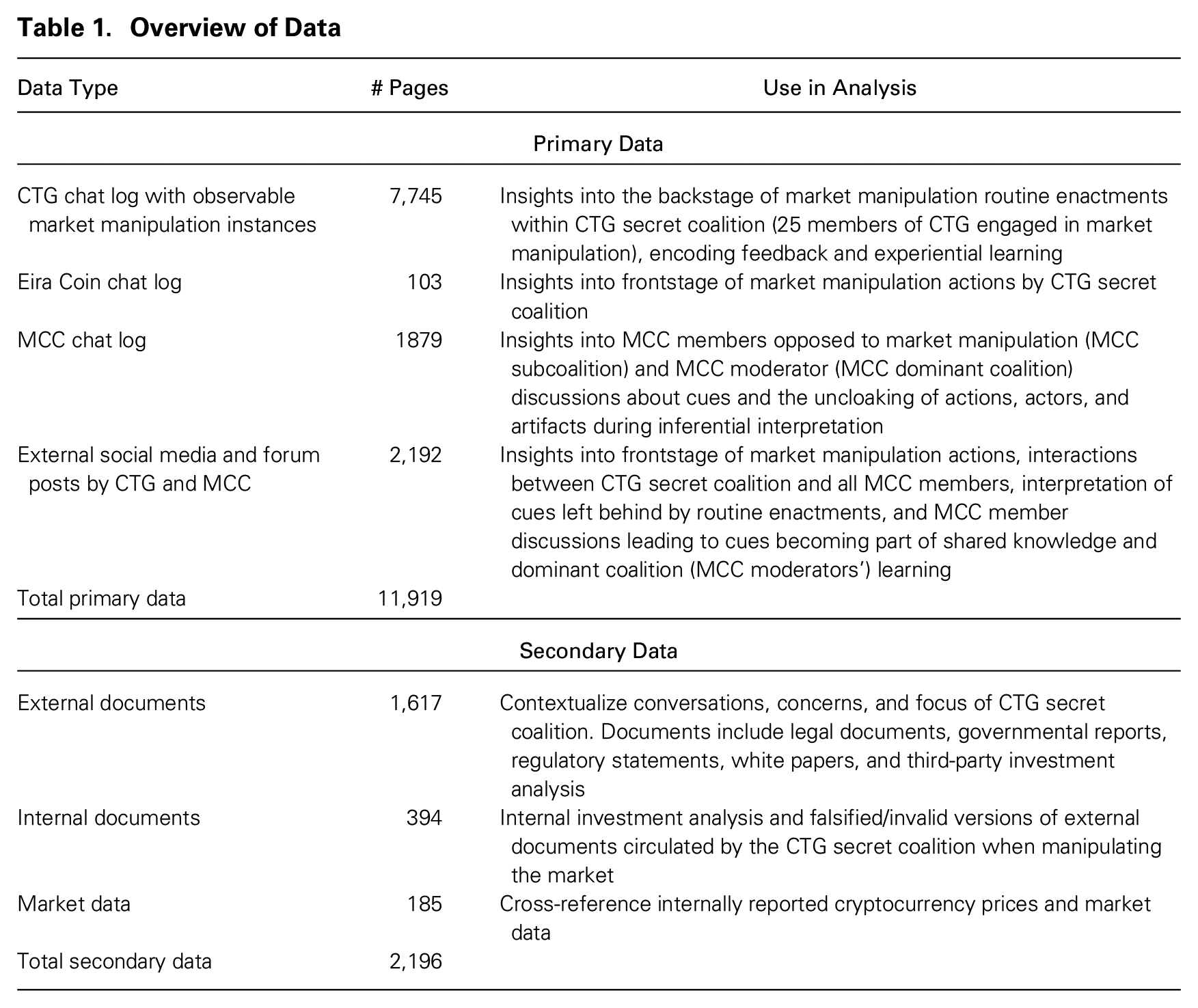
After being introduced to a contact at CTG in mid-2017, the first author requested access explicitly to conduct research; he did not know that a secret coalition within CTG engaged in fraud. He was granted access and introduced as a researcher who would lurk, or stay in the chatroom without actively participating. “Lurking” is a digital method known as invisible observation (Varis, 2016: 62). We used three data sources. Two data sources, chat logs and external social media and forum posts, became primary data for the study, representing the backstage and frontstage of interactions, respectively (Goffman, 1959). Table 1 provides an overview of the data.
Overview of Data
Chat logs
Primary backstage data consisted of chat logs from the CTG chatroom. Each chat log was divided by topic such as news, research, and trading. CTG’s chatroom was private; membership was by invitation only. Almost all members used a pseudonym, but many used the same name in the chatroom and across forums and social media. Traders used their own funds but typically made aggregate decisions about which coins to invest in. Many traded cryptocurrencies full time as day traders. They typically invested in coins that had a market capitalization between $1 and $10 million USD. The 120 members of CTG’s chatroom were given titles such as intern, analyst, associate, principal, and managing director. The managing director made promotion decisions, often on the recommendation of principals. Titles reflected contributions: those making more quality contributions were promoted to higher levels. Membership was relatively stable; the core group that started CTG vetted and approved invitations for new members.
We also collected data from a second chatroom that CTG members created for the Eira Coin, which became a platform on which fraud proliferated. Lastly, we collected data from MCC’s chatroom, which supplemented our primary data source for MCC (see Table 1). Although the first author observed some CTG interactions, the chat logs served as archival data (Ventresca and Mohr, 2002). Over 13 months, he spent 10 hours per week on average in the chatroom to understand CTG’s context and culture. While in the chatroom and shortly after departing, he recorded and kept reflective memos, supplementing observations in the chat logs.
External social media and forum posts
We collected primary frontstage data through external posts on social media and forums. To protect members’ confidentiality (Holt, 2015; Pratt, Kaplan, and Whittington, 2020), we do not name specific social media platforms and forums. We saved copies of messages, images, videos, comments, replies, and direct messages shared by CTG members on these platforms. Two forums were sources of data for this study: one was an anonymous image-based website, AnonCryptoBoard (ACB). Posts on that site were archived and became inaccessible after several days. The second forum (on which MCC was based) was a news aggregator website where registered users could create communities based on shared interests (see Table 1). Posts and comments within posts could be rated “up” or “down” (akin to a “like” or “dislike”). These ratings were aggregated on a post. Posts receiving many positive ratings stayed at the top of the page, while negative posts quickly fell off (we detail this in the findings section). MCC had more than 500,000 registered users during the study period.
We collected two types of forum posts: posts that the CTG secret coalition created while pretending to be part of the MCC community (to engage in market manipulation) and posts by MCC members with no CTG affiliation. CTG secret coalition members found that accounts with longer histories were more convincing (detailed in the findings); usernames therefore rarely changed during our analysis. In other instances, the secret coalition members informed group members which user they were, helping us to distinguish artificial from authentic engagement. MCC community posts focused on topics such as news, announcements, and discussion posts. For example, early discussions posted on MCC about the value of rumors changed to discussions of how to detect shilling (deceptive promotion of coins by individuals).
Documents and archival data
We obtained documents that CTG secret coalition members circulated internally, including regulatory reports on cryptocurrencies. CTG secret coalition members also shared raw data, like unsubstantiated rumors or leaked documents. While enacting fraud, they created authentic-looking but invalid analyst reports that they leaked on social media. We observed them creating these documents. We also collected data from MCC moderators when they presented evidence of suspected market manipulation.
Data Analysis
Following grounded theory (Strauss and Corbin, 1998; Pratt, 2023), we iterated between data, theory, and the categories that emerged to capture the underlying interpretative processes (Langley, 1999; Golden-Biddle and Locke, 2007). At first, we engaged in open coding (Locke, 2001) to understand the work accomplished by CTG members. Given CTG’s official focus on generating high-quality research to earn money, we started by asking questions about who was involved and what actions were taken in accomplishing this work. We realized that the analysis of investment opportunities was central to this work and involved numerous actors within CTG sharing artifacts (e.g., analytical charts, social media rumors, press releases, etc.) and taking actions (e.g., discussing or investigating artifacts). We realized that the investment analysis work, in constituting multiple actors who performed interdependent actions, resembled a routine (Feldman and Pentland, 2003: 103). We adopted a routine dynamics lens as an analytic tool, which allowed us to decompose each enactment for microanalysis (Strauss and Corbin, 1998).
We began mapping out the actors, actions, and artifacts (Feldman et al., 2016) that constituted the investment analysis routine enacted by CTG members. We traced these interactions from the first time until the last time that coins were mentioned. During this process, we encountered initial “hunches” (Sætre and Van de Ven, 2021: 684) that there might be manipulation as we observed a secret coalition of members discussing rumors they could create that would elicit a positive response from outside investors. We began looking for instances in which the secret coalition seemed to try to spread invalid information, manipulate transactions, or rig asset prices (U.S. Securities and Exchange Commission, 2021). After shifting our sampling strategy to match these hunches (Locke, 2001), we identified, from a sample of 36 coins over five months, 12 coins with elements of manipulation. We refocused our analysis on how the CTG secret coalition accomplished market manipulation. While this analysis started within the CTG secret coalition, elements of fraud and deception occurred outside CTG on social media and internet forums (such as MCC). For example, CTG secret coalition members would brainstorm content that they could post and share on social media about a coin. This shift allowed us to perceive the frontstage and backstage (Eberhard, Frost, and Rerup, 2019) to market manipulation: the frontstage was outside CTG (on social media and internet forums), which is what the audience (targets) could observe, whereas the CTG secret coalition’s coordination was backstage (in the chatroom), which targets could not see.
We found that 25 members, a subset of the 120 members of CTG, formed the secret coalition involved in market manipulation; 16 who were in the secret coalition’s core were consistently involved across enactments. We matched users between the chatrooms, social media platforms, and forums that members of CTG used. With 12 coins mapped out, we conducted additional coding with greater attention to the backstage (chatroom), the frontstage (social media and forums), and the interaction between the two. This coding revealed how the CTG secret coalition was enacting a hidden goal (market manipulation) within the MCC community under the guise of normal activities aligned with the goal of MCC moderators (facilitating discussions related to cryptocurrencies).
After open coding these routine enactments, we engaged in axial coding (Strauss and Corbin, 1998; Locke, 2001) to understand the consequences of the interactions between the CTG secret coalition and MCC members. We did this by aggregating open codes and understanding the relationships between these codes as subcategories and categories (Charmaz, 2006). For example, we abstracted codes about frontstage routine enactments into “cloaked actions, artifacts, and actors.” We found that CTG secret coalition members created false content (“cloaked artifacts”) and shared it on social media (“cloaked actions”) while presenting themselves as interested investors (“cloaked actors”) to obscure their hidden goal of market manipulation. We then traced how the CTG secret coalition encoded feedback from these cloaked actions and artifacts and updated the routine accordingly. These cloaked actions and artifacts left behind subtle but observable cues (Weick, 1995; Rerup, Gioia, and Corley, 2022), which became the basis of interpretations and subsequent learning by MCC members. We found that cues observed by MCC members provided inferential signals of deception in three ways. First, the sequence of actions provided a signal. Second, the volume of actions, how often a sequence was observed, provided a signal. Third, the pacing of actions provided a signal.
Having developed axial codes, we moved toward constructing a theoretical understanding of how these codes related to one another (Charmaz, 2006). We engaged in temporal bracketing (Langley, 1999), whereby we separated the market manipulation routine enactments into periods based on major discussions that MCC had about suspected market manipulation (detailed below in the findings), to identify “feedback mechanisms, mutual shaping, or multidirectional causality” (Langley, 1999: 703) and to understand how MCC members made sense of the hidden causal structure underlying the market manipulation enacted by the CTG secret coalition. We compared how learning unfolded within MCC against standard models of experiential learning (Argote, Lee, and Park, 2021), to understand how MCC members linked outcomes to antecedents and developed causal understandings of experience. In this process, a creative leap (Langley, 1999) occurred in which we identified our central category (Pratt, 2023) of inferential interpretation. Our analysis captured the dynamics of learning within MCC and how inferential interpretation, the ability to infer hidden goals from ambiguous experience, unfolded. We used visualizations of our data as we attempted to illustrate the recursive process (Cloutier and Langley, 2021: 11) in which the CTG secret coalition’s repeated routine enactments enabled MCC’s members to generate evocative interpretations of cues. Separating our data into time periods and reexamining associated axial codes allowed us to see the central roles of individual and plausible as well as subsequent collective and accurate interpretations (Christianson, 2019). We found that effective experiential learning from hidden goals relied on inferential interpretation, which preceded the validity and reliability that are central to effective learning in other experiential learning models (Rerup and Zbaracki, 2021). Below, we illustrate how MCC used inferential interpretation from ambiguous experience in learning to decipher the CTG secret coalition’s hidden goal.
Findings
The CTG secret coalition’s enactment of the hidden market manipulation goal created ambiguous experience. MCC achieved effective learning from this experience through inferential interpretation, which requires actors to transform observable cloaked cues in the frontstage—actions, actors, artifacts—into plausible interpretations of what might be going on in the backstage. As summarized in Table 2, the process allows actors to connect (hidden) antecedents to (observable but ambiguous) outcomes by moving from individual, plausible explanations toward collective, accurate understandings of cues and their situated environment. To accomplish this, the actors (see Table 1) had to move from individual interpretations with divergent beliefs to collective interpretations with an aligned goal (e.g., forming a subcoalition to stop manipulation). Table 2 highlights these forms of inferential interpretation dynamics: (1) individual and plausible and (2) collective and accurate. Individual and plausible inferential interpretation dynamics (recognition and abstraction) facilitated MCC members’ early speculations about suspicious actions (cues). Collective and accurate inferential interpretation dynamics (connection and corroboration) helped MCC members and moderators to develop causal relationships between actions, artifacts, and actors (cues).
Overview of Market Manipulation Cues and Inferential Learning Process for MCC
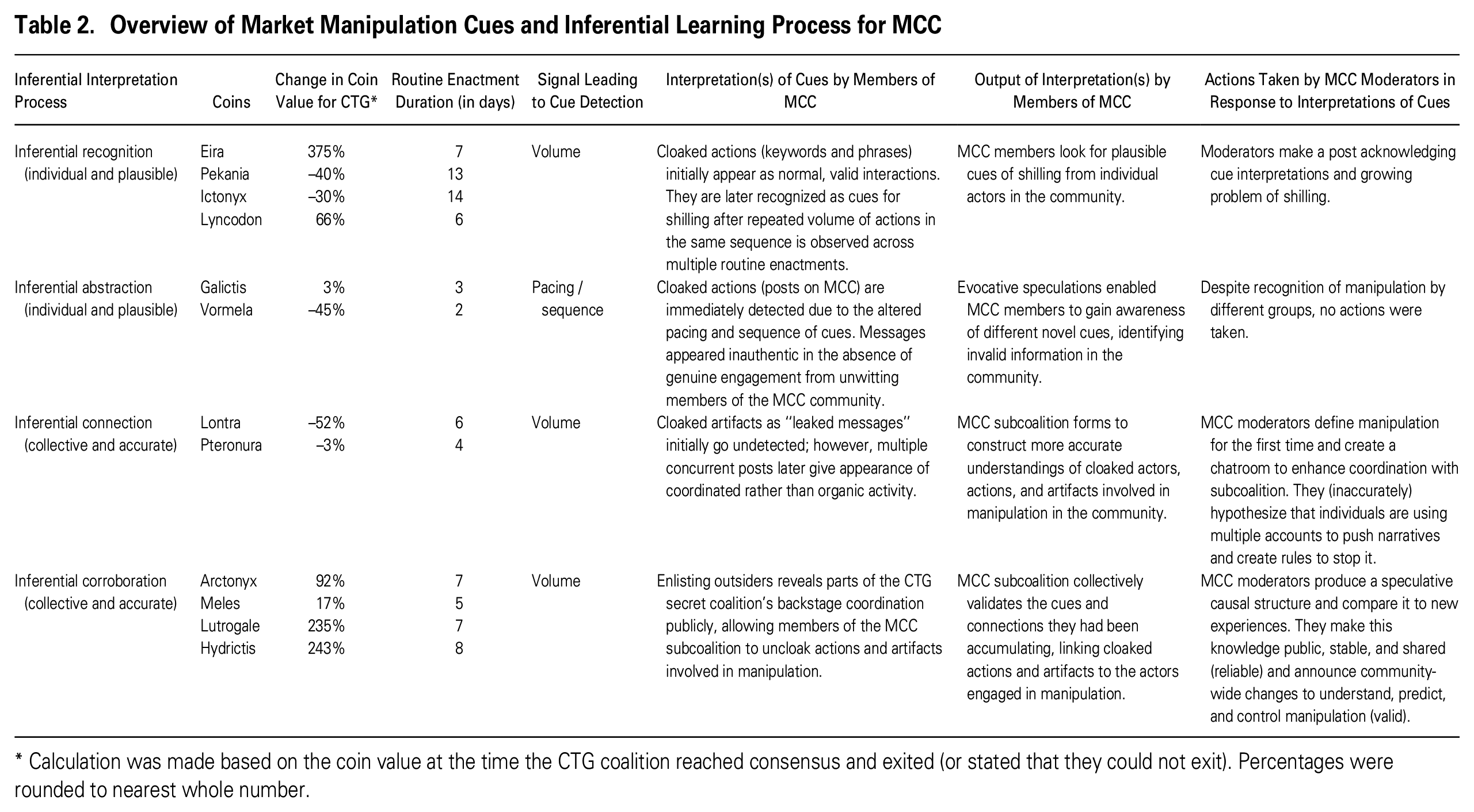
Calculation was made based on the coin value at the time the CTG coalition reached consensus and exited (or stated that they could not exit). Percentages were rounded to nearest whole number.
As summarized in Figure 1, inferential interpretation started with inferential recognition: individual members recognized individual cues that were repeated. This learning helped MCC members notice their environment and enabled inferential abstraction: the ability to identify new cues. Inferential abstraction allowed MCC members to see that manipulation could appear in many forms. Following this, MCC members concerned about the proliferation of fraud began to work together to understand what was going on. This spurred further learning, i.e., inferential connection, whereby members hypothesized about relationships between seemingly distinct cloaked actions and artifacts. MCC moderators created a chatroom for members of MCC who were concerned about manipulation. This subcoalition took identified cues (cloaked actions and artifacts) and attempted to link them to cloaked actors involved in the manipulation. Through a process of inferential corroboration, this collective effort allowed MCC moderators (dominant coalition), with the help of the subcoalition, to investigate, test, and verify previously generated speculative cues and their connections to construct accurate understandings of how manipulation was enacted. The dominant coalition assembled speculative causal structures and compared them to new experiences. This process allowed them to produce a valid understanding of manipulation, which they then shared within the community, and this sharing made it reliable. We found that valid and reliable learning was produced through the inferential interpretation process, which started with individual and plausible speculations about cues (e.g., generating speculative experiences) before moving to more-collective and accurate understandings. Effective experiential learning from hidden goals thus relied on inferential interpretation, which preceded the elements of validity and reliability that are central to effective learning in other experiential learning models.
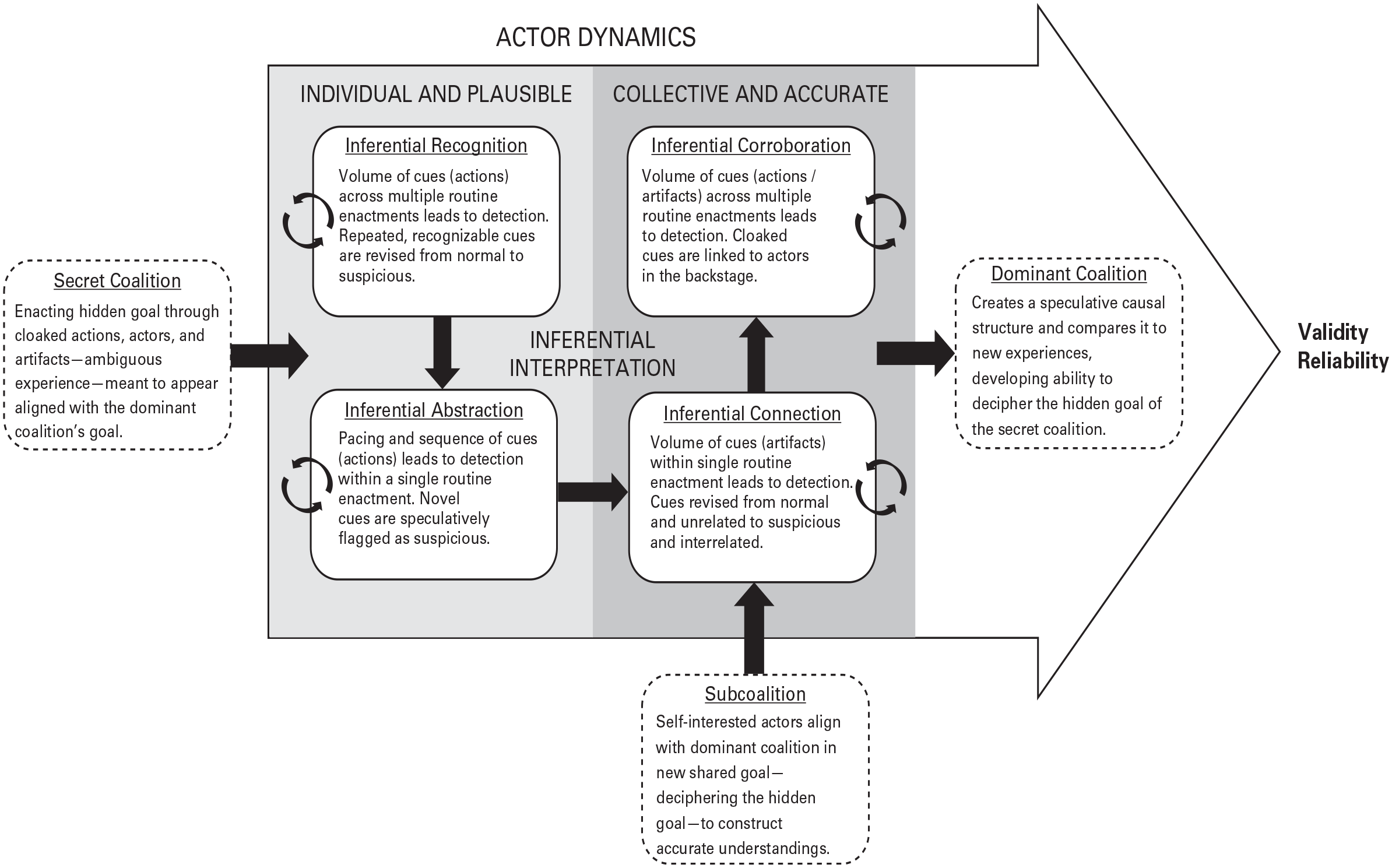
A Model of Effective Learning When Goals Are Hidden and Experience Is Ambiguous
Table 2 also summarizes changes in coins’ value (i.e., whether the manipulation was successful), the routines’ duration in days, the signal leading to cue detection and the inferential interpretation process within MCC, as well as outputs of interpretations and actions by MCC moderators in response to interpretations.
Hidden Market Manipulation Goal
To understand how MCC learned to decipher the market manipulation routine, we unpack the routine to identify the actions, artifacts, and actors that were sources of cues from which MCC learned. Figure 2 illustrates the enactment of this routine.
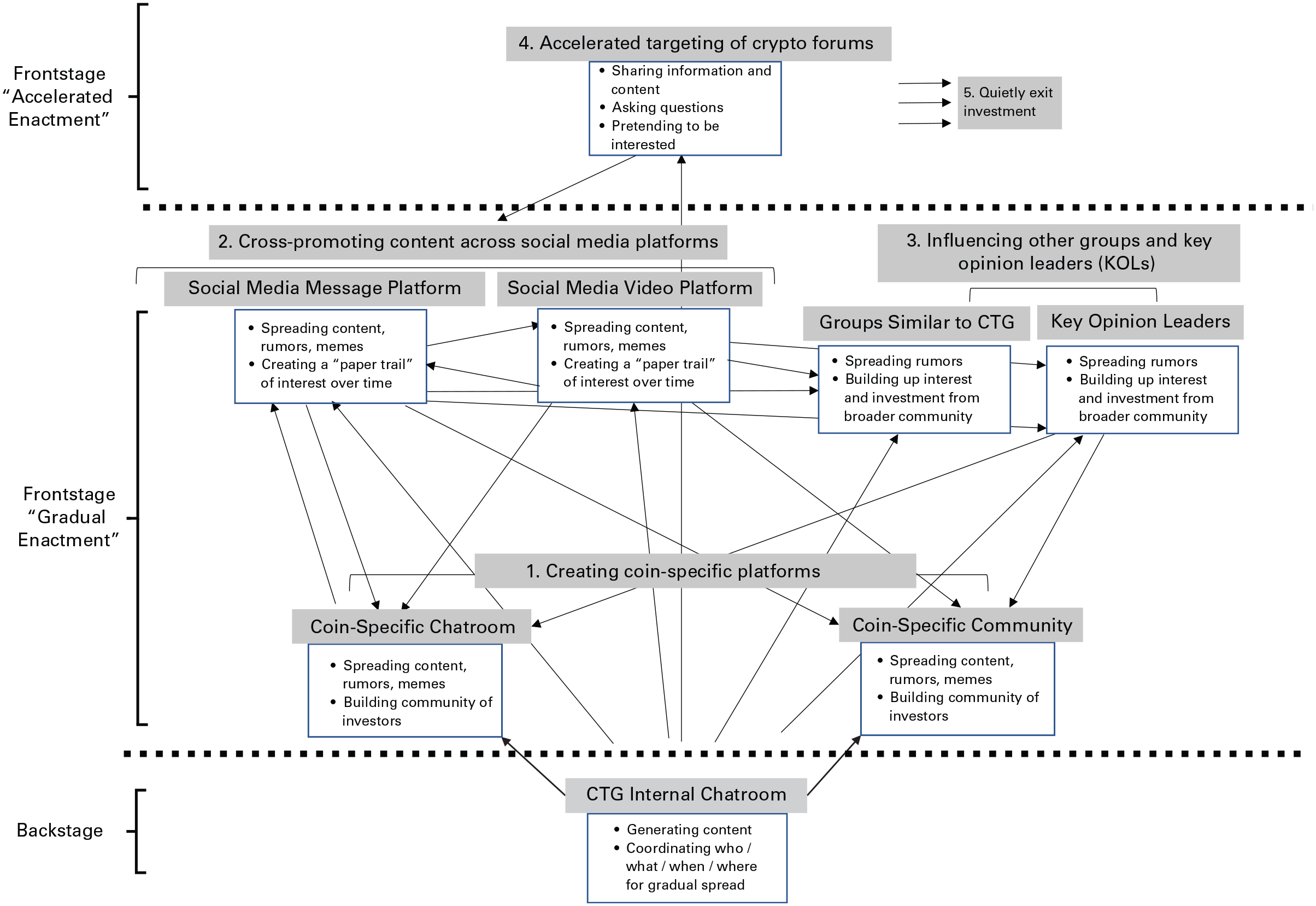
CTG Secret Coalition Market Manipulation Routine Enactment
The routine started when CTG’s secret coalition members created (1) official-looking platforms for the coin they aspired to manipulate. They then coordinated (2) within the private chatroom and generated invalid information (e.g., memes or humorous images that promoted investments, analysis, charts, etc.), which they posted on social media platforms and within coin-specific communities. This effort generated awareness in the cryptocurrency community (users on social media). After several days, this secret coalition spread (3) rumors about the coin to other private groups and to key opinion leaders such as vloggers. In the final 24 hours, they posted (4) on major cryptocurrency discussion forums (e.g., MCC), at which point they sold their positions (5) as price and demand surged. The use of posting and cross-posting across multiple platforms and staggering the posts over time hid the CTG secret coalition’s true goal of committing market manipulation and made the posts appear to be genuine interactions about the coin, in line with the MCC moderator’s goal of facilitating discussions related to cryptocurrencies.
The first such instance of market manipulation by the CTG secret coalition in our data regards Eira Coin (a grounded narrative detailing steps 1–3 of the market manipulation routine described above for Eira Coin is in Online Appendix A):
What is your analysis of Eira Coin?
[T]he developers aren’t total garbage. They’ll promote on social media. And of course, it’s low supply and cheap to buy. But they are stuck on a single exchange.
. . .
Where are they listed?
They are listed on D-Exchange. And that should really be a warning sign to us. They seem to have a vested interest in staying there. (CTG chat log)
As CTG secret coalition members spread invalid information about Eira online, they quickly zoomed in on MCC as an important target to advance their hidden goal:
Let’s create posts, spread it around on MCC, and then start promoting across social media.
Yeah, if you all have established accounts on MCC, start pushing info.
Someone else make some posts and I will share it. (CTG chat log)
Later, one CTG secret coalition member reflected on why they had prioritized MCC: “Associate #4: Check the post <Link to MCC>, tens of thousands of eyeballs on there at any moment, greatest place to p&d [pump and dump]” (CTG chat log). Once these CTG secret coalition members recognized that MCC was a large, active community, they focused on enacting the routine there.
CTG secret coalition members strategized about how to promote Eira Coin by using cloaked actions, actors, and artifacts. They tried to conceal the market manipulation goal and make each frontstage interaction appear normal. Another CTG secret coalition member described how they concealed their hidden goal through cloaked actions, generating ambiguous experience:
What I’m doing is mixing in information about other coins too, so it is not so obvious that it is all about Eira Coin, but still enough that when people read my stuff they see Eira. (CTG chat log)
In the 24 hours before the CTG secret coalition members sold their holdings, they accelerated their efforts. They planned to pretend to be an interested investor in the MCC community who had found a leaked analysis (which the CTG secret coalition had written) entitled “Why I’m Bullish on Eira Coin” and shared it on MCC. Their intent was to make the analysis (cloaked artifact) and interactions (cloaked actions) appear to be a normal interaction aligned with the goal of MCC moderators, which was to facilitate cryptocurrency-related discussions. The CTG secret coalition decided to first promote Eira on ACB, an anonymous image-based website that posted rumors and analysis about cryptocurrencies, before focusing on MCC, which they viewed as more important:
ACB is usually where the information is first, and then MCC scoops it up
. . .
Try to get them at ACB.
But don’t touch MCC.
It needs to look different than the post that will go on MCC.
Here is the post . . . <Link to ACB> (Eira Coin chat log)
Eighteen hours later, as planned, the CTG secret coalition placed a post on MCC that was cloaked to look as if it had come from an interested potential investor. It consisted of a brief, positive overview of Eira Coin. It described the merits of the coin and the team, stating that Eira had a functioning, quality technology and strong community support. It followed with the invalid leaked analysis that the cloaked poster claimed had been found circulating on social media, which reiterated similar talking points in an expanded form. The post also described how the coin had experienced “steady growth” since its initial offering (growth the coalition had manipulated). It concluded by asking if Eira was still undervalued. Several CTG secret coalition members replied to the post as cloaked actors, pretending to be prospective investors in the MCC community, who supplied a steady mix of positive sentiment (agreeing that it was undervalued and that they planned to buy) and questions (e.g., asking how high it could go) that generated more interest in Eira Coin. As the post gained traction, staying on top of MCC’s page for hours, the coalition flooded social media with memes featuring Eira Coin. These cloaked actions and artifacts generated more ambiguous experience among the unsuspecting targets as members of MCC bought in: Eira Coin’s price soon reached its peak, 375 percent higher than it had been a week prior (see Table 2). While coalition members publicly claimed that Eira Coin had just turned a corner and would go higher, a message was sent out to the CTG secret coalition members: We think that there is nowhere left for Eira Coin to go. Other groups have significant holdings and there is risk that they could sell off. There is also little hope that they will get listed on other exchanges. It is unstable right now, and you should start thinking about getting out. (Principal #2, CTG chat log)
CTG secret coalition members all confirmed as they sold off:
I’ve sold it.
Looks like Principal #2 is out too.
Fuck Eira Coin. I’ve sold it all.
I’ve sold off too. Maybe too fast, price dropped quite a lot. But still we made good gains this week. (CTG chat log)
Detecting Market Manipulation Cues: Inferential Interpretation of Ambiguous Experience
The CTG secret coalition had engaged in market manipulation without being detected. Hours after these members sold their positions in Eira Coin, members of MCC had a discussion on how to make money trading coins. The initiating post had five key components: it (1) encouraged community members not to believe everything they read and to do their own due diligence; (2) indicated that the coins they invested in would sometimes lose money; (3) informed that there are real use cases for blockchain technology and it will be valuable in the long run; (4) argued that regulatory actions (such as banning trading) could wipe out coins; and (5) stated that as a nascent market, it is high risk. The top (i.e., most highly rated) reply to this said they agreed with all but the first point. They argued, “If you are an active crypto trader it would be foolish not to pay attention to rumors and speculation . . .” (MCC post log). This statement suggested that many MCC members acknowledged that rumors were essential to investing in cryptocurrencies. Other users echoed this sentiment, stating they had profited from rumors and speculation. Several agreed that market volatility from rumors and the associated risk of losing money were simply part of cryptocurrency trading: “The volatility is what allows individual traders to make money” (MCC post log). This suggested that the goal of individual MCC members was to make money for themselves, and they were seemingly unaware or unconcerned that some rumors could be invalid and spread by actors working against the community. Even the original poster, who had advocated due diligence, agreed with this. When asked how to conduct research, they suggested checking social media, compiling information, and then later discussing any questions on MCC. CTG secret coalition members used this discussion as a template for spreading invalid information:
It goes on social media, people repost it.
Then the cycle is ACB to MCC to the masses [back to social media] . . . lots of shit makes it mainstream.
Only thing that matters are how many people see it. (CTG chat log)
Because many members of MCC relied on rumors and speculation for trading, they were unlikely to suspect speculative posts and comments about coins, even when cloaked actors (such as the CTG secret coalition) generated invalid information to manipulate the market. Further, MCC members were encouraged to vet investment opportunities in the same places where the CTG coalition was spreading invalid information and generating noise. These factors, coupled with the coalition’s backstage coordination, made it exceptionally difficult for MCC to learn to decipher fraud. In essence, if traders relied on rumors and speculation sourced from social media and MCC, in order to detect fraud they would need to disentangle genuine commentary (e.g., valid information) from baseless rumors and speculation (e.g., invalid information) that were meant to manipulate the market. This became a central challenge: distinguishing signals from noise.
Inferential recognition
CTG’s secret coalition encoded the enactment with Eira Coin as a success and repeated attempts to manipulate subsequent coins by using the same cloaked actions. In these next two enactments, however, they sought to cloak their actions by slowing the pacing of the enactment (see Table 2):
I’m going to start promoting Pekania on social media now. Are you all ready to go??
. . .
Don’t get going just yet . . . we don’t need eyes on it yet. You don’t get how we are supposed to build it up first . . .?
. . .
We spend a couple days buying slowly to get it cheap without making too much noise. (CTG chat log)
In these enactments, CTG secret coalition members followed the same patterning of cloaked actions and artifacts. They moved more slowly to reduce the chances of their actions being uncloaked; as the managing director explained, “it’d be terrible to get called out” (CTG chat log).
The CTG secret coalition had time to observe feedback and coordinate backstage to adapt to frontstage responses to these efforts. For example, it managed the chatroom for Pekania Coin (second manipulation attempt), discussing how to reply to members in the CTG chatroom:
Do you see what someone just asked in our Pekania chatroom? Can you answer it?
Jeezz look how many people joined in the past day. That question . . .? Well there was a rumor that came from the group . . . YO Analyst #5 CAN YOU WATCH WHAT YOU SAY IN THERE . . . it sounds bad!
Sorry, I deleted it. (CTG chat log)
Our analysis revealed at this point that some cues that were uncritically absorbed by members of MCC were later recognized as signs of manipulation. For example, when the CTG secret coalition was promoting Pekania, several prospective targets at MCC reacted positively to the highest-rated message in a discussion: “I’m getting flashbacks to Ratel Coin . . . I’m going in just in case this turns out to be the same” (MCC post log). Ratel Coin was subsequently referenced by CTG secret coalition members in future enactments, due to this positive feedback.
For Ictonyx (third attempt), the members of the CTG secret coalition came up with new cloaked actions to promote the coin:
So since Ictonyx also has their own exchange, I took a few promising ICOs, pretended to be the CEO [of the promising coins], and then applied on their behalf to be listed on Ictonyx. I then hit them up after they were approved and told them to message Ictonyx so they can get listed. (CTG chat log)
Nonetheless, the slower pacing in these two enactments made it difficult for the CTG secret coalition to get enough traction and plan an exit (Table 2).
In their fourth attempt (Lyncodon), CTG secret coalition members reverted to the pacing they had used for Eira Coin, engaging in market manipulation over six days. Our analysis showed that as they prepared to sell their holdings, they wanted to ensure their actions remained ambiguous:
Is everyone ready to go with Lyncodon? I mean have you bought enough? If so then we post on ACB.
Good to go.
Anyone else getting in right now please split up your buys. Small orders. You don’t want people looking at the charts and seeing big walls . . . then it’s clear what we are doing. (CTG chat log)
They again used a cloaked actor who pretended to be an interested investor in the MCC community. They focused on Lyncodon’s positive aspects: its good technology, high-quality team, and low circulating supply, and stated that it was likely undervalued. They shared an invalid leaked analysis (that they had created) they claimed to have found online and hinted that it would be listed on a major crypto exchange soon. They sold off their holdings for a profit.
Shortly after this enactment, MCC launched a community discussion about a problem called “shilling,” which it defined as occurring when an individual promoted a coin (through posts or comments) because they had a vested interest in it. While highlighting shilling as a problem in the community, they did not realize it could also be coordinated by multiple individuals. The original post included a meme that highlighted key points that a “shill” would make when promoting coins: the team, technology, supportive community, and claims that the coin was undervalued. The highest-rated reply to this post was a comment in quotation marks (as if they were shilling): “I was part of the RatelCoin/OtherCoin/AltCoin community at the beginning, this is just like it” (MCC post log). This comment referenced a specific coin (Ratel) that members of the CTG secret coalition had cited multiple times as evidence of their past success and ability to predict new coins during interactions on MCC. MCC members had initially received this cue positively (see above), but they revised their interpretation and now imagined that it was a cue for potential manipulation, demonstrating how they were engaging in multiple interpretations of cues. The second highest-rated reply added, “Especially when they keep repeating things about the team and technology without referencing any details” (MCC post log). Further replies to these comments agreed that these claims were likely untrustworthy cues. This discussion demonstrated awareness of certain keywords and phrases as cues for invalid information. However, this interpretation was only partially accurate in that it identified some cloaked actions but failed to realize that several cloaked actors were coordinating backstage. MCC’s moderators posted to acknowledge the discussion. The moderators stated that the community’s growth had led to challenges with shilling. They wanted to maintain a community in which investors could discuss cryptocurrencies without being manipulated (MCC post log).
Despite no one “calling out” the CTG secret coalition (as the managing director feared), several of MCC’s members noted cues from the observable actions of the market manipulation routine, which had been repeated with little variation (see Table 3A). They identified keywords that were used in repeated manipulation attempts. We refer to this subprocess as inferential recognition. While the CTG secret coalition’s successful routine enactments relied on cloaked actions appearing as normal, valid interactions, its repeated use of the same words and phrases that had first passed as valid became cues that MCC members suspected to be shilling. While the actions (and words) did not change, MCC’s interpretation of the cues did. This inferential recognition was the first sign of learning by MCC in our data.
Inferential Recognition (Hidden Goal: Manipulate Coin)
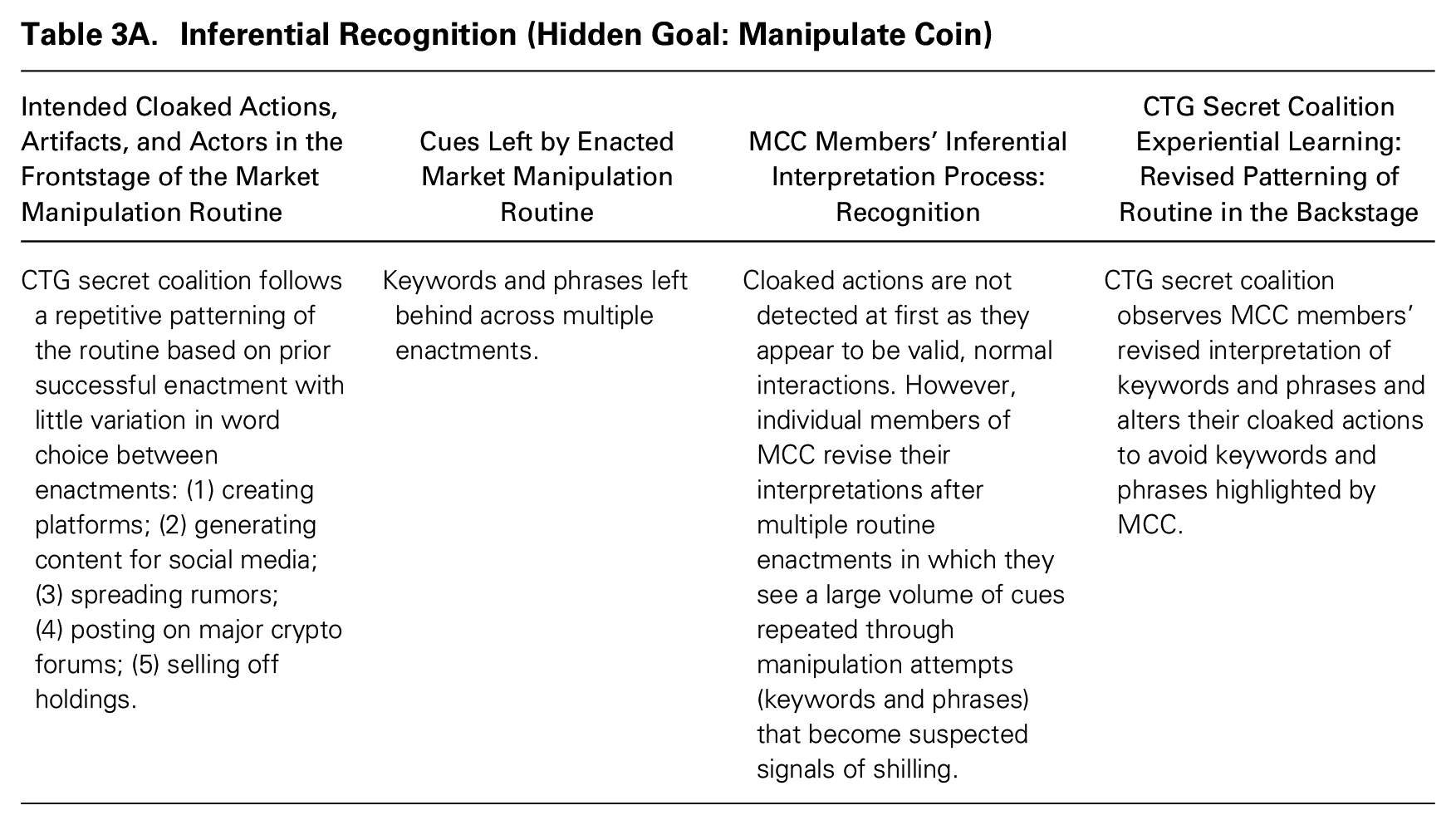
In response, the CTG secret coalition altered the market manipulation routine, which produced new cues from which members of MCC learned. We refer to this process by MCC members as inferential abstraction.
Inferential abstraction
Within CTG, secret coalition members spent approximately 48 hours plotting the next coin that they aspired to manipulate, Galictis. The MCC discussion on shilling quickly circulated through CTG. The coalition worked to create a new invalid leaked analysis that they would circulate during the manipulation enactment:
<Link to draft of “leaked analysis”> Hey can you look at this?
Looking good, look at that.
Don’t use those words. Look at this <Link to MCC discussion on shilling>. Look over all of the comments and avoid everything they highlight.
Ok got it. (CTG chat log)
To avoid detection, CTG’s secret coalition responded by altering the words and phrases they used (see Table 3A). This shows a divergence of learning between members of MCC and the CTG secret coalition. CTG was encoding feedback from enactments as a success or failure relative to their goal, which was hidden from MCC. At the same time, MCC members interpreted cues from ambiguous experience (e.g., cloaked actions), including revising their interpretations as noted above. These interpretations, while plausible, were not entirely accurate. MCC members assumed that the identified cues were related to individual shilling rather than coordinated manipulation. As CTG saw that MCC members were becoming suspicious, they changed their cloaked actions to conceal their hidden goal. After two prior attempts collapsed because they were prolonged (see Pekania and Ictonyx Coin in Table 2), the CTG secret coalition decided to adjust the pacing of the routine:
The hype cycles seem like they are getting shorter.
Yeah you’re right.
Like we don’t have weeks to build it up, it’s like we have a few days and then onto the next one. (CTG chat log)
They decided to move more quickly. The work on Galictis Coin began immediately:
We need to put this on ACB . . .
Keep spreading the Galictis Coin posts on social media.
The MCC post will be ready in a half hour. (CTG chat log)
Fewer than 18 hours later, CTG secret coalition members posted on ACB and MCC, following the same format they had used in their previous enactments but avoiding the keywords and phrases mentioned in the MCC discussion. They populated the posts with a mix of positive sentiment and questions meant to generate interest. They paid a freelancer to rate the MCC post positively, which would help push the post to the top of MCC. CTG secret coalition members joked about this deceptive action:
I just paid for upvotes on our MCC post
. . .
lmao, that’s illegal, I’m telling the crypto cops! (CTG chat log)
Multiple comments on MCC were negative. One member, responding to the positive posts, asked “Am I taking crazy-pills? Is everyone here a bot?” Another used the keywords from the MCC discussion on shilling, “GREAT TEAM, GREAT TECH, I’M IN” (MCC post log) even though CTG secret coalition members had avoided those words. Another reply stated, “I’ll go all in if someone says they have great tech lol,” to which other MCC members replied with “GREAT TECH” (MCC post log). CTG secret coalition members lamented that they could not generate buzz on social media: “It’s only us talking about Galictis Coin online guys . . .” (CTG chat log).
The market manipulation attempt failed. Over the next several days, members of the CTG secret coalition called the initiative “dead.” Instead of having created content for several days and prompting many interactions across several platforms, they had shared all of their content at once. Members of MCC and CTG had stated that information (news, rumors, etc.) about coins generally appeared on different platforms at different times, and CTG believed that this information flowed across platforms in a specific sequence (see above). But the accelerated pacing of the enactment meant that only the CTG secret coalition was participating in the discussions (see Table 3B below). The altered sequence of information and accelerated pacing led to cue detection. The overly positive discussion by the coalition fueled targets’ doubt and speculation that there was foul play.
Inferential Abstraction (Hidden Goal: Manipulate Coin)
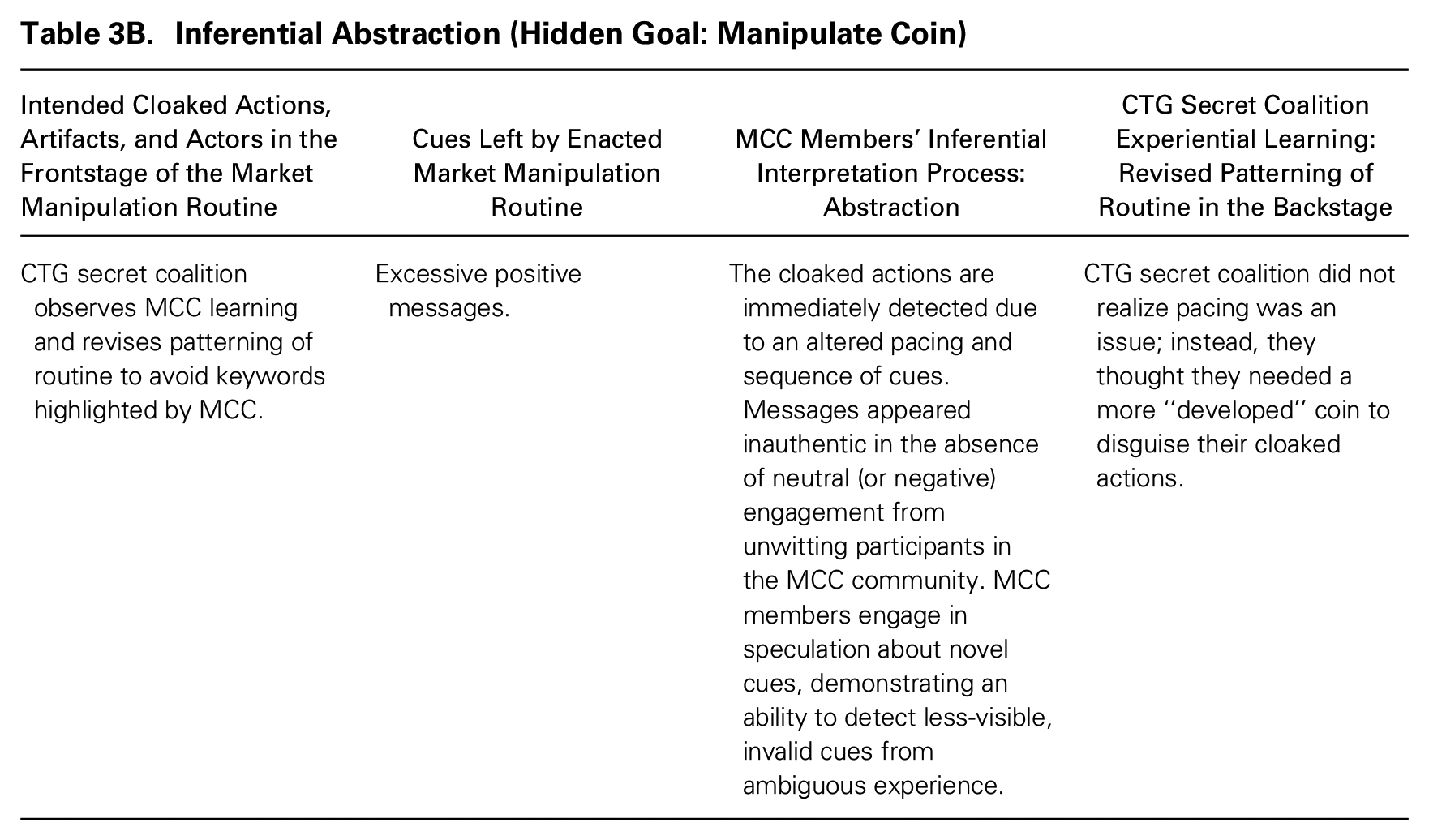
These changes meant that certain cloaked actions, namely positive messages from CTG’s secret coalition, became suspicious cues to MCC members through inferential abstraction. These actions became cues because they appeared inauthentic when there was no engagement from unwitting participants in the MCC community. This shows that MCC members engaged in evocative speculations in which they identified plausible novel cues (see Table 2; Table 3B) based on the (overly positive) sentiment of the interactions. While the speculation about mechanisms behind the novel cues may have been inaccurate—such as a member suggesting that the posts were the work of bots—targeted MCC members correctly inferred that novel cues were signs of manipulation even though the cues differed from previously recognized cues. MCC members used inferential abstraction to detect less-visible, invalid cues from ambiguous experience.
The CTG secret coalition moved on from Galictis and announced Vormela Coin days later (see Table 2). While the accelerated pacing of Galictis had generated new cues for MCC members to learn from, CTG secret coalition members did not acknowledge pacing as an issue (see Table 3B). They thought that a more developed coin would help cloak their actions:
We just need a coin with functioning tech, related partners, a decent team, and some buzz. Then we can scale it.
. . .
We’ve got intel that is clear to us, but other investors don’t have access to it. . . . They look at the surface-level buzz, that’s it. This is our new project to speed up the growth.
Yes, and that is Vormela Coin. (CTG chat log)
However, by following the same pacing as that used in the Galictis Coin enactment—enacting the market manipulation routine quickly—they met resistance. They quickly gave up: “Analyst #16: <Linking the Vormela post on ACB>: Busted. Look at everyone calling us out” (CTG chat log).
MCC coalition emergence and inferential connection
After six market manipulation attempts, some MCC members voiced concerns about the threat of manipulation. A discussion emerged on MCC about how problematic manipulation was and whether it was profitable enough that people would attempt to do this. During this discussion, we identified three emergent groups of actors at MCC engaging in learning: (1) those who were opportunistic, (2) those who were concerned, and (3) those who were defeatist. The opportunistic group sought to identify manipulation to profit from it: I try to spot market manipulation early so I can get in, profit, and get out. Why not? And some coins hold their value, so it’s not all bad. I think in general the manipulation is shady, but lots of things in this space are. (MCC post log)
In the concerned group, members felt that manipulation threatened the community: I’ve seen this pattern many times: people manipulate a cheap coin, others see the price going up and jump in . . . But it ends with a bunch of people bagholding [holding a coin that is now worth significantly less than what they paid]. (MCC post log)
The defeatist group considered manipulation inevitable. One wrote, “If you want to know what I think, it’s that every coin is being shilled here . . .” (MCC post log). Another post agreed and reiterated the consequences of allowing this to spread on the platform: While I can’t stand it, that’s what manipulation does. If I decide to steer clear from the manipulated coins, others are still going to go in, either because they fell for it or they want to make easy money fast. (MCC post log)
This was the first discussion in which members of MCC collectively acknowledged coordinated market manipulation as a problem. In an earlier discussion, MCC members had largely agreed that their goal was to make money and that rumors and speculation were part of that process. However, now rumors divided MCC members as concerns about manipulation emerged. No cues were discussed, and no action plan by MCC moderators came out of the discussion. The CTG secret coalition members monitored the discussion but were not concerned. Instead, they celebrated how influential one member’s social media account (used for manipulation) was becoming:
lmao, Analyst#4 check out who is sharing your content. <sharing a screenshot of the social media handle of a recently launched cryptocurrency exchange with 5,000 followers>. They’re sharing a lot of your posts.
The CTG secret coalition continued with two more attempts that failed. Its members then attempted to slow down the pacing of the routine enactment:
Lontra is going to be very solid. We have the next few days to promote it. (CTC chat log)
The routine enactment unfolded over six days (see Table 2). Prior to posting on MCC, they planned to spread invalid information by posting a screenshot of a conversation from the Lontra chatroom in which the marketing director disclosed to a member of CTG that Lontra would soon be listed on a major cryptocurrency exchange. By using a new cloaked artifact, the secret coalition was trying to make the routine enactment harder to detect. They decided that instead of a single post on MCC, they would make multiple posts:
<Sharing screenshots of conversation with Marketing Director> Just use this one.
When are we ready to go? Analyst #4 we need to coordinate. Who’s doing the MCC post? Who will get the upvotes?? . . . Associate #1 you handle MCC, use the same account we used for Galictis.
Principal #2 will also post on MCC, so we can have a couple.
When we are starting I’ll post the listing rumor . . .
I’m good to go, I’ll do an ACB post.
Associate #5 of CTG posted to ACB, sharing the screenshot that showed the marketing director saying they would be listed on a major exchange. Several replies were optimistic. The manipulation effort and the new, cloaked artifact (leaked conversation) initially went undetected. Thirty minutes later, another member posted separately on ACB:
Here’s my post: <link>
Someone reply and say you’re going to buy. Push the post.
CTG then made posts on social media. One member shared the listing rumor. Another went on a live video stream and began to share information about Lontra. Analyst #3 decided to post on MCC with a link to the social media post that was just created and no other context. Others disagreed with this move, as it deviated from their original plans:
Why would you just leave a link to social media? Who cares? This is what I was about to post <Shares link to text draft> . . .
I’ll post the screenshot. Principal #2 you should do yours too.
Yeah we can do that. No one will know they are connected.
We can’t have two that are about the same fucking thing.
We definitely can. This is just a bit of news. Yours is an analysis.
Having multiple is better. (CTG chat log)
Associate #5 made a third post on ACB. Associate #1 and Principal #2 made two more posts on MCC and paid a service to “like” the posts (so they would go to the top of MCC’s page):
We should buy likes, like we did for Galictis.
Let me know who’s paying I’ll split it. (CTG chat log)
Sentiment on the posts quickly went from positive to negative. Several people called it a scam. On MCC, concerned members expressed suspicions about the volume of posts: “Never saw this before and all of the sudden there are 3-4 posts about it” (MCC post log). The CTG secret coalition also realized that the excessive volume of posts had led to failure:
There are people in the Lontra chat saying not to trust Lontra because there were so many posts that all came at the same time . . .
We’ve learned a lesson for next time. (CTG chat log)
Shortly after, someone started selling off significant holdings, causing the coin price to collapse:
Fuccccckkk, Lontra is DEAD.
It got killed by a whale that dumped hundreds of thousands. They created several huge sell walls. And they aren’t even done yet.
I know man I just want to get out too. (CTG chat log)
The CTG secret coalition had attempted to cloak the artifacts to generate ambiguous experience. Changing the artifact from a leaked analysis to a leaked conversation initially worked to deceive MCC targets as they were receptive to Lontra and responded positively. However, when several posts were produced, the volume of posts all at once made the spread of news look coordinated, leading to inferential connection. Inferential connection allowed MCC members to evocatively hypothesize about relationships between seemingly distinct cloaked actions and artifacts (cues), transforming seemingly normal cues into cues of suspected manipulation (see Table 3C). The initial posts on MCC did not attract negative attention. However, when multiple posts followed, interpretations of the original posts were revised, becoming cues of a new form of manipulation. Inferential abstraction involved speculation about novel cues, while connection involved hypothesizing about relationships between (novel) cues (cloaked actions and artifacts).
Inferential Connection (Hidden Goal: Manipulate Coin)
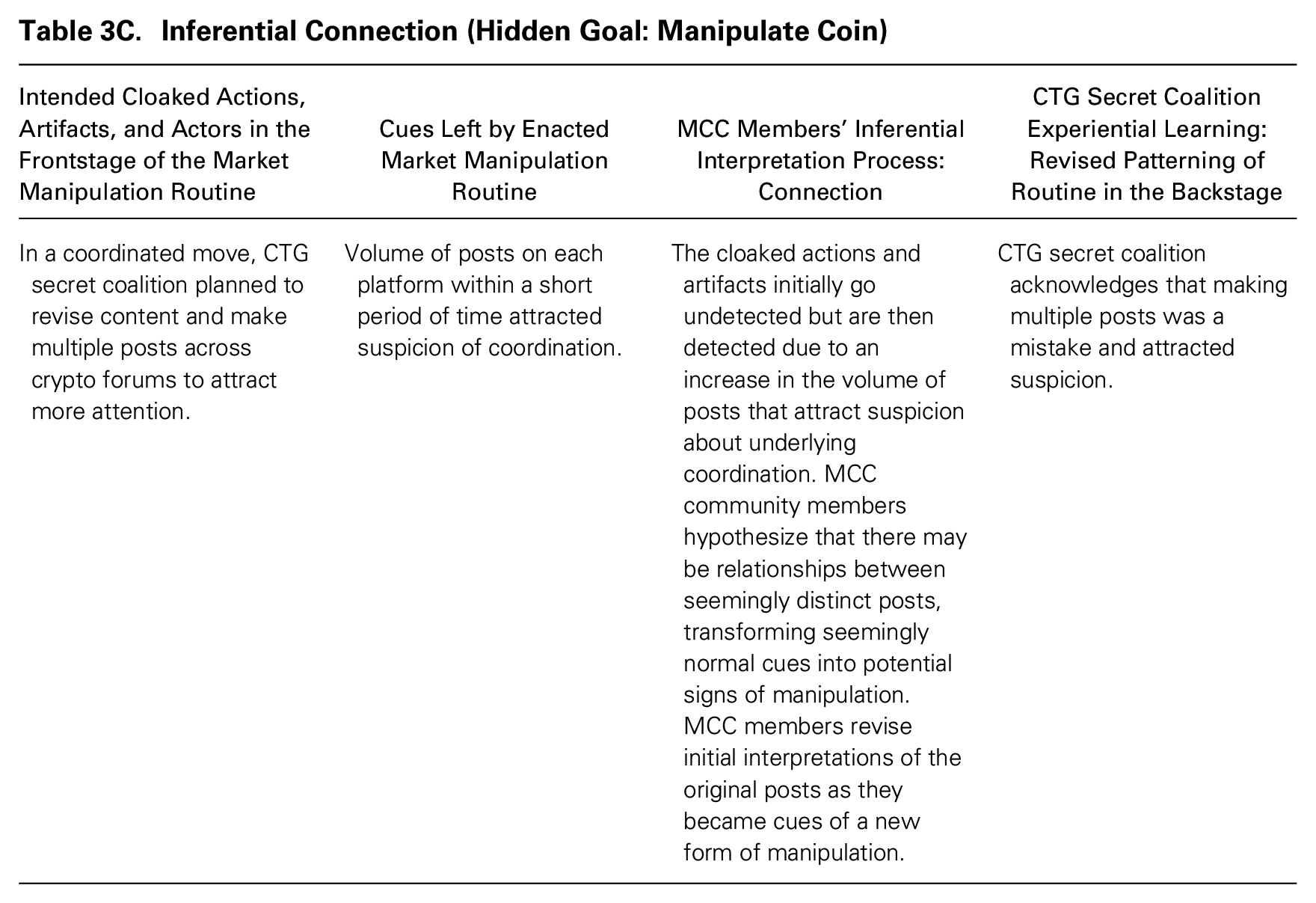
For the next attempt (Pteronura), the CTG secret coalition accelerated the enactment. It had learned that concurrent posts would lead to cue detection (see Table 3C), but it still did not appreciate how pacing affected cue detection. While members avoided multiple concurrent posts (volume), the attempt collapsed much like prior accelerated enactments had (see Table 2).
MCC moderators responded by updating the community rules. While they had previously stated that they wanted to make sure that the community could be a place where investors could discuss cryptocurrencies without being manipulated, they now explicitly stated that their goal was to stop manipulation. They attempted to ban manipulation, which they defined as “pump and dumps, shilling, or spreading fear, uncertainty, doubt” (MCC post log). MCC moderators (inaccurately) hypothesized that there might be individuals using multiple accounts to manipulate coins, stating that the “use of multiple accounts to manipulate narratives” (MCC post log) was not allowed. While this hypothesis was incorrect, it illustrates that MCC moderators were attempting to causally link antecedents of manipulation to outcomes and generate hypotheses about how it was being enacted. They also decided to ban certain types of posts that they would classify from then on as spam, such as any that asked if “X coin is any good?”, stating that these types of posts “invited speculation” (MCC post log). These changes acknowledged the growing concern and awareness across the community. Moderators asked members to report violations or suspected violations to the moderation team, as “we cannot be everywhere at once” (MCC post log). MCC launched a chatroom that enabled real-time notification of suspected manipulation, enhancing coordination between concerned members and moderators. Concerned members quickly joined the chatroom, with the goal of collectively uncovering and stopping manipulation. The top-rated comment stated, Great to hear. A step in the right direction for a safer community. Let’s be honest, more quality posts are better for everyone. (MCC post log)
Several MCC members applauded the effort, calling for more high-quality posts that would help investors make sound decisions. Unlike prior community discussions, in which they argued that rumors were essential to trading or that manipulation could be profitable, these members sought to root out manipulation en masse. As another member from this group stated, “Fucking finally. We are in the midst of a financial revolution and there are a bunch of people just trying to get rich quick” (MCC post log). For concerned members, this represented a shift from a singular goal of wanting to make money to aligning with the dominant coalition (MCC moderators) in a shared goal of wanting to stop manipulation. The chatroom became a more efficient platform through which this emergent subcoalition (concerned MCC members who now shared a goal with MCC moderators) and the dominant coalition could discuss cues. This collective interpretative process began to generate more accurate understandings of cues that would lead to valid and reliable learning.
Inferential corroboration
The previous four enactments by the CTG secret coalition had largely failed (see Table 2). Learning from MCC feedback, CTG coalition members revised their strategy. They decided to recruit outsiders from platforms they did not control to contribute to their posts on MCC. This move was risky, as part of the CTG coalition’s backstage coordination became public.
The first coin that CTG members used in this attempt, Arctonyx, was more profitable than any enactment since Eira (see Table 2). But several MCC members questioned these interactions, engaging in speculative learning: “I don’t believe the authenticity of these positive responses.” Someone replied to this poster by commenting, “Clearly these are people from the Arctonyx chatroom. They sent them this link and asked people to come and comment.” Another replied, “It looks like one person using multiple accounts” (MCC post log). The CTG secret coalition ignored this feedback, using a similar strategy in the next enactment with Meles and profiting again (see Table 2).
This new approach caught MCC’s attention. Following the two new enactments, MCC’s moderation team hosted a discussion that called for higher-quality posts and analysis. It stated that MCC would have tighter rules regarding suspected manipulation and would launch a campaign to uncover “raiding” (coordinated efforts to get groups of people to visit MCC and post and make comments). This move led MCC to engage in inferential corroboration, uncloaking cues (actions and artifacts) and linking them to the actors engaged in manipulation.
Within the MCC chatroom, subcoalition (see Table 1, Figure 1) members discussed a coin that they had been collectively investigating for suspected manipulation, aiming to unpack the causal mechanisms underlying the manipulation:
It’s fascinating, these guys make a fake celeb social media account, buy something. Then they tell tens of thousands of followers, circulate fake news and take a massive profit. Isn’t this illegal?!
I’m just waiting for Pekania to get what’s coming to them. (MCC chat log)
Despite quickly catching the MCC moderators’ attention, the CTG secret coalition persisted (see Table 3D below). In the next two enactments (Lutrogale, Hydrictis), CTG attempted to enlist members by posting publicly on each target coin’s community page (which they did not control): “Help us on MCC, leave a comment and vote!” (Lutrogale post log). These actions made additional parts of the CTG coalition’s backstage coordination public, yet the coalition persisted because the outside support helped their posts to gain traction:
All we need are about 20
We just passed 25! Let’s go! . . .
I just sent the link to an influencer . . .
He shared the post.
That was fast!!!
I’ll re-share it too. (CTG chat log, underline added)
Inferential Corroboration (Hidden Goal: Manipulate Coin)
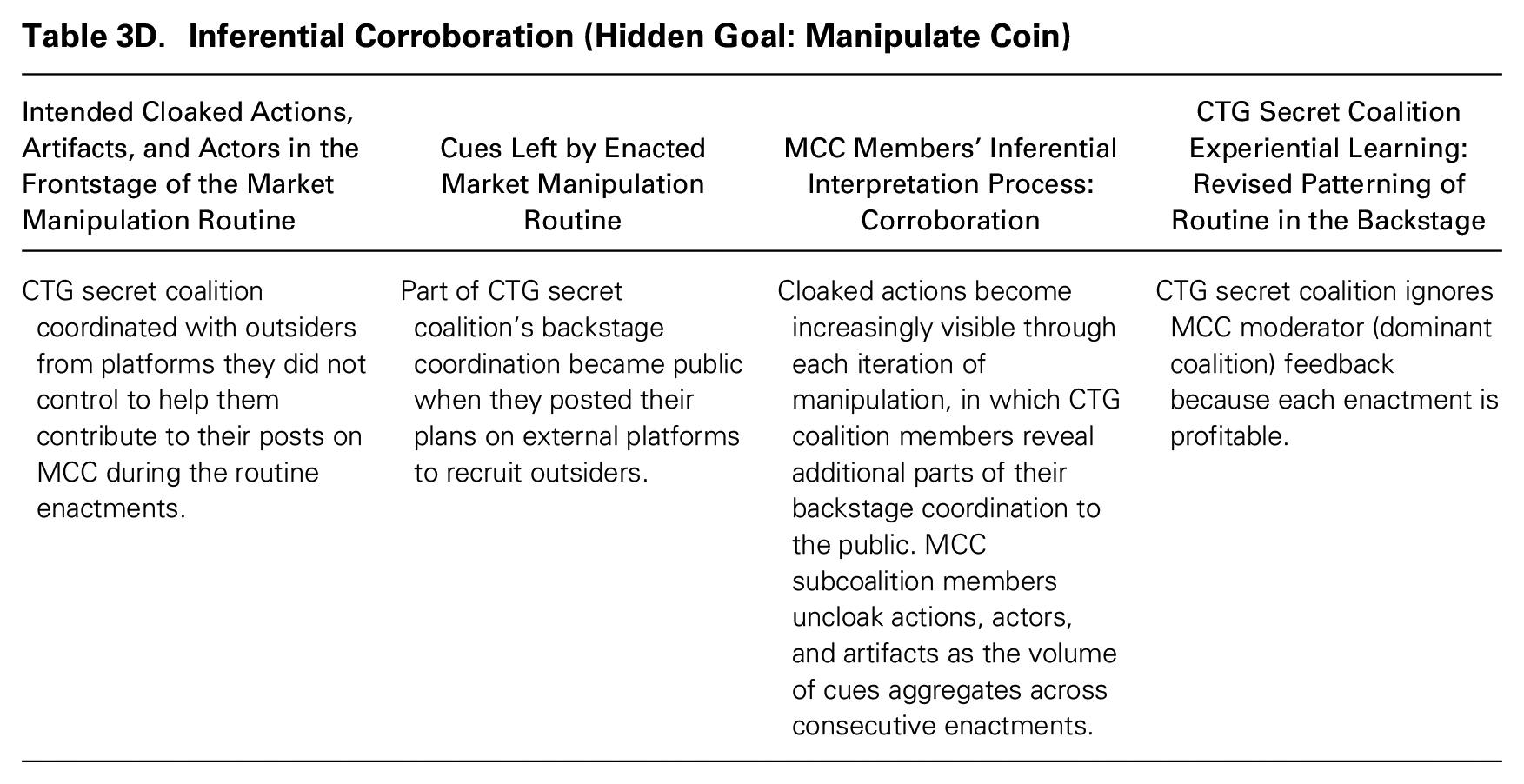
Although the CTG secret coalition profited from these enactments (see Table 2), it continued to recruit outsiders and reveal elements of its backstage coordination, enabling MCC to connect actions and artifacts to actors engaging in manipulation, as Table 3D shows.
Each successive enactment attracted greater suspicion. Posts on MCC expressed anger over “unbridled manipulation”: Manipulation is a fucking disease . . . the amount of manipulation here is unreal. I question how many of us actually have a genuine interest in the community? It feels like the majority are just manipulating coins. (MCC post log)
MCC had reached a breaking point. Hundreds of its members posted comments concerned with manipulation. Within the MCC chatroom, a moderator sent a message to the subcoalition members about the moderators’ emergent understanding of the causal structure behind manipulation enactments:
[I]mpulse investments or following directions from people passionately telling you how a coin is about to take off may be long cons. There are groups out there who only exist to research and identify coins that are low vol and low cap. They gradually accumulate and start spreading info on MCC and other platforms to create hype . . . these guys will tell you to buy in and have lots of charts and analysis all while they are unloading their holdings . . . all the mods here have seen this . . . we have an idea of what type of language they use and what to look for . . . (MCC chat log)
Shortly after sending this message within the chatroom, MCC’s moderators announced major changes to the community. These changes were meant to control manipulation, especially regarding how posts would be approved, adding that moderators would monitor posts on the main page to ensure they were not being manipulated. MCC moderators stated that they had reached this decision after communicating with community members and that their goal would be to engage with members, collect feedback, and respond when there were problems. They noted that MCC would ban projects from being shared if manipulation was suspected. They discussed the tips they had received about organized attempts to “raid” MCC and posted evidence from MCC’s members about suspected manipulation for Pekania Coin: We learned about manipulation through the communication platform outlined above . . . we collected substantial proof and discussed it . . . we decided the proof was significant and determined that we had to act. (MCC post log)
This statement indicated that MCC’s moderators relied on reports from subcoalition members who had observed cues of manipulation enactments, which corroborated prior hypotheses generated about the relationships between certain cloaked actions and artifacts and linked them to actors backstage. MCC moderators used these interpretations of cues to learn—understand, predict, and control—how the market manipulation routine was being enacted as they developed valid understanding of the causal structure between actions, artifacts, and actors in their community. An MCC subcoalition member replied to the moderator’s statement, spelling out how they had observed this manipulation unfolding: [P]eople share a link to MCC in a chatroom and ask everyone to go and support them. They also will go to coin-specific communities and ask the same thing. Anyone that is doing this is engaging in manipulation. You can see it here if you are looking at posts sorted by the time they were submitted. Something gets posted and five minutes later there are tons of positive comments. If you look into coin specific communities, chatrooms, social media, I promise you that you’ll find connections to those posts. We have to report this when we see it . . . (MCC post log)
MCC’s moderators aggregated the subcoalition’s interpretations of cues into an accurate understanding of the causal structure of manipulation. What MCC moderators learned had become reliable—public, stable, and shared—among the community, and it had become valid as they could use the knowledge to understand, predict, and control market manipulation. The collective learning effectively ended the CTG secret coalition’s ability to target MCC because the coalition could no longer effectively enact the market manipulation routine. The CTG secret coalition quietly deleted the Pekania Coin chatroom that they controlled.
Discussion
Interested in understanding how members of an online investment community learned when reality, causality, and intentionality were obscured, we explored the interpretive processes underlying learning from ambiguous experience that emanated from the enactment of hidden goals. Our findings showcase the individual and collective inferential interpretive dynamics through which actors produce understandings of fragments and traces of ambiguous experience (e.g., cues) that are both plausible and accurate. Actors’ individual dynamics focus on generating plausible interpretations, which help divergent actors to develop speculative experience about a hidden reality. The individual dynamics are strengthened through collective dynamics that lead to accurate interpretations (see Figure 1). Effective learning—establishing valid and reliable understandings of how hidden goals are enacted—emerges through a process of inferential interpretation.
The standard model of experiential learning posits that when experience is unambiguous, learning unfolds though reinforcement (Argote, Lee, and Park, 2021). An emerging stream of research posits that when experience is ambiguous and more challenging to interpret (Argote, 2024), cognitive complexity, in which imagination and meaning making are invoked, replaces reinforcement (March, 2010). We make two contributions to this emerging literature on learning from ambiguity, summarized in Table 4, by comparing the difference between the standard model of effective learning with statistical inference and our model of effective learning with hidden goals and inferential interpretation. First, we introduce intentionally hidden goals as a new source of ambiguity. Second, we introduce inferential interpretation as a new process for learning from ambiguous experience. By showing that interpretation is “far from being a straightforward linear sequence . . . [and is] in fact more complex and dynamic than previously assumed” (Greve and Gaba, 2017: 329), these discoveries change how effective learning is conceptualized.
Two Models of Effective Learning
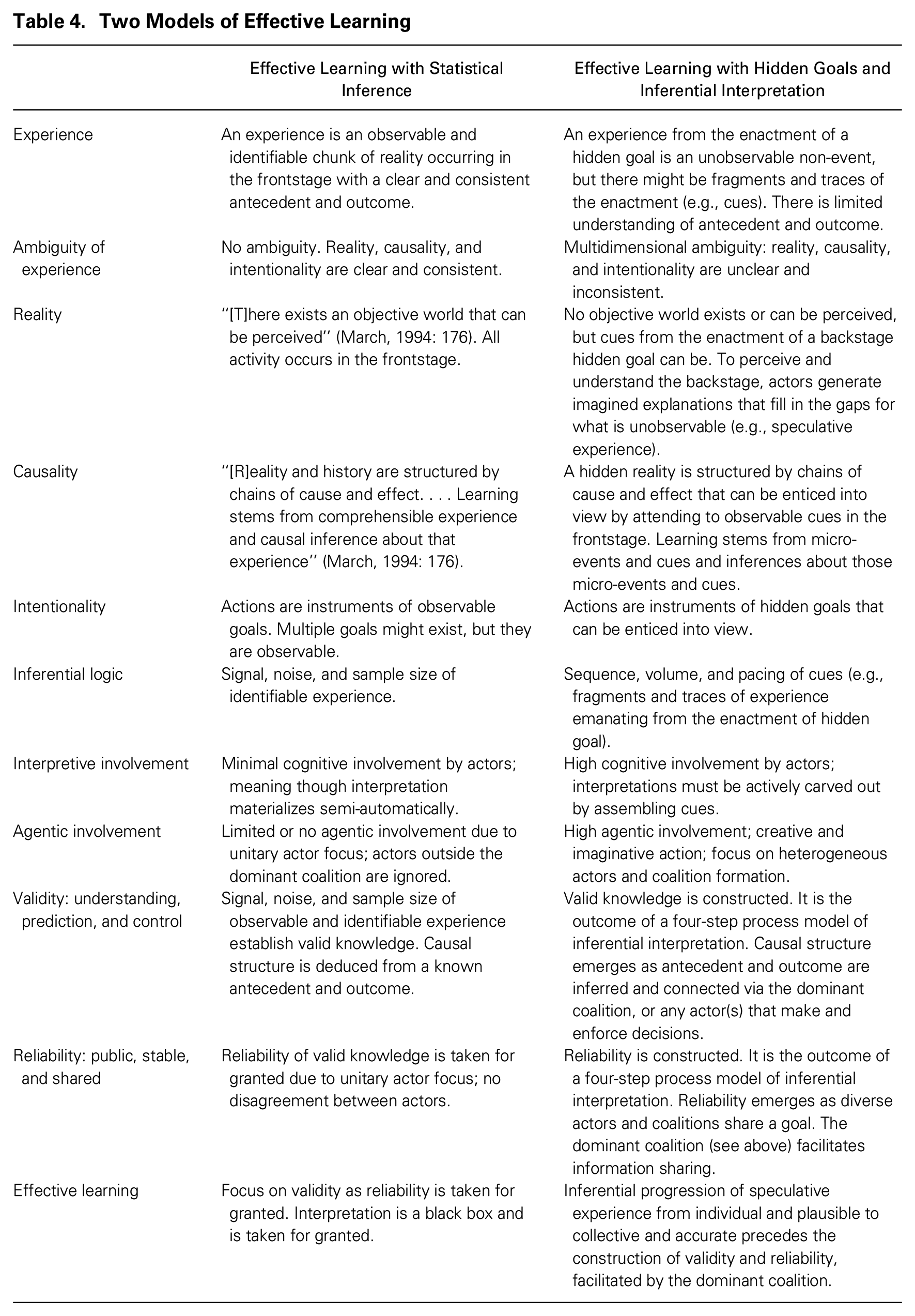
Hidden Goals as a Source of Ambiguity
In the standard model of learning (left side of Table 4), an experience is an observable and identifiable chunk of reality, such as a franchise (Kalnins and Mayer, 2004) or production (Darr, Argote, and Epple, 1995) experience that can be sampled and accumulated (Choi and Levinthal, 2023). This experience is unambiguous because it involves an observable objective reality, which is structured by chains of cause and effect that produce comprehensible experience, and intentions and actions are linked to observable goals.
Research has started to explore how effective learning from ambiguity occurs, but it has assumed that causality is the main source of ambiguity (cf. Konlechner and Ambrosini, 2019). Prior research on complex cognition (e.g., March, Sproull, and Tamuz, 1991; Levinthal and Rerup, 2006, 2021; Jordan and Audia, 2012; Gavetti and Warglien, 2015; Csaszar and Ostler, 2020) shows that responsiveness to experiential outcomes varies with interpretation and that ambiguity of experience complicates interpretation (Argote, 2024). In these works, the challenge is not that the antecedent may be hidden, as our findings show, but rather that outcomes may be attributed to the wrong (known) antecedents (March, 2010: 107). Existing literature suggests that interpretations of cues with no known antecedent would produce a “misattribution of causal linkages between behavior and outcomes” (Joseph and Gaba, 2020: 279) and superstitious learning (March, 1994: 89–91; Denrell, 2008; Zollo, 2009). For instance, causal ambiguity has been attributed to multiple, observable goals (Joseph and Gaba, 2015; Audia and Greve, 2021). Ambiguity is created by ambiguous feedback: which goal should the feedback be assigned to (Levinthal and Rerup, 2021)?
As summarized in Table 4, when goals are hidden and experience is ambiguous, validity does not emerge though statistical inference, and reliability cannot be taken for granted (Maslach et al., 2018; Rerup and Zbaracki, 2021). Goals and intentions are usually assumed to be observable and fixed (March, 1978), but research has seldom focused on understanding the role of hidden goals in models of learning and adaptation. We introduced hidden goals as a new source of ambiguity and theorized how learning unfolds when three sources of ambiguity—reality, causality, and intentionality—are simultaneously present (March, 1994). This focus allowed us to challenge the assumption that learning unfolds from an observable world in which reality, causality, and intentionality are known. When the observability assumption is relaxed and learning stretches across the frontstage and the hidden backstage (Goffman, 1959), validity and reliability unfold though inferential interpretation. But little is known about the complexity and dynamics of this process, including how actors embrace and manage ambiguity (discussed below).
The concept of hidden goals as a source of ambiguity has two main implications for the learning literature. First, it pushes interpretation to be more granular by relaxing the assumption that observers can directly observe what is going on in their environment. Instead, it suggests that actors may piece together understandings from incomplete and sometimes invalid information over time through cues. The standard model assumes that all variables are apparent for consideration, and interpretive variation stems from the different positions that actors hold in an organization (Levinthal and Newark, 2023: 4–5). With hidden goals, however, interpretive variation comes from the actors’ ability to recognize, abstract, connect, and corroborate cues.
Second, the concept of hidden goals as a source of ambiguity brings the heterogeneity of actors back to the foreground. Although the Carnegie School highlights the importance of considering multiple actors (March, 1962; Cyert and March, 1963), existing empirical models of learning often depend on unitary actors who effortlessly interpret experience (Joseph and Gaba, 2020). These models falter when faced with complex problems in which heterogeneous actors pursue multiple goals (Cyert and March, 1963; Rerup and Zbaracki, 2021). Hidden goals can be prevalent in any situation, job, or profession when one actor benefits from hiding their intentions from other actors. As we found, this is often accomplished by corrupting routine enactments that are part of an organization’s legitimate structure (den Nieuwenboer, da Cunha, and Treviño, 2017). For example, hidden goals may be enacted by departments that corrupt hiring routines to circumvent restrictions imposed on them by university administrators (Rerup and Feldman, 2011: 593). Self-interested actors can choose to obscure their actions and intentions to pursue such goals without interference (Lepisto and Pratt, 2012). In these instances, actors rely on ambiguity, which allows “them a credible claim to normalcy” (Harrington, 2012: 398). Intentionally hidden goals as a source of ambiguity may be more common than portrayed in the existing literature. Organizations may need to contend with several hidden goals, necessitating new understanding of how learning unfolds when there is such ambiguity. We illustrate below how experience is first assembled through cue-level understandings that gradually move from plausible and individual to accurate and collective through multiple interpretations (see also Christianson, 2019: 77).
Inferential Interpretation: A New Process for Learning from Ambiguous Experience
In the standard model (Table 4), most learning is public and occurs in the frontstage (Goffman, 1959). Learning with statistical inference posits that the more similar the experience (signal), the smaller the stochastic variance in the observed outcome of the experience (noise), and the larger the sample of experience (size), the less ambiguous and more valid the experience inferred is (March, 2010). Minimal interpretive engagement is required to make sense of this experience (Argote, 2024). The meaning of the experience is taken for granted and materializes semi-automatically (Baum and Dahlin, 2007; Greve and Gaba, 2017), requiring actors to be engaged minimally in cognition (Joseph and Gaba, 2020). Broader agentic involvement is assumed away because actors outside the dominant coalition are ignored (Greve, 2003), and the organization is conceptualized as a unitary actor (Argote and Greve, 2007). Effective learning understood as a change in knowledge focuses on generating valid knowledge from unambiguous, observable, and comprehensible experience relative to observable goals. Reliability is taken for granted. Thus, effective learning is a search for a solution to a known problem (Posen et al., 2018; Joseph and Gaba, 2020).
Conversely, as summarized in Table 4, an experience emanating from the enactment of a hidden goal is an obscured event that is difficult to immediately accumulate into a stock of experience. Learning might still occur if fragments and traces of the enactment (e.g., cues) can be assembled into an interpretation. However, that is challenging because the ambiguity of cue-level experience is multidimensional: reality, causality, and intentionality are unclear and inconsistent (March, 1994). Explicit interpretive efforts are needed “to understand the causal structure of the events of experience and to derive action implications from the understanding” (March, 2010: 15). Inferential interpretation follows a different logic than statistical inference does: changes in the sequence, volume, and pacing of cues serve as the basis for developing understandings of what might be going on as actors infer what speculative experience (beyond observable cues) can be. Effective learning is accomplished as understandings move from individual and plausible to collective and accurate as more cues are interpreted. The outcome of this process is valid and reliable understandings as the secret actions of the hidden goal are made public.
Actors must construct ambiguous experiences from the ground up by generating plausible inferences and allowing interpretations to emerge from cues. Plausibility is concerned with the likelihood of a certain experience, goal, or causal structure being in place: who is taking what actions relative to what goal, and how are the inferences related to observable cues? Outcomes and antecedents are fair game for inferences as cues are sorted and provisionally interpreted and revised. Once cues are recognized, actors begin to speculate about and imagine the existence of a plausible hidden goal and begin looking for other cues in their environment. This process helps cue interpretations aggregate into understandings of causal structures between hidden goals and ambiguous experience. A given cue is subject to many different interpretations that become more accurate as actors engage with the ambiguity of reality, causality, and intentionality.
Our findings suggest that future research on organizational learning should frame the construction of meaning—interpretation—as more dynamic, inferential, and heterogeneous. Meaning is central to the human condition, so different perspectives (Schutz, 1967; March, 1994; Weick, 1995) have emerged to understand which meaning-making processes are implicated in understanding the world (Bruner, 1990: 2). Given our focus on cue-level interpretations as a generative medium for theorizing about experiential learning, it is also worthwhile to consider the links between sensemaking and inferential interpretation (Sandberg and Tsoukas, 2020). Indeed, there are conceptual overlaps as sensemaking focuses on plausible interpretations of cues (Weick, 1995: 55–61). Integrating the two literatures may help to capture the “more complex and dynamic” aspects of interpretation (Greve and Gaba, 2017: 329).
Limitations and Future Research Directions
Cryptocurrency market manipulation is a context that may be a boundary condition for our findings. However, unconventional contexts are useful for examining understudied processes and phenomena (Bamberger and Pratt, 2010). In that sense, our context made theorizing on hidden goals and ambiguous experience more accessible. Inferential interpretation is only one such process through which secret actions may be made public. Auditors may uncover hidden goals such as fraud (Cooper, Dacin, and Palmer, 2013). In other instances when auditors fail to uncover (or disclose) hidden goals, they may be revealed by whistleblowers who have inside knowledge of the secret actions within organizations (Vadera and Pratt, 2013; Vadera, Tenbrunsel, and Diekmann, 2024). Future research should look at these sources of ambiguity and how they may influence the learning process.
Another potential limitation is that we did not consider how effective inferential interpretation unfolds in complex scenarios with longer time horizons. For instance, although Exxon (now part of ExxonMobil) produced internal knowledge that predicted global warming in the 1970s, researchers determined only recently what the firm knew then. “ExxonMobil worked to deny it—including . . . feigning ignorance about the discernibility of human-caused warming” (Supran, Rahmstorf, and Oreskes, 2023: 1). Our study takes place over a few months rather than examining a complex scenario unfolding over decades. Future research may use archival or machine learning methods to understand the temporal limits of inferential interpretation (Michalski, 1993; Pearl and Mackenzie, 2018; Hannigan et al., 2019).
Lastly, the move from individual to collective interpretations was important to our findings (Gavetti and Warglien, 2015; Christianson, 2019). While we highlight the heterogeneity of actors as both a source of ambiguity and a component of the process to manage it, we do not theorize on how politics may impede or facilitate inferential interpretation. Future research could focus more on how conflictual and political processes influence inferential interpretation and learning dynamics in organizations (Rerup and Zbaracki, 2021; Levinthal and Pham, 2024).
Conclusion
In past research, the dynamics that influence interpretation have been ignored, simplified, or taken for granted. However, interpretation is important when dealing with ambiguous experience. In effect, “[i]nterpretation [should be] treated as central, sense making as a basic need” (March, 1994: 207–208) in studies of experiential learning and performance feedback. In inferential interpretation, the link between interpretation and learning is less clear and more dynamic than prior empirical work portrays it. Our model of inferential interpretation unpacks the complexity and dynamics that allow divergent actors to gradually imagine what goes on in an unobservable backstage by deciphering hidden goals from ambiguous experience.
Supplemental Material
sj-pdf-1-asq-10.1177_00018392241273301 – Supplemental material for The Dynamics of Inferential Interpretation in Experiential Learning: Deciphering Hidden Goals from Ambiguous Experience
Supplemental material, sj-pdf-1-asq-10.1177_00018392241273301 for The Dynamics of Inferential Interpretation in Experiential Learning: Deciphering Hidden Goals from Ambiguous Experience by Bryan Spencer and Claus Rerup in Administrative Science Quarterly
Footnotes
Acknowledgements
We gratefully acknowledge and are indebted to associate editor Michael Pratt, the reviewers, managing editor Joan Friedman, and associate managing editor Ashleigh Imus for their helpful insights and guidance. We also thank Laura Claus, Martha Feldman, John Joseph, Kate Kellogg, Thorbjørn Knudsen, Bomi Kim, John Lafkas, Laurence van Lent, Jan Lodge, Dan Newark, and Brian Pentland for their insightful comments. Finally, we greatly benefited from input by reviewers at Academy of Management (2020), Strategic Management Society (2020), and EGOS (2020), and seminar participants at HEC Lausanne (2022), the City University of Hong Kong (2022), Alberta School of Business (2023), and Lundquist College of Business (2023). We also thank participants for granting us access to the research site. Financial support was provided by the Frankfurt School of Finance and Management and the City University of Hong Kong. This article is the result of a thoroughly collaborative coauthoring process. This research received no specific grant from any funding agency in the public, commercial, or not-for-profit sectors.

1
All actors and organizations in this manuscript are aliases (even when the original names are online usernames or pseudonyms). Due to the sensitive nature of the data, details in quotes have been changed to increase confidentiality.
Authors’ Biographies
References
Supplementary Material
Please find the following supplemental material available below.
For Open Access articles published under a Creative Commons License, all supplemental material carries the same license as the article it is associated with.
For non-Open Access articles published, all supplemental material carries a non-exclusive license, and permission requests for re-use of supplemental material or any part of supplemental material shall be sent directly to the copyright owner as specified in the copyright notice associated with the article.
