



Abstract
Although the liability of foreignness has been shown to present real economic barriers for foreign firms in various contexts around the globe, scholars continue to debate what drives this liability in different market contexts: lack of information due to institutional distance, lack of social embeddedness, discrimination, or something else. In this study, we propose a new theory, that in corporate lobbying within the nonmarket strategy context, the liability of foreignness is driven in no small part by a values-based ideological conflict stemming from the divide between democracy and autocracy. Private-sector firms from autocratic countries face costs of illegitimacy in Washington, D.C., and professional corporate lobbyists charge such firms a fee premium, in effect, to pay for legitimacy. We conduct an empirical study of the lobbying fees charged by professional corporate lobbyists in Washington, D.C., to their domestic and foreign firm clients, and the results strongly support the predictions of our theory. We also show that the liability of foreignness in this context endures for foreign firms from autocratic countries over the 15-year length of our sample period. Offering a new theoretical perspective as well as new empirical findings regarding the liability of foreignness, our study has practical implications for managers of foreign firms and may also generalize to other market contexts.
Keywords
The liability of foreignness, a central concept in the organizational theory of the multinational firm (Hymer, 1976; Zaheer, 1995), asserts that a foreign firm faces higher barriers to superior corporate performance in a host market, often in the form of higher costs for inputs and restricted access to opportunities. To survive, let alone thrive, in a host market, foreign firms often need a competitive advantage that outweighs the added costs of being foreign. The liability of foreignness has been shown to present real economic barriers in a range of contexts (e.g., Bell, Filatotchev, and Rasheed, 2012; Wu and Salomon, 2017; Kim, 2019).
Scholars debate what drives the liability of foreignness in different market contexts: lack of information due to institutional distance, lack of social embeddedness, discrimination, or something else (Kostova and Roth, 2002; Luo and Mezias, 2002; Eden and Miller, 2004; Denk, Kaufmann, and Roesch, 2012). If the liability of foreignness were attributable to lack of familiarity with host-country institutions, foreign firms could simply hire locals to help them master the institutional environment (Mezias, 2002). If lack of social embeddedness were to blame, a foreign firm could actively embed itself in local elite networks (Siegel, 2007). Alternatively, if the liability of foreignness were to result from discrimination and xenophobia, most or all foreign firms would face enduring economic barriers (Kim, 2019).
We theorize that in the nonmarket context of corporate lobbying, the liability of foreignness is driven largely by a values-based ideological conflict between democracy and autocracy. We focus here on a realm in which billions of dollars in firm-level resources are spent: lobbying. We posit that in the context of lobbying in the United States, this values-based conflict significantly drives the liability of foreignness for a specific type of foreign firm from an autocratic regime. A set of substantive value differences distinguish democracies from autocracies. In delineating these differences, we seek to shed light on one source of the liability of foreignness, not to offer a grand theory of this liability; we are taking a step toward establishing the contingent nature of the liability of foreignness in different market contexts, a goal called for in prior research (Denk, Kaufmann, and Roesch, 2012; Lu, Ma, and Xie, 2022). We also suggest that ideological conflict between political systems may be a component of the liability of foreignness in other market contexts.
In no way does this study view the liability of foreignness as normatively legitimate. We aim to identify its causes in order to provide empirical evidence that can be useful for discussion of the particular unfairness in question. The exact causes of the liability of foreignness could well vary by market even within a given host country. We find that the U.S. market for corporate political activity, in which the liability of foreignness takes the form of a social penalty for origins in an autocratic country, discriminates against a group on the grounds of its identity, which is normatively objectionable. For example, one or a few autocratic countries may stand out for their record of bringing people out of poverty and/or for low corruption. Some corporate leaders from that country will inevitably argue for human rights and the rule of law behind the scenes, while others actively aid the dictator, yet in a host country all will suffer discrimination based solely on their group identity. Empirical studies such as ours can identify what is going on and provide evidence for a societal discussion about injustice.
To test our theory, we scrutinize corporate lobbying from the vantage point of lobbyists—political elites who play a central role in Washington, D.C., politics (Baumgartner et al., 2009)—specifically the prices they charge domestic and foreign firms to try to influence the government on their behalf. Few, if any, studies have examined the liability of foreignness from the vantage point of host-market actors, nor have many studies assessed the precise economic cost of the obstacles that such local actors create. Lobbyists are an appropriate set of market actors to study because both domestic and foreign clients spend large sums on their services and because lobbyists enjoy considerable pricing power thanks to their insider status, which allows them to charge different fees to different subtypes of firms (Birnbaum, 1992; Drutman, 2015). It is widely accepted that foreign firms face higher economic costs of doing business, but few studies have examined why they do so, from the perspective of the economic actors that charge foreign firms higher fees. By offering empirical support for our theory in the context of nonmarket strategy consisting of many activities intended to influence government, civil society, consumers, and the media (Dorobantu, Kaul, and Zelner, 2017), whose importance is increasingly evident to both domestic and foreign firms (Jia, 2018; Blake and Jandhyala, 2019), this study provides substantive findings that may also be tested in other contexts.
In testing our theory in the empirical context of lobbying in the United States, we also identify a factor that has been elusive in the legitimacy literature: the economic price that firms burdened by perceived illegitimacy pay to attain legitimacy in a market. The legitimacy literature has struggled to identify the price of legitimacy to such firms (Deephouse et al., 2017). We identify a context in which the price of legitimacy can be measured and ascribed to various firm characteristics. We also offer insights about legitimacy and how it is attained.
Context: Lobbyists as Gatekeepers
Corporate political lobbying, defined as “the transfer of information in private meetings and venues between interest groups and politicians, their staffs, and agents” (de Figueiredo and Richter, 2014: 164), has often been identified as the dominant nonmarket strategy for influencing policymaking and regulatory processes in the United States (e.g., Milyo, Primo, and Groseclose, 2000). Since information on lobbying became publicly available in 1998, thousands of firms, represented by 12,000 lobbyists, have spent an annual average of more than $3 billion to lobby the U.S. Congress and federal agencies during our sample period.
Prior literature has shown that lobbyists function as gatekeepers and orchestrators (Birnbaum, 1992; Blanes i Vidal, Draca, and Fons-Rosen, 2012; Bertrand, Bombardini, and Trebbi, 2014), which enables them to confer legitimacy on their client firms in the eyes of politicians (Slodysko, 2020; Kim, 2021; Oprysko, 2022). Four mechanisms account for this capability. First, because members of Congress cannot rely solely on their small, low-paid staff for sufficient technical expertise (Rosiak, 2012), lobbyists often supply such expertise, even to the point of drafting ready-to-use legislation; members of Congress frequently file such legislation without revision (Grim and Siddiqui, 2013; Drutman, 2015; Williams, 2017; McCrain, 2018; Ellis and Groll, 2020). Shepherd and You (2020) showed that skilled congressional staff members often secure lucrative jobs in the lobbying industry by showcasing their legislative and policy expertise, which they then continue to provide to Congress on behalf of clients. Hertel-Fernandez, Mildenberger, and Stokes (2019) documented that lobbyists work closely with and thus can influence the congressional staffers who draft legislation. During our fieldwork, a high-status D.C. lobbyist with both domestic and foreign clients explained to us, You talk to reasonable members of Congress, and even some of the unreasonable ones who advocate against lobbyists—they are not sufficiently staffed, on an individual-member level or on a committee level, to be able to focus on one specific piece of legislation at a time. If you are a typical member of Congress in the House and you are on three committees, it is a lot of work, and you are not going to be an expert on all those things. The staff doesn’t have enough hours in the day to be able to come up with these things. If you are a policy-oriented lobbyist and you know this space, you can work with the staff to write the legislative language because you probably were a staffer previously. (Field interview, September 2022)
Second, lobbyists can be trusted confidants of Congress members (McIntire, 2006; Victor and Koger, 2016), even to the point that politicians adopt lobbyists’ opinions and advice when deciding whether to support a particular company’s position and/or request (Nownes, 2006; Bertrand, Bombardini, and Trebbi, 2014; LaPira and Thomas, 2017). Lobbyists with personal ties to politicians often provide them with sensitive counsel (Birnbaum, 1992; Leech, 2013) or valuable political/electoral information gleaned from well-connected clients and interest-group networks (Nownes, 2006; Franklin, 2014). An article in Politico portrayed the lobbyist Jeff Miller as the closest confidant of Kevin McCarthy, the former Speaker of the House (Fuchs, 2022). The article quoted a former McCarthy aide: “A lot of people like to think that they’re close to Kevin. There are very few people who actually talk to him about stuff or that he reaches out to proactively. . . . Jeff is a very key and central figure of that group.” The article further stated, “By the time McCarthy was bidding to lead the Republican conference back in 2015, Miller had the lawmaker’s ear. And he’s remained a steadfast ally, close confidant, travel companion, helpful fundraiser, and political consigliere ever since.”
Third, lobbyists contribute to politicians’ campaign funding and facilitate fundraising (Birnbaum, 1992; McIntire, 2006). Lobbyist-connected political action committees are a major source of campaign funds for politicians, and many studies have traced politicians’ dependence on lobbyist-enabled sources of campaign funds (e.g., Bertrand, Bombardini, and Trebbi, 2014; Franklin, 2014; Drutman, 2015). In the 2020 election cycle alone, lobbyists contributed more than $374.4 million to political campaigns, making them one of the top sources of campaign cash. Lobbyists also organize fundraising events for politicians (McIntire, 2006; McKay, 2018), thereby increasing their influence (Fuchs, 2022).
Fourth, lobbyists hire politicians’ family members, former politicians, and former congressional staffers (Birnbaum, 1992; LaPira and Thomas, 2017; McCrain, 2018; Lazarus, McCrain, and McKay, 2019). Politicians’ immediate family members and other relatives are often hired as lobbyists (Attkisson, 2010; Hetrick, 2021). The Washington Post reported in 2022 that “56 relatives of lawmakers have been paid to influence Congress, and more than 500 firms have spent more than $400 million on lobbying teams that include the relatives of members of Congress” (Fallis and Keating, 2012); thus lobbyists’ influence is consolidated via social ties (Birnbaum, 1992; LaPira and Thomas, 2017; McCrain, 2018). Becoming a lobbyist has also become a well-traveled career path in Washington, D.C., as former politicians and congressional staffers can readily parlay familiarity with the legislative process and personal relationships into high-paying lobbying positions (Birnbaum, 1992; Kaiser, 2009). Carolyn Blaydes, a former aide to Representative Tom Downey, stated in a published interview, “People coming up [as staffers] see it as a way to move up: become a lobbyist and probably double their salary” (Birnbaum, 1992: 128). Fifty-nine percent of former members of Congress became lobbyists after the 115th Congress (Zibel, 2019). This pattern is yet more pervasive among staffers, more than 5,000 of whom became lobbyists in the early 2000s (Farnam, 2011). Senate staff members’ median salary in 2018 was $30,000–$35,000, less than that of Senate janitors (Rosiak, 2012).
Lobbyists in the United States are obliged by the Lobbying Disclosure Act (LDA) of 1995 to disclose a great deal about whom they represent, what they charge, and what aims they pursue on behalf of clients. The LDA reporting requirements also include specifying the agencies lobbied and the number of lobbyists hired. Our study examined all U.S. federal lobbying transactions conducted by professional lobbyists hired by foreign multinational enterprises (MNEs) and by U.S. firms, 334,594 transactions in total, between 1998 and 2012.
This study also enables us to identify the factors that determine lobbyists’ fees. Transaction-level data on contracts between two parties that specify the activities in question are rare. Lobbying reports are unusual because they stipulate the activities that an agent, a lobbying firm, agrees to conduct on behalf of a principal, a lobbying client. These data allow us to calculate the unit cost of each activity; thus, after accounting for heterogeneity in lobbying activities, we can compare what client firms pay. It is also generally difficult to compare contracts because their scopes, purposes, and processes are idiosyncratic. The standardization imposed by federal disclosure requirements makes it possible to compare work in lobbying transactions over our 15-year sample period.
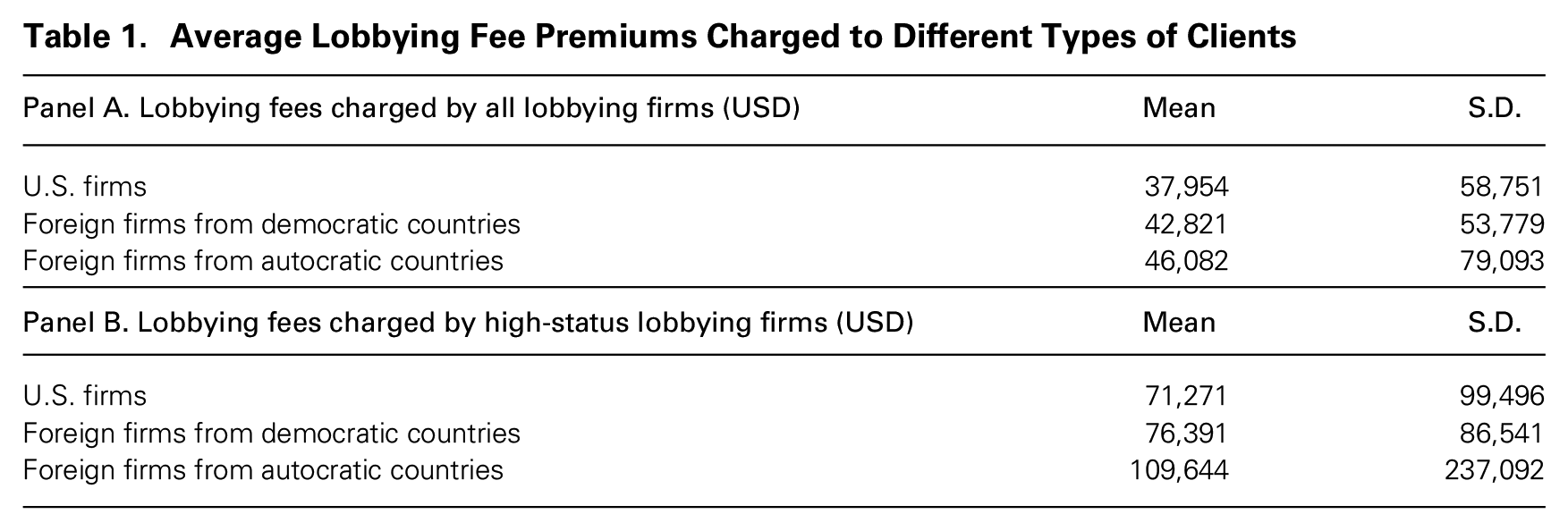
We found meaningful differences in the prices that clients pay, which inspired the efforts that we detail in the rest of this article. The summary statistics in Table 1, panel A, and Figure 1(A) suggest that the liability of foreignness in this market may be driven by values-based conflicts associated with the democracy–autocracy divide. The average difference between what lobbyists charge U.S. firms and foreign firms from democratic countries is nontrivial but still relatively small; by contrast, what lobbyists charge foreign firms from autocratic countries represents a substantial percentage premium per transaction. 1 This premium is even more pronounced when we examine the fees charged by high-status firms, as shown in Table 1, panel B, and Figure 1(B). 2 High-status lobbying firms (as defined by annual rankings published by two widely read Washington publications) are able to charge higher prices in general and far larger fee premiums to clients from autocratic countries. As Figures 1(A) and 1(B) show, the average fee premium charged by the full sample of lobbying firms to clients from autocratic countries is an economically consequential 21.4 percent. High-status lobbying firms charge an average fee premium of 51.7 percent to clients from autocratic countries. The clear difference in lobbying fee premiums across different types of clients, particularly differences associated with clients’ home countries, needs more theoretical and empirical attention in terms of both identifying the source of such a fee premium and analyzing the underlying mechanism.
Average Lobbying Fee Premiums Charged to Different Types of Clients
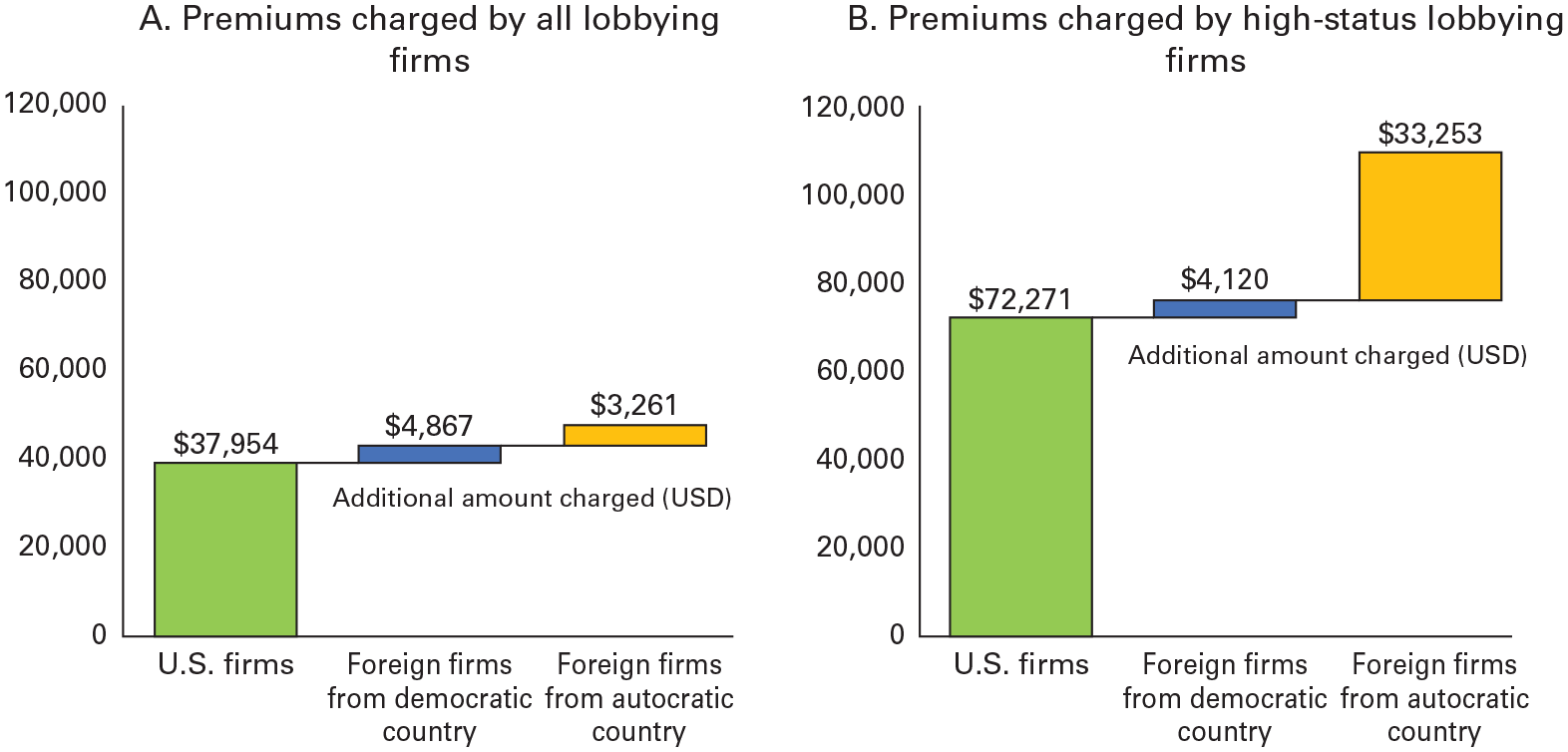
Average Lobbying Fee Premiums Charged to Different Types of Clients
Liability of Foreignness, Price Premiums, and Values-Based Ideological Conflict
Prior Theory on Liability of Foreignness and Price Premiums
For more than a quarter-century, since Zaheer (1995) elaborated on Hymer’s (1976) original theoretical idea of the liability of foreignness, the concept has been central to our understanding of the operations and strategies of foreign MNEs in host countries. The concept’s fundamental premise is that foreign firms pay more than domestic firms to do business in a host country because of their foreignness (Hymer, 1976). The liability of foreignness has drawn the attention of many international business scholars because it can impact the strategic decision making of foreign MNEs and must be overcome if foreign firms are to succeed in host markets (Luo and Mezias, 2002). Scholars have argued and shown that foreign firms generally suffer from illegitimacy (Kostova and Zaheer, 1999) arising from lack of social embeddedness, scant institutional knowledge of the foreign market, and explicit or implicit discrimination (Eden and Miller, 2004; Salomon and Wu, 2012). However, the particular sources of this liability in different market, geographic, and/or institutional contexts have not been fully specified (Denk, Kaufmann, and Roesch, 2012; Shi, Gao, and Aguilera, 2021; Lu, Ma, and Xie, 2022).
In their role as institutional gatekeepers, and as a political elite (Baumgartner et al., 2009), lobbyists provide clients with certification (Kim, 2019). Certification offers legitimacy to an organization by providing outside stakeholders with information about the organization not readily observable to others (King, Lenox, and Terlaak, 2005; Carlos and Lewis, 2018). In other words, individuals and organizations with institutional credibility and knowledge enable less-credible or less-known individuals and organizations to participate in a transaction that would otherwise be unavailable to them without such external certification (Sine, David, and Mitsuhashi, 2007). Yet, because of foreign MNEs’ perceived illegitimacy, which is driven by their foreignness (Edman, 2016), lobbyists will charge them higher fees in exchange for certification than they will charge domestic firms. We therefore propose the following baseline prediction:
New Theory on Liability of Foreignness and Price Premiums: Values-Based Ideological Conflict
A regime is defined in political science as the “set of basic formal and informal rules that determine who influences the choice of leaders—including rules that identify the group from which leaders can be selected—and policies” (Frantz, 2018: 6). A regime is autocratic (or dictatorial or authoritarian, terms used interchangeably in political science) if leadership is chosen by undemocratic means, that is, by means other than free and fair elections (Frantz, 2018: 6, 12). The most serious conflicts in political values are those between democracy and autocracy, an ideological divide that cannot be narrowed. Democracy operates on a central logic of free and fair electoral competition; autocracy runs on an opposing logic, an absence of free and/or fair competition and even of elections (Frantz, 2018).
Because autocracies have attributes at odds with the political values of a democratic system, firms identified with autocratic systems are viewed in democratic countries as lacking legitimacy (Shi, Hoskisson, and Zhang, 2016). They thus face a type of discrimination whereby they must bear higher costs to gain certification from the political brokers known as lobbyists (Kim, 2019). With few exceptions, lobbyists do not refuse to associate with firms identified with autocratic systems. But representing such firms may bring reputational costs and labor market constraints. Thus, the fee premium that a lobbyist charges represents a pay-for-legitimacy fee. 3
In well-functioning democracies, the rules for competitive lobbying are intended to provide legislators and regulators with benign industry-specific knowledge about how a proposed policy or regulation can impact firms and industries. Though every democracy fails to fully adhere to its values, their core logic embodies the concepts of competition, accountability, respect for human and civil rights, and fact-based discourse (McClosky, 1964; Gartzke, 1998). In contrast, autocracies exhibit most if not all of the following four attributes. First, the leader and/or ruling party uses violence with impunity against political enemies (Frantz, 2018: 1). According to the political scientists Geddes, Wright, and Frantz (2018: 1), over the past three decades such regimes “have perpetrated nearly 85 percent of mass killings by governments.” A regime in which a single individual or a few people make all decisions (Svolik, 2012) is fundamentally at odds with the system of U.S. democracy, wherein tens of thousands of actors, including lobbyists and firms, debate policy. In addition to inflicting domestic political violence, autocratic regimes often pursue interstate armed conflicts, typically against democratic regimes (as in the case of the Russian invasion of Ukraine in 2022). Democratic countries have been shown to be far less likely than autocracies to start wars; in fact, “all international wars since the end of World War I have involved dictatorships” (Geddes, Wright, and Frantz, 2018: 1).
Second, autocratic leaders and/or ruling parties typically use coercion and censorship against political opponents and journalists (Greitens, 2016; Geddes, Wright, and Frantz, 2018: 154). In contrast, political discourse and decision making in democracies largely entail voluntary, free association and free speech, both of which also manifest in lobbying. Third, autocratic leaders and/or ruling parties often rely on falsehoods to justify public policies (Magee and Doces, 2015). Functioning democracies typically feature a competitive market for information, which tends to weed out falsehoods. Though democracies also generate falsehoods, they tend to offer ample opportunities for facts and logic to win out. In contrast, as the political scientist Frantz (2018: 5) noted, “The information that [autocracies] release is often biased and intentionally inaccurate, even about basic information such as economic growth rates.” Finally, autocratic leaders and/or ruling parties often engage in personalized corruption in the forms of embezzlement, bribes, and accounting fraud (LaPorte, 2017). In Georgia during the immediate post-Soviet era, for example, the Shevardnadze family that controlled the country derived its wealth in part from bribes and embezzlement (LaPorte, 2017: 90).
Because the core operating principles of democracy and autocracy are so starkly at odds, companies from autocratic countries are widely viewed as lacking legitimacy when they seek influence for their business subsidiaries in democratic systems. Further, certain behaviors that corporate actors in autocratic systems view as legitimate are regarded as felonious in a democratic system. Even when not illegal, such behavior might attract negative scrutiny from independent media in a democracy. In turn, the potential for such scrutiny can create long-term career risks for lobbyists with foreign corporate clients unless the former are compensated adequately for assuming such risks. In the words of a D.C. lobbyist interviewed in the course of this study, “The greatest factor if you are representing authoritarian regimes is the chance for blowback. You don’t want to be drawn into an issue. There will be threats online. I always say the most dangerous place on earth is Twitter, and there will be no shortage of attacks there. And the other question is: what other kinds of clients will I lose?” (field interview, June 2021). A leading analyst of the lobbying industry also pointed out the legitimacy cost of representing clients from countries with autocratic regimes: “It does have those reputational risks. Lobbyists they are hiring might not want to be on that account. For those revolving-door lobbyists who may want to get back into government, that would be a big risk for them” (field interview, April 2021).
A lobbyist at a prestigious D.C. firm pointed out more directly the reputational risk that lobbyists must bear in representing clients from autocratic countries: “The price premium I charge to clients from autocratic countries is far more about the who-you-are premium; it’s not just an actual-problem perspective but a perceived-problem perspective” (field interview, September 2022). The same lobbyist elaborated on why reputational risk calls for a fee premium: If you are a lobbying shop like mine, and the potential client says they are from an autocratic country, your standard fee is no longer on the table. You start by asking for double. If it’s me, it’s because of the uncertainty of whether you have the needed information and perception to represent the client. . . . I don’t dedicate more people, and it doesn’t eat more into my staff time than any of my other clients. . . . If there emerges in the future something that is country-specific on the House floor, you will temporarily do a little more work, but it smooths out over the course of the year. So in the end it’s not that you’re having to devote more time to them over the course of the year. (Field interview, September 2022)
This evidence suggests that reputational risk leads lobbyists to charge firms from autocratic countries a substantial fee premium. This phenomenon leads us to the following hypothesis:
Because firms from autocratic regimes are viewed as affiliated with the opposing side of the values-based ideological conflict between democracy and autocracy, as a population they in effect often face stigma (Goffman, 1963). Zhang et al. (2021: 193) stated, If stigma is a “deeply discrediting” (Goffman, 1963: 3) mark that subjects a social actor to devaluation (Pescosolido & Martin, 2015: 91), the source of a stigma is that which creates or causes the discrediting “mark” that classifies the social actor as “different . . . of a less desirable kind” (Goffman, 1963: 3).
Those facing stigma often look for ways to conceal the source of the stigma (Jones and King, 2014). If the source is not a surface attribute, then firms may actively try to conceal their identity, such as in a context in which the ultimate owner does not always need to be visible even in the name of their U.S. business. For example, the Washington Post ran an article on July 16, 2023 about a Saudi-owned company in Arizona that sought to hide its owners’ identity by selecting a locally adapted name and never once having Saudi owners or executives appear in Arizona; the company also asked local partners never to mention that the business is Saudi (Stanley-Becker, Partlow, and Sanchez, 2023).
As the literature on stigma shows, one would expect the costs of stigma to be particularly salient in settings and situations in which that identity cannot be easily concealed (Jones et al., 2016), which would include nationalist issue contexts. Nationalism is defined in Barrington (1997: 714) as the pursuit—through argument or other activity—of a set of rights for the self-defined members of the nation, including, at a minimum, territorial autonomy or sovereignty. All nationalisms, therefore, share two features: (1) they define, at least roughly, the territorial boundaries that the nation has a right to control and (2) they define the membership boundaries of the population that makes up the nation the group that deserves this territorial control and that is entitled to the supreme loyalty of other members of the collective. These membership boundaries are set by members of the nation themselves, generally by an intellectual or political elite, though they may be based on ideas of surrounding groups as well. They establish the we that possesses the right to control the homeland (and as a result the they that does not share this right).
Yazici (2019) added that nationalism involves political actors prioritizing national concerns over all other concerns, and Schrock-Jacobson (2012: 826) noted that nationalism often engenders negatively “biased strategic assumptions” about people not considered members of the nation.
In nationalist issue contexts, the identity of originating from an autocratic country is unlikely to be concealable, and thus the costs of stigma for firms from autocratic home countries are likely to be substantial. Gary Becker’s (1971) economic theory of discrimination offers an analogy, whereby a nontrivial amount of the discrimination in society is driven by some people’s expectations of other people’s bigotry (e.g., on the part of their customers and employees). Here, too, the lobbyist as gatekeeper makes their risk-management decisions based on their perceived risk to their own labor market reputation and, in significant part, based on their expectations of what politicians and media may think about being connected to an autocracy that may cause a future flare-up. In contrast, the likelihood of the flare-up diminishes, at least to some degree, when the policy issue does not involve U.S. nationalism, such as when the only thing the client is lobbying for is an honorific regulatory designation that would not likely cause voters to be angry even if it were publicized.
In the presence of nationalism, the risk for a lobbyist of representing a firm from an autocratic country likely rises sharply. Consider an industry-based issue context in which domestic firms compete against foreign firms, including for preferred governmental policies and regulatory treatment. The domestic firms have an economic incentive and a much more prominent position from which to broadcast why the government should never favorably treat a firm from an autocratic country that does not share American democratic values. For example, in the applications for U.S. tariff exemption during the Trump administration’s trade war, some Chinese-owned firms, through concealed identities in the first round of tariffs, were able to win exemptions from U.S. tariffs aimed against China (Feng and Siegel, 2023). Interestingly, Feng and Siegel (2023) also found that such methods are limited and are less likely to be sustainable in an issue characterized by nationalism. Even the Chinese-owned firms that received the exemption were eventually discovered by the administration, and subsequent rounds of trade exemptions sought to actively exclude such firms. This exclusion occurred because, under conditions of nationalism, the stigma is likely to be larger, and domestic-owned competitors will believe it is possible to invoke nationalism to challenge foreign-owned firms attempting to receive favorable treatment from a U.S. politician. Moreover, the media and NGOs may also be motivated to bring to the public’s attention such cases of favoritism toward firms from countries with different political ideologies because a public appetite exists for stories about rooting out such favoritism (Kim, 2018; Yue, Mao, and Lu, 2022).
Some politicians invoke nationalism as a method of mobilizing the support of voters, and such politicians often bolster their nationalistic credentials when pursuing reelection. Further, politicians who are ordinarily inclined to follow a lobbyist’s lead in the case of a particular action are apt to care more about winning reelection (Werner, 2012). Thus, they more likely view a lobbyist’s foreign client as illegitimate if the issue area that is the subject of lobbying reflects U.S. nationalism. For example, if the issue area is one in which the government has historically promoted domestic national champions or engaged in protectionism or other nationalistic policies, politicians are likely to shun a foreign client from an autocratic home country. As a result, the associated illegitimacy will cause the lobbyist to charge a higher fee for association and representation. We thus predict the following:
Prevailing perceptions of foreign countries and firms from those countries tend to persist (Bell, Filatotchev, and Aguilera, 2014; Wan, Chen, and Yiu, 2015). This implies that overcoming or changing a prevailing perception will be even more difficult for companies that enter a democratic country from an autocratic regime because stigma is often a “persistent predicament” (Link and Phelan, 2001: 363) that tends toward permanence (Devers et al., 2009).
Moreover, because of perceived illegitimacy of their home-country norms and values (Adler-Nissen, 2014), discrimination against companies from autocratic countries is “flexible and extensive” in host countries (Link and Phelan, 2001: 379). This means that firms from autocratic countries can be discriminated against in ways that are socially accepted—from social isolation of their managers to higher fees for lobbying services—and the discrimination can be formulated broadly (Link and Phelan, 2001; Pescosolido and Martin, 2015). In other words, the illegitimacy-derived stigmatization of firms from autocratic regimes that leads to higher lobbying fees would be persistent and not easily overcome. We therefore make the following prediction:
Methods
Data and Sample
We obtained data filed between 1998 and 2012, in response to the Lobbying Disclosure Act, by 3,559 unique lobbyists and lobbying firms. The data came from the Center for Responsive Politics. 4 Our sample consists of 334,594 observations (that is, transactions) with 15,656 U.S. firms and 2,072 U.S. subsidiaries of foreign MNEs. Each report lists lobbying activities performed in a given filing period. Using this transaction-level data, we identified relevant lobbying activities and constructed relevant variables at the transaction, client, and lobbying-firm levels. Our main analyses encompass all lobbying transactions with both Congress and the executive branch; when lobbyists representing foreign firms calculate the fees they charge foreign clients, the same legitimacy mechanism applies to both branches.
Dependent Variable
Our dependent variable is the natural logarithm of the Lobbying fee in each transaction. Because of the skewness of the dependent variable, we transformed the dollar amount of each lobbying contract to its natural logarithm. Exact amounts need not be disclosed if a given client’s lobbying expenditure is less than $10,000 per half-year before 2008 and less than $5,000 per quarter since 2008. Current and former lobbyists agreed that actual lobbying expenditures unreported tend to be close to those threshold amounts. We thus attributed the threshold amount to any lobbying expenditure whose exact amount is not reported, and we ran the regression accordingly.
Explanatory Variables
Our first main explanatory variable is a binary variable of whether the client firm in each transaction is foreign (Foreign firm). Following Kim (2019), we designated a firm as foreign only if a foreign entity at the top of its ownership hierarchy—that is, a global ultimate owner—controlled the operations of the U.S. subsidiary. This definition is increasingly being adopted by many institutions, including governments, as a means to regulate and enhance supranational compliance efforts. We view this strict measure of ownership, which has both operational and ownership aspects, as appropriate to our study; the classification is conservative in estimating the effect of the main explanatory variable.
Because lobbying reports do not provide detailed information on client firms, such as ownership or home country, we identified firm identities via multiple steps. We began with Orbis, which codes corporate ownership trees across national borders by using national registries and other sources. Orbis assisted us with a company-matching exercise, using its back-end system. To the best of our knowledge, Orbis provides the most comprehensive data on ownership, even for privately held U.S. businesses, and it delivered precise and confirmed information on ownership for a large proportion of our sample. We then researched the remaining companies, one by one, in the Capital IQ, Worldscope, and Zephyr databases. We also studied their websites, public disclosures, and historical press coverage (e.g., Factiva) and conducted searches on Google, Corporation Wiki, and Bloomberg.
To identify autocracies, we used a political-regime measure (v2x_regime) obtained from the Varieties of Democracy (V-Dem) project. V-Dem’s political-regime classification scheme is based on two fundamental features of democracies: “the competitiveness of access to power (polyarchy) as well as liberal principles” (Coppedge et al., 2021: 266). In other words, the variable represents how a given country organizes its electoral process and rules, which is closely related, in turn, to fundamental societal norms and ideology (Cassels, 1996; Brands, 2018). Thus, the variable captures the institutionalized authority patterns that characterize a country’s position on a spectrum ranging from institutionalized democracy to autocracy, on a scale from 0 to 3 (0 = closed autocracy, 1 = electoral autocracy, 2 = electoral democracy, 3 = liberal democracy). For ease of interpretation, we inversed the measure to create our main explanatory variable (Home-country autocracy): the higher a country’s score, the more autocratic it is.
To test the claim of Hypothesis 3 that when client firms seek to lobby on issues that evoke nationalist implications, the fee charged to clients from autocratic countries will be higher, we first classified congressional issues in the lobbying reports. Applying our own knowledge of nationalism as a multidimensional construct from the political science, management, and international business literatures, along with our knowledge of the qualitative descriptions in each lobbying report, we classified at the individual issue level whether a foreign firm is likely to encounter U.S. nationalism during our sample period. We added to our own coding by convening three senior political scientists in the Harvard University Government Department, who are experts in American politics and knowledgeable of nationalism, to code each issue area independently according to whether a foreign firm during our sample period would be likely to encounter U.S. nationalism. This is akin to methodology in the law and economics literature that asks specialists to code how a given situation would be handled in a given institutional context (e.g., Djankov et al., 2008). In addition, to reduce individual bias, we built on a key lesson from the psychology literature (e.g., Baron et al., 2014) and took the panel of four independent codings (our prior independent coding plus those of the three Harvard political scientists) and aggregated the measure by coding an issue area as reflecting U.S. nationalism if at least three of the independent codings agreed that the area reflected nationalism (see Online Table A1 for the classification).
Although the experts’ coding is a more holistic and interpretive method that relies on specialists’ knowledge, we also included an alternative approach that is archival and entirely objective. Thus, we further classified the main industry of each lobbying client according to its import tariff. Tariffs are an administrative tool that sovereign states use to protect their national industries. We can reasonably assume that policymakers may view protecting such industries as likely to bolster their nationalistic credentials and thus to vote in favor of import tariffs for these industries. We downloaded tariff data from the U.S. Census and the U.S. International Trade Commission. The data show the import tariff schedule for each industry, so we classified industries based on their 2-digit NAICS codes and then calculated the average most-favored-nation tariffs based on harmonized import tariff schedules at the 2-digit NAICS level.
Lastly, we used the number of years that a given firm lobbied during our sample period (Client experience) as a foundational construct for testing Hypothesis 4’s claim that autocracy-associated stigma is an enduring source of the liability of foreignness in the nonmarket strategy context.
Control Variables
We included multiple control variables at the firm (client), transaction, and lobbying-firm levels that could influence fees charged to client firms. To account for the lobbying intensity of a given client and for willingness to pay in each lobbying contract (Schuler, 1996), we controlled for client firm status or size (Global Fortune 500 company) and included the natural logarithm of each firm’s Annual lobbying spending (after excluding the fee charged in the focal lobbying transaction). We also controlled for In-house lobbying as a percentage of total lobbying spending and for the Number of in-house lobbyists within a client firm’s government-affairs function, variables that capture a firm’s lobbying capability and intensity (Kim, 2019). Campaign contributions are known to be an effective means of access to elected politicians (Snyder, 1992); thus, we controlled for the natural logarithm of a client firm’s annual campaign contributions, to account for political capability that could influence the lobbying fees it is charged (Keim and Zeithaml, 1986).
To capture heterogeneity across lobbying contracts that can affect lobbying fees, we also controlled for transaction-specific characteristics. First, we included the number of lobbyists (Number of lobbyists hired in a given transaction) and the percentage of revolving-door lobbyists hired in a given contract (% of revolving-door lobbyists in a given transaction). Our interviews with current and former lobbyists confirm that, as is true of other professional service providers (e.g., lawyers, management consultants), the number of professionals (lobbyists) hired and their experience (government experience) are the most decisive factors in determining the fees charged to a client. Thus, these variables can effectively capture heterogeneity in the cost of professional labor across lobbying contracts. Moreover, because the scope of lobbyists’ work is driven by the number of issues they address, we controlled for the Number of congressional issues lobbied in a given transaction. Because lobbyists typically represent a client for a specified period but in some cases provide short-term help, lobbying fees can be differently calculated, so we included each lobbying Contract duration (Joskow, 1987).
Finally, we controlled for lobbying firms’ characteristics, which can affect what they charge clients. Lobbying firms with more clients connected to other lobbying firms are likely to be more-central players in the market and thus can charge higher fees because their perceived superior access through their lobbyists increases demand for their services. Thus, we controlled for the centrality of lobbying firms, using one-year-lagged eigenvector centrality calculated via client–registrant nodes (Registrant eigenvector centrality). We also controlled for lobbying revenue (Registrant lobbying revenue) to account for lobbying-firm size. Because a lobbying firm’s industry expertise and client base are likely to affect its fees, we controlled for the Herfindahl-Hirsch index of legislative issues addressed (Registrant issue Herfindahl-Hirsch index) and the number of industries represented by the firm’s clients (Number of industries lobbying firm represents) to indicate its degree of focus. We also included the Number of clients lobbying firm represents to account for the size of a lobbying firm’s client base, which helps the firm to amass diverse information on a range of policy issues.
Identification Strategy and Statistical Analysis
Our main analytical approach is a fixed-effects regression supplemented with matching analyses, and standard errors are corrected for clustering at the lobbying-firm level. Because our sample consists solely of firms that had already decided to engage in lobbying in the United States, some might argue that there is selection bias. However, our research question is whether the liability of foreignness prompts lobbyists to charge higher fees to clients from autocratic home countries, not what drove those firms to pursue lobbying. Whether to lobby, a separate strategic decision made by client firms, is beyond the scope of our study; we look at lobbying firms’ pricing decisions. Further, even if we presume that some potential foreign clients decided against lobbying because of high fees, this implies that the fees we observed could have been even higher for those firms. Thus, our demonstrated results should be conservative.
One advantage of the lobbying data is that each lobbying report represents a single transaction and provides information difficult to obtain in other settings. Specifically, each report specifies factors that determine the type of lobbying task in question. Thus, we can control for a number of factors other than our variables of interest that could drive the fee, such as the type of lobbying involved and the issue. More important, to directly address endogeneity concerns, we have implemented multiple techniques in this study.
First, we included multiple different fixed effects. In particular, because unobservable lobbying-firm characteristics could affect fees (e.g., eagerness to represent a less-legitimate client), we included lobbying-firm fixed effects in our main specifications. We also controlled for congressional-issue (topic) fixed effects, which capture heterogeneity in the scope and difficulty of lobbying work, inarguably a main driver of varying lobbying fees. We included filing-period and industry fixed effects (NAICS 2-digit) to capture unobserved heterogeneity across time periods and industries. In some specifications, we also included federal-agency fixed effects, which presumably capture the breadth of lobbying activities (Ridge, Ingram, and Hill, 2017).
Second, to test whether the fee charged to a client was driven by characteristics of the client or the transaction, by balancing our observations in an important dimension for determining lobbying fees we used an exact matching technique (e.g., year, industry, and same lobbying firm or lobbyist) and coarsened exact matching (CEM) methods. 5 Even if a certain type of lobbying firm self-selects for a certain type of domestic or foreign client, these analytical approaches (in conjunction with contract-level control variables) can alleviate endogeneity issues. Lastly, we also collected and analyzed out-of-sample data to test, and thus be in a position to further rule out, the most feasible alternative explanation, which is that the time required to serve a different client will be heterogenous and thus will drive the result.
Results
Table 2 presents the descriptive statistics and pairwise correlations for variables included in our main regression analyses. Our main regression results are presented in Tables 3–6 in the sections that follow. To sufficiently rule out major alternative explanations while better supporting our theory, we also provide a number of summary statistics and additional robustness checks, which can be found in the Online Appendix (Table A2 outlines all the analyses and empirical results of the study).
Descriptive Statistics and Pairwise Correlations
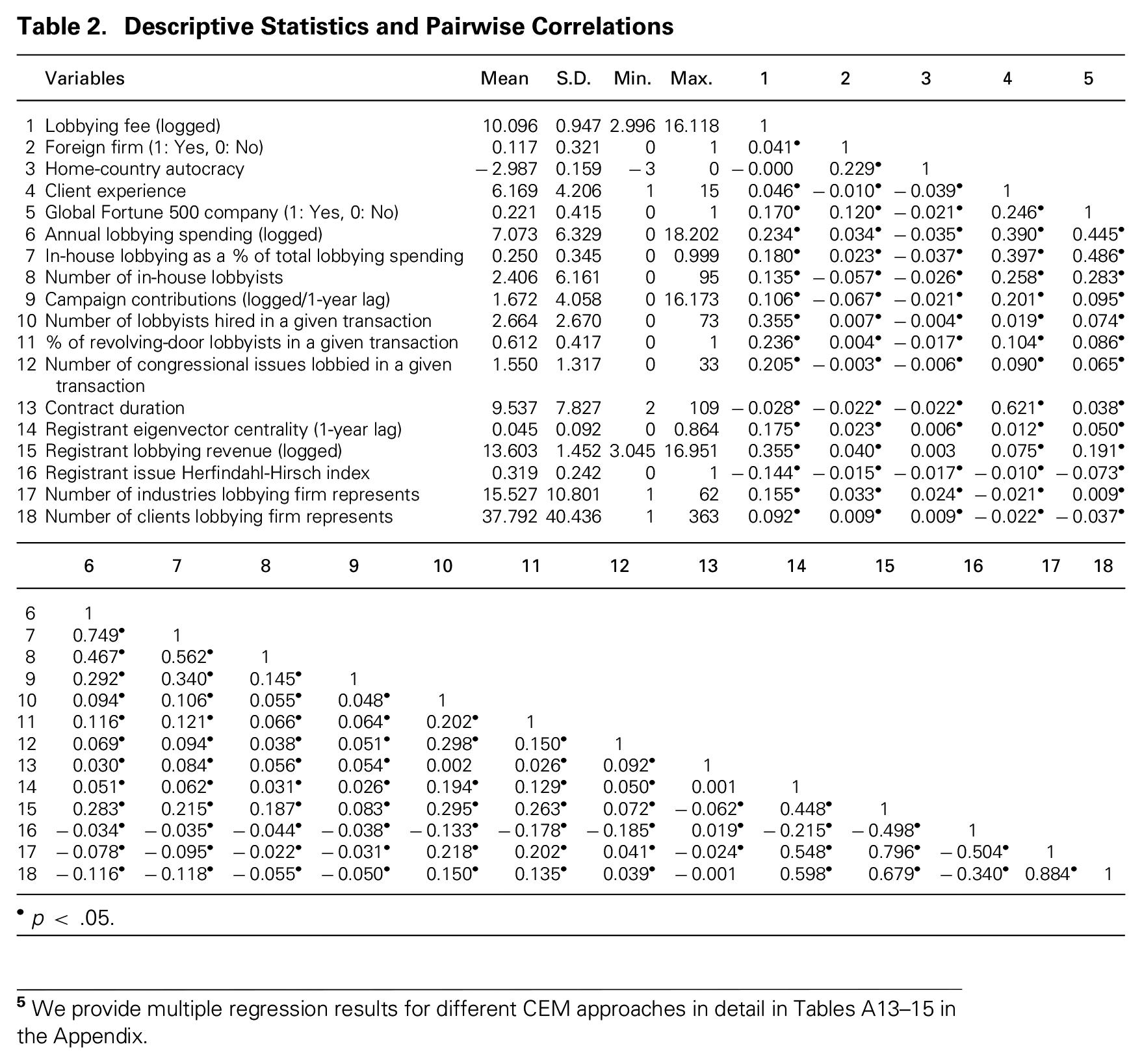
p < .05.
Fixed-Effects Regressions on What Lobbying Firms Charge Foreign Clients Depending on Foreignness*
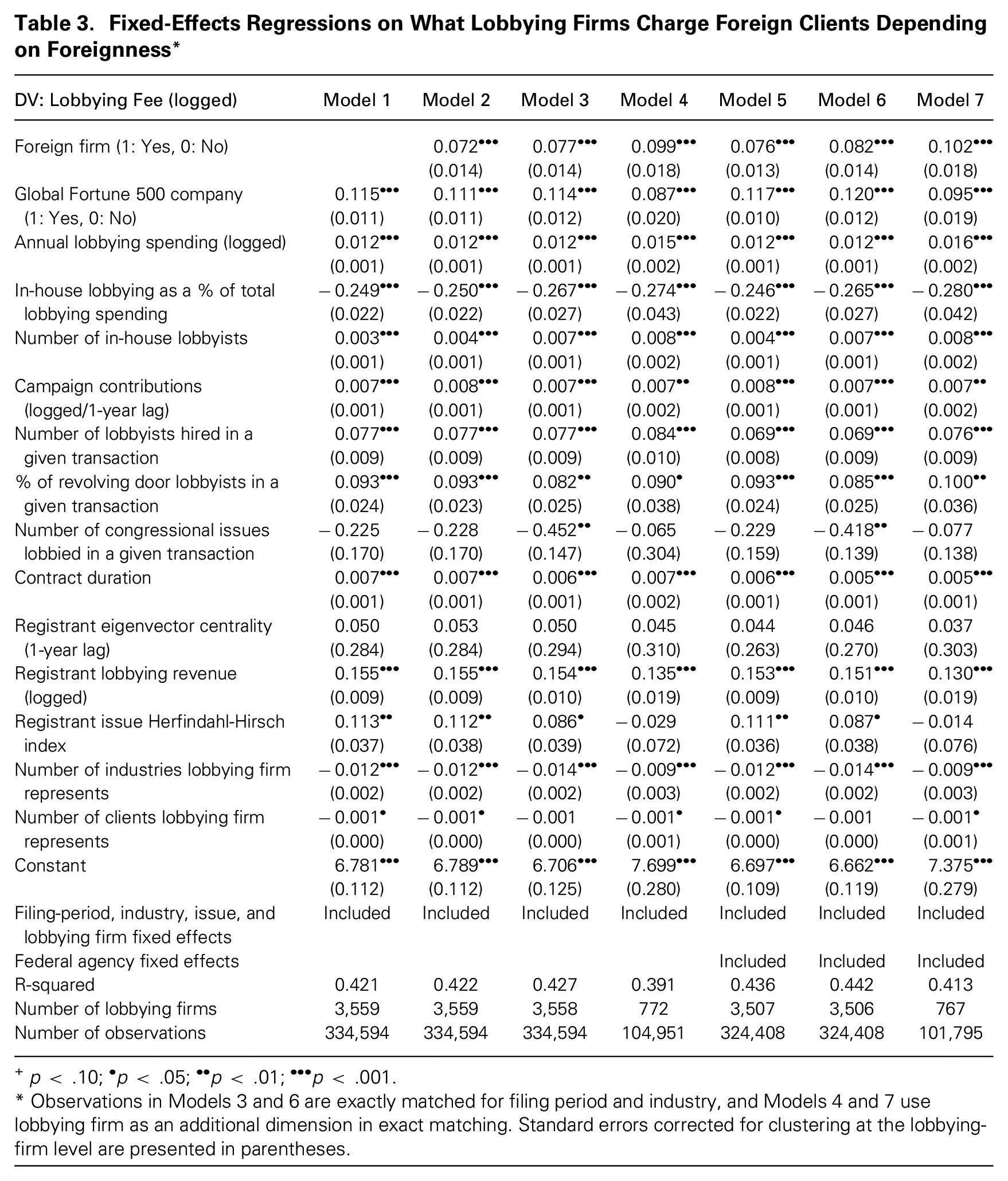
p < .10; • p < .05; •• p < .01; ••• p < .001.
Observations in Models 3 and 6 are exactly matched for filing period and industry, and Models 4 and 7 use lobbying firm as an additional dimension in exact matching. Standard errors corrected for clustering at the lobbying-firm level are presented in parentheses.
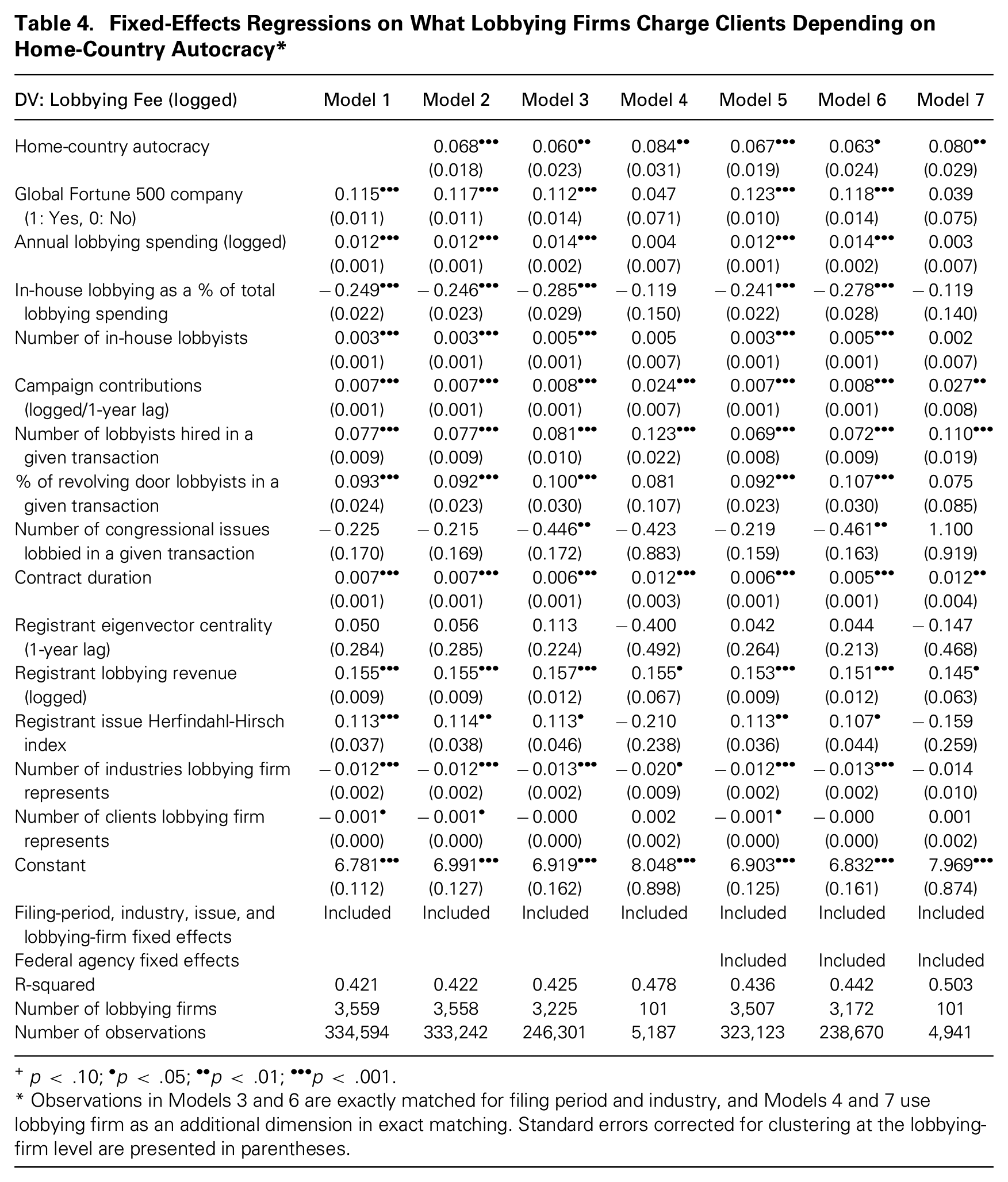
Fixed-Effects Regressions on What Lobbying Firms Charge Clients Depending on Home-Country Autocracy*
p < .10; • p < .05; •• p < .01; ••• p < .001.
Observations in Models 3 and 6 are exactly matched for filing period and industry, and Models 4 and 7 use lobbying firm as an additional dimension in exact matching. Standard errors corrected for clustering at the lobbying-firm level are presented in parentheses.
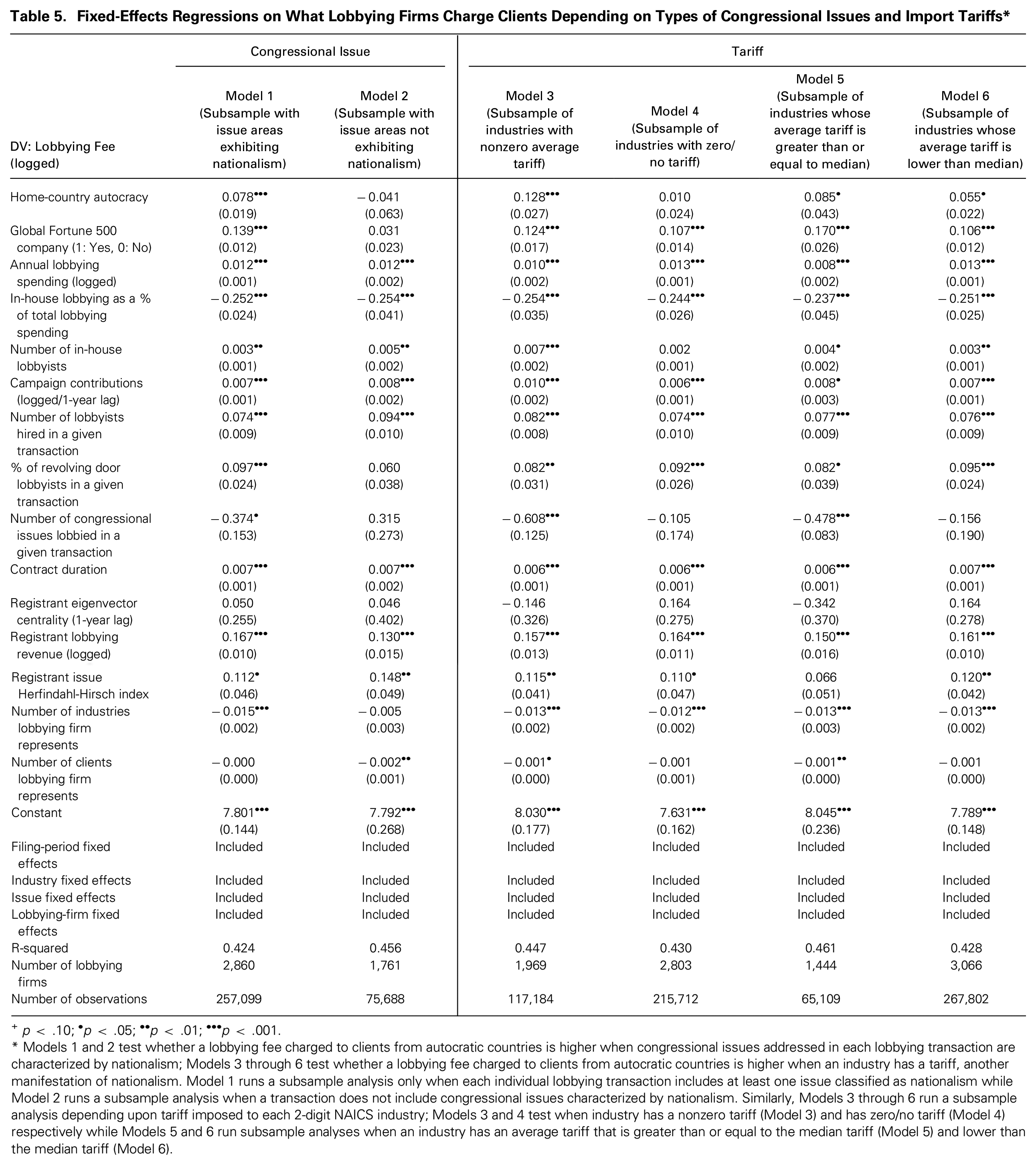
Fixed-Effects Regressions on What Lobbying Firms Charge Clients Depending on Types of Congressional Issues and Import Tariffs*
p < .10; • p < .05; •• p < .01; ••• p < .001.
Models 1 and 2 test whether a lobbying fee charged to clients from autocratic countries is higher when congressional issues addressed in each lobbying transaction are characterized by nationalism; Models 3 through 6 test whether a lobbying fee charged to clients from autocratic countries is higher when an industry has a tariff, another manifestation of nationalism. Model 1 runs a subsample analysis only when each individual lobbying transaction includes at least one issue classified as nationalism while Model 2 runs a subsample analysis when a transaction does not include congressional issues characterized by nationalism. Similarly, Models 3 through 6 run a subsample analysis depending upon tariff imposed to each 2-digit NAICS industry; Models 3 and 4 test when industry has a nonzero tariff (Model 3) and has zero/no tariff (Model 4) respectively while Models 5 and 6 run subsample analyses when an industry has an average tariff that is greater than or equal to the median tariff (Model 5) and lower than the median tariff (Model 6).
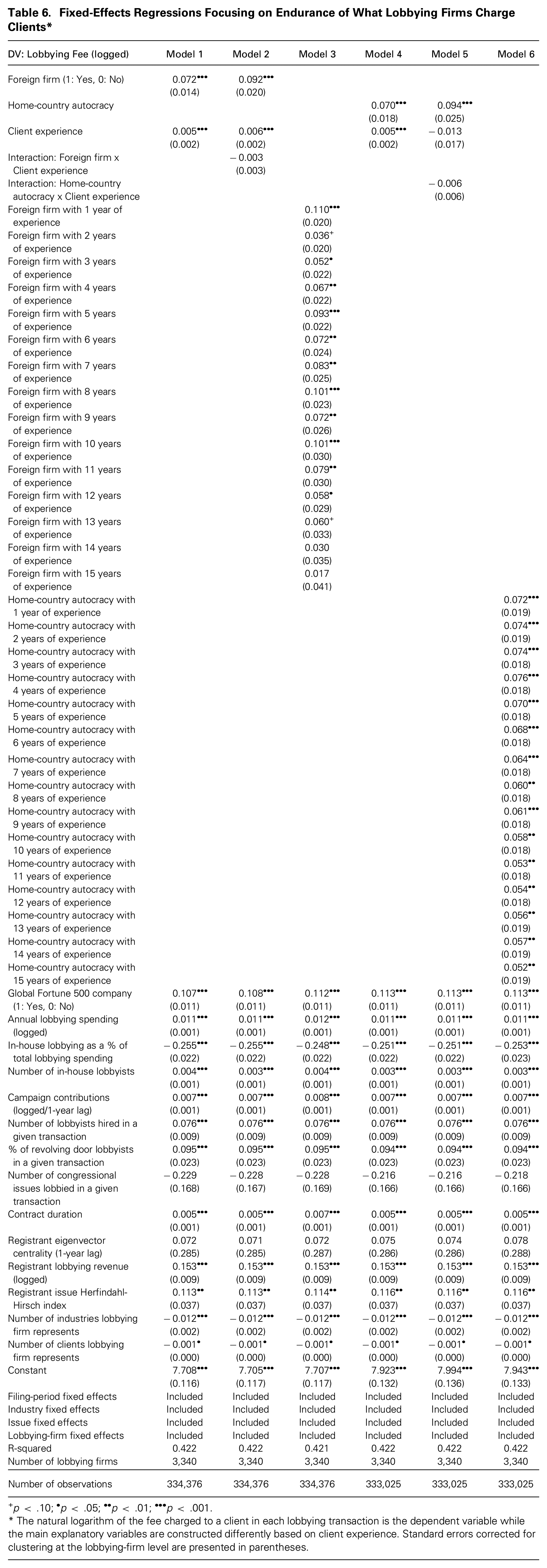
Fixed-Effects Regressions Focusing on Endurance of What Lobbying Firms Charge Clients*
p < .10; • p < .05; •• p < .01; ••• p < .001.
The natural logarithm of the fee charged to a client in each lobbying transaction is the dependent variable while the main explanatory variables are constructed differently based on client experience. Standard errors corrected for clustering at the lobbying-firm level are presented in parentheses.
The mean variance-inflation factor (VIF) for each variable included in the regression is less than 2.48, and no individual VIF exceeds 8.5, suggesting that there is no multicollinearity issue. We also tested our regressions after dropping control variables that are more highly correlated with our dependent variable, although we do not report those results. 6 The results remain robust, and the coefficients of our explanatory variable are statistically significant.
Hypothesis 1
Table 3 provides results of the main lobbying-firm fixed-effects regression for Hypothesis 1: that lobbying fees charged to foreign firms are higher than those charged to U.S. firms. Every model includes filing-period, industry, congressional-issue, and lobbying-firm fixed effects, and Models 5–7 add federal-agency fixed effects. Model 1 includes main control variables only. The signs of most control variables included in the specification are as expected, and the statistical significance and the value of coefficients for control variables are consistent across different models in Table 3. Model 2 is our main specification, and Models 3 and 4 use exact matching methods. Observations in Model 3 are exactly matched for filing period and industry, and Model 4 uses lobbying firm as an additional dimension in exact matching. Models 5–7 correspond to Models 2–4, respectively, but include federal-agency fixed effects in addition to the variables used in Models 2–4. Regardless of fixed-effects and different exact-matching approaches, the coefficients of our main explanatory variable are positive and statistically significant at p < 0.001; hence, the results strongly support our hypothesis that foreign firms pay higher fees than do U.S. firms. Note that the coefficients and standard errors are stable across different models and vary little, implying that the effect of foreignness is consistent and common across lobbying firms, holding constant other factors assumed to directly affect fees. Further, the coefficients of the explanatory variable in Table 3 range from 0.072 to 0.102, signifying that lobbyists charged approximately 7.2 to 10.2 percent higher fees on average to foreign firms than to U.S. firms.
Hypothesis 2
Table 4 provides results that further tease apart the variance we observed in Table 3. Hypothesis 1 asserts that foreign firms pay higher fees because of their foreignness. Table 4 substitutes a values-based conflict between democracy and autocracy, Home-country autocracy, as a main explanatory variable for a foreign-firm indicator variable, to help us learn whether home-country autocracy explains significant variance in the main specification presented in Table 3. Models 1–7 in Table 4 correspond to Models 1–7 in Table 3, respectively. Including home-country autocracy in Table 4 explains variance substantively as well as or slightly better than Table 3 does. Further, the coefficients of home-country autocracy in all models are positive and statistically significant. The results confirm Hypothesis 2. Considering the coefficient in Table 4, Model 2, we find that a foreign firm from a democratic country like Brazil faces an 8.7 percent fee premium, which is nontrivial but not particularly large. In contrast, a foreign firm from an autocratic home country like China is charged a 28.7 percent fee premium.
Figure 2 illustrates the post-estimation of fee premiums charged to different types of clients after we ran our main regression for Hypothesis 2, shown in Model 2 in Table 4. As foreign firms’ home countries become more autocratic, the fees charged to them increase, when we hold other variables constant. Figure 3 further illustrates the post-estimated average lobbying fees charged, based on the baseline regression models for Hypotheses 1 and 2 as above, shown in Model 2 in Tables 3 and 4. Figure 3(A) compares the fees charged to U.S. firms with those charged to foreign MNEs. Figure 3(B) further illustrates differences across firms from home countries with different political regimes.
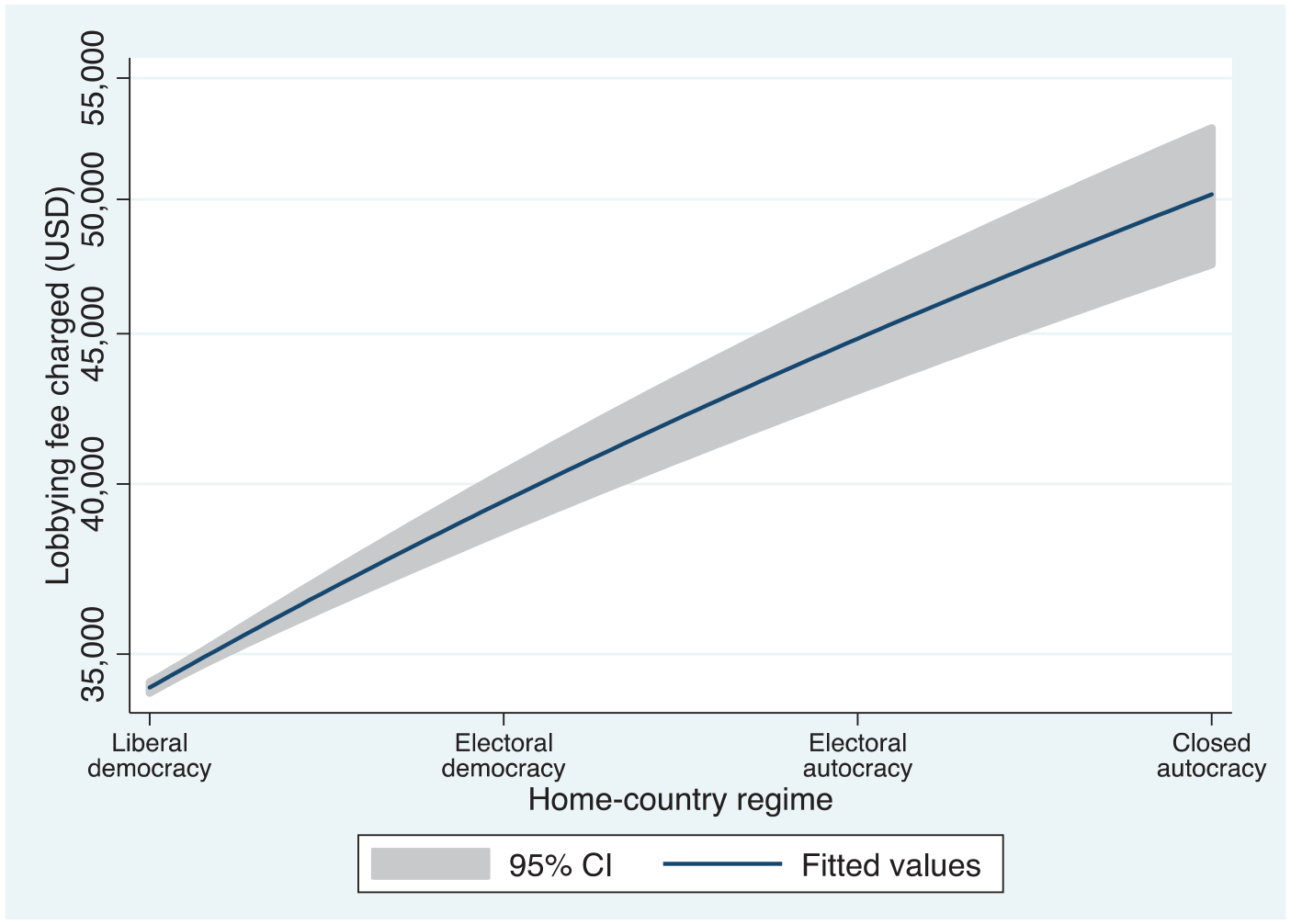
Predicted Effects of Home-Country Regime on Lobbying Fee Premiums
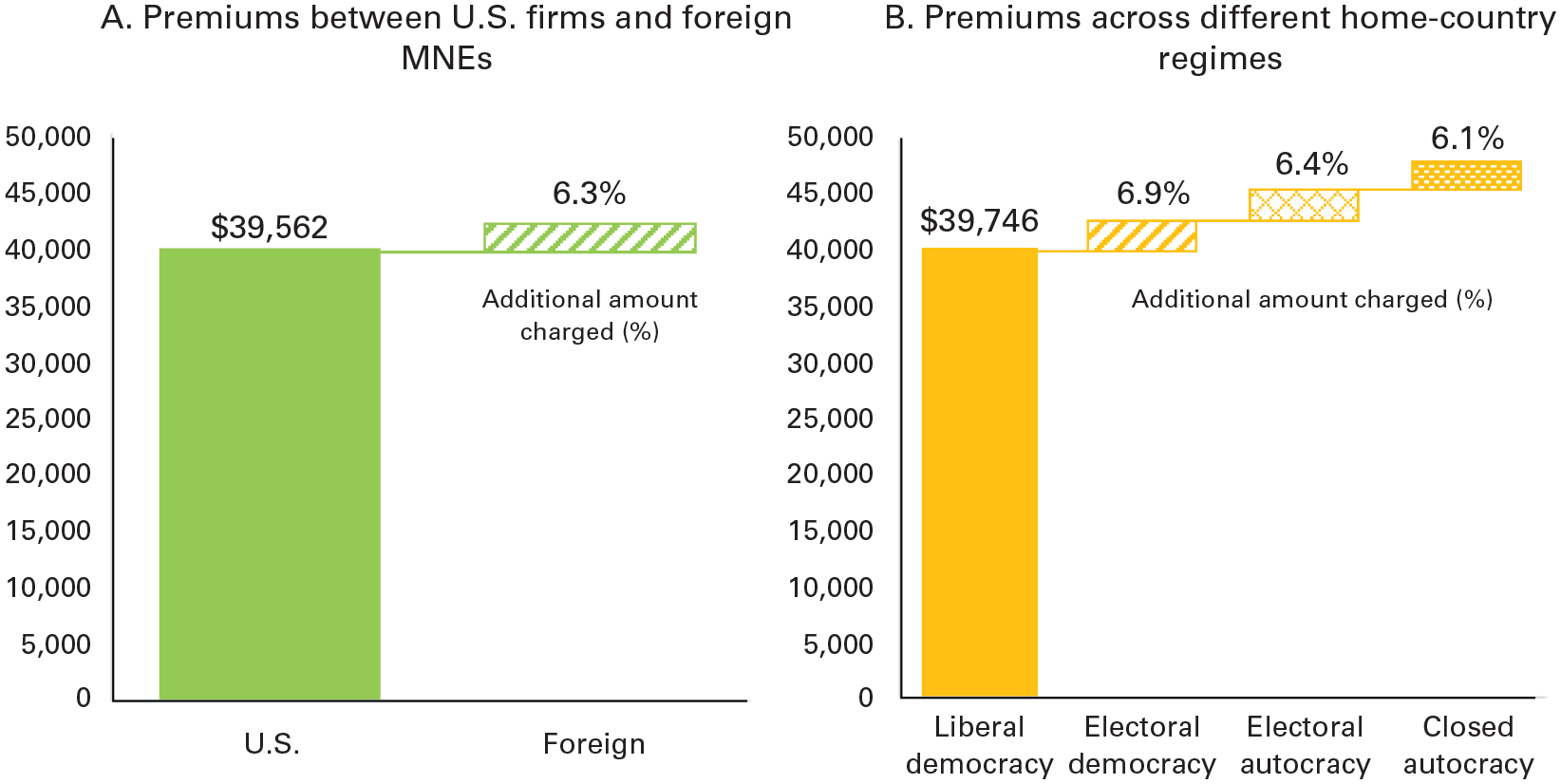
Predicted Lobbying Fee Premiums Charged to U.S. and Foreign Clients and by Home-Country Regime
Hypothesis 3
Hypothesis 3 asserts that if client firms seek to lobby on issues that evoke nationalism, the fee charged to clients from autocratic countries will be higher for issues with nationalistic implications. Table 5 presents regression results for Hypothesis 3. Models 1 and 2 show the subsample analyses depending on whether each lobbying transaction includes a nationalist issue. The coefficient of home-country autocracy in Model 1, which is a subsample of transactions addressing more-nationalist issues, is statistically significant at p < 0.001, while that in Model 2 is not. This finding strongly supports our arguments that foreign firms from autocratic home countries pay higher fees due to the unconcealable stigma that autocracy entails, which can easily invoke nationalism in political lobbying. (In a robustness check, we found that our results are robust to alternatively using any single one of the independent codings as well as to alternatively using a decision rule based on the unanimous coding of an issue area as nationalistic by the three political scientists from Harvard University.)
To further support our argument, we ran another test, presented in Models 3–6. Model 3 is a subsample analysis for an industry whose tariff is non-zero. Model 4 is a subsample analysis for an industry without tariff protection or whose tariff is zero. Similarly, if an industry-average tariff was greater than or equal to the median, we ran a subsample analysis for that industry in Model 5. Model 6 analyzes industries whose tariff was lower than the median. Model 3 shows that the coefficient for home-country autocracy is positive and statistically significant. Consistent with our theoretical mechanism, the same coefficient is not statistically significant in Model 4. Similarly, the coefficient for the relatively more precise test in Model 5 is larger than that in Model 6, implying that clients from autocratic home countries are charged a higher lobbying-fee premium if the tariff is higher in their industry. These additional regression analyses further support Hypothesis 3.
Hypothesis 4
Thus far, we have shown that foreign firms, particularly those from autocratic home countries, are charged significantly higher fees, statistically and economically, than are U.S. firms or foreign firms from more-democratic countries. Hypothesis 4 further claims that such a high premium for firms from autocratic countries will endure because of stigmatization. In other words, the stigma effect for firms from more-autocratic countries is likely to persist because of the values-based conflict between democracy and autocracy. Table 6 tests this claim: Models 1–3 are based on Model 2 in Table 3, and Models 4–6 are based on Model 2 in Table 4.
First, Models 1–3 test whether foreign firms still pay higher fees than U.S. firms do even when we consider firms’ lobbying experience, measured as years of lobbying. Model 1 controls for client lobbying experience (Client experience) as an additional control variable, while creating a two-way interaction term between the Foreign firm indicator and Client experience variables in Model 2. Model 3 further delves into the duration of the liability by comparing U.S. firms to foreign MNEs with identical lobbying experience. We created this variable as an interaction term between a foreign-firm indicator and different years of lobbying experience and included it in our regression. For example, assume that in 2008, there were four firms, A, B, C, and D, with different lengths of lobbying experience. Firms A and B have only one year of lobbying experience; firms C and D have three years of experience. Firms A and C are U.S. firms; firms B and D are foreign MNEs. In this case, firms A and B are compared via the newly created interaction term. Similarly, firms C and D are compared given their same lobbying experience. Given that our sample period is 15 years, we reiterate this process, creating 15 different interaction terms depending on the length of the client’s lobbying experience. Second, as we did with a foreign-firm binary variable, we ran a regression mirroring Models 1–3 with Home-country autocracy in Models 4–6. Models 4–6 correspond to Models 1–3, respectively.
As Models 1 and 4 show, our main explanatory variables remain statistically significant. The values of the coefficients are analogous to what we observed in Model 2 in Tables 3 and 4, indicating that even after we consider clients’ lobbying experience, lobbying firms charge higher fees to foreign firms, particularly those from autocratic countries, and this pattern is quite stable. Our main explanatory variables are statistically significant at p < 0.001, indicating the enduring effects of the liability as hypothesized. More-interesting results regarding enduring stigma are presented in Models 3 and 6. In Model 3, the coefficients are positive and statistically significant up to 13 years of lobbying experience, that is, foreign firms pay significantly higher fees for fully 13 years on average. The effect of being from an autocratic country is yet more enduring; foreign firms from autocratic countries are charged a significant fee premium for the full 15 years of the sample period. The results strongly support our argument that the average foreign firm from a country with an autocratic political system never sees a statistically significant decrease in its fee premium.
One might ask whether many foreign firms will lobby for a long time. In other words, if foreign firms behave systematically differently from U.S. firms, comparisons would not be apples to apples. We also found substantive similarity between the two groups in terms of lobbying experience, in panel A of Table A3 in the Online Appendix. Panel B of that table shows the percentage of firms, domestic and foreign, that stayed in the lobbying market through the final year of the sample period. The summary statistics suggest that the enduring effect of the fee premium that we observe in the main regression results is not likely driven by idiosyncrasies of foreign firms as a group but by the values-based ideological conflict between democracy and autocracy.
Robustness Checks
Heterogeneity in representing foreign and U.S. clients in lobbying transactions
One might claim that the characteristics of lobbying transactions will differ depending on the types of clients a lobbyist serves and that these differences will be the source of heterogeneous fees. In particular, the heterogeneity of foreign clients—particularly those from autocratic countries, whose interests might require more time and resources—might make it harder for lobbyists to represent them. In other words, an alternative argument is that a comparison of foreign and U.S. clients might not be apples to apples because the transactions in question differ. To rule out this possibility, we provide summary statistics for a few factors that create heterogeneity in lobbying efforts. For example, when a policy issue is highly contentious, many interest groups are apt to mobilize their resources, making lobbyists’ work harder and the chances of succeeding minimal (Baumgartner et al., 2009). If lobbyists must deal with multiple federal agencies, both the amount of work and the types of lobbyists involved will increase (Ridge, Ingram, and Hill, 2017; Kim, 2019). To rule out this possibility, we present Table 7, which provides summary statistics on most representative transaction characteristics by different types of clients, as we assume that these characteristics determine the lobbying fees. This table confirms that lobbying transactions are similar regardless of the type of clients each lobbying firm serves.
Characteristics of Each Lobbying Transaction by Client Type*
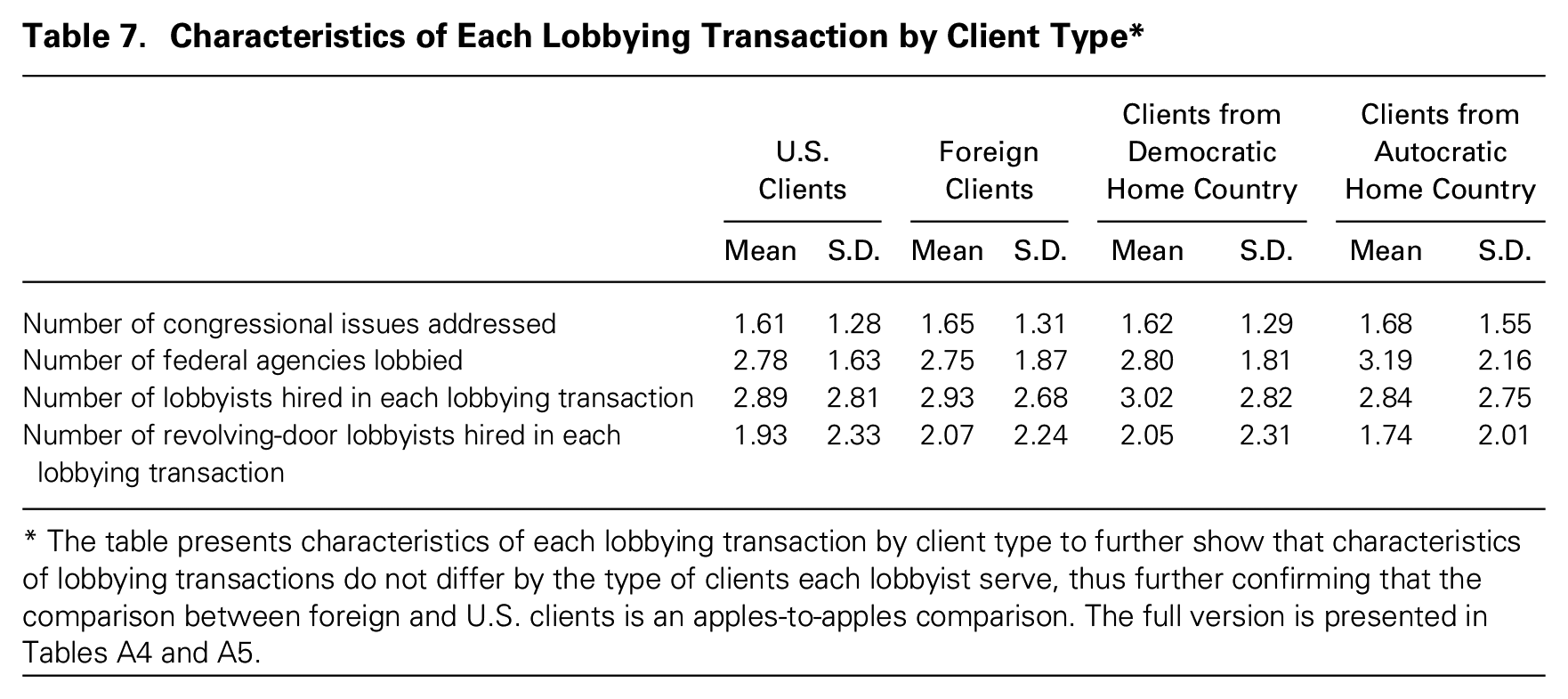
The table presents characteristics of each lobbying transaction by client type to further show that characteristics of lobbying transactions do not differ by the type of clients each lobbyist serve, thus further confirming that the comparison between foreign and U.S. clients is an apples-to-apples comparison. The full version is presented in Tables A4 and A5.
Our interviews support this conclusion. A foreign company’s governmental affairs manager reported not getting much lobbyist time for his company’s monthly $20,000 fee to a high-status D.C. lobbying firm: The time they give us is not as much as it should be. We do get emails on a weekly basis. They scour some bills for language that might be relevant to us. They flag articles and press stories. That shouldn’t take 2–3 hours per week. And we sometimes do meetings with them. They may do 5 of those per month. So that’s like 5 hours of meetings and 5 hours of prep per month. So they’re not doing a lot of work for that money. (Field interview, December 2018)
Tables A4 and A5 in the Online Appendix show a more extensive comparison across different client groups regarding various aspects of each lobbying transaction, broken out by lobbying-firm revenues. The findings illustrate that although transaction characteristics vary over time and by lobbying-firm size, they barely vary across different client groups. The key takeaway from the summary statistics and from this interview is that neither supports the thesis that it typically requires more resources to serve foreign clients, particularly those from autocratic countries.
Although the summary statistics above show no evidence that the nature of work between domestic U.S. and foreign clients is significantly different, we used out-of-sample data to do an additional robustness check to rule out whether a different type of work drives a higher fee for representing clients from autocratic countries. While we were looking for a way to further address the time-of-service alternative explanation, we learned that the Foreign Agents Registration Act (FARA) requires disclosure of detailed task completion data for the various foreign governments that lobbying firms represent (which the LDA does not require). Fortunately, a subsample of the lobbying firms in our original sample (LDA) also represented foreign governments, which thus reported this information (in FARA). We were therefore interested in whether it is significantly more task-intensive to serve an autocratic government compared to a democratic government. For this analysis, we further collected and digitized such data for a random subsample. We randomly chose a subsample of five high-status lobbying firms that serve both democratic and autocratic governments and five non-high-status lobbying firms that serve both these types of governments, for the beginning, middle, and end of the comparable sample time period of 1998–2012 (with the digitalized data coming specifically from the years 1998, 2000, 2005, 2010, and 2012). The Washingtonian and The Hill, both widely read in D.C., cover the lobbying industry and have published lists of high-status lobbyists (based on interviews with lobbyists and fellow journalists). We consider a firm to be high status if one of its lobbyists was ranked as high status at least once during the sample period by The Washingtonian (in 1998, the sole year it published such a list) or The Hill (during the years it published a high-status list, 2003 and 2005–2012).
We are able to see documentation of every phone call, every meeting, and every email associated with both types of clients, either from an autocratic or democratic home country, for each lobbying firm for those years. We found through empirical analysis of these data that no matter the statistical test performed, no statistically significant difference exists in this random sample between the number of tasks involved in representing an autocratic country compared to a democratic country for the same firms in the random sample. This finding further helps us rule out the most feasible alternative claim of time of service. Interviews further support this conclusion. One high-status lobbyist told us that lobbyists do not charge higher fees to clients from autocratic countries on the grounds that more hours of work will be required: I wouldn’t know anyone who could predict they would have to work X number of hours extra on the United Arab Emirates compared to the United Kingdom. There are some weeks where I don’t need to talk at all to my foreign clients. There are other times where I see something that is reported and I think it is a big deal. The price premium I charge to clients from autocratic countries is far more about the who-you-are premium. (Field interview, September 2022)
Adverse selection and matching
A major alternative scenario could be that only certain types of lobbying firms, notably those less competent or lower status, are likely to represent firms from autocratic countries and that this pattern explains higher fee premiums. Though our interviews refuted this assertion, Tables A6–A8 in the Online Appendix test for adverse selection by highlighting the role of lobbying firms of different status and their characteristics. 7
Table A6 lists high-status lobbying firms and lobbyists as delineated above with at least one client from an autocratic country, along with summary statistics (panel A) showing whether a firm’s pattern of representing such clients differs from those of other types of lobbying firms. High-status lobbyists represent 0.5 percent of all lobbyists; as a percentage of all high-status lobbyists, those with at least one client from an autocratic country account for 10.7 percent. Clearly, high-status lobbyists represent clients from autocratic countries. Table A6, panel B, lists all individual lobbyists at these high-status firms who have represented a client from an autocratic country at least once. This list illustrates that high-status lobbying firms accept clients from autocratic countries and that it is not rare for high-status firms and the lobbyists they employ to have such clients.
Tables A7 and A8 further explore whether any heterogenous pattern is apparent among these high-status firms with at least one client from an autocratic country. The average lobbying fee charged by a lobbyist with at least one client from autocratic countries during the sample period is $73,525; that of a lobbyist at the same firm without such a client is $71,384 (Table A7). Nor does the annual average income of the two groups differ much: the annual average income of a lobbyist with at least one client from an autocratic country is $612,486, and that of a lobbyist at the same firm without such a client is $583,108 (Table A8). Thus, clients from autocratic countries do not lack access to individual high-quality lobbyists.
Adverse selection and matching at the individual lobbyist level
Another alternative scenario is that certain types of lobbyists might choose to represent only certain types of clients. In particular, lobbyists whose annual income is low might opt for foreign clients because the lobbyists are less competent and thus are spurned by domestic U.S. clients. To test this possibility, we followed Bertrand, Bombardini, and Trebbi (2014) in calculating the annual lobbying income of each lobbyist by aggregating the revenue generated in each transaction (the fee charged divided by the number of participating lobbyists). For example, lobbyist A participates in three transactions in 2009 whose fees are $10,000, $20,000, and $5,000. These transactions involve four lobbyists, two lobbyists, and one lobbyist. The revenue generated by lobbyist A is assumed to be $2,500, $10,000, and $5,000; thus lobbyist A’s income in 2009 is calculated to be $17,500 ($2,500 + $10,000 + $5,000).
Table A9 in the Online Appendix presents the total annual lobbying income of each individual lobbyist, broken out further by size of lobbying firm. Tables A10 and A11 classify lobbyists by the types of clients they serve and the size of the lobbying firm. In both tables, panel A presents the average annual income of lobbyists who serve foreign clients, and panel B represents that of lobbyists serving U.S. clients. Interestingly, Tables A10 and A11 show that lobbyists serving foreign clients generate more income than do those who serve U.S. clients. Also, the annual income of the high-status lobbyists observed in Table A8 is much higher on average than the incomes reported in Tables A9–A11. Even the high-status lobbyists who serve autocratic clients generally earn more than the average for lobbyists at all lobbying firms. This pattern persists even at the largest firms in the sample. Assuming that the productivity of an individual lobbyist is associated with capability measured as income, we believe that this pattern shows that neither foreign firms in general nor those from autocratic countries are matched with less-capable lobbyists.
Counterfactual analysis
Given the summary statistics presented above, particularly those pertaining to lobbying-firm sorting, we formally tested whether high-status lobbying firms are more or less likely to enter into a lobbying contract with clients from autocratic countries. Basically, we performed a counterfactual analysis by creating all potential lobbying-firm/client ties each year; see appendix Table A12. In principle, if the results show that based on statistical significance, autocratic clients were no less likely than all other firms to match with a given lobbying firm in general or with high-status lobbying firms in particular, we can conclude that there is no evidence of the kind of assortative matching that would confound our main empirical results of interest.
Specifically, we ran a probit regression of all possible ties between a client and a lobbying firm with Home-country autocracy as a main explanatory variable. Next, we created an interaction term between Home-country autocracy and a binary variable of High-status lobbying firm to determine the likelihood that a high-status lobbying firm represents clients from autocratic countries. We created a binary variable indicating whether a lobbying firm actually represents a given client, based on actual lobbying transactions in each year. For example, assume that in 2009 there are three lobbying firms, A, B, and C, and two clients, X and Y. Firms A, B, and C all represent client X; only firm A represents client Y. In this case, the dependent variable will take the value 1 for lobbying firm–client pairs A–X, B–X, C–X, and A–Y and 0 for pairs B–Y and C–Y in 2009. We created every possible pair for each year in the sample period.
For Models 1 and 2, we created the variable representing a high-status firm based on whether the firm employed a high-status lobbyist in a certain year. Models 3 and 4 assume that a firm’s high status will persist in subsequent years. For example, assume that lobbyist A at firm B was ranked high status in 2004 and 2006. In Models 1 and 2, the firm takes the value 1 for high status in years 2004 and 2006 only. In Models 3 and 4, however, the variable for high-status lobbying firm takes the value 1 in all years from 2004 to 2012. Given that we ran this analysis at the client/lobbying-firm/year level, we dropped transaction-level variables. All variables included are at the annual level. The results confirm that clients from autocratic countries are no less likely than any other client to access a high-status lobbyist. Further, and more interesting, the coefficient on high-status lobbying firm is negative and statistically significant, while the interaction term is not statistically significant, implying that high-status firms are not less likely to form a tie with a client from an autocratic country.
Coarsened exact matching to rule out foreign firms being fundamentally different from U.S. domestic firms
Though lobbying reports enabled us to control for the most important observable aspects of lobbying contracts, and though multiple fixed effects employed in the main regression also supposedly captured unobserved heterogeneity across lobbying contracts, such heterogeneity could hinder direct comparison of the groups we aim to compare. Thus, using a coarsened exact matching (CEM) approach in robustness checks, we tried to estimate the coefficients of our explanatory variables with a balanced sample (see Iacus, King, and Porro, 2012 for more information about CEM). We used multiple and alternative matching criteria across models in appendix Tables A13–A15 (please see our more-detailed description in each table note) to see whether our estimation significantly varies across different matching variables. However, the magnitude of coefficients of our variables of interest differs little from those of balanced samples in different matching algorithms with robust statistical significance. Those results, in turn, are consistent with our estimation of the costs of paying for legitimacy shown in the main analysis.
Further accounting for different home-country variables to rule out the effect of other home-country characteristics
As Tables A16 through A19 in the Online Appendix show, we further attempted to rule out alternative explanations. In Table A16, our theoretical arguments imply that other measures of home-country regime that distinguish democracy from autocracy must show results similar to those of our measure of home-country autocracy. Thus, we sought to further validate our theoretical construct by testing various home-country political-regime measures from multiple different data sources. Regardless of different democracy measures, the results strongly support that lobbyists charge a substantial fee premium to firms from autocratic countries. As Tables A17 through A19 show, we tested for additional home-country institutional effects. In Table A17, we consider whether a foreign MNE’s home country is a tax haven. In Tables A18 and A19, we further account for several additional home-country institutional characteristics. In these further robustness checks, our results of interest are still strongly supported.
Further accounting for lobbying disclosure characteristics to rule out the idiosyncratic effects of lobbying transaction
In Tables A20 through A22 in the Online Appendix, we further accounted for the characteristics of lobbying reports to test whether these characteristics could have driven these empirical results. In Table A20, as delineated above, each lobbying report does not have to disclose the exact amount if it is below a certain threshold. Thus, we dropped the lobbying transactions from our sample to see whether the statistical results were influenced by the construction of our dependent variable. Even after these lobbying transactions are dropped, our results are robust. As Table A21 shows, to test whether outliers could have driven our results, we winsorized the highest 1 percent of the lobbying-fee data points at the 99th percentile and ran a regression. In Table A22, we dropped lobbying transactions that did not lobby the U.S. Congress. Our results of interest are robust and further supported.
Discussion and Conclusion
In the context of nonmarket strategy, thousands of firms seek lobbying services. In Washington, D.C., lobbying is a multi-billion-dollar-per-year industry. We find that the large fee premium charged to foreign firms is meaningfully driven by a large and enduring premium charged to firms from autocratic regimes. This is a market in which foreign firms seek and are charged for legitimacy, given conflicting values-based ideologies at the democracy–autocracy divide.
Lobbying is considered by many political scientists to be the most important corporate political activity in the United States. No restrictions are imposed on who can lobby, and any company, including foreign firms, can influence the policymaking process (Milyo, Primo, and Groseclose, 2000). The market for lobbying is not a small niche; tens of thousands of firms sought services, and expenditures on lobbying services grew steadily at a compound annual growth rate of 5.6 percent, reaching $3.5 billion per year by the end of the sample period.
Our main finding speaks to organizational theory’s search for the underlying causes of the liability of foreignness. Prior studies have focused on lack of information, lack of social embeddedness, or discrimination. We identify a factor that is meaningfully different: liability based on values-based ideological conflict at the democracy–autocracy divide. This conflict differs from discrimination based on xenophobia, race, ethnicity, or nationality. Approximately one of every three countries globally was an autocracy during our sample period (Frantz and Ezrow, 2011). Note that the fee premium we found in its largest and most enduring form was targeted at countries whose regimes resulted in a values-based ideological conflict at the democracy–autocracy divide. Again, we emphasize that we do not endorse this type of conflict, given that lobbying firms will make mistakes, specifically by failing to distinguish between opponents of autocratic regimes and those who clearly back those regimes and by categorically lumping together all autocratic countries.
While conducting this research, we were curious to learn whether high-status lobbyists would reject clients from autocratic countries or simply charge a higher price. One lobbyist predicted that stigma would cause a high-status lobbyist to avoid such firms: The lobbyist would think twice. You do get on a list of the people who are willing to represent companies that may not have the same values and ethics. You may find yourself representing members of the Communist party. That affiliation may cast a shadow on you. But everybody’s got their price. I knew a gentleman who was struggling to get a job representing clients. So you’ll get a smattering of those people. (Field interview with a senior lobbyist, December 2018)
This view prevailed among some lobbyists, but our examination of disclosure data revealed that many high-status lobbyists serve firms from autocratic countries; in fact, the rate at which high-status lobbying firms accept such clients is quite similar to their representation in the sample of all clients over time. Nor does there seem to be an adverse-selection effect whereby the lobbyists in least demand are hired by clients from autocratic countries. A matching regression showed that such clients faced no significant liability in hiring high-status lobbying firms. Why does illegitimacy lead to access with a substantial fee premium instead of exclusion? An interview with a lobbyist offers a hint: “Different firms had different ethos. Akin Gump, and Patton Boggs, would each represent everybody. There wasn’t active management of how much was too much reputational risk. There’s nobody who is all-knowing and all-seeing inside the lobbying firms” (field interview with a D.C. lobbyist, November 2020). This view implies that although in general lobbyists do care about their reputations, they also cannot know ex ante how much risk they are taking on. Thus, rather than rejecting clients from autocratic countries, lobbyists may aim to extract economic rents. Facilitating this stance is the fact that as service providers, lobbyists need not be exclusively associated with their most controversial client; they can serve numerous clients over the course of a year. In a service-to-many business model, it is logical that even many high-status lobbyists will see fit to have at least one client from an autocratic country as long as they can charge a premium.
We also wondered whether the fee premium changes with either the number of clients from autocratic countries each year or their cumulative number from the beginning of the sample period, since a lobbyist’s potential risk, and thus risk premium, may be differently calculated as their client portfolio changes. In a supplementary exercise, we tested whether this is true. First, we found no evidence that the fee premium moves toward a smaller number, suggesting that the fee premium is like a risk premium in corporate finance, in which risk is something that cannot be made to go away by taking on more risk but simply can be mitigated by reducing risk as a percentage of the overall portfolio. In another test, we also found that the fee premium actually went up with taking on more risk, which is analogous to Ghemawat’s (2007) theorizing that operational risk increased as multinational firms took on uncorrelated geographic risk across an increasing number of global geographic regions. These additional supplementary exercises are consistent with our argument that higher lobbying fees charged by lobbyists is a risk premium due to their own labor market reputations.
In our study’s context, unobserved factors could influence who gets to represent whom and how difficult the task is. We acknowledge the challenges and limitations of this context, but to help counteract this challenge, we have presented multiple pieces of both qualitative and quantitative evidence. On the qualitative side, we presented evidence from field interviews, which indicate that lobbyists attribute the premium to reputational risk rather than to the time required to serve that type of client. On the quantitative side, we found that individual lobbyists who serve foreign firms are not less productive in terms of annual income generated overall throughout their portfolios of clients. Even clients from autocratic countries appear to be able to hire individual lobbyists who are among the highest earners at high-status firms. From the observable variables, it does not appear that the fee premium for clients from autocratic countries can be attributed to having larger teams or to other observable measures of time required to serve the client.
A further attribute of this market is that we can effectively see prices and thus estimate the fee for legitimacy at each firm. To the best of our knowledge, this study is the first to measure and cleanly identify the price charged to counter a focal firm’s illegitimacy. While a few studies have examined companies’ expenditures to maintain legitimacy (e.g., Jeong and Kim, 2019) or examined how companies’ philanthropy can lead to lower capital costs (e.g., Zolotoy, O’Sullivan, and Klein, 2019), we are unaware of research that has attempted to estimate the price a firm pays to purchase legitimacy. Notably, firms are willing to pay a large and enduring fee premium even when that premium is fully transparent via public disclosures of lobbying reports. Also striking is that the premium is economically meaningful but not so exorbitant as to block such firms from competing in the nonmarket arena. In fact, whether the same firms pay a higher premium on various other costs in the factor market and/or in product-market arenas is an important question for future research.
What we found in the context of lobbying may be generalizable to other market contexts. Lobbying has known similarities to other markets, as other contexts also appear to impose a fee premium for coming from an autocratic home country. For example, being a service provider for an autocracy contributed to loss of reputation for a prominent business consulting company, Monitor Group. Shown to have received millions of dollars in fees for providing consulting services to members of Muammar Gaddafi’s autocratic regime in Libya, Monitor was publicly vilified when Gaddafi’s government threatened to annihilate thousands of Libyans (Pilkington, 2011).
This study also has practical implications for managers. Scholars widely agree that stakeholder management is critical to success in a foreign market and that legitimacy plays an important role (Jia, 2018; Kim, 2019). Our study illustrates that being perceived as legitimate is critical to firms’ political strategy. We show that foreign firms, particularly those from autocratic countries, are willing to pay a large premium to gain legitimacy via the services of professional lobbyists in Washington, D.C. We view this as part of a larger lesson about the current era of globalization, in which, because of values-based ideological conflict at the democracy–autocracy divide, simply to have a chance to compete, firms from the opposite side of the spectrum must pay a premium for standing behind partners who carry the power of certification and legitimacy. Thus, managers at a foreign firm may need to carefully assess what will enhance their legitimacy in the eyes of host-country stakeholders and how best to achieve their nonmarket aims. Prior studies of the liability of foreignness have mentioned certification as a need (Bell, Filatotchev, and Rasheed, 2012; Kim, 2019). But the idea that this liability could be driven in the context of nonmarket strategy by ideological conflict at the democracy–autocracy divide, which in turn leads a firm to buy legitimacy at a substantial fee premium, is new and merits study in additional market contexts.
Supplemental Material
sj-pdf-1-asq-10.1177_00018392231217676 – Supplemental material for Paying for Legitimacy: Autocracy, Nonmarket Strategy, and the Liability of Foreignness
Supplemental material, sj-pdf-1-asq-10.1177_00018392231217676 for Paying for Legitimacy: Autocracy, Nonmarket Strategy, and the Liability of Foreignness by Jin Hyung Kim and Jordan I. Siegel in Administrative Science Quarterly
Footnotes
Acknowledgements
We are sincerely grateful to associate editor J.P. Eggers and three anonymous reviewers for their valuable and constructive feedback. We are grateful for research funding from the University of Michigan and George Washington University. We also would like to thank the participants in the 2020 AOM symposium, the University of Michigan Hosmer-Hall seminar series, the HKUST management seminar series, the Baruch College international business seminar series, and the Rice University Strategy Symposium on Emerging Markets, and a group of political scientists at Harvard University’s Government Department for their helpful comments on earlier drafts. We are also thankful to the former and current lobbyists who spoke with us as part of our research interviews. We also would like to express our gratitude for the excellent RA work by Kexin Huang. We are also grateful to the ASQ editorial team, Joan Friedman and Ashleigh Suzanne Imus, for their assistance.
1
One Washington, D.C., lawyer who represents lobbying firms confirmed that our findings align with his own experience and what he has seen of his profession: “It is generally consistent with what I’ve seen in terms of fees: clients from politically authoritarian regimes pay more” (field interview, April 2021).
2
A later section delineates in more detail how we define high-status lobbying firms.
3
“You’re always taking on the reputational risk of your client in any lobbying representation” (field interview with a D.C. lobbyist, November 2020).
4
The Lobbying Disclosure Act (LDA) of 1995 requires all lobbying transactions involving private firms lobbying any part of the U.S. federal government to report with the Secretary of the U.S. Senate’s Office of Public Records. The Center for Responsive Politics compiles the data and makes the data available in a user-friendly format.
6
For variables in  whose pairwise correlations are statistically significant and greater than 0.2, we dropped each variable individually or those that are highly correlated and ran a regression to test whether the statistical significance of our main explanatory variables changes. The results do not change and strongly hold.
7
A leading analyst of the lobbying industry stated that despite career risk, most high-status lobbying firms are eager to serve clients from autocratic regimes: “We’ve seen some lobbying firms that take on controversial clients and still built up a big practice. Examples include Mercury, as well as Ballard Partners, which represented Qatar during a difficult time” (field interview, April 2021).
Authors’ Biographies
References
Supplementary Material
Please find the following supplemental material available below.
For Open Access articles published under a Creative Commons License, all supplemental material carries the same license as the article it is associated with.
For non-Open Access articles published, all supplemental material carries a non-exclusive license, and permission requests for re-use of supplemental material or any part of supplemental material shall be sent directly to the copyright owner as specified in the copyright notice associated with the article.
