



Abstract
Tedious work is pervasive in creative work, yet it has received little attention in the literature on creativity, including studies of science, innovation, and product development. Drawing from a comparative ethnography of two settings—systems biology and music production—we illuminate tedious work as an essential, previously under-investigated aspect of creative work that becomes increasingly prominent with digitization. Tedious work is repetitive, detail-oriented, and expertise-based, and we classify four types of it: fishing, administrating, polishing, and compiling. We develop a model of how tedious work emerges, why it becomes problematic, and what actors do to reduce its negative effects. Tedious work presents three risks to developing viable, novel outcomes—time drain, disengagement, and information overload—and we identify tactics that actors use to mitigate these risks and support individual creativity and the collective creative process. By unpacking the central notion of iteration and documenting the repercussions of creating novel outcomes with digitization, specifically the potential to amplify tedious work, we provide an important counterpoint to voices that hail digital technology’s low cost and unlimited potential for iteration and refinement.
Keywords
Creativity scholars typically emphasize the glamorous moments of developing novel outcomes: inspired brainstorming among IDEO designers (Sutton and Hargadon, 1996), exhilarating improvisation in jazz music (Fisher and Barrett, 2019), and intensive teamwork in Broadway show production (Uzzi and Spiro, 2005). Uzzi and Spiro (2005: 458) described “full days of collaborative brainstorming, the sharing of ideas, joint problem-solving, difficult editing as well as flash points of celebration and commiseration.” Yet, there is also another side to the process of forging novel outcomes. IDEO designers spend hours at their desks sketching and refining ideas (Hargadon and Sutton, 1997); dancers iterate between generating, practicing, and refining their choreography (Harrison and Rouse, 2014); and scientists conduct mundane data work (Ribeiro et al., 2023), such as making extensive annotations (Barley, 1994) to the point of developing a “mania for inscription” (Latour and Woolgar, 1986: 48). This laborious side of creative work brings to mind the famous adage about creativity and innovation: “Genius is one percent inspiration and 99 percent perspiration.”
The growing salience of digital technology within creative work across all industries likely increases the amount of such iterative, detailed, expert work. Scholars have typically heralded the benefits of digitization, which is “the encoding of analog information into digital format” (Yoo, Henfridsson, and Lyytinen, 2010: 725), specifically its unlimited opportunities for rapid experimentation, recombination, and iteration with seemingly little effort and cost (Sapsed and Tschang, 2014) and for precipitating waves of innovation across creative fields (Boland, Lyytinen, and Yoo, 2007). Yet, such unlimited possibilities may require additional labor. For example, digital technology dramatically increases design and prototype iterations in product development (Fixson and Marion, 2012) that entail hours of carefully refining and modifying models and virtual designs, accounting for up to 75 percent of total project cost (Marion and Simpson, 2009). Big data analytics—the pinnacle of digitization—enables unprecedented volume, micro-level detail, and multifaceted richness that require supportive, behind-the-scenes data management, control, and archival work (Goes, 2014). The notion of behind-the-scenes work stems from studies of computer-supported cooperative work that revealed hidden, expert labor by science librarians and technical service providers (Shapin, 1989; Clement, 1993; Hampson and Junor, 2005). “Hidden” suggests that such work is not generally visible to outsiders and, hence, is an elusive object of inquiry.
Drawing from a comparative ethnography of two settings in which digitization brings detailed, iterative work to the fore—systems biology cancer research and the Nashville music production industry—we explore the role of digitization in forging novel outcomes across both the arts and sciences. We thus answer a call for a more inclusive understanding of activities surrounding creative work, considering a broader range of actors and different settings (Harrison et al., 2022). Our contribution is threefold. First, we illuminate an essential, previously under-investigated aspect of creative work that becomes increasingly salient with digitization. We identify tedious work as repetitive, detail-oriented, and expertise-based, and we develop a classification of four types of such work: fishing, administrating, polishing, and compiling. In so doing, we provide greater nuance to the notion of iteration in creative processes. Second, we develop a model of how tedious work arises, why it becomes problematic, and what actors do to mitigate its negative effects. Specifically, we identify three risks that tedious work presents to the development of viable novel outcomes: time drain, disengagement, and information overload. We show how actors attempt to mitigate these risks and support individual creativity and the collective creative process through four tactics: curbing, automating, sustaining, and zooming out. Our study not only offers a generalized model of tedious work within the development of novel outcomes but also fuels future research by identifying tedious tasks, potential risks, and what actors do to bolster the creative process. Third, we discover that digitization’s potential for cheap and unlimited experimentation, refinement, and recombination amplifies tedious work. Our finding that actors exert agency over technology by curbing the extent to which they pursue unlimited possibilities contrasts with prior studies that focus on how actors harness technological potential (Leonardi, 2011). Our work thus extends a burgeoning stream of research on how technology both supports and undermines creative work, and our findings provide an important antidote to more-optimistic views of digitization.
Creating Novel Outcomes with Digitization
Creativity is most commonly defined as the generation of ideas, products, services, and solutions that are novel, useful, and implementable (Amabile, 1983, 1996; Simonton, 1988; Woodman, Sawyer, and Griffin, 1993; Sternberg, 1999; Runco and Jaeger, 2012). Given its core role in driving novelty, creativity has long been of interest to scholars across the arts and sciences (Amabile, 1983, 1996; Amabile and Gryskiewicz, 1987; Sternberg, 1999; Simonton, 2004). Two prominent research streams focus on identifying personal and contextual factors that enable or constrain individual creativity (Shalley, Zhou, and Oldham, 2004; George, 2008) and on elucidating a broader array of collective processes beyond idea generation (Perry-Smith and Mannucci, 2017; Harrison et al., 2022). We draw from this rich portfolio of insights to inform our study of tedious work in the development of novel outcomes.
Creative Work
A stream of research on individual creativity, the “mental operations that result in creative products” (Simonton, 2004: 15), highlights the salience of one’s mood and emotional state, intrinsic motivation, overall level of engagement with and focus on creative tasks, and the supportive or detrimental impact of leaders and time constraints. For example, positive moods enhance individuals’ willingness to seek new ideas and generate possibilities (Davis, 2009), as does individuals’ intrinsic motivation: their perceptions of tasks as interesting, personally absorbing, and worthwhile (Amabile, 1996; Collins and Amabile, 1999). One’s engagement, dedication, and absorption in the creative task (Zhang and Bartol, 2010a) and being “attentive, emotionally connected and totally focused” (Oldham and Da Silva, 2015: 6) are critical to individual problem solving and idea generation. However, creative tasks require strenuous mental energy and “some level of internal, sustaining force that pushes individuals to persevere in the face of challenges inherent to creative work” (Shalley and Gilson, 2004: 36). Leadership plays an important role, for example through supporting individuals’ intrinsic motivation and creative process engagement (Zhang and Bartol, 2010b). Time constraints both support and limit creativity (Rosso, 2014), as feasible time constraints support creativity (Amabile and Gryskiewicz, 1987), but too much pressure undermines idea generation (Amabile, Hadley, and Kramer, 2002).
A second stream of research on collective creativity has illuminated the rich social interactions beyond idea generation that make up creative work: defining problems (Hargadon and Bechky, 2006); evaluating ideas (Harvey and Kou, 2013); giving and receiving feedback (Harrison and Dossinger, 2017); developing shared understanding (Harvey, 2014; Seidel and O’Mahony, 2014); articulating constraints (Harrison and Rouse, 2014); establishing the veracity of novel findings (Owen-Smith, 2001); and negotiating new knowledge boundaries (Dougherty and Dunne, 2012). Such aspects of creative work are complicated by the uncertainty regarding what will result in novel outcomes (Bruns, 2013; Beghetto, 2021) and by ambiguity that arises from competing perspectives regarding quality (Lingo and O’Mahony, 2010). Novelty obfuscates quality judgments, even in contexts with objective, explicit, and widely shared standards, such as in the sciences (Galison, 1999).
Interestingly, there are also indications of other forms of labor involved in creative work that come to the fore with digitization and its associated expansive datasets. For example, animators at Pixar spend hours polishing the minute details of background decor, such as books on a bookshelf, that may or may not be used in the final film (Catmull, 2014); music industry audio engineers dedicate days to micro-polishing sonic data for a single song (Mixerman, 2012, 2014); and scientists analyze unprecedented volumes of digitized data during drug discovery (Drews, 2000; Dougherty and Dunne, 2012). The lack of rigorous scholarly investigation of such work, despite the dramatic increase in digitization, makes it a particularly compelling aspect of creative work at the individual and collective levels. We now turn to literature on developing novel outcomes with digitization to explore this further.
Digitization in Developing Novel Outcomes
A widely held conviction is that digitization is beneficial to creativity: “[Digital] technology can be deployed to augment the creative abilities of people and organizations and make new and valuable forms of innovation possible” (Austin, 2016: 2). A key rationale is that digital technology increases access to new and diverse information, which stimulates creativity (Oldham and DaSilva, 2015). Creative workers leverage technology to develop novel outcomes; for example, video game developers exploit digital technology to achieve novel game designs and features (Lê, David, and Thomas, 2013; Panourgias, Nandhakumar, and Scarbrough, 2014). Scientists harness digitization to manage data complexity in their drug discovery process (Dougherty and Dunne, 2012). However, digitization may also present particular challenges. For example, digitization increases preparatory and standardizing tasks in the biosciences (Ribeiro et al., 2023). Easy design iterations increase idea generation but also challenge teams not to equate over-iteration with design maturity (Marion and Fixson, 2021). In car manufacturing, digital representation enables actors’ detachment from physical objects, such that “engineers in the US sent the less interesting and routine tasks to the Indian modelers” (Bailey, Leonardi, and Barley, 2012: 1501); outsourcing these repetitive tasks resulted in inaccurate simulations and frustrating collaboration, which suggests that this type of work cannot easily be decontextualized. Digital technology bears the risk of information overload as it enables “information collection resulting in the availability of too many ideas and perspectives to effectively screen, process and integrate” (Oldham and DaSilva, 2015: 9). Overload occurs when too much information consumes too much time, causes stress, and undermines decision making (Edmunds and Morris, 2000). This is particularly precarious in work settings where actors cannot afford to ignore information (Edmunds and Morris, 2000), such as in the sciences.
In their insightful comparison of painting and drawing in the Italian Renaissance with video game development in the internet age, Sapsed and Tschang (2014) examined how digital technology changes core aspects of the creative process. They highlighted iteration, “the process by which creative works are refined and experimented with” (Sapsed and Tschang, 2014: 127–128), as an important characteristic of the creative process that is shaped by the availability of certain resources. For example, the greater availability of paper in the second half of the fifteenth century granted artists new freedom to explore and experiment with variations of their compositions (Chapman and Faietti, 2010). Ability to iterate, in turn, led artists to play with their ideas and design their paintings prior to execution (Sapsed and Tschang, 2014). The authors suggested that digitization, with its cheap and unlimited opportunities for iteration of creative ideas, has radically blurred and increased cycles of experimentation, refinement, and combination: In digital code, iteration is not a discrete preparatory step as it was with drawings on paper. . . . The implication is that with the high degree of manipulability of digital code, the creative process is more continuous and less stage-based as it was in Renaissance times. The extreme modularity of software allows some of the parts of the product to be made in separation and prototyped for testing, and then to be intensely iterated upon. (Sapsed and Tschang, 2014: 137)
The authors claimed that digitization has radically increased possibilities for data manipulation within all stages of the creative process and that iteration in the internet age is far more intense and involved than it was in Renaissance art. In light of the literature on creative work reviewed above, intense iteration driven by digitization likely exacerbates the amount of repetitive, cognitively taxing work in creative endeavors. Consequently, digitization in creative work may require workers to adopt new approaches with heightened attention to avoid or limit cycles of continuous experimentation and refinement. This is particularly important since creative agency and digital technology are deeply entangled (Lê, David, and Thomas, 2013; Panourgias, Nandhakumar, and Scarbrough, 2014). Our study seeks to illuminate the role of tedious work in developing novel outcomes—a particularly pressing topic given the rise of digitization in creative work across all industries.
Methods
To explore this topic, we engaged in a comparative ethnography of two settings in which digitization brings to the fore the tedious work in actors’ development of novel outcomes: systems biology at two top-tier U.S. universities and Nashville country music production. Both thrive on harnessing digital technology to develop novel and marketable outcomes in the form of scientific insights and publications and songs and albums, respectively. Yet, the settings exhibit variety in what developing the outcome and the outcome itself actually look like. Our purposeful sampling thus ensures that the settings reflect the phenomenon of interest richly and transparently (Eisenhardt, 1989). Comparative ethnographies enable scholars to leverage the deep insights that arise from studying phenomena in situ, to validate insights across settings, and to identify meaningful differences between them (Bechky and O’Mahony, 2016). These comparative studies generate accurate definitions, appropriate levels of construct abstraction, and theory that is “better grounded, more accurate, and more generalizable (all else being equal)” than findings from a single setting (Eisenhardt and Graebner, 2007: 27). Consequently, we anticipate that our emergent theory holds a greater degree of transferability beyond the boundaries of our study (Yin, 1994; Creswell and Miller, 2000). Our ethnographic approach illuminates the lived experience of people at work (Suchman, 1995; Clancey, 2006). Our immersion within these settings enabled us to tease out activities that may otherwise remain hidden (Orlikowski, 2000; Clancey, 2006) and to observe “expertise often hidden from view (in even seemingly mindless tasks)” (Star and Strauss, 1999: 11).
Data Collection in Our Two Settings
Systems biology
Systems biology is a field at the intersection of molecular biology and computational science that seeks to develop novel outcomes in the form of breakthrough insights into, in this setting, cancer evolution at the cellular level and potential treatment. New high-throughput digital technology, such as sequencing and mass spectrometry, allowed the collection of large-scale datasets from biological samples that required computational analysis and modeling for interpretation. Creating biological data could take from five days for a Luminex (micro-particle-based immunoassay) experiment to one year for a multi-scientist data collection effort. Modelers ran computer-simulated experiments and tried many ways of writing the code and analyzing the model. Scientists sought to bring together experimental data and computational models into a compelling storyline that would be well received by their peers and specialized journals. Viable novel outcomes consisted of studies published in highly coveted, peer-reviewed journals that demonstrated both sufficient agreement with and novelty vis-à-vis prior research. Scientists at different points in their careers engaged in multiple projects, rotating across them to contribute their expertise in experiments or models for months at a time.
The first author was immersed for 1.5 years in systems biology at a time when digital technology enabled biologists and modelers to advance larger-scale, more-precise experiments for the first time. She studied scientists in four systems biology labs at two top universities in the northeastern United States and in a fifth lab at a pharmaceutical company. The author formally joined one of the university labs. She followed scientists around this lab, writing down verbatim as much conversation as possible, describing in detail what they did, and occasionally asking questions. Field notes were transcribed later in the day. At lab meetings, the author connected with scientists from the other labs and arranged times to shadow them. The author conducted 20 informal and 61 formal interviews (most between 60 and 75 minutes) with scientists, principal investigators (PIs), and government officials; attended project meetings, three weekly lab meetings, and regional and national conferences; and collected archival material comprising Lab wikis (tools to preserve group research knowledge), emails, drafts and articles, and funding applications. Together, this provided rich data on how scientists developed novel insights through digital technology and on the role of tedious work.
Nashville music production
Nashville (known as Music City, USA) is at the heart of a global, billion-dollar country music industry and brings together a cast of characters: music producers, artists and their managers, recording and mixing engineers, session musicians (lead/bass/steel guitar, piano, fiddle, mandolin, drums, and background singers), and record label personnel. Digitization plays a key role in recording, editing, and mixing “tracks” (recorded versions of each instrument) into songs and albums. Within each track, for each instrument actors could isolate, micro-edit, and add treatments (such as reverb) to each individual note. A viable novel outcome consisted of a music recording that was sufficiently novel, had the support of record label personnel for distribution and marketing, and would be embraced by audiences within a highly competitive market. Artists, producers, and engineers often began projects with a kernel of possibility: lyrics, melody, and basic chords. Music was typically created collectively in the recording studio under significant time constraints. Creating the magic for a hit song was difficult, and doing so depended on fostering and maintaining positive creative energy among musicians. Final editing and synthesis typically involved producers, artists, and engineers, and the latter carried the bulk of highly focused, detail-oriented mixing, editing, and combining work.
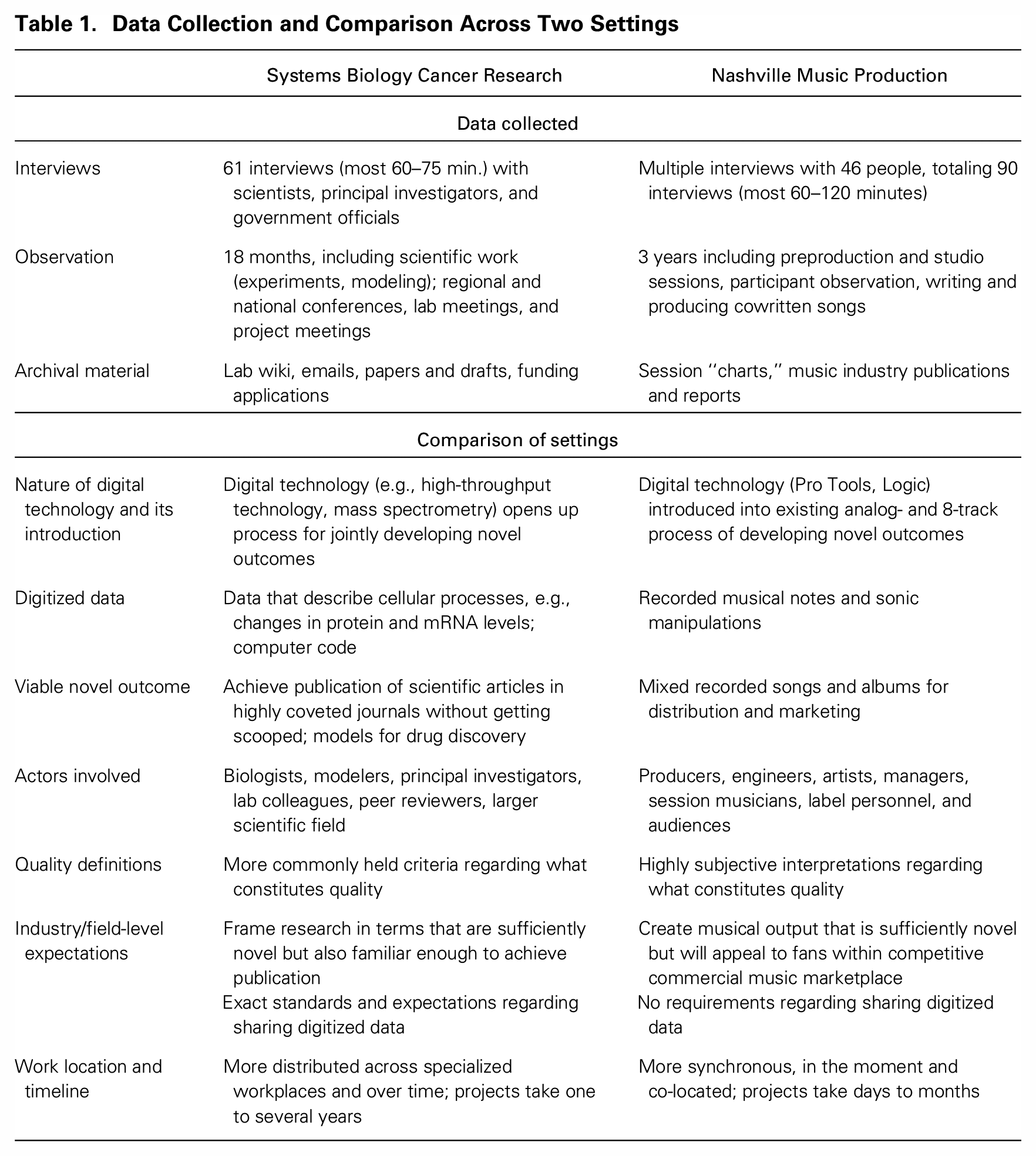
The second author was immersed in the Nashville music production industry for seven years at a time when digital recording technology was increasingly used in creative production. The author engaged with music industry and record label executives, producers, songwriters, musicians, and engineers as they worked; attended industry celebrations, festivals, showcases, and conventions; attended and facilitated industry summits, including those on digital technology; and helped launch a recording studio. The author conducted a formal three-year ethnography on the music production process, including interviews, observations, participant observation, and archival data. Interviews ranged from 60–120 minutes and totaled 90 interviews with 46 people. The author engaged in non-participant observation of pre-production and studio sessions; informal conversations with musicians, engineers, and producers; and participant observation that involved co-writing and co-producing a song. Archival data included music industry publications, blogs, and conference panels. Together, these data provided insights into the tedious work associated with the limitless possibilities of digital technology within music production. Table 1 provides a summary of data collected across settings.
Data Collection and Comparison Across Two Settings
Similarities and differences across settings
Our settings shared important commonalities, as Table 1 shows. In both contexts, multiple disciplinary experts came together to develop novel outcomes, using digital technology under time and budgetary constraints. We also noticed differences between systems biology and music production that we considered as we developed our concepts, ensured the robustness of our findings, and assessed the generalizability of our model. In systems biology, there were comprehensive requirements to publish data and information about data processing; no such requirements applied to music production. Definitions of quality and what would drive success were negotiated in both contexts, but in systems biology, publishing novel insights and securing funding demanded close adherence to field-level expectations regarding scientific methods and documentation; in music production, perceptions of quality were more individually held and highly subjective. Further, in systems biology, projects often spanned multiple years, and actors often worked apart from each other and distributed over time. In contrast, much of music production occurred in studio recording sessions during which actors improvised together. While a comparison across settings before and after the introduction of digital technology might be interesting, it was neither the objective of our research nor was it possible since the field of systems biology emerged only with the advent of computational modeling techniques (Kohl et al., 2010). In this way, our work departs from other ethnographies of technology and knowledge (e.g., Barley, 1986; Bailey, Leonardi, and Barley, 2012).
Analytic Approach
Due to the limited research on the role of repetitive, cognitively taxing work in the creative process, an inductive approach to developing theory was warranted (Edmondson and McManus, 2007; Maxwell, 2013). We followed best practices of other recent comparative ethnographies (especially O’Mahony and Bechky, 2006; Harrison and Rouse, 2015; Bechky and O’Mahony, 2016), such as initially sharing rich descriptions of the creative process in our respective contexts; clarifying key differences and similarities in process, roles, and activities; and “using tables that compare common constructs across . . . settings to foster constant comparison” (Bechky and O’Mahony, 2016: 173). A twofold analytical strategy allowed us to remain sensitive to insights that emerged from our data while also considering extant research (Glaser and Strauss, 1967; Locke and Golden-Biddle, 1984). We followed recommendations for analyzing and presenting inductively derived data (Strauss and Corbin, 1990; Gioia, Corley, and Hamilton, 2013). As described in more detail below, we developed a robust analytical process of (1) inductively generating first-order codes through open coding of our data; (2) comparing codes across our two settings and with extant literature and creating second-order concepts; and (3) further analyzing and interrogating how our second-order concepts related to one another to develop the aggregate dimensions and overall model.
Inductively deriving first-order codes
Over the course of several months, both authors open-coded their respective data by using the qualitative coding software ATLAS.ti and then shared and discussed an emerging set of first-order codes at weekly meetings (Strauss and Corbin, 1990). Given the great difference between our settings, we spent considerable time developing shared understanding of codes. For example, we discovered that scripts in systems biology and templates in music production served a similar purpose: automating. In probing the different technical language and what role activities played in each setting, we continually refined our coding. We iterated this phase many times until we began to gain a sense of how to reduce our first-order codes to second-order themes.
Developing second-order themes and aggregate dimensions
Next, we compared, contrasted, and interrogated codes for fit across our two settings and with the relevant literature, ultimately collapsing and combining codes until they reached a level of differentiation and meaningfulness to become second-order themes in our emergent theory. During this step of axial coding, we began to identify activities characterized by repetition, detail orientation, and requiring expertise. We found that actors engaged in fishing (casting about for potential insights or ideas without clear direction), administrating (annotating, tracking, and managing data), polishing (meticulously fixing errors, cleaning, and verifying data), and compiling (manipulating, combining, and recombining data). We further abstracted from these four themes to identify our aggregate dimension of tedious work.
We also recognized that tedious work presents three risks to the creative process of developing viable, novel outcomes: time drain, which involved devoting considerable time to activity that might be better or more productively used for other activities; disengagement, which comprised loss of focus, energy, best effort, or perseverance; and information overload, which led to feeling lost or overwhelmed amidst volumes of data and/or losing sense of the whole or larger perspective. Actors in both settings navigated these risks in four ways: curbing, which entailed strategically limiting the amount of fishing, polishing, and compiling; automating, through using templates, scripts, and similar technical shortcuts; sustaining, which involved helping individuals recover from cognitive and physical fatigue and lightening moods; and zooming out, by situating and interpreting specific details as part of a larger whole to gain perspective. We abstracted from these four themes to identify our aggregate dimension of booster tactics, which mitigate risks and support the creative process in the face of those risks. Within our respective settings, we triangulated across our data sources (Creswell and Miller, 2000). Tedious work, its associated risks, and booster tactics were evident in interview and observational data from both settings.
Bringing it all together
Finally, we analyzed how our second-order themes and aggregate dimensions related to one another and why. From this analysis, we were able to develop our model of tedious work, which we elaborate in the following section, including how tedious work arises in the arts and sciences, when and how it becomes problematic, and what actors do to mitigate its negative effects. We use pseudonyms to preserve the anonymity of our respondents.
Tedious Work in Developing Novel Outcomes
In both systems biology and music production, we found that tedious work was inextricable from the creative process as actors strove for viable, novel outcomes in the face of uncertainty and ambiguity. It consisted of activities that were needed to achieve a novel outcome and that could be deeply engaging. Modeler Jennifer acknowledged that “some of the most important pieces of data . . . could come from a very tedious process.” However, tedious work eventually became boring, exhausting, or overwhelming due to its repetitive nature. Music engineer Christian described, I’m doing this tedious work a lot on the editing side, because you do repetitive tasks 100 times or 1,000 times in a given day. On one project, we were under a lot of pressure; I would come into the studio and work from 8:30 or 8:45 in the morning, and in some cases until midnight or one in the morning the following day, with only a break at lunchtime, and maybe a dinner break at a half hour or hour each, and I would sit in that same chair in that same spot, and basically until my brain shuts down or I get too tired or I physically need to like depart.
In the next section we provide rich descriptions of four types of tedious work—fishing, administrating, polishing, and compiling—and how they manifested in our settings.
Four Types of Tedious Work
Fishing
Fishing involves repeatedly generating volumes of data to drive discovery of novel outcomes in the face of uncertainty and ambiguity. In systems biology, scientists engaged in fishing as they explored possible biological connections with computational analysis. Biologists ran initial experiments, often without hypotheses and sometimes based on incidental observations in the lab, to generate leads. Modelers used these preliminary datasets to identify the most interesting areas for measurements in follow-up experiments, which would help further determine the model. Eric, a biologist and modeler, explained, A lot of people in cancer research or pharmacology do a lot of screens. You screen for interesting stuff. What I’ve been doing is screens quite a bit and then I stumbled upon something interesting and then you’ve got to see if that is valid and then you further develop that. From there you can grab onto hypotheses and, hopefully, catch something. That’s why it’s called fishing, you’re fishing for stuff. Fishing has a really bad reputation in science. People always say, “You shouldn’t waste your time fishing.”
As suggested in this quote, fishing could result in leads but also in wasted time. Biologist and modeler Marc expressed a similar concern about fishing’s potential time drain during a lab meeting: “One sensitivity analysis requires 1,000 to 10,000 simulations which take between 8.3 and 83 hours on a single CPU. That’s too much time.” This popular type of analysis explored uncertainty in regions of the data to identify potential paths to specify the model but entailed significant iterations and time.
In music production, fishing involved artists, musicians, or producers repetitively casting about for possibilities without a clear sense of what would ultimately result in a preferred sound. As Rebecca, an artist, described, It was soul crushing. Well, we had a three-minute song. We walked in with an arrangement that we thought was good. Three or four takes that we felt were good, and then [the producer] said, “Let’s try 5/6 arrangements. Play this, play closer up on the mic, further back, play guitar here.” Probably played the song 40–50 times. We tracked six nights—[until] 12 midnight and we still have nothing.
The actors spent six nights on fishing to no avail, indicating time drain. The repetition and high focus of fishing sapped artists’ and musicians’ creative energy and time budget while leaving actors with volumes of only lackluster data to refine and manipulate later on.
Administrating
Administrating comprises annotating, tracking, and managing data and documenting processes. Actors often viewed this data management work as the most mundane and least creative task. In systems biology, modelers logged operations and changes to codes in a separate file of the model and built platforms such as data banks and a data wiki to make data accessible and searchable. Biologists meticulously noted all experimental steps and results in lab books and computer scripts. Lisa detailed, We need to manually write down the location of every antibody that we are using in the 96 well plate and its location. And we have to tell the script this, but sometimes we have 12 different drug conditions, 4, 5, 6 different antibody stains, and you can spend hours . . . inputting: “row one, column one is the control treated cells with this antibody. Row one, column two is”—and that has to go in every time. And that takes—it’s boring. It takes a lot of time.
The quote underscores the iterations of manual labor in administrating empirical data. Yet, without administrating, scientists could neither correctly work with their data nor meet standards for their scientific method.
In music production, engineers engaged in administrating to keep track of the overwhelming volume and granularity of data generated in their recording sessions. Engineers described how they faced volumes of data ascribed meaningless codes, which they needed to repetitively and carefully annotate and manage so individual parts were readily available to build on in the fast-paced studio environment. As engineer Bryce conveyed, “I have to keep track in my mind of where we’re at. ’Cause the producer that wants to keep everything will always say, ‘Let me hear the one eight times ago.’ I have to be really paying attention. Pro Tools keeps everything, so you get a window that pops up on the right. It’ll name ’em obscurely, Olympic part 1_01, then 02 and 03.” This quote highlights the intense focus required for administrating. Notably, engineers continued their tedious work of administrating after recording sessions ended, working long hours—sometimes until 3:00 or 4:00 a.m.—to have the data ready for the next day’s session at 10:00 a.m.
Polishing
Polishing entails fixing errors and improving single parameters or isolated individual performances. In systems biology, modelers engaged in substantial yet unavoidable polishing as they debugged their models and changed the connections and direction of cellular components; they needed to ensure that their models accurately reflected experimental data. In turn, biologists standardized and normalized data from experiments. For example, Ed, a biologist, filmed cell movements in 12 3-D movies, used a tracking program to capture motion data, and then compared these data to the original movies to correct them: Afterwards, when I gather the data, it takes me about three days straight just to analyze it. . . . To analyze one of them it takes 45 minutes just for the computer to do the analysis and then I have to manually also validate all those analyses that are done by the computer, that takes about another 45 minutes, hour and a half times 12. . . . So here are two cells like this [demonstrating], you don’t want the computer to think, “Oh, it was going like that and then it was going like that,” because that’s a change of direction that actually did not happen. So you have to really go into the movie and make sure that the computer tracked it right.
Ed pointed to objective field-level expectations that drove his rigorous analysis, without which “things would be much easier and faster.” Hence, polishing is repetitive and detail-oriented, and it takes considerable time.
In music production, artists and musicians repeatedly attempted to improve upon their performances during recording sessions, and engineers micro-edited sonic notes during mixing and final editing. Polishing was driven by artists’ and musicians’ desire to perfect performances, as this was their calling card for future gigs. As Caleb, a producer and engineer, described, I’ll tune a vocal, and I’ll listen to one word for sometimes six minutes, seven minutes, as I’m adjusting little, tiny nuances . . . on the same line over and over. And my wife . . . would often ask, “How can you sit there and hear that over and over again?” The motivation is to get to . . . where you can listen back and go, “Ah, that sounds better to listen to.” And of course, that’s subjective. A lot of people will disagree about that.
This quote underscores the repetitiveness and focused attention to micro-detail involved in polishing. It also points to the challenge of determining how much polishing is sufficient, as actors often had competing, subjective perceptions of what constituted quality.
Compiling
Compiling involves repetitive rounds of selecting, combining, and recombining datasets to create a cohesive, compelling whole. In systems biology, compiling arose as scientists tied diverse experiments and modeling efforts together into a meaningful storyline for grant applications and journal manuscripts. Eric, a biologist and modeler, elaborated: “It requires experts such as myself . . . to, on a very high level, compile all the different puzzle pieces and put them together and say this makes sense.” Developing a compelling storyline required all contributing scientists to arrange and rearrange insights from their research across multiple versions to overcome single domain paradigms prevalent at grant agencies and top journals. Compiling also involved original creative thinking; PIs contributed deep expertise as they iteratively compiled disparate pieces into a meaningful whole. PI Carl summarized this process: What’s happened with most of these papers is we just keep dividing them. . . . We split [name]’s paper and sent it to Science. . . . It took a year to review and then it came back with all these ad hominem reviews. So then we sent it to Molecular Cell and they said they’re fine with it but they want to see much more modeling. So we took out all the modeling from it and did more experiments to fill in and then we sent that to PLOS and PLOS was fine with it but they [Molecular Cell] wanted to see much more math and they [PLOS] didn’t want it in their journal. So now we took out all the math and that’s now going to Biophysical Journal.
Compiling thus took focused, expert effort repeated over several years to successfully position the data and achieve manuscript publication. Compiling severely tested scientists’ perseverance to defeat rejection rates of 90–95 percent.
In music production, compiling involved the precise work of selecting and mixing myriad vocal and instrumental takes, layering in additional sonic data such as prerecorded orchestral strings, and adding treatments, such as reverb, to achieve a desired sound. Garrett, a producer, described compiling: “You might layer on a buttload of guitars and everything and your mother . . . this guitar part that we’re working on here or this Mellotron part or this shaker part or whatever, well when I have them all nipped and tucked together it’s going to be this sort of richly colored soundstage.” The work of compiling hundreds of thousands of data points into a sonic whole typically fell on the shoulders of engineers in conversation with producers, artists, and their managers. Caleb described his compiling experience: Vocal comping, where you composite together all of those takes to create your final vocal take. . . . And that process is literally weeks. . . . I’ll sit there and only listen to one word at a time. I’ll listen to the very first word of the song, and I’ll literally listen to 15 versions in a row. Very quickly, like “Hello, hello, hello, hello, hello, hello, hello, hello, hello, hello, hello, hello.” And I’ll be listening to these little, subtle differences in pitch or in timing or where it seems to strike me personally. It could take me two hours to get from top to bottom. And all I’ve done is really just pay attention to one word at a time.
Compiling required hours of repetitive, detail-oriented work and was cognitively taxing and often overwhelming given the volume of data involved.
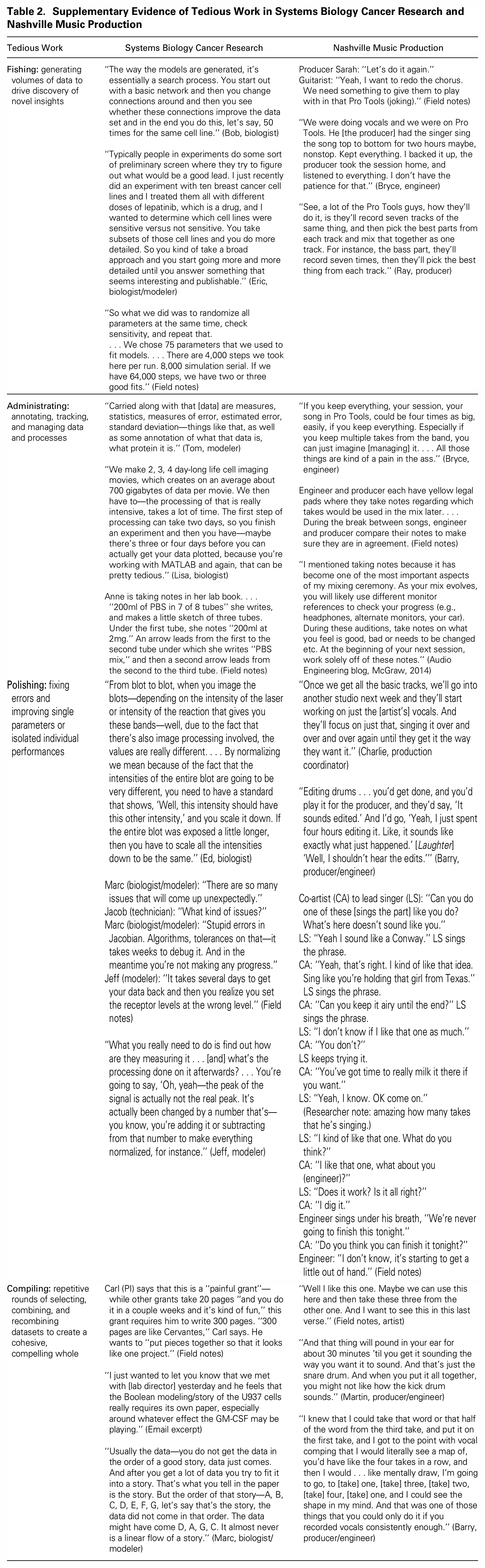
In both systems biology and music production, we found rich evidence of fishing, administrating, polishing, and compiling. Table 2 offers definitions and triangulated supplementary evidence. Our data indicate that tedious work was an inherent part of creative work and that it also presented three risks, which we turn to next.
Supplementary Evidence of Tedious Work in Systems Biology Cancer Research and Nashville Music Production
Navigating Risks of Tedious Work to the Creative Process Through Booster Tactics
Tedious work presents three risks to the creative process of developing viable, novel outcomes: time drain, disengagement, and information overload. We found that actors engaged in four tactics that mitigated these risks and boosted the creative process: curbing, automating, sustaining, and zooming out. Curbing and automating were mainly used to limit the overall amount of tedious work, in anticipation of the associated risks. Sustaining was primarily used to combat disengagement in the face of tedious work that could not be reduced, helping individuals recover from physical and cognitive fatigue, lighten moods, or reignite commitment. Zooming out was primarily used to counter information overload by providing direction and meaning in the face of expanding data volumes. While actors used these tactics in combination and in relation to multiple risks, for the sake of parsimony, we detail each only in relation to the primary risk.
Risk of time drain
A substantial amount of fishing, administrating, polishing, and compiling was needed to develop novel outcomes. Tedious work was path-dependent and accumulated over time. Decisions to fish and polish had cascading effects on the amount of subsequent administrating, polishing, and compiling. If not managed deftly, accumulating tedious work could lead to time drain both through time wasted in iterative cycles of such work that could be more productively used on other activities, and through time required for escalating amounts of tedious work that ultimately conflicted with project deadlines. In systems biology, time drain challenged time horizons for viable novel outcomes and conflicted with project and grant deadlines, career timelines, and publication cycles. In addition, novel insights quickly became obsolete when competing labs published similar work (when scientists were “scooped”). Similarly, music producers were keenly aware of both their need to meet project milestones and deadlines to maintain funders’ and market gatekeepers’ commitment and of the risk of misallocating time throughout their process. As Hank, a star producer, stated, “And it comes to the point where you’re scrambling because you have a deadline and time starts slipping away.” In both arts and sciences, actors engaged in curbing and automating to limit tedious work and associated time drain. Curbing involves strategically limiting the amount of fishing, polishing, and compiling. Automating comprises using templates, scripts, and similar technical shortcuts to generate data or create larger changes in the data.
Curbing
Scientists engaged in curbing to reduce the potentially escalating amount of tedious work over time by making conjectures and tailoring experiments and models in light of available timelines. According to PI Matt, “At a certain point, a student has to graduate soon and we can’t—it can’t be two more years. Maybe we envision four cell lines, but we got two and that’s what we’re gonna analyze. We often will cut things back to fit people’s timelines.” Similarly, at a lab meeting, a modeler asked Marc, the presenter, “Why do you want to eliminate parameters before calibration?” to which Marc responded, “There were too many. We couldn’t do it.” Scientists considered the tradeoff between anticipated tedious work and potential novel insights to decide where and when to curb. They curbed by designing experiments that yielded the most insightful data with the smallest time investment in tedious work. For example, Kenneth, a modeler, assessed which pilot sample of 32 condition sets would capture the most experimental variability to help “design an experiment that has as much of a dynamic range in all the species as possible and also that separates the measurements from each other. And it turned out that . . . by the time you got to 15 or so you were getting 90 to 95 percent of the information content of the full system just within that.” Also, modelers made assumptions or conjectures about links between molecules, thereby curbing the additional data generation, administrating, and polishing that would be needed to measure the link. Scientists thus limited their data generation to the most salient areas, maximizing the dataset’s explanatory power and analytical usefulness while curbing tedious work.
In music production, producers engaged in curbing to limit the potential escalation of fishing, polishing, and compiling. As Ted, a veteran producer, noted, “If you know what you’re doing, you can reduce a lot of tedious work.” Producers had to balance anticipated tedious work with the projects’ desired sound and budget and time constraints. Ted described how he engaged in curbing in a low-budget project: I’m doing the arrangements beforehand, cutting out a lot of that repetitive experimenting work that you would usually see in some of the other studio sessions. . . . I also have a really close working relationship with the engineers at [this] studio. They already have it set up in the Pro Tools with all the tracks labeled for the drum kit and stuff like that, they know what I’m looking for, my way of producing, what the budget is . . . they know that they have, like, four hours to get all the mixing done.
Producers facing the lowest budgets and tightest time constraints took an approach similar to that in systems biology: reducing the risk of time drain by dramatically curbing the amount of fishing, polishing, and compiling in the project. Curbing was also used throughout music production when producers recognized that tedious work was becoming unproductive. Barry, an engineer and producer, described how he subtly curbed compiling work that was becoming a time drain: They [the superstars] wanted to be there at the comps, and we would listen to all four takes. And these three superstars did not have an opinion. They would go, “Let’s listen again.” You know, one line at a time. One, two, three, four. And I slowly realized—this isn’t working. We’re taking too long to comp a vocal. And I discovered that as I went through each of the four takes of a line—if I hovered my mouse over the take that I liked, one of them would go, “Two?” And I’d go, “Yeah. I think two will work right there.” And then we’d go to the next line. [Laughs]
As the risk of time drain became apparent, actors used curbing to break cycles of tedious work. Producers underscored that avoiding time drain required a long view of the creative process and balancing quality aspirations and time constraints. As Caleb explained, “As a producer, you have to keep your scope on the project overall, not just the mixing and the editing and vocal and the guitar. You have to look at the entire project from start to finish, the timing, the deadline, what’s to be expected and delivered.” Hence, producers paid attention to whether specific moments of fishing, polishing, and compiling were draining time that could be better used elsewhere.
Automating
In systems biology, scientists engaged in automating to accelerate or shortcut tedious work. Automating often involved harnessing digitization to mitigate the risk of time drain not only by directly reducing tedious work but also by avoiding time-costly mistakes during manual labor that would spur additional polishing and administrating. Automating also enabled a larger number of measurements to drive the discovery of novel insights. Scientists engaged in automating through data and text mining, using software to extract established links between cellular molecules from publicly available databases and the literature. For modelers, automating often entailed tool development. For example, modeler Adam developed a MATLAB toolbox to normalize, center, and scale 100,000 different cell signaling measurements and to self-document all processing. Modelers Luca and Roy wrote software that modularized code writing to facilitate making changes to their program that could not handle long equations very well.
In music production, producers and engineers relied heavily on automating to reduce tedious work, save time, and facilitate on-the-fly idea generation and improvisation. Jack, an engineer, described, “I have developed muscle memory for every shortcut I could possibly need, so in a moment when someone says, ‘Can you do this?’, in less than ten seconds to five seconds, I’ve done it.” Automating also enabled engineers and producers to easily generate and polish data without having to dedicate hours to tedious work. Engineer Christian described, “If we’re talking about tuning vocals, the program that I use has gotten a lot better over the last year or two, and it’s a lot quicker, and it sounds a lot better. I don’t have to work so hard to not make it [the vocals] sound like, blah, you know.” Such automating was particularly important when working with tight budgets, artists with performance anxiety, or artists whose vocals needed considerable polishing to deliver a final recorded product of sufficient quality.
Thus, actors in arts and sciences employed curbing and automating to mitigate the risk of time drain and thereby bolster the creative process in the face of that risk. Actors also used these tactics to mitigate the risk of disengagement, which we turn to next.
Risk of disengagement
Creative work requires engagement—mental focus, effort, commitment, and emotional connection—that tedious work tended to undermine. In systems biology, scientists struggled to maintain their engagement and heightened detail orientation needed to avoid errors in their tedious work. In detailing why tedious work may lead to disengagement, they described this work as “mentally draining and requir[ing] high mental fortitude,” “not fun,” “thankless,” “not as rewarding,” and “not satisfying,” and they noted that it was “hard to feel its importance.” Tedious work presented a particular challenge to scientists’ long-term engagement in projects that typically spanned multiple years. Faced with endless polishing and compiling, especially in the face of high uncertainty regarding publication success, scientists could abandon projects, which in turn undermined project viability as expertise and deep knowledge of the creative process were lost.
In music production, creating the magic for a hit heavily depended on musicians’ individual creative effort and their collective creative energy. Producers sought to prevent expert musicians from dialing it in and artists from losing the energy needed for their vocal performance. Tedious work could undermine individuals’ engagement and mental focus as well as the collective creative energy among artists and session musicians needed to generate novel ideas that would distinguish a song within a highly competitive market. Barry described how producers who excessively polished would erode artists’ and musicians’ engagement: Well, people become dejected. . . . Especially with singers, guitar players, you have to be able to balance asking more from them, asking them to do better, and identifying when they didn’t have better. . . . And as an engineer, I would see so many producers just not be able to identify that. “You are just beating her up, man. You’re not making things better. They’re just getting worse, and faster and faster.”
In this way, excessive fishing or polishing could leave people emotionally wasted and defeated, which brought down individual energy and the collective vibe, resulting in increasingly uninspired performances that undermined the creative outcome.
To mitigate the risk of disengagement, actors curbed and automated tedious work where possible. When tedious work could not be reduced, they engaged in sustaining: actions that help individuals recover from cognitive and physical fatigue, lighten moods, or foster commitment.
Sustaining
In systems biology, scientists were acutely aware of how their individual engagement influenced their ability to accomplish the tedious work necessary for developing novel insights. PI Allan stated that tedious work should be done “when you’re fresh, able to focus and to manage something tedious. Sometimes you’re just in too good a mood to do something tedious.” Still, tedious work required utmost focus as any mistake would corrupt the experiment or model, triggering cascades of additional tedious work. Establishing such focus took 15–30 minutes and could be maintained for only a few hours per day. To gird themselves for tedious work, scientists planned their days according to their personal focus and energy rhythms. They selected their best times for tedious work, tackled it in dedicated blocks rather than scattered through the week, stopped when their focus waned, and prepared to efficiently resume it. Modeler Adam elaborated, I try to stay engaged as long as I can. That may be half an hour, a few hours, but then at some point you have to—you can’t sustain that and you have to take a break. And so one of the tricks is finding the best, finding the most efficient way to resume this work later. How do I take appropriate notes, capture my state of mind, remember all the details that I need to so that I can resume this work later.
Other scientists described building a routine or switching to different tasks such as chain sawing a tree or tending to emails, to regain focus and energy. When doing tedious work together, scientists used humor to reignite productive engagement. For example, during a meeting in which Marc, a biologist and modeler, and Jeff, a modeler, reviewed their model in painstaking detail, Marc said, “‘Did you get another bug, dude?’ Jeff: ‘Yeah, thousands.’ Marc activates a fanfare sound in his computer as applause. Jeff laughs” (field notes). This moment of humor lightened the mood, lifted the tension of deep focus, and enabled them to continue tedious polishing. Since much tedious work was nonnegotiable in science, sustaining served to remedy the risk of disengagement both in the moment and over the long arc of scientific research.
In music production, producers focused acutely on whether additional fishing and polishing undermined engagement. Caleb stated, “I’m always noticing people’s mannerisms, the way they raise their eyebrows, whether they look happy, frustrated, sad, for whatever reason.” Actors commonly employed humor to sustain artists and musicians when further tedious work was needed to achieve desired creative outcomes. Caleb continued, I was pushing them to go further, because I know we didn’t quite have it yet. And that can be an interesting experience, because they can get worn down or tired, and you have to still maintain the performance energy level—that they sound excited behind the instrument or their vocal. So we use humor a lot to sort of help try to break that tension and create an environment where they’re having fun, help push them in that little further direction, or get them out of their comfort zone in a way that might be cool or creative.
Garrett shared, “When I see that the artist is struggling, I have them take a break, go out for a walk, have dinner, have a shot of some alcohol [laughs].” Engineers, too, developed their own elaborate rituals to sustain focus and effort in the face of long days of tedious polishing and compiling work. Engineer Christian said, “Every morning I read a chapter in the Bible . . . I do a breathing exercise from [a guy] and then I exercise in some form or fashion. And I think all of those things combined does help reset. Now I can get off to a fresh start.” Other engineers confessed turning to alcohol or drugs to sustain their tedious work.
Risk of information overload
Repetitive high-focus, high-detail work bore the risk of information overload, which manifested in actors feeling cognitively overwhelmed or paralyzed, or losing perspective of how single details fit into the larger whole. Information overload became acute when actors attempted to compile their creative ideas amidst data that had accumulated over time.
Information overload was particularly problematic in systems biology given the enormous data volume. Experiments can generate tens of millions of data points that require computational analysis. Sean, a modeler, explained, “Because it’s such a large amount of data, it’s such a complicated network that if you tried to do it by hand, so to say, you are just overwhelmed.” Information overload was exacerbated by the enormous difference in data type pertaining to cellular molecules, various conditions, and multiple time points in experiments that connected with parts of a model and with mechanisms recognized in prior literature. This wealth of information and high uncertainty challenged scientists’ cognitive capacity required to understand the data, which was needed for a novel outcome. Adam, a modeler, described, “Debugging is a perfect example of this tedious [work] where you don’t even know how much you need to remember and at which level. So, you’re constantly struggling to try to figure out how much of this information do I need to retain in my head at any one time to understand the problem?”
In music production, information overload arose in two ways. Mixing engineers who had not been involved in recording sessions described feeling overwhelmed as they attempted to make sense of the massive volume of messy data they received from producers. Jack explained, “It shows up to me in a giant session with things everywhere and stuff going on—if it’s not very cleanly organized and well put together, it can be an overwhelming sense.” Information overload could lead engineers to miss key musical moments amidst the volume of data, leading to a lower-quality outcome. Information overload was also evident when engineers lost perspective regarding whether and how their highly focused and detailed work fit within the larger creative whole. Jack continued, Getting stuck in the weeds can occur, if I’m mixing specifically, after working on something for hours. All of a sudden, in literally a 15- or 10-minute span of time, I’ve lost my perspective. I don’t know where I’m at. I’m lost. And all of a sudden, the mix just starts to sound horrible. I become hypercritical of it. I’ve determined that most of what I’ve done is now a waste of time, and it’s crap. And so I would keep going and keep tweaking it. And in some cases get farther away from where I needed to be.
Thus, information overload risked engineers spending hours continuing to polish or compile data, leading to loss of perspective, poorly done work, and time drain.
To help mitigate the risk of information overload and boost the creative process, actors engaged in zooming out: situating and interpreting specific details as part of a larger whole to gain perspective.
Zooming out
In systems biology, zooming out involved switching from the micro perspective of cellular components to the macro perspective of the cell, bringing individual experiments and models into a meaningful storyline and connecting specific findings to the broader literature. Both the scale and granularity of their datasets—for example, 700 gigabytes from a single experiment—and the distribution of experiments and models over time and disciplines implied significant cognitive load that exceeded individual mental capacity. To reduce the risk of information overload, scientists used models to zoom out of the level of individual data points from multiple experiments. Jane, a biologist, explained, You’re not trying to study the nitty-gritty, but you’ve zoomed out, and now you’re trying to take into account many different pieces of a pathway, and many different protein interactions. And when you get into feedback loops and stuff, there’s no way your brain can keep track of oh, what’s up, what’s down, what affects what? So you need a model of some sort to keep track of it all.
Scientists regularly referred to an overarching model to help tie together experiment details from an expansive dataset. For example, as evidenced in field notes, “Alex approaches the poster on the wall. It measures approx. 3 by 4 feet and shows high-throughput data. It contains results in rows that are 1 inch high and columns that are 0.5 inch wide. Each cell is a full experiment with a graph representing the result. He points to a column and slides his finger down to a particular cell.” The poster is shown as Image 1 in the Online Appendix.
Similarly, scientists used whiteboards in the lab to create overviews of who was modeling which experiments and how those were connected in the cell. Zooming out also occurred at lab and conference meetings in which scientists presented and discussed their findings. Here, a multidisciplinary audience connected minute details to relevant fields to help interpret findings and identify technical solutions. PIs usually weighed in toward the end of lab meetings to tie in the broader literature. Thus, zooming out enabled scientists to counter information overload by cutting through overwhelming and seemingly endless data details to put their research into perspective.
In music production, zooming out was essential during final mixing to mitigate the risk of producers and engineers losing perspective on how all the sonic data would fit together. Information overload was a key concern—engineers typically sat in front of two to four oversized computer screens to be able to view the hundreds of thousands of sonic data points, as Image 2 in the Online Appendix shows.
As producer Sarah described, she strategically provided “fresh ears” as she zoomed out with her engineer during tedious polishing and compiling work to help evaluate how individual instruments fit together vis-à-vis the desired sound and cohesive whole they were trying to achieve: If I [the producer] sit there and listen to the drum bum bum 5,000 times, my ears are dead. Then I can’t hear the whole thing. I need to hear the thing fresh to be able to hear the whole thing. My ultimate goal in mixing is: does the overall sound make me laugh, or whatever it’s supposed to do? If it doesn’t, then I’ll zero in—that high hat is annoying, and then we’ll take everything out and work on the high-hat sound. Then we’ll put it all back together and see how it all sounds.
Engineers relied heavily on their producers to help them zoom out when they lost sight of the overall vision. Dan, an engineer, shared, “I need someone to pull me back and say, ‘Hey, remember this is sort of the focus,’ and I go, ‘Ah, yeah.’ And then I’m able to sort of be less critical of myself. So that zooming out allows me to be less critical of myself as well on a creative aspect.” Zooming out mitigated information overload and helped engineers disrupt cycles of self-critical thinking. Zooming out also helped maintain collective energy in the face of fishing and polishing in the recording studio. We frequently observed producers suggesting, “Let’s listen to the song as a whole and see what we have.” Inevitably, zooming out would galvanize energy as actors heard what they had accomplished so far and how the intensive focus on one area had served the song as a whole.
Combining booster tactics and assessing tradeoffs in managing risks
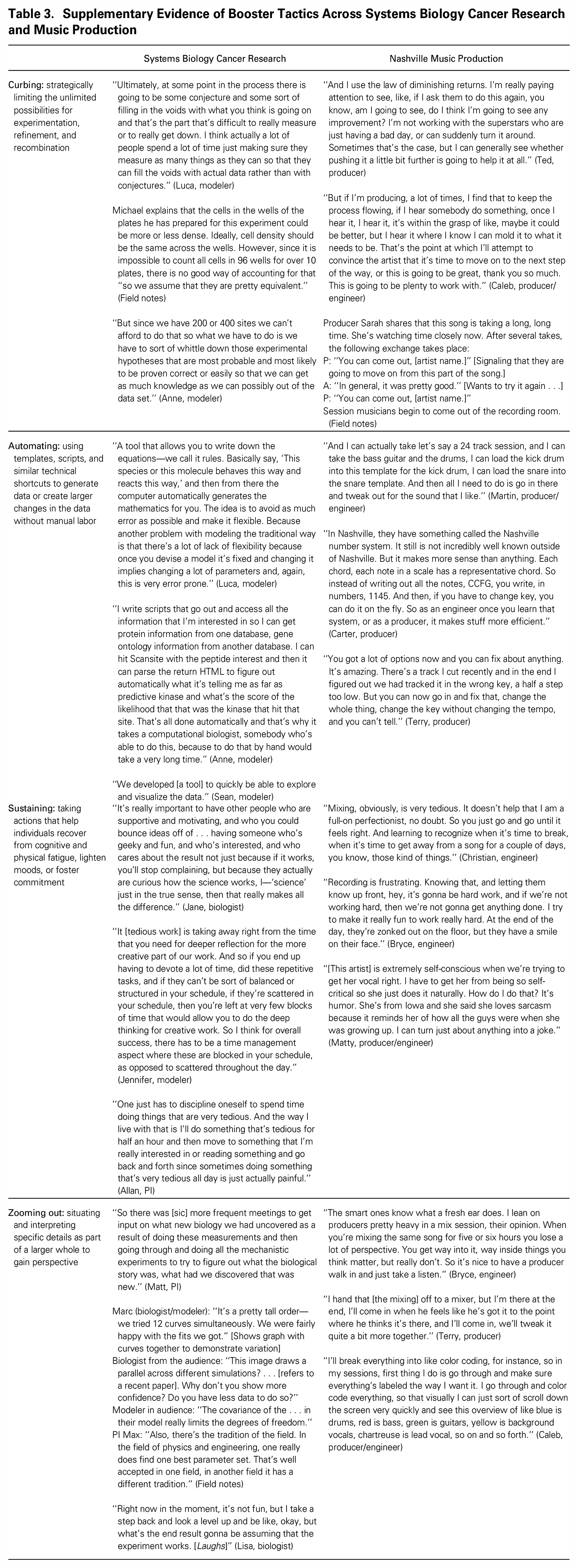
Our findings demonstrate that unlimited opportunities to experiment, refine, and recombine data—made increasingly possible by digitization—increase tedious work, which exponentially increases the risks of time drain, disengagement, and information overload. In light of these risks, we found that actors in both settings used tactics, in combination over time, to reduce tedious work and mitigate risks to the development of viable, novel outcomes. Curbing and automating limited the overall amount of tedious work and thus all three risks, especially the risk of time drain. Sustaining was used to maintain actors’ engagement in the face of tedious work that could not be reduced; similarly, zooming out provided meaning in the face of information overload and disengagement. Table 3 offers definitions and triangulated supplementary evidence of risks and tactics.
Supplementary Evidence of Booster Tactics Across Systems Biology Cancer Research and Music Production
As evidenced in our findings, tedious work is path-dependent and accumulates over time. Decisions to curb and automate or not were not obvious or easy but had significant repercussions for the subsequent accumulation of tedious work. They also needed to be made thoughtfully so they would not curtail future exploration and experimentation. In systems biology, additional fishing or polishing in the form of additional experiments or model equations implied weeks and months of tedious work. Fishing for leads was erratic, so scientists needed to decide when to abandon particular avenues in view of career, grant, and other deadlines. One project stalled when Donna, a biologist, and Duane, a modeler, could not agree on whether the anticipated benefit outweighed the additional tedious work. In music production, producer Barry described his struggle regarding whether to continue or curb fishing: “How do you know the next one isn’t the better one? Am I one shovelful away from hitting gold?” Both scientists and producers had to carefully balance curbing so as not to limit generative possibilities in the moment and later in the process.
Throughout the process of developing novel outcomes, actors managed risks proactively and in the moment. In systems biology, publishing novel insights and securing funding demanded close adherence to field-level expectations regarding scientific methods and documentation. As scientists could fairly clearly anticipate the escalating amount of polishing, administrating, and compiling that would be required, they relied heavily on proactive curbing and automating to limit the accumulation of tedious work. When facing a substantial, irreducible amount of tedious work, scientists turned to automating, yet this often also implied weeks and months of writing new programs and scripts, so each decision to automate required careful consideration. Within music production, no expectations for publishing data or methods existed, so while actors still had to evaluate, polish, and compile the volume of data created, they could discard unwanted material and creative options. Compared to systems biology, then, proactive curbing and automating were not as important in music production except in the most time- and budget-constrained projects. However, quality standards were more ambiguous and subjective in music production; there was little direction regarding how much fishing, polishing, and compiling was needed to create a hit. As a result, producers paid close attention in the moment to diminishing returns of additional tedious work vis-à-vis growing disengagement and information overload. For example, musicians polishing specific parts of their own performances (“overdubbing”) could easily grind down the collective energy of a recording session if not managed deftly in the moment. Producer Sarah recalled, “There was this fiddle player and he just kept wanting to overdub his part and kept wanting to try it again and lay over more. And I finally had to tell him, this isn’t a fiddle session, this is a song, and he looked at me with this attitude and I told him, you can either finish or you can leave.” In this case, other musicians had begun to leave the recording room to check their phones. As the producer sensed creative energy draining away, she used curbing in the moment to preserve musicians’ engagement and shift to more-productive activities.
While we cannot compare whether use of specific tactics at certain times resulted in different outcomes, we did observe that failure to use the tactics we have described led to unsuccessful projects. For example, in one systems biology project, failure to curb data fishing resulted in significant time drain, no leads after four years, disengagement by key actors, and hence project failure. Music producer Carter described how excessive editing in the final mixing process—“We put the white on the rice and just made it march lock step in time and it was boring”—undermined marketing and radio gatekeepers’ enthusiasm and resulted in a nonviable outcome. Both examples encapsulate clear yet painful lessons about the consequences of failure to mitigate risks of tedious work for developing viable novel outcomes.
Toward a Model of Tedious Work in Developing Novel Outcomes
We draw from these rich findings to develop a generalized model of tedious work that is inherent to the creative process. For reasons of parsimony, Figure 1 depicts the creative process as a linear, forward arrow, while in reality the process is recursive and messy. 1 Throughout the process, tedious work (at the bottom) accumulates into a mountain of work. The central arrow pointing upward from the mountain indicates that accumulating tedious work gives rise to risks that loom over the creative process like a thundercloud: time drain, disengagement, and information overload. If not managed deftly, tedious work risks undermine the creative process of developing viable, novel outcomes (represented by the lightning strike). Booster tactics (the circles) used in combination over time help reduce tedious work and mitigate risks. Curbing and automating are shown to the left as they serve to reduce tedious work and limit risk formation, and they are therefore often used proactively. Sustaining and zooming out are often used when risks manifest, so they are level with the cloud (on the upper right). Sustaining serves to maintain engagement in the face of tedious work that cannot be reduced, and zooming out provides meaning in the face of information overload and disengagement. Notably, Figure 1 captures a generalized model of tedious work in the creative process of developing novel outcomes. As our findings demonstrated empirically, digitization’s unlimited opportunities to experiment, refine, and recombine data increase tedious work and thus the risks of time drain, disengagement, and information overload.
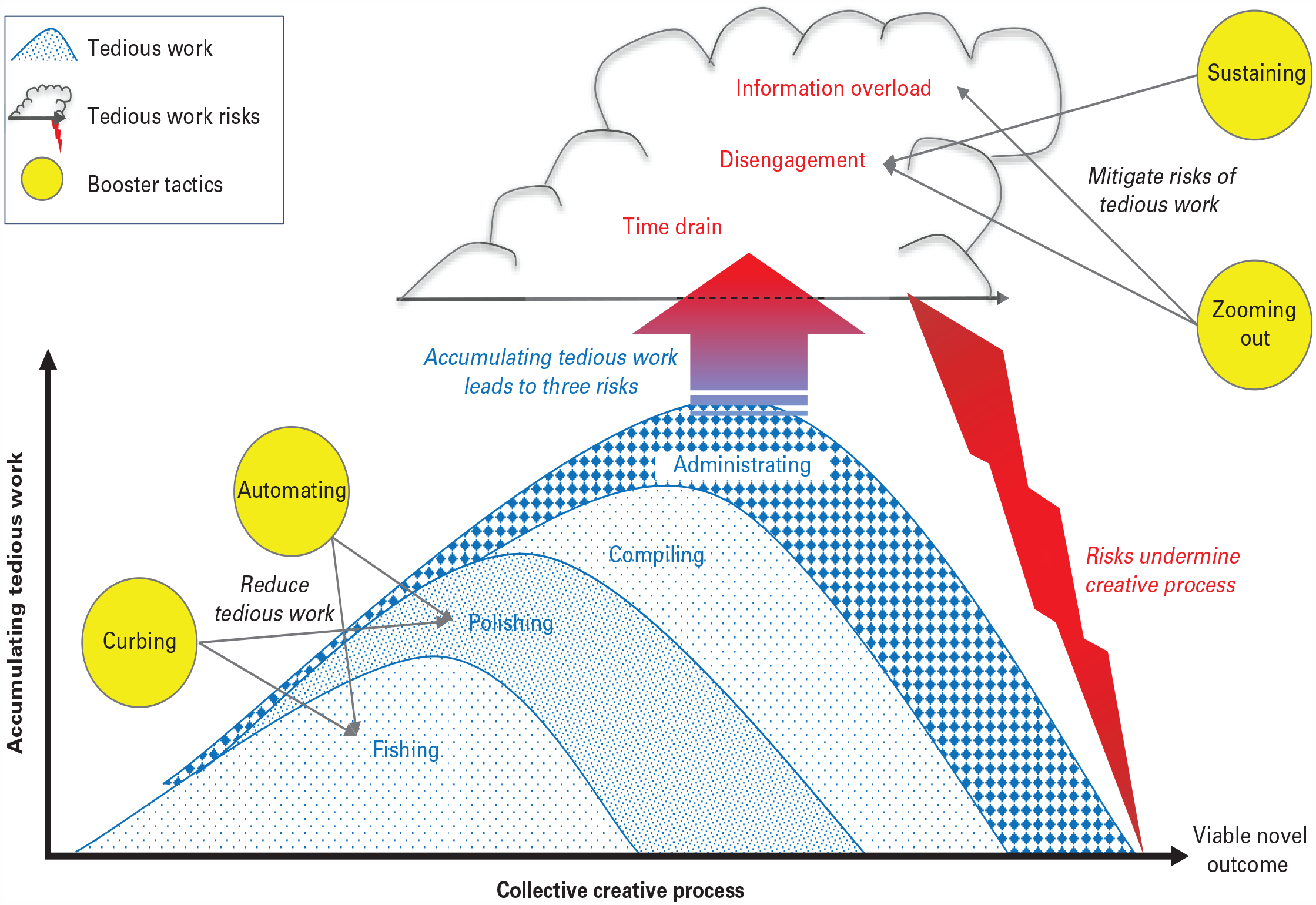
A Model of Tedious Work in Developing Novel Outcomes
Discussion
Our inductively derived model of tedious work provides insight into a critical yet heretofore undertheorized aspect of creative work. We find that tedious work is pervasive in developing viable novel outcomes in scientific research and music production. PI Carl estimated that “tedious, repetitive work represents 70 percent of my job,” similar to Marion and Simpson’s (2009) finding that iteration accounts for up to 75 percent of total project cost, which suggests that tedious tasks, depending on the setting, could comprise well over two-thirds of all labor toward developing novel outcomes. Data management tasks like administrating and polishing represent types of work that increasingly matter in data-driven professions (Goes, 2014; Ribeiro et al., 2023), as digital scientists “emphasize measuring, analyzing, and transforming data” (Dougherty and Dunne, 2012: 1469). The role of annotation has long been acknowledged in studies of scientific knowledge production (Latour and Woolgar, 1986; Fujimura, 1996; Knorr Cetina, 1999). Heeding the call for a more expansive view of creative work (Harrison et al., 2022), our comparative ethnography vividly illustrates tedious work—fishing, administrating, polishing, and compiling—as inherent to the creative process in the arts and sciences; illuminates the risks of time drain, disengagement, and information overload as tedious work accumulates over time; and shows how actors mitigate these risks and boost the creative process. Our study suggests that tedious work is relevant to expert creative work in a wide array of contexts, and it extends and launches several research streams on creative work and developing novel outcomes with digitization.
Expanding Our Understanding of Creative Work
Our study encourages radical rethinking of the notion of iteration that permeates models of the collective creative process, including the evolutionary model (Simonton, 1999), design thinking (Brown and Katz, 2011), the dialectical model of creative synthesis (Harvey, 2014), the creative idea journey (Perry-Smith and Mannucci, 2017), and more-specific creative processes of idea generation, problem definition, evaluation, feedback, and selection (Sutton and Hargadon, 1996; Hargadon and Bechky, 2006; Harvey and Kou, 2013; Seidel and O’Mahony, 2014; Harrison and Rouse, 2015; Harrison and Dossinger, 2017). Although iteration is a general assumption of creative process models, we find that paradoxically, repetitive cycles of data and more broadly idea generation, elaboration, and synthesis in everyday and extraordinary creativity carry key risks that undermine the development of novel outcomes. Despite iteration’s broad prevalence in the literature, there is no rigorous examination of it in processes more generally, nor any theorizing regarding its role in creative work. We begin to address this gap by articulating and substantiating four types of tedious work that feature in iteration and three associated risks that, if not managed deftly, can undermine all phases of the creative idea journey. Excessive fishing and polishing lead to disengagement and time drain; compiling volumes of granular data makes actors lose sight of the collective creative purpose and emerging novel outcome. We suggest that tedious work is path-dependent; for example, creative workers repetitively casting about for possibilities in the face of uncertainty trigger cascading amounts of administrating, polishing, and compiling work that undermine subsequent synthesis and implementation. By unpacking the concept of iteration, our study warrants future research that specifies more precisely when and how repetitive work reaches problematic risk thresholds at different points in the creative process, across contexts, creative projects, and types of creative occupations. Quantifying numbers of iterations and when risks become acute opens up a promising avenue to combine qualitative and quantitative approaches in process research. Particularly compelling contexts include any professions that involve careful documentation of work routines, such as in science. If tedious work constitutes three-quarters of all labor associated with developing novel outcomes, looking further into iterations—how many, when, by whom, how they are shaped, and when they become problematic—is a uniquely compelling prospect.
Our conceptualization of tedious work as a critical aspect of the creative process contrasts with prior notions that novel outcomes require reduced repetitiveness (Obstfeld, 2012). Obstfeld saw repetitiveness as distinct from creative work and as a feature that distinguishes creative projects from organizational routines. When we examine creative projects in our settings, we find considerable repetition within creative work. Further, our data suggest that these high-detail, deep-focus, high-expertise repetitions are a prerequisite for creative outcomes. While too much repetition can become problematic, tedious work generates a state of gestation through deep, prolonged engagement in expert labor that brings forth contributions to the novel outcome. Hence, an important implication for research on creativity and innovation is that mundane, potentially hidden underpinnings of creative work provide an essential foundation for novel ideas. A case in point is that tedious work cannot be outsourced as it requires deep content expertise and intimate knowledge of the countless micro decisions shaping the emerging novel outcome—how and how much to fish, administrate, polish, and compile—that people without adequate expertise and insight into the unfolding creative process cannot achieve. This insight parallels prior findings that outsourcing repetitive, less creative tasks in the automotive design process, rather than yielding expected benefits, led to misunderstandings (Bailey, Leonardi, and Barley, 2012).
In illuminating the long hours of focused, highly detailed, repetitive, emotionally and physically draining work, we look more comprehensively at the labor in creative work. In doing so, we provide a necessary counterpoint to many collective creative process studies. Our study highlights the labor and hands-on, physical underpinnings of realizing creative projects and dramatically expands the activities that scholars should consider in their creativity research. We provide and theorize ample examples of labor involved in getting creative work done: keyboarding, drawing, pipetting, counting, writing scripts to achieve automation, singing, and using scientific and musical instruments to generate, manipulate, document, and process data. Hence, tedious work impacts the body; for example, in music production, voices grow worn and tired from too much fishing and polishing. Our study thus serves as an invitation to bring work—the actual labor involved in developing novel outcomes—into creative process research, from initial idea generation and elaboration to final synthesis.
Our model also provides greater nuance to our understanding of the omnibus area of final editing, integration, and synthesis that collective creativity scholars often consider only theoretically (Harvey, 2014; Perry-Smith and Mannucci, 2017) or in passing (Lingo and O’Mahony, 2010). While relevant to the development of both breakthrough and incrementally novel ideas, our findings underscore the cognitive and emotional challenges that emerge during integration and synthesis. For example, our depiction of compiling provides greater insight into how micro-details associated with data and ideas are refined and brought together, the interweaving of compiling and zooming out required, as well as the time and labor involved. Notably, the risks of tedious work likely become most acute during integration and synthesis, when time conflicts result from inadequate preassessment of tedious work, the risk of getting lost in details rises with expanding data volume, and engagement is severely tested as creative workers approach the end of their marathon of developing a viable, novel outcome. Successfully navigating this critical aspect of the creative process requires tactics that reduce tedious work as much as possible, sustain engagement in tedious work that cannot be reduced, and provide needed meaning, purpose, and direction through zooming out. Zooming out thus plays an essential role in creative synthesis not only to forge new shared understanding (Harvey, 2014) but also to alleviate information overload and disengagement likely to arise from tedious work.
Individual and Collective Engagement in Creative Work
Our model of tedious work extends research on the emotional and cognitive states that are the focus of many creativity studies. We highlight the tedious conditions that can undermine positive mood (George and Jing, 2007; Davis, 2009), affect (Amabile et al., 2005), intrinsic motivation (Amabile, 1996; Collins and Amabile, 1999), and therefore engagement (Csikszentmihalyi, 1997; Zhang and Bartol, 2010a; Oldham and Da Silva, 2015), which are critical for individual creativity. Our data are particularly intriguing as they reveal the paradoxical nature of tedious work. It forms the backbone of creative work, yet too much of it undermines the creative process. It requires significant expertise and focus and thus can be deeply engaging, but it eventually becomes draining or overwhelming due to its repetitive and detailed nature, resulting in disengagement. Since emotional and cognitive engagement connects the individual to the tasks and to others (Kahn, 1990), disengagement arising from tedious work presents a risk to the collective creative process. This paradox matters especially in contexts such as dance, theater, music, and film that thrive on carefully curated collective energy for creative production. Because of its salience to creative work, the phenomenon of collective creative energy and its intertwinement with individual engagement remains ripe for exploration.
Tedious work makes visible the labor, or dark side, of creative work that requires a substantial investment of actors’ time and energy, thereby sapping the very ingredients thought to be necessary for idea generation (Shalley, Zhou, and Oldham, 2004; Rosso, 2014). The repetitive nature of tedious work can induce boredom and fatigue, which undermine individual motivation for and engagement in the task at hand. Yet, prior studies have shown that boredom fosters individual creativity (Mann and Cadman, 2014; Park, Lim, and Oh, 2019), which parallels our findings regarding the paradoxical nature of tedious work. Furthermore, our study suggests that repetition, rather than the feeling of boredom, might be the instrumental driver of creativity. We found that expert creative workers were professional about tedious work, knew how to tackle it in good spirit (albeit often with dark humor), and could even find it enjoyable and a source of satisfaction if the work was well done. We surmise that actors experience tedious work differently based on individual characteristics, occupational training, and seniority, as well as work context. For example, people on the autism spectrum have been found to better tolerate work requiring acute attention to detail and high repetition (Lohr, 2020), and workers open to experience have more creative ideas following repetitive, boring work than do those who are less open to experience (Park, Lim, and Oh, 2019). Our observations lead us to suspect that individuals with high tolerance for tedious work may self-select into certain occupations in which such work prevails (e.g., mixing engineers). Future research can explore which individual characteristics are especially amenable to conducting tedious work and how these differences shape whether actors experience tedious work as creative.
Our research points to the critical role of sustaining throughout the process of developing viable novel outcomes because it balances the negative effects of tedious work that cannot be reduced: cognitive and physical fatigue, depressed moods, and weakened commitment, which undermine creativity. Indeed, burnout and dropout are of particular concern in industries such as video game development (e.g., Crevoshay et al., 2019), in which individual creative workers bear the stress and burden of extensive tedious labor in the face of aggressive release deadlines. Underestimation and underappreciation of the time and labor involved in tedious tasks likely drive this situation. Thus, our study also directs scholarly attention to ways in which individuals sustain, restore, and motivate themselves in the face of tedious work. This matters in particular given the belief that workload pressure is an obstacle to creativity and given complaints regarding the general lack of creativity in professional work (Elsbach and Hargadon, 2006). Elsbach and Hargadon (2006) found that switching to mindless work—tasks that provide an energizing break from intense thought processes and skill application—helps restore individual focus and creativity. Similarly, our study points to an array of activities that actors use to sustain themselves in the face of tedious work: joking, meditating, taking breaks, exercising, using rituals and music to set the mood, and consuming alcohol and other drugs. Research is needed on when and how individuals identify the need for sustaining and zooming out, why some tactics might work better for certain individuals than others, and how sustaining and zooming out might be best supported across organizations and industries to prevent burnout.
Digitization and Developing Novel Outcomes
Iteration lies at the heart of the processes of generating and synthesizing ideas (Hargadon and Sutton, 1997; Leonardi, 2011; Harvey and Kou, 2013; Seidel and Fixson, 2013; Harvey, 2014; Harrison and Rouse, 2015; Harrison and Dossinger, 2017), and digital technology increases the rate of iterations (Thomke and Fujimoto, 2000; Sapsed and Tschang, 2014). Our study draws attention to the tedious labor that each iteration entails, which stands in stark contrast to the common perception that iteration in digitization is instant and cheap. Our work updates current conceptions of iteration in creative processes by calling attention to the substantial costs involved as iteration intensifies, including the compromise of quality. Future research is needed to better tease out these costs, especially how they accrue from tedious work across industry contexts.
Our study answers a call for research on the risks associated with digital technology in creative settings (Oldham and Da Silva, 2015). In contrast to the assumption that digital technology enhances engagement and therefore creativity (Oldham and Da Silva, 2015), our data show that the use of digital technology requires energy and focus, which undermines engagement over time. This risk of disengagement clashes with prominent promises of digital technology’s potential that ignore the effort involved in its use. For example, our study debunks Austin’s (2016) premise that digital technologies reduce the cost of iteration and experimentation in creative work. Specifically, we reveal the costs of tedious work and the labor involved in mitigating its inherent risks. Another risk that our study has identified is information overload. Digitization dramatically increases the data volume that actors need to grapple with in creative work, and getting lost among the data and underlying ideas threatens the conception and realization of the novel outcome. Our study suggests that visual aids are a way to deftly address this risk through zooming out, in line with prior evidence that such visual techniques foster shared understanding of prototypes (Seidel and O’Mahony, 2014).
Our insights extend early studies on the hidden work of science librarians and technical service providers within hierarchically well-defined environments (Shapin, 1989; Clement, 1993; Hampson and Junor, 2005). Such work, while often considered routine, manual, or mundane, was found to be cognitively complex and taxing, and it required significant expertise (Suchman, 1995; Star and Strauss, 1999). Our study brings the notion of hidden work forward into the arts and sciences: knowledge-intensive, creative contexts that are complex, ambiguous, and uncertain. Tedious work was also hidden in our settings as it was invisible to the unique target audiences of the creative work (Lingo and Bruns, 2021). Music fans did not know about the process that resulted in a hit song. Peer scientists understood the labor that went into an article, but repetitions of tedious work were not part of the argument or considered interesting, and they remained implicit despite comprehensive method sections. In both cases, the novel outcome provided limited, if any, information on underlying tedious work. Our work reinvigorates the challenge for scholars to discover aspects of work that are hidden from view and that digitization brings to the fore.
By bridging the literatures on creativity and digital technology, our study helps to launch future research into digital creativity and problematizes digitization’s unlimited possibilities for developing novel outcomes. Studies of creating with digitization typically highlight the benefits of digital technology. A burgeoning set of studies illuminates how digitization negatively affects product development by undermining evaluation of prototype viability (Bailey, Leonardi, and Barley, 2012) or promoting excessive iterations, suboptimal solutions, and delayed design decisions (Fixson and Marion, 2012). We solidify these concerns by exposing the pitfalls of digitization’s unlimited possibilities across the entire arc of the digital creation process, namely the labor and costs of exploiting its potential for unlimited experimentation, refinement, manipulation, and recombination. Digitization enables limitless experimentation within any stage of the creative process, but this freedom requires careful management (Sapsed and Tschang, 2014) and knowing when, how, and how much to exploit the possibilities of digitization. We surmise that this expertise is the new frontier of digital technology management. In light of our findings, digitization appears to be not strictly an advantageous tool but, rather, a double-edged sword. Digital creativity thus requires process leaders who understand digitization’s tendency to amplify tedious work and the associated risks of time drain, disengagement, and information overload.
Generalizability and Conclusion
We believe that our model captures the state of affairs in a broad array of modern professions that develop novel outcomes, especially those working with digital technology, including video game development, cinematography, photography, architecture, web design, many scientific disciplines, fashion, industrial engineering, and product design. For example, photos in National Geographic are no longer the product of a single genius moment but, rather, are the result of careful editing and compiling myriad takes of the same or similar scenes into a compelling cohesive whole. Each step in fashion design involves countless variations and micro-manipulations via specialized software. This implies that tedious labor associated with digitized data increasingly characterizes not only professions in the arts and sciences but data-driven white-collar work in general.
As our study illuminates how digitization amplifies tedious work, it invites speculation regarding the use of artificial intelligence tools such as ChatGPT and their capacity to tackle tedious work. The expert nature of tedious work and its embeddedness in the creative process suggest that it will remain an essential aspect of creative work, and that using AI tools to conduct tedious work might potentially give rise to new forms of such work. Repetitive tasks appear to be required for truly novel, creative outcomes—tasks during which actors become fully immersed to the point of boredom with the ins and outs of available ideas and data as they develop novel outcomes. Even though the “one percent inspiration and 99 percent perspiration” adage sounds discouraging, there may be no shortcut to the tedious work needed to achieve viable novel outcomes. If there is, the question becomes what that means for individual and collective creativity. As scholars examine how artificial intelligence transforms the way novel outcomes are developed, considerations of tedious work will be central to this conversation.
Our study also has important managerial implications. Our findings suggest that creative work benefits from leaders who hold a long view of the creative process and can project how early decisions shape the amount of tedious work vis-à-vis its potential risks. In our study, leaders both in arts and sciences displayed astute awareness and anticipation of tedious work, echoing findings that scientists anticipate and project in drug discovery (Dougherty and Dunne, 2012). Proactively curbing and automating early in the process to reduce risks during synthesis is an important skill requiring deep understanding of the entire creative process and deft handling so as not to limit generative possibilities but still complete projects. A testament to modern creative work, our comparative ethnography uncovers the more tedious underpinnings of such work—in contrast to the image of exciting work that creative professionals do. Our study thus serves as a call to better understand the implications of tedious work for creativity and innovation, for hiring and leading creative workers, and for all aspects of creative work.
Supplemental Material
sj-pdf-1-asq-10.1177_00018392231208190 – Supplemental material for Tedious Work: Developing Novel Outcomes with Digitization in the Arts and Sciences
Supplemental material, sj-pdf-1-asq-10.1177_00018392231208190 for Tedious Work: Developing Novel Outcomes with Digitization in the Arts and Sciences by Hille C. Bruns and Elizabeth Long Lingo in Administrative Science Quarterly
Footnotes
Acknowledgements
The authors gratefully acknowledge the support and constructive feedback of Colin Fisher, Emily Heaphy, Kate Kellogg, Siobhan O’Mahony, Merlijn Van Hulst, and three anonymous reviewers. The paper has benefited greatly from comments on earlier drafts by participants of the International Symposium on Process Organization Studies, Berlin Organizing Creativity Conference, and seminars at Worcester Polytechnic Institute, UMass Boston, and Rijksuniversiteit Groningen. We also offer our deep appreciation for our participants in the systems biology labs and Nashville music industry who generously provided access and insight into their creative work.
1
For readers seeing this article in black and white, please refer to the Online Appendix for a full-color version of  .
.
Authors’ Biographies
References
Supplementary Material
Please find the following supplemental material available below.
For Open Access articles published under a Creative Commons License, all supplemental material carries the same license as the article it is associated with.
For non-Open Access articles published, all supplemental material carries a non-exclusive license, and permission requests for re-use of supplemental material or any part of supplemental material shall be sent directly to the copyright owner as specified in the copyright notice associated with the article.
