



Abstract
In a 20-month ethnographic study, I examine how a technology firm, ShopCo (a pseudonym), considered 13 different recruitment platforms to attract racial minority engineering candidates. I find that when choosing whether to adopt recruitment platforms focused on racial minority candidates (targeted recruitment platforms) but not when choosing whether to adopt recruitment platforms on which the modal candidate was White (traditional recruitment platforms), ShopCo managers expressed distaste for what they perceived to be the objectification, exploitation, and race-based targeting of racial minorities. These managers’repugnant market concerns influenced which types of platforms ShopCo adopted. To recruit racial minorities, ShopCo eschewed recruitment platforms taking a transactional approach that emphasized speed, quantity, efficiency, opportunity, and compensation, in favor of platforms taking a developmental approach that emphasized individuality, ethics, equity, community, and commitment. I show that ShopCo managers had different relational models for recruiting based on the race of the candidate. By exploring the new mechanism of repugnant market concerns, I aim to increase understanding of employees’ resistance to DEI initiatives, which can create barriers to workplace reforms even when organizations are committed to change.
Keywords
Diversity, equity, and inclusion (DEI) initiatives are powerful tools for redressing organizational inequality, as such policies are designed to increase the representation of underrepresented group members in an organization (e.g., Dobbin, 2009), improve the organizational climate to be more inclusive of underrepresented group members (e.g., Mor Barak, 2017), or transform organizational hierarchies to promote underrepresented group members into leadership positions (e.g., Dobbin and Kalev, 2016). The successful translation and implementation of an organizational DEI initiative from policy to practice is critical for achieving a range of outcomes, from improving employees’ sense of belonging and increasing employee retention (Walton and Cohen, 2007; Walton et al., 2015; Danbold and Bendersky, 2020) to driving systemic change and addressing inequality at the industry and societal levels.
The literature on organizational inequality outlines multiple barriers to implementing DEI initiatives successfully in an organization. For example, previous studies have documented that DEI initiatives may fail because organizational decision-makers lack commitment (e.g., Edelman, 1992; Kulik and Roberson, 2008; Williams, 2017) or because of competitive threat responses from other employees (e.g., Bobocel et al., 1998; Heilman et al., 1998; Lowery et al., 2006), jurisdictional threat responses from organizational professionals (e.g., Kelly and Dobbin, 1998; Harrison et al., 2006; Dobbin and Kalev, 2018), and hidden biases about candidate quality (e.g., Heilman et al., 1998; Ridgeway and Correll, 2004; Aquino, Stewart, and Reed, 2005; Rivera, 2012; Galperin et al., 2020). Scholars have noted how employers can overcome these constraints when they are committed to implementing a DEI initiative (e.g., Scully and Segal, 2002; Raeburn, 2004; Buchter, 2021) and have organizational policies designed to address unconscious bias and provide accountability and resources for the initiative (Zald, Morrill, and Rao, 2005; Kalev, Kelly, and Dobbin, 2006; Kellogg, 2009, 2011; Herdman and McMillan-Capehart, 2010).
“ShopCo” (a pseudonym) is a for-profit, fast-growth technology company that, at the time of my study, was attempting to implement a DEI initiative designed to increase the representation of racial minorities in its technology department through targeted recruitment and hiring. In a 20-month ethnographic study, I examined the adoption or rejection of 13 different recruitment platforms designed to widen the pool of potential candidates for technical jobs. In general, such recruitment platforms provide employers with talent on demand by serving as matchmakers and information providers that operate between the individual worker and the employer (Finlay and Coverdill, 2007; Autor, 2008; Bonet and Hamori, 2017). ShopCo had attempted to neutralize employees’ resistance to its DEI initiative by stating a clear organizational mandate for the initiative, instituting organizational policies designed to address unconscious bias in the hiring process, and providing accountability and resources for the initiative. Prior research has shown that these tactics can effectively overcome barriers to implementing DEI initiatives (e.g., Scully and Segal, 2002; Zald, Morrill, and Rao, 2005; Kalev, Kelly, and Dobbin, 2006; Kellogg, 2009, 2011; Herdman and McMillan-Capehart, 2010; Buchter, 2021).
But despite having these known facilitators in place, ShopCo managers still struggled in their initial implementation of the DEI initiative. When choosing whether to adopt recruitment platforms focused on racial minority candidates (targeted recruitment platforms) but not when choosing whether to adopt recruitment platforms on which the modal candidate was White (traditional recruitment platforms), ShopCo managers expressed distaste about what they perceived to be the objectification, exploitation, and race-based targeting of racial minorities.
My analysis suggests an additional source of employee resistance that can arise as an organization attempts to implement a DEI initiative: repugnant market concerns. To help explain this previously unidentified mechanism, I draw on a useful variation in my ShopCo data and on theories of relational models (Goffman, 1959; Barley, 1990; Fiske and Tetlock, 1997; Mears, 2015) and repugnance (e.g., Zelizer, 1978, 1981; Roth, 2007). I demonstrate that what I call relational model mismatching can elicit repugnant market concerns and, as a consequence, serve as a barrier to an organization adopting targeted recruitment platforms to hire racial minorities for high-growth, high-wage technical jobs. Relational models offer actors a definition of the situation that helps them categorize social relations and act accordingly. For example, managers may have different relational models of candidate recruitment—transactional or developmental—depending on the candidate’s race. When one actor (such as a recruitment platform vendor) uses a different relational model than the accepted relational model of another actor (such as an organizational manager), the resulting relational model mismatch can elicit distaste from the other actor, who may then refrain from interacting. At ShopCo, managers viewed a transactional approach to recruiting racial minorities as repugnant and thus rejected targeted recruitment platforms that took this approach. ShopCo managers’ rejection of these recruitment platforms contributes to our understanding of organizational inequality by highlighting a previously unidentified constraint for organizations attempting to create more diverse, equitable, and inclusive workplaces: employee resistance due to repugnant market concerns.
Implementation of DEI Initiatives in Organizations
Constraints Associated with Successful Implementation of DEI Initiatives in Organizations
Scholars have documented that DEI initiatives in organizations can, and often do, fail. A lack of organizational commitment can result in only a ceremonial or compliance-oriented implementation of DEI initiatives (e.g., Edelman et al., 1991; Edelman, 1992; Dobbin, Schrage, and Kalev, 2015). For example, Edelman and coauthors (1991) found that affirmative-action officers adopt different interpretations of compliance depending on the political and organizational climate: these officers can become technicians focused solely on the bureaucratic elements of compliance or advocates focused on truly achieving DEI goals for underrepresented group members. Similarly, Edelman (1992) found that organizations can adopt DEI structures for ceremonial purposes to appear compliant with legal regulations (and to conform with their competitors), without being accountable for any substantive changes in their actions and behavior. As these findings suggest, without organizational commitment, DEI initiatives fail to achieve meaningful increases in representation, retention, or a sense of belonging for underrepresented group members.
While studies have long shown that organizations fail to address organizational inequality due to a lack of organizational commitment and will (e.g., Edelman et al., 1991; Dobbin, Schrage, and Kalev, 2015), recent scholarship has started to focus on the voluntary actions of well-intentioned organizations to address organizational inequality (e.g., Leslie, 2019). These researchers have argued that scholars should not be surprised that DEI initiatives adopted by uncommitted actors fail to achieve organizational equality. Instead, they suggest, researchers should focus on why DEI initiatives fail to achieve their desired outcomes even when organizational actors are committed to implementing the initiatives (Castilla and Benard, 2010; Cardador, 2017; Correll, 2017; Dobbin and Kalev, 2017; Padavic, Ely, and Reid, 2019).
Even when organizational leadership is committed, a DEI initiative may still fail because of competitive threat responses from line-level employees (e.g., Bobocel et al., 1998; Heilman et al., 1998; Lowery et al., 2006), jurisdictional threat responses from organizational professionals (e.g., Kelly and Dobbin, 1998; Harrison et al., 2006; Dobbin and Kalev, 2018), or hidden biases about candidate quality (e.g., Bielby, 2000; Kalev, Kelly, and Dobbin, 2006; Herdman and McMillan-Capehart, 2010). For example, Dobbin and coauthors (2015) found that managers exhibited a jurisdictional threat response to a DEI initiative that introduced personnel policies, such as job tests and performance evaluations, to reduce the likelihood that managerial prejudice would affect the evaluation and promotion process. Because managers interpreted the initiative as inhibiting their discretion and, therefore, the exercise of their jurisdictional expertise, the managers resisted the DEI initiative’s implementation. Documenting an example of competitive threat responses to DEI initiatives, Heilman and coauthors (1998) found that when individuals evaluated candidates who were selected through a preferential selection procedure (e.g., affirmative action), on average those individuals reacted negatively to the process. Importantly, however, if managers were told that merit was also considered during the preferential selection procedure, they reacted positively, thereby attenuating the competitive threat response.
Facilitators of Successful Implementation of DEI Initiatives in Organizations
Scholars have shown that organizational commitment, policies designed to address employees’ unconscious bias, and accountability measures and resources for DEI initiatives (e.g., Bielby, 2000; Scully and Segal, 2002; Zald, Morrill, and Rao, 2005; Kalev, Kelly, and Dobbin, 2006; Herdman and McMillan-Capehart, 2010; Buchter, 2021) are useful tools for addressing sources of organizational resistance among employees. For example, Scully and Segal (2002: 149) detailed how employee activists can use their employer’s commitment to DEI and the “exhortation of hypocrisy” to push top management to fulfill an initiative’s goals. In one example from their study, Black employees were able to push top management to redress staffing inequities in their South African operation by pointing out that the situation “was contrary to management’s espoused commitment to diversity” (Scully and Segal, 2002: 149). To address unconscious or hidden biases about candidate quality, organizations can use scorecards, name-blinded applications, and inclusive definitions of the prototypical worker to facilitate consistent evaluation of candidates (e.g., Correll, 2017; Danbold and Bendersky, 2020). Similarly, accountability practices that support organizational commitment—such as publicly posting employee demographic data, appointing an organizational decision-maker to track progress, and regularly measuring progress toward the diversity goal—can facilitate DEI initiative implementation success (e.g., Kalev, Kelly, and Dobbin, 2006; Richard, Roh, and Pieper, 2013). And resource practices from top managers, such as providing time and space during the work day to support the initiative, buffering employees from criticism and risk, and allocating symbolic and financial resources (e.g., Zald, Morrill, and Rao, 2005; Kellogg, 2009, 2011), have been associated with the successful implementation of organizational change initiatives, including DEI initiatives (e.g., Scully and Segal, 2002; Buchter, 2021).
I found that ShopCo managers initially failed to implement a DEI-focused employee recruitment initiative designed to address organizational inequality, despite the organization having a stated commitment to implement the initiative and policies designed to address unconscious bias and to provide accountability and resources for the initiative. Given the importance of DEI initiatives to redress racial underrepresentation in organizations, I sought to determine why this failure occurred in a context that featured the markers for success identified in prior research. My aim in doing so was to promote understanding of how and when a DEI initiative is implemented successfully (or not) by expanding our understanding of the sources of employee resistance.
Relational Model Mismatching and Repugnance as Constraints on Adoption
Relational models provide an infrastructure, or a “definition of the situation” (Goffman, 1959: 141), that helps actors categorize social relations, for example, as personal, financial, or familial (Barley, 1990; Mears, 2015). These models comprise distinct understandings, discourses, and practices (e.g., market-based, friendship-based, etc.) that provide actors with guidelines for how they should interact with each other (Barley, 1990; Zelizer, 2012; Mears, 2015). For example, Mears (2015) found that club promoters of VIP lounges used gifts and strategic intimacies to frame women’s labor as friendship-based rather than transactional. Given this infrastructure, the women acted according to a friendship relational model, working for free with a felt sense of friendship-based obligation to the club promoters, who showered them with gifts and other perks.
For any interaction to be sustained, however, the definition of the relationship and the means of interaction need to match (Goffman, 1959; Nelsen and Barley, 1997; Mears, 2015). When relational models are mismatched, they can elicit reactions of repugnance—distaste for the transaction (Roth, 2007)—from the interactants. For example, Mears (2015) found that when club promoters approached the interaction as transactional (rather than friendship-based) by paying the women directly, this mismatched the friendship relational model, and the women withdrew from their interactions with the club promoters. Similarly, Zelizer’s (1978) study on the creation of life insurance demonstrated that when life insurance organizations used commercial- and market-oriented rhetoric (i.e., a transactional relational model), family members found it morally repugnant to interact with the organizations because doing so placed a financial value on their loved ones’ lives. Life insurance organizations gained traction when they modified their relational model, reframing their product in family-based rather than transactional terms. By redefining the interaction as providing comfort for families dealing with grief and a way to help families avoid financial hardship, the organizations allowed family members to see how the definition of the relationship (family-based) and the means of interaction (interacting as family members should) matched. Buying life insurance could thus be seen as an appropriate way for family members to care for their loved ones.
In this article, I demonstrate that recruitment platforms for racial minorities can mismatch existing relational models and elicit repugnance from managers. Some managers have a developmental approach to diversity recruitment—an approach that emphasizes individuality, ethics, equity, community, and commitment. Recruitment platforms that take a transactional approach to candidate recruitment, emphasizing speed, quantity, efficiency, opportunity, and compensation, may cause these managers to express distaste because they perceive the transactional approach as resulting in the objectification, exploitation, and race-based targeting of racial minorities. Managers’ repugnant market concerns may, in turn, lead them to fail in their implementation of a DEI initiative—in this case, by rejecting recruitment platforms that could help the organization hire racial minority candidates into technical positions.
Methods
To develop a rich understanding of the micro-level processes involved in implementing a DEI initiative at an organization with a stated DEI mandate and organizational policies designed to address unconscious bias and provide accountability and resources for the initiative, I conducted a 20-month ethnographic study of a ShopCo DEI initiative. My use of ethnographic methods allowed me to observe, document, and analyze shared and contested meanings regarding ShopCo’s DEI initiatives (e.g., Spradley, 1979; Barley, 1983; Tavory and Swidler, 2009), which was essential for informing my understanding of ShopCo overall. As I elaborate in the next section, ShopCo was engaged in several DEI initiatives designed to promote a more diverse, equitable, and inclusive workplace. The data for this article came from one particular DEI initiative: the recruitment and hiring process. I observed the evaluation and selection of recruitment platforms designed to widen the pool of potential candidates for ShopCo’s technical jobs. Ultimately, for every open technical position, ShopCo sought to create a diverse slate of candidates (i.e., the candidate pool) who would compete for the job.
Research Context
ShopCo is a fast-growth technology company that operates an online marketplace that connects consumers and producers. Technical roles at ShopCo are in the product and engineering divisions, which I call the “technology department.” This department comprised 22 percent of ShopCo’s total workforce and was continuously hiring for technical roles. In addition to hiring for perennially open roles, ShopCo posted approximately 15 new open technical positions each quarter and hired about 11 people each quarter for these open positions.
ShopCo exhibited the necessary conditions the literature has identified for successfully implementing a DEI initiative: the organization was committed to implementing DEI initiatives and had organizational policies designed to address unconscious bias and provide accountability and resources for the initiative. See Table A1 in the Online Appendix for a complete list of ShopCo’s organizational policies and practices designed to facilitate the successful implementation of a DEI initiative.
Stated commitment to implementing DEI initiatives
In 2016 (before the start of my study), ShopCo participated voluntarily in the Obama administration’s Tech Inclusion Pledge, which asked signatories to collect and publicly report data on their employee demographics (an accountability practice). One ShopCo employee who helped sign up the company explained, “Diversity helps us. Why would we turn our backs on all that talent?” The results from ShopCo’s first survey of employee demographics (in 2016) indicated that its overall workforce was 82 percent White and 18 percent racial minority. (The response rate was greater than 80 percent and showed that the company’s workforce was 2 percent Black, 3 percent Latinx, 5 percent Asian American, and 8 percent multiracial.) 1 While this survey was voluntary and reflected only employees who opted to take the survey and to disclose their race, the results were meaningful for guiding ShopCo’s management of DEI.
Organizational policies designed to address unconscious bias
ShopCo managers also implemented various non-discrimination policies to help make the organization’s hiring, retention, and promotion practices more equitable. For example, ShopCo managers designed and implemented an Interviewing 101 training for all hiring managers. This training led participants through appropriate (and inappropriate) interview questions and discussed how implicit biases can enter the hiring process. ShopCo also used scorecards in interviews to help hiring managers use the same criteria to evaluate candidates equally. And ShopCo’s leadership adopted and implemented pay equity software that gave its managers informative data on market salaries and, importantly, allowed managers to identify and rectify salary discrepancies.
Accountability policies in place to support DEI initiatives
After conducting its inaugural DEI survey in 2016, ShopCo actively tracked its progress on DEI by biannually collecting data on its employees’ demographics and experiences.
2
This initiative (an accountability policy) was spearheaded by the Chief People and Culture Officer (CPCO) and members of ShopCo’s talent team. ShopCo published each diversity survey in an internal blogpost and analyzed the results to determine the next steps to address employees’ questions or concerns raised in the survey. The results and suggested next steps were shared publicly in company all-hands meetings (an accountability policy). Multiple comments in the spring 2018 diversity survey asked the company what it was doing to increase the number of racial minority employees at ShopCo. For example, one ShopCo employee said, I still think [ShopCo] has some work to do on the racial diversity front. . . . I think there should be more of a focus on attracting diverse hires. Not just because it’s the right thing to do, but [also] because of the business value it brings. . . . Diversity is another advantage in the fight to attract and retain talent [that] we can potentially leverage against the competition in [our] process of being a company filled with good and decent people.
These questions and comments pushed ShopCo to commit during its company all-hands meeting and on its internal blog to answering where it was finding applicants and how it was proactively connecting with a diverse applicant pool (an accountability policy). The survey results prompted ShopCo managers to decide to increase the number of racial minorities in the candidate pool for technical positions. They decided to focus on racial underrepresentation and not gender underrepresentation, because lack of racial diversity was viewed as a more pressing and intractable problem. As my field notes from a DEI strategy meeting indicate, [Our head of technical recruiting’s] concern [with racial underrepresentation at the senior level] is well-founded. We have one person of color in a senior level [in our technology department]. We also have a product manager, who is about to be a director. In all of the technology department, we have maybe a handful of people of color. To his point, our gender diversity has been improving and will continue to improve. We’ve done a lot of work on it. We have not done as much when it comes to racial diversity.
Resource policies to support DEI initiatives
ShopCo had a history of providing symbolic and financial resources to its employees to support the implementation of DEI initiatives. ShopCo offered all employees the opportunity to participate in employee resource groups during work hours (a resource policy). In addition, its CPCO oversaw an annual budget that included funding to support DEI efforts within ShopCo and in the broader community (a resource policy). For example, when members of its LGBTQ+ employee resource group expressed a desire to march in the annual community Pride Parade, ShopCo became a parade sponsor and provided ShopCo swag to attendees. And when members of the Black employee resource group organized programming during Black History Month, ShopCo donated office space for a speaker series and purchased prizes to support a trivia game. Finally, ShopCo’s CEO was a frequent supporter and champion of DEI at the company (a resource policy). Explaining their rationale, the CEO said to me, “a diverse workplace that comprises people with unique attributes, backgrounds, and ideas is good for business. Plus, [pause] it’s the right thing to do.”
Previous Efforts to Increase Racial Diversity in the Candidate Pool for Technical Positions
In September 2018 (the start of my study), ShopCo began exploring ways to increase the representation of underrepresented racial minorities in its candidate pool for technical positions. ShopCo had no explicit goals regarding the number of hires per job type or per job level; however, its managers benchmarked their results against metro area data for each office location. In an example from my field notes, a technical recruiter explained to the hiring managers in the technology department, There’s a lot of the same type of candidates [White males] coming in [for interviews], and we’re trying to have it balanced . . . we need to make sure that there are diverse candidates in the hiring pool, and [then] it’s about letting the process yield the best candidate for the role, but making sure that the top of the funnel is reflective of the rest of the world.
In another example, a director in the technology department approached the director of DEI and shared his concerns that the slate of candidates being considered for a role “look(ed) off,” referring to the fact that all candidates were White males. Together, these two directors approached the technical recruiting team to determine what additional measures could be taken to find diverse candidates for this role.
Recruiters recognized that they could not address candidate pool issues and that their traditional recruiting methods were insufficient for creating large pools of racial minority candidates. One technical recruiter explained that he found it difficult and uncomfortable to try to source a diverse applicant pool by using traditional means: “We are trying to get more diverse candidates . . . but, we don’t always know if a candidate is diverse. Like [he makes a discomforted face], I don’t always know based on what these candidates look like, and I don’t want to presume from just their name and their résumé.” Similarly, the head of talent said, From the talent side, our MO is sourcing with intention and making sure we have a reflective candidate pool from the start. But that doesn’t mean that the sourcing efforts to get diversity in the candidate pool always work out. [When you think about] people who are underrepresented in [our city], in [our city’s] tech scene, in [our city’s] tech scene engineering roles, [it’s a thin market].
In one observation of a talent team meeting to discuss strategies for building a diverse candidate pool, a DEI manager said, We realize that we’re having a challenge hiring a lot of engineers, and tech is by far our least diverse department. Least [diverse in terms of] gender, least in race and ethnicity, least in sexual orientation. [Technology] is not the diverse department we would like them to be. This is a double challenge because [technical roles are] hard to hire [in general], and they’re the least diverse.
In the past, ShopCo had used traditional recruitment platforms, such as Indeed, Hired, and Entelo, to supplement their recruitment efforts for engineering candidates. ShopCo managers viewed such platforms as useful tools to help them quickly and efficiently identify, screen, and reach out to candidates in a competitive labor market. As one technical recruiter at ShopCo explained, “because of the market for software engineers in particular, the longer the candidate is in each stage [of the hiring pipeline], the more likely we are to lose that candidate [to another company].” And, in a talent team meeting I observed, the head of talent explained, The best way to [source engineering talent] is to cast a wide net and use all your resources. . . . We work with [recruitment platforms] on a contingency basis, so we only pay them if they find us somebody that we hire. . . . [Recruitment platforms] help you cross that first bridge, they help you talk to the candidates. And then the [recruitment platforms] get their fee, which is 25% of the salary.
However, ShopCo’s talent team recognized that relying on traditional recruitment platforms to find racial minority candidates would not work. As the head of technical recruiting explained, To be non-PC about it, [a traditional recruitment platform] can find ten White dudes in the time it would take to find two diverse candidates. Right? If that candidate happens to be diverse, [the traditional recruitment platform] can send them to us. If not [if the candidate isn’t diverse], [the traditional recruitment platform] has ten other companies they can send [the candidate] to and get paid. So, we have those conversations [with traditional recruitment platforms about targeting racial minority talent], and all that will do is drop us down their priority list, and we’ll see less candidates from them, which is the unfortunate thing.
In other words, each traditional recruitment platform has competing demands on its time and resources. If its search process yields traditional engineering candidates (e.g., White males), it has multiple client companies to which it can send those candidates. Given this, ShopCo’s requests for specialized searches focused on diversity frequently went unaddressed. As a result, to help ensure that their technical positions had a diverse slate of candidates for each role, ShopCo turned to targeted recruitment platforms specifically focused on racial minority candidates.
Ethnographic Data Collection
I spent a total of 20 months in the field (2,440 observation hours), conducted 150 structured interviews, and collected data in three phases. Phase one was my preliminary four months of fieldwork, during which I averaged 35 hours per week at my field site. I was given a desk located with ShopCo’s talent team and attended their weekly team meetings. To familiarize myself with ShopCo as a company, I attended “ride alongs” to learn about employees’ work in other departments; “lunch and learns,” during which employees discussed a ShopCo product or project their team was working on; employee resource group meetings, which focused on DEI at ShopCo; and company outings and team-building exercises. I also followed and observed ShopCo’s other DEI initiative work, such as career leveling, pay equity analysis, leadership development, and anti-bias trainings. This time in the field helped orient my understanding of ShopCo as an organization with a DEI mandate and organizational policies designed to address unconscious bias and provide accountability and resources for the initiative (e.g., Scully and Segal, 2002; Zald, Morrill, and Rao, 2005; Kalev, Kelly, and Dobbin, 2006; Kellogg, 2009, 2011; Herdman and McMillan-Capehart, 2010; Kaiser et al., 2013; Buchter, 2021; see Table A1 in the Online Appendix).
During phase two, which lasted a year, I averaged 30 hours per week at my field site. I was still embedded with the talent team but also spent time observing employees in the technology department. During this time, I tested and rejected existing explanations for ShopCo’s lack of racial representation in technical positions and began to see that, when evaluating and selecting targeted recruitment platforms, ShopCo managers seemed to be concerned about issues of objectification, exploitation, and race-based targeting.
In phase three, which lasted four months, I was in the field an average of 20 hours per week. I used this time to refine my emerging theory by interviewing and observing ShopCo’s talent team and technology department employees.
Interviews
Throughout my study, I conducted 150 structured interviews with ShopCo employees. In all of my interviews, I asked ShopCo employees about their awareness and perceptions of different DEI initiatives at the company, the challenges of DEI in technology more broadly, and their opinions on what ShopCo was doing to address underrepresentation of racial minorities in the technology department. These interviews were important for formulating my understanding of DEI challenges and opportunities at ShopCo. In interviews with 13 technical recruiters and hiring managers, I also asked their opinions on the quality of the recruitment platforms that ShopCo evaluated and adopted, the quality of the candidates on the recruitment platforms, and the opportunities and challenges associated with using these recruitment platforms to hire racial minorities for technical positions. I returned to these 13 individuals throughout my study to ask follow-on questions and refine my emerging understanding of how and when top managers may implement a DEI initiative successfully.
Archival materials
I accessed and analyzed archival materials from ShopCo and the recruitment platforms. I analyzed the quantitative and qualitative data from every ShopCo biannual DEI survey to date, for a total of seven surveys by the end of my study. I also analyzed and coded ShopCo’s internal and external web pages focused on its DEI efforts, and any DEI initiative–relevant postings on ShopCo’s Slack messaging boards. For each recruitment platform, I analyzed and coded the platform’s sales promotions materials, email exchanges between ShopCo and sales associates, and each platform’s website content.
Observations
As part of my ethnographic data collection, I observed ShopCo managers’ DEI strategy meetings, the demonstration of AI-based recruitment platforms, 3 and debriefs between technical recruiters and hiring managers in the technology department regarding whether to adopt these recruitment platforms. During my observations, I created near-verbatim transcripts, in real time, to ensure that I captured a detailed record of each session. 4 I also have observational and retrospective data on ShopCo’s selection processes for 13 recruitment platforms. Four of these recruitment platforms are traditional, meaning they do not focus on racial minorities, and the modal candidate on the platform is White. Nine of these platforms are targeted, meaning they focus on racial minorities, and the modal candidate on the platform is a racial minority. See Table 1 for a complete summary of cases in my dataset. I directly observed the selection processes for ten of these recruitment platforms and collected retrospective data on three of them.
Summary of Cases in My Dataset
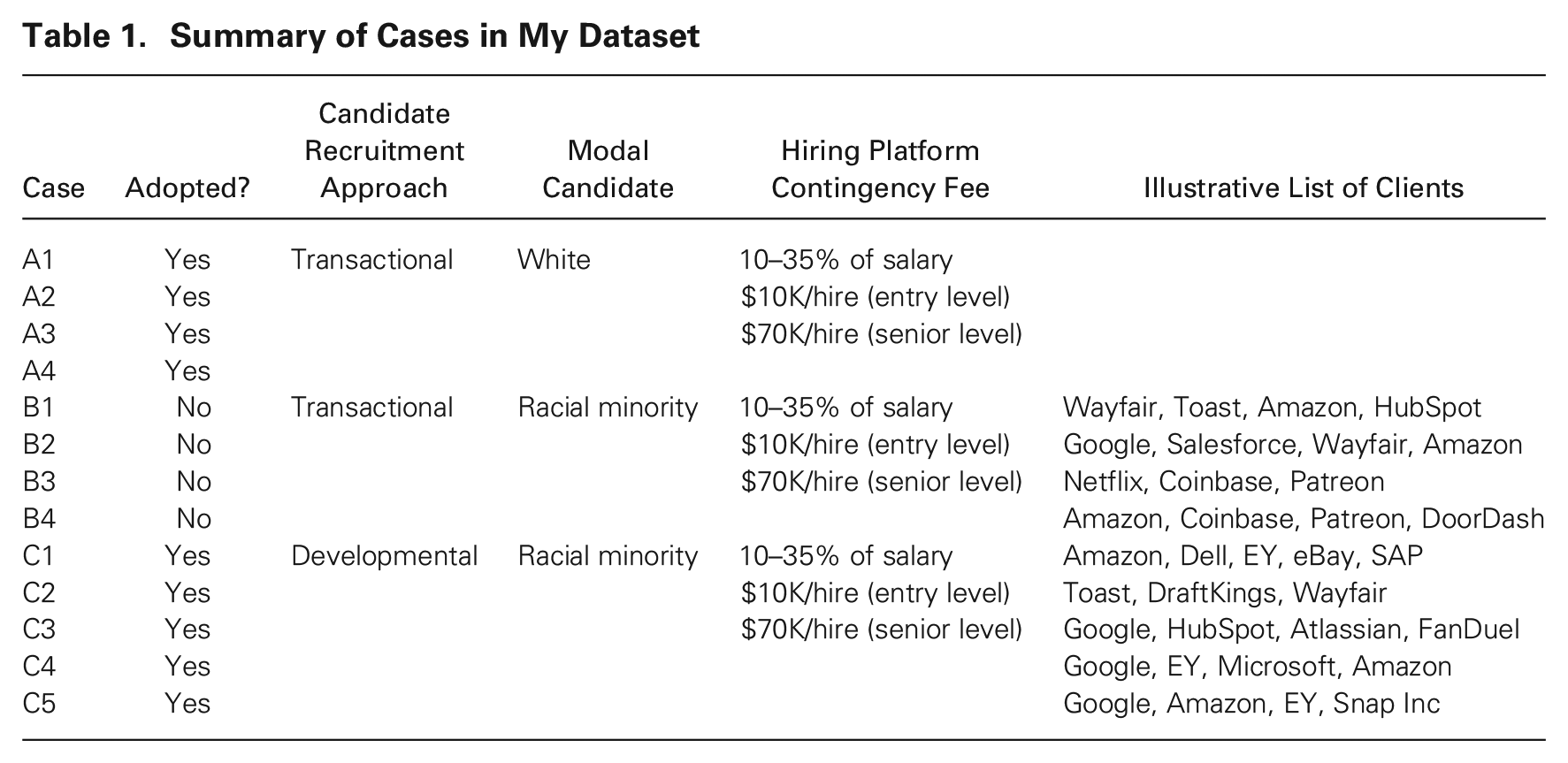
A typical demo began when a sales associate from a recruitment platform reached out to the ShopCo people team manager about its product. 5 The people team manager then scheduled a meeting for the sales associate to demonstrate its product. Typically, the people team manager and a technical recruiter attended the initial demo, which lasted one hour. During the demo, the sales associate walked ShopCo’s managers through the platform, highlighting the platform’s functionality and data analyses. The sales associate discussed the number of candidates on the platform, their demographics, their skills and coding languages, the typical placement rate (e.g., selected for an interview, offered a position, etc.), and other data analytics. Finally, the sales associate discussed the cost of the recruitment platform, which included a contingency fee option.
After the sales associate departed, ShopCo’s people team manager and technical recruiter debriefed for approximately 30 minutes about the recruitment platform. During the debrief, they discussed whether additional ShopCo managers should review the recruitment platform. In 12 of the 13 cases, ShopCo invited the recruitment platform sales associate to give another demo. In these cases, the head of talent, the head of technical recruiting, and a hiring manager from the technology department attended the second demo, which also lasted one hour. After the second-round demo, the head of talent, head of technical recruiting, hiring manager, people team manager, and technical recruiter debriefed on the recruitment platform and decided whether to adopt it. This process usually unfolded over many days. The team held an initial 30-minute to one-hour debrief session and often formulated new questions for the recruitment platform sales associate. The questions were usually answered over email between the ShopCo people team member and the recruitment platform sales associate. Team members continued to discuss, until they reached consensus, whether to adopt the recruitment platform.
Inductive Data Analysis
My inductive data analysis (Glaser and Strauss, 1967; Strauss and Corbin, 1990) consisted of reading my field and interview notes multiple times, writing analytical memos, and tracking rhetoric and actions related to candidate recruitment for technical positions over time. Analysis occurred in three phases. In phase one, I analyzed and categorized ShopCo employees’ DEI sentiments. I used data from ShopCo’s biannual DEI survey and transcripts from the 150 interviews with employees across the company to examine how ShopCo employees thought about DEI, its value in the workplace, and the challenges associated with achieving a diverse, equitable, and inclusive workplace.
In the second phase of analysis, I returned to my data to understand why ShopCo, as an organization with a stated commitment to diversifying its technical staff, was struggling to achieve its DEI goals. Because my first phase of analysis allowed me to rule out some of the existing explanations for ShopCo’s failure to implement a DEI initiative (e.g., lack of commitment, only ceremonial actions, or known sources of employee resistance), I sought to find a new explanation. During this analysis phase, I discovered a surprising puzzle in my recruitment platform data. 6 While ShopCo’s top managers articulated how difficult it was to find and source high-quality racial minority candidates through traditional methods, I observed multiple instances of ShopCo managers rejecting targeted recruitment platforms that had the potential to fill this need. After this discovery, I started the third analysis phase to understand why ShopCo was adopting some recruitment platforms but not others.
In the third phase of analysis, I sought to understand when and how ShopCo managers were adopting (or not) recruitment platforms focused on racial minority candidates. For each recruitment platform, I constructed narrative summaries that focused on (1) what was talked about in the demos and debriefs (construction), (2) how it was talked about (discursive strategies), and (3) with what consequences (action orientation; i.e., adoption of the recruitment platform or not) (Willig, 2014). I iteratively compared and contrasted my codes across my cases and uncovered two key findings that subsequently formed the core of my account for the selection or rejection of a recruitment platform focused on racial minority candidates.
In the third phase of analysis, I first conducted a between-platform analysis of the narrative summaries of each recruitment platform and its adoption outcome. I compared traditional recruitment platforms with targeted recruitment platforms. Table 1 breaks down the recruitment platforms by modal candidate race. This analysis led me to produce a relational model that reflected a transactional approach to candidate recruitment: an approach emphasizing speed, quantity, efficiency, opportunity, and compensation. My between-platform analysis revealed that a transactional approach was acceptable in one instance (traditional recruitment platforms) but not in another (targeted recruitment platforms where the modal candidate was a racial minority).
Then, I used analytic induction (Katz, 2001) to conduct within-platform analyses. I compared targeted recruitment platforms that were similar in terms of price and quality but had different outcomes at ShopCo (one was adopted and the other was not). I traced the narratives on adoption (or not) for these targeted recruitment platforms and found that they centered on three themes: concern with (1) objectification, (2) exploitation, and (3) race-based targeting. These concerns, which reflected issues that ShopCo managers viewed as repugnant, were raised in all nine cases of targeted recruitment platforms in my dataset. However, in five of these nine cases, the ShopCo top managers overcame these concerns and adopted the targeted recruitment platform. To understand how some targeted recruitment platforms overcame these repugnance concerns, I returned to my data and produced a second relational model for candidate recruitment that reflected a developmental approach to candidate recruitment: an approach emphasizing individuality, ethics, equity, community, and commitment. See Table 2 for a breakdown of each relational approach by logic, rhetoric, practices, and relational model.
Definitions of Transactional and Developmental Approaches to Candidate Recruitment
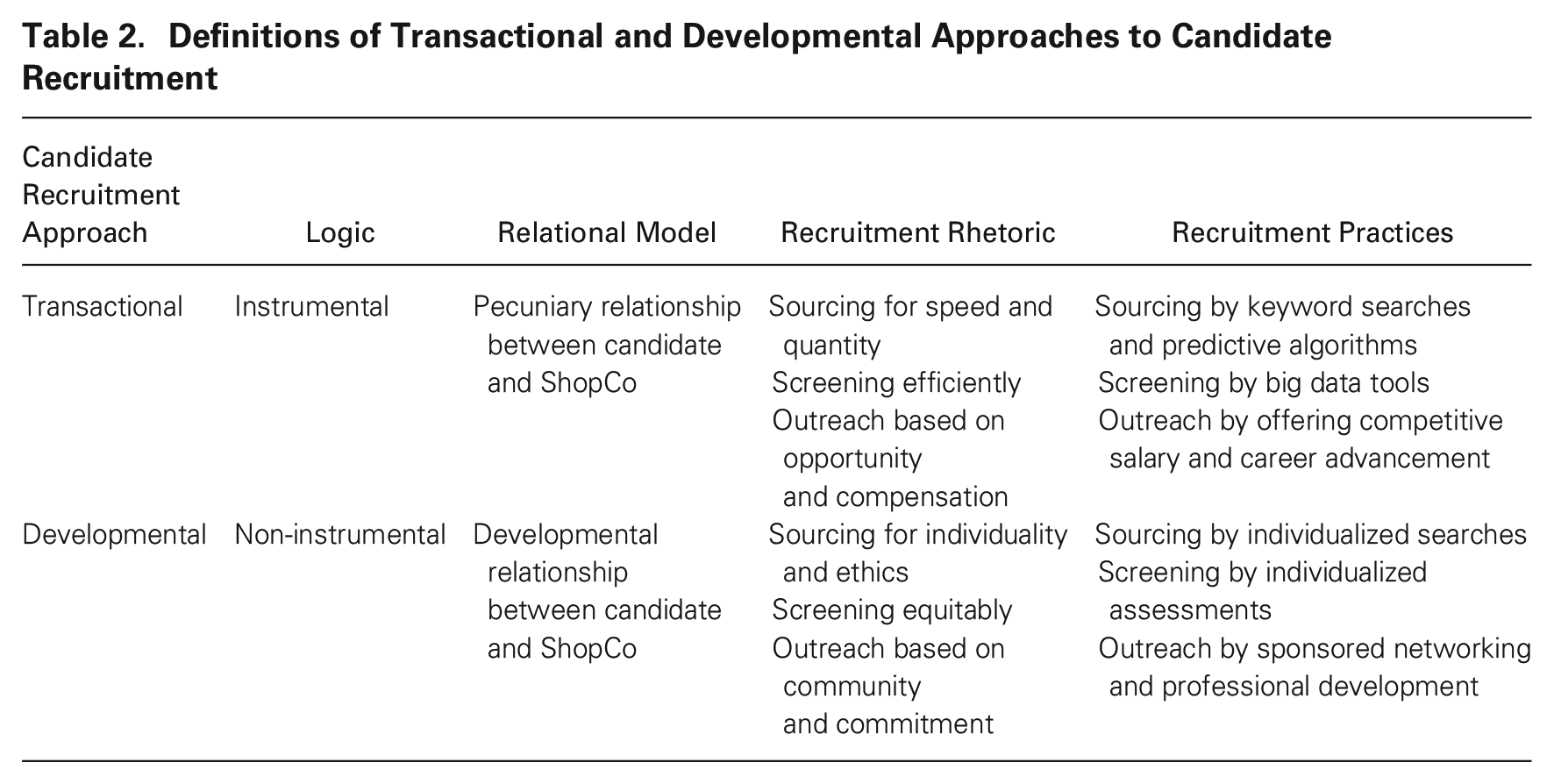
After inductively coding my data to produce these two approaches to candidate recruitment, I conducted additional analyses to validate my findings. First, I hired two independent coders to analyze and code the recruitment platforms’ rhetoric and practices as transactional or developmental. There was a strong level of agreement (92 percent) between my coding and that of the two independent raters, and I calculated a Fleiss kappa score of 0.79, which indicates a substantial level of agreement. Second, I conducted natural language processing on the recruitment platforms’ rhetoric. I used latent Dirichlet allocation (LDA) topic models (Blei et al., 2003; Steyvers and Griffiths, 2007) to analyze the content of the recruitment platforms’ websites and to generate topics. These analyses add validity to my interpretation that my data reflect two relational approaches to candidate recruitment. First, the coherence and perplexity scores analyses showed that two topics were the best fit for my data (a two-topic model had the highest coherence and lowest perplexity scores). Second, the dominant topics from the two-topic model aligned with my qualitative coding of different relational approaches to candidate recruitment: in model 1, the top three dominant topics were source, recruit, and hire, which reflect a transactional approach to candidate recruitment; and in model 2, the top three dominant topics were develop, learn, and support, which reflect a developmental approach to candidate recruitment.
Findings
Variation in Adoption Outcomes Across Recruitment Platforms
ShopCo explored the adoption of 13 different recruitment platforms to help it quickly source, screen, and reach potential candidates for its open technical positions. In general, ShopCo managers recruited engineers by using a transactional approach that emphasized speed, quantity, efficiency, opportunity, and compensation. For example, the director of engineering described how ShopCo changed the starting salaries for different technical roles to reach and engage more candidates: “We just made a 40 percent salary increase for principal software engineer roles. That’s due to supply and demand. There is more demand for software engineers than there are [engineers] available.” In another example from my field notes, a technical recruiter opened the discussion on ShopCo’s technical hiring in the previous quarter by stating, “We have always prioritized speed and quality [in our hiring processes].”
ShopCo managers described the process for technical candidate recruitment as transactional. It is not surprising, then, that ShopCo adopted some recruitment platforms that reflected a transactional approach to candidate recruitment (see Table 1). In my dataset, I have eight cases of recruitment platforms that used a transactional approach to candidate recruitment. These platforms matched one another in terms of price (contingency fee model), quality (candidate credentials and placement statistics), and purpose. And yet, ShopCo adopted only four of these platforms.
How do I explain this variation in adoption outcomes? I do so by leveraging the race of the modal candidate on each platform. As Figure 1 depicts, when the modal candidate on a recruitment platform was White (a traditional recruitment platform), ShopCo managers accepted a transactional approach to candidate recruitment. In contrast, when the modal candidate on a recruitment platform was a racial minority (a targeted recruitment platform), ShopCo managers rejected a transactional approach to candidate recruitment. As I describe below, targeted recruitment platforms that used a transactional approach to recruiting racial minority candidates raised repugnant market concerns.
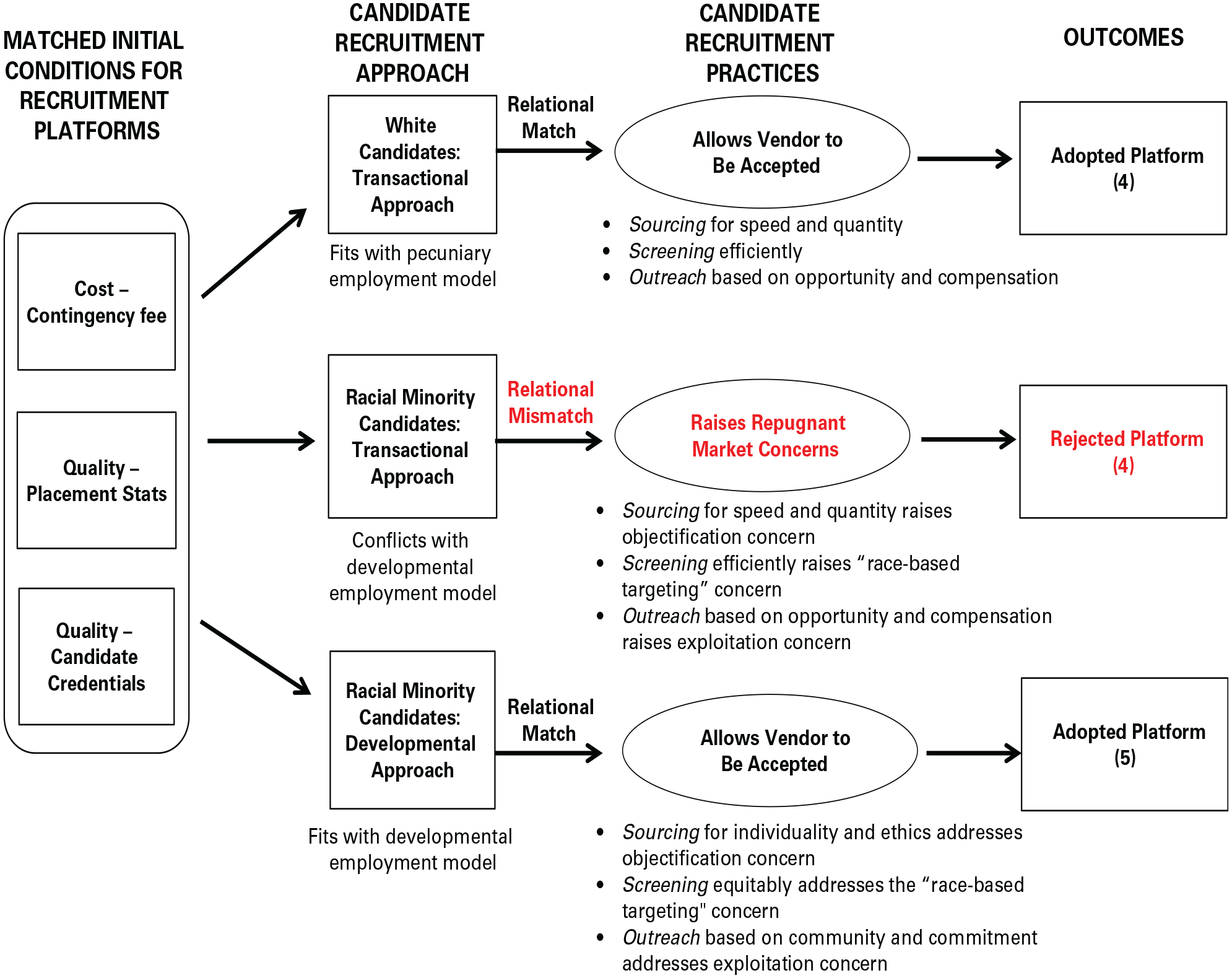
ShopCo Managers’ Adoption (or Rejection) of Recruitment Platforms Based on Repugnant Market Concerns
Explaining Variation in Adoption Across Platforms: Transactional Approaches to Candidate Recruitment and Repugnant Market Concerns
During the process of choosing to adopt a recruitment platform, ShopCo managers revealed that they found it morally repugnant to use a transactional approach to recruit racial minority candidates. This served as a constraint on the platforms’ adoption. I observed multiple instances of ShopCo managers exhibiting distaste for this approach to candidate recruitment when they evaluated targeted recruitment platforms but not when they evaluated traditional recruitment platforms. When evaluating traditional recruitment platforms (four platforms in my dataset), managers at ShopCo adopted those with a transactional approach to candidate recruitment, as this did not raise any repugnant market concerns. For example, during a debrief for an adopted traditional recruitment platform (Platform A2), the head of talent explained that he was comfortable with a transactional approach to candidate recruitment: The time that you’re saving your team from going out there and continuing to dig and dig and dig [for engineering candidates], where a [recruitment] platform can do some of that work for you? [Pause] The return on investment that getting that engineer in the door a month sooner, two months sooner. The contribution that the person will give in that [saved] time, where otherwise you may still be looking for them. [Pause] It far outweighs the hiring fee that we just paid.
In contrast, when salespeople for targeted recruitment platforms displayed a transactional approach to candidate recruitment, ShopCo managers chose not to adopt those platforms (see Table 1). When describing these rejected targeted recruitment platforms, the DEI manager said, “It’s like Indeed [a traditional recruitment platform], but it has diverse candidates [on it] instead. Like, you can go on there and shop for diverse candidates, which sounds terrible.” When she described the platform, the DEI manager put air quotes around the word “shop” and made a face as if she was disgusted with the concept. Similarly, an engineering manager described these platforms this way: They say, “we’ll help you increase your diversity candidates,” and then you go on their platform, you pay them money, and they send you candidates. . . . But I struggle with that because it doesn’t seem super good or [pause] the right way to do things.
ShopCo rejected a transactional approach to candidate recruitment for racial minorities because it raised repugnant market concerns. As I explain in further detail below, ShopCo managers exhibited concerns about objectification, race-based targeting, and exploitation when they evaluated targeted recruitment platforms that reflected a transactional approach to recruiting racial minorities but not when they evaluated traditional recruitment platforms that reflected a transactional approach. This, in turn, led managers to reject targeted recruitment platforms that could have helped them implement their DEI initiative goal of creating a more diverse candidate pool for their technical positions. I observed ShopCo managers express support or repugnance for a transactional approach to candidate recruitment when they evaluated eight recruitment platforms’ processes for the three phases of candidate recruitment: sourcing, screening, and outreach (see Figure 1).
Sourcing Phase of Candidate Recruitment: Identifying Candidates
A common task between traditional and targeted recruitment platforms in the sourcing phase is identifying candidates. ShopCo recruiters wanted recruitment platforms to search actively for candidates for their open positions, rather than relying solely on inbound applications of candidates who applied directly to ShopCo. As the head of technical recruiting shared, “The caliber of engineer we look for is not [applying online]. They’re either pretty happily employed, and we have to pry them out [of their current place of employment], or they’re going through their network of people [to learn about opportunities].” ShopCo recruiters also wanted to ensure that sourced candidates were warm leads, meaning each candidate was interested in new opportunities and open to recruitment. When carrying out a technical sourcing effort, the recruiter shared, “I usually go for people who are open to opportunities, but not everyone has that on [their profile], especially the right people.”
While ShopCo found a transactional approach, characterized by speed and quantity, acceptable for traditional recruitment platforms’ sourcing processes, this approach was a relational mismatch for targeted recruitment platforms. In the sourcing phase, ShopCo managers’ objectification concerns made a transactional approach to sourcing racial minority candidates repugnant.
ShopCo managers accepted a transactional approach to sourcing from traditional recruitment platforms
For traditional recruitment platforms, ShopCo managers drew on a transactional approach to candidate recruitment that emphasized speed (saving time—theirs and the candidate’s) and quantity (yielding large numbers of potential applicants). They also used the recruitment practice of keyword searches and predictive algorithms. For example, as is shown in my field notes of a recruiter building an initial list of candidates for a software engineering role, “the way that I usually find people is through keyword searches.” The recruiter then types the keyword terms “software engineer,”“web developer,”“[City] area.” The recruiter said, “and then [I include] the coding language [we use at ShopCo], like Ruby or React, and sometimes I include technologies that we use.” This process yielded 500 potential candidates.
In another example of sourcing practices that emphasized speed, a ShopCo recruiter debriefed with the talent team about a call with a candidate that was cut short. From my field notes, Well, that was a quick call! The salary was too low [for the candidate]. The lead recruiter replies, “Well, it’s better to get that out of the way quickly than to drag [the candidate] along.” The recruiter agrees and says, “Yeah. I like to tell [candidates] right away [about salary] so that if it’s not a good fit, we don’t waste each other’s time.”
ShopCo managers adopted traditional recruitment platforms when the salespeople emphasized speed and quantity, which is consistent with a transactional approach to sourcing. For example, a salesperson for Platform A1 (an adopted traditional recruitment platform) described the product as “data-driven” and provided placement statistics such as “two-hour response time to a first contact message” and “four days is the average time from [the hiring company] sign-up to a first-round interview [with a Platform A1 candidate].” Similarly, during an interview about Platform A4 (an adopted traditional recruitment platform), the head of technical recruiting said, Within two weeks we had made our first hire. . . . We were able to save a lot of time and effort in digging and getting the word out about ShopCo. . . . We may have dug [ourselves] for a month to build that pipeline, whereas with [Platform A4], we were able to build that list of qualified people in days.
ShopCo managers found a transactional approach to sourcing from targeted recruitment platforms to be repugnant
Because of their concerns about objectification, ShopCo managers rejected targeted recruitment platforms when the salespeople drew on a transactional approach to candidate recruitment that emphasized speed and quantity. For example, the promotional materials for Platform B3 (a rejected targeted recruitment platform) emphasized speed and quantity in sourcing: “[Find out] which recruiting efforts . . . are most cost-effective. . . . Scan hundreds of thousands of candidates’ skill sets in seconds . . . [and] track [your] return on investment of sourcing and recruiting efforts over time.” Even though the material described how the platform’s sourcing efforts could save clients time and yield large numbers of candidates, ShopCo managers rejected it. Similarly, Platform B2 (a rejected targeted recruitment platform) paralleled Platform A1 (an adopted traditional recruitment platform) and touted its ability to quickly source “warm leads,” saying, “Our candidates are 5× more likely to respond to our [client] companies regarding their open opportunities. . . .”
ShopCo managers were concerned that targeted recruitment platforms that used keyword searches and algorithms to predict race (to compile a larger candidate pool than opt-in pools) dehumanized racial minorities and transformed them into objects defined by their race. From one of my interviews, a DEI manager, talking about targeted recruitment platforms, said, “I don’t think many companies care about diversity. I don’t think many ask the recruitment platforms about where they get their candidates. I don’t think the platforms care about the candidates, not as people.”
When targeted recruitment platforms’ salespeople or promotional materials drew on a transactional approach to sourcing, ShopCo managers rejected them. During the debrief for Platform B3 (a rejected targeted recruitment platform), a DEI manager explained to the CPCO and the head of talent how the platform sourced candidates: [Platform B3] is, before I start explaining it, it sounds really scary what they’re able to do. We’d want to be comfortable with them. What [Platform B3] does is based on sophisticated algorithms, they take candidate information and assign them demographic identities. The candidate is not self-identifying [their race]; [Platform B3] identifies the candidate’s [race].
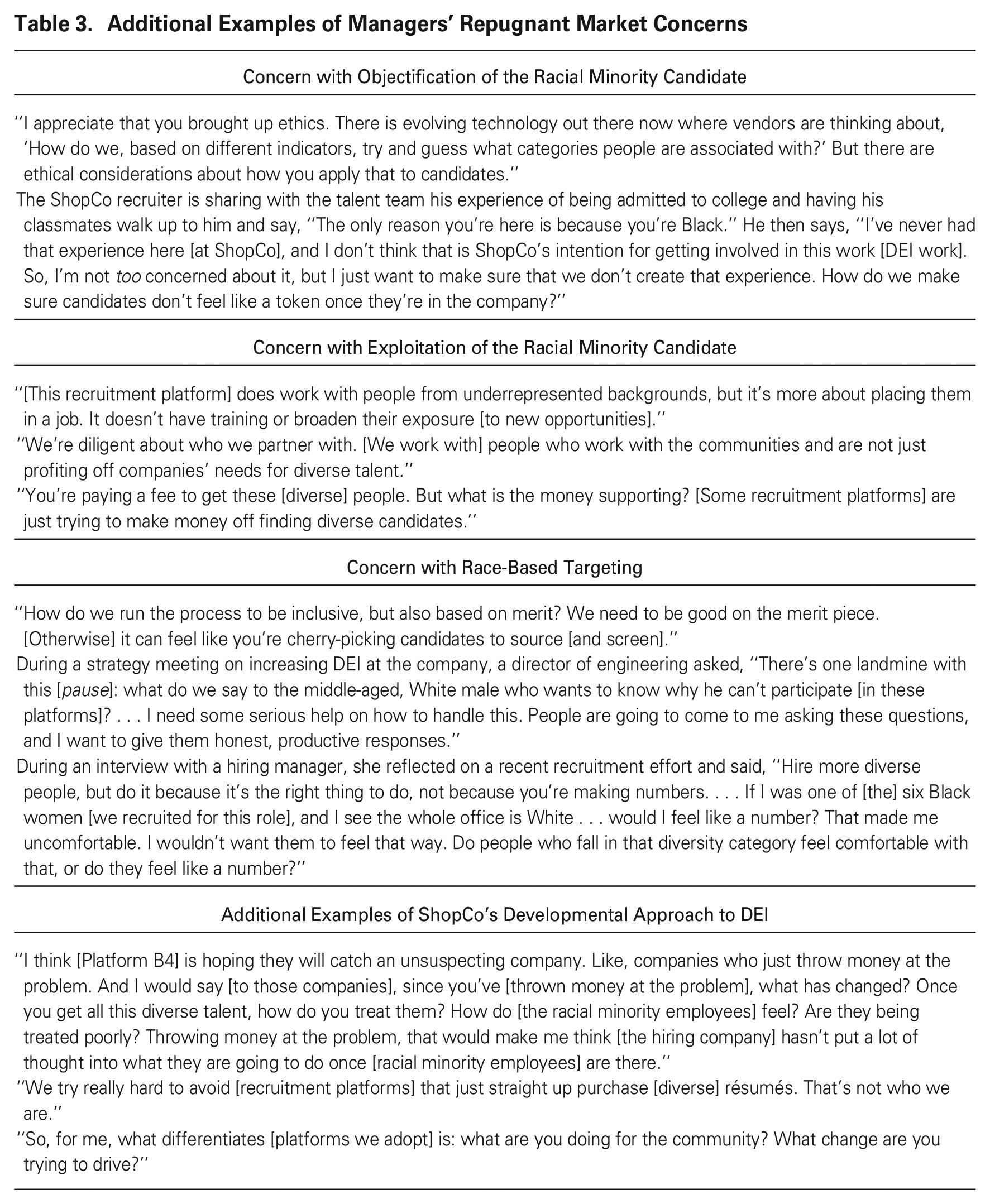
The head of talent expressed concern with this sourcing practice. He opened his mouth wide in shock and said, “That’s disturbing! I wouldn’t want to be identified by an algorithm.” He then made a face of disgust and shook off the feeling. The CPCO was similarly uncomfortable with an algorithm “assigning” racial categories to candidates. The DEI manager agreed that she wouldn’t feel comfortable being racially identified by an algorithm, even though she acknowledged it could potentially help build a wider pool of applicants for their technical roles. See Table 3 for additional examples of repugnant market concerns in the sourcing phase.
Additional Examples of Managers’ Repugnant Market Concerns
Screening Phase of Candidate Recruitment: Evaluating Candidates
In the screening phase, ShopCo recruiters wanted to ensure that sourced candidates were a good potential fit for positions at ShopCo. The screening phase typically entailed evaluating each candidate’s knowledge, skills, and abilities (e.g., technical screens). ShopCo managers wanted the recruitment platform’s process to strike a balance between volume and quality to yield a pool of high-quality candidates. As a technical recruiter explained, We measure the quality of the candidate and that’s where we make sure we’re getting the right people interested [rather than just a large volume of candidates]. . . . We don’t want [recruitment platforms] to just reach out to the lowest hanging fruit to get their numbers.
ShopCo managers looked for an efficient screening process when evaluating recruitment platforms, meaning a process that would both yield a high volume of candidates and ensure that candidates were qualified for the open position.
While ShopCo managers found a transactional approach to screening characterized by efficiency acceptable for traditional recruitment platforms, it was a relational mismatch for racial minority candidates. In the screening phase, ShopCo managers’ concern with race-based targeting made a transactional approach to screening racial minority candidates repugnant.
ShopCo managers accepted a transactional approach to screening from traditional recruitment platforms
In general, the traditional recruitment platforms’ salespeople drew on a transactional approach to screening that referenced big data tools and an efficient process that would yield high-volume and high-quality candidates, and ShopCo adopted these platforms. For example, the demo materials provided to ShopCo by Platform A3 (an adopted traditional recruitment platform) emphasized that the platform’s process enabled the quick assembly of high-quality candidates. The materials described, “Our [recruitment platform] was able to source, qualify, and quickly assemble the entire team of 60 [engineers] over the course of two short months.” Similarly, the demo materials provided to ShopCo by Platform A1 (an adopted traditional recruitment platform) emphasized, “Our proprietary big data tools enable us to identify and vet high-quality candidates . . . introducing you to great matches in only a day or two.”
ShopCo managers considered targeted recruitment platforms’ use of a transactional approach to screening to be repugnant
ShopCo managers’ concern with race-based targeting made a transactional approach to screening racial minority candidates repugnant. This is ironic because targeted recruitment platforms are by definition designed to highlight and help employers use race in their hiring decisions. And yet, ShopCo managers are no different than the general public in their distaste and repugnance for the explicit use of race in hiring or race-based targeting (see Newport, 2020). I found that ShopCo managers expressed either a positive ambivalence or a negative ambivalence about race-based targeting. A positive ambivalence regarding race-based targeting emerged during a conversation with a hiring manager in the technology department: I feel that pressure as a hiring manager. We hired two White men. And now I feel urgency to say that we have these [vacancies] left, we have to make sure that women, people of color get the remaining [open positions]. . . . We don’t want to have a homogenous team. But I don’t want to send the message to my team or candidates, or anyone else, that we’re cherry-picking [candidates] to satisfy diversity.
Similarly, a recruiter shared during a DEI strategy meeting, With new, external hires, we want to bring in diverse candidates at all levels. And, we want to make sure that we’re promoting people here who are not just White males. And, we want to make sure that there isn’t the underlying notion that they’re a [racial] minority and that’s why they got the job.
As these quotes reflect, a positive ambivalence regarding race-based targeting raises the concern that such targeting will lead others to perceive ShopCo as uncommitted to its DEI initiatives and, instead, as merely trying to satisfy diversity quotas. Alternatively, a negative ambivalence regarding race-based targeting raises the concern that ShopCo is simply trying to satisfy diversity quotas and that such targeting will lower the quality of eventual hires (see Castilla and Benard, 2010; Seron et al., 2018; Noble and Roberts, 2019). For example, a ShopCo hiring manager reacted negatively to a proposal for diversity hiring goals when he said with exasperation, “What would specific [diversity hiring] metrics do [for ShopCo]? If we’re just looking to check off boxes, we’ll get [diverse] people who may or may not be qualified for the role.”
Whether they showed positive or negative ambivalence about race-based targeting, ShopCo managers rejected targeted recruitment platforms when they used a transactional approach to screening that emphasized efficiency. Specifically, these targeted recruitment platforms lauded high volume and high quality to evoke race-based targeting—or a process oriented around the explicit use of race and quotas. For example, the demo materials provided to ShopCo by Platform B3 (a rejected targeted recruitment platform) drew on an efficient, transactional approach that could “Efficiently mine candidate pools for skills, experience, underrepresented candidates, and more.” Similarly, in the demo for Platform B4 (a rejected targeted recruitment platform), the sales associate drew on a transactional approach to screening when she discussed the platform’s use of big data tools to efficiently source and screen racial minority candidates (similar to Platform A1, an adopted traditional recruitment platform). From my field notes, The Platform B4 sales associate says, “We make it easier to identify and recruit the brightest and the best.” She then pulls up a preview of potential candidates for an open position. A ShopCo manager asks, “If I’m seeing the demo screen correctly, there’s a symbol next to Angie’s name [a dummy profile created for the demonstration]. What does that mean?” The Platform B4 sales associate responds, “That’s diversity sourcing. You can put in a request for whatever [diversity dimension] you want. . . . You can be specific or pretty general.”
In the debrief for Platform B4, the ShopCo head of talent told the DEI manager and a technical recruiter, “This isn’t a tool we’re looking to use. This seems built for companies who just pay for diverse talent . . . it works with those companies who are just trying to bump up their diversity numbers.” While a transactional approach to screening that emphasized efficiency was acceptable to ShopCo managers for traditional recruitment platforms, it was a relational mismatch for platforms that focused on racial minority candidates. See Table 3 for additional examples of managers’ repugnant market concerns in the screening phase.
Outreach Phase of Candidate Recruitment: Engaging Candidates
The final phase of the recruitment process was outreach to the candidate, which involved getting candidates excited about joining the recruitment platform and typically focused on benefits to the candidate. While ShopCo managers found a transactional approach to outreach characterized by opportunity and compensation acceptable for traditional recruitment platforms, it was a relational mismatch for engaging racial minority candidates. ShopCo managers’ concern with exploitation made a transactional approach to outreach repugnant when applied to racial minority candidates.
ShopCo managers accepted a transactional approach to outreach from traditional recruitment platforms
A transactional approach to outreach emphasized opportunity and compensation. For example, the demo materials from Platform A2 (an adopted traditional recruitment platform) used the following rhetoric to encourage candidates to join the platform: “Deeply ingrained within the tech communities, including startups through established companies, our experts will connect you with opportunities where you can grow, earn what you’re worth, and keep your career interesting.” Similarly, Platform A4 (an adopted traditional recruitment platform) said, “Not only will we work to connect you with the right position and the right company, but we’ll help you understand the market in the near term, discover new opportunities over time, and plan your professional future.” ShopCo managers adopted traditional recruitment platforms when the salespeople emphasized opportunity and compensation in their outreach tactics to candidates, which is consistent with a transactional approach to outreach.
ShopCo managers considered targeted recruitment platforms’ use of a transactional approach to outreach to be repugnant
ShopCo managers’ concern with exploitation led them to reject targeted recruitment platforms when sales associates and materials drew on a transactional approach to outreach that emphasized only opportunity and compensation. Managers were concerned that targeted recruitment platforms were exploiting racial minority candidates to make money, without providing sufficient benefits in return.
For example, Platform B1 (a rejected targeted recruitment platform) highlighted “high paying jobs and upward mobility” as benefits the candidate might accrue if they joined the platform. And Platform B2 (a rejected targeted recruitment platform) said it was “the leading career advancement platform for Black, Latinx, and Native American professionals.” Later, in a debrief session about Platform B2, the director of engineering said, “Yeah [Platform B2] is getting us access to diverse candidates, but what are these [targeted recruitment platforms] really doing for the [candidate]? Are they just profiting off of diversity? Which, honestly, most of them are.” The head of talent expressed a similar sentiment when he shared, I’m against [targeted recruitment platforms] profiting and contributing nothing to the challenge [of diversity in tech]. . . . Where does the candidate experience play out in [their participation on the recruitment platform]? How does the candidate benefit from this? . . . If I’m a diverse candidate, is the platform I participate on vetting the companies for me [for characteristics of diversity and inclusion]? Or are they just taking any [hiring] company’s money?
While ShopCo found a transactional approach to outreach characterized by opportunity and compensation acceptable for traditional recruitment platforms, they considered it a relational mismatch for racial minority candidates. See Table 3 for additional examples of managers’ repugnant market concerns in the outreach phase.
ShopCo Accepted a Developmental Approach for Racial Minority Recruitment
To recruit racial minority candidates, ShopCo eschewed recruitment platforms that emphasized speed, quantity, efficiency, opportunity, and compensation (a transactional approach to candidate recruitment) in favor of platforms that emphasized individuality, ethics, equity, community, and commitment (a developmental approach to candidate recruitment; see Figure 1). I observed multiple occasions of ShopCo’s top managers espousing a developmental approach to DEI initiatives more broadly. During one diversity recruitment strategy session, a recruiter struggled with the perception of objectification and turned to a Black employee in the technology department and earnestly asked, “What do you think about the phrase ‘we want to hire diverse candidates?’ [Making a cringing face herself] Does that make you cringe?” In another example from my field notes, during a review of the biannual DEI survey data, top managers discussed how to highlight ShopCo’s new initiative to recruit racial minorities for technical roles: The CPCO says, “I don’t like the word ‘target,’” in response to a bullet point that reads “Talent continues to target underrepresented groups. . . .” The rest of the team agrees. One member says, “Because it makes them [underrepresented groups] like an object?” The CPCO agrees. Another member says, “And ‘target’ is like the language of the police. Police target people.” The group decides to use “reach” instead and the CPCO says she likes this, “Because it’s like ‘reach out a hand,’” and she extends her arm as she says it.
Similarly, the DEI manager explained ShopCo’s approach to diversity recruitment to me this way: “We’re really mindful of who we choose to partner with. We’re not predatory in this space [of diversity recruitment].”
A developmental approach to diversity recruitment emphasized individuality and ethics in the sourcing phase to overcome objectification concerns, equity in the screening phase to overcome race-based targeting concerns, and community and commitment in the outreach phase to overcome exploitation concerns (see Figure 1). ShopCo managers adopted targeted recruitment platforms—and therefore made progress on their DEI initiative implementation—only when the platform reflected a developmental approach to candidate recruitment. Out of the nine targeted recruitment platforms in my dataset, ShopCo adopted five. The main difference between the five adopted targeted recruitment platforms and the four rejected targeted recruitment platforms was the relational model to candidate recruitment reflected in the platform’s sourcing, screening, and outreach phases. (See Table A2 in the Online Appendix for additional examples of a recruitment platform’s relational model by phase.)
ShopCo managers accepted targeted recruitment platforms’ developmental approach to sourcing
Because ShopCo managers were concerned with objectification issues, they wanted to know how the targeted recruitment platforms sourced and identified racial minority candidates. Consequently, ShopCo managers accepted targeted recruitment platforms when the sales associate or promotional materials drew on a developmental approach to sourcing that emphasized individuality and ethics. For example, a sales associate for Platform C3 (an adopted targeted recruitment platform) described the platform’s sourcing efforts this way: “we’re moving out of a traditional model of finding folks [via keyword searches and predictive algorithms] and discussing how we’re intentionally reaching out [to racial minority candidates].” When a ShopCo manager asked the sales associate from Platform C1 (an adopted targeted platform) how they sourced and identified candidates for the platform, the platform’s sales associate responded, A big reason people sign up [to join our recruitment platform] is the personal relationship [with other candidates on the platform]. We try to build our marketplace with Historically Black Colleges and Universities, the National Society of Black Engineers. . . . We try to build a diverse network.
In his response, the sales associate explained how personal relationships among racial minority candidates and within racial minority communities were used to identify and source candidates to the platform. Salespeople and promotional materials for adopted targeted recruitment platforms drew on a developmental approach to sourcing based on individuality and ethics, thus overcoming managers’ objectification concerns.
ShopCo managers accepted targeted recruitment platforms’ developmental approach to screening
ShopCo managers were concerned with race-based targeting and, therefore, wanted to know how targeted recruitment platforms evaluated potential candidates for their open positions. Specifically, ShopCo managers adopted these platforms when salespeople and promotional materials used a developmental approach to screening that centered on equity: an approach focused on level-setting the process. During the demo for Platform C3 (an adopted targeted recruitment platform), the sales associate explained the recruitment platform’s mission to address racial inequality: We’re [recruiting] people who haven’t had opportunities to get into tech because of systemic racism. . . . We’re working hard to break that down. We want to be an inclusive space for everyone. . . . We’re talking about people who haven’t had this opportunity [to enter tech], because they’ve been boxed out of the path.
During the debrief for Platform C3, ShopCo managers remarked that the platform was helping to level-set the process when they advocated for its adoption. The director of engineering said, “The spirit of this is providing opportunities within engineering to those that have not had that opportunity before. The benefit we get is to give back and to increase our diversity in [engineering].” Similarly, in a debrief session for Platform C5 (an adopted targeted recruitment platform), the ShopCo director of DEI supported the platform’s screening approach: It’s the intention behind [the recruitment platform]. Take [Platform C5], it doesn’t promise you that you’re going to get [a certain number] of candidates so that you as a company can say you’re meeting your quota of this many [diverse candidates].
In another example, the sales associate for another adopted platform (C4) described the screening process the targeted recruitment platform used when a racial minority candidate was matched with an employer’s open position. As indicated in my field notes, the sales associate said, “There’s tests you have to pass, interviews you have to pass. We want to make sure [the candidate] can succeed [in your open position]. We give [the candidate] a hand up, not a handout.”
ShopCo managers accepted targeted recruitment platforms’ developmental approach to outreach
Finally, ShopCo managers had the perception that targeted recruitment platforms were exploiting racial minority candidates. As such, they scrutinized the relational approach to candidate recruitment that the platforms’ salespeople and materials highlighted during the outreach phase and adopted the platforms that drew on a developmental approach demonstrating community and commitment. During the debrief for Platform C5 (an adopted targeted recruitment platform), a ShopCo manager rationalized its adoption by highlighting the (perceived) authentic and committed practices it used in the outreach phase: The sales associate explained they do a lot—conferences, workshops, things for people to come and learn, panels about salary negotiations. The different things that they provide for members of the community, what they do, how they came to be—it matters.
Another ShopCo manager agreed and emphasized Platform C5’s developmental approach to recruiting racial minorities: [Platform C5] is a community, and by being part of it, you’re saying you’re an inclusive place, and you’re open to diversity. If candidates come your way, fantastic. But [if not], you [still] get to be part of a community.
Short- and Long-Term Outcomes of ShopCo’s Developmental Approach to Recruitment of Racial Minority Candidates
ShopCo’s developmental approach to recruiting racial minority candidates had both short- and long-term implications for its recruitment efforts (see Table 4). In the short term, ShopCo managers’ developmental approach to recruiting racial minority candidates led them to select five targeted recruitment platforms that helped them diversify their candidate pools for technical positions. These targeted recruitment platforms helped ShopCo to source, screen, and reach out to racial minority candidates, and racial minority candidates were hired from these targeted recruitment platforms for technical positions at ShopCo. Yet, two important long-term implications of ShopCo’s developmental approach to targeted recruitment speak to its potentially negative downstream consequences.
Direct Implications of Employer Relational Model Matching for Diversity Recruitment*
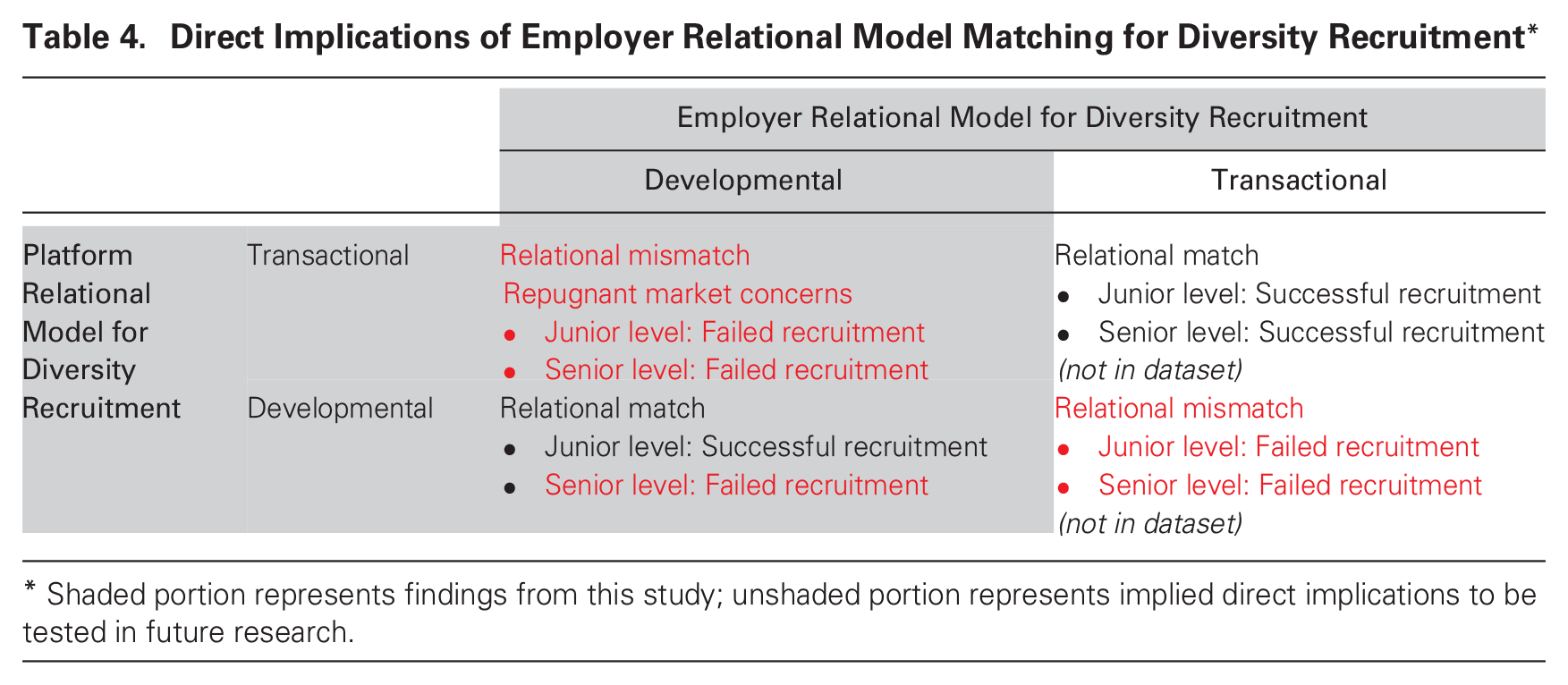
Shaded portion represents findings from this study; unshaded portion represents implied direct implications to be tested in future research.
First, the targeted recruitment platforms that ShopCo adopted tended to yield more junior-level racial minority candidates. While this helped ShopCo diversify the lower levels of the technology department, it did not help the company access senior-level racial minority candidates. In a meeting after ShopCo had completed the selection and implementation of targeted recruitment platforms that reflected a developmental approach, a DEI manager said, “So, if you look at entry-level positions and you compare them to higher-level roles [pause]. When you look at the demographic spread, we are more diverse in entry-level roles.” In a follow-up strategy meeting on the next steps for DEI at ShopCo, the head of talent said, “We’re not bringing in associate engineers anymore, because we don’t have the work that’s appropriate for them. We’re only hiring senior engineers going forward.” This speaks to the first long-term implication I observed at ShopCo: developmental approaches to targeted recruitment might concentrate diversity at the lower levels of the organizational hierarchy.
Second, when the global pandemic of COVID-19 struck, ShopCo found itself in a precarious financial position. Faced with financial constraints and uncertainty, ShopCo had to reduce its labor force and laid off many of its junior-level employees across the company—a proportion of whom were racial minorities who had been newly hired through the adopted targeted recruitment platforms. For example, by April 2020, ShopCo no longer had any racial minorities in individual contributor roles in its product division (a subdivision of the technology department). This speaks to the second long-term implication I observed at ShopCo: developmental approaches to targeted recruitment might create instability in a company’s DEI efforts. While the COVID-19 outbreak was a global pandemic of epic proportions, there are many other more-likely scenarios when a company may face financial insecurity and uncertainty that result in layoffs. If developmental approaches to targeted recruitment concentrate diversity at lower levels of the organizational hierarchy, company layoffs are likely to erase the results of a company’s DEI efforts (see Kalev, 2016).
Addressing Alternative Explanations
I have argued that the relational model of candidate recruitment reflected by the recruitment platform (i.e., transactional versus developmental) and the attending repugnant market concerns that the relational approach elicits (or not) can explain the difference in ShopCo’s top managers’ adoption or rejection of targeted recruitment platforms. However, other potential explanations exist for the differences, which I now examine.
The quality of transactional targeted recruitment platforms determined ShopCo’s top managers’ decisions
One may wonder whether ShopCo’s top managers rejected targeted recruitment platforms that employed a transactional approach because the platforms were lower quality and not, as I suggest, because of the managers’ repugnant market concerns. My data suggest this is not the case. First, in designing my comparative cases, I looked at the demographic data of candidates on the recruitment platform and each platform’s list of advertised clients (i.e., other employers who had adopted the platform). This analysis yielded no discernible difference between the rejected and adopted targeted recruitment platforms in terms of quality (see Table 1). Furthermore, my field notes indicate that when managers evaluated targeted recruitment platforms, their discussions did not center on questions of quality. For example, in the debrief of Platform B1 (a rejected targeted recruitment platform), the hiring manager said, “[Platform B1] is a great platform, don’t get me wrong. But [pause] it’s more about placing [racial minority candidates] in a job,” reflecting a transactional approach to candidate recruitment. Finally, each type of recruitment platform offered a contingency-fee-based model; that is, ShopCo paid only if it hired a candidate recruited from the platform. This lowered the risk to ShopCo’s top managers and should have attenuated any concerns about differences in platforms’ quality.
The qualifications of racial minority candidates on the transactional targeted recruitment platforms drove ShopCo’s top managers’ decisions
Similarly, one might wonder if there was a difference in candidate quality on the platforms. Again, my data indicate this was not the case. Candidates on the recruitment platforms had similar skill sets in terms of coding languages, and each recruitment platform offered a service to conduct an internal technical screen of each candidate’s coding abilities. Furthermore, my field notes indicate that during the evaluation process, the discussions did not center on questions of candidate quality. In fact, I observed multiple occasions when ShopCo managers rejected the notion that there were not enough qualified racial minority candidates available, as reflected here in my field notes: “You hear companies saying, ‘we would love to hire diverse candidates, we just can’t find them [because they don’t exist].’ That’s not true. There are tons of candidates who are qualified. It’s whether you’re getting in touch with them.”
ShopCo’s top managers worried about legal concerns associated with using targeted recruitment platforms
One might think that ShopCo’s top managers rejected targeted recruitment platforms because of legal concerns. My field notes indicate that the legality question was raised about targeted recruitment writ large, not with respect to one relational model of racial minority candidate recruitment versus another (i.e., transactional versus developmental). My field notes further indicate that ShopCo’s top managers overcame this concern with targeted recruitment writ large by framing the use of recruitment platforms as an attempt to diversify its candidate pool. In this discussion from my field notes, a technical recruiter struggles with the perception of race-based targeting and the potential legal implications of such an approach:
In this way, ShopCo’s top managers achieved their DEI initiative goal by ensuring that a diverse slate of candidates was available to compete for the role. But this did not guarantee the outcome of being hired for the role. Furthermore, if ShopCo’s top managers were concerned only with legal issues, I would have expected managers to reject all targeted recruitment platforms. Instead, I found that ShopCo adopted targeted recruitment platforms that reflected a developmental approach to recruitment and rejected such platforms that reflected a transactional approach.
ShopCo was not a competitive employer
One might argue that if ShopCo was not a competitive employer, this may have limited its ability to attract top candidates and its ability to pay for top candidates of any race. Furthermore, ShopCo’s placement in the employer ecosystem has important ramifications for the generalizability of my findings. My longitudinal ethnographic study of ShopCo suggests that it was a competitive “high road” employer (Osterman, 2017: 1). During my 20 months at ShopCo, the company grew from approximately 400 employees to close to 1,000 employees; it acquired two companies, expanded into three new cities, and reached a valuation of more than $1 billion. Additionally, ShopCo enjoyed consistently high ratings on Glassdoor and won numerous employer awards, including “Best Place to Work for Millennials,”“Best Small and Medium Workplaces,” and “Most Innovative Company of the Year.”
Discussion
Existing research has made significant progress toward understanding how and when a DEI initiative that top managers have proposed will be implemented successfully. Scholars have specified demand-side policies that organizations can use to facilitate a DEI initiative’s implementation (Danbold and Bendersky, 2020; Dobbin and Kalev, 2022), identified how the mechanisms proposed may not always work to meet those goals due to employee resistance (e.g., demand-side constraints; see Kalev, Kelly, and Dobbin, 2006; Dobbin, Schrage, and Kalev, 2015), and suggested managerial practices to overcome these constraints (e.g., Walton et al., 2015; Dobbin and Kalev, 2016; Correll, 2017). Still, organizations continue to face underrepresentation of racial minorities in their technical positions (e.g., The New York Times Editorial Board, 2014; Bogost, 2019; Dickey, 2019). Given the increasing interest in addressing DEI issues in organizations, understanding what additional barriers remain to implementing DEI initiatives successfully—especially within seemingly committed organizations—has both practical and theoretical importance.
In my ethnographic study of ShopCo, I observed that managers had access to multiple targeted recruitment platforms that could have addressed their hiring needs for high-quality racial minority candidates for technical positions. These platforms had fee structures and candidate skill sets that were similar to those of the traditional recruitment platforms. But because of their repugnant market concerns, ShopCo’s top managers rejected several targeted recruitment platforms that could have helped them implement their DEI initiative of increasing the representation of racial minorities in their candidate pool.
To recruit racial minority candidates, ShopCo eschewed platforms that emphasized speed, quantity, efficiency, opportunity, and compensation (the transactional approach to candidate recruitment) in favor of platforms that emphasized individuality, ethics, equity, community, and commitment (the developmental approach to candidate recruitment, see Figure 1). I use these findings to develop a theoretical model (see Figure 2) of how and when a DEI initiative that top managers have proposed will be implemented successfully, and through this model I offer three novel contributions: a new source of differential treatment, a new demand-side constraint, and a new market intermediary constraint.
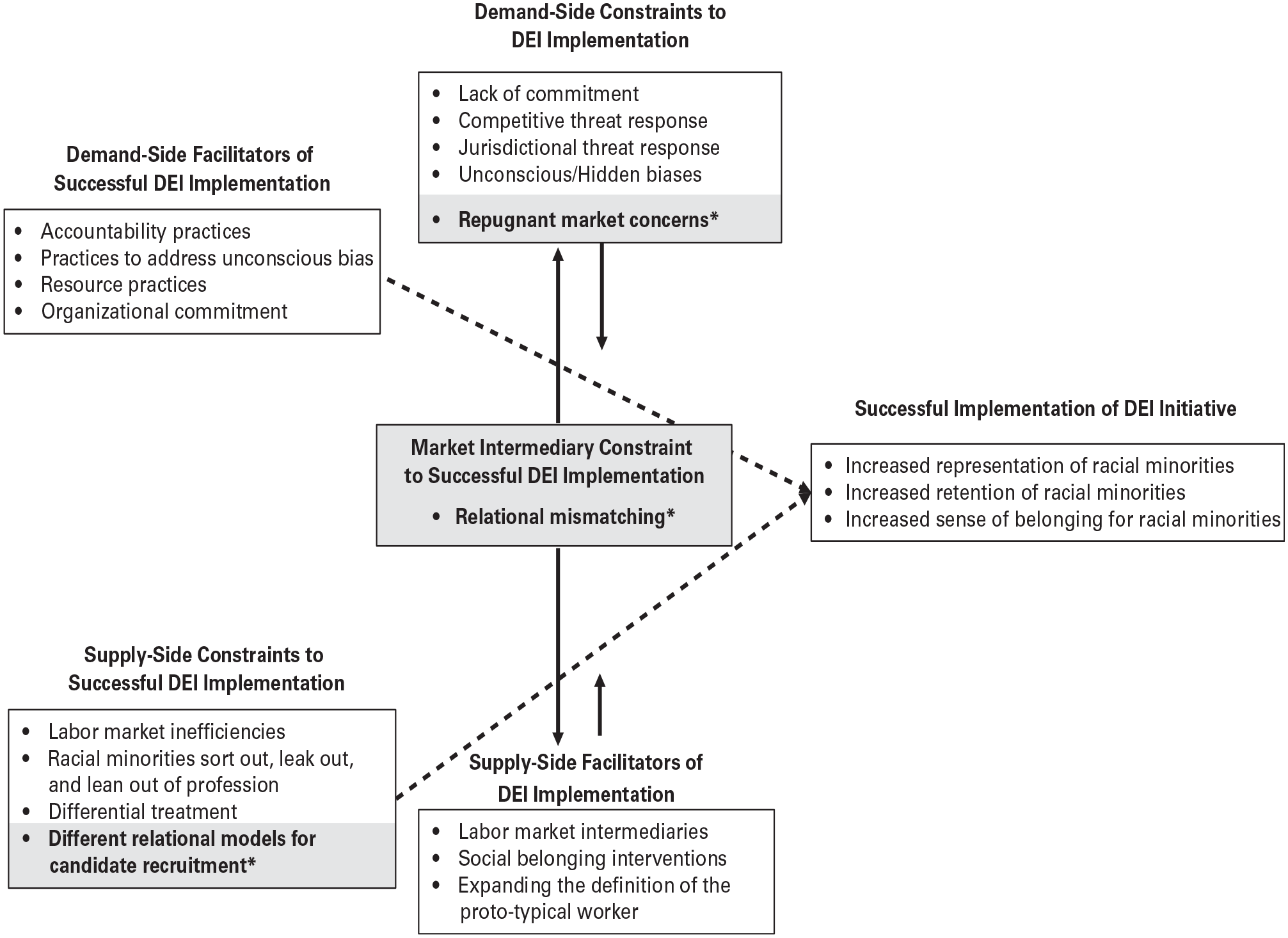
How and When a DEI Initiative Proposed by Top Managers Will Be Implemented Successfully *
New Source of Differential Treatment: Different Relational Models for Candidate Recruitment
Previous studies have documented how differential treatment of job candidates enters the decision-making process at the candidate evaluation stage (see Bielby and Bielby, 1999; Dreher, Lee, and Clerkin, 2011; Fernandez-Mateo and King, 2011). These studies have demonstrated that differential treatment can distort candidate pools by limiting underrepresented group members’ access to the pool or by underusing members of the pool (e.g., Rubineau and Fernandez, 2015; Abraham, 2020). My study builds on this prior work on differential treatment in several important ways.
First, I highlight a new type of differential treatment shaping organizational inequality: the use of different relational models for candidate recruitment. ShopCo managers had one relational model for candidate recruitment when the modal candidate was White (transactional approach) and a different relational model for candidate recruitment when the candidate was a racial minority (developmental approach). The transactional relational model used keyword searches, predictive algorithms, big data tools, and competitive salaries and career advancement opportunities to accomplish a quick, efficient, and high-yield recruitment process. In contrast, the developmental relational model promoted individualized searches and assessments and sponsored networking and career development opportunities to accomplish an individualized, ethical, and community-based recruitment process. While the developmental relational model at ShopCo yielded entry- and junior-level racial minority candidates, ShopCo employees observed that it did not yield senior-level candidates.
Second, I suggest how this differential treatment may (un)intentionally enter the job candidate evaluation process and have important downstream implications for organizational diversity. Inequality scholars have long discussed how the differential treatment of racial minorities during the credentialing and evaluation processes causes racial minority candidates to “sort” and “leak” out of the labor market (e.g., Reskin and Roos, 1990; Fernandez-Mateo and Fernandez, 2016; Brands and Fernandez-Mateo, 2017). This ultimately affects the diversity of the labor market and who is eligible for hiring and promotion opportunities (or the “shape of the river”; see Bowen and Bok, 2016: lviii). Similarly, previous scholars have documented how racial minorities, writ large, have limited access to recruitment pools or are underused within a recruitment pool (e.g., Rubineau and Fernandez, 2015; Abraham, 2020). By identifying a new source of differential treatment, I provide a finer-grained understanding of how managers may evaluate, access, and source candidates from recruitment pools. I demonstrate how the search and recruitment strategy that managers deem acceptable can have important practical implications for which type of candidate is ultimately hired and where organizational diversity goals are achieved. Specifically, a transactional approach to candidate recruitment for White candidates allowed ShopCo managers to access and source White candidates with various tenures (e.g., entry level through senior level). However, a developmental approach to candidate recruitment for racial minorities concentrated ShopCo managers’ hiring at the entry and junior levels. Therefore, this strategy allowed ShopCo managers to achieve their organizational diversity goals only at the lower levels of the organizational hierarchy.
Finally, I extend the work of scholars who have elaborated firm-level employment relational models (i.e., Baron, Burton, and Hannan, 1996; Hannan, Burton, and Baron, 1996). These scholars demonstrated that different firms may have different relational approaches to employment (e.g., star, commitment, factory, or engineering relational models for employment) that, in turn, have downstream consequences for each firm’s success and stability. I show that the same firm may have different relational approaches to candidate recruitment, depending on candidates’ race: a transactional candidate recruitment relational model for White candidates and a developmental candidate recruitment relational model for racial minority candidates. I also demonstrate that these different candidate recruitment relational models may contribute to important downstream consequences for a firm’s DEI initiative success and stability.
New Demand-Side Constraint: Repugnant Market Concerns
Prior work on organizational inequality has documented that a lack of organizational commitment (e.g., Edelman, 1992; Kulik and Roberson, 2008), employee resistance (e.g., Bobocel et al., 1998; Harrison et al., 2006; Lowery et al., 2006; Dobbin and Kalev, 2018), and unconscious or hidden biases about candidate quality (e.g., Ridgeway and Correll, 2004; Aquino, Stewart, and Reed, 2005; Rivera, 2012) are demand-side constraints that can impact the successful implementation of DEI initiatives. My study builds on this prior work on demand-side constraints in several important ways.
First, I highlight a new demand-side constraint that can impact the successful implementation of DEI initiatives: repugnant market concerns. I found that ShopCo managers were concerned with their perception of the objectification, exploitation, and race-based targeting of racial minority candidates, which led them to reject transactional targeted recruitment platforms in favor of developmental targeted recruitment platforms (see Figure 1). Similar to scholars who have used discourse analysis to demonstrate how organizational narratives affect support for (or resistance to) DEI initiatives (Ely, 1995; Ely and Thomas, 2001; Padavic, Ely, and Reid, 2019), I used discourse analysis to identify how employee perceptions and values affected the perceived appropriateness of various relational approaches to candidate recruitment. In this way, my study reveals the ironic, uncomfortable, and emotionally fraught reactions managers may face when implementing a DEI initiative.
Second, by tracing the source of managerial anxiety and tension—repugnant market concerns about transactional approaches to candidate recruitment of racial minorities—I deepen our understanding of repugnant markets and related phenomena. The literature on repugnant markets has shown how a distaste for certain kinds of transactions (Roth, 2007) can serve to constrain market-based transactions (e.g., Lacetera and Macis, 2018). For example, in her study of the commercialization of sperm and egg donation, Almeling (2007) found that market-based transactions were acceptable in one instance (sperm donation) but not another (egg donation). In a similar vein, Anteby (2010) demonstrated that professionals in the cadaver market eschewed market-oriented practices in favor of more-humane practices to overcome concerns of coercion, exploitation, and objectification. My findings show that repugnant market concerns have important implications for the success of DEI initiatives, in addition to having implications for other kinds of market-based transactions. My identification of repugnant market concerns with transactional approaches to diversity recruitment may help to explain the mixed findings of previous organizational inequality research (e.g., Leslie, 2019). For example, in Bartels and colleagues’ (2013) survey of organizations’ diversity management practices, the authors found that organizations expressed greater support for solutions that projected diversity to the public and established a reputation in the community (a developmental approach) than for more-transactional solutions.
New Market Intermediary Constraint: Relational Mismatching Between Employer and Vendor
Prior work on market intermediaries suggests that there are several constraints to facilitating matchmaking between employers and candidates. Researchers have found how these intermediaries can replicate, reproduce, and reify the biases they are meant to counteract (e.g., Fernandez and Mors, 2008; Dreher, Lee, and Clerkin, 2011; Fernandez-Mateo and King, 2011). For example, in her study of network referrals and resource exchange, Abraham (2020) documented how the perceptions of a third party affected whether women were referred for opportunities. In particular, Abraham’s (2020) study showed that for male-typed occupations, when the referrer (a market intermediary) believed that a potential new client could prefer men, they were less likely to refer women or to give them access to resources—even in the absence of information about explicit gender-based bias. In this way, the intermediary was distorting the pool by underusing members of the pool. My study builds on this prior work on market intermediary constraints in several important ways.
I suggest a new form of market intermediary constraint: relational model (mis)matching between the employer and the vendor (see Figure 2). In ShopCo’s case, its managers’ developmental approach to recruiting racial minority candidates and the targeted recruitment platforms’ transactional approach were relational mismatches. More generally, an employer’s developmental approach to DEI initiatives and a vendor’s transactional approach to such initiatives represent a relational mismatch that could lead to failure to implement the initiative (see Table 5). Furthermore, the opposite could also be true: an employer’s transactional approach to DEI initiatives and a vendor’s developmental approach may also represent a relational mismatch that could lead to failure to implement.
Theoretical Implication of Relational Model Matching for Successful Implementation of DEI Initiative by Top Managers
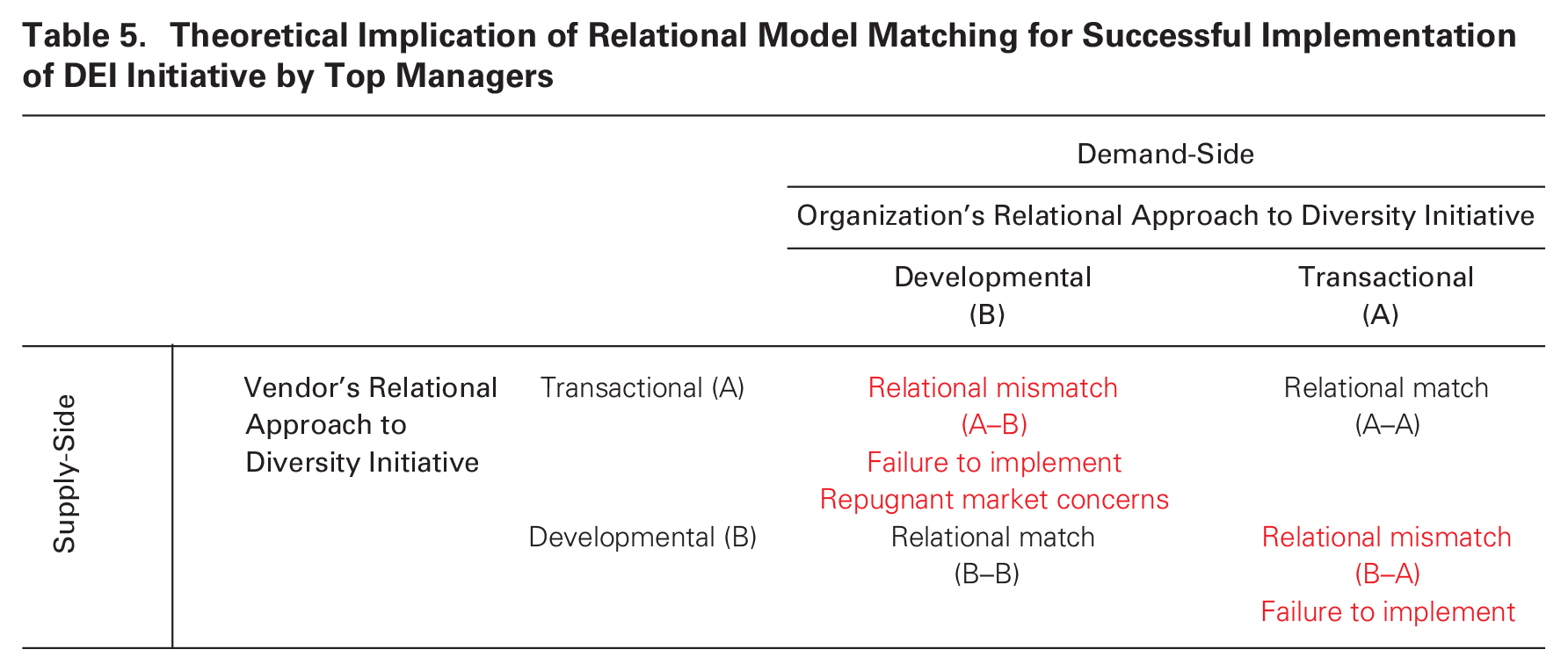
A key theoretical insight from my study is that for managers to implement a DEI initiative successfully, the employer’s and the vendor’s relational approaches to the initiative need to match. Yet, general intuition should lead us to think this might be quite difficult to accomplish. To understand why this relational matching may be a general challenge, it is useful to take a step back and consider the broader environment in which DEI initiatives are situated. Recent research (Georgeac and Rattan, 2023) has found that between 70 and 80 percent of Fortune 500 companies espouse an instrumental logic (the business case) for diversity. Given that transactional approaches use an instrumental logic (see Table 2), we can assume these companies represent a transactional approach to diversity initiatives. Although there is no current mapping of the DEI vendor landscape, we can assume that vendors reflect the market demand; therefore, a proportional number of vendors also reflect a transactional approach to DEI initiatives. This will yield relational matching (represented as “A–A” in Table 5).
Yet, the existing literature points to how a transactional relationship could result in tokenization, which is a potential driver of turnover and attrition for racial minority employees (Laband and Lentz, 1998; Reid and Padavic, 2005; Nishii and Mayer, 2009). Furthermore, emerging research has documented how DEI initiatives that reflect an instrumental logic are less appealing to racial minorities (e.g., Georgeac and Rattan, 2023) and are associated with worse outcomes (e.g., Starck, Sinclair, and Shelton, 2021; Srinivasan and Monin, 2022). This may explain why, even when DEI initiatives that reflect a transactional approach are implemented, organizations fail to achieve sustained racial diversity due to low levels of attraction and retention of racial minority employees.
Finally, as I observed in the case of ShopCo, for companies that espouse a developmental approach to diversity initiatives (approximately 5 percent of Fortune 500 companies; Georgeac and Rattan, 2023), it may be difficult to achieve relational matching (represented as B–B in Table 5) if vendors reflect the market demand for transactional approaches. Taken together, these findings suggest that there may be a macro-level mismatch between what vendors are providing (transactional approaches), what employers are demanding (mostly transactional approaches, with a smaller percentage developmental), and what employees are requiring (developmental approaches).
Opportunities for Future Research and Boundary Conditions
I use analytic induction to demonstrate how ShopCo managers initially failed in their DEI initiative implementation due to a new source of employee resistance—repugnant market concerns—and how relational mismatching between ShopCo and the recruitment platforms elicited these concerns. Qualitative, ethnographic research is best suited to examining the logic, rhetoric, and actions of individuals to reveal a system of meanings. In this way, my study demonstrates that employers may have implicit relational models for candidate recruitment (such as transactional approaches for White candidates and developmental approaches for racial minorities) that can provoke repugnant market concerns—regarding objectification, race-based targeting, and exploitation—when there is a mismatch between the employer and the recruitment platform.
Future researchers could use experimental or mixed-method designs to explore and expound upon my findings in various ways. For example, my finding of repugnant market concerns with a transactional approach to diversity recruitment represents differential treatment. However, I cannot adjudicate between multiple interpretations of the managerial motivations shaping this differential treatment. On the one hand, managers’ repugnant market concerns could be a sincere reaction by White majority-group reformers who view a transactional approach to DEI initiatives as raising objectification, race-based targeting, and exploitation concerns. Given this interpretation, majority group reformers could view a developmental approach as a means to overcome these concerns and reinforce their stated commitment to DEI to racial minority group members, who have good reason to question majority group members’ motivations and goals (see Hughey, 2012; Anderson, 2022; Kirgios et al., 2022; Georgeac and Rattan, 2023; Jackson and Kellogg, 2023). On the other hand, repugnant market concerns could represent a covering exercise for managers’ hidden biases about racial minority candidates. Previous scholars have shown how moral licensing (see Monin and Miller, 2001; Merritt, Effron, and Monin, 2010; Kaiser et al., 2013) can enact bias in organizations. Under this interpretation, ShopCo managers may have espoused repugnant market concerns regarding objectification and exploitation (morally appropriate concerns) in order to enact and license their negative ambivalence about race-based targeting (organizational bias about candidate quality). Similarly, social psychologists have used experimental methods to reveal the degree to which individuals actually prefer inequality among social groups, regardless of their stated objectives (see Pratto et al., 1994). Under this interpretation, ShopCo managers may have adopted targeted recruitment platforms that reflected a developmental approach to candidate recruitment because these platforms yielded junior-level candidates and concentrated racial diversity in the lower levels of the organizational hierarchy. Future researchers could explore how, when, and to what extent repugnant market concerns serve as a sincere concern voiced by White majority-group member reformers or as a vehicle for enacting hidden biases.
Second, future researchers could examine whether repugnant market concerns exist within other types of diversity recruitment (e.g., gender, LGBTQ+, veterans) and in other types of jobs or industries. Third, future researchers could expound upon my theoretical implications (see Table 5) and explore whether and how other types of diversity initiatives, when framed transactionally, elicit similar repugnant market concerns. Future research could also examine the extent to which recruitment platforms that reflect a transactional approach to recruiting racial minorities can be leveraged successfully to achieve organizational diversity goals (e.g., Mackey, 2022).
Finally, I observed how developmental approaches to targeted recruitment yielded more junior-level candidates. Future researchers could determine to what extent this is an outcome of attraction issues on the platform—for example, how the rhetoric and practices of developmental, targeted recruitment platforms (e.g., conferences, networking, and professional development opportunities) are more attractive to junior-level racial minority candidates than to senior-level racial minority candidates and, therefore, increase the likelihood of junior-level racial minority candidates joining the platform.
My study has important boundary conditions for generalizing my findings. First, not all organizations that desire increased racial diversity may find a transactional approach to recruiting racial minorities repugnant. Indeed, this was evidenced by the fact that some employers, just not ShopCo, adopted targeted recruitment platforms using a transactional approach. On the one hand, ShopCo and its leadership may represent idiosyncratic organizational dynamics that are difficult to replicate in other settings. ShopCo is a high-road employer engaged in multiple DEI initiatives with organizational support from leadership and line-level employees. This allowed me to observe, in high relief, repugnant market concerns with transactional approaches to diversity recruitment. On the other hand, these repugnant market concerns, and the emotionally fraught reactions that different approaches to DEI implementation elicited, are likely to exist in the boardrooms, conference rooms, and faculty lounges of various organizational settings.
Repugnant market concerns offer a novel way of thinking about employees’ resistance to DEI initiative implementation (or not) and set a new theoretical agenda for the study of DEI initiatives in the workplace. What is generalizable from my study is the reaction of repugnant market concerns, or how different approaches to the implementation of a DEI initiative may elicit ironic, uncomfortable, and emotionally fraught reactions even from seemingly committed organizational decision-makers.
Supplemental Material
sj-pdf-1-asq-10.1177_00018392231183649 – Supplemental material for (Not) Paying for Diversity: Repugnant Market Concerns Associated with Transactional Approaches to Diversity Recruitment
Supplemental material, sj-pdf-1-asq-10.1177_00018392231183649 for (Not) Paying for Diversity: Repugnant Market Concerns Associated with Transactional Approaches to Diversity Recruitment by Summer R. Jackson in Administrative Science Quarterly
Footnotes
Acknowledgements
This paper benefitted greatly from the insightful feedback of Katherine Kellogg, Ray Reagans, Ezra Zuckerman Sivan, Jenna Myers, Raquel Kessinger, and Ari Galper. I am also grateful to Julia DiBenigno, Basima Tewfik, James Riley, Cat Turco, JoAnne Yates, Michael Wahlen, Robin Ely, Katie Coffman, Melissa Mazmanian, Emilio Castilla, Roberto Fernandez, Teresa Amabile, Ryan Buell, and Robert Kaplan for their thoughts and feedback. My paper developed through and was strengthened by the comments from audience and seminar participants in the MIT Sloan Economic Sociology Working Group, University of Toronto Rotman School of Management Strategy Seminar, Harvard Business School Organizational Behavior Unit Seminar, 2020 INFORMS Dissertation Proposal Competition, Harvard Business School Gender and Race in Organizations Working Group, Stanford Graduate School of Business Rising Scholars Conference, Carnegie Mellon University Economic Sociology Conference, Harvard Business School Junior Faculty Seminar, Harvard University Economic Sociology Seminar, and 2019 Academy of Management Professional Development Workshop on Qualitative Dissertations. Thank you to Haisley Wert, Jolly Rop, Noelle Castro, Desiree Belonge, Christine Rivera, and Melissa Velez for their incredible research assistance and support of my paper. My research was supported by the MIT Sloan Good Companies, Good Jobs Initiative. I am indebted to Christopher Rider and three anonymous reviewers for realizing the potential of this work. Finally, my study would not have been possible without the generous support of ShopCo employees, who gave their time and thoughts and from whom I learned so much. Thank you.
1
The DEI survey also indicated that ShopCo’s technology department was 30 percent female and 18 percent non-White.
2
During my data collection (September 2018–April 2020), ShopCo conducted six additional DEI surveys, and the response rate was always greater than 70 percent. The company shared two archival DEI surveys with me.
3
AI-based recruitment platforms work by using algorithms to match candidates on the platform with an employer’s open position.
4
Near-verbatim means that I sat with a laptop during each observation and attempted to type in real time everything that was said, correcting minor typos and small word omissions soon after the observation.
5
As my field notes and archival access to email exchanges between the people team manager and sales associates show, every recruitment platform that reached out to the people manager received at least a first-round review.
6
For each recruitment platform, I drew upon data from three sources: observations of the demo and debriefs of it (including email exchanges between ShopCo and sales associates), interviews with technical recruiters and hiring managers, and archival material from each recruitment platform’s website and marketing materials.
