



Abstract
Most literature on aesthetic innovation has focused on single producers who use radical aesthetic innovation to differentiate their products. However, a few scholars, as well as anecdotal evidence, suggest that when gazed at from the category level, aesthetic innovation usually occurs as incremental variations of a dominant aesthetic. Extant theory fails to account for why we see cycles of shift and stability in the dominant aesthetic of a category. In this study, we identify the mechanisms that drove such shifts and stability in the dominant aesthetic of the hearing aid category from 1945 to 2015. Leveraging this study, we develop theory showing that alignment or misalignment between category meanings and recent cultural trends spurs producers to generate new categorical aspirations to associate their category with new sets of meanings. However, producers introduce radical new aesthetic innovations only when a change in product form allows them to experiment. Examining aesthetic evolution at the category level helps to shed light on category-level patterns of aesthetic shifts and stability, why attempts to differentiate outside the dominant aesthetic are rare, and why product aesthetics across a category shift synchronously between dominant aesthetics. Furthermore, we enhance understanding of the roles of culture in category evolution and of aesthetics in the construction of category meaning, and we show how such meanings are periodically and collectively renegotiated in mature categories.
Aesthetic features offer tangible cues that influence audiences’ cognitive and emotional responses to products (Yamamoto and Lambert, 1994; Rafaeli and Vilnai-Yavetz, 2004; Luchs and Swan, 2011), and producers can innovate on such aesthetics to differentiate their products from those of competitors (Bloch, 1995; Utterback et al., 2006; Karjalainen and Snelders, 2010; Ravasi and Stigliani, 2012; Cattani et al., 2020). The aesthetic qualities of a product comprise dimensions such as color, contour, and surface textures (Baldessarelli, Stigliani, and Elsbach, 2022). Most studies of aesthetic innovation have focused on single producers’ pioneering efforts to differentiate their products through radical aesthetic innovations (Verganti, 2009; Salvato and Rerup, 2018). For example, Alessi used such innovation to associate their kitchenware with art (Dalpiaz, Rindova, and Ravasi, 2016), and Dyson used it to radically alter consumers’ responses to their vacuum cleaners (Ravasi and Lojacono, 2005).
Recently, some scholars have begun to examine aesthetic innovation from a category-level perspective (Talke et al., 2009; Dell’Era and Verganti, 2011; Eisenman, 2013; Eisenman and Simons, 2020; Sgourev, Aadland, and Formilan, 2023). Taking such a bird’s-eye view enables us to understand not only pioneering producers’ successful launches of radical aesthetic innovations (Djelic and Ainamo, 2005; Dalpiaz, Rindova, and Ravasi, 2016) but also how these product launches are part of general patterns at the category level. Scholars have suggested that aesthetic innovations are often undertaken within the confines of a dominant aesthetic (Verganti, 2008; Eisenman, 2013: 347), that is, a combination of aesthetic elements that dominates a product category at a given point in time. Studies have thus indicated two forms of aesthetic innovation: radical aesthetic innovation, in which entirely new aesthetics are introduced within a product category, and incremental aesthetic innovation, in which producers offer minor elaborations of an existing dominant aesthetic (Norman and Verganti, 2014).
Anecdotal evidence has also indicated that product categories appear to evince a succession of shifts in a dominant aesthetic that often greatly influence market growth and competition (Abernathy and Clark, 1985; Eisenman, 2017). For example, the late 1990s saw a shift in the dominant aesthetic of the mobile phone product category. Before this time, most mobile phones were square, metallic, and bulky, whereas after this period, they had bright colors and rounded contours (Djelic and Ainamo, 2005). Within the market for electronic cigarettes, the aesthetics shifted from mirroring combustible cigarettes to later emulating high-tech products such as USB flash drives (Hsu and Grodal, 2021). In the realm of portable audio devices, the aesthetic of gray-and-black square boxes with sharp contours, which had dominated the category for 20 years, was swept away within a brief period by bright colors and organic, soft contours (Du Gay et al., 1997; Verganti, 2008).
Despite the importance of these shifts and stability, scholars’ tendency to focus on single producers’ use of aesthetic innovation has created a gap in our understanding of how and why such patterns unfold. In this article we therefore ask, which mechanisms drive shifts and stability in the dominant aesthetic of a product category?
Similar to how theories of technological evolution have enhanced our understanding of technological innovation cycles (Grodal, Krabbe, and Chang-Zunino, 2023), mapping the dynamics of aesthetic evolution may enable us to advance our understanding of aesthetics in product market competition (Rindova and Petkova, 2007; Eisenman, 2013). First, it is important to understand the mechanisms that cause some aesthetics to become dominant and others to fail. Producers at times introduce multiple aesthetics within a product category, yet at other times they may converge on a single aesthetic within which they must differentiate themselves (Cappetta, Cillo, and Ponti, 2006; Verganti, 2008). To know which outcome to expect at different points in a product category’s evolution, we need to better understand the mechanisms that cause certain aesthetics to rise to dominance and others to fizzle out.
Second, studying shifts and stability in the dominant aesthetic is important for understanding the timing of aesthetic innovation. Producers who introduce radical aesthetic innovation can reap great rewards (Ravasi and Lojacono, 2005). But such innovation is a rare event that tends to follow long periods of stability in the dominant aesthetic (Norman and Verganti, 2014; Eisenman, 2017). For example, within the mobile phone market, Nokia designed their iconic 3210 with bright colors and soft contours in 1999 in the context of an aesthetic that had dominated since the category’s infancy (Djelic and Ainamo, 2005; Healy, 2019). The paucity of radical aesthetic innovation is surprising and raises an intriguing question: if such innovation is so beneficial, why is it not pursued more often? To shed light on this question, we must understand what opens the window of opportunity for radical aesthetic innovation. Producers may suffer penalties if they introduce such innovations too early—or too late. If producers introduce radical aesthetic innovations too early, they risk market devaluations because either their products are not included in consumers’ consideration set or, if they are included, they do not fit consumers’ expectations (Zuckerman, 1999; Creusen and Schoormans, 2005; Hsu, 2006). If producers introduce aesthetic innovations too late, they might fall behind their competitors.
Third, it is important to understand shifts and stability in the dominant aesthetic because aesthetics are closely linked with category meanings (Krippendorff, 1989; Sgourev, Aadland, and Formilan, 2023). Past studies have found that when aesthetics across a category change, the meaning and valorization of the entire product category often change as a result (Delmestri and Greenwood, 2016; Lashley and Pollock, 2020; Munir, Ansari, and Brown, 2021). Shifts in the dominant aesthetic will therefore have great implications for single producers seeking to construct meaning around their products (Kennedy, 2008; Navis and Glynn, 2010; Boghossian and David, 2021). Previous work has shown that category-wide aesthetic change often coincides with performance increases (Abernathy and Clark, 1985). For example, Delmestri and Greenwood (2016) showed that grappa producers created aesthetic similarity to perfume flasks in their packaging to imbue the products with luxury connotations and increase the price point. Likewise, producers shifted the aesthetics of computers from beige colors with boxy contours to black or bright colors with rounded contours, to transform the machines from office equipment into a lifestyle product and thereby expand sales (Eisenman, 2017).
Thus, understanding shifts and stability in dominant aesthetics is important for investigating broader questions of changes in category meanings and performance. To shed light on the mechanisms driving such shifts and stability, we studied the evolution of hearing aids in the U.S. market over a 70-year period (1945–2015). We observed two shifts in the dominant aesthetic that punctuated two distinct periods of aesthetic stability, and we developed a model that explains aesthetic evolution at the category level. Our article shows how aesthetic evolution of a product category is driven by producers’ creation of new categorical aspirations and changes to overall product form.
Methods
Setting: U.S. Hearing Aid Product Category
Qualitative theory building is best done in contexts in which the phenomenon of interest manifests with high intensity (Eisenhardt, 1989; Yin, 1998). We used three criteria to choose our setting: first, to trace the aesthetics, we needed the product to be a physical object with visible aesthetic elements; second, we searched for a product that consumers wear and that thus acts as a sociocultural signifier (McCracken, 1986; Eisenman, 2013); third, we searched for a product category that allowed us to trace aesthetics over an extended period spanning several decades. Hearing aids satisfied these three criteria. 1 A hearing aid is a physical object with observable aesthetic elements, it is worn on the body throughout the day, and it is a dense carrier of negative sociocultural meanings, such as old age, fragility, handicap, and even low intelligence (Kochkin, 1990; Abrams and Kihm, 2015). In addition, we were able to study the aesthetics of hearing aids in the U.S. from 1945 to 2015, a period that witnessed dramatic evolution in this product on several dimensions (Berger, 1984; Edwards, 2007). 2
Data Collection
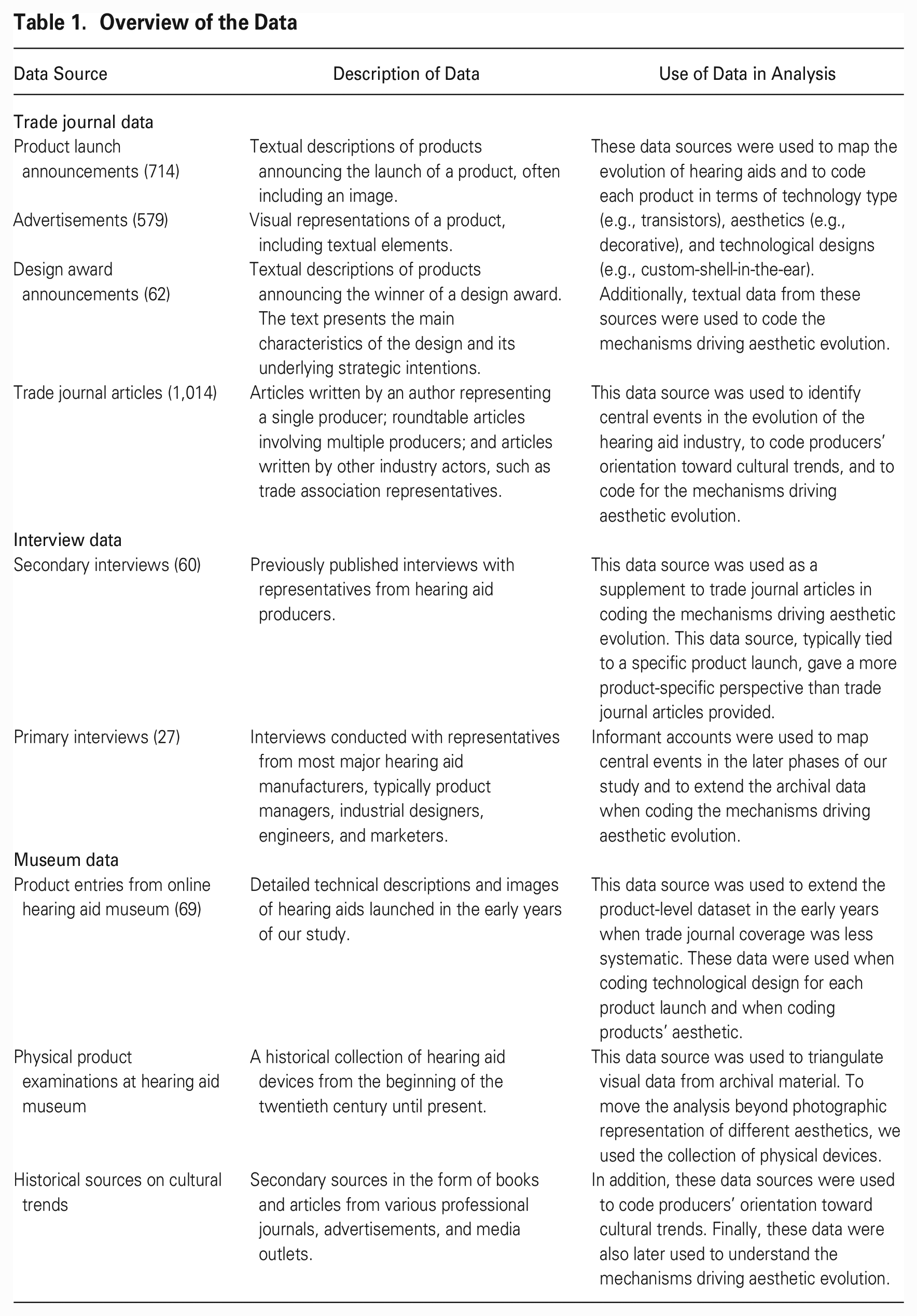
We conducted an in-depth, longitudinal, inductive study because our aim was exploratory (Pettigrew, 1990; Eisenhardt and Graebner, 2007) and processual in nature (Langley, 1999). Table 1 provides an overview of each data source and how we used them in our data analyses.
Overview of the Data
Trade journals
Trade journals document discussions among producers, industry experts, industry associations, and distributers regarding key industry events and issues (Hoffman, 1999; Hoffman and Ocasio, 2001). We collected data from the following six trade journals: The Hearing Journal (1947–2015), Hearing Aid: Journal of the Industry (1949–1951), The Hearing Dealer (1951–1973), Hearing Review (1994–2015), Hearing Instruments (1975–1997), and Audecibel (1952–1972). 3 For all but a few years of the period we studied, at least two of these trade journals provided coverage. These journals were a main advertising channel and thus contained an exhaustive overview of all hearing aids launched in the U.S. during our 70-year study period.
Initially, we extracted three types of data from the trade journals to construct a product-level dataset. We collected 714 product launch announcements across 617 products, 579 advertisements across 385 products, and 62 design award announcements. These sources contained product descriptions and images. We also constructed a dataset of 1,014 trade journal articles written by industry stakeholders that contain analyses and discussions of technology, products, and the hearing aid market. An important component of these data was the Hearing Industries Association’s statistics of annual sales across different product segments.
Online museum
We collected 69 product entries for hearing aids produced during our study’s earlier years from an online museum (www.hearingaidmuseum.com), which had higher-quality images and more-detailed technological descriptions than the trade journals represented.
Physical museum
We collected data at The Eriksholm Collection, which contains a large historical collection of hearing aids. At this museum, we compared the images from the trade journals with the physical devices in the museum’s collection. This allowed us to understand each device’s aesthetic beyond the two-dimensional product images in our dataset.
Interviews
We collected 87 interviews with representatives from hearing aid producers, such as industrial designers and product managers. We conducted 27 primary interviews during 2015–2016 and collected 60 secondary interviews with producers (23 during 1978–1980 from The Hearing Journal and 37 during 2003–2015 from www.audiologyonline.com).
Historical sources
We also collected 82 books and articles from history, cultural studies, and sociology that provided contextual information about societal and cultural trends.
Data Analyses
We analyzed the data through five iterative stages representing different analytical steps (Glaser and Strauss, 1967; Miles and Huberman, 1994; Corbin and Strauss, 2014).
Stage 1: Historical reconstruction
Drawing on Langley (1999) and Kahl and Grodal (2016), we triangulated data from trade journals and secondary sources (e.g., Berger, 1984; Nielsen, 2008) to create a timeline of central events in the hearing aid industry (see Online Appendix 1).
Stage 2: Identifying product launches
We grouped all the advertisements, product launch announcements, and museum entries around individual products, to construct a dataset of 994 products launched during the period 1945–2015. We associated each product launch with one or more corresponding photos of the hearing aid, to identify its aesthetic. Our analyses are based on the 902 of these 994 devices for which visual data were available.
Stage 3: Aesthetic evolution
To map the aesthetic evolution of hearing aids, we identified each hearing aid’s aesthetic through variations in three aesthetic elements: color, texture, and contour (Rindova and Petkova, 2007; Eisenman, 2017). (See Online Appendix 2 for more details on this process.) In our coding of aesthetics, we excluded the overall form of the hearing aid (such as its size and shape) because this could have been determined by the technological design (Alexander, 1964). In our coding of color, we considered color spectrum and color combination. To code texture, we identified the hearing aid’s surface, which could be smooth, granulated, shiny, or matte. For contour, we identified the shape of the edges and the finer details of the silhouette. We triangulated our observations with claims about aesthetics in the product launch announcements or advertisements. Although nearly all combinations of aesthetic elements occurred at least once in the data, the aesthetics of the product category clustered around three dominant aesthetics: (1) decorative aesthetic, (2) bodily aesthetic, and (3) high-tech aesthetic. Each of these three dominant aesthetics differs in all three aesthetic elements (color, texture, and contour); therefore, a product launch in which all three aesthetic elements had been overturned, compared to a prior aesthetic, constituted a radical aesthetic innovation. Table 2 shows examples and textual evidence of each dominant aesthetic. Finally, we trained a team of five coders to code the aesthetics of the products in our dataset with our typology of aesthetics.
Overview of the Dominant Aesthetics
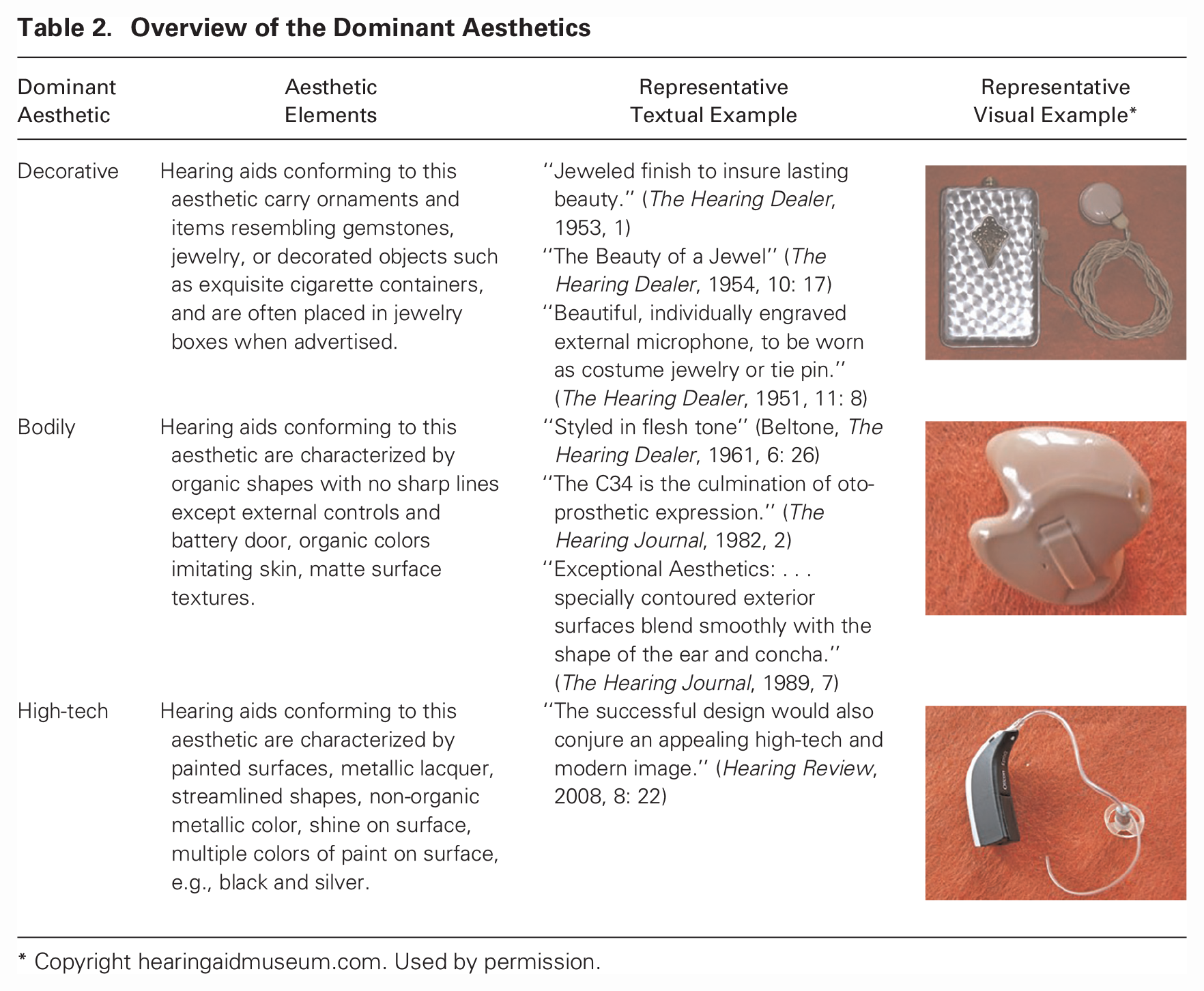
We counted the total number of products exhibiting each of the aesthetic variations, year by year, to identify when a new aesthetic was introduced and when it eventually became dominant. Using a definition of dominant design similar to that of Anderson and Tushman (1990), we defined an aesthetic as dominant when, for more than four years in a row, more than 50 percent of the products launched in a particular year constituted incremental aesthetic elaborations of that aesthetic. That is, although the producer did not notably change any aesthetic element, there were variations within each of the aesthetic elements (e.g., slight variations of the dominant color, such as variations of beige, or the adoption of an angular contour in place of the previous year’s more rounded design; see also Eisenman, 2013). Finally, some products were coded as hybrids if only one or two elements had been overturned. We identified two shifts, i.e., periods in which a previously dominant aesthetic gave way to a new dominant aesthetic, and one period of aesthetic stability, i.e., a period in which an aesthetic was dominant for a prolonged period.
Stage 4: Identification of mechanisms
The fourth stage was guided by a salient puzzle we encountered during the second stage (Grodal, Anteby, and Holm, 2021): why were there periods of shifts and stability in the dominant aesthetic? Guided by this puzzle, we identified six mechanisms through several iterative rounds of coding: category–cultural fit, generating categorical aspirations toward new cultural trends, maintaining categorical aspirations, aesthetic conviction overrules, aesthetic–form link, and rallying behind the new aesthetic.
Initial empirical observations
We initially made several empirical observations by reading through our data (see Spradley, 1979; Grodal, Anteby, and Holm, 2021). Some of these initial insights were based on statements by producers or other industry representatives in trade journal articles and interviews. However, equally important were observations based not on overt statements but, rather, on numbers (such as firms’ sales, performance of the category overall, and consumer statistics) or behaviors (such as product launches, use of promotion material, and R&D efforts). Finally, a range of observations were based on a combination of these empirical observations. For example, we juxtaposed market-outcome numbers with statements of producers interpreting and discussing these outcomes.
Initial working hypotheses
After our initial reading of the data, we arrived at a range of working hypotheses, which represented our initial attempts to explain the shifts and stability of the dominant aesthetic. These working hypotheses guided our subsequent explorations of the data in that when we reanalyzed our data, we sought to verify, dismiss, or elaborate on the working hypotheses. Through this process, new working hypotheses emerged.
Systematic quantitative coding
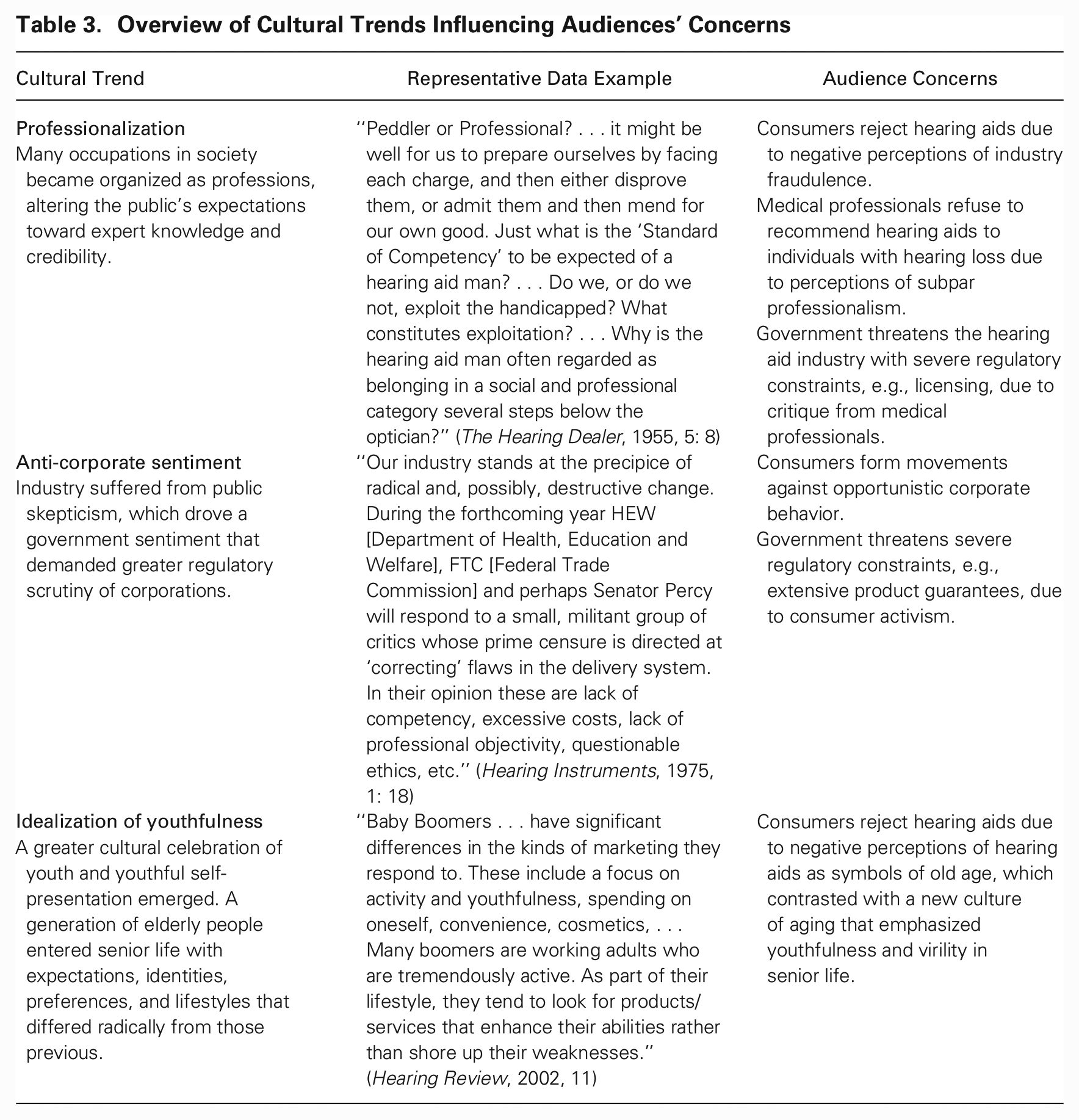
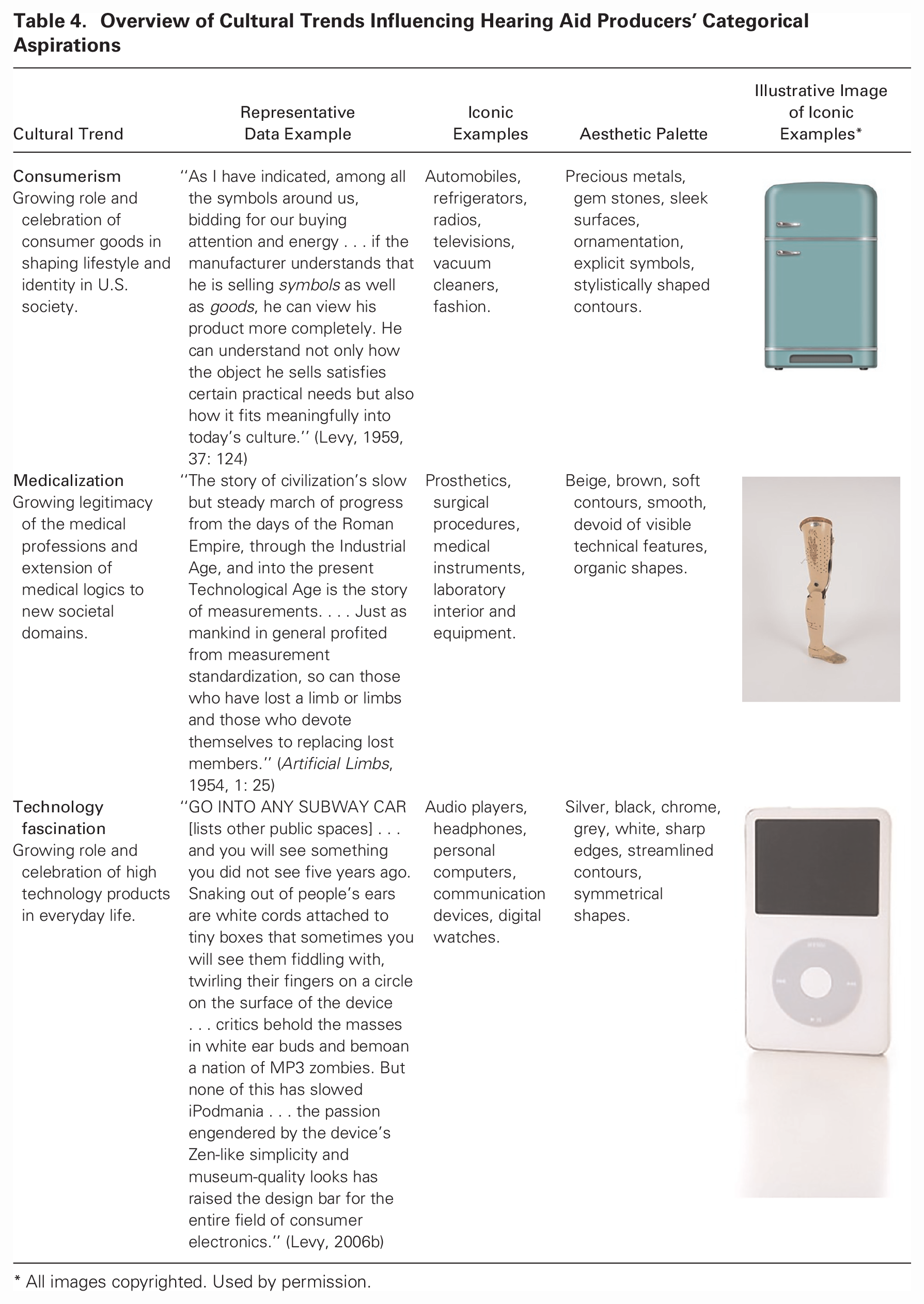
To explore our working hypotheses, we systematically coded our data by tracking core constructs. Two of our working hypotheses linked producers’ orientation toward cultural trends and aesthetic innovation. We therefore coded producers’ orientation toward cultural trends in society. We identified 24 cultural trends and systematically coded the 1,014 trade journal articles for references to each of these trends. We read through each article because an automated search for terms like “high-tech” and “medical” resulted in too many false positives. This coding identified six central cultural trends, such as “medicalization” and “technology fascination.” Three of these trends influenced audience concerns (see Table 3), and producers drew on three other trends for inspiration (see Table 4). The remaining 18 cultural trends we identified were peripheral, such as “space age” and “Ronald Reagan.” In total, we identified 852 references to the 24 cultural trends across the 1,014 articles, 778 of which referred to the six central cultural trends.
Overview of Cultural Trends Influencing Audiences’ Concerns
Overview of Cultural Trends Influencing Hearing Aid Producers’ Categorical Aspirations
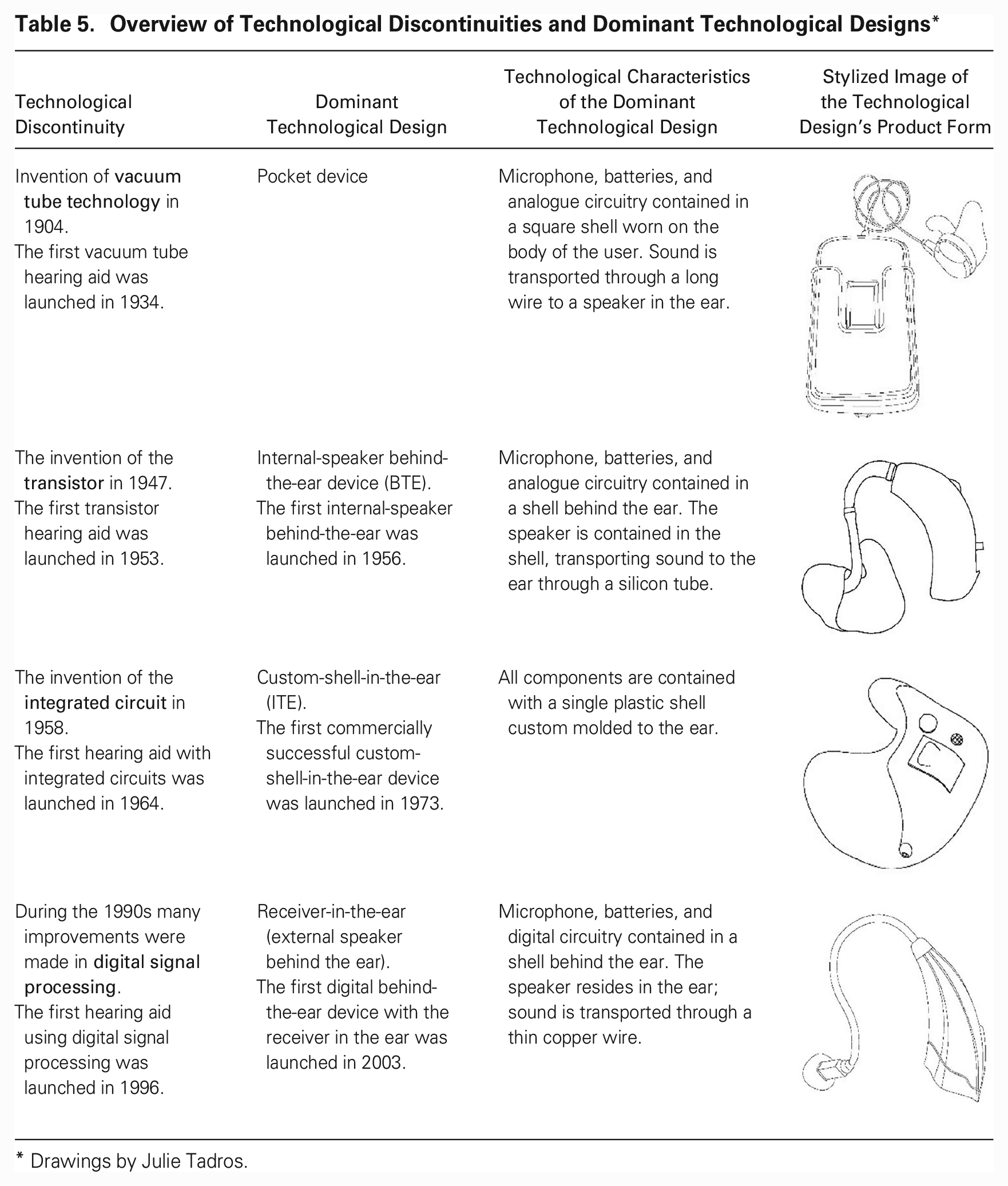
The second of our working hypotheses postulated a connection between radical aesthetic innovation and technological discontinuities. We set out to explore this relationship further by tracking technology evolution. Guided by extant theorizing (Henderson and Clark, 1990; Christensen, Suárez, and Utterback, 1998), we examined each product launch to determine the technological design of each of the 902 products, tracked designs’ sales prevalence over time, and identified all technological discontinuities. Following Anderson and Tushman (1990), we identified a technological design as dominant if it commanded more than 50 percent market share of annual sales for more than four consecutive years. Table 5 shows an overview of each technological discontinuity and its associated dominant technological designs.
Overview of Technological Discontinuities and Dominant Technological Designs*
Drawings by Julie Tadros.
Initial identification of mechanisms
By combining the results of the initial coding with insights gathered from our quantitative coding, we identified several initial mechanisms. To increase the rigor of our findings, we triangulated between data sources such that each mechanism was supported by a diverse array of observations in the forms of statements, numbers, and behaviors, when relevant.
Comparison of mechanisms and outcomes across periods
To refine our identification of the mechanisms, we cycled between observations of the periods that displayed shifts or stability in the dominant aesthetic. By comparing the mechanisms across the phases, we learned how different manifestations of the mechanisms generated different outcomes.
Stage 5: Final theorization of mechanisms
To enhance analytical generalizability in our final theorization of the six mechanisms, we explored their applicability to other product categories. To do this, we familiarized ourselves with aesthetic evolution within other product categories, such as automobiles (Abernathy, 1978; Abernathy and Clark, 1985; Kwoka, 1993), personal computers (Eisenman, 2017), refrigerators (Peavitt, 2017), drones (Kaiman, 2016), and hair dryers (Hart, 2017). This exercise led us to recode and refine some of our analysis. Finally, we sequenced the mechanisms into a theoretical model. The figure in Online Appendix 3 shows this process.
The Aesthetic Evolution of Hearing Aids: 1945–2015
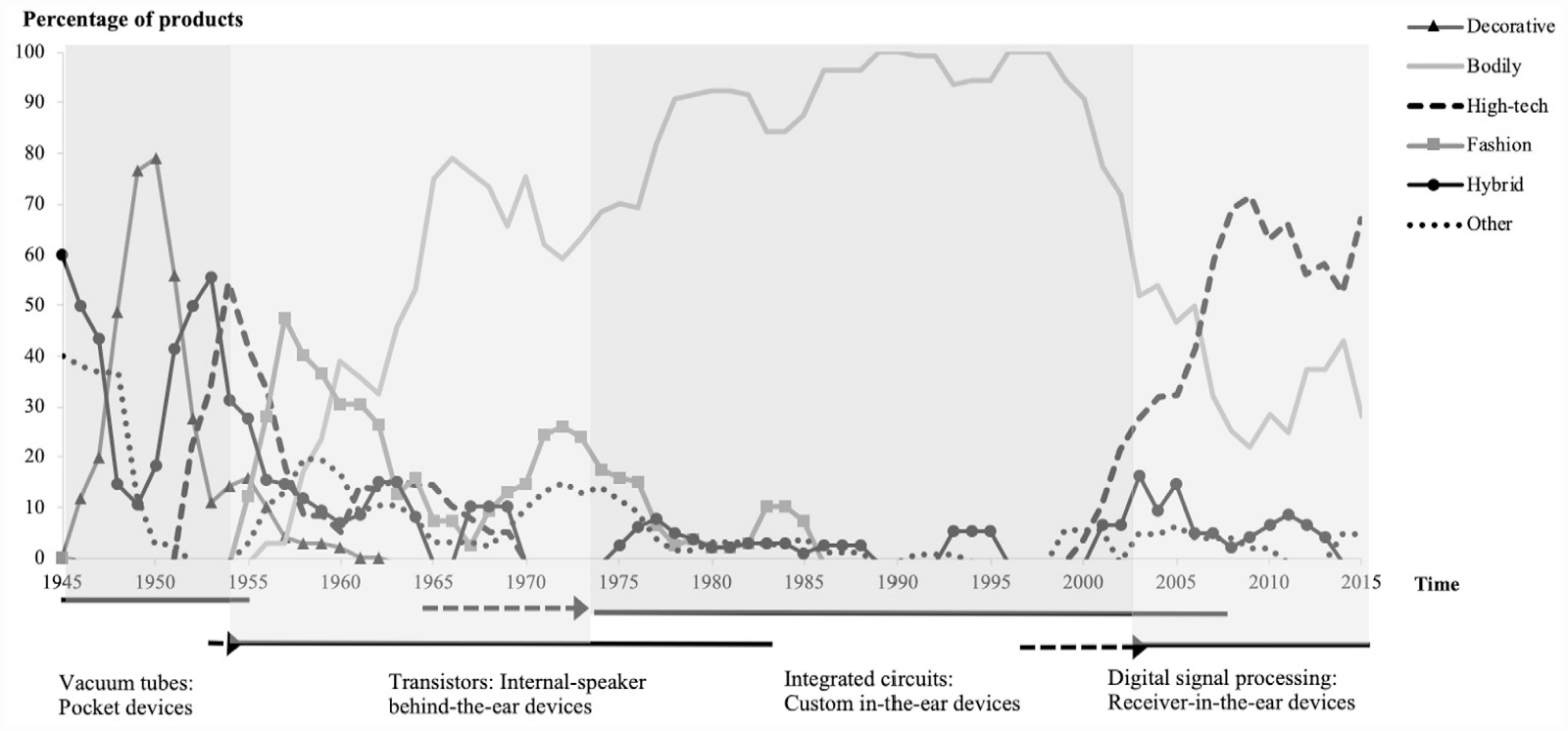
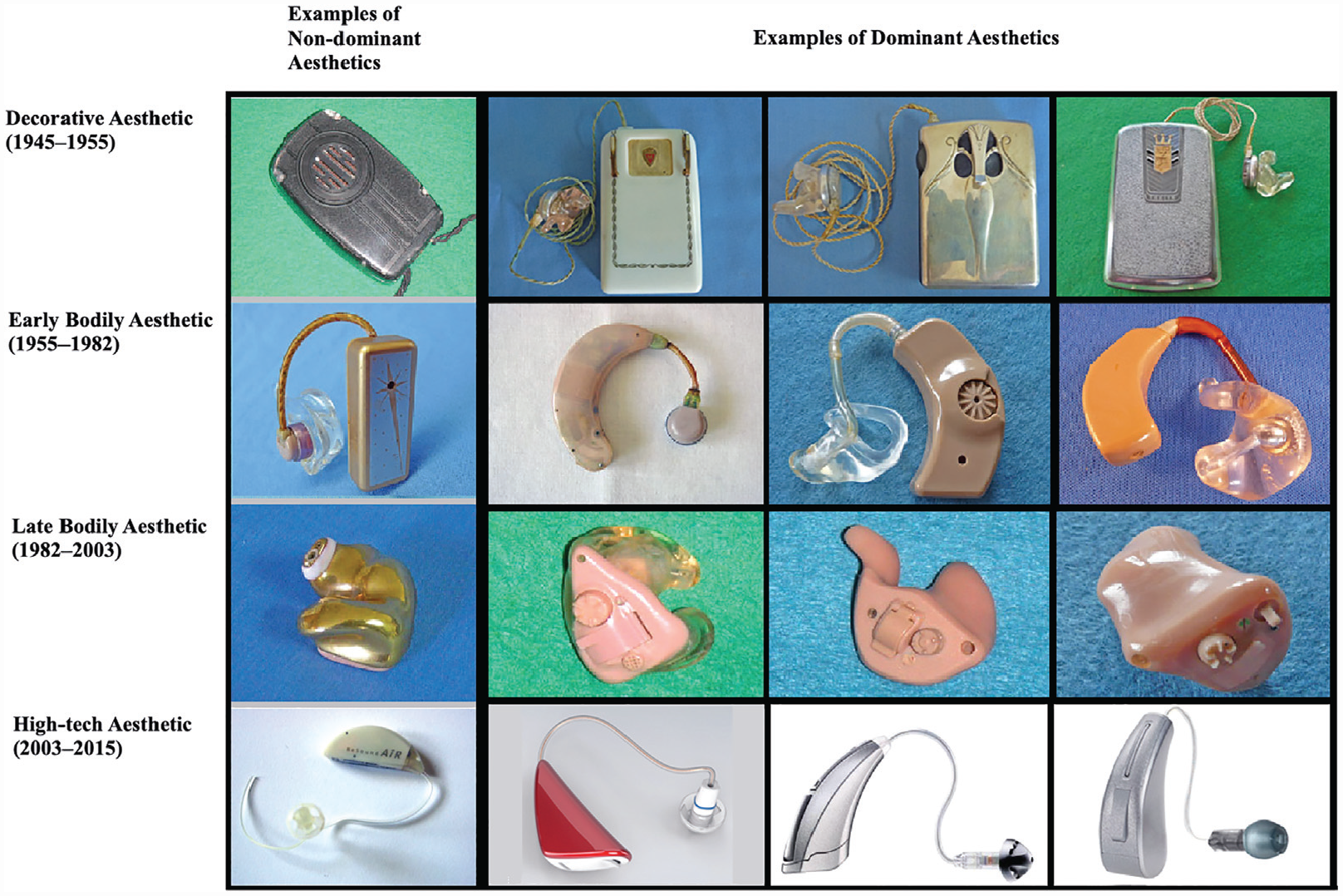
We found that most hearing aids that launched during our 70-year time period adhered to a dominant aesthetic. When producers engaged in radical aesthetic innovation, a new aesthetic would sometimes sweep across the entire product category within a couple of years. The category underwent two shifts in the dominant aesthetic as well as a prolonged period of aesthetic stability when, for four decades, producers nearly exclusively launched products with the same aesthetic. Figure 1 shows the aesthetic evolution of hearing aids, and Figure 2 shows examples of the different aesthetics.
The Aesthetic Evolution of Hearing Aids, 1945–2015*
Examples of Aesthetic Innovations Across Different Technological Designs*
The first shift in the dominant aesthetic happened between 1955–1964, when a decorative aesthetic gave way to a bodily aesthetic, as Figure 1 shows. 4 After this shift, a prolonged period of aesthetic stability lasted for four decades. Figure 1 shows some aesthetic hybridization in 1975–1980, but this variation was slight and brief. The second shift began around 2003, and within five years, the bodily aesthetic gave way to the high-tech aesthetic. Some producers continued to launch products with bodily aesthetics, albeit mainly on devices that still used the previous dominant design, which now held scant market share.
In general, we observed that hearing aid producers tended to maintain and change their product aesthetics in near synchroneity. In the next section, we elaborate on the mechanisms that drove shifts and stability in the dominant aesthetic of the hearing aid category.
Explaining Shifts and Stability in the Dominant Aesthetic of a Product Category
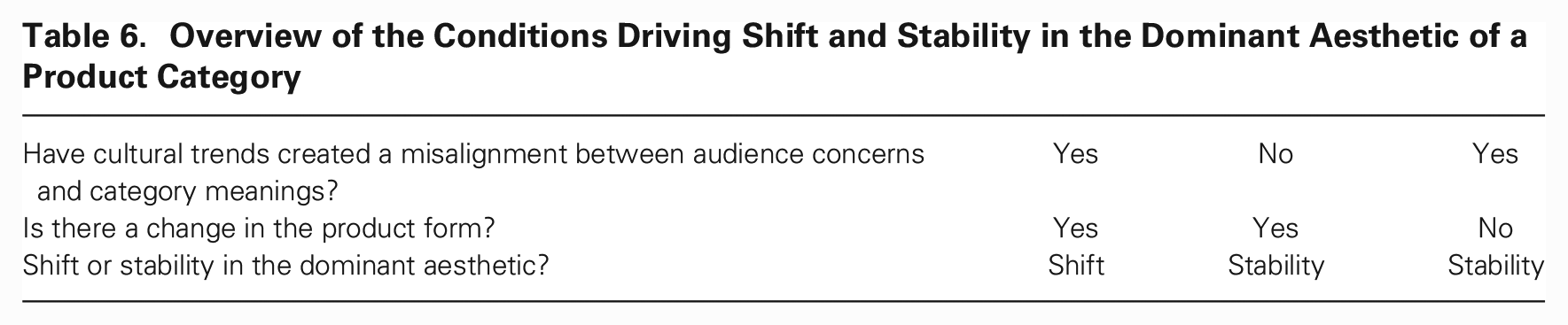
Shifts in the dominant aesthetic of a category occur when two conditions are met: new cultural trends create a misalignment between audience concerns and category meanings that spurs producers to aspire toward new sets of category meanings, and a significant change in product form precedes the development of the new aspirations. In contrast, if such a cultural misalignment has arisen but a change in the product form has not preceded it, then the dominant aesthetic will remain stable. Likewise, if there is a change in the product form but this change does not precede a cultural misalignment, the dominant aesthetic will again remain stable (see Table 6 for an overview of these conditions). Below, we elaborate on the mechanisms that explain why this is the case.
Overview of the Conditions Driving Shift and Stability in the Dominant Aesthetic of a Product Category
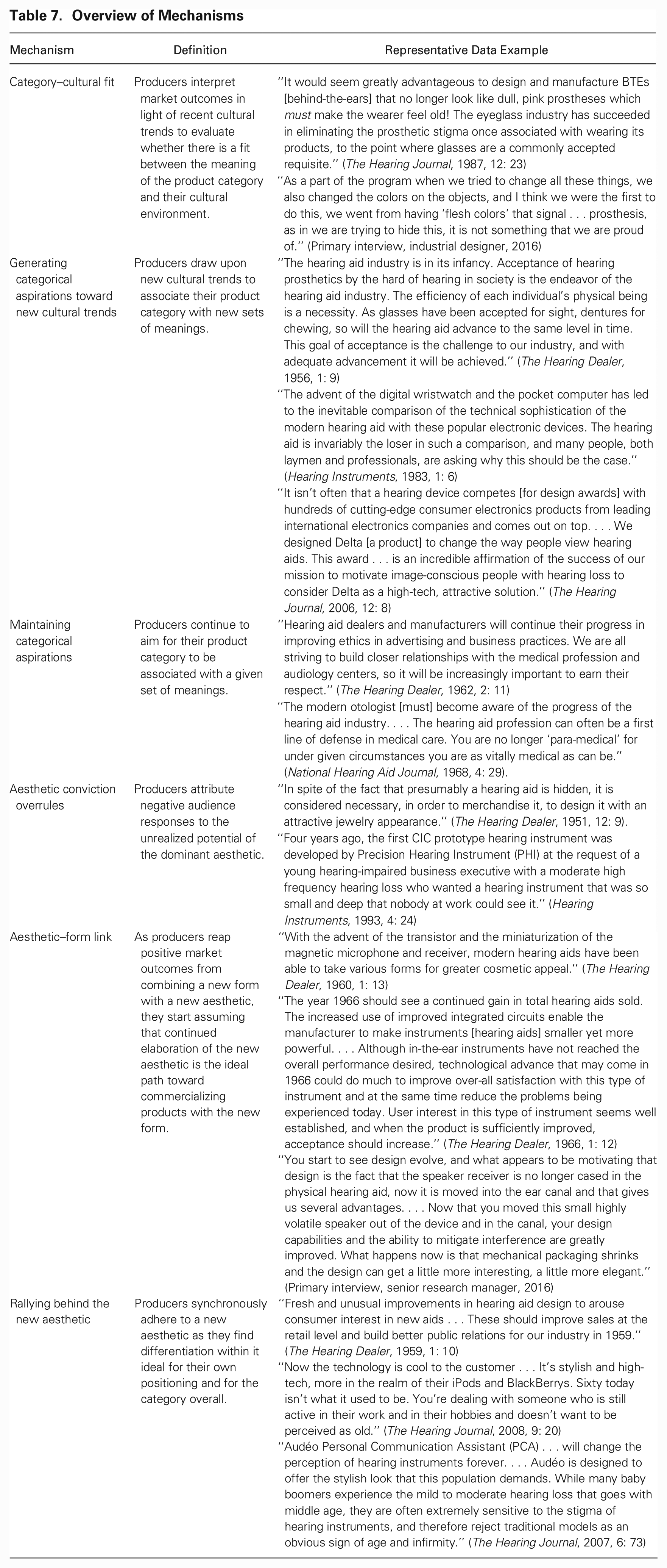
We explain the patterns reported above through multiple mechanisms (see Table 7 for an overview and definitions). The first set of mechanisms details producers’ generation of categorical aspirations. In the context of the hearing aid category, these mechanisms were related to cultural trends in two ways. First, during our time period, consumers and other audiences were consistently dissatisfied with hearing aids, but consumers’ major concerns changed over time (see Figure 3). Second, during our time period studied, we observed that in response to the three waves of concerns voiced by audience members, producers shifted their orientation toward three cultural trends (consumerism, medicalization, and technology fascination) that could act as sources of inspiration to address audiences’ new concerns (see Figure 4).
Overview of Mechanisms
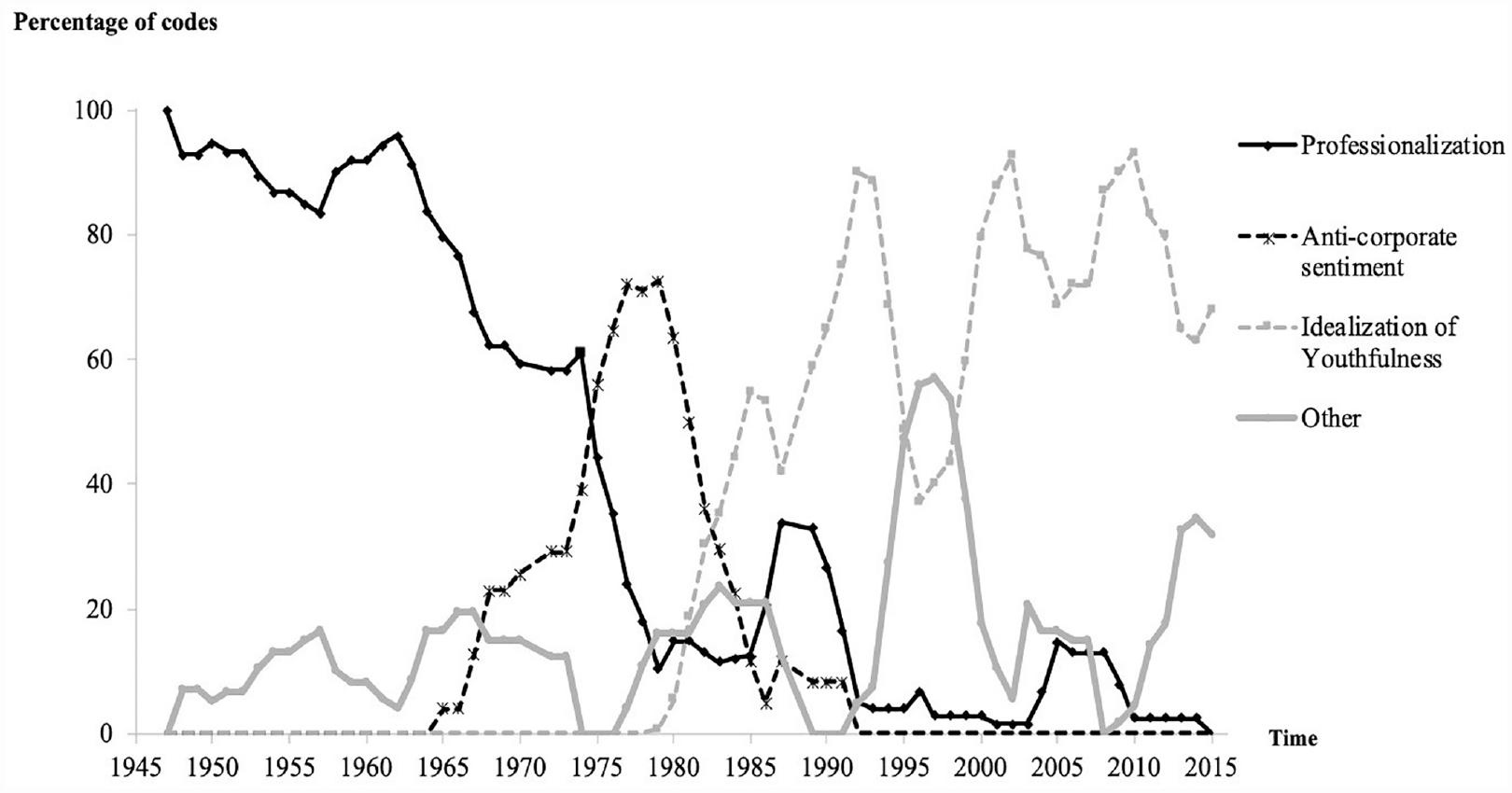
Hearing Aid Producers’ Orientation Toward Cultural Trends Influencing Audience Responses, 1945–2015*
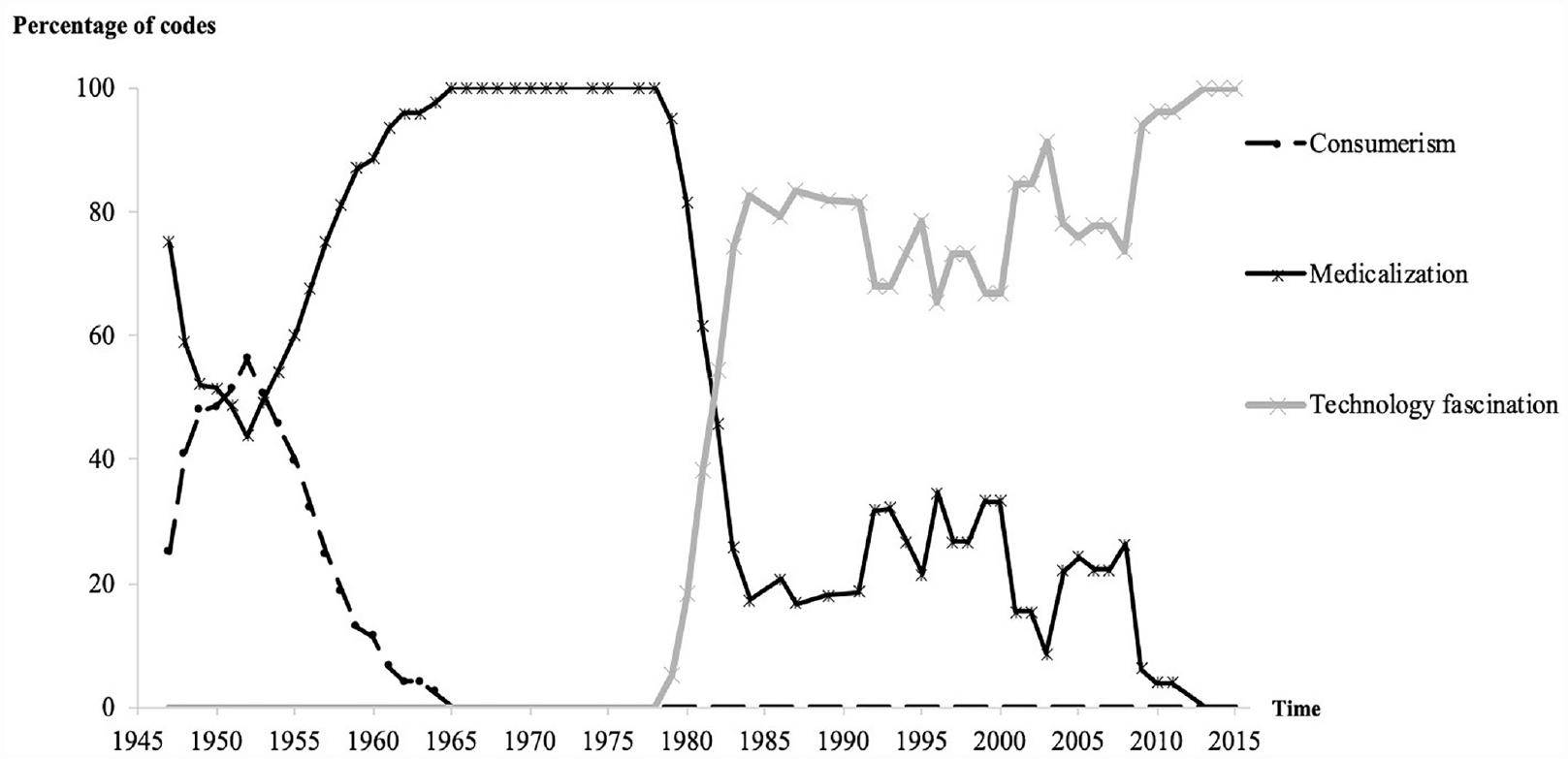
Hearing Aid Producers’ Orientation Toward Cultural Trends that Inspired Categorical Aspirations, 1945–2015*
The second set of mechanisms concerns whether a change in product form makes producers rethink the aesthetics of their products. Technological designs influenced the overall form of hearing aids because they changed component arrangement and size, thus enabling producers to experiment with the product form and its placement on the consumer’s body. Figure 5 shows the market share of each technological design, illustrating its rise to prominence and subsequent decline, and Table 5 shows the product form enabled by each dominant technological design.
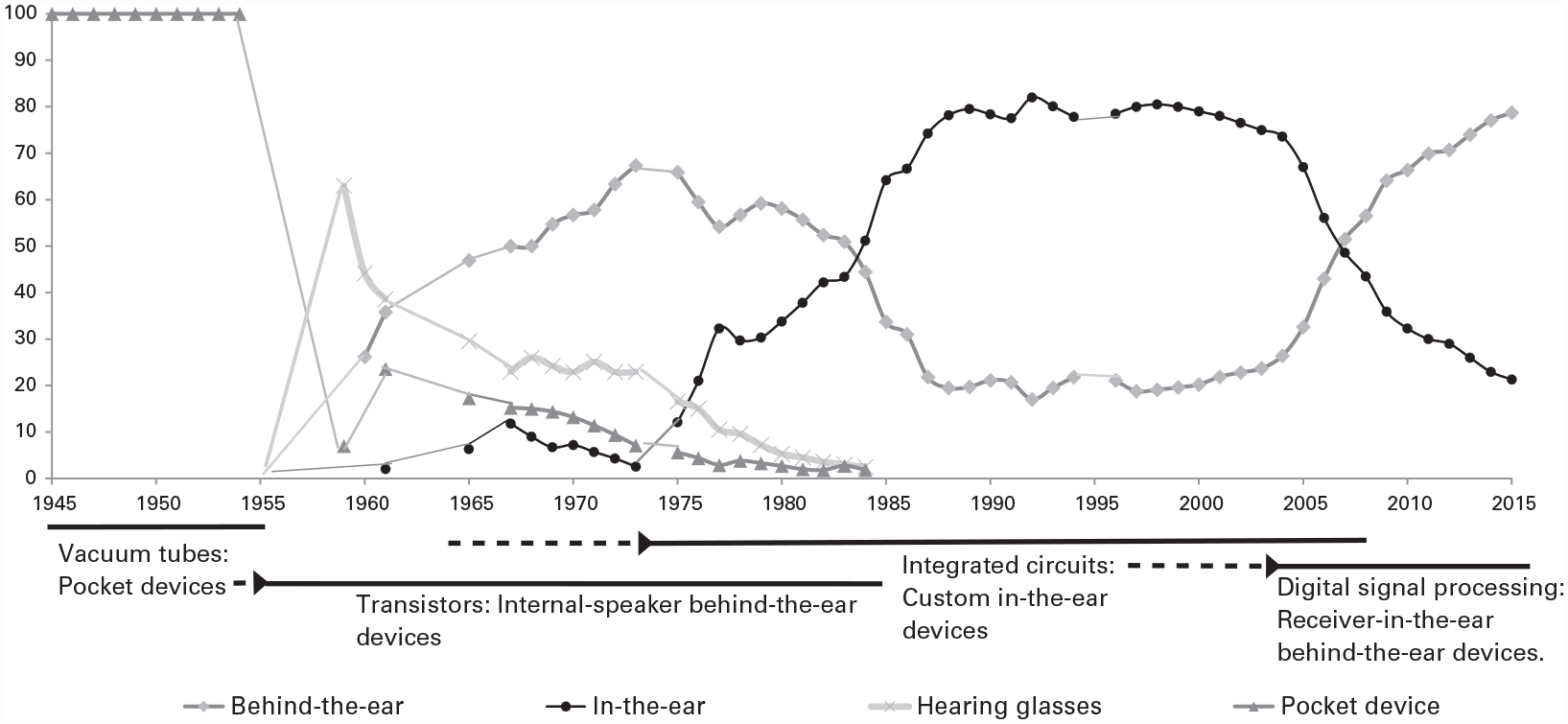
The Evolution of Dominant Technological Designs of Hearing Aids, 1945–2015*
The third set of mechanisms explains why an aesthetic rise comes to dominate a category. We show that when hearing aid producers shared the same categorical aspiration, they all adopted the aesthetic best aligned with that aspiration as they began to experience positive category-level outcomes.
The Decorative Aesthetic
At the start of our time period studied, the dominant technological design of hearing aids was the pocket device, which had emerged after the introduction of vacuum tube technology in 1934 (Mills, 2011). The pocket device could be attached to clothes and part of a person’s attire. As shown in Figure 5, pocket devices commanded 100 percent of market share in 1945. These devices exclusively adhered to the decorative aesthetic and decorative hybrids (see Figure 1).
Generating categorical aspirations toward new cultural trends
During the dominance of the decorative aesthetic, hearing loss was seen as a sign of cognitive dysfunction and a “badge of senility” (The Hearing Dealer, 1957, 1: 25). Market growth was stagnant, and producers thus looked toward cultural trends for inspiration to change the meanings of their products.
During the early postwar era, the dominant cultural trend was consumerism (see Figure 4). As vast numbers of the U.S. working class ascended to middle-class status (Nickles, 2002), demand rose for products that could serve as “external symbols of status . . . commensurate with [their] changing [social] position” (Martineau, 1958: 121). Consumerism implied a set of meanings, for example consumption as social signaling (Levy, 1959), products as symbols of social status (Whiteley, 1985), and social status as economically defined (Cohen, 2004). A prime example was the automobile, which became an iconic status symbol during the postwar era (Banham, 1955; Barthes, 1972; Flink, 1990; Foster, 2003), reflected in advertisement claims such as, “You may be an unpretentious person about most other things, but you sure like the envious attention your car receives . . . it’s a showpiece in the same way an attractive home is a showplace” (Studebaker advertisement, 1947). Automobiles, household goods, and other iconic products of the time employed a range of aesthetic elements, such as precious metals and ornamentation, that came to symbolize consumerism (Heitmann, 2018).
Hearing aid producers believed that if they could design hearing aids that resembled icons of luxury and status such as automobiles, radios, refrigerators, and fashion accessories, then they, too, could ride the wave of consumerism and make hearing aids fashionable.
As an industry, we might compare ourselves to the refrigerator industry about the time electrical refrigerators began to supplant the ice box. The first job was to sell people on the general idea of a refrigerator. (Hearing Aid: Journal of the Industry, 1949, 11: 11–18)
To realize this vision for their category, hearing aid producers envisioned a trajectory along which they could, over time, refine the decorative aesthetic to propel their product category toward full market acceptance. The goal was “to make hearing aids glamorous with methods similar to those used by optometrists to sell the gals on wearing glasses. The hearing gadgets will come in fashionable colors—emerald green, sapphire blue, chartreuse, etc.—to match current styles” (Hearing Aid: Journal of the Industry, 1950, 6: 28). Producers aimed to render pocket devices so exquisite that consumers would not care to hide their hearing aids:
Like jeweled watches and eye glasses, hearing aids are now designed to be a part of everyday dress. . . . Its gold and silver case make it no longer necessary for the hard of hearing to conceal their handicap. (Hearing Aid: Journal of the Industry, 1949, 9: 11)
Most producers tried to outdo one another by creating pocket devices with increasingly elaborate decorative elements (see Figure 2). In sum, during the dominance of the decorative aesthetic, all hearing aids were pocket devices adorned with gold, silver, and gemstones because producers aimed to create hearing aids that consumers would associate with luxury and consumerism.
The Shift to the Bodily Aesthetic
The introduction of transistors into hearing aids in 1953 facilitated a drastic reduction in their size and a change in their overall form. Simultaneously, producers sought to position hearing aids as medical devices. Together, these changes enabled a shift away from the decorative aesthetic and toward the bodily aesthetic during the years 1955–1963 (see Figure 1).
Category–cultural fit: Misalignment
Before the shift to the bodily aesthetic, sales growth in the hearing aid category was significantly below expectations (The Hearing Dealer, 1955, 1: 11). Some producers reported improved sales, but collectively producers suspected that some unknown factor was obstructing market penetration. At the same time, producers faced criticism from key audiences such as consumers, medical professionals, and regulators. The American Medical Association argued that “nowhere is there as little interest in establishing and maintaining standards of competency for the prosthesis fitter as is found with respect to the hearing aid dealers. . . . No group of handicapped persons is more open to exploitation by commercial interests than the hard of hearing” (as quoted in The Hearing Dealer, 1955, 5: 8). While trying to make sense of this, producers realized that audiences’ concerns had changed in step with shifting cultural trends. Specifically, producers recognized that market growth was disappointing because the signifiers of commercialism and luxury were no longer aligned with audiences’ new expectations of professional credibility (see Figure 3). For example, an Audivox director pointed to the decorative aesthetic as the culprit due to the growing influence of professionalization:
In his [the consumer’s] eyes the acquisition of a new hearing aid does not connote the frivolity of a new fur coat . . . we, as sellers of a medical commodity—no really a medical necessity—we shall come off relatively well in such a re-evaluation [of hearing aids as medical devices]. (The Hearing Dealer, 1958, 1: 15)
In light of category-wide negative audience responses, producers began to question whether the association with luxury made their products appear unprofessional.
Generating categorical aspirations toward new cultural trends
As audiences grew disenchanted with hearing aids’ association with luxury, producers found inspiration in a new cultural trend: medicalization (see Figure 4). In the postwar era, increased focus on medicalization had changed perceptions of the medical professions from artful to scientific by promoting the ideas of science’s power to control the human body, the doctor as savior, and scientific advances as human emancipation (Friedson, 1970; Zola, 1972; Berg, 1995; Serlin, 2004; Starr, 2008). Categories such as surgical procedures and prosthetic devices became icons of medicalization. Surgeons were viewed as heroic saviors because soldiers returning from the battlefield had their bodies restored by modern medical procedures (Gritzer and Arluke, 1989; Serlin, 2004; McAleer, 2011). Prosthetic devices generated an aesthetic palette—beige, brown, and smooth with soft contours (i.e., devoid of visible technical features)—that came to designate the cultural trend of medicalization (Artificial Limbs, 1961; Serlin, 2004). 5
Hearing aid producers latched onto medicalization as a potential solution to the dire underperformance of their product category. As the president of Sonotone stated,
There has been a gradual lessening of prejudice against the “different,” both handicapped and gifted. Since World War II—with advances made in plastic surgery and rehabilitation in general, and with the publicity given this progress, there has been an acceleration of the evolution of this attitude [of acceptance toward worn medical devices] . . . this has opened vast new markets for all prosthetic devices, not the least of which are hearing aids. (The Hearing Dealer, 1957, 2: 13)
Drawing inspiration from this cultural trend, producers began to associate their products with icons of medicalization:
Regardless of the sales gain, I believe this will be a year that will establish our industry in its proper stature as a respected organization to properly fit prosthetic appliances for which there will be a constant and valued need. Persons manufacturing and offering these [hearing] instruments will have a new and more important role in the eyes of professional people concerned with health problems as well as a more elevated position in the minds of the general public. (The Hearing Dealer, 1960, 1: 13)
To address audiences’ concerns that hearing aids lacked professional cachet, producers generated new categorical aspirations by drawing analogies to other medical devices, such as prosthetics, that they perceived to be in close conceptual proximity to hearing aids.
Aesthetic conviction overrules
Surprisingly, although hearing aid producers already had aspirations toward medicalization as early as the 1940s, these aspirations did not initially manifest in new product aesthetics (see the time lag between the rise in medicalization in Figure 4 and the rise in the bodily aesthetic in Figure 1). To explain this delay, we point to the mechanism aesthetic conviction overrules: producers disregard the opportunity to create radical aesthetic innovation due to their conviction that further refining the existing dominant aesthetic will improve audiences’ reception of the category.
Once producers had formed aspirations toward medicalization, they began to pursue these aspirations through means other than aesthetics, such as marketing strategies. One industry representative outlined a strategy to achieve alignment with the new audience concern of professionalization:
Is it not time that we tried to foster ads with the appearance of conservatism, of professionalism, of high quality which is so needed if we are to convince the public that we are the sound, professional and conservative people that most of us actually are? (Hearing Aid: Journal of the Industry, 1949, 12: 19)
The quote reflects producers’ aspirations to align the meaning of their category with professionalization. However, producers did not yet alter their products’ aesthetics, which raises a question: why did no producer introduce a product with the bodily aesthetic until years after the rise of the medical aspiration? As the following quote demonstrates, producers remained convinced that the decorative aesthetic could be exploited further:
This is revolution in the hearing aid business! For the first time instruments will come out of hiding and be proudly worn as personal ornaments in full view! . . . The idea of wearing a hearing aid will be made attractive. (The Hearing Dealer, 1954, 8: 17)
In 1954, even after the medical aspiration had become widespread among producers, this executive continued to emphasize their newest product as a promising step toward realizing the potential of the decorative aesthetic. This quote reflects that producers still believed continued refinement of the decorative aesthetic would quell consumers’ reservations about hearing aids. Instead of changing their products’ aesthetic, producers pursued the medical categorical aspiration through other means, such as ads.
Aesthetic–form link: Aesthetic experimentation for a new form
Despite the misalignment in category–cultural fit, no radical aesthetic innovation emerged until after the advent of transistors in 1953, which prompted a range of new technological designs that enabled substantial changes in product form. One of several designs was the behind-the-ear design, which constituted a substantially new hearing aid form (see Table 5 for examples).
With this form, producers sought to render hearing aids indistinguishable from the wearer’s body. To achieve this aim, producers extracted aesthetic elements from an icon of medicalization, prosthetics, and recombined these elements into a new aesthetic characterized by beige color and organic contours to resemble the human body (see Figure 2, second row).
When producers began altering the form of hearing aids, they also introduced many different aesthetics, including the bodily aesthetic, the fashion aesthetic, and a range of hybrid aesthetics (see Figure 1). One executive noted,
The most important event, the introduction of the transistor made possible the revolution in hearing aid design—an entirely new concept of wearability. The continuous battle of smaller components allows an ever increasing trend towards compactness. Styling to create cosmetic consumer appeal [product blending with the body] will also be a great factor in making hearing aids acceptable. (The Hearing Dealer, 1960, 1: 14)
In describing how the transistor had enabled producers to rethink hearing aid design to pursue “cosmetic consumer appeal,” the executive uses industry jargon to indicate an aesthetic that blended with the body, in contrast to the decorative aesthetic, which aimed to signal splendor and luxury. In addition to the behind-the-ear design and the bodily aesthetic, the transistor enabled the bone conduction design that gave rise to the fashion aesthetic: hearing aids with aesthetic similarity to fashionable eyeglasses and hair barrettes.
Rallying behind the new aesthetic
After introducing a plethora of new aesthetics, producers eventually converged on the bodily aesthetic. They did so to convey meanings related to medicalization, in pursuit of their new medical aspirations. This happened even though consumers favorably received the fashion aesthetic, and products reflecting this aesthetic witnessed a quick spike in sales (in 1957–1958, about half of hearing aids sold had the technological design that nearly exclusively exhibited the fashion aesthetic; see Figures 1 and 5). But, in contrast to the bodily aesthetic, the fashion aesthetic was not aligned with producers’ aspiration to the medical category and gradually lost traction despite the initial spike in demand.
Initially, the bodily aesthetic offered an opportunity for select producers to radically differentiate their products, and several producers reported their best annual sales ever (The Hearing Dealer, 1961, 1: 7). However, as all producers faced the cultural misalignment of their existing aesthetic, they quickly began to imitate the bodily aesthetic both because it aligned with their categorical aspirations and because producers consistently reported improved market acceptance of their products (The Hearing Dealer, 1960, 1: 8–11). Indeed, there was little debate about whether the bodily aesthetic represented the right direction for the industry. A trade journal editor commented, “the public is beginning to accept the concept of the hearing aid as a necessary and even commonplace prosthesis. . . . association with professional and licensed men in the medical field will raise the public’s general appreciation” (Editor, The Hearing Dealer, 1956, 1: 5). Producers also believed that differentiating within the bodily aesthetic was preferable to radical aesthetic innovation. In combination with the product-level patterns observed in Figure 1, this conviction was palpable in advertisement claims that products were “attractively made for the best cosmetic [bodily] appearance” (The Hearing Dealer, 1961: 2). As a result, producers rallied behind the bodily aesthetic as it rose to dominance.
Stability of the Bodily Aesthetic
The dominance of the bodily aesthetic remained stable for more than three decades (see Figure 1). This is puzzling because during this period, there was not only misalignment between the medical meanings of the bodily aesthetic and new cultural trends around youthfulness; there was also a technological change that enabled producers to alter the product form. Why did the bodily aesthetic remain stable despite these changes? We found that two distinct combinations of mechanisms sustained this period of stability. Recognizing this distinction, we split this stable period into two parts—early and late stability—to better understand its persistence.
The bodily aesthetic’s early period of stability
From 1964 to 1982, no shift in the dominant aesthetic occurred even though, starting in 1964, the introduction of integrated circuits into hearing aids enabled producers to change the product form (as in the shift to the bodily aesthetic). In contrast to when the bodily aesthetic rose to dominance, this time producers altered the product form even though they had not formed any new categorical aspirations.
Category–cultural fit: Alignment
During the late 1960s, producers faced a new cultural trend that influenced audience concerns: anti-corporate sentiment (see Figure 3). This cultural trend was seeded by corporate scandals and social movements protesting immoral corporate practices (Nader, 1965; Rorabaugh, 2015), and these scandals and movements raised public demand for greater government regulation of industries. As one industry representative explained,
FTC [Federal Trade Commission] in recent years has become the terror of the business community. . . . Industry after industry has found itself incapable of staving off the agency’s intervention. . . . No industry has been untouched by the array of regulatory proceedings whomped up by a hyper-active staff of lawyers. (Hearing Instruments, 1975, 10: 4)
Producers realized that this new anti-corporate sentiment could spur negative category-wide market outcomes due to criticisms from regulators and consumers. Yet, unlike during the shift to the bodily aesthetic, this time producers perceived an alignment between anti-corporate sentiment and their medical aspirations as they believed that the medical meanings had not yet been adequately fortified. As the president of the hearing aid company Starkey stated, “we will not secure broad interest in hearing aids within the public sector until the public itself recognizes hearing impairment as a serious handicap demanding attention” (The Hearing Journal, 1979, 4: 13). He thus explained how further positioning of hearing aids as medical devices remained the ideal path for the hearing aid category. Figure 4 shows producers’ continued orientation toward medicalization.
Maintaining categorical aspirations
During the bodily aesthetic’s early period of stability, producers maintained their aspirations that further promotion of hearing aids as medical devices would strengthen the product category, as reflected in the following quote:
Volume sales in 1968 will undoubtedly break all previous records. . . . This means that more hard of hearing persons were persuaded to enjoy the benefits we offer than ever before. . . . Yes, our public image is better—but still a long way from where it rightfully belongs. (National Hearing Aid Journal, 1969, 1: 5)
Instead of generating new categorical aspirations, producers also focused on how they could further exploit the medical aspiration. An Illinois distributor reported, “an attempt is being made to establish a hearing aid as a prosthetic device in relation to [Illinois] Workman’s Compensation laws” (National Hearing Aid Journal, 1964, 12: 22).
Aesthetic–form link: Continued aesthetic elaboration of the new form
In 1964, incumbents introduced integrated circuits into hearing aids, and these were used to create a new custom-shell, in-the-ear architecture in 1973 (see Table 5 and Figure 5). Thus, much like when bodily aesthetics rose to dominance, a technological change once again enabled producers to change the overall product form. But because producers maintained their categorical aspirations, they did not pursue radical aesthetic innovation; instead, they re-created the existing dominant aesthetic in the new form. Promotional material accompanying custom-shell, in-the-ear product launches showed this in language such as “its smooth, sleek appearance combined with a non-reflective matte finish are said to make the [in-the-ear] unit cosmetically pleasing” (Hearing Instruments, 1979, 2). A decade later, the vice president of the Westone company reflected, “The first generation of modular instruments was promoted more on cosmetic factors than on acoustical performance” (Hearing Aid Journal, 1980, 4: 10). Only a few producers used the change in form to experiment with new aesthetics; these attempts were short-lived and often hybrid in character (see Online Appendix 4).
Thus, during the bodily aesthetic’s early period of stability, the dominant aesthetic remained stable because producers perceived the medical meanings of their aesthetics to be aligned with the cultural trend of anti-corporate sentiment. This alignment motivated producers to maintain their medical aspirations. When integrated circuit technology eventually enabled producers to change the product form, producers continued to incrementally differentiate within the bodily aesthetic.
The bodily aesthetic’s late period of stability
During this aesthetic’s late period of stability, producers realized that medical meanings were misaligned with new cultural trends; in response, they generated new categorical aspirations. But because no technological changes enabled producers to alter the product form, no aesthetic experimentation occurred.
Category–cultural fit: Misalignment
Around 1978, producers began to orient toward a new cultural trend: idealization of youthfulness (see Figure 3). Initially, producers did not attribute much significance to this cultural trend because the hearing aid category overall was enjoying stable growth with market penetration increasing, and in 1982 the industry reached its long-awaited goal of one million products in annual sales (Hearing Instruments, 1983, 5: 16). However, by 1988, the growth of the entire hearing aid category had stagnated once again (Kochkin, 1990). Some individual producers still enjoyed isolated market growth, such as U.S. manufacturer Starkey, which, according to a competitor, “sprinted across the steppes” (primary interview, former sales manager, 2015). Yet, the category’s overall negative performance compelled producers to recognize that their challenges were rooted in perceptions of the category as a whole. Hearing aid producers began to wonder whether there was misalignment between the positioning of hearing aids as medical devices and consumers’ idealization of youthfulness. One producer reflected on the current market conditions:
[By] 1989 [only] . . . 25.7% of hearing-impaired adults reported owning hearing instruments. . . . the industry’s challenge is to reposition hearing instruments to appeal to the younger, more affluent, and less severely impaired segments. . . . The industry needs a Marlboro man. (The Hearing Journal, 1990, 5: 25)
In particular, producers learned that the hard-won image of their products as medical devices was now backfiring in light of consumers’ newfound idealization of youthfulness: “These eternal teeny boppers don’t want to get old and furthermore, they won’t want to appear old either” (Hearing Instruments, 1993, 5: 9). A director of the industry association elaborated:
Don’t flesh-colored hearing instruments denote mechanical prosthetic devices? When we promote our hearing instruments as being hardly noticeable, don’t we reinforce the message, “hide your hearing loss” which translates into, “You are unacceptable/unlovable as a person because you have a hearing loss.” (The Hearing Journal, 1993, 11: 37)
The quote illustrates how producers realized that the bodily aesthetic was the problem because it amplified the association of hearing aids with infirmity and disability and, furthermore, that no elaboration of the bodily aesthetic would ever remove the stigma.
Generating categorical aspirations toward new cultural trends
When producers understood the misalignment between the medical meanings of their category and consumers’ idealization of youthfulness, they began to search for inspiration in alternative cultural trends. This search culminated in a new categorical aspiration: to associate hearing aids with the cultural trend of technology fascination (see Figure 4). As one industry representative stated, “high-technology is a key word in the lifestyle of the 80’s and its impact is being felt in literally every occupational field” (Hearing Instruments, 1984, 1: 4).
The cultural trend of technology fascination had emerged in the 1970s, nearly a decade before hearing aid producers finally took notice (see Figure 4). During this time, many high-tech products had evolved from being perceived as esoteric and alien to being ubiquitous elements of everyday life that most Americans took for granted (Pantzer, 1997). This new cultural trend engendered a popular attitude toward technology products as icons of display and fashion (Du Gay et al., 1997) that blurred the divide between humans and machines (Haraway, 1991; Campbell and Pastina, 2010) and reflected a growing understanding of technology as a means of enhancing human capacities (Mick and Fournier, 1998; Kozinets, 2007; Carolus et al., 2019).
During this period, epitomizing the trend of technology fascination were numerous consumer products, such as the personal computer (Haddon, 1988), video games (Aoyama and Izushi, 2003), and portable audio players (Du Gay et al., 1997). These iconic products generated a new aesthetic palette (Du Gay et al., 1997; Levy, 2006a), favoring black metallic paint and symmetrical shapes, which came to embody the high-tech aesthetic.
Hearing aid producers began to orient their products’ aesthetics toward technology fascination in the late 1970s (see Figure 4). But not until the late 1980s did they perceive misalignment between the meaning of the bodily aesthetic and consumers’ idealization of youthfulness. The following quote exemplifies the inspiration that producers shrewdly—albeit belatedly—drew from the cultural trend of technology fascination:
As the population ages . . . it becomes increasingly important to remove the stigma attached to the word “aid.” I believe that the industry must communicate to its potential customers that the hearing health care industry has become a high technology industry. (Hearing Instruments, 1989, 12: 9)
Producers thus candidly aspired to associate the hearing aid category with meanings related to high technology.
Aesthetic conviction overrules
Although producers began to pursue the high-tech categorical aspiration in the late 1980s, the high-tech aesthetic did not gain momentum until more than a decade later (see the time lag between the rise of technology fascination in Figure 4 and the rise of the high-tech aesthetic in Figure 1). Why did this delay occur? We found that without a technological change to enable producers to alter the product form, their aesthetic conviction (i.e., that the medical aesthetic merely needed further refinement to vanquish consumers’ reservations) overruled their new high-tech aspirations:
An infusion of youth with mild-to-moderate hearing losses into our customer base would have a positive impact on the market. First, it would help change the stereotype of the typical user (i.e., a feeble, elderly person who is nearly deaf). . . . Can CIC [completely-in-the-canal] hearing instruments [with the bodily aesthetic] attract this new type of customer? . . . The results are extremely encouraging. . . . The CIC will attract a younger, more affluent, and more educated consumer to the market. (The Hearing Journal, 1994, 11: 49–53)
Because the form of hearing aids remained the same, producers could not conceive of aesthetic innovation beyond the bodily aesthetic, which they saw as inextricably tied to the product form of in-the-ear design.
Despite not having introduced the high-tech aesthetic, producers’ commitment to the high-tech aspiration was firm. They sought to associate their category with high-tech meanings through ways other than aesthetic innovation, such as linguistic changes in advertising. For example, a group of market researchers concluded, “Change the name of hearing aids to something with a high-tech name that the baby boomer generation would expect . . . a ‘personal audio device or instrument’” (Hearing Instruments, 1993, 6: 20).
Aesthetic–form link: Continued aesthetic elaboration for the existing form
Even after producers realized that the medical-category aspiration and the bodily aesthetic no longer aligned with consumers’ idealization of youthfulness, they continued to pursue this aesthetic because they were convinced that it merely needed further refinement to succeed. An industrial designer informed us of the first product he designed in the mid-1990s, which reflected a bodily aesthetic:
Our R&D director said: “we want to see something entirely new. What can you come up with?” . . . my take on it was to create something that fitted the form language of the ear. . . . No we did not . . . [break with the bodily aesthetic] at all . . . all the other products looked like that [bodily aesthetic], also competitors’ [products]. (Primary interview, product designer, 2015)
Thus, even when striving to design entirely new products, producers’ pursuit of novel designs, in the absence of a change in product form, occurred exclusively as incremental elaborations on the dominant bodily aesthetic.
Much as they had done during the bodily aesthetic’s early period of stability, during its late period of stability producers continued to incrementally differentiate their products within this aesthetic. This stability was not due to the absence of new categorical aspirations but, rather, lack of a technological change that would have enabled a change in product form. As a result, producers persisted in their efforts to differentiate within the bodily aesthetic, as the following advertisement reflects: “Non-glare faceplate: . . . Esthetically contoured with rugged hinge battery door” (The Hearing Journal, 1984, 3: 53) and “New cosmetics: . . . Its anatomical contouring is combined with a low glare matte finish and improved color selection for precise matching of skin tones” (Hearing Instruments, 1989, 5). The producers who launched these elaborations reported increased sales for their products, despite the overall stagnant market growth starting in 1986 (Hearing Instruments, 1989, 12: 6–13).
The Shift to the High-Tech Aesthetic
Around 2003–2009, the high-tech aesthetic rose to dominance, ending four decades of aesthetic stability. Although producers had previously abandoned the medical aspiration in favor of the high-tech aspiration, they began to experiment with new aesthetics only when digital technology matured and then enabled producers to alter product form. We briefly account for the first three mechanisms that we presented in the context of the prior period.
Category–cultural fit: Misalignment
During the bodily aesthetic’s late period of stability, producers still believed that the medical aspiration was misaligned with new audience concerns rooted in the cultural idealization of youthfulness. Some producers did experience positive market outcomes individually. For example, the producer Widex’s first digital product launch in 1996 tripled their revenue within three years (primary interview, former marketing director, 2015). Yet, producers were aware that their product category in general was stagnating due to negative associations of hearing aids with old age and disability (Kochkin, 1999), as the following quote illustrates:
It has been said that baby boomers are less likely to accept growing old. However, as long as hearing aids are associated with aging, there are few indicators that suggest a downward age shift in hearing instrument users will occur. (Hearing Review, 2003, 10: 2)
This quote shows that producers still faced stagnant market growth and believed that the cultural idealization of youthfulness had altered consumers’ concerns (see Figure 3).
Generating categorical aspirations toward new cultural trends
Technology fascination remained producers’ main cultural inspiration during the high-tech aesthetic’s rise to dominance (see Figure 4). A designer noted, “We don’t exist in a bubble. There are more wearable devices, and these will impact how society accepts [hearing aids] . . . there is a growing cultural influence” (primary interview, industrial designer, 2016). For example, the Apple iPod (introduced in 2001) and the Apple iPhone (introduced in 2007) drove a perception of high-tech products as seamlessly intersected with human life (Campbell and Pastina, 2010; Bull, 2015) and introduced a new aesthetic vocabulary for consumer electronics consisting of streamlined organic shapes and colorful palettes (Levy, 2006a). These icons fueled producers’ aspirations toward the meanings associated with technology fascination, as exemplified by this quote from the director of Starkey:
Many people outside of our industry still look upon the hearing aid business as if it were small, antiquated, and uninteresting. . . . Consider the Apple iPod and the positive effect surrounding it. The iPod is respected and its value acknowledged by those who have never even owned one. (Hearing Review, 2005, 3: 88)
Drawing an analogy to the Apple iPod, the director’s words reflect producers’ categorical aspiration to align hearing aids with technology fascination.
Aesthetic conviction overrules
As we identified for the bodily aesthetic’s late period of stability, new categorical aspirations per se did not catalyze the shift toward the high-tech aesthetic. Instead, producers pursued the new aspiration by means other than aesthetics. For example, producers made claims such as that hearing aids were “[a] computer that listens” (The Hearing Journal, 2000, 1). Eventually, producers achieved their goal: the virtually invisible hearing aid. Producers now projected that increasing market penetration was only a matter of increasing the functional capacity that they could fit into such miniature shells.
Aesthetic–form link: Aesthetic experimentation with the new form
Producers had long aspired to associate hearing aids with new sets of meanings but did not depart from their commitment to the bodily aesthetic until a new technology enabled them to alter the overall product form. Thus, the high-tech aesthetic’s rise to dominance began once digital signal processing enabled receiver-in-the-ear technological architecture in 2003. This new design had a radically different speaker placement compared to prior designs, which enabled producers to change the overall product form. When producers began to experiment with the new form, that broke their cognitive tie between the existing form of hearing aids and the bodily aesthetic (see Table 5).
Although producers could have adapted the bodily aesthetic to the new product form, very few did (see Figure 2 and Online Appendix 4). Instead, most producers began to conceive of aesthetic possibilities for the new product form through the lens of the high-tech aspiration. A design director from GN Resound described how the new form of the hearing aid inspired him to conceive of the high-tech aesthetic:
Some things occur that totally make objects change in their [aesthetic] expression. You suddenly get some opportunities with . . . new technology . . . then you can “screw” the concept together in a new way. . . . we started playing with the elements and could see that we sat with something entirely different. (Primary interview, design director, 2015)
The quote illustrates how changes in technology facilitated changes in product form that enabled producers to rethink their aesthetic conviction. Because the new form represented something “entirely different,” the form confronted the designer with the question of which aesthetic to use, which pushed producers to conceive of new aesthetic possibilities in connection with their efforts to change the product form. We observed that the producers who successfully introduced the new aesthetic were not the ones who first introduced the new technological design (see Online Appendix 4). Instead, aesthetic innovation happened when multiple producers began to experiment with the new product form to achieve a new aim: to design hearing aids as stylish electronic accessories desired for their visual qualities (see Figure 2, fourth row).
Rallying behind the new aesthetic
The shift to the high-tech aesthetic began in 2003. Within six years, most producers had launched products with the new aesthetic (see Figure 1). The adoption of this aesthetic happened quickly because producers were already committed to the high-tech categorical aspiration and thus saw the high-tech aesthetic as the best path forward for the category overall and for their own products. The bodily aesthetic was still present, but it was largely banished to in-the-ear hearing aids that commanded a marginal market position during the remaining years of our time period studied (see Figure 1 and Online Appendix 4). A product manager from Bernafon noted how most producers rallied behind the new aesthetic because they saw it as a viable path to change the negative meanings that consumers associated with the bodily aesthetic:
Open fittings and thin tubes were possible [which changed the form of hearing aids] . . . it was like a gold rush. The whole industry basically tried to change the perception of hearing aids because we knew that there was a stigma attached to hearing aids as a prosthesis. (Primary interview, product manager, 2016)
As in previous periods, producers began adhering to the high-tech aesthetic because they believed that differentiating their products within it (rather than outside of it) was the ideal position for both them and the product category. Product launch announcements claiming that the product would bring about changes in the perception of hearing aids and offer a superior version of the high-tech aesthetic reflected this:
The new hearing system from Bernafon . . . radically reinvents the perception of hearing aids . . . a revolutionary product design. . . . the color and surface finish of the device can be paired in numerous combinations to suit the user’s particular style or mood. (The Hearing Journal, 2007, 11: 71)
The producers who introduced the high-tech aesthetic, GN Resound in 2003 and Oticon in 2006, initially reaped high increases in market share for a few years until most producers had launched products with the new aesthetic (primary interviews: vice president, 2015; product manager, 2016). After producers rallied behind the high-tech aesthetic, such producer-level rewards were less prevalent, but producers collectively received category-wide rewards such as less reported stigmatization and a higher market penetration rate (Rauterkus and Palmer, 2014; Carr and Kihm, 2022).
Shifts and Stability in the Dominant Aesthetic of Product Categories
To answer our research question regarding which mechanisms drive shifts and stability in the dominant aesthetic of a product category, we now present a theoretical model that explains aesthetic evolution at the category level and details how producers use aesthetics to change the meaning of their product category (see Figure 6). Our model has three sets of mechanisms, each of which explains an important condition in how episodes of shift and stability unfold in a dominant aesthetic.
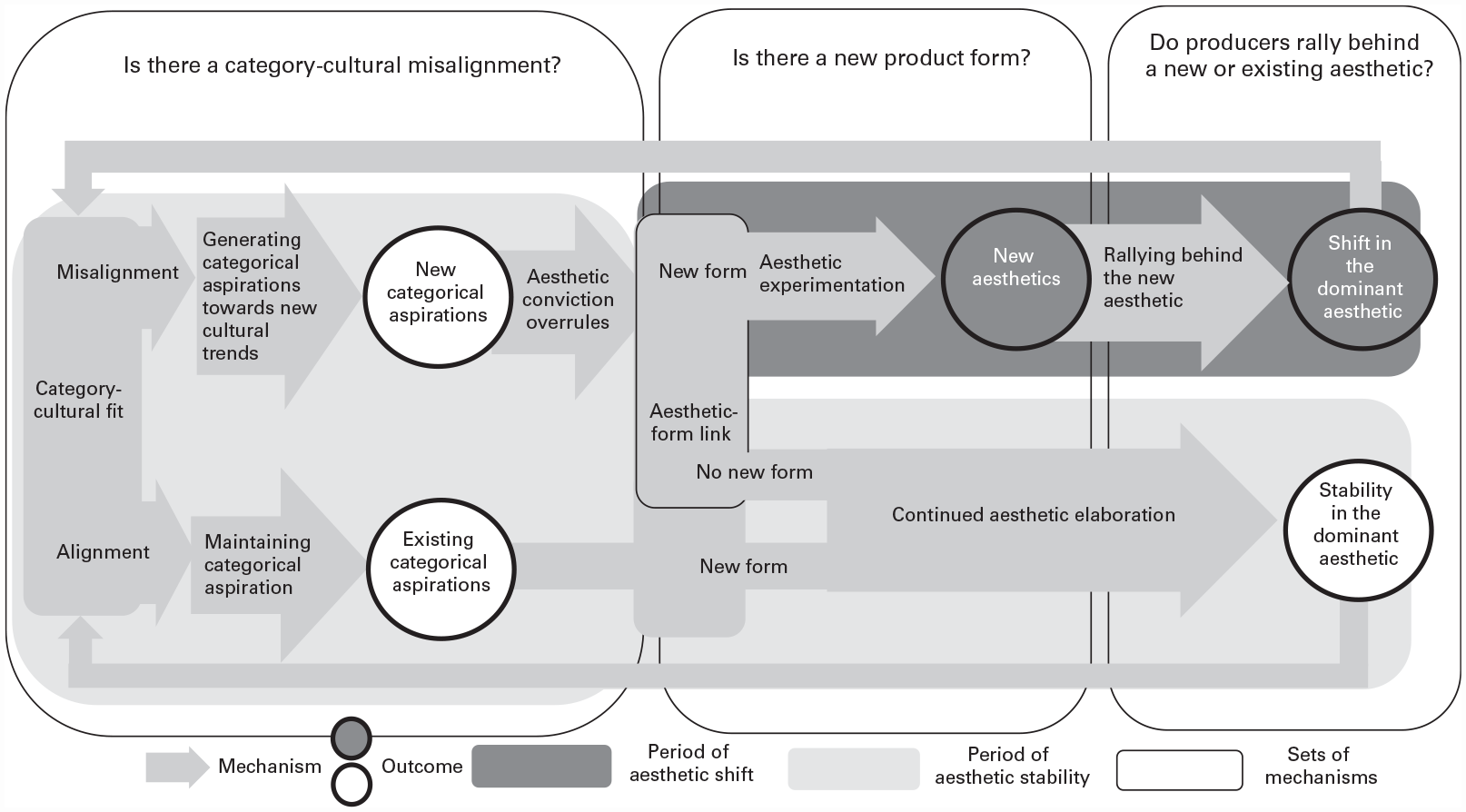
Theoretical Model of the Aesthetic Evolution of Product Categories
The first part of the model, on the left, explains whether cultural trends have pressured producers to generate new categorical aspirations. We divide this set of mechanisms by whether the meanings associated with a product category are aligned or misaligned with the cultural trends that influence audience concerns (i.e., the category–cultural fit). As cultural trends emerge and decay, producers must continuously align their product category’s meanings with these cultural trends, to avoid misalignment. Producers maintain their categorical aspirations when the meanings of the category’s aesthetics align with prevailing cultural trends. In contrast, misalignment results when cultural trends shift and the category meanings that audiences previously appreciated now devalue the category. However, producers tend not to realize such misalignments until they suffer negative market outcomes across the entire category. When negative market outcomes concern only individual producers, they tend to reason that it is not the overall set of meanings associated with the category that causes the negative market outcomes, because more-successful producers’ products also convey these meanings.
Even if producers have generated new categorical aspirations, they do not immediately engage in radical aesthetic innovation because their conviction about the existing aesthetic’s potential overrules the new aspiration. When an aesthetic becomes dominant and producers experience positive, category-level market outcomes, they form a conviction that refining the new aesthetic is the best approach to improve performance for their category.
The first set of mechanisms applies to other contexts as well. For example, the initial military meanings associated with drones cast the category in a sinister and dangerous light, which was misaligned with consumers’ focus on safety and enjoyment. 6 In response, producers generated a new categorical aspiration of drones as a popular consumer technology; this spurred an aesthetic shift from black-and-chrome drones with pointy contours to white-and-gray machines with sleek and soft contours, earning one of the producers the nickname “the Apple of drones” (Kaiman, 2016). Likewise, industrial robotic arms faced the challenge of being seen as making human workers redundant. In response, robotic arm producers changed the aesthetic palette from a hard, industrial look to soft, blue and gray colors suggesting that the technology was well-meaning and could render human work more intelligent (Tondu and Bardou, 2009).
The second mechanism, shown in the center of our model, outlines whether an opportunity for producers to change the existing product form spurs them to experiment with new aesthetics. This mechanism is rooted in producers’ tendency to cognitively link a certain aesthetic to a product form. Once producers have started to reap positive market outcomes by combining a product form with a specific aesthetic, they tend to create the conviction that this aesthetic is the ideal path to commercializing products with the current product form. Our model implies that if producers have new categorical aspirations but there is no change in the product form, producers will continue to engage in incremental aesthetic innovation within the existing dominant aesthetic. Because producers conceive of an aesthetic in connection with the product form, when the form changes, it allows producers to conceive of new aesthetics. But if producers have not generated new categorical aspirations, they will merely re-create the existing dominant aesthetic on the new form.
We also observe this set of mechanisms in other product categories. For example, in the 1920s, refrigerators were wooden with sharp, pointy, boxy contours—signaling antique furniture. In the 1930s, the introduction of freon eliminated the need for a monitor top, unleashing an aesthetic shift in refrigerators, which became rounded with sleek contours, similar to automobiles in the 1940s (Mazovick, 2013). Likewise, the first hair dryers were large and stationary, with metallic colors and transparent elements designed to signal a new era of postwar prosperity and growing leisure time for women to attend to their appearance (Hart, 2017). Changing the form from stationary to handheld hair dryers generated a shift to sleeker, more-modern plastic surfaces in pastel colors, signaling an accessory for the active working woman who was no longer confined to the home. In contrast, no such aesthetic shift occurred in cars’ transition from fossil-fuel to electric power, even though electric vehicle producers adhered to new categorical aspirations related to sustainability (Watkins, 2018), because this technological change did not generate a change in the overall product form.
The third part of the model, on the right, explains how a new aesthetic achieves or maintains category-wide dominance, resulting in either a shift or stability in the dominant aesthetic. A new aesthetic achieves dominance when most producers find that the meanings it conveys are beneficial for both the category overall and for their individual aims to differentiate within the category. Importantly, we find that although the market may enthusiastically receive a new aesthetic, if the aesthetic does not cohere with producers’ new categorical aspiration, producers will tend not to rally behind it. When producers do rally behind a new aesthetic, they begin to differentiate their products by incrementally elaborating on the aesthetic. As producers begin to experience positive, category-level market outcomes in the wake of a new aesthetic, they form the conviction that perfecting the new aesthetic will eventually quell consumers’ concerns; this conviction reinforces the link that ties the product form to the dominant aesthetic. Even if individual producers subsequently experience negative market outcomes, they interpret this as a failure to perfect the existing dominant aesthetic, and in response, they double down on their efforts to achieve that goal. The result is stability of the dominant aesthetic.
We find evidence of rallying in other product categories as well, such as anecdotal reporting in categories as diverse as automobiles (Hoffer and Reilly, 1984; Kwoka, 1993), mobile phones (Djelic and Ainamo, 2005), personal computers (Eisenman, 2017), and black metal album covers (Sgourev, Aadland, and Formilan, 2023).
Discussion
This article aimed to understand the drivers of shifts and stability in the dominant aesthetic of product categories. A central contribution of our study is to elevate the perspective on aesthetic innovation from the single-producer level to the product-category level, thereby shedding light on the dynamics of aesthetic evolution.
The Dynamics of Aesthetic Innovation
Most existing literature has emphasized aesthetics as a means for differentiation (Bloch, 1995; Creusen and Schoormans, 2005). Aesthetic differentiation has typically been conceptualized as visual distance from either a category prototype or the aesthetics of prior designs (Rindova and Petkova, 2007; Talke et al., 2009; Chan, Lee, and Jung, 2021). Extant models of aesthetic innovation tend to assume that this aesthetic reference point is stable and are therefore not able to explain changes in such reference points for aesthetic differentiation, as happens when the dominant aesthetic of a category shifts. Our theory of aesthetic evolution suggests that dominant aesthetics both limit and enable producers’ use of aesthetics to differentiate their products. Shifts between dominant aesthetics are ultimately driven by drifting cultural trends that influence audience concerns and the cultural meanings available for producers to draw upon. We thus propose that periods of confined, incremental aesthetic elaboration occur because the dominant aesthetic follows lengthy cycles of cultural trends spanning several years—often decades. Future research could test this theory in other settings to refine its broader applicability and boundary conditions. For this endeavor, the ability to analytically disentangle radical aesthetic innovations from incremental ones is crucial. The methods outlined in this article for coding aesthetics (detailed in Online Appendix 2) may provide the guidance researchers need to pursue this topic further.
A perspective characterizing much research on aesthetic innovation has emphasized the role of fashion cycles (Pesendorfer, 1995; Cappetta, Cillo, and Ponti, 2006; Eisenman, 2013). A central role of aesthetic innovation, according to this view, is for producers to differentiate their products by offering consumers superior symbolic (Verganti, 2009) or expressive value (Chan, Lee, and Jung, 2021) to use for sociocultural positioning and identity construction (Belk, 1988). In explaining aesthetic change, most studies point to fashion cycles and emphasize the importance of endogenous mechanisms and downplay the role of exogenous mechanisms, such as broader societal and technological changes (Lieberson, 2000; Kaufman, 2004; Godart and Galunic, 2019). According to this view, we should expect a shift in the dominant aesthetic once the potential for further differentiation becomes exhausted as the aesthetic diffuses to the mass market (Cappetta, Cillo, and Ponti, 2006). In contrast to this stream of work, we emphasize the role of exogenous mechanisms such as cultural trends and technological changes.
In line with recent studies emphasizing factors that are exogenous to the evolution of cultural elements, such as political shocks (Obukhova, Zuckerman, and Zhang, 2014) or scandals (Sgourev, Aadland, and Formilan, 2023), we found that as cultural trends in society drift (often triggered by structural changes in society), audiences’ concerns toward a product category may change, and previously valorized category meanings might attain a negative valence. Although we studied a highly homogenous market compared to, for example, nascent technology markets (Bijker, 1997; Anthony, Nelson, and Tripsas, 2016), our findings suggest that category-level changes in dominant aesthetics are driven by factors exogenous to fashion cycles, namely, broader cultural trends and technological discontinuities. Thus, we propose consideration of other mechanisms driving aesthetic evolution, apart from traditional accounts of fashion cycles such as elite segments’ desire to stylistically distinguish themselves from the rest of society (Simmel, 1957; Pesendorfer, 1995; Cappetta, Cillo, and Ponti, 2006).
Through empirical attention to contextual factors such as cultural trends and technological changes, we show how single producers’ pursuit of aesthetic innovation functions in tandem with broader, environmental factors affecting the entire product category. We also build on past research that has indicated the role of culture in aesthetic innovation (Rindova, Dalpiaz, and Ravasi, 2011) as well as the literature on how producers can make strategic use of culture (Lounsbury and Glynn, 2001; Rao, Monin, and Durand, 2003; Weber, 2005; Harrison and Corley, 2011; Maurer, Bansal, and Crossan, 2011; Jones et al., 2012). A central idea underlying these studies is that organizations can eclectically draw on a bricolage of cultural meanings (Rao, Monin, and Durand, 2005; Verganti, 2008; Godart and Galunic, 2019). We augment this line of work by showing how producers are constrained in which cultural meanings are salient and which are viable to draw upon. For most product categories, the array of cultural trends that can resolve misalignment in category–cultural fit is limited in light of the restricted number of relevant cultural trends and the fact that new trends emerge slowly.
Our work also challenges the view that changes in cultural expressions are gradual rather than discrete. Scholars emphasizing endogenous mechanisms in the evolution of cultural expressions often hold the view that an aesthetic gradually mutates into a different one as producers continually strive for novelty (Kaufman, 2004). By pointing to the structuring role of dominant aesthetics in product categories, our study offers a contrast to this view. While we do observe aesthetic hybridity and the lingering of old styles between dominant aesthetics, this transition period is short as producers shift from creating aesthetics that reflect one categorical aspiration to aesthetics that reflect another such aspiration. To support our observation that aesthetic shifts tend to be fairly discrete, we note how the cultural trends that producers draw on may backfire, forcing producers to shift toward new trends to alter their products’ meanings. Cultural changes thus create hazards when past category meanings are suddenly devalued, but they also create opportunities for producers to generate radical aesthetic innovations. In that sense, we argue that irrespective of single producers’ characteristics and network positions, their space of maneuverability in aesthetic innovation is constrained by recent cultural trends. In light of our findings, future research, focusing on either single producers or the category level, should pay attention to broader cultural trends that structure individual producers’ efforts to differentiate their products. We suggest that researchers examining aesthetic evolution should not limit their focus to fashion cycles but also should consider how technological change and cultural trends can drive aesthetic innovation. Furthermore, studies on the evolution of cultural expressions are often confined to contexts naturally prone to fashion dynamics, such as clothing (Cappetta, Cillo, and Ponti, 2006; Godart and Galunic, 2019) and given names (Lieberson, 2000; Obukhova, Zuckerman, and Zhang, 2014). However, as our case of the hearing aid category shows, categories that are less fashion-intense also show important patterns of aesthetic evolution, and it is important to understand the drivers of such changes.
Because our study focused on the antecedents of aesthetic evolution, future research could examine the outcomes of aesthetic evolution, such as shifts in the dominant aesthetic. For example, how do aesthetic shifts influence category performance, and how are such performance outcomes influenced by the valence of the meanings associated with the prior dominant aesthetic? Another interesting avenue that our study presents is the relationship between category-level aesthetic evolution and producer-level performance. We observed that producers who pioneered a new aesthetic tended to reap dramatic sales gains for a few years until the aesthetic became imitated category-wide. Interestingly, however, these producers tended to already be commercially successful. Thus, their aesthetic innovations were not a response to their declining, individual performance but, rather, to negative market outcomes facing the category in general. Future research could explore this further by examining how producer-level versus category-level market outcomes spur producers to reconsider the meanings associated with the aesthetics of their products.
The Timing and Antecedents of Radical Aesthetic Innovation
Another question our study answers is why we observe long periods of aesthetic stability punctuated by sudden waves of radical aesthetic innovation (Abernathy and Clark, 1985; Verganti, 2008). We know that consumers gravitate toward new styles when an aesthetic eventually matures (Cappetta, Cillo, and Ponti, 2006), so why do producers adhere to the same aesthetic beyond what extant theory predicts would be its expiration date? Also, when the benefits of pioneering radical aesthetic innovation are so high (Ravasi and Lojacono, 2005), why do most aesthetic innovations occur within a dominant aesthetic? Past works have tended to emphasize agentic conditions related to a single producer, such as new, visionary directors or managers (Djelic and Ainamo, 2005; Verganti, 2009; Dalpiaz, Rindova, and Ravasi, 2016). By advancing a category-level perspective (Eisenman, 2017), we augment the findings of previous studies on single producers pioneering new aesthetics.
Several studies have suggested that when a new technology life cycle commences, producers aim to render their products more intelligible by cloaking them in a familiar aesthetic (Clark, 1985; Hargadon and Douglas, 2001; Kaplan and Tripsas, 2008; Kahl and Grodal, 2016). Furthermore, the literature has suggested that later in a technology life cycle, producers introduce aesthetic innovation to differentiate their products from those of their competitors (Rindova and Petkova, 2007). These studies reported that as a product’s prototypical appearance automatically shifts with technological discontinuity (Clark, 1985), producers therefore must use aesthetic innovation to have the product resemble the prototypical appearance associated with the former technology life cycle (Hargadon and Douglas, 2001; Kahl and Grodal, 2016). Thus, we should expect that aesthetic stability will characterize the early part of a technology life cycle because producers will seek to emulate the preceding technology’s visual appearance (Rindova and Petkova, 2007; Chan, Lee, and Jung, 2021), whereas the later stage of the technology life cycle will witness the introduction of new aesthetics. We find that technological discontinuities can be a central antecedent of radical aesthetic innovation, as the change in form enabled by the technology spurs producers to reconsider the aesthetic of their products. However, rather than addressing a need to explain new technology products’ functionality, our theory emphasizes how the natural change in form spurred by some technological discontinuities acts as a push for producers to redefine their product category’s alignment with drifting cultural trends. We find that changes in technology alter the canvas upon which producers innovate in aesthetics, but that producers’ aspirations to change their category’s meanings are the driving force of aesthetic evolution.
Another question that our study answers is why producers often fail to execute timely responses to misalignment between product aesthetics and cultural trends. Studies of aesthetic innovation have reported that consumers tend to devalue a dominant aesthetic for an extended period before producers respond (Ravasi and Lojacono, 2005; Norman and Verganti, 2014). For example, our model would infer that Nokia’s successful introduction of fashionable mobile phones exploited a delayed response by competitors whose orientation toward the cultural trends of the “information society” fixated them on a dominant aesthetic signaling that phones were nothing more than functional tools (Djelic and Ainamo, 2005: 11). Eisenman (2017) likewise indicated that for about a decade before Apple successfully launched the iMac, there was misalignment between the beige and boxy computer aesthetic, signaling bland and monotonous office work, and consumers’ desire for computers that could serve as lifestyle objects in the home. Yet, the reason behind the delay in producers’ responses has thus far been unclear.
We show that early successes with a new aesthetic establish the aesthetic–form link, a belief that the dominant aesthetic is inextricably tied to the current product form. This explains producers’ delayed responses to the misalignment between cultural trends and the dominant aesthetic, as producers first must be able to alter the overall product form. This explanation augments prior studies of inertia that have tied producers’ lack of timely response to organizational identity rooted in technological regimes (Tripsas, 2009), industry affiliation (Zuzul and Tripsas, 2020), and business models (Tripsas and Gavetti, 2000). For example, we posit that producers’ existing aesthetic conviction might explain why the change in the iMac monitor’s form coincided with a new aesthetic for personal computers (Eisenman, 2017). Our findings point to a window of opportunity, between the emergence of a new cultural trend and an opportunity to change product form, for producers to introduce new aesthetic innovations. Thus, we suggest that producers can exploit the fact that their competitors’ aesthetic conviction likely delays them from replacing an underperforming aesthetic until a change in product form pushes them out of their belief. While our study observed changes in form as an important mechanism in unleashing aesthetic innovation, future research could explore the commercial and strategic gains of producers seeking to exploit a misalignment in category–cultural fit through radical aesthetic innovation prior to a change in form.
The Dynamics of Category Meanings
Our study also has implications for categorization theory (Zuckerman, 1999; Cattani, Porac, and Thomas, 2017). A core observation within theories of categories and optimal distinctiveness is that producers differentiate within a zone of legitimacy that is set by audiences’ perception of which products do and do not belong within the category based on the category prototype or a set of features important to the actors doing the categorization (Zuckerman, 1999, 2017; Zhao et al., 2018). However, the category prototype, such as the understanding of how a laptop, minivan, or hearing aid should look, is not static but evolves over time in response to technological and demand-side changes (Grodal, 2018). We show that the category meanings within which producers may differentiate change due to evolving cultural trends, which at times create misalignment between audience concerns and category meanings. In addition, in terms of producers’ efforts to differentiate within a category, we show that the space of viable differentiation in aesthetics is narrower than the setup theorized by Zuckerman (1999), who suggested a two-stage model in which firms first must claim membership within a category and then differentiate within it. We show that in addition to signaling category membership, producers’ aesthetic differentiation is further constrained because many possible aesthetics are not viable due to misalignment with current cultural trends. We thus call for future research to synthesize insights on the role of culture in category meaning change (Weber, Heinze, and DeSoucey, 2008; Delmestri and Greenwood, 2016) with insights from research on optimal distinctiveness (Zhao et al., 2017; Taeuscher, Zhao, and Lounsbury, 2022).
Our model also expands the established model of category evolution past category maturity. Extant theory posits that producers first seek to legitimize their category, and they differentiate themselves within it only after achieving legitimation (Rosa et al., 1999; Kennedy, 2008; Navis and Glynn, 2010). By tracing the evolution of a product category for an extended period, we show how categories undergo multiple cycles in which producers repeatedly rally behind a new set of meanings. We emphasize the role of external categories that producers draw on to create new categorical aspirations. This invites further questions regarding the ecology of categories (Aranda, Conti, and Wezel, 2021; Boghossian and David, 2021).
Another prevalent question in categorization theory is, how are category meanings constructed? Extant literature has emphasized the role of linguistics in the construction of category meanings (Kennedy, 2008; Khaire and Wadhwani, 2010; Zunino, Suarez, and Grodal, 2019). Recently, however, studies have pointed to the role of physical dimensions, such as technological designs (Grodal, Gotsopoulos, and Suarez, 2015; Raffaelli, 2019) and visual attributes such as color (Sgourev, Aadland, and Formilan, 2023). We emphasize the role of aesthetics and show that which aesthetic becomes dominant is important in shaping the cultural meanings of a product category. Future research might revisit core aspects of categorization theory by giving empirical attention to aesthetics, potentially using the lens of design semantics, with attention to how design features exhibit semantic statements (Krippendorff, 1989).
Boundary Conditions
A boundary condition of our study is that architectural innovations influenced the timing of producers’ experimentation with new aesthetics (Henderson and Clark, 1990). In other contexts, however, a change in form might be spurred by different types of technological changes, such as new materials, process innovations, or even new regulations or new consumer needs. Thus, future research could, for example, examine how innovation is unleashed in product categories that are less constrained by technological designs.
Another boundary condition is that we studied a stigmatized product category. The aesthetic patterns that we observed might therefore have been driven by producers’ desire to shed the stigma. When comparing our findings to those of related studies, however, we found that aesthetic shifts were also present in non-stigmatized product categories (Dalpiaz, Rindova, and Ravasi, 2016; Eisenman, 2017), such that cultural trends also spur audiences to deem existing products boring, old-fashioned, uncool, or simply misaligned with the current tastes of the market (Djelic and Ainamo, 2005; Ravasi and Lojacono, 2005; Eisenman, 2017). We thus argue that stigma is not discrete but, rather, a continuum because product categories may reflect a gradation of negative connotations. Future research could further investigate the aesthetic evolution of product categories bearing meanings of different types and valences.
Conclusion
Through our in-depth inductive study of hearing aids, we conclusively identify the mechanisms that drive periods of shift and stability in the dominant aesthetic of a product category. Our theoretical model augments theories of aesthetic innovation and considers both the single-producer and the category level. In doing so, we recast aesthetic innovation as a central vessel for the construction and evolution of category meanings.
Supplemental Material
sj-pdf-1-asq-10.1177_00018392231173677 – Supplemental material for The Aesthetic Evolution of Product Categories
Supplemental material, sj-pdf-1-asq-10.1177_00018392231173677 for The Aesthetic Evolution of Product Categories by Anders Dahl Krabbe and Stine Grodal in Administrative Science Quarterly
Footnotes
Acknowledgements
We would like to thank Rasmus Koss Hartmann, Victor Seidel, Fernando F. Suarez, Woody Powell, the participants at the Networks and Organization seminar at Stanford University, Carliss Baldwin, and Ezra Zuckerman Sivan for their comments on the paper. We would also like to thank Robert Flynn, Claus Nielsen, Dominic Stiles, and Monica Brava for their assistance with data collection, as well as Julie Tadros for her help with creating drawings and illustrations. Finally, we would like to thank Mary Benner and three anonymous reviewers for their careful guidance in the review process. The Eriksholm Research Centre has provided invaluable assistance in granting us access to their historical collection of hearing aids. The first author would like to thank Dannie Kjeldgaard and Mette Praest Knudsen for supervising the dissertation upon which this manuscript is based.
1
A hearing aid is a technological device capable of compensating for hearing loss. It is a product category distinct from cochlear implants, which are used to treat deafness (Garud and Rappa, 1994).
2
We focused on producers competing in the U.S. market, several of which were European.
3
The Hearing Journal was originally named National Hearing Aid Journal.
4
One exception was the Danish manufacturer Oticon. In the early 1990s, Oticon launched the first fully automatic, digital programmable device, which was available in high-tech colors (Ravasi and Lojacono, 2005).
5
We observed these aesthetic elements in the exhibits of online museums on prosthetic limbs, at https://collection.maas.museum/object/242949 and  .
.