



Abstract
Two research streams examine how social movements operate both “in and around” organizations. We probe the empirical spaces between these streams, asking how activism situated in multi-organizational contexts contributes to transformative social change. By exploring activities in the mid-1990s related to advocacy for domestic partner benefits at 24 organizations in Minneapolis–St. Paul, Minnesota, we develop the concept of inhabited ecosystems to explore the relational processes by which employee activists advance change. These activists faced a variety of structural opportunities and restraints, and we identify five mechanisms that sustained their efforts during protracted contestation: learning even from thwarted activism, borrowing from one another’s more or less radical approaches, helping one another avoid the traps of stagnation, fostering solidarity and ecosystem capabilities, and collaboratively expanding the social movement domain. We thus reveal how activism situated in multi-organizational contexts animates an inhabited ecosystem of challengers that propels change efforts “between and through” organizations. These efforts, even when exploratory or incomplete, generate an ecosystem’s capacity to sustain, resource, and even reshape the larger transformative social change effort.
Keywords
Activism in organizational contexts is pivotal for advancing transformative social change. The literature on organizations and social change has flowed in two streams. One probes tactical maneuvers within a single organization. The other follows cascades of change across sets of organizations. Both types of change may be prompted by surrounding social movement efforts or referent organizations. While research on activism “in and around” organizations shows how change can be pushed by activists who occupy either internal or external positions (Briscoe and Gupta, 2016), change may also result from the efforts of activists who are not simply either insiders or outsiders. Activists from multi-organizational contexts blur this dichotomy. The grounded work of employee activists who connect across organizational contexts, to steward change efforts “between and through” organizations, offers a fruitful space for research.
To explore this space, we examine employee activism during early moments in the highly contested fight for non-discrimination on the basis of sexual orientation in the mid-1990s. This period was very contentious, especially in contrast to corporate support 20 years later. In February 2013, for example, over 300 corporations, many of them Fortune 500 companies, filed supportive amicus briefs for two cases before the U.S. Supreme Court that ultimately led to the recognition of same-sex couples’ right to marry. Such corporate support was inconceivable in 1991 when Lotus Development Corporation stood alone among publicly traded U.S. companies in offering domestic partner benefits (DPBs): employer-based health care benefits for family members including same-sex partners. Activism on this issue was hotly contested and sometimes provoked rigorous corporate opposition in the mid-1990s. We examine how employee activists’ efforts reverberated between and through organizations in an unsettled organization field, affecting the scope and shape of activism.
Research at the intersection of organizations and social movements (Davis et al., 2005) has been flourishing. Past research on social movements tended to focus on activists’ efforts directed at the state with the aim of making legislative changes (McAdam, Tarrow, and Tilly, 2001). At the nexus of research on organizations and social movements, the state still has a role, but the focus shifts to how organizations are the direct targets of outside activism and how insider activism brews in organizational sites. Outside activists target organizations directly “aiming to influence society by first altering organizational policies and practices” (Briscoe and Gupta, 2016: 1) and deploy negative media coverage (Gamson et al., 1992) and consumer boycotts (Mayer, 2007) in those efforts. Activism may generate changes when organizations face downward pressure on stock prices (King and Soule, 2007) or defensively adopt practices to avert reputational taint (Carberry and King, 2012). When organizations are sites of activism, employees use insider access and levers to experiment with workplace activism that may advance broader social movement goals (Creed, Scully, and Austin, 2002; Raeburn, 2004), for example, through on-the-ground efforts that seek proactive environmental stewardship (Wright, Nyberg, and Grant, 2012), various approaches to recycling (Lounsbury, 2001), more equitable employment opportunities (Scully and Segal, 2002), or greener information systems (Carberry et al., 2017). These local, often small wins and tempered insider moves (Meyerson and Scully, 1995) may sometimes yield changes that, though gradual, are customized and meaningful in an organization (Scully and Segal, 2002).
With studies focusing on organizations either as targets or as sites, research has been divided into a more macro stream in which social movements are tracked as extra-organizational prompts for inter-organizational trends and a more micro stream in which social movement projects are recounted in ethnographies of savvy, nuanced, and even stealthy employee moves. We propose that investigating an intermediate level of activity can advance our understanding of how organizations and organizational contexts play a role in transformative social change. Studying locally grounded activists’ tactics is useful not just for understanding singular sites but also for observing how change efforts move across organizational boundaries. Kellogg (2009) contrasted two sites in her signature study of the insider activism of change agents in two hospitals working to eliminate dangerously long shifts for medical residents. Extended further, researchers might benefit from more contrasts and could also explore whether and how activists look at and appropriate tactics from counterparts in other organizations in their environment. Attention to multi-organizational contexts can anchor the more micro studies in surrounding change efforts.
Conversely, microprocesses can animate the more macro approaches. For example, in studies of how contentious human resource policies spread across populations of organizations, it would be useful to know where and how activists on the ground were priming the pump for their organization to adopt a change, such as by “trigger[ing] attention and deeper processing” regarding what was happening in the vanguard organizations (Briscoe and Safford, 2008: 466). Microprocesses can uncover how activists maneuver so as to attend “to the actions of other adopters” and not to “attract unwanted attention” (Fiss, Kennedy, and Davis, 2012: 1090, 1083) while adapting controversial practices that move across organizations. Based on existing research, “we typically know that potential adopters are brought into contact with the diffusing practice but do not know quite what they see,” resulting in “theoretical fuzziness about the microprocesses involved in diffusion” of change (Strang and Soule, 1998: 269). Macro studies often imply or infer microprocesses, leaving open opportunities to study how activists prompt or redirect multi-organizational change efforts.
Combining multi-organizational contexts and activists’ grounded experiences requires looking not at large populations like the Fortune 500 or at singular organizations but at sets of connected organizations. We identify employee activists embedded in a shared context with shared resources and capabilities pursuing change across highly varied organizational settings. We attend to microfoundations (Powell and Colyvas, 2008) while retaining an appreciation of structural parameters and constraints, such as resistant organizations in which top leaders fear employee, consumer, or legislative backlash. Probing the spaces between macro and micro research streams, we address how experiences of activism situated in multi-organizational contexts contribute to transformative social change.
We selected an ongoing and contested change effort in order to explore different states of workplace activism simultaneously, including states in which activists experience small wins, may be on the brink of a change, or are thwarted in their pursuit of change. In settings in which contestation is active, harsh, and even frightening, we look at the “brute experiences” of the employee activists, in the tradition of pragmatism (Maddux and Donnett, 2015; Misak, 2016). We develop the concept of “inhabited ecosystems” to capture at once the lived experiences of activists and the dynamic multi-organizational contexts shaping and shaped by their activism.
The term “ecosystem” has three broad uses in the organizational literature. In human ecology, an ecosystem is “an assemblage of differentiated and interrelated organisms together with their common habitat” (Hawley, 1982: 159). Population ecology uses ecosystems to focus attention on the field’s resources and structures and on how competitive and selective forces exert pressures that shape the constituent organizations. An architectural perspective on ecosystems shifts attention to structures and mechanisms of interdependence that foster entrepreneurial activity (e.g., Adner and Kapoor, 2010; Adner, 2017) or promote sector growth (Powell, Koput, and Smith-Doerr, 1996). The evolution of these three literatures shows a shift in attention toward more structure, away from agency, though recent work has begun building bridges from structural perspectives to inhabited activity, exploring situated micro interactions in interstitial fields (Furnari, 2014) and investigating how interactions build “scaffolding” for further transformation activities (Scully and Creed, 1997; Mair, Wolf, and Seelos, 2016). Attending to both structure and agency, we use “ecosystem” to capture elements of connection, interrelatedness, and resource pools that characterize the in-between spaces we examine. We draw on the “inhabited institutions” perspective (Scully and Creed, 2005), which emphasizes “institutions are constructed and propelled forward by social interactions” (Hallett and Ventresca, 2006: 213; Thompson, Purdy, and Ventresca, 2018) and “institutional fields are understood and tethered to local activity” by shared meanings (Leibel, Hallett, and Bechky, 2018: 35). In our approach, structural interdependence shapes the context, while the affiliative ties (Borgatti and Halgin, 2011) and less examined relational work of activists (Campbell, 2005) may animate, sustain, and reshape that context.
Organizations and Social Change Processes
The literature at the intersection of organizations and social movements highlights that organization studies concepts are useful for explaining how social movements develop (Clemens, 2005) and that social movements offer useful metaphors for analogous processes in organizations (Zald and Berger, 1978). The literature moved from metaphors to mechanisms (Scully, 2017) to examine organizations’ involvement in the advancement of social movements. Research has explored a range of change advocacy mechanisms, including reframing societal issues to gain legitimacy in corporate settings (Creed, Scully, and Austin, 2002), spreading activism tactics across a field to spark attention and reverse investment policies (Soule, 1997), and pressing organizations for policy changes in ways that reverberate through the supply chain (Bartley and Child, 2014) or with competitors (Yue, Rao, and Ingram, 2013). Scholars have characterized these actions as activism “in and around” organizations, arrayed on a “spectrum from insider activists to outsider activists” (Briscoe and Gupta, 2016: 7). The significance of this distinction is that the levers for social change are different. Activists inside organizations have greater access to information but face limitations because they depend on the organizations for their livelihood; conversely, outsider activists have powerful levers, such as the media or protests, but less knowledge or access to customize their advocacy (Briscoe and Gupta, 2016). From a pragmatic, inhabited perspective (Hallett and Ventresca, 2006), however, the insider and outsider distinction might not be so sharp. For example, insiders at nearby or similar organizations may have the same freedom as outsiders to exert pressure for change, yet still have knowledge akin to that of insiders. Considering some combination of outsider power and insider savvy opens up interesting theoretical possibilities.
From “In and Around” to “Between and Through”
Activists who are neither fully inside nor outside an organization may have “partial or temporary” statuses (Briscoe and Gupta, 2016: 11). Examples include shareholder activists collectively mobilizing for change through ownership and corporate governance (Davis and Thompson, 1994) or student activists working to eliminate sweatshop labor from the production of clothing with school logos (Briscoe, Gupta, and Anner, 2015). We suggest a different kind of space between insider and outsider activism. Employees and social movement organizers may operate at once both inside and outside organizations. As insiders, employees experiment with tactics that they may borrow from, or may pass on to, activists in other organizations. Thus activism may move across and through organizations, perhaps in chains of actions and adaptations. In the spaces between organizations, social movement organizations (Zald and Ash, 1966) may shape and test social movement messages and tactics and bring potential cross-organizational allies into contact, in addition to bringing the movement to the attention of corporate managers (King, 2008). Other conceptions of in-between spaces appear in the organizations literature on “nexus work” (Lingo and O’Mahony, 2010), brokerage (Burt, 2004), inter-institutional contradiction (Seo and Creed, 2002), and “interstitial spaces” (Furnari, 2014). In the context of social movements and organizations, we apply this lens to show how activism shapes the change effort between and through organizations, not just in and around them.
The social movements literature has long distinguished between more macro studies of how social movements emerge on the political landscape and more micro studies of how members are recruited to social movements by persuasive frames or engaged comrades (McAdam, McCarthy, and Zald, 1988). Research on intra-organizational change efforts, typically qualitative, “has a different feel in terms of forming a base of evidence” (Briscoe and Gupta, 2016: 21) that is rich with nuance but often heavily context dependent. Studies of inter-organizational change “paint a rudimentary description of the mechanisms” such that “many studies have implied the intervening mechanisms through which activism influences organizational outcomes” (Briscoe and Gupta, 2016: 44, 17) rather than explicitly examining those mechanisms at a meso level. While inter-organizational studies offer useful insights into the propagation of change critical to large-scale social transformation, they are less immersed in the lived experiences and interactions (Hallett and Ventresca, 2006) of the activists propelling change than the intra-organizational research. To explore the link between the lived experiences in inhabited change processes and large-scale social change requires moving between micro and macro perspectives.
Contestation and the Lived Experience of Struggle
Change efforts that are contested provide particularly fruitful contexts for examining the interplay of microprocesses and macro contexts. Activists’ lived experiences involve risk, shame, threat, and even fear (Goodwin and Pfaff, 2001; Creed, DeJordy, and Lok, 2010; Creed et al., 2014; DeJordy and Barrett, 2014). Midway in a change effort, when it is difficult for activists to predict what the result will be, it is hard to sustain involvement in the absence of obvious progress. Researchers use the term “challengers” (Gamson, 1975; Fligstein and McAdam, 2011; Bertels, Hoffman, and DeJordy, 2014) to reflect that change agents challenge the status quo and face opposition to their efforts. “Institutional blockers” (Levy and Scully, 2007) or “guardians” (DeJordy, 2010) are invested in preserving the status quo and are likely to be better organized and to have more resources than change agents. Lived experiences of struggles between challengers and defenders of the status quo fade from view because of “a strong selection bias in diffusion research, where investigators choose ultimately popular practices as appropriate candidates for study” (Strang and Soule, 1998: 285). Retrospective studies limit researchers’ access to the activists’ brute experiences of contestation. Intra-organizational studies, while more attuned to those experiences, tend to be restricted to contestation unfolding within an organization, thus providing little insight into the inter-organizational dynamics and episodes of contention as change propagates through a field (Fligstein and McAdam, 2011).
Attending to contestation requires that we recognize change efforts “as the product of constitutional struggles—conflicts evoked by social movements over the fundamental character of social, political, and industrial order” (Schneiberg and Soule, 2005: 122). Looking more deeply at ongoing contested change across organizations gives more insight into “how social values and collective arrangements are made and unmade; how things arise and how they change” (Hughes [1971], quoted in Barley, 2008: 495). We give “full and comparative attention to the not-yets, the didn’t quite-make-its, the not quite respectable, the unremarked and the openly ‘anti’ goings-on in our society” (Hughes, 1971: 52). To investigate why and how activists sustain their commitment to making change during such contestation, we turn to work on relational mechanisms.
Understanding Relational Mechanisms
Social movements researchers and organizations researchers have developed three broadly similar categories of analytic mechanisms: environmental, cognitive, and relational (Campbell, 2005). Environmental mechanisms include how organizational boundary spanners read the context, locate opportunities and constraints, and identify benchmark organizations and actions. Cognitive mechanisms largely focus on framing (Benford and Snow, 2000), recognizing “that the interests of movement supporters were not objectively given by their social circumstances, including political opportunity structures, but had to be defined, interpreted, and socially constructed (McAdam et al., 1996)” (Campbell, 2005: 49). For example, proponents of a change engage in “cultural brokerage” to bridge the varied cultural repertoires among those they aim to mobilize for change (Giorgi, Bartunek, and King, 2017). How activists read the cultural context is a microprocess of inter-organizational change, because their “interpretive work selects and transforms diffusing practices” (Strang and Soule, 1998: 277). Relational mechanisms point to how activists do more than merely receive scanned information from the environment or shape and transmit cognitive frames. Connections among actors and their network positions enable them to propagate change (Campbell, 2005). Thus attention to relational mechanisms may make visible more contingent and cumulative processes that propel the spread of contested practices. Looking at the experiences of interconnected change agents in a multi-organizational context during contestation should provide empirical insights that increase our understanding of how relational mechanisms manifest and operate.
Social movements and organizational research have each considered relational mechanisms, typically through network theories of connection and structure, but they have done so on separate tracks. Research has explored how existing and emergent ties among activists can open new channels—sometimes incidentally, sometimes strategically, and sometimes with new constituencies as allies—enabling even strapped social movements to gain and mobilize new resources (Morris, 1993, 2000; Ganz, 2000). Separately, organization theorists have examined how relational ties expand the reach of corporate actors pursuing innovation (Obstfeld, 2005) or governance changes (Davis, 1991). At the intersection of social movements and organizations research, however, relational mechanisms have received less explicit attention. Campbell (2005) characterized this research as focused on cultivating leadership and networks for access to resources, consistent with a conception of networks as pipes that allow the flow of resources, but not one of networks as social connections that shape the lived, interactive experiences of activists.
In the social movements literature, relational mechanisms have figured in addressing the central puzzle of how people are recruited and mobilized. This work distinguishes between activists and those who withdraw from or eschew activism, finding that mobilized activists are not those most ideologically compelled by the movement frames but those who have meaningful interpersonal ties and “integration into activist networks” (McAdam, 1986: 87). In contrast, research on activism inside organizations has spent less time examining the problem of recruiting activists, because the workplace is a ready-made context in which activists solve the problem of where and how to find each other (Scully and Segal, 2002). Relational ties within a workplace sustain activists through “cycles of engagement,” with activists noting that “just the existence” of their group as a site for exchanging examples and shifting their attributions keeps them going (Scully and Segal, 2002: 155). The joint importance of “attitudinal affinity and biographical availability” (McAdam, 1986: 87) indicates that relational ties matter, as do the opportunistic settings that pull people together. More than simply pipes through which resources flow, relational ties are affinities and affiliations that can build solidarity (Borgatti and Halgin, 2011) across organizational contexts.
Methods
Situated Experiences of Contested Social Change
We conducted interviews in the mid-1990s, when contestation around domestic partner benefits (DPBs) and other gay, lesbian, bisexual, and transgender (GLBT) rights in the workplace was garnering attention in both public discourse and organizational research (Raeburn, 2004; Chuang, Church, and Ophir, 2011; Anteby and Anderson, 2014). 1 Collective action, including intense lobbying, was underway on both sides of two proposed pieces of federal legislation. By the fall of 1996, the Defense of Marriage Act would pass in the U.S. Congress, denying federal marital rights to same-sex couples, and the Employment Non-Discrimination Act, which would have prohibited discrimination on the basis of sexual orientation, would fail to pass in the Senate. (It did not become law until 2013.)
We selected the Twin Cities (Minneapolis–St. Paul) as the research site for our fieldwork because it offered three features important for this investigation into experiences of activism in contested multi-organizational change efforts. First, the change effort there was incomplete and ongoing. A few major corporations and other organizations in the region had adopted DPBs, but most organizations in the area had not. There was active advocacy around the issue. A scan of articles in the newspaper of record for the region, the Minneapolis Star Tribune, on various search criteria related to GLBT workplace issues in the 10 years prior to our interviews (n = 70) and the ten years after them (n = 177) highlights the ongoing and escalating attention to the issue. Activists and their proponents actively contested GLBT civil rights more broadly at the state and municipal level in the early 1990s. For example, while GLBT activists and their allies had successfully waged the “It’s Time, Minnesota” campaign to amend the Minnesota Human Rights Act to include protections for GLBT people, a court ruling at the time reversed a municipal plan to extend health care benefits to the partners of gay and lesbian city employees, which had consequences for other public entities. Thus GLBT workplace activism experienced both support and opposition, successes and setbacks. Second, research provides evidence that Twin Cities organizations influence one another on corporate social responsibility issues (Galaskiewicz, 1997), making the area a good place to explore relational mechanisms. Third, a national social movement organization (SMO) working for GLBT rights, the Human Rights Campaign (HRC), pointed us to two Twin Cities SMOs, one a community organization that we call the “GLBT Center” or just “the Center,” and the other an alliance of workplace advocacy groups promoting DPBs and other GLBT-friendly workplace practices, which we call “the Alliance.”
The Sample: Organizations and Employee Groups
The Alliance helped us identify and connect with employee activists by providing a roster of member GLBT employee groups at 27 Twin Cities “employer organizations,” a term we use to distinguish organizations with employees who could receive DPBs from volunteer or advocacy organizations. We approached all 27 groups and gained research access to 24 for this study. The employer organizations varied in their sector, industry, size, and whether they had adopted DPBs. To verify that our sample represents the active participants engaged in the conversation around DPBs at the time, we searched the Minneapolis Star Tribune for references to “domestic partner benefits” for the five years leading up to our interviews. While this specific issue garnered limited press coverage, of the 12 articles retrieved, nine focused on organizations in our sample, and none mentioned employer organizations not included in our sample.
We conducted 72 interviews, one each with the executive directors of the Center and the Alliance and 70 with employee activists and other informants from the 24 workplace organizations. We refer to employees who advance GLBT workplace issues as “activists,” consistent with work on internal change agents (Scully and Segal, 2002) and with Clemens’s (2005: 352) observation that when challenging formal power structures, “members of corporations behave like activists.” The sample includes the leader (or spokesperson or contact) for each GLBT employee group from the Alliance roster (n = 24), other GLBT workplace activists and their straight allies (n = 34), human resource professionals (n = 9), and top executives who had been targets of successful advocacy and become allies (n = 3). The sample is diverse in terms of sexual orientation, gender, race, and profession.
Together, the 24 employee groups represent agents advocating for social change in a geographically bounded and embedded space. We view them as challengers (Gamson, 1975; Bertels, Hoffman, and DeJordy, 2014) in an unsettled field. Our use of the term “field” builds on the perspective of strategic action fields, reflecting our interest in exploring “socially constructed arenas within which actors with varying resource endowments vie for advantage” (Fligstein and McAdam, 2011: 3). An important aspect of the formulation of strategic action fields is that they are “embedded in complex webs of other fields” (Fligstein and McAdam, 2011: 8). This concept usefully captures that our activists are embedded not only in their employee advocacy groups but also in their organizations, geographic region, and industries, as well as the national social movement and political context. While we focus at the level of the geographic region and use employee groups as our unit of analysis, the shared embeddedness across those units provides important context to their experiences and thus to our findings.
Data Collection
For each organization, we interviewed at least one person—more in some and eight at one organization, because the employee groups differed in terms of membership, engagement, and degree of ally support. A field team, comprising two of the authors and a research assistant, conducted the interviews. Most interviews paired one informant with one researcher. The interview team was diverse in terms of both gender and sexual orientation. Interviewer and interviewee pairings included homogeneous and heterogeneous combinations with respect to gender and sexual orientation. Interviews lasted from 30 to 90 minutes and, unless interviewees requested otherwise, were audio recorded and transcribed; field notes were consulted when audio was unclear or missing. Online Appendix A (http://journals.sagepub.com/doi/suppl/10.1177/0001839219899613) provides details of the interview data.
The interviews followed a semi-structured protocol designed to elicit informants’ perspectives on and experiences of their respective employee group’s advocacy efforts, both within their employer organization and with other organizations. We asked questions on the history and current status of issues related to GLBT inclusion at their employer; the engagement of the GLBT employee group, including its current efforts, accumulated successes, past failures, and future goals; the relationship of the GLBT activists to high-level decision makers, allies, and other diversity-related employee affinity groups (e.g., groups based on race or gender); and connections to other organizations in the region, such as the Center, the Alliance, and GLBT employee groups at other organizations. These questions elicited rich narratives that related informants’ work with their employee groups, as well as their experiences with and aspirations for the ongoing and contested change effort. We also gathered training handouts and materials from events relating to GLBT workplace issues to understand the overarching movement’s presence and the range of local activities.
We supplemented the interviews and field data with archival data to situate informants’ accounts in historical context. For example, we used criteria listed in the Gay and Lesbian Values Index, a corporate rating compiled by Gary Lukenbill from 1995 until its acquisition by the Human Rights Campaign (HRC) in 2001, and the HRC Corporate Equity Indices from 2002 to 2016, which enabled us to track updates to corporate rating criteria that expand beyond DPBs.
Data Analysis
Our analysis involved four steps. We first created qualitative portraits of each employee group. When comparing portraits, we found that the groups varied significantly on many factors beyond adoption (or not) of DPBs. Second, we coded the portraits along various aspects of their experiences. Third, we performed quantitative cluster analysis on the coded profiles to identify the varied states of change advocacy in this setting. Finally, we reanalyzed our qualitative data informed by the cluster analysis. Though we use the employee activist groups as the unit of analysis, for simplicity we refer to each group using a pseudonym for its employer organization.
Creating portraits of employee groups
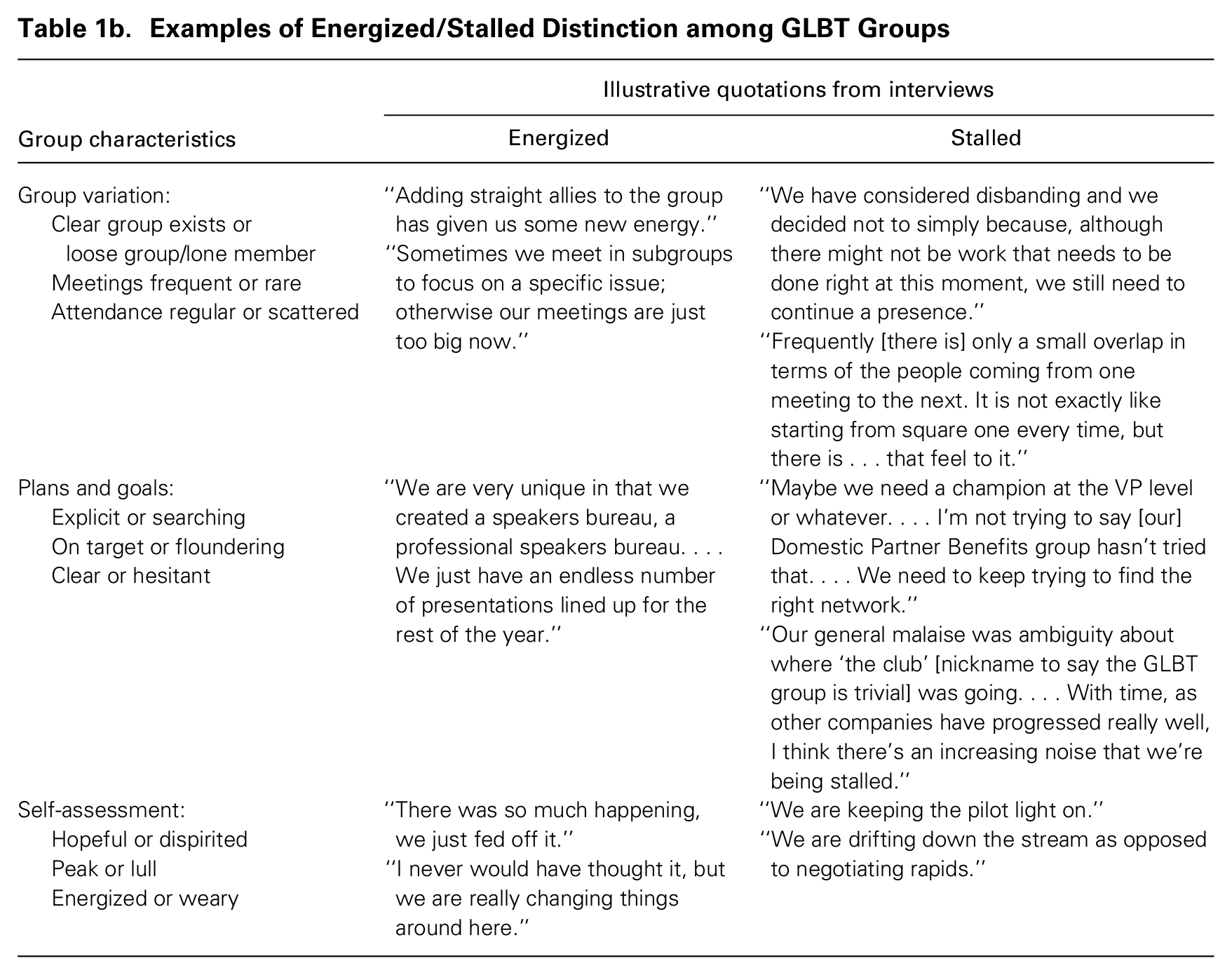
We developed a standard template for synthesizing informants’ accounts of their respective group’s history, current activities, and plans for the future. Comparing the composite accounts revealed differences in informants’ appraisals of how the change effort was going for their group. Most insiders’ appraisals of their own group also contained appraisals of the struggles, successes, and setbacks at other organizations. These portraits became the basis for coding the robustness of each employee group, its plans and goals, and its assessment of its own efforts. Table 1a summarizes each group’s state while Table 1b provides sample self-appraisals used in our coding. Our comparisons revealed the groups’ experiences varied in ways that aligned neither with the state of adoption of DPBs nor with organizational characteristics such as sector or industry. Further, the portraits of some employee groups in organizations that had adopted DPBs showed little activity, while those at some pre-adopter organizations showed energetic action and tactical innovation. The portraits also revealed considerable variety in the ways employee groups engaged with other stakeholders both inside and outside their organizations. This observation motivated our next phase of analysis.
Sample of Organizations by Sector, Industry/Type, and Domestic Partner Benefits (DPB) Adopter Status (n = 24)*
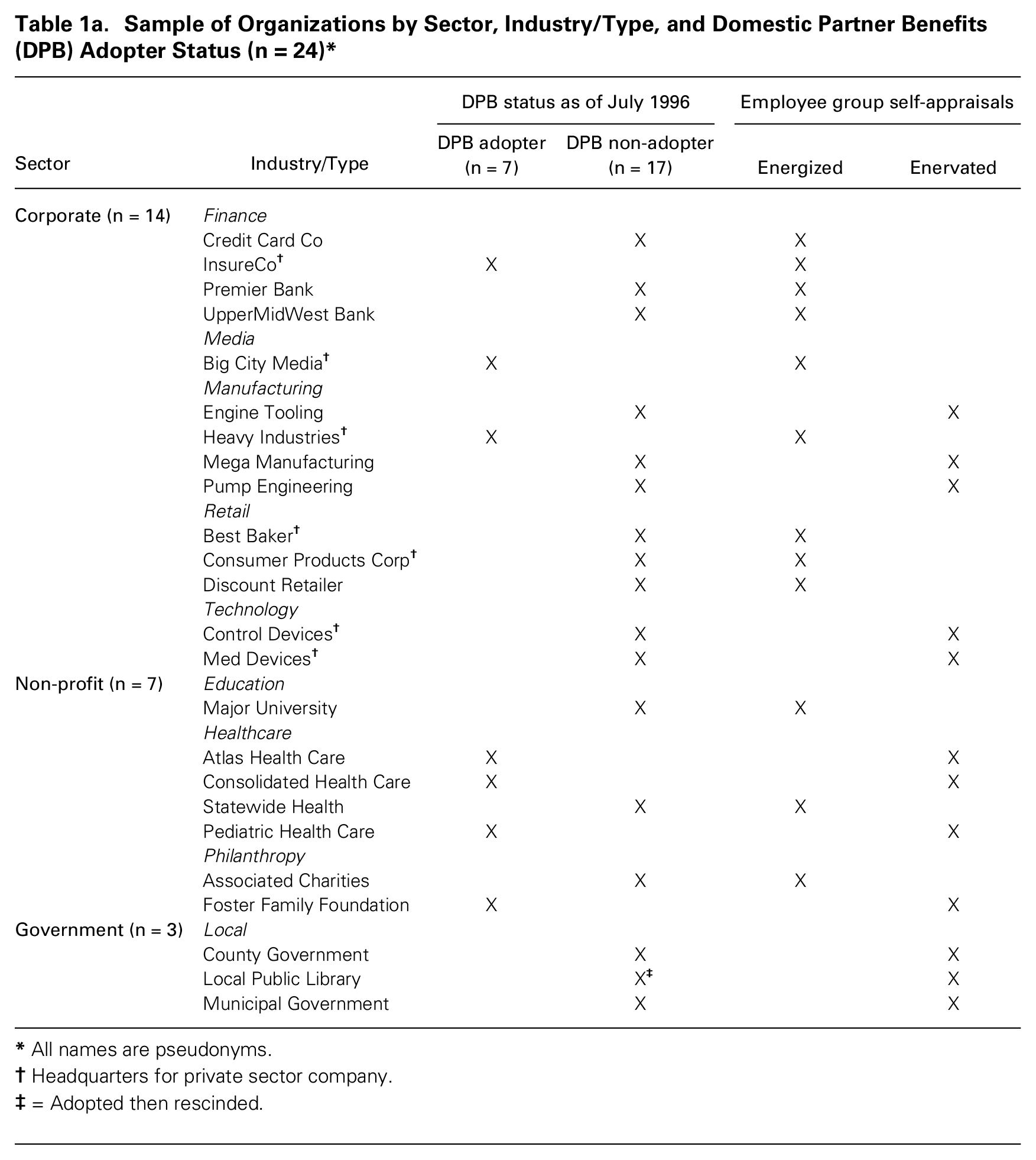
All names are pseudonyms.
Headquarters for private sector company.
= Adopted then rescinded.
Examples of Energized/Stalled Distinction among GLBT Groups
Capturing lived experiences
Our next step was inductive: identifying codes pertaining to the experiences employee groups had with internal and external relationships. The 18 rows of Table 2 show eight codes for experiences, interactions, or relationships inside activists’ own employer organizations (e.g., having formal recognition of their GLBT affinity group) and ten that are inter-organizational (e.g., attending external meetings or referring to information about other groups’ efforts). We coded these on an ordinal scale based on how prevalently they featured in informants’ stories for each GLBT group as a whole, thereby capturing heterogeneity in the presence and salience of these interactions and relationships across the groups.
Activists’ Appraisals of the Change Effort*
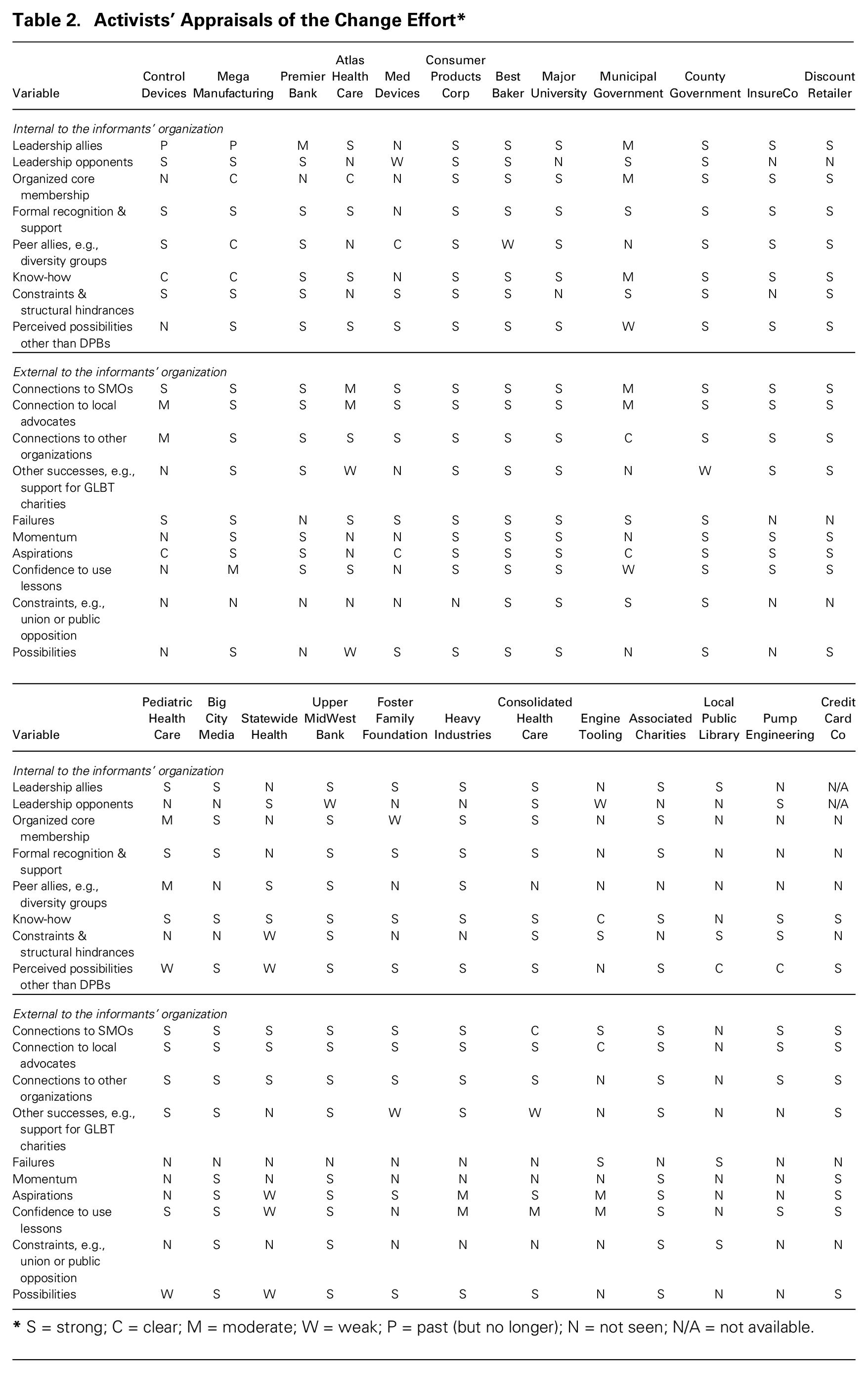
S = strong; C = clear; M = moderate; W = weak; P = past (but no longer); N = not seen; N/A = not available.
Mapping the social positions of employee groups
To explore the similarities and dissimilarities across groups, we correlated the patterns of how these employee groups reported acting and interacting within and across organizations. We used those measures of similarity to perform hierarchical cluster analysis (Johnson, 1967) using the complete link method to investigate the heterogeneity of perspectives in the ecosystem, which reflect different social positions (Ibarra, Kilduff, and Tsai, 2005; Fligstein and McAdam, 2011). From the resulting set of hierarchical solutions, we selected the five-cluster solution, because it had the optimal score on Newman’s Q measure of modularity (Newman and Girvan, 2004).
To better understand the common experiences and perceptions of the environment that yielded these clusters, we ran factor analysis on the original profile matrix shown in Table 2. Principal component analysis with a varimax rotation generated five factors with eigenvalues above 1. We labeled these factors in light of the experiences our informants described, as captured in the variables from Table 2. In order, the five factors are support, connection, obstacles, momentum, and skills. Table 3 presents details about these five factors and the characteristic variable loadings. For simplicity, we named the factors based on substantive meaning of the items loading into the factor, not the sign of loading. We then used average factor scores for groups in each cluster, accounting for signs of loadings and factor scores, to characterize the common experiences that bound groups in each cluster together.
Results of Factor Analysis*
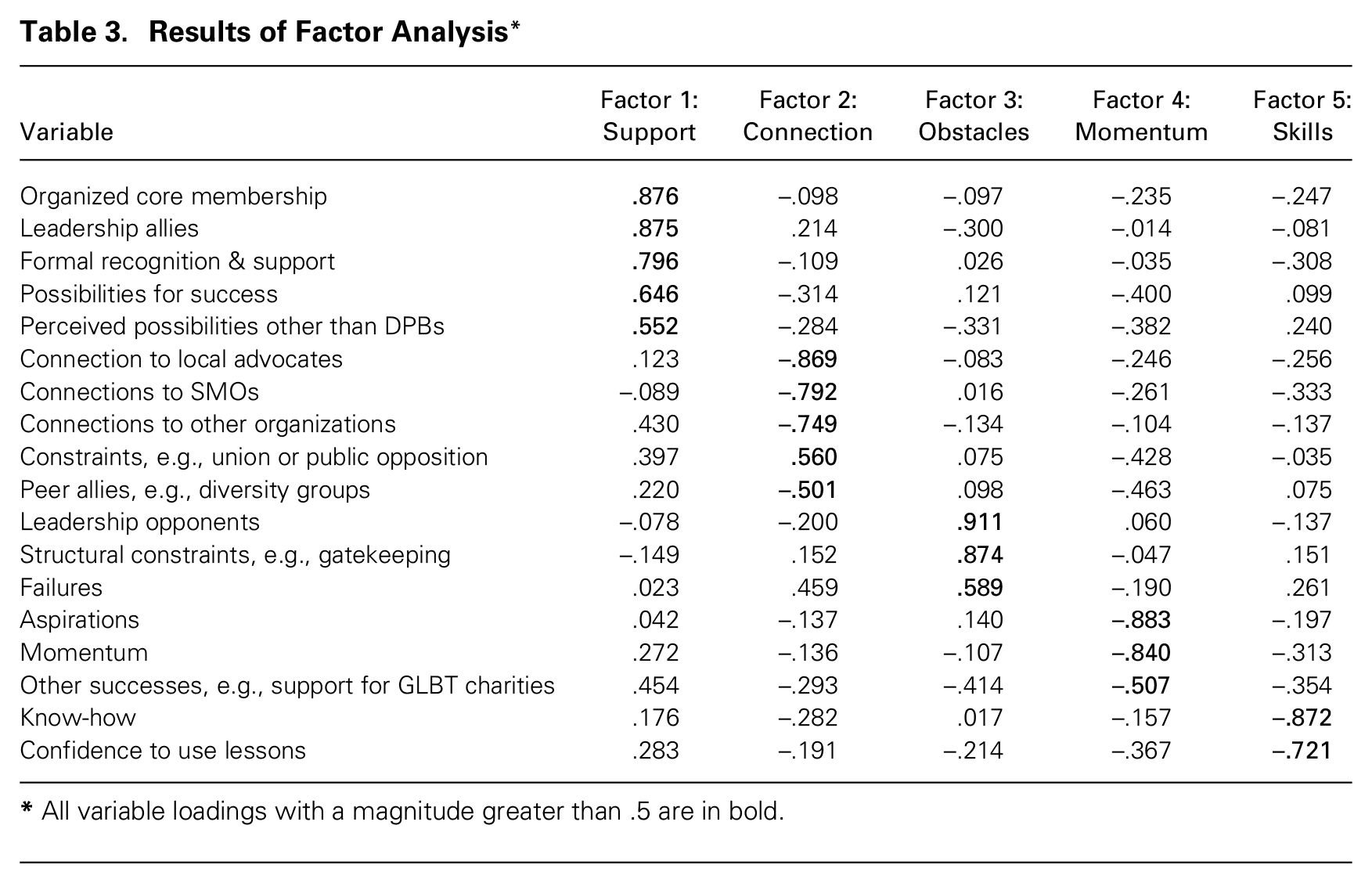
All variable loadings with a magnitude greater than .5 are in bold.
Exploring the ecosystem
Finally, informed by the cluster analysis, we returned to our qualitative data, assessing the shared inhabited experiences of activism. We first address the characteristic experiences of each cluster and then the role those experiences play, individually and collectively, in enhancing the robustness of the ecosystem as a whole.
Findings
Animating an Ecosystem of Challengers
Early activism in our setting sparked connections between and through organizations. Two co-workers at Pediatric Health Care decided to form an advocacy group inside their organization. One of them, an openly gay man, then talked with a former co-worker, a lesbian who had moved to the tech company Control Devices. She approached the senior vice president of international marketing at Control Devices, a straight African American man, and asked if he would take on the role of corporate sponsor for a GLBT employee group; the corporation’s diversity policies required such a sponsor for any employee group to form. The issues for the GLBT group reminded him of the civil rights movement and the emergence of African American employee groups two decades earlier, and he agreed. One of his first actions as sponsor was to host the inaugural citywide forum on GLBT workplace issues in Control Devices’ corporate auditorium. The woman who had asked him to be the sponsor recalls him saying, “I want you to write a letter to all these companies and use my name. . . . Send a mailing to the VPs.” The combination of his professional networks and Control Devices’ sponsorship of the inaugural forum helped start a cross-organizational effort.
In the following weeks, the initial players from Pediatric Health Care and Control Devices formed a task force, joined by an assistant dean from Major University. These activists’ organizations were not all early adopters of DPBs. Pediatric Health Care, a leader at the time, stalled in its activism after securing DPBs; Control Devices shifted from the vanguard to the rear when the senior VP retired seven months after the forum, and it was still fighting for DPBs 18 months later; and Major University supported internal activism but did not yet have DPBs because a third party, the state legislature, controlled the decision. In the dynamic nature of the ecosystem, players can emerge and recede as circumstances change. In this case, the forum became an institutionalized, recurring event hosted by different organizations over time.
The task force’s nascent activism was supported by the Center, the local GLBT community advocacy organization whose leaders had long wanted to support workplace activism but lacked inside contacts. Once the Center got involved, it propelled local workplace activism. For example, the Center placed notices in the gay press inviting GLBT employees to meet in its space: [S]o people who didn’t feel safe being out in the workplace . . . had a number and a name that they could call. . . . We just started connecting people. Having [the Center] there was really helpful because it gave people a way to circumvent the dynamics of their particular institutions. . . .
The cultures of community activism and workplace activism were quite different. The Center’s director of community education recalled that fostering collaboration required community organizers and the employees seeking to establish employee groups in their workplaces to learn how to work with each other: “[People in workplaces] weren’t the people [we] typically interacted with. . . . They were learning about a gay organization and how to access that, in the sense of empowerment.” She also noted that the early work of this collaboration included eliciting ideas for activist tactics from employee groups and sharing them across organizations: We started doing mutual support kinds of things. I think the first workshop we had, and they weren’t even workshops, we had panels of people that talked about how you start a workplace group. Then [employees from] organizations that were further behind would come and learn from each other. We did one on how you find allies in upper administration. . . . very concrete. . . . how do you start a group, advertise, find allies, begin talking about domestic partner benefits.
The assistant dean at Major University shared how she navigated between the opportunities provided by visible student activism and the internal politics of her organization. While she was keen to seize the moment when campus agitation made it into the press, she also wanted to minimize political surprises for the university leader: “There isn’t a move that I made that [she], the special assistant to the president, didn’t know about. There was no way that I was going to embarrass a sitting president, who frankly, was trying to be supportive.” The informal gatherings that “weren’t even workshops” were settings for sharing these tactics, especially for employee activists whose jobs did not normally require such skills.
Activism between and through organizations built upon intensive efforts inside organizations. Sharing experiences and challenges from internal efforts across organizational boundaries enabled broader learning. In an inhabited ecosystem, activists’ direct experiences vary, but they are also aware of successes and failures in other organizations. Relational awareness often shaped activists’ own actions or support for others’ actions. Thus this founding story shows how activism manifests in a variety of forms and places, including between and through organizations. We used cluster analysis to interrogate this variety of experiences of activism in our setting.
Heterogeneity in an Inhabited Ecosystem
Our comparative analysis showed that the activist groups experienced various combinations of internally and externally focused change efforts that challenge the routine dichotomy of insider and outsider. Further, they operated in different states of awareness, engagement, and constraint during the ongoing and contested change effort. Our hierarchical cluster analysis uncovered five distinct patterns of how employee activist groups perceive, relate to, and interact with the change effort within and beyond their organizations.
Notably, variations in these patterns of awareness and engagement do not fall neatly along the divide of adoption or non-adoption of domestic partner benefits. Instead, we find a spectrum of engagement among both adopters and non-adopters, including innovative change efforts, steady activism, and various forms of stagnation. Each of the five clusters has a distinctive pattern of loading (or negative loading) on five factors: support, connection, obstacles, momentum, and skills. Support refers to receiving support from top leaders. Connection indicates having a range of connections both within and outside the workplace organization. Obstacles refers to the presence of various structural hurdles or powerful opponents, including gatekeepers and top leaders. A negative loading on obstacles reflects having overcome such opposition, and overcoming opposition is analytically distinct from having support from powerful allies. Momentum captures a self-appraisal of having clear goals, ongoing efforts, and the capacity to build on success, while a negative loading on momentum indicates perceptions of being stalled. Skills refers to activists’ confidence in their ability to shape and advance a change effort. Five clusters emerged, each with unique patterns of these factors. Table 4 provides the average factor scores for each cluster.
Analysis of Factor Scores by Cluster*
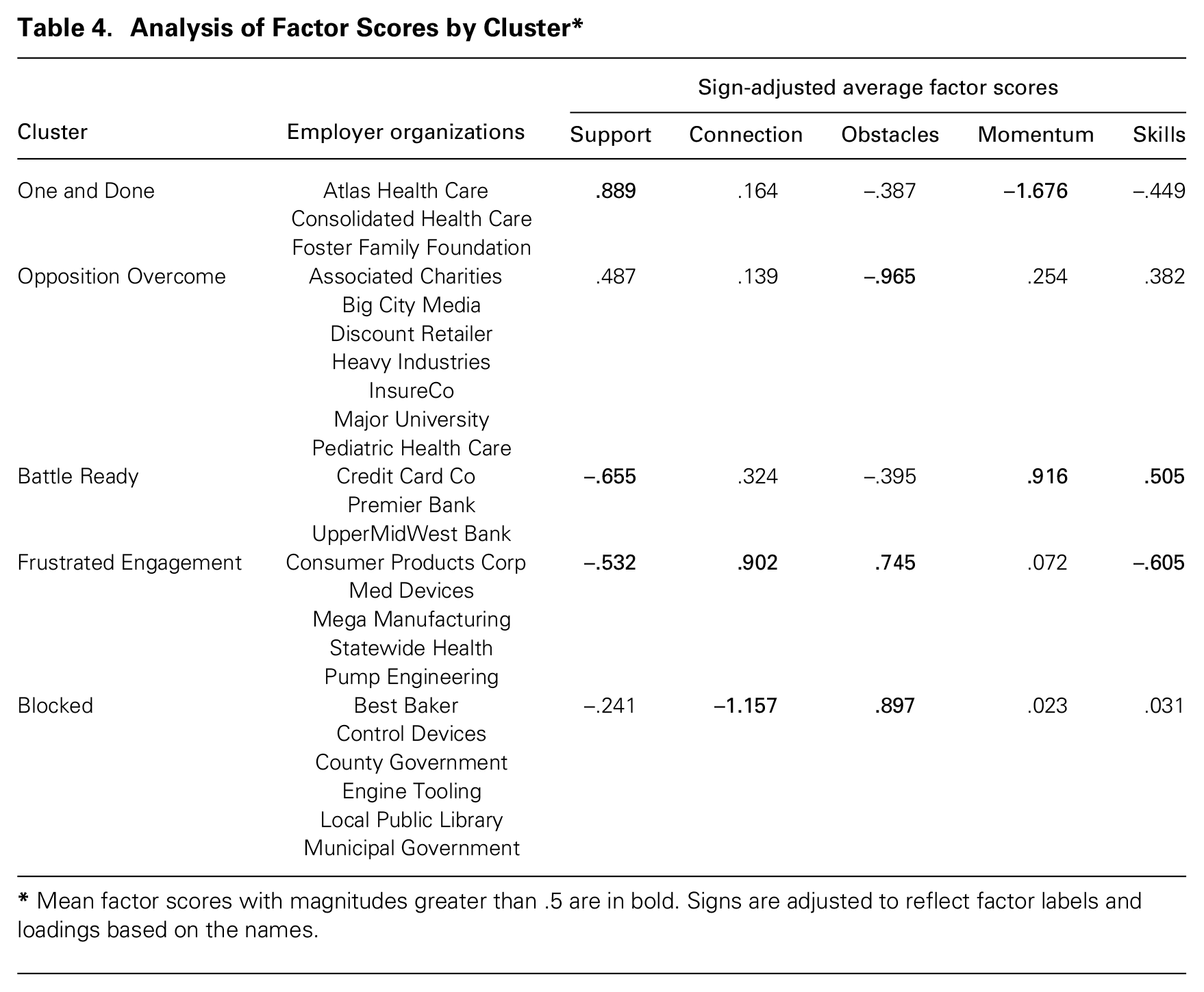
Mean factor scores with magnitudes greater than .5 are in bold. Signs are adjusted to reflect factor labels and loadings based on the names.
We named each cluster based on the mean scores for the factor(s) that most strongly characterized it: One and Done, Opposition Overcome, Battle Ready, Frustrated Engagement, and Blocked. The clusters represent lived experiences of these activist groups in the midst of the ongoing, contested changes, not innate characteristics of any given employee group or their organizations. Their accounts reveal that their respective experiences could and often did change as part of their engagement in the change process. We observe and later discuss how the concurrent presence of these heterogeneous states combines to shape and propel transformative social change by the very fact of the real-time, simultaneous variety. Table 5 provides the defining characteristics for each cluster and how these contribute to the ecosystem capacity.
Cluster Composition, Characteristics, and Role
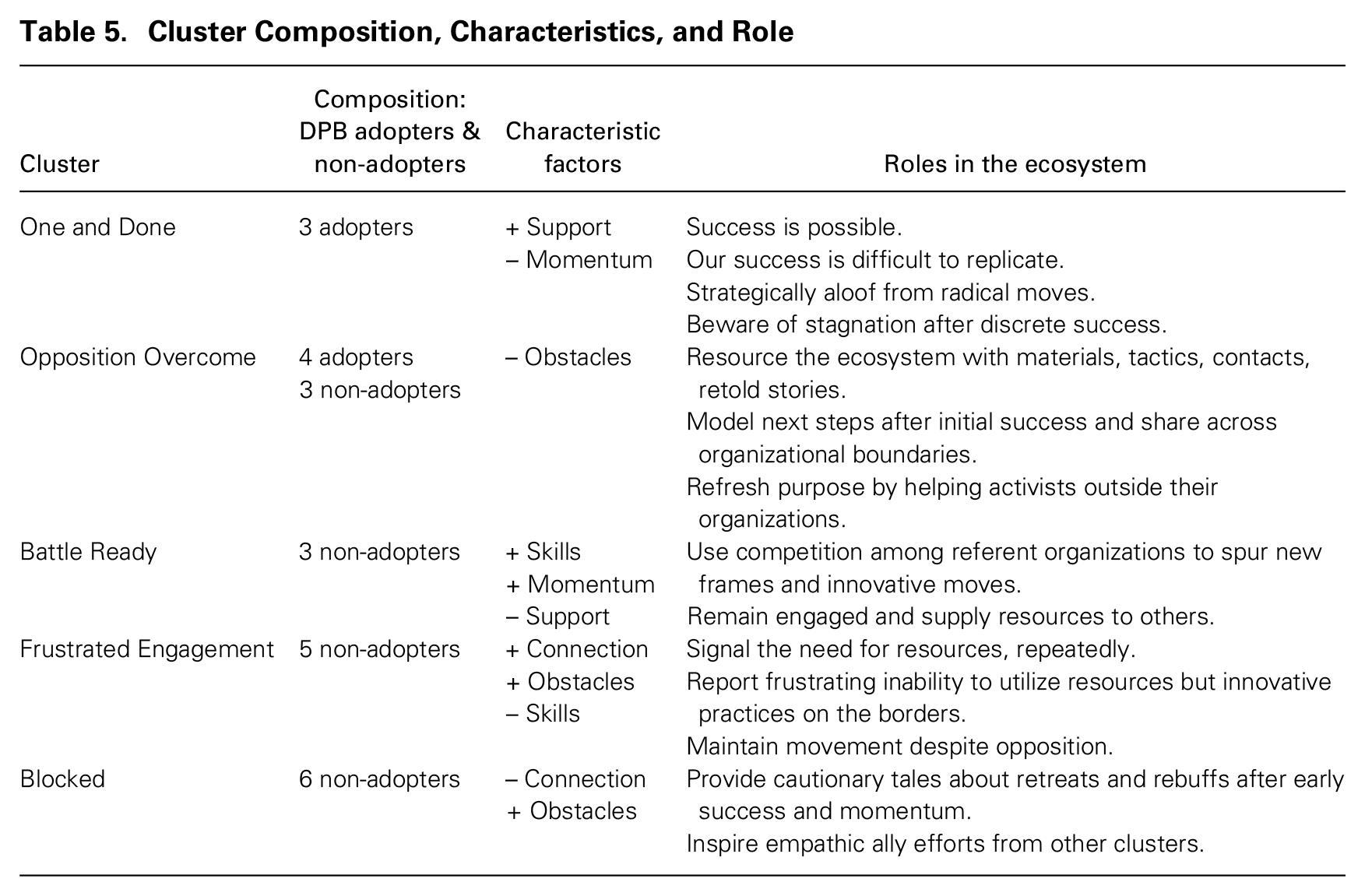
Before discussing each cluster in detail, we characterize these positions in social space. In Figure 1, two axes define the space in which organizations engage contested and ongoing change: “experience of contestation” and “capacity to move forward.” We position clusters on the contestation axis based on a composite of the factors support and obstacles. Placement on the capacity axis represents activists’ perceptions of agency, based on a composite of two other factors, skills and connections. We convey the fifth factor, momentum, through shape and shading in the figure, with darker shades representing less momentum. The One and Done cluster, the dark octagon on the left, comprises groups that secured DPBs but lacked momentum because of unclear future direction in the wake of relatively uncontested success. The Opposition Overcome cluster, the white circle above it, comprises seven groups, only four of which secured DPBs, but all of which felt ready to leverage the capacity for change they built by successfully surmounting obstacles. The Battle Ready cluster, the white circle to its right, comprises groups that remained engaged despite not yet securing DPBs. They rated highly on momentum and skills but lacked the top-level support to convert their efforts into outcomes. The Frustrated Engagement cluster, the gray triangle in the upper right, comprises groups facing persistent, powerful opposition yet maintaining strong connections to others in the ecosystem. Groups in the Blocked cluster, the gray triangle at the lower right, were isolated and thwarted. Figure B1 in the Online Appendix provides a more detailed representation of the ecosystem, including color and additional text that reflects each cluster’s experiences. We next elaborate on each cluster in relation to the others and to the change effort as a whole.
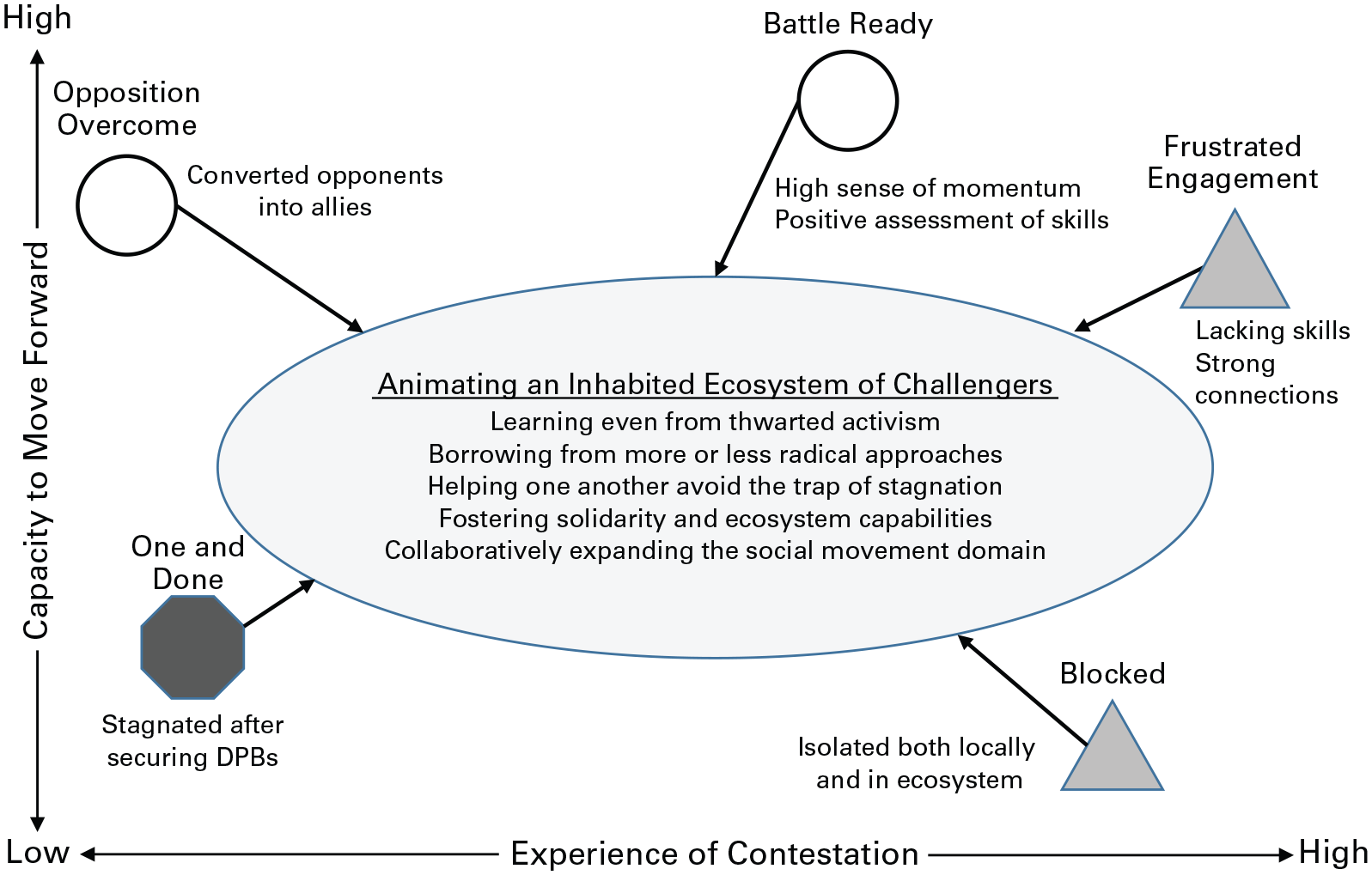
An inhabited ecosystem of challengers in an ongoing and contested change effort.
One and Done
Strong scores for support and strong negative scores for momentum define this cluster. In these organizations, activists in senior positions with access to high-level decision makers spearheaded the quest for DPBs. Success was not without contention, but the activists were quickly able to obtain top-level support through persuasive, narrowly focused efforts conducted entirely at the senior level. Entitled the “living room strategy meeting,” a common story described a high ranking, openly gay man at Atlas Health Care who had invited fellow high-status GLBT executives to his home to strategize how they could leverage their combined social capital in lobbying for DPBs. While successful in securing DPBs, this approach did not facilitate future advocacy. That leader explained, “I don’t know that there is a lot of shared vision about what the group could or should be. . . . [F]or the most part the specific issues that we have tried to advocate for in the company have been resolved in our favor easily.”
Organizations in this cluster, while they may be beacons of hope to others in the ecosystem, experienced little need to build an organization-wide infrastructure for further action on broader issues. For example, at Consolidated Health Care, when the initial proposal for DPBs failed because of a top executive’s moral objections, decision makers used the excuse that it was too late in the budget cycle. Consequently, leading up to the next budget cycle, the leader of the quest for DPBs—a high-ranking, openly gay man—carefully forecasted benefits and costs. His strategy, which was successful on this second try, unfolded entirely at the highest level.
The “living room strategy” story also serves as a cautionary tale. Each group in this cluster stagnated after obtaining DPBs, and some of the activists were painfully aware that they had stalled. At the Foster Family Foundation, one gay man reported, “we are drifting down the stream as opposed to negotiating rapids.” A lesbian colleague added that “we have considered disbanding and we decided not to, simply because, although there might not be work that needs to be done right at this moment, we still need to continue a presence.” In this cluster, group members recognized that, success with DPBs notwithstanding, there was work to be done, especially for employees in front-line positions or outside of headquarters. Nevertheless, the groups lacked the capacity for action around these issues.
Opposition Overcome
Our findings show that support and opposition manifest as two distinct factors. While the One and Done cluster scores positively and high for support, a strong negative score for obstacles defines the Opposition Overcome cluster. In a space of intense and ongoing contestation, what distinguishes members of this cluster are their experiences of encountering, managing, and overcoming oppositional forces. In the process of engaging opposition over a protracted period of time, these activists made useful connections and developed social and political skills to help advance their cause. Activists in these groups cultivated access to top leaders in order to encounter and pivot opposition. This access distinguishes them from the activists in the Frustrated Engagement and Blocked clusters, for whom organizational opposition remains powerful and distant.
Characteristic of this cluster, opposition was gradually overcome at InsureCo, where the senior vice president (SVP) of human resources had quickly and sharply rebuffed the GLBT group’s first request for DPBs. The co-founder of the GLBT group invited the SVP to lunch, explaining that she believed the SVP probably had never had a chance to talk about such issues. She went “without an agenda,” taking an open “just ask me anything” approach. The SVP later related his wife and teenage children described him as having had an epiphany after that meeting and that he overcame his fear. With his help, the GLBT group soon was working with the CEO and meeting with the board over dinner. The group helped their senior allies frame the business case for DPBs and gay-friendly employment policies more generally. In the CEO’s words, it was about remaining a leader in the industry and not becoming “a Hartford dinosaur”—referring to the U.S. city where many insurance companies locate their headquarters. He told us that he saw opportunities to attract both talented GLBT employees and GLBT customers with specific investing and estate needs.
What was particularly significant to the employee activists, both inside and outside of InsureCo, was how the CEO responded when tested following an announcement of a function linked to Gay Pride Week in the corporation-wide daily e-mail newsletter. As the CEO recounted, the newsletter item was a normal announcement: “the day before, the garden club had been in, that sort of thing.” But there was a furious backlash from the offices in Dallas and Atlanta, known to be in more conservative regions in the U.S.: Half the office in Dallas signed a petition addressed to me. . . . I got on the airplane . . . to Dallas . . . the next week. . . . I conducted 8 one-hour meetings [for 400 employees]. . . . By 10:00 the next morning everybody in the offices around the country knew exactly where we stood on this issue. . . . I hardly needed to go to Atlanta, but I [had] already committed to. . . . I ended up at that meeting and said, “I’m sorry . . . this is the way this company is going to run, and if you are really uncomfortable with that then maybe you might be happier working someplace else.” I left it right on the line and in one week, the whole issue was gone.
At the time, InsureCo had not yet implemented DPBs, but the CEO later felt that his decisiveness laid the foundation: “As I look back now, if we had not done that . . . we could not have introduced benefits for unmarried partners without significant backlash. We got no backlash.” This story might be a classic story of insider activism, but its frequent retelling across the inhabited ecosystem shows how events in one organization serve as a resource and aspiration for other groups.
Another example from the Opposition Overcome cluster involves the senior vice president of human resources at Heavy Industries, who activated her network to build what she called her “magic circle” to spread the word about the business relevance of GLBT issues. She gave a ground-level view of how she used networks: I thought this [GLBT issue] must be difficult for CEOs, because they don’t know how to be about this. Maybe, if you got some movers and shakers from really good companies together to talk about it, we could figure out a way. And maybe if we all announced, you know, four of us at once, it would take the heat off if they were worried about the press.
Her next move came from an internal connection then expanded across organizations: Then, at the suggestion of one of the gay employees in our company, I talked to [the executive director of the Alliance]. I said . . . “Who are some of the really good companies?” . . . And that’s how it started. . . . I knew the VP of HR at [InsureCo]. . . . His CEO is on our board so that was a good network to develop, and I knew [InsureCo] was thinking about [DPBs]. . . . [That VP] said, “Sure, I’ll come to the lunch. Makes sense to me.” . . . There was also some thought in this since my CEO . . . is on [Control Devices’] board. . . . [I called around] and said, “I’d really like to see [us] do this.” . . . They were all struggling with, “How do we do this?”
This story might seem like the canonical account of leveraging top-level networks and board interlocks. Before content could flow through the structural pipes connecting the organizations, however, both internal activism and cross-organizational conversations and learning had to be activated. Internally, the SVP was prompted to engage after talking to a young gay man who was a temporary administrative worker in her office. He did not have positional power but did have access, and he encouraged the SVP to attend a talk being sponsored by the Alliance. She told us that she was initially reluctant and had declined earlier invitations to such events, but she went this time because of the young man’s personal urging. The talk featured Karen Thompson, co-author of Why Can’t Sharon Kowalski Come Home? (Thompson and Andrzejewski, 1988). Karen’s partner of several years, Sharon, was in a coma after a car accident. Because Karen was not legally next of kin, Sharon’s parents and the hospital staff prevented her from visiting her partner and refused to let her participate in critical medical decisions. The talk made an impression. The SVP explained that the idea of being kept from her husband in a similar situation was horrifying and abruptly changed her perspective.
This illustration shows how diverse activities flowing through the Alliance had an impact on overcoming opposition. The Alliance, formed by activists from three area organizations, curated an event that, combined with an employee’s invitation, sparked empathy in a high-level executive, who in turn curated gatherings for high-level executives. The “magic circle” is a top-level structural mechanism for propagating change, but the impact it had stems from a complex set of interactions within and across levels of hierarchy, within and across organizations. The impetus for change happened through, then around, then in, and finally between organizations.
Battle Ready
This cluster is composed of employee activist groups in non-adopter organizations with high positive scores for skills and momentum but high negative scores on support. The groups remained engaged, directing their momentum into experiments to advance their change efforts. The activists in these groups saw themselves as being able to learn from others’ lessons and to overcome the lack of support. They believed they already had or could readily acquire the skills needed to advance DPBs and other GLBT workplace issues. While activists in this cluster tended to believe it was “only a matter of time” until their organizations followed suit for their industry or region and adopted DPBs, they believed they could and should do more than tread water while waiting. One activist at Premier Bank explained how he was planning to leverage the success of the activist group at its crosstown competitor, UpperMidWest Bank, by also having a booth at the Twin Cities Pride Festival: [UpperMidWest] . . . had personal bankers at their booth. . . . Next year we will. . . . The fact that [UpperMidWest] is doing something, you play off of it. You do it for all that it’s worth. . . . If [UpperMidWest] did it [offered DPBs], [Premier Bank] would be forced to do it just to maintain parity. . . . Just the fact that I can show that these other major companies are supporting this effort puts pressure on them in the sense that “We don’t want to be first, but we don’t want to be last.”
All the activists from groups in this cluster voiced the belief that their organizations would soon adopt DPBs. Credit Card Co, a group in this cluster, adopted DPBs just three months after our interviews. This cluster is the only one in which all the organizations are from the same sector/industry, in this case the financial sector. Their actions showed both reciprocal awareness of what benchmark financial sector organizations were doing and an awareness of a menu of tactics from which they drew and to which they added, like showing how visible company support at pride events could grow the customer base.
While waiting for formal adoption decisions, the employee groups in this cluster were innovators and experimenters, devising new approaches that built capacity for change across the ecosystem. They used their financial skills to do cost analyses of DPBs that they shared with activists at other groups in the ecosystem. They also persuaded the estate planners in their banks that there was an untapped GLBT market, translating the “good for business” message into market niche development in their organizations. The activists in this cluster built robust capacity, new metrics, and new tactics for obtaining DPBs and advancing GLBT inclusion more broadly, both within and across organizations. Their innovations were an important resource in catalyzing action across the inhabited ecosystem.
Frustrated Engagement
A high positive score on the connection factor is defining for this cluster, which also scores highly on obstacles (indicating they had not overcome opposition) and highly negatively on skills. Employee groups in this cluster reported being highly connected and engaged with others in the ecosystem, both internally, with peers, allies, and other workplace diversity groups, and externally, with other GLBT employee groups and social movement organizations in the ecosystem.
For groups in this cluster, the visibility of the Opposition Overcome cluster members was a mixed blessing: they were sustained by the sense of what was possible but aware of their relative deprivation. Activists’ accounts showed concerns over their ability to access pathways to the top. They were uncertain that they had the skills used to breed success in the Opposition Overcome cluster. Among the three clusters composed entirely of non-adopters, Frustrated Engagement groups’ perceived lack of human capital (i.e., low scores on skills for activism) distinguished them from those in the Battle Ready cluster, but their greater social capital (i.e., high scores on connections), situating their lived experiences in a more relational context, contrasted with those in the isolated Blocked cluster.
With connections, activists learn about best practices, even if those practices appear potentially unworkable in their current circumstances. Activists in this cluster routinely attended workshops and learned, for example, the critical importance of (and some strategies for securing) a senior executive sponsor. A leader of the GLBT group at Mega Manufacturing noted, “We have to get more key sponsors in upper-level management to help us carry the ball here. . . . I think that is a lesson that I have learned from the [Alliance].” She talked about a past executive sponsor, an African-American man who was corporate director of HR. He attempted to create opportunities for GLBT employees to raise key executives’ comfort levels regarding GLBT individuals and issues: “He basically said, ‘Here is a live gay person, and they are not going to bite your head off.’” He also spoke on GLBT issues with the most prestigious executive group at Mega, the Council of Technology Directors; but with his retirement, that sponsorship died out, and the GLBT group was never able to reestablish that level of access. As this illustration suggests, employee groups’ states within a change effort are dynamic and complex. After a promising start, this group became characterized by frustration, whereas with continued sponsorship, it might have overcome the otherwise strong opposition at Mega.
Some groups in this cluster relied on the efforts of lone activists—a recipe for frustrated engagement. At Pump Engineering, the lone activist worked the night shift, which made it difficult to engage with potential executive allies. Although particularly savvy about the issues facing rank-and-file GLBT workers and working hard to learn effective tactics for connecting to powerful executives, he still struggled to get even small wins. For example, he was unable to get permission to post a notice on the factory bulletin board presenting ways for GLBT employees to contact one another safely, a tactic he learned while developing external connections at an Alliance workshop for activists. He had hoped the notice would spawn a small group that could lobby for GLBT inclusion in the company’s equal employment opportunity (EEO) statement, observing with frustration, “[We] don’t even have an EEO policy that says GLBT. Can’t we start there? . . . It’s been legislated, you know.”
Another activist who worked largely alone, a lesbian at Med Devices, also got ideas from attending activist workshops. She decided to try for a small win by co-hosting an event on women’s health with the women’s employee affinity group. She was rebuffed when its members expressed a concern that “it is bad enough that we are seen as feminists, we can’t risk being seen as lesbians.” Undeterred, she then hosted a luncheon linked to the national organization PFLAG (Parents and Friends of Lesbians and Gays): “There are people that are straight that want to support our group. . . . We had a PFLAG brown bag lunch, and it was standing room only.” The PFLAG lunch triggered support, but she was unable or unsure about how to leverage it: One HR person in particular called us up, and he said, “I really enjoyed the PFLAG meeting. I am really willing to help in any way. Let me know if you need my help.” We haven’t been able to figure out how we need his help. . . . He has never gotten a call from us, which is unfortunate.
Overall, the activists in organizations in the Frustrated Engagement cluster were aware of the need to garner support from executives and decisions makers but lacked the access or were unable to overcome various obstacles to do so for a variety of reasons, often structural, such as retirements or shift times. They reported seeing success and recognizing best practices in other organizations but had limited ability to translate that into their own organizations.
Blocked
Finally, the Blocked cluster’s factor scores indicate isolation and barriers—a high negative loading on connection and a strong loading on obstacles. The activists in this cluster shared perceptions of opposition and distance from upper management experienced by activists in the Frustrated Engagement cluster, but they lacked that cluster’s relational connections that provided ideas and fueled experimentation. Activists from groups in this cluster talked about “keeping the pilot light on” until the effort could be re-animated. Non-adopter organizations during a highly contested change effort are often portrayed as or assumed to be of this blocked type. But we found non-adopters’ experiences were quite varied in terms of being engaged or not, hopeful or frustrated, mobilized or simply blocked. Non-adopter organizations appeared in four different clusters during an ongoing change effort. What distinguishes the Blocked cluster from other non-adopters is the activists’ sense of isolation; it is the only cluster with a high negative loading on connection.
In one of the Blocked organizations, the CEO had stated employees would get DPBs “over my dead body.” It was only after his retirement several years later that the organization implemented DPBs. In some cases, being thwarted by such powerful opposition paradoxically contributed to the robustness of the ecosystem as a whole, as blocked groups’ negative experiences yielded new resources for other clusters. For example, the CEO just quoted also refused to allow a gay man, who had earned the reward of a luxury cruise for two by being a top salesperson, to bring his partner along. To formalize that exclusion, the CEO changed the reward to explicitly extend it only to married couples, which also prevented a straight salesman from bringing his fiancée. This story of being blocked became a ready rejoinder to a question that GLBT employee activists encountered in many settings across the ecosystem: “So what does GLBT identity have to do with the workplace anyway?” Ironically, the CEO’s enacted opposition expanded the repertoire of frames and cultural resources available for other activists.
This example shows how the heterogeneous experiences of challenger groups—even experiences of being blocked—combine to propel change, building capacity for sustained activism across the ecosystem that is greater than the sum of the parts. In Figure 1, which represents an inhabited ecosystem, the center represents the capacity built from heterogeneous forms of activism, experiences, and resources. In Figure B1 in the Online Appendix, each cluster is annotated with contributions that, when combined, animate an inhabited ecosystem that propels change between and through organizational contexts. We turn now to how these diverse elements contribute to sustaining and propelling the change effort.
Propelling Activism toward Transformative Social Change
We have highlighted that the heterogeneous composition of an inhabited ecosystem of challengers is significant for transformative social change because the varied states of change advocacy operate in relation to one another to propel the change effort. Activists frustrated by their situation may draw ideas from others who experiment with new approaches, while activists who have achieved wins might remain involved because they see others who are blocked. This fabric of relational connections sustains the ecosystem; it fosters enabling forces and conditions by supporting experiments across settings and by making it possible for more and less radical efforts to co-exist in practice and in mind. Relational connections also buffer against two perils for a change effort, stagnation and burnout, because activists in heterogeneous situations continuously prompt one another and work against the risks of complacency, isolation, or despair. These interactions enable the range of available tactics and the scope of the change issue itself to expand.
Learning even from thwarted activism
During protracted contestation in an inhabited ecosystem, any given organization may have successes or setbacks, but the totality of efforts and reciprocal responses sustains the change effort. In our setting, the task force created by activists from Pediatric Health Care, Control Devices, and Major University gathered examples of emerging activism from multiple organizations. The assistant dean from Major University observed that many potential activists were not versed in useful and promising tactics, so she created a manual for them. Control Devices subsequently produced the manual and made it available at the inaugural forum. The manual, known as the “Control Devices Manual” among our informants, and the forum became lasting resources for the ecosystem. The assistant dean explained her motivation: [T]here’s an incredible vacuum of knowledge for people. . . . The focus of putting that notebook together is like, “Here is a primer. Whether you are at step five or whether you are at step one, here is the information you need to know about employee groups dealing with queer issues in your workplace. Here are samples from [Best Baker], [Consumer Products Corp]. Cut and paste, put your title at the top, and go with it. . . . There are all kinds of people out there who can help you with issues, give you direction, help you with strategy, ready to eliminate isolation.
The examples she shared offered guidance for early advocacy moves, such as forming employee groups, finding and inviting potential members, soliciting member concerns, and lobbying to include GLBT issues in organizations’ equal employment opportunity (EEO) statements. While the manual’s examples came from organizations that later experienced setbacks (Best Baker became Blocked, and Consumer Products Corp moved into the Frustrated Engagement cluster), they fueled the ecosystem with ideas and templates, inspiring other activists to stay in the fight.
Borrowing from one another’s more or less radical approaches
The options for activism included both visible and stealth tactics. Through working with the Center, employee activists learned about more radical tactics, while in the workplace, they encountered tactics more adapted to a corporate style. Activists across the ecosystem positioned themselves in relation to these alternative approaches, choosing those that seemed the best fit.
On the radical flank, one informant from Major University explained how she had wrestled with getting involved in a movement in and for corporate settings: Why am I doing all of this corporate organizing? Why am I not organizing for the homeless gays and lesbians? . . . As I got to know folks, it was clear why. . . . Because these are folks who were having a tremendous amount of discrimination at work and were getting so empowered and so energized by all of this [activism around DBPs], it was just incredible to watch. . . . The piece that clicked for me . . . if one believes, which I still sort of do, that American business runs the world, if you change American business about how it deals with issues of diversity and sexual orientation, I don’t think it is too grandiose to say that we are changing the world.
She identified “changing the world” as the aspiration—a goal that may resonate with some organizations but be viewed as radical at others. As an invited speaker in other organizations, her outsider status allowed her to say bolder things than insiders would. She was, at once, an insider and outsider in this space of ongoing change.
Activists in the Battle Ready cluster found that, while awaiting the moment for DPBs, they could channel corporate philanthropy toward other GLBT causes. At UpperMidWest Bank, the employee group made requests to the corporation’s philanthropy arm: We have not had any requests for funding denied to date in our one and a half years of existence. We haven’t asked for a whole lot, [but] right now we were very pleased to get funding for the PhilanthroFund [like a GLBT United Way in the Twin Cities] Network Night. I think [UpperMidWest] was a [premium level financial] sponsor.
While at first these activists thought their move in the philanthropy domain was on the radical edge, they soon recognized that it positioned their group and GLBT causes as firmly within the established corporate good citizenship frame respected and enacted in the Twin Cities region. They also found that their choice of charities created opportunities for educating straight co-workers and potential executive allies about aspects of GLBT experience and why the social service organizations were needed.
From the conservative flank, corporate insiders were circumspect about the social movement activism that surrounded their quest for DPBs. When high-level corporate players used their social capital to gain DPBs, they often chose not to connect to other GLBT employees who were more visibly—one executive even said “flamboyantly”—involved in the local pride movement. When the rank and file of the GLBT employee group at Atlas Health Care was agitated over being denied use of the corporate banner for the pride march, the top executive driving the DPBs campaign labored to “maintain, not 2 or 6 degrees of separation, but 100 degrees of separation” between the people concerned about the banner and those deliberating DPBs. At other organizations, activists found a middle ground by framing how having a booth at the pride day advanced the business case for corporate engagement in GLBT issues.
The inhabited ecosystem of relationally connected challengers and workplaces was able to hold both conservative and radical tactics, thereby enabling activists to steer between the two approaches in ways that made sense for their corporate style, values, possibilities, and opportunity structures. Conservative and radical activists, and those in between, were all able to operate within the inhabited ecosystem and seed it with small wins and big aspirations.
The inhabited ecosystem was a space in which repertoires of action accumulated and became available and in which activists could locate themselves. This holding space made possible a spectrum of more and less radical activism that became a resource to redefine the radical edge in real time. Activists often experimented with both provocative and tempered moves to see what worked, and they shared what they learned with others through the frequent retelling of stories, whether about marching at pride or living room cocktails or any from a full spectrum of moves. A social movement, as it operates between and through organizations, can gradually expand, radicalize, and eventually normalize its transformative social change agenda through these innovations. Co-opting an established corporate commitment to philanthropy to support certain causes is potentially radicalizing or normalizing, depending on an activist’s perspective. Arguably, it is both.
Helping one another avoid the traps of stagnation
A common risk for social movement activism inside organizations is that early small wins become routinized and curb further action. Groups in the One and Done cluster secured DPBs easily but failed to build momentum, mobilization, or motivation for continued advocacy. In contrast, the group at InsureCo won harder-fought battles before securing DPBs, but fighting built capacity that sustained their work past the adoption of DPBs—capacity they refocused on addressing the subtle forces of heteronormativity and exclusion in the workplace. Activists at InsureCo recognized that issues of workplace heteronormativity persisted, despite their strong CEO champion. They told the story of a gay man’s dilemma at an InsureCo team-building retreat when an opening ice-breaker exercise was to write the name of one’s “Hollywood dream date” on an index card and put it in a bowl; cards would be pulled, and the group would guess who wrote that name. The employee was forced to choose among undesirable options: explicitly attempt to pass as a straight man by writing a woman’s name (a heteronormative response), a choice hardly consistent with the goals of authenticity and team-building; come out on the spot, which involves a high level of stress and questions of trust; or leave the card blank. The employee left the card blank, and his next performance review referenced this incident and noted he was “stand off-ish” in team activities.
This story was shared at InsureCo and beyond, and employee activists recognized that the change effort was far from complete. Informants across organizations who used this story recounted that there was often an “aha” moment for listeners, who grasped the unfairness when performance reviews and promotion prospects were at stake. Circulating stories such as this one builds awareness and maintains a sense of urgency that there remain issues to address, somewhat curbing the risk of stagnation. On any given occasion, a GLBT employee activist or ally could draw on one of several such stories suited for their specific situation and organizational context. These stories became a shared cultural repertoire, and their retelling wove threads between and through organizations, giving momentum to the change effort and keeping complacency at bay.
Fostering solidarity and ecosystem capabilities
The ups and downs of activism’s successes and defeats can generate burnout. The ecosystem can carry engagement across organizational contexts, sustaining momentum for change efforts that might attenuate if left to any one organization or employee group. Many interviewees cited outside speakers as sources of new perspective and energy. One activist from InsureCo described the mobilizing effect of their professional speakers bureau: We didn’t wait for diversity trainers to come in. . . . It just wasn’t gonna happen fast enough. . . . So we send a gay man, a lesbian, and a friend of the network to do presentations to approximately 20 to 30 people. We just have an endless number of presentations lined up for the rest of the year [at InsureCo and other organizations].
Most of our informants were not in roles that required them to think about organizational change; they were in accounting, information systems, marketing, and operations. Serving as speakers or attending presentations kept issues interesting and relevant. The presentations helped employee activists still lobbying for DBPs hone their persuasive capacities and their nimbleness with terms like “EEO statement” and frames like “human rights issue.” Resources like the forums, speakers bureaus, and a manual for new activists sustained their energies and expanded their capabilities. These are not exclusively cognitive approaches, providing facts and framings; they also build on and extend affective ties of solidarity to sustain engagement across cycles of success and failure.
Collaboratively expanding the social movement domain
DPBs are just one piece in the quest for workplace equality, and an inhabited ecosystem view reveals how the scope of change expands. In our setting, a variety of new issues and tactics began to circulate, spawning new recognized goals across the groups. For example, having an executive sponsor was something that some activist groups enjoyed and other activists sought with varying success, but most employee activists were aware of the symbolic and instrumental importance of the role. “Soft” HR benefits were another emergent goal picked up by groups waiting for DPB implementation as something for which they could advocate in the meantime and over which HR departments often had more discretion than they did with DPBs. Examples of soft benefits included being able to take family sick leave for a same-sex partner or allowing a same-sex partner to use the company car on the weekend. A story that reverberated across the ecosystem with the shorthand “Dolores’s husband has a cold” shows how both the issue domain and the menu of tactics expanded. It was first told at a company-wide meeting on diversity strategies at Big City Media, as a rather brave pushback against the organization’s claims that this workplace was great for GLBT employees, partly based on its offering DPBs. The story contrasts actual experiences of two employees: Dolores was able to stay home from work one day when her husband “merely” had a cold, while a gay man was denied a sick day to care for his hospitalized partner. Emphasizing “merely” in retelling the story highlighted the stark nature of this otherwise subtle discrimination. This story became a resource in the inhabited ecosystem, told not only by activists in Big City Media but also by activists from other groups that had not yet secured DBPs.
At the time of our interviews, the Human Rights Commission only tracked which corporations offered DPBs. Later, both executive sponsorship and soft HR benefits became explicit items on the scorecard. We do not claim that actions in our set of organizations were causal, but we expect that a series of local moves in inhabited ecosystems created these new ideas about how to understand, seek, and assess GLBT workplace equality. Transformative social change is propelled as social movement issues move between and through organizations.
Discussion
Our study shows how lived experiences of activism situated in multi-organizational contexts contribute to transformative social change. We found five relational mechanisms that animate what we call an “inhabited ecosystem” and propel a contested change effort between and through organizations: learning from thwarted activism, borrowing from more and less radical approaches, helping one another avoid the traps of stagnation, fostering solidarity and ecosystem capabilities, and collaboratively expanding the social movement domain. We find that, while early and relatively easier wins stand as beacons of possibility, the change effort is advanced and sustained when activists who are blocked or delayed in the face of contestation experiment with new tactics, develop an emergent sense of solidarity, and keep relatively more successful players engaged. The resulting variety of states of activism among challenger groups animates and provides resources to the inhabited ecosystem.
Contributions to Understanding Insider Activism
Researchers have looked inside organizations where activism is occurring and, by probing what insider activists do to advance their cause, have found spaces in which the imaginative use of inside levers has advanced broader societal causes. Examples include repurposing existing social movement discourse into new organizational settings (Taylor and Raeburn, 1995; Katzenstein, 1998; Creed, Scully, and Austin, 2002), using new regulatory requirements as opportunities to advance a cause and to flex the limits of the legislation (Edelman, 1992; Howard-Grenville, 2007; Kellogg, 2009), and harnessing grassroots energy while securing higher level cover to push for provocative workplace changes such as civil rights or climate adaptation (Scully and Segal, 2002; Wright, Nyberg, and Grant, 2012). Our study contributes to two areas missing from these detailed portraits of insider activism. First, we fill out the silence around how separate initiatives inside single organizations can be linked to understand sustaining momentum. Studies have hinted that this cross-organizational space holds dynamic activity through the exploration of personnel flows among organizations as a source of activism ideas (Scully and Segal, 2002), ongoing scans of the external environment to find legitimate models and benchmarks that might prompt change (Briscoe and Safford, 2008; Chuang, Church, and Ophir, 2011), and shared awareness of legal precedents from other organizations wrestling with equal opportunity laws (Edelman, 2016). However, none of this research is designed to observe and theorize these cross-organizational activities directly. A second silence we address arises from a selection bias in the literature that diverts attention to sites where activism has succeeded and away from what happens where activism is ongoing, stalled, or delayed. Although less successful insider initiatives have been studied as the basis for contrast with more successful advocacy (Kellogg, 2009), our study discovers that lagging and less successful efforts are loci of potential innovation in their own right, when observed in the complex context of multi-organization spaces.
We encounter employees not solely as insider activists but also as outsider activists who contribute to change efforts in other organizations. Holding both internal and external positions, their forms of activism complement the “in and around” perspectives with the vantage of “between and through.” We find activists can face distinct sets of opportunities and challenges, have access to varied tactics and assets, experience different timing and types of outcomes, and may bridge these to invent new action repertoires. We use the term “ecosystem” to highlight the simultaneity of diverse states of energy and stocks of resources among a set of interlinked challenger groups and organizations. Following how activists co-create this “inhabited ecosystem” reveals how they cope with energy states ranging from depleted to engaged by making moves that in turn continuously reanimate the ecosystem. Exploring this activity at a granular level, we observe unexpected, recurring activities that codes such as early adopters, non-adopters, or likely next adopters may obscure. The inhabited ecosystem is a crucible in which a mix of moves—some brave and sure, others tentative and experimental—melds into a whole more robust than the sum of component activity. Heterogeneity enables slow learning (Herriott, Levinthal, and March, 1985) at the nexus of exploitation (of established tactics) and exploration (of new tactics), facilitating the discovery of more “possible alternatives” (March, 1991: 76).
We find value in bringing the concept of heterogeneity into research at the intersection of organizations and social movements, where the urgency of injustice can foster a bias for speed. Slower learning can expand the domain of activism as activists offer new approaches and expand their quests beyond a single, focal objective determined a priori. It enables activists to develop and share repositories of both more and less radical approaches in the wider social movement (Bertels, Hoffman, and DeJordy, 2014), which is essential to building a more lasting scaffolding for change. While the existing literature has observed that the object of diffusion may be changed by the diffusion process (Strang and Meyer, 1993; Ansari, Fiss, and Zajac, 2010; Fiss, Kennedy, and Davis, 2012), our findings extend this insight by showing how slow learning can propel transformative social change. Future research using inhabited ecosystem analyses of political struggles may offer additional insights into how transformative social change can happen against the odds, in places where power, contestation, setbacks, and slow progress might otherwise be expected to extinguish the change effort.
Contributions to Understanding Contestation and Change
The study of highly contentious change efforts has examined both sides of contestation: activists seeking change and powerful players blocking it. Research on activism has examined how historically oppressed populations overcome obstacles to mobilization and participation by developing a collective sense of injury and of identity (Kurtz, 2002; Morrill, Zald, and Rao, 2003), by tapping network connections that support risk-taking (McAdam, 1986), and by encompassing both more and less radical ideological standpoints to critique the status quo (den Hond and de Bakker, 2007; Bertels, Hoffman, and DeJordy, 2014). On the opposition side, researchers have examined how those interested in preserving the status quo may use their higher status or power to counter change (Kellogg, 2012) or implement strategies to inoculate their organizations against change (Ingram, Yue, and Rao, 2010; Carberry and King, 2012). In contrast, the powerful can also lose their united front as they cope differently with the threats of external contestation (Weber, Rao, and Thomas, 2009).
We extend this literature by looking at how change efforts play out when activists and opponents directly encounter each other in the workplace, such that senior leaders may become allies who not only support change efforts in their own organizations but also promote and inspire change in other organizations, including those where other insider activists are lobbying. Former opponents who become allies may tell their stories in shared forums and tap their own cross-organizational networks, but with new framings and proposals to circulate through the networks. Activists share with one another their ideas about how to enroll higher level allies or encourage one another not to give up when those in power are intransigent. These continuous ripples of contestation and settlement across the inhabited ecosystem show a dynamic process that activists reshape between and through organizations. A study solely of successful vanguard organizations would miss the heterogeneity, complex interdependencies, and dynamics of how both activism and opposition evolve and transform. Contrary to the idea that bold change comes largely from successful first movers, we find that there is learning when activists are thwarted by contention and face protracted battles. Such struggles can be seedbeds of new activities through experimentation, cultivation of reluctant or initially less skilled activists, articulation of new frames for naming injustices, and an expanded repertoire of tactics for securing change. These findings prompt a different way of looking at how social movements are propelled through organizations in the face of recurring contestation. Future research might further examine how change efforts are co-created by social movements and employee activists. Social movements have often been treated as forces exogenous to organizations—stewarded by social movement professionals or propelled by consumers, shareholders, or the media, rather than by employee activists (Davis and Thompson, 1994; King and Soule, 2007) and fading away after their initial provocation to organizations (Carlos et al., 2018). Not merely exogenous forces, local and national movements may also evolve with and through distributed employee activism.
Contributions to Understanding Relational Mechanisms
The literature on social movements has borrowed from the organizations literature to study how emergent organizational forms and practices (Clemens, 1993, 1996), increases in organizational density (Minkoff, 1997), and board interlocks (Davis and Thompson, 1994; Bertels, Hoffman, and DeJordy, 2014) can support social movement efforts. This research has focused more attention on cognitive and environmental mechanisms than on relational mechanisms (Campbell, 2005). An enduring set of questions about relational mechanisms asks how people create bonds of solidarity as they mobilize to undertake risky change efforts, how they resist the pressures amidst contestation that might demoralize or disband them, and how they build collective capacity. Cognitive mechanisms such as identifying shared interests and shaping compelling, or even competing, frames (Benford and Snow, 2000; Creed, Scully, and Austin, 2002; Kaplan, 2008) help toward these ends, as do environmental mechanisms such as finding allies in the political opportunity structure (McAdam et al., 1996). Regarding the under-examined relational mechanisms, Campbell (2005) observed two main approaches, strategic leadership (Ganz, 2000; Williams, 2016) and network ties (Tilly, 1978; Crossley, 2016). Strategic leaders scan the environment for new alliances that could bring resources. Network ties provide a way for challengers to mobilize current connections (Bertels, Hoffman, and DeJordy, 2014). While useful, ties employed for these purposes are often transactional and instrumental.
In contrast, our work foregrounds affective ties among activists who share a purpose but who face challenges, discouragement, and even shame in their efforts. These ties are bolstered by mutual awareness, empathy, and shared aspirations. While they enhance the network’s “strategic capacity” (Ganz, 2000), these relational ties matter in a surprising way that departs from the logics of resource mobilization and strategic instrumentalism. It is not just ties to powerful players or activists with reservoirs of experience that matter for building shared capabilities; ties among players who lack resources and are blocked in their efforts can also contribute to the robustness of the change effort. Our findings challenge the primacy of the instrumental focus and include players beyond the leadership level of organizations. Many activists in our study remained engaged because they valued the affective ties among their peers. Solidarity growing out of relational processes, rife with human struggles and empathy, sustains hope and mobilization. In turn, such sustained engagement among actors across different organizational settings fosters the mutual development of increasingly skilled employee activists. Collective agency begets new change agents. The inhabited ecosystem focus reveals how initially tenuous ties among actors who are often under-resourced can coalesce into meaningful ties that build solidarity that sustains and propels the movement. To further explore transformative social change between and through workplace settings, future research may adduce other kinds of relational dynamics.
Implications for Theory and Research
We started from well-articulated concepts, grounded in long research traditions of ethnographies of advocacy work and event history analyses of diffusion. Each tradition is associated with a dominant methodological approach that is both prescriptive and proscriptive, enabling and constraining. From there, we explored how inchoate, informal, and emerging change efforts are sustained through relational ties that span organizational boundaries. This perspective enables us to look anew at solidarity, not as a means to an end but as the product of activists’ evolving relational ties and the shared energy, knowledge, and possibilities they make possible. At times successful and other times thwarted, activists are the connective tissue of the inhabited ecosystem, enabling not only a bricolage of tactics but a knitting together of savvy insiders and bewildered would-be change agents to cultivate capacities to pursue change. Our work gives contour and clarity to what constitutes “inhabited institutional processes” (Scully and Creed, 1997) that unfold within structural constraints and opportunities to reshape institutions.
The idea of inhabited ecosystems also contributes to mechanism-based approaches in organization studies (Davis and Marquis, 2005). Using a mix of quantitative and qualitative methods in attending to relational mechanisms (Campbell, 2005) enables us to capture a heterogeneous, evolving, and distributed change effort. We use the term “mechanism” advisedly, adducing mechanisms from activities that are grounded in opportunity structures and not reducible to an unsituated notion of agency. By taking an inhabited ecosystem perspective that includes attending to relational awareness, ongoing interaction, and affiliative ties, we discover how employee activists are able to develop a shared repertoire of activism and uncover patterned activities that propel transformative social change much in accord with the tradition of “collective mechanisms” (McAdam, Tarrow, and Tilly, 2001). Sixty years ago, Mills (1959: 226) suggested that “personal troubles cannot be solved merely as troubles, but must be understood in terms of public issues.” We offer insights into the mechanisms that translate personal troubles into organizational and societal issues.
Research has also suggested that through constrained change agents’ independent “partaking” of scattered organizational changes, broader change will result over time through the “probabilistic accumulation” of practices into new patterns and institutional arrangements (Dorado, 2005) or through cycles of learning and generativity enabled by distributed experimentation (Ferraro, Etzion, and Gehman, 2015). Future research in an inhabited ecosystem perspective can further elaborate how the inter-organizational scaffolding discussed here provides insights into what we call “curated accumulation,” more purposive than chance accumulation but not the result of unconstrained strategic agency. Our approach, balancing an appreciation of lived experiences (pragmatism) with the structural characteristics of embeddedness, offers fresh methodological opportunities. The mechanisms for transformative social change we identified were accessible only by adopting the lens of an inhabited ecosystem animated by activists with heterogeneous experiences moving through distributed spaces. By exploring the linkages among organizations, we can trace the structural mechanisms that bring change agents “into contact with the diffusing practice” and also trace the pragmatic experiences of “what they see” as activism progresses between and through those same organizations. We start reducing the “theoretical fuzziness about the microprocesses involved” (Strang and Soule, 1998: 269) by specifying this set of mechanisms that provoke and sustain transformative social change.
Conclusion
While legislative defeats and harsh contestation have continued, in the nearly 30 years since Lotus Development Corporation offered domestic partner benefits in 1991, the momentum for LGBTQ+ workplace equality has been toward broader change that promotes social justice. In the words of Dr. Martin Luther King, Jr., paraphrasing Theodore Parker, “the arc of the moral universe is long, but it bends towards justice.” Noticing and mapping inhabited ecosystems to understand sustained activism between and through organizations may help us better understand how and why this arc bends so.
Supplemental Material
Supplemental_Material – Supplemental material for Inhabited Ecosystems: Propelling Transformative Social Change Between and Through Organizations
Supplemental material, Supplemental_Material for Inhabited Ecosystems: Propelling Transformative Social Change Between and Through Organizations by Rich DeJordy, Maureen Scully, Marc J. Ventresca and W. E. Douglas Creed in Administrative Science Quarterly
Footnotes
Acknowledgements
This research would not have been possible without all the participants at our research sites, especially those who brokered access for us and John Austin’s excellence in collecting and managing data. We also thank Forrest Briscoe and the three ASQ reviewers whose feedback was invaluable in developing this paper. In addition, we are grateful to the FSC Group (Elaine Backman, Hannah Riley Bowles, Diane Burton, Robin Ely, and Kathleen McGinn), the Fulton 214 writing group (Erica Foldy, Pacey Foster, Danna Greenberg, Tammy MacLean, Peter Rivard, Jenny Rudolph, and Steve Taylor), the conveners (Michael Lounsbury, Renate Meyer, and Tamar Zilber) and participants in the 2013 EGOS Standing Working Group, “An Institutional Family Reunion,” and the participants at the inaugural Paul Lawrence conference at HBS on “Connecting Rigor and Relevance in Institutional Analysis” (especially discussant Sarah Soule) for thoughtful comments on earlier versions. Finally, we are also indebted to Stephanie Bertels, Guillermo Casasnovas, Elisabeth Clemens, Tina Dacin, Jerry Davis, Tim Hallett, Tim Hannigan, Bryant Hudson, Matt Kraatz, David Levy, David Obstfeld, Gerardo Okhuysen, Woody Powell, Craig Prichard, Paolo Quattrone, Francisco Ramirez, W. Richard Scott, David Strang, Dara Szyliowicz, and countless others who offered support and guidance along the way.

Supplemental Material
1
We recognize LGBT, LGBTQ, and LGBTQ+ are the currently accepted acronyms, reflecting the evolution of the movement, but we use GLBT in the methods and findings sections to reflect the language in use at the time of (and in) our interviews.
Authors’ Biographies
References
Supplementary Material
Please find the following supplemental material available below.
For Open Access articles published under a Creative Commons License, all supplemental material carries the same license as the article it is associated with.
For non-Open Access articles published, all supplemental material carries a non-exclusive license, and permission requests for re-use of supplemental material or any part of supplemental material shall be sent directly to the copyright owner as specified in the copyright notice associated with the article.
