



Abstract
Many legalized markets bear categorical stigma—a vilifying label attached to an industry and its participants—that threatens their performance and survival chances. This happens because audiences avoid engagement with stigmatized organizations to minimize the probability of stigma transfer. Although scholars have explored what strategies stigmatized companies undertake to mitigate their stigma, we know very little about whether and how audiences’ acceptance of stigmatized organizations actually happens and if industry-level processes play a role in this acceptance. We develop a theory of identity exposure predicting that customers will become less concerned about stigma transfer when stigmatized organizations unambiguously reveal their identities by publicly advocating and celebrating their business and when vanguard customers openly discuss stigmatized organizations and their products in public forums. We find support for our theorizing in the analyses of customers’ concerns about stigma in Weedmaps.com—a marijuana-based community—from its inception in 2008 through 2014. Ultimately, our findings and extensive robustness checks suggest that identity exposure within stigmatized industries can alleviate customers’ concerns about stigma transfer and in this way accelerate the market destigmatization process.
Keywords
Stigma—a vilifying and consequential label attached to individuals and organizations—has attracted a significant amount of scholarly attention (e.g., Goffman, 1963; Devers et al., 2009; Thomson, 2018). Yet researchers have started studying stigma attached to industries only recently (e.g., Durand and Vergne, 2015; Lashley and Pollock, 2020). It represents a type of categorical stigma and is commonly defined as a vilifying label that contaminates organizations belonging to the same industry or market (Vergne, 2012). Categorical stigma is relatively common in modern society and can be observed in a variety of markets, including men’s bathhouses (Hudson and Okhuysen, 2009), the arms industry (Vergne, 2012), pornography (Jensen and Sandström, 2015), nuclear power plants (Piazza and Perretti, 2015), the finance industry (Roulet, 2015), legal brothels (Wolfe and Blithe, 2015), and alcohol, tobacco, and gambling industries (Grougiou, Dedoulis, and Leventis, 2016).
Categorical stigma substantially reduces relevant audiences’ engagement with organizations in a stigmatized category and can materially harm their performance and survival chances (Piazza and Perretti, 2015). This happens because audiences fear that interacting with stigmatized organizations will transfer the stigma onto themselves (Hudson and Okhuysen, 2009). Thus, unsurprisingly, many studies on categorical stigma have focused on strategic actions that organizations undertake to mitigate their stigma (e.g., Wolfe and Blithe, 2015; Reinmoeller and Ansari, 2016; Lashley and Pollock, 2020). By contrast, we know much less about how audiences react to stigmatized organizations’ actions, strategic and otherwise (for a similar point, see Helms and Patterson, 2014). Since the ultimate objective of stigma management is a change in audiences’ attitudes toward stigmatized organizations, it is important to understand the organizational actions and industry processes behind this change. Therefore, the key objective of this study is to uncover processes in stigmatized industries that favorably change audiences’ attitudes with respect to organizations bearing categorical stigma and thus promote market destigmatization. Specifically, we are interested in organizational actions and market processes that may reduce the fear of stigma transfer for one key audience: customers.
We develop a theory of identity exposure, according to which customers’ public exposure to the identities of organizations participating in a market is key to decreasing customers’ concerns about stigma transfer. We identify two mechanisms through which identity exposure operates. First, categorical stigma can be mitigated if an increasing number of organizations in a stigmatized industry, instead of concealing or disguising their actions, unambiguously reveal their identities by publicly advocating and openly celebrating their business. Second, customers themselves can actively disseminate and promote the idea that there is no need to be ashamed of an association with a stigmatized market if they talk transparently and concretely about the market, its organizations, and their products with other audience members. We argue that these mechanisms of identity exposure by firms and by customers, respectively, can reduce consumers’ concerns about stigma transfer and positively change how customers interact with organizations that bear categorical stigma. We also propose that the impact of identity exposure mechanisms will be attenuated in regions where a greater proportion of the population is liberal, because the presence of liberals tends to reduce stigma transfer concerns.
We test our theory in the context of the legal medical marijuana market in the U.S., which is a stigmatized category in part because of its association with the broader illegal marijuana market. We find support for our conjectures in analyses of online customer reviews of medical marijuana dispensaries displayed on the website Weedmaps.com—a marijuana-based community—from its inception in 2008 through 2014. 1
Background
Categorical Stigma and Stigma Transfer Concerns
Drawing on the seminal work of Erwin Goffman (1963), extant research defines organizational stigma as “a label that evokes a collective stakeholder group-specific perception that an organization possesses a fundamental, deep-seated flaw that de-individuates and discredits the organization” (Devers et al., 2009: 155). Scholars have studied which organizations become stigmatized, what penalties they experience as a result, and how they can manage and even remove stigma (for a review, see Thomson, 2018). Recently, researchers have directed their attention to categorical stigma, defined as “a macro, field-level phenomenon affecting all organizations that are members of a category, simply as a result of being associated with it” (Piazza and Perretti, 2015: 725). The source of categorical stigma does not reside in a specific organization but in the identity of the market itself. An organization bearing categorical stigma experiences negative evaluations based on its association with an industry recognized as engaging in stigmatized practices (Roulet, 2015).
Stigma presents a threat to organizational performance and viability (Devers et al., 2009). Consequently, a great deal of research has explored strategies that organizations undertake to manage their stigma to improve engagement with audiences (Thomson, 2018). Most common strategies focus on concealing stigmatized activities. For example, vilified organizations often place their operations in isolated locations and use discreet façades and signage to hinder casual recognition (Hudson and Okhuysen, 2009; Wolfe and Blithe, 2015). Less common strategies focus on cooptation and reframing; they require organizations to actively construct attributes that are the focus of their stigma and persuade audiences to reconsider their negative evaluations (Helms and Patterson, 2014; Dioun, 2018; Lashley and Pollock, 2020).
The key objective of any effective strategy of stigma management is to improve engagement with audiences to ensure continuous interaction and exchange of resources. Audiences avoid stigmatized organizations in part because they fear that stigma will be transferred to them (Jonsson, Greve, and Fujiwara-Greve, 2009; Helms and Patterson, 2014). They believe that stigma is contagious and could infect those associated with it. The fear of stigma transfer is prevalent in many industries. For example, customers (and even suppliers and regulators) believe that a connection to a men’s bathhouse stigmatizes them, and they report experiencing shame and embarrassment from being associated with these organizations (Hudson and Okhuysen, 2009). And many consumers of medical cannabis—even those with a valid prescription for a documented medical condition—fear being labeled as drug abusers and look for discreet interaction with medical marijuana dispensaries to deal with stigma transfer concerns. In Table 1, we provide quotes from reviews of dispensaries on Weedmaps.com that illustrate our key concepts. Quote #1 in that table shows that some consumers of medical cannabis are concerned that categorical stigma attached to organizations will be transferred to them.
Quotes from Weedmaps Reviews of Dispensaries Illustrating Key Concepts and Underlying Processes
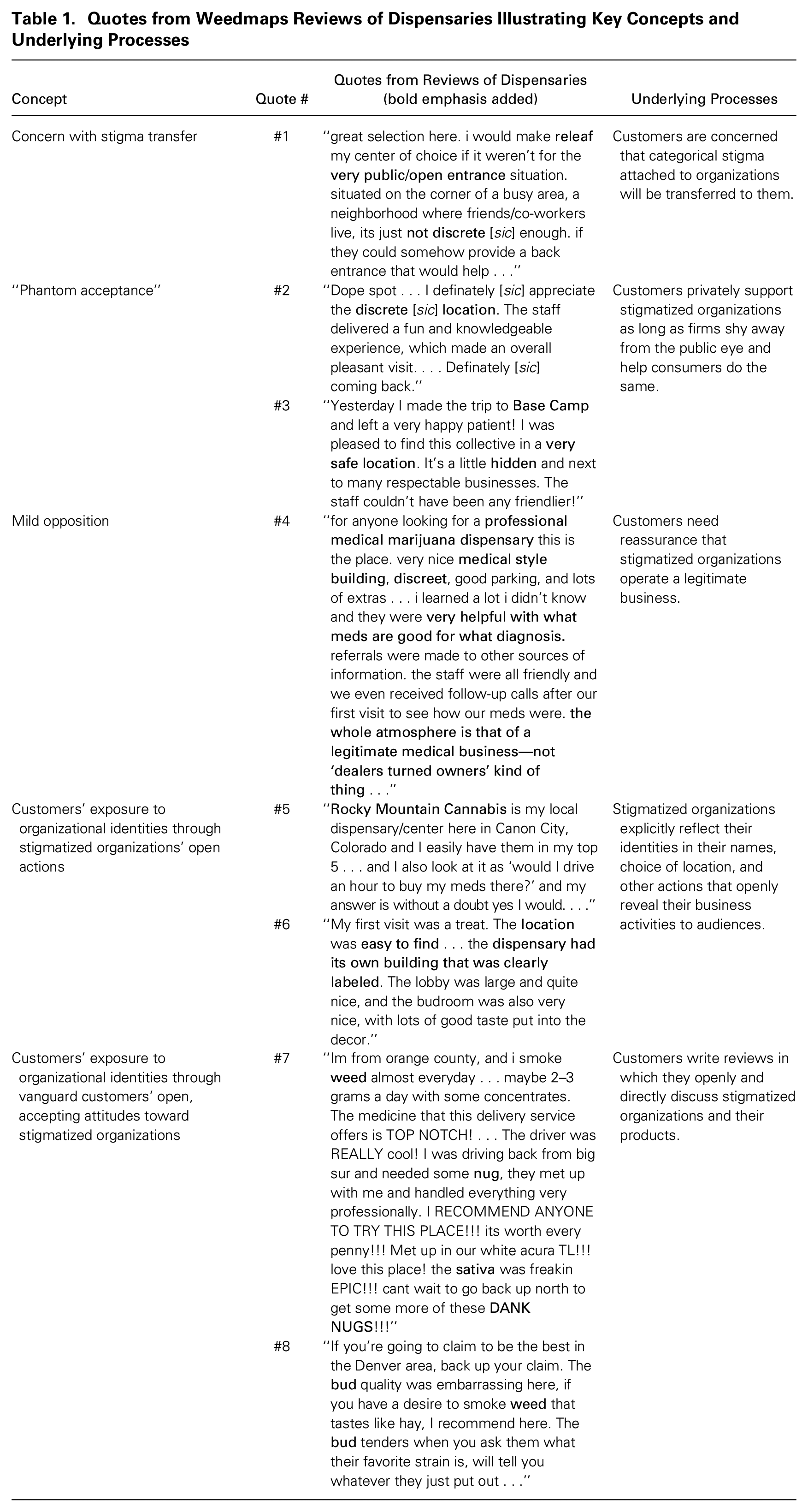
Research has shown that audiences’ fear of stigma transfer is not unfounded. Stigma-by-association is often assigned to individuals, organizations, and even products (Jonsson, Greve, and Fujiwara-Greve, 2009; Pontikes, Negro, and Rao, 2010; Barlow, Verhaal, and Hoskins, 2018). The anticipated negative effects from interacting with stigmatized organizations motivate audiences to pursue different courses of action: they can minimize or even eliminate contact with stigmatized firms (Pozner, 2008), or they can engage in “phantom acceptance” by privately supporting stigmatized organizations as long as they conform to expected norms of behavior (Goffman, 1963).
Reducing concerns about stigma transfer held both by audiences that engage in phantom acceptance and by audiences that oppose and dissociate from a stigmatized market is a key step toward audience acceptance and should be a main goal of stigma management (Helms and Patterson, 2014). But most research on stigma does not directly establish whether organizations’ actions to manage their stigma have the desired effect on audiences. Although insightful qualitative studies have greatly expanded our knowledge about how stigmatized firms and their audiences interact (e.g., Hudson and Okhuysen, 2009; Helms and Patterson, 2014; Lashley and Pollock, 2020), most focus on organizational actions aimed at reducing stigma rather than directly on audience reactions. There is an even greater paucity of quantitative research that identifies a direct empirical relationship between stigma management practices and audience responses (but see Vergne, 2012, about how stigma dilution strategy affects major newspapers’ disapproval). And to our knowledge there are no quantitative studies of how consumers react to firm actions that can potentially mitigate stigma transfer concerns.
As a result, we know much less about audiences’ actual reactions and do not understand well whether consumers’ stigma transfer concerns really decrease in response to organizational actions and industry processes. This is unfortunate, because the overall decrease in stigma transfer concerns is an important precursor to market destigmatization. In this study, we both depart from and contribute to the extant literature by theorizing and providing quantitative evidence of how audience acceptance of organizations in a stigmatized legalized industry evolves as a result of market ecological processes in the form of similar actions (that are not necessarily coordinated or planned) by incumbent organizations and vanguard customers.
Focus on Stigmatized Legalized Markets
Our theory sheds light on destigmatization processes in markets that previously existed as an informal illegal economy before they gained legal status via regulatory approval (Webb et al., 2009). We refer to these industries as legalized markets. Examples of legalized markets in the U.S. include the alcohol industry after the repeal of Prohibition in 1933, the lottery ticket market after state-by-state legalization started with Puerto Rico in 1934 and New Hampshire in 1964, and abortion clinics after the legalization of abortion nationwide in 1973.
Legalized industries usually have already achieved legitimation with many audiences but may remain stigmatized because of an enduring association with their illicit past and with illegal markets that sell the same offerings. These types of markets are not well understood, yet we believe they present a unique opportunity for studying the evolution of categorical stigma because they allow us to focus on destigmatization separately from processes of legitimation. This is important because the extant literature suggests that legitimation and destigmatization are two distinct processes and should not be confounded (Devers et al., 2009; Helms, Patterson, and Hudson, 2019).
Market destigmatization differs from both cognitive and socio-political legitimation in tangible ways. A market obtains socio-political legitimation when it complies with prevailing institutional rules (DiMaggio and Powell, 1983). A market achieves cognitive legitimation when audiences start taking it for granted, which occurs when they experience recurring direct and indirect encounters with multiple organizations operating in the market over an extended period of time and as a result start perceiving the market as having a fact-like status (Hannan, Polós, and Carroll, 2007). On their own, neither legitimation type is sufficient for achieving market destigmatization, because neither taken-for-grantedness nor institutional compliance guarantees that audiences will stop attaching a vilifying label of deviance to organizations participating in the stigmatized market. Nevertheless, a market that has achieved cognitive and/or socio-political legitimation may signal to certain (though not all) audiences that it is safe to destigmatize and can thus expediate destigmatization processes (Lashley and Pollock, 2020).
Theoretical Development and Hypotheses
Types of Customers with Stigma Transfer Concerns
Different audiences may react differently to categorical stigma, which makes it necessary to study them separately (Helms and Patterson, 2014). We focus our theorizing on customers because of their critical role in organizational performance and survival (Rosa et al., 1999). Yet because consumers themselves are heterogeneous, they may also differ in how they react to organizations operating in stigmatized markets. A broad range of reactions to categorical stigma includes open support, “phantom acceptance” (Goffman, 1963), and opposition (to varying degrees). Customers who exhibit either phantom acceptance or opposition tend to have stigma transfer concerns and thus contribute to the persistence of market stigma.
Phantom acceptance customers privately support organizations with categorical stigma as long as the companies shy away from the public eye and help consumers do the same (Hudson and Okhuysen, 2009). For example, in the market for medical marijuana, many individuals buy cannabis from legal dispensaries and support them as long as these dispensaries help consumers remain discreet by providing little or no signage on their storefronts, locating stores in low foot traffic areas, offering deliveries instead of walk-in sales, doing little or no overt marketing or advertising, and the like (refer to user quotes #2 and #3 in Table 1). While phantom acceptance consumers perceive a legalized market as legitimate, they are aware that some individuals do not, and as a result they feel the need to hide their association with it.
Alternatively, potential customers—those who need the product but have not purchased it yet—may choose not to buy and consume vilified offerings because they are opposed to any stigmatized market. A key reason for such opposition is an automatic association of a legalized stigmatized market with its illicit past and (in some cases) with illegal markets that sell the same product. For example, some individuals who are opposed to cannabis consumption may have a valid medical reason for its use. Yet they will not buy it for their treatment because they fail to see a clear categorical distinction between a legal medical marijuana dispensary and a drug “dealer turned owner” (see user quote #4 in Table 1). When producers conceal their activities and phantom acceptance customers hide their involvement with the market, these actions tend to confirm and reinforce potential consumers’ doubts about the market’s legitimacy.
Management of Stigma Transfer Concerns in Legalized Markets
To mitigate the stigma transfer concerns of either type of customer, firms in stigmatized markets tend to pursue concealment strategies and, as a result, avoid revealing to the public their organizational identity—the features that organizational members perceive to be central, distinctive, and enduring about their company (Albert and Whetten, 1985; Whetten, 2006). One key aspect of any organizational identity is the nature of its business activities (Hannan, Polós, and Carroll, 2007). By not revealing what they do for business, organizations in stigmatized markets try to disguise and obscure the very essence of their existence (Hudson and Okhuysen, 2009) and in this way to distance themselves perceptually from the deleterious effects of categorical stigma (Vergne, 2012; Durand and Vergne, 2015; Piazza and Perretti, 2015).
Unfortunately, when organizations with categorical stigma hide their identity from the public, they miss an opportunity to influence the social narrative about their industry. Zelizer (1978) showed that in the nineteenth century, the emerging life insurance market remained stigmatized as profanation of the sacred event of death until life insurance companies took an active part in changing the discourse about acceptable ways of preparing for death. Because legalized industries, such as the medical cannabis market, originate in illegal markets, they initially inherit the negative social narrative from their illicit past (Lashley and Pollock, 2020). This narrative, if not managed, perpetuates phantom acceptance among existing customers and further alienates potential consumers who may be inclined to enter the market but are still opposed to it. Ultimately, these dynamics slow public acceptance of the market and, in the process, impede destigmatization. Thus, a key question is whether any organizational actions or industry processes can generate open acceptance from a broad range of customers.
Accepting stigmatized organizations can be seen as audiences’ willingness to risk having stigma transferred to them (Helms and Patterson, 2014). But why would customers ever take such a risk? The reasons differ across the types of consumers. Customers engaged in phantom acceptance may be willing to risk stigma transfer if their personal costs of keeping secret a connection to a stigmatized industry outweigh the benefits from hiding. Concealing involvement with a stigmatized industry from family, friends, and colleagues can generate economic costs from spending time and resources to travel to locations remote from places of residence and work (Wolfe and Blithe, 2015), as well as safety-related costs of venturing into dangerous neighborhoods (Wickes and Hipp, 2018) and buying unsafe products online. Other costs of keeping a secret include the psychological burden of heightened distress (Sedlovskaya et al., 2013), self-regulatory depletion (Critcher and Ferguson, 2014), and shame (Tracy and Robins, 2006), as well as social costs of feeling isolation and loneliness (Slepian, Halevy, and Galinsky, 2019). When these costs stop being commensurate with the gravity of the secret of associating with a stigmatized market (e.g., when the secret stops being embarrassing), phantom acceptance customers lower their perception of stigma transfer risks.
Reduction in stigma transfer concerns happens differently for potential customers who are (mildly) opposed to the stigmatized market. They may lower their perception of stigma transfer risks and buy a stigmatized product if they are persuaded that organizations with categorical stigma are not associated with either illicit activities or the shady past of the legalized market but are in fact lawful and appropriate.
Theory of Identity Exposure
To better understand the process through which existing and potential consumers lower their stigma transfer concerns, we develop a theory of identity exposure and articulate two possible mechanisms behind it. First, identity exposure may operate directly when customers improve their perception of the stigmatized industry in response to producers publicly revealing, avidly advocating for, and celebrating their organizational identity. Second, identity exposure may operate indirectly when customers lower their stigma transfer concerns in reaction to vanguard consumers revealing and celebrating organizational identities of producers by openly discussing organizations and their products in public.
Identity exposure through organizations’ open actions
We argue that customers may positively alter their perception of the stigmatized industry if a critical mass of organizations openly espouse and advocate for their organizational identity, effectively changing the social narrative about the broader market. Specifically, organizations stop treating what they do as something shameful and embarrassing and not only transparently project but also celebrate their offerings. Importantly, these acts do not need to be a coordinated collective action (very often they are not), but if enough organizations start publicly celebrating their organizational identity, this can alter the extent to which customers perceive the risk of stigma transfer.
Organizations can expose their identities to audiences in different ways. They can choose locations in high-traffic areas (Hudson and Okhuysen, 2009), showcase their products in public certification contests (Rao, 1994), send out press releases (Pontikes and Barnett, 2015), bait politicians into public discussion (Helms and Patterson, 2014), and so on. Organizational actions that change the nature of the narrative about the market become especially vital (Adams, 2012). As a result, language is paramount in identity exposure. When organizations linguistically expose their identities in a consistent and repetitive manner in public discourse, they trigger habitualization—a process in which actions that are frequently repeated are cast into a pattern and become a social norm (Berger and Luckmann, 1966). Eventually, the habitualized exposure of organizational identities as something worth celebrating gives them an unchallenged, taken-for-granted quality, which in turn may change the perception of these organizations (and the overall market) from tainted to normalized (Zelizer, 1978; Lashley and Pollock, 2020).
The normalizing process is more likely to succeed when identity exposure of stigmatized organizations manages to galvanize customers. This is likely to happen when, by being open and passionate about their identities, organizations generate discourse with a positive valence. When valenced discourse is based on cultural codes that resonate with both producers and consumers, it becomes especially potent at changing market perceptions because not only does it elicit an energetic and emotional response from audiences (Greve, Pozner, and Rao, 2006), but also it may engender commitment and support for the market (Weber, Heinze, and DeSoucey, 2008). Such discourse may arise in different forms. Previous research has documented, for example, how ideas of progressive movement purveyed in newspapers reformed the thrift industry (Haveman, Rao, and Paruchuri, 2007), enthusiasts’ public comments improved the perception of the emerging micro-radio market (Greve, Pozner, and Rao, 2006), pamphlets and speeches were used to garner support for dairy and grain cooperatives (Schneiberg, King, and Smith, 2008), and revealing documentaries shaped political discussions about fracking (Vasi et al., 2015).
Ultimately, valenced discourse serves as a path through which organizations operating in a stigmatized market can reveal and celebrate their identities, lending them a broader sense of legitimacy in the eyes of skeptical consumers. If organizations openly rejoice at what they do, identity exposure may reshape understandings shared by producers and by existing and potential consumers by shifting the focus of the discourse from a dirty secret and shady business to unapologetic pride for what they sell and consume.
An organization’s name is one of the more overt and meaningful forms of valenced discourse that an organization seeking to celebrate its identity can leverage (Muzellec, 2006; Kuilman and Wezel, 2013; Engel, van Werven, and Keizer, 2020). Although organizational names are discrete actions initiated by their founders, once registered and publicly displayed, they become an objective reality (Berger and Luckmann, 1966). In contrast to other forms of discourse—such as word of mouth, press releases, lobbying, and speeches—organizational names are ubiquitous in markets; they tend to endure over time, and they can freely and efficiently communicate targeted information to the public as a whole (Glynn and Abzug, 2002; Dobrev, Ozdemir, and Teo, 2006). Organizational names are arguably the closest thing to agitprop that exists in the business world (Lee, 2001; Schmeltz and Kjeldsen, 2016). For these reasons, names can be particularly effective at displaying and celebrating organizational identities.
Organizational names, however, do not automatically alter the discourse in a stigmatized market (Phillips and Kim, 2009). A name becomes an effective tool for identity exposure only if it reveals and broadcasts an organization’s identity (Glynn and Marquis, 2004). For this to happen, a company needs to explicitly reflect its identity in its name. In the medical marijuana market, dispensary names such as Cannabis Station, Weedmart, and Medical Marijuana Couriers unambiguously and unapologetically display that these firms sell cannabis—in contrast to innocuous or ambiguous names like Dana Point Safe Harbor Collective and Belmont Shore Natural Care, which do not reveal what these organizations offer. If founders choose identity-revealing names for their ventures, they broadcast to customers not only that they have nothing to hide but also that they are proud of what they do for business. This is especially true in newly legalized markets, which tend to be populated by small ventures. Given the logistical and regulatory hurdles of running a business in a stigmatized market, founders of these small firms need to be inherently passionate about their ventures. Transparent and celebratory names become an effective identity exposure tool for such firms.
The greater the number of companies that publicly celebrate and advocate their identities through their names, the higher the probability that many consumers encounter and are exposed to at least some of these companies. Repetitive frequent encounters with such organizations create a habit of perceiving them as natural and appropriate (Berger and Luckmann, 1966). As a result, both companies and customers stop seeing the overall market as a dirty secret. When this happens, consumers engaged in phantom acceptance may become less concerned about stigma transfer and, as a result, grow more open in their acceptance and support of the stigmatized market. Stigmatized organizations’ open actions combined with existing customers’ overtly supportive behavior may in turn persuade potential consumers, who are opposed to the market because they associate it with shady dealings, to reconsider their perceptions in a more positive light.
Ultimately, organizations’ public advocacy and celebration of their identities may help both existing and potential customers shed embarrassment about their interactions with such companies and, as a result, reevaluate the risk of stigma transfer and change the overall perception of the market (refer to user quotes #5 and #6 in Table 1 for examples of user behavior in the cannabis market). We thus predict the following:
Identity exposure through open consumer attitudes
Explicit actions by organizations are only one way that customers become exposed to their identities. Another way is through the consumers themselves. Customers not only buy and consume products but also evaluate them. Over the last decade, it has become increasingly common for consumers to write reviews and share them in public internet forums. Entire online communities have been built around markets, as customers come together to share their evaluations of companies and their products. Examples include popular online communities for craft beer lovers on BeerAdvocate (Verhaal, Khessina, and Dobrev, 2015; Frake, 2017), for book enthusiasts on Goodreads (Kovács and Sharkey, 2014), for restaurant patrons on Yelp (Kovács, Carroll, and Lehman, 2013), and for movie lovers on IMDb (Hsu, 2006).
By bringing together consumers who publicly discuss and evaluate producers and their offerings, online communities increase transparency of what is happening in the market (Piskorski, 2014). They provide a conduit for ongoing commentary about the industry not only to consumers who are actively involved in generating reviews and conversations in a community but also to passive onlookers who anonymously visit the community to read active users’ comments (Greve and Song, 2017). By offering a quick summary of opinions convenient for making purchasing decisions, online communities attract both existing and potential customers (Kovács and Sharkey, 2014; Hennig-Thurau, Wiertz, and Feldhaus, 2015). Furthermore, online reviews expose these customers to both large and small producers (Greve and Song, 2017). Consequently, valuations and commentary posted in an online community affect reviewed companies’ product sales (Zhu and Zhang, 2010) and may even change the competitive structure of the industry that the online community is based on (Greve and Song, 2017). This suggests that discourse happening in an online community may shape how existing and potential consumers perceive the market, as well as change their views on categorical stigma attached to this market.
By bringing together many thousands (even millions) of users who share their opinions in reviews, online communities offer a particularly salient environment for the process of identity exposure to occur. When customers are afraid of stigma transfer, they may write reviews that do not explicitly connect them to a stigmatized product. Such reviews support and enhance secrecy, and by extension they may perpetuate shame, embarrassment, and misinformation surrounding the market (Tracy and Robins, 2006). But if the number of customers who write explicit reviews—directly discussing stigmatized companies and their products—increases and reaches a critical mass, they can provide another avenue for exposing stigmatized firms’ organizational identities. In the marijuana industry, when users write reviews in which they openly discuss marijuana (calling it weed, cannabis, bud, nugs, ganja, and other clearly identifiable names), they change the conversation about producers and the market both for themselves and for customers who read their reviews (see user quotes #7 and #8 in Table 1).
The language that reviewers use to talk openly about stigmatized products and organizations may eventually reshape the perception of the overall market through a habitualization process (Berger and Luckmann, 1966). If, through repeated conversations, a customer continues describing a certain product or its producer in a particular way (e.g., “cannabis” or “marijuana dispensary”), this recurring action can instill in this person the habit of seeing the product or producer as natural or taken for granted. If these conversations are carried out in a community with many others who are also influenced by that language, the repeated exposure to organizations’ identities and their products may trigger a shift in broader audiences’ perceptions of the market from what they have previously seen as tainted to normalized. Existing and potential consumers alike, then, may utilize specific language from this habitualized discourse in other social contexts. For example, they may feel less hesitant to openly discuss stigmatized markets in their workplace or with acquaintances who are not directly exposed to these markets.
Such open conversations create a basis for identity shifts among customers (Mills, 1940). By talking openly about consuming cannabis, individuals destigmatize themselves through a relabeling process (Preston et al., 1998). They are no longer “addicts” who try to hide their affliction but rather “responsible users” who do not have a reason to be embarrassed of their cannabis consumption. They perceive going to dispensaries not as something shameful like sneaking to a crack house but as a normal activity analogous to going to a convenience store or pharmacy (Lashley and Pollock, 2020). The increasing exposure to consumers who self-destigmatize by being publicly open and unapologetic about consuming stigmatized products may reduce concerns about stigma transfer in more cautious and potential customers.
Thus, the mechanism of identity exposure through customers’ open attitudes facilitates the removal of stigma and associated shame and discomfiture from both existing and potential consumers and in this way alleviates their fear of stigma transfer. These arguments lead to the following hypothesis:
Identity Exposure in Politicized Regions
Identity exposure as a mechanism that lowers consumers’ concerns about stigma transfer may be more or less powerful depending on specific conditions of a regional market. Although many possible factors may moderate the impact of identity exposure, political ideology presents an especially interesting case because it affects public opinion, which is a foundational component of stigma (Feinberg et al., 2017). Indeed, a large body of research in social and political psychology investigates how political ideology influences perceptions of intolerance and prejudice (e.g., Jost, Federico, and Napier, 2009; Hodson and Busseri, 2012; Ordabayeva and Fernandes, 2018).
Perhaps the most invoked dimension of political ideology is a left–right divide, where the left serves as a proxy for liberalism and the right denotes conservativism. This dichotomy is further delineated by a contextualist orientation (for liberalism), which is defined by tolerance of outgroups, and an absolutist orientation (for conservativism), which is associated with support for rigid moral rules and high levels of punitiveness (Alford, Funk, and Hibbing, 2005; Feldman and Johnston, 2014). Based on this conceptual bifurcation, research has found that right-wing ideologies are associated with increased prejudicial attitudes toward stigmatized groups, e.g., sexual minorities (Hoyt and Parry, 2018), with intergroup contact with stigmatized people exacerbating this effect (Hodson and Busseri, 2012). In contrast, liberalism typically correlates with accepting a greater diversity of life choices, including the choices of stigmatized groups (Zhang and Brym, 2019).
Overall, this research suggests that political ideology shapes consumers’ attitudes toward a stigmatized market (Conover and Feldman, 1981). The more liberal views an individual has, the more likely that person is to be tolerant toward a newly legalized market and the less likely to attach stigma to it. For example, in 2011 (the midpoint of our observation period), 69 percent of liberals but only 34 percent of conservatives supported the legalization of marijuana in the U.S. (Newport, 2011). Research has also found that even when people share the same political ideology, those living in regions with a dominant presence of liberals are more likely to support left-leaning policies than those living in regions with a high percentage of conservatives (Feinberg et al., 2017). Thus regions with high proportions of liberals tend to be more tolerant to stigmatized markets, which should help consumers of stigmatized products be less concerned with stigma transfer.
It is logical to expect that when customers have low concerns about stigma transfer, the identity exposure mechanisms become less salient. Therefore, the dominance of liberals in a region should moderate the effect of identity exposure on reducing stigma transfer concerns:
Empirical Design
Setting and Data Sources
We test our predictions on the U.S. medical marijuana industry. For decades, marijuana was considered to be a Schedule I drug in the Controlled Substances Act of 1970—that is, a drug defined by the federal government as having no accepted medical use and a high potential for abuse. The private sale and consumption of marijuana in the U.S. remained illegal until in 1996 California became the first state to legalize marijuana use for the purposes of medical treatment. Since then, 33 states and the District of Columbia have followed suit. 2 At the federal level, marijuana remains a controlled substance, even for the purposes of medicinal use. As a result, the creation and enforcement of the rules and regulations related to the consumption of medical marijuana are specific to the states that have legalized it. In 2009, the U.S. Attorney General made it clear that the federal government would not aggressively prosecute those who use cannabis for medical reasons provided they adhere to state laws regarding the substance.
To test our hypotheses, we turn to the online marijuana community Weedmaps.com: a repository for information on U.S. legal marijuana dispensaries. 3 Founded in July 2008, the community has well over 4,000 dispensaries listed and receives roughly two million monthly visitors. On Weedmaps sellers of marijuana register their dispensaries and list their products for a fee. Dispensaries upload product information, prices, discounts, photographs, and other relevant data. Customers can use Weedmaps free of charge to find local dispensaries, review products and dispensaries, and read reviews left by other users. The result is a community interface for producers and consumers to share information and build relationships within the broader legal cannabis industry in the U.S.
Weedmaps presents a unique opportunity for studying destigmatization of legalized markets for two main reasons. First, it is built around a product that, while legal in many states, remains socially stigmatized. According to the General Social Survey (GSS), from 2006 to 2016, only 46 percent of all respondents answered “yes” to the question of whether marijuana should be made legal. In addition to customers, other audiences are also concerned about stigma transfer related to this industry. Most banks and other financial institutions are very hesitant to loan money for starting a dispensary because marijuana remains illegal at the federal level. Many dispensary owners must operate on a cash-only basis because credit card service companies do not want to be associated with cannabis. Dispensaries also have difficulty advertising through traditional channels, such as newspapers, billboards, television, and radio. 4 Second, Weedmaps provides rich information on consumers’ attitudes and reactions to the stigmatized product of marijuana that customers express in their reviews. This information is available both across dispensaries and over time. During our observation period, each dispensary received on average 34 reviews yearly. There were roughly 144,000 unique user IDs. On average, each user wrote two reviews, and 10 percent of users wrote more than four reviews.
We are cognizant that not all consumers of cannabis register and review products on Weedmaps. It is a common limitation of this kind of data (Verhaal, Khessina, and Dobrev, 2015; Hsu, Kovács, and Koçak, 2019). But we believe that these data are still an appropriate sample for testing our theory. Consumers who write reviews engage with a market more actively than an average customer does. The literature treats such consumers as vanguards (Rosa and Spanjol, 2005; Koçak, Hannan, and Hsu, 2014). Research has shown that a vanguard influences the rest of the audience both directly and by shaping market artifacts and categories (Koçak, Hannan, and Hsu, 2014). Destigmatization often starts with vanguard audiences before it spreads to everyone else (Helms and Patterson, 2014).
Our data include information on all dispensaries and their products, as well as all user reviews from the inception of Weedmaps in July 2008 through June 2014, when the emergence and growth of the recreational marijuana industry started (Hsu, Koçak, and Kovács, 2018). Because the mechanisms driving destigmatization may differ for medical and recreational dispensaries, we specifically focus on the era exclusive to medical marijuana.
The data are stratified by two geographic levels: state and county. Legalization of cannabis is state-specific, and federal laws are strict. Transporting marijuana across state lines, either by mail order or personally, is a federal crime, even when marijuana is legal in both the state of origination and destination. Although socio-political legitimation of cannabis is restricted by state boundaries, stigmatization and destigmatization processes are likely more local in nature, especially when a state is large. Users are exposed to dispensaries in areas where they live and work. Our analysis at the county level (while accounting for state-level influences) reflects this dynamic more precisely.
The Weedmaps data cover 4,248 unique dispensaries, but we omitted 250 organizations that did not receive a single review because we cannot assess consumer concern about stigma transfer for these dispensaries. Additionally, from the General Social Survey (GSS), we collected county-level data on individuals’ opinions of whether marijuana should be made legal and on their political views. Because the GSS does not survey all counties in all years, we dropped 715 dispensaries located in counties that the GSS did not cover (see more about this in the “Robustness Checks” section). Finally, we collected data in an online survey, described below. The final data set contains 3,283 dispensaries that received roughly 280,000 user reviews. They are located in 36 counties in 10 states plus the District of Columbia.
Role of language in identity exposure in the marijuana market
We build our identity exposure measures based on linguistic artifacts because they reflect the nature of public discourse. We measure (1) the language that dispensaries use to convey their identities as marijuana producers and sellers and (2) the language consumers use to publicly discuss marijuana dispensaries and their products. To this end, we adapt the construct “grade of membership” (GoM) originally designed to measure the degree to which a firm is a member of a given category (Hannan, Polós, and Carroll, 2007). We modify the GoM construct to measure the extent to which firms and consumers use clear and unambiguous language when they communicate their participation in the cannabis market. The higher the marijuana-related GoM of the language that organizations and vanguard consumers use, the more explicitly they communicate their engagement with the cannabis market to other audiences and, consequently, the more existing and potential consumers are exposed to dispensaries’ organizational identities.
We focus on organizational names as a linguistic tool that firms use to broadcast their organizational identities. Organizational names vary in the extent to which they convey what a company produces or sells. 5 In our empirical setting, 37 percent of dispensaries use marijuana-related words in their names. Of these, roughly 1 percent unambiguously indicate the nature of their business by including in their names words like marijuana, weed, pot, or cannabis, such as in Weedmart, Spocannabis, and BeachCitiesMarijuana.com. These firms broadcast high marijuana GoM through their names. At the other extreme, 63 percent of firms in our setting have names that do not refer to their organizational identities at all; their names—such as Helping Hand Caregivers and Wickenburg Alternative Medicine—do not indicate any connection to offering marijuana. These firms broadcast a zero marijuana GoM through their names. Between these two extremes are firms with names that contain code words, such as green, reefer, coffeehouse, herb, leaf, and blunt. Examples of dispensaries with such names include The Green Nugget Therapy, Aromatic Herbal Center, and Green Leaf Clinic. While such names do not make explicit reference to marijuana that all audiences would understand, those who consume cannabis understand them.
We believe that a higher level of marijuana GoM broadcast by firms’ names will increase customers’ exposure to the organizational identities of dispensaries. The first indication that dispensary names are powerful in attracting customer attention and can potentially generate effective identity exposure comes from user reviewers. Consumers often discuss dispensaries’ names in their evaluations, such as “Really cool name and fun to go to”; “First off love the name of this shop . . . super original!”; and “Don’t waste your time and money at the other dispensaries like I did. Just start with the cool name.”
As for customers, the language they use to talk about dispensaries and their products may (or may not) help other customers and audiences form a clear idea about sellers’ organizational identities and the overall industry. The more directly customers talk about the market, using unambiguous words understandable by everyone, such as marijuana, weed, pot, or cannabis—in other words, the higher the marijuana GoM of the language they use in their discourse about the industry—the more they linguistically validate and codify the organizational identities of dispensaries and the overall market as something they are not ashamed of, and the more they expose other audiences to this in the process.
Operationalization of Variables
Dependent variable
The dependent variable is the dispensary’s proportion of reviews concerned with stigma. To create this measure, for each dispensary we divided the number of reviews in which users revealed explicit concern about stigma transfer by all reviews received by the dispensary in a given year. To determine whether a review expressed concern with stigma, we applied the computational approach SenseClusters, developed by Pedersen, Purandare, Kulkarni, and Joshi (Pedersen, 2003). We used the text from all reviews as an input into the program.
As the first step, the program eliminated stop words (e.g., a, and, this, and the like) in the texts of reviews. Then the program calculated the frequency with which each of the remaining meaningful words appeared in all available reviews. The five most frequent words found in the reviews were great, best, place, time, and staff. We used this output to look for the most frequent word that expressed explicit concern with stigma. The word discreet was the one with the highest frequency, as it appeared in the reviews 2,450 times.
The next step was to identify the words that occurred immediately after the word discreet. We asked a question: Discreet about what? The program generated a list of bigrams, i.e., ordered pairs of words. The word discreet occurred with the following group of nouns: location, spot, delivery, professional, place, service, amp, parking, building, area, fast, shop, dispensary, storefront, packaging, safe, staff, and reliable. We then identified words other than discreet that occurred with this same group of nouns. These additional words and expressions that were used to express concern about stigma in reviews were (in)discreet(ly), discretion, low profile, low key, privacy, confidential, trustworthy, secret, private, hidden, hide, reserved, understated, inconspicuous, subtle, tactful, clandestine, covert, concealed, nondescript, expose, on the down low, on the dl, buttoned-up, and off the beaten path. We also added the word quiet to this list if it appeared in reviews immediately before the words location, spot, or place. In sum, the SenseClusters program created a dictionary of words expressing concern with stigma based on texts of all reviews that we used as an input into the program.
The SenseClusters program has several advantages. It allowed us to identify misspelled words, such as when discrete was used instead of discreet immediately before the nouns from the above list. The program also let us identify not only the words that expressed concern with stigma transfer but also their synonyms and antonyms. Finally, it detected slang or abbreviations used by reviewers. The result was an automated dictionary of words that helped us create a measure with high external validity.
From 2008 to 2014, roughly 6,500 reviews revealed users’ explicit concern with stigma transfer. Figure 1 shows that when a state joins Weedmaps, its average proportion of reviews concerned with stigma usually starts somewhat high and then decreases over time. In some states, however, stigma transfer concerns increase for the first year or two before starting to decrease. We concluded that this initial increase is a data artifact. The two-year initial increase is observed only for states that joined Weedmaps in its first year of existence (July 2008–July 2009). The one-year initial increase is observed only for states that joined Weedmaps when it was more developed but at the end of a calendar year. In both cases the states did not have enough time to accumulate a meaningful number of reviews during their initial period on the website.
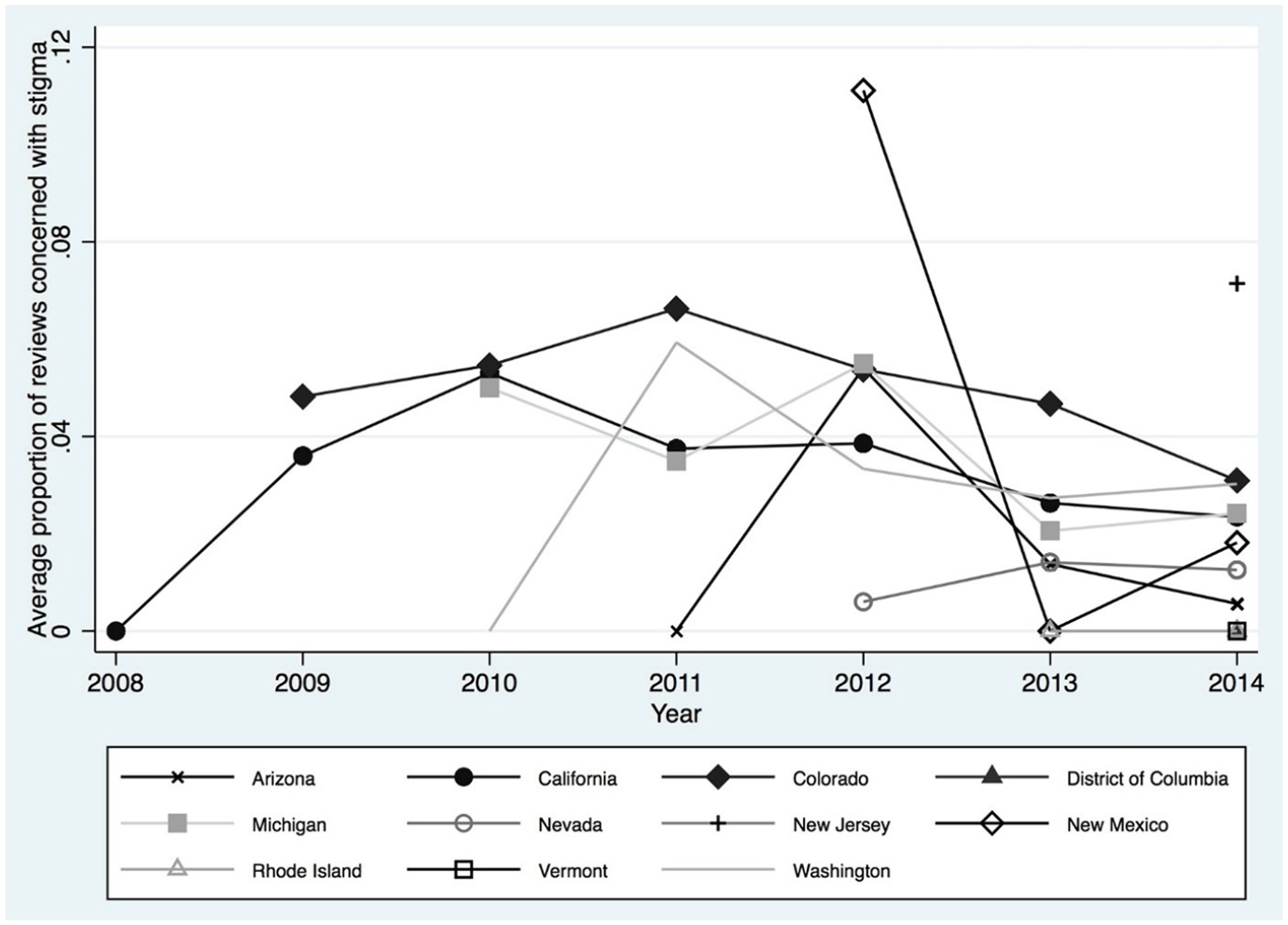
Average Proportion of Reviews with Stigma Transfer Concerns by State-Year
Independent variables
The two independent variables measure customers’ exposure to organizational identities of dispensaries (1) through dispensaries’ names and (2) through customer attitudes in reviews of dispensaries. We use the grade of membership (GoM) construct as a base for creating both measures. As we discussed above, words that founders use to name their organizations and that customers use to review dispensaries may have a direct, subtle, or no reference to marijuana. The more direct the reference, the higher the marijuana GoM of a word. To determine a GoM of each specific word related to cannabis, we conducted an online survey on All Our Ideas (www.allourideas.org).
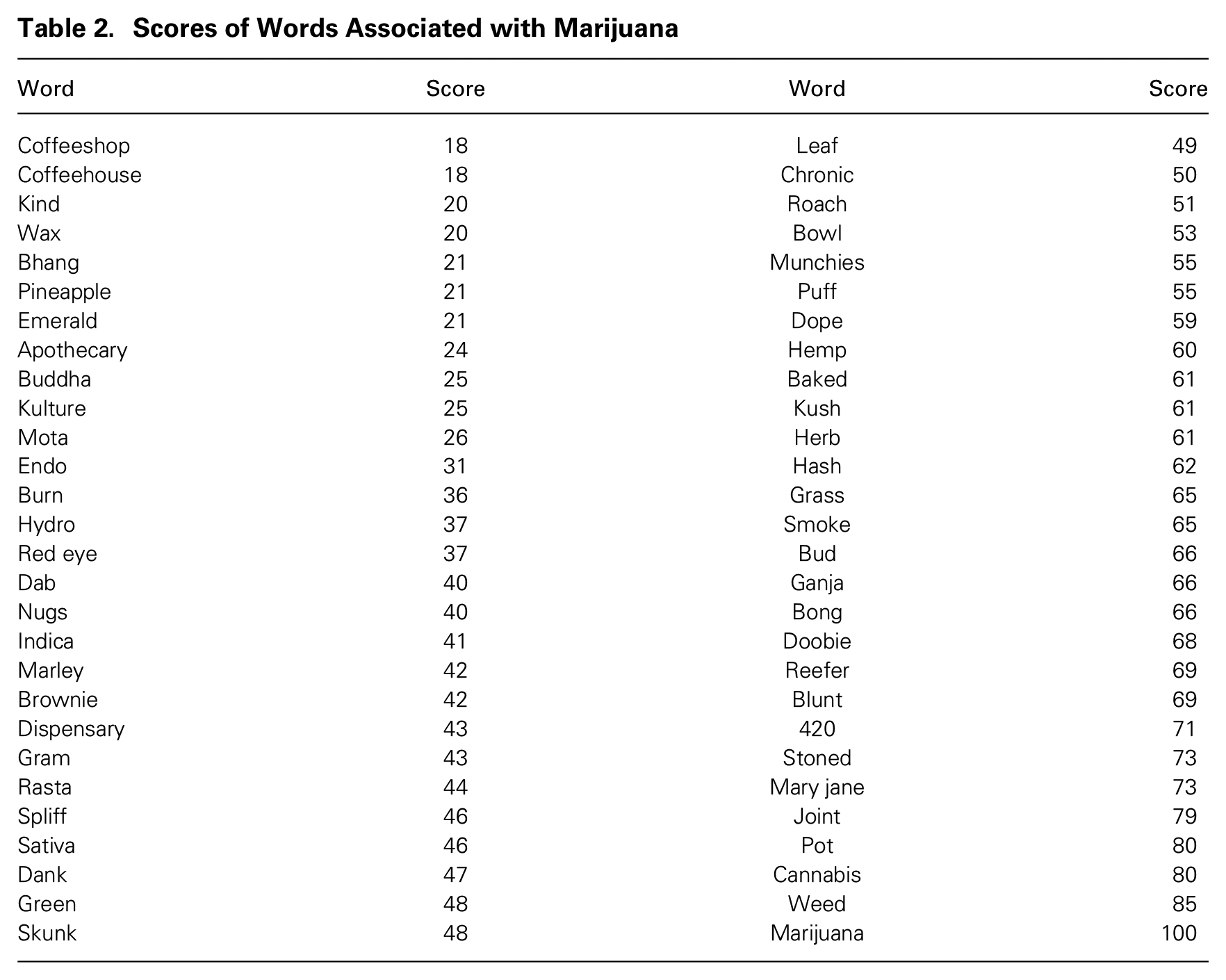
Following the method developed by Kovács, Carroll, and Lehman (2013), we generated a list of words commonly associated with marijuana and asked survey participants to do a set of pairwise comparisons to choose a word that in their opinion was associated with marijuana more. Participants could add their own words, which were then incorporated into the survey. The final output included 56 words. Participants made 11,717 pairwise comparisons of these words. They were asked to submit 20 comparisons (though some made more). As a result, the number of participants totaled approximately 585. Based on the survey outcomes, a score was assigned to each word. The scores range from 18 (e.g., coffeehouse) to 100 (e.g., marijuana). Table 2 shows the scores for all the words. A low value indicates that people do not strongly associate a word with marijuana, i.e., a word has a low marijuana GoM. A high value indicates that people strongly associate a word with marijuana, i.e., a word has a high marijuana GoM. Words not included in the table have a zero marijuana GoM.
Scores of Words Associated with Marijuana
Exposure to dispensaries with identity names is the first measure of the identity exposure construct. It is based on the idea that customers gain greater exposure to a producer’s organizational identity when the producer overtly broadcasts its identity through its name. Names with higher GoM generate greater identity exposure. We constructed this variable in two steps. First, we calculated the GoM of each specific dispensary by summing scores of all words in its name (assigned based on Table 2) and then dividing this sum by the total number of words in the name. Second, we summed GoMs of all dispensaries located in a given county in a given year. We then divided this sum by 100 for scaling. Figure 2 shows a boxplot of variation in the exposure to dispensaries with identity names both between and within counties (Rabe-Hesketh and Skrondal, 2012). Each box represents a yearly variation within a county (the longer the box, the higher the variation). Each filled dot represents an outlier (a data point in the .35 percent of a distribution tail). Figure 2 reveals that there was a lot of variation in exposure to dispensaries with identity names both between and within counties over time.
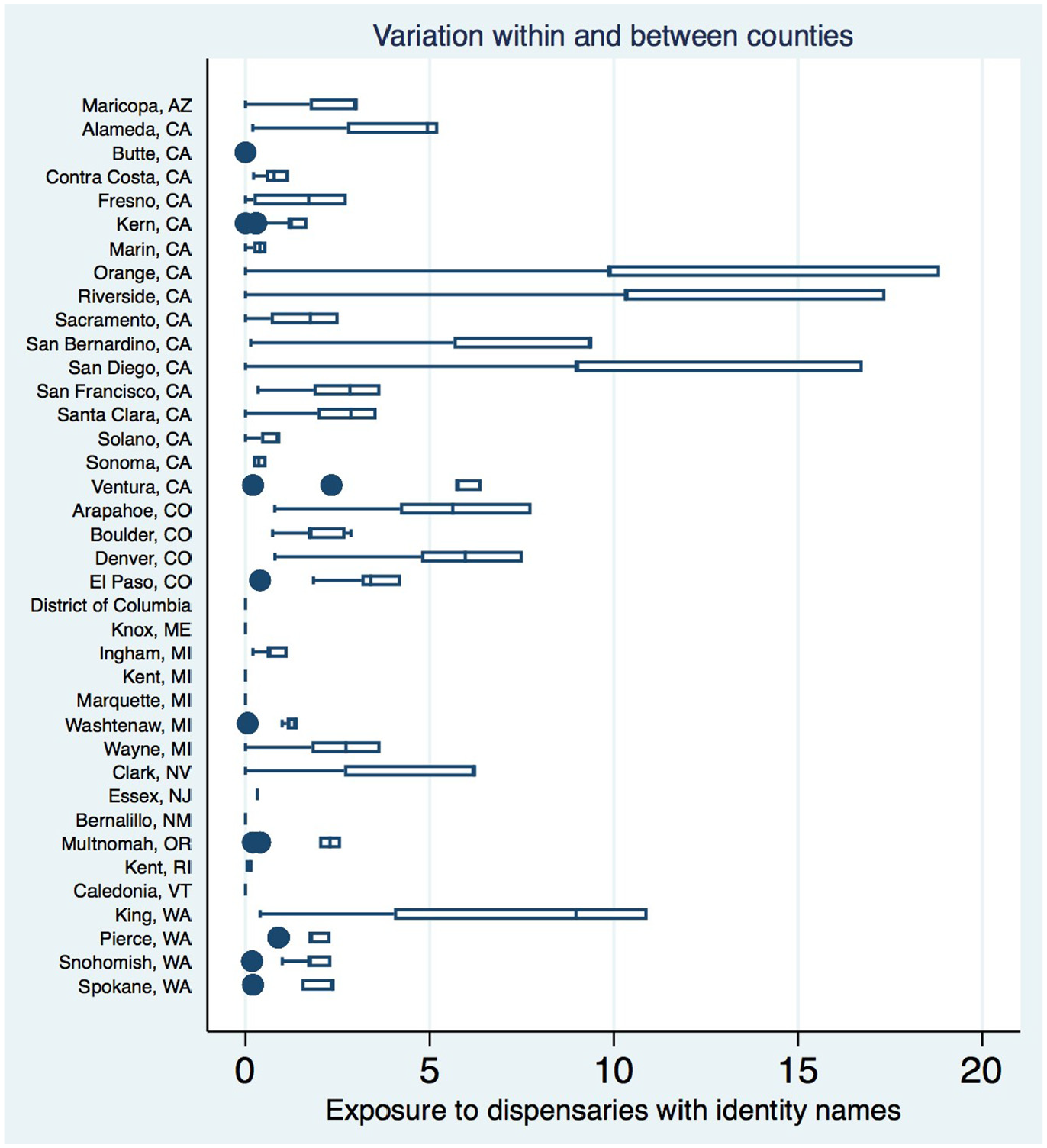
Exposure to Dispensaries with Identity Names by County*
Exposure to reviews with open attitudes is the second measure of the identity exposure construct. It is based on the idea that customers gain more exposure to organizations’ identities and the overall market when other customers openly discuss the market and its participants. We define a review as having an open attitude toward the cannabis market if the review includes words that have a non-zero association with marijuana. The higher the marijuana GoM of a word, the more open attitude it projects. To create this variable, we again relied on scores of marijuana-associated words listed in Table 2. First, we calculated the GoM for each review received by a dispensary by summing the scores of all words in the review and then dividing this sum by the total number of words in the review. Next, we calculated the average GoMs for all reviews that each dispensary received in a given year. Finally, we aggregated this measure to the county level by calculating the average value for all reviews of all dispensaries in a given county in a given year. Figure 3, which is a boxplot, reveals a lot of variation in the exposure to reviews with open attitudes both between and within counties over time.
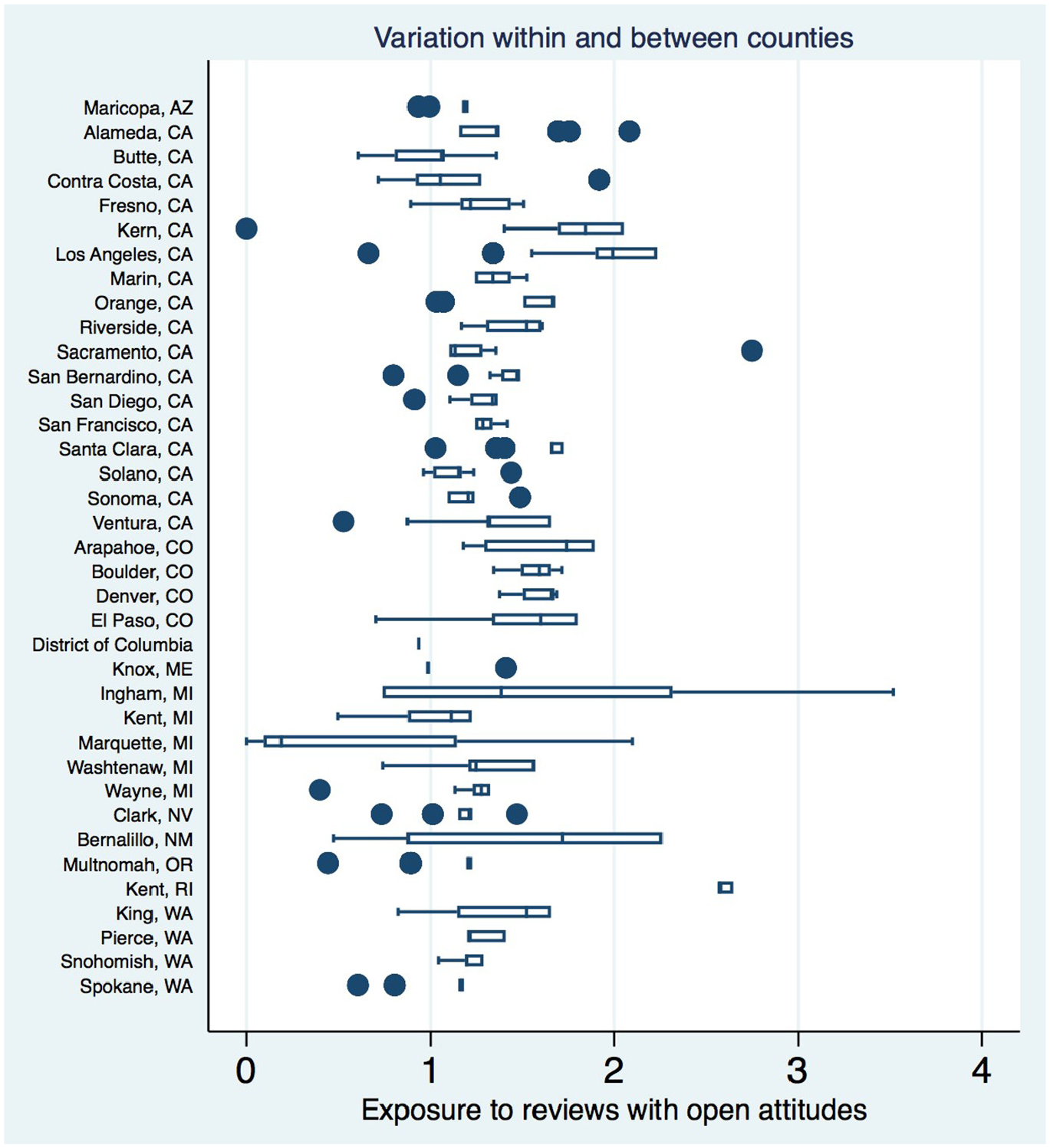
Exposure to Reviews with Open Attitudes by County*
County liberalism is a variable designed to test whether the identity exposure mechanisms are less impactful in more liberal regions. To create this measure, we relied on data from the GSS, which asks respondents to identify their political views by placing themselves on a seven-point Likert scale ranging from extremely liberal to extremely conservative. We built the variable county liberalism as a proportion of respondents in a given county in a given year that self-identified as extremely liberal, liberal, or slightly liberal. On average, 32 percent of respondents consider themselves at least slightly liberal. Because there are no data available for the years 2009, 2011, and 2013, we used linear interpolation for those years.
We did not lag independent variables (or controls), because it is reasonable to assume that customers who write reviews on Weedmaps react to the current state of dispensaries and the cannabis market rather than to what happened a year ago.
Control variables
A number of additional factors may affect whether customers are concerned about stigma transfer. Several variables at the dispensary, county, and state levels control for these influences. All time-variant variables are updated yearly.
At the dispensary level, we control for a dispensary’s characteristics that may influence whether it attracts or repels customers concerned about stigma transfer and, consequently, whether customers will express their concerns in reviews. For example, large and old dispensaries are more visible and thus may appear to customers as less discreet than smaller and younger firms. To control for these influences, we created dispensary age that measures a firm’s tenure in years on Weedmaps.com. We do not have precise information on the size of dispensaries, but we assume that organizations that have enough resources to maintain a laboratory where they test the chemical properties of the marijuana they sell tend to be larger. We use these data to create a proxy for dispensary size, which is a dummy variable coded as one if a dispensary does lab testing of its products. Dispensaries that openly broadcast their marijuana identity are likely to repel (attract) users with high (low) concerns about stigma transfer. To account for this influence, we created the time-invariant variable dispensary name GoM that measures the marijuana GoM of a dispensary as broadcast in its name. It is a sum of scores of all words (assigned based on Table 2) in the dispensary’s name divided by the total number of words in the name. The higher a dispensary’s name GoM, the more explicitly it broadcasts its marijuana identity through its name.
Next, we control for dispensaries’ characteristics that make customers feel more or less discreet about their engagement with these organizations and thus affect their concerns about stigma transfer. The dispensary offers delivery dummy variable is equal to one if a dispensary offers delivery services. The dispensary safety dummy variable is equal to one if a dispensary provides security on site. The dispensary limited access dummy variable is equal to one if a dispensary grants access only to clients older than 21. The dispensary photo dummy variable is equal to one if a dispensary exhibits photos on Weedmaps; it controls for attracting customers who want to see how discreet a dispensary’s location is before choosing to engage with it. Finally, whether they are concerned about stigma transfer or not, customers should find dispensaries that offer discounts more appealing and submit more reviews about them, including more reviews concerned with stigma. A dispensary marketing dummy variable is equal to one if a dispensary offers coupons.
Because reviewers’ differences may affect their stigma transfer concerns, we control for average reviewer experience, which measures an average number of years a dispensary’s current evaluators have been submitting reviews on Weedmaps.com. We also control for average reviewer preference for delivery, which measures a dispensary’s annual proportion of reviews that mention the word “delivery.” Both variables are built at the dispensary-year level.
At the county level, we control for county stigma intensity that measures the intensity of stigma attached to the marijuana market in a given county in a given year. This variable is based on the data collected by the GSS, which asked respondents whether the use of marijuana should be made legal. We constructed the variable by calculating the proportion of respondents who answered either “no” or “don’t know” to this question (48 percent of respondents). Because there are no data available for the years 2009, 2011, and 2013, we used linear interpolation for those years. We also control for county size by dummy variables representing five quantile categories ranging from less than 31,000 to more than 10 million inhabitants.
At the state level, we control for temporal changes in social attitudes toward marijuana use. First, we control for years since state legalization, which is a count of years since marijuana has been legalized in a given state. Second, to measure more directly the change in social attitudes about marijuana use in specific states, we utilized metadata from The New York Times, which is a national coverage newspaper, to identify all articles (title, abstract, and lead paragraph) that mentioned the words marijuana, cannabis, or dispensary as well as the name of each state in our dataset. We then used the software package Linguistic Inquiry and Word Count (LIWC, 2007) to identify positively charged words in each article. Then, for each state, we counted all identified positive words across all articles and divided this count by the total number of words across all articles published in a given year to create the variable state positive press coverage about marijuana use.
Model Specification
Our data have a hierarchical three-level structure. The dataset includes 3,283 dispensaries (level 1), 36 counties (level 2), and 10 states plus the District of Columbia (level 3). Levels 2 and 3 constitute an (unbalanced) panel in which counties and states have been repeatedly observed. We measure the dependent variable at the dispensary level. The purpose of our empirical model is to exploit the variation within counties over time while simultaneously accounting for the variance between counties in their respective states. A multilevel analysis is needed to estimate these two-level effects (Sampson, Raudenbush, and Earls, 1997; Sampson, 2003). To that end, we decompose the effects of county-level variables into within and between components, specified in a hybrid model (Allison, 2009). A within effect is based on variation within counties over time, and between effects are based on variance between counties in a given state.
Multilevel, hybrid models allow simultaneous estimation of within and between effects (for a discussion of hybrid models see Schunck, 2013; Schunck and Perales, 2017). In such models, within effects are fixed effects and between effects are random effects (Allison, 2009; Schmidt-Catran and Spies, 2016). An important advantage of using a hybrid model in our study is that within effects control for unobserved heterogeneity within the counties over time, while between effects account for variance between counties. Only counties that were observed multiple times can contribute to the estimate of within effects (34 counties were observed at least twice). One county and Washington, D.C., being observed just once, contribute only to the estimates of between effects.
We estimate factors that affect a dispensary’s proportion of reviews concerned with stigma using a mixed-effects generalized linear model (MEGLM) as implemented in STATA. The specification is also known as GLMM (generalized linear mixed models). The GLMM is an extension of GLMs to include random effects and thus be suited to analyze clustered data, such as multilevel and panel data (Schunck and Perales, 2017). We chose the GLM approach because the dependent variable is a proportion that ranges between 0 and 1, inclusive (Papke and Wooldridge, 1996). Because reviews are observed at the dispensary level, the proportion is assumed to follow a binomial distribution, and logit is used as the link function.
Findings
Table 3 provides descriptive statistics for the key variables. Table A1 with correlations between these variables is available in the Online Appendix (http://journals.sagepub.com/doi/suppl/10.1177/0001839220972422). The correlation between the identity exposure measures is relatively high (r = .80), but we simultaneously include both exposure measures only in fully saturated models. All other correlations are relatively low. The dataset includes 3,283 dispensaries observed from July 2008 through June 2014. Approximately 51 percent of the dispensaries received at least one review that expressed concern about stigma transfer.
Descriptive Statistics for Dispensaries, 2008–2014*
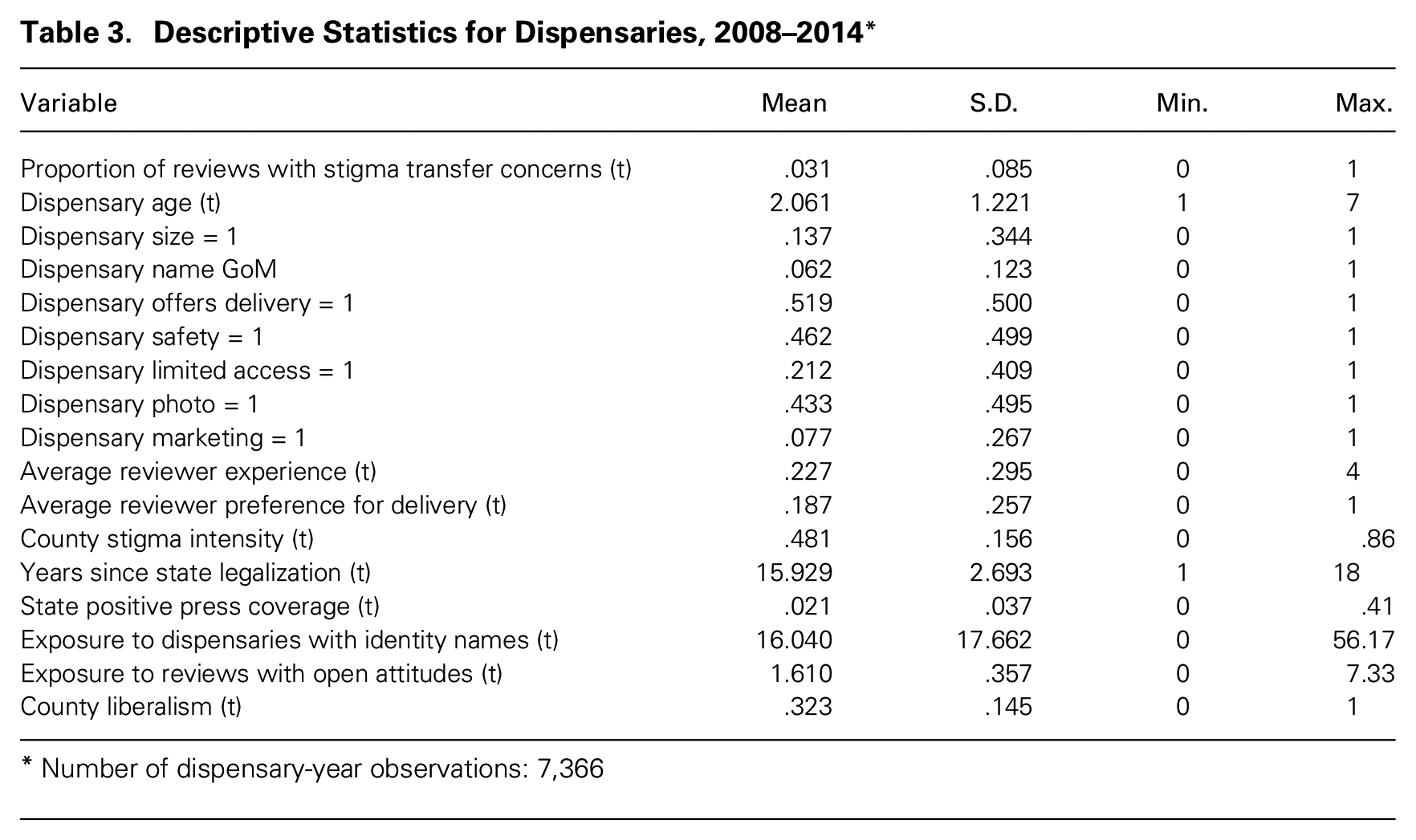
Number of dispensary-year observations: 7,366
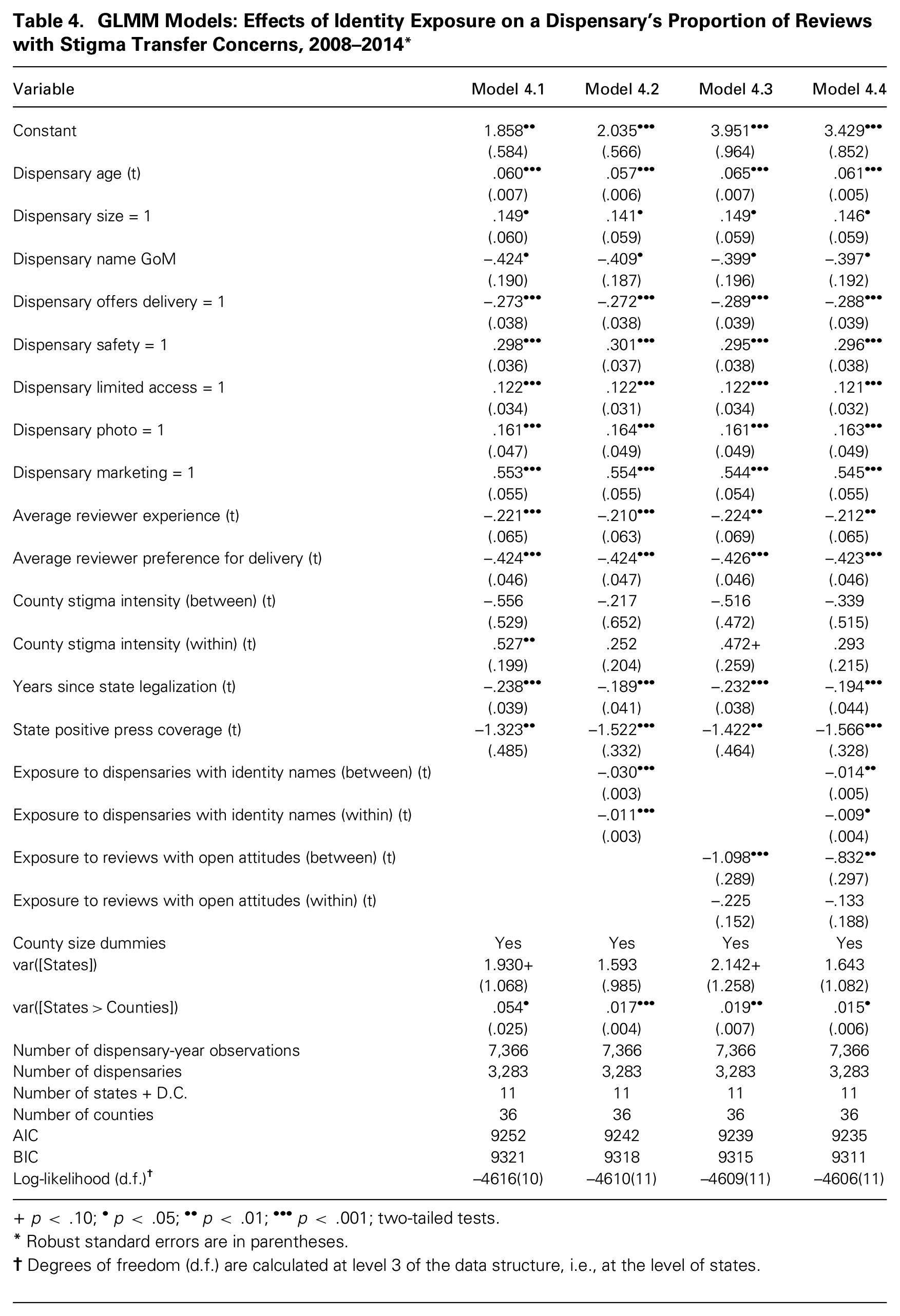
Tables 4 and 5 report estimates of GLMM models that predict effects of explanatory variables on the proportion of reviews concerned about stigma transfer that a dispensary receives in a given year. All county-level variables consist of within and between components. Within components show effects within counties, i.e., in a focal county over time. Between components show effects between counties nested within a focal state.
GLMM Models: Effects of Identity Exposure on a Dispensary’s Proportion of Reviews with Stigma Transfer Concerns, 2008–2014*
p < .10; •p < .05; ••p < .01; •••p < .001; two-tailed tests.
Robust standard errors are in parentheses.
Degrees of freedom (d.f.) are calculated at level 3 of the data structure, i.e., at the level of states.
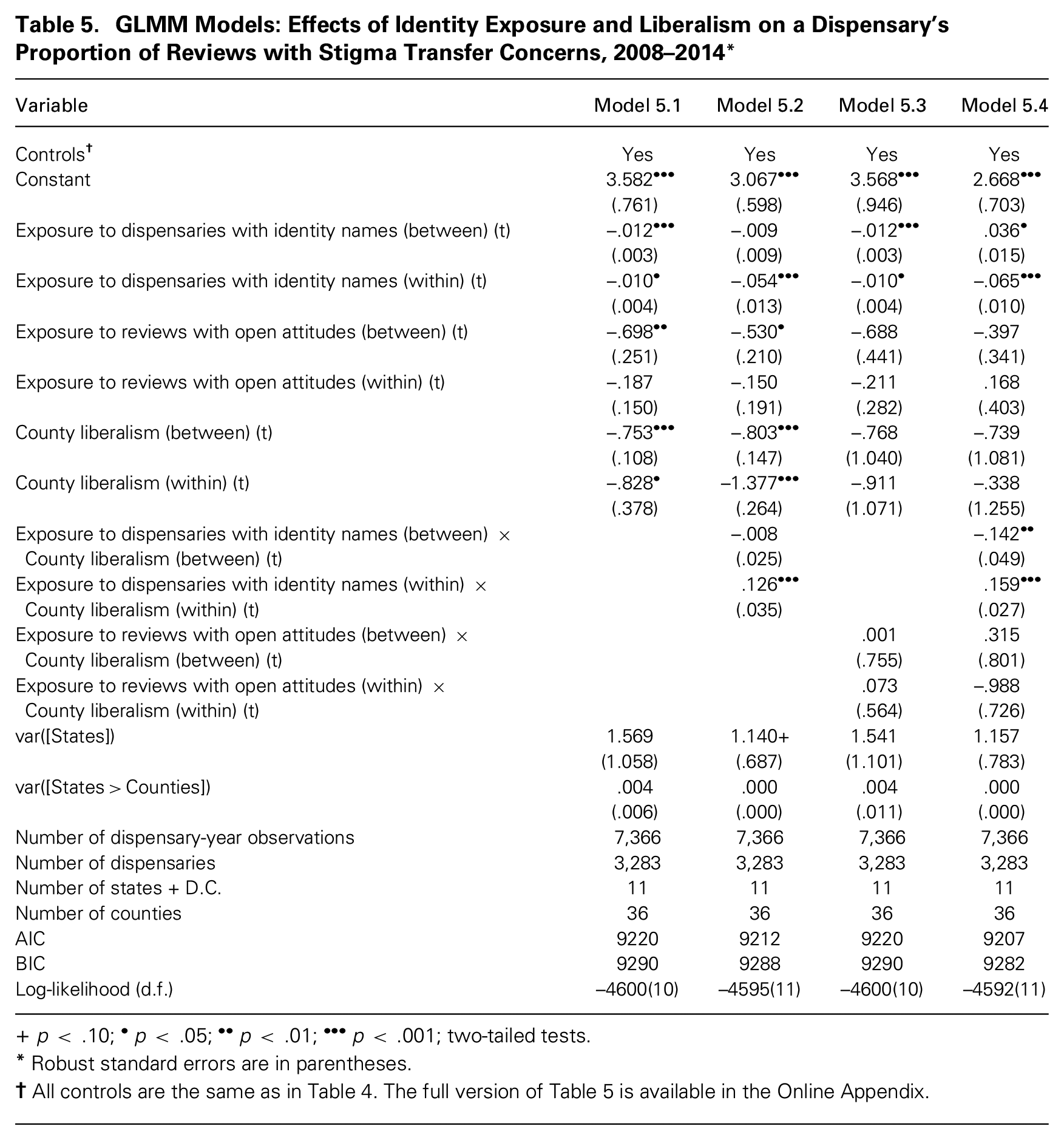
GLMM Models: Effects of Identity Exposure and Liberalism on a Dispensary’s Proportion of Reviews with Stigma Transfer Concerns, 2008–2014*
p < .10; •p < .05; ••p < .01; •••p < .001; two-tailed tests.
Robust standard errors are in parentheses.
All controls are the same as in Table 4. The full version of Table 5 is available in the Online Appendix.
Table 4 tests for hypotheses 1 and 2. Model 4.1 is a baseline model that shows a high amount of marginally significant variance between states (var(States) = 1.930+) and a reasonable and statistically significant amount of temporal variation between counties nested within states (var(States>Counties = .054•). Controls in Model 4.1 exhibit common and expected effects. The model includes the within and between components of the stigma intensity variable. Only the within effect is statistically significant, supporting our expectation that effects of stigma within counties are stronger than effects based on a comparison of stigma across counties. Specifically, we found that the higher the proportion of the population that is against the legalization of marijuana (i.e., stigmatizes marijuana use) within a county, the greater the proportion of reviews concerned about stigma transfer a dispensary operating in this county receives.
Model 4.2 introduces the within and between components of the variable exposure to dispensaries with identity names. As predicted, both within and between effects are negative and statistically significant. In substantive terms, we find that when customers’ exposure to dispensaries that project a marijuana identity in their names within a county increases by one standard deviation, the proportion of reviews concerned about stigma received by a dispensary located in this county decreases by 10 percent. This result supports Hypothesis 1. The within-cluster effect is statistically different from the between-cluster effect (chi2(1) = 17.02; p > .000). We expected to find a strong within effect because consumers are likely to encounter and thus get exposed to dispensaries in the county where they live. A strong between effect is expected as well because consumers concerned with stigma transfer may either travel outside of their county to buy cannabis (very likely for people who live close to county borders) or order it online to be delivered to avoid being seen entering a dispensary. As a result, they may be exposed to dispensaries outside of their county of residence (but still within their state).
Model 4.3 is the same as Model 4.2 except that instead of the between and within components of the variable exposure to dispensaries with identity names, it includes the within and between components of the variable exposure to reviews with open attitudes. Although both components have a predicted negative impact on stigma transfer concerns, only the between component of exposure to reviews is statistically significant. In substantive terms it is larger and statistically different from the within-cluster effect (chi2(1) = 14.98; p > .0001). Thus, when updating their concerns about stigma transfer, consumers pay attention to reviews written not only about dispensaries in their county but also about dispensaries in other counties of the state they live in. Given that it is easy to find reviews about any dispensary in a state online, this finding is not surprising. In substantive terms, we find that when exposure to reviews with open attitudes between counties increases by one standard deviation, the proportion of reviews concerned about stigma received by a dispensary decreases by 29 percent. This result supports Hypothesis 2.
Model 4.4 is a fully saturated model that includes both exposure to dispensaries and exposure to reviews variables. It demonstrates that exposure variables that were significant in Models 4.2 and 4.3 remain significant and in the expected direction when they are simultaneously included in the same model, providing further support for hypotheses 1 and 2. Overall, Table 4 suggests that the mechanism of exposure to dispensaries with identity names operates strongly at both the county and state levels, whereas the mechanism of exposure to online reviews with open attitudes operates more strongly at the state level.
Table 5 tests for Hypothesis 3. Model 5.1 introduces the main effect of county liberalism and shows that both within and between coefficients for this variable are in the expected negative direction and significant. The coefficients are not statistically different (chi2(1) = .03; p > .866) from each other. These findings indicate that the higher the percentage of residents with liberal views who live in the county and in the state that a dispensary is located in, the less users express concerns about stigma transfer in their reviews of this dispensary. The exposure variables show the same effects as in Table 4, providing further support to hypotheses 1 and 2. To test Hypothesis 3, Model 5.2 introduces the interactions between the variables exposure to dispensaries with identity names and county liberalism (both between and within components). As expected, the interaction based on within components is positive and significant, supporting Hypothesis 3. Overall, the model shows that the higher the percentage of liberals living in a given county, the more attenuated the effect of the exposure to dispensaries with identity names on stigma concerns in reviews about a dispensary located in this county. However, interpreting interactions in hybrid models is not straightforward (Schunck, 2013). 6
To ease the interpretation of the interaction effect, we build Figure 4. It shows the (within) effect of the exposure to dispensaries with identity names conditional on the observed range of the variable county liberalism. The figure displays both the point estimates and the 95-percent confidence interval. It illustrates that, as predicted by Hypothesis 3, the beneficial negative effect of exposure to dispensaries on stigma concerns becomes lower in magnitude when the proportion of liberals in a county increases. Unexpectedly, the graph also shows that for county liberalism values greater than .51, the impact of exposure to dispensaries on stigma concerns becomes positive when exposure reaches high values itself. But a closer examination reveals that this unexpected effect is a statistical artifact and does not exist in the observed data. In our dataset, no county has high enough values on liberalism and exposure simultaneously to increase stigma transfer concerns in real life. For example, for counties with 52 percent liberals, the exposure to dispensaries must reach its maximum value of 56 to start increasing stigma transfer concerns. For counties with 100 percent liberals, the exposure must reach the value of 20. Yet in our data any county with more than 51 percent liberals never reaches a value of exposure greater than 9.4. In sum, in the observed data, the effect of exposure to dispensaries with identity names on stigma transfer concerns gets attenuated in counties with a high percent of liberals, but it never reverses its overall beneficial impact on reducing stigma transfer concerns.
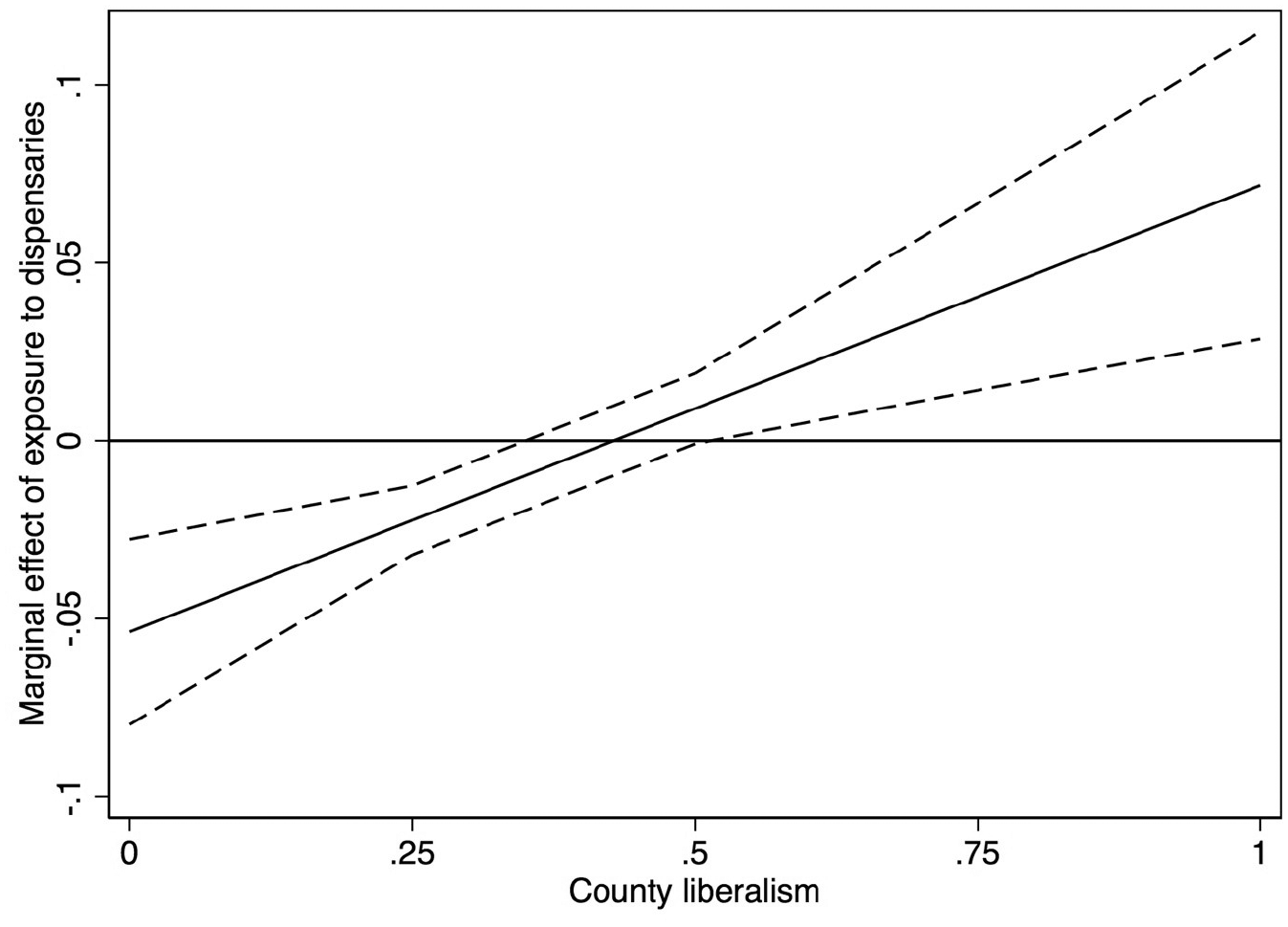
Interaction Effect between County Exposure to Dispensaries with Identity Names and County Liberalism on the Dispensary Proportion of Reviews with Stigma Transfer Concerns
Model 5.3 is the same as Model 5.2 except that instead of the variable exposure to dispensaries with identity names, we interact the variable county liberalism with the variable exposure to reviews with open attitudes. Both within and between interactions are positive as predicted but not statistically significant, meaning that the impact of the mechanism of exposure to reviews with open attitudes is not significantly attenuated in more liberal regions. Model 5.4 is a fully saturated model with all interactions together. The interaction between exposure to dispensaries (within) and county liberalism (within) is still positive and significant, as expected.
In additional analyses at the state level (available in the Online Appendix), we find that controlling for state liberalism, the impact of the mechanism of exposure to dispensaries with identity names on stigma concerns is further attenuated with increasing state polarization, defined as the divergence of political attitudes and opinions to ideological extremes (Fiorina and Abrams, 2008). 7 This finding is consistent with previous research showing that polarization leads to more extreme beliefs and behavior (Fiorina, Abrams, and Pope, 2005; Baldassarri and Bearman, 2007) and thus suggesting that in highly polarized regions, individuals inclined to more extreme attitudes and actions are less likely to hide their association with stigmatized entities and be concerned about stigma transfer, rendering identity exposure mechanisms less important.
Robustness Checks
Endogeneity concerns
One possible concern with our analyses is reverse causality: dispensaries may pick their names in reaction to consumer reviews. In our setting, however, the event timing suggests that classic reverse causality is not a problem. Dispensaries pick their names before launching their operations and thus before they start receiving reviews. This means that reviewers’ comments about a focal dispensary cannot determine the dispensary’s name choice. But hypothetical comments that founders of a new dispensary may believe their organization could receive once it starts its operations could potentially affect the choice of the new venture’s name.
To account for this possible endogeneity properly, we ran our models using an instrumental variable two-stage least squares estimation with the cluster option on dispensary ID. This specification is used for an exactly identified model and under the assumptions of conditional homoskedasticity and independence (Hayashi, 2000). The test of endogeneity was not significant, and for this reason, we do not report the instrumental variable models as our main models (Nichols, 2007). Instead, we report them as a robustness check.
We chose the variable The Kauffman Index of Growth Entrepreneurship: State Trends as our instrument. It is based on an index that ranks U.S. states on three composite indicators: rate of startup growth, share of scale-ups, and high-growth company density. Essentially the index is a measure of how states compare in terms of how conducive the environment is for entrepreneurs to flourish—i.e., how startup-friendly each state is. This index is updated annually and ranks all 50 U.S. states. The Kauffman Index is broken up into two groups: the 25 largest and 25 smallest states by population. Each group is then ranked from 1 to 25 in terms of how supportive or friendly the state is toward entrepreneurial growth, with 1 being the most entrepreneurship-friendly state and 25 being the least.
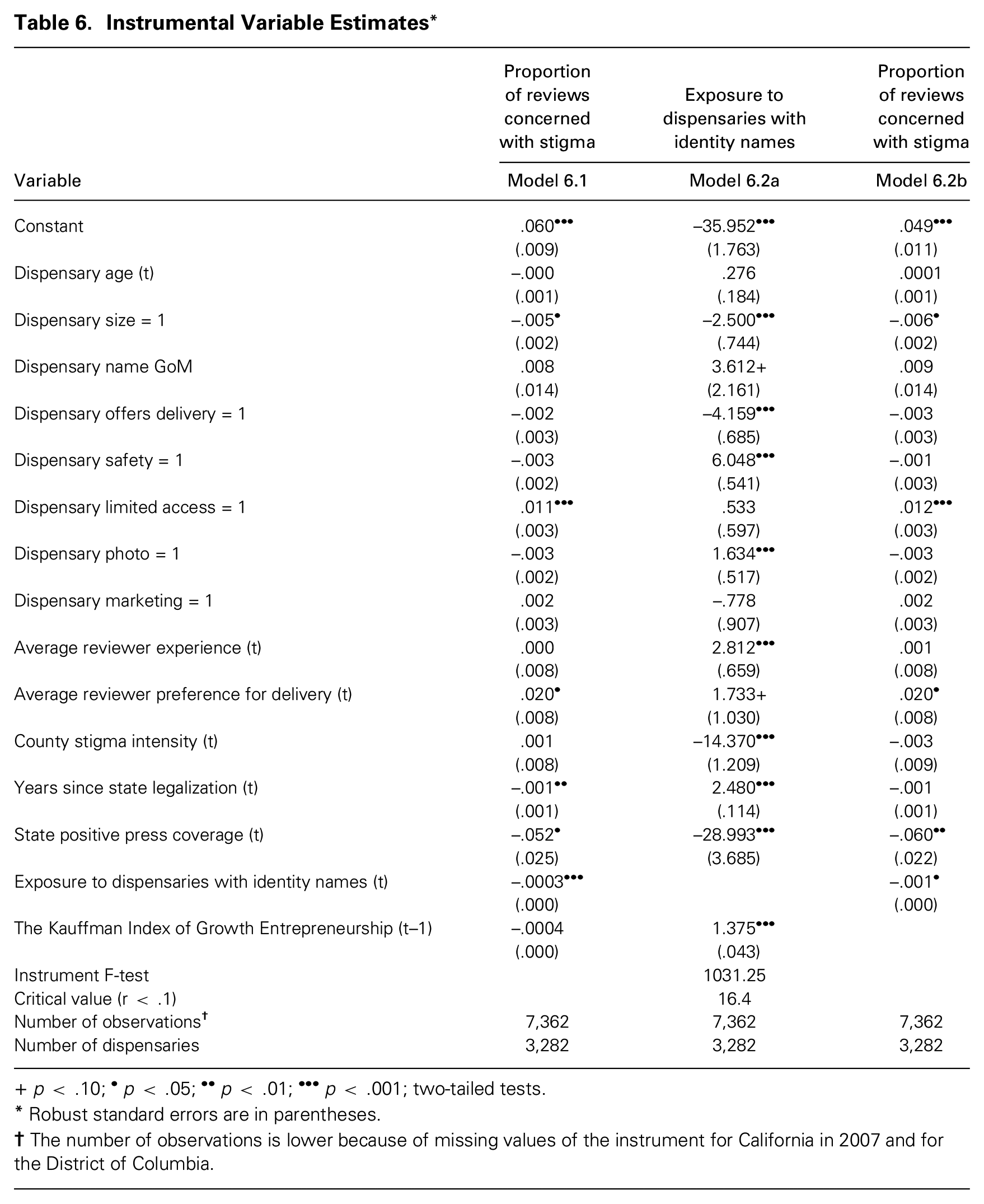
Table 6 shows the instrumental variable estimates. We believe that the Kauffman index is a good instrumental variable for two reasons. First, the large majority of entrepreneurial ventures are likely to be in markets that are not stigmatized. Therefore, the heterogeneity in state growth of entrepreneurship is unlikely to be driven by the underlying social stigma associated with marijuana use. In other words, the ease or difficulty of starting and growing a new business in a state is not correlated with stigma attached to the marijuana industry (or to any other stigmatized industry). Thus the chosen instrument is not correlated with our dependent variable and can be claimed to be a source of exogenous variation. Second, a state’s friendliness toward entrepreneurship is likely correlated with dispensaries’ founders choosing names with clear references to marijuana. In states that make it very difficult to start and grow a new business, entrepreneurs need to be very dedicated and passionate about their venture and its products. Otherwise, it may not be worth all the trouble and risk to start the business. Individuals who are very passionate about cannabis and truly believe in the product are more likely to start a business with a name that clearly communicates that they sell marijuana.
Instrumental Variable Estimates*
p < .10; •p < .05; ••p < .01; •••p < .001; two-tailed tests.
Robust standard errors are in parentheses.
The number of observations is lower because of missing values of the instrument for California in 2007 and for the District of Columbia.
We cannot statistically test for the exogeneity of a single instrument, because the model is exactly identified. Instead, following Dahl and Sorenson (2012), we report Model 6.1, which is a reduced-form OLS model (predicting the proportion of reviews concerned with stigma) that includes both the instrument Kauffman Index of Growth Entrepreneurship and the instrumented variable exposure to dispensaries with identity names as covariates. Although this is not a formal test of exogeneity, the results suggest that the Kauffman index has no direct effect on the proportion of reviews concerned with stigma, controlling for the exposure to dispensaries with identity names, which lends some confidence to the assumption that we can exclude it from the structural model (Model 6.2b).
We then test for a weak instrument by computing the F-test for the excluded instrument in the first-stage regression in Model 6.2a (Stock and Yogo, 2005). The model shows that the F-test is 1031.25 with a p-value of .000. These values far exceed the critical threshold of 16.4 to ensure that the two-stage least-squares estimates have no more than 10 percent of bias of the OLS estimates. This reveals that the instrument influences the exposure to dispensaries with identity names. Thus the test indicates that the chosen instrument is strong.
In the second stage, the effect of exposure to dispensaries with identity names estimated based on the exogenous instrument of the Kauffman index remains significant and negative in Model 6.2b that predicts a dispensary’s proportion of reviews concerned with stigma. The size of the coefficient on exposure to dispensaries with identity names is greater in Model 6.2b (the IV estimation) than in Model 6.1 (the OLS estimation). These results reveal that if we account for endogeneity, our predicted effect is even larger.
Alternative operationalization of variables 8
In the reported models, the county liberalism variable is based on coding respondents as having liberal views if they self-identified in the GSS as extremely liberal, liberal, or slightly liberal. As a robustness check, we built a more conservative measure by accounting for respondents who self-identified only as either extremely liberal or liberal. All predicted results held with this new measure. The AIC test revealed that the models reported in the paper have a superior statistical fit.
The variable county stigma intensity is based on respondents who answered either “no” or “don’t know” to the GSS question of whether the use of marijuana should be made legal. As a robustness check, we rebuilt this variable accounting only for respondents who answered “no.” All results strongly held with this more conservative measure. The AIC test revealed that models based on this measure did not have a better statistical fit compared with the reported models.
We checked for robustness of the variable years since state legalization of cannabis. In the reported models, it is based on the number of years since the approval of the law. But in some states, a significant amount of time may elapse between the approval of the law and when it comes into effect. We reran all models with an alternative version of the variable based on the number of years since the legalization of medical marijuana actually went into effect in a given state. All results strongly held with this alternative measure.
The variable exposure to dispensaries with identity names measures exposure to all dispensaries that consumers have a chance to encounter in a given county. Because we have a separate control for a focal dispensary name GoM, as a robustness check, we omitted its value from calculating the exposure to dispensaries with identity names. All results strongly held with this alternative measure.
Additional controls
The reported models control for two characteristics of an average user who writes reviews about a dispensary in a given year: (a) reviewing experience (in years on Weedmaps.com) and (b) preference for delivery (the proportion of reviews that contain the word “delivery”). In a robustness check, we added three more controls for an average reviewer’s characteristics at the dispensary-year level: (1) the average experience of reviewers based on the number of reviews they have submitted by a given year, (2) the proportion of reviews that contain the word “price,” and (3) the proportion of reviews that contain the word “selection.” All results held when we controlled for all five variables. We decided to include only two variables (that showed significant effects) in reported models for statistical parsimony.
Alternative explanations
One possible alternative explanation for our findings related to exposure to dispensaries that broadcast their marijuana identity through names is that this effect is mostly driven by market leaders, who may have a disproportionate effect on industry discourse. To rule out this explanation, we separated out the variable exposure to dispensaries with identity names into two variables: exposure to market leaders with identity names and exposure to market non-leaders with identity names. We operationalized market leaders in several ways both at the county and state levels: (a) the dispensary with the highest number of reviews in a county (state) in a given year, and (b) the 10 percent and (c) 25 percent of dispensaries with the highest number of reviews in a county (state) in a given year. We found that greater exposure to both market leaders and non-leader dispensaries with identity names decreases customers’ stigma transfer concerns, but across different leader operationalizations, these effects are more robust for the exposure to non-leading dispensaries than to market leaders. While interesting, these findings do not undermine our current theoretical rationale.
Another alternative explanation related to our findings about the exposure to user reviews with open attitudes about marijuana is that customers reading reviews may react not to open attitudes but rather to the identity shifts or self-relabeling rationalizations of marijuana users as patients and marijuana consumption as healing or a health-related activity. To address this concern, we created two new variables that capture identity shifts through relabeling processes in consumer reviews. First, we created a variable that measures exposure to reviews that mention the word “patient.” The second variable utilized our SenseClusters approach in order to identify exposure to reviews that mention health-related words, including patient(s), hospital, treatment(s), meds, clinic(s), doctor, physician, ill, caregiver, AIDS, depression, epilepsy, therapeutic, cancer, anxiety, chemotherapy, cure, homeopathic, leukemia, wellness, and health. When we included these two variables in our models, all previous findings about the exposure to user reviews with open attitudes strongly held. Thus, after controlling for the degree to which consumers are exposed to such relabeling processes in reviews, we still find support for our hypothesized effects of the identity exposure mechanisms.
Another alternative explanation is that when writing their reviews, users react not to the identity exposure mechanisms but to reviews other consumers wrote before them. If previous reviews expressed stigma concerns, users may be more likely to express stigma concerns in their reviews as well, and if previous reviews expressed few stigma concerns, users may be less likely to express such concerns. To rule out this alternative explanation, we reran all models by adding the variable exposure to reviews with stigma transfer concerns submitted in the previous year. As expected, the between and within coefficients for this variable were positive and significant. All previous findings strongly held, except for the exposure to dispensaries with identity names in the fully saturated Model 4.4.
Alternative samples
During our observation period, only dispensaries in Colorado could operate as recreational and only starting in January 2014. Our data end in July 2014. As a result, very few recreational dispensaries exist in our database, but we do not know who they were. Dropping all dispensaries that operated in Colorado from January to July 2014 made the (within) effect of exposure to dispensaries with identity names in the fully saturated Model 4.4 marginally significant, but all other results strongly held.
Because some dispensaries have missing county-level data, we excluded them from reported analyses. But as a robustness check, we reran analyses at the state level, which allowed us to keep all dispensaries in the dataset. These state-level analyses on a full population of dispensaries showed support for all our hypotheses.
Discussion
The literature on organizational and categorical stigma has flourished over the last couple of decades. Scholars have produced an impressive corpus of research on strategic actions that firms undertake to manage their stigma with an objective to improve the level of engagement with their audiences (for a review, see Thomson, 2018). Less understood, however, is the question of whether audiences change their perceptions of stigmatized organizations in response to organizational actions and whether industry dynamics play a role in the process of this destigmatization (for a similar point, see Helms and Patterson, 2014).
We have attempted to address this theoretical lacuna in the context of a stigmatized yet recently legalized industry. We investigated how audiences come to accept categorical stigma by studying processes that reduce consumers’ concerns about stigma transfer. We suggested that customers will become less concerned about stigma the more they are exposed to organizational identities of producers in the stigmatized market. We proposed two mechanisms for this identity exposure: (1) through exposure to organizations that publicly broadcast and celebrate their identities in their names and (2) through exposure to the attitudes of customers who openly discuss identities of stigmatized organizations with which they engage. We also suggested that customer concerns about stigma will be lower in highly liberal regions, and as a result, the impact of the exposure mechanisms will be attenuated in such areas.
We tested our predictions in the U.S. medical marijuana market and specifically in the online community for this market—Weedmaps.com—from its inception in 2008 through 2014. Analyses revealed the following key findings. First, identity exposure mechanisms significantly reduce the stigma transfer concerns of customers who engage with organizations in the medical cannabis market. The greater the number of dispensaries that explicitly broadcast a marijuana identity in their names, the less consumers express their concerns about stigma transfer in online reviews of dispensaries. And the greater the number of online reviews openly discussing dispensaries and cannabis products that consumers encounter, the less they express concerns about stigma transfer in their own reviews. Second, we found that the destigmatizing effects of identity exposure are attenuated in more liberal counties and highly polarized states.
When generalizing the findings from this study, one should keep in mind limitations related to the nature of our empirical setting. Although the U.S. medical marijuana market is highly appropriate for testing our theory, it is a unique population in several aspects. First, a distinctive feature of this industry is its strong online presence. We think that exposure mechanisms will be weaker in markets that do not have an online presence, because consumers encounter fewer organizations that broadcast their identities and come across fewer customers who are open about engagement with such organizations offline than online. Second, the U.S. marijuana market during our observation period was populated by single-product firms that produced and sold only cannabis and cannabis-related products. A single-product organization has fewer options to consider than a multi-product firm does when deciding whether to broadcast its identity in the name. Multi-product firms have an incentive to choose names connecting them to the non-stigmatized markets they participate in to play up their legitimate offerings and divert attention away from offerings deemed shady (Vergne, 2012). As a result, the exposure mechanism through organizational names may not be as common in stigmatized markets populated by multi-product companies. Comparative studies of stigmatized markets populated by single-product and multi-product firms are necessary to establish this difference, as well as to uncover additional mechanisms that may drive destigmatization in markets dominated by multi-product organizations.
Keeping these limitations in mind, this study contributes to several literatures. First, it has important implications for organizational research on categorical stigma (e.g., Piazza and Peretti, 2015; Lashley and Pollock, 2020). This study is one of very few we were able to identify that investigates in a systematic, quantitative way the processes that facilitate audience acceptance of organizations with categorical stigma (see also Vergne, 2012). This differs from, and complements, previous research that has generally explored how to alleviate categorical stigma by predominately focusing on strategic actions of organizations that seek to manage their own stigma (Wolfe and Blithe, 2015; Grougio, Dedoulis, and Leventis, 2016). Our findings suggest that industry processes in the form of the actions of many organizations, on one hand, and many customers, on the other hand, play a consequential role in mitigating audience concerns about stigma transfer. Thus our study suggests that categorical stigma can be mitigated not only at the level of an individual organization through its strategic actions but also at the industry level through similar (but not necessarily coordinated) actions of many organizations and their customers. Importantly, we uncover two mechanisms of identity exposure behind these processes and believe they can be important steps to destigmatizing a whole market.
Our study also contributes to the literature on categorical stigma in another way. This literature tends to study how strategic actions of organizations to mitigate stigma affect organizational performance and survival. They simply assume—but do not directly establish—a beneficial effect of these actions on audiences’ attitudes and reactions to organizations with categorical stigma (but see qualitative studies by Hudson and Okhuysen, 2009; Helms and Patterson, 2014). We directly investigate how the actions of organizations and customers reduce consumers’ concerns about stigma transfer, and we suggest a novel mechanism of identity exposure as a tool for changing customers’ attitudes and reactions to categorical stigma.
Next, we contribute to research on organizational identity (Whetten, 2006; Hannan, Polós, and Carroll, 2007) by revealing an underexplored function of organizational identity: its role in mitigating categorical stigma. We developed a novel theory of identity exposure and identified two distinct mechanisms through which it operates: through firms being open about their organizational identities and through consumers being open about their engagement with stigmatized organizations. We also contribute to the organizational literature on names, which has shown that audiences rely on names to make inferences about organizational and product identities (Lee, 2001; Glynn and Abzug, 2002; Khessina and Reis, 2016). Research has found that producers use pseudonyms to hide their association with a stigmatized market, which leads to the persistence of categorical stigma (Phillips and Kim, 2009). By contrast, our study reveals that organizational names can help market destigmatization if producers choose names that expose and celebrate their organizational identities.
Our findings are also relevant to research on market transitions from illegal economies (i.e., black markets) to legalized industries (Webb et al., 2009). Recent examples of such markets include sports betting and online gambling. We show that although legalization does not remove the categorical stigma of past illegal activities from a newly legalized market, the mechanisms of identity exposure may significantly reduce it. Additionally, we contribute to research on ecological processes driving industry change (for a review, see Carroll and Khessina, 2019) by offering a novel construct of identity exposure that explains evolutionary changes in stigmatized markets.
This study may elicit new questions and fruitful directions for future research. One productive avenue is to investigate how audiences other than customers come to accept categorical stigma. Other possible directions are to identify specific tools for identity exposure depending on the nature of an industry or market segment, as well as to uncover additional industry-level mechanisms that may change stigma acceptance by audiences. Another possibility for future research concerns audience heterogeneity. The extant literature on stigma has generally assumed that members of the same audience ascribe and process categorical stigma equally. Yet stigmatized markets, like most markets, are composed of heterogeneous audience members who may interpret processes related to stigma differently. For example, we found that more liberal audiences are less concerned about categorical stigma. Consequently, very liberal regions depend less on the identity exposure mechanisms to achieve market destigmatization. It would be interesting to see what other population groups are more or less accepting of categorical stigma and consequently can either substitute for or complement the identity exposure mechanisms in market destigmatization. Finally, our analyses focus on consumers who are sensitive to the effects of stigma transfer. Understanding how less-sensitive customers (and other audiences) make sense of stigmatized industries presents a potentially fruitful course of future research.
Ultimately, categorical stigma remains a pervasive and important social phenomenon that has clear economic impacts across a broad range of markets. Greater understanding of this process will benefit these marginalized markets and the organizations operating in them.
Supplemental Material
Khessina_Reis_Verhaal_online_supp – Supplemental material for Stepping out of the Shadows: Identity Exposure as a Remedy for Stigma Transfer Concerns in the Medical Marijuana Market*
Supplemental material, Khessina_Reis_Verhaal_online_supp for Stepping out of the Shadows: Identity Exposure as a Remedy for Stigma Transfer Concerns in the Medical Marijuana Market* by Olga M. Khessina, Samira Reis and J. Cameron Verhaal in Administrative Science Quarterly
Footnotes
Acknowledgements
We would like to sincerely thank Editor Henrich Greve for his invaluable guidance in the review process and three anonymous reviewers for their extremely helpful comments and suggestions. We also greatly appreciate feedback on earlier versions of the manuscript from Matt Barlow, Stanislav Dobrev, Emre Ekinci, Balázs Kovács, Matt Kraatz, Ying Li, Jeff Lowenstein, Eduardo Melero, and Olav Sorenson; seminar participants at the University of Illinois at Urbana–Champaign and Universidad Carlos III de Madrid; and conference participants at the 2018 Organizational Ecology Workshop and 2019 Academy of Management Meeting. We are thankful to Joshua Katz and Ying Li for help with data collection and Andre Santoloni for processing the New York Times data. Special thanks go to Joan Friedman for helping with copyediting the manuscript. Finally, we gratefully acknowledge financial support from the Gies College of Business at the University of Illinois at Urbana–Champaign and the Spanish FEDER/Ministerio de Ciencia e Innovación – Agencia Estatal de Investigación (Grant RTI2018-097033-B-I00). A six-page abridged version of an earlier manuscript appeared in the 2019 Academy of Management Best Paper Proceedings.
Supplemental Material
Supplemental material for this article can be found in the Online Appendix at  .
.
1
Importantly, the data collected for this study end in 2014, which is the same year that the first U.S. state (Colorado) legalized recreational marijuana dispensaries. We do this intentionally because public perceptions of stigma, and the processes underpinning destigmatization, may manifest differently for these recreational dispensaries.
2
As of October 18, 2020.
3
Several research papers in the general field of management and organizations use data from Weedmaps (e.g., Washburn and Klein, 2016; Hsu, Koçak, and Kovács, 2018; Hsu, Kovács, and Koçak, 2019). But none of them has studied stigmatization (destigmatization) processes. A few papers based on data collected elsewhere have studied destigmatization of the U.S. marijuana market (e.g., Dioun, 2018; Lashley and Pollock, 2020). But they have focused more on historical actions of organizations and social activists than on audiences’ reactions to these actions. Our paper complements this research by specifically exploring customers’ reactions and the change in their attitudes toward the stigmatized market (i.e., change in consumers’ stigma transfer concerns) using quantitative methods on a large-scale database.
5
In industries in which multi-product companies are common, broadcasting an organizational identity through a name can be infrequent, because firms with multiple unrelated products may not want to choose a name that binds them to only one industry. But in the marijuana dispensary market, unrelated diversification is extremely uncommon (and is often forbidden by law). Our investigation revealed that during the observation period, most if not all dispensaries sold only cannabis and cannabis-related products (e.g., marijuana, pipes, vaporizers, edibles, merchandise such as t-shirts with cannabis graphics). We did not identify any multi-product (not related to cannabis) companies.
6
Because one cannot rely on factor variable notation when creating an interaction based on within variation, post-estimation commands, such as Stata’s margins, cannot be used. Instead, one needs to generate the interaction term, cluster mean center the new variable, and then enter the new variable into the model (Schunck, 2013). Then it is possible to estimate the interaction effect by using the lincom Stata command to compute the point estimates and confidence intervals (Schmidt-Catran and Spies, 2016, ).
7
We cannot include the polarization variable in reported county-level analyses because it is measured at the state level (Shor and McCarty, 2015). Political scientists define polarization as situations in which during legislative roll call votes, conservative lawmakers vote only with other conservatives and never with liberals, and liberal lawmakers vote only with other liberals and never with conservatives (McCarty and Shor, 2016). As a result, polarization is measured at the level of partisanship in political spheres, such as state or federal legislatures (McCarty, Poole, and Rosenthal, 1997).
Authors’ Biographies
References
Supplementary Material
Please find the following supplemental material available below.
For Open Access articles published under a Creative Commons License, all supplemental material carries the same license as the article it is associated with.
For non-Open Access articles published, all supplemental material carries a non-exclusive license, and permission requests for re-use of supplemental material or any part of supplemental material shall be sent directly to the copyright owner as specified in the copyright notice associated with the article.
