



Abstract
This paper examines the emergence of temporal coordination among multiple interdependent routines in a complex work setting that does not allow for up-front scheduling. We propose that when actors continuously have to prioritize their expected contributions to multiple interdependent routines, they address this challenge by orienting not just toward routines but also toward person-roles. Drawing on an ethnographic study of an agile consulting project team confronted with continued scheduling failures, we demonstrate how the dynamics of prioritizing enabled the actors to resolve what at first appeared to be an irresolvable and highly complex problem of temporal coordination. We add to the literature on routine dynamics and temporality by setting forth the dynamics of prioritizing as an explanation for the temporal patterning of complex work settings. We introduce the notion of role–routine ecologies as a novel way to conceptualize such complex work settings and contribute to developing a performative theory of person-roles and their significance for coordinating.
In complex work settings, actors frequently experience an intricate challenge of temporal coordination. They face more deadlines than they can meet, and thus they have to prioritize. In addition, they need to take into account the prioritizing of others who might have conflicting and shifting priorities. It is therefore often not feasible to agree on a common rank order of urgency up front, e.g., a formal schedule that works for everyone. Instead, actors have to prioritize dynamically, somehow dealing with conflicting and shifting rank orders of urgency. To date, we know very little about how actors confront this dynamic and complex challenge of temporal coordination.
Prior research has long recognized that organizational routines play an important part in temporal coordination (e.g., Stene, 1940; Cyert and March, 1992; Turner and Rindova, 2018). Understood as endogenously dynamic action patterns (Feldman and Pentland, 2003), routines have proven to be specifically relevant for understanding how temporal coordination is accomplished in practice. Prior studies have shown how actors engage in sequence-based or timing-based patterning to temporally coordinate their actions within the performance of a single routine (Turner and Rindova, 2012, 2018). But these studies pay little attention to the question of how actors manage participation across multiple routines (Feldman et al., 2016). This question is particularly pertinent in more-complex work settings in which actors have to deal with a variety of tasks simultaneously, and to do so they need inputs from multiple other internal or external actors who themselves are dealing with a variety of tasks (Briscoe and Rogan, 2016). Against this backdrop, we explore an important yet underappreciated puzzle related to routine dynamics in complex work settings: How do actors temporally pattern the performance of multiple, interdependent routines when up-front scheduling is not an option?
To do so, we investigated the emergence of temporal patterning among multiple routines within an agile management consulting team. The puzzle was particularly salient in this case because the most obvious solution, designing a formal schedule, did not work. As in many other agile work settings (Dikert, Paasivaara, and Lassenius, 2016), team members were involved in multiple parallel performances of routines, often also spread across multiple projects. Hence every project schedule would have needed to be aligned with numerous other project schedules. This increased the complexity of the implied scheduling task to a point where the project team was unable to come up with a formal project schedule that would work for everyone. In fact, when the team tried to establish internal deadlines to coordinate its work, these were hardly ever met and generated numerous temporal conflicts. Surprisingly though, the team did manage to meet all key external project deadlines in the end—it somehow addressed this highly complex challenge of temporal coordination in a viable way.
In analyzing how the consultants resolved this challenge, we found that they oriented their actions not just toward organizational routines but also toward person-roles: social-relational patterns in a person’s behavior (Turner, 1990; Hernes, 2014; Luhmann, 2018). Person-roles enabled actors to deal with multiple and shifting rank orders of urgency by changing the question from “When do I have to do what?” to “Whose request is more important to me right now?” That is, actors prioritized by transcending the task orientation of routine performances, also focusing on whether the timing of their actions would be recognized as appropriate by significant others, a novel mechanism that we call role-based prioritizing. Over time, this mechanism generated role–routine couplings, as the temporal pattern of a focal routine was adjusted to fit the temporal preferences of a specific person-role, and temporal ripple effects, as the temporal patterning of one routine indirectly patterned other routines. Together, and over time, the combination of these mechanisms led to the emergence of a negotiated temporal order that was a viable solution to the problems of temporal coordination with which the consultants struggled at the beginning of the project.
The Challenge of Temporally Coordinating Multiple Routines
Contrary to the traditional conceptualization of routines as “codified blueprint[s] of action” (Van de Ven, Delbecq, and Koenig, 1976: 323), the recent literature on routine dynamics shifts attention to their processual nature as emergent and generative action patterns (Feldman and Pentland, 2003; Pentland et al., 2012; Feldman, 2016). In line with this literature, we define organizational routines as “repetitive, recognizable pattern[s] of interdependent actions, involving multiple actors” (Feldman and Pentland, 2003: 96) that are oriented toward the accomplishment of a “day-to-day operational task” (Rerup and Feldman, 2011: 584) and emerge as their constituent actions become reflective of each other (Kremser, Pentland, and Brunswicker, 2019).
A core issue in routine dynamics research is how “the specific actions taken by specific people at specific times” (Feldman and Pentland, 2003: 101) become recognized and enacted as patterns, a process Feldman (2016) has called “patterning.” Patterning entails the ways in which “participants engage in and reflect on action sequences, and share information and understanding through connections with other routine participants” (Turner and Rindova, 2018: 1253). In patterning, actors select and arrange the actions they need to perform so that they “fit together to form joint action” (Dionysiou and Tsoukas, 2013: 186). The concept of patterning thus highlights the ongoing and emergent coordinating inherent also in the performance of routines (Faraj and Xiao, 2006; Bechky and Okhuysen, 2011; Jarzabkowski, Lê, and Feldman, 2012; Bechky and Chung, 2018).
In our study, we join other recent scholarship that focuses on the key role of temporality in the patterning of routine performances (Turner and Fern, 2012; Turner and Rindova, 2012, 2018; Turner, 2014; Howard-Grenville and Rerup, 2017). A focus on temporality reveals that patterning is necessarily also about skillfully arranging and relating actions in time. Recently, Turner and Rindova (2018) elaborated on two distinct forms of temporal patterning within single routines: sequence-based and timing-based. In sequence-based patterning, actors observe and develop a shared understanding of which actions ought to precede or succeed which other actions within an unfolding routine performance (Pentland and Rueter, 1994; Pentland and Feldman, 2007; Pentland, Hærem, and Hillison, 2010). They do so by drawing on subjective, cyclical event time; they ‘‘use the event as a reference point for things that happen before and after’’ (Ancona, Okhuysen, and Perlow, 2001: 515). By treating each action as an event in an unfolding series, actors can recognize patterns in “the order of occurrence of multiple actions” (Turner and Rindova, 2018: 1256) and develop expectations about their sequence. These expectations, in turn, guide further routine performances (Danner-Schröder and Geiger, 2016; LeBaron et al., 2016).
By contrast, timing-based patterning reflects how “the act of performing routines in similar ways can establish expectations for when things happen” (Turner, 2014: 127). In timing-based patterning, actors link routine performances to clock time, i.e., time as “divisible into objective, quantifiable units such that the units are homogeneous, uniform, regular, precise, deterministic, and measurable” (Ancona, Okhuysen, and Perlow, 2001: 514). Such linking is particularly useful for patterning routine performances that are dispersed in time and space or that occur across organizational boundaries. For example, in a series of studies, Turner and Rindova (2012, 2018) demonstrated how the consistent, recurrent performance of a garbage collection routine at specific times of the day generated rigid customer expectations about when the specific steps in this routine would be performed. This timing pattern facilitated coordination between customers and garbage collectors, yet it also exerted a strong pressure on the latter to uphold this pattern by consistently performing the routine at the same times each week.
Previous research has thus established that the temporal patterning of routines can refer both to their endogenous sequence and to the timing of their constituent actions in relation to an exogenous timeframe. Both of these temporal patterning strategies, however, rely on one shared and consistent rank order of urgency—either in the form of a shared sequential pattern or in the form of an integrated schedule. In both cases, actors will agree on which actions are more or less urgent at each point in time.
Notwithstanding these advancements of knowledge on the temporal patterning of single routines, Turner and Rindova (2018: 1275) concluded that future research needs to explicitly illuminate “how routine participants coordinate actions not only within, but also across routines.” This call also reflects the more general recognition that routine dynamics research needs to “move beyond organizational routines as the unit of analysis and consider relations among routines” (Feldman et al., 2016: 511). Only very recently, scholars have begun to elaborate on how collective organizational outcomes depend on the orchestration of multiple interdependent routines rather than on the performance of a single routine (e.g., Deken et al., 2016; Sele and Grand, 2016; Geiger, Danner-Schröder, and Kremser, 2020).
Temporal patterning across multiple routines is particularly challenging in various new work settings that can be collectively described as complex (Briscoe and Rogan, 2016; Dobusch et al., 2017; Bechky and Chung, 2018). These include agile organizations that rely on multiple self-organizing teams as well as project-based organizing (Dikert, Paasivaara, and Lassenius, 2016; Lee and Edmondson, 2017). Such settings require actors to make contributions to multiple routines, sometimes across several projects. As a result, actors often find themselves having to prioritize, but what appears urgent and important to one actor might seem less so to another. Thus, conflicts over the temporal patterning of multiple routines are likely to arise and further complexify coordination. Both sequence- and timing-based patterning are ill-suited to resolve the implied coordination challenge because they rely on one consistent rank order of urgency, a requirement that is at odds with the dynamism of complex work settings (e.g., Faraj and Xiao, 2006; Kellogg, Orlikowski, and Yates, 2006; Valentine, 2018). To explain how actors temporally coordinate multiple routines in such settings, we therefore need to pay closer attention to their strategies of prioritizing dynamically, in light of both emergent contingencies and changing priorities.
This insight points us toward the intersecting dynamics of routine performances and individual actors’ lines of conduct, i.e., their continuous stream of activity that can become recognized as contributing to multiple patterns at the same time (Sewell, 1992). For example, an actor could interpret the sequential order in another actor’s line of conduct as an indication of that actor’s priorities and take this as a starting point when prioritizing her routine contributions. The timing of actions within actors’ lines of conduct—their enacted priorities—could thus connect “not only participants within a routine but also routines within actors, supporting the agentic performance of multiple routines by these actors” (Turner and Rindova, 2018: 1275). This insight suggests that each actor’s line of conduct can contribute to temporally integrating multiple routines in an emergent manner because it establishes temporal relations between them. Paying closer attention to how individual actors perform their lines of conduct in complex work settings thus promises to shed new light on the temporal coordination of multiple routines. To unpack patterns in an individual actor’s line of conduct, organization theory often draws on the concept of role, which we turn to next.
Roles as a Principle of Temporally Patterning Multiple Routines
Roles can be broadly defined as patterns of action “tied together only by their emanation from a single individual who is oriented to a single status during the period of his action” (Turner, 1990: 88f.). Roles have been theorized in various ways in the social sciences in general (e.g., Mead, 1934; Turner, 1956; Goffman, 1959) and organization studies in particular (e.g., Hughes, 1937; Katz and Kahn, 1978; Bechky, 2006). Interactionist role theory (Mead, 1934; Blumer, 1969; Turner, 1990) is especially relevant for our concerns. Its focus on role performances provides us with a dynamic understanding of roles that is compatible with and therefore able to complement current theorizing on routine dynamics (see Dionysiou and Tsoukas, 2013). Interactionist role theory posits that “[r]oles are continuously constructed and reconstructed as individuals engage in . . . interaction with incumbents of alter roles” (Turner, 2006: 252). This also implies that, just as a standard operating procedure differs from the routine understood as an action pattern (Reynaud, 2005), the formal organizational role of a person will often be quite different from and less specific than this person’s enacted “working role” (Turner, 2006: 243).
Exactly as the pattern of the routine can be broken down into numerous routine performances (Goh and Pentland, 2019), the pattern of a role is made up of numerous role performances (Katz and Kahn, 1978; Lynch, 2007). A role performance is a sequence of actions during which a role’s functional accountabilities and relative social positions are partially (re)negotiated. Functional accountabilities are the “task requirements of different roles and how they relate to one another” (Okhuysen and Bechky, 2009: 476), i.e., the set of tasks—often also including contributions to routines—a specific role is expected to perform. Relative social positions refer to the relations of deference that connect a focal role to other roles within its role set (Merton, 1957; Sauder, Lynn, and Podolny, 2012). Because the pattern of a role usually entails a quite complex set of work relations, any one performance of that role can focus on only a few aspects (Katz and Kahn, 1978).
We understand a typical role performance as involving at least two actors—ego and alter—who engage in either one or both of two generic processes: role-taking and role-making (Katz and Kahn, 1978). Role-taking begins with “looking at or anticipating another’s behavior by viewing it in the context of a role imputed to that other” (Turner, 1956: 316). It entails that ego enacts his or her role by taking the role of alter, i.e., in anticipation of alter’s possible reactions. Role-making, in turn, occurs when ego’s actions establish a relation to alter’s role by signaling how ego envisions alter’s role (Katz and Kahn, 1978). As a whole, each performance of a role will be an important reference point during the next performance of this role. This amounts to endogenous role dynamics during which the pattern of a role is partially (re)negotiated (Katz and Kahn, 1978; Bechky, 2006).
An often sidestepped implication of this conception of roles as endogenously dynamic patterns of action is that, over time, it becomes more and more likely that each person will give his or her role “a content different from the content that another person would have given it” (Hernes, 2014: 101). One project manager might become known for being very relaxed in her attitude toward the regular tardiness of a specific employee. Another might be feared for sanctioning this employee if he comes two minutes late to a meeting. We expect that these person-specific aspects of enacted roles will be highly relevant in complex work settings in which multiple actors might share the same formal role but perform it entirely differently. To emphasize this performative and person-specific aspect of roles, we therefore join others in using the term person-roles (Hernes, 2014; for a related conception, see also Luhmann, 1995, 2018).
This conceptualization helps us to shed new light on the relation as well as the difference between person-roles and organizational routines. Crucially, any action of a specific person at a specific time and place might become recognized as part of a routine performance and the performance of a person-role at the same time. A team member, for example, can prioritize her contribution to one routine instead of another because she believes that the team leader expects her to prioritize this routine. This action then is part of performing the focal routine and, at the same time, an instance of role-taking (Dionysiou and Tsoukas, 2013). Although any one action can be part of a person-role and a routine at the same time, the patterns of person-roles and routines remain distinct. Routines pertain to sequential patterns in the way operative tasks are accomplished by multiple actors wherein “the sequence matters, not in the sense that it is always the same, but in the sense that the order in which actions are taken is often meaningful” (Feldman et al., 2016: 507). In contrast, when talking about (person) roles, we highlight the patterned aspects in an individual actor’s relationships to members of her role set (Katz and Kahn, 1978; Hernes, 2014; Luhmann, 2018).
Person-roles can become principles of temporally patterning routines when, as in complex work settings, the functional accountabilities of a person-role entail contributions to multiple routines. Since making a contribution to one routine usually implies not making a contribution to another, enacting a given person-role necessarily imposes some kind of temporal organization among the routines in and through that person’s line of conduct. Hence role performances might lead to the emergence of new solutions to problems of temporal coordination among routines, regardless of whether that was an intention orienting the role performance.
When routines rely on contributions not only from ego and alter but also from a larger set of relevant alter roles, this dynamic will become considerably more complex than the rather dyadic conception of role performances we have outlined above. To address this complexity, we now turn to the literature on role sets.
Negotiating Order in Complex Role Sets
Coming from structural role theory (e.g., Merton, 1957; Rizzo, House, and Lirtzman, 1970; Pfeffer and Salancik, 1975), the concept of the role set is defined as “the complex of roles associated with a single social status” (Merton, 1957: 111). It foregrounds the role conflicts that ego is likely to experience when its relevant alter roles have different, even contradictory expectations. In addition to such intra-role conflicts, complex work settings can also make it more troubling to transition between multiple roles, such as that of a parent and that of a professor—an issue which is discussed as having inter-role conflicts (Kossek and Ozeki, 1998; Ashforth, 2001; Lynch, 2007). In today’s complex work settings, both intra- and inter-role conflicts tend to be more pronounced because employees often have to collaborate with a highly diverse set of alter roles. Also, they cannot rely anymore on clearly established and broadly accepted boundaries between work and private life (Roberts, 2007).
The many (temporal) intra- and inter-role conflicts that arise in complex work settings cannot be addressed effectively by taking or making only a single alter role during dyadic interactions. A more collective approach is needed. Mead (1934: 149ff.) famously referred to this as the difference of (role) play versus game. Play, which can be likened to the basic model of role performance outlined above, refers to a dyadic interaction between ego and a single alter “where there is a simple succession of one role after another” (Mead, 1934: 159). Game refers to a more complex social situation, like a baseball game, that involves multiple relevant others, each with a different role. In a game-type situation, it becomes useful—if not necessary—for actors to address the often conflicting demands of multiple relevant alter roles by orienting themselves toward “a purpose or objective rather than a specific directive” (Turner, 1956: 320). Interactionist role theory typically conceives of this process as the gradual construction of a self that “reflects the general behavior pattern of his social group to which he belongs” (Mead, 1934: 164)—assuming a pre-existing and rather stable group pattern. Structural role theory, in turn, emphasizes that this group pattern is also the outcome of a complex combination of pre-established social facts, such as positional power (e.g., Merton, 1957; Crozier, 1964; Handel, 1979).
Bechky (2006) explicitly combined interactionist and structural role theory by adopting a negotiated order perspective (Strauss et al., 1963). This enabled her to show the importance of collective negotiation processes in creating and maintaining—rather than merely uncovering—a partially shared understanding of a purpose that enables individuals to effectively address role conflicts. She illustrated how film crew members engaged in the reflective practices of thanking, admonishing, and joking to create and maintain a shared understanding of the collective principles that governed the role set of the crew. This finding aligns with more general research on coordinating that underlines the relevance of continuous efforts at (re)creating at least a partially shared understanding of the work context to facilitate organizational coordinating (Okhuysen and Bechky, 2009). Following this work, we argue that the emergence of a negotiated temporal order in complex work settings usually relies not just on dyadic interaction but also on more collective forms of reflection, also known as “reflective talk” (Dittrich, Guérard, and Seidl, 2016).
Thus the literature on role-based coordination helps shed light on our core conceptual puzzle—the temporal patterning of multiple routines in complex work settings. Temporal coordination problems among multiple routines are likely to emerge when multiple actors within the same role set have conflicting rank orders of urgency. The resultant role conflicts can trigger role performances through which actors partially renegotiate the functional responsibilities and relative social positions of the involved person-roles. Actors can thus performatively arrive at solutions to the initial temporal coordination problems, whether that was intended or not. Over time, such ongoing negotiations can amount to a more dynamic form of prioritizing that might result in a negotiated temporal order that addresses conflicts between multiple rank orders of urgency in a dynamic way. To see how this process plays out empirically, we now turn to an empirical study of a consulting project team.
Methods
Research Site
Our analysis draws on an ethnographic study of a medium-sized agile consulting project team that worked on a large civil construction project. The second author undertook the fieldwork in 2013 at the German subsidiary of BestAdvise, a leading international consulting firm positioned in the top management consulting market. BestAdvise is a typical generalist consulting firm that offers services in different functional (e.g., strategy, organization, marketing, HR) and industry-specific (e.g., finance, automotive, transportation) areas of expertise. The project team we focus on consisted of ten members spanning two different units of BestAdvise. Most team members had not previously worked with each other on joint projects, with the exception of the project managers, Pete and Linda, who had a history of collaboration with the partner Hugh. 1 The two partners responsible for the project assembled the team specifically for that project based on the consultants’ expertise.
Consulting projects constitute a typical case of complex work settings. This makes them particularly insightful for studying the temporal patterning of multiple routines. Projects can be understood as forms of temporary organizing (Bakker et al., 2016). They are defined by having an institutionalized ending (Manning and Sydow, 2011; Lundin and Söderholm, 2013; Lundin et al., 2017): an ultimate deadline by which the project goals have to be completed. Given the high costs associated with hiring consulting teams—in Germany, daily rates often range from about €1,500 for junior consultants to about €3,500 for partners—clients usually try to negotiate a fixed price and project duration up front. All delays in the delivery of a project thus directly impact its profitability. As a consequence, temporally coordinating project work viably—avoiding costly delays and meeting all key client deadlines—is a key challenge for the involved actors. For the team we studied, repeated planning and scheduling delays posed a serious problem.
Data Collection
The second author collected observational, interview, and documentary data as an observing participant between October and December 2013. During this period, he worked with the consulting team daily, Monday through Friday. To understand temporal coordination within the project, he focused his observations on the situated actions of individual actors. He also took extensive field notes (Emerson, Fretz, and Shaw, 2011) on time-use patterns, work practices, and the formal and informal conversations he witnessed or participated in; see Table 1.
Overview of Participant Observations
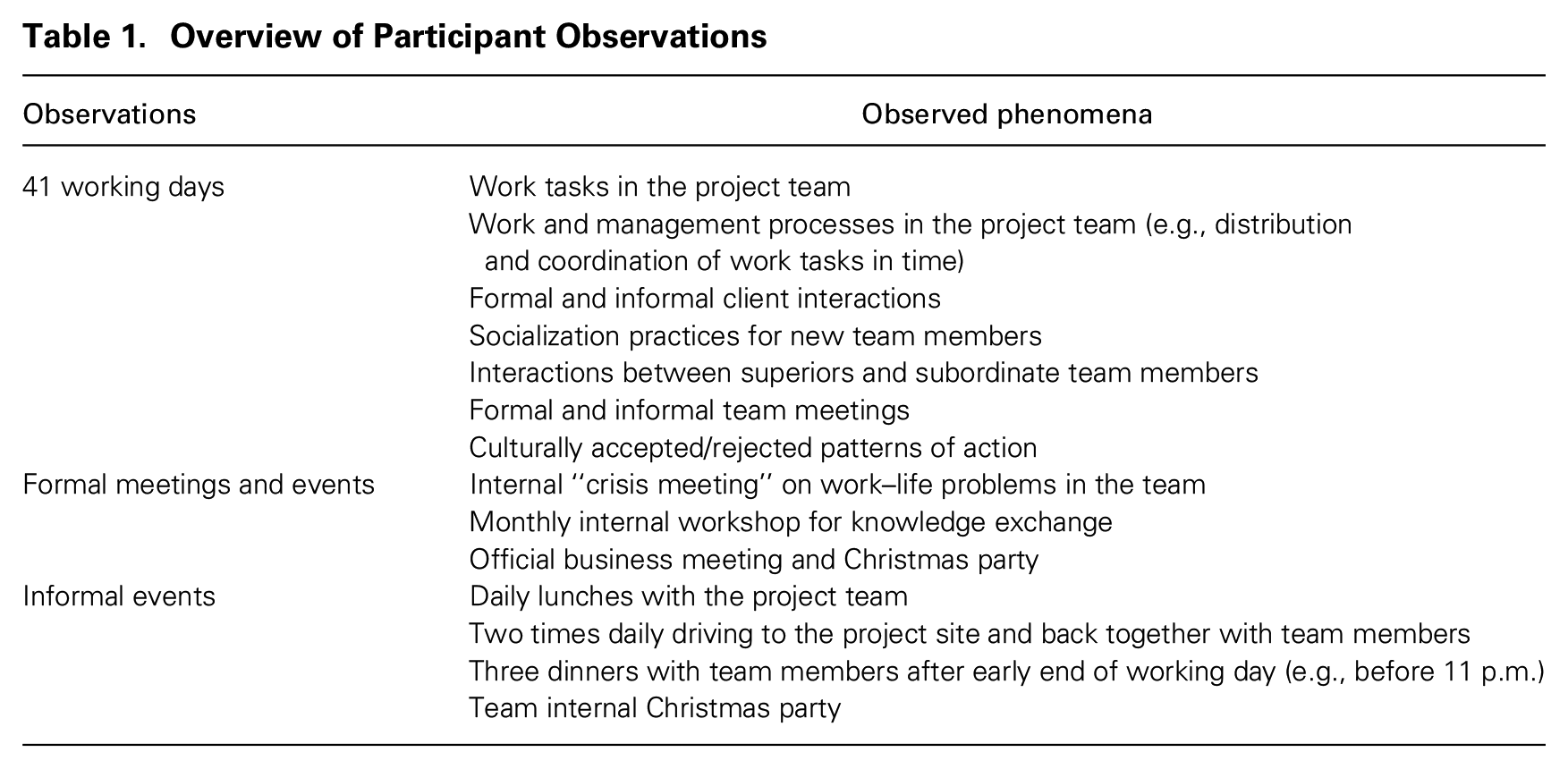
All team members generally stopped by the project managers’ area when they left for or came back from a meeting or any other appointment. Because the second author shared a desk with the two project managers, he gained a good understanding of the activities that happened beyond the locale of the project room, such as meetings with clients. He could thus take detailed field notes on team members’ activities in real time while working on his laptop. Another benefit of taking field notes on the laptop was that precise time marks were automatically added to each note. This greatly benefitted the data analysis process by allowing us to reconstruct the timing of various actions. The second author expanded field notes to more detailed reports every evening. On very long work days, he audio-recorded extensive voice memos, which he later transcribed. In total, he generated over 400 double-spaced pages of ethnographic field notes.
Throughout observations, the second author assumed the role of the “observing participant” (Gold, 1958) and worked on the same day-to-day tasks as other junior team members. At the same time, he observed team members’ work. He openly communicated the topic of the study to all team members at the beginning of the observation period. The tight integration in the work processes and the openness about the research project allowed him to develop good rapport with team members, who were very supportive.
The second author also collected internal documents and e-mails, including internal newsletters, presentations, handbooks for new project members describing key project tasks and activities and their schedules, behavioral codes, and rule catalogues for organizing projects. Of particular interest for this study were documents concerning the formal rules the project team gave itself. These included documents used to familiarize new team members with the scope and structure of the project, the team’s responsibilities and tasks, and the timing of various activities. Other documents defined the team’s culture and values, such as by listing rules for conducting client meetings.
In addition, the second author conducted 52 semi-structured interviews with BestAdvise’s consultants (16), project leads (9), partners (19), HR representatives (6), and members of the top management team (2). These interviews were useful for understanding the history and culture of BestAdvise and the broader organizational context of the consulting project, such as the various non-project-related tasks consultants also work on. Of particular relevance for our analysis are the interviews conducted with all ten members of the consulting project team, which lasted 58 minutes on average. They were designed to generate insights on how consultants temporally coordinate, organize, and structure their work every day; on the team members’ understanding of their tasks and responsibilities; and on their perceptions of how collaboration within the project team works. The interviews also helped to fill in gaps in the observational data, such as by asking members to report on how their collaboration with particular team members had unfolded. Finally, interviews were useful for understanding how team members subjectively experienced the emergent temporal patterning of their work.
Data Analysis
We analyzed our data inductively and iteratively, aiming to build theory on the temporal coordination of routines in complex work settings based on our ethnographic data (van Maanen, 1979; Bansal, Smith, and Vaara, 2018). To increase the validity of our findings, we adopted an insider–outsider approach to data analysis (e.g., Rerup and Feldman, 2011), whereby the first author assumed the role of a neutral outsider who interrogated and critically questioned the second author’s initial interpretations of the data as well as emerging theoretical ideas. Thus we were able to triangulate between multiple data sources and the interpretations of both authors (Flick, 2008). Our analytical process involved four steps that built on each other but also partially overlapped.
First, we analyzed the patterns of time use within the project team, particularly by drawing on time-stamped observational and e-mail data. We looked at what actions team members undertook at what times, and we individually coded these actions based on operative tasks they could accomplish “without further ado” (Schatzki, 2008: 122), such as editing slides, writing minutes, uploading protocols, and making phone calls. We found that, after the first few weeks of the project, most work weeks shared common time patterns, i.e., many similar actions were repeatedly performed by the same actors at similar times, day by day and week by week. This repetition of some actions inspired us to draw on organizational routines as a sensitizing concept (Blumer, 1954) for further theorizing.
Second, we combined all data into a research database using the software MaxQDA and inductively reconstructed the multiple routines involved in the day-to-day work of the consulting team. We did so by following the approach outlined in Kremser and Schreyögg (2016) and further developed in Kremser, Pentland, and Brunswicker (2019). We differentiated routines from each other by asking “whether the actions we refer to (a) strive to contribute to the same operational task and (b) are reflective of each other” (Kremser and Schreyögg, 2016: 716). Drawing on the set of operative tasks we identified in step one, we differentiated seven routines as recurrent action patterns, thereby excluding the non-routine and non-project-related tasks team members also worked on. We conducted this analysis in joint meetings, whereby the first author played the role of an interviewer who interrogated the second author who, in turn, played the role of an expert on the field. In these meetings, we zoomed in on each routine to describe its triggering information, the typical steps involved in performing the routine, and its expected output. Table A1 in the Online Appendix (http://journals.sagepub.com/doi/suppl/10.1177/0001839220948483) shows the work we did in this stage. Zooming out from individual routines, we further analyzed the task interdependencies among the routines, i.e., we reconstructed the partial results each routine “expected” from other routines. We interpreted them as a “routine cluster,” i.e., “a distinct unit, which . . . consists of multiple, complementary routines, each contributing a partial result to the accomplishment of a common task” (Kremser and Schreyögg, 2016: 698). We then recoded our data by pattern-matching actions to the seven routines.
In a third step, we analyzed the ways in which the performances of the multiple routines were coordinated in time. To do so, we created a stylized representation of the team’s work week in which we broke down each member’s actions into 30-minute blocks and color-coded each block based on the routine this member worked on; see Figure A1 in the Online Appendix. In comparing and contrasting routine performances week by week, we noticed that our observational and e-mail data from the first weeks included many instances of what we call “local temporal conflicts,” i.e., situations in which actors explicitly engaged in renegotiating the often-misaligned timings of their actions. Our interview and archival data revealed that many local temporal conflicts resulted from the actors’ failure to follow the formal project schedule, which is shown in Figure A2 in the Online Appendix. Even so, actors managed to handle local temporal conflicts in a way that enabled them to meet all key project deadlines. For us, this constituted an “empirical mystery” (Alvesson and Kärreman, 2007) that represented our conceptual puzzle: How did the team temporally pattern the multiple routines without being able to follow a pre-planned, formal schedule?
In a fourth step, we zoomed into the local temporal conflicts to analyze how actors resolved them on the performative level, moving both backward to identify antecedents and forward to identify consequences of conflict resolution. In particular our interview data indicated that, from an individual point of view, local temporal conflicts resulted from the difficulties of deciding how to prioritize contributions to the different routines each actor was expected to contribute to, i.e., the functional accountabilities implied in the actors’ person-roles. This insight prompted us to move beyond solely looking at routines and the interdependencies among them. Instead, we started to focus on the intersecting dynamics of routines and person-roles, analyzing how actors prioritized their expected contributions to different routines by also considering who is expecting these contributions from them. By systematically recoding our data on local temporal conflicts, we identified three different yet often overlapping performative mechanisms of prioritizing. Two of these mechanisms—timing- and sequence-based prioritizing—were variations of the already familiar timing- and sequence-based patterning. The third one—role-based prioritizing—is a novel mechanism we inductively theorized based on our data. We also noted that sequences of role-based prioritizing were often followed by joint conversations—what we refer to as “reflective talk” (Dittrich, Guérard, and Seidl, 2016)—wherein team members collectively reflected on provisional local solutions and generalized them as collective premises for future prioritizing.
In a final step, we zoomed out of local temporal conflicts and examined the effects of the three mechanisms over time. We conducted a simple week-by-week quantitative analysis of the relative importance of role-based, sequence-based, and timing-based prioritizing in our observational data. We did so by counting the weekly number of coded instances of each mechanism and calculating the respective percentage of each mechanism for each week. The result of this analysis is therefore very much influenced by the spatial positioning of the second author in the project office. We believe that his positioning gave us a good general, yet by no means complete, understanding of what was going on, also in terms of temporal conflicts. This analysis offered two interrelated observations about this specific project. First, role-based prioritizing was most pronounced at the beginning of the observation period, whereas later on, sequence- and timing-based prioritizing prevailed. We theorized this as a result of role–routine couplings, whereby the temporal solutions that emerge from role-based prioritizing become part of the temporal pattern of the affected routine(s). Second, a decrease in the number of local temporal conflicts implicated the emergence of a relatively consistent collective time-use pattern. Temporal ripple effects, which were a necessary consequence of the workflow between the routines of the cluster, further facilitated the emergence of this pattern. Given these intersections of routine and role performances, we coined the term role–routine ecology to conceptually capture how the performative coupling of routines and person-roles facilitated the emergence of temporal coordination within the project.
Findings
Introduction to the Case
The team we studied worked on a complex, long-term civil construction project plagued by serious slowdowns and quality issues. The construction project was divided into multiple modules, each of which represented a part of the overall construction task to be accomplished by one or more subcontractors (i.e., “Planning,”“Cables,”“Building 1,”“Building 2”). The consulting team’s mission was to speed up the construction project and resolve the quality issues. To do so, consultants had to continuously gather information about the different modules, process this information in order to develop propositions on how to cope with key problems, and feed these propositions back to the respective client representatives in the affected modules.
To gather information from and feed suggestions back to client representatives, consultants set up and participated in numerous regular meetings that brought together many participants who were on tight schedules and spanned different organizations (i.e., the consulting firm, its client, and various subcontractors). Hence the time slots of these meetings could not be rearranged easily, and a rather rigid weekly cycle of meetings emerged; see Table 2. All participants had to adhere to this meeting cycle to ensure that critical decisions were made in a timely manner.
Overview of Weekly Meetings
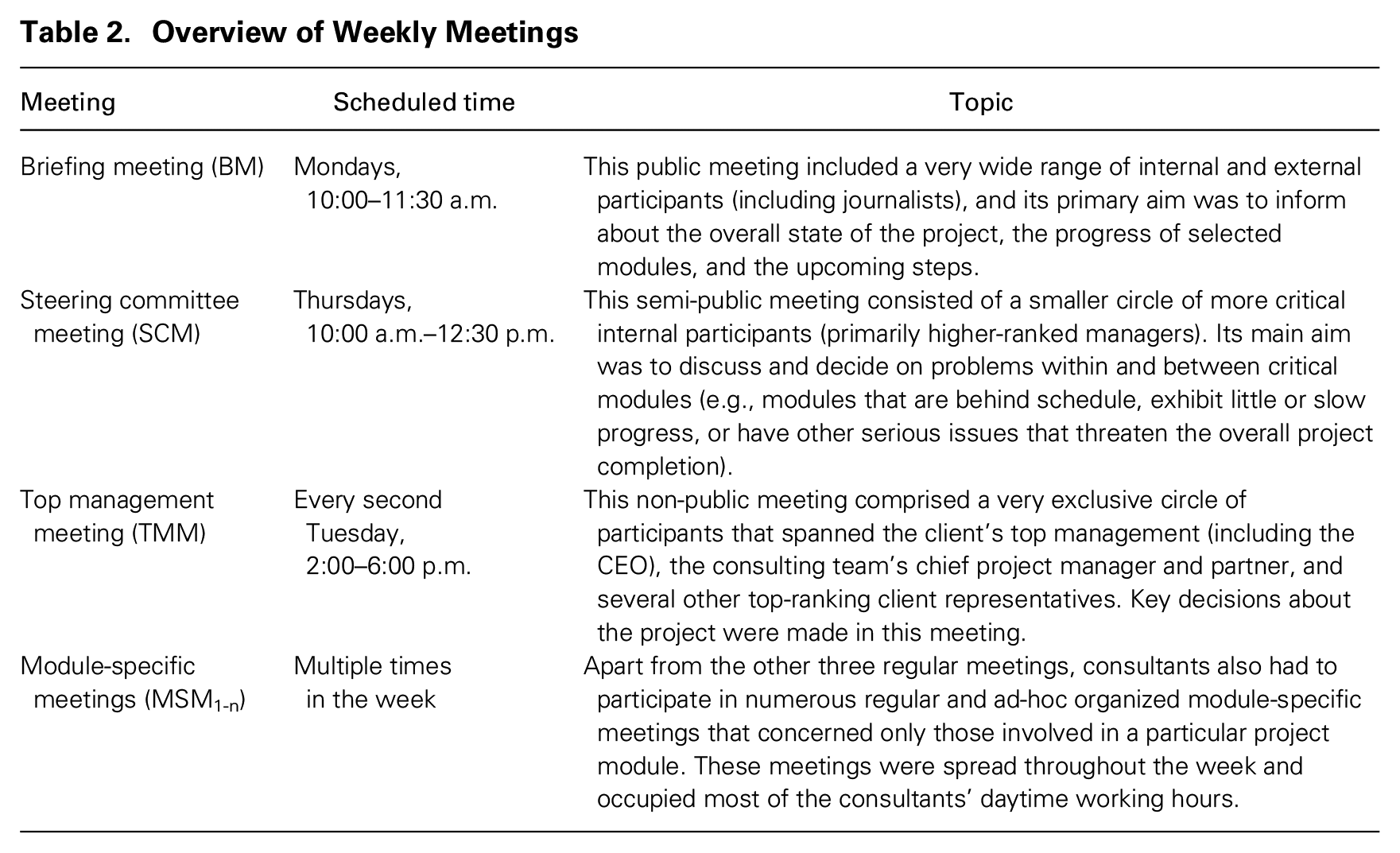
Between meetings, the consulting team processed the information of previous meetings in order to prepare the decisions that needed to be made in the meetings to come. The consulting team divided this information-processing task into seven routines that are the focus of our analysis: debriefing, agenda setting, module progress tracking, updating the module management activity list, risk management, module profiling, and presentation preparation. Descriptions of these routines, as well as who participated in each, are in Table A1 in the Online Appendix. We now turn to the challenge of temporally coordinating the performances of these routines.
The Complex Problem of Temporal Coordination within and among Routines
Our data indicate that, in trying to temporally coordinate the routines of the project cluster, team members encountered various obstacles to both sequence- and timing-based patterning. Sequence-based patterning was particularly hindered by actors’ simultaneous involvement in the parallel performances of multiple routines. This was an obstacle given the various interdependencies among and within the routines; see Figure 1. Actors often had to interrupt the sequential performance of a given routine and switch to another activity when they had to wait for someone else to deliver, when other activities had a higher urgency, or when there were unexpected calls and events: In this project, we often need to reorganize on a short-term basis. We are constantly on call, new tasks come in. You have planned to work on a certain task for a certain amount of time and then suddenly someone calls: “There is this appointment, you should join and please prepare something in advance.” So, your own planning, your to-dos, you need to reorganize [them] again. (Clemens, senior consultant)
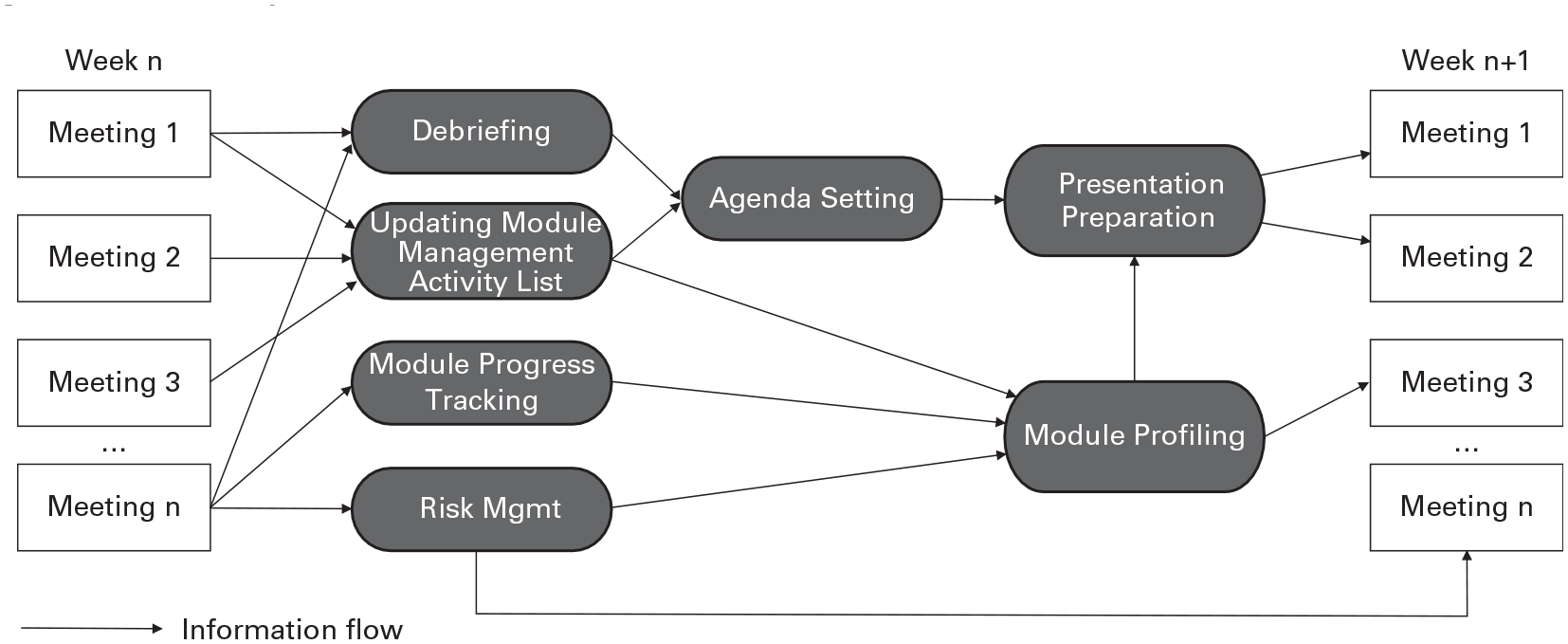
The Project’s Routine Cluster with Information Flows
Timing-based patterning proved difficult too, as actors’ efforts to schedule the performances of the project routines failed. As Linda put it, “[H]ere, you cannot make a plan in advance and then simply execute it.” Team members tried to develop a schedule for project routines by devising an internally consistent regime of formal deadlines when the project was initially set up. They could not make this schedule work, and deadlines were rarely met: You can see it very well with our debriefing round [in general scheduled for 7 p.m.]. For example, this week. An e-mail arrives 20 minutes before the meeting saying: “Debriefing needs to be pushed back. Will start at 8 p.m.” Then it starts at 8:30 p.m. and goes till 10 p.m. In this case, I had an internal call scheduled for 8 p.m. I had to push it back to 9 p.m. It’s just . . . we need a little bit more time discipline! I mean, with client appointments, we are always on time; why is it so difficult to be punctual internally?! (Arnold, senior consultant)
Our analysis revealed that a core obstacle to timing-based patterning was the unpredictable workflows of the more-senior team members who were all also involved in a number of non-project-related activities, such as contributing to other projects, attending meetings with other clients, and acquiring new projects: In the beginning, I was thinking: It’s just the project work, Monday through Friday, clear to-dos, done, bye-bye. But there are actually at least three things at the same time: I still have stuff coming in from my old project, which went very well, but that’s where the client comes in: “We could perhaps write an article on how great we were. By the way, we do not know what to write, could you write it, Gavin?” Then, my mentor calls in and says, “Hey, Gavin, we are working on this acquisition, that’s the topic. You’ve already done something similar in the past, and our colleague got sick, so: could I get five pages from you by next Wednesday?” So these kinds of things come in, and coordinating becomes difficult. (Gavin, senior consultant)
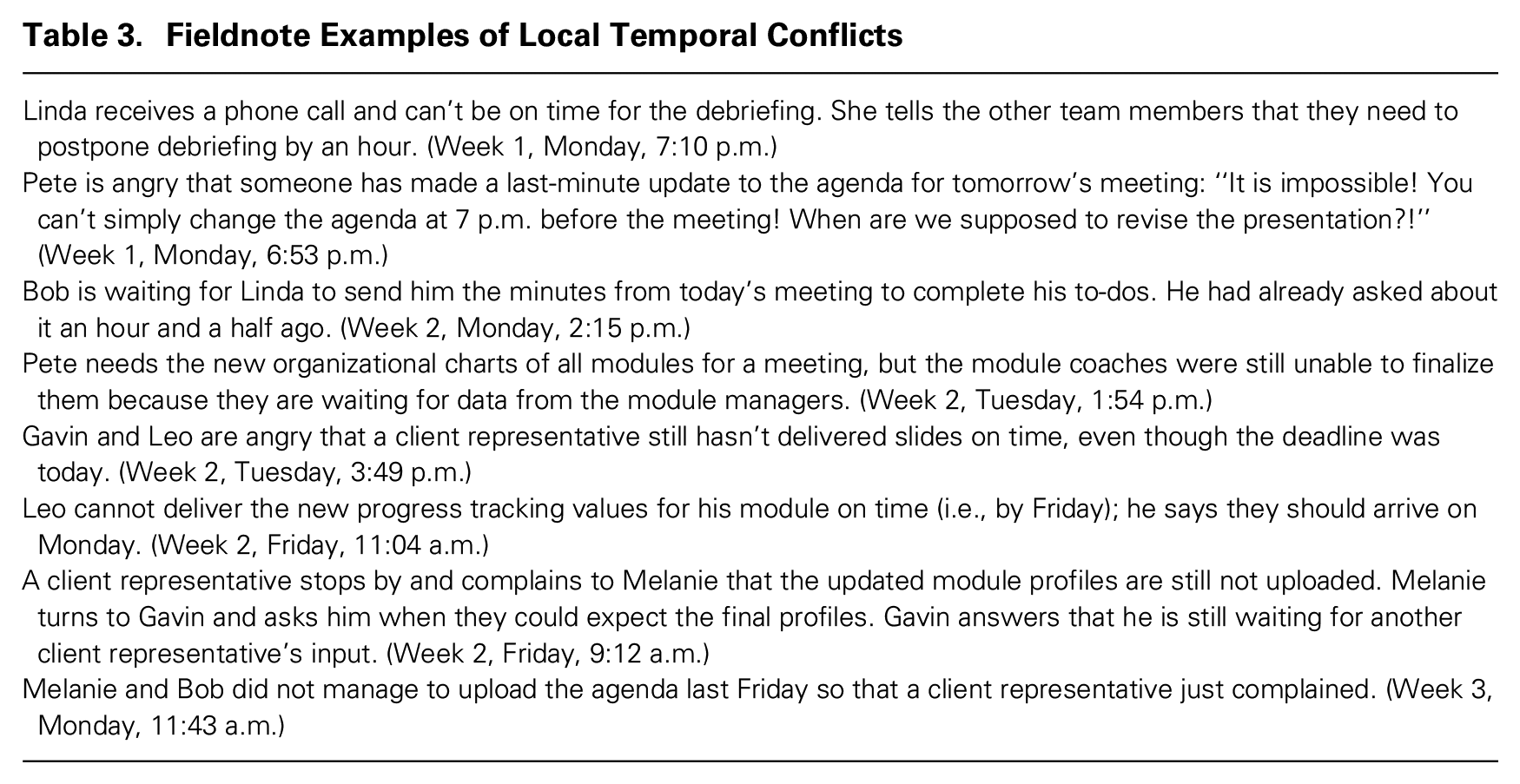
Senior team members’ unpredictable workflow increased the complexity of the coordination challenge so much that it was irresolvable in terms of sequence- and timing-based patterning alone. In our data, the breakdown of both types of patterning manifested in numerous emergent local temporal conflicts—situations in which actors explicitly engaged in renegotiating the often-misaligned timings of their actions. During nine weeks of observation, we identified 72 local temporal conflicts in our field notes; see Table 3 for examples.
Fieldnote Examples of Local Temporal Conflicts
For individuals, such conflicts were closely related to the question of how to prioritize. Each consultant was always involved in parallel performances of multiple routines and needed to decide which routine had the highest priority and which routines could wait: You are actually always on this multi-tasking level . . . you always have other things to do, and you constantly have to organize yourself: But what is important? What to do first? What can wait? You have to learn extremely well how to time and prioritize. What do I do now and what can wait? . . . I could sit down here till 8 p.m. today and do the presentation for [Module D], I could check our deliverables for the supervisory board meeting, and 500 other things. (Gavin, senior consultant)
Such decisions depended on how others would prioritize their routine contributions and were further complicated by the fact that consultants were usually involved in other projects and non-project-related activities as well. The breakdown of sequence- and timing-based patterning meant that individual actors needed to prioritize by somehow taking into account different and shifting rank orders of urgency.
Surprisingly, a relatively consistent pattern of temporal coordination emerged within the course of the nine weeks. This pattern is visualized in Figure A1 in the Online Appendix; each column represents a different team member, each row a 30-minute time block, and each color a different type of action. Despite being the source of constant complaints, in particular due to the long working hours (on most days the consulting team worked well over 12 hours), this collective pattern enabled the team to consistently meet its most important external deadlines. To explain how this pattern emerged we had to expand our analytical focus beyond routine performances. That was the case because actors approached emerging local temporal conflicts by orienting their actions not only toward the pattern of routines—asking “When do I have to do what in order to successfully accomplish a given task?”—but also toward the patterns of person-roles—also asking “Who expects what from me, and how important is this person to me?” The following considerations highlight these intersecting dynamics of routines and person-roles.
Temporally Coordinating by Orienting Toward Routines and Person-Roles
In analyzing how actors resolved local temporal conflicts, we found that they continuously iterated among three mechanisms: role-based, sequence-based, and timing-based prioritizing. The relative prevalence of each mechanism shifted over time; see Figure 2. We next share four vignettes that empirically anchor these mechanisms and their consequences.
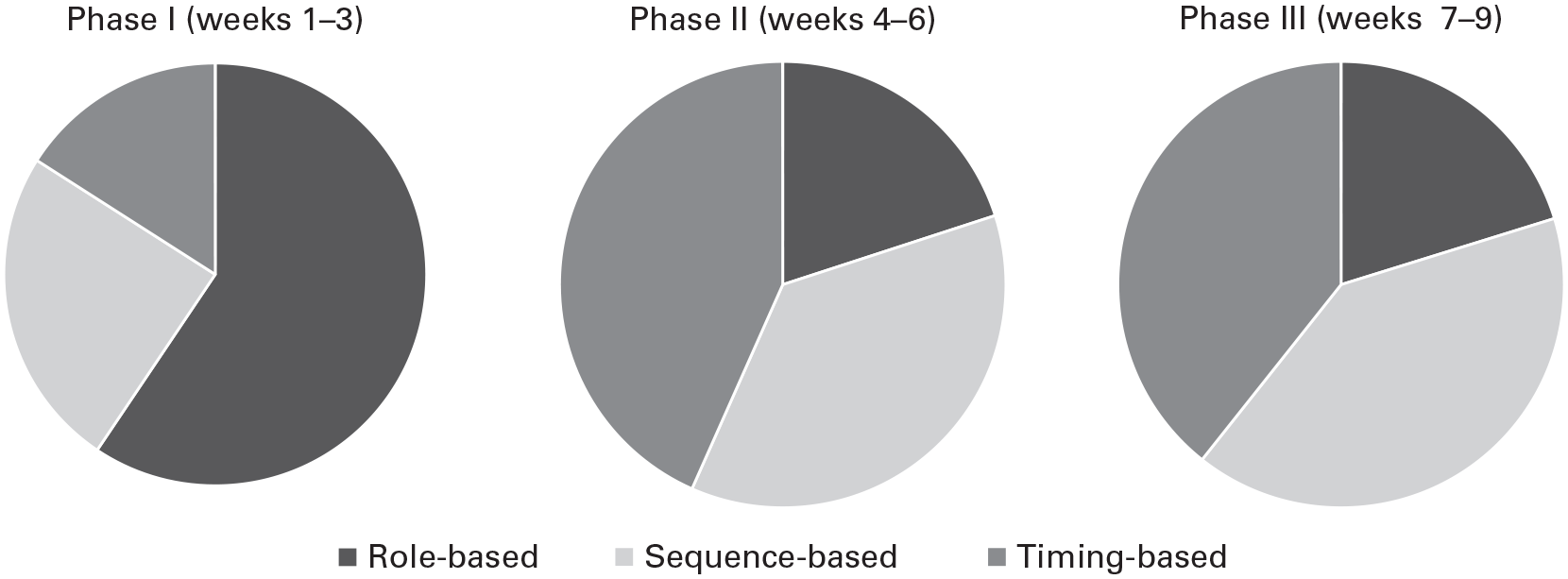
The Development of Prioritizing over Time
Vignette I: Role-based prioritizing
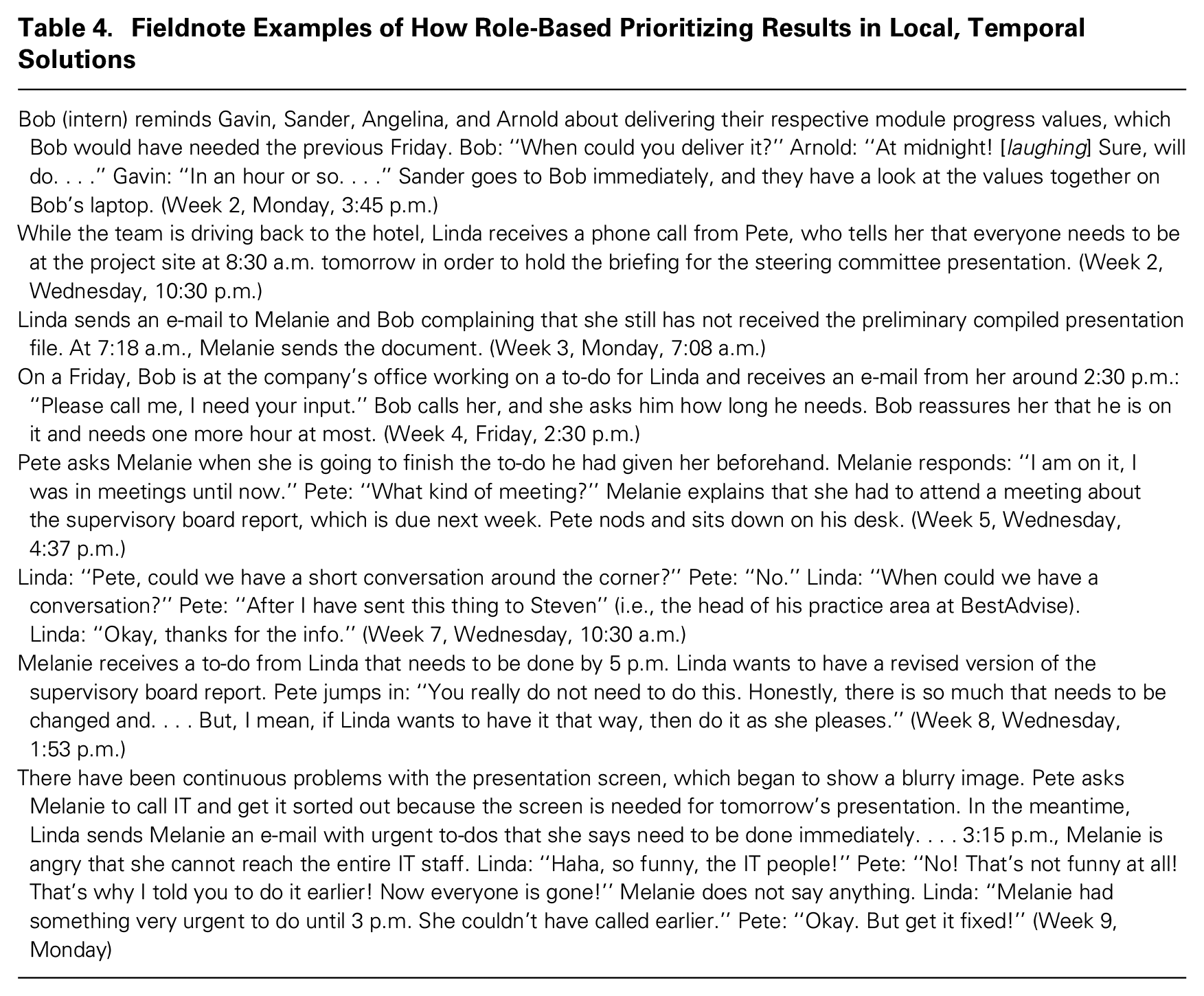
Actors’ increased orientation toward person-roles enabled them to engage in role-taking and role-making to negotiate provisional solutions to local temporal conflicts, a mechanism we call role-based prioritizing. To demonstrate how this mechanism worked, we examine how a local temporal conflict among client representatives, the junior consultant Melanie, and the senior project manager Pete was resolved. Table 4 offers additional examples from our data.
Fieldnote Examples of How Role-Based Prioritizing Results in Local, Temporal Solutions
One Thursday afternoon, Melanie was waiting for Pete to send her the minutes from a meeting in order to proceed with her work on updating the module management activity list (MMAL). Melanie expected Pete to act in line with the formal schedule of this updating routine, according to which the list needed to be updated on Thursday evening so clients could access the activity protocol (this routine’s partial result) on Friday morning. While Pete was rushing out of the team room for a meeting, he briefly stopped behind Melanie’s desk and asked her to send him a set of slides he needed. Melanie politely told Pete she had already sent these slides and then asked whether he could send her the minutes she needed. Pete, obviously surprised by Melanie’s inquiry, answered, “Oh, the minutes, yes, they are basically ready. You will have them by end of business tonight.”
The next morning, Melanie was still waiting for the minutes. When she arrived in the team room and looked at her e-mail inbox, she became worried as there were multiple inquiries sent by client representatives who had asked for the results of the updating MMAL routine. Realizing that the formal schedule was being violated, Melanie took the role of those clients—key actors in her role set—and wanted to prioritize finishing the routine. But she needed Pete to deliver the minutes first. Realizing that she was stuck between the clients’ complaints (which implied one rank order of urgency) and Pete’s delays (which implied a different rank order of urgency), she decided to send an e-mail to Pete: From: Melanie Sent: Friday, 10:22 a.m. To: Pete Cc: Bob; Linda Subject: SCM protocol Dear Pete, Because I have already received several inquiries on the team e-mail account, it would be great if you could send us the minutes from yesterday’s steering committee meeting. Thank you and best wishes! Melanie
In this e-mail, Melanie attempted to make Pete’s role by signaling that Pete’s delayed contribution was causing trouble in her own person-role performance. But Pete ignored Melanie’s e-mail. When he arrived in the team room around 11 a.m., Melanie again asked him about the minutes:
Pete, there were a number of inquiries about the activity list, I wrote you an e-mail . . .
Who else has asked besides [client X]?
Several module coaches have asked me, too.
So, there is no rush . . .
After this brief conversation, Pete again confirmed he was “on it” and continued working on other tasks on his laptop.
This conversation demonstrates that Pete did not accept Melanie’s attempt to make his role. He signaled that not he but rather Melanie ought to adjust her line of conduct. He did so by defining who and whose inquiries were considered important (“Who else has asked . . . ?”) and, based on this, what a reasonable timing for finishing the contribution is (“there is no rush . . .”). In so doing, Pete suggested that delays in the routine are acceptable even when certain—apparently not so important—actors complain.
That same day, when Melanie came back from lunch, she still had not received the minutes from Pete. She reminded Pete again and noted that she would need them by 2:50 p.m. because she needed to leave the project room by 3:30 p.m. to catch her flight home. Pete responded by asking Melanie why she had decided to leave so early. Slightly irritated, Melanie responded that she would book a later flight the following week. Pete did not comment anymore and eventually sent the minutes at 2:53 p.m. so that Melanie could complete the routine performance and upload the final activity protocol by 3:15 p.m., almost a day after the formal deadline.
The next week, Melanie enacted her own person-role by referring to her experience from the previous week, essentially taking Pete’s rather than the clients’ role in her prioritizing. Pete—who was apparently more important to Melanie’s person-role than the clients—had given Melanie the impression that he did not consider the clients’ requests to finalize the MMAL update on time as particularly important. Accordingly, she did not consider it a problem that Pete did not deliver the minutes by Thursday evening. Melanie left the project team office at 8 p.m. Thursday because she had arranged to have dinner with her father, who was in town for one night. Melanie had announced her leaving earlier via e-mail without receiving any objection.
But that week, Pete acted differently. Shortly after 8 p.m., he sent the minutes: From: Pete Sent: Thursday, 8:08 p.m. To: Melanie Cc: Linda; Bob Subject: SCM protocol Hi, Attached you will find the minutes from today’s SCM. Cheers, Pete
As Melanie was having dinner, she could not respond immediately. Not receiving a response, Pete engaged in making Melanie’s role by sending a second e-mail with a harsher tone 90 minutes later: From: Pete Sent: Thursday, 9:38 p.m. To: Melanie Cc: Linda; Bob Subject: SCM protocol Why is it not going out??
Only after she had come back to her hotel room did Melanie respond. Knowing from the previous week’s experiences that her prospects of asserting herself in relation to Pete were very limited, she wrote the following: From: Melanie Sent: Thursday, 10:54 p.m. To: Pete; Bob Cc: Linda Subject: RE: SCM protocol Hi Pete, None of us had access to the project team account. We will update, upload, and send the activity protocol first thing tomorrow morning. Best wishes, Melanie
The next morning, after arriving in the team room, Melanie immediately started updating the activity protocol. She offered her excuses to Pete and assured him that this would not happen again. In the following weeks, Melanie retained this provisional local solution: she immediately started to work on the activity protocol as soon as Pete had sent her the minutes.
This vignette illustrates how during a number of role performances, the timing of Melanie’s routine contributions was partially renegotiated to better fit into Pete’s line of conduct. Thereby, both actors also established a provisional temporal solution to a local temporal conflict concerning the right timing of Pete’s and Melanie’s contributions to the routine in question. Engaging in role-based prioritizing shifted Melanie’s focus from purely task-related to social-relational issues. Instead of asking herself how to keep the project’s formal schedule intact, she forged her line of conduct by asking herself how to prioritize so that the timing of her actions would be recognized as appropriate by significant alter-roles in her role set (clients and Pete). As a result, both Melanie and Pete could repair what they recognized as misaligned action timing. The misalignment with the client was less important to Melanie. The relative social positions of the client, Pete, and Melanie were thus also reconfigured. Pete did not adjust to Melanie and the client, so Melanie had to adjust to Pete (her senior) and shield him from client complaints.
Vignette II: Reflective talk and timing- and sequence-based prioritizing
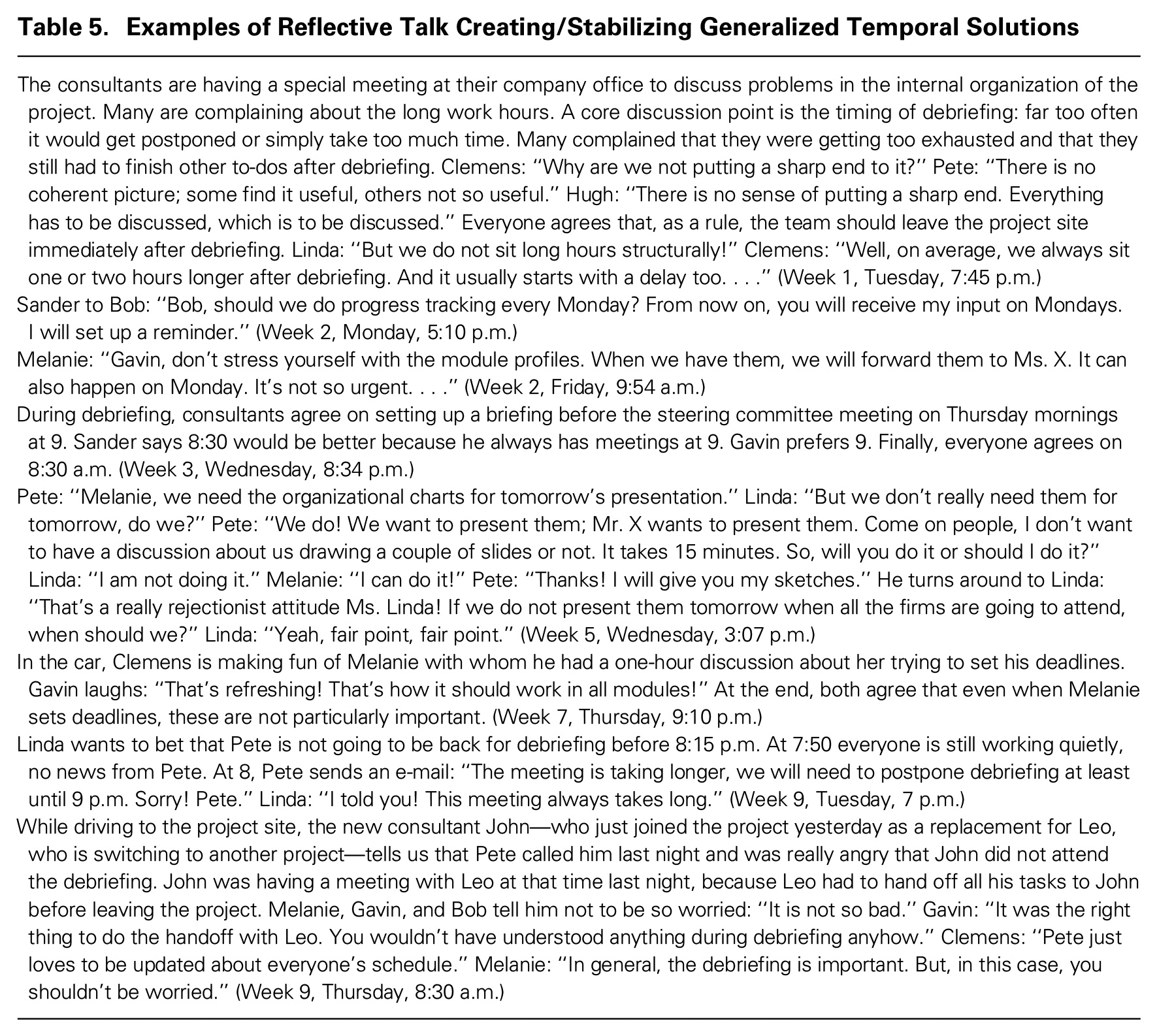
Although provisional temporal solutions were usually negotiated through role performances, they were also often reflected upon, abstracted, and generalized during episodes of reflective talk; see Table 5. This happened most often when already-negotiated temporal solutions resulted in renewed local temporal conflicts.
Examples of Reflective Talk Creating/Stabilizing Generalized Temporal Solutions
An episode of reflective talk occurred between Melanie and Bob while they were driving to the project site the morning after Pete’s angry e-mail about the minutes in week two (Vignette I). The moment Bob got into the car, Melanie looked at him and said, “Concerning the e-mail from last night, it’s my fault!” Bob was initially surprised, as he did not have a company smartphone and had not seen the e-mails from the previous night:
What e-mail?
Oh, you still haven’t seen it? Pete has sent us the minutes last night at 8 p.m. and then a kind of angry e-mail at 10 p.m., asking why we still haven’t published the activity protocol on the server.
Really? But last week, he took it so easy as he was not ready with the minutes and we had to wait so long. . . . There were even people asking about it!
I know, right? Good that you remember the same that I do. . . .
This conversation illustrates how actors collectively reflected on past provisional temporal solutions and sought others’ advice to create a shared understanding meant to inform future performances. Melanie and Bob collectively negotiated how to generalize the enacted local temporal solution for the future: Should Melanie deliver at a specific point in time (i.e., timing-based prioritizing), or should she watch out for when Pete delivers and act immediately after him (i.e., sequence-based prioritizing)? The conversation indicates that both Melanie and Bob initially interpreted the local temporal solution in timing-based terms, i.e., they expected Friday to be an acceptable deadline for completing the routine (“But last week, he took it so easy . . .”). Through their talk, they collectively established that this interpretation was wrong (“it’s my fault”) and that they should handle the provisional temporal solution in sequence-based terms instead. By treating Pete’s actions as a cue concerning when to contribute, they effectively established Pete’s person-role as a temporal boundary condition for the performance of the routine. In sum, role performances and reflective talk enabled these actors to develop provisional solutions to emerging local temporal conflicts and then to abstract and generalize these solutions in terms of either sequence- or timing-based prioritizing. Over time, this created what we call role–routine couplings.
Vignette III: Role–routine couplings
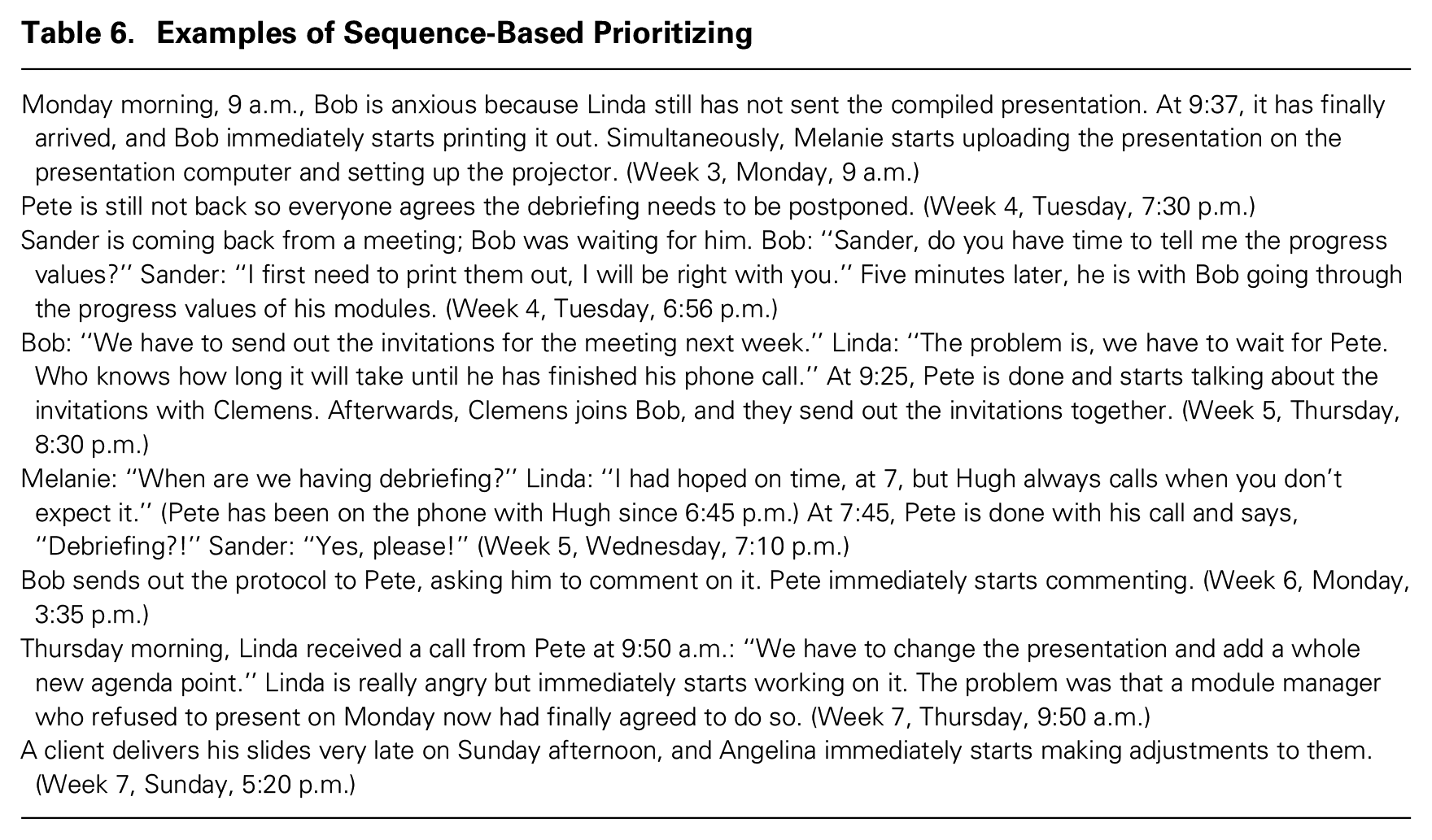
Role–routine couplings emerged when the temporal solutions negotiated through role-based prioritizing—and sometimes further clarified through reflective talk—became an accepted part of the temporal pattern of specific routines. We identified two types of role–routine couplings in our data. First, as illustrated by Vignette II, actors coupled person-roles and routines in terms of sequence-based prioritizing. In that case, Melanie and Bob treated Pete’s (and not the clients’) actions as a temporal signpost to immediately prioritize work on the updating routine; see Table 6 for additional examples from our data. In this vignette, we highlight the second type of role–routine couplings, in which solutions from role-based prioritizing become the basis for timing-based prioritizing, essentially establishing expectable timeslots for the performance of specific routines. (Table 7 offers more examples of timing-based prioritizing from our data.)
Examples of Sequence-Based Prioritizing
Examples of Timing-Based Prioritizing
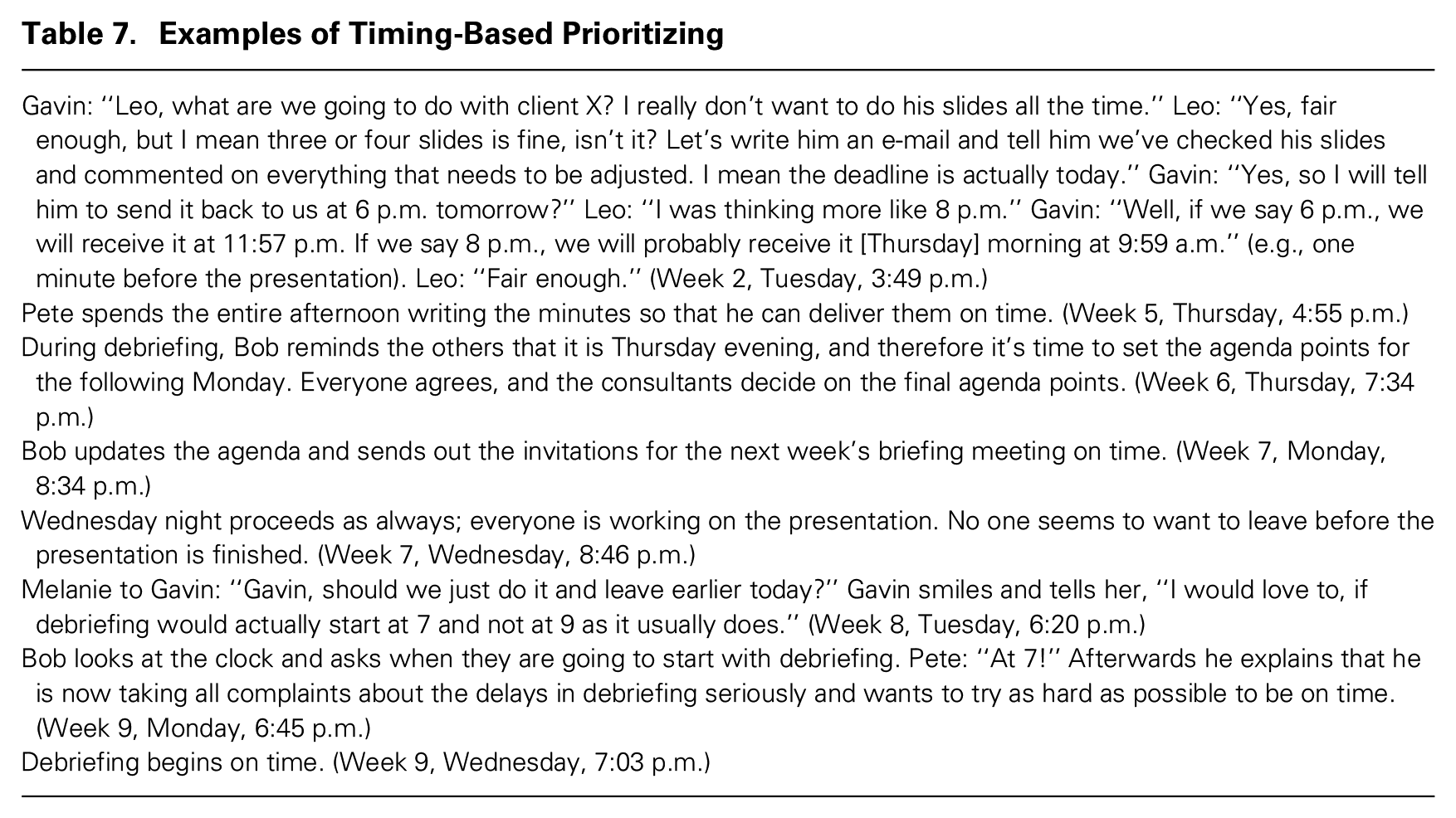
Client-side module managers consistently delivered their contributions to the presentation preparation (PP) routine on Wednesday evenings, instead of on Tuesday evening as scheduled. Over time, the module coaches—consultants Clemens, Gavin, Sander, Angelina, and Leo, who were responsible for the next step in this routine—began to take these delays for granted. They had learned from past episodes of role-based prioritizing that their social position relative to that of the clients would usually prevent them from asserting their own preferred pattern, i.e., the formal schedule. The following field note excerpt from a Wednesday evening supports this point:
It is 6:20 p.m., and not a single module presentation has been received by the team. Pete asks Melanie to check the project’s e-mail account as, oftentimes, module managers would send their presentations there instead of directly to the module coaches. Melanie immediately goes to the computer and checks the account, but there is nothing in it. “Nothing,” she replies to Pete, who looks like he is getting nervous. He calls one of the module managers, Tom, who has been invited to present. Tom tells Pete that he hasn’t started with the presentation yet as his module coach, Clemens, is sick and missing from work. The consultants who have listened to the call start talking about how they could possibly make [client-side] module managers deliver on time. Bob asks whether this might be an agenda point for the next steering committee meeting. “They simply don’t care,” Linda replied. “We’ve tried everything, there is nothing we can do. We have to carry on like that.”
This excerpt illustrates how team members engaged in reflective talk about clients. Even though the continuous delays spawned dissatisfaction with clients’ action timing, Linda neutralized suggestions to engage in explicit role-making by arguing, based on her past experiences, that the clients “simply don’t care.” As a result, consultants generalized the rule that it would be most appropriate to deliver their contributions to the PP routine on Wednesday evenings or nights, effectively taking clients’ expectable delays as a temporal boundary condition for the temporal patterning of the routine.
In contrast to the reflective talk in Vignette II, here consultants generalized a standard temporal location in the performance of the PP routine and not a tight sequential coupling to the actions of a specific person. That important difference had consequences for the temporal patterning of routines. For example, when a client did deliver his contribution to this routine according to the formal schedule one time—sending it on a Tuesday afternoon—team members were surprised and joked about it:
In this conversation, the client’s delivery was interpreted first and foremost in temporal terms, as “early” (even though it was on time in terms of the formal schedule), and consultants recognized it as an exception to the general expectation that client-side contributions to this routine arrive on Wednesday evenings. Rather than immediately acting on the client’s delivery, as a sequence-based coupling would imply, Gavin continued working on other tasks and waited until Wednesday evening to make his contribution to the PP routine. In so doing, he stabilized the established temporal solution, i.e., the expected timing of that routine contribution on Wednesday nights. Thus in contrast to sequence-based couplings, timing-based couplings generally made the temporal pattern of routines more expectable and less variable.
In sum, role–routine couplings enabled actors to resolve local temporal conflicts and revert back to either sequence- or timing-based prioritizing as less-taxing mechanisms. The increasing use of timing-based prioritizing, in turn, facilitated the emergence of expectable time slots for specific routine contributions.
Vignette IV: Temporal ripple effects
Over the course of multiple weeks, fixing specific routine contributions to specific time slots led to temporal ripple effects across the routine cluster. Our analysis of such effects indicates that their impact on the routine cluster was twofold. On one hand, they ensured that once a temporal solution was established within a time-sensitive routine, other less time-sensitive routine performances could be reorganized to fit the temporal pattern of that time-sensitive routine. Routines perceived as time sensitive by the consultants often had an external deadline, such as the PP routine, which had to be finalized before a weekly meeting with high-ranking client representatives. Establishing that most contributions to the time-sensitive PP routine would be made on Wednesday evenings implied that performing the less time-sensitive debriefing routine, formally scheduled for 7 p.m. every day, often needed to be postponed:
Linda is talking on the phone with Clemens, discussing the presentation. She asks Clemens to undertake further adjustments. Clemens agrees and asks whether debriefing is going to take place as scheduled at 7 p.m. Linda responds that, first, the presentation needs to be finalized. Pete intervenes: . . . A discussion commences regarding the need for debriefing. The consultants complain that there is still too much to do for the presentation. Pete suggests a more extensive debriefing on Thursday afternoon instead. The other team members agree.
But postponing debriefing also meant that the agenda-setting routine, which was less time sensitive (i.e., it had no immediate effect on the action timing of client representatives) and depended on information from the debriefing routine, had to be delayed as well. As a result, the invitations for the next week’s presentation—the partial result of the agenda-setting routine—could only be sent out on Friday morning instead of on Thursday evening as scheduled. By adjusting the timing of less time-sensitive routine performances to fit established temporal solutions within a time-sensitive routine, temporal ripple effects changed the temporal patterning of the routine cluster as a whole.
On the other hand, the temporal ripple effects also created new local temporal conflicts when they clashed with the established temporal pattern of another time-sensitive routine. For example, due to delays in performing the PP routine, consultants often had to postpone performing the module profiling routine, which required considerable client involvement. On one such occasion, the client representative Judy came to Melanie on a Friday morning and angrily asked her why the updated module profiles were not yet uploaded on the server. She further complained that such delays had become “normalized” and explained what problems they caused in her own work. Melanie reacted by saying that she needed Gavin to send her the profiles—a delayed partial result of the PP routine. Gavin jumped into the conversation, explaining that he was still waiting for additional data from a module manager to finalize the profiles. Judy was not happy with this excuse and later escalated the issue to Linda. Eventually, Linda, Melanie, and Judy engaged in multiple rounds of role-taking and role-making, as well as reflective talk, until they reached an agreement about a new expectable time slot for the module profiling routine: Mondays, after the briefing meeting.
Thus the timing-based coupling of one routine with clients’ person-roles created unintended temporal ripple effects throughout the routine cluster. These effects could facilitate temporal coordination by fitting less time-sensitive routines to the temporal pattern of more time-sensitive routines in an emergent way. But temporal ripple effects could also create disturbances, generating further conflicts that prompted actors to turn to role-based prioritizing again to renegotiate new temporal solutions. (For another example of these dynamics of prioritizing, see Figure A3 in the Online Appendix.) As we show next, this form of dynamic and ongoing prioritizing eventually consolidated a consistent and collective—but not entirely appealing—second-order pattern of temporal patterns.
The Negotiated Temporal Order and Its Background Expectancies
Over the course of our observation period, the consultants increasingly recognized a larger pattern of time-use patterns—the negotiated temporal order of the consulting project. Figure A1 in the Online Appendix illustrates this emergent, second-order pattern—or pattern of patterns. It exhibited a number of identifiable characteristics. First, senior consultants’ daytime hours were largely occupied by meetings, as indicated by the purple blocks in Figure A1. Second, whereas some routines were generally performed in a temporally variable way, others tended to occur during certain time slots throughout the week. For example, most contributions to the presentation preparation routine were created on Wednesday evenings and Thursday mornings. In contrast, most contributions to module progress tracking happened whenever there was nothing else to do. Third, each weekday tended to exhibit an expectable, specific length. Mondays, Tuesdays, and Wednesdays usually started at 9 a.m. and ended around 11 p.m. Thursdays usually went from 8:30 a.m. to around 8:30 p.m. Fridays were usually shorter days that ended between 4 and 6 p.m.
Our analysis suggests that these properties of the negotiated temporal order cannot be explained by only the generic mechanisms identified above. Instead, these properties arose as the mechanisms were enacted against three “background expectancies” (Garfinkel, 1967: 36) that were generally not addressed during negotiations of temporal order: external deadlines, delays by senior consultants, and the temporal primacy of work life. By treating these background expectancies as a given, most of the time not even talking about them, actors transformed them into “a ‘seen but unnoticed’ background of common understandings” (Garfinkel, 1967: 44) for the negotiation of temporal order.
First, as is common in project work, consultants had a number of taken-for-granted external deadlines that marked some routines as especially time sensitive. This increased the pressure to compensate delays with extra work hours. For example, the deadline for the presentation preparation routine—10 a.m. Thursday—was set externally and treated as non-negotiable by the consultants. This meant consultants often had to work very late on Wednesday nights, and most Thursday mornings were rushed and stressful:
In the car to the project site, it is unusually quiet as everyone is busy. Linda is doing final edits on the presentation. Melanie is driving. We arrive at 8:37. Everyone seems stressed as the steering committee meeting is about to begin at 10. . . . Linda is getting nervous because Clemens has still not delivered the final version of his module presentation to Melanie. . . . Shortly after 9 a.m., Clemens’ slides arrive, and Melanie immediately starts cleaning them up and putting them together in the master presentation file. Linda rushes her to hurry up as she has to rehearse the presentation with Hugh. Melanie responds that she is going as fast as she can. . . . At 9:20, Melanie is done and prints the final version of the slides which she then hands off to Linda and Hugh.
Second, senior team members were involved in other projects too. This frequently led to delays by senior consultants, which were rarely the subject of negotiations during role performances and reflective talk—they were simply taken as a given:
During debriefing, the consultants start discussing whether the briefing with Hugh, which is planned for 8:30 on the next morning (step 5 in the PP routine), is going to happen on time.
Is Hugh going to be on time?
I don’t think so. He won’t be here before 9. He had an overnight flight, coming back from his project in Kurdistan. He is always very tired after those. He normally never complains, but when he has one of those overnight flights, he is like “Ugh, again a night flight. I feel really wasted. . . .” So, I think we should move it to 9.
Similarly, consultants usually took for granted that, for more-senior team members, the time between 9 a.m. and 7 p.m. would be occupied by meetings: You can actually only work . . . only after 8 p.m. . . . you have a time span where you can work on your project tasks. (Clemens, senior consultant)
The pervasiveness of this aspect of the temporal order was also recognized by the junior consultants: It is, of course, somewhat frustrating when . . . the colleague simply because of more urgent priorities in his own workflow cannot actually work on it [the delivery of a contribution to a certain routine]. I don’t think this is due to ill will. It’s simply what the daily business brings along. (Melanie, junior consultant)
Third, consultants also took for granted the temporal primacy of work life—the belief that the temporal needs of their work roles took priority over the temporal needs of their non-work roles. Long work hours were normalized and highly institutionalized within the larger temporal context of consulting in general and within BestAdvise in particular: You have to adjust your expectations. . . . If you think, “Okay, I could maybe meet a friend after I am done with work at 8 p.m., or maybe go to the cinema,” then you would simply generate additional stress for yourself. Because then you realize, “Okay, actually I want to do something else, but then I sit here, and I am going to sit here till 11 p.m. and work on the presentation.” (Gavin, senior consultant)
These three background expectancies contributed significantly to a dynamic in which temporal intra-role conflicts were systematically resolved at the expense of temporal inter-role conflicts, in particular conflicts between consultants’ work and non-work roles. Consultants regularly complained about work–life conflicts. These were most pronounced for senior consultants, many of whom had young children and families: The workload on this project was very high in the beginning. . . . It really becomes a problem when I don’t get enough sleep. . . . My work simply constrains my private life. It constrains it because I look at this BlackBerry on the weekends. It constrains my private life during the week. Either I am not here at all, or I do not have the possibility to see my closest person, my girlfriend, for four nights a week. I simply cannot see her. So, my private life is constrained. On this project, even though I sleep at home I still do not see her because we work so long hours. . . . When I come back home, she is usually asleep. (Sander, senior consultant)
Despite the strain it created for individual team members, the negotiated temporal order constituted a viable solution to the problems of temporal coordination with which the team struggled initially. It allowed the team to avoid the worst kinds of delays—those that would disturb the rigid weekly meetings cycle—and to significantly reduce the number of local temporal conflicts, as Figure 3 shows. In addition, it enabled more-senior team members—those whose person-roles exhibited the highest complexity because their work activities depended on the collaboration of third parties who they could not control by means of formal authority—to cope with the poor predictability of their daily workflows. Actors could achieve all this by performatively negotiating and restabilizing an emergent temporal order within the constraints of their background expectancies.
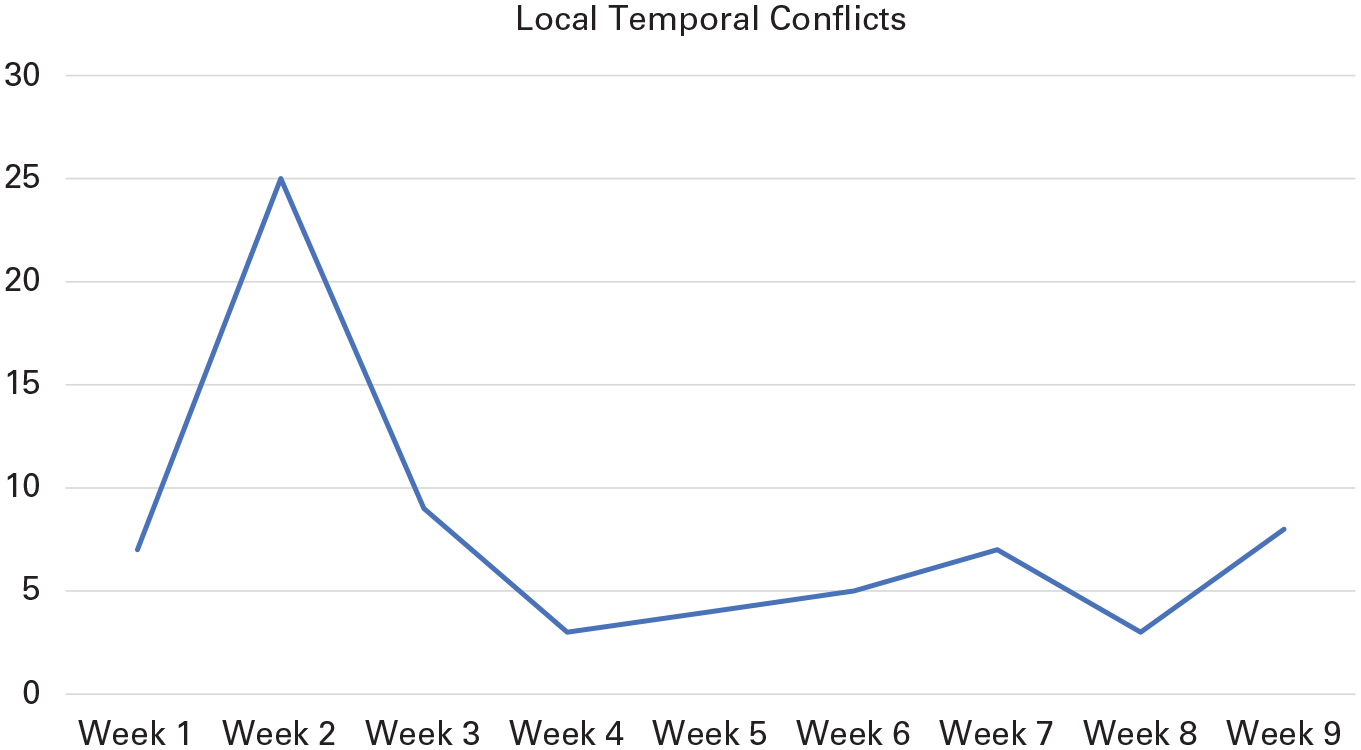
Local Temporal Conflicts over Time
Discussion
The Dynamics of Prioritizing: A Process Model of Temporal Patterning in Role–Routine Ecologies
Our aim was to build theory on how actors temporally coordinate multiple interdependent routines in complex work settings, wherein static prioritizing often fails. To do so, we had to bring into focus the patterns of person-roles in addition to those of routines. This dual focus revealed the dynamics of prioritizing as our core empirical finding and an answer to our research question. The dynamics of prioritizing refer to actors’ iterative use of three prioritizing mechanisms—sequence-, timing-, and role-based prioritizing—which, over time, is likely to result in role–routine couplings and temporal ripple effects. Unfolding against a background of the specific expectancies held and enacted by the consulting team members, the dynamics of prioritizing shaped the negotiated temporal order of this project. Figure 4 integrates our core findings and sets forth a general process model of temporal coordination in complex role–routine ecologies.
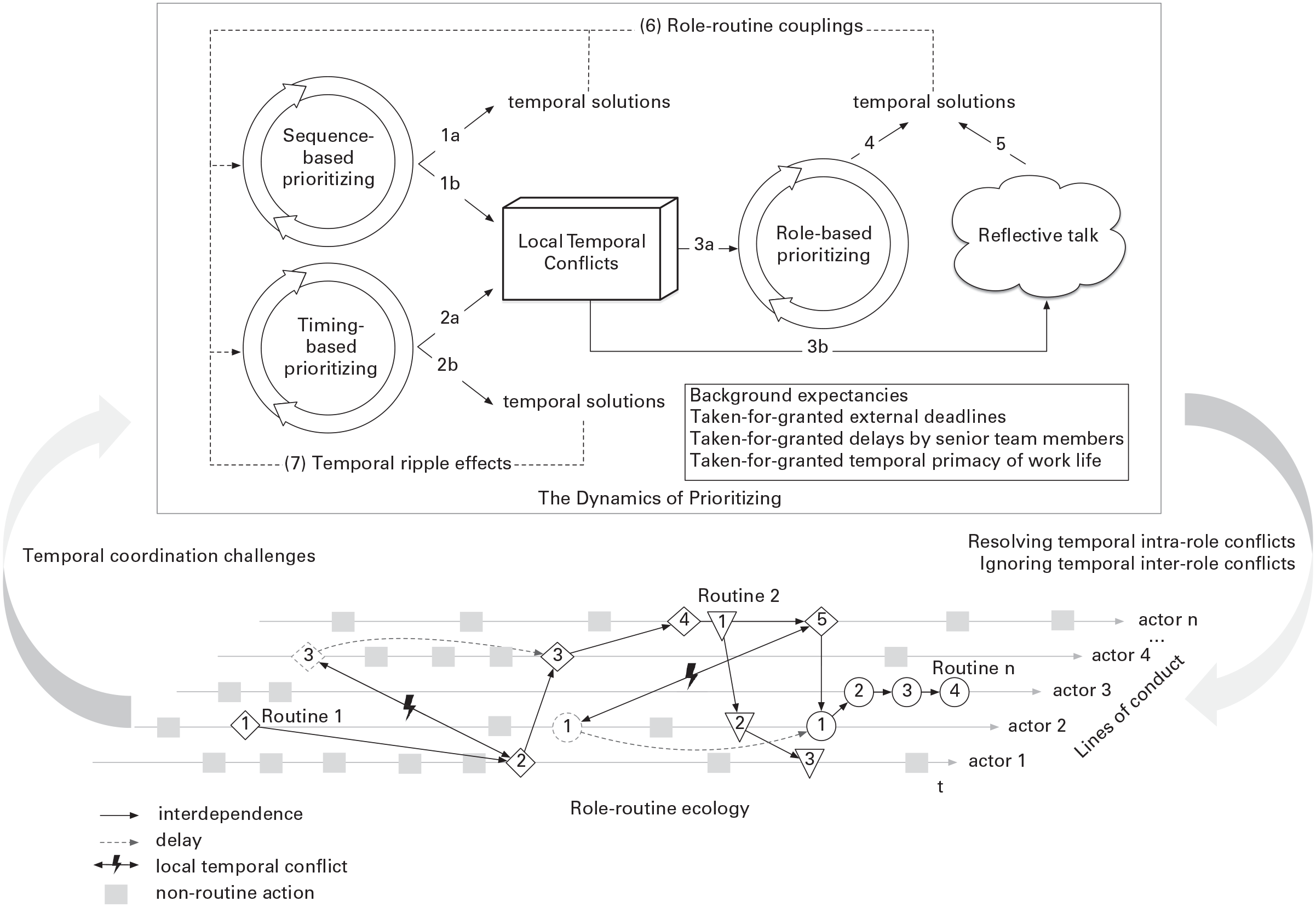
A Process Model of Temporal Coordination in Complex Role–Routine Ecologies
The bottom layer of our model represents the complex work setting we studied as a role–routine ecology: a complex system of two different yet intersecting action patterns, person-roles and organizational routines. We use ecology to emphasize that these two action patterns are coupled not as a consequence of intentional design efforts, as in the case of the interfaces that connect the routines of a cluster (Kremser and Schreyögg, 2016), but in an emergent manner, as a result of ongoing patterning. Our model theorizes how problems of temporal coordination are addressed within such role–routine ecologies.
At the core of our model are three distinct mechanisms of prioritizing that emerged from our data. Sequence-based prioritizing was most effective when consultants worked on the same routine, could directly observe each other’s actions, and thus built shared temporal expectations about the appropriate sequential ordering of contributions to that routine (1a; see also Turner, 2014). In complex work settings, however, actors are simultaneously involved in the parallel performances of multiple routines that are distributed in time and space. This generally reduces the effectiveness of sequence-based prioritizing and can lead to local temporal conflicts (1b; see also Turner and Rindova, 2018). Timing-based prioritizing is effective when actors have enough time to make their contributions at the expected “standard temporal locations” (2a; Zerubavel, 1981). But in our research context, the effectiveness of timing-based prioritizing was limited because senior team members were involved in multiple other projects as well. They often had more deadlines than they could meet, leading to further local temporal conflicts (2b).
To resolve such conflicts, consultants engaged in role-based prioritizing (3a), a previously unrecognized patterning mechanism that anchors actors’ prioritizing in expectations about the social consequences of contributing to one routine at the expense of another (as in Vignette I). Compared with sequence- and timing-based prioritizing, it changes the relevant question from “When do I have to do what?” to “Whose request is most important to me right now?” This shift enables actors to address complex temporal conflicts by transforming them into social-relational conflicts in which actors negotiate who should adjust their line of conduct to whom (4). Role-based prioritizing is therefore particularly effective at resolving temporal conflicts that result from multiple misaligned rank orders of urgency among the members of a role set—in other words, temporal intra-role conflicts within complex work settings.
In our study, temporal solutions were occasionally perceived as ambiguous or tested by recurring temporal conflicts, as in Vignette II. In such cases, they were often scrutinized during episodes of reflective talk (3b; Dittrich, Guérard, and Seidl, 2016), in which consultants abstracted and generalized solutions so that they could serve as a basis for future prioritizing (5). This was done either by creating a shared understanding of the implications of past prioritizing, as in Vignette II, or by stabilizing already established temporal solutions in the face of deviations, as in Vignette III. Reflective talk usually involved more actors than those who participated in the performances that were reflected upon and thus tapped into these other actors’ socio-cognitive resources. We found that reflective talk can shape the evolution of role–routine ecologies by establishing, changing, and stabilizing discursive relations between past and future performances, or “paths” (Goh and Pentland, 2019), of different action patterns.
Over time, actors’ ongoing iteration among the three prioritizing mechanisms and reflective talk had two important temporal outcomes: role–routine couplings and temporal ripple effects among routines. In Figure 4, these are represented with dotted lines to indicate that they are not immediate outcomes of specific actions at specific times but rather aggregate outcomes of multiple performances over several days and weeks. Through role–routine coupling (6), the pattern of a focal routine is adjusted to better fit the preferences of a specific person-role. In our case, specific person-roles became “pacers” (Ancona and Chong, 1996) for the performance of specific routines. We would generally expect that less powerful actors involved in the routine performance are likely to engage more extensively in role-taking (Crozier, 1964). Consequently, person-roles in less powerful positions are more likely to adapt their routine contributions to the preferences of those in more powerful positions and not vice versa (see Vignettes I and II). Adding to this established insight, we find that role–routine couplings can have two different effects on the temporal pattern of a focal routine. Sequence-based couplings are likely to make the temporal pattern of the coupled routine more variable because they connect the routine performance with a specific triggering action enacted by a specific person yet at varying times. By contrast, timing-based couplings are likely to make the temporal structure of the coupled routine more consistent because they connect the routine performance to a standard temporal location that fits well into specific actors’ lines of conduct.
We further theorize that the temporally consistent performance of a focal routine is likely to create temporal ripple effects (7) among routines, as in Vignette IV. As soon as specific, time-sensitive routines take on expectable temporal patterns, actors will start to prioritize their contributions to other routines around these established temporal patterns, thereby indirectly patterning the remaining routines. The theoretical explanation hereof is twofold. First, reserving a standard temporal location for one routine will have a displacement effect on the others given the general scarcity of time as a resource (see Turner, 2014). One actor (usually) can do only one thing at a time. Contributing to one routine therefore (usually) means not contributing to another. Second, in a routine cluster, this displacement effect will not be random but temporally patterned according to the (task) interdependencies between the routines of the cluster. In sum, role–routine couplings and temporal ripple effects relate specific local interactions—which result from individual actors’ dynamic prioritizing —with the larger pattern of the role–routine ecology.
The dynamics of prioritizing theorized in our model will likely lead to the emergence of a relatively consistent pattern of temporal coordination among the routines of a cluster: a negotiated temporal order. Because it emerges through action and reflection, this pattern can be theorized as a form of order that is and can be stable only for now (Orlikowski, 2000). In principle, therefore, both minor and major changes in this larger pattern are possible, such as when a new member joins the team. The specific shape of this pattern likely further depends on the background expectancies of the performing actors: taken-for-granted issues and features of the larger organizational context that are generally not addressed during negotiations of temporal order. In our case, these included external deadlines, delays by senior consultants, and the primacy of work roles. Negotiating the temporal order under these premises created a context in which temporal solutions to intra-role conflicts were acceptable even if they came at the cost of creating temporal inter-role conflicts, such as those between consultants’ professional and private roles. The resultant pattern enabled the consulting team to accomplish its mission—to meet all key client deadlines—but only at a high price: long work hours that were aligned with the temporal demands of the most powerful team members but clashed with the temporal demands of consultants’ non-work roles.
Contributions and Implications
Role–routine ecologies as a novel way to conceive of complex work settings
Our paper deepens current understandings of organizing in complex work settings (e.g., Obstfeld, 2012; Pine and Mazmanian, 2017; Kellogg, 2019) by introducing the notion of role–routine ecologies. Conceptually, this notion connects and adds to research on negotiated order (Strauss et al., 1963; Strauss, 1978; Bechky, 2006, 2011), routine dynamics (Feldman et al., 2016; Feldman et al., 2019), and role theory (Biddle, 1986; Okhuysen and Bechky, 2009). It does so by foregrounding how the dynamics of task accomplishment—the focus of research on routines—and those of socially accepted behavior—the focus of role theory—likely intersect and even mutually constitute each other in complex work settings. Conceiving of complex work settings in terms of role–routine ecologies will be useful to analyze the many ways in which individual interests and differences in social status might have a patterning effect on the accomplishment of organizational tasks, and vice versa. And while this insight is not new (see, e.g., Trist and Bamforth, 1951), expressing it in terms of a role–routine ecology allows for more conceptually and empirically sound appreciation and analysis of the resulting dynamics.
The notion of role–routine ecologies helps integrate the foundational concepts of roles and routines and enables us to consider the differences and connections between them. It elucidates how each pattern accomplishes an analytically distinguishable purpose in the ongoing process of negotiating (temporal) order in complex work settings. The evolving patterns of organizational routines support actors in developing an understanding of what could happen next during the collaborative accomplishment of a specific task (Cohen and Bacdayan, 1994; Pentland and Feldman, 2007). We find that this offers actors useful orientation points during both timing- and sequence-based prioritizing. But such an orientation is insufficient in complex work settings, in which actors are involved in the performance of multiple routines yet often assign different priorities to each routine. To prioritize effectively when confronted with conflicting priorities, actors need an additional orientation to person-roles. Such an orientation helps them address emergent temporal conflicts that might be irresolvable in purely temporal terms, i.e., by a perfect schedule or an unequivocal task sequence. It does so by enabling actors to transform temporal into social-relational conflicts, thereby opening up a new path toward conflict resolution via role-taking and role-making. Resolving such conflicts, in turn, enables actors to manage participation across routines, an ongoing and so-far poorly understood challenge (Turner and Rindova, 2018).
While the patterns of person-roles and routines are empirically and analytically distinguishable, they emerge from the same performative basis—what we have called actors’ lines of conduct. By implication, these patterns might intersect and interact. The role–routine couplings that we observed are just one of several types of connections that we could imagine. We would assume that better understanding these connections will be highly relevant for advancing current theories of coordinating. The notion of role–routine couplings might be a new, more precise way to unpack how individual interests and status negotiations can have a patterning effect on organizational task accomplishment, a phenomenon that has been observed especially in highly complex work settings (e.g., Jackall, 1989). Analyzing such settings as role–routine ecologies therefore promises to shed new light on novel forms of work and organizing that have so far stayed at the fringe of organization and management theory.
Dynamic prioritizing as a temporal patterning strategy in complex work settings
We contribute to research on the patterning of routines (Feldman, 2016; Goh and Pentland, 2019; Pentland et al., 2020) by theorizing the dynamics of prioritizing as a form of temporal patterning in complex work settings. In such settings, static prioritizing according to one consistent rank order of urgency or importance will be much less effective due to “conflicting temporal demands” (McGrath and Kelly, 1992: 407). Our findings demonstrate how actors react to this problem by shifting dynamically between different prioritizing mechanisms. By theorizing these mechanisms our paper extends and elaborates on prior research on sequence-based patterning (Pentland and Rueter, 1994; Pentland, Hærem, and Hillison, 2010; Danner-Schröder and Geiger, 2016; LeBaron et al., 2016) and timing-based patterning (Turner and Rindova, 2018) within single routines. Specifically, we introduce role-based prioritizing, which sets priorities based on relative social positions, and we elaborate on sequence- and timing-based prioritizing, which set priorities based on event and clock time, respectively.
More generally, the dynamics of prioritizing shed new light on how temporality feeds into patterning. The scarcity of time that characterizes many complex work settings (Perlow, 1999) generated numerous local temporal conflicts in our case. But these conflicts were not simply failures or dysfunctions of coordination; they also served as a generative friction in the patterning of roles and routines. Enacted temporal conflicts were an expression of social and task interdependencies that became a structuring force of organizational practice precisely because time in this setting was scarce. We would expect different interdependencies between roles and routines—and hence a different shape and dynamic of the role–routine ecology—in settings where actors are not constantly pressed for time and do not have to prioritize dynamically.
By theorizing the dynamics of prioritizing we uncovered two previously unrecognized outcomes of the temporal patterning of routines: role–routine couplings and temporal ripple effects. We expect these generic temporal outcomes to be prevalent in many complex work settings but to produce different temporal orders depending on the background expectancies held by the performing actors. In our case, role–routine couplings and temporal ripple effects resulted in long working hours because background expectancies fostered a dynamic in which temporal intra-role conflicts were often resolved at the expense of temporal inter-role conflicts.
Toward a performative understanding of person-roles
Finally, our study contributes to ongoing efforts to theorize organizational roles—and their significance for coordinating—in performative terms (Goffman, 1959; Turner, 1990; Hernes, 2014; Luhmann, 2018). Prior research has acknowledged that “role structures cannot be taken as given but must be viewed in light of the actions taken by people who occupy these roles” (Bechky, 2006: 5). Yet this research usually examines already-established “shared role systems” (Bechky and Okhuysen, 2011: 241)—wherein people merely need to understand how to “slip into” pre-established roles—and argues that such “deindividualized” (Valentine and Edmondson, 2015: 406) systems facilitate coordination due to their “structuring and stabilizing force” (Bechky, 2006: 15).
Our study pushes the performative theorizing on role-based coordination one step further by elaborating on the notion of person-roles. Drawing on the works of Hernes (2014) and Luhmann (2018), we conceptualized person-roles as person-specific action patterns that need to be (re)negotiated on an ongoing basis—rather than as deindividualized and abstract structures that are given a priori. This conceptualization enabled us to see how, on various occasions, actors with the same formal role (e.g., project manager) would enact their functional accountabilities and relative social positions in distinct, person-specific ways. For example, whereas Pete and Linda were both project managers, they acted differently during role and routine performances. The concept of person-role also brings into view the collective efforts necessary for actors to establish a viable and comprehensive shared understanding of their role set, not only in terms of what the abstract functional accountabilities and social positions of different person-roles are—an established insight in prior research—but also in terms of how specific actors enact them.
The concept of person-roles particularly contributes to the negotiated order perspective (Bechky, 2011) as a bridge between structural and interactionist role theory. Rather than negotiating roles in the abstract (e.g., discussing what it means to be a junior consultant), the actors we studied did so in a person-specific manner, often prompted by perceived local incompatibilities between their own and others’ lines of conduct. Such incompatibilities, however, did not result in a quasi-automatic negative sanctioning of deviant behavior, as commonly assumed in interactionist role theory (e.g., Turner, 1990). Instead, perceived incompatibilities triggered a negotiation process, wherein deviations could be deemed insignificant, sanctioned negatively, or stabilized. In this sense, our findings challenge the assumption of a universal, positively charged “norm of consistency” (Turner, 1990: 97). Instead, our conceptualization of person-roles ‘only’ requires actors to expect others to have expectations about their behavior (see also Luhmann, 1995). Such a second-order expectation of expectations enables actors to observe the difference between expected and experienced behavior and to initiate processes of renegotiation whenever they deem this necessary or sensible. In sum, our conceptualization of person-roles shifts stability into the background and pulls the dynamics of role performances—and the implied endogenous change of person-roles—into the foreground as a core mechanism that facilitates coordination.
Limitations and Future Research
Our methodological choices and analytical foci on temporal coordination go hand in hand with several limitations. First, the context of our study is specific with respect to the complex interdependencies among routines and the dynamic character of consulting work, which is driven by a continuous responsiveness to client demands. Nevertheless, our central finding—how the dynamics of prioritizing enable actors to temporally coordinate routines without a schedule—is likely to have significance in a number of other contexts that are similar to consulting project work. Given the trend of “projectification” in Western economies (Lundin et al., 2017) and the propagated shift to post-bureaucratic, “agile,” and self-managing forms of organizing (Lee and Edmondson, 2017), we expect the dynamics of prioritizing to gain increasing significance in a growing number of contexts characterized by multiple, conflicting temporal structures. Future comparative studies could contribute greatly to our emergent understanding of how routines are temporally patterned, be it via person-roles or other yet-to-be-discovered principles of temporally connecting routines. Moreover, simulation research, already established in the study of routines (Pentland et al., 2012; Pentland et al., 2020), would be suitable for studying the consequences of the intersecting dynamics of task accomplishment and prioritizing in a context-free manner. Finally, quantitative time-use studies could be used to test the propositions that emerge from this kind of research.
Second, we focused on an observation period of nine weeks. Over the years, however, the long-term evolution of role–routine ecologies might take an entirely different form (Kremser and Schreyögg, 2016). Empirical studies that focus on the evolution of role–routine ecologies over more extended periods of time are essential.
A third limitation results from our analytical focus on only one project within a project-based organization. The neglect of the larger organizational context is an important shortcoming because while the pattern of temporal coordination we observed was viable for that project, it was hugely problematic for many individuals in this company due to its persistently long working hours and the resultant detrimental effects on work–life balance (Blagoev and Schreyögg, 2019). This, in turn, resulted in problems for the organization as a whole, specifically in acquiring new talent on the job market. Future research might focus more explicitly on the organizational level of analysis and study its interaction with the dynamics we observed on the project level.
Finally, our analytical focus on temporality led us to shift into the background other important factors and themes. For example, we noted on several occasions that positional power shapes role interactions and prioritizing in significant ways. While it was beyond the scope of our study to analyze power relations, our understandings of both routines and coordination could benefit from integrating insights for power theory (e.g., Fleming and Spicer, 2014). Similarly, recent studies have suggested that roles also matter for the selection of routines (Nigam, Huising, and Golden, 2016) and for their structural change over time (Eberhard, Frost, and Rerup, 2019; Rosales, 2020). Future research could draw upon our conceptualization of role–routine ecologies as an analytical tool to explore the multiple entanglements of person-roles and routines in organizations.
Supplemental Material
Supplementary_File – Supplemental material for The Dynamics of Prioritizing: How Actors Temporally Pattern Complex Role–Routine Ecologies
Supplemental material, Supplementary_File for The Dynamics of Prioritizing: How Actors Temporally Pattern Complex Role–Routine Ecologies by Waldemar Kremser and Blagoy Blagoev in Administrative Science Quarterly
Footnotes
Acknowledgements
We are truly indebted to Associate Editor John Wagner and three exceptional anonymous reviewers for their invaluable feedback throughout the review process. We wish to thank Stewart Clegg, Katharina Dittrich, Brian Pentland, Thomas Schmidt, Dennis Schoeneborn, Jörg Sydow, and Jun Xiao, as well as the members of the Routines.Research.Community and the participants of the EGOS Colloquium 2016 in Naples for their highly valuable feedback on earlier versions of the paper. BestAdvise provided us with exceptional research access that made this study possible. We are grateful to all BestAdvise employees who supported our project and participated in this study. Finally, we also wish to thank the German Research Foundation (DFG), which provided the second author with a generous scholarship during the data collection process and beyond.
Supplemental Material

1
We use pseudonyms throughout to protect the identities of the study participants.
Authors’ Biographies
References
Supplementary Material
Please find the following supplemental material available below.
For Open Access articles published under a Creative Commons License, all supplemental material carries the same license as the article it is associated with.
For non-Open Access articles published, all supplemental material carries a non-exclusive license, and permission requests for re-use of supplemental material or any part of supplemental material shall be sent directly to the copyright owner as specified in the copyright notice associated with the article.
