



Abstract
Actors in a multiplex relationship—one crossing multiple domains—can struggle to transition into new roles in one domain without disrupting existing interactions and the role hierarchy in another. Via an inductive study of intergenerational leadership successions in seven Chinese family firms, we examine how actors can complete such a single-domain role transition. We find that a succession between the founder/father and the successor/son is successful when the mother (i.e., the founder’s wife) is active in the family but not the firm, acting as a trustworthy third party to the founder and successor in the family while staying nonpartisan to their business disagreements. Limiting her involvement to the family allows the mother to help the founder and successor maintain their existing family roles and interactions while transitioning into new roles in the firm. A mother involved in both firm and family could not stay nonpartisan between the founder and successor, which compromised their trust in her and prevented her from legislating over their multiplex relationship and facilitating the succession. We conceptualize the position of the uniplex third: the network position an actor occupies when she or he is connected in only one domain to two actors who have a multiplex dyadic relationship. Our cases reveal that the uniplex third position grants an actor authority via establishing trustworthiness and nonpartisanship relative to a multiplex dyadic relationship. The uniplex third party can thus facilitate change in one domain and maintain stability in another. We also observe how the mother is inhibited from occupying the uniplex third position when her kin are involved in the firm’s top management. If conflicts exist in the firm between the mother’s nuclear family and her kin, we find the mother disengages from succession-aiding activities in both family and firm domains.
Relationships that cross multiple social and economic domains are double-edged swords. These multiplex relationships—such as relationships between family members or friends who are also involved in business together (Luo and Chung, 2005; Ingram and Zou, 2008)—tend to be more stable, more productive, and less conflict-ridden than relationships restricted to a single domain, because they enable the actors involved to draw on the knowledge and trust built in one domain to foster collaboration and reduce conflict in another (Granovetter, 1985; Uzzi, 1996; Hardin, 2002; Zelizer, 2005). But such relationships are also resistant to change, and attempts to change a relationship in one domain can often disrupt the entire relationship (Kuwabara, Luo, and Sheldon, 2010). Prior research has examined how actors may benefit from the stability of multiplex relationships (Uzzi, 1997; Ingram and Roberts, 2000; Zellweger, 2014), but it has yet to address how actors can overcome the inertia of such relationships so as to usher in change.
One noteworthy instantiation of multiplex relationships’ resistance to change is the difficulty of single-domain role transitions, in which two actors in a multiplex relationship transition into new roles in one domain without disrupting existing interactions and role hierarchies in the other. Such transitions are frequently difficult because they often disturb the alignment of role hierarchies across domains. Actors involved in multiplex relationships tend to structure their interactions in one domain in accordance with their relative hierarchical positions in another (Nadel, 1957). For example, leaders of family firms often expect deference from their children in the firm, just as they do in the family (Luo and Chung, 2005). Similarly, friends who are also startup co-founders often treat each other—and expect to be treated—as egalitarian partners in business just as they do in their friendship (Baron, Burton, and Hannan, 1996). Such alignment of role hierarchies, however, is often broken during single-domain role transitions, as actors transition into new roles in one domain to engender a hierarchy that is now inconsistent with—or even the reversal of—the one they occupy in another. This, in turn, creates role confusion and conflicts (Simmel, 1950; Stryker and Macke, 1978). Single-domain role transitions thus exemplify how change is difficult in multiplex relationships—and how it can destabilize such a relationship when attempted.
Nevertheless, because transitions in role hierarchies pervade social and organizational life (White, 1970; Podolny and Barron, 1997; Jonczyk, Lee, and Galunic, 2016), actors in multiplex relationships are highly likely to come across situations in which they desire or need to undertake single-domain role transitions. Friends who co-found a firm may need to transition into hierarchical managerial roles in the firm as growth calls for a clear organizational structure (Wasserman, 2012). Business allies who are also friends may need to appoint a clear leader for their alliance so as to better manage joint projects (Uzzi, 1997; Davis, 2016). To the best of our knowledge, however, research on social networks has yet to study how actors in multiplex relationships might carry out such transitions.
We address this gap through an inductive study of intergenerational leadership successions in Chinese family firms. This setting is apt for studying single-domain role transitions in multiplex relationships because the goal of the succession is that the successor/son will take over the CEO role from the founder/father in the firm domain while both maintain their existing roles and interactions in the family. As such, the succession process would reverse the previously aligned role hierarchies in the firm and the family: the successor would move into a superior role (as the firm owner and CEO) to the founder in the firm while remaining in the inferior role (as the son) to the founder in the family. We carefully track seven cases of intergenerational succession in family-owned, family-managed manufacturing firms in China’s Yangtze River Delta via an extensive data-collection effort over six years. Analyses of our interview, observational, and archival data reveal that, while all the cases began under comparable conditions, there was significant variation in how they unfolded.
Role Transitions in Multiplex Relationships
Multiplex relationships are dyads in which interactions occur across multiple social and economic domains (Verbrugge, 1979; Ibarra, 1995; Kuwabara, Luo, and Sheldon, 2010). Examples include business partners who also share personal relationships (DiMaggio and Louch, 1998; Hsu, 2007; Hallen, 2008), board members who are also friends (Westphal and Bednar, 2005; Westphal and Zajac, 2013) or members of the same social club (Kono et al., 1998; Marquis, 2003), entrepreneurs and venture capitalists who are also activists for a common cause (Greenberg and Mollick, 2017), and top managers who are also members of the same family (Dyer, 1986; Chua, Chrisman, and Sharma, 1999; Gomez-Mejia et al., 2007; Duran et al., 2016). Multiplex relationships enable actors to draw on the knowledge, trust, and understanding they developed in one domain to inform their interactions in another (Wasserman and Faust, 1994; Ingram and Zou, 2008). These relationships thus tend to be more stable, as the spillover of trust and understanding across domains motivates cooperation while discouraging conflict (Gould, 1991; Krackhardt, 1992; Beckman and Haunschild, 2002; Smith and Papachristos, 2016).
Yet multiplex relationships also predispose the alignment of role hierarchies across domains. This is because relational interactions not only foster trust and understanding but also habitualize actors to treat each other in accordance with their positions in one particular role hierarchy. When these actors enter into a multiplex relationship, they naturally transpose the role hierarchy that they are accustomed to from one domain into another. For instance, friends who are also co-founders of a company often conduct—and expect one another to conduct—their business interactions in accordance with their egalitarian friendship (Baron, Burton, and Hannan, 1996). When one cofounder then conducts business interactions in ways that are appropriate to the business but run counter to such egalitarianism, the other cofounder may respond with backlash (Wasserman and Gordon, 2009).
Given such alignment of role hierarchies across domains, one would expect single-domain role transitions within multiplex relationships to be challenging. Such transitions often aim to implement a role hierarchy between two actors in one domain that is inconsistent with the hierarchy that these actors are accustomed to in another, creating confusion and conflict (Simmel, 1950). This is why venture co-founders who are also friends frequently struggle to settle into formal business roles: trapped between the transition toward formal business hierarchy and the desire to maintain their egalitarian friendship, they often experience escalating tensions and conflicts until their business relationship, their friendship, or both dissolve entirely (Wasserman, 2012).
Yet by and large, the research on multiplex relationships in the social networks literature has not examined single-domain role transitions. 1 It has predominantly focused on how actors can benefit from the stability, trust, and cooperation that multiplex relationships engender (Granovetter, 1985; Uzzi, 1996; Ingram and Zou, 2008). For example, Ingram and Roberts (2000) examined how friendships between executives of competing hotels fostered business norms against price cutting. Similarly, Ingram and Lifschitz (2006) noted how friendships between builders in the shipbuilding industry fostered idea sharing and innovation. More recently, Battilana and Casciaro (2013) showed how a strong personal relationship between two actors in a professional organization allows one actor to more effectively win the other’s support for organizational change. Stability inevitably begets inertia, however, and the inherent stability of multiplex relationships necessarily renders them resistant to changes such as role transitions. Yet despite several scholars noting this inertia (Uzzi, 1997; Anderson and Jap, 2005; Holloway and Parmigiani, 2016), research on multiplex interpersonal relationships has yet to examine how it can be overcome during role transitions without engendering significant disruptions.
Research on Roles and Role Transitions
Given that our research question concerns role transitions, the research on roles and role transitions is also relevant for our study. Here, studies have examined how individual actors separate or integrate their roles across social and economic domains in ways that improve their job satisfaction and firm performance (Ibarra, 1993; Nippert-Eng, 1995; Ashforth, 2001; Rothbard, Phillips, and Dumas, 2005; Eddleston and Powell, 2012). Recent work on role transitions has explored how such transitions in one domain may spur actors to rethink their existing roles in another (Rogers, Corley, and Ashforth, 2017) and how such transitions affect their networks (Jonczyk, Lee, and Galunic, 2016). Yet this body of work focuses decidedly on the individual transitioning into and out of roles and is largely silent on how two actors in a multiplex dyadic relationship transition into new roles relative to each other.
Overall, our literature review reveals a gap in prior literature on single-domain role transitions in multiplex relationships. The research on multiplex relationships in the social networks literature has yet to examine processes of change such as role transitions. Research on role transitions has also yet to study how pairs of actors in multiplex relationships should structure and manage their relationships across multiple domains so as to complete single-domain role transitions with minimal disruption. We therefore examine how actors in a multiplex relationship can transition into new roles in one domain without disrupting their interactions and role hierarchy in another domain.
Methods
We conducted an inductive, multiple-case study of father–son leadership successions in family-owned, family-managed manufacturing firms in China’s Yangtze River Delta Region. The multiple-case design is particularly useful when a research question focuses, as ours does, on phenomena for which there is insufficient theoretical understanding (Eisenhardt, 1989; Davis and Eisenhardt, 2011). It also lets us examine how processes such as succession that began under similar conditions in similar organizations diverged; such analyses often engender theoretical insights that are less susceptible to confounding factors and are more generalizable (Eisenhardt and Graebner, 2007; Rindova, Petkova, and Kotha, 2007).
Setting
The intergenerational successions we study took place largely in the first decade of the 2000s in firms that were founded in the 1990s by former farmers and workers in the rural villages of the Yangtze River Delta. The founders were the CEOs and had complete ownership of their companies. Approximately seven to twelve years after founding, the founders initiated the succession processes. Each of the founders strived to pass on both the CEO position and the ownership to their sons while reducing their own role to become an advisor on the firm’s board—without disrupting existing interactions and hierarchy in the family.
The founders’ decisions to initiate succession were motivated, in part, by their reflections over how their skillset had become increasingly ill-suited to the globalizing and digitizing Chinese economy. In the mid- to late-1990s—when the firms we studied were founded—the Chinese economy largely lacked formal regulations on intellectual property, and transactions were mostly conducted via personal relationships (Peng and Luo, 2000; Park and Luo, 2001; Eesley, Li, and Yang, 2016). In such an environment, the founders could rely on their skills in low-cost imitation and relationship building to quickly grow their firms. Yet as China gained membership in the World Trade Organization in 2002 and as the e-commerce industry began to take off in the mid-2000s, the country’s economy became increasingly driven by exports and e-commerce. Doing business with foreign customers and winning over the younger, wealthier demographic that shopped online required the implementation of formal management routines as well as genuine product innovation. So as the foreign and online markets became increasingly crucial, the founders began to feel that their skills in relationship building and low-cost imitation could no longer drive firm growth the way they once did.
To ensure that their firms could thrive in China’s increasingly global and digital economy, the founders voluntarily initiated the succession process. The successors, who had grown up during China’s economic transformation, tended to be more skilled in working with foreign clients, in creating innovative products, and in online sales and marketing. Moreover, the successors in all of the firms we examined had obtained significant managerial experience around the time succession began and were motivated to succeed their fathers as new leaders of their firms. And the founders took note of the successors’ strengths: even though the founders’ own skills and preferred managerial style, which emphasized low-cost imitation and relational rather than formal management, differed from those of the successors, they believed that the successors’ skillset and outlook were more suitable to China’s increasingly global and digital economy. Putting such belief into action, the founders initiated the succession processes by formally appointing the successors to vice-president positions.
Yet the founders and successors did not wish for the succession in the firm to alter their interactions and hierarchical positions in the family. As our informants told us, the founders and successors in all the firms we examined had shared strong, trusting family relationships before succession began. Neither the founders nor the successors wanted the succession in the firm to disrupt their roles and relationships as fathers and sons.
Our empirical setting is thus particularly appropriate for building theory on single-domain role transitions in multiplex relationships, because at the center of each of our cases is a multiplex relationship comprising the founder/father and the successor/son that exists in both firm and family domains. During the succession process, they attempt a role transition in the firm without disrupting existing interactions and role hierarchy in the family, which is precisely our research question. Thus by studying the succession process, we aim to build theory on how actors in multiplex relationships may carry out single-domain role transitions.
Sampling
Consistent with building theory from multiple cases (Miles and Huberman, 1994; Eisenhardt and Graebner, 2007), we used theoretical sampling to select cases of succession that would be conducive to building theory on single-domain role transitions in multiplex relationships. Unlike random sampling procedures more appropriate for deductive studies, theoretical sampling is a purposefully nonrandom procedure that selects cases for theory-building reasons: to illuminate the focal phenomenon and to present theoretically important contrasts (Yin, 1994; Nelson, 2016). Therefore we did not seek a random, representative sample of family firm successions in China, but rather a comparable set of cases that would be most conducive to building theory on multiplex relationships. To do so, we first collected an initial sample of all private manufacturing firms from two towns in the Yangtze River Delta. From this, we then chose our final sample of cases using selection criteria based on prior literature.
First Round of Data Collection: Constructing the Initial Sample (May–September 2013)
While the successions took place largely during the 2000s, our data collection took place between 2013 and 2018. Our initial sample, collected between May and September 2013, consisted of the complete set of private manufacturing firms in two towns (each around 250,000 in population) in the Yangtze River Delta region. 2 Consistent with the methods employed by prior qualitative studies of family firms (Koiranen, 2002; Kammerlander et al., 2015), we started with directories of private enterprises in the early 2000s in these two towns made available by the local government and industry associations. We worked with local experts such as local industry association representatives, private equity investors, consultants, government officials, and university professors in May 2013 to identify all firms in these directories that (a) were entirely privately owned, (b) conducted actual manufacturing in house, (c) had at least three levels of managerial hierarchy (i.e., factory worker, middle management, and top management), and (d) employed at least 20 employees. This procedure resulted in our initial sample of 31 private manufacturing firms.
We gathered qualitative data in the form of in-person interviews on each of the 31 firms. To arrange in-person interviews, we relied on introductions by the local experts we had worked with in constructing our initial sample. We devised and followed a standard interview protocol that focused primarily on the history of the firm, the backgrounds of top managers, and the trajectory of the succession (or why, in some cases, it failed). In this first round of data collection, we conducted one to three in-person interviews with founders and other top executives (including successors, if succession had taken place) at each firm in our initial sample. Interviews lasted two hours on average. From this first round of qualitative data collection, we gathered preliminary histories and profiles—including accounts of succession processes in firms that had experienced them—for each of the 31 firms in our initial sample.
Choosing the Appropriate Cases (October 2013–April 2014)
After returning from the field with the first round of data on all 31 firms in our initial sample, we devised the criteria we would use to arrive at the cases for our study. Since our goal was to build theory on role transitions in multiplex relationships, firms in which succession was affected by factors unrelated to our research question were inappropriate as cases. Those factors would likely confound our analyses of how the structure and dynamics of multiplex relationships affected the succession processes. A review of the literature on family-firm succession suggests that such factors include the founder’s unwillingness to pass on the leadership role (Dyer, 1986; Potts et al., 2001; Sharma et al., 2001; De Massis et al., 2016), the successor’s incapability or lack of commitment (Morris et al., 1997; Chrisman, Chua, and Sharma, 1998; Shepherd and Zacharakis, 2000; Cabrera-Suarez, DeSaa-Perez, and Garcia-Almedia, 2001; Bennedsen et al., 2007), and a poor founder–successor relationship prior to succession (Handler, 1990; Dyck et al., 2002; Le Breton-Miller, Miller, and Steier, 2004; Cabrera-Suarez, 2005; Pyromalis and Vozikis, 2009). We thus devised our criteria to choose cases in which these and similarly confounding factors were absent, which meant choosing cases in which the antecedent conditions to succession generally predisposed successful succession. Our selection criteria were as follows: founders had to be willing to pass on company leadership and be in good health prior to succession; successors had to be willing to lead the firm, have significant managerial capability and have worked in the firm and been trained by the founder prior to succession, and have shared personal and professional relationships with the founder. There was no sibling rivalry over succession because of China’s One Child Policy.
While our criteria for sampling cases predispose them to successful successions, we did not choose cases based on them having experienced successful successions (or any other dependent variable). Rather, using our criteria enabled us to arrive at cases based on them having satisfied a set of antecedent conditions that tend to predispose them to successful successions—even cases that did not actually experience successful successions. Thus all our cases began succession with comparably favorable antecedents, but our criteria allow for variation in succession outcomes among the chosen cases, and it is in analyzing the origin of such variation that we could build theory on multiplex relationships.
Our criteria filtered out 20 of the 31 firms in our initial sample: seven because the founder did not wish to pass on company leadership, eight because the successor lacked the necessary managerial experience, and five because the successor wished to pursue another career. This resulted in 11 firms meeting our criteria.
Additional Data Collection
We returned to the field five more times (May–August 2014, January–April 2015, June–August 2016, November–December 2017, and May–June 2018) to gather more details on the 11 cases that passed through our criteria. These repeated, extended rounds of data collection allowed us to (a) build further trust with our informants, (b) collect granular, sensitive information on the succession processes, such as accounts of family conflicts, and (c) further triangulate our accounts and improve the accuracy of our data by interviewing informants whom we did not interview previously.
In the process, we learned that four out of our 11 firms were actually inappropriate as cases for our study because their succession processes and outcomes were significantly confounded by exogenous factors prior to succession that were unrelated to our research question regarding multiplex relationships. 3 These four firms had met our selection criteria earlier because the reasons for their inappropriateness were private matters that we could not learn until we had built greater trust with our informants. Yet given that factors unrelated to our research question had a significant impact on the succession processes in these four firms, we decided against using these firms as cases for theory building. This resulted in a final sample of seven firms being chosen as cases for our study. 4
Data Sources
Our primary data sources were semi-structured interviews, conducted on site and face to face with individuals who had directly participated in the succession processes (as a member of the firm, a member of the family, or both). These “first-person informants” included the founder, the successor, the founder’s wife (i.e., the successor’s mother), other members of the extended family (such as the mother’s kin), and top managers in the firm. Over multiple rounds of interviews, these informants provided detailed, granular stories of the events, conflicts, and decisions during the succession processes. Their accounts constitute the main body of our case histories.
We also interviewed third-party informants who were not directly involved in the succession processes but were nevertheless knowledgeable about them as observers. These included long-time business partners, close friends of the controlling family, local business association members, and local government officials. As these informants were not directly involved in the successions as either a member of the firm or a member of the controlling family, they had relatively little personal stake in the succession processes and were thus more likely to provide objective accounts. Interviewing these informants also rendered our accounts robust to omissions in the narratives provided by direct participants of the successions, regardless of whether these omissions stemmed from faulty memory or from desire to withhold certain information (such as family conflicts). While the two groups of informants seldom disagreed with each other, the accounts provided by the third-party informants frequently enriched accounts provided by informants who directly participated in the successions. Thus, by triangulating both first-person and third-person accounts of successions across informants with different perspectives and different levels of personal stake, we not only bolster the accuracy of our accounts but also mitigate recollection and other forms of biases (Martin, 2011; Nelson, 2016).
All in all, we conducted 315 interviews: 183 interviews with our informants at the seven firms in our final sample and another 132 interviews at the 24 firms (i.e., the rest of the 31 firms in the initial sample) that were not chosen as cases in our final sample. While these additional 132 interviews were not used directly for the case analyses, they nevertheless enriched our understanding of the larger social and economic context surrounding the firms in our final sample. Interviews were conducted in person and averaged two hours, resulting in a total of more than 600 hours of qualitative data from 315 interviews.
We supplemented these interviews with casual conversations with more than 150 mid-level managers, factory workers, R&D engineers, sales personnel, and other employees at the seven firms in our final sample about the changes they experienced during the successions. We also personally attended more than 150 events at these seven firms, including board meetings, conferences, sales pitches, banquets, and family gatherings. This resulted in an additional 500-plus hours of observational data that further refined our understanding of the dynamics of social relationships in both firm and family domains.
Finally, we complemented our interview and observational data with archival data—including official statistics provided by the firms (e.g., revenue, firm size), company websites, newspaper articles, company brochures, and third-party biographies of key actors in the firm—to learn more about the firms’ histories, organizational structures, and management. When appropriate, we also used such archival data to prompt our informants so as to collect more accurate interview data. Overall, our interview, observational, and archival data combined to provide us with well-triangulated, granular, and longitudinal accounts of single-domain role transitions in the founder–successor relationships we studied.
Interview Procedure
Our interviews generally proceeded as follows. We began by asking each of our informants to recount the history of the firm. We then asked the informant to walk through the major events related to the succession process, beginning with any actions that the key actors took to prepare for the succession before it started and ending with events that took place in the firm and in the family post succession. Here we used an open-ended format to gather details about decisions, conflicts, and other events; for example, “How was the succession difficult for your family relationships?” and “How did you overcome this difficulty?” During later rounds of data collection, in interviews with informants whom we had already interviewed, we skipped questions on the history of the firm and spent more time discussing details of the succession process. The interviews were conducted in Mandarin Chinese by one of the authors, but all notes and transcriptions were written in English. Between the interviews, we stayed in contact with our interviewees by phone, e-mail, and text messages to build trust in preparation for additional visits, to further triangulate our accounts, and to ensure accuracy.
Beyond triangulation of data from different groups of informants, we used archival data to preface our questions so as to aid our informants in recollecting past events, in line with suggestions from prior research for mitigating recollection bias (Sudman and Bradburn, 1974; Rossi, Wright, and Anderson, 1983; Coughlin, 1990). For example, we did not simply ask the successor, “Who made the decision to enter the online market?” Instead, we first prompted him: “Your company website says that your company commenced online sales in year X, which was during the succession. Was entering the online market your idea or your father’s?” We also used archival data after we finished each round of data collection to triangulate the accounts we had gathered and improve their accuracy.
To further mitigate possible recollection bias, we used interview techniques that prior research has found helpful in boosting accuracy and objectivity. When possible, we used the phrases and terms native to our informants’ cultural context to more accurately convey the precise meaning of our questions, develop rapport, and better prompt their memory (Spradley, 1979). We also used questions about counterfactual scenarios to prompt additional details (Spradley, 1979; Eisenhardt, 1989); for example, “Why didn’t you just fire him?” Overall, our use of archival data and specialized interview techniques enabled us to minimize recollection bias and improve the accuracy and objectivity of our data.
Data Analysis Procedure
In line with prior research (Rindova, Dalpiaz, and Ravasi, 2011; Grodal, Nelson, and Siino, 2015; Petriglieri, 2015; Nelson, 2016), we inductively analyzed our data by iterating back and forth between the raw data, the relevant literature, and our emerging theoretical insights. For the sake of clarity, however, we present our analyses in the following sequential steps.
Step 1
We compiled each individual case of succession into a complete case history by triangulating our interviews, observations, and archival data, emphasizing themes that were supported by multiple data-collection methods and confirmed by multiple first-person and third-party informants (Jick, 1979). When necessary, we followed up with our informants to fill in missing details.
Step 2
We conducted an in-depth coding of the case histories we had compiled (Strauss and Corbin, 1998). Working line by line, we identified and grouped similar actions, behaviors, and events into a preliminary set of codes (Locke, 2001). As was done in recent studies that have coded qualitative data (Petriglieri, 2015), we used the terms used by our informants whenever possible and used descriptions to code actions or events that our informants did not explicitly label. For example, the following passage was coded preliminarily as “mother helps resolve conflicts between founder and successor”: There was a time . . . when [the founder] and [the successor] couldn’t agree with each other on the new logo for the company . . . both of them wanted to have their own way. Soon, they started to take the disagreement really personally and they argued with each other constantly—in the office and in their house. . . . The mother witnessed this and she was having none of it. She told them, in unequivocal terms, that she was in charge in the family and for so long as she’s in charge, she won’t allow them to bring business arguments into the family. . . . They can argue all they want when they’re by themselves in the company, but so long as they’re at a family occasion together with her—dinner, Mid-Autumn Festival, whatever—they need to “shut it and treat each other as family.”
Step 3
Revisiting our preliminary codes, we iterated between them and our data to ensure that they accurately captured key actions and events of the succession processes. This enabled us to improve the accuracy of our preliminary codes. Looking again, for example, at the passage above, which we had initially coded as “mother helps resolve conflicts between founder and successor,” we realized that it could be more accurately coded as “mother pushes business disagreements out of the family.” We similarly elaborated on all of our other preliminary codes until we had arrived at a set of codes that accurately captured the key actions and events in our data. We documented this second set of codes both in our case histories and in the summary tables we devised for each case.
Step 4
We consolidated our codes into higher-order themes by comparing across cases and looking for broader patterns (Eisenhardt, 1989; Rindova, Dalpiaz, and Ravasi, 2011). In particular, we compared cases in which the mother was effective in facilitating the succession process with cases in which she was not in order to abstract theoretical insights from these mothers’ actions. For example, we realized that our codes of “mother pushing business disagreements out of the family” and “mother establishing boundary around family domain” were variations on a higher-order theme: the mother helping the founder and the successor to separate firm and family domains. This realization, in turn, led us to examine cases in which the mother was less effective at such separation of domains. This analytic step produced a set of higher-order themes that encompassed our initial codes.
Step 5
We further iterated between our derived higher-order themes, our codes, and our data until we had induced the simplest set of concepts that could explain our observations (Glaser and Strauss, 1967; Kellogg, 2018). We also drew on prior literature to understand not only how these concepts functioned in our cases but also their more abstract mechanisms.
Outcome Variables
The first key outcome variable is succession in the firm domain. Following prior research (Churchill and Hatten, 1987; Vancil, 1987; Handler, 1994), we coded the founder and the successor as having completed the succession process if all of our informants, observations, and archival data agreed that the successor had taken over the operating duties of the CEO, acquired majority ownership, and become the leader of the firm. We coded the succession as having failed if all of our informants, observations, and archival data indicated that the successor had permanently exited the firm or that the firm had been permanently split among the founder, the successor, and any additional shareholders. Our various data sources agreed on the outcome of succession.
The second key outcome variable is how the succession affected relationships in the family domain. Our ability to assess that is a strength of our study, as our qualitative data enabled fined-grained assessments of the quality of relationships between the key actors in our cases. Specifically, we looked at changes in the founder–successor relationships and in the founder’s and the successor’s relationships with any other family members who were involved in the firm’s top management during the succession. For both founder–successor relationships and relationships with other family members, we coded their post-succession condition to be strong if all informants agreed that these relationships remained strong, intimate, and trusting; strained if they all indicated that these relationships had become less intimate and trusting; and broken if they all indicated that the individuals in these relationships no longer interacted. We triangulated data from our informants and our observations. Our various data sources agreed on the impact of succession on family relationships.
We observed substantial variation in succession outcomes despite all seven of our cases being embedded in the same social and economic context and starting succession under comparably favorable antecedent conditions. The firms we designate “Dragon” and “Tiger” experienced successful successions. “Horse,”“Ox,” and “Ram” experienced difficult successions initially but managed to overcome these difficulties and complete the succession. Nevertheless, for “Ox” and “Ram,” the successful successions came at the cost of broken family relationships. “Serpent” and “Monkey” experienced not only failed successions but also strained family relationships during and after the succession processes. Table 1 summarizes our seven cases’ comparable pre-succession profiles and their significant variation in succession outcomes and post-succession family relationships. Figure A1 in the Online Appendix (http://journals.sagepub.com/doi/suppl/10.1177/0001839219845875) illustrates the historical context surrounding our cases.
Profiles and Succession Outcomes of Case Firms in Final Sample*
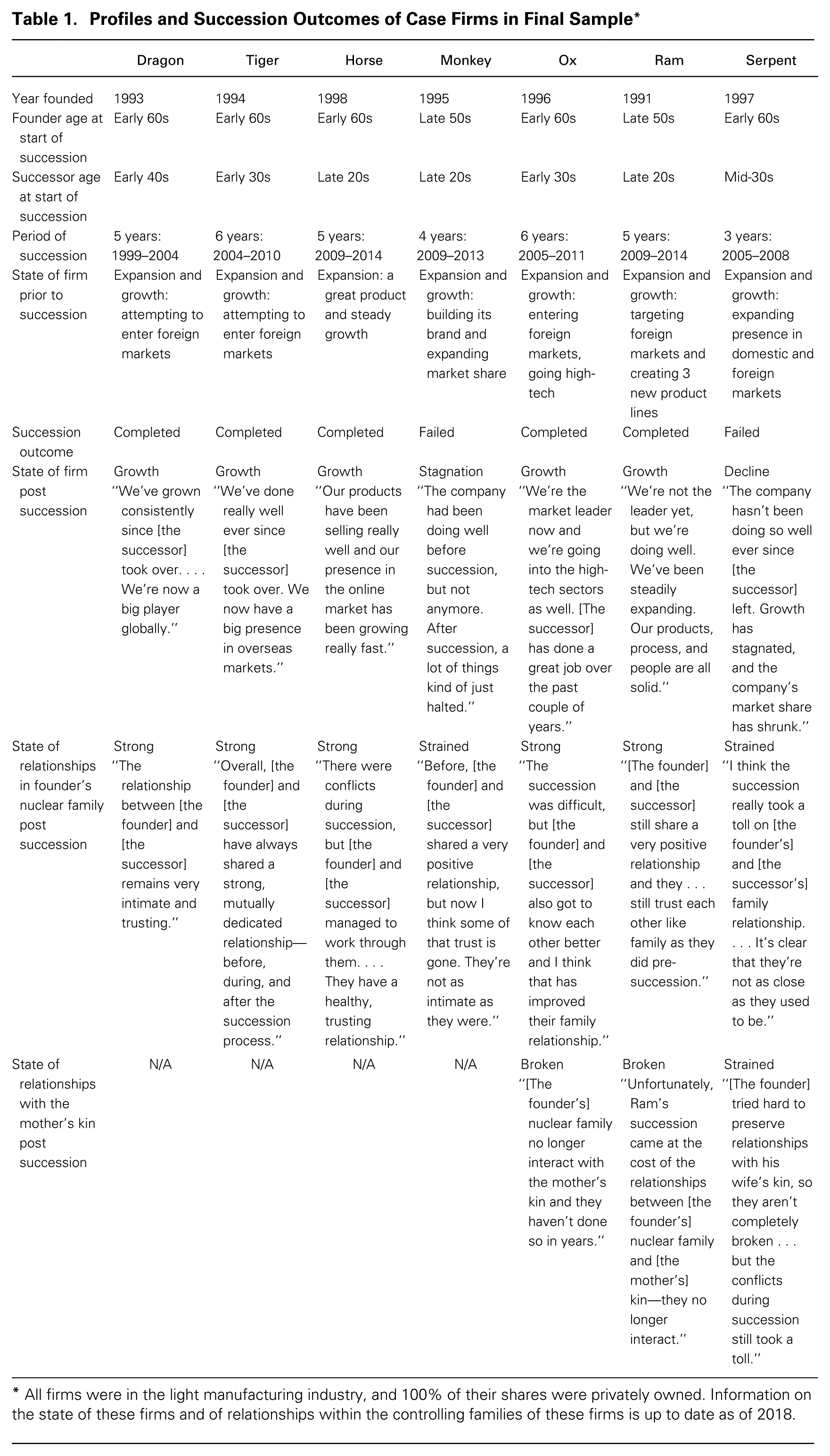
All firms were in the light manufacturing industry, and 100% of their shares were privately owned. Information on the state of these firms and of relationships within the controlling families of these firms is up to date as of 2018.
Single-domain Role Transitions
Although the founder and successor in each of our cases wanted the succession, they struggled with the process once it started. As our data reveal, this was largely because the succession process forced each founder–successor pair toward a role hierarchy in the firm that was a reversal of the hierarchy they wished to maintain in the family. Prior to the succession, each pair enacted the roles of CEO and VP in the firm and father and son in the family; the founder/father was thus hierarchically superior to the successor/son in both firm and family domains. This alignment of hierarchies predisposed the founder to transpose family norms and expectations into the firm: he expected the same deference from the successor in the firm that he did in the family. One successor recounted, “When we first started the succession process, I often felt like I had to treat my father in accordance with deference and filial piety in the firm like I do in the family, and he certainly expected me to do that. . . .”
The succession process, however, would break the alignment of role hierarchies across domains by reversing the firm’s organizational hierarchy while maintaining the family’s hierarchy. Every founder–successor dyad in our cases struggled with this process as they attempted to grasp how they would simultaneously treat each other as a superior in one domain and a subordinate in another. The challenges that the founders and successors experienced here are consistent with research that has documented the stress experienced by actors who occupy superior positions in one hierarchy but inferior positions in another (Stryker and Macke, 1978; Bacharach, Bamberger, and Mundell, 1993; Magee and Galinsky, 2008).
5
One founder recalled the challenges of coming to terms with his son as the new leader of the firm while remaining the father in the family: I remember that, when my son first started to have an important role in the company, this one time, he told me that the way I was managing was not good and that we needed a new way of running the production. The first thing that crossed my mind was, “I was the one who changed diapers for you when you were running around butt-naked, and now you’re telling me what to do!?”
A successor similarly remembered the challenge to adapt to the new roles in the workplace: The early days of succession were really difficult. . . . My father would often get unhappy when I told him to respect me and my ideas like he would a colleague, and he’d say that I still need to “respect my father” . . . and I’d often feel that he was lording over me and still treating me like his son.
The role transition in the firm was particularly challenging for the founder because it incited his anxieties over losing the respect of the successor and other family members in the family itself. Our interviews revealed that, in all cases, the founder wished to maintain the respect associated with being the father in the family even as he voluntarily decided to pass on the leadership role in the firm to the successor. The founder therefore became wary that stepping down from the leadership role in the firm would also result in his loss of respect in the family. Such anxieties are consistent with recent research that has shown how actors in superior hierarchical positions tend to perceive the loss of that position as threatening and respond to it with outward-targeted mistrust and suspicion, particularly toward those who would move up in the hierarchy due to the same processes that would result in their loss (Bothner, Kang, and Stuart, 2007; Neeley, 2013; Marr and Thau, 2014).
6
In all seven cases, the founder’s anxiety over possible loss of respect in the family predisposed him to perceive the successor’s differences of opinion on business matters as disrespect, even as he rationally believed that succession was necessary for the firm’s future growth. Ram’s founder remembered how his anxiety over losing respect in the family undermined his professional relationship with his son in the firm: “Of course, I knew that, in theory, I had to separate firm from family. But I think my worries that my son would start to disrespect me in the family . . . had an effect on my ability to consider his new propositions for our company objectively.” The successor at Dragon also remembered how his father’s desire to retain the respect of the family created conflicts in the firm: My father . . . wanted to pass on the company to me, yes, but he was also worried that I’d start disrespecting and challenging him in the family. Our household—like most households in rural China—we take filial piety very seriously, and a big part of that filial piety was younger generations respecting and deferring to family elders. So, when I’d started taking on more responsibilities in the firm, my father . . . became worried that I’d lose respect for him in the family, that the “younger generation” would start to look down upon the “older generation” and their ways of doing things. So, when I told him that I wanted to change the way our production was run—a way that he instituted—you can see how it was easy for things to get a bit emotional. . . .
While the founder was wary of losing respect in the family, the successor—in all seven cases—was anxious that he would never fully come into his own as the leader of the firm. If the traditional father–son role hierarchy were transposed into the firm, the successor would be obliged—as he would be in the family—to respect and obey the routines and practices that his father had established rather than implement his own. Unwilling to become the CEO in name only, the successor in all seven cases became increasingly pointed in his disagreements with the founder so as to make his own mark on the firm. The successor also increasingly perceived the founder’s differences of opinion over business matters as his father using family roles and norms to force his obedience to the managerial practices his father had established. The successor at Serpent remembered: I felt that, even as my father said I’m the successor, I was really just a “nominal” successor and that I’d still have to defer to my father in the company and uphold what he did—you know, the same way I’m expected to do so in the family. And that made me very unhappy. . . . So naturally I had many fights with my father. . . .
These struggles reveal a key theoretical insight for why the single-domain role transition is difficult: by breaking the alignment of hierarchies across domains, this process creates potential both for the loss of respect and for unfulfilled authority gain. As a result, the two actors involved in the single-domain role transition become increasingly adversarial, as one becomes defensive against perceived loss of respect while the other becomes defiant against perceived attempts to block her or him from gaining authority. This is so even if both actors had actually desired the role transition prior to its commencement.
On the Uniplex Third: Enabling Single-domain Role Transitions
Dragon and Tiger: The mother ushers in the succession process
At Dragon and Tiger, which experienced successful successions, the founder and the successor relied on a third party—the mother (i.e., the founder’s wife and the successor’s mother)—to facilitate the succession process. In both cases, the mother moved into a structural position relative to the founder–successor dyad that enabled her to legislate over family roles and interactions. Leveraging this structural position, she then engaged in actions to facilitate the succession while maintaining family stability.
Mother’s uninvolvement: Laying the structural foundations for separating firm and family
At Dragon and Tiger, the mothers laid the structural foundation for their facilitation of succession by refraining from all involvement in the firm and limiting their activities to only the family. Such uninvolvement in the firm went beyond abstaining from formal managerial roles; the two mothers also refrained from informal mediation of business disagreements between the founder and the successor. For instance, Mrs. Dragon, who had never been involved in management prior to succession, explicitly chose to stay uninvolved in the firm when succession began and to focus solely on “taking care of her husband and son” in the family.
7
She would decline Mr. Dragon and Dragon Jr.’s requests for her mediation in their business disagreements by telling them to “figure out the disagreements [yourselves].” Mrs. Tiger’s uninvolvement was more explicitly motivated by her desire to “simplify” the succession process. Prior to succession, Mrs. Tiger had actually been “deeply involved in [Tiger’s] sales and business development.” But shortly before the succession began, she ceased all formal and informal involvement in the firm, believing that any such involvement would “make the succession too messy.” A long-time manager at Tiger recounted: Mrs. Tiger used to be the head of sales at Tiger, but she thought that it was best to leave the company and take care of the family when her son entered the company. . . . It was better to just let the two men work out differences over issues in the company and she would focus on taking care of them at home.
At both Dragon and Tiger, the mother’s uninvolvement in the firm engendered a network structure that granted the founder and successor the freedom to interact as a dyad in the firm, while she remained active in the family to stabilize their relationship as father and son within a family triad. The mother’s uninvolvement in the firm meant that neither the founder nor the successor could leverage her support to tilt the balance of power in his favor and enforce obedience within the firm (Simmel, 1950). Instead, they were forced to renegotiate their roles in the firm as equals, a dynamic that granted both enough latitude to express opinions and disagreements. At the same time, the mother’s activity in the family constrained their latitude to unilaterally violate established norms and hierarchy in the family, which could bring on rebuke from her as well as resistance from each other (Simmel, 1950; Krackhardt, 1992). Thus the mother’s involvement in only the family simultaneously granted the founder and the successor flexibility in the domain in which role transition was desired (the firm) and stability in the domain in which stability was desired (the family). She thus structurally enabled the role transition in the firm to proceed without disrupting existing interactions and role hierarchy in the family. A family friend of Mrs. Tiger remembered: I think Mrs. Tiger was very wise. . . . [Mr. Tiger] and [Tiger Jr.] were bound to have disagreements during the succession process and they needed to work through those things themselves in order for the succession to proceed. If Mrs. Tiger had stayed [in Tiger’s top management], her involvement may have tipped the balance between [Mr. Tiger] and [Tiger Jr.], and that would’ve made things much messier. . . . But in the family she was certainly active, since she didn’t want the strong family relationship between her husband and son to be harmed by what happened in the company.
Mother aids the succession process: Delineating boundaries and reinterpreting family roles
The mother’s uninvolvement in the firm—which structurally separated the role transition in the firm from the existing hierarchy in the family—also allowed her to delineate boundaries between firm and family in terms of the content exchanged in the founder–successor relationship. Here, she implemented rituals that specified when the founder and the successor must interact only as family members. These rituals generally applied to situations in which the founder, the successor, and the mother were together. For instance, Mrs. Tiger ruled that, during family gatherings for dinners, holidays, birthdays, and weddings, Mr. Tiger and Tiger Jr. must cease all discussion of company matters and interact solely as father and son. If either Mr. Tiger or Tiger Jr. violated this ritual, Mrs. Tiger would enforce the boundary. Similarly, Mrs. Dragon stipulated that, during dinners, Mr. Dragon and Dragon Jr. must leave behind all company matters and “treat each other as father and son.” When the two violated this ritual, Mrs. Dragon would tell her husband and son to “drop the chatter about business when [you’re] with the family.” Dragon Jr. recounted an instance when he and his father disobeyed his mother’s “dinner table boundary”: I had a pretty big fight with my father. . . . The fight was about the construction of a new office building. I had managed this project from the beginning and had personally designed this new building, but when it came time for it to be built, my father wanted it scrapped. He didn’t like it. He had a different idea for the company building. I was angry, but he wouldn’t budge. . . . When we were at the dinner table, I was still angry and he was too, and my mother wasn’t happy about that. She told us, “I don’t care what you guys did at work, and I don’t want to care. But now you’re at my dinner table, and at my dinner table we are family. You guys can fight tomorrow when you get to the company, but not at my dinner table.” She’s right: family is family.
Every such ritual constituted a detailed stipulation of whether, in a particular circumstance, the founder and the successor should interact as family members or as firm executives. In aggregate, these rituals delineated a coherent boundary around the family domain. Inside that boundary, founder and successor were required to suspend the exchange of content specific to the firm domain (e.g., business disagreements). This, in turn, helped clarify when and where they could suspend their family obligations and treat each other purely as professional colleagues. Dragon Jr. described his mother’s boundary delineation: Before my mother stepped in, my father and I were always fighting . . . in the company, in the family, everywhere. . . . But now that my mother made it very clear when and where we are family, it’s also more clear to us when and where we should be treating each other as CEO and VP. So now, when my mother is around or when we are at the family dinner table, we are family. But when she’s not around and it’s just the two of us in the factory or the boardroom, we treat each other as business colleagues.
Thus, by delineating boundaries, the mother also helped the founder and successor separate firm from family in terms of the content they exchanged in their interactions.
Moreover, the mothers’ decision to act as the third party to the founder and successor in only the family domain enabled them to create new interpretations of the roles of the father and son that were more conducive to the transition in the firm without being disruptive to the existing family hierarchy. For example, Mrs. Dragon would have one-on-one conversations with her husband to ease his concerns about Dragon Jr. being disrespectful and to encourage him to rethink being a father as being “a benevolent figure who trusts the younger generation.” She also encouraged her son in private to “understand where [his] father was coming from” and urged him to think of himself as “not going against [his] father, but improving on the previous generation’s work.” Mrs. Tiger, too, had private conversations with her husband and son to reinterpret their family roles in ways that were conducive to the role transitions within the firm. She would remind Mr. Tiger that, while he’d always be the father of the household, he should let his son “forge his own path.” She would also encourage Tiger Jr. to think of his role as a son as one who “forged his own legacy by building on his father’s work and legacy rather than dismantling it.” One time when Tiger Jr. felt particularly frustrated at his father’s resistance to his proposals for new management practices, Mrs. Tiger told him in private: Look, your father . . . he isn’t as resistant to the more formal management practices that you proposed as you think. But you also need to understand that he built this company in a certain way with certain people, and those methods and people got the company to where it is now. . . . So think of your father’s resistance as an opportunity . . . to work with him, so that you can build your system on what he has done with this company.
In this manner, without altering the family hierarchy, the mother’s reinterpretations facilitated the succession by ameliorating the founder’s anxieties over losing respect and the successor’s anxieties over unfulfilled authority gain. By creating new interpretations of the father role that were more conducive to the succession (e.g., a father who enables his son to come into his own instead of always deferring), the mother reduced the founder’s anxiety over losing respect in the family, which in turn rendered him less defensive against the successor in the firm. Similarly, by reinterpreting the son role (e.g., one who shows respect to his father not by strictly obeying his father’s legacy but by building on it), the mother soothed the successor’s anxiety that the family hierarchy would be transposed into the firm in a way that would inhibit him from fully taking over as the company leader. The aggregate result of such reinterpretations is to enable the founder and successor to depersonalize their business disagreements, which allowed them to more effectively work through their differences. Dragon Jr. recounted how his mother’s reinterpretation of family roles enabled him and his father to depersonalize and resolve their business disagreements: My father and I were both strong-headed individuals who each wanted to do his own thing . . . and yes, the succession was something that meant a lot to both of us personally. . . . My mother was a very positive influence in helping the two of us understand that the way we felt personally towards each other as father and son, the way we felt personally about the company, and the succession process—those things don’t have to get in the way of each other. So even if I’m critiquing my father’s decision for our new factory design, I’m not disrespecting him—I’m actually trying to improve on what he did . . . and she really helped both of us see that.
Overall, the actions of the mother at both Dragon and Tiger in staying uninvolved in business, delineating boundaries, and reinterpreting family roles contributed to successful successions while also preserving family solidarity. Both companies continued to grow after succession, both aggressively expanded into foreign markets, and both are now industry leaders. The founders and successors at both Dragon and Tiger share positive, trusting relationships with each other and with the mothers to this day.
Horse: Mother’s changing involvement in the firm decreases her effectiveness in the family
Unlike Mrs. Dragon and Mrs. Tiger, Mrs. Horse—who had been VP of production and human resources prior to succession—remained in that position after the succession began. While she had full faith in Horse Jr.’s managerial capabilities, she thought it was best to stay in top management during the succession to provide an “additional guiding hand for [her] son.” Thus, as she engaged in boundary delineation and role reinterpretation from within the family to maintain stability, she also remained in the firm’s top management so as to guide the succession process from within the firm.
Yet Mrs. Horse’s decision to retain her top managerial role—and thus to be present in the family and the firm—actually blurred the boundary between the two domains. This in turn increased both her and Mr. Horse’s tendencies to transpose the family role hierarchy and family norms of deference into the firm, creating a two-parents-against-one-child power dynamic in the firm. For instance, when Mr. Horse and Horse Jr. disagreed over Mr. Horse’s refusal to professionalize management practices, Mrs. Horse—together with her husband—chided Horse Jr. for “being disrespectful to his parents.” This in turn validated Mr. Horse’s own tendency to blur the boundary between firm and family. While he initially tried to “treat [Horse Jr.] as a colleague” in business disagreements, witnessing Mrs. Horse chiding Horse Jr. that way convinced him that Mrs. Horse was on his side when he treated Horse Jr. in accordance with family roles and norms. Over time, Mr. Horse became more convinced that “[Horse Jr.] should act more respectfully towards his parents in the firm” and that he “should listen to his parents more, since his parents are more experienced and are only trying to look out for him.” By retaining her top managerial role, Mrs. Horse not only transposed family hierarchy into the firm herself but also validated Mr. Horse’s tendency to do the same.
Unsurprisingly, such a two-against-one dynamic exacerbated Horse Jr.’s anxiety over unfulfilled authority gain in the firm, and he responded by rejecting Mrs. Horse’s attempts to facilitate succession—not only in the firm, but also in the family. From Horse Jr.’s perspective, he could not distinguish between his mother delineating boundaries and reinterpreting roles within the family (which she claimed was done to maintain family stability) on the one hand, and her “siding with his father” in the firm on the other. As a result, he began to view all her attempts to maintain family stability as her “teaming up with his father against him in disagreements over company matters”—a view that was validated by Mr. and Mrs. Horse’s own tendencies to transpose family hierarchy into the firm. Even when his mother sincerely wished to delineate boundaries, reinterpret roles, and resolve family conflicts, Horse Jr. would respond by telling her to “first obey these boundaries and rules yourself before imposing them on others.” Thus rather than delineating boundaries, Mrs. Horse’s involvement in both firm and family led her to blur the boundary between these domains, which eroded her son’s respect for her in both domains. Even when she attempted to engage in actions that would otherwise aid the succession process, her son viewed those actions as unjustified on account of her own involvement in firm and family, as he recounted: I respect my father and mother immensely, but when I tried to convince them that they should do things [in the business] differently, I felt like the two of them would almost always stick to their old way of doing things and resist my new ideas, so although I was the “successor” on paper, my parents were still the actual decision makers. . . . [Mrs. Horse] says that [she] wants to keep family and company separate, but how was I supposed to keep family and company separate when [she was] still involved in management?
In the third year of succession, Mrs. Horse—realizing that her continued involvement in the firm was derailing the succession and damaging family solidarity—relinquished her top managerial role to focus exclusively on “taking care of the family.” She explained: With me at the company, things were just getting messy. It’s hard enough with my husband and my son by themselves. If I get involved, things will just get messier. It’s better to just let the two men in my family sort out the things at the company by themselves, and I’ll focus on taking care of them at home.
Mrs. Horse’s decision to step down from Horse’s top management enabled her to regain respect in the family. It also affirmed her dedication to the family and proved that her actions in the family were meant to maintain family solidarity. She thus regained the respect of her husband and—in particular—her son, enabling her to aid them with the succession process. Much like the mothers at Dragon and Tiger, Mrs. Horse established rules and rituals to delineate boundaries between firm and family, and she helped her husband and son reinterpret their family roles in order to reduce their anxieties and ameliorate conflicts. These actions forced Mr. Horse and Horse Jr. to resolve their professional differences independently of their family relationship. Horse Jr. remembered: I think my parents realized after a while that, for me to take over, they’d have to step away. So my mother decided to focus more on taking care of the family and let my father and I work out the succession on our own. . . . That gave me the freedom I needed to show my parents that my ideas are valuable, and it also meant that my father and I are going to work things out on our own now. . . . Of course, my father and I still have our differences, but we’re a lot more harmonious now. When things get a bit heated, my mother will typically step in and make sure that we don’t get too emotional . . . but that doesn’t happen that often anymore. . . . I think after my mother left the company, my father and I started learning how to work together as partners in business. . . . Now, it’s all about who’s right: If my father’s right, I listen to him; if I’m right, he listens to me. Now, my parents no longer dismiss my proposals just because I’m their child.
While the succession at Horse began poorly, Mrs. Horse’s decision to relinquish her top managerial role proved to be the key decision that enabled a successful succession. Five years after succession began, Horse Jr. took over as CEO and sole owner. He then began to invest heavily in Horse’s online retailing capabilities, which increased market share and profits. The firm is now a regional market leader.
Monkey: Mother’s retention of her managerial role contributes to failed succession
Mrs. Monkey had been a company VP before succession began and remained so throughout succession, even as she engaged in boundary delineation and role reinterpretation within the family during this process. Her intention was to facilitate the succession process in both firm and family. Yet, as was the case at Horse, Mrs. Monkey’s involvement in the firm compromised her efforts within the family and hindered the succession. Her involvement predisposed her (and others) to transpose family hierarchy and family norms of deference into the firm, which cemented Mr. Monkey’s understanding that he is a “parental figure to [Monkey Jr.] in both firm and family.” As the succession wore on, he became more prone to viewing his son’s business ideas as the “opinions of a child” rather than as the proposals of the future CEO. As had happened at Horse initially, Mrs. Monkey’s involvement in the firm during the succession blurred the boundary between firm and family while creating a two-against-one dynamic against Monkey Jr. Mrs. Monkey acknowledged as much: Looking back . . . yeah, I think I acted like a parent to [Monkey Jr.] and treated him as a child instead of as the company’s successor. . . . I really just wanted to help, to guide him along, but sometimes when we were arguing about company matters, my parental attitudes came out . . . and I think that may have had negative consequences. . . .
In response, Monkey Jr.—like Horse Jr.—began to withdraw respect for Mrs. Monkey in the family. Unable to distinguish her efforts to maintain stability in the family from her “alliance with [Mr. Monkey] against [him]” on company issues, Monkey Jr. began to turn a deaf ear to his mother’s claims that she was trying to establish boundaries between firm and family. And when Mrs. Monkey attempted to reinterpret her son’s family role so as to facilitate succession while preserving his family relationship with his father, Monkey Jr. retorted that she “should first think about how her educating [him] like a kid in the company . . . is affecting [his] relationship with [his father].” A longtime family friend recalled how Mrs. Monkey’s involvement in the firm created frictions in both firm and family: Everything at Monkey would’ve been so much easier if Mrs. Monkey had just stayed out of the company. . . . With Mrs. Monkey involved, now Monkey Jr. has to deal with his mother in addition to his father . . . and [Mr. Monkey] and [Mrs. Monkey] tended to agree. So of course, after a while, Monkey Jr. started thinking that his parents were against him! That made [arguments] more difficult to resolve in the company, but that also contributed to resentment in the family. . . . I mean, yeah, [Mrs. Monkey] would say that “we should keep family and firm separate,” but how was [Monkey Jr.] supposed to believe that when his mother was herself involved in the company?
Unlike Mrs. Horse, however, Mrs. Monkey—with the best intentions—did not relinquish her top managerial role, as she herself explained: [Mr. Monkey] and I really thought that he was capable, and [we] both wanted to pass on the company to him so we could turn our company into one of those “hundred-year old companies.” But China can be a difficult environment to navigate for anyone . . . so I just wanted to stay involved in the company’s top management to act as an extra hand for my son [during the succession process].
Despite her good intentions, Mrs. Monkey’s decision to remain as VP ultimately led to succession failure. Her involvement in both firm and family increased her and her husband’s tendency to transpose family norms into the firm, leading Monkey Jr. to further lose respect for her in the family as conflicts among all three became increasingly frequent and personal. After four years, Mr. Monkey, Mrs. Monkey, and Monkey Jr. collectively gave up on the succession, as they were tired of the conflicts and wary of permanently damaging their family relationships. Monkey Jr. moved overseas to pursue a different career, leaving the firm to his father. As of 2018, the firm is still in operation but has yet to professionalize its management practices or expand into the online market. It faces an uncertain future as Mr. Monkey nears retirement.
On the uniplex third position and authority over multiplex relationships
Together, the succession processes at Dragon, Tiger, Horse, and Monkey reveal that a third-party actor to a multiplex dyad undergoing single-domain role transition could facilitate that transition by engaging in the processes of delineating boundaries and reinterpreting roles. More crucially, however, acceptance of this third party’s authority for engaging in such facilitation stems from her or his occupancy of the uniplex third position.
At Dragon and Tiger—and eventually at Horse—the founder’s and the successor’s acceptance of the mother’s authority to legislate over roles and interactions in the family underpinned her effectiveness in enabling the transition process in the firm without disrupting the existing family hierarchy. As Nadel (1957) observed, in many domains of social and economic life, a specific actor is endowed with the authority to legislate how other roles and norms in that domain are to be enacted. Such an authority figure is necessary because almost no set of roles and norms is sufficiently well-defined to stipulate how to behave in every situation. So, while most actors have generic understandings of their roles, they often rely on a third-party authority figure to advise them in specific circumstances. This is what we observed at Dragon and Tiger: the founder and successor, unable to separate firm from family, relied on the mother as a third-party authority to help them delineate boundaries and interpret their roles and interactions in the family in ways that enabled—rather than inhibited—the succession process in the firm.
What the cases of Horse and Monkey reveal, however, is that acceptance of a third party’s authority depends on that third party’s occupancy of the uniplex third position. We define this previously unexamined network structural position as an actor who is connected in only one domain to two actors who have a multiplex relationship, i.e., a relationship that crosses multiple domains. The uniplex third position grants the occupying actor authority in one domain by absolving her or him from suspicions of status competition and power struggle in another domain—one in which she or he is uninvolved. This fosters alters’ acceptance of her or his authority, as they now trust that she or he would not misuse authority in one domain to pursue self-interest in another. Such acceptance is further cemented because, by occupying the uniplex third position, the third party abstains from “taking sides” in the domain in which she or he is uninvolved and therefore from creating a two-against-one dynamic. If, however, the third-party actor is involved in multiple domains (i.e., does not occupy the uniplex third position), her or his authority is compromised, as alters begin to suspect both misuse of authority and partisanship. This was what happened at Horse initially and at Monkey right up to the end of succession. Overall, the position of the uniplex third engenders acceptance of the occupying actor’s authority by establishing her or his trustworthiness and nonpartisanship to alters in a multiplex relationship, thus enabling her or him to facilitate the process of single-domain role transition.
We illustrate the structure of the uniplex third position in figure 1. The left-hand side illustrates the mother’s position when she is involved only in the family domain, which enables her to act as the trustworthy but nonpartisan authority to the founder/father and the successor/son—authority that she can use to facilitate the single-domain role transition between the founder/father and the successor/son. This was what happened in the cases of Dragon and Tiger. The right-hand side illustrates the structure resulting from the third party becoming involved in multiple domains. Here, the mother is involved in both family and firm domains and is no longer able to facilitate the single-domain role transition involving the founder/father and successor/son. This was effectively what happened in the cases of Horse (initially) and Monkey. After Mrs. Horse stepped away from the firm, however, the network structure comprising her, Mr. Horse, and Horse Jr. reverted to the one on the left.
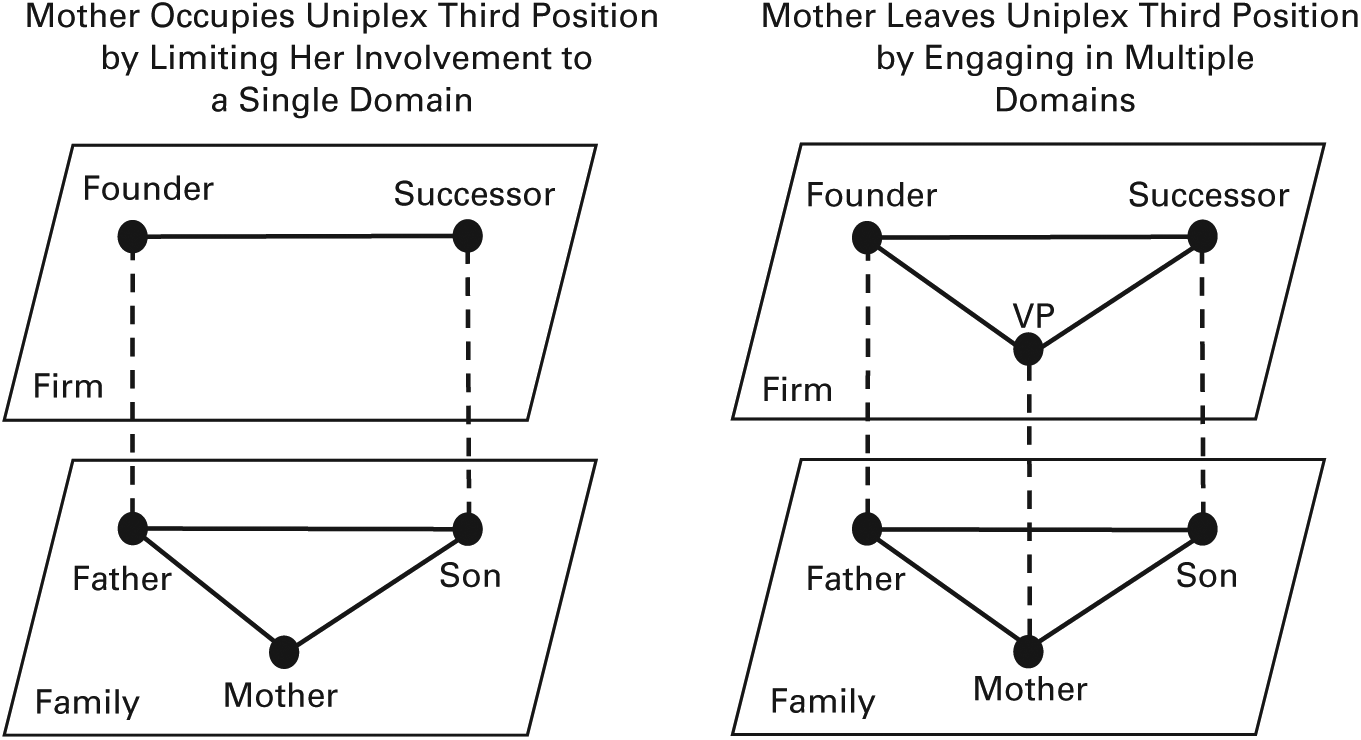
Structural results of the uniplex third position to a multiplex dyad in a single domain vs. multiple domains.*
On Cross-domain Closure: When Occupancy of the Uniplex Third Position Is Inhibited
Thus far we have examined only the nuclear family, i.e., the triad composed of the mother, founder, and successor. The cases of Ox, Ram, and Serpent illustrate how the uniplex third can be impacted by the structure of relationships beyond this triad.
Ox and Ram: Mother caught between her nuclear family and her kin
At Ox and Ram, although the mother was uninvolved in the firm during succession, her facilitation of the succession process was compromised by the involvement of her kin in the firm’s top management—specifically, Mrs. Ox’s brother and uncle and Mrs. Ram’s brother. These members of the mother’s kin did not share meaningful relationships with the founder and the successor in the family domain. In the words of Ram Jr., he and his father saw Mrs. Ram’s brother as effectively “an acquaintance with the family name.” Yet at both firms, the mother’s kin in top management frequently conflicted with the founder and successor (i.e., the mother’s nuclear family) in the firm as they sought to advance their personal interests. The more critical problem for our study was how the mother’s kin inhibited her occupancy of the uniplex third position.
At both Ox and Ram, the mother’s kin in top management attempted to drag her out of her uniplex position in the family by demanding that she advocate their interests during their conflicts in the firm. Mrs. Ox’s brother and uncle constantly pushed her to “take their side” during their business conflicts with Mr. Ox and Ox Jr. When Mrs. Ox refused, desiring to stay out of company matters, they scolded her for “not fulfilling her duties to her own family” and accused her of “betraying the family that raised her.” Similarly, Mrs. Ram’s brother demanded that she “speak on [his] behalf” in his business conflicts with Mr. Ram and Ram Jr. When Mrs. Ram made clear her desire to “stay out of business matters and stick to taking care of her [nuclear] family,” her brother accused her of “abandoning her kin.” Both Mrs. Ox and Mrs. Ram wished to refrain from involvement in the firm and to focus on taking care of their nuclear family. Yet feeling obligated toward their kin and their side of the family, the mothers at the two firms felt an increasing pressure to become involved in the firm and thus to leave the uniplex third position.
What’s more, the founder and the successor also began to make their respect for the mother’s authority in the family conditional on her support in the firm against her kin. To the founder and the successor, the mother’s obligations to her interfering kin and her unwillingness to “discipline” them signified that she herself was still “acting on behalf of her own kin instead of her husband and son.” Wanting her to “earn [their] respect by proving . . . that she was completely dedicated to her [nuclear family],” the founder and the successor began to make their respect for her family authority conditional on her taking decisive action against her kin. For example, when Mrs. Ox attempted to use her authority to establish boundaries between firm and family, her husband and son retorted that she “should first make [her brother and uncle] obey these boundaries so they’d stop interfering.” Mrs. Ram similarly recounted how she was paralyzed by conflicting demands: Succession at Ram was very difficult at first. I had my [kin] on one side accusing me of betraying them. I had my husband and son on the other side saying that I was biased towards [my kin] and siding with [my kin]. We were all fighting with each other and I was stuck in the middle of the whole thing . . . I didn’t know what to do. . . .
Thus as the succession wore on, Mrs. Ox and Mrs. Ram were pulled in two directions by their nuclear families’ and their kin’s conflicting demands for their partisan support.
Wanting to end the torture of being pulled in two directions—yet unwilling to take a partisan stance against either their nuclear family or their kin—Mrs. Ox and Mrs. Ram ceased all succession-aiding activities and disengaged from both their nuclear family and their kin in both firm and family domains. They stopped all efforts to enforce boundaries or to ameliorate conflicts and concerned themselves with only household chores. Unsurprisingly, with the mother no longer lending her aid, the founder and successor at both firms found it increasingly difficult to separate business from family. This—together with the interference of the mother’s kin—increased their stress, leading to increasingly personal conflicts both with each other and with the mother’s kin. As a family friend of Mr. Ox recalled: Ox had a tough time during the first two years of succession. The founder, the successor, [Mrs. Ox’s kin]—they fought all the time, and nobody could get along with anybody. . . . Now, if Mrs. Ox could help [Mr. Ox and Ox Jr.] separate family from business, that would make things much easier . . . but with [her kin] involved, Mrs. Ox was caught in the middle. As we say in China, the flesh on your palm is your flesh, but the flesh on the back of your hand is also your flesh ( ). If your palm went to war against the back of your hand, what could you do? For Mrs. Ox, the blood kin in her maternal family was fighting with the blood kin in her nuclear family. The only thing she could do was to not do anything . . . and when she was not doing anything, the fighting between everybody else only got worse. . . .
Unwilling to see years of hard work destroyed by family infighting, the founders of Ox and Ram decided to end the conflicts once and for all by removing the mother’s kin from top management, even if it meant straining the relationships between their nuclear families and the mothers’ kin. Mr. Ox recalled: So I resolved to get rid of [Mrs. Ox’s kin]. One morning, I called [Mrs. Ox’s uncle] into my office, and I sat him down and I handed him an envelope containing a pretty big chunk of money. . . . Then I said to him, “Look, I still respect you, and when we’re at family gatherings I’ll still treat you like family. But this is my business, and I want to pass that on to my son one day. I’m not sure having you around is a good thing. So, I’m letting you go. Here’s some money as compensation.” He looked at me in total shock, then he started screaming . . . and he grabbed the money and stormed out the door, all the while cursing me. . . . I did the same to [Mrs. Ox’s brother]. . . . After this, my wife and I couldn’t go to her family to celebrate Chinese New Year. . . . Nevertheless, now things are clean here.
For Ox and Ram, removing the mother’s kin from the firm proved crucial for their successful successions, albeit at a heavy social cost to their families. In both cases, the mother, founder, and successor were excommunicated from the mother’s kin and barred from attending any of their social gatherings. Nevertheless, the decision to remove the mother’s kin freed the two mothers from the torture of being pulled apart by the conflicting obligations, which in turn restored the founders’ and successors’ respect for her authority “without needing her to prove anything . . . so [they] could restart [succession] with a clean slate.” Both Mrs. Ox and Mrs. Ram quickly reengaged with the founder and the successor as the uniplex third in the family, specifically by delineating boundaries between firm and family domains and reinterpreting family roles to be more conducive to the succession in the firm. Mr. Ram recounted how removing his wife’s brother from the firm enabled his wife to reengage as the authority in their nuclear family: All of us—me, my son, my wife—could take a breather after [Mrs. Ram’s brother] was fired. Now, my son and I work out our disagreements amongst ourselves without having to worry about [the mother’s kin], and if things get a bit out of hand, then my wife is always there to make sure that family is still family. She is very adept at this, and she always knows how to calm us down when we get a bit emotional. . . . My son and I know that my wife—his mother—is here for us in the family. She does a lot to remind me not to look at my son as a kid in the firm. She is right. The next generation, they have a lot more information and they’re also quicker in thought. We can’t keep treating them as kids. For Ram to grow, I had to learn to treat my son as a colleague in the company and accept his suggestions and criticisms. Without my wife, doing that would be much more difficult.
The mother’s renewed occupancy of and activity in the uniplex third position in the family ultimately contributed to successful successions at both Ox and Ram, despite the initial struggles. Ox Jr. became CEO after six years of succession and Ram Jr. after five. Both went on to professionalize management practices in their firms and expand into new markets. Both Ox and Ram have grown consistently since succession concluded, and relationships among the founder, successor, and mother have been positive.
Serpent: Mother’s kin forces mother out of uniplexity and derails succession
Serpent also faced succession troubles that stemmed from the interference of Mrs. Serpent’s kin forcing her out of uniplexity and undermining her authority to legislate over family roles and interactions. Two of her kin, while not sharing meaningful family relationships with Mr. Serpent and Serpent Jr., were top managers and insisted that she advocate their interests in the firm. At the same time, members of her nuclear family demanded her involvement in the firm so that she could help “sort through the mess . . . with her own kin” and made their respect for her authority conditional on her “taking action” against her own kin. Unwilling to choose sides yet unable to exercise family authority, Mrs. Serpent ceased her attempts to delineate boundaries or ameliorate family conflicts and disengaged from activity in both family and firm domains. As Serpent Jr. recounted: You know, one of the most annoying things about [Mrs. Serpent’s kin] is that they bring all this family stuff into the company. If it was just my dad and me, my mother probably could’ve done something to ease the negative emotions between us. But now she can’t do that because [her kin] are also involved in the company. So, when [they] want her to do something that benefits their interests but hurts [the nuclear family], that puts her in a tough position. . . . Look, at the time, I was pretty angry with my mother for not doing more to support her husband and son . . . but looking back, with her husband and son on one side and her blood kin on the other, what was she supposed to do?
Unlike Mr. Ox and Mr. Ram, however, Mr. Serpent did not remove his wife’s kin from the firm. Despite not personally sharing strong relationships with them, he still felt that firing them was inappropriate by family norms. He also knew that doing so would anger the rest of Mrs. Serpent’s maternal family, and he did not want to put his wife in the position of no longer being able to “go to the [house of Mrs. Serpent’s kin] to celebrate Chinese New Year and Mid-Autumn Festival.”
This decision may have preserved Mr. Serpent’s and his nuclear family’s social relationships with Mrs. Serpent’s kin, but it proved detrimental for the succession. As succession wore on, the kin kept increasing their demands on Mrs. Serpent, who in turn receded even further from her position as the uniplex authority in the family. With no third party legislating over their relationship, Mr. Serpent and Serpent Jr. were unable to resolve their increasingly frequent conflicts with each other and with Mrs. Serpent’s kin. Three and half years into the succession, Serpent Jr., fed up with the family feuds, left to start his own firm—taking many of Serpent’s best salespeople and engineers with him. Serpent’s performance declined and never recovered, while relationships between Mr. Serpent and Serpent Jr. remain strained to this day.
Cross-domain Closure as a Structural Constraint on the Uniplex Third
The relationships among the mother, her nuclear family, and her kin at Ox, Ram, and Serpent showcase a network structure that constrains an actor attempting to occupy the uniplex third position: cross-domain closure. Cross-domain closure is a structure specific to multiplex networks in which two unconnected actors of an open triad in one domain are directly connected in another domain. For example, at Ox, Ram, and Serpent, the nuclear family (i.e., the founder and the successor) is indirectly connected to the mother’s kin via the mother but not directly connected in the family, such that they form an open triad in the family domain. This open triad, however, is closed by a direct connection between the mother’s kin and the nuclear family in the firm domain. Note that cross-domain closure is distinct from the closure that prior research has examined in uniplex networks, in which two unconnected actors of an open triad in one domain would form a direct connection in that same domain (Simmel, 1950; Coleman, 1988; Burt, 2001). As a result, unlike closure in uniplex networks—which results in a strictly closed triad—cross-domain closure results in a network structure that manifests as a closed triad when viewed across domains but as an open triad within one particular domain. In the cases of Ox, Ram, and Serpent, the triad comprising the nuclear family, the mother, and the mother’s kin manifested as closed when viewed across firm and family domains but as open when viewed only in the family domain. We illustrate the structural distinction between cross-domain closure and closure in uniplex networks in figure 2.
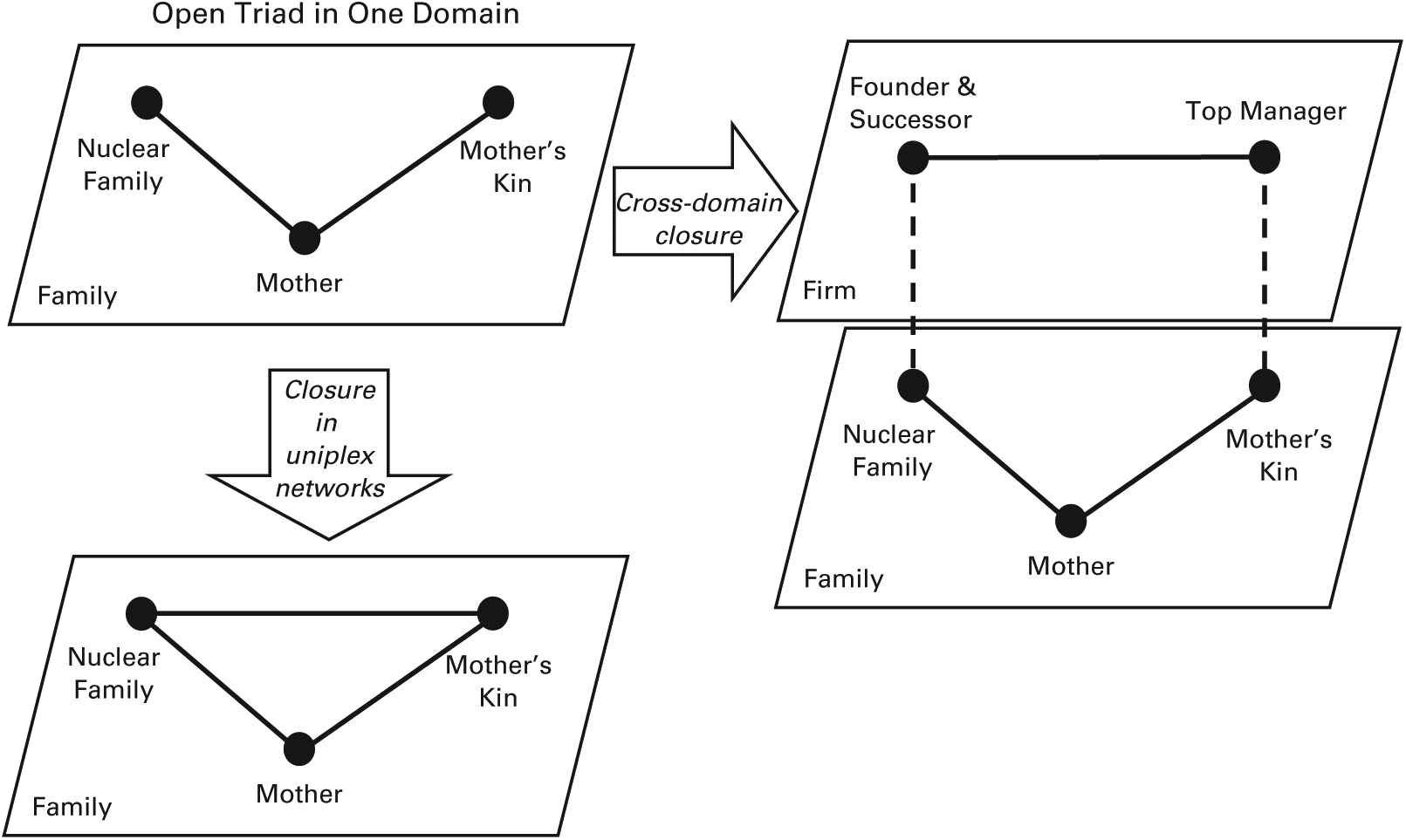
Structural results of cross-domain closure versus closure in a uniplex network.*
Unlike the network closure that prior literature has examined (Coleman, 1990; Sorenson and Stuart, 2001; Reagans and McEvily, 2003), cross-domain closure does not promote cooperation but instead lifts unbridged divisions between actors from one domain into another. This is clearly illustrated in the cases of Ox, Ram, and Serpent. Despite their direct connection in the firm domain, the nuclear family (i.e., founder and successor) and the mother’s kin did not interact significantly in the family and considered each other to be members of distinct kinship groups (i.e., nuclear family and mother’s kin; or, in Mandarin, pojia and niangjia). In other words, the direct connection between the nuclear family and the mother’s kin in the firm domain did not actually bridge divisions between them in the family (i.e., differences in interests or obligations) to engender a closed triad among the nuclear family, the mother, and the mother’s kin in the family domain. What this direct connection did do, instead, was to make the divisions that formerly existed in only the family now relevant to their interactions in the firm, thereby creating conflicts between the nuclear family and the mother’s kin in the firm domain. Thus cross-domain closure is also distinct from the closure examined in prior social networks literature in its process: rather than bridging the divisions between unconnected actors of an open triad to promote cooperation, it transposes divisions across domains of a multiplex network to create conflicts.
Figure 3 illustrates the process by which cross-domain closure constrains a third-party actor from occupying the uniplex third position. By transposing divisions between the two unconnected actors of an open triad across domains, cross-domain closure creates normative pressures that force any third party to whom both of these actors are connected into partisan involvement across multiple domains. This necessarily inhibits the third party caught in the middle from remaining uniplex in only one domain. Unable to bear the pressure of being caught in the middle, the third party often responds by disengaging from activity in all domains altogether. This was precisely how the involvement of the mother’s kin in the top management of Ox, Ram, and Serpent prevented her from occupying the uniplex third position. As both the nuclear family and the mother’s kin strived to gain the upper hand in their conflicts, both pressured the mother into involvement on their side within the firm—and made their trust and respect for her conditional on such partisan involvement. This created enormous normative pressure on the mother to abandon her uniplex position in the family and also become involved in the firm. Unable to bear such pressure, the mother disengaged in both firm and family domains, thereby depriving the founder and successor of a uniplex third party capable of legislating over their relationship and facilitating the succession process. Our cases thus reveal cross-domain closure to be a network structure that strongly predisposes the transposition of existing divisions and conflicts across domains, which then drags any third party caught in the middle into such conflicts. The consequence for this third party is that her or his occupancy of the uniplex third position becomes inhibited, as she or he is forced to either surrender to the normative pressures that demand partisan involvement across multiple domains or escape such pressures by disengaging from all domains altogether.
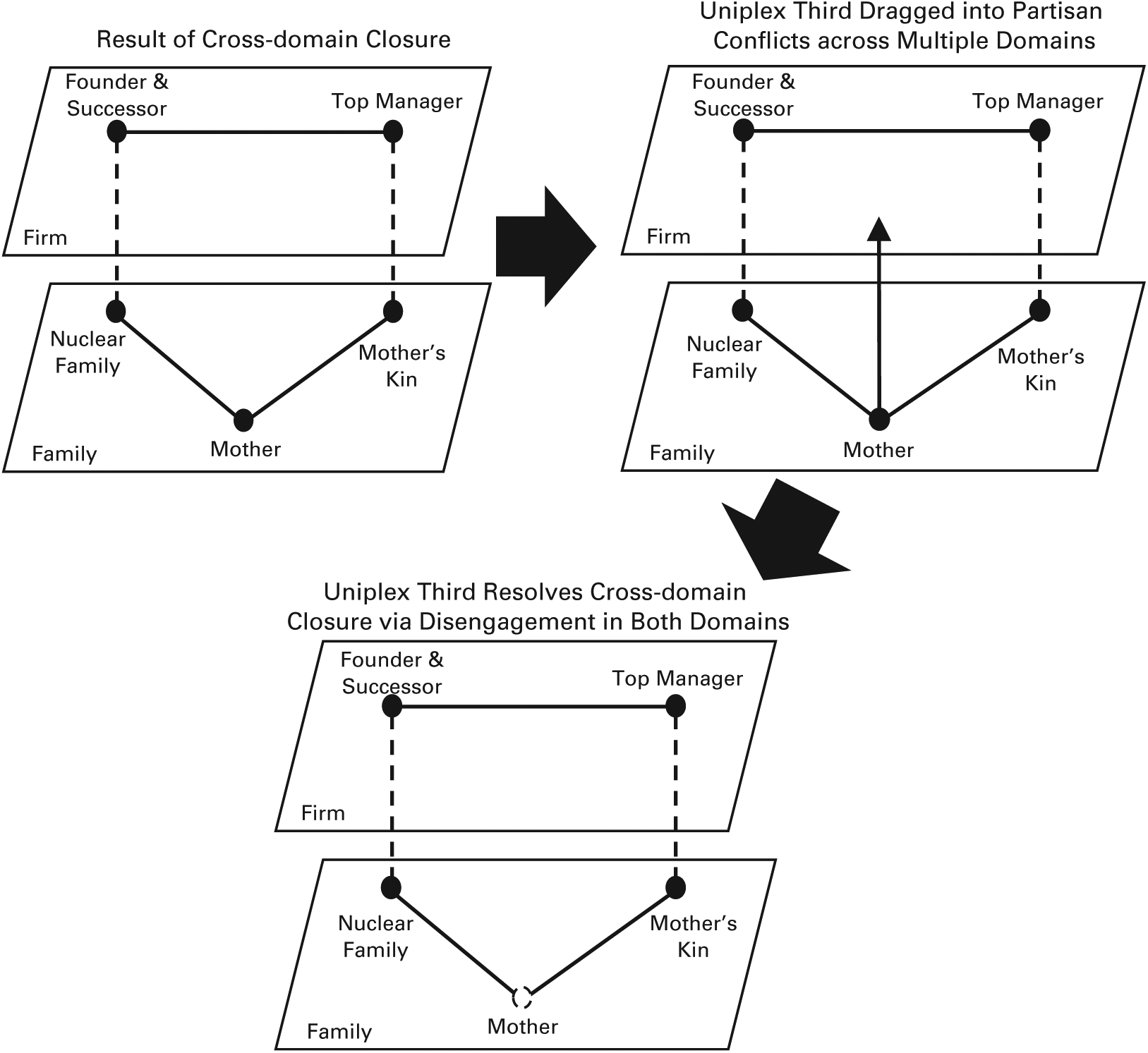
How cross-domain closure constrains the third-party actor from remaining uniplex.*
Discussion
This paper was motivated by an inquiry about how actors in multiplex relationships can carry out single-domain role transitions while avoiding disruptions. To answer this question, we examined single-domain role transitions across seven cases of intergenerational succession. We found that differences in the structures of relationships across firm and family domains contributed to significant variation in the succession process and outcome across the seven firms. Moreover, three of our cases—Horse, Ox, and Ram—showed how changes in the structure of relationships across firm and family domains midway through the succession altered its trajectory. Analyzing these three cases in juxtaposition with the other four cases thus enabled us to build theory on how the structure of relationships surrounding a multiplex dyad enables or constrains single-domain role transition.
We found that two actors in a multiplex relationship can carry out a single-domain role transition by relying on the legislation of a third actor in the uniplex third position. We also found that this third-party actor’s occupancy of the uniplex third position—and therefore her or his effectiveness in facilitating the single-domain role transition—is constrained by cross-domain closure. Overall, our findings elucidate the structural network mechanisms that both enable and constrain single-role transitions in multiplex relationships. Our study thus contributes to the research on multiplex relationships by starting to examine the structures and processes underlying how roles, hierarchical positions, and relational dynamics in a multiplex dyadic relationship change.
While we entered this study motivated by inquiries about single-domain role transitions—and, more broadly, change in multiplex relationships—the emergent insights of this study also enable us to extend both the research on social networks and the research on multiplex relationships by theorizing on the structure and dynamics of multiplex networks. Our conceptualization of the uniplex third position enables us to contribute to the broader social networks literature by extending the research on the third-party actor to the realm of multiplexity. Our elucidation of cross-domain closure similarly enables us to contribute theoretical insights on how network closure functions in multiplex networks—and on how this differs from closure in uniplex networks. Lastly, we contribute to the research on family firms by shedding light on the network structures that may be most conducive to generating positive synergies between family and firm domains.
The Uniplex Third Position and Authority over Multiplex Relationships
We contribute to the social networks literature by examining the third party in the context of multiplexity. While a large body of research has studied the third-party actor (Fernandez and Gould, 1994; Burt, 2001; Obstfeld, Borgatti, and Davis, 2013; Samila, Oettl, and Hasan, 2016; Piezunka et al., 2018) and another equally large body of research has studied multiplex relationships (Uzzi, 1996; Kuwabara, Luo, and Sheldon, 2010; Trapido, 2013), neither has examined the third party in the context of multiplex relationships. Prior research has examined how the third party in a network triad fosters cooperation, resolves conflicts, and facilitates knowledge exchange (Reagans and McEvily, 2003; Obstfeld, 2005; Lingo and O’Mahony, 2010; Tortoriello and Krackhardt, 2010). More recently, studies examined how the third party’s willingness and ability to foster within-triad cooperation depends on the characteristics of her or his alters in the triad (Davis, 2016; Zhelyazkov, 2018). Yet this line of work has been conducted predominantly in the context of uniplex networks. Meanwhile, research on multiplex relationships has identified how multiplexity provides stability and discourages conflict (Granovetter, 1985; Ingram and Roberts, 2000; Zelizer, 2005), yet this stream of research has largely focused on the dyad to the neglect of the third party and network triads. As such, while research on social networks has revealed much about the third party in uniplex networks and about multiplexity in relational dyads, it has yet to examine the third party in multiplexity.
Our study explicitly examines the third party in multiplexity, and this has led us to conceptualize the previously unexamined structural position of the uniplex third, which we define as an actor who is connected in only one domain to two alters who have a multiplex dyadic relationship. In the cases of Dragon, Tiger, and—eventually—Horse, the mother occupied this uniplex third position by being connected to the founder and successor in only the family while staying uninvolved in the firm. Our analyses also illustrate why occupying the uniplex third position resolves a crucial but thus far neglected dilemma.
A third-party actor attempting to exercise authority over two alters in a dyad faces a dilemma of how to establish both trustworthiness and nonpartisanship, as the network structure conducive to generating trust is opposite to the one conducive to establishing nonpartisanship. For two alters to accept the authority of a third, the third party must win the alters’ trust and convince them that she or he would not exploit them for self-gain (Coleman, 1988; Uzzi, 1997). Moreover, acceptance of the third party’s authority also necessitates that the third party establish her or his nonpartisanship and dispel concerns that she or he would side with one alter against the other (Simmel, 1950; Fernandez and Gould, 1994; Obstfeld, 2005). Yet while trust would be more effectively built if the third party formed strong, intimate relationships with the alters (Granovetter, 1985; Uzzi, 1996), nonpartisanship would actually be easier to establish if the third party refrained from deep involvement in the alters’ lives so as to stay out of their disagreements and avoid creating imbalanced (e.g., two-against-one) power dynamics (Bearman, 2005; Reagans and Zuckerman, 2008).
The uniplex third position resolves this dilemma by allowing a third-party actor to simultaneously build trust and establish nonpartisanship, thereby granting this third party authority over alters in a multiplex relationship. This is so because the uniplex third position enables this third-party actor to form strong relationships and thus build trust with alters in one domain while staying uninvolved in—and thus nonpartisan to—their disagreements in another. Indeed, at Dragon and Tiger, the mother’s occupancy of the uniplex third position within the family won the founder’s and successor’s respect for her authority; they perceived her as the trusted family caretaker who is disinterested—and therefore nonpartisan—toward their business disagreements. We thus identify the following structural property of the uniplex third position: by enabling a third-party actor to establish both trustworthiness and nonpartisanship, it grants this actor authority over alters in a multiplex relationship.
Our conceptualization of the uniplex third position also distinguishes it from the brokers studied in prior literature (Burt, 2005; Kleinbaum, 2012; Quintane and Carnabuci, 2017; Halevy, Halali, and Zlatev, 2019). An actor in the uniplex third position is neither the tertius gaudens who plays two alters off against each other for self-gain (Simmel, 1950; Burt, 1992) nor the tertius iungens who joins two alters for collective benefit (Gargiulo, 1993; Fernandez and Gould, 1994; Burt, 2001; Obstfeld, 2005). Rather, the actor in the uniplex third position is a legislator who helps two alters in a multiplex dyad establish how they ought to interact in one domain vis-à-vis their relationship in another. In doing so, the actor in the uniplex third position becomes a valve between domains, controlling the degree to which the roles, norms, and hierarchy of one domain would flow into and affect relational interactions in another.
The concept of the uniplex third as a legislator who controls the degree to which elements from one domain of a multiplex relationship would flow into another domain may have implications for the research on organizational innovation. In prior research, the propensity for change in one domain of a multiplex relationship to engender changes in another domain has generally been viewed as one of the drivers of organizational innovation (Padgett and Powell, 2012; Powell and Sandholtz, 2012). After all, this propensity of multiplex relationships is what enables the recombination of new knowledge, skills, and organizational forms across disparate domains to engender innovation (Von Hippel, 1988; Powell, Koput, and Smith-Doerr, 1996). Yet we show that separating domains in terms of roles, norms, and hierarchies may be as important—especially in terms of succession in family firms—for spurring organizational innovation as merging domains in terms of knowledge and skills. While merging new knowledge from disparate domains may give rise to ideas for innovation, allowing changes to roles, norms, and hierarchies in one domain to also merge with existing normative elements of other domains may engender so much infighting that the innovations become impossible to implement. As such, we contribute to the research on organizational change by providing a mechanism—the uniplex third party—for how actors in organizations can draw on the knowledge and skills from disparate domains of their multiplex relationships to engender innovation without being torn by conflicting normative obligations to these domains.
Cross-domain Closure: When Occupancy of the Uniplex Third Position Is Constrained
Our findings on the constraints to a third party’s occupancy of the uniplex third position also enable us to extend the research on network closure to multiplex relationships. Research on social networks has extensively examined the properties and implications of network closure (Coleman, 1990; Gulati and Gargiulo, 1999; Sorenson and Stuart, 2001; Reagans and McEvily, 2003). More recently, scholars have examined closure in networks in which the actors involved have different profiles, play different roles, or are different types of organizations (Shipilov and Li, 2012; Sytch and Tatarynowicz, 2014; Ter Wal et al., 2016; Ter Wal, Criscuolo, and Salter, 2017; Zhelyazkov, 2018). Yet, by and large, this body of research has examined closure involving fundamentally uniplex relationships in which the actors involved all operate in a single (e.g., business) domain. The properties and implications of closure in the context of multiplex relationships—in which the actors involved operate across multiple domains—remain underexamined.
We address this gap by introducing the concept of cross-domain closure, whereby two unconnected actors of an open triad in one domain are directly connected in another domain. This concept is distinct from the network closure in uniplex contexts that prior literature has examined in that, rather than bridging divisions within an open triad to promote cooperation, it transposes such divisions from one domain into another to engender conflicts. This is what happened in the open triad composed of the mother, her nuclear family, and her kin at Ox, Ram, and Serpent, where the nuclear family and the mother’s kin were largely unconnected in the family domain. The kin’s involvement in top management resulted in a direct connection between them and the nuclear family in the firm, yet this direct connection did not actually bridge the divisions in interests and obligations between the mother’s kin and the nuclear family in the family domain. Instead, it served to lift such divisions from the family into the firm, creating conflicts that then dragged the mother out of the position of the uniplex third. Thus cross-domain closure constrains an actor’s occupancy of the uniplex third position by expanding conflicts between her or his alters, which forces her or him into either partisan involvement across multiple domains or complete disengagement in all domains.
Our insights on cross-domain closure point to an additional distinction from the network closure examined in prior literature, namely in how it constrains agency. 8 The closure in prior networks literature constrains agency by reducing an actor’s choices over her or his role within a network: an actor tied to disconnected alters could choose to enact one role toward one alter and another role toward a different alter, but the number of these choices shrinks with every relationship that forms between these alters (Mehra, Kilduff, and Brass, 2001; Burt, 2005). In the extreme, an actor who is embedded in a completely closed network may enact only a single role in accordance with a single set of group norms (Simmel, 1950; Krackhardt, 1999). In contrast, cross-domain closure constrains agency by reducing the actor’s choices over the domains she or he may become involved in. An actor in a multiplex network with no cross-domain closure may choose between involvement in only one domain or across multiple domains. This was the case at Dragon, Tiger, Horse, and Monkey, where the absence of the mother’s kin in the firm granted the mother the agency to either stay uniplex in the family or become involved in the firm (see also Padgett and Ansell, 1993). Under cross-domain closure, however, that agency over domains is constrained, as we saw at Ox, Ram, and Serpent. Thus closure in uniplex networks and cross-domain closure differ in how they constrain agency: the former constrains agency by reducing an actor’s choices over roles, while the latter does so by reducing an actor’s choices over domains.
Implications for Research on Family Firms
Our study has implications for the research on family firms—specifically, in elucidating the network structures that may be most conducive to positive synergies between family and firm. Prior research on family firms has shown how the presence of family members, family-oriented goals, and family norms in the firm can both help firm performance (Gomez-Mejia et al., 2007; Le Breton-Miller, Miller, and Lester, 2011; Eddleston and Powell, 2012) and harm it (Villalonga and Amit, 2006; Bennedsen et al., 2007; Carney, Gedajlovic, and van Essen, 2011). This suggests that the involvement of family in the firm could create both synergies and conflicts (Zellweger, 2014), yet not much is known about how a firm’s controlling family should structure its relationships in the family domain—beyond the founder–successor dyad—so as to maximize synergies while minimizing conflicts (Aldrich and Cliff, 2003; Stewart and Hitt, 2012; De Massis and Foss, 2018; Rousseau et al., 2018). Our study addresses this gap by showing how a uniplex third party in the family could create positive synergies between family and firm while reducing the anxieties over loss of respect and unfulfilled authority gain that often give rise to conflict. We also show how the positive influence of this uniplex third party can be compromised by conflicts between subgroups within the controlling family. The implication, therefore, is that positive synergies between the family and the business are more likely when a uniplex third party free from family infighting is present to legislate over the multiplex relationships in the family firm.
Boundary Conditions, Limitations, and Future Research
As with all studies that attempt to build theory using data gathered from a small set of organizations, the insights we induce from our study may be bounded by conditions specific to our research context. One boundary condition may be the domain from which the single-domain role transition originates, i.e., whether the role transition is taking place in a more private (e.g., family or friendship) domain versus a less private (e.g., business) domain. One limitation of our study is that the transitions we examined all took place in the firm, with the actors involved attempting to guard the family from disruption. If, instead, the role transition took place in the more private domain (e.g., the family) of a multiplex relationship while the actors attempted to stabilize interactions in the less private domain (e.g., the firm), then perhaps the role transition would place greater strains on the trust between these actors and thus be more challenging to carry out. Future research may fruitfully extend our theoretical insights by testing whether an actor in the uniplex third position can also facilitate a single-domain role transition that takes place in the more private domain of a multiplex relationship.
Another boundary condition may be the larger cultural context surrounding our cases. While every one of our cases was embedded in the same Chinese social and cultural context, we nevertheless observed significant variation across our cases in the key independent and dependent variables (i.e., succession process and outcome). As such, the mechanisms of the uniplex third and cross-domain closure—rather than the Chinese context—are the likely drivers of our findings. Of course, because we do not have data on other contexts, we cannot definitely ascertain whether the mechanisms of the uniplex third and cross-domain closure are applicable to other social and cultural contexts.
Future research may further elaborate on our insights on the uniplex third-party closure by examining them in networks with different dynamics and roles than the ones we studied. For instance, whereas we studied the uniplex third in a network that is generally cooperative, future research could examine the uniplex third in a triad where the alters are engaged in a competitive relationship—such as a mother to two siblings who are competing to be the successor in their family firm. Similarly, future research may extend our insights by examining triads in which the father—or even the son—plays the role of the uniplex third in the family while the mother is involved in the business.
Lastly, while we focused on the structural mechanisms of the uniplex third party, future research may study how the content of the uniplex third’s relationships with alters may affect his or her effectiveness. In our cases, the mother—who occupied the uniplex third position—shared strong, trusting relationships with the founder and the successor. This likely increased the mother’s effectiveness in the uniplex third position: these strong relationships gave the founder and the successor good reasons to believe that the mother cared deeply for both of them, which rendered them more accepting of the mother’s authority in the family and more receptive to her efforts at facilitating the succession. In a different context in which the uniplex third party does not share strong, trusting relationships with alters, the alters may be less receptive to her or his attempts at legislating their roles and norms, thereby rendering her or him less effective. Future research may thus extend our insights by examining the impact of relationship content on the effectiveness of the uniplex third party.
Supplemental Material
Supplemental_Material – Supplemental material for The Uniplex Third: Enabling Single-domain Role Transitions in Multiplex Relationships
Supplemental material, Supplemental_Material for The Uniplex Third: Enabling Single-domain Role Transitions in Multiplex Relationships by Jian Bai Li and Henning Piezunka in Administrative Science Quarterly
Footnotes
Acknowledgements
We acknowledge the ongoing support and guidance of Mark Granovetter, Kathleen Eisenhardt, Charles Eesley, Stephen Barley, Ezra Zuckerman, and Jennifer Petriglieri on this study. We also benefited greatly from comments by Javier Gimeno, John Padgett, Jason Davis, Walter W. Powell, Ko Kuwabara, Xiaowei Rose Luo, Nan Jia, and seminar attendees at Stanford University, National University of Singapore, INSEAD, the Academy of Management Annual Meeting, and the Strategy Symposium on Emerging Markets. We are very grateful to our many informants in the Yangtze River Delta region for their introductions, the information they shared, and their help in making this study possible. Lastly, we thank Associate Editor P. Devereaux Jennings and two anonymous reviewers for their aid in improving this study throughout the review process. This research was partially funded by the Stanford Technology Ventures Program, the Stanford Center at Peking University Student Exchange Program, the Asia Center of Management Science and Engineering at Stanford University, the Stanford Institute for Innovation in Developing Economies, the Freeman Spogli Institute for International Studies, and the National University of Singapore. All errors are our own.
Supplemental Material

1
The term “multiplexity” is used in a very different sense in a separate stream of work on interorganizational relationships. Whereas we use multiplexity to denote relationships that exist across multiple domains (e.g., business and friendship), the work on interorganizational relationships sometimes uses it to denote networks with non-identical nodes (Gimeno and Woo, 1996; Ferriani, Fonti, and Corrado, 2013; Rogan, 2014; Zhelyazkov, 2018), for example, a triad between a firm, its supplier, and its buyer (Shipilov and Li, 2012). Although the nodes making up the networks are not identical, however, the networks that this body of work examines still exist within a single (business) domain and are fundamentally uniplex. We therefore exclude this body of work from our review of the literature on multiplex relationships.
2
We focus on manufacturing firms because other forms of private enterprise (such as mom-and-pop restaurants or shops) are generally far smaller and lacking in formal organizational structures and roles. As such, what transition of a formal leadership role means in these small organizations is far less well-defined, making them less appropriate cases for studying role transitions in multiplex relationships.
3
In one firm, the founder was the brother of the local party secretary (even though the firm was 100 percent owned by the founder), and this below-the-surface family connection to the government significantly aided both the succession process and firm performance. In another, the succession was severely derailed by the sudden death of the founder, which forced the unprepared successor into the company leadership role. In another, the founder’s gambling addiction saddled his family with millions of RMB in debt to loan sharks, which contributed to a conflict-ridden succession process. In another, the founder had a prolonged extramarital affair, which eroded his relationship with his wife and son while contributing to the firm’s conflict-ridden succession.
4
5
We thank one reviewer for the suggestion to incorporate insights from recent research on hierarchy and power to further enrich the case analyses.
6
We thank one reviewer for the suggestion to incorporate insights from recent research on status loss to further enrich the case analyses.
7
For simplicity’s sake, we will from this point forward refer to the founder of the firm as Mr. [Firm Name], the successor as [Firm Name] Jr., and the mother as Mrs. [Firm Name]. For example, the founder of the company “Dragon” is referred to as Mr. Dragon, his wife as Mrs. Dragon, and his son (the successor) as Dragon Jr.
8
We thank the editor and reviewers for encouraging us to think more deeply about how our work relates to the research on network closure and agency.
Authors’ Biographies
References
Supplementary Material
Please find the following supplemental material available below.
For Open Access articles published under a Creative Commons License, all supplemental material carries the same license as the article it is associated with.
For non-Open Access articles published, all supplemental material carries a non-exclusive license, and permission requests for re-use of supplemental material or any part of supplemental material shall be sent directly to the copyright owner as specified in the copyright notice associated with the article.
