



Abstract
Through an in-depth, historically embedded study of the craft revolution in Dutch beer brewing that began in the 1970s, we illuminate how organizational fields may experience regenerative change through the reemergence of traditional arrangements. The remarkable resurgence of craft in this context, following the rapid industrialization of the twentieth century that left only industrially produced pilsner in its wake, serves as the basis of our process theory of regenerative institutional change through logic reemergence. The results of our qualitative analysis show that institutional logics that appear dead or decomposed may never truly die, as they leave remnants behind that field actors can rediscover, repurpose, and reuse at later stages. We show how, in the Netherlands, networks of individuals that had access to the remnants of craft brewing were regenerated, in part fueled by increasing exposure to British, Belgian, and German craft brewing, and how these networks ultimately succeeded in reviving traditional prescriptions for beer and brewing, as well as restoring previously abandoned brewery forms and technologies and beer styles. These activities led not only to a sudden proliferation of alternatives to the dominant industrial pilsner but also to fundamental changes in the meaning and organization of beer brewing, as they were associated with the reinvigoration of institutional orders that preceded those of the corporation and the market. Yet we also observe how, on the ground, remnants of traditional craft often needed to be blended with contemporaneous elements from modern industrialism, as well as foreign representations of craft, to facilitate reemergence. We thus argue that regenerative institutional change likely resembles a dualistic process of restoration and transformation.
Keywords
Many organizational fields in which modernity has seemingly taken hold may experience a revival of traditional arrangements. Revival dynamics are visible in organizational fields as diverse as cattle farming (Weber, Heinze, and DeSoucey, 2008), retail banking (Marquis and Lounsbury, 2007), radio broadcasting (Greve, Pozner, and Rao, 2006), and whisky distilling (McKendrick and Hannan, 2014). Such cases pose a puzzle for institutional change theoreticians (Fligstein, 1991; Haveman and Rao, 1997; Meyer et al., 1997), who, following Weber (1958), have long depicted change as a process of modern institutional arrangements destroying and replacing traditional ones (Suddaby, Ganzin, and Minkus, 2017). Institutional change can thus paradoxically also occur through the reemergence of traditional arrangements that challenge modern ones. Although these processes are apparent in various studies (Carroll and Swaminathan, 2000; Weber, Heinze, and DeSoucey, 2008; Marquis, Huang, and Almandoz, 2011), we have yet to theorize how regenerative institutional change unfolds and how it is different from more progressive forms of institutional change.
Research on institutional logics—sets of societal- and field-level principles that are taken for granted and shape organizational behavior (Thornton, Ocasio, and Lounsbury, 2012)—offers a meta-theoretical perspective for understanding at least one path of institutional regeneration: that of reemerging institutional logics. According to this perspective, institutional change occurs when there is a shift in the relative dominance of institutional logics, which is associated with a change in the composition of the organizational field in terms of actors and their practices (Haveman and Rao, 1997; Oakes, Townley, and Cooper, 1998; Thornton and Ocasio, 1999). Previous research in this area has generally painted a picture of increasing modernization as the result of the growing influence of the logics of the market or the corporation at the expense of logics associated with family, religion, community, or the professions, which previously dominated fields (Thornton and Ocasio, 1999; Lounsbury, 2002; Thornton, Ocasio, and Lounsbury, 2015).
Regenerative institutional change thus refers to shifts that occur due to the reemergence of logics that had previously experienced decline and decomposition due to modernization. The development of the grass-fed livestock market in the U.S. as a result of the revival of traditional farming practices (Weber, Heinze, and DeSoucey, 2008) suggests a reemergence of particular logics that had previously dwindled in importance due to a shift toward industrial agriculture. The microradio movement in the U.S. spurred the reemergence of communal, religious, and educational radio stations by way of restoring low-power radio technology that had previously been abandoned as a result of increasing corporate concentration and federal regulation (Greve, Pozner, and Rao, 2006). And the reemergence of community banks in areas in the U.S. that were previously subject to acquisition activity by large national banks (Marquis and Lounsbury, 2007) also suggests that shifts toward particular logics can be reversed. Yet in spite of these empirical examples, we lack theory that explains how decomposed institutional logics might reemerge.
While it has been acknowledged that logics leave behind traces as they decompose (Schneiberg, 2007; van Gestel and Hillebrand, 2011; Raynard, Lounsbury, and Greenwood, 2013), we need studies documenting when and how such institutional remnants (Dacin and Dacin, 2008) may facilitate logic reemergence and field-level change at later stages. This is an important issue for research on institutional change, as our current understanding of this phenomenon is largely based on studies of progressive forms of change (Suddaby, Ganzin, and Minkus, 2017). The typical study describes cases of change as involving the introduction of novel elements into established settings (Zietsma et al., 2017). As a result, the alternative institutional change path that involves the revival of elements from the past, although apparent in a variety of cases, remains poorly understood (cf. Schneiberg, 2007: 71).
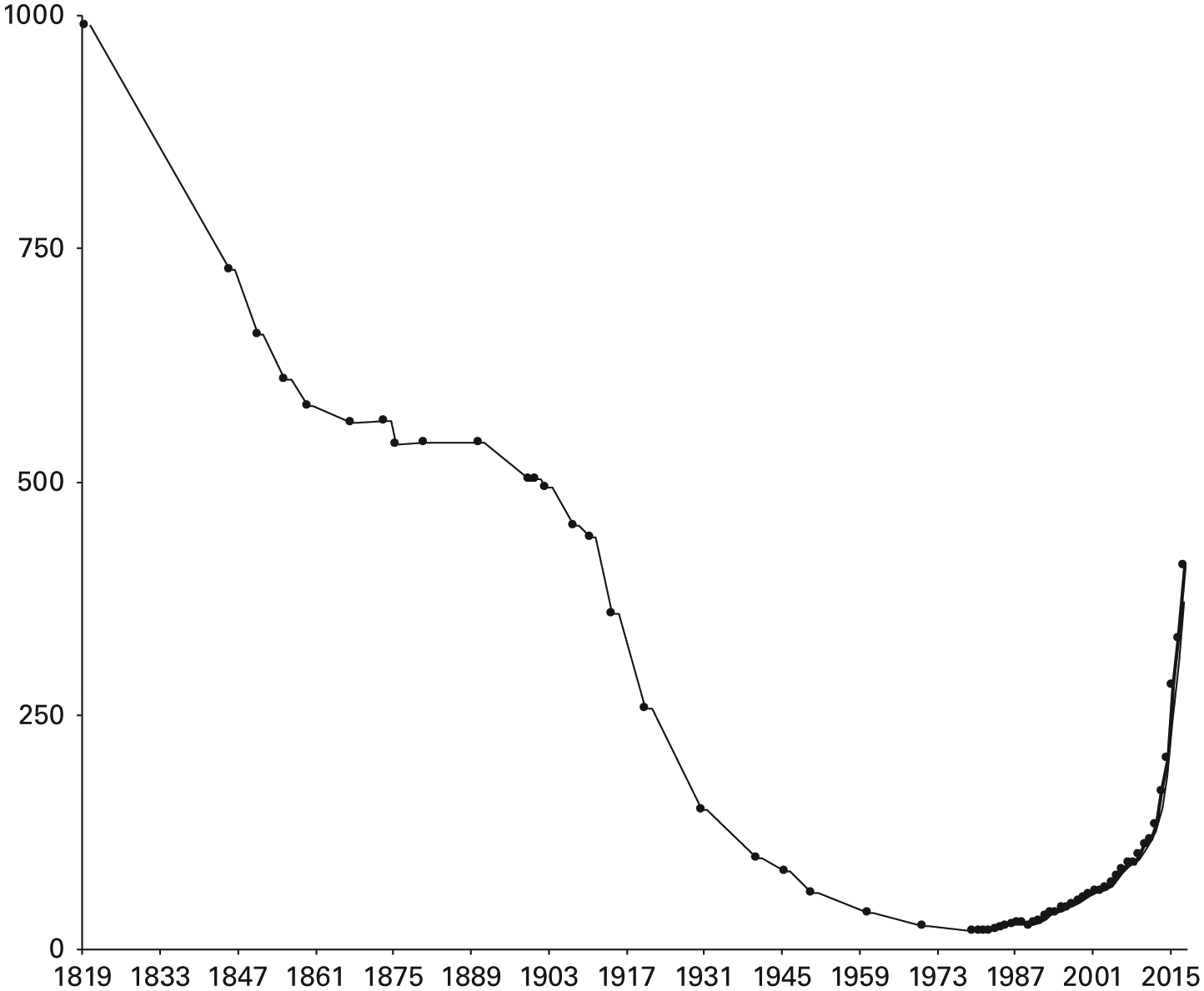
Number of beer breweries in the Netherlands, 1819–2016.
To examine how decomposed logics reemerge to fuel field-level change, we conducted an in-depth, historically embedded study of the revival of craft in the Dutch beer-brewing industry. This represents an extreme case (Siggelkow, 2007) of regenerative institutional change, as the craft revival followed an extensive period of total domination by industrial brewing. Whereas at the beginning of the nineteenth century there were still nearly a thousand traditional beer breweries in the Netherlands, the number of independent producers was reduced to about 500 by 1900 (Hoelen, 1952; Simons, 1992; Unger, 2001), 100 by 1940 (Hoelen, 1952; Simons, 1992), and 13 by 1980 due to industrialization and subsequent concentration. As graphed in figure 1, however, the craft-brewing revolution has contributed to a rapid resurgence of the population of breweries since. We use observations from our study to inductively describe the process of craft revival in this context and develop a theoretical model of regenerative institutional change through logic reemergence.
Institutional Change, Institutional Logics, and Institutional Remnants
Change through Shifts in Institutional Logics
In the past two decades, research on institutional change has proliferated, making it one of the core areas in organization theory (Micelotta, Lounsbury, and Greenwood, 2017; Zietsma et al., 2017). Whereas early theorizations of the process depicted institutional change as occurring when exogenous shocks force actors embedded in stable and homogenous institutional environments to adapt (Meyer, 1982; Ruef and Scott, 1998; Sine and David, 2003), recent theorizations have developed increasingly fine-grained accounts that reveal multiple different pathways for institutional change. We now understand institutional change as occurring through various kinds of shifts in the institutional logics that structure a particular societal sphere (Thornton and Ocasio, 1999; Micelotta, Lounsbury, and Greenwood, 2017; Ocasio, Thornton, and Lounsbury, 2017).
Institutional logics are collective, taken-for-granted organizing principles that guide embedded actors. They are co-constituted phenomena, as they follow from both societal-level “institutional orders,” such as the market or professions (Friedland and Alford, 1991; Thornton and Ocasio, 1999; Thornton, Ocasio, and Lounsbury, 2012), and from organizational field-level practices (Lounsbury and Crumley, 2007; Smets, Morris, and Greenwood, 2012; Gawer and Phillips, 2013). Field-level logics are embedded in broader societal-level logics, with the former being contextualized instantiations of elements that may or may not span multiple institutional orders (Wright and Zammuto, 2013). For example, Nigam and Ocasio (2010) analyzed the emergence and adoption of a logic of “managed care” in the U.S. hospital field, which combined elements of societal-level market, corporation, and professions logics to shape the organization of hospitals.
Institutional logics encompass multiple elements. They are principally defined in terms of ideational elements (Friedland and Alford, 1991; Thornton and Ocasio, 2008; Nigam and Ocasio, 2010) that provide actors with the cognitive and normative tools, such as implicit schemas and norms and explicit vocabularies of practice (Loewenstein, Ocasio, and Jones, 2012; Thornton, Ocasio, and Lounsbury, 2012; Ocasio, Loewenstein, and Nigam, 2015), to make sense of their environment and to identify, express, and justify particular means and ends (Ranson, Hinings, and Greenwood, 1980; Rao, Monin, and Durand, 2003; Suddaby and Greenwood, 2005). With institutionalization, however, logics become more than norms, schemas, and vocabularies; they begin to involve material embodiments representing these ideational elements (Nigam and Ocasio, 2010). These embodiments may include concrete practices, specified organizational roles or structures, and even technical or symbolic objects (Thornton, Ocasio, and Lounsbury, 2012; Jones, Boxenbaum, and Anthony, 2013). Once institutionalized, logics can therefore be understood as unique sets of “means–end couplets” guiding actors’ motivation, cognition, and behavior (Friedland, 2002: 383). For example, Haveman and Rao (1997: 1613) observed that, in the context of the U.S. thrift industry, forms of organizing like “membership rules, governance structures, financial-intermediation technologies and products . . . could not be decoupled from their institutional logics.”
The institutional logics perspective has proven useful for understanding processes of institutional change, as it can facilitate identification of both macro- and micro-level dynamics and allow for the theorization of “cross-level effects” (Thornton, Ocasio, and Lounsbury, 2012: 18). Macro-level dynamics may involve changes to the broader interinstitutional system that structures society, which may have trickle-down effects in particular fields. For instance, institutional theorists have observed how many fields have become increasingly dominated by a market logic due to broader forces such as progressivism, globalization, and financialization (Haveman and Rao, 1997; Davis, 2009; Thornton, Ocasio, and Lounsbury, 2015). Micro-level dynamics, in contrast, may involve the everyday work of actors carrying particular institutional logics, which may alter the balance between the different field-level logics that structure organizational fields (Zietsma and Lawrence, 2010; Goodrick and Reay, 2011; Smets, Morris, and Greenwood, 2012). By providing a multilevel lens on institutional change processes (Thornton, Ocasio, and Lounsbury, 2012), the institutional logics perspective allows for more fine-grained explanations of institutional change across multiple ideal-typical dimensions (Micelotta, Lounsbury, and Greenwood, 2017; Zietsma et al., 2017).
Progressive vs. regenerative institutional change
Previous research, which has predominantly documented progressive forms of institutional change (Suddaby, Ganzin, and Minkus, 2017; Zietsma et al., 2017), has shown how modernization typically involves a process of logic replacement, as in the case of the U.S. higher education publishing industry in which a market logic came to supplant an editorial logic associated with the professions (Thornton and Ocasio, 1999). In other cases, progressive institutional change may lead to logic blending, such as in the legal services field, in which idiosyncratic local logics were merged into a global logic with the advent of global law firms (Smets, Morris, and Greenwood, 2012). Progressive institutional change is thus commonly portrayed as being fueled by exogenous institutional elements.
Other research, however, indicates that institutional change can also take more regenerative forms through the reemergence of traditional logics (Greve, Pozner, and Rao, 2006; Marquis and Lounsbury, 2007; Schneiberg, 2007; Weber, Heinze, and DeSoucey, 2008), suggesting that the seeds for change may at times be found by looking inward and backward to institutional elements from the past (Schneiberg, 2007). Regenerative change likely unfolds, at least in part, through mechanisms that are distinct from reported processes of progressive logic replacement or blending. But in spite of the phenomenological evidence that institutional change often has cyclical tendencies (Thornton, Jones, and Kury, 2005; van Gestel and Hillebrand, 2011; Nicolini et al., 2016), this alternative pathway of institutional change awaits further theorization. We find inspiration for this theorization effort in a small set of studies that hint that decomposed institutional logics leave behind remnants that may continue to play some role in field-level dynamics long after they have been put aside.
Decomposed Logics and Institutional Remnants
Most notably, Schneiberg (2007: 48, 61) observed how, in U.S. infrastructure industries, alternative logics to the dominant market logic and “large-firm corporate capitalism” that appeared to be defeated during “the era of corporate consolidation” never truly disappeared. Instead, “something [was] being passed on or down over time” that allowed “those seeking to organize alternatives to for-profit corporations . . . to piggyback on the legacies, bits and pieces of alternatives” produced during previous time periods (Schneiberg, 2007: 64). Greve and Rao (2012) and Raynard, Lounsbury, and Greenwood (2013) made comparable observations in the context of Norwegian nonprofits and Chinese corporate social responsibility (CSR) initiatives. Collectively, these studies suggest that institutional logics make imprints on their environments that may outlast them when they decompose.
When we define institutional logics as coherent sets of ideational and material elements that guide behavior, we can define the imprints left behind by decomposed logics as institutional remnants that resemble sets of ideational and material elements that are no longer coherent and that have ceased to guide behavior. Although such remnants can dissolve entirely and may thus never be rediscovered, in practice they often remain conserved in the form of “mnemonic traces” (Olick and Robbins, 1998; Mena et al., 2016) that may “serve as important touchstones for future retrieval and reinterpretation” (Ocasio, Mauskapf, and Steele, 2016: 679). We can distinguish among three such traces: texts, memories, and artifacts (cf. Schultz and Hernes, 2013; Ocasio, Mauskapf, and Steele, 2016).
The remnants of a decomposed institutional logic can persist in the form of texts that may preserve both its ideational and material components. For example, texts stemming from pre-industrial societies offer insight into ideational elements like traditional values and beliefs, as well as access to material elements like traditional regulations, technologies, organizing templates, and concrete depictions of organizational structures and practices (e.g., Kieser, 1989; Khaire, 2011; Crone, 2015). Institutional remnants can also endure in the form of orally conveyed memories capturing a picture of the ideational and material components of a decomposed logic. For example, individuals and communities that have witnessed processes of industrial concentration may nurture memories of a pre-industrial society, which, depending on circumstances, may also produce feelings of symbolic or material loss associated with the perceived marginalization of their cultural and societal roles due to institutional logic shifts (e.g., Greve, Pozner, and Rao, 2006; Marquis and Lounsbury, 2007; Suddaby, Ganzin, and Minkus, 2017). Finally, institutional remnants can be found in the form of scattered physical artifacts left behind by the dissolved organizational carriers of a decomposed logic, representing and preserving its material components. For example, underneath the observable elements associated with modern arrangements remain the relics of traditional arrangements, such as traditional names or logos, buildings, repurposed production sites, or abandoned but conserved tools (e.g., Stigliani and Ravasi, 2007; Ravasi and Phillips, 2011; Hatch and Schultz, 2017). All forms of remnants are likely to persist in incomplete and fragmented fashion, however, and are thus unlikely to convey a coherent logic that can inspire collective action.
Research suggests that institutional remnants are sometimes actively maintained by actors who could be considered “custodians” (Dacin and Dacin, 2008; Howard-Grenville, Metzger, and Meyer, 2013; Dacin, Dacin, and Kent, 2018) and who may be embedded in larger “mnemonic communities” (Halbwachs, 1992; Zerubavel, 1996; Mena et al., 2016). In organizational fields first experiencing logic decomposition, such custodians may be visible in relatively marginalized positions, from which they continue to conserve alternative ideational and/or material logic elements by adhering to traditional organizational forms and practices (Schneiberg, 2007). In a subsequent stage of decomposition, logic elements are no longer actively embodied in organizational forms and practices, but custodians may still be found in the form of dormant organizational actors (Kozhikode, 2016) who have ceased to actively embody the decomposed logic yet have built “abeyance structures” preserving social networks and vocabularies (Taylor, 1989) through which they continue to maintain various logic elements in a coherent fashion. This facilitates easy retrieval that could enable quick reactivation depending on environmental circumstances (Taylor, 1989; Kozhikode, 2016). In advanced stages of decomposition, institutional remnants are no longer maintained by marginalized or dormant actors and instead remain in a forgotten state until rediscovery or unnoticed demise.
Although previous research has thus pointed to the relevance of institutional remnants for contemporaneous institutional processes and has developed some relevant theory around the maintenance of partially decomposed logics by marginalized or dormant actors, few studies have attempted to develop a dedicated theory of institutional logic reemergence (cf. Thornton, Ocasio, and Lounsbury, 2012: 13). Specifically, we do not yet fully understand how decomposed institutional logics may reemerge at later stages to cause change in organizational fields.
Method
Research Context: Institutional Regeneration in Dutch Beer Brewing
We address this gap through a historically rich qualitative study of the reemergence of craft in Dutch beer brewing. 1 This setting represents an extreme case, since the traditional craft-brewing logic reemerged after it had been fully replaced by modern industrial brewing.
Traditional craft brewing
Dutch beer brewing historically evolved as a typical craft industry (Kieser, 1989; Thornton, 2002; Crone, 2015) in which field-level instantiations of the institutional orders of the family, community, religion, and the guilds functioned as custodians of craft. Traditional breweries were small, manually operated, and owned by skilled craftsmen. 2 Craft was such a dominant logic in the field that the industry was historically slow to develop the distinction between wealthy owners and dependent workers typical of many other industries (Unger, 2001: 159, 213). Most large breweries were run by families that owned multiple brewing businesses (Philips, 1999), and the cross-generational transmission of brewing skills often relied on family ties. Traditional brewing was thus rife with conservative forces for maintaining community- and family-specific brewing practices, resulting in traditional breweries producing a vast variety of beer styles with considerable differences across geographies (Unger, 2001: 124–125, 128–129; Mulder, 2017). This variety persisted until the beginning of the twentieth century (Schippers, 1992). As an ideal type, traditional craft brewing thus involved a concern with maintaining community- and family-specific brewing practices; handwork and small-batch production; and a degree of mysticism around the brewing process, which depended on the difficult-to-obtain tacit skills of brewmasters, who tended to enjoy high status in their communities.
Modern industrial brewing
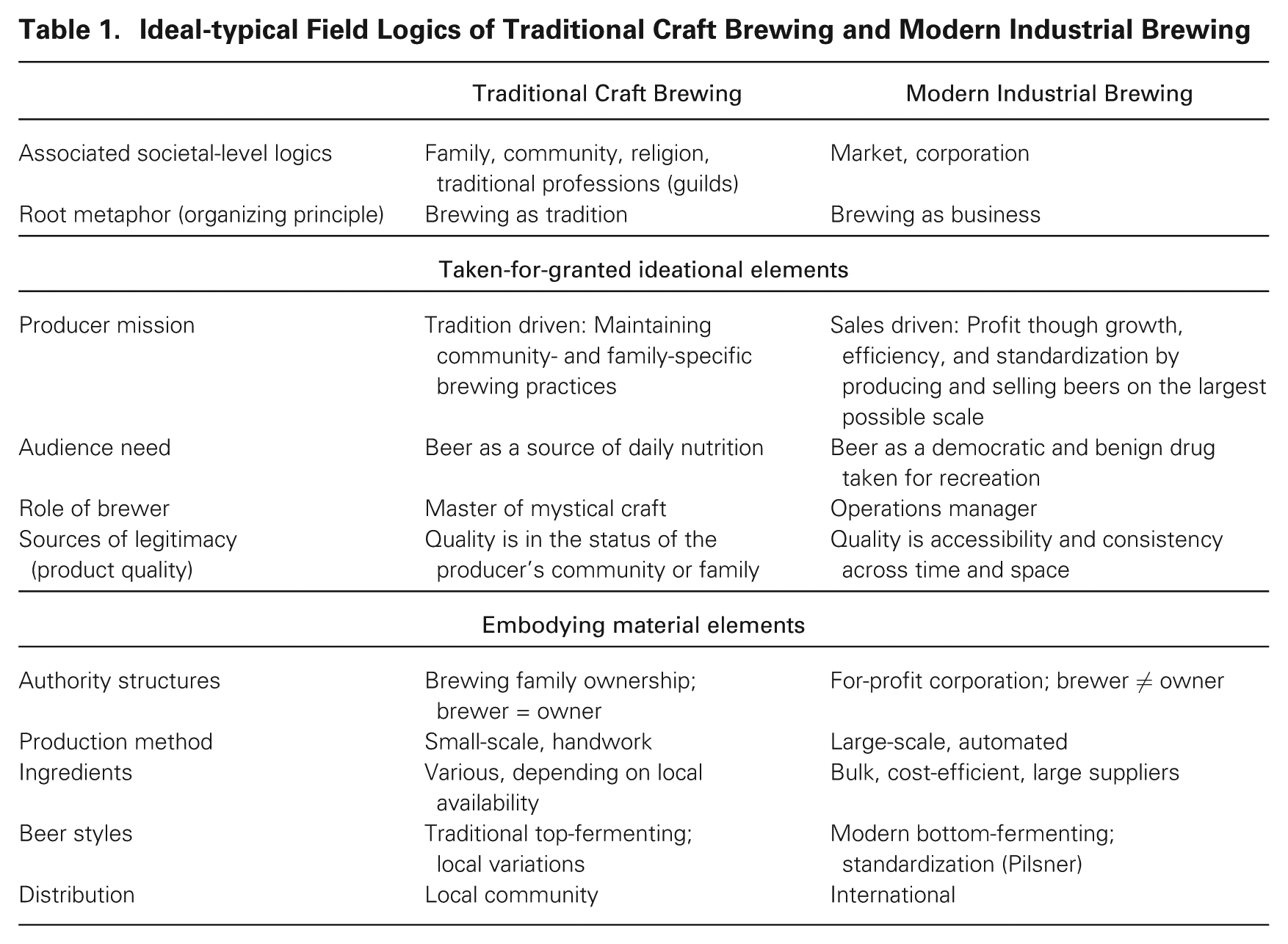
The Industrial Revolution, the invention of the corporation, and substantial improvements in the transportability of perishable goods ultimately enabled both the proliferation of modern industrial breweries and the emergence of a very different institutional logic around the turn of the twentieth century. Although there were many other examples, Heineken is the epitome of industrial brewing. It was established in 1864, when the son of a trader in cheese and butter acquired a struggling traditional brewery that had recently become a limited liability company. Heineken quickly developed into one of the largest breweries globally by focusing on mass production of industrial lager. The economic rationalization of beer brewing by Heineken and others led to a dramatic homogenization of products (Jansen, 1987; Philips, 1999), such that by 1980 all of the beer produced in the Netherlands could be classified as industrial lager and traditional breweries had failed en masse (Hoelen, 1961; Schippers, 1992; Unger, 2001). 3 As an ideal type, modern industrial brewing involved a concern with profit, market power, and economies of scale; an automated and standardized brewing process; and a highly rational approach to the organization of production and sales, in which brewmasters became operations managers who were hierarchically subjected to financial and sales managers. Table 1 contrasts the ideal-typical logics of traditional craft and modern industrial brewing.
Ideal-typical Field Logics of Traditional Craft Brewing and Modern Industrial Brewing
Remnants of the decomposed craft-brewing logic
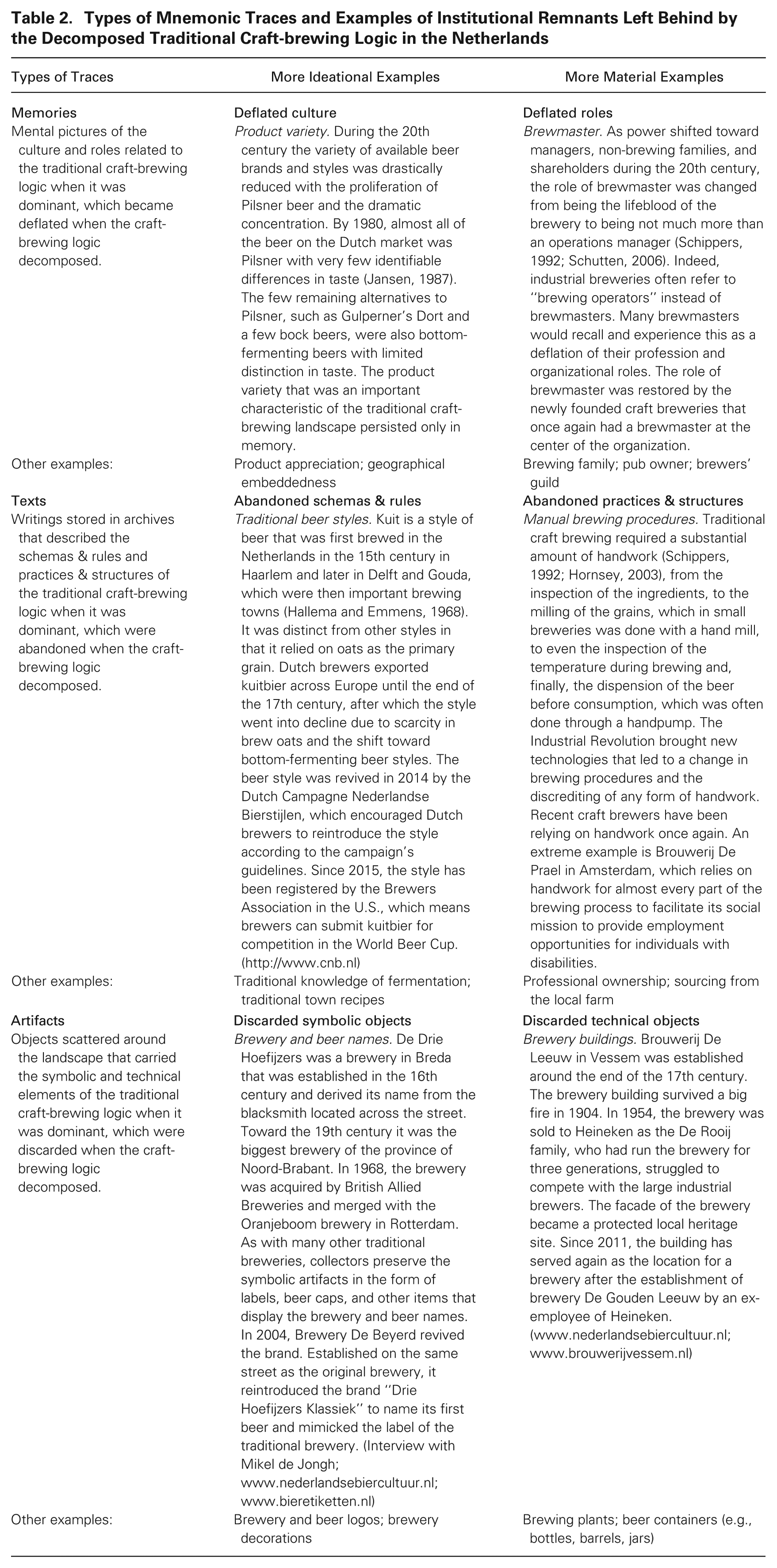
The dominance of the large industrial brewers led to substantial diminishment and, ultimately, dissolution of the roles of field actors who used to carry traditional craft brewing. But this decomposed logic left behind institutional remnants that continued to be at least partially conserved, examples of which we provide in table 2. We distinguish between ideational and material remnants and differentiate among three types of mnemonic traces through which these remnants were conserved: memories, texts, and artifacts. Examples of institutional remnants that ended up playing an important role during subsequent processes of regeneration were abandoned schemas and rules around community-specific traditional beer styles, discarded technical objects such as traditional brewery buildings or brewing plants, and memories of deflated roles such as brewmaster or brewing family. The evidence in table 2 is not exhaustive, since our observations are likely skewed toward remnants that ultimately were recorded or recollected. In addition, we have ascribed examples of institutional remnants to specific types of mnemonic traces, while acknowledging that institutional remnants often leave behind multiple types of traces simultaneously. For example, discarded brewery names may be recorded in memory, texts, and artifacts. 4
Types of Mnemonic Traces and Examples of Institutional Remnants Left Behind by the Decomposed Traditional Craft-brewing Logic in the Netherlands
Impediments to regeneration of craft
While these remnants appear to be important resources for institutional change (Schneiberg, 2007), regenerating them was rife with challenges due to their significant degree of decomposition. First, although there were individuals who could act as custodians of these institutional remnants, they were dispersed and had either become disembedded from the field or had completely switched to modern industrial brewing. Until 1980, there had been no collective efforts in the field to maintain or conserve elements of the craft-brewing logic (Mulder, 2017). Craft-brewing remnants were therefore scattered around the field. Second, the remaining remnants provided only an incomplete set of representations of the traditional logic, which was insufficiently actionable. Knowledge of the traditional fermentation process, for example, could not be gained from mnemonic traces alone. Especially difficult to reconstruct were the ideational elements providing schemas, norms, and vocabularies of practice (Loewenstein, Ocasio, and Jones, 2012; Thornton, Ocasio, and Lounsbury, 2012; Ocasio, Loewenstein, and Nigam, 2015). In some ways, this mass of decomposing cultural material was thus waiting for a theory or a fire (cf. Coase, 1984). Third, due to the prior organizational failure of its carriers, remnants of craft brewing had a low level of remaining legitimacy, if not a stigma. Traditional craft brewing had come to be associated with inferior quality as compared with modern industrial brewing (Schippers, 1992), in part because of the political efforts of the modern industrial brewers (Daane, 2016). Compliance with increased “quality” regulations imposed in 1926, which had resulted in part from industrial brewers’ lobbying efforts, required substantial investments in ingredients and equipment, which many traditional breweries were unable to make (Daane, 2016). These policies, which had institutionalized crisp industrial lager as the dominant and qualitatively superior product, combined with the natural stigma associated with failure initially disqualified remnants left behind by the traditional carriers of craft brewing as legitimate building blocks for later change efforts.
In spite of these challenges, however, the craft-brewing logic reemerged in the Netherlands through the establishment of 489 new breweries between 1980 and 2016. These new organizations collectively regenerated the institutional remnants of craft. This led to fundamental institutional change, as these organizations contributed to the restoration of the institutional orders of the community, family, professions, and religion in the field. A look at the first 209 new breweries showed that the vast majority of them were deliberately established as local craft-directed enterprises: 66 percent had clear ties to the community, and 82 percent had a brewmaster who was also the owner. At least 26 percent were explicitly run as family enterprises, and 6 percent were religious enterprises or made prominent use of religion in their communications. To understand how this process of logic reemergence occurred, especially in light of the described challenges, we set out to comprehend the actors engaged in regenerative activities and how their collective efforts led to the observed reemergence of craft and field-level change.
Data
To collect qualitative data on the field’s historical and contemporaneous evolution, we deeply engaged with three types of actors: founders of new breweries, pioneers of a consumer movement (the founders of PINT, Promotie Informatie Traditioneel Bier), and representatives of incumbent breweries. In total, we conducted 96 semi-structured interviews with 93 individuals representing the three different groups between 2004 and 2016. This resulted in an average of 75 minutes of recorded interview time per covered brewery and 70 minutes per consumer movement representative. These interviews helped us understand general temporal dynamics in the field; founding stories involving founders’ backgrounds, their interactions with institutional remnants, and their organizational construction efforts; and how craft and industrial brewers drew differently on the logic elements available to them.
We mostly conducted our interviews with brewery founders at the brewing site, frequently while our interviewees were attending to the brewing process. This ethnographic component of our data collection process allowed us to acquire a deep contextual understanding of the field, which facilitated our interpretation of the role of institutional logics (Thornton, Ocasio, and Lounsbury, 2012: 134; Zilber, 2017). During the interviews we conducted after 2008, we used photos of distinguishing features of traditional craft and modern industrial breweries, taken during prior interviews, to probe how brewery founders experienced the different logics and used different elements in their efforts to regenerate craft brewing. See Online Appendix D for a selection of these photos.
We also consulted 206 issues of PINT Nieuws, the consumer movement’s bimonthly magazine, published between 1980 and 2015. This allowed us to supplement and verify our interview data. Finally, to understand our phenomenon in context and identify remnants of the decomposed traditional craft logic, we consulted a wide range of published sources on the history of beer brewing in the Netherlands and other countries (e.g., Hoelen, 1961; Jansen, 1987; Kistemaker and Van Vlisteren, 1994; Unger, 2001; Boak and Bailey, 2014; Hindy, 2014). We also corresponded with a prominent historian specializing in the history of Dutch beer brewing at multiple stages to verify our interpretations. See table E1 in the Online Appendix for a detailed overview of our data sources.
Analysis
We relied on process research (Barley, 1990; Langley, 1999; Langley et al., 2013) and grounded theory techniques (Corbin and Strauss, 1990; Glaser and Strauss, 2009; Gioia, Corley, and Hamilton, 2012) to build a grounded process theory of regenerative institutional change through logic reemergence. Our analysis was highly iterative, and during multiple rounds of analysis, we gradually zoomed in on the interactions of actors with the remnants of the decomposed institutional logic. We distinguish among three analytical steps, which we discuss sequentially. These are (1) understanding the context, during which we (a) read texts on Dutch beer-brewing history and created a historical narrative, allowing us to identify different examples of institutional remnants, and (b) conducted semi-structured interviews with field actors; (2) developing a base model, during which we (a) used temporal bracketing strategies to distinguish between different stages of the logic reemergence process and (b) engaged in visual mapping to build an initial model; and (3) constructing a final theoretical model, during which we (a) zoomed in on the unique aspects of our data to uncover mechanisms related to the interaction of field actors with institutional remnants and the role of these remnants in the logic reemergence process and (b) used those insights to iteratively refine our base model.
Understanding the context
We engaged our data with open minds to achieve a rich understanding of our context. First, we worked on achieving a deep understanding of the historical evolution of the field. Following common practice in process research (Langley, 1999; Zietsma and Lawrence, 2010; Delmestri and Greenwood, 2016), we constructed both a high-level historical narrative for distant history and a detailed list of key events for more proximate history; see Online Appendix E. The chronology allowed us to identify the beginning of the craft revival and the key actors involved in the process, and it was an important source for identifying the different examples of institutional remnants shown in table 2.
Second, adopting an interpretivist lens (Langley and Abdallah, 2011; Gioia, Corley, and Hamilton, 2012), we developed a deep understanding of the organizational actors involved (also see Lounsbury and Kaghan, 2001; Zilber, 2017). A key aim was capturing the founding stories of many organizations and giving as much “voice” to our informants as possible (Gioia, Corley, and Hamilton, 2012: 17). This involved deep interactions with the founders of new craft breweries and with the founders of pioneering beer pubs and of the consumer movement organization PINT. The collected stories and observations gave us general insights into field actors’ backgrounds, their motivations, their struggles, and the resources they had at hand to overcome founding challenges. We noticed that although nascent craft breweries had all disassociated themselves from industrial brewers, restored the role of brewmaster, and reintroduced traditional top-fermenting beer, they were not a homogenous group. We observed a number of important points of difference that informed our interpretation of the reemergence process.
Third, to better understand the different ways in which actors interacted with institutional remnants, we induced a categorization of the different contemporaneous incarnations of the craft-brewing logic. We followed what Reay and Jones (2016) described as a “pattern-inducing” approach to derive patterns from our interview data and capture organizational instantiations of field-level logics. Rather than imposing predefined categories on our data, we searched for emerging themes to capture organizational differences related to logics. This allowed us to stay open to the unique lower-level instantiations of higher-order logics or institutional orders in our empirical setting. After numerous iterations, we differentiated among three organization-level reincarnations of the traditional craft-brewing logic that are associated with different societal-level institutional orders. We compared the constructs that emerged from our field data with similar logics reported in prior studies and with the ideal-typical societal-level logics theorized by Thornton, Ocasio, and Lounsbury (2012) to refine our labels.
Developing a base model
We used “temporal bracketing” (Giddens, 1984; Barley, 1990; Langley, 1999) strategies to identify discrete phases based on a chronological ordering of the data. We identified phases to reflect relative continuity in the context and nature of the actions within the phase but discontinuity at the boundaries between the phases (Denis, Lamothe, and Langley, 2001). This step had two iterative components. First, we distinguished between different stages of logic reemergence, using our case chronology and brewery population data to identify critical junctures. 5 Second, we created an initial data structure for the process model by dividing our actors into different groups, such as pioneering pub founders, craft brewery founders, and consumer movement activists, and summarizing their activities. This allowed us to distinguish between different sets of activities and different aspects of the logic reemergence process. We then compared our observations with the findings of similar process studies (Purdy and Gray, 2009; Nigam and Ocasio, 2010).
Inspection of the initial data structure revealed that the activities of all actors involved in the logic reemergence process were heavily intertwined, recursive, and co-constitutive but also that there was some degree of temporal ordering. Activities had different starting points and were at least partially dependent on previously initiated activities. For instance, the activities of pioneering pub founders who drew attention to the decomposition of traditional craft brewing in the Netherlands appeared to be essential for the establishment of collective organizations like the consumer movement organization PINT. In turn, texts produced by movement actors provided nascent brewery entrepreneurs with important ideational elements, such as schemas, norms, and a vocabulary of practice. While using these temporal fault lines, we iterated among our event history, our data structure, and other studies to identify starting points and consequences of different sets of activities, ultimately settling on defining labels for three unique albeit highly overlapping stages of the logic reemergence process.
Subsequently, we constructed a tentative “visual map” (Langley, 1999) based on our initial data structure, which captured our early high-level understanding of the process of logic reemergence. This base model distinguished between a beginning and an end state, sketched the relations between the different actors and field-level changes at every stage of the logic reemergence process, and labeled the arrows guiding our preliminary understanding of the interlinking mechanisms connecting the stages.
Constructing a final theoretical model
During the final step, we refined our data structure and elaborated our base model by examining key mechanisms through a series of more focused analyses. For each stage, we paid close attention to the role played by institutional remnants, which emerged as a key construct during our prior analytical iterations. In particular, we closely examined the interrelationships among three aspects of the logic reemergence process: different regenerative activities, related changes in the status of the remnants of the decomposed institutional logic in the field, and related regenerative institutional changes affecting the composition of the field. We then iteratively refined our concepts and relationships until there was a close fit between the model and data.
Although we recognize that stages partially overlap and have recursive and co-constitutive properties, we focused on a visualization that illustrated the differences between each stage of logic reemergence most clearly and that indicated important transition conditions: specific challenges that needed to be overcome through particular sets of regenerative activities if regenerative institutional change was to progress and result in field-level change.
We present our findings by first describing how the craft-brewing logic reemerged in the Netherlands through a chronological delineation of the key activities and mechanisms that we identified through our analysis and then present our theoretical model.
The Reemergence of Craft Brewing in the Netherlands
We identified three partially overlapping stages of logic reemergence. Each stage involved a unique set of regenerative activities related to a particular change in the status of institutional remnants and was associated with distinct regenerative institutional changes at the field level. “Rediscovering a logic” refers to regenerative activities contributing to the recollection of remnants of the decomposed logic by regenerating networks of dormant custodians. “Refurbishing a logic” involves the relegitimation of these remnants through the regeneration of ideational elements. Finally, “reincarnating a logic” entails reactivating the remnants of the decomposed institutional logic through the regeneration of material elements. Table E2 in the Online Appendix presents our data structure and qualitative evidence.
Stage 1: Rediscovering the Craft-brewing Logic
The process of regenerative institutional change in Dutch beer brewing began during the early 1970s, when networks of actors with marginalized roles—such as brewmasters and members of traditional brewing families, who were the dormant custodians of craft brewing—were restored and transformed. These groups were reawakened when they were exposed to the surviving elements of traditional craft brewing in surrounding countries and began to mix with other marginal actors who were attracted to a budding hobby-brewing scene. Out of these interactions developed a growing sense that something of value had been left behind with the shift to modern industrial brewing. This fueled an interest in Dutch beer-brewing history and the mobilization of resources to promote nostalgia-infused change, ultimately leading to the rediscovery of what was left of the decomposed craft-brewing logic.
Drawing attention to traditional alternatives
A key development was the emergence of five independent beer pubs that were not contractually tied to any industrial brewer and that began to import modest amounts of traditional foreign craft beer, predominantly Belgian ale, as an alternative to Dutch industrial lager. These locales, where individuals with “strange tastes” could meet (to quote a representative of one of these pubs), were Café De Beyerd in Breda, Gollem in Amsterdam, Jan Primus in Utrecht, ‘t Pumpke in Nijmegen, and Locus Publicus in Rotterdam and Delft. The idea to import foreign beers emerged when the founders of these pubs came in contact with traditional beer styles that were still being brewed in Belgium, Germany, and the United Kingdom. Piet de Jongh (Café De Beyerd) explained to us: I wasn’t always interested in beer. I enjoyed going to Belgium, my father too. We took the children to the Belgian coast and that’s where I got to know all the speciaalbieren. There were different local beers all along the coast. And that’s where I learned to recognize and enjoy the difference. I thought it would be fun to try it here too. I really wanted to specialize with a new type of café, not just a neighborhood café.
The owners of pioneering beer pubs started with very modest means and ambitions and were surprised by the impact of their actions. Their initial success was followed by an emerging network of importers that began to specialize in foreign traditional craft beer. One of these was Biergroothandel De Kikvorsch, established in Altforst in 1975. These pioneering activities provided a window into the brewing industries of Belgium, Germany, and the United Kingdom, where traditional craft brewing had managed to survive, which led to increasing public attention to traditional alternatives to modern industrial beer brewing. Some brewery founders we interviewed recalled the galvanizing role played by these pubs. Willem Thuring, founder of Brouwerij Bourgogne Kruis in Oosterhout in 2012, said: Café de Beyerd in Breda was my favorite pub. During my time at high school I went there to play table football and billiards in the breaks. As such, when I was 17 I had already participated in a beer tasting competition. I regrettably lost the certificate, but I did become “beer king.” They serve you a number of Trappist beers, and then you have to say from which breweries they are. That was a lot of fun, and it was the first pub that served Belgian beers including on draft. That was really special.
Reawakening dormant logic custodians
The attention given to traditional alternatives reawakened actors with marginalized or dissolved roles, who were dissatisfied with the state of the Dutch beer-brewing industry. The exposure to foreign traditional craft beer led to these actors’ growing perception that something had been lost in the Netherlands with the shift toward industrial brewing. The pioneering beer pubs gave these actors a chance to meet and (re)connect. One of these, Gollem in Amsterdam, began to organize an annual beer festival in 1978 for alternative Dutch beer. Initially, this was a very small-scale affair, but the festival grew from 65 to over 300 visitors within two years and would eventually attract more than 10,000 visitors (Daane, 2016; PINT, 2017). The festival focused on bokbier, a dark German beer style that can be brewed as either a modern lager or traditional ale, which was at the time a rare alternative to industrially produced pilsner. The pubs and their festivals thus provided an important space for marginalized actors, like enthusiast consumers, brewmasters, and pub owners, to connect and discuss the state of Dutch beer brewing. Importantly, these groups contained both individuals with access to institutional remnants and individuals who were entirely new to beer brewing.
Establishing nostalgia- and change-promoting collectives
The reawakening of local custodians of craft brewing and the growing exposure to foreign traditional craft beer inspired feelings of nostalgia and mobilized resources to promote change in the industry. A group of Dutch beer enthusiasts who frequented the pioneering pubs also regularly traveled to London to visit pubs there. They noticed that the diversity of beers and brewing practices was higher in the UK and that there was a consumer association—the Campaign for Real Ale or CAMRA—promoting the revitalization of traditional craft brewing. This group would go on to establish the Dutch beer consumer association PINT. Nico van Dijk, one of the founders and the first chairman, explained: In 1979, I had become a member of CAMRA and we went to England for an annual general meeting. There, we submitted a motion to set up a Benelux CAMRA.
6
And those chauvinistic English said: no way. Then we sat at the bar with Joe Goodwin [chairman of CAMRA at the time] in the evening, and he said: “I really think it’s a bit of a shame because I think it’s a wonderful project. I want to help you. Here you have 50 pounds and the mailing list of the CAMRA members in the Benelux.” There were some Belgians and a total of 40–50 Dutch. With the help of those 50 pounds we bought stamps and then wrote to those people. We then organized in a café here in The Hague the first meeting. About 10 or 12 showed up. It was a very diverse group of people. There was a biologist, a candidate notary, there were a few pub boys, a beer dealer, a trader in agricultural machinery . . . but the majority were consumers. The initial meeting led to a number of subsequent meetings. I was the initiator and chairman, and it was all a bit difficult. Then I once had a tirade and asked, “Are we going to establish this club or not?” Eventually, we found five men, including me, to go to a notary, and an act was drawn up and then PINT was established in November 1980. We were not allowed to use the name CAMRA.
The establishment of PINT initiated the emergence of an ecosystem of new collective organizations that all contributed to a nostalgia-infused movement for change in the industry. In 1983, Nico van Dijk co-established a foundation for beer item collectors (BAV), which fueled greater awareness of traditional Dutch craft brewing. In 1984, the first modern brewers’ guilds—De Roerstok and Twents Bierbrouwersgilde—were established to encourage hobby brewing, inspiring a new generation of brewery entrepreneurs. The Bier Keurmeesters Gilde (BKG) that trains judges for the independent examination of the quality of amateur beers during competitions and tastings was established in 1986. And in 1987, an association for specialty beer pubs (ABT) was established, which acted as a catalyst for the distribution of craft beer. Collectively, these initiatives amplified the initial effect of the pioneering pubs. They revitalized marginalized actor groups by reawakening traditional members, providing them with spaces to reconnect and reflect, and attracting new recruits. The hobby-brewing scene provided an alternative portal for outsiders and new generations to enter the field, one that did not involve socialization in modern industrial brewing.
Curating institutional remnants
The establishment of these collectives was also associated with a dramatic increase in the amount of text produced about Dutch beer-brewing history. For example, PINT released a bimonthly magazine in which it regularly published stories like the one below: The last brewery, that made a top-fermenting yeast beer, was and still is the beer brewery De Schaapskooi in Tilburg. Up until 1958, Brouwerij Marres in Maastricht also still made a top-fermenting yeast beer. . . . Heineken is now the biggest brewery in the Netherlands and one of the biggest in Europe. Since 1864, Heineken has taken over the following breweries: [what follows is a list of 13 Dutch breweries that were acquired by Heineken in over a century. Similar lists follow for Skol and Artois, predecessors of what is currently known as AB InBev]. (PINT Nieuws 1, Nov. 1980: 5–7)
The beer item collectors association BAV also published a bimonthly magazine that frequently reported on historic Dutch breweries. A number of writers also began addressing the history of Dutch beer brewing (e.g., Philips, 1982; Jansen, 1987). As a result, there was growing awareness of the history of Dutch brewing, and a growing amount was recollected and curated, increasing the availability and accessibility of the remnants of the craft logic.
Thus during the first stage of logic reemergence, institutional change took off once ties between the previously dormant and dispersed custodians of the decomposed logic were regenerated. This involved restorative activities as dormant actors were reawakened, ties between them were reestablished, and the remnants of the decomposed logic were again made available and accessible. It also involved transformative activities as the dormant custodians of craft became organized in new ways, new recruits became absorbed in these networks, and foreign entities also came to be regarded as representations of a craft-brewing logic that had decomposed in the Netherlands.
Stage 2: Refurbishing the Decomposed Craft-brewing Logic
These regenerated networks and recollected institutional remnants facilitated regeneration of the ideational elements of the craft-brewing logic. This involved the proliferation of texts promoting alternatives to industrial brewing, which provided new norms and schemas for craft brewing. These texts largely represented a collective sensemaking and sensegiving process (Weick, 1995) through which the remnants of craft brewing were reinterpreted and subsequently repurposed. As these texts evolved and found increasing resonance with a growing community of marginal field actors who were interested in change, a renewed vocabulary of practice emerged and evolved that would ultimately facilitate both a symbolic segregation and a material blending of craft and industrial brewing.
Disrupting the modern logic
These texts were especially visible in the communications of the consumer association PINT, which became an important vehicle for the reproduction and dissemination of texts on traditional craft brewing and regenerative institutional change. These texts reflected how actors were actively disrupting the modern industrial brewing logic by enabling a new discourse on alternatives to industrial pilsner. PINT’s membership grew from 30 in 1981 to over 1,000 by 1994, and its bimonthly magazine attracted an increasingly wide readership in the Dutch beer-brewing field. But since PINT became organized around multiple local chapters that kept close ties with local pubs, hobby brewing associations, and eventually nascent craft breweries, which were not necessarily members of the association, the texts it produced were indicative of a developing national discourse and captured the regenerated vocabulary of practice surrounding craft brewing that began to emerge from reestablished networks. PINT not only provided a platform for alternative voices in the beer industry but also deliberately disseminated texts about what was “wrong” with the beer industry and what remedies were needed according to emerging ideas that were constitutive of this discourse.
A recurring component of these texts was the use of frames in which prototypical examples of modern brewing, industrial brewing corporations such as Heineken, were depicted as a foil to provide a favorable contrast for craft brewers. For example, PINT Nieuws often questioned the practices of the brewing corporations, implicitly blaming them for the “destruction” of the Dutch beer-brewing culture. In the words of PINT founder Nico van Dijk: More than 99% of the beer that is consumed is pilsner. It’s even more amazing if we look at the assortment of beer offered by the bigger breweries. Take Skol in Breda as an example. Things aren’t going well for either Skol or its parent company, Allied Breweries in England. Look at the numbers. What did this multinational do? They got involved in Dutch breweries. They allowed well-known, established brand names to disappear and closed breweries that they had taken over. (Opening speech, 4th National Bock Beer Festival, Nov. 1981)
Reinterpreting and repurposing institutional remnants
The texts produced around this time also reveal how the ideational elements of craft brewing were regenerated by reinterpreting and repurposing institutional remnants. Throughout the 1980s, institutional change efforts were framed as attempts to restore brewing traditions. In the first issue of its news magazine, PINT listed its eight goals, which we show in Online Appendix F. They were reproduced on the last page of every new issue until 1991. These goals included: Objectively informing the consumer about: . . . traditional brew- and drafting methods and the renewing of interest in beer culture in the Netherlands. . . . Stimulating breweries to produce beers brewed in a traditional way, without unnecessary, unnatural additives, filtering and pasteurization—henceforth referred to as “traditional beers.” (PINT Nieuws 1, Nov. 1980: 1)
While reflecting the importance of tradition, these goals also indicated that the notion of traditional beer might be interpreted in different ways. These texts suggested that restoring traditional brewing practices would solve three problems that were perceived to be affecting the Dutch brewing field in 1980. A first perceived problem was the decline of Dutch beer culture as a result of the mass extinction of traditional breweries during the concentration driven by the modern industrial beer producers. PINT encouraged the restoration of traditional beer brewing as a way to revive Dutch beer-brewing culture. PINT produced extensive reports on dissolved traditional craft breweries and mobilized members to preserve some of the smaller incumbents, which were the closest embodiments of the craft-brewing logic, even if they had switched to modern brewing practices. When the large British brewing conglomerate Allied Breweries announced that it would close a previously acquired Dutch brewery in Arcen in 1980, PINT supported a small team of ex-employees who wanted to continue brewing at the same location. This led to the establishment of De Arcense Stoombierbrouwerij, the first new brewery in the Netherlands since WWII and the first to reintroduce traditional top-fermenting beer brewed on Dutch soil.
A second perceived problem was the decrease in appreciation for beer or the declining role of the beer consumer, as evidenced by the association of beer with mass consumption rather than sensory appreciation. Peter Eissing (co-founder of PINT) wrote: We’re allowed to discuss the bouquet, the rich taste and the beautiful color of a fine wine. Do this about a fine beer—and there are those beers that are just as good as fine wines—and people think it’s a little strange. You don’t talk about beer, you just knock one back. Perhaps this is caused by the fact that most people see beer only as pilsner. (PINT Nieuws 1, Nov. 1980: 4)
Texts would promote the reintroduction of traditional beer styles to solve this issue. PINT wrote extensively about traditional craft beers that used to be produced in the Netherlands or were still being produced in other countries that could instill a culture of appreciation. For example, PINT Nieuws featured a report on the brewing history of Breda: In the southernmost provinces, throughout history, people drank a great deal. That was the case in Breda. As was written in an earlier article, there were 11 brewers active in Breda in 1416. The assortment of beers at that time was enormous. Breda was famous for its brown beers and wheat beer (witbier). (PINT Nieuws 18, Nov. 1983: 4)
Every issue featured similar reports on traditional Dutch brewing practices or current practices in foreign countries, offering detailed information on how particular beers were produced. For example, PINT published an extensive history of the Trappist Brouwerij De Koningshoeven, reporting on its attempts to bring back traditional craft beer. In an interview, Eissing reflected on how beer enthusiasts thought about these traditional beer styles: The inspiration from the past is based on the diversity of the products on offer in the past. . . . Tastes have changed. However, the variety that was produced in the past [still serves as inspiration]. We hang on to that. It would be wonderful to have that kind of variety again.
At the same time, hobby brewing became increasingly regarded as an important means for reintroducing lost beer styles. Since professional brewing training focused exclusively on modern industrial brewing techniques and industrial brewers were unlikely to change their practices, it was clear that the reintroduction of craft brewing required a process of “lay expertise” development and legitimation (Croidieu and Kim, 2018). PINT actively supported hobby brewers to acquire and diffuse the skills necessary to reengage with traditional brewing practices.
A third perceived problem was related to the quality of the beer produced by the brewing corporations. PINT members questioned the use of chemicals during the brewing process. The third issue of PINT Nieuws contained a report entitled “Are chemical additives in beer harmful?” written by Peter Molenaar, a founding member of PINT who was also a biochemist. The article included a long list of additives that brewers were allowed to use and criticized the current regulations on beer additives. Voicing concerns about beer quality, beer enthusiasts favored the reintroduction of traditional craft beer “without unnecessary, unnatural additives, filtering and pasteurization” (PINT, 1980). These concerns centered on the idea that brewers used additives to cover up mistakes or “manipulate” the brewing process to save costs. For instance, reference was frequently made to the German Reinheitsgebot, a medieval traditional beer ordinance prohibiting German brewers from brewing beer with any ingredient other than water, barley, hops, and yeast. Beer enthusiasts generally favored this purist approach to brewing, but in lieu of additives, brewers needed knowledge to control the brewing process. The reports published by PINT on these issues reflect beer enthusiasts’ attempts to regenerate knowledge of traditional craft brewing by recombining the domestic remnants of craft brewing with active foreign representations. What is remarkable here is that the dramatic failure of traditional Dutch craft brewers was partly due to their association with the impure practices and incompetence that prompted the regulations imposed in 1926. The remnants of the decomposed craft logic were thus gradually transformed from something that had become useless into something that held considerable value for many field actors.
Recombining categories to theorize traditional alternatives
The proliferation of texts on craft brewing provided a regenerated vocabulary, facilitating processes of sensemaking and sensegiving of traditional alternatives in a modern context. This meant a dynamic recombination of new and preexisting categories that would ultimately pave the way for the emergence of a new set of collective norms and schemas. The evolution of this regenerative process was particularly apparent in the social labeling of craft breweries and their beers. Texts initially relied heavily on the Dutch labels of traditie (traditional) and ambachtelijk (artisanal) in contradistinction with modern brewing practices, thus referring to traditioneel bier or ambachtelijke brouwers. These labels were used by nascent brewery entrepreneurs such as Jan Ooms, co-founder of De Scheldebrouwerij in ‘s Gravenpolder (established in 1994), who said: Ambachtelijk means trying to get the most out of something in a simple way with the available resources that you have at hand. . . . My brew master has also worked at Interbrew and there processes like filtering for instance mean pushing a button and opening a tap. Ambachtelijk means milling yourself, not by pushing a button or automatically. Instead you feel the whole process, you taste it, you smell it, you are busy with the process from front to back.
While these labels appealed to the traditional custodians of craft brewing, other actors in the regenerated networks resisted. For example, Herm Hegger—founder of Brouwerij Raaf, established in Heumen in 1984, and Stadsbrouwerij De Hemel, established in Nijmegen in 1996—told us: I have always been bothered by the tension between the false romanticism that beer lovers like to hear and the ordinary reality of beer brewing. For example, people pretend that beer brewing is very ambachtelijk and they make reference to the past, but that does not make any sense. All beers that were brewed over 100 years ago were disgusting. . . . Beer brewing is a vak [trade]. You write your own recipes. There is no such thing as old recipes. I hear that sometimes, but that’s drivel I want to get rid of. . . . I, myself, have built a modern plant and am therefore at the forefront in terms of technology. I try to have every technology in house as long as I can afford it.
As networks expanded and came to represent more diverse voices, the adherence to tradition faded. With the growing interest in Belgian beer, the vocabulary shifted toward the more inclusive labels of speciaalbier and speciaalbierbrouwerij that were popular in Belgium to refer to traditional craft beers and brewers. The adoption of these labels implied a subtle transformation of the initial schemas of the reemerging craft logic. On one hand, the theorization of how speciaalbier production ought to be organized continued to rely on notions from traditional craft brewing. For instance, speciaalbier was synonymous with traditional top-fermenting beer, as Belgian traditional producers were the prototypical exemplars of speciaalbierbrouwerijen. On the other hand, the relatively ambiguous meaning of speciaalbier offered enough leeway to allow for both traditional and more modern interpretations of craft practice. As a result, a collective schema emerged in which a variety of entrepreneurs identified themselves as speciaalbierbrouwers aiming to revive Dutch beer-brewing culture by following predominantly active Belgian examples.
Although the speciaalbier label was an important element of the early schemas providing new frames and scripts to nascent craft brewery founders, regenerating the ideational elements of a decomposed logic was an ongoing process, and over time we also observed a shift away from this notion. Increasingly, Dutch craft breweries began to adopt the Anglicized label of craft bier in their vocabulary. In December 2016, the Dutch collective for independent microbreweries changed its name from KBC to CRAFT to be more inclusive of craft producers of bottom-fermenting beers, who felt excluded by the speciaalbier label. This change reflects the increasingly transformative nature of regenerative activities, allowing traditional craft elements to blend with facets of modern industrial brewing.
Thus during the second stage of logic reemergence, the ideational elements of craft brewing were regenerated through the dissemination of texts that recombined categories to make sense of craft brewing in a modern context. This involved restorative activities through which particular labels and scripts were brought back into use. But it also involved transformative activities, as new labels and scripts were needed to positively distinguish decomposed production arrangements from modern ones while allowing room for some material blending. The emergence and evolution of norms and schemas ultimately enabled a variety of legitimate contemporary reincarnations of the craft-brewing logic.
Stage 3: Reincarnating a Decomposed Logic
The regenerated ideational elements of the refurbished craft logic, embodied in the evolving vocabulary of practice around traditioneel/ambachtelijk bier, speciaalbier, and eventually craft bier, inspired a growing group of brewing entrepreneurs to work on regenerating the more material elements of craft brewing. This led to a rapidly growing population of craft breweries. During the 1980s, 17 such breweries were established, and from the 1990s onward, the number of new breweries began to grow exponentially. Whereas 49 craft breweries were established in the 1990s and 76 during the 2000s, in the year 2014 alone 85 new breweries were set up. Collectively, these breweries brought the previously abandoned practices and discarded objects back into the industry. But they also combined them with elements from modern industrial brewing and from foreign traditional exemplars. We observed considerable variation across reincarnation types that appeared to depend on the founders’ background and on associated differences in values and beliefs coming from different societal-level institutional orders.
Mobilizing founders of new organizations of traditional form
The first breweries to reincarnate the craft-brewing logic were Trappist Brouwerij De Koningshoeven in Berkel-Enschot near Tilburg, reestablished in 1979 after the brewing operations had been licensed to an industrial lager producer, and De Arcense Stoombierbrouwerij, established at the abandoned industrial brewing site left behind by Allied Breweries in Arcen in 1981. Brouwerij Raaf in Heumen (founded in 1984) was one of the first new breweries to be set up from scratch. These founders attempted to integrate the principles outlined by PINT into new organizations. But they faced considerable challenges at the time, and it was highly uncertain whether their initiatives would be able to survive. Herm Hegger explained: There were no suppliers, no market for buying and selling. That’s why I made my own brewing installation and to get the cost of rent down I decided to rent a run-down location that I then fixed up myself. The building was a former brewery from 1915. The building had remained empty the entire time, and I renovated it and started brewing there. I had all sorts of tricks to make it feasible for me. A brewery is actually a very capital-intensive business, but with these kinds of workarounds I could make it work.
By the end of our observation window (in 2016), only 2 of the 17 entrants of the first cohort—those established from 1981 to 1990—were still active and fully independent. Pioneering founders were not primarily driven by economic motives but would justify their actions in terms similar to those employed by PINT. Hegger explained, “I was ambitious. I wanted to encourage the spread of speciaalbier across the Netherlands.” Founders of alternative breweries were also inspired by the emerging frames that painted the modern industrial brewing corporations as a common enemy that they could mobilize against. Many founders objected to the brewing corporations’ practices, and some were especially emotional about this. For example, Wim Smit, founder of Brouwerij Sloth in the small town of De Steeg (established in 1981), said: I’ll give you an example of how Heineken operates. If you come across a café that sells Heineken, that café is in debt to Heineken. Say the café owner comes to you to buy beer and the Heineken man comes along. . . . Then the café owner has to get rid of the beer on the spot, otherwise he’ll hear: now that loan you have from Heineken? You’ll have to pay that back next week because the contract specifies which beer we allow you to have on tap here. And those really are the gangster-like methods that they use! (From interview published in De Winter, 1986)
Broadly, three different revitalized groups of field actors founded new breweries. They represented different marginalized field roles, and although they all identified with the regenerated norms and schemas of craft brewing, they were attracted to different aspects of the regenerated craft-brewing logic due to differences in their values and beliefs related to their backgrounds across different societal-level logics.
Former brewing operators
Several founders, such as those of De Arcense Stoombierbrouwerij and Brouwerij Raaf, were ex-professional brewing operators of brewing corporations. While striving for more creative autonomy, they essentially approached craft beer brewing as a modern profession. Although they were keen to reintroduce traditional beer styles and brewing techniques, they did not shy away from borrowing elements from modern industrial brewing to achieve absolute control over the production process. These founders tended to focus on scientific perfection when they reincarnated craft brewing.
Traditional brewing family members
Several other founders were descendants of traditional brewing families that had gone out of business. They considered craft brewing a traditional profession, which was first and foremost a community or family practice and in some cases also a religious practice. One example is Gerard De Kroon, who established a small museum brewery in Oirschot in 2002 to revive and conserve the traditional family brewery De Kroon, which had been acquired by Bavaria after ten generations in 1999. Others were members of younger brewing families that were more heavily imprinted with modern industrial brewing principles, such as Leo Brand, founder of Christoffel Brouwerij in Roermond in 1986, who is a descendant of a well-established brewing family that had preserved the family brewery for well over a century through significant modernization before Heineken acquired it. Thus while some of the traditional brewing family founders held on to traditional elements when they reincarnated craft brewing, others comfortably blended traditional with modern elements, aiming for scientific perfection as well.
Hobby brewers
A substantial number of founders had no traditional ties to the brewing industry but were dissatisfied beer consumers who had learned the brewing process as a hobby. These consumers frequently turned into brewery entrepreneurs after being made redundant in their day jobs or in order to make a dramatic career switch (Dijksterhuis and Kaldenbach, 2017). They tended to approach craft brewing as a creative profession, emphasizing expanded autonomy as opposed to more modern professional values of scientific perfection (cf. Rao, Monin, and Durand, 2003: 797). They also displayed values and beliefs that hark back to traditional professions, the guilds, religion, and community. One example is Kaspar Peterson, founder of Brouwerij ‘t IJ in Amsterdam in 1985, who taught himself how to brew beer through experimentation and regular visits to Belgian breweries. Over time, these types of founders would increasingly emerge from organized hobby brewing guilds such as De Roerstok in Tilburg. As these founders would start with very modest means, they had no other option but to follow highly traditional methods of production. Yet they often did not feel constrained by traditional prescriptions and freely experimented with new ingredients. Because beer brewing was an expression of their passion, with their ventures emerging from creative enterprise they undertook in their free time, these founders tended to reincarnate craft brewing as a form of artistic expression.
Reusing and displaying institutional remnants in the construction of alternative product offerings
Each type of founder reused institutional remnants when constructing their nascent breweries, but for each type the balance between restorative and transformative activities played out differently. Founders of breweries who reincarnated craft brewing as tradition emphasized restoration over transformation. A telling example is Museumbrouwerij De Roos in Hilvarenbeek, which was established in 1997 to restore and conserve the remnants of a traditional brewery that had failed 60 years earlier but later began to brew its own beer on a small scale as well. The volunteers who worked for this brewery strived to bring back and display many elements of the former brewery in their original state. To brew beer that met modern quality standards, however, some transformative adjustments were required. This was illustrated by the welcoming text on the brewery’s website: [T]he only authentic beer brewery in the Netherlands. . . . Museumbrouwerij De Roos in Hilvarenbeek is a unique village brewery from the 19th century. Here you’ll experience the world of traditional beer. Volunteers have successfully restored the old building and its inventory and have even built a new brewery. De Roos has become a living museum in which history, knowledge . . . and fun go hand in hand.
This contrasts with founders of breweries that aimed for scientific perfection when reincarnating craft brewing and prioritized transformation over restoration. These breweries started from the theorized principles of a speciaalbierbrouwerij, or at later stages craft brouwerij, and restored traditional beer-brewing styles and techniques. When possible, however, these elements were modernized to allow for the highest possible degree of control over the production process. An illustrative example is De Haagse Bierbrouwerij in The Hague, established in 2001, whose founder Anton Schults told us how he applied industrial principles to the production of traditional beer styles: An important development for me was the bit of automation that I carried out. Things like connecting pumps to the computer and valves that have been replaced by electronic valves that can be opened and closed by the computer. That everything should be ambachtelijk and a bit primitive is an image I do not want to have. There is nothing ambachtelijk about it. You are engaged in an industrial process. An industrial process that can only be 100% good if it is automated, simple as that. . . . My main and only objective is to achieve the highest possible product quality. Because that’s exactly what is lacking in the world of small breweries. It is a big problem for small brewers to deliver quality continuously. . . . I do not want that, I want a good product that is consistent in quality. I work very carefully and want to permanently keep an eye on the quality so that it never changes. I have also perfected the recipes.
Finally, founders of breweries who reincarnated craft brewing as artistic expression seemed to balance restoration and transformation. They did not experience brewing traditions as a constraining force and used institutional remnants as an inspiration for experimentation. They also felt less inclined to gain strict control over the production process and did not mind that each batch of beer would come out slightly different. They restored the traditional craft-brewing logic by bringing back forgotten recipes, ingredients, or techniques but also contributed to its fundamental transformation by combining traditional ingredients with more exotic inputs, such as particular fruits and, later, American hops. An example of this type is Brouwerij De Molen in Bodegraven, whose products have received widespread critical acclaim. Menno Olivier, who established the brewery in 2004, had started as a hobbyist and gradually gained more brewing experience working for short periods at several nascent craft breweries. He then built his own microbrewery, using it to provide brewing workshops. The success of these activities led him to start his own brewery in a historic flourmill. He acquired modern stainless steel scraps from the dairy industry and, like many other founders, built his own brewing plant that allowed for artisanal production processes. The brewery became known for the fact that each batch of beer was unique and sold as such. As Menno said, “I have a very pampered taste so I always want to taste something different, and that is why I make all kinds of different beers. I don’t want it to always be the standard type. With Heineken you know what you get, and that is exactly what I do not want. I do not want to have a uniform product.”
Table 3 summarizes these ideal-typical reincarnations of the traditional craft-brewing logic, placing them on a continuum reflecting differences in the degree of blending between traditional craft brewing and modern industrial brewing.
Ideal-typical Reincarnations of the Craft-brewing Logic in Dutch Beer Brewing
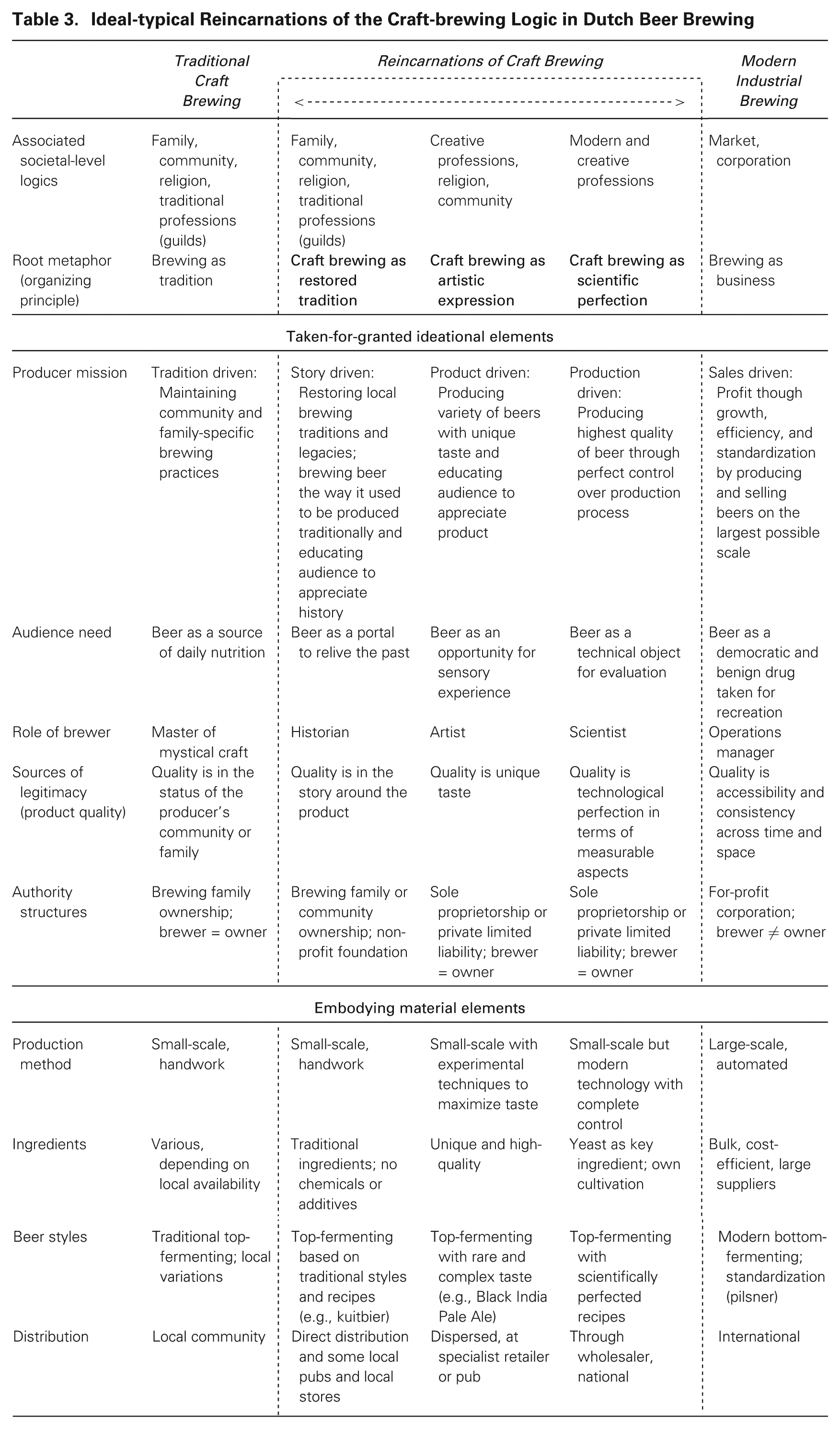
The blending of traditional craft elements with facets of modern industrial brewing facilitated diffusion by ensuring that regenerated traditional alternatives conformed with modern expectations. Founders combined traditional and modern elements in different ways and to different degrees. One example was the reliance on brewmasters steeped in modern industrial brewing, who were able to apply scientific principles to traditional recipes. Another example was brewing craft beer in plants closed by modern industrial brewers, such as in the case of De Arcense Stoombierbrouwerij. Finally, many breweries blended local brewing traditions with market trends. For instance, Brouwerij De Vecht in Loenen aan de Vecht, established in 2016, brewed Ambachtelijk 1710 Loender Bier as an India Pale Ale, a beer style that had recently become popular in the Netherlands, rather than attempting to restore it as close as possible to the original form.
Toward the end of our observation window (in 2016), the traditional craft-brewing logic had successfully been reincarnated, as evidenced by an established market for regenerated traditional alternatives. Craft brewing had gradually moved from being forgotten, to a popular hobby, to a serious field-level phenomenon. Even in terms of market logic metrics, the revival was starting to look impactful. Conservative estimates put the market share of independent craft brewers at 5 percent of 1.2 billion liters for 2015 (de Voogt, 2016; Nederlandse Brouwers, 2016). This estimate does not include the amount of alternative beer sold by the large incumbent brewers, however, which is another 8 percent (Nederlandse Brouwers, 2016). The changing strategies of incumbent breweries showed that craft brewing, in addition to invoking notions of restored tradition, artistic expression, and scientific perfection, had become a considerable business. Whereas in the past modern industrial breweries acquired traditional breweries only to close them and consolidate market share, they now acquired them to maintain them as semi-independent entities and gain a toehold in the growing craft beer market. For example, Heineken acquired the traditional family brewery Brand in Wijlre in 1989 and has continued to run it as an independent brand. Similarly, Bavaria acquired control over the brewing operations of Trappist Brouwerij De Koningshoeven in 1998, even though the monks maintained ownership of the brand and continued to be involved in the brewing operations. That the propagators of modern industrial brewing are now searching for ways to reintegrate traditional craft brewing into their organizations is perhaps the clearest evidence that the traditional craft-brewing logic has not only reemerged but has come to challenge the industrial brewing logic that had once obliterated it.
Discussion
While previous research has suggested that traditional arrangements regularly reemerge—even in fields long dominated by trends toward modernization—our study provides an important step in theorizing the regenerative process. Adopting the institutional logics perspective as a theoretical lens (Thornton, Ocasio, and Lounsbury, 2012; Ocasio, Thornton, and Lounsbury, 2017), we have used the case of the reemergence of craft in Dutch beer brewing to study one path of regenerative institutional change: that of the field-level reemergence of decomposed institutional logics.
We found that logic reemergence occurs in three stages: rediscovering, refurbishing, and reincarnating a logic. During these stages, field actors engage in three sets of regenerative activities—regenerating networks of logic custodians, regenerating ideational logic elements, and regenerating material logic elements—that involve recollecting, relegitimating, and reactivating institutional remnants. We have integrated these findings into a generalizable model shown in figure 2, which elucidates how these processes relate and unfold over time. We discuss this model in more detail below.
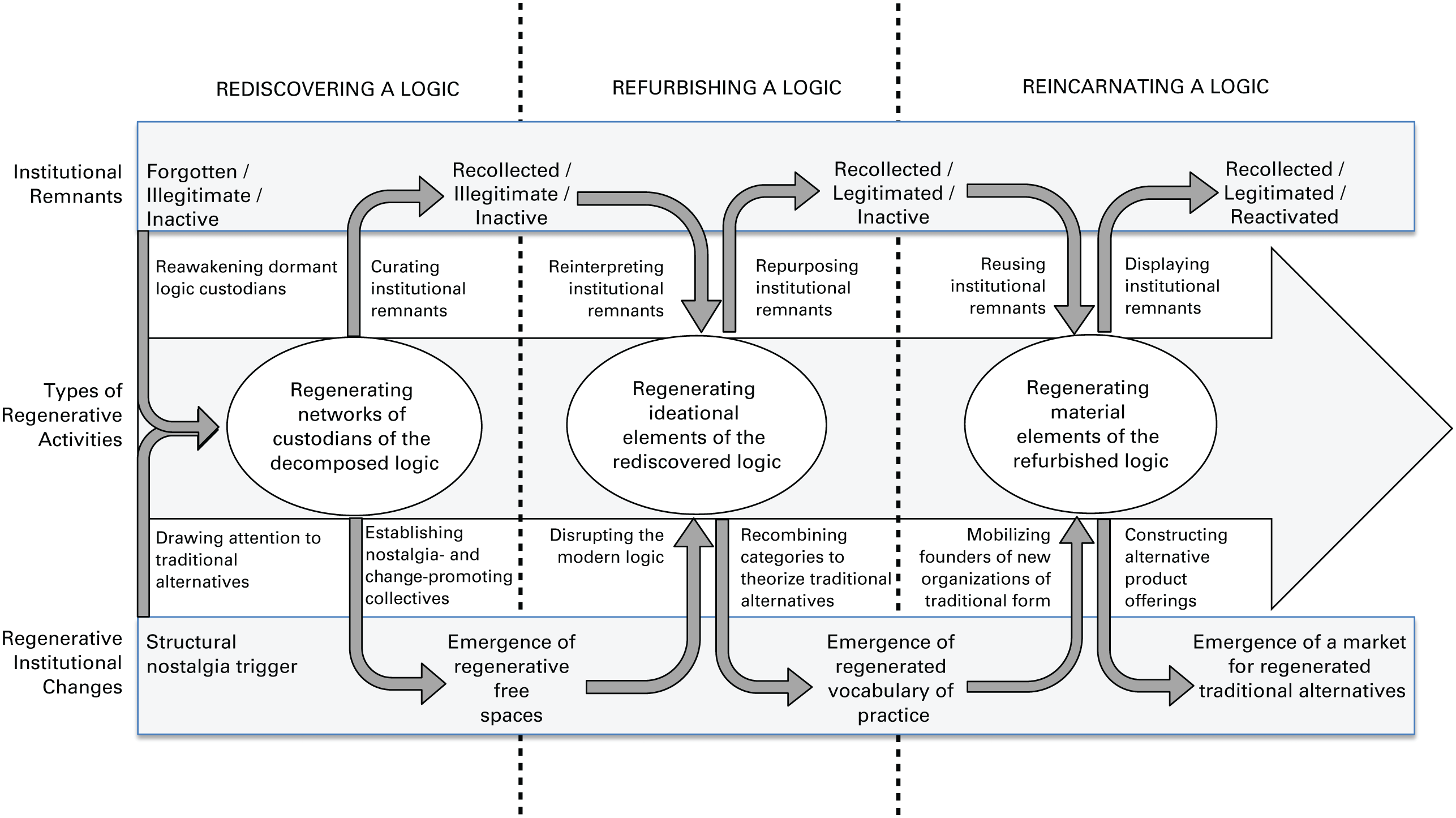
Theoretical process model of institutional regeneration through logic reemergence.
Our findings encourage further research on nonlinear forms of institutional change. While the possibility of logic reemergence has been acknowledged in previous research on institutional logics (Schneiberg, 2007; van Gestel and Hillebrand, 2011; Thornton, Ocasio, and Lounsbury, 2012), we sought to increase our understanding of this process by developing a dedicated theory of logic reemergence. Although our case shares certain similarities with cases of organizational field-level change through progressive logic shifts, there are two differences. One involves the regeneration of the networks of dormant custodians of a decomposed logic. The other involves the regeneration of ideational and material elements. Across these aspects, regenerative institutional change involves a crucial balance between restorative and transformative activities. This balance causes processes of logic reemergence to have a truly generative impact on organizational fields, rather than merely a regressive or reaffirming impact.
Rediscovering a Logic: Regenerating Decomposed Networks and Recollecting Institutional Remnants
Institutional logics are the product of the partially autonomous interaction between collectives of individuals and culture (Thornton, Ocasio, and Lounsbury, 2012). The grounded process model we constructed reflects this, as it pays attention to the co-constitutive dynamics of field-actor networks on one hand and symbolic and material culture on the other. We propose that field-level change through the reemergence of a decomposed logic starts with a process of rediscovering, which involves recollecting institutional remnants, making forgotten institutional logic elements available and accessible again. But a key impediment to recollecting such institutional remnants is the decomposed nature of the networks of actors who have access to such remnants. Due to processes of logic decomposition, these actors are likely to have become disembedded, dispersed, dormant, and unorganized. Based on our findings, we propose that regenerative institutional change through field-level logic reemergence requires the regeneration of disembedded actor groups who are dormant custodians of a decomposed logic and are associated with different institutional orders than those of the dominant logic. In our case, an important observation related to the success of the regenerative movement was that the networks of traditional actor groups and their ties to the field were not only restored but were also transformed by the unique reconfiguration of these ties and the absorption of new recruits within these actor groups. Whether this process leads to cross-level effects and subsequent field-level change appears to depend on unique field-level triggers, the emergence of distinct free spaces, and platforms that make institutional remnants accessible again.
Our study suggests that regenerating actor networks and recollecting institutional remnants requires what we have labeled as “structural nostalgia triggers”: field-level occurrences that raise awareness about traditional field arrangements and cause field actors to long for a return to those arrangements to revive what they perceive as lost culture. Based on our study and previous research, it appears that a range of triggers can produce field-level nostalgia that may lead to regenerative change. In our study, such a trigger was the establishment of windows into other fields, such as the Belgian, German, and British brewing industries, in which traditional logics survived and continued to be visibly and prominently embodied in organizational practice. Another example of a structural nostalgia trigger may be a field-level crisis that becomes associated with a dominant modern logic, such as when traditional agriculture reemerged in the U.S. in response to reported cases of poor animal care and concerns about the use of hormones in industrial farming (Elsbach, 1994; Weber, Heinze, and DeSoucey, 2008).
Our study also suggests that free and interstitial spaces play an important role in processes of regenerative institutional change (Rao and Dutta, 2012; Furnari, 2014; Croidieu and Kim, 2018). Beer pubs, beer collector clubs, beer judge guilds, hobby brewing guilds, and other collectives provided what we labeled as “regenerative free spaces.” We found such spaces to be a necessary condition for regenerative institutional change, allowing regenerative activities to be scaled up from local initiatives to field-level projects, as they can mobilize a large and diverse group of actors who have the capacity to recombine elements from different institutional orders, as well as provide opportunities to freely experiment with the transformation of the decomposed logic by blending institutional remnants with other logic elements. The increasingly widespread phenomenon of “maker spaces” also appears to have this property (Aldrich, 2014).
Finally, our study suggests that the creation of curated platforms that make the institutional remnants of the decomposed logic accessible again is another key mechanism for logic rediscovery to fully occur. In the case of Dutch beer brewing, platforms were created by nostalgia-infused collectives that both enabled the recollection of institutional remnants and improved their accessibility for a broader group of actors. This was apparent in events at which collectors of brewing history would meet with other actors, in the various print media produced by these organizations, and increasingly in online databases maintained by actors affiliated with these collectives. Previous researchers have observed that for movements to be successful they need to mobilize collective resources (Greve, Pozner, and Rao, 2006; Weber, Heinze, and DeSoucey, 2008). Relatedly, research on collective memory has attached an important role to the “communicative infrastructure” or the “general sociotechnological system through which individuals connect and communicate with each other” (Ocasio, Mauskapf, and Steele, 2016: 692). The emergence of curated platforms for building and diffusing knowledge around institutional remnants thus seems to be a necessary condition for successful regenerative institutional change in organizational fields.
Refurbishing and Reincarnating a Logic: Regenerating Ideational and Material Remnants of a Decomposed Institutional Logic
While the revitalization of dormant actor groups that carry institutional remnants can lead to the collective rediscovery of a decomposed logic, these processes in and of themselves will not be sufficient for field-level regenerative institutional change. A key impediment to actual logic reemergence is that remnants of decomposed logics contain neither ready-made templates for action nor legitimate norms that allow actors to transition into being successful cultural entrepreneurs. Decomposed logics can thus be understood as collapsed (rather than coherent) networks of material and ideational elements with critical holes that require patching if they are to mobilize actors. The effective patching or refurbishing of a decomposed logic and subsequent field-level change hinge on the combination of the remnants of the logic with external elements, such as from similar logics that are embodied in other fields or dominant logics in the local field. In this process, a balance must emerge between more restorative forces that symbolically segregate the rediscovered logic from the dominant logic and transformative forces that allow for material blending of both. Whether these processes lead to field-level institutional change appears to depend on the antecedent process of logic rediscovery, the emergence of a vocabulary of practice that reflects common ground between more traditional and contemporaneous interpretations of the decomposed logic, and the availability of external material logic elements that allow for blending.
Our findings suggest that if logic rediscovery does not lead to cross-level effects that facilitate collective access to the institutional remnants of the decomposed logic, the subsequent stages of refurbishing and reincarnating a logic may be less likely to occur and, if they occur, less likely to result in sustainable field-level change. For example, when networks of dormant custodians of the decomposed logic are simply restored in their original form, there is likely to be a limited capacity to transform the decomposed logic at later stages and add elements from other logics, which appears to be critical for successful regenerative change. Moreover, mobilization problems would limit the scaling up of regenerative activities from the individual to the organizational and field levels. This also appears to be evident in the case of the successful reemergence of Swiss mechanical watchmaking, as newcomers like Alpina had an important role in translating mechanical watchmaking into the twenty-first century (Raffaelli, 2018).
Our findings also suggest that language plays an important role in conjoining symbolic and material elements in a coherent manner that inspires collective action (Thornton, Ocasio, and Lounsbury, 2012: 149; Ocasio, Loewenstein, and Nigam, 2015). In particular, because decomposition affects the less tangible aspects of an institutional logic more severely, holes in the network of logic elements are especially likely to emerge around ideational elements, such as implicit schemas and norms and explicit vocabularies of practice. Field-level logic reemergence thus requires processes of refurbishing the logic that involve the use of recovered ideational elements, which facilitate authentic relegitimation, in conjunction with new elements that ultimately facilitate reincarnation of the decomposed logic. Based on our case, we argue that processes of refurbishing a logic are more likely to inspire field-level change if regenerated theories, frames, and narratives lead to the collective problematization of the modern logic and the presentation of elements of the traditional logic as a solution (Weber, Heinze, and DeSoucey, 2008; Raffaelli, 2018). At the field level, this would result in symbolic segregation between the reemerging decomposed logic and the dominant incumbent logic. This observation aligns with research on resource partitioning that has shown how industry-level revival is associated with establishing symbolic spaces that incumbents cannot easily encroach (Carroll and Swaminathan, 2000; McKendrick and Hannan, 2014).
An important complication for regenerative institutional projects, however, is that effective theorization also requires reference to examples or templates if they are to inspire material action (Nigam and Ocasio, 2010). This is problematic in the case of logic decomposition, as initially there are only incomplete templates and inactive exemplars. If refurbishing a logic involves merely restorative processes that strictly segregate the reemerging logic from the dominant logic, cultural entrepreneurs are going to be significantly constrained and will struggle to reincarnate the refurbished logic. Although these processes have rarely been examined in previous research, this appears to be in line with Cruz, Beck, and Wezel’s (2018) observation that blending traditional with modern elements led to new venture failure in the German region of Franconia, where conservative forces were considerable. The refurbishing process thus appears to need to result in the regeneration of ideational elements that both symbolically segregate the rediscovered logic and allow for some degree of transformation through material blending with external logics. Our case suggests that one mechanism through which this may occur is the transposition and translation of ideational elements from external fields in which similar logics are still actively embodied. Examples of such elements include the Belgian speciaalbier label and later the American craft bier label. The vocabulary of practice associated with these labels continued to allow for symbolic segregation while increasingly facilitating material blending, as the meaning of these labels was less constrained by local tradition.
In addition, the process of reincarnating a logic, the final stage through which a reemerging logic is institutionalized and causes field-level change, depends not only on the antecedent processes of rediscovering and refurbishing the logic, but also on the availability of material resources that enable organizational entrepreneurship. The release of resources by incumbent actors embodying the dominant logic in the field (McKendrick and Hannan, 2014; Negro, Visentin, and Swaminathan, 2014) seems to have been one critical factor through which logic reincarnation through recombination with modern elements was ultimately possible. For instance, without the access to abandoned brewing sites, brewing equipment, or even brewing operators from modern industrial brewers, the regeneration of craft brewing would have been much more complicated if not impossible.
Implications for Research on Field-level Change through Institutional Logic Shifts
To expand our theoretical repertoire of institutional change pathways, we have theorized an alternative form of institutional change that previously went relatively unnoticed. Our study also makes a number of contributions to the literature at the intersection between institutional logics and field-level change. Our theory of logic reemergence stresses the importance of appreciating the historical contingencies of institutions and institutional logics (Thornton, Ocasio, and Lounsbury, 2012; Suddaby, Foster, and Mills, 2014; Ocasio, Mauskapf, and Steele, 2016), advances our understanding of the cultural resource environments that actors are embedded in by elaborating temporal and material dimensions (Scott et al., 2000; Baker and Nelson, 2005; Sine and Lee, 2009), and provides insights into how field-level logics may evolve through degenerative and regenerative dynamics (Rao, Monin, and Durand, 2003; Ocasio, Mauskapf, and Steele, 2016).
Perhaps most interestingly, however, our research provides field-level evidence for the thesis that there is symbiotic interdependence among institutional orders in that the dominance of one leads to instability and sets in motion feedback mechanisms that lead to the reemergence of others (Thornton, Ocasio, and Lounsbury, 2012: 119). Similar observations have been made elsewhere, such as by Padgett and Powell (2012), who pointed to the mechanism of “network thinning” that makes systems vulnerable toward tipping, and by Karl Polanyi, who described “pendular swings” in systems and “double movements” (Polanyi, 1957; Dale, 2012). Our study suggests that when one logic becomes overly dominant and causes the destruction of another, individual and cultural networks thin as many actor groups become increasingly disembedded from the field and a narrower range of cultural resources is employed. Logic decomposition thus results in dormant actor groups and institutional remnants that provide a latent capacity for change that can be triggered by field-level events. Moreover, the destruction of a logic may paradoxically be a more potent antecedent of regenerative change than the mere marginalization of a logic. Our case suggests that the decomposition of a logic may allow for the revitalization of marginalized actor groups and processes of creative recombination that transform the original logic and allow for blending with other logics, which result not only in institutional change but also in innovation and economic benefits. Such recombinant processes seem less likely when a marginalized group of actors clings to a minority logic, but we note that Raffaelli (2018) documented an example of reemergence that did not appear to involve complete logic decomposition.
Future Research
Our research offers a first step toward better understanding the dynamics of logic decomposition and reemergence, but more research is needed to fully appreciate these dynamics. Understanding regenerative institutional change requires looking through an historical lens at the evolution of organizational fields, while at the same time taking an expansive interpretivist approach to understanding and appreciating the motivations and activities of contemporaneous field actors. We see at least two promising avenues for future research on the subject of regenerative institutional change.
First, we encourage more comparative research to provide deeper insight into the specific mechanisms through which regenerative institutional change may unfold. Future research may look at similar regenerative movements across geographical fields, or it may hold geography constant and examine logic reemergence across a set of different fields. Although various mechanisms of regenerative institutional change may be worth exploring, one that seems particularly interesting is the role of dormant organizations (Kozhikode, 2016): those that used to embody the now decomposed logic but switched entirely to the now-dominant logic to survive. Such organizations represent dormant yet embedded and organized actors who may appear better equipped to engage in processes of regenerative institutional change than the dormant, disembedded, and unorganized actors who appeared to be most relevant in our case. In principle, regeneration and relegitimation challenges should be less steep when a field harbors many such organizations, as they could engage in processes of organizational identity resurrection (Howard-Grenville, Metzger, and Meyer, 2013; Raffaelli, 2018). This could make the regenerative institutional change process even less dependent on external forces (Schneiberg, 2007; Padgett and Powell, 2012). Although multiple organizations could have served the role of dormant organizations in our case, all except one, the Trappist Brouwerij De Koningshoeven, seemed relatively incapable of switching back from industrial to craft brewing. What makes organizations capable or incapable of switching back from modern to traditional logics is an interesting question for future research. In particular, as our case of regenerative institutional change appeared to require the introduction of new organizations, we wonder whether there may be other settings in which embedded organizations can drive regenerative institutional change processes and whether these processes would look different. Raffaelli’s (2018) study of the resurgence of mechanical watchmaking offers some interesting insights in this respect that could be contrasted with our findings.
Second, we encourage research on regenerative institutional changes that are ongoing and that can be observed in a more fine-grained fashion by focusing specifically on one of the dynamics we have identified. For instance, future research may explore ongoing efforts to regenerate networks of logic custodians. There are currently multiple organized initiatives on reviving crafts more broadly (e.g., KIEN, 2018; also see Aldrich, 2014), which provide an excellent opportunity for studying logic reemergence processes in situ and in vivo and for comparing more successful with less successful instances of regenerative change. Alternatively, there appear to be interesting dynamics between enthusiast consumers and regenerative producers, such as are also visible in the reemergence of traditional photography or Swiss watch making (Hampel, Tracey, and Weber, 2016; Raffaelli, 2018), that we did not explore in detail.
Clearly, fields can experience the reemergence of many types of institutional logics. Apart from the craft revolution that has reached multiple sectors (Ocejo, 2017), the transition toward an environmentally sustainable organizational society (Weber, Heinze, and DeSoucey, 2008; van Bommel and Spicer, 2011) and the emergence of neolocalism in the wake of growing globalization (Shortridge, 1996; Flack, 1997; Marquis and Battilana, 2009) also appear to involve the regeneration of traditional institutional elements that had previously been abandoned. Even beyond logics that are naturally considered “traditional,” our model may apply to cases in which “modern” logics—such as those associated with the market—experience decomposition and subsequent reemergence (cf. Nicolini et al., 2016).
It is important to remain realistic about regenerative institutional change, however. While there are many examples of regenerative institutional processes, they often appear, at least initially, to be relatively marginal phenomena. An important critique that thus can be raised is that regenerative processes will ultimately be overpowered by increasing modernization and will not lead to true institutional change. Indeed, craft brewing has become big business, as evidenced by the fact that industrial brewers are increasingly adopting craft elements. As such, it appears that craft may be providing an important lifeline for established corporations in a declining industry (Colen and Swinnen, 2016; Garavaglia and Swinnen, 2018). Over time, success in this field may therefore depend less on whether breweries authentically restore traditional arrangements and more on whether they are able to borrow traditional elements to preserve modern arrangements. For instance, although modern industrial producer Heineken continues to dominate the Dutch beer-brewing market, it has recently introduced unfiltered pilsner (Keuringsdienst van Waarde, 2017). Similarly, organic food production (Sikavica and Pozner, 2013), fair trade (Ingenbleek and Reinders, 2013; Reinecke and Ansari, 2015), and green manufacturing have also become big business.
But this critique ignores the fact that industries experiencing regeneration are often fundamentally transformed. The fact that craft brewing has become big business means that alternative forms of organizing have established a legitimate and sustainable niche from which incumbent organizations face a serious challenge. Indeed, traditional practices tend to display a certain degree of inseparability from their traditional logics and vice versa (cf. Raffaelli, 2018). Yet it is an empirical question whether the regenerative institutional changes we observed in our study are sustainable and whether the newly established organizations of traditional form will survive in the long run.
Although organizational theorists have long argued, in the spirit of Weber, that institutional change occurs through the replacement of traditional arrangements with modern counterparts, our study of the craft revival in Dutch beer brewing instead shows that, through processes of regenerative institutional change, traditional arrangements may reemerge and come to challenge the modern arrangements that once replaced them. Our study therefore urges organizational theorists to realize that what is dead may never die.
Supplemental Material
DS_10.1177_0001839218817520 – Supplemental material for What Is Dead May Never Die: Institutional Regeneration through Logic Reemergence in Dutch Beer Brewing
Supplemental material, DS_10.1177_0001839218817520 for What Is Dead May Never Die: Institutional Regeneration through Logic Reemergence in Dutch Beer Brewing by Jochem J. Kroezen and Pursey P. M. A. R. Heugens in Administrative Science Quarterly
Footnotes
Acknowledgements
We thank Associate Editor Chris Marquis and three anonymous reviewers for their insightful comments, as well as Joan Friedman and Linda Johanson for their expert editing. We are also grateful to many of our colleagues for their thoughtful comments on earlier versions of this manuscript. We are particularly indebted to Derek Harmon, Jennifer Howard-Grenville, Bill Foster, Vern Glaser, Royston Greenwood, Thomas Lawrence, Sébastien Mena, Willie Ocasio, Thomas Roulet, Wendy Smith, Roy Suddaby, Pooya Tavakoly, and Paul Tracey. We have also greatly benefited from the feedback from participants at the October 2016 OTREG meeting in Cambridge as well as paper development workshops at the University of Alberta and the University of Cambridge. Finally, we would like to thank all our interviewees as well as Jan Ausems, Rob Gras, Moniek Haaring, Jessica Kroezen, Monique Verbeek, Willem Verboom, and Richard Unger for their help and support during various stages of the study.

Supplemental Material
2
When it was still a cottage industry, brewing was very much a practice engaged in by craftswomen. With commercialization it increasingly became a business that was dominated by men, but women continued to make up at least 10 percent of the brewer population throughout the ages (van Dekken, 2010).
6
Benelux refers to Belgium, the Netherlands, and Luxembourg.
Authors’ Biographies
References
Supplementary Material
Please find the following supplemental material available below.
For Open Access articles published under a Creative Commons License, all supplemental material carries the same license as the article it is associated with.
For non-Open Access articles published, all supplemental material carries a non-exclusive license, and permission requests for re-use of supplemental material or any part of supplemental material shall be sent directly to the copyright owner as specified in the copyright notice associated with the article.
