




Abstract
This article examines how the deployment of private security officers to patrol public spaces, and their use of body-worn cameras (BWCs), has become possible in Sweden where public video surveillance was long considered unthinkable and where the protection of privacy remains strong. We ask how the expansion of private security officers into public spaces can be understood, and how the use of BWCs by these officers has affected the nature and scope of public space surveillance. Based on interviews with private security officers and key stakeholders, as well as policy documents, we use the concept of function creep to explain how such new uses evolve over time, and we draw on the theory of the normalisation of the exceptional to understand why it has taken place. We refine the normalisation theory by arguing that the ‘normalisation of perceived threats’ can be driven by a series of criminal events, political responses, and dominant public discourses – rather than by a single exceptional event, as Flyghed originally proposed. In doing so, we contribute to the theoretical development of the normalisation of the exceptional and offer an empirically grounded analysis of how the implementation of BWCs in the private security industry, alongside the expansion of private security officers in public spaces, constitutes a new mode of policing and surveillance in Sweden. Our study thereby adds to the growing body of critical scholarship on BWCs.
Introduction
During the last decade, body-worn cameras (BWCs) have become part of the standard equipment for many policing agents. In some countries, such as the United States (US), BWCs have been introduced to enhance the transparency and accountability of the police and deter police officers and the public from wrongful behaviour. In other countries, such as the Netherlands, Spain and Sweden, BWCs have been implemented to reduce the number of assaults and threats towards policing agents by deterring members of the public from assaulting officers, thereby improving officers’ work environments (Coudert et al., 2015; Hansen Löfstrand and Backman, 2021; Timan, 2016). Likewise, a small but growing body of research has examined the use of BWCs by policing agents other than state police officers – such as healthcare staff, private security officers, and ticket inspectors – focusing on whether BWCs help reduce assaults against staff and on how employees themselves conceptualise and use the technology (e.g. Ariel et al., 2019; Hansen Löfstrand and Backman, 2022; Leleux and Webster, 2020; Wilson et al., 2022).
However, technologies do not necessarily produce (only) the intended functions. As has been shown, technologies tend to be adapted and adjusted to suit individual and organisational needs (De Laet and Mol, 2000; Orlikowski, 1992). Regarding the use of BWCs among policing agents, it has been argued that the technology not only has the potential to increase transparency or protection of officers, but it may also augment surveillance in society and cause ‘unprecedented levels of citizen surveillance’ since BWCs are mobile and follow their carriers through public places and into private homes (Bud, 2016: 118; Goold, 2021; Lippert and Newell, 2016). Even in countries such as Sweden – where public video surveillance was considered virtually unthinkable as recently as the 1990s, and where regulations of public video surveillance are explicitly designed to ensure ‘protection against violation of privacy’ (Björklund, 2011: 361) – the use of BWCs has become commonplace.
The aim of this article is to explain how the deployment of private security officers to patrol public spaces and their use of BWCs to surveil the public, has become possible in Sweden. Specifically, we ask how the expansion of private security officers into public spaces can be understood, and how the use of BWCs by these officers has affected the nature and scope of public space surveillance. To explain how this expansion has occurred, we draw on the concept of function creep. To explain why it has taken place and come to be accepted, we also employ the theory of the normalisation of the exceptional. In doing so, we further develop the normalisation theory to understand how private security patrols of public spaces, and the use of BWCs to monitor the public, are no longer contested practices but have come to be regarded as legitimate. Finally, we discuss how the growing presence of private security officers, and their use of BWCs, has transformed the nature and scope of public space surveillance, resulting in a new mode of policing and surveillance in Sweden.
This article not only contributes to the theory of the normalisation of the exceptional, but also offers an empirically grounded analysis of how BWC use increases the overall level of surveillance of citizens in public spaces, thereby contributing to the growing body of critical scholarship on BWCs. By focusing on the private security industry, our study also expands the limited body of research on BWC use by policing agents other than state police officers.
Documents included in the study.
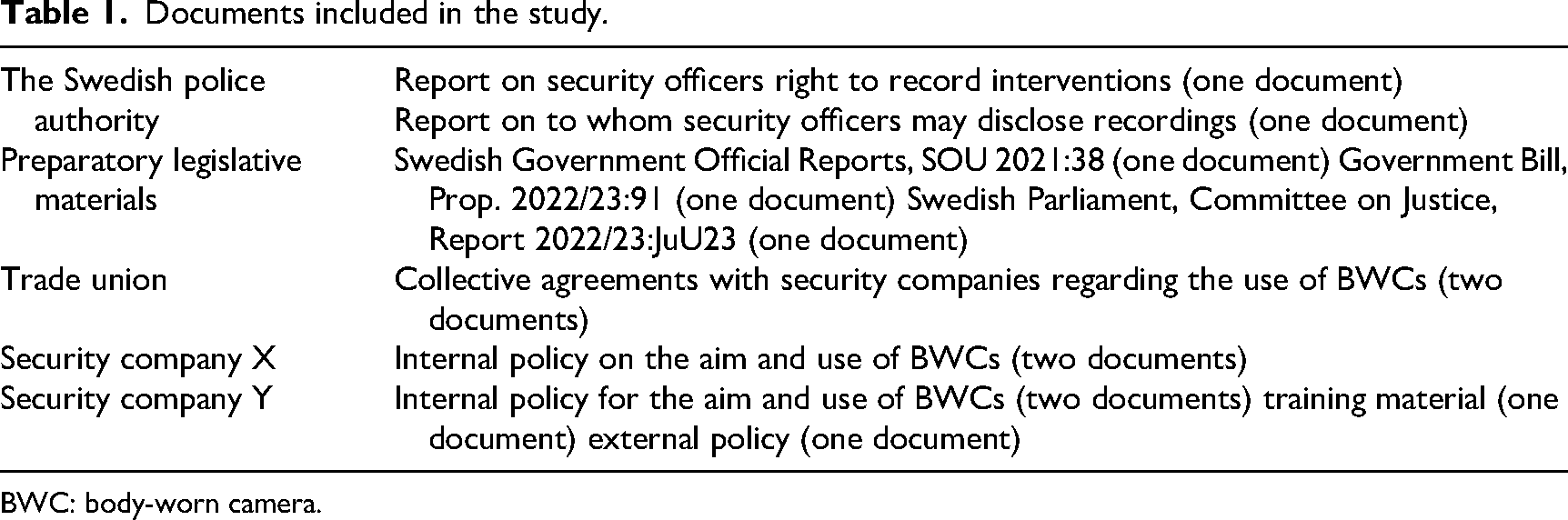
BWC: body-worn camera.
Background: Private security officers in Sweden
Regular use of BWCs was first introduced in Sweden by private security companies in parts of their operations in 2018. Thus, in Sweden, BWC became part of the equipment for security officers operating in certain public spaces prior to their broader implementation by the Police Authority as they were not standardised for patrol officers until 2023.
At present, around 6300 individuals are appointed as security officers in Sweden, compared to approximately 10,600 uniformed police officers in external service (Haglund/TT, 2025; Milchner Funseth, 2025). To become a private security officer, a person undergoes two weeks of training 1 organised by the Swedish Police Authority. After completed training, a person can apply to the Police Authority for appointment as security officer, and become employed as security officer at a private security company or be self-employed.
Security officers are, in contrast to ordinary security guards, delegated limited policing powers. Swedish regulations allow the Police Authority to confer security officers with the right to ‘preserve public order’ – a task otherwise reserved for the police – and security officers have the right to use force and arrest people (SFS 1980:578, 1980). Although a small number of security officers are self-employed and work directly for pubs or nightclubs, the vast majority are employed by private security companies. These companies provide security officers to a wide range of clients, including private businesses, municipalities, hospitals, sports arenas, football clubs, and even the police (Hansen Löfstrand, 2024). Security officers may only be deployed to carry out the tasks specified in the national legislation regulating their role, and only at the types of locations listed therein.
At the time of the empirical study presented in this article, security officers work and duties were regulated by the Act on Security Officers (SFS 1980:578, 1980). The main provision of the act (§2) stated that security officers may be appointed by the police to work in designated places such as pubs and nightclubs where alcohol is served, and at public events and gatherings as specified in the Public Order Act (SFS 1993:1617). However, an exception to the main rule could be found in Section 3, which stipulates that if ‘there is a particular need and it is of essential importance to the public interest’, private security officers may be appointed by the police in other cases than those stipulated in the main section. Such cases can include private security officers patrolling public spaces. Section 3 became known as the exemption clause, and areas approved with reference to the clause have come to be referred to as §3 Areas. In practice, the Police Authority only appoints security officers to §3 Areas after receiving a request from a third party. In general, it is local municipalities, public authorities and public transport companies that request permission to contract security officers to §3 Areas.
The number of times when exceptions have been deemed warranted has increased dramatically over the past two decades, as has the size of the areas (Hansen Löfstrand, 2021). In contrast to other countries where the development of private policing is part of a state driven aim (e.g. Fitzgibbon and Lea, 2020), the development in Sweden was not the result of a political strategy (Hansen Löfstrand, 2021). On the contrary, the political system has continued to consider policing to be a matter for the state, to be executed by the Swedish Police Authority. Hansen Löfstrand (2021) has shown how the marketisation of policing in Sweden – that is, the expansion of private security officers patrolling public spaces – was established in what she refers to as an institutional void (i.e. a lack of political directives). The Swedish private security industry was, together with local municipalities, an important player, as was the Swedish Police Authority that both enabled and legitimised the development by approving applications for §3 Areas. The Police Authority's approval of §3 Areas has been interpreted by the security industry as a silent acknowledgment that the police do not have the resources needed to patrol public spaces in the way they used to, and that security officers are needed in these spaces (Hansen Löfstrand, 2021).
BWC: New and increased forms of surveillance
Although BWC research has primarily focused on the extent to which these devices enhance police accountability and reduce unwarranted police violence by monitoring officers’ actions (Backman and Hansen Löfstrand, 2022), a growing body of critical scholarship has examined their broader implications for surveillance regarding in particular how public spaces are viewed, the publics ability to avoid surveillance, and the perspective captured by the recording.
For instance, Goold (2021) argues that the widespread use of closed-circuit television (CCTV) surveillance has normalised public surveillance and, in doing so, impacted how public spaces are viewed. Beyond infringing on individual privacy in public spaces, Goold (2021: 174) contends that surveillance in public spaces also ‘symbolically claims’ these spaces as ‘the state's domain’, thereby undermining the public's ability to exercise political rights. While BWC might be viewed as a mere extension of existing state surveillance practices – offering no significant shift in the balance of power between the state and its citizens – several scholars have argued that BWCs constitute a qualitatively different mode of surveillance than CCTV (Brucato, 2015; Goold, 2021; Lippert and Newell, 2016; McKay and Lee, 2020).
It has been argued that the use of BWCs also makes it more difficult for members of the public to avoid being recorded or to even know that they are being recorded – or to identify whom to contact in order to request access to footage or file a complaint. As Marx (2020: 14, italics in original) succinctly noted: ‘unlike the fixity of mounted cameras in public areas, which you come to, BWCs, like drones and pizza delivery, come to you’ (see also Goold, 2021).
Brucato (2015) argues that BWCs constitute a form of surveillance that conceals the policing agent's actions, as they record from the point of view of the officer. Typically worn on the chest, BWCs may feature a small screen displaying what is within the camera's frame. While this may render the device more visible to the public compared to CCTV, it nonetheless captures only what lies in front of the lens – thereby concealing most of the officer's own actions – unlike traditional CCTV systems, which typically record both the public and the policing agent. Unlike many conventional CCTV cameras, BWCs also record sound (Lippert and Newell, 2016), thus enhancing the surveillance of both officers and the public. Moreover, BWCs are normally equipped with a pre-recording function, which allows the camera to continuously record without saving footage unless activated; once the officer presses the record button, the device captures the preceding 60 s. In addition, BWCs can be operated in ‘stealth mode’, enabling covert recording without any visible or audible indicators. Taken together, these features ensure that officers’ perspectives are ‘legally and culturally privileged’ (Brucato, 2015: 470; McKay and Lee, 2020).
While BWCs may be implemented with the aim of enhancing the accountability and legitimacy of policing agencies, studies have shown how the privileging of officers’ point of view may simultaneously undermine efforts by minority groups to hold officers accountable by documenting incidents of misconduct or brutality. Rather than fostering transparency, the BWC's perspective can be mobilised to reinforce the legitimacy of law enforcement agents by presenting the footage as offering the ‘whole and true’ account, in contrast to fragmented and supposedly less trustworthy recordings captured by members of the public (Brucato, 2015; Goold, 2021; Hansen Löfstrand and Backman, 2022: 70). The BWC's capacity to display the unedited perspective of security officers has thus become a central element in the private security industry's efforts to reclaim control over the documentation and interpretation of policing encounters (Hansen Löfstrand and Backman, 2022).
Normalisation of perceived danger and private security patrols
To examine how the deployment of private security officers to patrol public spaces and the use of BWCs to surveil the public – whether overtly or covertly – have unfolded and gained legitimacy, this article draws on two complementary theoretical perspectives. The concept of function creep is used to capture the process through which technologies and practices gradually expand beyond their originally intended purposes, while the theory of the normalisation of the exceptional provides a framework for understanding why it happened: the broader social and institutional conditions that make such expansions possible.
The theoretical concept of function creep refers to the extended use of a technology for purposes beyond those originally intended (Backman, 2012a; Dahl and Sætnan, 2009; Koops, 2021). Processes of function creep have been explained in various ways. For example, they are sometimes said to occur ‘because they can’ owing to the flexibility of technologies and the creativity of their users (e.g. Dahl and Sætnan, 2009: 85). Function creep has also been described as a process through which members of the society gradually become accustomed to a new technology and the moral boundaries established at the time of its implementation. Over time, this familiarity enables a shift in reasoning, where additional uses – perceived to fall within the same moral frame – are considered acceptable (e.g. Backman, 2012b). Koops (2021: 50) notes that the widespread use of function creep as an analytical concept ‘suggest that the phenomenon of gradual expansion beyond what was originally foreseen is a widespread, perhaps natural, phenomenon’. As a result, function creep may appear to be an inevitable consequence of technological development, rather than a social process in need of explanation. To avoid portraying the emergence of a new mode of policing and surveillance in Sweden as merely a case of function creep, we combine the concept of function creep – to describe the process through which new functions emerge – with the theory of the normalisation of the exceptional (Flyghed, 2002), which enables us to explain the conditions that allow such expansions to occur and become accepted.
The theory of the normalisation of the exceptional distinguishes between two types of normalisation: normalisation of policing methods and normalisation of perceived threats (Flyghed, 2002). Normalisation of policing methods refers to situations in which a policing method, originally introduced for a specific and exceptional context, comes to be applied more broadly. This expansion may occur through formal changes in policy or legislation that authorise the method's use in a wider range of situations, or through informal practices in which the police extend the method's use beyond its legal mandate, with such practices later being retrospectively legitimised. In Sweden, for instance, private security officers were initially authorised to operate only in clearly defined, predominantly private, spaces and for specific purposes. In this article, the normalisation of policing methods allows us to examine how collaborations between local governments, the police, and private security companies contribute to a gradual expansion of both the legal and moral boundaries of private security officers’ roles.
The normalisation of policing methods shares many similarities with the concept of function creep. Like function creep, it involves an ‘extended use, regulated or unregulated’, of a method for ‘purposes for which it was not initially planned’ (Backman, 2012a: 18). The main difference between the two concepts is that the normalisation of policing methods has a narrower focus, while function creep is a more general concept. Although the concept of normalisation of policing methods could be used to analyse the expansion of private security officers as a policing method, it does not capture the changes in how BWCs are used. While we recognise the overlap between the two, we use function creep to describe what has happened – the process through which new functions have emerged – and the theory of normalisation of the exceptional to explain why these developments have taken place.
The second type of normalisation is the normalisation of perceived threats. As Flyghed (2002) argues, this type of normalisation precedes the introduction of new policing methods and the subsequent normalisation of those methods through expanded regulation. In Flyghed's theory, the normalisation of perceived threats is linked to exceptional events, such as serious terrorist attacks, and their impact on the use of coercive methods and surveillance by the police. These events tend to have a high ‘sensation value’ and gain substantial media attention. At the same time, they are often directed toward diffuse objects and values – such as the democratic society or national security – and are themselves often equally vague. It may be unclear where the threat originates, or when and where a similar event may occur again. According to Flyghed (2002: 30), the result is a heightened and collectively reinforced sense of ‘impending danger’, accompanied by a perception that existing control mechanisms are inadequate to protect citizens. In this article, we develop Flyghed's theory by analysing a case in which the sense of impending danger is not caused by one specific exceptional event, but rather by a series of crime incidents and the political responses they have generated.
Studies of normalisation processes have been criticised as one-sided analyses of negative developments in policing and civil liberties and for disregarding positive developments (e.g. Waddington, 2005). For example, it has been argued that introducing new legislation undermining civil liberty should not be confused with enforcing the same. ‘Statute books tend to be littered with legislation that is unenforced’, wrote Waddington (2005: 362). However, as we show in this article, normalisation and implementation of new policing methods are not necessarily driven by legislation and parliamentary action or constrained by legal mandate. For example, actors may attempt to stretch the boundaries of policing powers beyond the ‘boundaries of what is permissible’ (Flyghed, 2002: 34). Once such policing methods have become normalised, it is not uncommon for them to be legitimised retrospectively through new legislation.
The theory of normalisation thus offers a framework for analysing how both the arenas of surveillance and the actors involved in its execution have expanded beyond what was previously considered acceptable in Sweden. Combined with the concept of function creep, it provides an analytical lens through which the intertwined developments of an expanding private security presence in public spaces and the increasing use of BWCs while patrolling public spaces can be examined. Together, these concepts guide our analysis of how shifts in technology, governance, and legitimacy have transformed the nature and extent of public space surveillance in contemporary Sweden.
Methodology
We draw upon the results of an empirical study 2 we conducted in the private security industry in Sweden in 2019–2022. In the study, we interviewed 18 key stakeholders in the field: nine employer representatives (e.g. human resources staff, security managers and representatives of employer organisations), six union and employee safety representatives, a representative of the Swedish Police Authority responsible for the authority's guidelines for private security officers and two representatives for a company providing BWCs. We also interviewed 20 private security officers working for two of the largest security companies in Sweden. All participating officers had experience of wearing BWCs in their work from approximately two months to two years. All participants were informed of the study's purpose, procedures, potential risks and benefits, and their right to withdraw at any time before they signed a written consent form.
In the study, we also collected all relevant policy documents from the two companies and additional policy documents such as the Police Authority's statement regarding security officers’ right to record interventions. During the time of the empirical study, a legislative revision regarding the Act on Private Security Officers was taking place and we followed the work conducted as well as the public and political debate of §3 Areas and private security officers. In total, we collected and analysed 13 documents, see Table 1. To not risk exposing the security companies participating in the study, we will only provide a broad description of the documents included in the study.
In the interviews, we asked questions about when, why and how BWCs were implemented in the organisations and the industry, how BWCs are used (what kind of situations are recorded, how security officers start a recording) and the benefits and drawbacks of BWCs. We also asked about implications for the work environment and the right to privacy. All interviews were recorded and transcribed verbatim. The quotations used in this article have been translated from Swedish to English by the authors and have been edited slightly to improve readability when it did not affect the interpretation of the text. To preserve the anonymity of the participants, we do not reveal the gender, age, company or location of participants.
We conducted an inductive coding process and used the constant comparison method (Charmaz, 2014; Turner, 1981), in which all quotations in the same code are compared with each other one by one to ensure a comprehensive understanding of their similarities and differences in order to provide an overall analytical understanding of the concept. Our analysis in this article is based on codes such as ‘§3 Areas’, ‘covert recording’, ‘comparing BWCs and CCTV’, ‘accounts of BWCs’ and ‘effects of BWCs’. Overall, we understand the societal process we followed during this research project to represent a new mode of policing and surveillance in Sweden.
Private surveillance in public spaces: A new mode of policing and surveillance
In the following, we present our analysis of the two interlinked processes of function creep – increasing public sector contracting of private security officers to patrol public spaces and the introduction of BWCs in the private security industry. First, we examine the expansion of §3 Areas and how this development is connected to the so-called ‘police crisis’ in Sweden, as well as to the fear of organised crime and criminal immigrant groups in areas labelled ‘socially disadvantaged areas’ by the police. Operating in larger and more numerous areas requires new skills from security officers and exposes them to new forms of risk as they take on responsibilities associated with police work. In the subsequent section, we analyse how BWCs – although initially introduced in response to these perceived risks – have come to be used in ways that extend surveillance in public spaces beyond their original purpose. We analyse how these changes have become possible through a broader process of normalisation, whereby both the perceived threats and the means of policing have gradually come to be seen as legitimate and necessary.
Extending private security patrolling in public spaces
In recent years, public sector organisations contracting private security officers to patrol public places in the name of public safety and security has continuously increased (Hansen Löfstrand, 2021). By stakeholders and security officers, this development is presented as police work performed by security officers because of the lack of police resources: Security officer: They [the municipality] have looked at, um, people [who] don’t feel safe in streets and squares, and with the lack of resources in the police—well, they don’t have the time to deal with these kinds of business, and then this [patrolling private security officers] became an investment by the municipality to create more safety, one out of several investments, to, like, reclaim the streets to put it simply, and create more safety, and then also, uhm, prevent crimes, to put it simply. (IP15 [interviewed person no 15])
The security officer cited above (IP15) describes how the city council did not initially receive permission for §3 Areas from the Polie Authority. However, it received ‘directives from the police’ on improving the application and making it possible for the Police Authority to approve it, ‘which resulted in us getting them [§3 permissions]’. In addition to approving the application for §3 Areas, the Police Authority, according to the security officer, reinterpreted the legislation regarding §2 Areas. As a result, the Police Authority provided the city council and security company with substantial new areas in the city and the suburbs, in conjunction with the §3 Areas, where security officers can work on §2 basis, such as sports grounds, parks and beaches, creating a large contiguous area in which to operate. The description by the security officers is in line with findings in previous studies that has shown that the development towards more and larger areas where security officers can patrol has been driven by municipalities in cooperation with the Police Authority and private security companies to navigate the legal restrictions and provide more security officers in more public spaces of the city (Hansen Löfstrand, 2021, 2024).
The line of reasoning demonstrated by the quote above, and by previous research, can be related to political and public portrayal of the police as increasingly under-resourced and unable to maintain visible patrols (Andersson and Nilsson, 2017). Rather than debating alternative responses to the perceived crime problem, political parties – both at the local and national levels – have competed to propose initiatives to increase the number of officers on the streets and introduce harsher penalties for organised crime and criminal networks. On the local level, such efforts have translated into expanded use of private security officers, who patrol public areas to ‘create more safety’ and ‘reclaim the streets’, as described by the security officer quoted above.
The new work tasks being ‘substitutes’ for police operations in public spaces ‘after this police crisis, where society thinks the police are not present enough to provide safety’ (IP28), demand, to some extent, new skills from security officers. The officers’ new tasks in §3 Areas include patrolling by foot or car, responding to calls from citizens about ‘unrest’ in the areas, improving residents’ sense of safety in their neighbourhood, building relations with people in the area, ‘reclaiming the streets’ and reducing crime statistics. These new work tasks are not perceived as entirely positive or without problems. On the contrary, it has been noted that some new tasks were previously conducted by police officers with substantially longer training and a different set of powers, and these new tasks constitute new risks for security officers whose mission is no longer to ‘handle the drunks in the mall’ (IP28): Industry body representative: What the security officers become in real life is local police officers, or local constables, like then they are expected to do more … Then there is also an expectation to confront, for example, trafficking of both drugs and other things … There's a risk that these, like, more organised criminal gangs or whatever you call it, want to set an example to make security officers step back and not interfere with their business. That risk increases day by day with these new assignments. (IP28)
The industry body representative in the quotation above draws upon the much-debated problem of ‘organised criminal gangs’ in Sweden to underline the potential dangers facing security officers performing tasks once conducted by neighbourhood police. Organised crime and so-called criminal immigrant groups in ‘disadvantaged areas’, as they are termed by the Swedish Police Authority and in the media, have in particular been framed as central problems in Sweden (Andersson and Nilsson, 2017; Hansen Löfstrand, 2015, 2021; Nafstad, 2023). By ‘disadvantaged areas’ the Swedish Police Authority refers to certain suburbs, predominantly inhabited by immigrant groups and characterised by low-cost rental housing. In official discourse and public debate, these areas are described as sites of parallel societies, where residents are said to avoid cooperating with the police, refrain from reporting crimes or testifying, and fear the presence of organised criminal groups (Nafstad, 2023; Polisen, 2015).
The current increase in deadly gun violence in Sweden – particularly among men aged 15–29 (Brå, 2024) – is widely perceived as concentrated in disadvantaged areas and linked to gang-related environments, and it has generated concerns among policymakers, media, and the public, as well as within the security industry. The industry body representative quoted above, underscores his argument by referring to two separate occasions when security officers were shot at, and implies that it is only a matter of time before a fatal incident will occur: Industry body representative: The shooting against a patrol car [with security officers] in the south parts of the city before the summer, and then you had the, this shooting at security officers in [city], and then, then we’re like, [small sigh] someone, sooner or later [will be hit]. (IP28)
To address the new risks that security officers face, the BWC was introduced to improve the safety of the officers (Hansen Löfstrand and Backman, 2022).
Increasing surveillance of public spaces
Although introduced to improve the work environment of security officers, implementing BWCs in the private security industry has intensified the surveillance of the public. In contrast to the possibility of ‘surveillance slack’, i.e. when the surveillance potential of new technology is not used (Marx, 2002; Waddington, 2005), security officers, as users of the technology, have imagined new purposes for using BWCs.
The official intentions behind implementing BWCs in the two security companies from which we interviewed security officers were to deter the public from assaulting officers and, in case of an assault, to gain evidence to support the officers as victims. The collective agreements between the companies and the trade union stated that BWCs are to be used ‘to prevent threats and violence’ against security officers and ‘increase the Police Authority's ability to investigate crimes’. Although the latter writing can be interpreted as any type of crime, an employer representative clarified that the company had denied a request from a security officer to provide a recording of a shoplifting incident to the police since the recording did not involve ‘threats and violence’ against the officer (IP34). In the training material for officers who will use a BWC camera, one of the companies states that the BWC must be used for the ‘right purpose’, which is described as documenting threats and violence directed at the security officer. Examples of wrong purposes are to record ‘just in case’ or to gain evidence for other crimes than threats or violence directed at the officer. Used in this way, the privacy intrusion for members of the public and for security officers caused by the BWC was framed by the companies as acceptable and as compliant with the legal requirements of the General Data Protection Regulation.
The interviewed security officers described how they, in line with the intended purpose of BWCs, used BWCs to deter members of the public from harassing or assaulting them. Recording is described as a ‘safety measure’ (IP23) if a situation is deemed ‘a little outside of my comfort zone’ (IP22). It was, however, considered ‘better to film once too much than once too little’ (IP26) because the camera can be used to influence those the security officers interact with and ‘calm down’ someone who is agitated (IP21).
To deter members of the public from acting out physically or verbally against officers is perhaps most easily understood as a pacifying act that improves the work environment of the officers. However, the ability to prevent harassment and attacks by recording with BWCs also intensifies the level of surveillance in public spaces and thereby reinforces the power and control exercised by the security officer. In the quotation below, an officer describes how he uses the BWC to make people he refers to as ‘Romany beggars’ leave a bus terminal: Security officer: you can just start it, without re-, no need to record, they see themselves on the small screen, well they run off like, like greased lightning. (IP36)
Another officer explains how it is no longer necessary to verbally draw people's attention to the presence of CCTV in the space: Security officer: you just turn it [the BWC] on. It even makes a sound when you turn it on, and they get it, like, ‘Oh, now they’re recording, I’ll leave’. (IP16)
The use of surveillance to discipline people has been well known since Foucault's (1995) analysis of Bentham's panopticon, as is his concept of the carceral web of surveillance and disciplinary power, and it is well known that surveillance of public places is used to compel people who are not considered the right clientele (i.e. not potential customers) to leave these areas (e.g. Fitzgibbon and Lea, 2020; Lomell, 2002, Sætnan et al., 2004). Nevertheless, using BWCs to exclude certain groups of people from public places systematically delves beyond their initial purposes. Security officers’ descriptions of how the BWC can be used to make certain people leave a public space corroborates Goold's argument that BWCs risk creating a society in which surveillance of public spaces is normalised and ‘that public spaces (and the narratives that emerge from them) somehow belong to the police and the state’ (Goold, 2021: 172; see also Fitzgibbon and Lea, 2020).
Despite the official intentions behind the implementation of the BWCs – to deter the public from assaulting officers and provide evidence to support the officers if they are attacked – security officers found merit in a non-intended function that intensifies the surveillance of the public. According to security officers, an important and useful function of BWCs is their ability to produce evidence in the sense of recordings of incidents and crimes that occur around the officers, not just crimes directed at the officer. Such recordings are believed to help the police and ensure that people do not ‘get away’ with crimes committed ‘right in front’ of a security officer (IP17). The ability of the police to use recordings from security officers’ BWCs to identify perpetrators is mentioned by security officers both in relation to specific events such as football games and hooligans (IP16) or for more general events such as gangs of youths that have ‘taken over’ a place and challenge security officers’ mandate to police the area: Security officer: It was in [part of the city classified as a disadvantaged area]; we had trouble with a gang of youths that provoked my officers; they smoked marijuana in front of the officers, and they were standing there, kicking signposts. They, uhm, well, they had taken control of this [part of city] centre, and as soon as I roll up [in my car] to the square there, I always start recording … It may be good for the police to identify these individuals who were there and what they did and so on. (IP21)
It is worth noting that the youths were smoking marijuana, illegal in Sweden, and ‘kicking signposts’, despite the officers’ BWCs. Hence, BWCs did not have a deterrent effect, and are described by the interviewed security officer as first and foremost a way to document people and their actions. As described above, in the documents used to account for and legitimise BWCs in the private security industry, BWCs are to be used to document harassment and crimes directed towards security officers and are not to be used to document crimes taking place around the security officer. However, the crimes taking place around the officers are described as a provocation directed at the officers, and it is described as ‘very easy’ for the officers to collect and store a recording ‘if the police want it in the future, and it can be good as evidence for someone’ (IP22). In other words, it is presented as being without extra cost for the officers to provide the Police Authority with some extra surveillance and potential evidence.
Some security officers related success stories of how their recordings have proven important for the police investigation: Security officer: I had this large knife fight at [public space in city centre], uhm, I arrive as the second patrol, but as soon as I get out of the car, I turn on the camera, and then I run down to [the place of the fight], and then I pass the perpetrators. Well, yeah, it was them, well, okay, well then, I had [small laugh] the camera on, and then it records when I was running, and then the police got this film, and they could … and there and then, it was like the last piece of the puzzle. (IP21)
In the two quotations above, security officers describe how they begin to record when they arrive at or approach the public space to which they have been called. For other security officers, using BWCs to gather evidence and help the police catch criminals has evolved from turning on the camera ‘in case anything happens’ around the security officers to using them strategically to produce evidence. In the quotation below, a security officer describes how the BWC and its ability to record can be used strategically to gather information from people they have arrested (while they are waiting for the police to arrive and take custody of the person): Security officer: It helped, like, you can, like, divert the conversation to other things to, like, get more if there's, like, if there's drugs or weapons involved, that you try to get them to say things, reveal things. Otherwise, maybe you sit there and talk about cars and motorcycles with them, but now you try to use the time maybe to get them to give themselves away, to help the investigation with more stuff … Maybe he happens to say who's got a weapon, or something like that. It has happened, too, that someone happened to give their friend away completely. Like, if you have that on tape, it's awesome. (IP27)
Security officers in Sweden are allowed to arrest people, but they must ‘immediately’ turn the arrestee over to the police. However, security officers were (at the time of the interviews) not allowed to transport arrestees to the police. Instead, they had to wait for the police to arrive and take custody of the person. In practice, this often meant waiting for quite some time, sometimes hours, before the police arrived. Although not the intended purpose, using the BWC to document what the arrestees say can make a tedious part of the job seem more meaningful.
Surveillance of the public in public spaces has also intensified through the ability to use the BWC in ‘stealth mode’. As mentioned above, the BWC comes with a stealth mode that makes covert surveillance possible. In its ordinary mode, it is evident that a recording is in progress. The BWC makes a noise when a recording is started, and a small screen shows people in front what is being recorded. In stealth mode, nothing is shown on the screen and the camera makes no sound when the recording starts. In other words, it looks as though it is turned off. Stealth mode is used either from the outset or the camera is switched into stealth mode when the officer encounters someone who does not want to be recorded: Security officer: Often when people say they won’t talk to me because I’m recording, then I usually put it in, uhm, stealth mode and say that I’ve ‘turned it off’, but at the same time, I also start to record, because I reckon that if you say that you don’t want to be recorded, uhm, by security officers, then it's likely that you’ve got some hidden agenda, uhm, so I usually always record in these instances. But they, well, I make them believe that I simply am not and that I’ve turned off the camera. (IP15)
The officers interviewed argued that people with nothing to hide do not oppose being recorded, so people who oppose using BWCs have something to hide, which warrants recording in stealth mode.
Recording in stealth mode (i.e. covert recording) used to be deemed unacceptable for the police or other actors. For example, when CCTV is mounted in public places, the operator must inform people that CCTV is in operation (IMY, 2021). For BWCs, no such regulation is in place because, according to current Swedish regulations, only CCTV cameras mounted in fixed places are covered by the surveillance camera regulation in Sweden.
Considering the Swedish regulation of CCTV and the well-known duty to inform the public about cameras in operation, as well as the security companies’ policy to wear the camera so that it is visible to the public, we asked security officers who used stealth mode how they felt about recording people covertly: Security officer: I don’t think that much about it. The only thing I think about, like, well, it's there, and, well, it's nice that it's there because if something happened then at least there would be proof. (IP21)
In the line of reasoning exemplified in the above quotation, the ability to prove the occurrence of incidents and provide evidence of events is highlighted, while the potential intrusions on privacy are downplayed. This reasoning is in line with the official accounts of the use of BWCs in the private security industry in Sweden (Hansen Löfstrand and Backman, 2021, 2022).
Surveillance of public spaces is further intensified by the use of the BWCs’ ability to pre-record. Once activated, the camera records continuously without saving the recordings. However, if the security officer presses the record button, the BWC begins saving and includes what it recorded 60 s before the officer pressed the button.
3
In other words, the pre-recording mode makes it possible to record events that have already taken place. The feature was designed with the intention to help increase the transparency of policing organisations by including what occurred just before the officer began a recording. However, Swedish security officers have found it ‘useful’ to be able to document potential crimes occurring around them: Security officer: Well, everything can be useful, even when I’m in the car driving, as I said, it's always on and records a minute before, so if anything happens on the road or something, and I think like ‘now I passed this and I saw this’, press it down and it has, like, recorded in the past minute, which can be, like, anything. Interviewer: Are you allowed to use it like that, too, or are there limits to where you can do so? Security officer: No limits; we can use it now, wherever I want. (IP18)
The security officer reports that the BWC is ‘always on’, meaning that it is set to pre-recording mode ‘in case anything happens’. The officer paints a picture of always being on the lookout, using BWCs when patrolling on foot and by car to document the surroundings in case criminal activity occurs.
To summarise, combined with the expansion of the number and sizes of areas where security officers can patrol, the use of BWCs and the ability to carry the technology around (by foot or car) make it more difficult for members of the public to evade surveillance. The technology can record sound, facilitate covert surveillance and pre-record. We argue that this represents a significant intensification of surveillance and policing and warrants the description of a new mode of policing and surveillance in Sweden.
Conclusion
In this article, we argue that the implementation of BWCs in the private security industry, alongside the expansion of private security officers in public spaces, represents a new mode of policing and surveillance in Sweden – one characterised by intensified surveillance of public spaces. We contend that this new mode has emerged through two intersecting processes of function creep. Our analysis has shown how new partnerships between local governments, the police, and private security companies have enabled an expansion of the areas in which private security officers operate, beyond what was previously considered legally permissible, necessary, or warranted. We have also demonstrated how security officers, equipped with BWCs originally intended to protect them from harassment and violence, have developed new uses for the technology that go beyond its initial purpose, namely to assist the police in proving that a crime has been committed. The camera's capacity for pre-recording and stealth recording has allowed for creative use of the BWC to gather evidence. Through these extended functions, private security officers contribute to an expansion of the state's policing and surveillance capacities and its ability to govern at a distance.
Although function creep is a useful concept for describing how new functions of technologies emerge beyond their initial purposes and transgress established moral boundaries, it does not sufficiently account for the actors who actively push for these new functions and help redefine what is considered morally acceptable. We have therefore employed and developed the theory of the normalisation of the exceptional (Flyghed, 2002) to explain how function creep can occur. We propose that the emergence of this new mode of policing and surveillance in Sweden – driven by two intersecting processes of function creep – can be explained by expanding Flyghed's theory to include a broader set of conditions that produce a heightened and collectively reinforced sense of impending danger, as well as by recognising the ‘potentially creative force of technologies’ (Berg, 1998: 478).
We argue that the normalisation of perceived threats can be driven not only by spectacular, one-off events – as Flyghed originally suggested – but also by a chain of criminal events, political responses, and dominant public discourses. As we have shown, managers and industry representatives describe the new responsibilities of patrolling security officers – in ‘disadvantaged areas’ depicted as spaces that need to be ‘reclaimed’ – as a form of ‘police work’ that exposes security officers to heightened risk. The severity of these risks is emphasised through examples of officers being shot at, accompanied by the suggestion that it may only be a matter of time before a fatal incident occurs. Such claims should not be understood as confined to the security industry, but as part of a broader political and media discourse that constructs organised criminal groups in disadvantaged areas as a generalised societal threat extending beyond those directly involved in criminal networks. Within this discourse, innocent citizens are framed as living under constant threat – vulnerable to misdirected shootings and fearful of so-called ‘parallel societies’ (Nafstad, 2023; Schclarek Mulinari, 2025). The discourse divides the population into ‘good’ and ‘bad’ residents, where ‘young men of immigrant or ethnic minority background’ are singled out as the ones posing a threat to the welfare state and local community, and who therefore require new forms of control and protection (Gressgård, 2016: 13; Hermansson, 2022; Nafstad, 2023).
In addition, security officers’ portrayals of individuals who object to being recorded as having ‘hidden agendas’ can be interpreted as further reinforcing the perception that they operate in inherently threatening environments. In this way, narratives of crisis and threat lay the groundwork for function creep, enabling both the redefinition of security officers’ roles and the extension of surveillance technologies such as BWCs into public spaces.
We therefore propose that the prevailing political and media discourse – where crime in public spaces, and particularly crime associated with immigrant groups such as the deadly gun violence, is framed as a threat to welfare state values – can be understood as a process of normalisation of perceived threats (Flyghed, 2002). In contrast to Flyghed's original conceptualisation, which focuses on spectacular, one-off events such as terrorist attacks or riots, our analysis suggest that such normalisation can also occur through a longer chain of events that are constructed as exceptional through media representation – such as incidents of deadly gun violence. Combined with the discourse on the ‘police crisis’, this has paved the way for the normalisation of policing methods, notably the increasing and expanding use of private security officers in §3 Areas.
To conclude, we have demonstrated how intensified surveillance of public spaces can emerge through a process of normalisation – even in a country such as Sweden, where public video surveillance was unthinkable as recently as the 1990s, and where legal frameworks for crime prevention surveillance explicitly emphasise the importance of ‘protection against violation of privacy’ (Björklund, 2011: 361). If such an intensification of public surveillance can emerge through normalisation processes in Sweden, we argue that similar developments are likely to unfold elsewhere under comparable conditions. Research on BWCs therefore needs to be broadened to include sectors and policing agents beyond the state police. Since state police forces constitute only one part of the wider carceral web, a narrow focus on their use of BWCs risks underestimating the broader implications of body-worn surveillance technologies – particularly when adopted by private actors tasked with performing public policing functions.
Footnotes
Acknowledgements
We would like to thank the participants in our study for their time and effort in sharing their views and experiences. We also would like to thank the Research Group on Criminology and Sociology of Law at the University of Gothenburg for providing a constructive critique of an early draft of the article.

Funding
The authors disclosed receipt of the following financial support for the research, authorship, and/or publication of this article: This work was supported by AFA Försäkring (Grant No. 170201).