



Abstract
This study focuses on the interplay between social origin, location and students’ educational choices. In particular, by using population-wide administrative data from Norway focusing on students’ school track choices in upper secondary education, we aim to gain insight into the complex dynamics through which social origin and location intersect in shaping students’ educational choices. In doing so, we aim to contribute to the current literature on spatial inequality in education, which has often treated students outside larger cities as a homogeneous group. The results show that rural students choose vocational tracks over academic tracks more frequently than do their urban counterparts and that this is not simply a reflection of spatial differences in socioeconomic resources. We find that urban-rural differences are less pronounced among students whose parents have higher levels of education but are considerably more pronounced among students whose parents are less educated. However, rural students from higher educational origins still appear less likely to choose academic tracks than their urban counterparts with similar educational backgrounds. By differentiating between the primary and secondary effects of social origin, we discuss how these patterns relate to differences in school performance and educational choices arising from different cost-benefit and risk assessments.
Introduction
Extensive sociological research has centred on the association between social origin and educational attainment. This large body of literature has shown that children from higher origins tend to perform better at school, are more likely to choose academic tracks and remain in the education system longer than students from lower origins (Bukodi et al., 2017; Bukodi et al., 2021; Erikson, 2020; Erikson and Rudolphi, 2010). However, most of these studies are based on analyses conducted at the national level (Breen et al., 2009; Hertz et al., 2008) or focus on children and young people living in larger cities (Chetty and Hendren, 2018; Hansen, 2005; Sharkey and Faber, 2014). In contrast, rurality is seldom integrated into analyses of educational inequalities, limiting the evidence on how social origin influences students’ educational careers in nonmetropolitan and rural areas (Bæck, 2016, 2024; Graham, 2024).
In Norway, seven out of ten students in the most urban areas enrol in academic tracks in upper secondary education the first semester after finishing compulsory education. In comparison, fewer than four out of ten rural students do so due to their tendency to favour vocational tracks (Statistics Norway, 2023). The phenomenon of rural and urban students making different educational choices is not restricted to Norway. Studies from several other Western countries have shown that rural students tend to make different educational decisions than urban students during the transition from compulsory to upper secondary education and that rural students tend to be underrepresented in higher education (Bradley et al., 2008; Byun et al., 2012; Koricich et al., 2018; Newbold and Brown, 2015; van Maarseveen, 2021). However, most studies focus on documenting and explaining the educational gap between rural and urban students, emphasising average outcomes rather than investigating how spatial variations differ across different groups of individuals. In particular, limited evidence exists on how the urban‒rural education gap varies across students’ social backgrounds (Wells et al., 2023).
This study investigates the interplay between social origin, location and students’ educational choices. Specifically, by analysing the school track choices of rural and urban students in upper secondary education in Norway, the aim of the current study is to provide insight into the complex dynamics through which social origin and location intersect in shaping students’ educational decisions. In doing so, we aim to contribute to the current literature on spatial inequality in education, where students outside larger cities are often treated as a homogeneous group (Fray et al., 2020; Wells et al., 2023). Location may exert different effects on different social groups, and ignoring this may oversimplify the diversity and complexity of educational decisions within rural and urban areas. Therefore, our study centres on the following research question: How do urban‒rural differences in educational choices vary by social origin?
We utilise population-wide administrative data covering the Norwegian 2002–2004 birth cohorts to answer this question. Our focus is on the critical decisions made by students at age 16 regarding their choice between pursuing an academic or vocational school track. While vocational tracks include practical and job-specific curricula, academic tracks prepare students for higher education. Therefore, deciding between academic and vocational tracks is decisive for students’ involvement in higher education and their educational attainment (Erikson, 2020).
We apply a case-comparative design, focusing on students who grew up in either a rural or an urban part of the country and entered upper secondary education in 2018–2020 (n = 93,000). The rural and urban areas of focus provide an interesting case for the study of socio-spatial decision-making processes, as they show marked differences in their opportunity structures, such as access to educational facilities and the characteristics of the labour market. Additionally, there are significant disparities in the average number of students opting for academic and vocational tracks in each area, with the latter being a much more common decision among rural students.
In contrast to much of the previous literature on rural education and urban‒rural differences, we treat social inequality in education as the overall consequence of primary and secondary effects (Boudon, 1974). That is, we posit that social inequalities in educational attainment are a consequence of a combination of environmental factors in early childhood that affect individuals’ school performance and social differences in their choices that arise from different cost‒benefit and risk assessments, which occur regardless of their previous performance. The benefit of this approach is that it enables us to identify where to concentrate our efforts in explaining educational inequalities. Furthermore, it enables us to gain deeper insight into the similarities and differences in the influence of social origin across the urban‒rural continuum (see Jackson, 2013).
Following this introduction, we review the literature on inequality of educational opportunity (IEO) before outlining the importance of the urban‒rural continuum. After reviewing this literature, we present a conceptual framework for understanding the complex dynamics through which social origin and location may intersect in shaping students’ educational choices. Furthermore, we give a brief presentation of the Norwegian context and a presentation of the data and materials used in the study. Finally, we present the study results, followed by a discussion and conclusion of the main findings.
Review of the literature
The role of social origin
Following Boudon (1974), we can understand inequality of educational opportunity (IEO) as operating through two mechanisms: primary and secondary effects. As previously noted, primary effects refer to how children from higher origins tend to perform better at school than children from lower origins. Secondary effects, in contrast, refer to the tendency of children from higher origins to make more ambitious educational choices than children from lower origins, even when comparing equally performing children. This theoretical framework, famously outlined by Boudon (1974), has given rise to a prolific body of research literature that has examined the role of primary and secondary effects in students’ educational decision-making (Jackson and Jonsson, 2013; Erikson and Rudolphi, 2010; Schindler and Lörz, 2012). In brief, this literature has shown that primary and secondary effects are usually present in all educational transitions in most modern societies (Bukodi et al., 2021; Jackson and Jonsson, 2013). Furthermore, it has been demonstrated that students of higher origins exhibit a compensatory advantage whereby they appear less affected by their previous academic performance (such as poor performance) compared to students of lower origins (Bernardi and Triventi, 2020).
The effects of social origin on children’s academic performance are often understood through the lens of cultural capital theory (Bourdieu and Passeron, 1990; Van De Werfhorst and Hofstede, 2007). Moreover, they are frequently attributed to environmental factors in early childhood and to conditions in the home environment that support children’s school performance, such as differences in parental vocabulary, reading practices, educational guidance and homework assistance (Hoff, 2003; Erikson and Jonsson, 1996; Stangeland et al., 2023). The secondary effects have often been explained based on rational choice theory, which assumes that individuals make rational decisions that align with their objectives. Briefly, students’ educational choices are regarded as the outcome of decisions made by families that are guided by the expected costs, risks and benefits of different decisions (Goldthorpe, 1996; Breen and Goldthorpe, 1997; Erikson, 2020).
Breen and Goldthorpe (1997) applied this universal framework to the concept of relative risk aversion, where the avoidance of downward mobility is assumed to explain why equally performing students make different educational choices (Lievore and Triventi, 2022). Building on this, Bukodi and Goldthorpe (2022) argued that modern societies’ resistance to change towards greater equality in mobility is caused mainly by advantaged families’ motivation and capacity to protect their children against downward mobility, as downward mobility may have damaging economic, social and psychological consequences. This theory assumes that the motivation to avoid downwards social mobility is stronger than the motivation for upwards social mobility and that more resources support this motivation (Holm and Jæger, 2008). Having the motivation to avoid downward mobility and the resources to do so represents a powerful combination that, according to Bukodi and Goldthorpe (2022), may lead to persistent inequalities.
Various measures, including parental class, status, education and income, have been used as proxies for social origin. By decomposing social origin, Bukodi and Goldthorpe’s (2013) analyses suggest that downward mobility in education and status, rather than class or income, is the critical concern in loss aversion for educational decisions. Parents with higher education may therefore encourage their children to choose an academic track regardless of their previous academic performance because this offers the most direct route to higher education (which is necessary to avoid downwards educational mobility) (Breen and Karlson, 2014).
The role of rural and urban location
Although inequality – the study of who gets what and why – has been at the heart of sociology since its inception, Lobao et al. (2007) argue that this simple formula fails to recognise that ‘where’ is also a fundamental component of resource distribution. As Gieryn (2000: 466) claims, ‘Place is not merely a setting or backdrop, but an agentic player in the game – a force with detectable and independent effects on social life’. As different places have different physical, cultural and geographical characteristics, we cannot uncritically assume that patterns at the national level are applicable in all contexts and places (see Lobao et al., 2007).
In this article, we draw attention to the urban‒rural continuum. Studies from several Western countries, including the Netherlands (van Maarseveen, 2021), the United States (Byun et al., 2012), Canada (Newbold and Brown, 2015) and Australia (Bradley et al., 2008), have shown that children who grow up in urban areas attain higher levels of education than children in rural areas. This also applies to Norway, where disparities in higher educational attainment between urban and rural students have become more pronounced for cohorts born after 1980 (Zahl-Thanem and Rye, 2024).
Several explanations have been proposed to explain the differences in educational attainment between urban and rural areas. In the quantitative literature, a key question has been whether spatial variation reflects differences in population composition (e.g., socioeconomic background) or whether rural areas differ from their more urban counterparts even after controlling for these compositional differences (Schucksmith and Brown, 2016). Although studies often highlight the importance of compositional effects, most studies show significant disparities between rural and urban students, even after accounting for composition differences (e.g., Newbold and Brown, 2015; van Maarseveen, 2021; Zahl-Thanem and Rye, 2024).
Contextual explanations often emphasise that the urban labour market is dominated by more knowledge-intensive industries than rural ones (Newbold and Brown, 2015; van Maarseveen, 2021). Consequently, academic tracks and higher education may have a higher expected value for returns in urban areas. In contrast, vocational education and training may yield greater returns in rural areas, especially in areas dominated by primary and secondary industries or unskilled manual and service work (Rönnlund et al., 2018). The availability of educational facilities is another factor identified as a critical contribution to the educational disparities between rural and urban students. As most higher education facilities are located in urban areas, the decision to enrol in academic or vocational programmes could be influenced by the economic and social costs of relocation, such as leaving friends and family (Pedersen and Gram, 2018; Thissen et al., 2010). Additionally, numerous studies have underscored the pivotal role of the community and the social structure of the school environment in influencing aspirations and decisions (Fray et al., 2020; Strømme, 2020). These studies illustrate how educational decision-making is influenced not only by individual- or familial-level factors but also by the context in which the decision is being made.
Disparities in opportunity structures, along with other compositional and contextual factors, may result in the (re)production of very different educational logics in rural and urban areas, steering students towards academic or vocational tracks (Rönnlund et al., 2018; Hegna and Reegård, 2019). However, research on educational inequalities at the subnational and regional scales often focuses on the average effects of location, treating student cohorts outside larger cities as a homogenous group (Fray et al., 2020). As a result, few studies have examined how urban‒rural differences in educational choices operate differently according to students’ social origin. Wells et al. (2023) noted that although the idea of socioeconomic background and rurality interacting in complex ways is not new (see, e.g., Byun et al., 2012; Bæck, 2016), the evidence supporting this claim remains very limited.
Linking social origin to location: a conceptual framework
To analyse the interlinkage between structural conditions in space, social inequalities and people's agency in educational decision-making, we utilise the concept of regional opportunity structures developed by Bernard et al. (2023) as a starting point. The concept highlights the presence or absence of opportunities and the ease or difficulty of accessing them, considering accessibility and mobility constraints that may hinder individuals from exploiting location-based opportunities (Bernard et al., 2023; Bernard and Keim-Klärner, 2023).
The unequal spatial distribution of opportunities between rural and urban areas, including the accessibility of educational facilities and labour market characteristics, may steer rural and urban students towards either academic or vocational tracks. However, Bernard et al. (2023) argue that individuals should not be perceived as passive victims of their environment. Instead, they should be seen as active agents who ‘use, choose, shape, and evaluate opportunities in accordance with their needs, preferences, and perceptions’ (Bernard et al., 2023: 115). In other words, it is essential to distinguish between opportunity structures on the one hand and individual outcomes on the other. Zahl-Thanem and Rye (2024) proposed that the educational aspirations of rural and urban students are informed by rational cost‒benefit and risk assessments of the various available educational options. Although opportunity structures may influence students’ educational decisions, the authors proposed that this does not occur deterministically but rather in relation to the available family resources of different students and their motivation to avoid downward mobility.
To date, few studies have thoroughly examined the interaction between social origin, urban/rural location and students’ educational choices. One exception is a study by Wells et al. (2023), which demonstrated that the rural–non-rural disparity in postsecondary enrolment in the United States was considerably more pronounced for students from low and middle socioeconomic status (SES) backgrounds, while the rural–non-rural gap was considerably smaller for high SES students. Based on this, it was argued that students from more privileged backgrounds may have the resources to navigate the specific barriers of opportunity in rural locations through their economic and cultural capital, while students from families without such resources may rely more on local opportunities.
However, some studies have shown that location also influences the educational decisions of students from privileged backgrounds. For instance, Koricich et al. (2018) found that high-SES students in the United States appeared to receive slightly less benefit than their non-rural high-SES peers. Similarly, Zahl-Thanem (2023) found that upper-class students from rural areas in Norway were less likely to pursue higher education than their urban upper-class counterparts. However, in the latter case, using social class as a proxy for social origin across the urban‒rural continuum may complicate comparisons, as high-class students from rural areas may differ from their urban counterparts and not rely heavily on educational credentials to maintain their class position. In contrast, parental income and education could represent more appropriate measures, as previous studies have highlighted the importance of parental education and identified financial difficulties as a key barrier to educational aspirations in rural areas (Fray et al., 2020).
To advance the research field and better understand the link between social origin and location, this study argues that it is necessary to distinguish between the primary and secondary effects of social origin. Jackson (2013) argues that ignoring the distinction between performance and choice may lead researchers to mistake a dual phenomenon requiring distinct and separate explanations for a single composite requiring a single explanation. While research on social inequality in education often treats education inequalities as arising solely from differences in academic performance between different social groups (Jackson and Jonsson, 2013), the opposite tends to be the case in the rural education literature, where studies often emphasise how rural students from privileged families may use their resources to transcend the structural barriers posed by rurality (Bæck, 2016; Wells et al., 2023; Zahl-Thanem and Rye, 2024). Although this suggests that secondary effects may play a significant role in rural areas, the evidence on how primary and secondary effects unfold geographically is limited.
Jackson and Jonsson (2013) analysed the role of primary and secondary effects in a cross-national comparative context. They found much less variation in primary effects across countries than in secondary effects, suggesting that primary effects could be perceived as a ‘floor level of inequality’ that appears relatively robust across societies and contexts. In contrast, above this floor level, there is considerable variation in how secondary effects and educational choices determine the overall level of inequality. Building on this, we expect primary effects to play a significant and similar role in both rural and urban areas, while we anticipate that secondary effects may play an even more critical role in rural areas than in urban areas due to the higher costs and risks associated with pursuing academic tracks followed by relocation to participate in higher education. Additionally, we expect that urban and rural students from higher origins will be more homogeneous due to their motivation to avoid downward mobility and greater access to resources to overcome the structural barriers of location.
The Norwegian context
In Norway, children start primary school the year they turn six and usually finish lower secondary school the year they turn 16. Both primary and lower secondary education are compulsory, and everyone who completes lower secondary education has the right to pursue upper secondary education (UDIR, 2019). Upon completing lower secondary education, students must choose between leaving or continuing their educational career through a vocational or academic track. In 2020, more than 97% of all Norwegian students directly transitioned to upper secondary education in the autumn following the end of compulsory schooling (Statistics Norway, 2023). Thus, the main question in Norway is seldom whether students will decide to continue their education but rather what programme they will choose.
Upper secondary schools in Norway consist of five general (academically oriented) programmes that prepare students for higher education and ten vocational programmes that lead to a trade certificate. Academic tracks usually last three years, while vocational tracks often consist of two years of schooling and a two-year apprenticeship. Although academic tracks represent the direct path to higher education, some transfer regulations allow students to change tracks. For instance, in 2018, approximately one-fifth of students transitioned from the second year of vocational education to supplementary studies to prepare for higher education (UDIR, 2019).
Students’ access to the different programmes of their choice is contingent upon their average grades from the final year of compulsory education. Students applying to upper secondary education are required to rank their preferences, identifying their three most preferred school tracks, as well as up to three schools within each track. All students are guaranteed access to a spot in one of their three preferred tracks, while the ranking is based solely on grades (Jansen and Johnsen, 2023). Grade requirements tend to be higher in academic tracks than in vocational tracks. However, these requirements differ year to year between programmes and schools depending on the ratio of applicants and the number of places available. All public education in Norway is free, including studies at higher education institutions operated by the Norwegian state. Additionally, Norwegian educational grants and loan schemes are designed to ensure that all individuals have equal access to educational opportunities (Nokut, n.d.).
Norway is an interesting case for analysing socio-spatial educational decision-making due to its relatively dispersed population of 18 people/km2. This is in contrast to more densely populated countries such as the United Kingdom (280 people/km2), Denmark (140 people/km2), Germany (239 people/km2) and Spain (95 people/km2). The settlement pattern in Norway is concentrated in somewhat limited areas, particularly in the central Eastland area, as well as along the coast, especially around larger cities. Nevertheless, many Norwegian residents live in sparsely populated areas (KMD, 2023).
This article focuses on urban areas comprising 25 municipalities concentrated in southeastern, southwestern and central Norway (see Figure 1). These areas are the most urban and densely populated areas in Norway, with a population of approximately 2.4 million, which accounts for 44% of the Norwegian population. These urban areas generally offer a wide range of upper secondary programmes in each municipality, and most municipalities either provide higher education facilities or are within the commuting distance of such facilities. Knowledge-intensive industries and a robust private sector characterise the labour market. This includes private services such as media, I.T., financial and general knowledge services (KMD, 2023). The percentage of residents with higher education in these areas surpasses the national average (NOU, 2020: 40). This is also the case for the immigrant population, where immigrants and Norwegian-born individuals with immigrant parents constitute between 20% and 30% of the total population (NOU, 2020: 47).
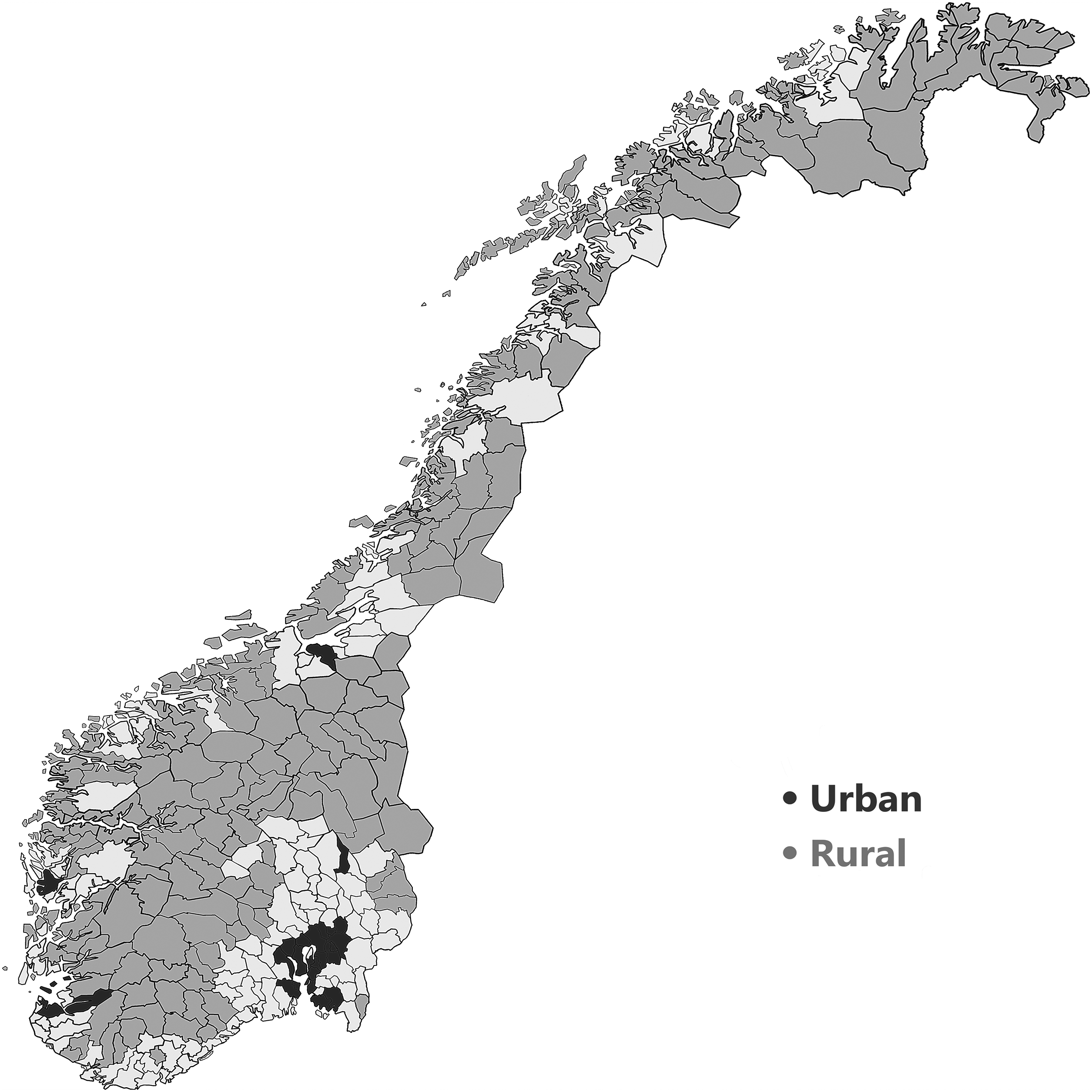
The map shows Norway’s rural areas and urban areas.
The rural areas comprise 209 municipalities spread throughout the country, including coastal and inland areas in the north and south. They are home to approximately 739,000 residents, which accounts for 14% of the Norwegian population. While high competition between schools and programmes is evident in most urban areas, issues of accessibility and distance are more decisive in the rural parts of the country. For instance, many rural students must commute or relocate to attend upper secondary school. Additionally, only 10 out of the 209 municipalities have a physical higher education campus (Schei and Trædal, 2021), meaning that most students must relocate to pursue higher education. In contrast to the urban labour market, the rural labour market is frequently driven by location-bound resources such as agriculture, fishing and related processing industries. Other important sectors include the public sector, building and construction, education, health and care services (KMD, 2023). In contrast to urban areas, the proportion of residents with higher education is below the national average (NOU, 2020: 40).
In summary, these rural and urban areas present an intriguing case for analysing the intersection of social origin and location in educational decision-making processes, as they exhibit distinct differences in their opportunity structures, particularly regarding access to educational facilities and labour market characteristics.
Data and materials
We use full-population administrative data provided by Statistics Norway and analyse these data within the platform Microdata.no, developed by the Norwegian Agency for Shared Services in Education and Research (SIKT) and Statistics Norway (SSB). The platform is a browser-based research infrastructure with integrated software for statistical analysis and has built-in data protection to avoid compromising the anonymity of individuals. For this article, we extracted data on the Norwegian 2002–2004 birth cohort, including education and income data from parents. Our data include all individuals who lived exclusively in either a rural or an urban area for three years between the ages of 13 and 15 and who started upper secondary school in the autumn of 2018–2020 following the completion of compulsory schooling (n = 93,064).
Variables
The primary dependent variable in this study is students’ enrolment in academic versus vocational tracks, which is based on enrolment in upper secondary school in the autumn semester following compulsory schooling (2018–2020). As previously noted, more than 97% of all Norwegian students transitioned directly to upper secondary education following the end of compulsory schooling at age 16 in 2020 (Statistics Norway, 2023). Given that our main interest lies in students’ socio-spatial choice between academic and vocational tracks, we exclude relatively few students who did not enrol in upper secondary education in the autumn following compulsory school.
Social origin is operationalised using parental education and family income. We measure parental education through two different approaches: a ‘combined approach’ and a ‘dominance approach’. The combined approach is based on a seven-category scale developed by Bukodi and Goldthorpe (2013) that allows us to examine the combination of mothers’ and fathers’ educational attainment, thus responding to recent criticisms of the dominance approach (see Thaning and Hällsten, 2020). However, we adjusted the scale to capture the distinction between upper and lower levels of higher education to better fit the Norwegian context (see Table 1 for all seven categories). The dominance approach is based on a three-category scale that utilises the educational level of the parent with the highest completed education (Erikson, 1984). Parental income is based on the average income of mothers and fathers from work, benefits and other sources over the three years when their children were aged 13 to 15. We use a rank-based approach that measures the relative positions of family incomes rather than the actual values. The advantage of this approach is that it is less vulnerable to outliers, skewed distributions and non-linearity.
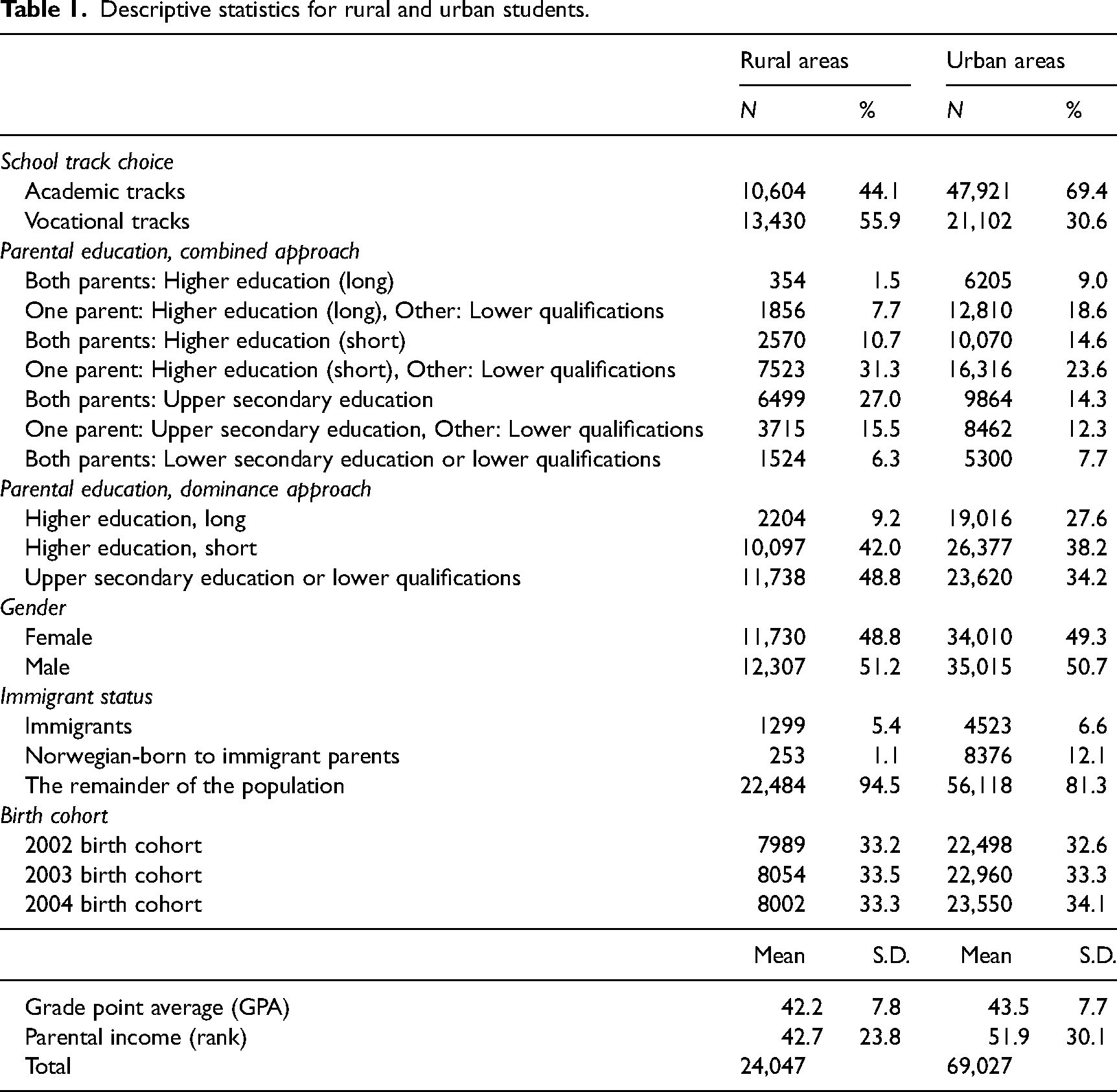
Descriptive statistics for rural and urban students.
The grade point average (GPA) shows the average grades in 11 subjects from the final year of compulsory school and forms the basis for admission to upper secondary school. GPA is measured on a scale ranging from 10 (the lowest average grades possible) to 60 (the highest average grades possible). Although the vast majority of students in Norway achieve grades in lower secondary education, GPAs are available only for those who achieve a grade in at least eight subjects. This means that the analysis excludes students who received a grade in less than eight subjects, which accounts for approximately 3.7% of the original cohorts.
Rural and urban areas are operationalised based on the official Norwegian Classification of Centrality Index. This classification ranks all 356 municipalities in Norway based on their weighted travel distance to workplaces and service functions. The classification comprises six categories: Centrality 1 and 2 denote urban areas, and centrality 5 and 6 denote rural areas (see ‘The Norwegian context’ section for a more detailed description of each area). As we use a comparative approach to understand the interplay between social origin and location, we only extract data on students who were raised in areas classified as either rural or urban. Therefore, students who were raised in other parts of the country were excluded from the analyses. Additionally, to ensure that children have sufficient ‘exposure’ to rural or urban environments, we focus on students who resided exclusively in either a rural or an urban area over the three years between the ages of 13 and 15.
Descriptive statistics
Descriptive statistics for all variables are presented in Table 1 for the rural and urban cohorts.
In short, the table shows large differences between rural and urban students in terms of their participation in academic and vocational tracks in upper secondary education, with a much greater frequency of rural students participating in vocational tracks. Furthermore, the average GPA of rural students is slightly lower than that of urban students. The table also shows that rural parents’ income and education levels are generally lower than those of urban parents. Nevertheless, it is essential to note the heterogeneity of parental education and income among rural students, which shows significant educational and income disparities within rural areas. Finally, the proportion of students who are Norwegian-born to immigrant parents is greater in urban areas than in rural areas. 1
Analytic strategy
To gain an overview of the disparities between the educational choices made by rural and urban students in upper secondary school, we first apply logistic regression models with and without controls for family resources and previous academic performance. Furthermore, to investigate how urban‒rural differences in educational choices vary by social origin, we predict the probability of choosing academic tracks for rural and urban students whose parents have different education and income levels. Next, we utilise GPA to distinguish between primary and secondary effects and examine whether patterns differ between urban and rural contexts. Finally, we assess the robustness of these results by conducting additional analyses to address potential threats that may alter our results and conclusions.
Two measures of parental education are employed: the ‘combined approach’ and the ‘dominance approach’. The seven-category combined approach is employed for the initial analyses as it provides a detailed and precise comparison of social origin between rural and urban students and accounts for various combinations of mothers’ and fathers’ educational level. However, due to its complexity, the three-category dominance approach is used for the subsequent analyses when examining how parental education interacts with income and GPA (i.e., relying on the educational level of the parent with the highest completed education). The combination of these two approaches allows for a comprehensive analysis of the role of parental education across rural and urban areas that strikes a balance between detail and simplicity, thereby contributing to a thorough understanding of the sociospatial role of parental education.
To address the difference in the immigrant population between rural and urban areas, we include immigrant controls when examining the differences in educational choices between these areas (Table 2). Additionally, in the robustness section, we examine whether excluding the immigrant population alters our main conclusions. Our focus in this article is not on gender differences, so we do not present separate analyses for boys and girls. However, we include gender as a control variable in all our models. 2
Differences between rural and urban students’ educational choices in upper secondary education.
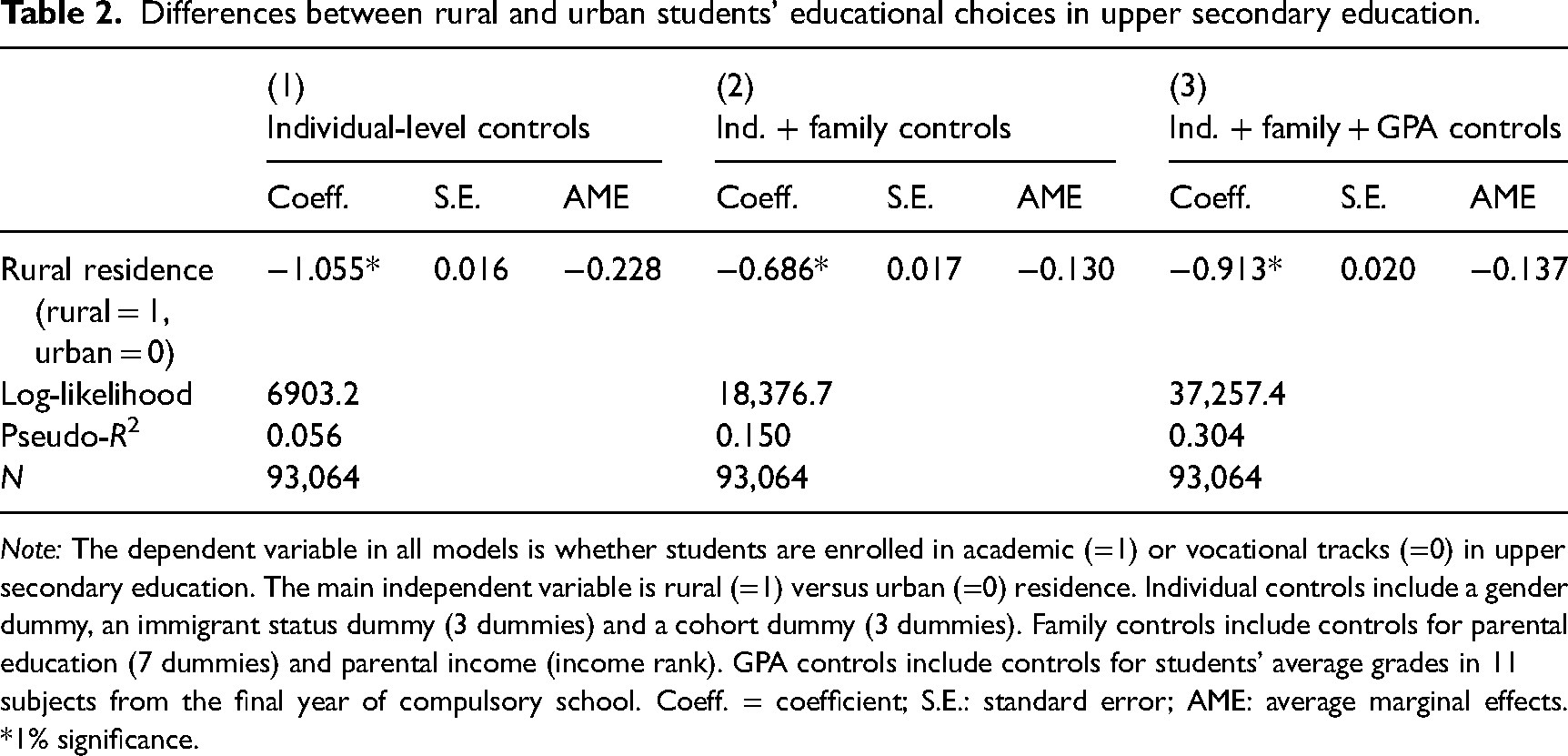
Note: The dependent variable in all models is whether students are enrolled in academic (=1) or vocational tracks (=0) in upper secondary education. The main independent variable is rural (=1) versus urban (=0) residence. Individual controls include a gender dummy, an immigrant status dummy (3 dummies) and a cohort dummy (3 dummies). Family controls include controls for parental education (7 dummies) and parental income (income rank). GPA controls include controls for students’ average grades in 11 subjects from the final year of compulsory school. Coeff. = coefficient; S.E.: standard error; AME: average marginal effects. *1% significance.
Results
Urban-rural differences in educational choices
Table 2 shows the results of logistic regression models, with academic versus vocational tracks as the dependent variable and place of residence (rural versus urban) as the primary independent variable of interest. Model 1 shows the differences in educational choices between rural and urban students when only individual-level controls are included (gender, immigrant status and cohort). Model 2 adds family controls (parental education and income) and Model 3 adds student GPA controls.
Overall, the analysis in Table 2 reveals significant differences between the educational choices of rural and urban students in upper secondary education. Model 1 shows that students from rural areas are less likely to enrol in academic tracks than their urban counterparts and prefer to opt for vocational tracks (after adjusting for immigrant status, gender and cohort). Including family controls in Model 2 (parental education and income) reduces this effect. However, significant differences persist between rural and urban students even after adjusting for family controls. This suggests that compositional factors do not solely explain the variation in educational choices between rural and urban students. Specifically, the analysis shows that rural students have an approximately 13% lower probability of enrolling in academic tracks in upper secondary education after considering parental education and income, as well as gender and immigrant status.
Furthermore, incorporating GPA controls into Model 3 does not impact the urban‒rural differences in educational choices, which suggests that spatial variations in previous academic performance are not the root cause of the differences in educational choice between rural and urban students.
Social origin and students’ educational choices
To investigate how urban‒rural differences in educational choices vary by social origin, we first predict the probability for rural and urban students to participate in academic tracks based on the educational level of their parents. These estimations are graphically shown in Figure 2 and are derived from logistic regression models of the rural and urban cohorts (Table A1, Online Appendix).
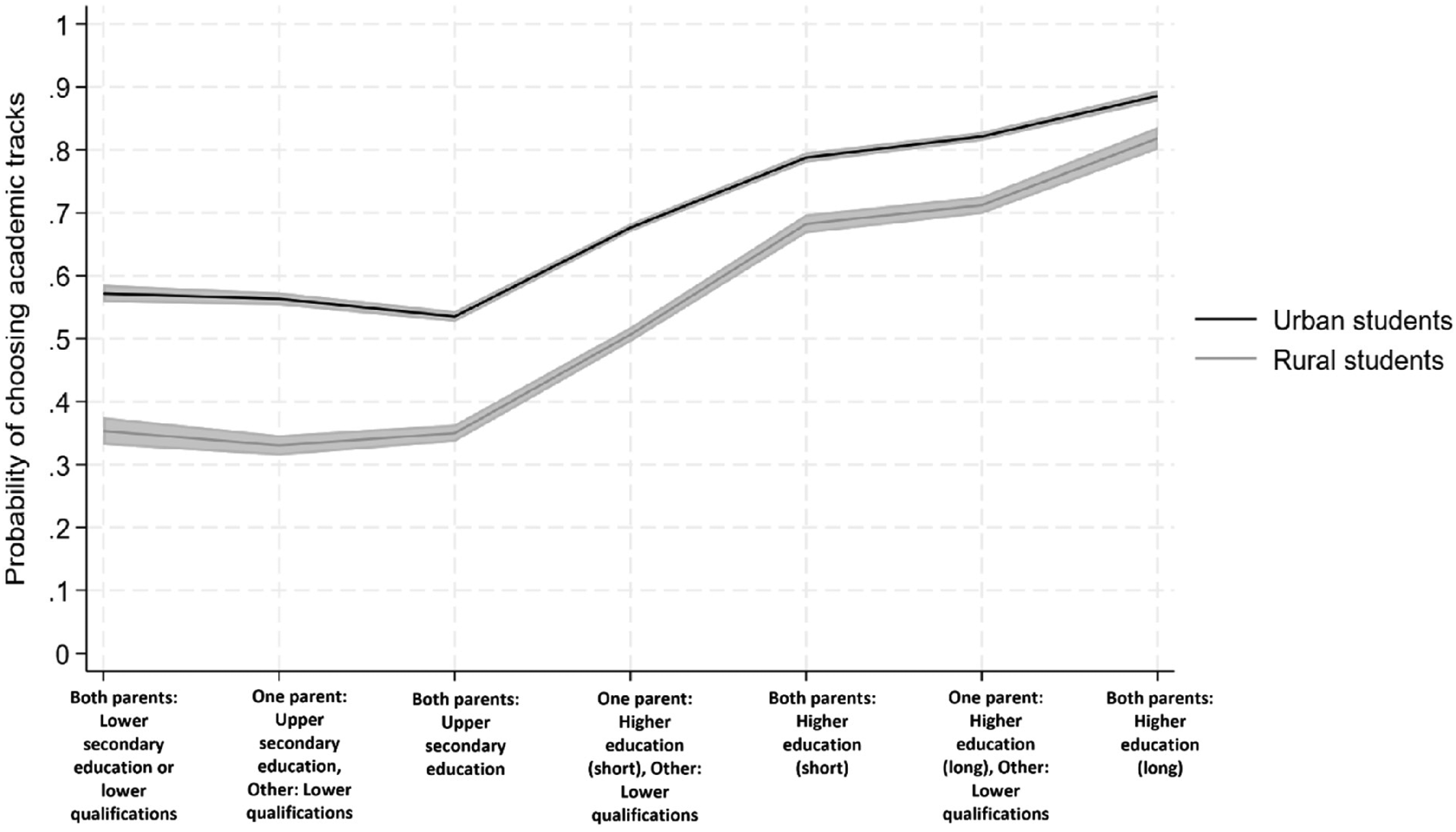
Probability of choosing academic tracks by parental education, differentiated by rural and urban students. Predicted probabilities with 95% confidence interval.
In accordance with the findings presented in Table 2, the figure shows that rural students are less likely to enrol in academic tracks and more likely to enrol in vocational tracks than urban students, even if their parents possess similar educational levels. However, the figure reveals that students from urban and rural areas with highly educated parents tend to make more similar choices than do students from families with less educated parents, as they appear more likely to pursue academic tracks.
We further predict rural and urban students’ probability of participating in academic tracks based on parental education and income. These findings are presented graphically in Figure 3 and are based on logistic regression models with interaction effects between parental education and income (Table A2, Online Appendix). To facilitate the following analyses and prevent the generation of overly intricate figures, we employ a dominance approach to parental education, with the parent who holds the highest level of education serving as the reference point.
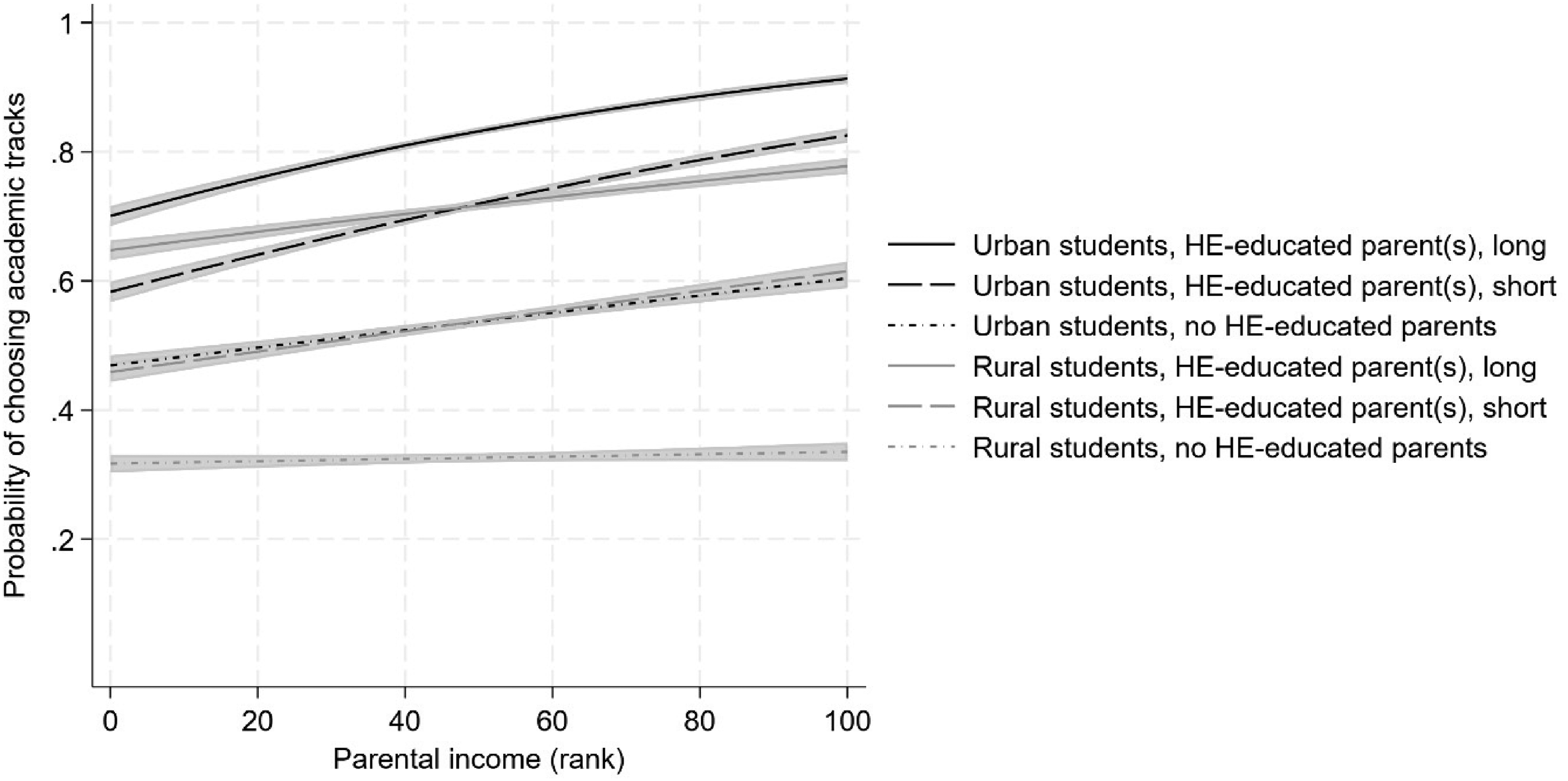
Probability of choosing academic tracks by parental education and income, differentiated by rural and urban students. Predicted probabilities with 95% confidence interval. HE: higher education.
The figure corresponds with the findings in Figure 2, which demonstrated that students residing in rural and urban areas tend to diverge in their school track choices, even when comparing students whose parents possess comparable levels of education. Figure 3, however, shows that the probability of enrolling in academic tracks increases when students have parents with higher income levels. This phenomenon is observed among all groups of students residing in rural and urban areas, except for rural students with no higher-educated parents. Nevertheless, the size of the effects indicates that the impact of income on educational decisions is relatively modest and does not suggest that income represents a particular barrier in rural areas.
The role of primary and secondary effects
Thus far, we have shown how urban‒rural differences in educational choices vary by social origin. The following section analyses how this relates to primary and secondary effects. In particular, are the more homogeneous patterns observed among students whose parents have high levels of education driven by better performance in school, or do they make different choices irrespective of their previous performance?
Figure 4 shows the GPA distribution for rural and urban students by parental education. The figure reveals considerable differences in school performance according to parental education in both rural and urban areas. Students with higher-educated parent(s) at the upper levels (higher education, long) perform better than those with higher-educated parent(s) at the lower levels (higher education, short). Furthermore, these students perform better than those whose parents have upper-secondary education or lower qualifications. Supplementary analysis utilising t-tests with Bonferroni corrections revealed that urban students whose parents had higher education (long) had a significantly greater GPA (M = 47.3, SD = 6.5) than did their rural counterparts whose parents had similar backgrounds (M = 46.7, SD = 6.9), t(DF = 93,062) = −4.0, p < .001. Furthermore, no significant differences in performance were observed between urban and rural students whose parents had attained a lower level of education.
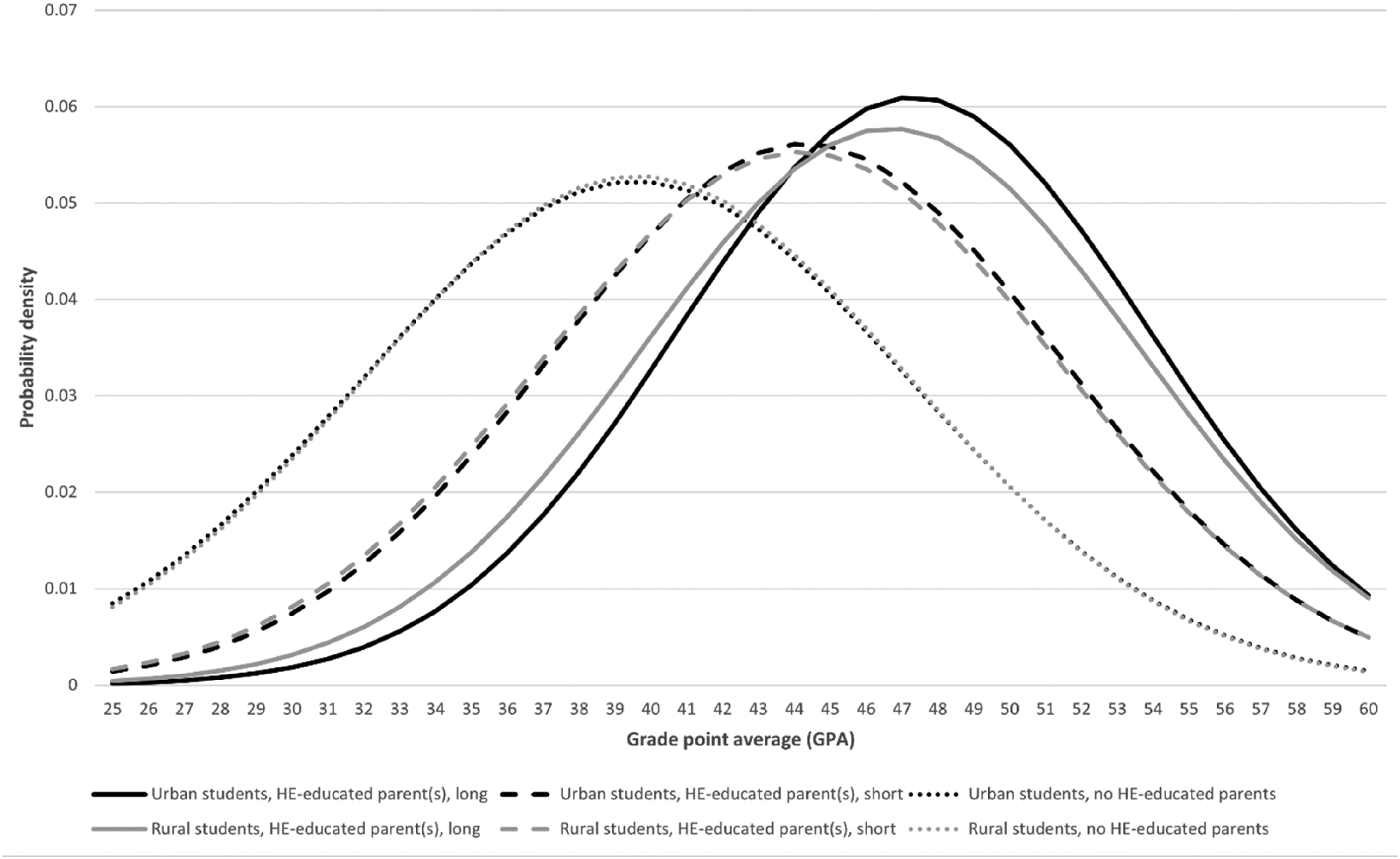
The distribution of GPA by parental education, differentiated by rural and urban students. HE: higher education.
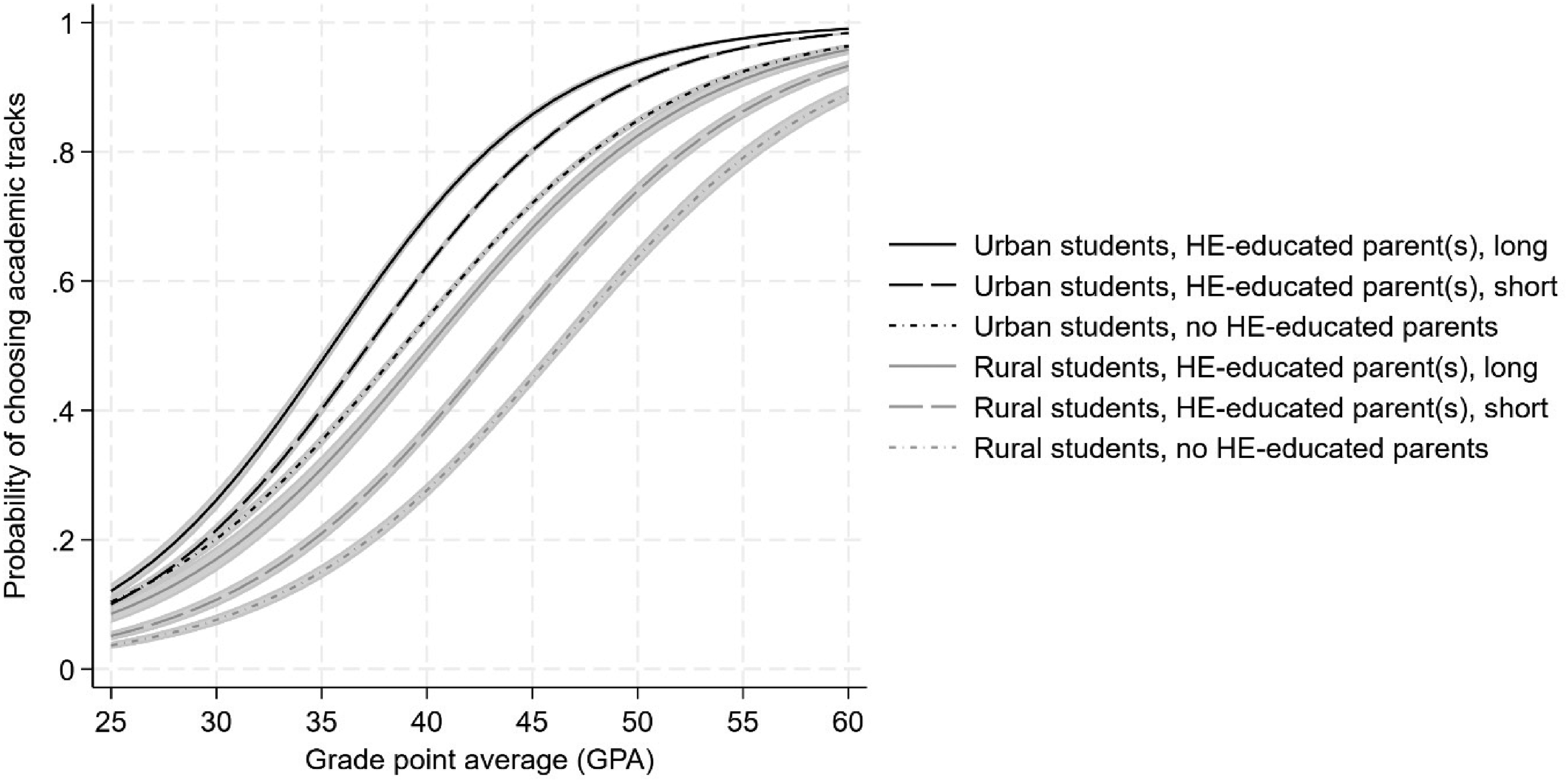
Probability of choosing academic tracks by parental education and GPA, differentiated by rural and urban students. Predicted probabilities with 95% confidence interval. HE: higher education.
We now focus on the educational choices that rural and urban students make at different GPA levels to investigate the secondary effects (Figure 5). These estimates are based on logistic regression models for rural and urban students with interaction effects between parental education and GPA (Model 2 in Table A3, Online Appendix). The figure reveals that rural and urban students make different educational choices depending on their parents’ educational attainment, even when equally performing students are compared. In other words, secondary effects are evident in both urban and rural areas. Specifically, the curves for urban students whose parent(s) have higher education (long) lie above those for urban students whose parent(s) have higher education (short), which lie above those for urban students whose parents do not have any higher education. A similar pattern is observed among rural students, although their curves lie below those of urban students.
In both urban and rural areas, the most significant gaps between the curves appear at the middle of the scale, with narrower gaps at the top and bottom. This indicates that urban and rural students who perform exceptionally well are likely to enrol in academic tracks regardless of their parents’ educational level. In contrast, students who perform poorly are less likely to enrol in academic tracks irrespective of their parents’ educational background. In other words, secondary effects are most evident at intermediate performance levels, which is consistent with previous research (Jackson et al., 2007).
Finally, the larger gaps between the curves observed among rural students in comparison to their urban counterparts suggest that the secondary effects are more pronounced in rural areas than in urban areas.
Robustness
Finally, we address three potential threats that may affect the conclusions of this study: the potential bias that may arise from using GPA as a measurement of school performance, the potential influence of differences in the immigrant population between rural and urban areas, and the potential impact of the COVID-19 pandemic.
Measurement of school performance: Using GPA as a measure of primary effects across the urban‒rural continuum may be prone to bias for two reasons. First, it assumes that the decision between academic and vocational tracks is made after lower secondary education exams, ignoring the possibility that these decisions could be anticipated. Previous studies have highlighted how anticipated decisions are likely to influence students’ performance in subsequent examinations either positively or negatively (Jackson et al., 2007; Erikson and Rudolphi, 2010). As a result, using GPA at the end of compulsory school to separate primary and secondary effects may lead to underestimation of secondary effects. Second, GPA may be prone to geographical bias because it is not a standardised measure. Higher grades may be more easily achieved in low-performing environments, potentially affecting geographical comparisons at the subnational scale.
To investigate whether anticipatory decisions and geographical bias influence our results, we utilise standardised test results from National Tests in reading and mathematics conducted among students in 8th grade (age 13). In brief, supplementary analyses show a pattern comparable to that of GPA (see Figures A1 and A2 in the Online Appendix). While some performance differences between rural and urban students are evident (and statistically significant) when comparing children with similar backgrounds, the results largely correspond with those obtained using GPA, indicating that the secondary effects appear more pronounced in rural areas than urban areas.
Immigration: Although Table 2 demonstrates that urban‒rural disparities are not caused by disparities in the number of immigrants or those who are Norwegian-born to immigrant parents, one concern may be that the patterns of social origin are driven by immigrant status. Supplementary analyses reveal that excluding immigrants and those who are Norwegian-born to immigrant parents leads to a lower proportion of students whose parents have lower secondary education or lower qualifications pursuing academic tracks in both rural and urban areas (Figure A3, Online Appendix). This is due to a greater proportion of immigrants and Norwegian-born children of immigrants with low-educated parents opting for academic tracks, even at lower grade levels (Figure A4, Online Appendix). Nevertheless, excluding immigrants and children who are Norwegian-born to immigrant parents from the analysis does not alter our main results or conclusions.
The influence of COVID-19: In past crises, such as the financial crisis in 2008, there was an increase in the number of applications for certain educational programmes. As the 2004 birth cohort entered upper secondary education in the autumn of 2020, their decision could be influenced by the COVID-19 pandemic. However, supplementary analyses (Table A4, Online Appendix) show that the COVID-19 pandemic has not significantly impacted the selection of academic versus vocational tracks. This could be attributed to the fact that students had applied before the virus had reached Norway.
Discussion and conclusion
By analysing population-wide register data from Norway, we find that rural students choose vocational tracks over academic tracks more frequently than their urban counterparts and that this is not simply a reflection of spatial differences in socioeconomic resources, previous academic performance, or immigrant background. This is not surprising given the unequal opportunity structures that exist between rural and urban areas. These include differences in labour market structures and access to educational facilities, which may result in varying assessments of the anticipated costs, risks and benefits of different educational choices. Additionally, these findings are consistent with previous research in other Western societies showing that rural and urban students have disparate aspirations and tend to make different educational decisions (Byun et al., 2012; Newbold and Brown, 2015; Echazarra and Radinger, 2019; van Maarseveen, 2021).
However, this article illustrates that it is not only where the decision is made but also who makes the decision that matters. In particular, the results show that the differences in educational choices between rural and urban students are less pronounced among students whose parents possess higher levels of education. Conversely, they are considerably more pronounced among students whose parents have low levels of education. This finding aligns with research conducted in the United States by Wells and colleagues (2023), who discovered that the disparity in postsecondary enrolment between rural and non-rural students is more noticeable for low- and middle-SES students. Nevertheless, the findings of this study demonstrate that similar patterns extend beyond the borders of the United States to include the country of Norway.
Our results suggest that the more homogeneous pattern observed among students from higher origins can be attributed to a combination of primary and secondary effects. That is, rural and urban students from higher origins tend to perform better in school, likely due to the various forms of support they received at home during childhood (Hoff, 2003; Erikson and Jonsson, 1996; Stangeland et al., 2023), which may have consequently boosted their interest and confidence in academic pursuits. However, we also find that students from higher origins are more likely to choose academic tracks than those from lower origins when students with equal academic performance are compared – a pattern observable in both rural and urban areas. This observation directs our attention to the secondary effects of social origin and to the resources and aspirations available to students during the decision-making process (Jackson and Jonsson, 2013).
For instance, family resources may enable students from more privileged backgrounds to navigate and overcome the challenges posed by limited opportunities and geographical barriers (Bæck, 2016; Wells et al., 2023). While this may include financial assistance from parents, it may also encompass a heightened awareness of educational opportunities that extend beyond those available locally, as well as other mechanisms that may serve to reduce the perceived costs and risks associated with choosing academic tracks (Fray et al., 2020). Furthermore, these patterns may also stem from an underlying motivation to avoid downward educational mobility (Bukodi and Goldthorpe, 2013), potentially explaining why students from higher origins appear to overlook poor performance and choose academic tracks more frequently than similar-performing students from lower origins (Bernardi and Triventi, 2020).
However, while we find students from higher origins to be more consistent in choosing academic tracks, students from higher origins in rural areas still appear less likely to choose academic tracks than their urban counterparts with similar backgrounds. For instance, our findings demonstrate that among students with two parents who have obtained a higher education degree, those from rural areas are less likely to choose academic tracks in upper secondary school when compared to their urban counterparts with equal backgrounds. In fact, rural students whose parents have higher education degrees are less likely to choose academic tracks than urban students whose parents do not have higher education degrees, when comparing equally performing students. 3 Thus, our findings diverge from those of Wells et al. (2023) but align with those of Koricich et al. (2018) and Zahl-Thanem (2023), suggesting that students from more privileged backgrounds are not immune to the influence of their residential context.
One potential explanation for this observed pattern is that the social and emotional costs associated with relocating for educational purposes may also impact students from higher social origins (e.g., by leaving friends and family behind). However, it is also plausible that due to the higher prevalence and potentially higher prestige of vocational tracks in rural areas, choosing such pathways does not necessitate the same degree of justification, explanation, or legitimisation as it might in urban contexts, where academic tracks tend to hold higher prestige (Hegna and Reegård, 2019). It may, therefore, lessen the negative social and psychological consequences associated with downward educational mobility to a greater extent than in urban contexts. Although our data do not allow us to investigate whether these assertions are true, they clearly show that a greater proportion of rural students from higher origins tend to favour vocational tracks compared to their urban counterparts with similar backgrounds and performance levels.
To extend the understanding of socio-spatial decision-making processes and the implications of our findings, it is essential to consider the study’s limitations and outline avenues for future investigation. First, the study's observation window is limited to students’ educational choices at age 16, which limits the scope of the evidence provided on completion rates and further educational transitions. For instance, students from rural areas may opt to transfer from the second year of vocational education to supplementary studies to a greater extent than their urban counterparts, intending to pursue higher education. This could alter the main patterns in this study. Nevertheless, previous studies conducted in Norway have revealed considerable differences in higher education attainment at age 30 among students from urban and rural areas, even among students whose parents have attained higher education (Zahl-Thanem and Rye, 2024). This suggests that the educational decision made at age 16 may largely explain the patterns observed at higher levels. Future studies would still benefit from researching multiple educational transitions, rather than a single one, if the data allow, as this could provide a more comprehensive understanding of these patterns.
Second, the case-comparative approach employed in this study was designed to investigate areas with distinct opportunity structures. However, future studies that apply a more detailed categorisation of the urban‒rural continuum distinguishing between different types of communities with unique opportunity structures would be valuable because they would provide insight into the heterogeneity of rural and urban areas. This may encompass both qualitative and quantitative studies, the latter of which may employ more sophisticated multi-level analyses.
By emphasising the diversity of both geographical locations and the individuals within them, sociologists can develop a more profound and nuanced understanding of the processes influencing students’ educational decisions. This approach is crucial for advancing research on spatial inequality in education but also for generating the insights needed to design targeted policies and interventions aimed at reducing educational disparities within and across various territories.
Supplemental Material
sj-docx-1-asj-10.1177_00016993241305615 - Supplemental material for Social origin and educational choices: A comparative study of rural and urban students’ school track choices in Norway
Supplemental material, sj-docx-1-asj-10.1177_00016993241305615 for Social origin and educational choices: A comparative study of rural and urban students’ school track choices in Norway by Alexander Zahl-Thanem and Arild Blekesaune in Acta Sociologica
Footnotes
Acknowledgements
The authors are grateful to the three anonymous reviewers for their constructive comments.
Data availability
Access to the data underlying this article is restricted to approved research institutions in Norway that have signed an institutional access contract with Microdata.no. Therefore, it cannot be shared publicly. Researchers with access to the Microdata.no platform can access the syntax through the following link:  .
.
Funding
The authors disclosed receipt of the following financial support for the research, authorship, and/or publication of this article: This research was funded by Ruralis – Institute for Rural and Regional Research as part of the strategic institute project ‘Spatial inequalities and mobilities in Norway’.
Supplemental material
Supplemental material for this article is available online.
Notes
Author Biographies
References
Supplementary Material
Please find the following supplemental material available below.
For Open Access articles published under a Creative Commons License, all supplemental material carries the same license as the article it is associated with.
For non-Open Access articles published, all supplemental material carries a non-exclusive license, and permission requests for re-use of supplemental material or any part of supplemental material shall be sent directly to the copyright owner as specified in the copyright notice associated with the article.
