




Abstract
Using population register data, we examine how intermarried parents’ choice of ethnic registration of their children is associated with the offspring's probability of having a tertiary-level education. The study context concerns two ethnic groups, Finnish speakers and Swedish speakers in Finland, which are native and have equal constitutional rights, but have unequal admittance rates to tertiary-level education. We find that a mixed background per se does not play any crucial role for educational attainment, but that own ethnic affiliation matters. Swedish-registered males and females with mixed background are more likely to be higher educated than their Finnish-registered counterparts. The difference is more pronounced if it is the father and not the mother who is Swedish registered. These findings illustrate that intermarried parents’ ethnic registration of their children may have far-reaching consequences for the children's educational opportunities. Intermarried parents may well opt for the minority group if the choice may promote the child's future educational chances.
Introduction
Increasing intermarriage rates over the past decades has resulted in extensive research on preferences and partner choice among intermarried couples, referring to marriages or cohabitating unions between persons with differing ethnicity, race, religion, or nationality (Osanami Törngren et al., 2016). However, less attention has been put on the offspring of these couples (Song, 2016). Studies on the preferences of intermarried persons have thus been engaged with partner choice, rather than with choices that intermarried parents make for their children (Finnäs and O’Leary, 2003). Structural outcomes, such as the educational attainment of children of intermarried parents, are also poorly understood (Emonds and Van Tubergen, 2015). This gap in the literature needs to be addressed. Schools are powerful sources of ethnic identification and transmission. The parental choice for how the child is ethnically registered largely affects which educational system the child enters and may therefore be strategically important (Finnäs and O’Leary, 2003; Gaspar, 2011).
We add to the literature on the offspring of intermarried couples (or more specifically couples in ethnically mixed heterosexual unions) by combining the two abovementioned areas. Our main aim is to examine how intermarried parents’ choice of ethnic registration of the children associates with tertiary-level educational attainment of the offspring. To this end, we use Finnish population registers, within which an individual's mother tongue, or ethnic or ethnolinguistic affiliation, is chosen by the parents recently after the child is born. Only one official mother tongue is allowed. It can be changed at any point, but few persons do so (Obućina and Saarela, 2017).
In general, parents’ aspirations for their children's education, and intermarried parents’ choice of ethnic affiliation of their children, are conscious actions (Xie and Goyette, 1997; Vincent, 2017). Thus, if one ethnic group has better educational opportunities, intermarried parents may plausibly consider affiliating the child to that group. We contribute by studying the relationship between offspring's ethnic affiliation and educational attainment in such a setting, proposing that the child's future educational career may lie behind intermarried parents’ decision of affiliating their child to the ethnic minority group. First, we ask whether there are educational differences between persons with mixed background and those with endogamous background. Second, we analyse if the offspring's ethnic affiliation matters alongside ethnic background. Third, given the ethnic affiliation, we evaluate also whether the parental ethnicity–gender combination matters for offspring's tertiary-level educational attainment. The latter dimension is important for how the child is ethnically registered (Obućina and Saarela, 2020), and it may also influence children's educational outcomes (Basu and Insler, 2017; Ramakrishnan, 2004; Van Ours and Veenman, 2010). Thus, we compare persons with different ethnic background, with different ethnic affiliation, and with different parental ethnicity–gender combination.
We study two population groups, Finnish speakers and Swedish speakers in Finland. Their main distinguishing feature is the mother tongue, which intersects strongly with cultural characteristics, meaning that the two groups differ along ethnic or ethnolinguistic lines (Saarela et al., 2023). Given the context of Finland, we use the terms ethnic, ethnolinguistic, and mother tongue interchangeably. The two groups are autochthonous, which implies that the Swedish speakers, who constitute a minority in number, are not exposed to social discrimination or expected to assimilate into the majority group (Obućina and Saarela, 2020). The ethnolinguistic affiliation of children of mixed background may nevertheless be associated with their educational opportunities because there are relatively more study places in the Swedish language at the tertiary level. As a consequence, a higher proportion of Swedish-registered individuals are admitted compared to Finnish-registered individuals among those who apply for tertiary studies. For instance, in 2021, while half of all Swedish-registered applicants were admitted, only one-third of Finnish-registered applicants were successful in securing a place (Finnish National Agency for Education, 2021).
The focus on a setting where parents choose the ethnic affiliation for their child makes the present study an important contribution to the literature on the educational consequences of having a mixed background. The reason is that studies based on self-reported measures of ethnicity may show biased educational outcomes of children of intermarried parents, because self-identification of ethnicity is, at least to some extent, endogenous and selective (Duncan and Trejo 2011, 2017; Waters, 1990). We largely circumvent the endogeneity problem, because in our study context, ethnic affiliation is determined by the parents.
Identification and education of children with mixed ethnic background
Studies on children of mixed background have mainly been concerned with ethnic or racial identity. Some have focused on the identity reported by the offspring (Lee and Bean, 2007) while others have placed attention on the affiliation selected by the parents (Finnäs and O’Leary, 2003; Obućina and Saarela, 2020; Qian, 2004; Saenz et al., 1995; Xie and Goyette, 1997). Intermarried parents’ ethnic identification of their children depends on several factors. At the micro level, the child's gender and the degree to which it is exposed to the culture of the minority group are some of the factors studied, while socioeconomic status and demographic characteristics, such as the ethnicity–gender combination, are parental-related factors of interest (Qian, 2004; Saenz et al., 1995; Xie and Goyette, 1997). Another question often raised is whether the mother or the father is the more significant parent in the transmission of ethnic identity (Bratter and Heard, 2009; Finnäs and O’Leary, 2003; Obućina and Saarela, 2020; Qian 2004; Xie and Goyette, 1997). At the macro level, studies have considered structural factors, such as group status, size of the minority group, and the degree of ethnic diversity in the area. Saenz et al. (1995) found that both individual-level characteristics and factors at the structural level relate to the ethnic identity reported for the child. A study based on settings similar to the one analysed here examined mixed ethnolinguistic couples in Finland and mixed ethno-religious couples in Ireland (Finnäs and O’Leary, 2003). It suggested that the relevance of the regional population is declining in importance over time, while parental education was increasingly more relevant.
It can be assumed that the ethnic or racial identification of children of mixed couples is a conscious choice made by the parents (Xie and Goyette, 1997). In the absence of an agreement, parents may base the decision on the appearance of the child, leave it to the parent that completes the form, decide for rotation of ethnic identity over time or across siblings, or even draw lots for category. The decision may also be a result of bargaining, in which the higher educated or economically dominant parent has more say in choosing the ethnic identity of the child (Qian, 2004). In the case of Finland, no evidence for the bargaining hypothesis has been found, and rotation over time and across siblings is rare (Obućina and Saarela, 2020).
Overall, the literature on ethnic identification of intermarried parents’ children has focused on internal and external factors behind the choice, as well as the outcomes of it, rather than on the processes that lead to the decision. Most parents feel a sense of responsibility towards their children's schooling (Vincent, 2017). The choice of school is a complex, subjective, emotionally charged and stressful process that fundamentally is a question of what is believed to be best for the child (Ball, 1997). The choice of school is often also accompanied by a sense of anxiety on how to ensure that the child receives a ‘good’ education (Vincent, 2017).
In settings where the educational opportunities favour the minority group, intermarried parents may affiliate the child to that group. A related explanation could be found in rational choice theory. It has been extensively used by social scientists in the analysis of individual choices of actions (Buskens, 2015; Ermakoff, 2017), in sociological frameworks of educational choices (Breen and Goldthorpe, 1997), and in stratification research to explain social inequalities during educational transmission (Dumont et al., 2019; Jackson et al., 2012). Rational choice theory assumes that individuals make the decisions that are most in line with their personal preferences after weighing the risks and benefits of their actions. When applied to ethnic identification, if ethnicity is an option, the theory suggests that ethnic affiliation is based on the rational calculation of risks and benefits of ethnic association (Yang, 2000). Choosing the affiliation for the child with his or her future education in mind could, thus, be a form of utility maximisation among mixed couples.
Genuine rational choice theory is nevertheless concerned with social outcomes rather than individual outcomes. For this reason, another potential underpinning to the question of what a rational person would do in a particular situation can be found in the complementary framework of decision theory (Hechter and Kanazawa, 1997). It focuses on how individuals use their freedom when there are options to choose between, and assumes that the actions are goal directed (Hansson, 1994). Affiliating the child to the minority group in order to increase its chances of getting into tertiary education may, thus, be a result of intermarried parents’ goal-directed behaviour in the presence of options.
Furthermore, the choice of affiliating the child to the minority group may be motivated by factors extending beyond the child's future educational opportunities. Sense of belonging and sociocultural issues play an inherent role in the identity processes of persons in mixed families (Gibbs, 1989; Neville et al., 2014). If mixed parents’ belongingness to the minority group is strong, they may prefer raising their child within that culture. Individuals in mixed unions although tend to have a more diverse background, indicating more fluid ethnic identities, compared to those in non-mixed unions (Saarela et al., 2024). Disparities in sociocultural backgrounds can therefore pose challenges in transmitting an integrated sense of ethnic identity to the child, but they may also offer opportunities for renegotiation in the child's registration decision (Gibbs, 1989; Saarela et al., 2024). Factors such as socialisation, experiences, interactions, family dynamics, and perceived socioeconomic benefits and disadvantages beyond educational opportunities are then likely taken into account (Liebler, 2016). Affiliating the child to the Swedish-speaking group in Finland may be considered as beneficial, given the group's strong societal position and high degree of social integration.
Thus, the sociocultural perspective on ethnic identification and belonging aligns closely with rational choice theory, as affiliating the child to the minority group indicates a decision rooted in personal preferences following an evaluation of associated risks and benefits. A wish for belonging does not, however, rule out an argument based on decision theory, as the wish may be manifested in a goal-directed behaviour in the specific situation of having to decide between one of two registered ethnic affiliations (unique mother tongues) for the child. With the register-based data used here, we cannot empirically distinguish between, and consequently test, which theoretical explanation accounts for the choice of affiliation. Nevertheless, if the relative advantage for Swedish-registered individuals in terms of access to higher education were to improve over time, this finding would to some extent align with both theories.
The educational achievement of children with mixed background has been sparsely investigated, mainly due to scarce data on intermarriage. In some countries, such as France and Sweden, ethnicity or race is not recognised and intermarriage studies are therefore based on data on citizenship or country of birth (Osanami Törngren et al., 2016). In addition, most population surveys in which intermarriages can be detected focus on adults and not their offspring (Kalmijn, 2015). Early research from the United States showed higher educational levels in second-generation immigrants with intermarried parents than children with foreign-born parents (Chiswick and DebBurman, 2004; Ramakrishnan, 2004). A reverse relationship, with worse educational outcomes in children with mixed background, was found when controlling for several observable parental characteristics and marriage decision endogeneity (Emonds and Van Tubergen, 2015; Furtado, 2009). However, among Asian Americans, children with an immigrant father and native mother have relatively poor educational outcomes, despite the average higher human capital and income level of these couples (Basu and Insler, 2017). For this group, the ethnic identity of the child was found important for the child's educational attainment, alongside the ethnic identity of the native parent.
European studies show that children with mixed background generally perform as well as those with native parents. In Italy, the educational outcomes of children with Western ancestry or with a father born in a non-Western country were much in line with those of natives, while children with a non-Western mother performed notably worse (Azzolini et al., 2017). The educational performance of children with one native parent in Denmark and Britain is similar to that of children with two native-born parents (Muttarak, 2013; Tegunimataka, 2021). In Sweden, Germany, England, and the Netherlands, children with intermarried parents of high socioeconomic status also perform equally well as children with native-born parents, although there is some variation (Kalmijn, 2015).
Less is known about the offspring of intermarried parents from non-discriminated ethnic minority groups (Gaspar, 2011). In countries where such groups have existed for centuries, there has been some research. Parents’ choice of group affiliation for their children has been studied in Ireland and Finland (Finnäs and O’Leary, 2003; Obućina and Saarela, 2020) and upbringing strategies among ethnically mixed families in Portugal (Gaspar, 2011). A study of Moluccans in the Netherlands has shown that mixed background children with a Dutch mother are higher educated than those with a Moluccan mother and those with endogamous Moluccan parents (Van Ours and Veenman, 2010). This is presumably related to mothers’ important role in child-raising in the Moluccan culture, along with native mothers’ greater knowledge of the Dutch educational system.
Research questions
In this paper, we assume that when mixed parents choose the ethnic affiliation for their child, they may well consider the minority group if the choice comes with an educational advantage for the child. Our study case is Finland, where the group in minority (Swedish affiliated) has higher admittance rates to tertiary-level education than the majority population (Finnish affiliated). Ethnic affiliation in the present context refers to an individual's registered ethnolinguistic affiliation or mother tongue. We present an explorative study that aims to find out whether tertiary-level educational attainment of the offspring of mixed couples depends on the parents’ choice of ethnic registration of their children.
In a stepwise examination, visualised in Figure 1, we specify three sets of research questions. First, we focus on the offspring's ethnic background, i.e. mixed or endogamous. In the second step, we additionally consider the offspring's ethnic affiliation. In the final step, we focus on the parents’ ethnicity–gender combination alongside the ethnic affiliation of the offspring and, hence, compare persons with different ethnic affiliation as well as persons with the same ethnic affiliation.
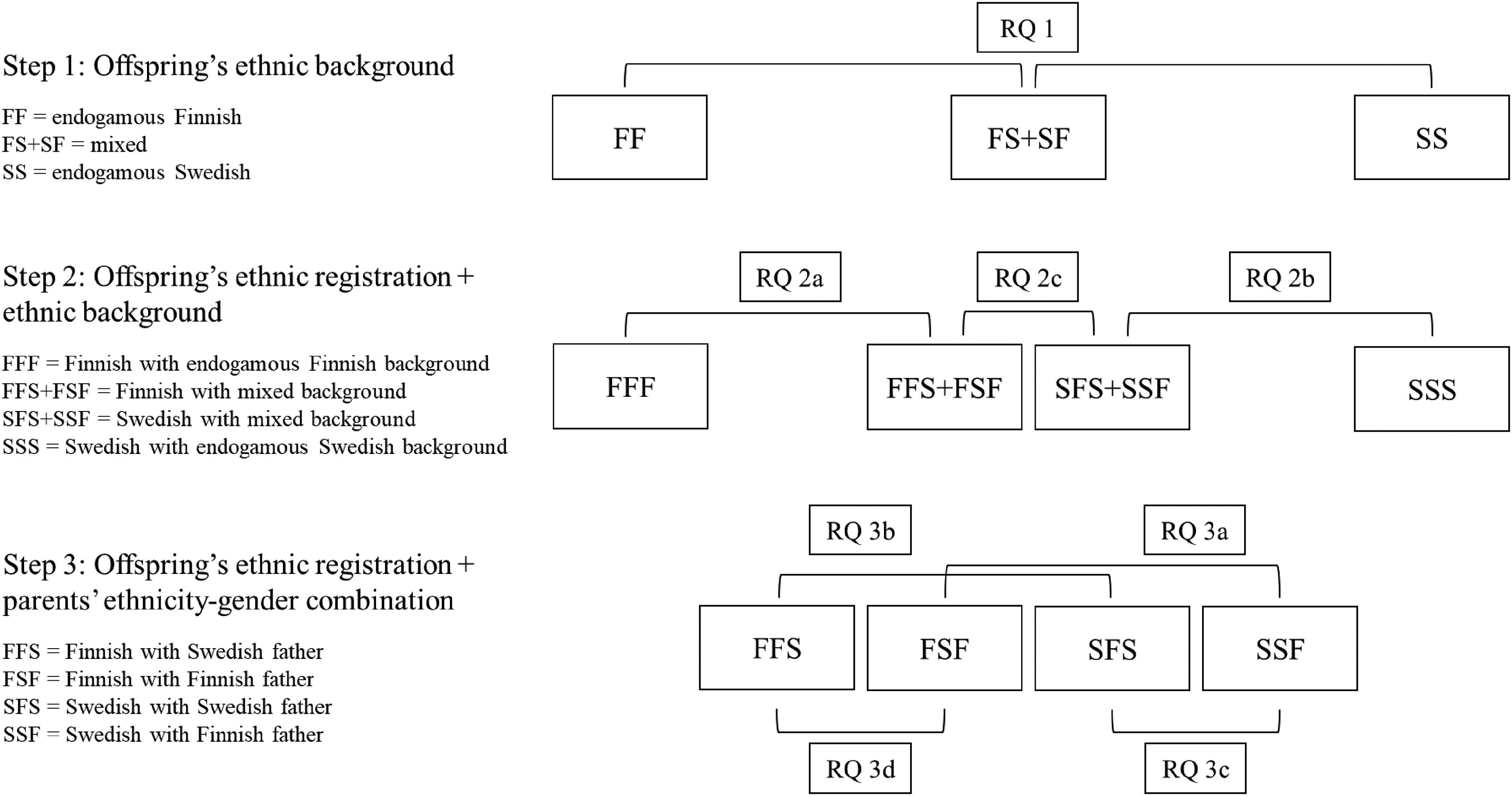
The compared groups within each set of research question in the stepwise examination.
As illustrated in Figure 1, we compare the tertiary-level educational attainment of persons with
mixed and endogamous background (RQ 1) mixed and endogamous Finnish background if they are Finnish registered (RQ 2a) mixed and endogamous Swedish background if they are Swedish registered (RQ 2b) Swedish and Finnish registration if they have mixed background (RQ 2c) Swedish and Finnish registration if the father is Finnish registered and the mother is Swedish registered (RQ 3a), and if the father is Swedish registered and the mother is Finnish registered (RQ 3b) Swedish-registered father and Finnish-registered mother, on the one hand, and Finnish-registered father and Swedish-registered mother, on the other hand, when the person is Swedish registered (RQ 3c), and when the person is Finnish-registered (RQ 3d)
The context of Finland
Although most immigration of foreign-born persons to Finland has happened during the past three decades, the country has long traditions of intermarriage between its two main native ethnic groups, the Finnish speakers and the Swedish speakers (Obućina and Saarela, 2020). The groups have lived side by side on the country's western and southern coastlines for a long time, and they have been guaranteed equal constitutional rights for more than a century. At present, Finnish speakers constitute barely 88% and Swedish speakers around 5.2%, or roughly 290,000 of the total population of 5.5 million persons.
The two study groups are similar in appearance but differ in several other respects. The main distinctive feature is the mother tongue, which intersects strongly with cultural characteristics, implying that the two groups differ on ethnic or ethnolinguistic lines (Saarela et al., 2023). As an example, the variation is manifested in parallel societies for politics, science, media, agriculture, culture, and sports. Swedish speakers are also known to generally identify themselves as a separate ethnic group with a Scandinavian heritage, whilst maintaining a strong affiliation to a Finnish national identity. Until the second half of the 20th century, intermarriage was notably less common as compared to contemporary Finland. In the 1950s, slightly more than 20% of all Swedish speakers married a Finnish speaker, after which the proportion increased remarkably, up to almost 40 percent since the 1980s (Finnäs, 2015). There is some asymmetry in the intermarriages, since roughly 40% of Swedish-speaking males form a union with a Finnish speaker, as opposed to just above one-third of Swedish-speaking females (Saarela et al., 2023). This probability of intermarriage decreases with the level of education (O’Leary and Finnäs, 2002), which contrasts to the situation in many other countries (Kalmijn and Van Tubergen, 2006; Meng and Gregory, 2005).
Alongside several socioeconomic and demographic characteristics, Finnish population registers include information on the mother tongue of each citizen. Only one mother tongue, or ethnic/ethnolinguistic registration, can be opted for. The mother tongue is registered soon after the child's birth and chosen by the parents. Few persons change it later in life. The track chosen by the parents therefore largely determines which ethnic community the child will be raised within. This is particularly the case with regard to whether the child enters the Swedish or Finnish school system. Around 60% of children of mixed background are registered as Swedish speakers and although the chosen mother tongue has few binding consequences, it indicates the parents’ wish for the dominant mother tongue and hence ethnicity during childhood (Obućina and Saarela, 2020). It also has some practical consequences, as the registration determines the communication language with government authorities and, if the municipality of residence is bilingual, with municipal services. Despite mandatory teaching of Swedish for Finnish speakers and of Finnish for Swedish speakers in compulsory schools since the mid-1970s, far from all Finnish speakers and Swedish speakers speak both languages. Finnish speakers constitute the numerical majority in the country, and their language is the dominant one in most of the regions. Half of all Swedish speakers live in Finnish-speaking majority areas. Consequently, Swedish speakers get in contact with the Finnish-speaking population notably more often than Finnish speakers do with Swedish speakers. Bilingualism is therefore supposedly much more common among Swedish speakers.
In intermarried parents’ choice of mother tongue for their children, the relative size of the ethnic population in the municipality of residence was previously important (Finnäs, 1990). However, this factor has lost its relevance over the decades, and nowadays, mixed couples’ ethnicity–gender combination and education are much more important for the intergenerational transmission of ethnic identity (Finnäs and O’Leary, 2003; Obućina and Saarela, 2020). The ethnic affiliation of the mother plays a prominent role in the choice, particular if she is a Swedish speaker (Finnäs and O’Leary, 2003), and the importance of having a Swedish-registered mother for affiliating the child to the minority group has even increased over time (Obućina and Saarela, 2020). Sons are somewhat more likely than daughters to be affiliated to the father's ethnic community, as are daughters to their mother's community. The higher the educational level of the parents, the higher is the likelihood of the child being Swedish registered (Finnäs and O’Leary, 2003; Obućina and Saarela, 2020). In couples with children born 1988–2014, compared to unions where both parents have less than a secondary education, the odds of affiliating the child to the Swedish-speaking minority group in the highest-educated intermarriages is 3.5 times if the mother is the Swedish speaker. The odds are even higher if the father is the Swedish speaker. Potential mechanisms might be above-average ethnic awareness, above-average preferences for cultural plurality, and higher levels of aspirations among highly educated parents in the minority group. Furthermore, the easier access to Swedish-speaking universities is suggested to play a role.
From an educational point of view, Finnish speakers’ and Swedish speakers’ equal constitutional rights imply that the groups have parallel school systems up to upper secondary level. It also implies that the parents are free to choose the child's educational language irrespective of the registered mother tongue of the child. Thus, a person's mother tongue in the official statistics has no direct consequences for the individual. Both population groups are also provided tertiary education by universities and universities of applied sciences. Five of the universities in Finland (Åbo Akademi University, Hanken School of Economics, the University of Helsinki, the University of the Arts Helsinki, and Aalto University) are responsible for educating a sufficient number of individuals who are proficient in Swedish (Universities Act 558/2009). These study places are available for all students with enough skills in Swedish, regardless of their mother tongue. The universities are autonomous and have varying solutions for providing tertiary education in Swedish. Therefore, the number of available Swedish-speaking study places is not comparable across universities. However, according to 2021 year's statistics for accepted applicants by mother tongue, more than half of the Swedish-affiliated individuals who apply for studies at universities or universities of applied sciences are accepted, while the corresponding number for Finnish-registered females is only one-third, and around 40% for the Finnish-registered males (Table 1). Thus, the chances of being accepted into tertiary education are higher for persons who are registered as Swedish speakers.
Tertiary-level education by ethnic registration.
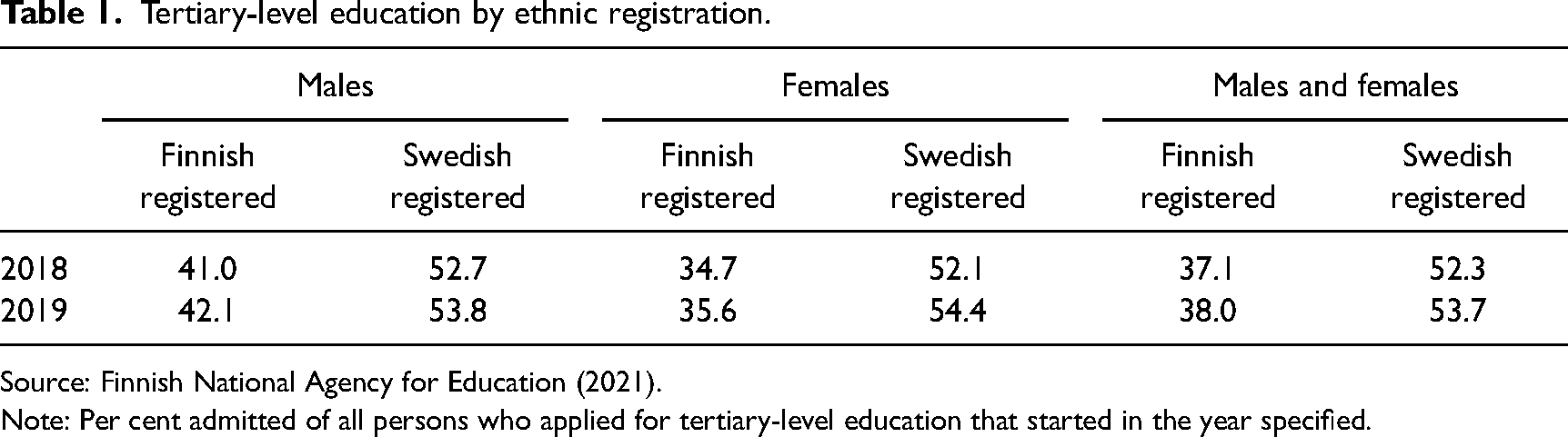
Note: Per cent admitted of all persons who applied for tertiary-level education that started in the year specified.
We take use of the Finnish case to study the relationship between ethnic registration and tertiary-level educational attainment in children of mixed background in situations where the minority group has better educational opportunities. As suggested by Obućina and Saarela (2020), the easier access to Swedish-speaking universities may be one reason why highly educated mixed couples register their child as a Swedish speaker. In this paper, we embrace this idea. When it comes to their child's ethnic affiliation, mixed couples may well decide for the minority group with the intent to increase the child's future educational chances. The ethnolinguistic registration of children with mixed background may consequently be of significant importance for their future educational chances.
Data and methods
The analyses are based on population register data provided by Statistics Finland. The data cover the entire population and contain longitudinal information on all individuals who lived in the country between 1970 and 2017. Each person can be linked to the mother and the father, subject to that the parent was alive at the end of 1970.
The average age of master's degree graduates in Finland is 28 (Opetus- ja kulttuuriministeriö, 2019). Thus, to have a large number of persons who have completed their studies, we restrict the analyses to index persons who had turned 30 at the end of 2017. To have as many individuals as possible who can be linked to their parents, we exclude index persons born before 1955. Accordingly, we study index persons from the cohorts born 1955–1987. The index person's mother tongue refers to the registered mother tongue in the year the person turns 15, or closest prior to that for cohorts whose information is census based. At that age, adolescents finish compulsory basic education and choose either general upper secondary education, which can be seen as an indicator of aiming at tertiary education, or some other form of secondary education. The mother tongue at age 15 is in practice the one that has been chosen by the parents recently after birth. Only 0.6% of the index persons in our study population for whom we can identify mother tongue at early childhood (those born 1969 or later) had changed their mother tongue by age 15. We analyse index persons who are either Finnish registered or Swedish registered, whose parents are either Finnish registered or Swedish registered, and who lived in Finland at the ages of 15 and 30. We estimate separate models for males (sons) and females (daughters), because a higher portion of females are tertiary-level educated (Pekkarinen, 2012). There is also some evidence to suggest that parents and children of the same sex are slightly more likely to have the same ethnic registration as compared to those of opposite sex (Obućina and Saarela, 2020).
The outcome variable is a person's highest level of education and separates those with a tertiary-level education (ISCED level 5 or higher) from all others. Our primary interest is to see how the probability of obtaining tertiary-level education in individuals with mixed background relates to their own and their parents’ ethnic affiliation.
In the first stage of the analyses (cf. Figure 1), we focus on parents’ ethnic affiliation, in order to see how persons with mixed background are positioned in comparison to others. Thus, the explanatory variable is based on parents’ registered mother tongue and consists of three categories: endogamous Finnish background (FF), endogamous Swedish background (SS), and mixed background (FS + SF), where F refers to Finnish registered and S to Swedish registered.
In the following step, we turn focus to the registered mother tongue of the offspring along with their ethnic background. We form a categorical variable that separates between Finnish-registered persons with endogamous Finnish background (FFF), Swedish-registered persons with endogamous Swedish background (SSS), Finnish-registered persons with mixed background (FFS + FSF), and Swedish-registered persons with mixed background (SFS + SSF). The first letter refers to the person's own ethnic registration, the second letter to the mother's ethnic registration, and the third letter to the father's ethnic registration.
In the final step, parents’ ethnicity–gender combination along with one's own registered mother tongue is analysed. The variable separates between Finnish-registered with Swedish-registered father (FFS), Swedish-registered with Swedish-registered father (SFS), Finnish-registered with Finnish-registered father (FSF), and Swedish-registered with Finnish-registered father (SSF).
Finnish-affiliated index persons with endogamous Swedish-registered parents and Swedish-affiliated index persons with endogamous Finnish-registered parents constitute only 0.1% of all index persons in the data. For the sake of readability of the results, we exclude them from all analyses. The data are restricted to municipalities in which all six categories of parents’ and offspring's combined ethnic affiliation are represented. Same sex couples and their children cannot be identified with these data. In our study population, these children must nevertheless be few, considering that same sex marriage was legalised as late as in 2015. After restrictions, the data consists of 1,180,789 persons in the child generation, whereof 57,305 have mixed background.
We measure educational attainment with logistic regression models. The model specification for each research question follows equation (1):
We report all results in terms of average marginal effects:
Results
Table 2 presents the proportion of daughters and sons with tertiary-level education by the parents’ ethnicity–gender combination (Panel A) and by the combination of one's own and parents’ ethnic affiliation (Panel B). The share of persons with tertiary-level education is slightly higher in persons with a mixed background than in those with endogamous Finnish-registered parents and highest in persons with an endogamous Swedish background. Among daughters, 53.4% of those with mixed backgrounds have a tertiary-level education, while the share is 52.2 for those with an endogamous Finnish background and 57.4 for those with an endogamous Swedish background (Panel A). Corresponding numbers for sons are 38.7, 36.9, and 38.7. Thus, having a tertiary-level education is less common in sons, but the between-group differences are about the same as for daughters.
Tertiary-level education (%) and total number of observations in daughters and sons by parents’ ethnic registration and by own and parents’ ethnic registration, where F is for Finnish registered and S is for Swedish registered.
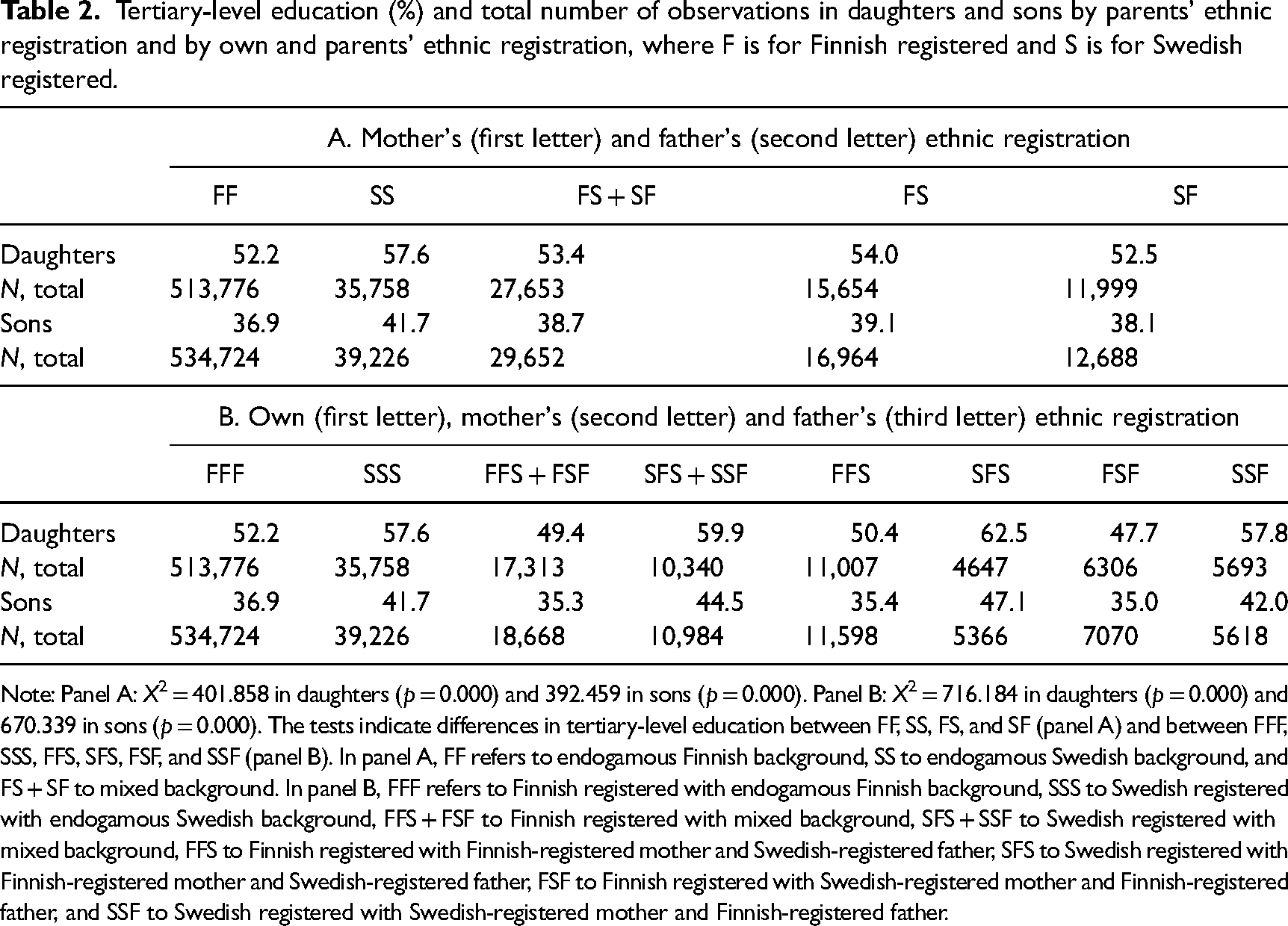
Note: Panel A: X2 = 401.858 in daughters (p = 0.000) and 392.459 in sons (p = 0.000). Panel B: X2 = 716.184 in daughters (p = 0.000) and 670.339 in sons (p = 0.000). The tests indicate differences in tertiary-level education between FF, SS, FS, and SF (panel A) and between FFF, SSS, FFS, SFS, FSF, and SSF (panel B). In panel A, FF refers to endogamous Finnish background, SS to endogamous Swedish background, and FS + SF to mixed background. In panel B, FFF refers to Finnish registered with endogamous Finnish background, SSS to Swedish registered with endogamous Swedish background, FFS + FSF to Finnish registered with mixed background, SFS + SSF to Swedish registered with mixed background, FFS to Finnish registered with Finnish-registered mother and Swedish-registered father, SFS to Swedish registered with Finnish-registered mother and Swedish-registered father, FSF to Finnish registered with Swedish-registered mother and Finnish-registered father, and SSF to Swedish registered with Swedish-registered mother and Finnish-registered father.
Panel B shows that for Finnish-registered persons, having tertiary-level education is somewhat more common among those with endogamous backgrounds than those with mixed backgrounds, while the reverse applies to Swedish-registered persons. For Finnish-registered daughters, the percentage share with tertiary-level graduation is 52.2 among those with an endogamous background and 49.4 among those with a mixed background. For sons, the numbers are 36.9 and 35.3, respectively. In Swedish-registered daughters, 57.6% of those with an endogamous background and 59.9% of those with a mixed background have tertiary-level education. Corresponding shares for their male counterparts are 41.7 and 44.5. In persons with a mixed background, their own mother tongue plays an important role in the educational outcome. The tertiary-level education rate is 59.9 among Swedish-registered daughters and 49.4 among Finnish-registered daughters. For male persons, the percentages are 44.5 for Swedish registered and 35.3 for Finnish registered. Thus, in persons with a mixed background, the proportion of those who are educated at the tertiary level is around 10 percentage points higher in Swedish-registered persons as compared to Finnish-registered persons.
Panel B shows also that Swedish-registered persons are more likely to be highly educated irrespective of whether it is the mother or the father that is Swedish, but the ethnic group difference is larger when it is the father. For illustration, the difference in the percentage share between Swedish-registered and Finnish-registered daughters is 12.1 (62.5–50.4) if the father is Swedish registered and 10.1 (57.8–47.7) if he is Finnish registered.
Finally in Table 2, we look at differences across persons of the same ethnic identity with respect to the parental ethnicity–gender combination. We find that among both Swedish-registered and Finnish-registered sons and daughters, the proportion of those educated at a tertiary level is higher in persons with a Swedish-registered father as compared to those with a Finnish-registered father. For example, 47.1% of Swedish-registered males whose father is Swedish affiliated possess a tertiary-level degree, while the percentage is 42.0 in Swedish-registered males with an opposite parental ethnicity–gender combination (compare SFS with SSF). It is worth mentioning that Swedish-registered sons and daughters with a Swedish-registered father are higher educated than those with endogamous Swedish-affiliated parents (compare SFS with SSS). The highest tertiary-level graduation rate, or 62.5%, is found in female offspring of mixed couples where the father is Swedish registered (SFS).
Among persons with a mixed background, Swedish affiliated are notably higher educated parents than Finnish affiliated (Table 3. The tertiary-level education rate in intermarried mothers of Swedish-affiliated persons is around 12 percentage points higher than that of Finnish-affiliated persons, and in fathers it is about 10 percentage points higher (compare FFS + FSF with SFS + SSF). The highest proportion of tertiary-level educated, or roughly 45%, is found in intermarried Swedish-affiliated fathers to Swedish-affiliated persons (SFS). The joint education of parents is also relatively higher in offspring–parent combinations with Swedish-registered offspring, whether male or female. For example, in almost 26% of Finnish mother–Swedish father unions with Swedish-affiliated offspring (SFS), both parents have a tertiary-level education.
Tertiary-level education of fathers and mothers, and distribution of parents’ joint education by own (first letter) and parents’ (second and third letter for mother’s and father’s, respectively) ethnic registration (%).
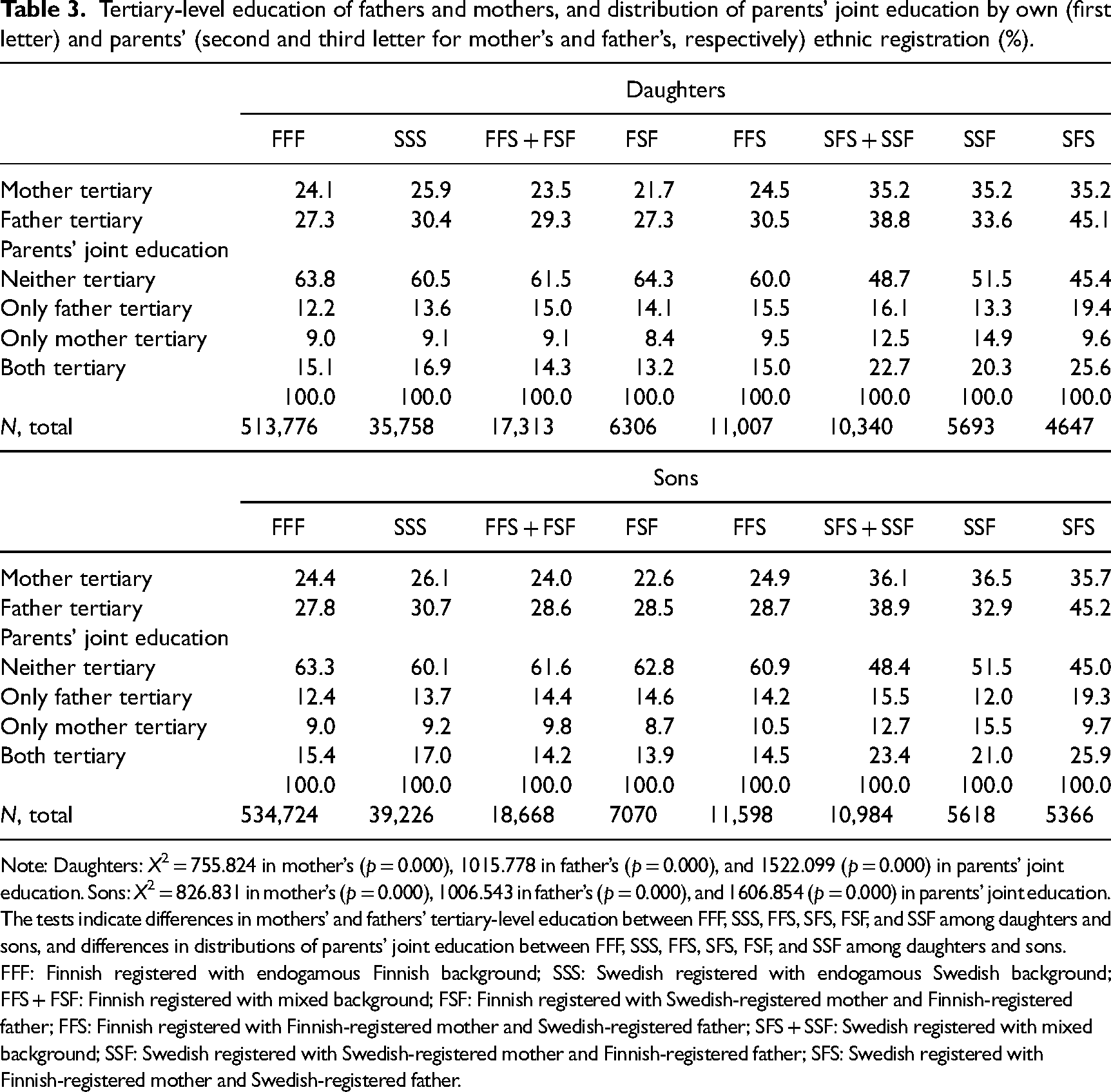
Note: Daughters: X2 = 755.824 in mother’s (p = 0.000), 1015.778 in father’s (p = 0.000), and 1522.099 (p = 0.000) in parents’ joint education. Sons: X2 = 826.831 in mother’s (p = 0.000), 1006.543 in father’s (p = 0.000), and 1606.854 (p = 0.000) in parents’ joint education. The tests indicate differences in mothers’ and fathers’ tertiary-level education between FFF, SSS, FFS, SFS, FSF, and SSF among daughters and sons, and differences in distributions of parents’ joint education between FFF, SSS, FFS, SFS, FSF, and SSF among daughters and sons.
FFF: Finnish registered with endogamous Finnish background; SSS: Swedish registered with endogamous Swedish background; FFS + FSF: Finnish registered with mixed background; FSF: Finnish registered with Swedish-registered mother and Finnish-registered father; FFS: Finnish registered with Finnish-registered mother and Swedish-registered father; SFS + SSF: Swedish registered with mixed background; SSF: Swedish registered with Swedish-registered mother and Finnish-registered father; SFS: Swedish registered with Finnish-registered mother and Swedish-registered father.
For both Tables 2 and 3, differences in tertiary-level educational attainment across the ethnic registration categories are statistically significant at the 5% level (see the footnotes of the tables).
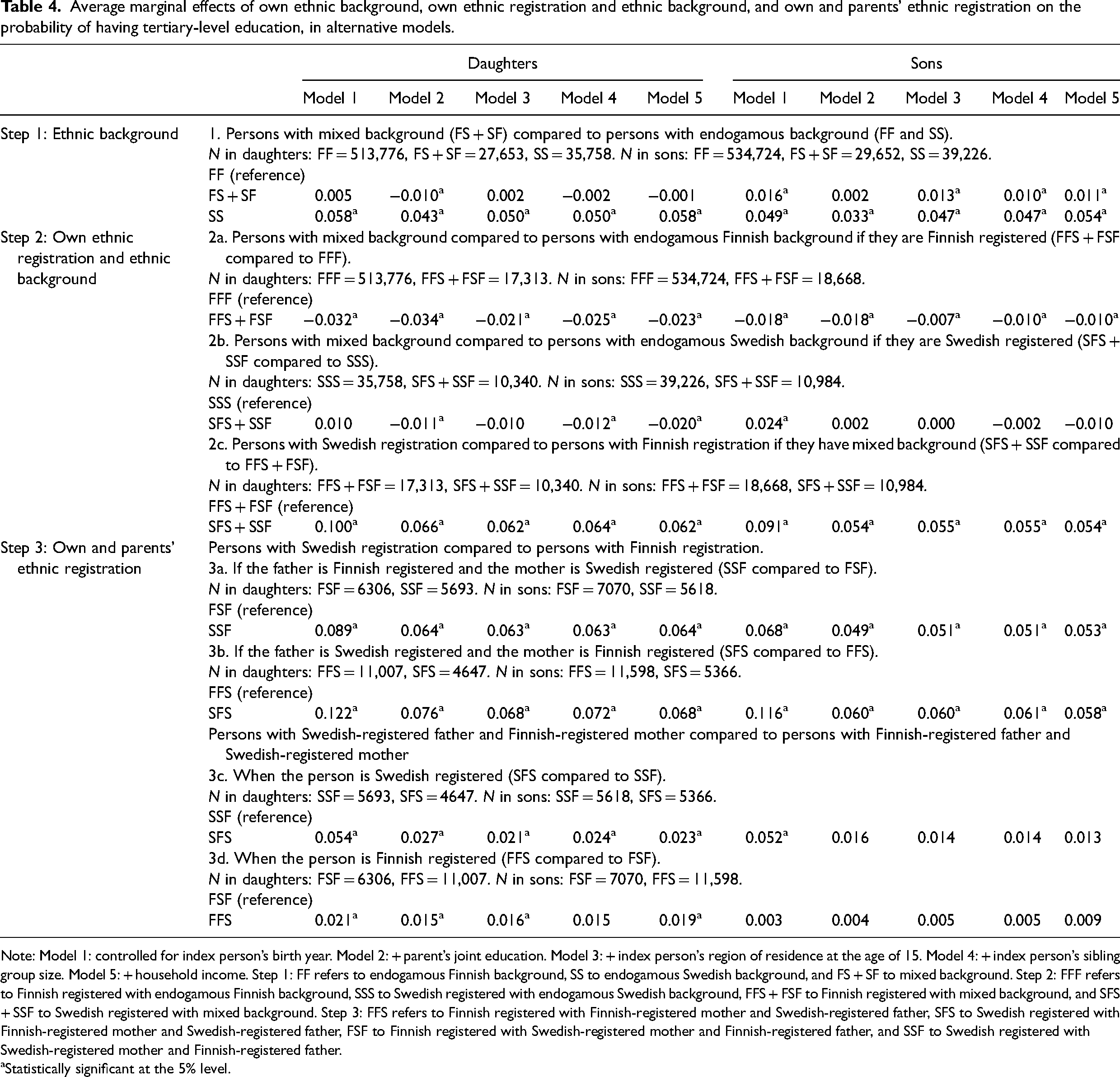
In Table 4, we report average marginal effects based on the logistic regression models. The table consists of three panels. Each of them corresponds to one step of the examination and, accordingly, to one set of research questions. Step 1 thus refers to RQ1, Step 2 to RQ 2a–2c, and Step 3 to RQ 3a–3d. In each of these analyses, we first control for the index persons’ birth year (Model 1), then include parents’ joint education (Model 2), the index persons’ region of residence (Model 3), sibling group size (Model 4), and household income (Model 5).
Average marginal effects of own ethnic background, own ethnic registration and ethnic background, and own and parents’ ethnic registration on the probability of having tertiary-level education, in alternative models.
Note: Model 1: controlled for index person’s birth year. Model 2: + parent’s joint education. Model 3: + index person’s region of residence at the age of 15. Model 4: + index person’s sibling group size. Model 5: + household income. Step 1: FF refers to endogamous Finnish background, SS to endogamous Swedish background, and FS + SF to mixed background. Step 2: FFF refers to Finnish registered with endogamous Finnish background, SSS to Swedish registered with endogamous Swedish background, FFS + FSF to Finnish registered with mixed background, and SFS + SSF to Swedish registered with mixed background. Step 3: FFS refers to Finnish registered with Finnish-registered mother and Swedish-registered father, SFS to Swedish registered with Finnish-registered mother and Swedish-registered father, FSF to Finnish registered with Swedish-registered mother and Finnish-registered father, and SSF to Swedish registered with Swedish-registered mother and Finnish-registered father.
Statistically significant at the 5% level.
Step 1 shows that there are no differences in the probability of having a tertiary-level education between daughters with a mixed background and daughters with an endogamous Finnish background. In sons, the probability is slightly higher for those with a mixed background when all control variables are included in the analyses (Model 5). For the offspring of endogamous Swedish-affiliated parents, the probability of being high educated is nearly 6 percentage points higher than for the offspring of endogamous Finnish-affiliated parents.
In the next step of the analyses, we turn attention to the ethnic affiliation of the index person, along with the person's ethnic background (Step 2 in Table 4). In Finnish-registered persons, those with a mixed background are slightly less probable of having a tertiary-level education than those with endogamous parents (RQ 2a). When we look at Swedish registered and compare persons with mixed and endogamous Swedish background, there is no probability difference in sons while in daughters, it is slightly negative (RQ 2b). When we focus on the offspring with mixed background (RQ 2c), we find that a Swedish-registered person has a notably higher probability of having a tertiary-level education than a Finnish-registered person. The probability is 10 percentage points higher in females and 9.1 percentage points higher in males (Model 1). Parents’ joint education explains part of the probability differences, but even after adjusting for all control variables, the probability difference is 6.2 percentage points in females and 5.4 percentage points in males (Model 5).
Finally, we focus on the parental ethnicity–gender combination alongside the offspring's ethnic affiliation (Step 3 in Table 4) and begin by looking at group differences between Swedish-registered and Finnish-registered persons with a mixed background. If the father is Finnish registered (RQ 3a), the difference between Swedish-registered and Finnish-registered daughters and sons in the probability of having a tertiary-level education is 8.9 and 6.8 percentage points, respectively, when only controlling for the birth year of the index person (Model 1). The control variables explain just under one-third of this difference (Models 2–5). The probability difference in favour of the Swedish-registered is much higher when the father is Swedish registered (RQ 3b), or 12.2 percentage points in daughters and 11.6 in sons in the first model. Controlling for parental joint education notably reduces the probability difference, which however remains, but becomes only slightly higher than it is between Swedish-registered and Finnish-registered persons with a Finnish-registered father and Swedish-registered mother. The analyses of within-group differences in Swedish-registered and Finnish-registered persons with respect to the parental ethnicity–gender combination show that in Swedish-registered (RQ 3c), the probability of having tertiary-level education is more than 5 percentage points higher in both sexes if the father is Swedish registered as compared to if he is Finnish registered (Model 1). Parents’ joint education explains half of the difference in daughters (Model 2), but even in the fully adjusted model, the probability difference is 2.3 percentage points (Model 5). In sons, the probability difference becomes statistically nonsignificant when the control variables are included. In Finnish-registered persons with a mixed background (RQ 3d), daughters with a Swedish-registered father have a 2.1 percentage point higher probability of being tertiary-level educated than those with a Finnish-registered father. Control variables only slightly contribute to the difference. For sons, the parental ethnicity–gender combination does not matter.
To assure that the results are not biased because part of the children in our data are siblings, we repeated the analyses with data that were restricted to first-born children. To check the robustness of using ethnic registration at age 15, we also performed separate analyses based on offspring's ethnic registration at age 1. Both robustness checks resulted in estimates almost identical to those presented in Table 4 (results not shown but available upon request). Odds ratios of all variables included in stepwise models are found in Tables S1–S3 in the online Supplemental material.
Discussion
A growing body of literature has been concerned with children of mixed ethnic background. The ethnic identification of the child and the choice of school for the child constitute important choices that intermarried parents make for their children. Yet, little is known about intermarried parents’ choice of ethnic affiliation for their child and particularly how that relates to the educational outcomes of the children. The underlying line of reasoning in this paper is that intermarried parents reasonably consider the minority group if that choice entails an educational advantage for the child. We have contributed to previous literature by examining how the probability of having tertiary-level education is related to the parental choice of offspring's ethnic registration in such settings. This would suggest that the child's future educational career may lie behind intermarried parents’ decision of affiliating their child to the ethnic minority group. The focus on a context where ethnic affiliation is chosen by the parents is another contribution of the paper, as we circumvent the endogeneity problem that may arise from self-reported ethnicity and cause biased educational outcomes.
We have examined individuals from the Finnish-speaking majority and the Swedish-speaking minority in Finland. These ethnic groups have equal constitutional rights, but unequal admittance rates to tertiary-level education, in favour of the minority. In a stepwise examination, we first compared persons with mixed and endogamous background. Second, we considered the offspring's ethnic affiliation alongside the ethnic background. Finally, we focused on the parents’ ethnicity–gender combination together with the registered ethnic affiliation of the offspring and thus compared persons with different ethnic affiliation as well as same ethnic affiliation. We found a slightly higher probability of having a tertiary-level education in males with mixed background as compared to males with two Finnish-affiliated parents, but no corresponding probability difference in females. Accordingly, a mixed background per se does not play any crucial role. Instead, one's own ethnic affiliation matters for both sexes: Swedish-registered persons with a mixed background have a notably higher probability of being educated at the tertiary level than their Finnish-registered counterparts. Parents’ ethnic affiliation is important as well. The differences in educational outcomes between Swedish-registered and Finnish-registered persons are larger if the father is Swedish registered and the mother is Finnish registered than if the father is Finnish registered and the mother is Swedish registered. Additionally, daughters with a Swedish-registered father are more likely to have a tertiary-level education than those with a Finnish-registered father irrespective of their own ethnic affiliation.
Thus, when groups are native and stand on equal constitutional ground, persons with a mixed background are as likely to be highly educated as those with both parents affiliated to the majority group. This finding corroborates those by Azzolini et al. (2017), Muttarak (2013), and Tegunimataka (2021), who analysed persons with one native and one foreign-born parent. Our results are also in accordance with those by Basu and Insler (2017), who found that the ethnic identity of the child is essential in determining the child's education. When we observed persons with a mixed background, and additionally considered the registered mother tongue of the offspring, we found clear differences in educational attainment in favour of the Swedish registered. More than one-third of the difference in the probability of having a tertiary-level education is due to parents’ joint education. However, even when controlling for that, Swedish-affiliated females have a 6.2 percentage point higher probability of having a tertiary-level education as compared to Finnish affiliated. In the male group, the corresponding probability difference is slightly smaller, but still notable.
Our results support the argument that intermarried parents may affiliate their children to the minority group in order to improve the child's future educational chances. The cohort range in our study is quite broad, spanning from 1955 to 1987, and consequently, we performed separate regressions for older and younger birth cohorts, born 1955–1969 and 1970–1987, respectively. Results from these regressions are presented in Tables S4 and S5 in the online Supplemental material. These findings generally align with our initial analyses, leading us to conclude that considering all cohorts together is appropriate. While our study did not allow us to test whether the choice of ethnic affiliation could be explained by a certain theory, the finding from these stratified analyses provide some suggestive evidence. The effects of ethnic registration on education are somewhat higher in the younger cohorts, although the pattern is not fully consistent across gender, steps, and models. This suggests that, to some extent, parents of later-born cohorts have been somewhat more rational or goal oriented. This inclination may stem from raising their children in an increasingly competitive environment, leading them to consider that the Swedish language opens up educational opportunities and holds practical value in the labour market. Simultaneously, however, they may have expressed a stronger desire for sociocultural belonging and ethnic identification.
Affiliating a child with mixed background to the Swedish-speaking group also means that the child in most cases becomes bilingual (Obućina and Saarela, 2020), as Swedish speakers’ contact with the Finnish-speaking community is much more common than vice versa. The child can most likely therefore choose Finnish-speaking tertiary-level education as well, which further increases the chances of having a tertiary-level education. It is known that children with highly educated parents are more likely to be Swedish registered (Finnäs and O’Leary, 2003; Obućina and Saarela, 2020). Possibly, highly educated parents may be more aware of the differential in admittance rates at the tertiary level and make their decision on basis of that knowledge. Not only does the Swedish-speaking group show relatively high educational levels, but the community is also characterised by a high degree of social integration and strong traditions (Monti and Saarela, 2023; Saarela and Finnäs, 2002). As the chosen mother tongue indicates the ethnic community within which the child will grow up, Swedish-affiliated children with mixed background are likely to be raised in such an environment. In such circumstances, it is possible that inspiration and peer support are abundant, which in turn increases the probability of attaining a tertiary-level education.
Thus, the ethnic registration of persons with mixed background plays an important role in explaining the ethnic difference in educational attainment. The combination of parents’ ethnic affiliation and gender was nevertheless found to matter, which corroborates previous research on education of persons with a mixed background (Basu and Insler, 2017; Ramakrishnan, 2004; Van Ours and Veenman, 2010). Swedish-registered persons are more likely to be educated at the tertiary level than Finnish-registered persons irrespective of whether the father is Swedish affiliated or Finnish affiliated, but the difference is larger if he is Swedish affiliated. Moreover, parent's joint education contributes more to the probability difference in tertiary-level education between Swedish registered and Finnish registered if the father is Swedish registered. Here, the educational level of the Swedish-registered father plays a significant role. Swedish-registered fathers of Swedish-registered persons show the highest tertiary-level education rates among fathers. More extensive networks among Swedish speakers than Finnish speakers have been suggested to play a role for higher incomes in endogamous Swedish-speaking couples compared to couples of other ethnicity–gender combinations within these two groups (Härtull and Saarela, 2018). The advantage is primarily related to man's income. Unobservable characteristics, such as attitudes and networks, may therefore also influence the educational choices made by their children. Still, there is a notable difference in the probability of being highly educated between Swedish- and Finnish-registered persons in cases where the mother is Swedish registered, and this should not be neglected. Irrespective of parents’ ethnic affiliation, our control variables only partly explained why Swedish-registered persons are more likely to be tertiary-level educated than Finnish-registered persons, which indicates that it is the ethnic registration of the child that is important.
In a final stage, we looked also at within-group differences in Swedish-registered and Finnish-registered persons by the parental ethnicity–gender combination. In Swedish-registered persons, those who have a Swedish-registered father and a Finnish-registered mother have a higher probability of possessing a tertiary-level degree than those who have an opposite parental ethnicity–gender combination. However, the difference among sons disappears after controlling for parents’ joint education. Thus, it is the parents’, and in particular the father's, high education that influences Swedish-registered sons. In the case of daughters, the within-group differences are not explained by any covariates. The same applies to Finnish-registered daughters, amongst whom those with a Swedish-registered father also are somewhat more likely to have a tertiary education than those whose father is Finnish registered. Possibly, there are operative characteristics related to the daughters’ parental ethnicity–gender combination that we are not able to control for. However, for Finnish-registered sons, the parental ethnicity–gender combination does not matter at all for the tertiary-level educational attainment.
A limitation of this study is that we have been able to only assess the mere outcome of the process of ethnic registration, that is, whether the child is Finnish or Swedish registered, and not the decision process itself, nor any values underlying the choice of registration. The very core of the decision thus remains unclear. That notwithstanding, our results imply that in a setting where groups have unequal admittance rates to higher education, parents’ ethnic registration of their children may have far-reaching consequences for the children's future, and that being affiliated to the minority group might even be beneficial. The generalisability of our findings may also be subject to limitations. Concepts of assimilation, which most previous research on children with mixed background rely on, are not applicable to our study context, as it has considered a situation where both ethnic groups are indigenous and have equal constitutional rights. Similarly, our findings are not applicable on settings where minorities are in less advantageous positions or expected to assimilate into the majority group. In such situations, affiliating the child to the majority group is presumably a better option, provided that language is not a hindrance. We acknowledge also that there may be factors that contribute to the higher educational attainment among Swedish speakers compared to Finnish speakers, which are not fully understood. Register-based information on school performance, in the form of school grades for children with mixed and non-mixed background, would provide valuable insights into the understanding of the reasons behind the ethnic gradient in tertiary-level education. Comparisons based on such data would be a fruitful avenue for future research.
The implications of our findings suggest that for intermarriages in general, the parental ethnicity–gender combination matters for offspring educational attainment. When ethnic groups have equal constitutional rights and intermarried parents must decide on a single ethnic registration of their child, they may well opt for the minority group if the choice appears to promote the child's future educational opportunities.
Supplemental Material
sj-pdf-1-asj-10.1177_00016993241302263 - Supplemental material for Ethnic registration and tertiary-level education of children of mixed native couples: Register-based evidence from Finland
Supplemental material, sj-pdf-1-asj-10.1177_00016993241302263 for Ethnic registration and tertiary-level education of children of mixed native couples: Register-based evidence from Finland by Camilla Härtull and Jan Saarela in Acta Sociologica
Footnotes
Data availability
The data are register-based and anonymized. The access, preparation, and analyses of data were performed within Statistics Finland's remote access system FIONA. The contract number is TK-52-694-18. The data can consequently be obtained from Statistics Finland by other researchers, provided that a research application is approved, and service fees are paid.
Funding
The authors disclosed receipt of the following financial support for the research, authorship, and/or publication of this article: This research received financial support from Svenska Litteratursällskapet i Finland.
Human subjects’ protection
The data are register based and anonymized, and used with Statistics Finland's remote access system FIONA, meaning that there was no need to seek explicit ethical approval for the study. According to the Statistics Act in Finland, Statistics Finland decides independently on all licences of use granted for its basic data.

Supplemental material
Supplemental material for this article is available online.
Author biographies
References
Supplementary Material
Please find the following supplemental material available below.
For Open Access articles published under a Creative Commons License, all supplemental material carries the same license as the article it is associated with.
For non-Open Access articles published, all supplemental material carries a non-exclusive license, and permission requests for re-use of supplemental material or any part of supplemental material shall be sent directly to the copyright owner as specified in the copyright notice associated with the article.
