




Abstract
Most analyses of the intergenerational transmission of criminal justice contacts compare outcomes of the second generation to the criminal history of the first generation. Ignoring the demographic process underlying transmission introduces selection bias into estimates insofar as the first generation's criminal history affects the family formation and the probability of parenthood. I study how differential selection into fatherhood across criminal histories may affect prospective transmission of criminal justice convictions. I use administrative data on the complete fertility patterns and criminal justice history all Danish men born during 1965–1973 and retrospective odds-ratio estimates of intergenerational transmission of criminal justice contacts to estimate prospective transmission of crime and the impact of differential fertility on cohort criminal justice involvement. Seriousness of criminal justice involvement is associated with earlier transition to fatherhood but ultimately higher levels of childlessness. The findings suggest that the existing retrospective estimates of the intergenerational transmission of criminal justice contacts overestimate the population level dynastic transmission. Ignoring differential fertility across criminal justice history leads to upward-biased estimates of how criminal justice involvement is maintained across generations when using retrospective sources. Population-level description of fertility trends has substantial implication for theoretical understanding of how transmission of offending occurs at the population level.
Introduction
A growing body of literature considers the consequences of paternal conviction and incarceration for children (e.g. Andersen and Wildeman, 2014; Wildeman and Andersen, 2017), with emphasis on the role of fathers’ offending in explaining children's offending (see Besemer et al. (2017), Wildeman and (2020) for recent reviews). Focusing on how fathers’ criminal activity impacts sons’ criminal activity is informative from an epidemiological risk-factor perspective that seeks to address a specific person's risk of committing crime by considering their parental ancestry. Yet, such studies of from-father-to-son transmissions only provide parts of the full picture.
Parenthood is a necessary condition for onward intergenerational transmission. This statement has substantial and important implications for our understanding of the magnitude of intergenerational transmission (Song and Mare, 2015). Intergenerational transmission is not a question of individuals’ probability of inheriting a social position, but rather a question of how social positions are maintained across generations. That is, to examine the intergenerational transmission of criminal activity as a social phenomenon, we must study how the phenomenon is transferred and maintained at the societal, or population, level rather than study individual level risk of criminal activity depending on the parental background.
However, research often conflates these different perspectives. As an example, in their carefully crafted and well thought-out study of mechanisms underlying the intergenerational association of crime, Hjalmarsson and Lindquist (2013) note that the literature on intergenerational association in criminal behavior:” [t]aken together […] produces a rich, descriptive picture that highlights the role of the family in perpetuating crime from one generation to the next. (p. 69).” Yet, these studies take the second generation as the starting point in the transmission process. They do not study the family's role in the onwards transmission of crime, but instead study how an individual's criminal behavior is associated with their familial background.
When viewing crime as the transfer of a propensity across generation at the societal level, differences in realized parenthood and the number of children fathered becomes important for how the criminal propensity of a generation gets transmitted onwards. Insofar criminal activity correlates with the probability of fatherhood, conditioning on fatherhood creates endogenous selection (collider) bias (Elwert and Winship, 2014). Further, differences in unique number of fertility partners across criminal justice involvement also point to important differences in type and intensity of father–child relationships that may also play a role in intergenerational transmission.
In this study, we provide descriptive evidence on differences in the timing and likelihood of having become at father at age 45 for ever- and never-convicted and -incarcerated Danish men. Using the full population of Danish men born during 1965–1973, we describe the population-level association between men's registered criminal justice involvement, time of registered termination of criminal activities, and the timing and likelihood of transitioning to parenthood. Timing and prevalence of fatherhood differed across the severity and timing of criminal justice contacts. Men with a history of criminal justice involvement transitioned earlier to fatherhood but ultimately also had lower probability of ever becoming fathers. Retrospective estimates of intergenerational transmission provide upward biased estimates for how registered criminal activities are transmitted forward across generations.
Individual criminal history and fatherhood
Criminal offending and criminal justice contact often concentrate in a subset of families (e.g. Farrington et al., 1996, 2001) and along the male line (Farrington et al., 2001). Yet, the transmission of any form of social experience across generations is contingent on the second generation being born. Thus, both fertility and social and/or genetic transmission are necessary for intergenerational transmission to occur. Most studies of the intergenerational transmission of criminal justice involvement focus only on the social and genetic transmission by implicitly conditioning on parenthood in the transmitting generation through retrospective data (see Besemer et al. (2017) and Wildeman (2020) for recent reviews).
Whereas retrospective studies provide evidence on an individual level about risk factors for offending, recent work on social mobility and reproduction of status has demonstrated that ignoring the underlying demographic mechanisms of family formation may lead to bias when trying to consider how social status and states are maintained across generations (e.g. Breen and Ermisch, 2017; Lawrence and Breen, 2016; Song and Mare, 2015). Systematic differences in the probability of becoming a father and in the number of children men have across their criminal justice histories can induce collider bias when trying to use estimated relationships of retrospective intergenerational transmission (conditional on the second generation being born) of crime to inform on the strength of intergenerational transmission of criminal offending at the population level (not conditioning on a second generation being born).
Criminal justice history and the transition to fatherhood
A criminal history leads to a decrease in human capital (Aizer and Doyle, 2015; Western et al., 2001) and serves as a signal to (potential) long-term partners of poor match quality (cf. Becker et al., 1977). At the same time, criminal involvement signals participation in a risky lifestyle that also is associated with early transition to fatherhood (e.g. van Roode et al., 2017). Thus, these two sets of influences likely affect the probability of transition to fatherhood for men with a history of criminal justice involvement in countervailing ways, differently at different points in the life course, and differently depending on the intensity of the criminal history.
Risky lifestyle and early fatherhood
Male offenders have higher risk of early fatherhood compared to other men (Schoon and Mullin, 2016). The association between criminal involvement and early parenthood may reflect an underlying confounder of general risky lifestyle choices, which ultimately leave men with a history of criminal justice convictions and incarcerations to do worse on the relationship market (Fallesen and Andersen, 2017; Zoutewelle-Terovan et al., 2016). Thus, men with a history of offending may simply transition to fatherhood earlier (a tempo effect) due to risky behavior when younger without ending up with a higher number of children (a quantum effect) because (a) potential and present partners view them as less desirable long-term partner choices; or (b) criminal justice involvement signals that they are a poor match. Further, the risk of union dissolution increases if the men experience incarceration (Comfort, 2007; Fallesen and Andersen, 2017; Wakefield and Andersen, 2020)—even when incarceration spells are short (Fallesen and Andersen, 2017). Ultimately, men with criminal justice contacts may transition to fatherhood at younger ages, but also have more unstable relationship trajectories, with instability increasing with severity of contacts with the criminal justice system.
Criminal justice history as a signal to potential fertility partners
In the classical terms formulated by Becker (1973), individuals voluntarily engage in partnership when the expected utility of doing so supersedes the expected utility of remaining single. Ongoing criminal activity lowers the likelihood of employment (Loughran et al., 2017), and also casts a shadow even after termination of criminal behavior (e.g. Pager, 2003), thus lowering men with criminal justice histories’ perceived value as potential partners on the relationship market. Here, we assume that realized fertility is preconditioned on the union being formed. Men may also father children without being in a union with the mother. Within the taxonomy of the present study this do, however, fall under the guises of expression of a risky lifestyle.
Persistent, heavy involvement in criminality may ultimately lead to lower likelihood of ever becoming a father (Huschek and Blokland, 2016), because potential romantic partners may perceive relationships with such men as a poor investment, especially if the involvement in criminality remains ongoing. Thus, age at the termination of a criminal trajectory likely have impact not only on human capital [more work experience can accumulate when individuals do not commit crime (Loughran et al., 2017)], but also on signals send to the society at large and to potential partners of having left a criminal past behind (Bushway and Apel, 2012). Yet, the causal ordering of events is important. Life course criminology has argued for parenthood in general, and fatherhood in particular, as turning points leading to desistance and ultimately termination of criminal behavior (e.g. Sampson and Laub, 2003). It is difficult to provide causal evidence on the link between fatherhood and criminal desistance and termination due to the nonrandom nature of parenthood. Yet, some have argued that at least in a Nordic context, termination tends to predate fatherhood (Monsbakken et al., 2013), indicating that men are more likely to desist because they are ready to transition into more prosocial roles, instead of desisting because a new role is thrust upon them.
Selection and transmission mechanisms
Fathers and sons share genes and are likely to share an environment. Genes play a well-established role in explaining antisocial behavior (e.g. Wertz et al., 2018). The genetic component's role in criminal behavior is generally found to be of similar size to the social component and additive (Hjalmarsson and Lindquist, 2013; Kendler et al., 2014), meaning there appears to be little scope for gene–environment interactions. Some environments may be more conducive to criminal offending than others, and especially persisting offenders may live in more conducive ones (Kirk, 2018; Sharkey et al., 2017). Growing up alongside a criminal father in a community without prosocial norms (Buonanno et al., 2009; Mehlkop and Graeff, 2010) and with an absence of capable guardians and prosocial peers (Buonanno et al., 2009; Cohen and Felson, 1979) may impart a higher tendency towards criminality regardless of the father's own criminal history.
Fathers may also directly impart propensity for criminality on their children through role-modelling (Farrington, 2011). Early fatherhood is linked to higher rate of transmission of offending (Lizotte et al., 2015). Absent biological fathers transmit less criminal propensity than adoptive fathers and present biological fathers do (Hjalmarsson and Lindquist, 2013). Further, the intensity of father's criminality also matters. Incarceration causally increases the risk of children being charged with a crime (Wildeman and Andersen, 2017), and the strength of the intergenerational relationship between fathers and sons is increasing with paternal criminal activity (Hjalmarsson and Lindquist, 2012).
So, prior work suggests that the longevity and severity of men's criminal involvement likely increase their risk of fathering children early in the life course. Yet, severity and longevity decrease the likelihood of finding a steady partner, which may ultimately result in higher degree of childlessness among those who did not transition early in the life course. Similarly, severity of offending history appears to increase the transmission. At the same time, it also increases the risk of union dissolution, thereby limiting fathers’ day-to-day interaction with their children. Thus, beyond men's transition to fatherhood, we also consider timing of fatherhood, as well as the number of unique fertility partners across the childbearing career to study the confounding factors of young age at fatherhood and likelihood of lower involvement with children. To capture the longevity and severity of men's criminal justice histories, we consider age at the termination of criminal trajectory and whether there ever was any incidence of incarceration.
Data
To study transitions to parenthood and further parities across age and criminal justice involvement for Danish men, we link data from the Danish fertility and birth registries to data on criminal convictions and incarcerations. The fertility data cover all individuals born after 1973 or born after 1941 and alive and in Denmark after January 1, 1979. Data are close to complete for all cohorts born from 1956 (Knudsen, 1998). The fertility data links children and their parents, with a high level of reliability (Statistics Denmark, 2017). We include all men born in Denmark in the period 1965–1973, who will be our sample of individuals of interest. In total, we consider 354,354 men (we also provide results for women in the Appendix and discuss these at the end of the paper). The year 1965 is the oldest cohort, because this is the first cohort where we have complete data on criminal convictions from age 15 and onwards. The year 1973 is the last cohort we can follow in terms of fertility and criminal convictions until age 45. We link cohorts to their alive born children, right-censor men in the data at the following events: death, first emigration, and turning 45 years of age, and treat twin births as double births at the same time for measuring the number of children fathered.
One concern is that fathers with criminal histories are less likely to be registered as the actual father of a child in the data. We are however not concerned about this for three reasons. First, only 1.5% of children born during the study window have unknown fathers. Second, Danish women are legally bound to supply information on who the father of their child is, and in case of doubt a paternity test is carried out. Third, Denmark saw it first sperm bank founded in 1967 and has the highest rate of children born following medically assisted reproduction, including access to treatment for single and lesbian women, meaning that most unknown fathers likely are anonymize donors. This is further corroborated by the fact that mothers whose children had unknown fathers were on average 0.2 years older than mothers where father was known.
From the Danish crime registry, we link information on all criminal convictions (excluding traffic violations and administrative infractions) and all prison sentences of a length of 7+ days for the period 1980–2018 (see Andersen (2018b) for description of the data). We also obtain age at the time of last committed crime that led to a conviction before turning 45 years of age. We impose the lower bound of seven days on incarceration spells to disregard short jail spells following an arrest. Anyone with at least one sentence of seven days of incarceration or more is grouped as ever incarcerated.
We further divide those convicted into youth-limited and persisting offenders depending on whether they committed any criminal act leading to conviction after turning 21, or whether their known offending was limited to adolescence. Whereas the 21st birthday is a somewhat arbitrary cutoff, it does in broad terms coincide with the beginning of decline the age-crime curve when crime is captured as criminal justice convictions, 1 and partly informed by the taxonomy suggested by Moffitt (1993). In total, our choices on how to characterize criminal actions and age at last criminal act that led to conviction leave us with five distinct groups as seen from Figure 1.
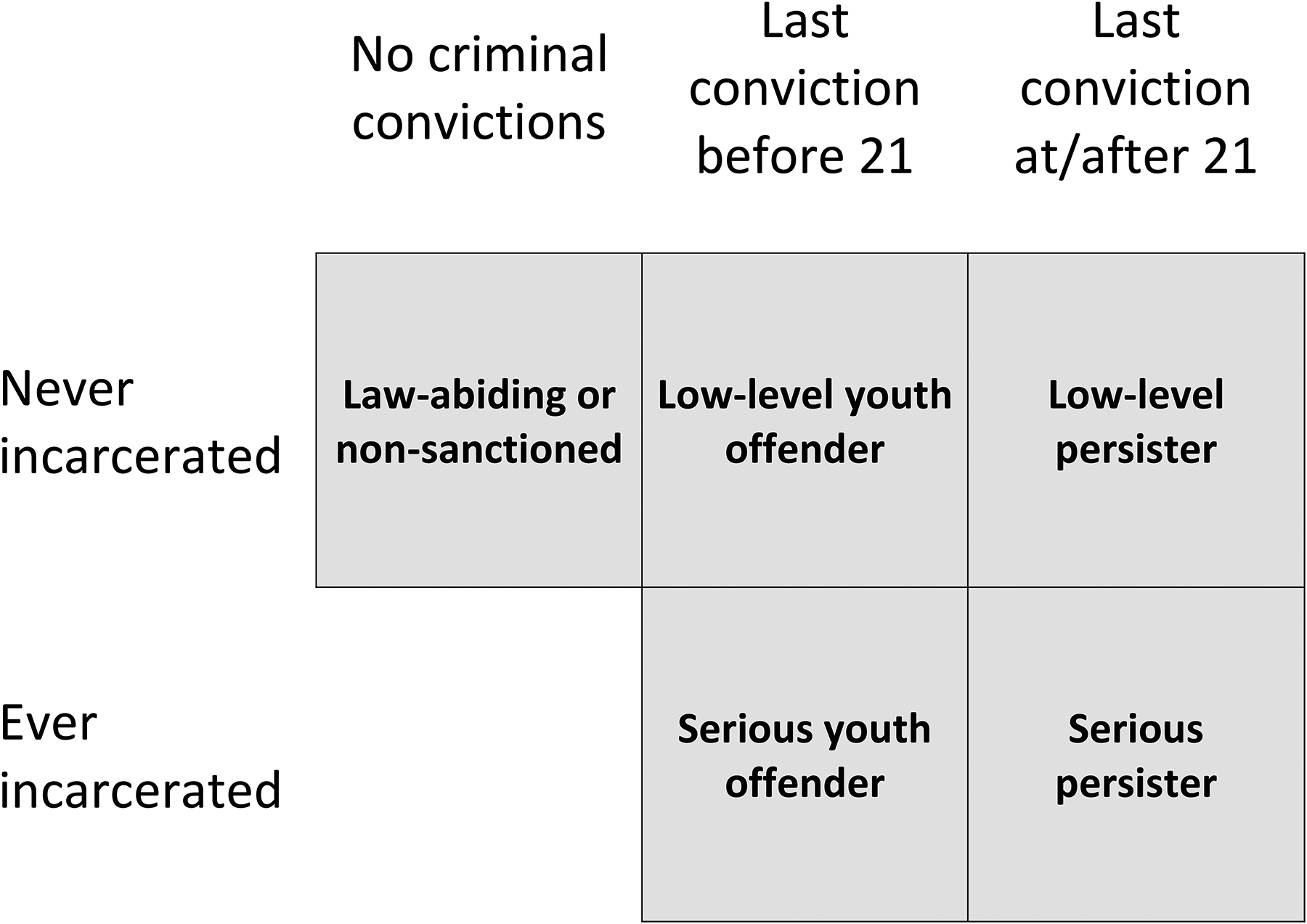
Group taxonomy conditional on type of sentence and age at last conviction.
Analytical strategy
To estimate how differential fertility affects the estimates of intergenerational transmission, and in turn what the crime rate would have been if all men had similar fertility rates, we need two main pieces of information. First, the counterfactual number of children men with criminal justice histories would have had, had they similar fertility rates as those without CJ involvement. Second, how many of the sons born to offenders would offend relative to sons born to law-abiding men.
The demographic foundation for intergenerational transmission
We first calculate probability of ever becoming a father at age 45 across criminal justice history, and then the average number of children fathered at age 45, also across criminal justice history. We refer to the latter measure as the completed cohort fertility because only a negligible number of men father children after turning 45. Together, these two measures allow us to judge whether differences in completed cohort fertility is due to differences in the share of each group of men who become fathers, or differences in the number of children fathers in each group have.
Considering the timing of fatherhood, we estimate Kaplan–Meier (KM) curves for each group across ages 15–45, right-censoring those men who at 45 had not yet become fathers. The event is becoming a father. The KM estimator is a nonparametric estimator of the form:

To study the timing of cohort fertility until completion defined as age 45, we calculate the following measure:

The implication of differential fertility for intergenerational transmission
To study the role the differences in fertility rates across criminal justice histories, our components of interest is: (a) how many male children with criminal convictions we can expect men with criminal justice conviction to father relative to how many they would father, had men with criminal justice convictions exhibited similar cohort fertility rates as men without histories of criminal justice convictions; (b) what the corresponding crime rate among the second generation would be if men with histories of criminal justice convictions had similar fertility to men without criminal histories; and (c) how the estimate of the intergenerational transmission of crime change when we apply a prospective approach.
We assume no selection into fatherhood within the groups of men with and without criminal histories. This assumption is likely unfeasible. However, if sorting into fatherhood generally occurs more through human capital channel sketched out above than through the risk behavior channel, and if female fertility partners on average select partners within each group who have higher prosocial capital (and thus, will be less likely to transmit offending across generations compared to the men not selected for fatherhood), our estimates of both components of interest will be conservative.
For the sake of simplicity, we divide the sample into only two categories: (1) men who ever have received a criminal justice conviction; and (2) men who never have received a criminal justice conviction. This provides an estimate for a situation where the transmission of criminal justice convictions is identical for all levels of men's criminal justice contact—that is, youth-limited offenders and persisters transfer criminality to the same degree. Given that youth-limited offenders have fertility rates essentially identical to men, who never receive a criminal justice conviction (see the Results section) and that the strength of transmission likely is positively correlated with men's level of criminal involvement, this will lead to a lower bound estimate of how much retrospective estimates underestimate forward intergenerational transmission. We also perform an estimation for a situation where youth-limited offenders (who mainly terminate their criminal trajectory prior to fatherhood) have sons who are only as likely to offends as the sons of men without any criminal history. Given that this grouping singles out the persisters as the sole carriers of the intergenerational transmission of crime, this group reflects the highest criminal intensity, and because persisters have substantial lower average observed fertility, this calculation will provide an upper bound estimate.
Because we only have complete information on registered offences from 1980, we cannot readily estimate the retrospective transmission of criminal offending from our data. Instead, we rely on studies by Hjalmarsson and Lindquist (2012) and Besemer et al. (2017). Hjalmarsson and Lindquist (2012) provide the odds ratio of the estimate of the association between father's criminal conviction and son's criminal conviction for Sweden (2.06), a neighboring and to a large extent similar country to Denmark in terms of criminal activity and punishment (Pratt, 2007), fertility (Hellstrand et al., 2021), and welfare state arrangements (Kvist et al., 2011). Besemer et al. (2017) provide a meta-analysis of the intergenerational transmission of criminal behavior from a broader set of countries (2.40). The odds ratio for the association between father and son's criminal convictions (

The odds ratio remains the same for different set of values of probabilities if the relative relationship between the odds remains the same. Hjalmarsson and Lindquist (2012) provide some validation for the odds ratio remaining close to constant at least for different parts of the life course: their paper also provides odds ratio for the intergenerational association in juvenile delinquency, which is similar in relative magnitude to the OR for criminal justice convictions. By (a) assuming that the odds ratio remains constant; (b) knowing the probability of having a father who have had criminal justice contact; and (c) the share of men in society who ever receives a conviction, we can recover PC and PL and from there provide a prospective estimate of the reproduction of criminal offending across generations. The average share of sons with a criminal justice conviction, S, can be written as the weighted shares of son's crime (P) conditional of father's criminal justice history (F):


Results
In this section, we first present descriptive evidence on the fertility differences across criminal histories of all Danish men born in 1965–1973, the only cohorts for which we have completely criminal justice histories from age 15 and onwards and who have turned 45. We use these differences to estimate how crime rates may look absent fertility differences across criminal justice histories. Last, we compare the retrospective odds ratio estimates to prospective odds ratio estimates to demonstrate how differential levels of fertility play a substantial role in shaping the onward transmission of crime across society.
Men's criminal justice history and fertility
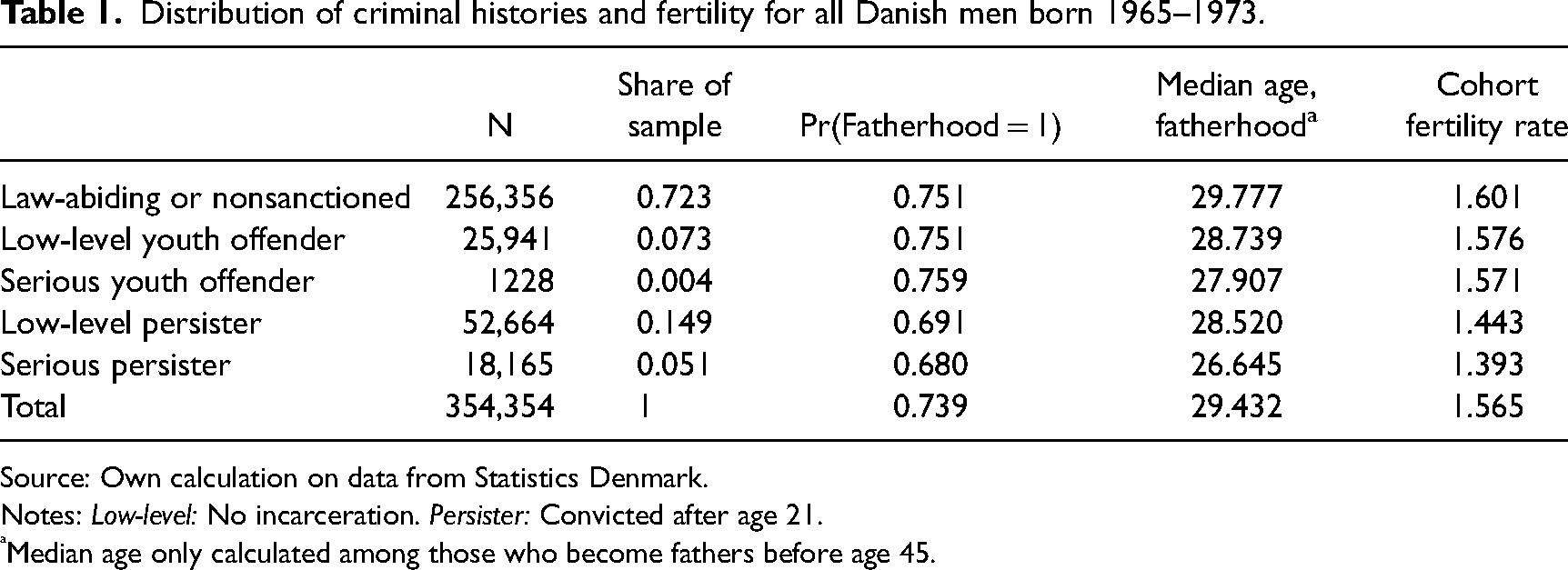
Figure 2 describes the Kaplan–Meier curves for transitioning to parenthood for men from 15–45 across the history of criminal justice involvement. Table 1 shows the distribution of conviction and incarceration histories across the cohort, as well as the ultimate share who ever become fathers, the median age at fatherhood for men who become fathers, and the total number of children fathered at age 45. More than 26% of all men received at least one conviction at age 45, and 20% received their last conviction after turning 21. Only 5.5% of the men ever experience an incarceration spell of more than seven days, and almost all of them continue to receive convictions after turning 21.
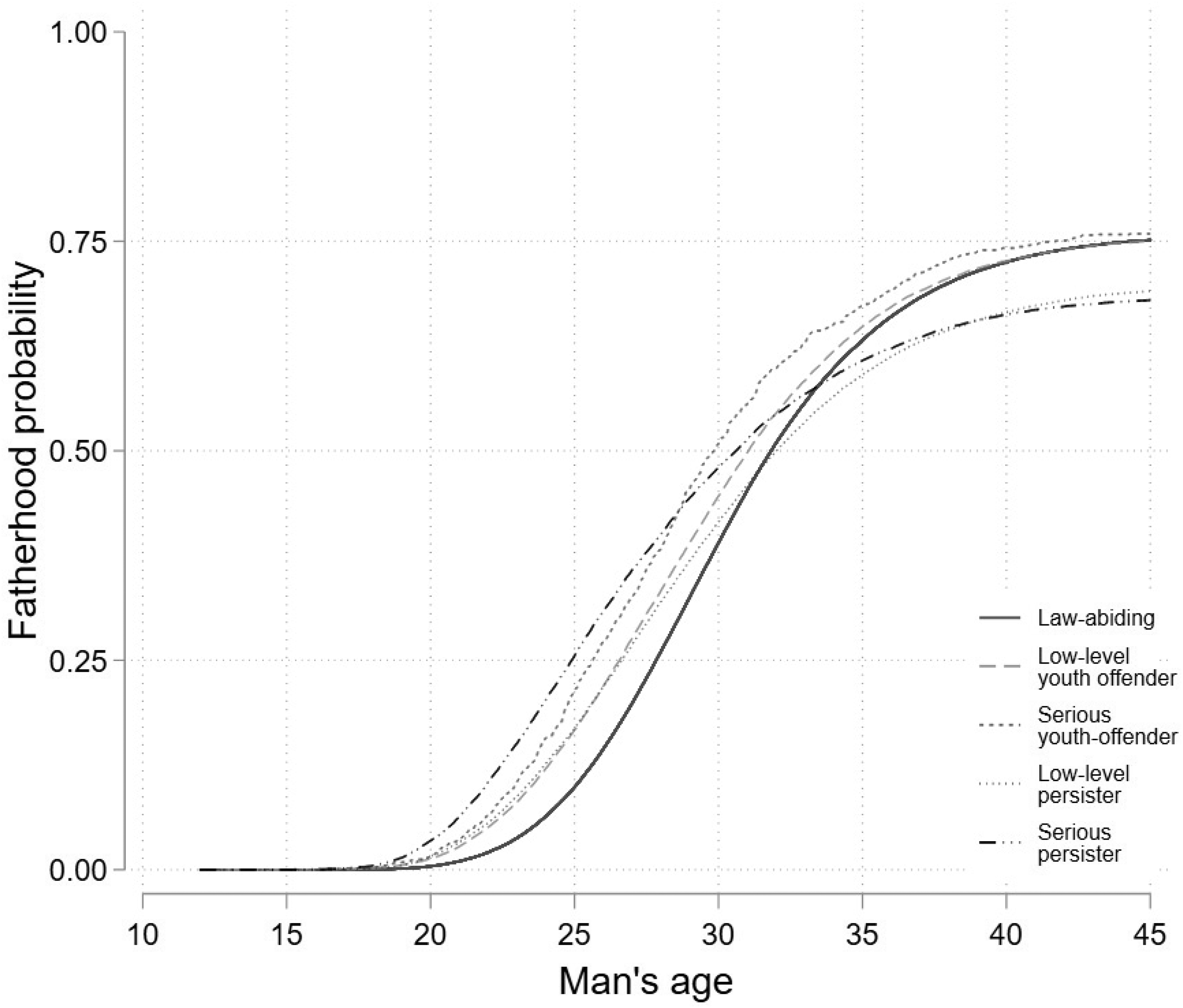
Kaplan–Meier curves for the transition to fatherhood conditional on criminal justice history for Danish men born during 1965–1973. Source: Own calculation on data from Statistics Denmark. Notes: Low-level: No incarceration. Persister: Convicted after age 21.
Distribution of criminal histories and fertility for all Danish men born 1965–1973.
Source: Own calculation on data from Statistics Denmark.
Notes: Low-level: No incarceration. Persister: Convicted after age 21.
Median age only calculated among those who become fathers before age 45.
For the group that never received a criminal conviction, 75% was fathers at age 45, with the median age of first-time fatherhood being 29.8 years of age among fathers. Among those who received their last criminal conviction after turning 21 less than 70% was fathers at age 45 unconditional on incarceration. The persisters differed on timing of transition to fatherhood, with median age transition being 26.6 years for the serious persisters, and 28.5 years for the low-level persisters. Low-level youth offenders had fatherhood transition-probabilities like men without a history of criminal justice contacts, but transitioned at an earlier age, with the median age for becoming a father for the first time being 28.7 years. We find the largest likelihood of fatherhood among serious youth offenders—77% of this group had become fathers at age 45, although this estimate has wide standard errors and is not significantly different from law-abiding men and low-level youth offenders (see Figure A1 in the Appendix). Thus, youth limited offenders were equally likely to become fathers as men who never received a conviction, but did so earlier in the life course. Timing of desistance and termination correlated with the likelihood of transitioning to parenthood for men, with youth-limited offenders transitioning earlier and more to fatherhood than men without a history of criminal justice contacts did. Persistence and type of criminal justice contacts were associated both with the timing and likelihood of men's transition to fatherhood.
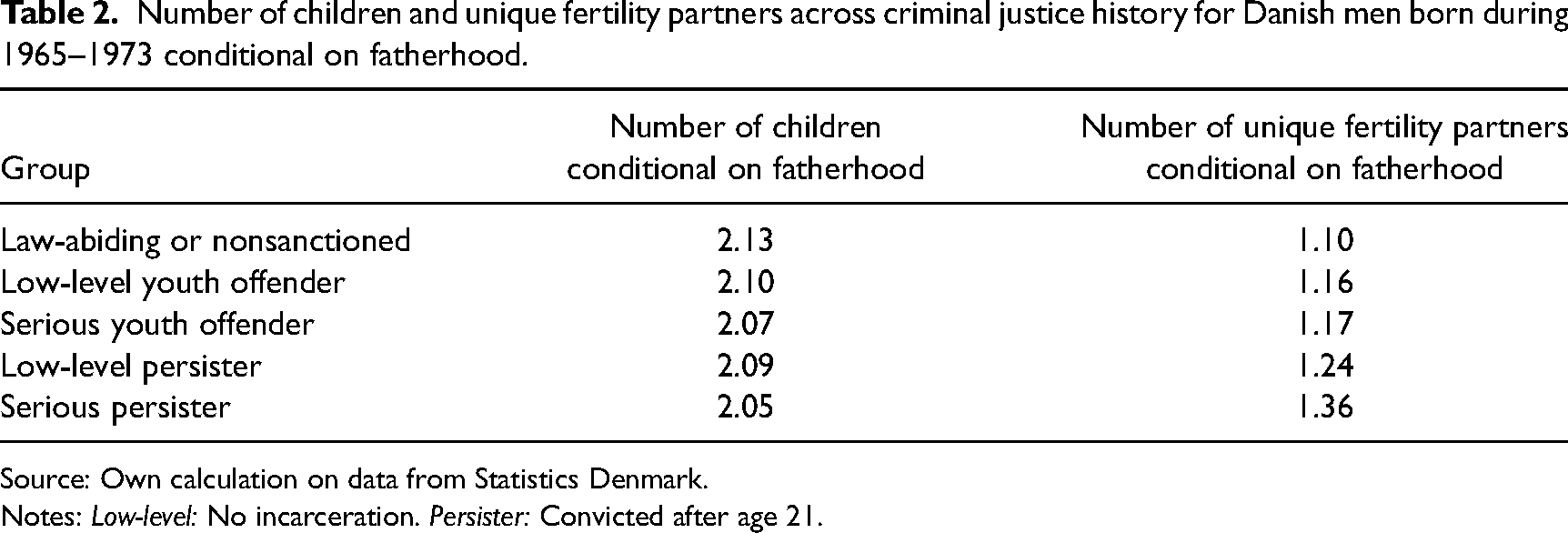
Figure 3 reports the completed cohort fertility for the 1965–1973 cohort of men across the men's history of criminal justice involvement. The pattern is similar to Figure 2. Men convicted after turning 21 had on average fewer children, with serious persisters having the lowest number of children (1.4 child). Youth-limited offenders and men without a history of convictions had similar number of children at 1.6 child for each group. Thus, those least likely to become fathers also had on average the fewest children. Table 2 reports the average number of children for each group conditional on fatherhood. Among men who became fathers, differences in the average number of children across history of criminal justice involvement are much more muted. Thus, the main difference in cohort fertility across the groups is driven by entry into fatherhood, not by differences in how many children men who become fathers had.
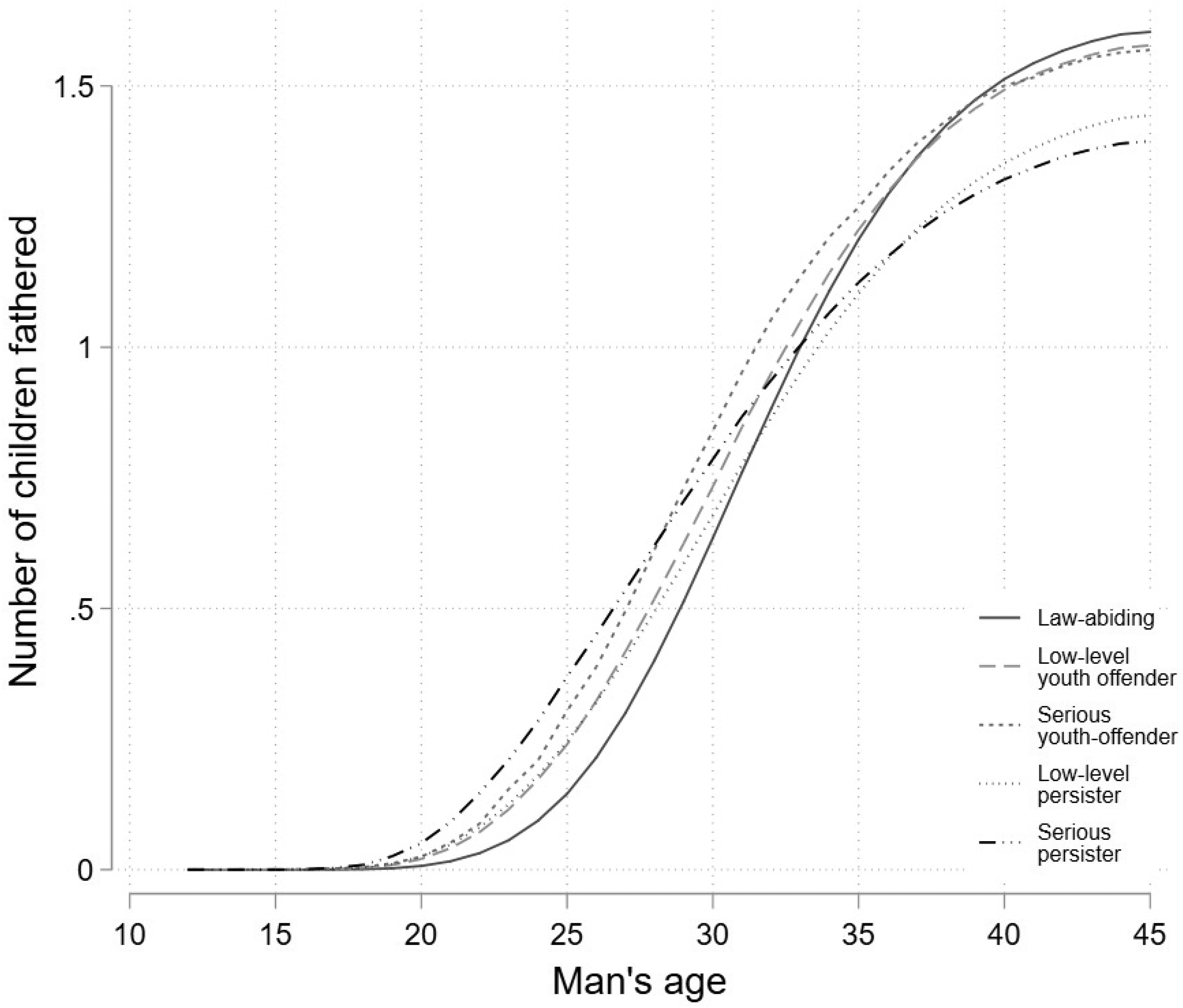
Completed cohort fertility across age conditional on criminal justice history for Danish men born during 1965–1973. Source: Own calculation on data from Statistics Denmark. Notes: Low-level: No incarceration. Persister: Convicted after age 21.
Number of children and unique fertility partners across criminal justice history for Danish men born during 1965–1973 conditional on fatherhood.
Source: Own calculation on data from Statistics Denmark.
Notes: Low-level: No incarceration. Persister: Convicted after age 21.
Table 2 further reports that whereas the average father without any criminal justice conviction had 1.10 unique partners, fathers who persisted and had a history of incarceration had on average 1.36 unique partners—a 24% difference. So, men with more persistent criminal justice histories had lower likelihood of becoming fathers and had lower completed cohort fertility, but those who became fathers did so at a younger age, fathered a similar number of children, and had higher rates of multiple partner fertility.
The implication of differential fertility for the estimates of intergenerational transmission
In this section, we calculate an approximation of the prospective transmission of criminal justice convictions in Denmark and compare these to approximated retrospective estimates. Because the estimates of intergenerational association from Hjalmarsson and Lindquist (2012) is measured at age 30, we also measure the average share of sons with a criminal justice conviction, (S), at that point. The most recent Danish birth cohort whose convictions can be followed to end of age 29 is the 1988 cohorts. At the end of 2018, 19.0% of males in that cohort had received at least one conviction under penal law. 2 Yet, the oldest men in the cohort fertility sample were only 25 in 1988, so many of them had still not become fathers (as seen in Figure 2). Further, the share of recent birth cohorts who are ever convicted or charged with a crime has substantially declined, including among those not yet 30 years of age (Andersen et al., 2016). Therefore, we extrapolate the cumulative share of men ever convicted for more recent birth cohorts by assuming that the relative difference between the cumulative rate at age 20 (25) for men born in 1998 (1993) and the cumulative rate for men born in 1988 will remain the same until age 30. 3
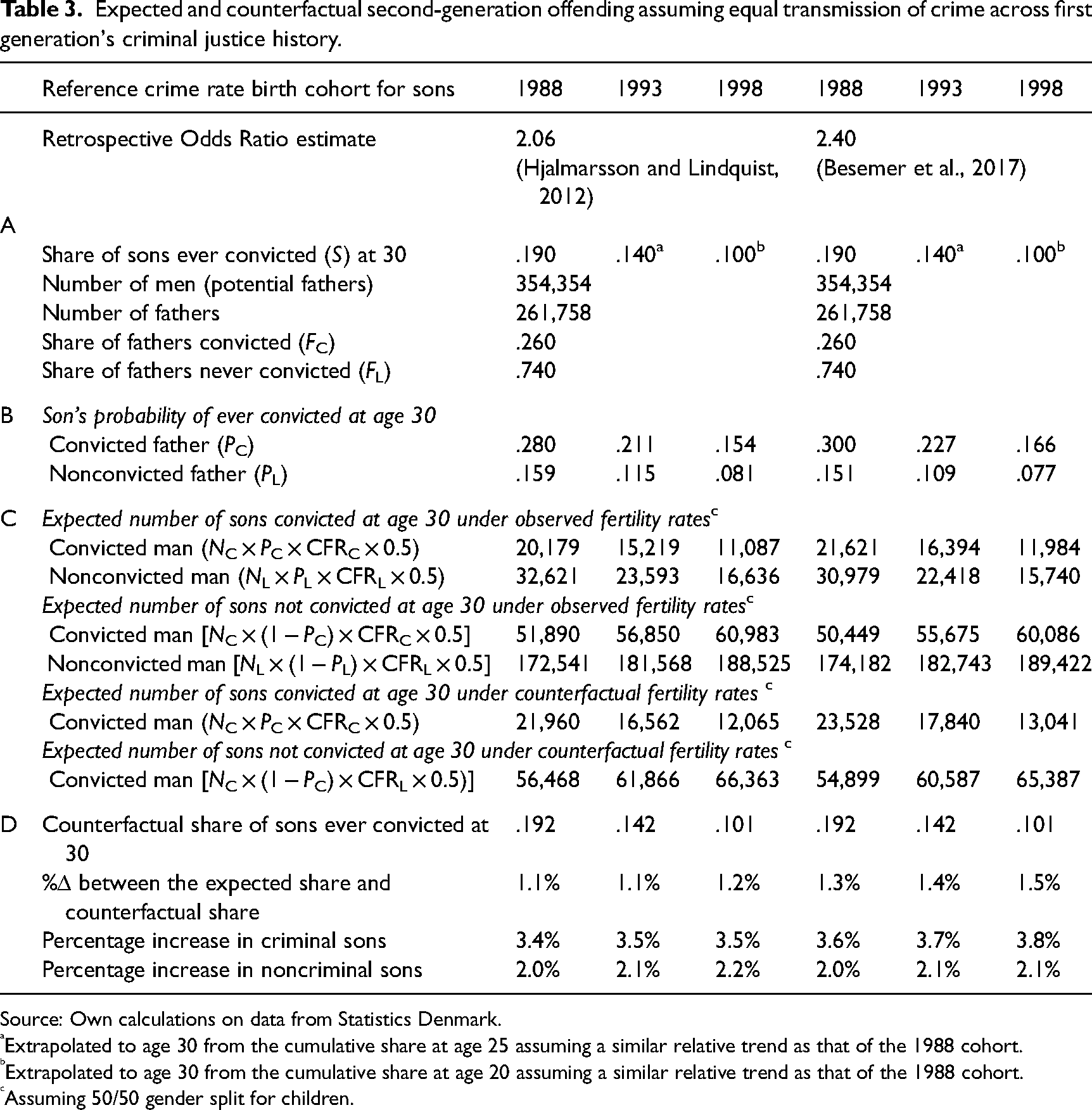
The different shares of sons (S) ever convicted across birth cohorts are shown in Panel A in Table 3 together with the odds ratio for the intergenerational association of offending and the share of fathers, who are ever (never) convicted. From Table 1, we can calculate the share,
Expected and counterfactual second-generation offending assuming equal transmission of crime across first generation's criminal justice history.
Source: Own calculations on data from Statistics Denmark.
Extrapolated to age 30 from the cumulative share at age 25 assuming a similar relative trend as that of the 1988 cohort.
Extrapolated to age 30 from the cumulative share at age 20 assuming a similar relative trend as that of the 1988 cohort.
Assuming 50/50 gender split for children.
In Table 3, we assume that the intergenerational transmission of criminal justice convictions is identical across men's level of criminal involvement. That is, in this scenario the transfer of ever committing crime is independent of age at the termination of criminal behavior and intensity of criminality. Because men who persist into the twenties have lower fertility rates than youth-limited offenders, and intensity likely increase the transmission (Hjalmarsson and Lindquist, 2012; Wildeman and Andersen, 2017), this means that our counterfactual scenario probably represents a lower bound estimate of the role differential fertility plays in shaping how crime is transmitted across generations.
Panel B reports the derived probabilities of a son ever receiving a conviction at age 30, derived from the information in panel A and using equation 4. See Appendix B for an example. Based on Hjalmarsson and Lindquist (2012), for the 1988 birth cohort we would expect 28% of all sons born to fathers ever convicted at age 45 to have received a criminal justice conviction at age 30, whereas we would expect 16% of sons born to never convicted fathers to have received a conviction at age 30. The estimate of intergenerational transmission provided by Besemer et al. (2017) instead suggests that for the 1988 cohort, 30% of sons born to convicted fathers receive a conviction before age 30, whereas only 15% of sons born to nonconvicted fathers ever receive a conviction before age 30.
In Panel C, we calculate how many convicted and nonconvicted sons men with and without a conviction history could expect to have. We also present results from the counterfactual scenario where convicted men had nonconvicted men's cohort fertility rate. For the 1998 cohort of sons, and using the ORR provided by Hjalmarsson and Lindquist (2012), we would expect 1781 more convicted sons had convicted men had the same fertility rates as nonconvicted men. At the same time, we would also expect 4578 more nonconvicted sons. In total, as shown in Panel D, this would be an increase of 3.4% in the number of convicted sons in society and a 2.0% increase in the number of nonconvicted sons. Such an increase results in a 1.1% increase in the share of sons ever convicted in a birth cohort from .190 to .192. That increase would in return have resulted in 2.7 criminal convictions more per 1000 sons if we assume that these hypothetical criminal sons received the same number of convictions as their nonhypothetical peers did. 4 Results from the extrapolated 1993 and 1998 cohorts show smaller absolute differences between the expected and the counterfactual scenario (which is expected due to the declining overall share of men to ever receive a conviction), but also increasing relative differences.
Table 3 also reports the results using the retrospective odds ratio provided by Besemer et al. (2017) [ORR = 2.40], indicating a higher degree of transmission of criminal behavior than found by Hjalmarsson and Lindquist (2012). Table 3 reports that for the 1988 cohort, we could expect 1907 extra sons that would have received a conviction before age 30 (a 3.6% increase), and an additional 4450 nonconvicted sons (a 2.0% increase). The share of the 1988 cohort with a conviction at age 30 would increase with 1.3% to .192, implying an additional 3.2 criminal acts per 1000 sons under the same assumptions as above.
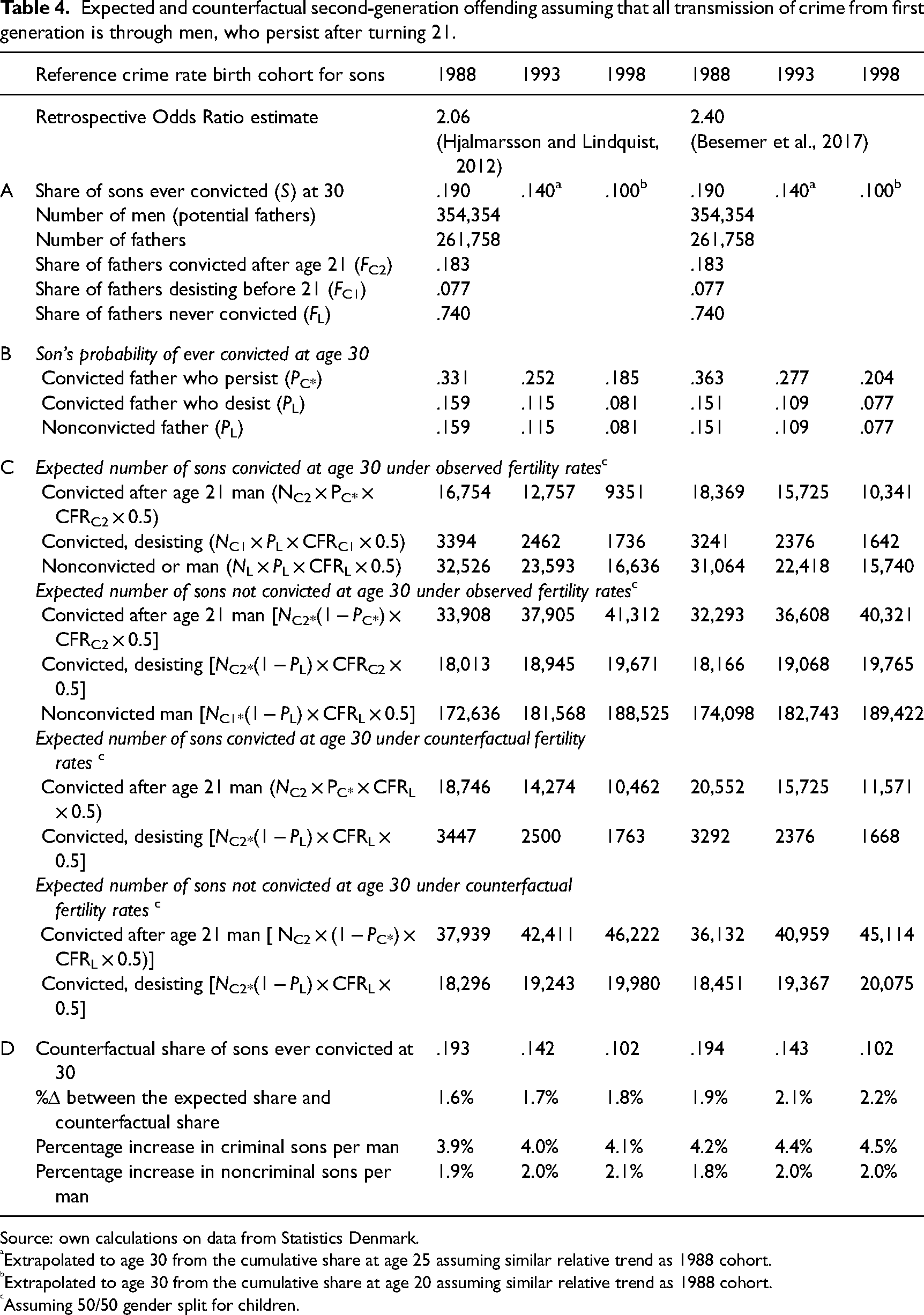
Table 4 reports expected and counterfactual results from the scenario where men who desist their criminal activity before turning 21 does not transmit their criminal conviction unto the next generation, building on the extension seen in equation 5. Panel B reports the expected probability of a son to have received a conviction conditional of paternal criminal justice history. Under the assumption that all transmission carries through fathers who persist, one-in-three sons born to persisters in 1988 is expected to receive a conviction before turning 30. Under the hypothetical scenario of equal fertility rates across criminal justice history and using the retrospective ORR of 2.06 as the starting point, we could expect an additional 2045 sons with a conviction at age 30 (a 3.9% increase) and 4314 additional sons without a conviction (a 1.9% increase). The share of sons ever convicted would increase to .193, which would be an increase of 1.6%, corresponding to an additional 3.9 more criminal acts per 1000 sons born in 1988. Under the higher estimate of intergenerational transmission provided by Besemer et al., would under the counterfactual scenario expect 2234 additional sons with a conviction before age 30 (4.2% increase), and 4124 more nonconvicted sons. This lead the share of sons ever convicted at age 30 to increase with 1.9% to .194, corresponding to 4.7 additional crimes per 1000 sons born in 1988. Results from the extrapolated 1993 and 1998 cohorts show smaller absolute differences between the expected and the counterfactual scenario (which is expected due to the declining overall share of men to ever receive a conviction), but also increasing relative differences between the expected and counterfactual scenario.
Expected and counterfactual second-generation offending assuming that all transmission of crime from first generation is through men, who persist after turning 21.
Source: own calculations on data from Statistics Denmark.
Extrapolated to age 30 from the cumulative share at age 25 assuming similar relative trend as 1988 cohort.
Extrapolated to age 30 from the cumulative share at age 20 assuming similar relative trend as 1988 cohort.
Assuming 50/50 gender split for children.
Finally, Table 5 reports two sets of prospective odds ratios for the intergenerational transmission of crime. First, the prospective OR for all men who ever father a child. Compared to the retrospective odds ratio, this measure considers differences in number of children between men with and without criminal justice convictions, conditional on these men becoming fathers. Second, the prospective odds ratio for intergenerational transmission of criminal convictions for all men. Compared to the retrospective odds ratio, this measure account for both the difference in number of children among men who become fathers, as well as the difference in probability of entering fatherhood. For the 1988 cohort of sons, we see only a small difference in retrospective and prospective odds ratio when using the prospective odds ratio that only includes fathers (2.06 vs. 2.03). Thus, as also suggested by Table 2, differences in number of children among fathers across criminal justice history plays little to no role in how crime is transmitted across generations in Denmark.
Comparing retrospective and prospective odds ratios.
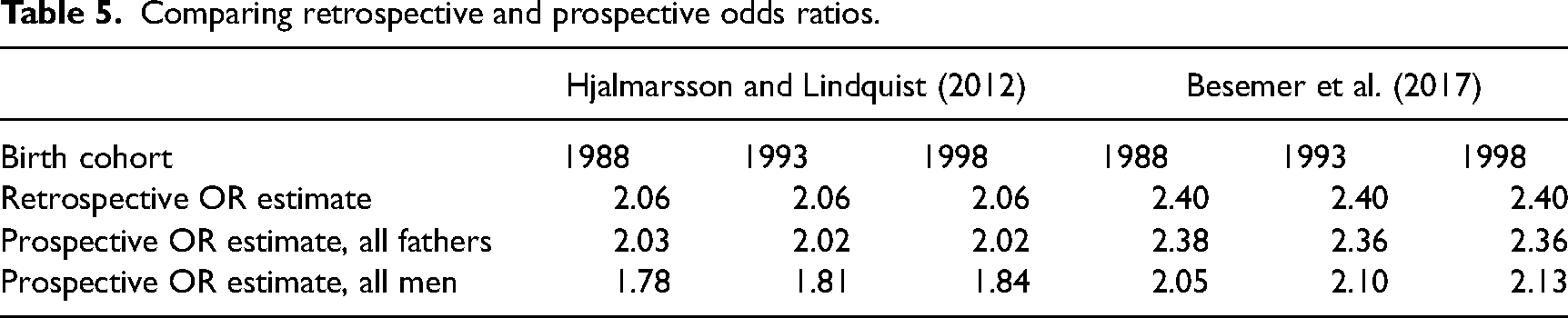
When we instead compare the retrospective odds ratio to the prospective odds ratio for all men, we see larger differences. The prospective estimate for the transmission of criminal convictions from a man to a son is 1.78, 24% smaller than the retrospective estimate. As the share of sons ever convicted declines as younger cohorts generally exhibit a crime decline (Columns 2 and 3, Panel B in Tables 3 and 4), the prospective estimate for all men moves closer to the retrospective estimate. Thus, retrospective estimates of intergenerational transmission of crime overestimate the forward transmission of crime from one generation to the next at the population level, as long as men with a history of criminal justice conviction have lower fertility rates than men without a history of criminal justice convictions, but as crime becomes a rarer event, the difference between retrospective and prospective estimates diminishes.
Limitations of findings
The above presented research rests on a set of implicit assumptions (see above for explicit assumptions). First, the data comes from administrative population registers and thus represent an administrative reality that might not correspond perfectly to peoples’ lived lives. When it comes to crime, some, if not most, criminal actions are never assigned a guilty party, and other never even reported or discovered. Here, we hinge our study on the assumption that people who continuously commit crime are more likely to be convicted. Second, the society is in the process on an ongoing crime decline, which at least for Denmark appears to happen at the extensive margin (Andersen et al., 2016). This could have substantial implications for the magnitude of the difference between retrospective estimates and prospective estimates.
Last, as fatherhood does not happen in a vacuum, may be transformative, and may initiate desistance (Kerr et al., 2011). Mother's criminal behavior also matters (Hjalmarsson and Lindquist, 2013), and assortative mating may also play a role (Andersen, 2018a). These important processes have not been thoroughly considered in this study. In Appendix Figures A2–A4, we present fertility estimates for women using the same taxonomy as used for fathers. Figure A2 shows that only women who are serious persisters have lower ultimate probability of becoming mothers compared to the four other groups. Like men, if serious persister women become mothers they do so at a younger age. But given (i) the much smaller share of women who engage in crime; (ii) the tendency for female offending to be more heavily related to substance abuse and co-offending with male (partners) (Brennan et al., 2012; Steffensmeier and Allan, 1996); (iii) and that the mechanisms linking parental offending to offspring offending across gender lines (Auty et al., 2017), we chose to solely focus on male-to-male transmission in this study.
Conclusions
In this study, we have considered how differences across criminal involvement in the probability of fatherhood and number of children men father may have substantial implications for our understanding of the intergenerational transmission of criminal behavior. The more intense a man's criminal justice contacts were across his life course (measured through age at desistance and whether he ever was incarcerated), the fewer children he would one average ever father. Men who persist offending into adulthood are less likely to ever become fathers, but those who do, do so at younger ages, where their criminal intensity likely still is higher and transmission risk likely amplified. The differences in number of children ever fathered across criminal justice histories can lead to bias in the estimates of how the propensity for criminal justice contacts is transmitted across generations. The retrospective approach of regressing son's criminal history on father's criminal history ignored differences in fertility across a criminal background. Under two different scenarios, we demonstrated how known retrospective estimates of intergenerational transmission implies higher crime rates than observed if differences in fertility are not considered. Last, we showed that prospective estimates of the intergenerational transmission are smaller than retrospective estimates, but also that the difference decreased as the share of a second-generation cohort who could expect to ever receive at least one criminal justice conviction decreased. The latter implied that if the great crime decline continues and the odds ratios for intergenerational transmission remains constant, retrospective estimates will become less biased over time.
Perspective
Three key insights can be drawn from this study. First, although well established in other parts of sociology considering intergenerational relationships, we have now also for criminal offending demonstrated we should always have in mind what direction the transmission is studied from. Are we looking back from the perspective of the second generation, or forward from the perspective of the first generation. Insofar there is differential fertility across the social phenomenon studied, the direction studied have implication for what question an empirical study will answer. Second, if men with a criminal justice history continue to have lower fertility rates than men without, the intergenerational transmission of offending will explain less and less of observed societal crime rates. Third, the study also points to a possible additional explanation of the great and at least until the last decade ongoing crime decline—differential selection into fertility. If the intergenerational transmission process is truly causal and not simply confounded by other factors, then criminal men having fewer children than law-abiding men could be a salient independent cause of the decline in crime observed across the Western world since the 1990s (Blumstein and Wallman, 2006). That is, by being selected out of fatherhood, transmission occurs less and less—the selection out of fatherhood caused certain men to never become fathers, thereby not transmitting criminal propensity onwards to their children. However, to fully study this would need data sources that covers a large population for most of the 20th century and include information on both fertility, intergenerational links, and crime—data sources that at presently are not available.
Supplemental Material
sj-docx-1-asj-10.1177_00016993231198334 - Supplemental material for Criminal justice involvement, transition to fatherhood, and the demographic foundation of the intergenerational transmission of crime
Supplemental material, sj-docx-1-asj-10.1177_00016993231198334 for Criminal justice involvement, transition to fatherhood, and the demographic foundation of the intergenerational transmission of crime by Peter Fallesen in Acta Sociologica
Footnotes
Acknowledgments
The author is deeply indebted to Lars H. Andersen for many discussions and numerous excellent suggestions, as well as to Arjan Blokland, Shawn Bushway, Bobby Apel, Linus Andersson, Frida Rudolphi, and colleagues at the LNU-group at the Swedish Institute for Social Research, Stockholm University for useful comments. Andreas M. Andersen provided valuable research assistance. Previous version was presented at the American Society of Criminology Annual Meeting and at Stockholm University.
Funding
The author(s) disclosed receipt of the following financial support for the research, authorship, and/or publication of this article: This work was supported by the Forskningsrådet om Hälsa, Arbetsliv och Välfärd (grant number 2016-07099) and ROCKWOOL Fonden (grant number 1182).

Supplemental material
Supplemental material for this article is available online.
Notes
Author biography
References
Supplementary Material
Please find the following supplemental material available below.
For Open Access articles published under a Creative Commons License, all supplemental material carries the same license as the article it is associated with.
For non-Open Access articles published, all supplemental material carries a non-exclusive license, and permission requests for re-use of supplemental material or any part of supplemental material shall be sent directly to the copyright owner as specified in the copyright notice associated with the article.
