



Abstract
Affirmative action policies (AAP) polarise the public debate in Western democracies as they involve favouring one candidate at the cost of others because of their group membership. Against this backdrop, we ran a factorial survey experiment in Denmark, France and Germany on the introduction of a hypothetical regulation favouring women and immigrants with equal qualifications in the recruitment process for a management position (N = 4264; YouGov online panel). Our data show that support for AAP for women is significantly greater than for immigrants in all three countries. Moreover, support for AAP is much higher in France than in Germany and Denmark. Germans and Danes show similar low support for AAP for immigrants, while support for AAP for women is higher in Germany than Denmark. We conducted multilevel regression models to investigate the power of several attitudinal factors in explaining target group and country differences. Results show that respondents’ varying levels of ethnic and gender prejudice and perceived disadvantage entirely explain target group differences in support for AAP. Furthermore, differences between Germany and Denmark in the support of AAP for women are explained by different levels of prejudices and perceived disadvantage, and attitudes towards state intervention. However, these attitudinal variables cannot explain why support for AAP is much higher in France.
Introduction
Identity politics has become one of the most polarising policy areas in Western democracies (Fukuyama 2018). Some consider group-based rights a necessary and complementary tool to individual-based rights for redressing group-based unequal participation in various societal arenas (Fraser 1998). The allocation of particular rights to individuals because of a common group membership may lead to a fragmentation of the society into subgroups defined by particular, seemingly constitutive identities, however (Fukuyama 2018). Accordingly, whether and how incorporating such constitutive group identities into the design of policies against inequality influences social cohesion, and vice versa, is an open question. Affirmative action policies (AAP) are one form of identity politics as they involve favouring one candidate at the cost of others because of their group membership (Harrison et al., 2006). Such regulations have been implemented in the form of gender quotas for company board positions in many European countries, for example (Möhring and Teney, 2020).
Investigating the determinants of support for AAP has a particularly significant societal relevance: it can provide empirical evidence about the mechanisms underpinning societal polarisation on a particularly contested form of identity politics, thereby helping us to understand why AAP might produce unintended outcomes (de Zwart, 2000). Moreover, this issue provides for interesting scientific inquiry. Support for AAP does indeed result from an interplay of several attitudinal dimensions: identification with the target group, one's own level of prejudice against the target group, the perception of unequal opportunities faced by the target group, and attitudes towards state intervention (Krysan, 2000). Thus, investigating citizenś support for policies to redress categorical inequality can enable us to shed light on the interplay of key attitudinal dimensions underpinning the support for concrete and real-life context policies. This provides obvious advantages over the analysis of abstract attitudinal items on the acceptance of equality for underrepresented groups. The latter may be subject to social desirability bias, especially as the expression of prejudice against underrepresented groups becomes less socially accepted (Krysan, 2000). Moreover, abstract items measuring acceptance of equality remain largely indeterminate with respect to their implications for everyday behaviour and policy attitudes outside the survey context.
Despite its particularly great societal and scientific relevance, research on citizenś support for AAP has so far been dominated by studies which focused on the US and attitudes of (white) Americans towards (existing or hypothetical) affirmative action programmes for ethnic minorities (Harrison et al., 2006; Krysan, 2000). However, recent studies have pointed to large cross-national variation in overall AAP support (Barnes and Córdova, 2016; Möhring and Teney, 2020). Moreover, we still know very little about support for AAP for different underrepresented groups. To the best of our knowledge, previous research has exclusively investigated AAP for a single target group, with the exceptions of Hunt and Smith (2022), Scarborough et al. (2019) and Wilson (2006), who focused exclusively on the US. Therefore, we aim to fill these research gaps by investigating not only cross-national variation in support for AAP but also the extent to which support for AAP varies among different target groups. We address the following two main research questions: (1) how can we explain variation in support for AAP for women and for migrants; and (2) how can we explain this cross-national variation in the overall support for AAP and the differences between the two target groups? The basis of our analysis is a unique international factorial survey experiment carried out in Denmark, France and Germany, including vignettes on the introduction of a hypothetical regulation favouring women or individuals with a migration background (referred to as ‘migrants’ in the following) with equal qualifications in the recruitment process for a management position. We chose women and migrants as examples of underrepresented groups because, on the one hand, regulations favouring women in recruitment processes have become more and more common in Europe (Arndt and Wrohlich, 2019), and on the other hand, ethnic discrimination in recruitment processes has been documented in research (Lancee, 2021).
Rationale for the country selection
Denmark, France and Germany provide contrasting average levels of support for boardroom gender quotas, i.e., for the most senior positions of leadership in the economy, with high support in France, followed by Germany and very low support in Denmark (Möhring and Teney, 2020), while the three countries exhibit similar proportions of women in management positions overall (Dämmrich and Blossfeld, 2017). Furthermore, the countries differ in the extent of prejudice against migrants and women, and of support for state intervention (Pew Research Center, 2018). Denmark, France and Germany also reflect different levels of integration of women and migrants in the labour market.
All three countries show a similar immigration history: a large low-skilled immigration wave coming from mainly Muslim-majoritarian countries in the 1960s and 1970s (Koopmans, 2013), followed by (1) a diversification in the countries of origin and in the educational levels of migrants; and (2) an increase in intra-EU migration (King, 2002). However, the countries provide contrasting contexts regarding both the structural integration of women and migrant minorities in the labour market and the associated policies. In Germany, state institutions and benefits are designed towards a male breadwinner model, but at the same time, a gender boardroom quota has been in place since 2016.
While France and Denmark are similar in promoting a dual earner model and having high rates of female employment, they differ in their quota implementation: France introduced a gender boardroom quota relatively early, in 2011, and with tough sanctions for non-compliance; Denmark has no binding quota as yet (Arndt and Wrohlich, 2019). Accordingly, womeńs economic power (measured as the proportion of board members in the largest quoted companies – supervisory board or board of directors – and the proportion of board members at the central bank) is much higher in France (82.9 points out of 100) than in Denmark (56.5) and in Germany (49.7) (EIGE 2019).
With regard to migrants’ labour market integration, the (2012) proportion of third-country nationals who are not in education, employment or training (proportion of NEET) was lowest in Denmark (25.2%) followed by Germany (31.7%) and much higher in France (44.7%) (MIPEX 2014). Cross-national differences in policies aiming at improving migrants’ labour market integration point to a similar country ranking: targeted support for migrants’ labour market integration is at a similarly high level in Germany and Denmark (90 points out of 100 on the MIPEX targeted support indicator) and much lower in France (50 points) (MIPEX 2014). Thus, and in contrast to Denmark and Germany, France is characterised by a higher level of economic power among women and at the same time by a weaker labour market integration of its migrant population and fewer targeted policies to support migrants’ labour market integration.
Explaining target group differences in support for AAP
Four key factors have been highlighted in the literature on support for policies aimed at redressing ethnic inequality: (1) group-based interest and group identity; (2) ethnic prejudice; (3) belief about discrimination and source of inequality; and (4) support for state interventionism (Dixon, Durrheim and Thomae 2017; Sniderman et al., 1999). Existing studies investigating differences in (redistributive) solidarity between target groups have consistently highlighted the significantly lower support for solidarity for migrants than for other vulnerable groups (e.g., van Oorschot, 2008). Furthermore, a recent U.S. study investigating support for diversity policies in the workplace pointed to the fact that policies targeted at ethnic minorities face more opposition than policies targeted at women (Scarborough, Lambouths and Holbrook, 2019). The exact mechanisms behind these target group differences in the support for AAP remain an open empirical question.
To tackle this question, we draw on the deservingness theory for welfare programme and redistributive solidarity (van Oorschot, 2000). Deservingness can be understood as ‘the extent to which a subject is considered worthy or unworthy of an outcome, based upon the relative relationship between this outcome and the actions and characteristics of the subject’ (Kootstra, 2016, 327). Accordingly, individuals make use of five different deservingness criteria to judge whether some groups are held to be more deserving of welfare support than others: need, reciprocity, identity, attitudes and control. The reciprocity and need criteria do not apply to the case of support for AAP in management positions. The reciprocity criterion implies that those making a greater perceived contribution to society in the past, present or future are considered more deserving. The need criterion allocates more deservingness to those perceived to have greater (financial) needs (Laenen, Rossetti and van Oorschot, 2019). As AAP are neither a financial based welfare benefit nor a policy targeted at the (financially) needy, these two criteria do not apply when judging the deservingness of women and migrants for AAP in management position. By contrast, the three remaining deservingness criteria provide a fruitful theoretical framework for understanding target group differences in support for AAP.
Identity criterion of deservingness
The identity criterion postulates that those who are perceived as belonging to one’s own group or seen as more similar and closer to one's own group are judged to be more deserving. This identity criterion can also be interpreted through the lens of social identity theory: individuals who perceive that a policy will benefit members of their own group are more likely to support it. Consequently, members of the target groups are more likely to be in favour of those policies that are believed to help their own demographic group (Harrison et al., 2006). By contrast, members of the non-target group are likely to oppose affirmative action policies because they perceive members of the target groups as competitive threats for valued (but scarce) social resources, statuses and privileges (Bobo, 2000, 142–43). The empirical literature on support for AAP has consistently confirmed this group interest-based explanation (e.g., Harrison et al., 2006; Smith and Hunt, 2020; Teney et al., 2022). Furthermore, recent empirical studies have pointed to the fact that members of an underrepresented group are more likely to support AAP targeted at other underrepresented groups than members of the majority group (i.e., white men) (e.g., Bolzendahl and Coffé, 2020; Kane and Whipkey, 2009; Scarborough et al., 2019). This finding corresponds to the underdog principle: people who are objectively less well-off tend to support the principle of equality to a larger extent and are more likely to judge inequalities from the stratification system as unjust (Robinson and Bell, 1978). Accordingly, members of an underrepresented group are more likely to support policies aiming at redressing inequality faced by underrepresented groups in general, regardless of the policy target group.
Therefore, as women belong to an underrepresented group, they might be more likely than men to feel solidarity with and support AAP in favour of other underrepresented groups, such as migrants.1 Thus, the identity criterion of deservingness provides a more overarching theoretical framework for understanding group differences in support for AAP towards distinct target groups than the sole group-based interest explanation. Accordingly, we expect women to support AAP for women to a larger extent than men (Hypothesis 1a). Moreover, we also hypothesise that women will be more supportive than men of AAP targeted at migrants (Hypothesis 1b). The identity criterion of deservingness can explain differences in the support for AAP between members of underrepresented groups and the majority. However, there is also large heterogeneity in the level of support for AAP within groups: not all majority members oppose AAP and not all members of underrepresented groups support AAP. The two further deservingness criteria provide a theoretical framework to investigate target group differences in the support for AAP among individuals.
Attitude criterion of deservingness
The attitude criterion of deservingness implies that those who are perceived as more grateful, compliant and conforming to a society's standards are judged to be more deserving (van Oorschot, 2008; 2000). For instance, Reeskens and van der Meer (2019) operationalised the behaviour of actively seeking work as an attitudinal criterion of deservingness for unemployment aid. More broadly, earlier studies on deservingness pointed to the role of attractiveness of the target group in the evaluation of deservingness of the particular target group: we judge a person or social group we like to be more deserving than a person or group we dislike, hence discriminating against the latter (Feather, 1999). We apply this attitudinal criterion to the specific case of AAP by using measures of both taste-based and statistical discrimination. Taste-based discrimination assumes behaviour towards members of a certain group is based on a general dislike of the group, such as sexism or racism (Becker, 1971). By contrast, statistical discrimination refers to behaving towards members of a group by relying on (accurate or non-accurate) group-level estimates associated with the ascriptive characteristics of the group members (Arrow, 1973; Phelps, 1972). In the case of AAP for a management position, such a group-level estimate could be expressed by the perception that members of the target group in general do not meet the standards required to hold a management position. We operationalise the attitudinal criterion of deservingness with items evaluating the underrepresented group (1) as an economic or cultural threat; and (2) as not possessing the necessary competencies and qualities to hold a management position. Holding with such negative stereotypes and forms of prejudice is likely to be associated with a stronger opposition to AAP for the respective target group. Indeed, ethnic and racial prejudice are significantly related to lower support for informal solidarity towards migrants (van Oorschot, 2006), for welfare programmes targeted at ethnic minorities (Harell et al., 2016), and even reduces support for other welfare benefits (e.g., for a universal basic income, Bay and Pedersen, 2006). Overall, individuals in Western democracies show higher levels of negative stereotyping and prejudice against migrants than against women. Therefore, we assume that the greater opposition to AAP favouring migrants can be explained by higher levels of negative stereotypes and prejudice against migrants than against women (Hypothesis 2). This would, in turn, explain why the overall support for AAP is higher for women as the target group.
Control criterion of deservingness
Lastly, the control criterion of deservingness postulates that those perceived to have little or no personal control over getting into or out of their situation are judged to be more deserving of welfare benefit. Translating the control criterion of deservingness to our case is straightforward: if members of the target group are perceived as facing a disadvantage in the labour market, they will be considered to be more deserving of AAP. Indeed, as AAP for a management position aims to redress inequality faced by underrepresented groups in the labour market, the belief that members of underrepresented groups are not disadvantaged in the labour market would imply that AAP are not necessary. This, in turn, would lead to a greater opposition to AAP. The perception that group members are unfairly treated or structurally disadvantaged is indeed a strong determinant of support for AAP for ethnic minorities (Harrison et al., 2006; Krysan, 2000) and for diversity policies in the labour market for women and ethnic minorities (Scarborough et al., 2019). Here again, we hypothesise that target group differences in support for AAP can be explained by differences in the perceived disadvantage of women and migrants in the labour market (Hypothesis 3). Moreover, according to the above-mentioned underdog principle (Robinson and Bell 1978), members of underrepresented groups are more likely to perceive inequalities as unjust. Accordingly, women are more likely to perceive higher levels of disadvantage for migrants in the labour market. This, in turn, could further explain gender differences in the support for AAP in favour of migrants (see Hypothesis 1b).
To sum up, we expect to be able to explain differences in the support for AAP targeted at women and persons of migrant origin by accounting for the identity, attitude and control criteria of deservingness. Thus, we assume that the target differences in the level of support for AAP is due to differences (1) in the perception of the target group as being similar to oneself (Hypotheses 1a and 1b); (2) in the level of negative stereotypes and prejudice against the target groups (Hypothesis 2); and (3) in the perception that the target groups are disadvantaged in the labour market (Hypothesis 3).
Explaining cross-national differences in support for AAP
As described above, a previous study on differences in public support for the introduction of a gender boardroom quota across European countries pointed to large between-country variations (Möhring and Teney, 2020). We suggest two factors that can explain this country-level variation. First, the overall level of stereotyping and prejudice against women and ethnic minorities and the overall perception of disadvantage faced by women and migrants might vary across our sampled countries. Such cross-national variation in the overall level of prejudice and perception of disadvantage of underrepresented groups is expected to explain the country differences in support for AAP (Hypothesis 4). International survey data do indeed point to considerable variation in the overall level of prejudice against ethnic minorities and women. In a recent PEW survey (Pew Research Center, 2018), the proportion of respondents who think that migrants make the national economy stronger because of their work and talent was much higher in Denmark and Germany (both 66%) than in France (54%). By contrast, Germans seem to endorse much more traditional gender roles than the French and the Danes: while 68% of Danish and 63% of French respondents agree that it is good for family life when women have full-time jobs, only 43% of Germans do so (Pew Research Center, 2018).
Second, support for AAP is not only derived from the personal level of stereotyping and prejudice and the perceived disadvantage faced by underrepresented groups, but also from the acceptance of a strong state intervention in the economy. Sniderman et al. (1999) even argued that prejudice is of secondary importance compared to opposition to welfare in explaining opposition to AAP. According to this principled conservatism theory, opposition to AAP is a sole function of political conservatism, and is thus independent of any prejudice (e.g., Krysan, 2000; Sidanius et al., 1996). The fact that the overall level of support for state intervention in the economy might differ across our countries could also provide an explanation for the varying level of support for AAP between Germany, Denmark and France. In fact, a recent PEW survey points to significant cross-national variation in the overall acceptance of state intervention among our sampled countries: French and Danish respondents agree to a much larger extent than Germans that it is the government´s responsibility to ensure a decent standard of living for all (Pew Research Center, 2018). Therefore, we hypothesise that country differences in support for AAP can be partly explained by varying levels of support for state intervention in the economy (Hypothesis 5).
Data and methods
Data
To assess support for AAP for women and migrants, we developed vignettes on a hypothetical AAP regulation. These vignettes were varied in four dimensions and were formulated as follows: “[Women/people with a migration background] are [significantly underrepresented/underrepresented] in the [private/public sector] in [country]. An independent commission therefore suggests the following regulation: employers should be legally obliged to favour [women/people with a migrant background] with equal qualifications in the recruitment for [senior/middle/lower] management positions. To what extent do you support or oppose this regulation?”
Respondents were asked to answer using an 11-point Likert scale ranging from 0 (completely oppose) to 10 (completely support), which constituted our dependent variable. In this contribution, we investigated solely the variation in support for AAP as a function of the AAP target groups (i.e., women and persons with a migrant background). However, the vignettes contained three further dimensions besides the AAP target groups: (1) the level of segregation faced by the target group (i.e., whether the target group is underrepresented or significantly underrepresented); (2) the sector of activity (i.e., private vs public) and (3) the management level of the position targeted by the regulation (i.e., senior, middle or lower management position). With these further dimensions, we wanted to test whether respondents accept quotas (only) under certain conditions. Quotas might be considered more necessary, the more underrepresented a group is; the less is ‘at stake’, i.e., the lower the position to be filled; and if it is only applied in the public sector, not impairing private businesses. However, apart from the target group dimension, support for the AAP regulation did not vary significantly across the levels of the three other dimensions, which is remarkable. Thus, when evaluating an AAP regulation, respondents only make use of the piece of information on the target group and ignore the other information describing the context of the AAP regulation. These results clearly point to the relevance of investigating variation in the support for AAP across target groups. We used a full factorial design for drawing a random sample of vignettes from the entire vignette universe considering all possible combinations of the dimensionś levels. Each respondent was randomly assigned to four versions of the vignette.
The survey experiment data were collected in September 2018 among a random sample of participants of an online panel by YouGov in Germany, France and Denmark. In each country, a sample of 3000 respondents in the workforce stratified by age and gender took part in our survey experiment. The proportion of respondents with a leadership role was 36.2 percent (N = 1103) in France, 33.0 percent (N = 962) in Germany, and 21.4 percent (N = 650) in Denmark. The final sample included 4264 respondents each with answers for 4 vignettes, totalling 17,056 units. Of the 9088 participants in the survey, 4115 had to be deleted due to missing values on one of the included variables (listwise exclusion). Furthermore, all 709 respondents with a migrant background (defined as persons without citizenship status in the respective country and/or with at least one foreign-born parent) were removed from the sample. As the data collected do not contain any information on the country of origin, we cannot distinguish between respondents from various European and non-European countries of origin. Therefore, composition heterogeneity of this category hampers any meaningful interpretation.
After having answered the four vignettes, respondents were asked to give their opinion on several attitudinal items. We measured prejudice against women and ethnic prejudice with a set of four items. The first two items referred to prejudice against women: ‘Women don’t have the necessary competencies and qualifications for leading positions’; ‘Women are less willing than men to fight for their careers’. Next, ethnic prejudice was measured with the following items: ‘Is immigration to [country] good or bad for [the country's] economy?’; ‘Do migrants undermine or enrich [country's] cultural life?’. These attitudinal items could be answered on an 11-point Likert scale. We constructed two additive indices ranging from 0 to 10 measuring prejudice against women and ethnic prejudice. The correlation of the indicators for prejudice against women and migrants amounted to 0.068. Next, perceived unequal treatment faced by women and ethnic minorities was measured with the following items: (1) ‘Do you think that women are disadvantaged in recruitment processes for leading positions in [country]?’ and (2) ‘Do you think that persons with an immigration background are disadvantaged in recruitment processes for leading positions in [country]?’. These items could be answered using a five-point Likert scale ranging from ‘not disadvantaged at all’ to ‘strongly disadvantaged’. Lastly, acceptance of state intervention in the economy was measured with the following bipolar 11-point Likert scale item: ‘Individuals should take more responsibility for providing for themselves’ vs ‘The state should take more responsibility to ensure that everyone is provided for’. All attitudinal variables were centred on their mean. In the regression analyses, we controlled for a set of socio-demographic characteristics that have been shown to be associated with support for a gender quota (Barnes and Córdova, 2016; Möhring and Teney, 2020; Teney et al., 2022): gender, age, cohabitation status, educational attainment (in three categories), personal income (in three categories) and holding a leadership position. Moreover, we controlled for respondents’ sector of activity (working in the public/ non-profit sector vs in the profit sector) and respondents’ number of children. Online Supplementary Material Table A.1 presents the descriptive statistics and the average levels of perceived discrimination of women and migrants, of prejudice against women and migrants, and of opinion towards state intervention in Germany, France and Denmark.
Estimation strategy
The units of analysis were the vignettes, with respondents’ evaluation of the vignette as a dependent variable. We thus had a within-subject experimental design as each respondent evaluated four vignettes and used a two-level random slope model to analyse variations in the support for AAP across target groups (Auspurg and Hinz, 2015). The target group dimension (measured at the vignette level, level 1) was allowed to vary across respondents (level 2). In each model, we included cross-level interaction terms between respondents’ gender and the target group dimension. We furthermore introduced three-way interactions of country (Germany as the reference category) with gender and with the target group dimension of the vignette. To control for the rank order of the vignette, we used a categorical variable with the first vignette the respondent evaluated as the reference category.
Results
We have structured our results in two parts. First, we focus our analyses on target group differences in support for AAP. Then, we turned to the analyses aiming to assess the factors behind country differences in the overall support for AAP.
Target group differences in support for AAP
To assess our hypotheses on target group differences in support for AAP, we conducted four multilevel regression models (see Models 0–4 of Online Supplementary Material A Table A.2). Model 0 included only the country dummies and no further individual-level controls. Model 1 was composed of the vignettes’ target groups, respondents’ gender, the country dummies and the control variables. In addition, the main model contained (cross-level) interaction terms of the AAP target group with gender and country. In the second model, we added the measures of ethnic and gender prejudice. Model 3 was composed of the main model variables and our items on perceived disadvantage of women and migrants in the labour market. Finally, Model 4 contained the variables of the main model, the two prejudice measures and the two perceived disadvantage items.
AAP for migrants received lower support than AAP for women by an average of 1.70 scale points (p = 0.000), ceteris paribus (see Model 0 of Online Supplementary Material Table A.2). Figure 1 presents the average level of support for AAP for women and migrants by country (based on Model 0 in Online Supplementary Material Table A.2). We see large cross-national variation in the overall support for AAP: support for AAP was generally much greater in France than in Germany and Denmark. Support for AAP for women was higher in Germany than Denmark, while Germans and Danes showed a similar level of support for AAP for migrants. Furthermore, France and Germany were similar in the difference in the average level of support for AAP towards women relative to AAP for migrants (gap amounts to 1.70 scale points in Germany, 1.79 scale points in France and 0.85 scale points in Denmark).
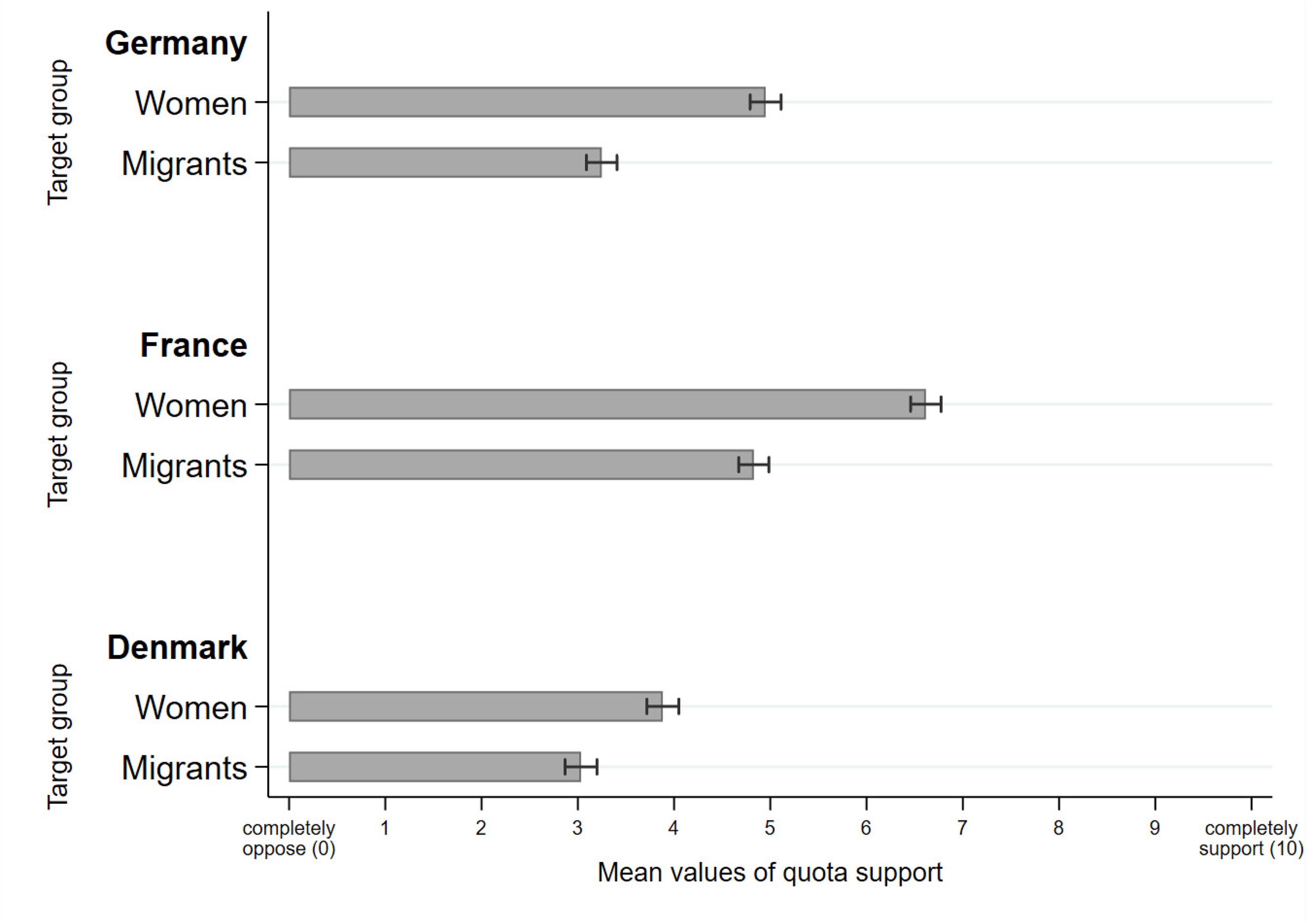
Average level of support for AAP directed towards women and migrants in Denmark, Germany and France. Note: The answer categories range from 0 (completely oppose) to 10 (completely support). Source: authors’ survey experiments with YouGov online panel (2018); sample N = 4264.
For all three countries combined, the general support for AAP was 1.50 scale points (p = 0.000; scale 0–11) higher among women compared to men (see Model 1 of Online Supplementary Material Table A.2). Figure 2 plots the predicted values of support for AAP for each target group by respondents’ gender and country (based on Model 1 of Online Supplementary Material Table A.2). The results presented in Figure 2 provided support for Hypotheses 1a and 1b. Recall that these hypotheses were derived from the identity deserving criterion and aimed to explain (respondents’) gender differences in support for AAP. The predicted values in Figure 2 do indeed show that women supported AAP for women and migrants to a much larger extent than men supported AAP for women (Hypothesis 1a), and for migrants (Hypothesis 1b, with the exception of German women). The gender gap was larger for AAP for women than for AAP for migrants, however. That is, women did support AAP for their own group to a larger extent than AAP for migrants. Thus, our results confirm, first, the group-based interest explanation (i.e., that women support AAP for their own group to a larger extent); and second, the fact that members of an underrepresented group (in this case women) tended to support AAP for other underrepresented groups to a larger extent than members of the majority.
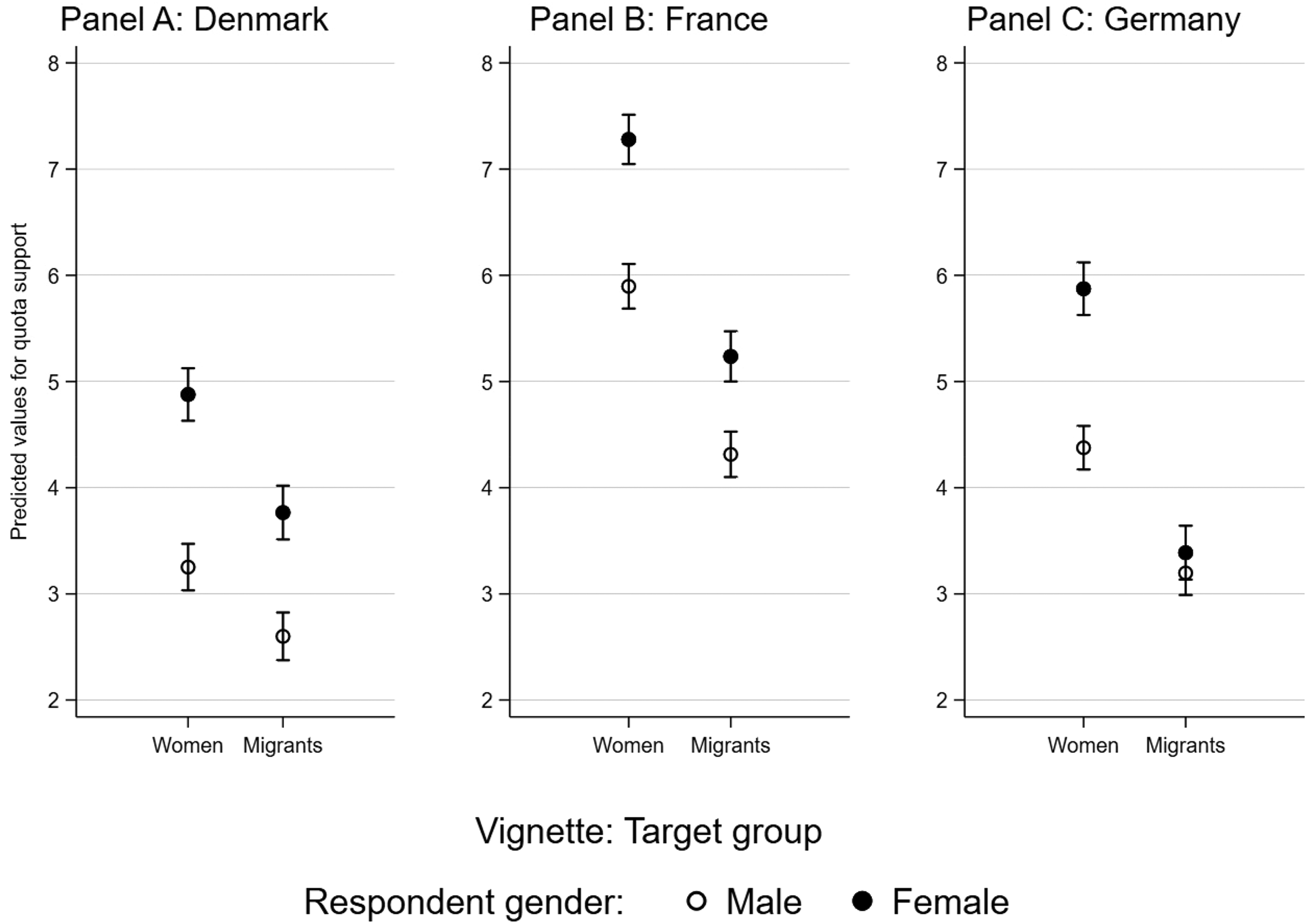
Predicted values of support for a quota in recruitment processes for women and migrants, by respondents’ gender. Note: Controlling for sector of activity, holding a management position, income, education, age, marital status, number of children and vignette order. Source: Authors’ survey experiments with YouGov online panel (2018); sample N = 4264.
Next, Figure 3 presents the coefficients (1) of gender and ethnic prejudice (Panels A and C); and (2) of perceived disadvantage of women and migrants (Panels B and D) on support for AAP for both target groups. The corresponding multilevel regression coefficients can be found in Model 2 (for prejudice) and Model 3 (for perceived disadvantage) of Online Supplementary Material Table A.2. Both measures of prejudice were significantly and negatively associated with support for AAP for the corresponding target group. Moreover, and interestingly, they correlated significantly with support for AAP for the other target group (see Model 2 in Online Supplementary Material Table A.2). Respondents with a high level of ethnic prejudice were significantly less likely to support AAP for women. By contrast, respondents with a high level of prejudice against women were significantly more likely to support AAP for migrants. However, the predicted values of support for AAP for both target groups for respondents with a high level of prejudice against women need to be interpreted with caution: very few respondents held a high level of prejudice against women, which explains the particularly large confidence intervals on the right-hand side of the graph on prejudice against women (Figure 3, Panel A). More importantly for the assessment of our second hypothesis, both prejudice measures can explain the target group gap in support for AAP. Thus, the fact that respondents supported AAP for women to a much larger extent than AAP for migrants is due to differences in the overall level of ethnic and gender prejudice. Respondents with a low level of ethnic prejudice and respondents with a high level of gender prejudice held similar levels of support for AAP regardless of the AAP´s target group. These results confirm our second hypothesis: the fact that AAP for women received more support than AAP for migrants was due to varying levels of prejudice against migrants and women. Thus, the attribute criterion of deservingness also helps to explain differences in the level of support for AAP for different target groups.
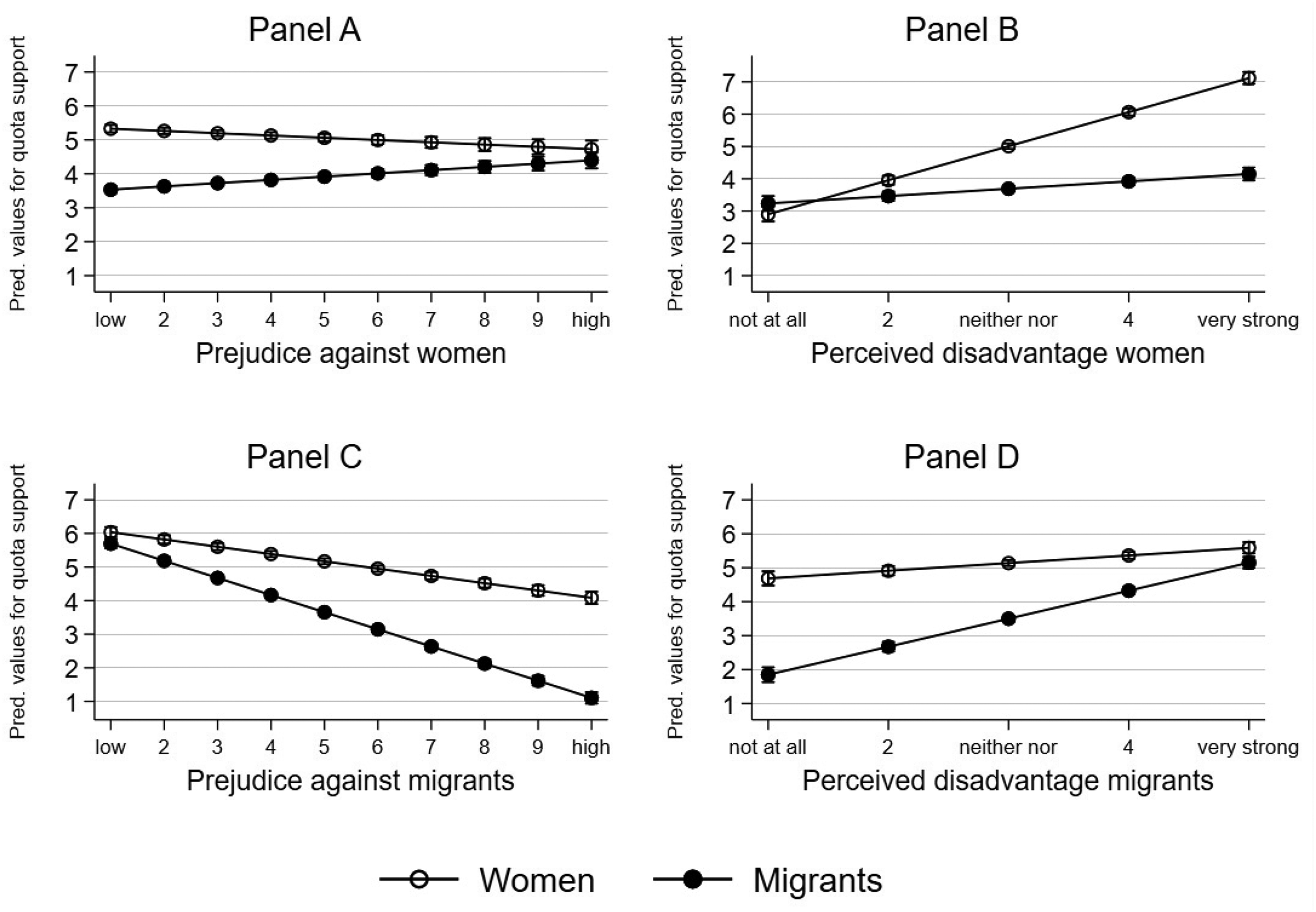
Predicted values of support for a quota in recruitment processes for women and migrants, effect of prejudice and perceived disadvantage, by vignette target group. Note: Controlling for gender, sector of activity, holding a management position, income, education, age, marital status, number of children, country and vignette order. Source: Authors’ survey experiments with YouGov online panel (2018); sample N = 4264.
Panels B and D of Figure 3 present the effects of perceived disadvantage of women and migrants on support for AAP for both target groups (see Model 3 in Online Supplementary Material Table A.2 for the corresponding multilevel regression coefficients). Here again we can see that both variables explain the target group gap in support for AAP. First, respondents who perceived migrants as strongly disadvantaged in the labour market supported AAP for persons of migrant origin to the same extent as they supported AAP for women. Second, the level of support for AAP for women was as low as the level of support for AAP for migrants among respondents who thought that women do not face any disadvantage in the labour market. These results confirm our third hypothesis: target group differences in support for AAP were also due to varying levels of perceived disadvantage of women and migrants in the labour market. This also points to the relevance of the control criterion of deservingness for explaining target group differences in support for AAP: members of underrepresented groups who are perceived to have little or no personal control over getting into or out of their situation are judged to be more deserving of AAP. For the sake of comprehensiveness, we provide the multilevel regression results combining the two prejudice measures and the two perceived disadvantage items (see Model 4 in Online Supplementary Material Table A.2).
Country differences in support for AAP
Turning now to the second part of our analysis, we focus on country differences in the overall support for AAP for women and persons of migrant origin. Recall that we hypothesised that the country differences in support for AAP can be explained by country differences in the overall level (1) of ethnic and gender prejudice and of perceived disadvantage faced by women and migrants (Hypothesis 4); and (2) of support for state intervention in the economy (Hypothesis 5). Generally, support for AAP is 1.52 scale points (p = 0.000; scale 0–11) higher among French respondents compared to German, and 1.12 scale points (p = 0.000) lower among Danish respondents compared to German, ceteris paribus (see Model 1 of Online Supplementary Material Table A.2).
Figure 4 presents the results for the country differences in support for AAP. Panel A (based on Model 1 in Online Supplementary Material Table A.2) corresponds to our main model with a dummy for the vignette target group (and interaction terms of target group vignette with gender and the country dummies), a dummy for gender, country dummies and our set of socio-demographic control variables. Accordingly, French respondents were much more likely than German and Danish respondents to support AAP towards both target groups. Moreover, Danes were significantly less likely than Germans to support AAP for women, but shared a similar level of support for AAP for migrants. Thus, we found significant country differences in the overall support for AAP, with the exception of Germans’ and Dane’s similar support levels for AAP for migrants.
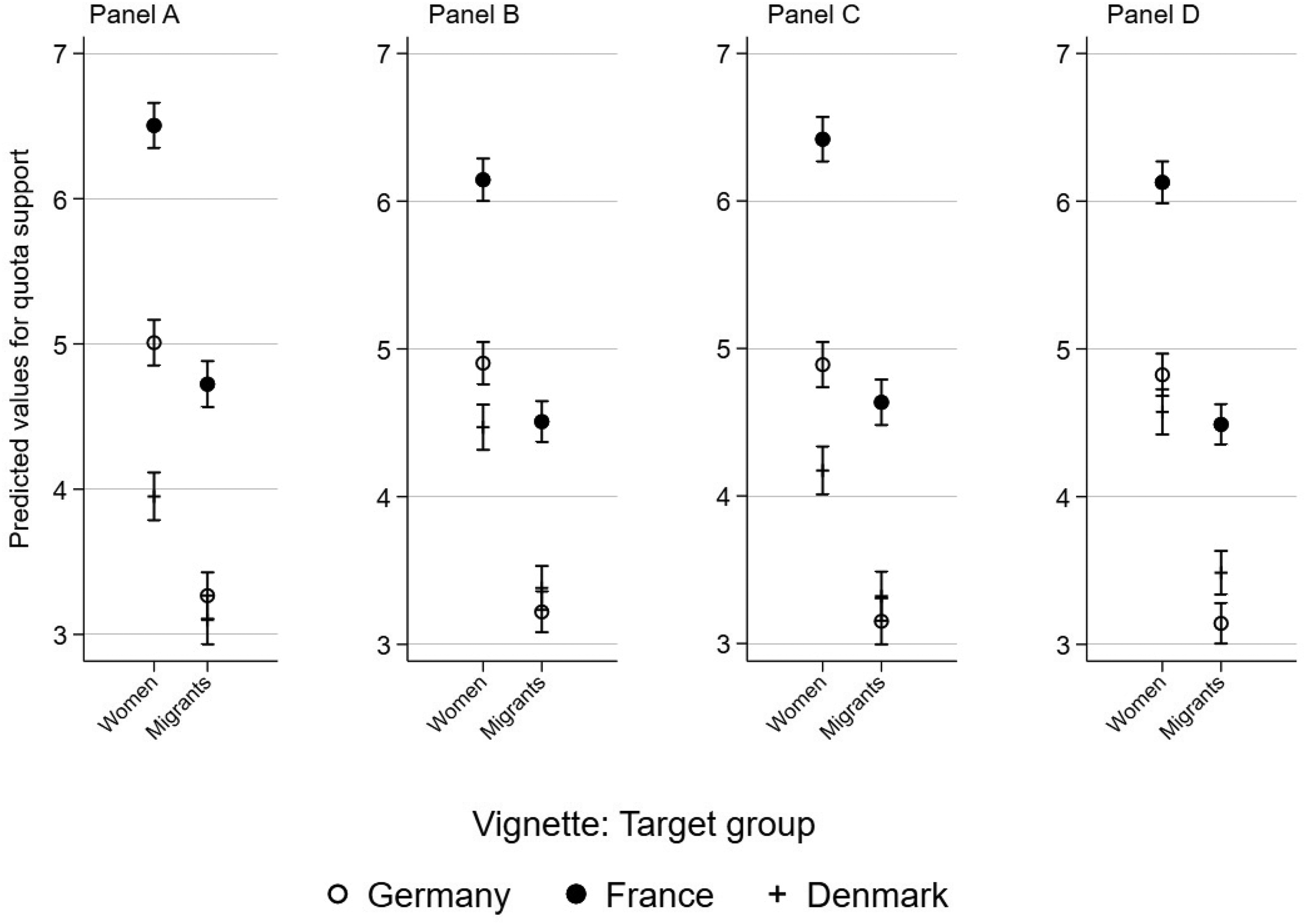
Predicted values of support for a quota in recruitment processes for women and migrants, by country. Note: Panel A: Main model. Panel B: controlling for prejudice against and perceived disadvantage of women and migrants (see Model 4 in Online Supplementary Material Table A.2). Panel C: controlling for support for state intervention (see Model 5 in Online Supplementary Material Table A.2). Panel D: controlling for prejudice against, perceived disadvantage of women and migrants, and support for state intervention (see Model 6 in Online Supplementary Material Table A.2). Source: Authors’ survey experiments with YouGov online panel (2018); sample N = 4264.
In Panel B of Figure 4 (see Model 5 in Online Supplementary Material Table A.2 for the corresponding regression coefficients), we introduced our measures of prejudice against migrants and women and perceived disadvantage of women and of migrants. Controlling for this set of attitudinal variables can explain a large portion of the gap between Germany and Denmark in support of AAP for women. However, these attitudinal variables only slightly helped to reduce the gap between the French respondents and the German and Danish respondents in their support for AAP for both target groups. These findings provide some support for our fourth hypothesis: country differences (at least differences between Germany and Denmark in support of AAP for women) are due to different levels of ethnic and gender prejudice and of perceived disadvantage of the AAP target groups.
In Panel C of Figure 4 (see Model 6 in Table A.2 for the regression coefficients), we introduced our measure of support for state intervention in the economy. This explained some of the differences between Denmark and Germany in the overall support of APP for women. By contrast, the predicted values for France remained stable once we controlled for attitudes towards state intervention. Thus, and here again, the fact that French respondents showed much larger support for AAP for both target groups than Germans is not due to different national levels of support for state intervention. Hence, our results partly confirm our fifth hypothesis, but only for German-Danish differences. Finally, Panel D (see Model 6 in Table A.2 for the corresponding regression coefficients) combined the measures of prejudice, perceived disadvantage and support for state intervention. Here again, we see that the German and Danish respondents held similar levels of support for AAP, while the French respondents supported AAP for both target groups to a significantly larger extent, when controlling for our set of attitudinal variables.
Robustness analyses
We performed several robustness analyses to verify the results of our study (see Online Supplementary Material B). First, we ran the regression models using only information from the first vignette each respondent was presented to examine whether the repetition of vignettes was associated with differences in respondents’ assessment of the hypothetical regulation (see Table B.1 in Online Supplementary Material B). Some of the relationships described above became non-significant when conducting the analysis only with the first vignette, presumably due to the power loss by using only one quarter of our sample. However, all coefficients were in the same direction and consistent with the results based on all vignettes. Second, we ran the regression models including migrants, with migration background operationalised as a binary variable (see Table B.2 in Online Supplementary Material B). As described in Endnote 1, we have no information on the country of origin of respondents with a migration background. Results show that a migration background was significantly positively related to support of the regulation. Other results did not differ from the ones presented above. Finally, due to the loss of cases resulting from the listwise deletion, we ran the regressions with an imputed version of income (Table B.3 in Online Supplementary Material B). While the imputation of income yielded 432 more cases in the regressions, the results were mostly identical with the non-imputed version.
Conclusion
The implementation of AAP for redressing inequality has been the subject of lively public debate in most Western democracies. The lack of empirical studies on support for and opposition to AAP outside of the US context is therefore striking. With this contribution, we want to highlight both the scientific and societal relevance of conducting comparative studies on this issue. Based on a unique international factorial experiment survey, our study enabled us to compare the support for AAP for two different target groups (i.e., women and persons of migrant origin) in three different countries (i.e., Germany, France and Denmark). Our results show that women, as members of a group largely underrepresented in positions of leadership, support AAP for both their own group and for other groups underrepresented in positions of leadership, in our case migrants, to a larger extent than members of the majority group. Thus, a group-interest based explanation is not sufficient to explain group differences in support for AAP. Indeed, our results point to the fact that members of an underrepresented group seem to perceive more solidarity towards members of other underrepresented groups and identify to a greater extent with them than do members of the majority. This, in turn, confirms the findings of previous (US) studies (e.g., Scarborough et al., 2019). Future studies encompassing larger samples of respondents from underrepresented groups would be able to assess the generalisability of our findings to members of other underrepresented groups in the cross-national perspective.
Moreover, not only individuals’ own attitudes and perceptions, but also the normative climate in a country with respect to how citizens view disadvantages of underrepresented groups and sources for these disadvantages, matter for the acceptance of AAP measures. In this context, what is important is not only how much inequality and disadvantage exist, but how they are usually perceived. Our results show that target group differences in support for AAP are mainly due to country differences in the levels of prejudice against the AAP target groups and of perceived disadvantage of target group members in the labour market. Investigating the generalisability of our findings to other potential AAP target groups would constitute another important future research avenue. Lastly, we were able to show that the differences between Danes and Germans in their level of support for AAP for women can be accounted for by differences in national levels of ethnic and gender prejudice, of perceived disadvantage of women and migrants, and of attitudes towards state intervention. All in all, prejudice against target groups and perceived structural disadvantage of target group members seem to play a particularly important role in both target group and country differences in support for AAP. Strikingly, however, neither these variables nor attitudes towards state intervention in the economy were able to explain why our French respondents show such a high level of support for AAP for both target groups. We can only speculate on the reasons why French respondents supported AAP for women and migrants to a much larger extent than their German and Danish counterparts, and why their support for AAP cannot be explained by our set of attitudinal variables, such as support for state intervention. France has a long tradition of state feminism, with the establishment in 1981 of a Ministry of Women's Rights focusing on gender equality in the labour market and women's rights (Bereni and Revillard 2007) or with the implementation in 2000 of a binding quota system for women in French politics (Bereni and Lepinard 2004). French citizens have therefore been socialised in a context in which policies supporting women's integration in the labour market have become self-evident state policies against inequality. By contrast, the Republican principle of liberté, égalité, fraternité implies a state colour blindness as the legal and political framework. This Republican principle of equality is internalised through the secondary socialisation in state schools among other things (Langan 2008). AAP as policies favouring persons because of their group membership contradict this Republican principle of equality. AAP favouring persons with a migrant background are therefore particularly controversial and disputed in the French context. This particular standing of AAP favouring persons with a migrant background in sharp contradiction with the shared understanding of the French Nation State might explain why attitudinal items such as support for state intervention cannot explain support for AAP favouring migrants among our French respondents. It admittedly cannot explain why French respondents support AAP favouring persons of migrant origin to a significantly larger extent than Danish and German respondents.
Turning now to the theoretical contribution of our paper, we showed the relevance of translating the deservingness theory for welfare programme and redistributive solidarity (van Oorschot, 2000) to the case of AAP. Three out of the five deservingness criteria (i.e., identity, attitudes and control) turned out to be powerful explanatory factors for target group and country differences in support for AAP. We want nevertheless to mention one main limitation of the deservingness theory for analysing support for AAP for different target groups. We operationalised the control criterion of deservingness with an item of perceived disadvantage of women and migrants in the labour market. The items we used only focus on the perception of disadvantage without measuring the causes for this perceived disadvantage faced by target group members. However, the reasons for the underrepresentation of women and of persons of migrant origin in management positions are hardly comparable. The underrepresentation of women in management positions in our selected countries results mostly from the particular challenges faced by women when combining family and career. By contrast, the underrepresentation of migrants in management positions in France, Germany and Denmark is mainly due to the lower propensity of migrants to hold the educational credentials required for such management positions. A more fine-grained assessment of the role of the deserving control criterion in support for AAP would require measures not only of the perception of disadvantage faced by the target groups but also of the perceived causes of this disadvantage.
Supplemental Material
sj-docx-1-asj-10.1177_00016993231163416 - Supplemental material for Public support for affirmative action policies favouring women and migrants in recruitment processes: An international survey experiment
Supplemental material, sj-docx-1-asj-10.1177_00016993231163416 for Public support for affirmative action policies favouring women and migrants in recruitment processes: An international survey experiment by Katja Möhring and Céline Teney in Acta Sociologica
Footnotes
Funding
This research was partly funded by the Deutsche Forschungsgemeinschaft (DFG), Collaborative Research Center SFB 884 ‘Political Economy of Reforms’ (grant number: 139943784), allocated to the first author, and the Heinz-Maier-Leibnitz price funding (DFG) allocated to the second author.

Notes
Author biography
References
Supplementary Material
Please find the following supplemental material available below.
For Open Access articles published under a Creative Commons License, all supplemental material carries the same license as the article it is associated with.
For non-Open Access articles published, all supplemental material carries a non-exclusive license, and permission requests for re-use of supplemental material or any part of supplemental material shall be sent directly to the copyright owner as specified in the copyright notice associated with the article.
