




Abstract
Separation often leads to worse economic consequences for women than for men. However, little is known about how economic consequences of separation play out for different groups of women. Women who are younger than their male partner are generally assumed to have lesser agency, but evidence mostly comes from contexts with low gender equality. Here, we examine women's benefit recipiency as a function of the partner age gap of their dissolved union. Using register data from Sweden, we examine whether women from man-older unions suffer greater economic disadvantage after separation, and whether patterns differ for ancestral Swedes and women with migrant background. Results from logistic regression models suggest that, post-separation, the uptake of social and housing benefits increases for nearly all groups of women. However, these data do not show any consistent disadvantages of women from man-older unions. Among ancestral Swedes, patterns differed by benefit type, and among women of African/Middle Eastern origin, benefit recipiency increases were inversely U-shaped to the age gap. Social norms do not appear to explain economic costs of separation, but may explain why the risk of separation itself differed between ancestral Swedish women and women with migrant background.
Keywords
Introduction
Separation, that is the dissolution of a marital or cohabiting union, is costly. If the couples who part ways have children, social, emotional and economic costs can be substantial when one household becomes two. The evidence to date from high income countries has established that following separation, women have greater drops in earnings, larger decreases in personal wealth and are more likely to receive welfare benefits than men (Bayaz-Ozturk et al., 2018; Leopold, 2018; Raz-Yurovich, 2013; Smock et al., 1999). The explanation for women's relative disadvantage after union dissolution is likely related to a host of factors linked to gendered division of labour between partners. In most high income contexts – including gender egalitarian ones like Sweden on which this study is based – women tend to take longer breaks from the labour market to care for children (Duvander and Viklund, 2019). Once back at work, they are more likely to work part time more than men (Halldén et al., 2012). In addition, women as a group tend to work in sectors and job types that are lower paying to begin with (Halldén and Härkönen, 2015), and partner with men who out-earn them (Chudnovskaya and Kashyap, 2020). The costs to women of different family dynamics become more visible once a union dissolves and each partner has to live independently.
While much attention has been paid to gender differences in the cost of separation, less focus has been placed on how such costs differ between women from different types of unions (see Van Winkle and Leopold, 2021 for an exception). In particular, little evidence exists on how costs of separation differ for women depending on the age gap between them and their (former) partner. This is an important omission because large partner age gaps in man-older unions, typically more than a couple of years, have been argued to be associated with lesser gender equality (Bozon, 1991; Rothstein, 2012), and to have adverse effects on women (Barbieri and Hertrich, 2005; Holland Jones and Ferguson, 2009). All else equal, man-older unions create incentives for a “traditional” family model with gender division of labour (female childbearing vs. male labour market engagement). This is because seniority in terms of age provides a head-start on the labour market and higher opportunity costs of childrearing activities for men relative to their younger partner (Rothstein, 2012). It is also possible (albeit rarely tested) that there is selection into man-older unions of individuals who favour a more “traditional” family dynamic. In both cases, women from man-older unions may become more economically disadvantaged following separation, compared to women from age-homogamous unions.
Conversely, the opposite hypothesis can also be formulated. Given that older men, all else equal, are more mature, have more resources and fewer reasons to compete with their partner, being younger than their male partner may enable women to complete higher education or pursue labour market activities of their own. If such assumptions hold, women from man-older unions may be more financially independent and, as a result, less economically vulnerable if the relationship were to dissolve. However, positive impacts of man-older unions may only be seen in contexts where women are free to seek specialisation from wage labour to the same extent as men, parenthood and labour market activities can be combined, and where both parents are expected to contribute to childcare. All of these conditions are present in Sweden (Duvander and Viklund, 2019) and therefore it is possible that man-older unions are not detrimental to women in this context.
The objective of this paper is to examine whether the costs of separation vary by partner age gap of the dissolved union. We examine this relationship among both ancestral Swedes and migrant women with African/Middle Eastern background, where man-older unions are common. The effects of man-older unions on women and the economic costs of union dissolution are two interlinked research topics, which we here combine. We take advantage of the diverse immigration to Sweden and examine whether consequences of age heterogamy are uniform or vary for natives and women with immigrant backgrounds. We use register data from Sweden, a country with high gender equality, female labour force participation and relatively high uptake of paternity leave (Duvander et al., 2021). Our examination is twofold: first, we explore the risk of separation from the first childbearing partner by partner age gap. Second, we examine the economic consequences (receipt of social and housing benefits) after separation by partner age gap. Recent research from Sweden has shown that partner age gaps differ for individuals with immigrant backgrounds (Uggla and Wilson, 2021). Specifically, women with African and Middle Eastern backgrounds have higher average partner age gaps compared to women with Swedish backgrounds. Because partner age gaps have been argued to reflect gender inequality, it is worth exploring whether in the Swedish context – one of the most gender egalitarian countries in the world (Oláh and Bernhardt, 2008) – different age gaps are linked to risk of dissolution and economic vulnerability among both ancestral Swedes and immigrant women.
Thus, we address the following research questions:
RQ1: Do women from man-older childbearing unions suffer worse economic consequences (social and housing benefit recipiency) following separation than women from age-homogamous, or woman-older unions unions? RQ2: Do the economic consequences of separation vary between ancestral Swedish women and women with immigrant origin?
Background
Economic consequences of separation
Being in a stable partnership is associated with a number of economic advantages for individuals. At the most basic level, individuals benefit from the income of their partners because couples often partially pool their income (Heimdal and Houseknecht, 2003). This not only gives each partner access to more resources, but also provides financial security. In addition, household cost per capita is lower as couples benefit from economies of scale as compared to single-person households (Browning et al., 2013). The dissolution of a union implies a loss of such benefits and often represents a significant economic shock. These challenges are magnified for women, and even more so when children are involved (Leopold and Kalmijn, 2016).
Research on gender differences in the economic consequences of partnership dissolution consistently show that women experience income decline after separation, while evidence for men is inconsistent and even suggests that incomes may increase post-dissolution (Andreß et al., 2006; Bayaz-Ozturk et al., 2018). As women typically earn less than their partners, they are more likely to suffer from the loss of spousal income, and are more likely to become the resident parent after separation, thus bearing higher household costs and lower per capita income (Mortelmans, 2020). Increases in employment post-separation, and the receipt of child support payments often fail to compensate for the loss of spousal income (Hogendoorn et al., 2020). This results in women – and particularly mothers – being more likely to rely on welfare benefits or to fall into income poverty after separation (Bradshaw et al., 2018; Hogendoorn et al., 2020; Hübgen, 2018).
Part of the reason that mothers fare worse economically than fathers after separation is related to gender inequality in paid and unpaid labour that exists prior to separation (Holden and Smock, 1991). Women have been shown to be more likely to work part time after childbirth in order to focus on childrearing, and this division of labour reinforces and strengthens already existing gender inequalities in earnings (Kennerberg, 2007; Nylin, 2020). After separation, return to full-time work is often not possible when mothers largely continue to shoulder a majority of parenting duties at least when the children are young (Mortelmans, 2020). Taken together, union dissolution places disproportionate economic burden on mothers by decreasing household income and increasing their economic disadvantage. However, there is variation across contexts in the consequence of separation. Welfare states can help to mitigate the severe economic burden placed on women. For example, the share of lone parents at risk of poverty ranges from 15% in Sweden to nearly 50–60% in the United States (Casey and Maldonado, 2012; Hübgen, 2018). Factors such as income-related welfare provisions, family policies and childcare provisions can help to relieve the economic consequences of separation. Notably, welfare benefits can amount to nearly 40% of household income of lone parents in countries with expansive welfare states (e.g. Sweden) (Bradshaw et al., 2018). It is the receipt of two such measures that we investigate in this paper.
To date, some scholars have considered the relative earnings of age (dis)similar partners when the union is still intact (Dribe and Nystedt, 2017). However, here we study the effect of man-older unions after union dissolution of childbearing unions. To examine the post-separation situation is important, as only then can we tell whether dynamics affect a woman's economic independence. Given that there is a large literature on women's income trajectories after separation (see Mortelmans, 2020 for review), we instead target the recipiency of welfare benefits (social and housing benefits). This decision is motivated by our interest in measures that clearly indicate that families need support from the state to meet a decent standard of living. In addition, we eschew thorny issues related to voluntary low salaries when children are young, a common consequence of high rates of reduced working hours among women in Sweden after childbearing (Roeters and Craig, 2014). Thus, our two measures reflect a more comparable and objective assessment of whether women need economic assistance in order to support themselves and their children.
Age gap trends and detrimental effects for women
Preferences among men (for younger women) and women (for relatively older men) are well-documented (Bhrolcháin and Sigle-Rushton, 2002) and exist in many cultures (Buss, 1989). Patterns of hypergamy (that women marry up in terms of social status) are also widespread across cultures. But throughout many Western countries, mean age gaps have decreased during the 20th century (Esteve et al., 2009; Kolk, 2015; Qian, 1998; van Poppel et al., 2001). This age gap decline has happened in tandem with increased gender equality and a higher ability to enter marriage on similar grounds across the sexes (Dribe and Stanfors, 2017). The simultaneous development of lower age gaps and women's agency in society and in couples, has led some to conclude that partner age gaps can be both a cause and a consequence of gender dynamics. Some evidence suggests that man-older relationships are associated with lower gender equality, within and between countries (Atkinson and Glass, 1985; Bozon, 1991; Casterline et al., 1986; Van De Putte et al., 2009). In sub-Saharan Africa, women with higher age gaps have lower access to contraception, even after controlling for the woman's education (Barbieri and Hertrich, 2005). In some historical studies, the age gap between spouses or partners has even been used as a direct proxy for a woman's agency, i.e. assuming that relatively younger women are less able to negotiate their position against their husband (Carmichael, 2011; Rotering and Bras, 2019). It is difficult to estimate how appropriate such general assumptions are. In some cases, younger women may have more – not less – bargaining power due to their youth and higher reproductive value (Pawłowski and Dunbar, 1999).
The notion that women are disadvantaged in unions with older men seems to be based mostly on contexts where gender equality is low overall, and often health outcomes has been the focus. It is not evident that any argument of lower agency of women in man-older unions is generalizable across contexts or extends to other types of outcomes. However, resource theory (Blood and Wolfe, 1960, Shelton and John, 1996) posits that the individual with more resources (e.g. income or education) has greater bargaining power within the relationship and can negotiate lesser involvement in domestic tasks and more investment in their own career. If this assumption holds, it should lead to women in man-older unions – even if the age difference is small – being more economically disadvantaged following separation.
Potential benefits of man-older unions
The detriments to women of man-older unions have been frequently highlighted, but studies rarely point to the benefits older age in a partner might confer to women. The fact that man-older unions are widespread – and persist despite considerable decline in the past century (Kolk, 2015; van Poppel et al., 2001) – begs the question what benefits women gain from such unions. Unless women are coerced into unions preferred by men, man-older unions may not universally have pernicious effects on women. All else equal, older men have more life experience and more resources than younger peers. Consequently, an older partner who has established himself on the labour market and has higher financial means might enable a female partner to focus on her employment. Because both partners do not simultaneously have to make initial important investment in careers, there may be benefits related to “less career competition”. Older men are more likely to have had a family before, and some may wish to be more active in childrearing the second time around, leading to a gender shift in midlife (Pyke and Adams, 2010). Moreover, a higher income or education of older men may aid in outsourcing household tasks such as cleaning and childcare, that otherwise disproportionally fall on women (Cornelisse-Vermaat et al., 2013). If so, one might expect that the economic consequences for women if dissolution occurs, should be less severe than in age-homogamous or woman-older unions.
Social norms
The social norm argument invokes a frequency-dependent thinking and third-party influence (see Kalmijn, 1998). If social norms have large influence, we expect that the economic consequences for women could be greater in couples who break the age-gap norm within their ethnic group. In our study, this would be considerably man-older unions among women with Swedish background and woman-older unions among the women with Africa/Middle Eastern background. Previous work from the Nordic context has demonstrated that the link between the age gap and women's income during marriage is weak (Carollo et al., 2019) and that age-homogamous partners earn more, not less (Dribe and Nystedt, 2017). Although the underlying reasons for this pattern are unclear, it is possible that ancestral Swedish women who separate from age-homogamous unions may suffer the lowest economic costs. However, man-older unions are likely to be the norm among groups where marriage is still somewhat instrumental and family structures are traditional, female age at childbearing preferably early, and the main earning responsibility lies on the man (Dribe and Stanfors, 2017). If social sanctions, e.g. from disapproving family or friends are incurred if one diverts from a culturally prescribed pattern, then this in itself likely provides a benefit to man-older unions for some immigrant women. With this background, we formulated the following hypotheses:
H1: Based on sociological resource theory, women who separate from man-older unions should be more economically disadvantaged, than women separating from more age-homogamous unions or woman-older unions. We expect this to be the case both in the group in which the average age gap is low (ancestral Swedes) (1a), and among women of African/Middle Eastern background (1b). H2: Based on the “less career competition” perspective, women separating from man-older unions should be less economically disadvantaged, among both ancestral Swedes (2a), and among women of African/Middle Eastern background (2b). H3: Based on the social norms perspective, women who enter unusual union types for their ethnic group, should be the most economic disadvantaged after separation. Consequently, economic costs will be most apparent among man-older 6 years or more among ancestral Swedes (followed by woman-older unions) (3a), but among woman-older unions, followed by intermediate age gap-unions among women of African/Middle Eastern background (3b).
We expect that if women are largely unaffected by separation, their odds of receiving social and housing benefit should not increase steeply following the year of separation. The lagged dependent variable (i.e. benefits recipiency) allows us to compare economic conditions prior to and after separation. To understand the risk of separation event itself for these women, we also run survival analyses for union dissolution.
The Swedish context
In Sweden, the partner age gap of first childbearing unions declined from approximately 3.5 years in the 1930s to around 2 years in the 1960s onwards (Kolk, 2015). The fact that the mean age gap has been constant around 2 years (man-older) is helpful for our purposes as it indicates a stable age gap norm among Swedish-born individuals. Moreover, the trends are very similar for childbearing unions and for spouses. However, during the end of the 20th century, there was also an increase in the number of unions in which the woman is older than her male partner, implying that norms of hypergamy (women partnering up) have become less strict (Kolk, 2015). Overall, age gaps are higher (more man-older) among individuals who have lower education, and have a foreign-born partner (Gustafson and Fransson, 2015). Mixed marriages (intermarriages) often have high (man-older) age gaps and marriage migration to Sweden is associated with high (man-older) age gaps (Niedomysl et al., 2010).
In this study, we focus on childbearing unions among ancestral Swedes and immigrants from Africa and the Middle East (and their descendants) who have a high average age gap. We ask, is there patterned variation by partner age gap in the economic consequences of separation for women (RQ1), and are any patterns uniform across background (RQ2). RQ2 stems from the possibility that partner age gaps might not have the same impact on separation and its consequences among groups where man-older unions are common and groups where they are rare. For instance, Erman and Härkönen found that effects of parental separation on educational achievement among Swedish migrants were weaker among groups where separation is common (2017).
In Sweden, there is large variation in the mean age gaps of different immigrant groups and their descendants. Uggla and Wilson (2021) show that among women from Africa and the Middle East, age gaps are notably higher than the Swedish norm, but over time there is considerable intergenerational adaptation in age gaps between partners among immigrants. However, little is known about whether these age gaps are detrimental to women in Sweden, regardless of background. Comparing women with Swedish to those with African or Middle Eastern background, we have to keep in mind that patterns of family formation, partner choice and separation sometimes differ among immigrants and ancestral Swedes. Immigrants from Africa and the Middle East are a diverse group of people and here we only describe some general patterns at the aggregate level.
We include immigrants from Somalia, Eritrea, Ethiopia, Egypt, North Africa (except Egypt), Lebanon, Syria, Iran, Iraq and Turkey, other African and other Middle Eastern countries, according to the Statistics Sweden country classification. Compared to ancestral Swedes, immigrants from the Horn of Africa and North Africa, the Arab Middle East and Iran have rather high rates of entry into first marriage, divorce and remarriage (Andersson et al., 2015). However second generations do not differ much from their parents’, indicating a socialization effect in family trajectories (Andersson et al., 2015). Separation among Swedish parents is common: approximately 30% of children by the age 15 experience a parental separation (Thomson and Eriksson, 2013). Figures are similar among children with an Iranian-born mother, whereas children of Iraqi and Turkish mothers have lower separation risks, around 25% and 20% by age 15, respectively (Erman and Härkönen, 2017). Among women with Swedish background, it is common that both parents share childcare responsibilities after separation – up to 40% of children alternative to live with their mother and their father (Fransson et al., 2018), with lower frequencies among foreign born (Turunen et al., 2017). The custody of children is joint by default and alimony is less important than in many other contexts. Following divorce, the most disadvantaged spouse is, during a transition period, entitled to alimony payments. However, alimony is not an obligation at the dissolution of a cohabiting union (Avdic and Karimi, 2018).
Data and methods
The data of this paper is based on a collection of data called Migrant Trajectories from Statistics Sweden (SCB). Data are accessed through SCB's micro-online access system, MONA. Individuals enter the registers when they are born (if Swedish-born), or when they obtain a resident permit or register their immigration (a requirement to live in Sweden). Swedish register data offers longitudinal data with complete birth and union events for parents, along with information on registered addresses of all parents. Children and parents can be linked through (anonymised) personal identification numbers (as long as they have lived in Sweden at some point in time). This means that we can capture childbearing histories of all women living in Sweden, both those who immigrated and the second generation. Socioeconomic factors such as education and subsequent welfare benefits are also linkable through the personal identification number. The longitudinal nature of the data, and the breadth of indicators is key to our research questions which are essentially examining trajectories of different union types.
Swedish registers also have a large number of immigrants from diverse countries. Part of our objective is to compare trajectories of man-older unions between ancestral Swedes and immigrant women who are likely to have different social norms related to man-older unions. For this purpose, we have opted for immigrant women (and their children) from Africa and the Middle East, where we know that mean age gaps are high and man-older unions common in Sweden (Uggla and Wilson, 2021) and in the origin countries (Ni Bhrolchain, 2006). Our aim is not to carry out a comprehensive examination of the stability and consequences of man-older unions in all different immigrant groups, rather, we are interested in those that lie at opposite ends of the spectrum (cf. Uggla and Wilson, 2021), and may have “culturally distant values” (Dribe and Lundh, 2012). We define women with immigrant background from Africa or the Middle East as those who were born in the African and Middle Eastern countries listed above, or Swedish-born women (second generation) whose both parents were born in any of those countries. Among first generation immigrants, we include those who had their first child in Sweden and arrived before age 45. The so-called 2.5 generation, individuals with one Swedish-born and one foreign-born parent, are excluded to reduce uncertainty about what environments and norms they have been exposed to. We also exclude women who had less than 5 years between immigration and their first child. This is to only include immigrants who have had a chance to establish themselves on the labour market, and for a more reliable estimate of benefit recipiency (newly arrived individuals are overrepresented as benefit recipients) (Franzén, 2001).
We include women who have their first birth between 1997 and 2015, in Sweden to a known partner who resided in Sweden at the time of birth or the year after. This is because we are interested in examining ever-cohabiting childbearing unions, and their risk of dissolution and economic consequences subsequently. We take the perspective of the women, because our aim is to compare women from different types of unions rather comparisons between the genders. 1997 is our start year because since that point, the requirements of the housing benefit have remained constant. We include only individuals who have consecutive observation years to ensure we know their activity every year since childbearing. Separations are defined as not being registered at the same address (or partner's address being missing). Individuals who are registered as moving in and out with their partner multiple times are excluded (approximately 3% of couples). While individuals might not be registered with their partner at every year even if the union is intact, we exclude these cases for a conservative and more reliable estimate of whether the union is intact.
We focus on childbearing unions (as opposed to all married unions) because division of labour tied to childcare vs. labour market activities are at the core of our research question. Moreover, about half of childbearing unions are not marriages when the first child is born (Thomson and Bernhardt, 2010). For the Swedish context, focusing on childbearing unions also has the advantage that we can detect whether partners are coresiding. Unions where the parents are not coresiding at the year of birth, nor in the subsequent year are excluded. The childbearing union has to be the first for the woman, but her male partner may have had other children previously. This is important to our research question, as excluding men who have had partners previously would exclude many potential partners and unions of interest. Lastly, because intermarriage increases risk of dissolution compared to ethnically endogamous unions (Dribe and Lundh, 2012) we focus solely on childbearing unions between Swedish-born and other Swedish-born, and immigrants from the African or Middle East with other immigrants from the same countries.
Our key independent variable is partner age gaps. Partner age gaps are based on male age minus female age in calendar years, and categorised into woman-older, man-older 0–2, man-older 3–5 years, or man-older 6 years or more. These categorisations capture a relatively large proportion in each, although the distribution differs between women of Swedish and African/Middle Eastern origin (see Table 1).
Demographic characteristics (at woman's first birth) and social and housing benefit recipiency (when first child is 1 year), by partner age gap. Includes women (of any age) who have their first birth 1997–2015.
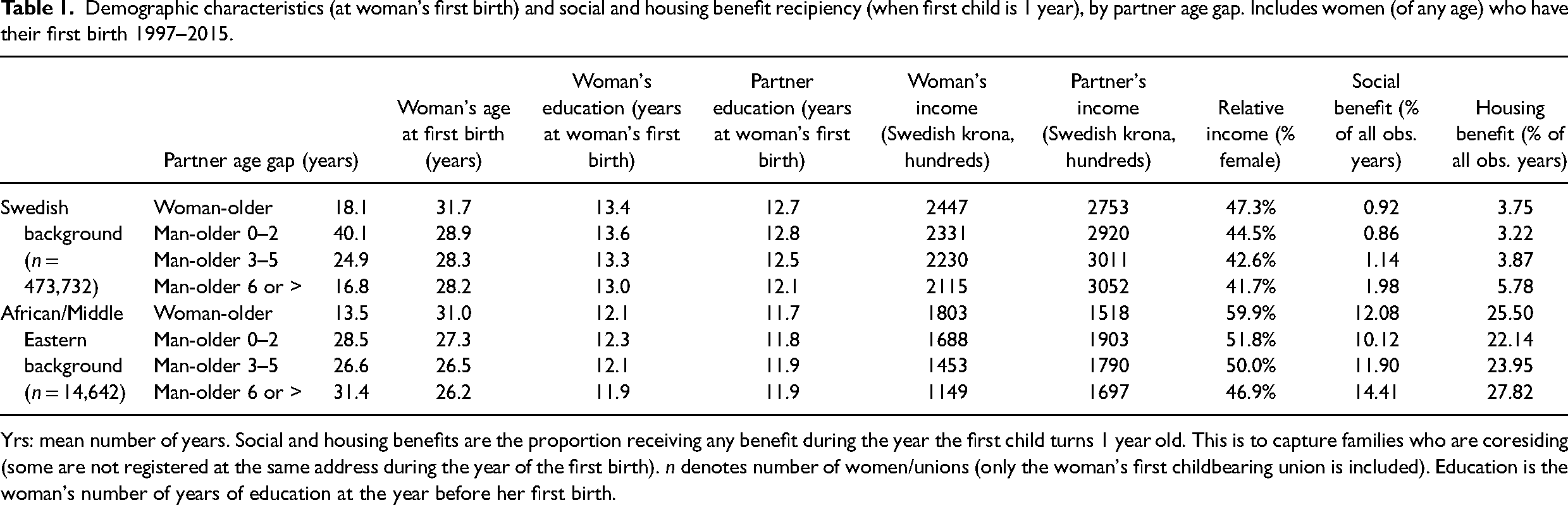
Yrs: mean number of years. Social and housing benefits are the proportion receiving any benefit during the year the first child turns 1 year old. This is to capture families who are coresiding (some are not registered at the same address during the year of the first birth). n denotes number of women/unions (only the woman's first childbearing union is included). Education is the woman's number of years of education at the year before her first birth.
Social and housing benefit
Our two benefits outcomes are constructed as a binary measures, because we are interested in whether individuals receive “any” support of the kind during the calendar year. Social benefit (Försörjningsstöd, Ekonomiskt bistånd, formerly known as Socialbidrag) is the more restrictive of the two, and can be attained only if the individual has no other valuable assets. The Swedish welfare state has other types of benefits that are typically predicated on past employment, but among individuals who have no or little previous work, social benefit has been deemed the last income safety net (Gustafsson, 2013). To receive social benefit an application has to be made to a social welfare office, and an appointment with a social worker is sometimes part of the procedure. All individuals residing in Sweden are eligible, but immigrants who recently arrived (excluded in our data, see above) are instead entitled to an introductionary compensation (Introduktionsersättning), nearly identical to social benefit. The family unit has to have a low total income and be unable to earn an income through other means. Thus, any valuable assets such as a car have to be sold to be eligible. The actual value is calculated by a norm for living expenses that varies across the country depending on regional living costs. Single parents are overrepresented as recipients (three to four times higher than cohabiting parents) and foreign citizens are approximately six times more likely to receive social benefits than Swedish born (Halleröd, 2003). Housing benefit is a means-tested welfare benefit that can be applied for by families with children and eligibility depends on income level, one's cost of housing and number of children. It is more common than social benefit: in 2002, 60% of single parents, and 15% of all households in Sweden received housing benefit (Chen, 2006). The objective is to support households during periods of difficulty.
Analyses
Separation risk
We first examine the event of separation itself. The time at risk starts when mothers had their first birth (any time 1997 and 2015), and couples are followed until 2016 or until separation occurs. We plot Kaplan–Meier survival curves, and use Cox proportional hazards models to examine the risk of separation by the partner age gaps. Analyses are stratified by ancestral/immigrant background. We present the results as Kaplan–Meier curves by the partner age gap, to give an estimate of the proportion of women that experience the separation and its timing. We additionally estimate the risk of separation using Cox proportional hazard models to control for demographic and socioeconomic characteristics. The Cox model does not require specifying a baseline hazard, and does not assume any specific shape of the underlying function (Therneau and Grambsch, 2000). Covariates in the Cox models include the woman's age at first birth (categorical), the woman's highest educational level at first birth(primary, secondary, tertiary, missing), partner's highest education at birth year, woman's income (the year prior to the first birth, in quintiles), partner's income at childbearing (quintiles), marital status at childbearing (married/unmarried) and number of children (time-varying). In the migrant models we also control for country of origin. (For more details, see Supplementary Table S1.)
Costs of separation
Our main aim is to examine whether the receipt of benefits following separation varies by age gap of the former union. The population under study here comprises only women who did experience a separation. However, we observe each woman from 2 years before to 2 years after separation. This is achieved by a time variable with the following categories: -2 years prior to separation, -1 year prior, 0 is the separation year (when parents are no longer registered at the same address), and +1 and +2 the subsequent years. Our time frame was chosen to capture a short time before and after and including as many unions as possible. The strength of this design is that we are able to examine how economic resources are developing prior to the year of separation. We perform logistic regressions stratified by partner age gap. To account for the fact that the data has a panel structure with multiple observation years per woman (max 5 years), we specify population-averaged effects and estimate robust standard errors. We adjust for the same variables as for separation risk (see Cox models above) and in addition the duration of union/age of oldest child (time-varying) and the woman's activity (employed, parental leave, student, unemployed or inactive) (time-varying). The activity is determined by the highest amount received from each of those sources (or 0 for inactive) for each calendar year. By adjusting for partner characteristics at the year of the birth, we capture at least some aspects of differential selection into unions of different age gaps (as evident in Table 1). The odds ratios are plotted in Figure 2, and all models consider two groups: ancestral Swedish women and immigrant women from Africa/Middle East and their descendants (see Supplementary Table S2 for proportions of ancestry groups and second generation vs. foreign-born).
Results
Table 1 shows that ancestral Swedish women in man-older unions have lower age at first birth, lower education and lower income at childbearing, and are more likely to receive both types of benefits (when the child is 1 year old). This relationship is dose dependent and implies that for intact unions, economic hardship is higher among couples where the man is older than the woman. However, when examining partner characteristics the picture is more complex. Among women with Swedish background, partner's income is higher and woman's share of income (within the couple) is lower in more man-older unions, whereas partner's education is lower in more man-older unions. Among women of immigrant origin, the woman's share of income is also higher among woman-older couples, but the women with the highest-earning partners are those with an age gap of 0–2 years man-older. Overall these descriptives show that there is differential selection based on demographic and socioeconomic factors into different unions, and that such factors vary between ancestral and immigrant women.
Figure 1 shows the risk of separation since year of the couple's first child. Among women with Swedish background, separation risks are largest among man-older couples of 6 years or more. Couples where the woman is older, or the man is 3–5 years older have an intermediate risk, whereas couples where the man is 0–2 years older have the lowest risk of separation. Among women of African or Middle Eastern background, however, the man-older 6 years or more and woman-older couples have the greatest separation risk, followed by man-older 3–5 year and man-older 0–2 years. Moreover, the differences between age gap categories are smaller. Among women with Swedish background, couples where the man is older by 6 years or more show higher separation risk almost immediately after the birth.
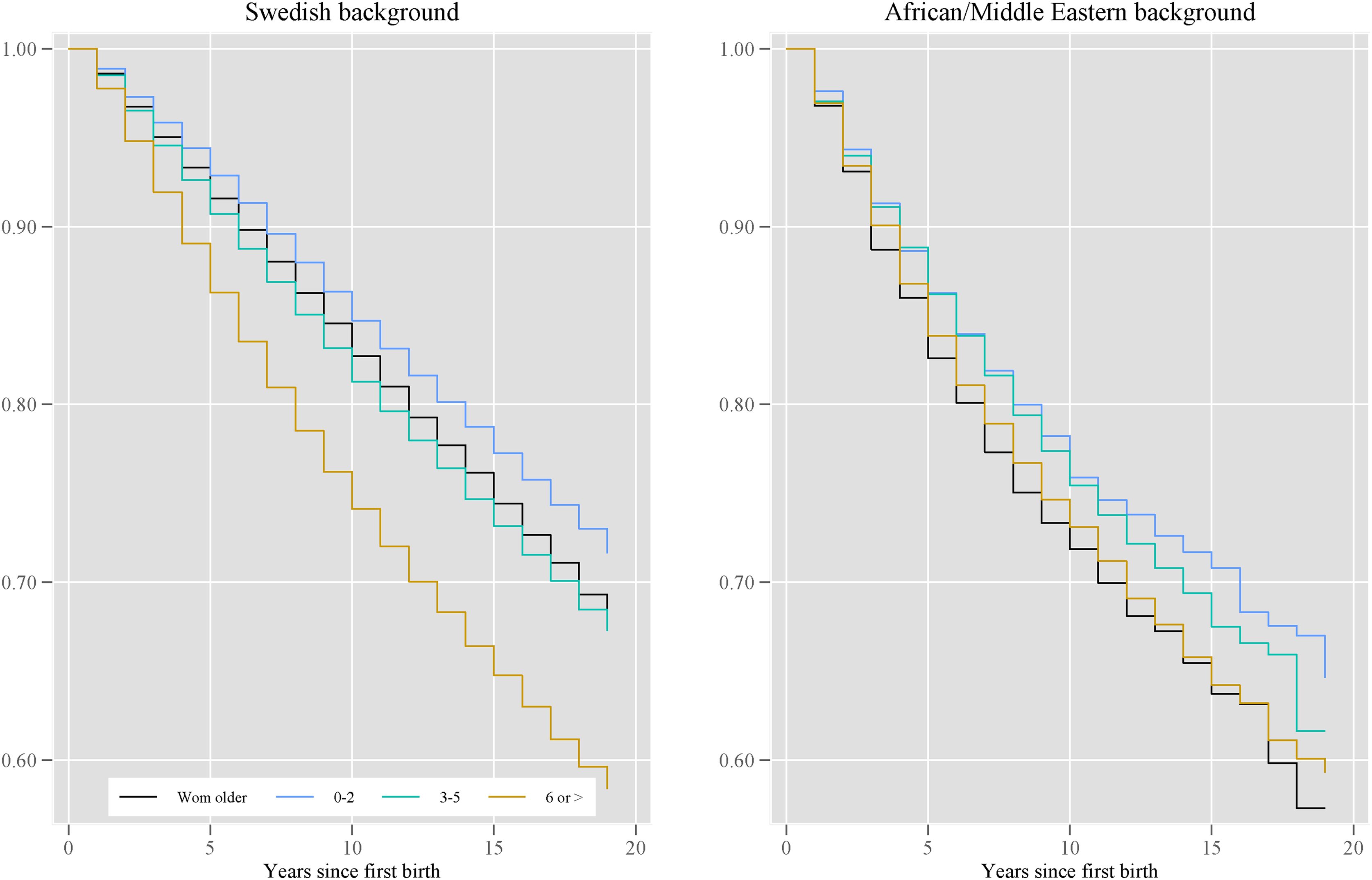
Kaplan–Meier plot for proportion of intact unions, by age gap category (woman-older man-older 0–2 years, man-older 3–5 years, or 6 or more years man-older, and woman's background. Includes women (of any age) who have their first birth 1997–2015. Note: includes only ancestral–ancestral Swedish (left) or immigrant–immigrant (right) childbearing couples.
In the Cox models (Table 2), women of Swedish origin face the highest separation risks if in a man-older union (man 6 years older or more). The hazard ratio decreases after adjustment for covariates but still notably higher). Woman-older unions have the second-highest separation risks, and the lowest risks are found among 0–2 year man-older couples. Among women of African or Middle Eastern origin, separation risks are highest among woman-older unions. Women-older disadvantage remains after controlling for various demographic and socioeconomic variables but there were no significant differences in separation risk between man-older, 0–2, 3–5 or 6 or more years for women with migrant background. Overall, separation risks seem greater among the types of couples that are rarer within each group. (For full models with covariates, see Supplementary Table S1.)
Cox models for risk of separation by age gap of union, unadjusted and adjusted hazard ratios with p-values in parenthesis.
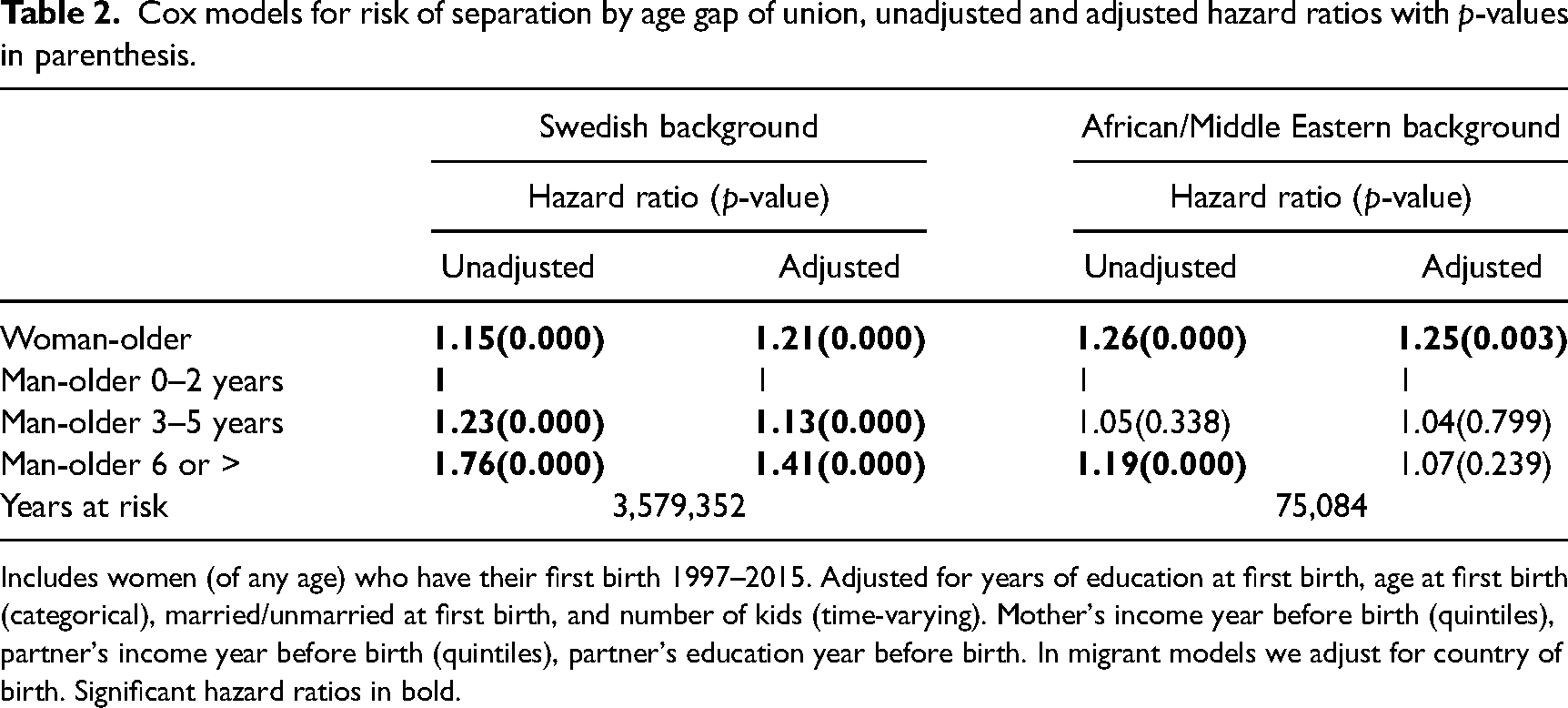
Includes women (of any age) who have their first birth 1997–2015. Adjusted for years of education at first birth, age at first birth (categorical), married/unmarried at first birth, and number of kids (time-varying). Mother's income year before birth (quintiles), partner's income year before birth (quintiles), partner's education year before birth. In migrant models we adjust for country of birth. Significant hazard ratios in bold.
Cost of separation
Table 3 shows the percentages of individuals receiving social and housing benefit, one year prior to, and one year following separation, by age gap category. (Note that we cover also −2 to +2 years in the models, but all 5 years are not shown here to allow for easier comparison.) There are large differences in the increases after separation as opposed to prior, but baseline level differences based on age gap categories are relatively small. In line with prior research (Franzén, 2001), results also show that immigrants or descendants of immigrants from Africa/Middle East have higher rates of benefit recipiency than ancestral Swedes.
Percentage of women receiving any social and housing benefits, by age gap category, in the year preceding separation, and the year following separation.
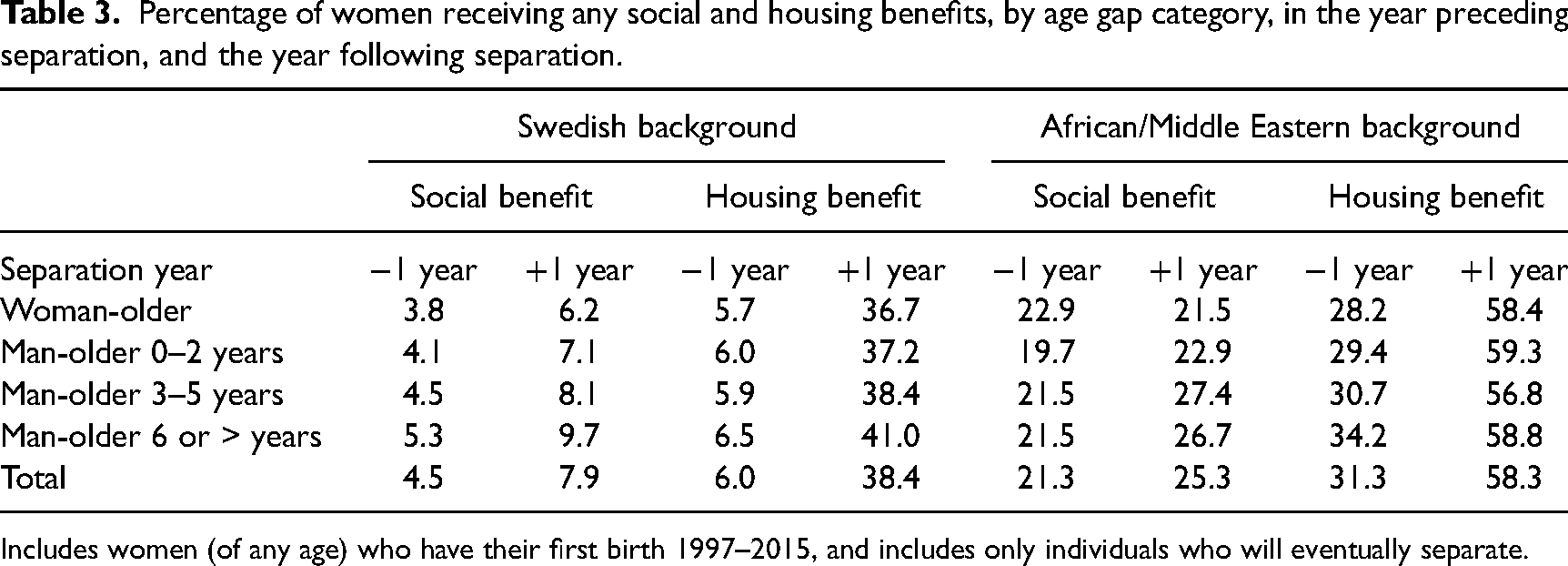
Includes women (of any age) who have their first birth 1997–2015, and includes only individuals who will eventually separate.
In Figure 2, among all women the odds of receiving economic benefits increase after separation. (For full models, see Supplementary Tables S3–S6.) The only exception is migrant women from woman-older unions, who have no statistically significant increases in the odds of social allowance. Among ancestral Swedish women, the social benefit increase is smallest among women from women-older unions, whereas the three man-older groups have somewhat higher odds. For housing allowance, the relationship is the reverse – ancestral Swedish women from woman-older unions have the highest increase in odds, though there is some overlap with the category man-older 0–2 years. Thus, hypothesis 1a – worse economic consequences among ancestral Swedish women from man-older unions holds only partially for social benefit and does not hold for housing allowance. It was surprising that increases for Swedish origin women from age-homogamous couples appear similar to those of women from unions where the man was 6 or more years older.
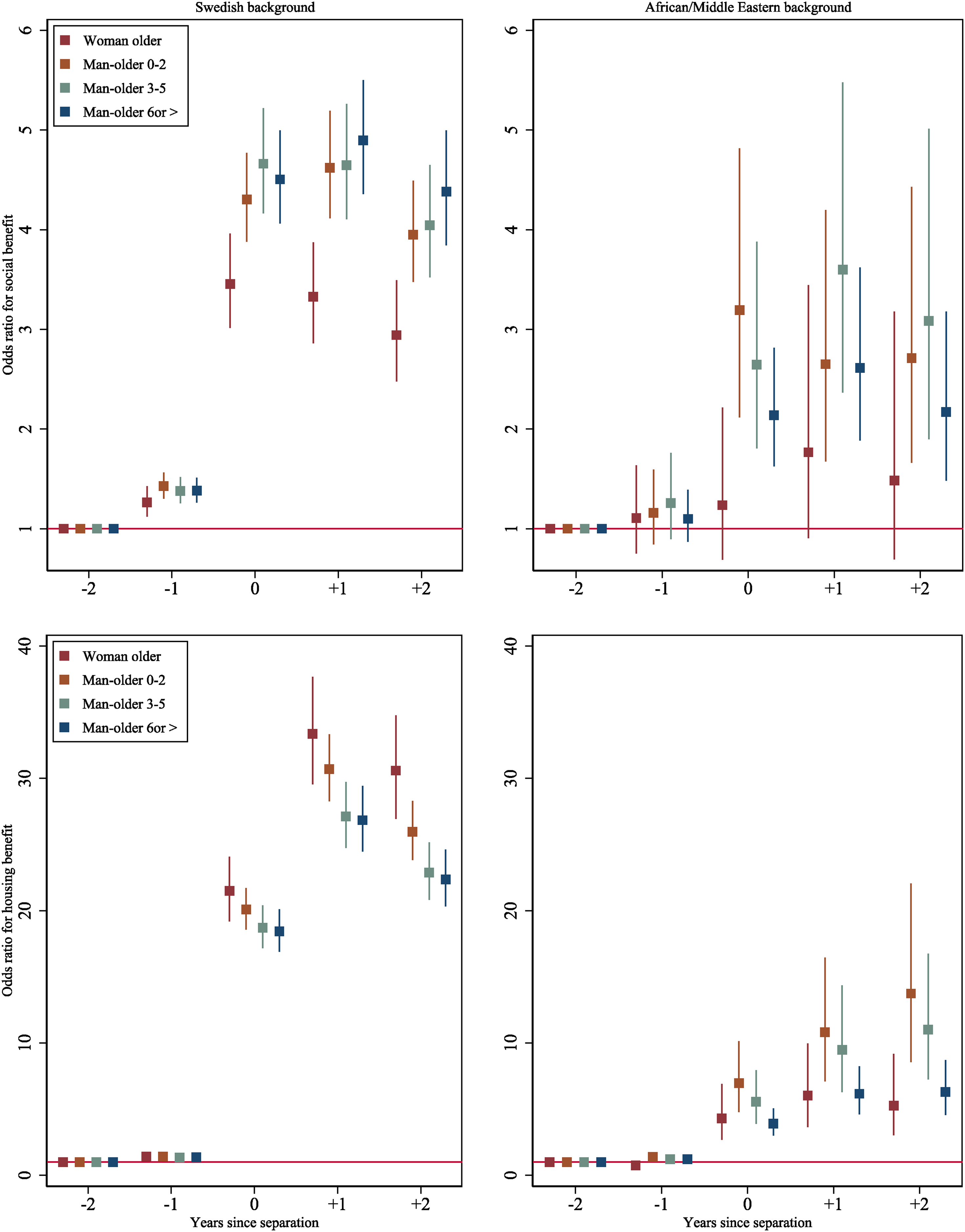
Benefit recipiency by separation timing, receipt of any social benefit (top panel) and housing benefit (bottom panel), by Swedish background (left panel) and African or Middle Eastern background (right panel). Includes women (of any age) who have their first birth 1997–2015. Results are shown as odds ratios with 95% confidence intervals.
Among women with migrant background, separating from women-older unions is the only group without significant odds increase after separation. This is in line with hypothesis 1b, but counter to both hypotheses 2b and 3b. However, the relationship for housing benefit is reversely U-shaped; migrant women from woman-older and the most man-older unions have the lowest increases following separation. This suggests some support for hypothesis 3b, the importance of social norms.
Discussion
Whether the cost of separation varies as a function of the age gap of the dissolved union has been largely unexplored. Our study is the first to examine patterned differences by partner age gap on risk of separation and woman's economic benefit recipiency after dissolution. These data do not support the idea that man-older unions are universally detrimental to union stability or women's economic situation after separation. In contrast, they suggest that union types which are more rare – as man-older by 6 or more years among Swedes and woman-older among immigrant women have heightened separation risks.
Overall, the economic predicament of women who have separated from man-older unions was not significantly worse than women from more age-homogamous unions. The hypotheses derived from sociological resource theory of lower agency among relatively younger female partners were not universally supported. Although ancestral Swedish and immigrant women from woman-older unions had lower social benefit increases, differences between unions of women from man-older unions of 0–2 years and 6 or more years were small. This goes counter to the perspective that women enjoy benefits of older men post-separation (hypotheses 2a and 2b), e.g. through not competing over career opportunities. However, when considering housing benefits, the results shift; the women from woman-older unions had higher increase in odds of housing benefit than women from age-homogamous unions. This would be the clearest indication that having non-overlapping careers may be beneficial but was only seen among the Swedish sub-sample and relative differences were fairly small given the high odds. It is possible that women from women-older unions having higher increases in housing benefits post-separation reflects a higher tendency of these women to be in their own household, and therefore a sign of higher economic standing. Lastly, we conclude that the framework invoking social norms may help explain some differences in for whom separation is likely to occur in the first place, but does not show a coherent picture in the analyses of the economic consequences (i.e. no support for hypotheses 3a or 3b).
Across the board, union dissolution incurred increased risk for women of not being able to support themselves and their children on earnings only; odds of receiving both types of benefits increased after separation for women of Swedish and African/Middle Eastern background alike. This is in line with the large body of previous evidence that has mapped poverty risk and income loss in women following union dissolution (Mortelmans, 2020). The lower increases in social benefits among Swedish women from woman-older unions may be related to the fact that they have higher incomes at first birth than women who enter man-older unions. Women from woman-older unions have partners who earn less than men in man-older unions. The idea that women in man-older unions would be better off due to the man's relatively older age, and higher attachment to the labour market, is not consistent with earlier research showing highest incomes among age-homogamous couples (Dribe and Nystedt, 2017).
These results point to larger relative economic disadvantage following union dissolution for Swedish women than women of immigrant origin. These differences are likely driven by considerably higher baseline levels of benefit recipiency among immigrant women, but were nonetheless unexpected. Thus, concluding that women of Swedish origin experience a starker shock of separation may be correct given their relative increase after dissolution, but overall, immigrant women in our data are more disadvantaged economically when unions are intact. We caution against simplistic interpretations and believe the development of trajectories have to be seen in conjunction with their relative starting point.
Immigrant women as a group have a double disadvantage on the labour market (Le and Miller, 2010; Rebhun, 2008), that might be even stronger in families where the husband is her senior. However, the fact that we did not find stronger disadvantages among the immigrant women in our data may also suggest that age at first birth and women's education might account for most of the potential effects of “traditional” family norms. Also, some countries of origin included here, e.g. Iranians have relatively low average age gaps to begin with (Uggla and Wilson, 2021). An important point is that many of the women with immigrant background in our sample were child migrants (62%) and second generation migrants (15%), with long exposure to Swedish society. It is possible that costs of man-older unions would be appear if the characteristics of our immigrant sample had been different. From previous research we know that second generation migrants, have very similar marriage and divorce rates (Andersson et al., 2015), and age gaps as ancestral Swedes (Uggla and Wilson, 2021).
The economic disadvantage examined herein is economic dependency on sources other than earnings after union dissolution. We believe that our two measures, one more restrictive (social benefit) and one fairly common (housing benefit) capture well the different disadvantages faced by women after separation. While individuals might choose to decrease work hours, especially following the birth of the first child, our measures of benefit recipiency target individuals who are living on such low incomes that the state deems it below the necessary standard of living. It is possible that other patterns would become visible with a longer perspective, but we considered a relatively narrow time frame in order to reduce the possibility of different types of living arrangements that may arise over time. Our 5-year snap shot provides insight into critical time points before and after union dissolution.
Our analyses allow disentangling the effects of separation on economic outcomes by conditioning on the economic position of individuals prior to the separation. This is important because economic hardships may actually lead to separation and cause us to overestimate the economic effects of separation. It is important to note that our research design compares the economic predicament of women before and after separation at the household level. This means that it is both partners’ incomes combined that determine whether benefits are received prior to separation. After separation it is based on women's new household (her own income or any other co-resident adults). We cannot rule out the possibility that there are patterned differences in post-separation living arrangements (i.e. if women from man-older unions are more likely to rely on family support or a new partner) conceal differences economic disadvantage following separation, even with our short time frame. Therefore, these results should be interpreted as the post-separation trajectories of women from different age gap unions – and whether they rely on support from the state. Given that our data are drawn from national registers, it is possible that the year of separation is not the actual year when two individuals part ways. However, previous research indicates that this is a reliable measure of who is actually living with whom (Thomson and Eriksson, 2013).
A crucial contribution of our study is that it targets dynamics of partner age gaps in a highly gender egalitarian context. Some previous evidence suggests that the economic consequences of separation vary by union type; the effect of separation on women's income was less negative among cohabiting, as opposed to married couples in Canada (Le Bourdais et al., 2016). However, whether this reflects larger economic costs for women from “more traditional” families may be a different question. The results presented here are in line with previous findings on age gaps and women's earnings from Denmark (Carollo et al., 2019) and Sweden (Dribe and Nystedt, 2017) that did not find any clear disadvantage on women's incomes in intact man-older unions. Further work from different contexts, and where possible different groups within countries, will help to elucidate the impact of separation on women's economic independence.
Supplemental Material
sj-docx-1-asj-10.1177_00016993221136050 - Supplemental material for Are women from man-older unions economically disadvantaged following separation? Sweden 1997–2015
Supplemental material, sj-docx-1-asj-10.1177_00016993221136050 for Are women from man-older unions economically disadvantaged following separation? Sweden 1997–2015 by Caroline Uggla, Eleonora Mussino and Siddartha Aradhya in Acta Sociologica
Footnotes
Author's Note
Caroline Uggla is also affiliated with Åbo Akademi, Åbo, Finland.
Funding
The author(s) disclosed receipt of the following financial support for the research, authorship, and/or publication of this article: This work was supported by the Forskningsrådet om Hälsa, Arbetsliv och Välfärd, NORFACE European Commission Horizon 2020, Riksbankens Jubileumsfond (grant number 2016-07105, 2018-00310, 724363, M18-0214:1).

Supplemental material
Supplemental material for this article is available online.
Author biographies
References
Supplementary Material
Please find the following supplemental material available below.
For Open Access articles published under a Creative Commons License, all supplemental material carries the same license as the article it is associated with.
For non-Open Access articles published, all supplemental material carries a non-exclusive license, and permission requests for re-use of supplemental material or any part of supplemental material shall be sent directly to the copyright owner as specified in the copyright notice associated with the article.
