



Abstract
This article demonstrates the disadvantages that students leaving special needs schools (Förderschule) face in their school-to-work transition in Germany. We analyse whether the institutional label of ‘having attended a special needs school’ – beyond and above low school attainment – results in scarring effects for students’ chances of integration into training and employment after leaving school. We focus on students classified as having learning disability (Lernbehinderung), the largest group among students with special educational needs (SEN) and examine their NEET risk compared to equally low-attaining students from general schools at age 20/21. The analyses are based on rare longitudinal data for SEN students, the German National Educational Panel Study. Employing matching and regression techniques, we find that the label of ‘having attended a special needs school’ does generate long-term scars above and beyond low school attainment. However, this is only the case for school leavers with a lower secondary school certificate but not for those without school certificate.
Keywords
Introduction
Not being integrated into education, employment, or training (hereafter NEET) during the school-to-work transition has long-lasting negative consequences for young people’s labour market entry (Luijkx and Wolbers, 2009; Ralston et al., 2022) as well as for other life domains, such as life satisfaction, well-being, health, trust or political and social engagement (Bynner and Parsons, 2002; Eurofound, 2012; Jonbloed and Giret, 2022; Nordenmark et al., 2015). Despite a large body of research on NEET, little is known about the NEET risks of students from special needs schools during their school-to-work transition. The aim of our study is filling this gap by investigating whether the institutional and highly visible label of ‘having attended a special needs school’ results in scarring effects (DiPrete and Eirich, 2006), that is, whether it increases students’ risk of exclusion from training and employment.
The NEET concept has been criticised for pooling a quite heterogeneous group of young people as well as for its negative ‘what they are not’ definition (e.g. Furlong, 2006; Yates and Payne, 2006). Yet, as an analytical (rather than a theoretical) concept, it has the advantage of being a ‘comprehensive indicator’ of exclusion from both education systems and labour markets during the school-to-work transition (Schoon, 2014: 13; see also Ralston et al., 2022). Moreover, as our study focuses on students having been classified as disabled, NEET might be a better indicator than unemployment to make the exclusion of people with disabilities visible – because the latter is an employment-related concept that does not cover all facets of exclusion, including being outside the labour force (Jenkins, 1991: 566).
Our study contributes to comparative research on school-to-work transitions as well as to research on the (negative) consequences of disability labelling. Comparative research has improved our understanding of how education systems structure school-to-work transitions (e.g. Korpi et al., 2003; Levels et al., 2014; Wolbers, 2007). In this research, Germany’s vocational education and training (VET) system has been shown to also integrate young people with low school attainment into training, which in turn improves their labour market integration (Eurofound, 2012; Shavit and Müller, 1998), for example by lowering the NEET risk among 15-to-24-year-old youth (OECD, 2020). However, this research is mostly based on German surveys that only include respondents who attended general schools but not students from so-called ‘Förderschulen’, that is, segregated schools for students classified as having special educational needs (hereafter SEN students). This is problematic because, in contrast to other countries, most SEN students in Germany attend segregated schools and they constitute a significant share of school leavers with low educational attainment. Thus, our study provides an important corrective to earlier studies on Germany.
Moreover, the German context might be considered as a ‘laboratory’ to study SEN students’ school-to-work transitions in segregated SEN school systems (also present e.g. in France, Belgium, or Switzerland). In contrast to more inclusive school systems (like in Norway, Italy, and the US), it allows for investigating the consequences of the institutional labelling of SEN students induced by attending a segregated school for their transition into training and the labour market above and beyond individual characteristics of low achievement (in terms of competences) and low educational attainment (in terms of school certificates) – both of which are often characteristics of SEN students in other contexts. Moreover, in contrast to segregated school systems like France and Belgium, the strong VET system in Germany (like in Switzerland) provides a ‘second chance’ of educational improvement for low-attaining school leavers. The open question is, however, whether the more inclusive VET system is also able to alleviate negative consequences of school segregation for SEN students. With our study, we therefore add to our understanding of inclusion versus segregation with respect to VET, and thus broaden the view of disability studies that usually pay (only) attention to inclusion versus segregation with respect to the school system.
Our study has policy implications beyond Germany: Allocation to segregated SEN schools lost legitimacy, among other things, because of the ratification of the UN Convention on the Rights of Persons with Disabilities (UN CRPD) and the fourth Sustainable Development Goal ‘Quality Education’. Yet, structures of categorical boundaries and segregation of individuals classified as having SEN persist in Germany as well as in other countries. These structures exist despite rich research on discrimination and oppression experienced by students during their SEN school attendance (e.g. Gomolla and Radtke, 2009) and research showing that disabled students have increased learning opportunities in inclusive over segregated settings (for Germany see Kocaj et al., 2014). These segregated structures might be so persistent also due to the scarcity of studies like ours on the long-term post-school consequences of SEN classification and allocation to segregated schools. Our study contributes insights on the vulnerability of students from SEN schools after leaving school from a representative sample, which is still rare in disability-related studies on school-to-work transitions.
Our study draws on panel data from the German National Educational Panel Study (NEPS). 1 The data includes an oversampling of students from schools for students classified as having learning disability (hereafter LD schools), the largest group among SEN students in Germany. Using matching and regression techniques, we compare school leavers from LD schools to school leavers with low educational attainment from general schools (hereafter general low-attaining school leavers). Low school attainment is defined as leaving school with no more than a lower secondary school certificate in Germany (which resembles school dropouts in other education systems). These low-attaining school leavers are a meaningful comparison group because, first, the lower secondary certificate is the only certificate realistically obtainable at LD schools. Second, empirically there is quite a large overlap in individual characteristics between school leavers from LD schools and general low-attaining school leavers. As indicator of vulnerability in school-to-work transitions, we examine the NEET rates at age 20/21 (about four to five years after leaving school).
Institutional context
In 2008, Germany ratified the UN CRPD, which requires Germany to establish an inclusive school system (Steinmetz et al., 2021). Yet, the majority of students classified as having SEN are still taught in segregated schools. There are eight different special needs school types, corresponding to the official categories of need for ‘special educational support’ (Förderschwerpunkt) (Powell, 2010, 2011; see section 1 in Online supplement for detailed information).
In 2008/2009, 81% of SEN students were taught in segregated schools; that figure was down to ‘only’ 64% in 2018 (National Education Report, 2020: 117). However, in the same period, the overall share of students attending special needs schools only decreased from 4.8% to 4.2%; while the share of students classified as having SEN increased from 5.9% to 7.4%. These figures indicate a growing trend to classify students as having SEN rather than progress in inclusive schooling (see also in-depth analyses by Steinmetz et al., 2021). For students classified as having learning disability – the largest group among SEN students and the focus group of our study – the trend has been comparable: In 2009, 79% of them attended an LD school (KMK, 2016: 5); in 2018, it was still 44% (KMK, 2020: 5).
Some notes on the concept of learning disability: Generally, learning disability is a social construct and not classified by a clear cut-criterion, it does not rely on empirically validated or reliable measures (Blanck, 2020; Jenkins, 1991) – also visible in the changes of its categorical boundaries over time and across contexts (Powell, 2010). In Germany, learning disability is defined by prior school performance indicating considerable difficulties in learning at general schools because of deficits in the development of competencies, learning strategies, and essential basic prerequisites for learning (such as perseverance, attention, social-emotional dispositions) (see official definition in section 1, Online supplement). Thus, children demonstrating below-average school achievement, for example indicated by multiple grade retention or consistently poor grades, are at risk to be classified as having learning disability (Powell, 2011). The ambiguity in the classification process means that not all equally low-performing students are classified as ‘learning disabled’ and that there is room for socially biased sorting processes. One indicator of this ambiguity is that quite similar students in terms of cognitive and non-cognitive skills can be found in LD schools and in lower-track general schools (Holtmann et al., 2019) – this distributional overlap will be employed in our study (see below). Another indicator is that children from socially disadvantaged families, with a migration background, and boys are not only overrepresented among students attending lower school tracks in Germany but even more so among those attending LD schools (Gebhardt et al., 2011; Powell, 2011).
Students usually leave special needs schools after grade 9 or 10 (around age 16). They often do so without a recognised school certificate (about 72% in 2018) or only the lowest recognised school certificate (i.e. lower secondary certificate; about 24%) (National Education Report, 2020: Tab. D8–4web). Thus, in contrast to other countries, tertiary education (which requires a university entrance qualification, the Abitur) is not a path accessible to them.
What is the institutional context of school-to-work transitions for non-college-eligible school leavers in Germany? In contrast to countries like the UK, these students rarely enter employment directly, because some form of education is compulsory until at least age 18 in most federal states. Low-attaining school leavers are legally eligible to enrol in (firm- or school-based) VET programmes (hereafter VET programmes) (for details, see Protsch and Solga, 2016). 2 Firms and vocational schools select candidates for their training places. School leavers not entering regular VET programmes are usually channelled into prevocational programmes by the Federal Employment Agency, which do not lead to recognised VET certificates, but aim at improving young people’s training chances, for example, by providing the opportunity to catch up on missing school certificates (for details, see Holtmann et al., 2021). Moreover, the VET system also includes reduced VET programmes, that is, programmes for less-demanding occupations (e.g. sales assistant), which last only two instead of three years, and programmes designed specifically for young people classified as having disabilities or with low school certificates (Blanck, 2020; Gebhardt et al., 2011). 3
By the age of 20/21, non-college-eligible school leavers typically have finished a VET programme and started to work; if they participated in prevocational programme(s), they should still attend a VET programme. Thus, young people who are NEET at this age deviate from this normative pattern. Against this background, we examine whether school leavers from LD schools experience more vulnerability in their school-to-work transitions, indicated by higher NEET risks at age 20/21, compared to equally low-attaining school leavers from general schools.
Germany in light of previous research
Research on post-school success of students classified as having learning disability (hereafter LD students) is very limited. Representative quantitative studies that include LD students exist mainly for Norway (Kvalsund and Velsvik Bele, 2010; Myklebust and Båtevik, 2014), the UK (Aston et al., 2005; Gutman and Schoon, 2018) and the US (e.g. Erickson and Macmillan, 2018; Haber et al., 2016; McGee, 2010; Newman et al., 2011; Wells et al., 2003). The studies largely agree that, compared to the general youth population, LD students are not necessarily less likely to be employed after leaving school but are clearly less likely to be integrated in post-secondary education. The latter could increase their NEET risk. Studies for the UK indeed show that about 27% of 19-to-20-year-olds with SEN statements whilst in school were in NEET status, with those with cognition and learning difficulties most likely to be NEET (Aston et al., 2005: xi). Looking at the group of 16-to-20-year-olds, Gutman and Schoon (2018: Table 4) find that those with SEN statements whilst in school were twice as likely to be NEET than those without SEN statements.
Findings from these studies are, however, not easily generalisable across contexts because of large differences in the definition and classification of learning disability, school settings for classified students (Powell, 2006), and VET opportunities available after leaving school (Tschanz and Powell, 2020). In the US, for example, learning disability is defined as underachievement, based on discrepancies between performance in IQ tests and in school, and thus also includes students with moderate to high IQ test scores (Powell, 2011). These definitional differences not only influence the school setting but also the socioeconomic composition of this group: In contrast to Germany, where learning disability is ‘simultaneously a marker for socioeconomic disadvantage’ (Powell, 2011: 218; see also above), in the US, this category also contains students from privileged parents because of inclusive schooling (Powell, 2011: 88).
Moreover, the fact that the majority of LD students still attend segregated schools in Germany makes their labelling as learning disabled highly visible. At the same time, Germany is much more inclusive in post-secondary education than countries with inclusive school systems. Germany’s strong VET system, including prevocational programmes, has been shown to help integrate even low-attaining school leavers in training and the labour market (Brzinsky-Fay and Solga, 2016; Holtmann et al., 2021). Thus, in contrast to countries with more inclusive school systems, Germany’s VET system might provide a ‘second chance’ for LD students (Blanck, 2020), facilitating their school-to-work transitions and eventually lowering their NEET risk.
Research on the post-school success of students from LD schools in Germany is limited and based on non-representative evaluations of specific programmes (e.g. Neumann and Werner, 2012; Reims et al., 2016) or small regional samples (e.g. Basendowski and Werner, 2010; Gaupp and Geier, 2010; Van Essen, 2013; Zimmermann and Lex, 2013). These studies show that LD school leavers usually do not manage to access VET programmes directly after leaving school but have to enter prevocational programmes (at least once). Afterwards, a substantial proportion of them enter a VET programme, albeit often only reduced programmes for persons classified as having disabilities. A few studies have started to use representative nationwide data from the NEPS to analyse the first transition after leaving school, confirming that students from LD schools have difficulties directly entering VET programmes (Blanck, 2020; Holtmann et al., 2017, 2019). However, difficulties at the first transition might just indicate that they need longer to enter training. It is thus still unknown whether they also face a long-term risk of exclusion owing to scarring effects caused by their school type.
Theoretical expectations
What are possible explanations for higher NEET risks among school leavers from LD schools compared to general low-attaining school leavers? Our central expectation is that school leavers face scarring effects from attending a LD school, above and beyond low school achievement and attainment. Such scarring processes might be generated by the so-called resource-labelling-dilemma (Füssel and Kretschmann, 1993), that is, the tensions between the need for additional learning resources as provided by LD schools and, at the same time, facing the risk of labelling and stigmatisation starting already early in the life course (Dumont et al., 2017; Jenkins, 1991; Tschanz and Powell, 2020). The institutional label ‘LD school’ is highly visible and present in a person’s curriculum vitae (CV) throughout their life (Gutman and Schoon, 2018; Powell, 2006). When LD students apply for training places or jobs, this label might exacerbate the already strong signal of low productivity caused by low school attainment for gatekeepers (Spence, 1973). Evidence from observational and experimental studies supports the expectation of scarring effects caused by disability labels (see e.g. meta-reviews by Baldwin and Johnson, 2006; Run Ren et al., 2008).
To claim scarring effects of the institutional disability label, we must account for potential differences in other factors between school leavers from LD schools and low-attaining school leavers from general schools that also influence the NEET risk. First, we have to consider compositional differences. Research has shown that young people’s NEET risk is associated with their cognitive and non-cognitive skills (Ng-Knight and Schoon, 2017; OECD, 2016) as well as their socio-demographic characteristics such as gender, migration background, and parental resources (Bynner and Parsons, 2002; Furlong, 2006; Schoon, 2014). The process of classification and allocation to school types (see section Institutional context) is likely to result in systematic differences in these individual characteristics between students at LD schools and general schools – that in turn might translate into higher NEET risks for school leavers from LD schools, regardless of the LD school label.
Next, differences in NEET risks could result from differences in educational attainment at the end of general schooling. LD students are much less likely to obtain even a lower secondary school certificate than general low-attaining students. School certificates are strongly related to NEET risks (OECD, 2016: 24). This might be especially relevant in the highly credentialised German context where school certificates are very decisive for access to VET programmes (Holtmann et al., 2017), which are, in turn, important for successful labour market entry (Patzina and Wydra-Somaggio, 2020).
Different levels of NEET risk could also stem from differences in career planning at the end of general schooling. Differences in school-to-work transitions might not only be produced by (externally induced) scarring by gatekeepers but also by low-attaining school leavers’ own withdrawal (Pfahl, 2011; Solga, 2004). Because of institutional cooling-out processes (e.g. specific counselling by employment agencies) and/or self-stigmatisation (Dumont et al., 2017), a substantial proportion of them might not have developed occupational aspirations by the end of general schooling or, albeit eligible, might choose not to apply to regular VET programmes after leaving school. Such deficits in career planning could be more pronounced among LD school leavers than among equally low-attaining school leavers from general schools (Blanck, 2020; Pfahl, 2011).
Finally, higher NEET risks at age 20/21 might eventually be caused by differences in developments after leaving school, for example, because successful completion of VET programmes increases employment chances. Low-attaining school leavers from general and LD schools are very likely to differ in their VET pathways (regular/reduced VET programmes, prevocational programmes) – resulting from both the LD label and from differences in individual characteristics, educational attainment and career planning, as discussed above.
Data and methods
Data
We use data from the NEPS on a cohort of students who attended grade 9 in different school types in Germany in autumn 2010 (NEPS Network, 2019). This data set is one of the very few large-scale datasets to include a representative sample of students from LD schools in Germany. The annual panel waves provide both rich background information and detailed information on students’ life courses since grade 9. An oversampling of students from lower school tracks in the general school system allows for constructing a comparison group of equally low-attaining school leavers from general schools with a sufficient sample size.
Sample
The NEPS data do not allow for identifying students classified as learning disabled attending general schools. We therefore use low-attaining school leavers from general schools as a comparison group, which also includes (unobservable) integrated students classified as learning disabled. This means, we restrict the analytical sample to respondents who left school with no more than a lower secondary certificate (Hauptschulabschluss) from both LD schools and from general schools (n = 2422). Given the focus on NEET risks at age 20/21, we only include respondents who participated in the panel study in wave 10, conducted in autumn 2016, leading to an analytical sample of 991 cases, with 287 from LD schools and 704 from general schools.
We do not use weighted data in the analysis because the NEPS weights are not designed to model initial nonresponse and panel attrition for the specific subgroups of low-attaining school leavers from general and LD schools, but for the whole cohort, dominated by students with high(er) school attainment (Steinhauer and Zinn, 2016). Despite the aforementioned sample reduction, Table A2 (Online supplement) shows that panel attrition only led to a slightly positively selective analytical sample in terms of individual characteristics and, only for LD school leavers, of educational attainment compared to the full sample of all school leavers with no more than a lower secondary certificate. Thus, if at all, our analysis provides a conservative estimation of the scarring effect.
Dependent variable
Our dependent variable is the probability of being NEET at approximately age 20/21 (i.e. in October 2016). Respondents provided rich monthly information on their activities, from which we extract their status in October 2016. We code all categories that cannot be classified as a form of education or employment as being NEET (i.e. unemployment, parental leave, homemaker, sick/not able to work, retirement, vacation and ‘something else’). The main reason for being NEET at age 20/21 in our sample is unemployment (81%), followed by ‘something else’ (7%), only few respondents fall in the other categories. Note that while the literature has pointed to raising children as an important reason for young women to be NEET when looking until age 24/25 (e.g. Dicks et al., 2022), this is a minor NEET reason in our sample aged 20/21 (only 12 persons in our sample report being on parental leave).
Independent variables
Corresponding to our theoretical expectations, we consider several blocks of explanatory variables. Our central variable is the last school type attended before leaving general schooling: LD school or general school (regardless of type of general school).
Our indicators for individual characteristics were measured before leaving school, mostly in grade 9: measurements of deductive reasoning and perceptual speed as indicators of cognitive skills (Lang et al., 2014; see Gnambs and Nusser, 2019 for the validity of measurement for LD students); measurements of prosocial and problematic peer relationship behaviour as indicators of non-cognitive skills (Goodman, 1997); and socio-demographic background, that is, gender, migration background, parental employment, highest parental education, and number of books at home.
We thus consider both individual characteristics influencing selection processes into school types (socio-demographic background) and characteristics possibly affected by attending LD schools (cognitive and non-cognitive skills). Since data collection started in grade 9, we cannot determine the causes for differences in cognitive and non-cognitive skills. However, as we are interested in scarring effects of the LD school label (and not the effects of attending LD schools), this caveat is less problematic for our study, as long as we account for relevant individual characteristics (see also below).
We measure educational attainment at the end of general schooling by the school certificate, that is, whether respondents left school without school certificate or with a lower secondary school certificate.
We include two indicators for career planning at the end of general schooling: a dummy variable for whether respondents could name an occupational aspiration in grade 9 and a dummy variable for whether respondents submitted (at least one) application to start a VET programme directly after leaving school.
Finally, we operationalise developments after leaving school with two indicators. The first one is a dummy variable for whether respondents managed to catch up on a school certificate by obtaining a first or higher-level school certificate in the period between leaving school and October 2016. The second indicator marks whether respondents ever had access to a VET programme until October 2016, distinguishing between four categories: no access, access but not (yet) completed (including drop-outs), completion of a reduced VET programme, and completion of a regular VET programme. 4
We replace missing information on the independent variables with multiple imputation by chained equations, which is considered advantageous compared to alternative approaches (such as listwise deletion), especially when a lot of information on the respondents can be included in the imputation model, like with the NEPS (Van Ginkel et al., 2020). 5 We impute 25 data sets, on which we run our analyses separately and combine the results according to Rubin’s rules (Little and Rubin, 2002).
Table A1 (Online supplement) provides further information on the operationalisation of the independent variables, including the percentage of missing values before imputation (see Table 1 for descriptive statistics).
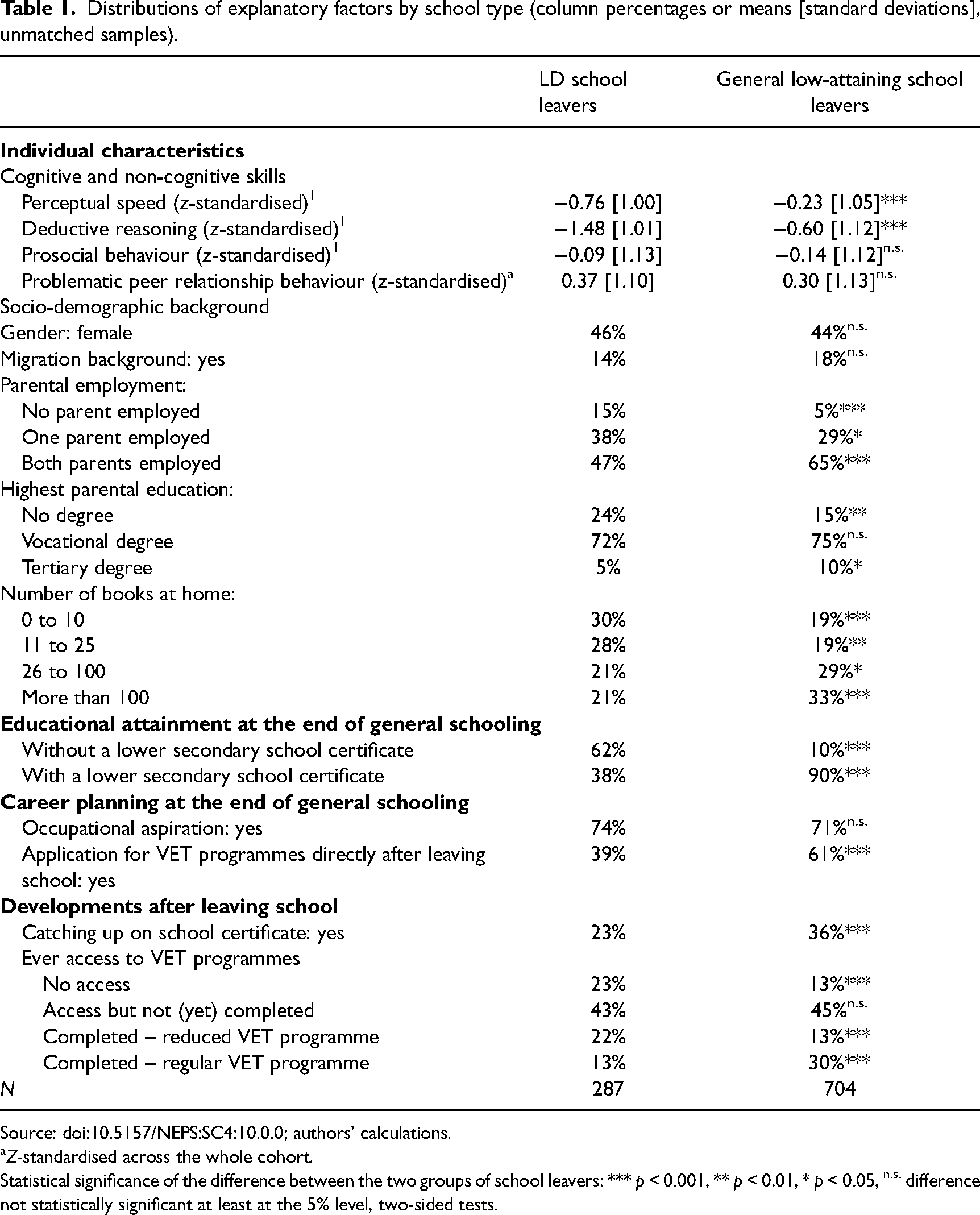
Distributions of explanatory factors by school type (column percentages or means [standard deviations], unmatched samples).
Source: doi:10.5157/NEPS:SC4:10.0.0; authors’ calculations.
Z-standardised across the whole cohort.
Statistical significance of the difference between the two groups of school leavers: *** p < 0.001, ** p < 0.01, * p < 0.05, n.s. difference not statistically significant at least at the 5% level, two-sided tests.
Analytical strategy
To assess the role of scarring from the label ‘LD school’ and the influence of the other potential explanations for differences in NEET risks between low-attaining school leavers from LD and general schools, we employ a two-step strategy (as suggested by Combet and Oesch, 2019): In the first step, we apply a matching approach to account for selection into school types, at least partially based on observables. We match the two groups of school leavers on their individual characteristics using entropy balancing (Hainmüller, 2012). With this method, we balance the weights of the group of school leavers from general schools in such a way that it resembles the group of LD school leavers on a wide range of included observables (see individual cognitive, non-cognitive and socio-demographic characteristics described above). Figure A1 and Table A3 (Online supplement) demonstrate that compositional differences in individual characteristics between both groups of school leavers disappear after entropy balancing. There might still be differences on unobservable factors, though. This matching method balances the data of our two groups more effectively than other matching methods, because our relatively small samples preclude estimation of complex parametric (probit) specifications and it avoids losing cases (quite likely e.g. with coarsened exact matching/CEM).
In a second step, we estimate a series of nested linear probability models (LPM) on the probability of being NEET at age 20/21, applying the weights obtained from entropy balancing, to examine the scar effect and the role of the abovementioned factors for differences in NEET risks among similar school leavers from LD schools and general schools. We interpret the difference between LD and general school leavers on the probability of being NEET at age 20/21 that remains after matching and considering their school attainment as the scar effect of the institutional disability label. We then examine whether deficits in career planning and developments after leaving school partially explain this scarring effect. To better understand the interplay between school type and school certificate for NEET risks, we finally replicate our analyses separately for school leavers with and without school certificate.
Results
Compositional differences in individual characteristics
Table 1 presents the differences between low-attaining school leavers from LD and general schools before matching. It reveals the ambiguity in the process of classifying learning disability. We observe not only differences but also similarities in the distribution of individual characteristics between the two groups: The groups do not differ in their non-cognitive skills, but LD school leavers demonstrate on average lower perceptual speed and deductive reasoning skills than general low-attaining school leavers. At the same time, the distributions of these cognitive skills show large overlaps for the two groups (Figure A2, Online supplement). This means, we observe equally weak or strong students in both school types. Differences are also substantial for socio-demographic characteristics: LD school leavers can rely on fewer resources from their families, as indicated by lower levels of parental employment and education, and fewer books at home, while the two groups do not differ with regard to gender composition and share of students with migration background. In both groups, young men and young people with migration background are overrepresented.
Educational attainment
Table 1 shows stark differences in the educational attainment of the two groups at the end of general schooling: Whereas only 10% of low-attaining students from general schools leave school without a lower secondary school certificate, 62% of LD school leavers do so.
Career planning at the end of general schooling and developments after leaving school
Both LD and general low-attaining school leavers are equally successful in forming an occupational aspiration by the end of general schooling (74% vs 71%, Table 1). These rather high aspirations for low-attaining youth are also found in other studies and explainable by the quite extensive vocational preparation in the final years of schooling, especially at lower-track schools (e.g. Kohlrausch and Solga, 2012). Yet, the two groups differ remarkably in their application behaviour: Whereas 61% of general low-attaining school leavers apply for a VET programme directly after leaving school, only 39% of LD school leavers do so (Table 1). This could indicate a withdrawal because of self-stigmatisation or institutional cooling-out processes.
Finally, Table 1 shows developments after leaving school until age 20/21. 6 LD school leavers are less successful in improving their school certificate (23% vs 36%), although they participate much more often in prevocational programmes than general low-attaining school leavers (89% vs 66%). Hence, a large proportion of LD school leavers are at long-term risk of remaining without a recognised school certificate. By age 20/21, 78% of LD school leavers have entered a VET programme that leads to a recognised certificate at least once, compared to 88% of general low-attaining school leavers, and 35% compared to 43% have completed a VET programme. For LD school leavers, however, reduced VET programmes play a major role, whereas low-attaining school leavers from general schools mainly complete regular VET programmes. These figures show the integrative potential of the German VET system for young people with low school attainment, but at the same time, that they still encounter difficulties in their school-to-work transitions.
NEET at age 20/21
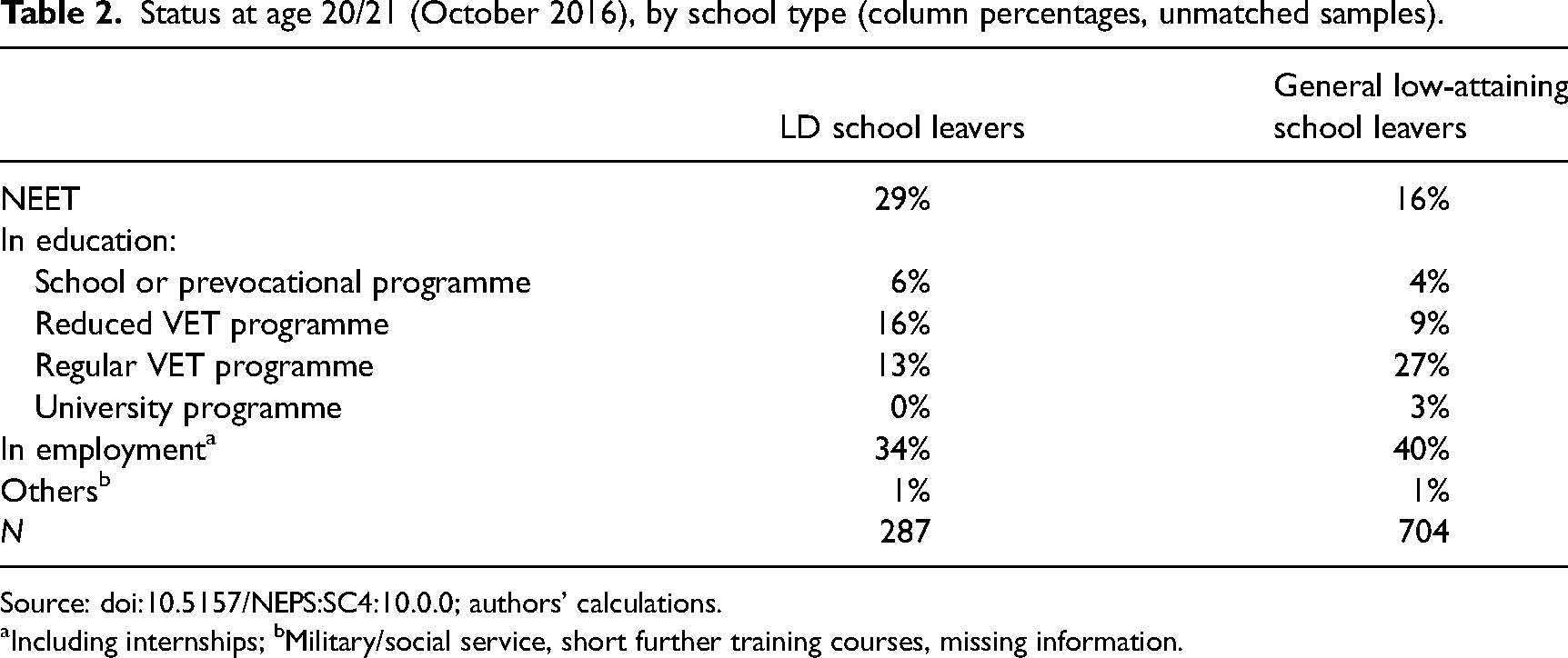
Table 2 shows that at age 20/21, both groups of low-attaining school leavers have a rather high NEET risk. However, the proportion in NEET is about 13 percentage points higher among LD school leavers than among general low-attaining school leavers (29% vs 16%). This difference stems from lower participation rates of LD school leavers in both employment (34% vs 40%) and educational activities, especially in VET programmes (29% vs 36% still attend a VET programme).
Status at age 20/21 (October 2016), by school type (column percentages, unmatched samples).
Source: doi:10.5157/NEPS:SC4:10.0.0; authors’ calculations.
Including internships; bMilitary/social service, short further training courses, missing information.
Do the aforementioned differences in the independent variables contribute to this higher NEET risk of LD school leavers? Figure 1 presents the point estimates for LD school attendance from different LPM estimating the probability of being NEET at age 20/21 (based on models M1 to M5 in Table A4, Online supplement).
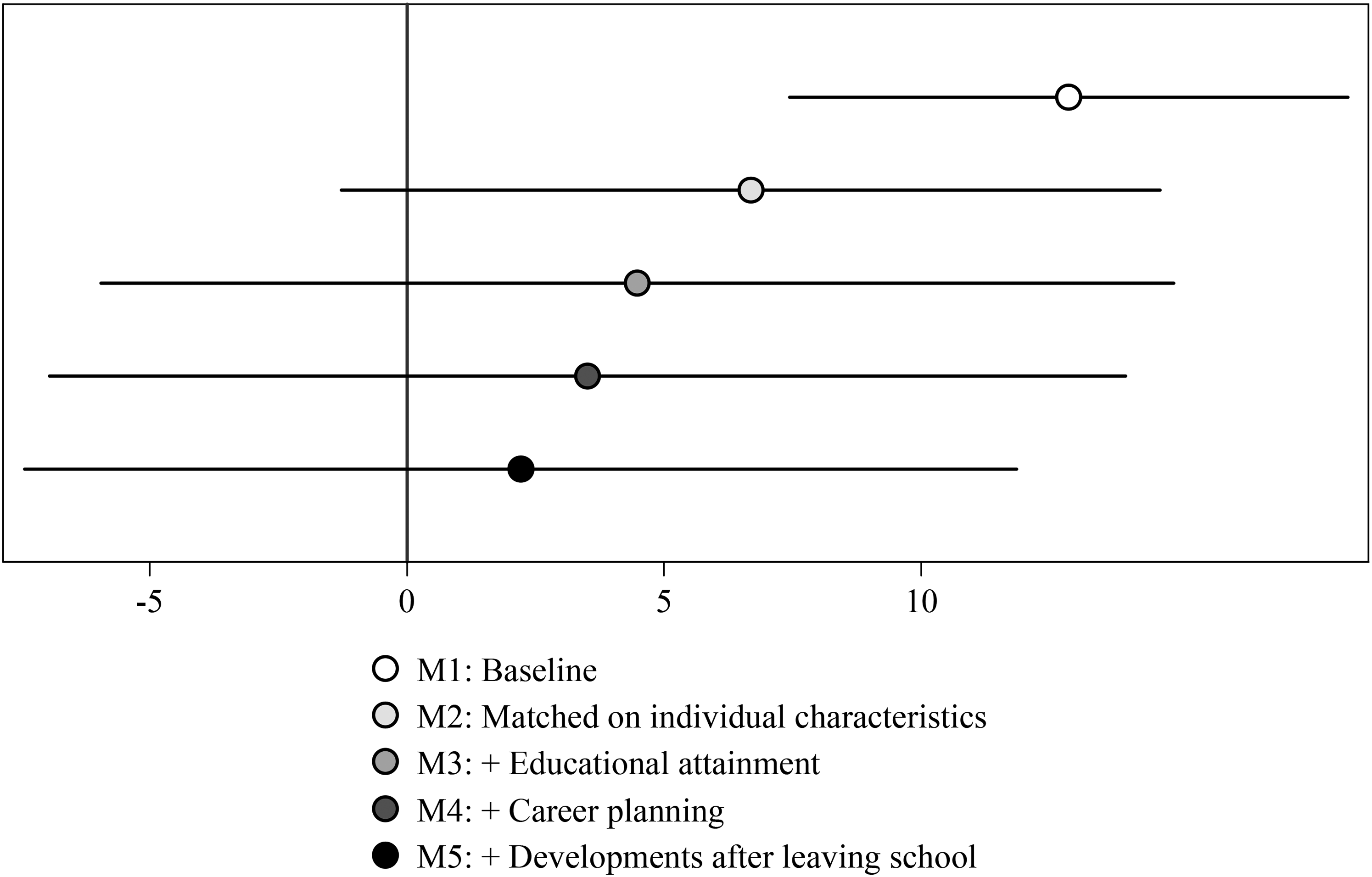
Effect of LD school attendance on probability of being NEET at age 20/21 (LPM point estimates and 95% confidence intervals). Based on models in Table A4 (Online supplement). Source: doi:10.5157/NEPS:SC4:10.0.0, authors’ calculations.
The baseline model M1 shows again the raw group difference of 13 percentage points in the probability of being NEET. In model M2, we estimate the NEET difference based on the matched samples (i.e. applying the weights obtained from entropy balancing). The coefficient for LD school attendance decreases to 7 percentage points (only significant at the 10%-level). This means that about half of the gap in NEET risk between low-attaining LD and general school leavers can be attributed to compositional differences in individual characteristics. However, the NEET risk is still substantially higher for LD school leavers than for similar school leavers from general schools. When additionally accounting for school certificates (model M3), the group difference decreases to 4 percentage points – indicating the scarring effect of the institutional disability label above and beyond low school attainment. The difference is still notable in size, however estimated with large uncertainty (not statistically significant).
In models M4 and M5, we subsequently add the indicators for career planning and developments after leaving school to the matched LPM estimation. In these models, the coefficient for LD school attendance decreases further to only 2 percentage points in the full model (statistically insignificant). Thus, part of the scarring effect results from disadvantages in terms of career resources and opportunities available during the school-to-work transition.
We conduct several sensitivity analyses (see Table A5, Online supplement). To account for regional variation in both the prevalence of LD schools and the provision of different VET programmes and labour markets conditions, we additionally include the 16 German federal states in the full model. Our substantive results remain unchanged. Furthermore, we estimate two models excluding cases from the control group with particularly high entropy balancing weights on at least one of the imputed data sets (≥ 99th and 95th percentile of all weights, respectively). This yields a larger coefficient for LD school attendance (6 and 11 percentage points, respectively); yet this also excludes selective groups of the samples. Estimating a logistic regression instead of LPM does not change our results.
Finally, we estimate our models with unemployment at age 20/21 as dependent variable, excluding the remaining NEET categories from the analysis (Table A6, Online supplement). Again, this does not change our substantive results, mainly because unemployment is the major reason for being NEET.
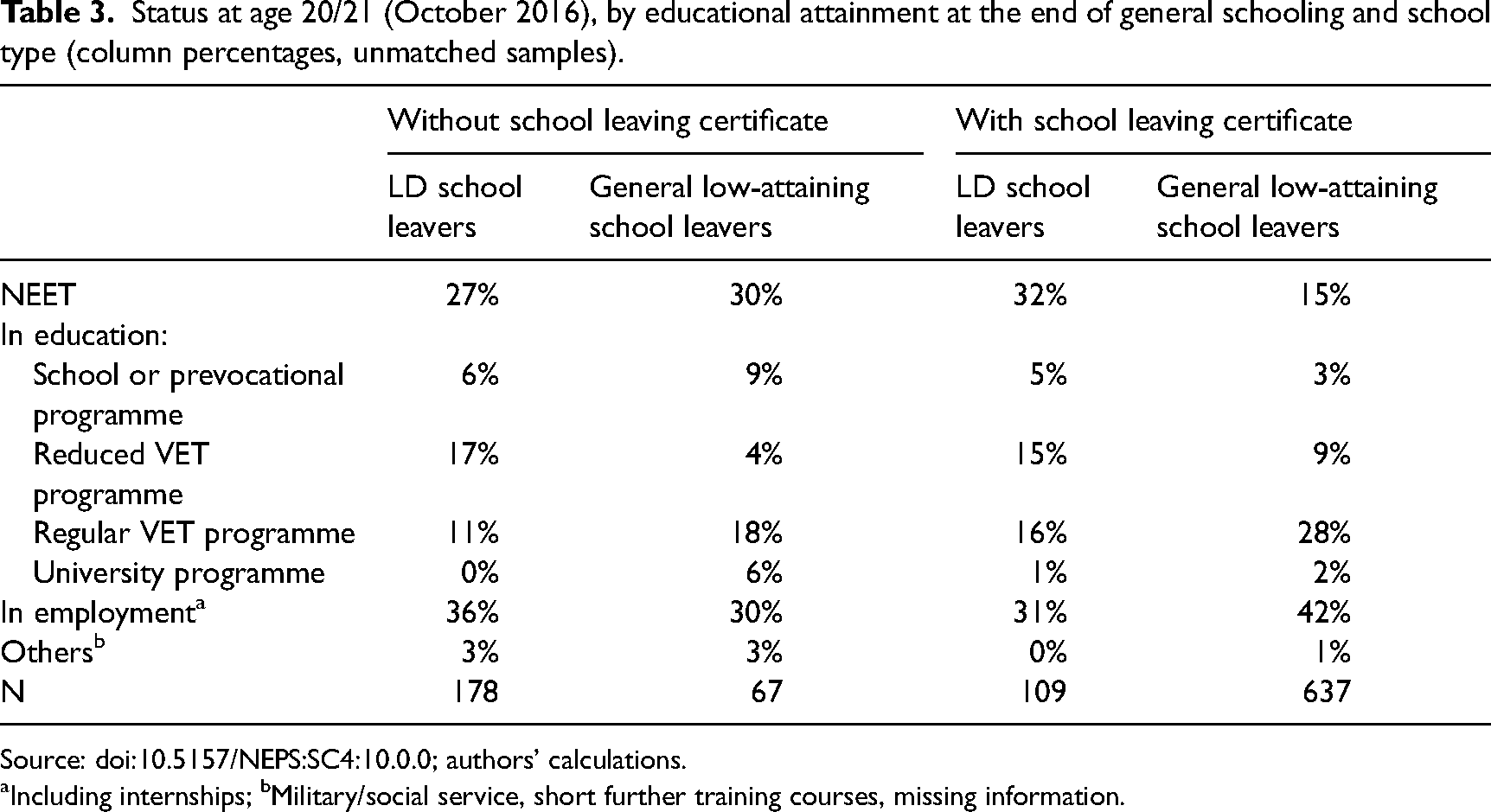
Separate analyses by educational attainment at the end of general schooling
Table 3 shows the status in October 2016 by school type separately for school leavers with and without a recognised school certificate at the end of general schooling. Among those without school certificate, the proportion in NEET at age 20/21 is equally high for school leavers from LD schools and from general schools (27% vs 30%). Among those with a lower secondary school certificate, however, we see notable differences depending on the school type attended (32% vs 15%). Table A7 (Online supplement) provides descriptive statistics on the independent variables differentiated by school certificate and school type.
Status at age 20/21 (October 2016), by educational attainment at the end of general schooling and school type (column percentages, unmatched samples).
Source: doi:10.5157/NEPS:SC4:10.0.0; authors’ calculations.
Including internships; bMilitary/social service, short further training courses, missing information.
Figure 2 shows the coefficients for LD school attendance from separate LPMs for school leavers with and without certificate (based on models in Table A8, Online supplement). We find that LD school attendance does not increase the probability of NEET among school leavers without school certificate. Comparing only similar young people in terms of individual characteristics (M2) and accounting for differences in career planning (M4) and developments after leaving school (M5), school leavers from LD schools even seem to fare better than school leavers from general schools (coefficient for LD school attendance only significant in M4 at the 10%-level). However, these results rely on a very small number of cases (especially for school leavers from general schools) and should be interpreted with caution (also because t-tests indicate that the coefficients in M4 and M5 are not statistically different from the coefficient in M2).
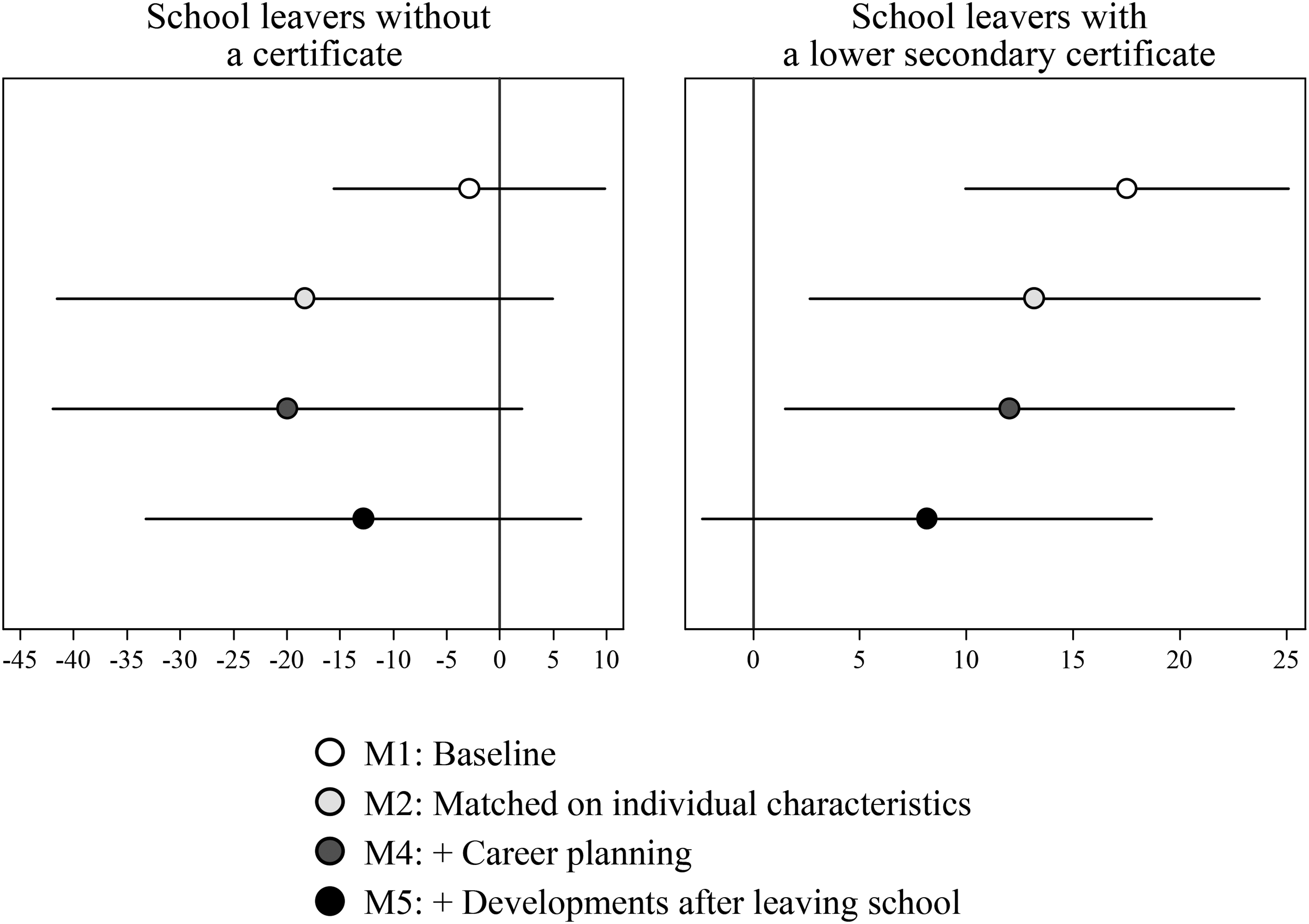
Effect of LD school attendance on probability of being NEET at age 20/21, by educational attainment at the end of general schooling (LPM point estimates and 95% confidence intervals). Based on models in Table A8 (Online supplement). Source: doi:10.5157/NEPS:SC4:10.0.0, authors’ calculations.
For school leavers with a lower secondary certificate, LD school attendance increases the probability of being NEET at age 20/21 considerably: The scarring effect of the LD label amounts to 13 percentage points (M2). Compositional differences in individual characteristics account for about a third of the NEET gap between school leavers from LD schools and from general schools (18 percentage points in M1 vs 13 percentage points in M2). After further considering differences in career planning (M4) and developments after leaving school (M5), the probability of NEET is still 8 percentage points higher for LD school leavers than for those from general schools (coefficient for LD school attendance not statistically significant in M5; t-tests support that the coefficient in M5 – but not the coefficient in M4 – differs statistically from M2).
These findings suggest that scarring effects of the institutional labelling of disability only occur among school leavers with a certificate. This does not mean, however, that school leavers without school certificate are not or less disadvantaged – their missing school certificate already generates high exclusion risks, more or less independent of the school type attended. 7
Discussion and conclusions
In this article, we focused on the longer lasting post-school disadvantages of attending segregated schools for students classified as having learning disability (LD schools) in Germany. Based on data from the German NEPS, we examined and compared the NEET risk at age 20/21 of low-attaining school leavers from LD schools and general schools. In doing so, we add to the debate on the post-school consequences of segregated versus inclusive education of students classified as having SEN. Moreover, concerning comparative school-to-work transition research, our findings provide evidence that the picture presented for Germany for low-attaining school leavers in existing studies is too positive, because most of them do not include school leavers from special needs schools.
Our analyses show that compositional differences in a wide range of individual characteristics (cognitive and non-cognitive skills, socio-demographic background) explain about half of the higher NEET risk of students from LD schools compared to low-attaining school leavers from general schools. However, a notably higher NEET risk remains even when taking these compositional differences and differences in school certificates into account. We interpret this higher risk as scarring effects of the institutional disability label. We show that differences in resources and opportunities available to students from both school types during the school-to-work transition (career planning and developments after leaving school) generate this scarring effect. Considering these differences, the NEET gap is almost closed to zero. Separate analyses by school certificate indicate that the higher NEET risk of LD school leavers (compared to general school leavers) only exists among those who left school with a (lower secondary) school certificate but not among those who left school without school certificate.
Our findings suggest, first, that the institutional label of ‘having attended a special needs school’ seems to generate long-term ‘scars’ (DiPrete and Eirich, 2006) for the integration into training and employment above and beyond low school attainment – at least for school leavers with lower secondary school certificates. For them, the LD school label seems to lower the signalling value of school certificates for gatekeepers (maybe caused by the resource-labelling-dilemma). Those without school certificate seem to be considered as having (too) low productivity regardless of the additional LD school label. Their very low school attainment falls far below the minimum of school attainment in Germany and, thus, has become an increasingly discrediting attribute (Solga, 2004). Second, post-school developments are strong predictors of school leavers’ NEET risk at age 20/21 – indicating that scarring processes already start right after leaving school, when LD school leavers try to enter the VET system. Theoretically, these findings demonstrate that the school type label matters for students classified as having learning disability not only in school but also during their school-to-work transitions.
Perhaps surprisingly because Germany’s segregated school system might suggest higher rates, our study shows similar NEET rates to those for the UK: As in the UK at age 19/20 (Aston et al., 2005: xi), about one-third of LD school leavers are in NEET status at age 20/21 in Germany. Yet, Germany has a more inclusive VET system than countries with inclusive school systems. We know from German studies that low-attaining school leavers are disadvantaged in their entry into VET programmes compared to higher-attaining school leavers (e.g. Holtmann et al. 2017); yet, our analyses show that a quite significant proportion of them is able to enter VET programmes. Thus, the German VET system provides the majority of low-attaining school leavers, also from LD schools, with a second chance to continue and improve their education and thereby to enhance their training and labour market integration (although still to a lower extent than for higher-attaining school leavers).
In sum, our study suggests that research on the consequences of disability labels should not only be concerned about inclusion versus segregation with respect to the school system but also with respect to VET. Policy-wise, our findings indicate that both inclusive school systems and inclusive VET systems can enhance learning opportunities and post-school employment chances of individuals classified as being disabled.
Among the limitations of our study are the limited case numbers included in our analyses, despite the oversampling of respondents from special needs schools and lower secondary schools in the NEPS. The NEPS data also do not allow identifying students classified as learning disabled attending general schools to compare scarring effects generated by the disability label as such versus by (inclusive vs segregated) school settings.
Supplemental Material
sj-pdf-1-asj-10.1177_00016993221114257 - Supplemental material for Long-term scarring from institutional labelling: The risk of NEET of students from schools for learning disability in Germany
Supplemental material, sj-pdf-1-asj-10.1177_00016993221114257 for Long-term scarring from institutional labelling: The risk of NEET of students from schools for learning disability in Germany by Laura Menze, Heike Solga and Reinhard Pollak in Acta Sociologica
Footnotes
Funding
The author(s) disclosed receipt of the following financial support for the research, authorship, and/or publication of this article: The paper was supported by the DFG - German Research Foundation (grant number: SO 430/8-2) and trans-sectoral research funding by the WZB Berlin Social Science Center for the project ‘School-to-Work Transition of SEN Students.’ The data collection for SEN students was co-funded by the Federal Employment Agency (grant number: BA 1213-15-46303 and BA 13-17-00004).

Supplemental material
Supplemental material for this article is available online.
Notes
Author biographies
References
Supplementary Material
Please find the following supplemental material available below.
For Open Access articles published under a Creative Commons License, all supplemental material carries the same license as the article it is associated with.
For non-Open Access articles published, all supplemental material carries a non-exclusive license, and permission requests for re-use of supplemental material or any part of supplemental material shall be sent directly to the copyright owner as specified in the copyright notice associated with the article.
