




Abstract
The gender gap in welfare state attitudes is the tendency of men to be less positive toward an encompassing welfare state than women. To study attitudinal gender differences at the individual level, this paper synthesizes prior explanations, focused on self-interest and norms, with a social identity perspective, centered on the process of social identification with a gender group. With representative survey data (n = 1515), covering social spending preferences in Sweden, this study uses a psychometric instrument to gauge the emotional and psychological centrality of gender to individuals’ concept of self—thus distinguishing between men and women with different degrees of attachment to their gender group (strength of gender identification). The results show a strong gender identification is negatively related to social spending preferences for men, but not for women. The findings are discussed in the light the influence of gender norms and masculinity threat, highlighting the structuring and normative implications of social policy for gender differences in attitudes toward the Swedish welfare state.
Introduction
The attitudes that men and women hold toward the welfare state play a crucial role in the democratic process. As an aggregate gender gap in socio-political attitudes is correlated with gender differences in turnout (Dassonneville and Kostelka, 2021) and vote choice—influencing the outcome of national elections (Abendschön and Steinmetz, 2014)—understanding gendered aspects of welfare state legitimacy has become an increasingly important. Gender differences in welfare state attitudes are well documented (Blekesaune and Quadagno, 2003; Garritzmann and Schwander, 2021; Goossen, 2020); in general, men are less, and women are more, positive toward government social spending (Burclau and Lühiste, 2021; Lizotte, 2017). However, the reason for this gender gap continues to puzzle, as attitudinal differences are only partially mediated by self-interest, gendered experiences, or values and ideological beliefs (review and results in Goossen, 2020).
This paper contributes to the study of gendered welfare state legitimacy by investigating the gender gap in attitudes toward social spending—defined as preferences for the tax-based welfare effort of the public sector in the areas of social assistance, basic education, support to the elderly, employment policy initiatives, health care, housing benefits, and support to families and children—in Sweden. The aim is to contribute to the analysis of the gender gap in welfare state attitudes by focusing on the hitherto neglected process of social identification with a gender group. Recent research has shown that many observable gender gaps in socio-political attitudes are in fact moderated by measures of strength of gender identification (Bittner and Goodyear-Grant, 2017a, 2017b; see also Magliozzi et al., 2016). In Sweden, the few studies carried out to date have similarly indicated that attitudinal gender gaps, covering a range of political domains, are primarily driven by men and women who rate themselves as highly masculine or feminine (Solevid et al., 2021).
However, as many studies primarily focus on how a broad range of previously observed gender gaps in political attitudes are moderated by non-binary operationalizations of gender identity, while devoting relatively little analytical attention to specific attitudes (such as social spending), we still lack a comprehensive investigation about how gender identity is related to social spending preferences. To fill this gap, this study synthesizes a non-binary approach to gender identity with prior explanations of gender differences in welfare state attitudes, focused on self-interest and gender norms. It does so by exploring how spending preferences (across several different social policy areas) relate to individuals’ strength of gender identification—defined as a dispositional and transsituational attachment to a gender group.
I use nationally representative data from the Swedish Welfare State (SWS) survey 2018 (n = 1515), which contain multiple measures of social spending preferences and four items that together measure strength of gender identification. Drawing on a mix of institutional theory, social identity theory, and the literature on masculinity threat, I formulate and test the following expectations: First, having a strong gender identification could promote attentiveness to gendered self-interest in relation to the welfare state, as well as increase the likelihood of adopting gender-stereotypical attitudes. I therefore expect women to be more positive than men toward increasing social spending, with differences being largest among strong identifiers. Second, some men may perceive welfare state expansion as a form of masculinity threat, as the expansion of the Swedish welfare state has historically promoted an expansion of women’s social and economic roles, and diminished the previously salient connection between masculinity and breadwinning. Moreover, the Swedish discourse on welfare politics has long featured an extensive critique of masculinity. I therefore expect that any relationship between strength of gender identification and social spending preferences should be stronger for men than for women.
Previous research on gender differences in welfare state attitudes
Following on the rapid expansion of women's social and economic roles during the 20th century—the first half of the gender revolution (Stanfors and Goldscheider, 2017)—it has been theorized that women's increased economic and psychological independence from men have led to the emergence of gender gaps in political ideology, attitudes, and behavior (Dassonneville, 2021). Individual level explanation to this phenomenon commonly focuses on gender differences in both long-term and acute self-interest (Blekesaune and Quadagno, 2003; Garritzmann and Schwander, 2021), and gendered socialization and experiences (Banducci et al., 2016; Mair et al., 2016): including the internalization of basic value orientations (Lizotte, 2020).
According to institutional theory, attitudes toward social policies are partly shaped by how enacted policies, through rules and eligibility criterion, construct groups of claimants and imbue on these claimants a sense of shared identity and common interests (Mettler and Soss, 2004). Arguably, many social policies affect men and women in slightly different ways. For example, it has been argued that a large tax burden make men—whose economic role has since the inception of the labor-market and up until recently been that of breadwinner—negative toward the welfare state, because this tax burden would impede on their ability provide for the families they are a part of (review in Banducci et al., 2016). Conversely, due to the same normative expectations of breadwinning and homemaking, women are arguably more reliant on welfare state solutions when balancing paid work with family obligations throughout everyday life (Daly and Rake, 2003).
A gender-differentiated stake in welfare provision is noticeable when studying the specific types of preferences in which men and women differ: women are more likely to support policies that mobilize and preserve labor-market skills during career interruptions (Garritzmann and Schwander, 2021). Similarly, large cross-country studies have associated the prevalence of higher work-family conflict for women in socioeconomically developed countries with the observation that women in these countries prefer government responsibility for eldercare more than men do (Mair et al., 2016). Furthermore, and in line with a self-interest argument, life-course events such as divorce seem to influence policy preferences in a gendered manner. Compared to men, women are more pro-welfare and pro-redistribution when in economically challenging situations (Edlund et al., 2005).
Parenthood is associated with a gender polarization in attitudes; motherhood seemingly having a liberalizing effect on women's political attitudes. This attitude polarization has been observed for issues where mothers have a direct self-interest, such as for public provision and financing of family support (Banducci et al., 2016; Burclau and Lühiste, 2021; Lizotte, 2017) (as most working mothers also perform the bulk of the unpaid labor (Altintas and Sullivan, 2017). Similarly, in Europe, countries with limited government support for parenting demonstrate larger differences in welfare state attitudes between mothers and non-mothers, compared to where there is ample governmental support to parents (Banducci et al., 2016). However, the relationship between motherhood and attitudes also holds true when mothers have less direct self-interest, such as with social welfare provision to the unemployed, sick and old (Banducci et al., 2016). Thus, it has been argued that motherhood functions as a socializing experience that alters the policy preferences of women, while similar effects on policy attitudes are not systematically observed for fathers (Banducci et al., 2016). Moreover, it has been argued that gendered perceptions of self-interest can be linked to norms of breadwinning and homemaking. For example, women's social policy preferences vary according to the economic safety net provided by a working partner, while men's attitudes are not associated with the labor-market situation of their partner (Häusermann et al., 2016).
Another explanation to attitudinal gender gaps is that they correspond to observable differences in pro-social values; theorized to be due to the influence of gender socialization. This research highlights how different role performances, rooted in society's gender division of labor, lead people to form diffuse and normative perceptions about how most men and women behave and how they ought to behave (Diekman and Schneider, 2010; Lizotte, 2020). Through sanctions and reinforcement, and processes such as self-categorization and stereotypification, men and women both regulate their own behavior to align with gender norms, and internalize such standards into their personality (Diekman and Schneider, 2010). Several cross-cultural and single country studies have yielded correlative evidence that gender differences in traits and pro-social values partially mediates several attitudinal gender gaps, for example toward government responsibility for and spending on social welfare (Blekesaune and Quadagno, 2003; Lizotte, 2020).
However, gender differences in welfare state attitudes continue to puzzle. For example, studies in the United States demonstrate that observable gender gaps in preferences for socially compassionate policies (e.g. spending on minorities and policies for reducing income differences) (Eagly et al., 2004), and preferences for government services and spending on childcare (Lizotte, 2017), persist when controlling for both parental status and self-interest variables. Furthermore, studies in Europe (Blekesaune and Quadagno, 2003), and in the United States (Lizotte, 2020), have shown that pro-social values such as egalitarianism do not fully explain the gender gap in welfare state attitudes. In fact, in most European countries (including Sweden) gender differences in attitudes toward government welfare provision persist when controlling for values, such as egalitarianism, authoritarianism, and multiculturalism; beliefs about the consequences of the welfare state; the respondents family situation; and a range of self-interest variables such as income, labor-market status, and educational attainment (Goossen, 2020).
A gender identity approach to political attitudes
As a complement to prior explanations, there is a burgeoning literature that is focused on social and intrapsychic aspects of gender identity; used as a framework for explaining gender differences in attitudes and behavior (see e.g. Bittner and Goodyear-Grant, 2017a, 2017b; Magliozzi et al., 2016; Solevid et al., 2021; Wood and Eagly, 2015). This research argues that solely focusing on categorical sex/gender differences run counter to most modern understandings of gender identity as a continuum, and that the saliency of gender in connection with political issues has often been underexplored.
The operationalization of gender identity generally follows one of two approaches. The first approach is concerned with measuring gender stereotypical traits: by use of standardized scales, such as Bem's Sex Role Inventory (Coffé and Bolzendahl, 2021), or self-assessments of femininity and masculinity (Bittner and Goodyear-Grant, 2017a; Magliozzi et al., 2016; Solevid et al., 2021). Applied to political attitudes, there is correlational evidence that such measures of feminine and masculine traits moderate the observable liberal-conservative gender gap in the United States (Magliozzi et al., 2016; McDermott, 2016), as well the gender gap in left-right ideology and GAL-TAN attitudes (Green Alternative Liberal vs Traditional Authoritarian Nationalist) in Sweden (Solevid et al., 2021). Overall, men are more right and TAN leaning and women are more left and GAL leaning; with differences being largest among the most gender-conforming individuals. Similar results have been recorded in a Canadian sample (Bittner and Goodyear-grant, 2017a). Although in Mexico, higher scores of masculinity and gender conformity were associated with stronger identification with a left party: demonstrating the contextual nature of these relationships (Cassino and Besen-Cassino, 2021). However, depending on the research question, one drawback to the traits-based methodology is that it does not specify whether individuals perceive masculine or feminine traits as important to their self-concept. Thus, while measure of masculine and feminine traits may very well correlate with attitudinal outcomes, I argue that they do not provide the necessary theoretical grounds for inferring that political events are interpreted through a gendered understanding of the social world.
A second approach is instead concerned with measuring respondents’ strength of gender identification. According to a social identity perspective, social identification with a salient in-group is a crucial component preceding the normative and expressive function that attitudes may have with respect to group membership (Smith and Hogg, 2008). For example, Ashmore et al. (2004) argue that aspects such as emotional significance and a perceived common fate with a (gender) group requires prior self-identification. While the tendency to self-categorize and self-stereotype as man or woman varies situationally—according to the saliency and significance of gender to a particular situation (Sinclair et al., 2006)—identification with a gender group also represents a relatively stable attribute of many individuals’ psychological makeup (Wood and Eagly, 2015). For the purpose of this paper, I define such strength of gender identification as a dispositional and transsituational attachment to one's self-identified gender group.
In practice, strength of gender identification has been measured both using a “feeling thermometer,” where respondents freely assess how strongly they identify with a gender group along a single item continuum (Bittner and Goodyear-grant, 2017b), and with standardized items such as the Importance to Identity sub-scale to Luhtanen and Crocker's (1992) Collective Self-Esteem scale; designed to measure the strength and emotional importance of group identity (Lindqvist et al., 2016; Morgenroth et al., 2021; Wood and Eagly, 2015). When choosing among the operationalizations, one benefit of using Luhtanen and Crocker's (1992) subscale is that it explicitly prompts individuals to indicate the emotional significance of their gender identity, and the perceived centrality to their concept of self. Although, like Magliozzi et al. (2016), one can argue that self-assessment of femininity or masculinity in fact indicates gender identification (rather than indicating the possession of specific traits), such measures still do not prompt respondents to reason on the emotional significance or centrality to their self-concept.
Empirically, studies have shown that individuals’ strength of gender identification account for observable gender differences in the justification of social inequalities; which have often been attributed to gender differences in personality traits such as social dominance orientation (Snellman et al., 2009; Wilson and Liu, 2003). Similarly, when studying political attitudes in Canada, Bittner and Goodyear-Grant (2017b) observed that gender differences in family values; political ideology; and attitudes toward welfare spending and social programs, job discrimination, and government involvement in the economy, were large among those with a strong attachment to their gender group, while small to no differences were found among men and women with a weak gender identification.
Theorizing social identification and the gender gap in welfare state attitudes
Why would gender differences in social spending preferences be related to how strongly men and women identify with their gender group? According to institutional theory, one reason may be that a strong gender identification promotes attentiveness to issues of gendered self-interest. This argument is supported by research that indicates that the relationship between gendered self-interest and attitudes (toward social welfare and the gender division of labour) are in turn moderated by the way that gender issues are articulated through social policy (e.g. Edlund and Öun, 2016; Goossen, 2020; Öun, 2013). In general, there is relatively little divergence in socio-political attitudes between men and women where gender specialization in social and economic tasks are supported by social policies (e.g. head-of-household tax credits for a dependent spouse, long but unpaid parental leave or only maternal leave, and lack of public childcare) (Edlund and Öun, 2016; Goossen, 2020; Öun, 2013). Conversely, socio-political attitudes diverge more evidently where policies emphasize gender equality through dual/overlapping social and economic roles. These findings are argued to be related to the (de)politicization of conflict around issues of gender equality. Where gender issues are not salient on the policy agenda, or when policies treat economic and social differences between men and women as innate, the resulting inequalities seem less likely to be recognized as a source of political disconcert. Thus, while these arguments focus on variation between national contexts, they assume that individuals are in fact attentive to gendered self-interest issues, and positioning vis-a-vis the institutional milieu. Yet, while we know that relationships between gender and attitudes vary at the policy level, we still have to determine the validity of this argument at the individual level.
I argue that another explanation to gender differences could be that some welfare state attitudes are experienced as stereotypically feminine or masculine. As redistributive ideas are opposed to stereotypical ideas about masculine dominance of outgroups, while long-term goals of social equality are instead well-aligned with the communal orientation of a stereotypical feminine gender role, one can expect men to be more negative, and women to be more positive, toward the welfare state (e.g. Diekman and Schneider, 2010; see also Lizotte, 2017, 2020). Assuming that social identification with a gender group function as a proxy for self-stereotypification, the likelihood of adopting gender stereotypical attitudes should be higher among strongly identifying men and women. Thus, similar to the institutional perspective, the expectation is again that strongly identifying men and women should hold the most different attitudes toward the welfare state.
I propose the following hypotheses. Hypothesis 1 (H1): On average, men are more negative, and women are more positive, toward increasing social spending. Hypothesis 2 (H2): Attitudinal gender differences are most pronounced among men and women who strongly identify with their gender group, and least pronounced among those who do not strongly identify with their gender group.
Threats to gender status, and the political significance of masculinity
With respect to the political relevance of gender identity, there is reason to believe that focusing on masculinity may be more relevant than focusing on femininity. According to interactionist perspectives, achieved gender status is an inherently unstable construct. Failure to achieve social status as a “real man” is associated with a range of damaging physiological states, emotions, and behaviors; many of the latter—such as adopting gender stereotypical attitudes—being aimed at reclaiming membership in the socially valued category of men (DiMuccio and Knowles, 2021; Pfeffer et al., 2016). While both men and women experience social pressure to conform to cultural notions of gender, similar compensatory strategies are not frequently observed among women subject to gender status threat (DiMuccio and Knowles, 2021; Pfeffer et al., 2016).
Several studies have indicated that there may be a connection between (fragile) masculinity and political attitudes and behavior (review in DiMuccio and Knowles, 2021). For example, in two experiments, men subjected to masculinity threat were more negative to gender equality (Kosakowska-Berezecka et al., 2016), and more accepting of discrimination disadvantaging women and gay men (Dahl et al., 2015), compared to men not subject to masculinity threat. The latter was especially true for men with a strong gender identification. In two other experiments, men were less likely to vote for a woman candidate in the US presidential election when primed with manipulated statistics on households with women earning more than men, compared to a control group not subject to masculinity threat (Cassino, 2018), or increasing men's versus women's unemployment rates (Carian and Sobotka, 2018). Furthermore, preference for a masculine president was a significant mediator of support for Trump in the 2016 elections (Carian and Sobotka, 2018). Overall, these findings are in line with a social identity theorization of group-threats as being both realistic, concerning political or economic resources, and symbolic, concerning the valorization, boundary making, and meaning of group identity (e.g. Klandermans, 2014; Stephan et al., 2000).
Welfare state expansion as a potential masculinity threat
In the following I argue that an expansion of the welfare state can be perceived of as a particular kind of masculinity threat in Sweden. Sweden has a long history of debating the welfare state from a gender perspective, and of promoting gender equality through gender mainstreaming social policies: such as through individualizing entitlements and social insurances (Borchorst and Siim, 2008; Klinth, 2002; Lister, 2009; Lundqvist, 2007; Svensson and Gunnarsson, 2012). Thus, Sweden is a good choice to study how men and women perceive a welfare state that is visibly concerned with transforming gender relations.
In terms of realistic group threat, the first half of the gender revolution—the rapid expansion of women's roles—was closely connected with the expansion of the public sector, and with reforms aimed at facilitating women's access to paid work (Stanfors and Goldscheider, 2017). During the 1960s and 1970s, the high demand for labor within the welfare sector, and the increased possibilities to combine work and family life, made public employment attractive to many women. Presently, Sweden has one of the world's largest percentages of women in the labor force, with a female to male participation rate of 90% (World Bank, 2021). While this does not mean that women enjoy equal economic or political resources, especially not when considering the gender segregated Swedish labor-market (women make up 65% of all public employees, while two-thirds of the privately employed workforce are men (Statistics Sweden, 2018)); this development still signifies a movement toward a more gender-inclusive social citizenship (Lister, 2009). In terms of realistic threats to masculinity, I argue that this development has the potential to weaken the previously salient connection between masculinity and breadwinning.
There are also threats that concern the valorization, and meaning, of masculinity on a more symbolic level. Two prominent debates have had a particular strong influence on the articulation of gender issues in relation to the Swedish welfare state. First, beginning in the 1960s, a gender role perspective emphasized the double oppression of men and women under constraining sociocultural gender roles (Klinth, 2002; Lundqvist, 2007). While this tradition equated women's emancipation with economic independence, it also held that a constraining masculine gender role had left men unable to enjoy life outside of achievement in the labor-market, and that absent fathers led young boys to form their notions of masculinity in opposition to (and contempt for) femininity: resulting in poor moral and social skills. The proposed solution to this set of problems was that men should be reoriented toward family life. This strategy was facilitated by government policies and information campaigns aimed at increasing father's uptake of parental leave (Klinth, 2002). However, as good parenting was often viewed as synonymous with the qualities ascribed to women's gender role, this led men's accomplishments as fathers to be contingent on their capacity to acquire feminine social skills, rather than achieving an alternative formulation of masculinity (Klinth, 2002).
During the 1990s, the Swedish debate on gender and welfare was infused with an analysis of power relations (Klinth, 2002; Lundqvist, 2007). Focusing on society's separation of masculine from feminine, and the valuing of all things perceived as masculine, this perspective did not see gender equality as project of dual emancipation. Instead of viewing the obstacles to gender equality as attitudes to be combatted through enlightenment, this perspective saw overturning masculine privilege connected with social citizenship as a zero-sum game. Thus, as women's emancipation could not be achieved with less than a genuine challenge to the masculine norms underpinning the social contract, advancing gender equality was seen as undoubtedly leading to anguish among some men. This perspective has been associated with legal pathways to gender equality, through anti-discrimination legislature and calls for affirmative action, as well as use-or-lose quotas of individualized parental leave.
Currently, and perhaps making up a third perspective, much of the debate on gender equality in Sweden concern the need to involve men in transforming destructive norms of masculinity (review in Olsson and Lauri, 2020). For example, the Swedish government has identified the need to target men and boys more clearly in gender equality initiatives (ibid.). However, while still aimed at political change, the focus on transforming masculinity is here only implicitly coupled with matters of the welfare state.
Nevertheless, in light of the potential destabilization of the traditional masculine breadwinner role and its connectedness with the Swedish welfare state project, as well as the symbolic problematization of masculinity within mainstream Swedish welfare state discourse, I formulate the following hypothesis. Hypothesis 3 (H3): a (negative) relationship between strength of gender identification and social spending preferences is stronger for men than for women.
Method
Data
The SWS surveys have gauged public attitudes toward a range of welfare issues in Sweden at different intervals since 1986. The most recent round, targeting the adult Swedish population (ages 18–79), with a strict random probability sampling design, was collected by post in May and June 2018. An internet-based response alternative was available. The response rate was 33% (n = 1627).
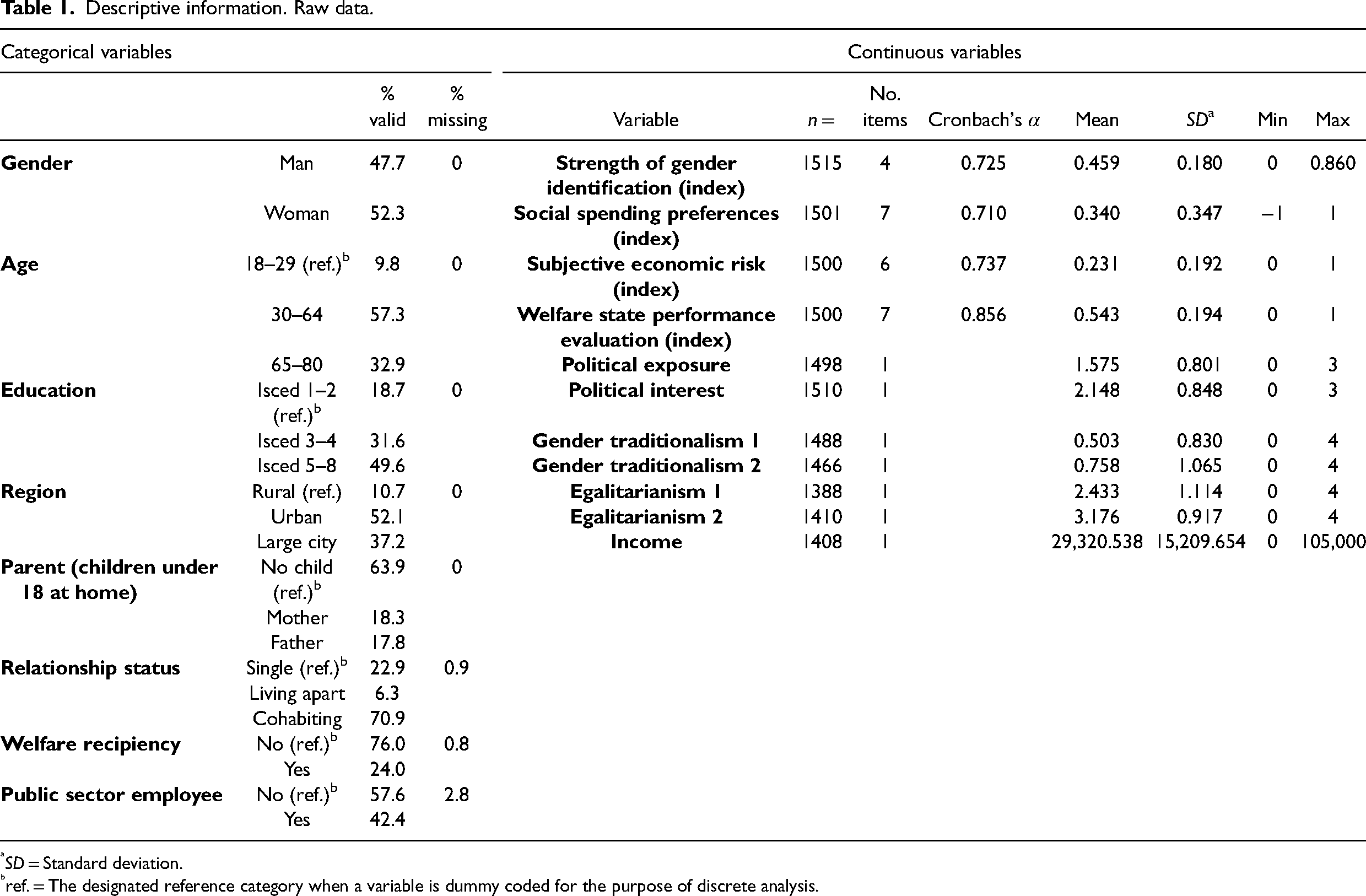
Arguably, for many transgender and non-binary individuals, positionality in relation to the welfare state may represent a different experience than for gender conforming men or women. This experience is not covered by the present arguments. Therefore, respondents with missing information on self-reported gender (n = 13), “other” gender (n = 2), or a mismatch between registered sex and reported gender (n = 15) were not included. After also removing invalid demographic information (n = 25), extreme outlier values on the income variable (>120,000 SEK/month) (n = 11), and respondents missing more than half the items used to construct the independent variable (strength of gender identification) (n = 64), the achieved dataset was n = 1515. Information on the distribution of sociodemographic variables is reported in Table 1.
Descriptive information. Raw data.
SD = Standard deviation.
ref. = The designated reference category when a variable is dummy coded for the purpose of discrete analysis.
Analysis plan
To test the hypotheses, I made use of ordinary least squares (OLS) regression, with social spending preferences as the independent variable. First, I included only gender as the analytical variable of interest (Table 2: M10). Then I introduced, in a stepwise fashion, different sets of control variables: sociodemographic variables (M11), family situation (M12), experience and evaluation of welfare (M13), political interest (M14), gender roles beliefs (M15), pro-social values (M16), and, finally, a model containing all control variables (M17). Second, I repeated the models, but included a measure of strength of gender identification, as well as an interaction term between gender and strength of gender identification (Table 2: M20 through M27). Missing values in the models were dealt with using chained equations multiple imputations (n = 10) (with predictive mean matching for continuous variables).
Social spending preferences, by gender and strength of gender identification. Ordinary least squares (OLS) regression.
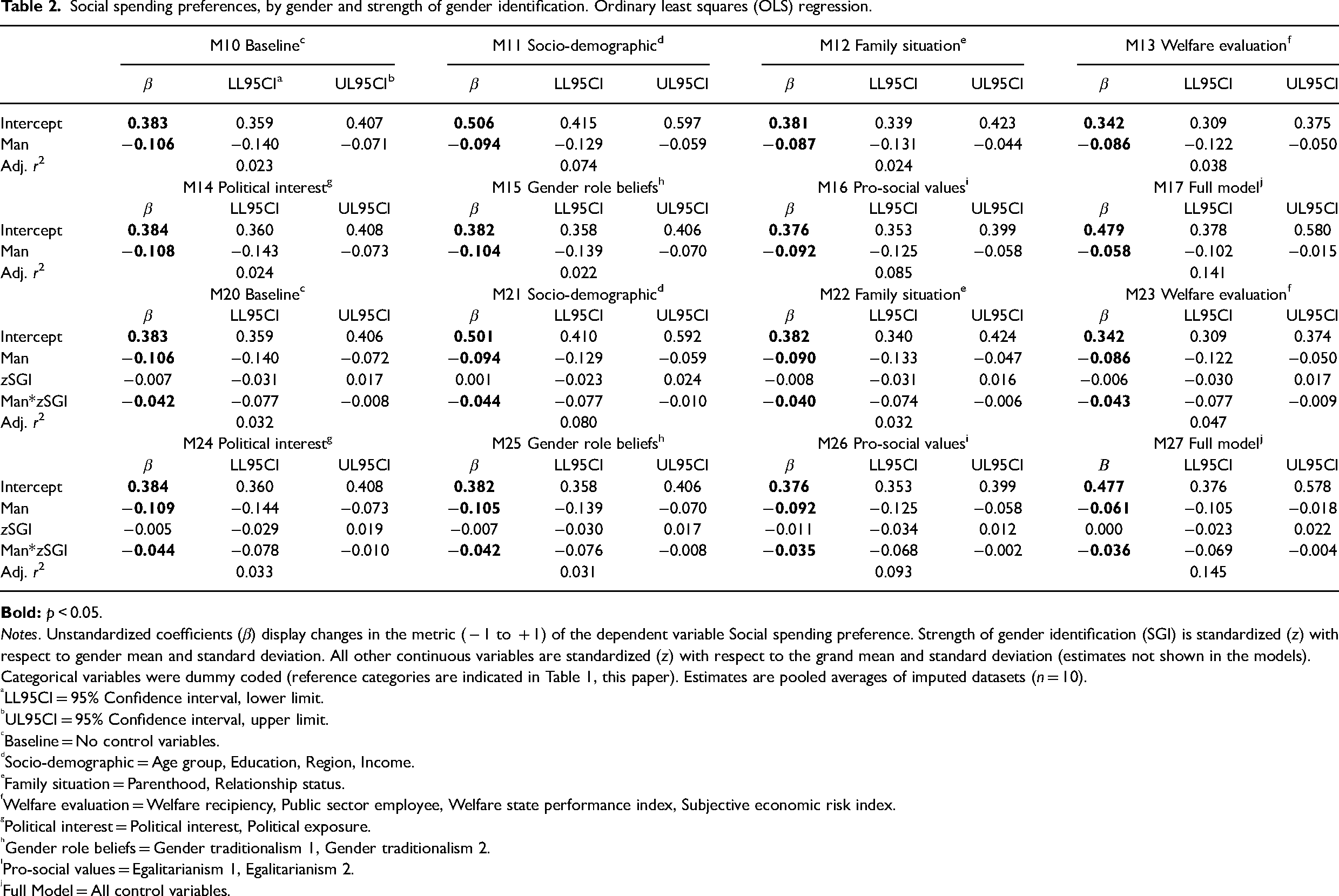
Notes. Unstandardized coefficients (β) display changes in the metric ( − 1 to + 1) of the dependent variable Social spending preference. Strength of gender identification (SGI) is standardized (z) with respect to gender mean and standard deviation. All other continuous variables are standardized (z) with respect to the grand mean and standard deviation (estimates not shown in the models). Categorical variables were dummy coded (reference categories are indicated in Table 1, this paper). Estimates are pooled averages of imputed datasets (n = 10).
LL95CI = 95% Confidence interval, lower limit.
UL95CI = 95% Confidence interval, upper limit.
Baseline = No control variables.
Socio-demographic = Age group, Education, Region, Income.
Family situation = Parenthood, Relationship status.
Welfare evaluation = Welfare recipiency, Public sector employee, Welfare state performance index, Subjective economic risk index.
Political interest = Political interest, Political exposure.
Gender role beliefs = Gender traditionalism 1, Gender traditionalism 2.
Pro-social values = Egalitarianism 1, Egalitarianism 2.
Full Model = All control variables.
Operationalizations
Continuous control variables: Income (SEK); Subjective economic risk (index); Evaluation of welfare state performance (index); Political exposure, meaning frequency of political discussions among friends/family/colleagues (Likert scale); Political interest, meaning frequency of political news consumption (Likert scale); two measures of Gender role beliefs, being that (1) men should work and earn money and women should take care of home and family (Likert scale), and (2) that family life suffers when women work full time (Likert scale); and two measures of Egalitarianism, asking about consequences for society if (1) income differences were reduced (Likert scale) and (2) differences in standard of living were increased (Likert scale). Indices were scored 0–1, with “1” indicating high risk and positive evaluations, respectively. See Table 1 for mean and dispersion estimates etc. For the exact wording of the questions used to construct the variables, see the Online appendix.
Results
Analysis of gender differences
In the following, I will denote strength of gender identification as SGI. First, I recount the results from the regression models that include gender as the independent variable, social spending preferences as the dependent variable, and various sets of control variables (Table 2: M10 through M17). In each model, the coefficient (β) for “Man” represents the average difference in social spending preference (scale: − 1 to + 1) between women (intercept) and men, while controlling for various sets of control variables. As the analytical focus concern how gender differences in social spending preferences behave in the presence of such controls, and not how these controls themselves affect social spending preferences, the coefficients for the control variables are not printed (available from the author upon reasonable request).
Among women, the average support for increasing social spending is 0.38 when not controlling for any additional variables (M10). On average, men are found to be less supportive than women are. The difference ranges from a − 0.11 unit negative difference in the baseline model (only comparing men to women (M10)), to a − 0.06 unit negative difference in the full model that includes all the control variables (M17). Both upper and lower 95CI limits associated with the coefficients are negative in all models. This means that we can conclude that the observed gender differences in social spending preferences are not fully mitigated by any of the control variables.
Analysis of strength of gender identification
Next, I recount the results from the models that include SGI, and the interaction term between gender and SGI (Table 2: M20 through M27). As SGI is standardized with respect to the mean and standard deviation of each gender (women μ = 0.469 SD = 0.177; men μ = 0.447 SD = 0.184, raw data), the analysis focuses on gender differences in the correlation between SGI and social spending preferences. Beginning with the baseline model, the coefficient for SGI is close to zero (β = −0.007). As women make up the statistical reference category, this means that there is no measurable effect of SGI in relation to social spending preferences among women. However, the interaction term between gender and SGI (“Man*zSGI”), which denotes the correlation between SGI and social spending preferences among men, is significant and negative (β = −0.042). For each standard deviation in SGI, men become − 0.04 units more negative toward increasing social spending. This interaction effect is illustrated in Figure 1. Overall, the negative relationship between SGI and social spending preferences among men varies slightly between the models: being largest when including socio-demographic control variables, welfare evaluation, or political interest, and smallest when including only pro-social values. However, the coefficient is negative in all models, with the 95CI containing only negative values.
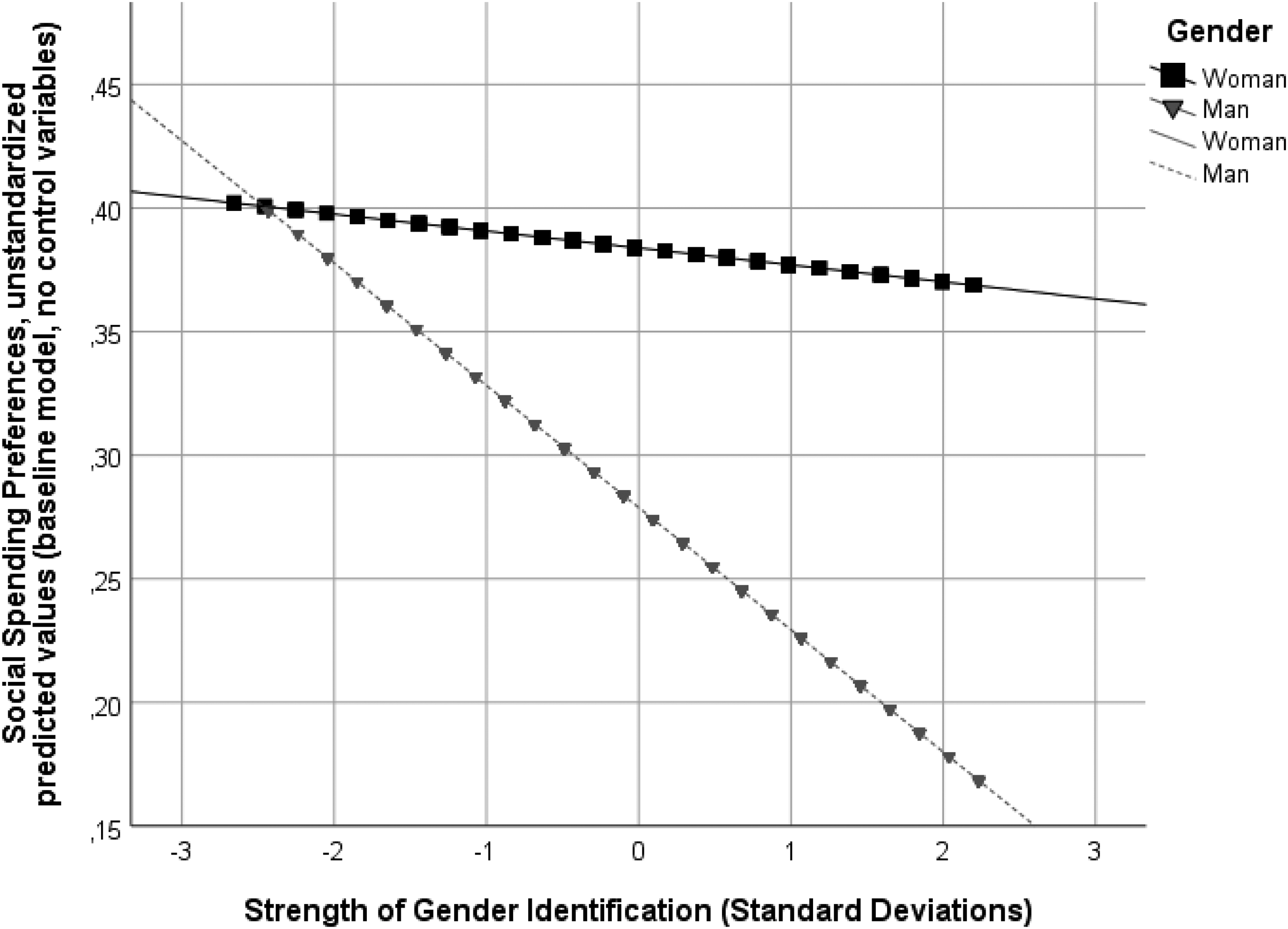
Predicted social spending preferences ( − 1 to + 1) by gender and strength of gender identification. Source: Values are predicted using information from the model M20 in Table 2, this paper. Note. The visualized data corresponds to the 10th imputed dataset.
In the full model (M27), one standard deviation in SGI again equals − 0.04 units negative differences in social spending preferences for men (β = −0.035). If we look at Figure 2, which graphs the mean predicted social spending preferences obtained from this model (M27), we observe that among respondents with a weaker than average SGI (one standard deviation below the average or more) there is virtually no certainty in telling apart men's and women's social spending preferences. Conversely, looking at respondents with an above average SGI (one standard deviation above the average or more), we observe quite large differences between men and women. This indicates that men who strongly identify with their gender group drive gender differences in social spending preferences. At the most extreme ends of the scale, we observe that men with SGI much below the average (SD>−2) have a predicted mean on the social spending preference scale equal to about 0.36, while those men with SGI much above the average (SD>2) have a predicted mean on the social spending preference scale equal to about 0.17 (for the 10th imputed dataset).
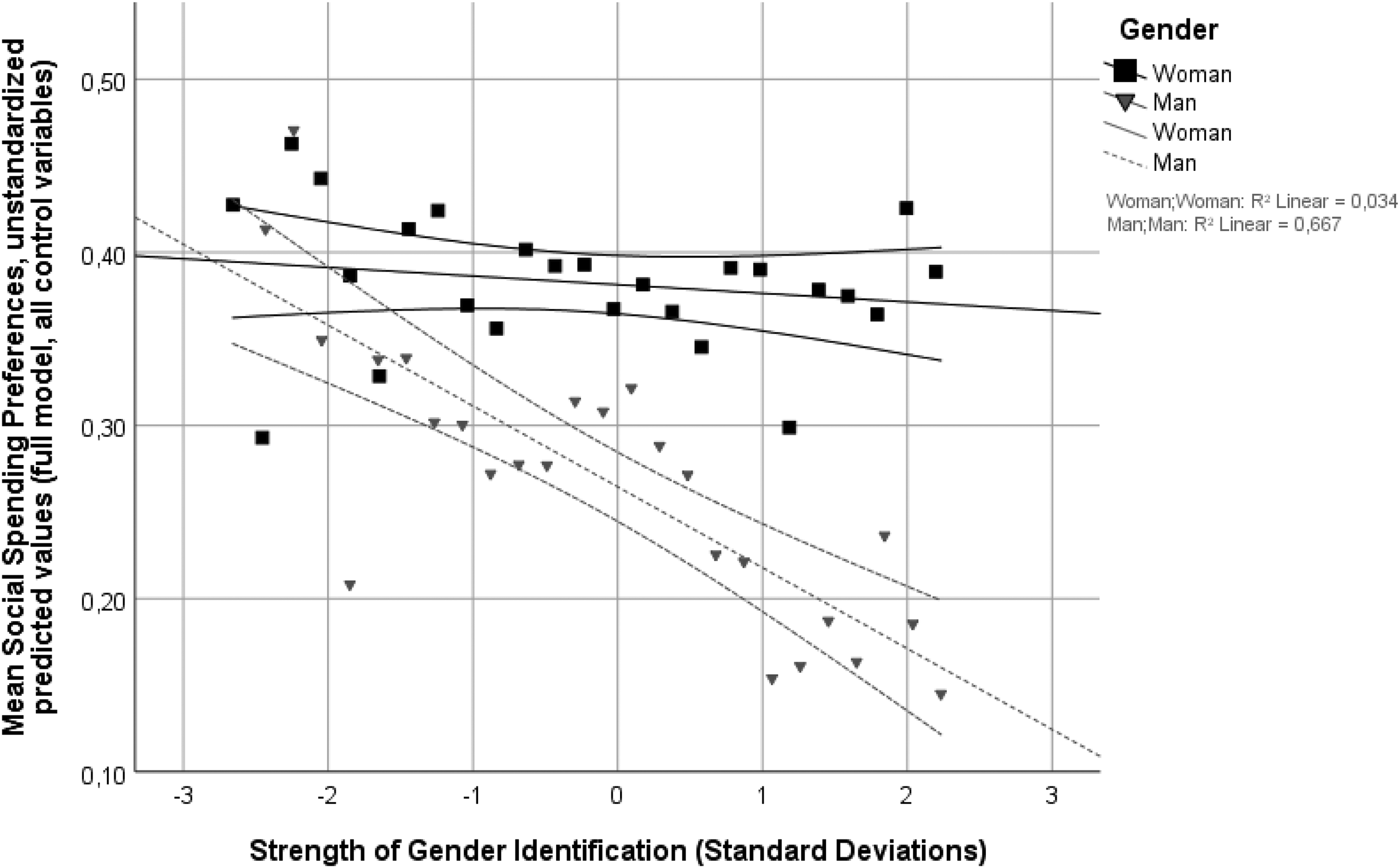
Mean predicted social spending preferences ( − 1 to + 1) by gender and strength of gender identification. Source: Values are predicted using information from the model M27 in Table 2, this paper. Notes. Confidence intervals are set to 95%. The visualized data corresponds to the 10th imputed dataset.
Confirming H1, men are on average less supportive of increasing social spending, compared to women. However, the findings are only in partial support of H2, which stated that differences in social spending preferences are most pronounced among the men and women who strongly identify with their gender group. Instead, the findings are in full support of H3, which stated that an expected negative relationship between SGI and social spending preferences is stronger for men than for women.
Additional analysis
To estimate how much of the total gender difference in social spending preferences that is attributable to men with an above average SGI, I compare estimates of gender differences in a full sample, containing all observations, to the same estimates in restricted sample, excluding men with an above average SGI (Table 3). The results demonstrate a reduction in gender differences between 24.5% (no controls) and 36.2% (full set of controls), when excluding observations of men with above average SGI. Additionally, when including control variables, gender differences in the restricted sample are not statistically significant.
Reduction in the total gender difference in social spending preferences ( − 1 to + 1), when excluding men with above average strength of gender identification (SD>1).
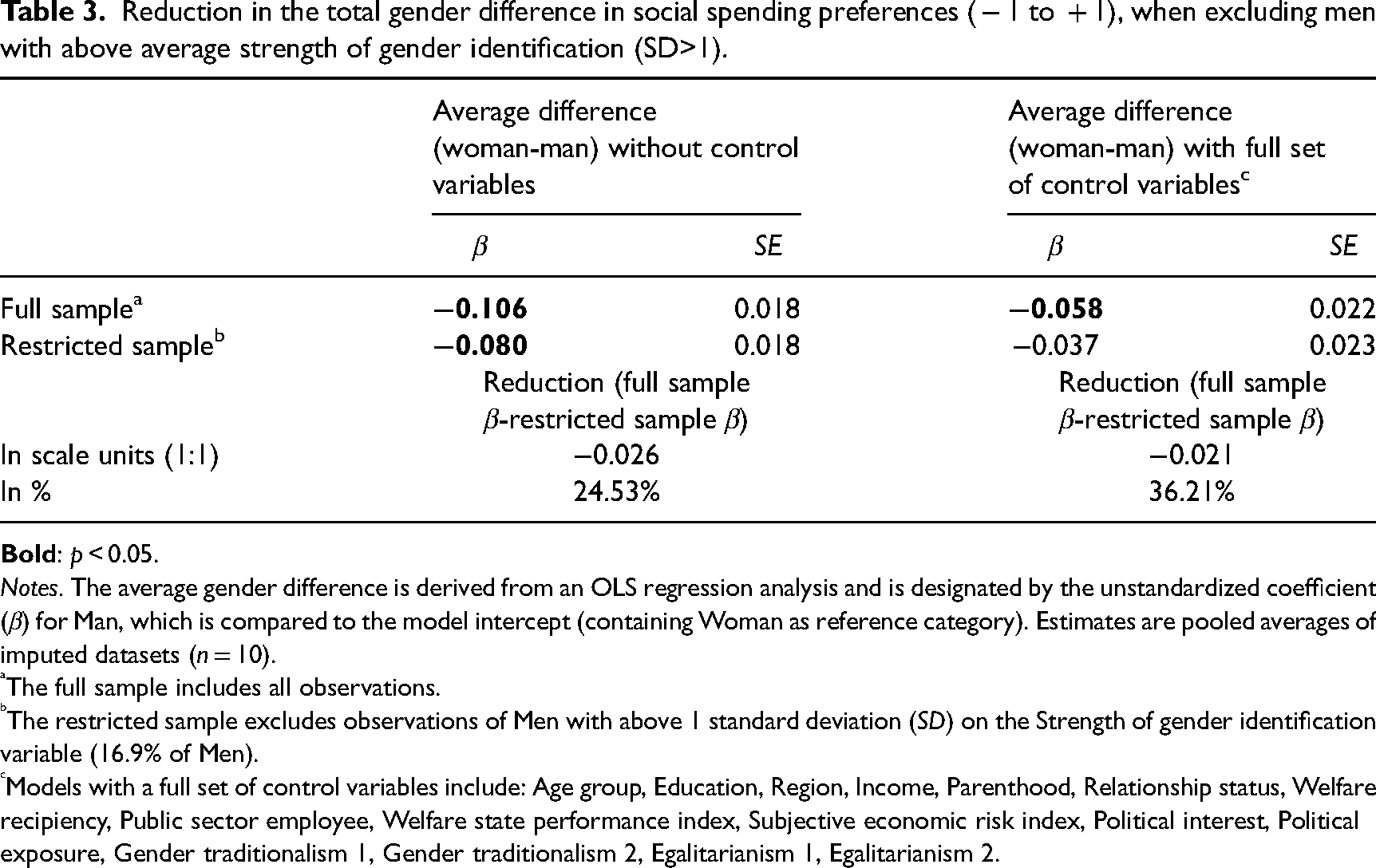
Notes. The average gender difference is derived from an OLS regression analysis and is designated by the unstandardized coefficient (β) for Man, which is compared to the model intercept (containing Woman as reference category). Estimates are pooled averages of imputed datasets (n = 10).
The full sample includes all observations.
The restricted sample excludes observations of Men with above 1 standard deviation (SD) on the Strength of gender identification variable (16.9% of Men).
Models with a full set of control variables include: Age group, Education, Region, Income, Parenthood, Relationship status, Welfare recipiency, Public sector employee, Welfare state performance index, Subjective economic risk index, Political interest, Political exposure, Gender traditionalism 1, Gender traditionalism 2, Egalitarianism 1, Egalitarianism 2.
To safeguard against the possibility that only a few spending areas drive the observed relationship between gender, SGI, and the index measuring social spending preferences, I explore each of the spending areas separately. Results are presented as a cross-tabulation in Table 4. Gender differences are noted for all spending areas except health care, with average differences being small for those with weak or average SGI (4.27 percentage points), compared to the more substantial differences between men and women with strong SGI (14.17 percentage points). Gender differences are particularly pronounced concerning spending on social assistance and basic (tertiary and upper secondary) education, while being somewhat less pronounced for family and child support.
Gender difference in favor of increasing social spending, by strength of gender identification (SGI).
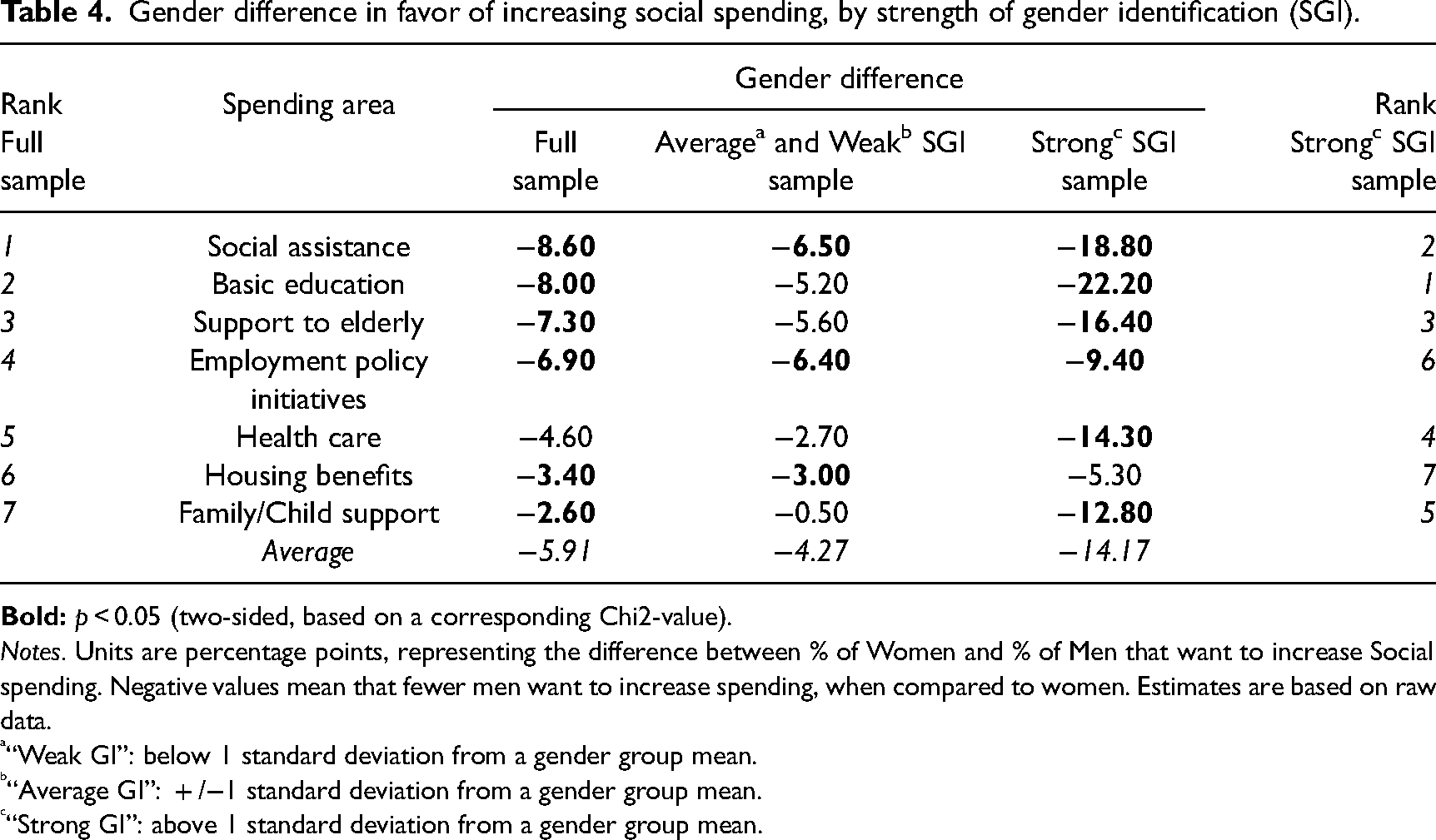
Notes. Units are percentage points, representing the difference between % of Women and % of Men that want to increase Social spending. Negative values mean that fewer men want to increase spending, when compared to women. Estimates are based on raw data.
“Weak GI”: below 1 standard deviation from a gender group mean.
“Average GI”: + /−1 standard deviation from a gender group mean.
“Strong GI”: above 1 standard deviation from a gender group mean.
Concluding discussion
The aim of this paper has been to contribute to the analysis of the gender gap in welfare state attitudes, by focusing on the process of social identification with a gender group. To this end, I have worked to synthesize prior explanations, focused on gender differences in self-interest and norms, with a social identity perspective. Specifically, I proposed that strength of gender identification, defined as a dispositional and transsituational attachment to one's gender group, could contribute to nuance previously observed gender differences in welfare state attitudes that were not accounted for by self-interest variables, gendered experiences, or values and ideological beliefs. Having here investigated gender differences in social spending preferences in Sweden, taken as a measure of the tax-based welfare effort of the public sector, I have found the following:
First, in accordance with previous findings (Blekesaune and Quadagno, 2003; Burclau and Lühiste, 2021; Garritzmann and Schwander, 2021; Goossen, 2020; Lizotte, 2017), I found that women were more, and men were less, positive toward increasing social spending. In accordance with the findings of, for example Banducci and colleagues (2016), I found these differences to be general, in that they were observed for most spending areas, rather than being specifically related to any particular policy. Furthermore, in accordance with the findings of Goossen (2020), I found that gender differences persisted even when controlling for socio-demographic and self-interest variables, family situation, experiences, and evaluations of the welfare state, gender role beliefs, and pro-social values (egalitarianism). So far, this replicates what we already know about gender differences in welfare state attitudes.
Second, I found that, among men, social spending preferences were negatively correlated with strength of gender identification. However, no association between these two variables was found for women. Furthermore, among respondents with a weak or average strength of gender identification, gender differences were non-existent or small, while among those with a strong gender identification, differences between men and women were of considerable size. Finally, I observed that a significant proportion (between 25% and 36%) of the gender gap in social spending preferences were attributable to men with an above average strength of gender identification.
I now turn to the theoretical implications of the above findings. As the strength of gender identification was only related to social spending preferences among men, the proposed function of social identification as a proxy for attentiveness to gendered self-interest (a perspective aligned with institutional theory (e.g. Goossen, 2020)), or a tendency to adopt gender-stereotypical attitudes (a perspective aligned with social role theory (e.g. Diekman and Schneider, 2010)), is probably more complex than theorized by these perspectives. Instead, the findings are well aligned with research that has found that (some) political attitudes have a stronger association with masculinity than femininity (Coffé and Bolzendahl, 2021; review in DiMuccio and Knowles, 2021). In this paper, I argued that the expansion of the Swedish welfare state—intricately interwoven with the expansion of women's social and economic roles (Lister, 2009; Stanfors and Goldscheider, 2017)—could be perceived as a threat to men's role as breadwinners. Similarly, much of the debate on welfare and gender in Sweden has tended to conceptualize masculinity in negative terms, as an obstacle to achieving a modern and egalitarian society, while so far having offered little in terms of genuinely alternative formulations of masculinity (Klinth 2002; Lundqvist, 2007; see also Borchorst and Siim, 2008; Svensson and Gunnarsson, 2012). Thus, in the Swedish case, there are reasons to believe that welfare state expansion could be perceived as a form of masculinity threat—at least by some men.
Given the present findings, a re-specification of the above arguments would thus read that when masculinity threat is experienced in relation to a social or political issue (for whatever reason) men's attitudes are more likely to vary according to their strength of gender identification. However, the inner workings of this postulation are still compatible with both a self-interest perspective, as well as a gender-norm perspective. When faced with masculinity threat, a strong emotional and psychological attachment to a masculine identity may prompt both acute attentiveness to gendered self-interest, as well as an increased likelihood of adopting stereotypical attitudes (as a strategy for re-asserting masculine dominance). This aligns with previous theorization of threats to social groups as being both realistic (self-interest) and symbolic (normative) (Klandermans, 2014; Stephan et al., 2000). While we need additional research, to disentangle the mechanisms that operate between strength of gender identification and attitudinal outcomes, the findings of this study highlight that accounting for men's emotional and psychological attachment to their gender identity is an important aspect of understanding the gendered legitimacy of the welfare state.
Limitations
I perceive of two limitations to the present study. First, the correlational evidence does not reveal the causal direction of the studied relationships. To remedy this, future studies could employ experiments, such as vignette studies, to explore whether introducing threats to gender status does affect social spending preferences in a causal manner.
Second, while this paper focuses on individual-level relationships, some arguments clearly link individuals’ positionality and experience to their immersion in a particular institutional milieu. This is true of the theoretical argument that welfare state expansion can be conceptualized as a form of threat to the masculine breadwinner role. Although the observed correlational relationships support hypotheses based on this argument, future studies should, in order to further strengthen the link between theory and data, look to compare different contextual settings (e.g. countries differing in experiences of state feminism in relation to welfare policies), or integrate a measure of strength of gender identification as part of a multilevel framework. The latter would require the inclusion of new survey items in large cross-national surveys.
Supplemental Material
sj-docx-1-asj-10.1177_00016993221108920 - Supplemental material for Not all men, nor all women: Strength of gender identification and social spending preferences in Sweden
Supplemental material, sj-docx-1-asj-10.1177_00016993221108920 for Not all men, nor all women: Strength of gender identification and social spending preferences in Sweden by Mikael Goossen in Acta Sociologica
Footnotes
Funding
The author disclosed receipt of the following financial support for the research, authorship, and/or publication of this article: This work was supported by the Swedish Research Council for Health, Working Life and Welfare (grant number 2016-00255).

Supplemental material
Supplemental material for this article is available online.
Author biography
References
Supplementary Material
Please find the following supplemental material available below.
For Open Access articles published under a Creative Commons License, all supplemental material carries the same license as the article it is associated with.
For non-Open Access articles published, all supplemental material carries a non-exclusive license, and permission requests for re-use of supplemental material or any part of supplemental material shall be sent directly to the copyright owner as specified in the copyright notice associated with the article.
