




Abstract
Labour market, health, and wellbeing research provide evidence of increasing educational inequality as individuals age, representing a pattern consistent with the mechanism of cumulative (dis)advantage. However, individual life courses are embedded in cohort contexts that might alter life course differentiation processes. Thus, this study analyses cohort variations in education-specific life course patterns of subjective wellbeing (i.e. life, health and income satisfaction). Drawing upon prior work and theoretical considerations from life course theories, this study expects to find increasing educational life course inequality in younger cohorts. The empirical analysis relies on German Socio-Economic Panel data (1984–2016, v33). The results obtained from cohort-averaged random effects growth curve models confirm the cumulative (dis)advantage mechanism for educational life course inequality in subjective wellbeing. Furthermore, the results reveal substantial cohort variation in life course inequality patterns: regarding life and income satisfaction, the results indicate that the cumulative (dis)advantage mechanism does not apply to the youngest cohorts (individuals born between 1970 and 1985) under study. In contrast, the health satisfaction results suggest that educational life course inequality follows the predictions of the cumulative (dis)advantage mechanism only for individuals born after 1959. While the life course trajectories of highly educated individuals change only slightly across cohorts, the subjective wellbeing trajectories of low-educated individuals start to decline at earlier life course stages in younger cohorts, leading to increasing life course inequality over time. Thus, the overall findings of this study contribute to our understanding of whether predictions derived from sociological middle range theories are universal across societal contexts.
Keywords
Introduction
All individuals strive to achieve high subjective wellbeing levels in their lives (Lindenberg, 1996). 1 Thus, research should extend beyond analyses of inequality in objectively measured life domains (such as income or employment) and provide empirical evidence of social differences in individuals’ subjective wellbeing, thereby acknowledging the complexities in human conditions (e.g. Stiglitz et al., 2009). Against this background, sociological research provides evidence of pronounced inequalities in the final outcome all individuals strive to achieve. Investigating such inequalities is important because subjective wellbeing is a predictor of mortality (Diener and Chan, 2011), and decreasing subjective wellbeing in countries might be a driver of decreasing social cohesion (Witte et al., 2020).
Research concerning educational differences in subjective wellbeing indicates that with increasing education, subjective wellbeing increases (e.g. Chen, 2012; Durst, 2021). Furthermore, life course research indicates that highly educated individuals are able to sustain high subjective wellbeing levels, while the subjective wellbeing of low-educated individuals strongly declines over the life course (Kratz and Patzina, 2020). Thus, educational inequality in subjective wellbeing increases over the life course, thereby following the predictions of the cumulative (dis)advantage mechanism (e.g. DiPrete and Eirich, 2006). The central characteristic of such processes is that even small relative differences in structural conditions at the beginning of life courses generate inequality in the accumulation of vital resources as individuals age. Concerning education and subjective wellbeing, evidence of increasing educational inequality is consistent with the predictions of social production function theory, which assumes that the ‘cumulative effects of differences in early “tracks” (in schooling and otherwise) cause individuals to differ increasingly from others with respect to acquired resources and encountered restrictions’ (Steverink et al., 1998: 456).
To date, no study has systematically investigated how life course patterns of educational inequality in subjective wellbeing change across cohorts. However, changes in the development of life course inequality are likely to occur because the social structure, which is stratified by cohorts, influences micro-level processes (e.g. Ryder, 1965). Research concerning important subdomains of subjective wellbeing (measured by objective outcomes) shows that substantial cohort variation exists. Such findings have strong implications for changing educational life course inequality in subjective wellbeing because health and labour market outcomes (e.g. employment or money) constitute crucial resources necessary to achieve high subjective wellbeing levels (e.g. Steverink et al., 1998; Winkelmann and Winkelmann, 1998; Wolbring et al., 2013). Important drivers explaining cohort variations in educational inequality in subjective wellbeing may include changing labour markets, compositional changes in educational groups, changes in education-specific health behaviour, and increasing stigmatization of educational failures across cohorts (e.g. Leopold and Leopold, 2018; Solga, 2002; Zajacova and Lawrence, 2018).
This study investigates how the development of educational inequality over the life course in life satisfaction, health satisfaction, and income satisfaction varies across cohorts. Such an analysis advances sociological knowledge regarding how the social structure influences intracohort differentiation processes (Dannefer, 2003). More broadly, such an analysis contributes to scholarly understanding of how social change influences the quality of life in a society as individuals age (Diener, 1984; Diener et al., 1999; Ormel et al., 1997; Stiglitz et al., 2009; Veenhoven, 2007, 2012). Furthermore, as subjective wellbeing is crucial for social cohesion (Witte et al., 2020), analysing change in life course patterns of educational inequality in subjective wellbeing advances knowledge concerning societal polarization over the life course and across cohorts. Moreover, by conducting analyses of life satisfaction and two important domain satisfaction measures (i.e. health and income satisfaction), this study enriches work related to educational poverty that focuses mainly on objective measures approximating single life domains. Thus, employing a subjective wellbeing framework advances our understanding of whether factual changes in the labour market and health over time translate into changes in individuals’ subjective wellbeing and satisfaction with broader life domains (Bernardi et al., 2017).
This study uses data from Germany that provide a large panel dataset necessary for the conducted analyses, that is, the Socio-Economic Panel Study (SOEP). These multicohort panel data enable me to disentangle age from period effects in the cohorts under study (Glenn, 2005; Mason and Fienberg, 1985). Based on these data, I estimate random effects growth curve models (RE GCs) to retrieve education- and cohort-specific age-wellbeing profiles and life course wellbeing differentials (i.e. cohort-specific age-education differences in subjective wellbeing).
Researching and disentangling cohort effects in life course inequality processes constitutes a central sociological interest because such an analysis directly addresses how societal change influences individual-level outcomes (Coleman, 1986; Ryder, 1965). Furthermore, the analysis of inter-cohort variation in life course inequality reveals whether ‘cohort-averaged’ life course patterns disguise the potential moderation effects of cohorts. Therefore, disentangling cohort and age effects improves our understanding of whether predictions derived from sociological middle range theories are universal across societal contexts.
Theoretical considerations and empirical findings
Education and subjective wellbeing over the life course
Empirical research in different social contexts investigating educational inequality in objective wellbeing measures (e.g. overall health, income and occupational prestige) consistently finds support for increasing differences between educational groups as individuals age (e.g. Bhuller et al., 2017; Bönke et al., 2014; Bracke et al., 2020; Dupre, 2007; Leopold and Leopold, 2018; Lynch, 2003; Manzoni et al., 2014; Mirowsky and Ross, 2008; Willson et al., 2007). Furthermore, research concerning educational inequality in subjective wellbeing over the life course also provides evidence of increasing life course inequality (Kratz and Patzina, 2020). Thus, prior research investigating educational inequality provides evidence supporting the cumulative (dis)advantage mechanism.
The idea of a cumulative (dis)advantage emphasizes the important role of path dependencies in individuals’ life courses (e.g. DiPrete and Eirich, 2006). According to Dannefer (2003: 327), ‘… cumulative advantage/disadvantage can be defined as the systemic tendency for interindividual divergence in a given characteristic (e.g. money, health, or status) with the passage of time’. In this broad definition, Dannefer emphasizes that cumulative advantage processes always work between groups rather than within individuals and that these processes arise from a complex interplay among structural conditions, institutional boundaries and individual behaviour.
The main characteristic of cumulative (dis)advantage processes is that even small initial relative differences (e.g. differences in the beginning of the life course) in structural conditions generate differences in the accumulation of vital resources over the life course. Thus, the ‘… current levels of accumulation have a direct causal relationship on future levels of accumulation’ (DiPrete and Eirich, 2006: 272). This idea describes the purest form of a cumulative (dis)advantage process (for an overview, see DiPrete and Eirich, 2006, and for alternative descriptions, refer to Ferraro and Shipee, 2009 or O’Rand, 2003). The literature provides many theoretical explanations of mechanisms explaining divergence patterns in outcomes over time (for an overview of theoretical mechanisms, see DiPrete and Eirich, 2006).
Social production function theory provides a theoretical basis for conceptualizing how education affects subjective wellbeing (Lindenberg, 1989, 1996; Ormel et al., 1997, 1999). The basic premise of social production function theory is that all rational actors (i.e. homo socio-oeconomicus (Lindenberg, 1990)) strive to achieve high happiness levels in their lives (Lindenberg, 1996). Thus, everyone strives to achieve the overall outcome of happiness. Actors achieve high levels of happiness by maximizing physical and social wellbeing given their set of resources and restrictions (Ormel et al., 1999). Empirical research concerning the importance of health and money for maximizing subjective wellbeing provides support for the hierarchical structure, with subjective wellbeing as the final outcome (e.g. Easterlin, 2001; Steverink et al., 1998; Wolbring et al., 2013).
Moreover, social production function theory predicts that educational differences in subjective wellbeing increase over the life course because this theory assumes that ‘cumulative effects of differences in early “tracks” (in schooling and otherwise) cause individuals to differ increasingly from others with respect to acquired resources and encountered restrictions’ (Steverink et al., 1998: 456). Thus, educational decisions early in the life course structure resource endowment (e.g. income in later life) and influence individual behaviour (e.g. the amount an individual exercises or smokes over the life course). Therefore, this theoretical approach relies on the following central assumption inherent in all life course theories: events at early life course stages (e.g. individual educational decisions) structure later life outcomes (Mayer, 2009).
Educational life course inequality across cohorts
Thus far, research investigating educational inequality in subjective wellbeing has focused on identifying cohort (Hadjar et al., 2008) and life course (Kratz and Patzina, 2020) trends. Evidence illustrating how life course patterns change across cohorts, thereby connecting both literature streams, is missing. As the social structure, which is stratified by cohorts, influences the individual ageing process (e.g. Riley, 1987; Ryder, 1965), studies investigating temporal changes in intracohort differentiation processes are important (Dannefer, 2003). Therefore, although previous research appropriately considered cohort effects to retrieve life course trajectories, ‘cohort-averaged’ life course patterns could still disguise the moderating role of generation effects. By explicitly addressing such moderator effects, this study connects to the literature stream investigating the role of context-specific structural conditions in the life course development of inequalities (e.g. Dannefer, 2003; Ferraro et al., 2009; Kratz et al., 2019; Leopold and Leopold, 2018; Mirowsky and Ross, 2008; Rözer and Bol, 2019) and provides evidence concerning how educational life course inequality in life satisfaction, health satisfaction, and income satisfaction varies across cohorts.
From a theoretical perspective, changes in educational life course patterns are likely to occur for two main reasons. First, labour markets and health behaviours, two highly important domains for the maximization of subjective wellbeing (Ormel et al., 1999), change across cohorts (Delaruelle et al., 2015). Second, over the course of educational expansion, the health and ability composition of educational groups might change, and educational expansion might alter societal norms of what constitutes the minimum standard of education, reflecting a process that might lead to increased stigmatization of the least-educated individuals in a society (Solga, 2002).
Labour market research provides evidence suggesting that over the course of modernization, technological advancements changed labour market structures. For example, U.S. research indicates that changes in technology lead to polarization in the demand for certain skill types (e.g. Card and DiNardo, 2002). In contrast to this finding regarding polarization, research investigating European labour markets indicates that over time, the demand for high-skilled occupations has increased (Oesch and Piccitto, 2019). This demand shift towards high-skilled occupations might explain why returns to university education increased across cohorts in Germany (Becker and Blossfeld, 2017, 2021). In contrast, research concerning the least-educated individuals shows that their employment opportunities deteriorated (Klein, 2015) and that the likelihood of entering labour markets through unskilled jobs vastly increased over time (Solga, 2002).
The findings from labour market research investigating highly educated and low-educated individuals corroborate research emphasizing the importance of degree attainment for labour market inclusion in Germany (Di Stasio et al., 2016). Furthermore, these findings have important implications for how educational inequality in labour market careers might change across cohorts. Research focusing on life course inequality has consistently shown that entry positions are crucial for further career development (e.g. Blossfeld, 1987; Gangl, 2006; Scherer, 2005). Therefore, the education-specific cohort trend of decreased first job quality and hampered access to labour markets may lead to increasing educational inequality in career outcomes.
Moreover, research provides clear evidence suggesting that educational inequality in healthy behaviours and overall health changed across cohorts. Health research provides evidence of increasing educational inequality in self-rated health across cohorts (e.g. Delaruelle et al., 2015; Goldman and Smith, 2011; Leopold and Leopold, 2018; Mirowsky and Ross, 2008) and increasing educational life course inequality over time, that is, across cohorts, educational inequality in health at comparable life course stages increases (e.g. Delaruelle et al., 2015; Leopold and Leopold, 2018; Mirowsky and Ross, 2008). The main driver of increasing educational inequality across cohorts is the deterioration of the health of low-educated individuals. A possible explanation is derived from research investigating healthy behaviours, which indicates that across cohorts, educational inequality in smoking behaviour and athletic activities, which are two major mediators through which education affects health (Mirowsky and Ross, 2003), has significantly increased (e.g. Hoebel et al., 2016, 2017; Pampel et al., 2015).
In addition, over the course of modernization, the composition of educational groups might have changed, causing increasing educational inequalities in health and labour market outcomes over time. An idea prominently discussed in the literature stems from Solga (2002, 2005), who states that over the course of educational expansion in Germany, negative selection into the low-educated group in terms of ability and socio-economic status occurred, an event that constitutes the main driver of the deteriorating labour market prospects discussed above. This process can be described as follows. Over the course of educational expansion, many individuals from low educational backgrounds experienced upward mobility. Upward mobility depends on individuals’ ability and social background. Simultaneously, downward mobility from high educational backgrounds was nearly non-existent. Thus, over time, ability- and background-selective upward mobility left a negatively selected group of low-educated individuals in younger cohorts behind (Solga, 2002).
Although a direct test of this theoretical mechanism is lacking, evidence from research concerning the development of socio-economic achievement gaps in standardized test scores of school students indicates that such gaps increase across cohorts in Germany (Chmielewski, 2019). As social origins still strongly influence offsprings’ educational attainment, this research implies that the average ability of low-educated individuals declines across cohorts. Moreover, Giesecke et al. (2015) provide an indication for substantial adverse compositional changes within the group of low-educated individuals. In their comparison of low-educated men from the mid-1980s and mid-2000s, the authors show that younger cohorts of low-educated men are more likely to be in poorer health and excluded from the labour market. In particular, the finding of deteriorating health corroborates the findings from health sociology presented above. Interestingly, although the highly educated group saw a significant influx of individuals from lower social origins, the health of highly educated individuals did not decrease across the cohorts (e.g. Leopold and Leopold, 2018). These described temporal changes within the low-educated group very likely influence how educational inequality over the life course unfolds across cohorts.
In addition to compositional changes, educational expansion increased the perceived standard of educational achievement (i.e. the expansion changed educational norms). Therefore, in younger cohorts, low education is more salient and associated with an ‘individual failure to succeed’ (Solga, 2002: 163).
Hypotheses concerning life course inequality and cohort changes
The presented theoretical considerations and empirical findings concerning the life course development of educational inequality in subjective and objective wellbeing domains lead to the following hypothesis:
H1: Across the life course, educational inequality in subjective wellbeing increases.
Furthermore, life course inequality patterns are likely to vary across cohorts. The section before identified the following four main reasons that may explain cohort variations: (a) changing labour markets, (b) changing education-specific health behaviour, (c) compositional changes of educational groups, and (d) potential stigmatization of educational failure. While increasing stigmatization across cohorts might have a direct effect on subjective wellbeing, the other explanations might indirectly affect subjective wellbeing through behaviour or labour market processes. Based on concepts stemming from social production function theory, changes in behaviour and labour market outcomes very likely induce changes in subjective wellbeing. For instance, changes in life course inequality in labour market-related outcomes could affect educational inequality in income satisfaction because labour market outcomes (e.g. employment or money) constitute crucial resources necessary to achieve high happiness levels (e.g. Winkelmann and Winkelmann, 1998; Wolbring et al., 2013). Moreover, increasing life course inequality in health, which is another important domain of subjective wellbeing, across cohorts, should also lead to increasing inequality in subjective wellbeing.
Furthermore, adverse selection into the low-educated group and, particularly, decreasing labour market and health outcomes across cohorts should lead to decreased subjective wellbeing among the least-educated individuals across cohorts. In contrast, labour market returns to university education even increased in Germany, and the health of this group remained high across cohorts. Thus, if life course inequality patterns change across cohorts, decreasing subjective wellbeing of the least-educated group should drive this process.
The theoretical considerations and empirical findings of educational inequality in cohort variations in objective and subjective wellbeing measures lead to the following hypotheses:
H2: Across cohorts, educational inequality in life course inequality increases. H3: Increasing life course inequality across cohorts is driven by decreasing subjective wellbeing of the least-educated individuals.
Methods, measures and data
Data
This study draws upon rich multicohort panel data from the SOEP (v33; N person-years = 624,575; N persons = 86,113). The SOEP version used in this study covers the period from 1984 to 2016 (for details of the data, see Goebel et al., 2019; Haisken-DeNew and Frick, 2005). I use a subsample of the SOEP data as I restrict the analyses to individuals aged between 30 and 80 years with no missing information. The final sample contains 431,401 person-years from 53,165 individuals. From this sample, I moreover construct five cohort-specific datasets (for an overview of the distribution of the model variables, see Tables A.1 and A.2 in the online appendix).
Measures
This study investigates educational differences in cohort-specific age changes in life satisfaction, health satisfaction, and income satisfaction. Research concerning subjective wellbeing often operationalizes wellbeing with general life satisfaction (Alderson and Katz-Gerro, 2016). The construct of subjective wellbeing stems from positive psychology (Diener et al., 2002) and consists of an overall assessment of life and affect (Diener, 1984). While affect relates to moods and emotions (Diener et al., 1999), the overall assessment includes a cognitive measure of how individuals evaluate their life overall.
While life satisfaction represents a cognitive measure of the overall assessments of individuals of their lives (including subdomains) (Diener, 1984; Veenhoven, 2012), domain satisfaction measures reflect ‘… the extent to which objective conditions in a particular area of life match people’s respective needs or aspirations’ (Delhey, 2014). I operationalize these outcome measures through self-reported responses to survey questions. In the SOEP, life satisfaction is measured by the following question: ‘How satisfied are you with your life all things considered?’ The respondents answer this question on a scale from 0 to 10 (0 is ‘completely dissatisfied’ and 10 is ‘completely satisfied’). The items related to health and income satisfaction rely on the same scale, and the related survey questions are as follows: ‘How satisfied are you today with the following areas of your life? How satisfied are you with your health? How satisfied are you with your household income?’ As research suggests that the results of econometric models treating measures as either categorical or metric variables do not differ substantially (Frijters and Beatton, 2012), I treat the outcome measures as quasi-metric variables.
Explanatory variables
This study employs the following three explanatory variables: individual education, cohort and age. To investigate educational differences, this study draws upon the ISCED-97 classification (Schneider, 2008: 98; UNESCO, 2006) and classifies individuals into the following three educational groups: low, medium, and high. Low-educated individuals (i.e. educationally poor individuals) do not hold a postsecondary degree (no university or vocational degree; ISCED-97 values of 0, 1, 2A, 2B). Medium-educated individuals hold a vocational degree (ISCED-97 values of 3A, 3B, 3C, 4A, 4B, and 5B), and highly educated individuals hold a university degree (ISCED-97 values of 5A and 6). 2
To analyse cohort variations, individuals are grouped into five different cohorts. The oldest cohort comprises individuals born between 1910 and 1939. The second oldest cohort comprises individuals born between 1940 and 1949. Further cohorts pool individuals born between 1950–1959, 1960–1969 and 1970–1985.
To model the age effect as flexibly as possible, I use a dummy variable approach. Therefore, I do not impose any functional form on the educational-age relationship. Thus, I do not pre-determine how life course inequality unfolds, a strategy that is particularly advantageous when investigating changes in life course patterns across cohorts.
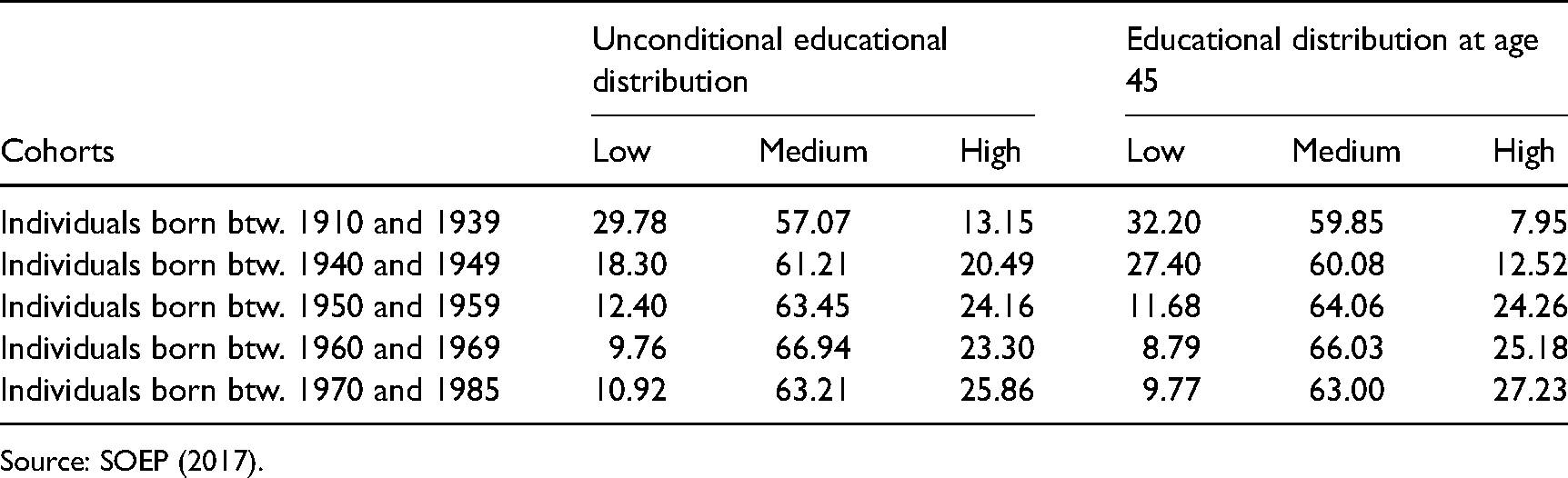
Table 1 displays the educational distribution of the five cohorts under study. Overall, the table indicates that the supply of highly educated individuals increased over time. This increase is particularly pronounced if I condition the data on an age group that is a part of each cohort. The share of individuals aged 45 years with a university degree increases from 7.95 in the oldest cohort to 27.23 in the youngest cohort.
Educational expansion in the data.
Source: SOEP (2017).
Individual confounders
To control for factors influencing both life satisfaction and educational achievement, I control for time-invariant and time-variant variables. The time-invariant factors include a dummy variable indicating a female respondent and a dummy for at least one parent with university education. The time-variant controls include a dummy variable indicating German nationality and a dummy variable indicating residence in West Germany.
Period effects
To control for period effects, I adjust each model for the real disposable income rate, the growth of the gross domestic product, and the unemployment rate (Di Tella et al., 2001, 2003; Frijters et al., 2004). I collected these measures from data stemming from the German Federal Statistical Office (Destatis, 2016). Moreover, as research has shown that economic recessions and reductions in unemployment benefits have an independent negative effect on an individual’s subjective wellbeing (Di Tella et al., 2003), I include a dummy variable indicating the reductions in unemployment benefits in 2004 3 and a dummy variable for 2009, the year after the 2008 economic recession.
Panel conditioning
To control for panel conditioning effects (see Warren and Halpern-Manners, 2012, i.e. a bias that arises if participants in panel studies alter their responses due to survey participation), I include three dummy variables indicating the first three person-years in the models. These variables are important because research investigating the development of subjective wellbeing shows that due to issues of social desirability, respondents report upwardly biased life satisfaction values in the first three interviews (Wunder et al., 2013).
Methods
The aim of this study is to estimate cohort-averaged and cohort-specific life course patterns. To retrieve these life course profiles, I employ RE GCs and specify the following equations:

Pt is a vector comprising period measures. Incorporating explicitly measured period effects is pivotal because I aim to disentangle these effects from age effects in cohort-specific equations. In addition, because I aim to understand the development of educational inequality as individuals age, it is only logical to approximate period effects. Modelling period effects through macroeconomic factors is easily possible because an elaborate body of research has already examined the relationship between these factors and subjective wellbeing (Di Tella et al., 2001, 2003; Frijters et al., 2004). This research focusing on the macroeconomics of wellbeing shows that the GDP, wage rate, and unemployment rate influence the individual development of subjective wellbeing. Period effects in an age period model are identifiable if no period trends exist (Bell and Jones, 2013).)
Results
Figure 1 presents the cohort-averaged life course patterns and life course differentials based on the random effects regressions described in subsection 3.3. The upper left part of Figure 1 shows the educational life course inequality pattern of life satisfaction, the middle left part shows income satisfaction and the lower left part shows health satisfaction. The black solid lines represent highly educated individuals, and the grey dashed lines represent low-educated individuals. The right part of Figure 1 always depicts life course differentials, that is, differences between highly educated and low-educated individuals at the same age.
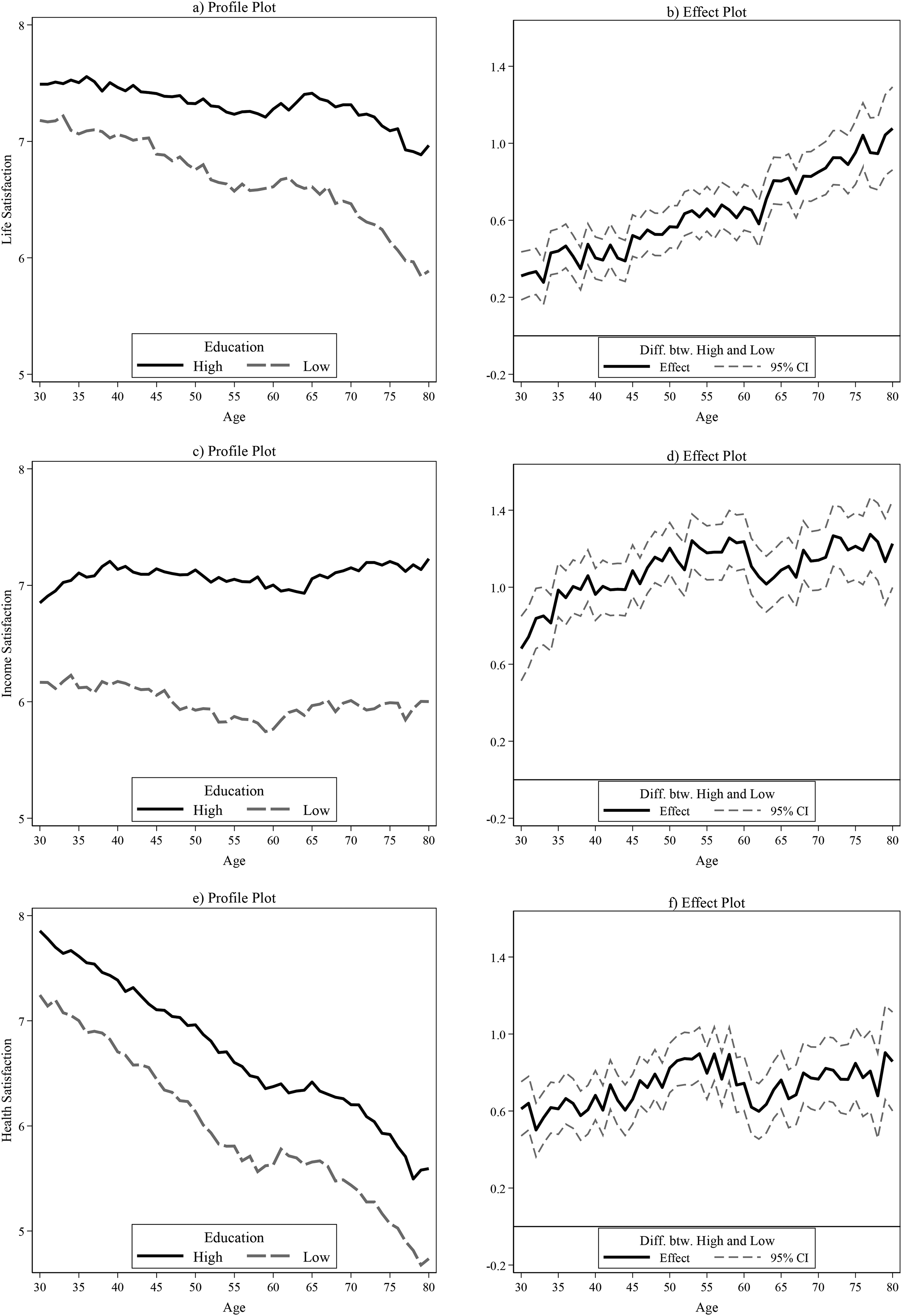
Cohort-averaged life course patterns and life course differentials of life, income, and health satisfaction.
The upper part of Figure 1 clearly shows increasing life course inequality in life satisfaction. As individuals age, educational differences in life satisfaction increase (upper-right part of Figure 1). Therefore, educational inequality over the life course in life satisfaction clearly follows a cumulative inequality process. The middle part of Figure 1 shows that the educational life course inequality pattern in income satisfaction, although not as pronounced as that in life satisfaction, also follows a cumulative inequality process. However, after the age of 50, life course inequality remains almost stable. The lower part of Figure 1 indicates that educational inequality in health satisfaction only slightly increases until the age of 55 and then remains almost stable over the life course.
In summary, the findings of the cohort-averaged life course patterns support the first hypothesis, which states that life course inequality in subjective wellbeing increases over the life course. However, the most pronounced increases were found in life satisfaction.
Regarding testing of hypotheses 2 and 3, Figure 2 to 4 depict the cohort-specific life course patterns and differential results. These figures are organized similarly to Figure 1.
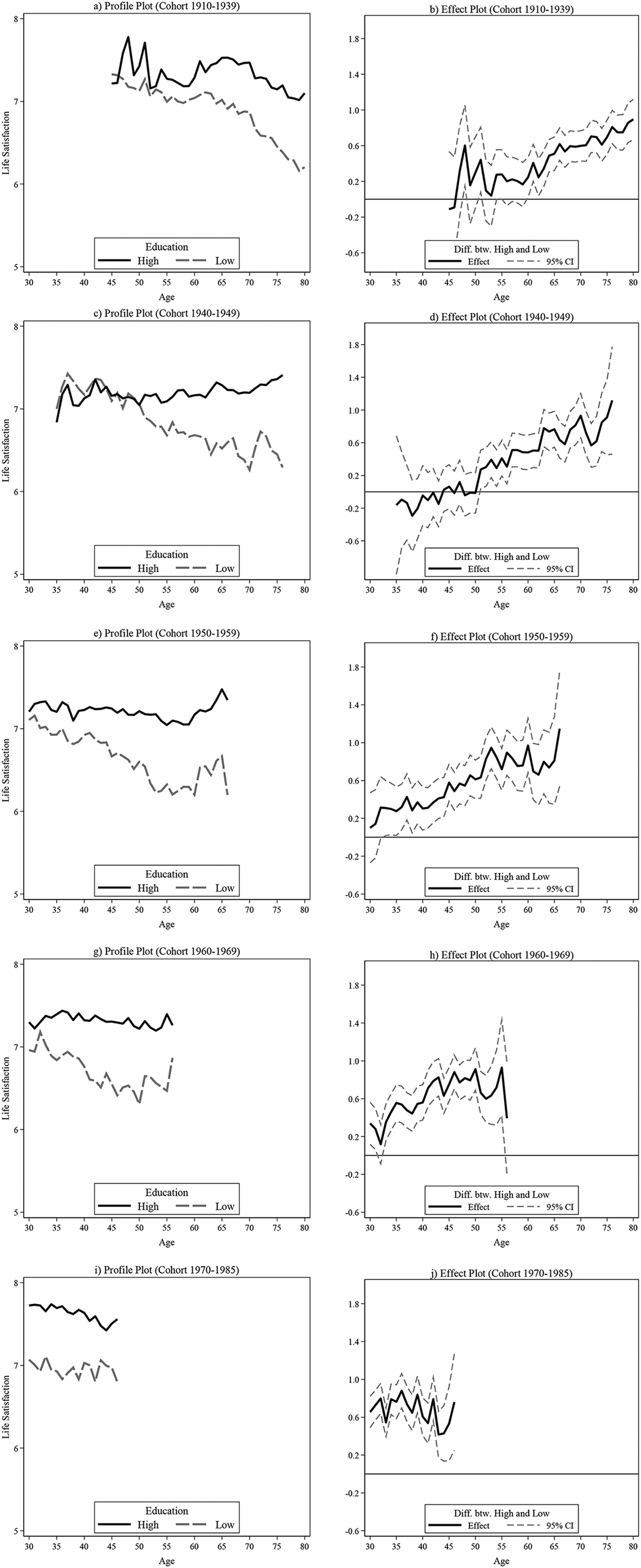
Inter-cohort variation in educational life course inequality (life satisfaction). For details, refer to regression Table A4 in the online appendix. Hierarchical growth curve models yield the same results. Figure A1 in the online appendix contrasts educational life course differences across cohorts, which were retrieved from one RE GC model including an interaction term among age, education, and cohort.
Figure 2 shows the results of life satisfaction. The results of cohort 1 (1910–1939) to cohort 4 (1960–1969) reveal that with increasing age, life course inequality becomes more pronounced, thereby confirming predictions of a cumulative (dis)advantage in each cohort. Furthermore, this inequality pattern becomes more pronounced across cohorts because over time, education-specific life satisfaction trajectories among low-educated individuals start to decrease at earlier life course stages (hypothesis 2). Interestingly, the lowest part of Figure 2 suggests that the cumulative (dis)advantage mechanism does not apply to the youngest cohort (1970–1985). In contrast, this part of Figure 2 shows substantial but stable educational inequality between the ages of 30 and 45. Thus, regarding life satisfaction, the results of cohort variations in educational life course inequality indicate substantial changes in the inequality pattern.
Furthermore, the findings on life satisfaction suggest that changes in the life course pattern appear to be driven mainly by low-educated individuals (hypothesis 3). However, when examining the life course profiles of low-educated individuals between cohort 4 (1960–1969) and cohort 5 (1970–1970), the results suggest that life satisfaction in cohort 5 is rather stable, which is inconsistent with the life course development in cohort 4. Thus, the increased educational inequality in the youngest cohort appears to be driven by an increase in life satisfaction among highly educated individuals, thereby challenging the prediction of hypothesis 3.
Figure 3 shows the results of income satisfaction. The findings are very close to the findings of life satisfaction. Between cohort 1 and cohort 4, the life course patterns follow the predictions of the cumulative (dis)advantage mechanism, and life course inequality appears to intensify across the cohorts (hypothesis 2). The lowest part of Figure 3 shows substantial educational inequality between the ages of 30 and 35. Subsequently, this difference decreases until the age of 45. However, among the youngest cohort, educational differences between the ages of 35 and 45 remain at a very high level. Furthermore, the findings of income satisfaction indicate that the increased educational inequality in life course patterns is mainly driven by a deterioration in income satisfaction among the least-educated individuals (hypothesis 3).
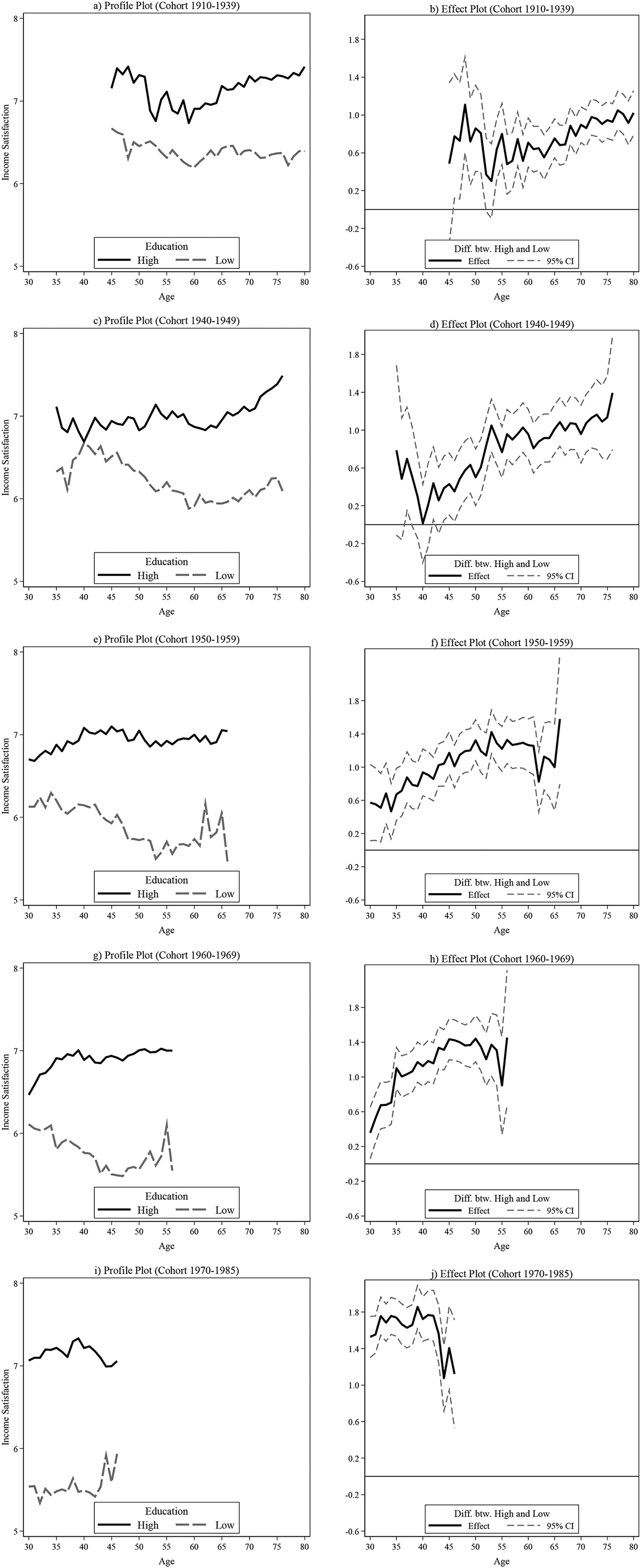
Inter-cohort variation in educational life course inequality (income satisfaction). For details, refer to regression Table A5 in the online appendix. Hierarchical growth curve models yield the same results. Figure A2 in the online appendix contrasts educational life course differences among cohorts, which were retrieved from one RE GC model including an interaction term among age, education, and cohort.
Figure 4 shows the results of health satisfaction. In contrast to life satisfaction and income satisfaction, the pattern of educational life course inequality among cohorts 1 to 3 does not follow the predictions of the cumulative (dis)advantage mechanism. Furthermore, the pattern hardly changes across these cohorts. However, between cohorts 4 and 5, educational life course inequality follows the prediction of cumulative inequality. Moreover, as the health satisfaction of low-educated individuals decreases across cohorts 3, 4 and 5, educational inequality between the ages of 30 and 45 in health satisfaction becomes the most pronounced in the youngest cohort, thereby providing empirical evidence supporting hypothesis 3.
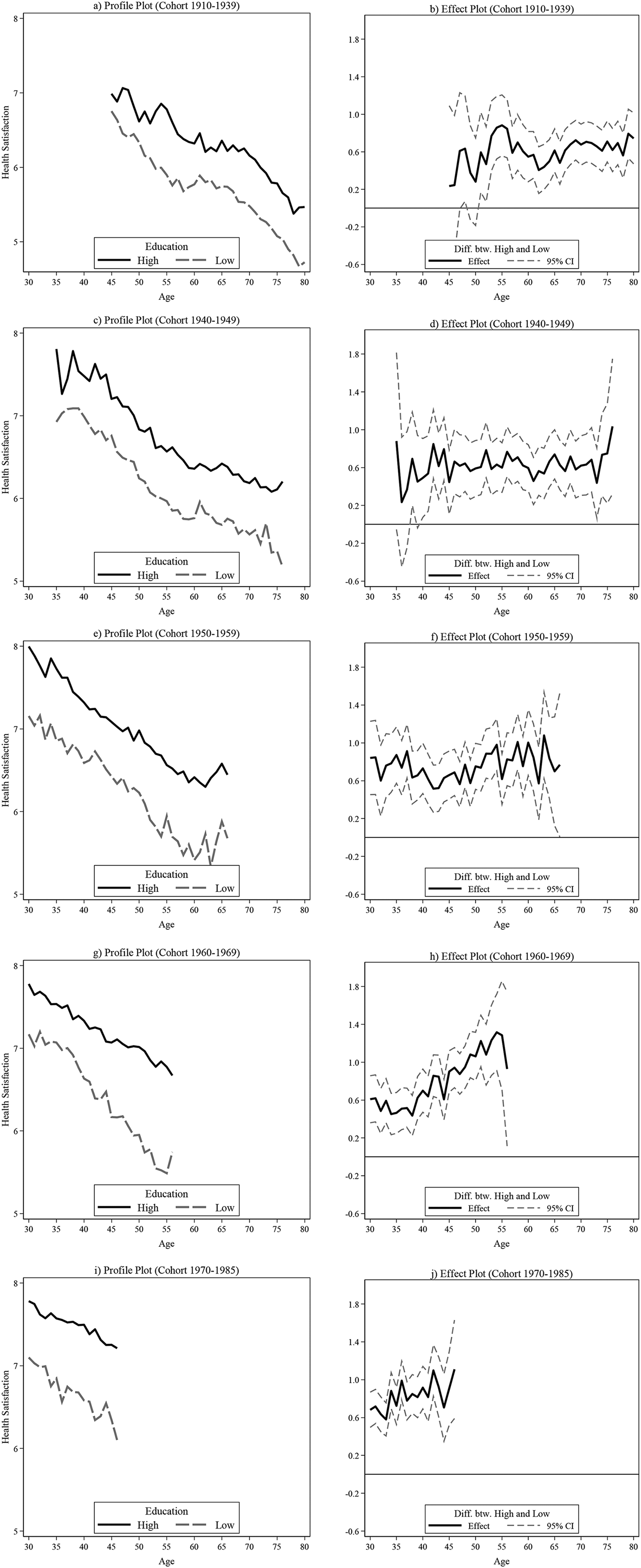
Inter-cohort variation in educational life course inequality (health satisfaction). For details, refer to regression Table A6 in the online appendix. Hierarchical growth curve models yield the same results. Figure A3 in the online appendix contrasts educational life course differences among the cohorts, which were retrieved from one RE GC model including an interaction term among age, education, and cohort.
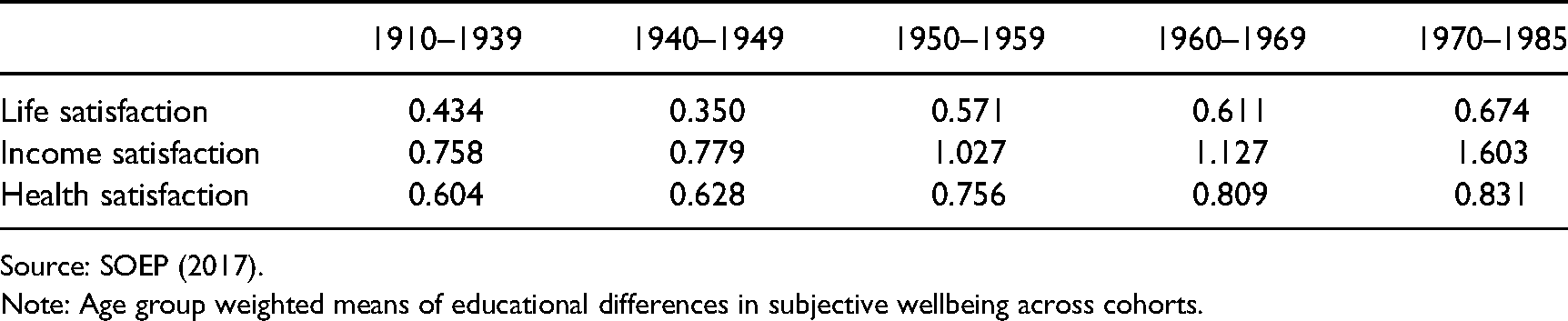
Finally, Table 2 further elaborates on hypothesis 2. This table depicts the total amount of educational life course inequality over time weighted by the number of observed age groups, which vary across cohorts. Regarding all satisfaction measures, the table clearly indicates increasing differences in subjective wellbeing between highly educated and the least-educated individuals. Thus, educational inequality over the life course increases across cohorts (hypothesis 2).
Average life course inequality across cohorts.
Source: SOEP (2017).
Note: Age group weighted means of educational differences in subjective wellbeing across cohorts.
Conclusion and discussion
Drawing upon theoretical considerations from life course theories and insight from health and labour market research, this study formulated expectations regarding how educational life course inequality in subjective wellbeing unfolds and how inequality patterns change across cohorts. By applying multicohort panel data (SOEP) and estimating RE GCs, this study found the following results.
First, educational inequality in subjective wellbeing increases over the life course. These findings are consistent with the predictions of the cumulative (dis)advantage mechanism and previous research concerning life satisfaction and objective wellbeing measures.
Second, life course patterns vary across cohorts, leading to increasing life course inequality between highly educated and the least-educated individuals over time. Furthermore, the findings of life and income satisfaction indicate that the cumulative (dis)advantage mechanism does not apply to the youngest cohort (individuals born between 1970 and 1985) under study. In contrast, the findings of health satisfaction suggest that cumulative (dis)advantage processes are only present among individuals born between 1960 and 1985.
Third, increasing educational life course inequality is mainly a result of decreasing subjective wellbeing levels and an earlier decline in subjective wellbeing trajectories among the least-educated individuals in modern societies. The life course development of subjective wellbeing among the highly educated remained fairly stable across the cohorts. In the youngest cohort (individuals born between 1970 and 1985), the life and income satisfaction of the highly educated group even increased at early life course stages. In addition, by comparing the life satisfaction profiles of low-educated individuals, the results indicate that in contrast to individuals born before 1970 in the youngest cohort, life satisfaction remains fairly stable from ages 30 to 45. Thus, in contrast to the predictions of this study, the increasing educational life course inequality in life satisfaction among the youngest cohort is driven by the increasing life satisfaction of highly educated individuals at earlier life course stages.
These results emphasize the importance of research focusing on averaged life course patterns, that is, approaches scrutinizing the age-wellbeing relationship while controlling for cohort effects, to elaborate on how the cohort context might influence the inequality processes under study. Thus, the present study contributes to research investigating temporal changes in intracohort differentiation processes (e.g. Kratz et al., 2019; Leopold and Leopold, 2018; Mirowsky and Ross, 2008; Rözer and Bol, 2019).
Moreover, the results of the decreasing subjective wellbeing of low-educated individuals across cohorts contribute to research investigating the consequences of educational poverty and the economic marginalization of the least-educated individuals in modern societies (e.g. Gesthuizen et al., 2011; Solga, 2002, 2005). Particularly in conjunction with labour market and health research, the findings show that in current societies, the least-educated individuals experience multiple disadvantages.
Furthermore, the results contribute to the political debate regarding degree inflation that claims that due to an increasing supply of individuals with higher education degrees, returns to these degrees decline over time (e.g. Burnett, 2015; Leonhardt, 2014; Nida-Rümelin, 2014). Thus far, I have not observed declining subjective wellbeing among the highly educated individuals across the cohorts. In contrast, I found stable and even increasing subjective wellbeing levels (in the youngest cohort) in this group. Therefore, policy efforts should focus on preventing educational poverty because of the declining subjective wellbeing of the least-educated individuals over the course of educational expansion.
This study argues that cohort changes in the labour market and health indirectly affect subjective wellbeing. However, as described, other processes, such as increasing stigmatization, could introduce temporal variation to education-specific life course patterns. As these processes likely directly affect subjective wellbeing and, therefore, likely influence life course patterns, future research must address these important questions.
Furthermore, this research cannot determine which pathway is more important for changes in the overall assessments of individuals’ lives. Based on the literature, the indirect effects associated with labour market processes appear to be the most relevant partially because many health outcomes also depend on labour market processes (Paul and Moser, 2009). To deepen our understanding of the potential drivers of inter-cohort variations, future work could employ causal mediation techniques (e.g. Hicks and Tingley, 2011).
Moreover, this study focused on only one societal context. As educational systems (Allmendinger, 1989) and labour markets (Hall and Soskice, 2001) vastly differ across countries, educational gradients in health and labour market outcomes are likely to change differently or not change at all over time in countries with, for example, more liberal regimes. Thus, future work should employ a similar empirical approach based on panel data, such as the BHPS or HILDA, to investigate whether cumulative inequality processes emerge or change over time. Such an analysis could deepen our understanding of the role of institutions in cumulative (dis)advantage processes in subjective wellbeing. In addition, the present study cannot rule out potential confounding bias due to unobserved variables. Therefore, the presented life course patterns do not reflect causal education-specific age changes.
Finally, how ongoing societal trends, such as digital transformation, could affect the education-specific life course development of subjective wellbeing remains a notable research question that should stimulate future work. Future research must also conduct a more fine-grained analysis of potential changes in the education-wellbeing relationship as with progressing educational expansion, both the number of individuals from diverse backgrounds and the supply of different subjects at universities change, which, in turn, increase heterogeneity within educational degree groups across cohorts.
Footnotes
Acknowledgements
I thank Ann-Christin Bächmann, Monika Jungbauer-Gans, Fabian Kratz, Fabian Ochsenfeld, Malte Reichelt and three anonymous reviewers for their helpful comments on the earlier versions of this paper. Furthermore, I would like to thank the American Journal Experts for language editing.
Declaration of conflicting interests
The author(s) declared no potential conflicts of interest with respect to the research, authorship and/or publication of this article.
Funding
The author(s) received no financial support for the research, authorship and/or publication of this article.

Supplemental material
Supplemental material for this article is available online.
Notes
Author biography
References
Supplementary Material
Please find the following supplemental material available below.
For Open Access articles published under a Creative Commons License, all supplemental material carries the same license as the article it is associated with.
For non-Open Access articles published, all supplemental material carries a non-exclusive license, and permission requests for re-use of supplemental material or any part of supplemental material shall be sent directly to the copyright owner as specified in the copyright notice associated with the article.
