




Abstract
Set against the backdrop of the Great Recession, the paper explores the interplay of unemployment experiences and political trust in the USA and 23 European countries between 2002 and 2017. Drawing on harmonized data from the European Social Survey and the General Social Survey, we confirm that citizens’ personal experiences of unemployment depress trust in democratic institutions in all countries. Using multilevel linear probability models, we show that the relationship between unemployment and political trust varies between countries, and that, paradoxically, the negative effect of unemployment on political trust is consistently stronger in the more generous welfare states. This result holds while controlling for a range of other household and country-level predictors, and even in mediation models that incorporate measures of households’ economic situation to explain the negative effect of unemployment on trust. As expected, country differences in the generosity of welfare states are reflected in the degree to which financial difficulties are mediating the relationship between unemployment and political trust. Overlaying economic deprivation, however, cultural mechanisms of stigmatization or status deprivation seem to create negative responses to unemployment experiences, and these render the effect of unemployment on political trust increasingly negative in objectively more generous welfare states.
Keywords
Introduction
In many Western democracies populist movements are on the rise, while trust in the traditional institutions of representative democracy is in decline (Norris and Inglehart, 2019). Economic difficulties and rising unemployment have often been assumed to be at the roots of surfacing extremist movements, political dissatisfaction and behind the loss of confidence that is reflected in ‘the erosion of normative support for the political institutions’ (Gallie, 2013: 17). Existing research has regularly confirmed the relationship between economic performance and trust in democracy. By now, a plethora of studies have addressed the effects of macroeconomic conditions on political trust with recent data (Armingeon and Ceka, 2014; Foster and Frieden, 2017; Kroknes et al., 2015; Roth et al., 2011; van der Meer and Dekker, 2011), underscoring the direct relevance of a deteriorating economic climate for political turmoil. These recent studies have mostly remained focused on the macroeconomic level, however, employing indicators such as gross domestic product (GDP) growth, GDP per capita or national unemployment rates. Far fewer studies have examined the relationship between economic strain and political trust at the micro level to date, even though classical depression-era sociology (Jahoda et al., [1933] 1971), the class voting tradition (Lipset, 1960; Schlozman and Verba, 1979) and the more recent literature on social exclusion (Gallie et al., 2003) all imply a prediction of adverse effects of job loss on political integration. The handful of recent studies that does address potential political effects of unemployment tends to find clear evidence for declining trust in democracy and increasing demands for government redistribution among the unemployed (e.g., Blekesaune, 2007; Jakobsen and Listhaug, 2012; Kroknes et al., 2015; Polavieja, 2013: 274; Roth et al., 2011).
In the present paper, we seek to add to this small body of literature by providing a cross-nationally comparative lens by testing two competing hypotheses regarding the influence of national welfare contexts on the relationship between personal experiences of unemployment and trust in democratic institutions. National systems of social protection constitute an important contextual dimension to mitigate the political implications of labour market marginalization. Welfare states differ substantially in the generosity and coverage of unemployment benefits and other systems of income protection (Emmenegger et al., 2015; Erlinghagen, 2019; Esping-Andersen, 1990; Hall and Soskice, 2001). These institutional differences translate into significant cross-country differences in the capacity to buffer workers from the economic deprivation caused by job loss and unemployment (DiPrete, 2002; DiPrete and McManus, 2000). If economic strain is the causal mechanism to link experiences of unemployment to political alienation, significant cross-national variation in welfare state generosity suggests that the unemployment–trust relationship depends on the institutional context: where welfare states fail to mitigate the economic consequences of unemployment, disappointment and political frustration are likely to result. In turn, adequate income security and higher levels of institutional support might be expected to limit mistrust towards the political system and sustain social and political integration among the unemployed in more generous welfare regimes.
To the best of our knowledge, the dependence between welfare state context and the strength of the unemployment–trust relationship has not yet been empirically examined. There is an established comparative literature showing the importance of welfare policies for explaining political alienation and dissatisfaction with democracy (Kumlin, 2004, 2011; Kumlin et al., 2017; Oskarson, 2007; Uslaner, 2017), but these studies do not focus on individual labour market status or experiences as explanatory factors. To connect the literature on the political economy of trust with research on contextual effects of welfare state institutions, we investigate the effect of individual experiences of unemployment on stated trust in democratic institutions in a multilevel design that combines survey data from 23 European countries and the USA. In the next section, we will lay out the theoretical arguments behind our research, before giving a description of our modelling strategy, operationalisation and research design in the third section of the paper. We then present and discuss the results of our empirical analysis and provide our conclusions in the final section.
Theoretical considerations
People’s trust in political institutions is an indicator for the legitimacy of the political system and one of the foundations of viable democratic governance. To explain the emergence of trust, two broad strands of research may be distinguished in the social science literature. Cultural theory characterizes trust as a stable trait that is acquired through political socialization within the family and wider community, and that is therefore mainly responsive to socio-economic conditions early in life (Almond and Verba, 1963; Norris and Inglehart, 2019). Cognitive evaluation models portray political trust as the result of citizens’ continuous subjective performance evaluations of political actors, political institutions or the political system at large. Relative to cultural theories, trust-as-evaluation models emphasize a larger degree of contingency in political trust and see citizens responsive to current changes in both personal socio-economic circumstances and in the broader social, economic or political context (Armingeon and Guthmann, 2014; Foster and Frieden, 2017; Uslaner, 2002: 151).
In the present article, we follow the trust-as-evaluation tradition and seek to understand if, when and to what extent the personal experience of unemployment may involve political re-evaluation and respective changes in political trust. As a consequence, we will be exclusively concerned with the political implications of citizens’ egocentric assessment of their personal socio-economic circumstances (Bélanger and Nadeau, 2014; Kinder and Kiewiet, 1981; Kumlin et al., 2017). Our concern is specifically with the impact of unemployment experiences on diffuse trust in democratic institutions (see Easton, 1975).
The experience of unemployment and political trust
Inquiring into the political and social repercussions of unemployment places this study within a venerable line of social science research extending from classic studies on the consequences of the Great Depression in the 1930s, to the studies of the 1970s and 1980s that were tracing the implications of the decline of manufacturing, and to the latest wave of research that has begun to examine the issue in the aftermath of the financial crisis (Brand, 2015; Burden and Wichowsky, 2014; Foster and Frieden, 2017; Gallie and Paugam, 2000; Jahoda et al., [1933] 1971); Naumann et al., 2016; Nguyen, 2017; Schlozman and Verba, 1979; Wilson, 1996). Without exception, the baseline expectation in the literature is that personally experiencing unemployment has negative effects on citizens’ political trust (Foster and Frieden, 2017).
Interestingly, different authors have advanced quite different arguments to account for a negative relation between unemployment and political trust. More often than not, the negative relationship between unemployment and political trust is taken as a direct corollary to the well-known regularity that personal economic success enhances perceptions of legitimacy, loyalty and trust in the existing political institutions (Almond and Verba, 1963; Lipset, 1960). Other authors explicitly emphasize adverse political effects from economic hardship more specifically (Brand, 2015; Mughan, 2007; Naumann et al., 2016; Reeskens and Vandecasteele, 2017; Russell et al., 2013), which is a well-documented consequence of unemployment (Brand, 2015; DiPrete, 2002; DiPrete and McManus, 2000; Gallie and Paugam, 2000).
For some authors a negative effect of unemployment on trust requires political attribution of economic misfortune (Bauer, 2018; Schlozman and Verba, 1979). Paralleling the literature on poverty and social exclusion, however, the processes that link economic deprivation to social withdrawal, resignation, shame and disintegration are more typically thought to be of a non-voluntaristic nature and to intensify with increasing duration of hardship (Böhnke, 2008; Jahoda et al., [1933] 1971; Mood and Jonsson, 2016). Unemployment is associated with a symbolic loss of status in (post-)industrial societies where paid labour continues to play a central role (Clark, 2003) for personal identity, especially if socially acceptable alternative roles are not available. On a more psychological level, it might be that citizens who experience unemployment lose an optimistic view on life in general, which is also known to affect trust (Andersen, 2009; Clark et al., 2001; Clark, 2003; Harrison, 1976; Nguyen, 2017). Moreover, it has been suggested that the bureaucratic procedures of the welfare state itself may be a cause of declining trust among the unemployed, since the recipients of unemployment benefits might experience stigmatization, bureaucratic control and insufficient or unreliable public support (Kumlin, 2004; Kumlin et al., 2017; Oskarson, 2007).
The role of welfare state context
The social, psychological and political processes that link the experience of unemployment to trust in democratic institutions are plausibly universal reactions among citizens in Western societies. Even so, it does not follow that the relationship between unemployment and political trust would be uniform across countries, because different institutional contexts may be able to mitigate and address some of the mechanisms that trigger political alienation among the unemployed. In general, theories of policy feedback suggest that institutional performance and policy generosity have positive effects on political trust, and shape political satisfaction and citizens’ values (Foster and Frieden, 2017; Kumlin, 2011; Nguyen, 2017; Uslaner, 2017). Empirically, the quality of political institutions and public services has repeatedly shown to be positively correlated with national levels of trust (Delhey and Newton, 2005; Foster and Frieden, 2017; Nguyen, 2017).
For the unemployed, welfare state institutions are likely to play a decisive role in this respect, as eligibility rules, the level and duration of unemployment benefits and other public transfer programmes like housing or social assistance benefits regulate the financial consequences of unemployment. Benefit levels vary considerably between Western welfare states (e.g. Jæger, 2006; OECD, 2019), and comparative research regularly confirms significant cross-country differences in the level of economic hardship experienced by the unemployed, with smaller loss of household income in the more generous welfare states of Scandinavia and Continental Europe (DiPrete, 2002; DiPrete and McManus, 2000; Gallie and Paugam, 2000). Differences in welfare state generosity will therefore translate into context-dependent political effects of unemployment if these mainly result from economic deprivation proper. More specifically, as countries with more generous public benefits are more effective in preventing financial difficulties among the unemployed, it is straightforward to predict that more generous welfare states should also be relatively more effective in mitigating the adverse implications of unemployment for political trust. Hence one would expect that
Hypothesis 1: the effect of unemployment experiences on political trust depends positively on the generosity of the welfare state.
While straightforward enough, one may relate to the more sociologically inspired literatures on deservingness perceptions, on the moral economies of welfare states, and also on the institutional determinants of stigmatization processes to form an exactly opposite expectation on the interaction between welfare states, unemployment experiences and political trust. It is widely established that public policies at least in part represent legal manifestations of prevalent social norms, but also that existing welfare state institutions create important feedback effects on citizens’ policy attitudes. Correspondingly, there is evidence that in wealthier European countries, citizens hold higher expectations for government and political institutions in general (Foster and Frieden, 2017). With respect to the welfare state more particularly, there also is evidence that the size, profile and generosity of existing institutions correlate with citizens’ attitudes towards the desirability of redistribution (Andreß and Heien, 2001; Sachweh, 2019; Svallfors, 2007), government responsibilities to address social problems (Koos and Sachweh, 2017), or even with citizens’ perceptions about which groups deserve or which circumstances normatively warrant public support (van Oorschot, 2000, 2006). Moreover, when it comes to unemployment benefits specifically, cutbacks in existing policies ‘appear to be a universal generator of democratic dissatisfaction across broad groups in Western Europe’ (Kumlin, 2011: 179), that is in characteristically generous welfare state environments.
This co-evolution of manifest welfare state institutions and citizens’ subjective policy attitudes creates the potential of a paradoxical (negative) effect of stronger welfare state institutions, especially among the clients and constituencies served by the welfare state. Where the state is not perceived as being responsible for addressing unemployment, the experience of unemployment might not be tied to any specific expectations about institutional support and might therefore not translate into any political response. Instead, (only) where addressing unemployment is being defined a public responsibility, trust in the political system might decline when citizens experience unemployment and do not receive the expected support or do experience negative (economic or other) consequences of unemployment that conflict with their expectations of a supportive welfare system (Kinder and Kiewiet, 1979; Kumlin et al., 2017). A closely related argument links lower levels of trust among welfare state clients to their actual experiences of stigmatization in their interactions with the welfare state’s bureaucracy, and to the adverse reaction to high levels of bureaucratic control that are typical with means-tested benefit systems or in labour market activation policy settings (Kumlin, 2004; Kumlin et al., 2017).
Taken together, the very fact that public institutions exist to address a particular social problem – such as unemployment – may be what gives rise to high expectations towards the state, to bureaucratic interactions that are strongly felt as stigmatizing, and to status and identity challenges that are charged with political overtones and conflict. Accordingly, there is a competing
Hypothesis 2: the negative effect of unemployment on political trust is stronger in the more generous welfare states.
To emphasize the underlying processes as cultural rather than economic in origin, and as centring on matters of recognition rather than manifest economic need, we label this the status deprivation channel. In contrast to the economic deprivation mechanism described before, the prediction is one of a negative interaction between welfare state generosity and the effect of unemployment experiences on trust: as policy expectations and issues of status recognition are conflictive in strong welfare states with encompassing policy responsibilities only, the negative effect of unemployment experiences on trust will be especially pronounced in these environments. In contrast, in countries with weaker welfare state traditions where the individual citizen is culturally and normatively held accountable for her own economic fate and where unemployment is not perceived to be a matter of public intervention, individual experiences of labour market difficulties will not be a strong predictor of political trust (Kinder and Kiewiet, 1979; Schlozman and Verba, 1979). 1
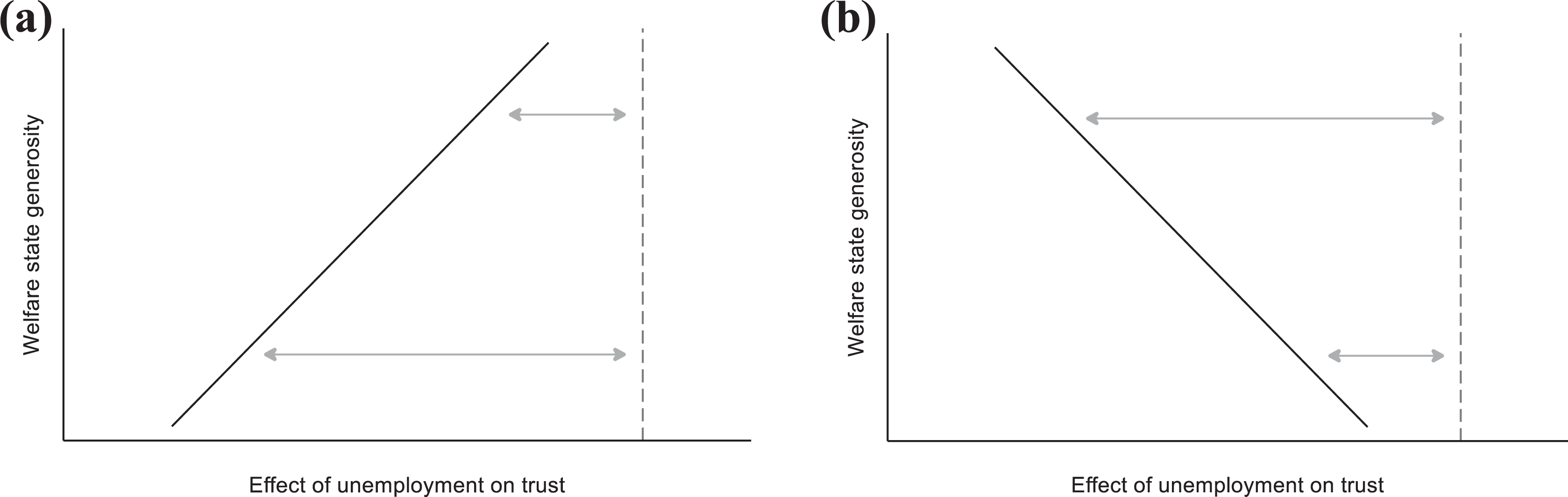
Alternative predictions on the cross-level interaction between welfare state generosity and the effect of unemployment on trust in political institutions. (a) H1, economic deprivation mechanism; (b) H2, status deprivation mechanism.
We illustrate the two opposing predictions on context dependence in the relationship between unemployment experiences and democratic trust in Figure 1, and we aim to explore the relevance of either prediction in the subsequent empirical analysis. But while having emphasized the distinct (economic v. recognition) roots of the two analytical mechanisms to link unemployment experiences and political trust so far, it seems important to stress that both politico-psychological processes are best seen as complementary rather than as mutually exclusive. It is well conceivable that strong welfare states are effective in mitigating the economic consequences of unemployment, thereby muting the economic deprivation channel, and that they simultaneously may trigger the status deprivation channel through the extensive bureaucracy, job search or other participation requirements they imply, or through high political expectations they partially are disappointing. Weak welfare states may in turn not politicize the experience of unemployment much, thus failing to trigger any status deprivation, but may be more susceptible to political distrust generated by the lack of income protection and the resulting economic deprivation among the unemployed. By implication, the observable cross-level interaction between welfare state generosity and the strength of the unemployment–trust relationship will be informative about whether economic or status deprivation is the predominant influence on the relationship, but should not be seen as empirically deciding any horse race between two mutually exclusive theoretical alternatives.
Finally, we should also like to clarify that our foregoing discussion was intended to illuminate our theoretical rationale for considering the welfare state an important factor to generate context dependence in the relationship between unemployment and trust, but not to suggest that the welfare state would be the only plausible source of context dependence. One obvious counter example is what is known as the relative deprivation hypothesis in the literature, namely that the psychological implications of unemployment depend on its prevalence in society: if few people experience unemployment, those citizens who actually do might feel particularly disadvantaged (Clark, 2003; Heggebø and Elstad, 2018; Russell et al., 2013: 231). Consequently, the stigma attached to unemployment could be high during an economic boom but might be much smaller during a major recession that is leaving many citizens in economic insecurity. Evidently, we will want to account for such alternative (and non-institutional) sources of context dependence when attempting to test our own arguments. Indeed, as our available survey data spans the Great Recession and its aftermath, it will be particularly important to differentiate between contextual effects that originate in macroeconomic conditions and those that may plausibly be attributed to welfare state institutions proper.
Data and methods
We test our hypotheses empirically with a combined dataset of the European Social Survey (ESS) Cumulative File, ESS 1–8 (2018) and the General Social Survey (GSS) (Smith et al., 2018). Fielded as biennial omnibus surveys, these two survey projects provide us with data on socio-demographic background, employment status and political trust for respondents from 23 European countries and the USA. We use data from the first eight waves of the ESS and the corresponding rounds of the GSS, and, since not all ESS member countries were participating in all survey rounds, we retain data from all those countries that participated in at least four of the eight ESS rounds. 2 The resulting survey data is spanning the years 2002–2017, and thus cover the period before, during and after the Great Recession in a set of Western democracies that also differ significantly in terms of social policy arrangements. 3 To focus the analysis on the part of the population directly affected by labour market conditions and labour market policies, we restrict the sample to working-age respondents aged between 16 and 64, and we augment the survey data with contextual data on national unemployment rates and on net income replacement rates to unemployed workers obtained from OECD sources (2019).
The dependent variable in our analysis is respondents’ stated trust in the national parliament. In line with our theoretical interest in fundamental (or diffuse) support for democratic governance, we focus on parliament as the signature institution of representative democracy, not because we expect the unemployed to harbour political evaluations specifically directed at parliament’s legislative performance. We see this reading supported by the fact that citizens’ reported level of trust correlates highly across political domains and institutions, and also from noting that our empirical results may be replicated in all essentials when using either trust in any of the other institutions that were queried or when taking a composite index of political trust that covers multiple institutions as the dependent variable. 4 In the practical analysis, we harmonize the 11-point Likert scale from the ESS and the three-category indicator from the GSS to a binary variable that distinguishes between respondents stating to have at least some trust (Y = 1) and those respondents who are expressing to have hardly any or no trust in parliament (Y = 0) by taking a value of 4 as the relevant threshold on the ESS Likert scale. 5
As the data display a hierarchical structure, we base our statistical analyses on the two-level linear probability model 6

that nests respondents i in kt = 279 country years and k = 24 countries. As standard methodological advice is to require the number of upper-level units to be greater than 30 (Bryan and Jenkins, 2015), we estimate the random intercept
The main explanatory variable of interest in the model is the respondent’s employment status (
At the aggregate level, we include time-varying measures of GDP per capita and the unemployment rate among prime-age workers aged 25–54 years to capture the effects of the business cycle and the Great Recession. We assume that respondents are likely to evaluate their country’s economic situation relative to historical experience (rather than relative to other countries), and therefore demean both indicators to capture within-country changes in macroeconomic conditions in our model. To analyse the effects of welfare state generosity, we construct a measure of workers’ net income replacement rate (NRR) in the event of unemployment by averaging across the different household types and earning levels distinguished in the corresponding OECD series including housing benefits. 9 The key advantage of deriving a measure from the current OECD series is that the resulting NRR reflects the extent of income protection achieved by public redistribution to the unemployed in its entirety, that is through the combination of all applicable transfer programmes, not just the benefit level of the national unemployment insurance programme specifically. In the main analysis, we utilize a time-constant measure of the NRR after 12 months of unemployment that averages across the available data points in the OECD sources within the observation window, and which is entered as the between-country deviation from the sample mean into the model. 10 Further information on the sample and distribution of all variables is available from Tables S1 and S2 in the Supplementary material.
From this starting point, our regression analysis proceeds in three steps. The first regression specification will be a standard main effects model that seeks to estimate the average effect
Unemployment and political trust in 24 democracies
We conduct our analysis for 24 democracies, among which there is significant variation in levels of democratic trust as well as in the extent of variation in political trust over time. Figure 2 shows the sample countries sorted according to their average level of trust in the 2002–2017 observation period, and with the vertical grey lines indicating the range of over-time variation within each country. Trust in the national parliament is lowest in Bulgaria, where less than 25% of survey respondents express having at least some trust in their national parliament, whereas at the opposite end of the scale the corresponding figure in Denmark is almost 90%. The level of democratic trust also correlates with its variability over time, as countries where respondents are expressing higher levels of trust in their national parliament also tend to be those that were seeing less over-time variability since the early 2000s. Levels of trust have been clearly quite variable in the countries in the lower half of the figure, and particularly so in Slovenia, Greece, Hungary, Portugal and Poland. In the upper half, Spain and Germany were experiencing relatively large changes in trust over time despite comparatively high levels of democratic trust, while trust has been high and largely stable in the Nordic countries and in the Netherlands. On the other end of the scale, Bulgaria is representing the clearest country case with stable and low levels of trust in parliament.
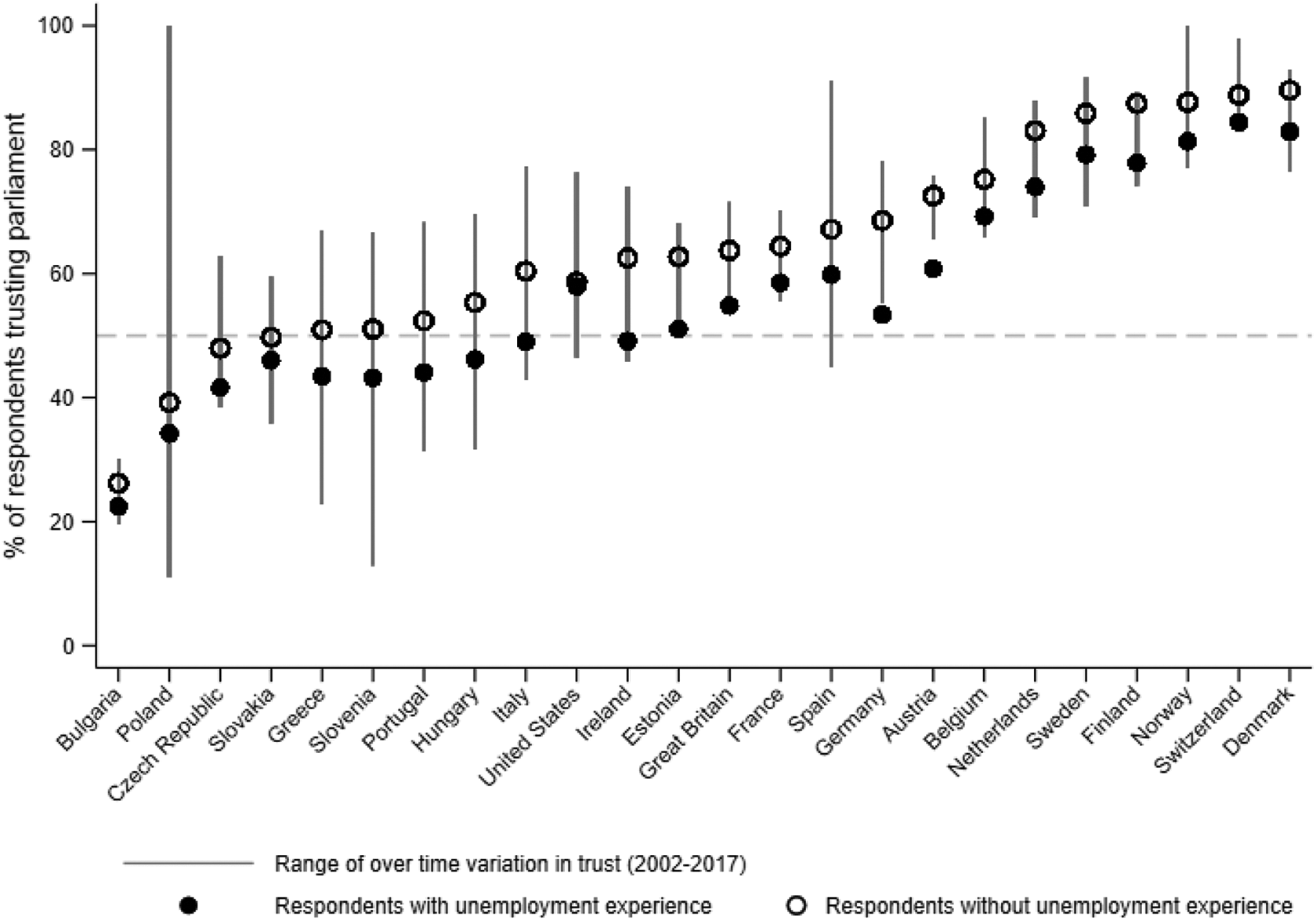
Political trust by employment status in 24 countries, 2002–2017.
Over and on top of these cross-national differences, there also are systematic differences in political trust between citizens who experienced unemployment and those who did not. With the single exception of the US case, respondents in all 23 European countries show higher levels of trust in their country’s parliament when they have not experienced any unemployment either at the point of the interview or in the recent past. Differences in democratic trust between the unemployed and all other citizens appear quite significant in countries as diverse as Ireland, Estonia, Germany, the Netherlands and Finland, whereas respective gaps are much smaller in countries such as Bulgaria, Poland, Slovakia, Slovenia, Switzerland, or the USA of course. We now turn to our regression evidence to examine this effect of unemployment experiences on political trust more closely.
Unemployment experiences, trust and the welfare state
Table 1 contains the main results from our multilevel regression analysis. More specifically, we present estimates for the key parameters of interest in three hierarchical linear probability models to predict working-age respondents’ trust in the national parliament in 24 democracies and 283 survey years. The three sets of estimates correspond to the three model specifications discussed before. The first model is the baseline main effects model, the second is the contextual effects specification that adds the cross-level interaction between welfare state generosity and respondents’ employment status, and the third is the mediation model that incorporates measures of respondents’ objective and subjective economic circumstances to capture the presence of economic deprivation. We discuss the evidence from the first two regression specifications here and then turn to the third set of estimates in the next section.
Effects of personal unemployment on trust in the national parliament.
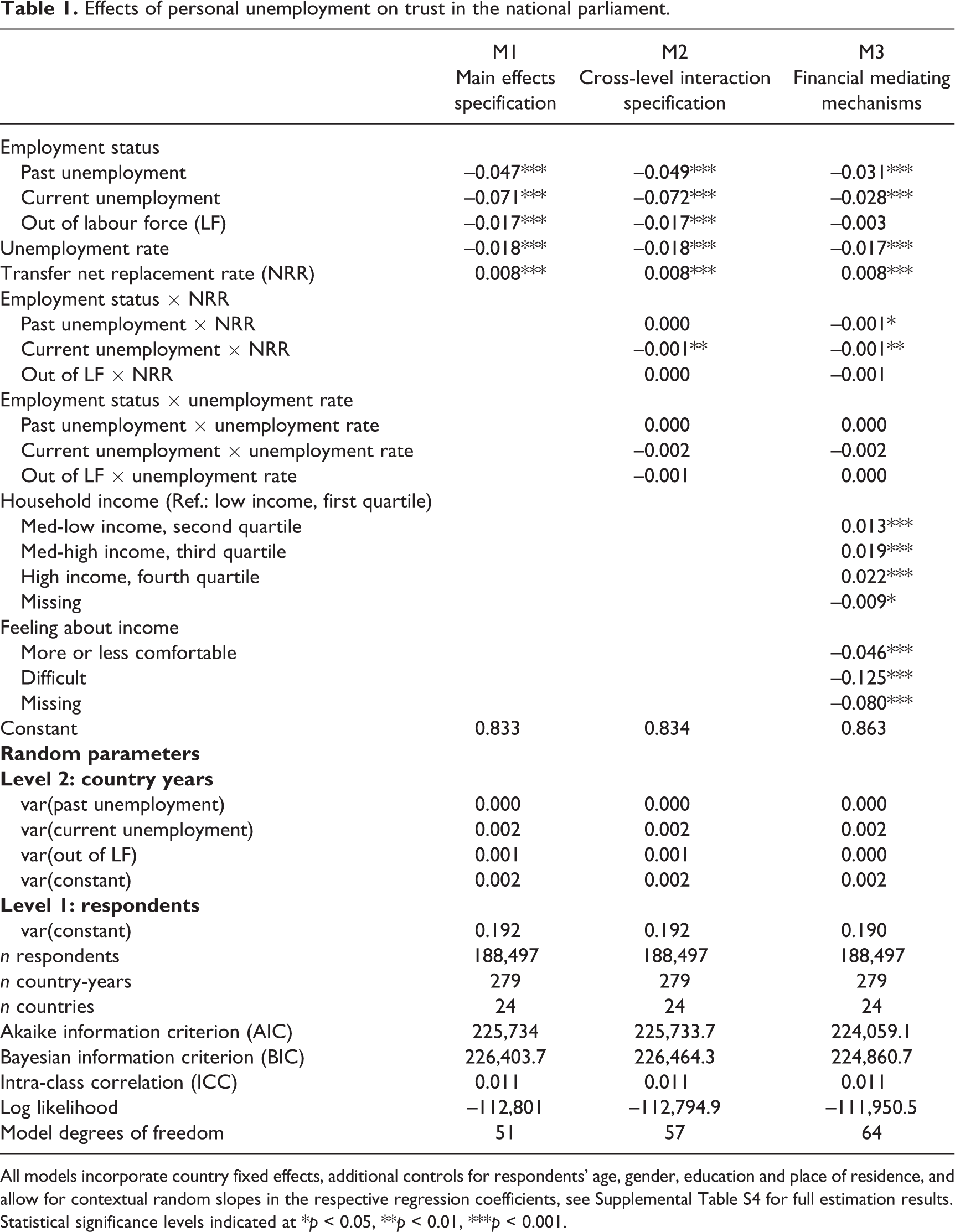
All models incorporate country fixed effects, additional controls for respondents’ age, gender, education and place of residence, and allow for contextual random slopes in the respective regression coefficients, see Supplemental Table S4 for full estimation results.
Statistical significance levels indicated at *p < 0.05, **p < 0.01, ***p < 0.001.
In the baseline specification, we first are able to confirm the descriptive evidence of a trust gap between the unemployed and other citizens. Even when controlling for individual-level covariates like gender, age, education and urban v. rural residency, and even when accounting for observed and unobserved contextual factors, unemployed respondents express a lower level of trust in the national parliament. Averaging across countries and survey years in the sample, their probability of having at least some trust in parliament is seven percentage points lower than among observationally equivalent employed respondents. This negative political effect of unemployment largely seems to persist even after citizens were able to secure reemployment, as we find political trust among employed citizens with a recent history of unemployment to still be five percentage points below the level of trust among employed respondents without such history on average. There also is evidence of a modest negative effect of other forms of economic inactivity, but in comparison the adverse effect of unemployment is about three to four times larger than that of inactivity.
This negative effect of unemployment occurs against a backdrop of various individual-level and contextual-level controls. On the individual level and averaging across countries and observation years, we do not find evidence of a systematic gender effect on trust. However, we find younger respondents, more educated citizens and respondents living in urban areas to be more politically trusting than their counterparts (see Supplemental Table S4 for full estimation results on these and all other parameters of the three models). We also find a clear negative effect of the aggregate unemployment rate that adversely affects political trust over and above any personal experience of unemployment. Furthermore, we see that trust in democratic institutions tends to be higher in countries that provide higher levels of income security to the unemployed, and the country fixed-effects, the country-year random coefficients, and the random slope parameters for all individual-level covariates account for further unobserved sources of variation in political trust in our sample.
Against these controls, we take the robust effect of unemployment as tentative evidence for some causal role of personal experiences of unemployment in explaining (lack of) political trust. Evidently, proper caution in interpretation is warranted in any (repeated) cross-sectional design where inference inevitably rests on between-subject variation, and where the issue of sufficient control for confounding factors looms large. Nevertheless, we also believe that three additional considerations render our interpretation principally defensible. First, in contrast to many other factors considered by social scientists, the incidence of unemployment will, in the wide majority of cases, be an event that is exogenously assigned rather than voluntarily chosen by respondents. This argument applies even more forcefully conditional on standard predictors of labour market productivity and labour market risk, and against the backdrop of an observation window that comprises unemployment experiences occurring during a major economic crisis. 13 Finally, while we lack information on unemployment duration in the surveys to test this empirically, the well-known length bias in cross-sectional samples is likely to contribute to a positive finding on the political role of unemployment in our study. We would not wish to convey a reading that takes our estimates as evidence for the claim that any experience of unemployment tends to decrease trust in democracy. Instead, given that the respondents who are observed as being unemployed in any cross-sectional sample tend to be those with disproportionately long durations of unemployment, the robust negative effect that we observe is well in alignment with assuming that negative political effects of unemployment will only set in after some relevant period of economic distress.
Importantly, however, the key interest of our paper is not whether there is any effect of unemployment on political trust, but whether and how that effect varies systematically with the generosity of the welfare state. The estimates from our second regression specification (provided in the middle column of Table 1) indeed demonstrate the presence of a respective cross-level interaction, and also that this interaction is negative, that is that the effect of unemployment on trust is becoming systematically more negative in objectively more generous welfare state environments. Empirically, in other words, the status deprivation mechanism appears to dominate the economic deprivation channel in generating a relationship between the generosity of public income protection on behalf of the unemployed and the adverse political implications of actual experiences of unemployment.
Figure 3 provides a graphical summary of our respective findings. The average marginal effects for the three different employment statuses – being currently unemployed, being currently employed but having experienced unemployment in the recent past, and being economically inactive – all vary negatively with the generosity of a country’s unemployment benefit system. So, the gaps in political trust relative to the reference group of employed respondents become larger the more generous the country’s welfare state. The negative effect of respondents’ current unemployment is consistently strongest in all settings except in the least generous welfare states and also the cross-level interaction with welfare state generosity is most pronounced among the currently unemployed. Among the latter, the effect size triples from the least generous welfare state context (NRR = –25, roughly corresponding to Greece) to the most generous (NRR = 10, corresponding to Norway). The pattern for past experiences of unemployment is similar, but less pronounced: again, the effect is becoming increasingly negative in more generous welfare states, but the substantive differences across contexts are rather small. For economically inactive respondents, there also is evidence of a moderate cross-level interaction, so that a significantly negative effect on political trust is only emerging in countries with at least intermediately generous welfare states. In support of an institutional reading of the evidence, it seems important to stress that these patterns are robust to controlling for the cross-level interaction between individual employment status and aggregate unemployment rates, and also to the incorporation of the cross-level interaction between employment status and GDP per capita as an alternative measure of macroeconomic conditions in an expanded model specification (see Supplemental Table S7).
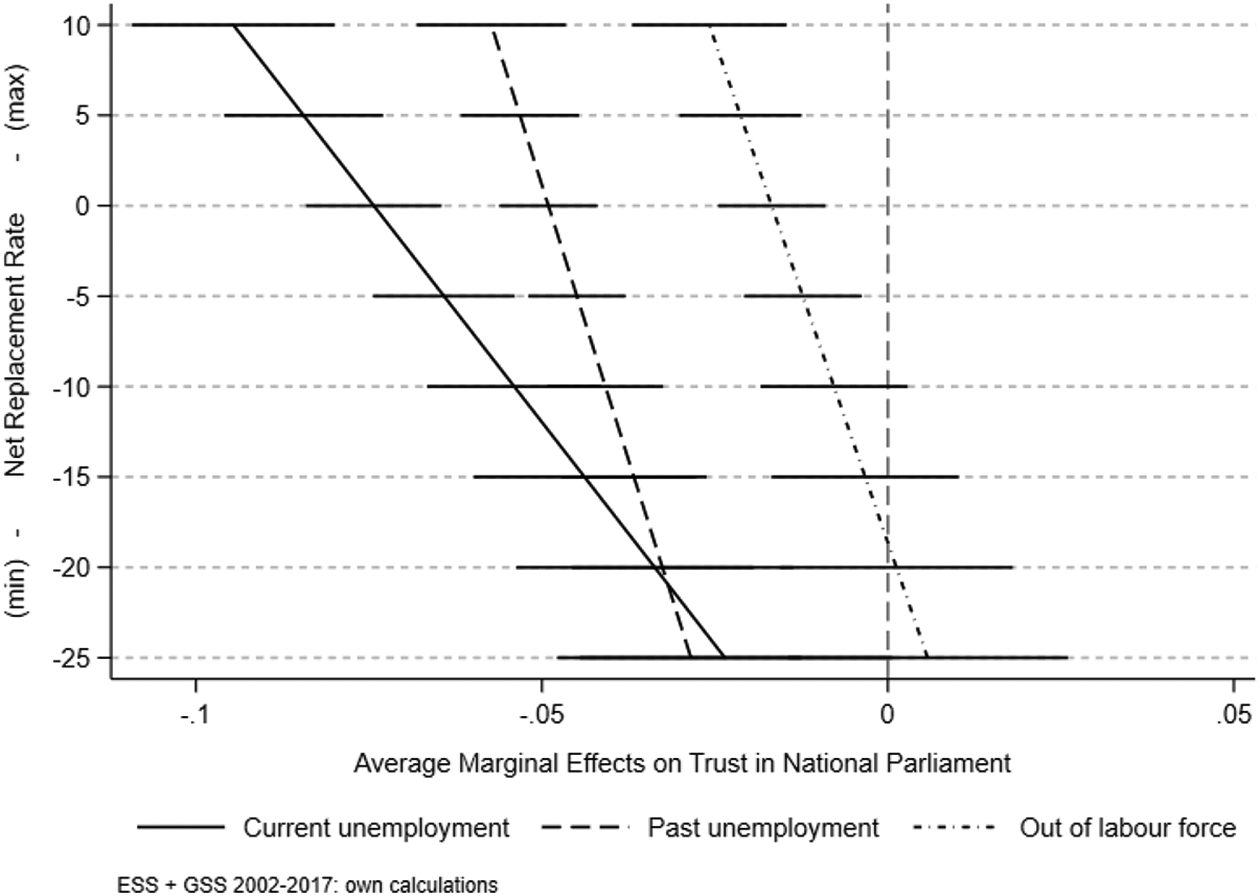
Cross-level interaction effects between welfare state generosity and unemployment.
Economic and status deprivation mechanisms
The negative sign for the cross-level interaction term alone is suggesting that economic deprivation cannot be the only mechanism to generate an association between unemployment and political trust. While it is impossible to pinpoint the status deprivation mechanism with the available items in the ESS/GSS survey data, we are at least able to explicitly test for the presence and magnitude of the economic deprivation channel properly, and thereby to examine whether the contextual effects of the observed economic deprivation and the unobserved residual that we equate with status deprivation show the opposing signs as expected under hypotheses H1 and H2. To that end, our third model specification is incorporating two measures for respondents’ objective and subjective financial situation. Our empirical estimates are provided in the last column in Table 1 (with a corresponding robustness check in Supplemental Table S8), and the key result is again illustrated by way of a plot of the implied average marginal effects in Figure 4.
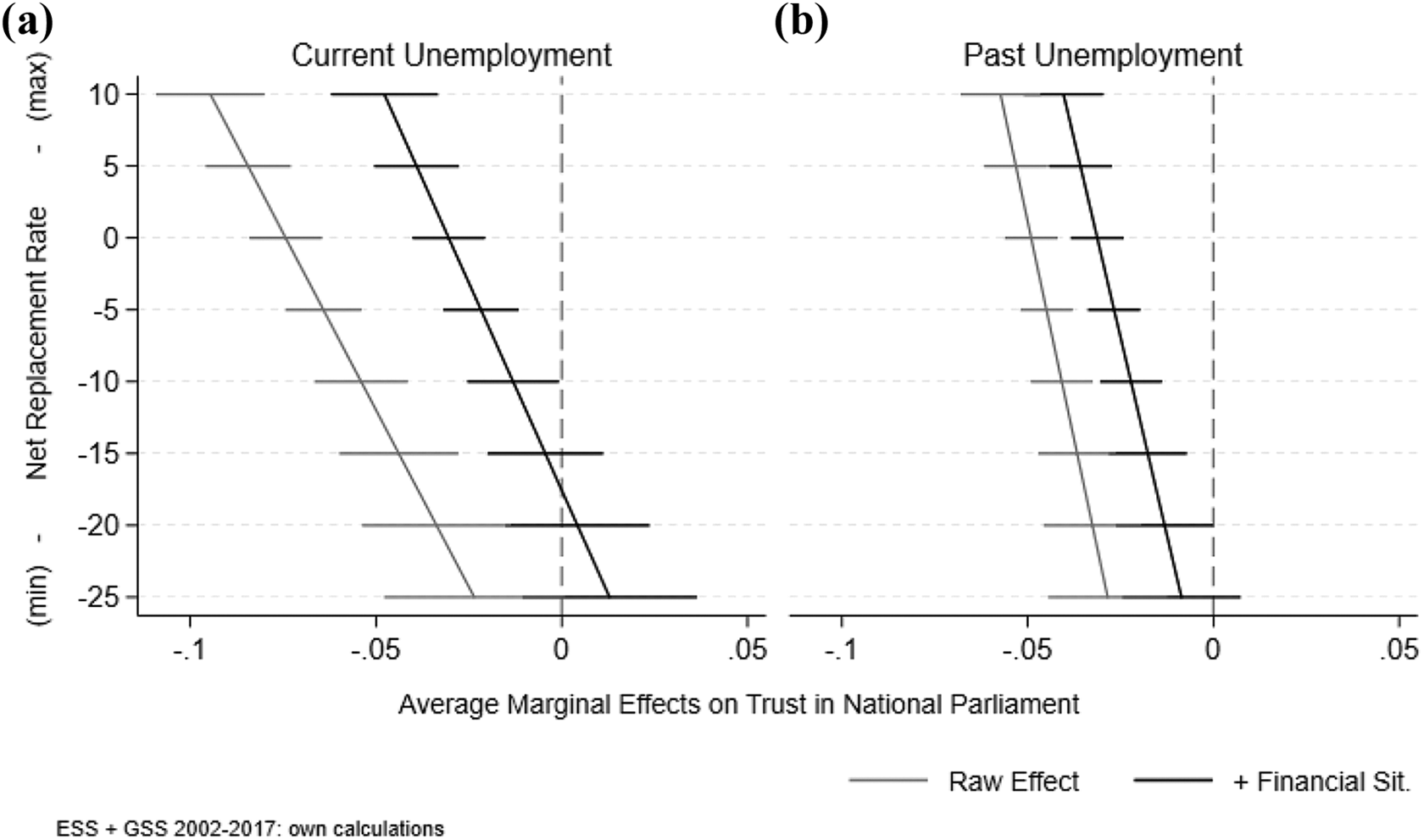
Economic deprivation as a mechanism for the effect of (a) current unemployment and (b) past unemployment on political trust.
Our mediation model provides clear evidence in favour of economic deprivation. Empirically, both citizens’ objective economic circumstances and their subjective evaluation of their own financial situation are related to their stated political trust. The higher respondents’ net household income and the better they evaluate their own ability to make ends meet economically, the more likely they are to express trust in the national parliament. Respondents’ economic circumstances also clearly act as a mediator in the unemployment–trust relationship; in the final model, the main effect of unemployment is considerably reduced but the cross-level interaction term is hardly changed in magnitude relative to the second regression specification.
Correspondingly, Figure 4 illustrates that financial difficulties explain a considerable part of the negative effect of unemployment on trust in all welfare state settings. It is also evident that the part of the total effect that is explained by economic difficulties is larger among the currently unemployed than among respondents with a history of past unemployment. As a result, it turns out that economic deprivation is able to completely account for the observed negative effect of unemployment experiences on trust in the less generous welfare states. In more generous settings, however, a part of the effect remains unexplained even when controlling for observable economic distress. In fact, the more generous a country’s welfare state, the larger the unexplained part of the effect of unemployment, so that it clearly is the residual, non-economic mechanism that is responsible for the negative cross-level interaction between unemployment, welfare state generosity, and political trust. In summary, we take the evidence from Table 1 and Figure 4 as confirming our argument that the citizens’ political response to experiences of unemployment is driven by both economic and non-economic mechanisms, and that while economic deprivation is the dominant motivation behind declining trust in countries with low income protection, non-economic status deprivation increasingly comes to the fore in countries with more generous social policies.
Discussion and conclusions
In this paper, we have examined the impact of personal experiences of unemployment on political trust, and we have explored how the relationship between unemployment and political trust varies across 24 Western democracies. Our empirical data confirm that the experience of unemployment has a negative effect on political trust in general, but also that the role of unemployment varies quite substantially by welfare state context. Somewhat paradoxically, we find unemployment to have systematically stronger negative effects on political trust in the more generous welfare states of Continental Europe and the Nordic countries.
We argue that this observation results from the interaction of two distinct mechanisms that create opposing implications for the role of the welfare state in shaping the relationship between unemployment and political trust. Providing adequate income protection is helpful to mitigate negative political responses driven by economic deprivation. These certainly do exist as our analyses clearly link citizens’ objective and subjective economic circumstances with trust in democratic institutions, and as our analyses further confirm economic distress as an important mediator to link unemployment experiences and declining political trust. Empirically, we find that financial difficulties consistently explain a decline in political trust among the unemployed in the order of five percentage points across all welfare state settings. In the less generous welfare states in our sample, this is sufficient to account for the entirety of the negative effect of unemployment on democratic trust that we find.
However, we also find that the more generous the welfare state, the larger is the negative effect of unemployment on political trust in general, and the larger is the part of the effect that cannot be explained by economic difficulties among the unemployed. In our view, this evidence points to the presence of an alternative political mechanism that is triggered by the experience of unemployment, but that is rooted in non-economic rather than economic motivations. While our survey data prevent us from capturing the process more clearly, this non-economic mechanism must involve an adverse political reaction to stronger public institutions. Our evidence demonstrates that this non-economic channel of political alienation becomes more prominent in the more generous welfare states, and also that it is the joint operation of economic and non-economic processes that eventually results in a negative cross-level interaction between the strength of the welfare state and the relationship between unemployment and trust at the micro level. Short of better identification, we have used the term status deprivation to summarize a set of non-economic processes that might be relevant. Evidently, we see it as a key task for future quantitative and qualitative research to determine more specifically whether it may be disappointed support expectations, processes of stigmatization, or adverse reactions to specific interactions with the welfare bureaucracy or to closer bureaucratic control, that is generating the paradoxical backlash in democratic trust in the more generous welfare states.
We also believe that our data strongly suggests institutional rather than structural roots for the observed variability across countries. Under a relative deprivation perspective, for example, it would be natural to expect that the political response to personal experiences of unemployment depends on the level of unemployment in society, and that unemployment might be more politically charged under good economic conditions. Our data do not yield any support for this argument, however, as we do not find evidence for any cross-level interaction between personal employment status and either aggregate labour market conditions or a broader economic indicator like GDP per capita. Instead, there is good evidence in our data that the Great Recession has implied a decline in political trust, but that is because citizens in general seem to expect adequate macroeconomic management from democratic politicians, not because the unemployed specifically would be the ones to lose trust in democratic policy-making during a recession. The decline in trust among the unemployed is real, but its magnitude is far too modest to explain broad declines in political trust in a major economic crisis.
Likewise, our research should not be misread to imply a negative relationship between the welfare state and political trust in general. Across countries, citizens in more generous welfare state environments as a rule also tend to express more trust in the political system. Rather, what we have been observing is a non-obvious interaction of individual unemployment status and the welfare state: experiencing unemployment in a more generous setting causes more dissatisfaction with the political system than experiencing unemployment in a weak welfare state. Or, put differently, as long as welfare states are weak, political trust tends to be low and independent of the individual employment status, yet precisely when welfare states provide objectively generous support and assume public responsibility for alleviating economic distress, individual unemployment suddenly becomes politically alienating in an otherwise high-trust context. We have offered one particular interpretation for this welfare state paradox in the present paper, and we hope that future research will add to our understanding of the underlying processes.
Supplemental Material
Supplemental Material, sj-docx-1-asj-10.1177_00016993211008501 - Unemployment and political trust across 24 Western democracies: Evidence on a welfare state paradox
Supplemental Material, sj-docx-1-asj-10.1177_00016993211008501 for Unemployment and political trust across 24 Western democracies: Evidence on a welfare state paradox by Carlotta Giustozzi and Markus Gangl in Acta Sociologica
Footnotes
Acknowledgements
The GSS and ESS data used in this research have kindly been made available by the National Opinion Research Center at the University of Chicago and the European Social Survey European Research Infrastructure Consortium at the City University of London. Of course, neither institution bears any responsibility for our analysis of the data, nor for any substantive inferences of this paper. Earlier versions of this research have been presented at the 2017 RC28 annual spring meeting on social inequality and mobility revisited in Cologne and at the 2016 European Consortium for Sociological Research (ECSR) annual meeting at the University of Oxford and Nuffield College. We are grateful to our colleagues for many helpful comments that we received on these occasions. Eric Uslaner and our colleagues at the Chair for Social Stratification and Public Policy, Jan Brülle, Rona Geffen, Anna Gerlach, Pilar Gonalons-Pons, Anne-Kathrin Kronberg, Timo Lepper, Kristina Lindemann and Fabian Ochsenfeld likewise offered insightful suggestions and advice. We also gratefully acknowledge funding from the European Research Council
Funding
The author(s) disclosed receipt of the following financial support for the research, authorship, and/or publication of this article: This work was supported by funding from the European Research Council under the European Union’s Seventh Framework Programme (FP7/2007-2013, ERC grant agreement n° ERC-2013-CoG-615246-CORRODE) for this research.

Supplemental material
Supplemental material for this article is available online.
Notes
References
Supplementary Material
Please find the following supplemental material available below.
For Open Access articles published under a Creative Commons License, all supplemental material carries the same license as the article it is associated with.
For non-Open Access articles published, all supplemental material carries a non-exclusive license, and permission requests for re-use of supplemental material or any part of supplemental material shall be sent directly to the copyright owner as specified in the copyright notice associated with the article.
