




Abstract
The paper analyses changes in the generosity of public transfers to the unemployed and their effectiveness for the alleviation of poverty risks in Germany and Great Britain between the 1990s and the 2000s. In the light of changing poverty risks among the unemployed, the contribution of policy changes is assessed using individual-level data on household incomes. The results indicate that the introduction and expansion of the tax credit programmes in Britain led to an increase of public transfers especially for those with low household market incomes and thereby also improved the effectiveness of transfers in combating poverty. In Germany, the generosity of transfers to the unemployed hardly changed over time, whereas the effectiveness of transfers to prevent households from falling into poverty declined. This can be explained by changes in the composition of the unemployed by recent labour force participation and household market incomes. As former labour market insiders are consistently better protected from poverty than former outsiders, the results confirm the stratified nature of unemployment protection in Germany, albeit no significant trend towards increasing dualisation in public benefits is found. Thus, the results do not support notions of a fundamental shift of the system of unemployment protection with respect to the generosity of transfers in Germany but emphasise the importance of changes in the German labour market.
Introduction
Over the last decade, many European countries have experienced a trajectory of economic growth and growing employment, whereas poverty rates have remained high or even increased (Cantillon, 2011; Cantillon and Vandenbroucke, 2014). This causes worries about unintended consequences of the social investment or activation paradigm that shifted the focus of social policy from providing public transfers to traditional risk groups like the unemployed to more active policy measures that emphasise labour market integration. Indeed, there is a pronounced increase in poverty among the unemployed in many countries. In this paper, I study how the economic well-being of the unemployed in Germany and Great Britain changed in light of policy efforts undertaken with the explicit goal to foster labour market activation.
The two countries exemplify very different approaches to social welfare (Esping-Andersen, 1990). In Great Britain, benefit generosity is low by international standards and means-tested benefits take an important role, corresponding closely to the ideal type of a liberal welfare state. In contrast, benefit generosity in Germany is higher, but also stratified by individuals’ employment histories, as social insurance benefits depend on the size of previous contributions. This conforms to the idea of what constitutes a conservative welfare state.
Using two distinct welfare state contexts offers an interesting opportunity to study how institutional contexts mediate the impact of two challenges to the provision of welfare state security: an increasing importance of the paradigms of activation or social investment on policy making and the increasing polarisation and dualisation of labour markets. The former implies a move from policies that protect the individuals and household from social risks by providing passive public transfers to policies that focus on (re)integrating individuals into the labour market (Cantillon, 2011; Cantillon and Vandenbroucke, 2014). The latter refers to inequalities between core employees that benefit from relatively stable and well-paid employment and an increasing share of individuals who are employed in non-standard and low-paid jobs (Emmenegger et al., 2012). These patterns of dualised labour markets can also carry over to social security systems, especially if benefits depend on previous contribution records: being a labour market insider or outsider before becoming unemployed will translate into being a social security insider or outsider with varying access to generous public benefits (e.g. Seeleib-Kaiser, 2016). The specific pattern of activation in German labour market policy could have further increased this dualised nature of unemployment protection, because changes in benefit systems were mainly targeted at those who are not eligible for unemployment insurance, whereas the generosity of insurance benefits for the short-term unemployed has hardly changed (Dingeldey, 2011a). In the UK, activation was more focused on the idea to make work pay alongside attempts to fight child poverty (Dingeldey, 2011a) and indeed research on the effect of these changes found improvements in poverty risks for low-earning families (Lupton et al., 2016; Waldfogel, 2010). However, it is unclear if the improvements these households experienced are also reflected in the situation of the unemployed, who have not been the primary group targeted by the reforms.
At first glance, figures on poverty risks among the unemployed seem to reflect the differences in welfare regimes as well as fundamental changes in recent decades: results for the 1990s show higher poverty risks among the unemployed in Britain compared to Germany (Nolan et al., 2000), but poverty rates increased dramatically in the latter country to almost 70% of all unemployed in 2013, compared to 52% in Great Britain (Ferragina et al., 2015). However, these changes have not only been accompanied by changes to the system of social protection, but also by major shifts in labour market inequalities and family formation that have also been identified as important drivers of changes in economic inequality and relative income poverty (Biewen and Juhasz, 2012; Brewer and Wren-Lewis, 2015; Brülle, 2016; Brülle et al., 2019; Corneo et al., 2014; McKnight and Tsang, 2014).
The paper at hand contributes to the empirical puzzle of changing poverty risks among the unemployed and studies how the economic well-being among the unemployed changed in Germany and Great Britain in light of labour market changes and policy reforms. I analyse the development of transfer generosity, using individual-level data on the amount of social transfers received by households. I also assess welfare state effectiveness in combating poverty, by looking at an indicator for the state buffer against poverty, that is, if public transfers are sufficient to lift households above the poverty threshold. To understand how policy changes influenced not only the average generosity, but also the stratification of benefits, I consider the distribution of transfers according to previous labour market status and current household market incomes: whereas a higher degree of targeting implies that generosity of transfers is larger for those with low market incomes, dualisation between social security insiders and outsiders implies that those who enter unemployment from well-paid and stable employment have access to more generous transfers. By studying how the generosity, stratification and effectiveness of benefits to the unemployed changed in two exemplary country cases, we can learn more about the broader challenge of a potential social investment paradox (Cantillon, 2011) and the effects of dualised labour markets.
Furthermore, the paper contributes to the methodological debate on how to measure welfare state change and its consequences. Using individual-level data to capture changes in the generosity and effectiveness of social transfers has important advantages over using synthetic cases (e.g. model families) to simulate the potential effect of policies (van Oorschot, 2013). At the same time, aggregate outcomes like poverty rates, but also the overall reduction of inequality and poverty by social transfers, can lead to misleading conclusions about the effect of policy changes if differences in the underlying population are ignored. I show how an individual-level perspective can alleviate this problem by using regression-based methods to look at different trends for population subgroups and by controlling for a range of important confounders.
The following section will review the institutional changes in the German and British welfare state and discuss the potential impact of these changes on poverty risks among the unemployed. Afterwards, I describe the database and the analytical strategy for the empirical part of the paper. I then show how welfare state generosity in case of unemployment changed over time depending on the current market income and previous employment status of households, before turning to an analysis of the effectiveness of transfers in terms of the protection of households from poverty using individual-level data from the Socio-Economic Panel (SOEP) for Germany and the British Household Panel Study (BHPS) for Great Britain. The final section of the paper offers a critical assessment of the results and gives an outlook on implications for social policy.
Change in the German and British system of unemployment protection
Job loss represents one of the major risks to household incomes in modern societies (DiPrete and McManus, 2000) and most welfare states encompass different systems to protect individuals from its consequences. Besides unemployment insurance, means-tested programmes aimed at unemployed individuals were introduced in both countries under study – income-based Jobseeker’s Allowance (JSA) in 1996 in Britain and Arbeitslosengeld II (ALG II) in 2005 in Germany (Clasen, 2011b; Dingeldey, 2011b). However, especially when considering not only the intended, but also the unintended impact of policies, it is crucial to also include potential effects of benefit types not specifically targeted at the unemployed, including social assistance and family benefits. Whereas the analyses use the total amount of transfers, irrespective of transfer type, the following description focuses on the transfers and policy changes that are expected to be most important for the unemployed.
In Great Britain, unemployment insurance (Unemployment Benefit) could be claimed for up to 12 months until 1996, given insured employment over two years before unemployment. It was paid as a flat-rate benefit without a means test. In international comparison, the generosity and coverage of unemployment insurance was low (Scruggs and Allan, 2006) and the majority of the unemployed received means-tested benefits. The introduction of the Jobseeker’s Allowance in October 1996 replaced the Unemployment Benefit with contributory Jobseeker’s Allowance (i.e. the insurance tier of the benefit) and restricted receipt to six instead of 12 months (Clasen, 2011a), thus further weakening the role of unemployment insurance in the traditional sense. Different types of tax credits to low-income families and workers were introduced and expanded between 1999 and 2003 (Bahle, 2011; Waldfogel, 2010). These benefits are means-tested and are progressively withdrawn with increasing market income. Whereas the Working Tax Credit as well as their predecessors are conditional on employment and low earnings, the Child Tax Credit as well as its predecessor introduced in 2001 are paid to middle- and low-income families independent of employment status. While both types of tax credits are not targeted at the unemployed, they can be relevant to their social security because there are children in the household, because the respondent switches between employment and unemployment, or because their spouses are gainfully employed and thus eligible for Working Tax Credit. 1
While benefit rates of unemployment insurance in relation to previous earnings have not changed since 1994 in Germany, the so-called Hartz IV reforms brought important changes to all tiers of unemployment protection between 2004 and 2006. Eligibility criteria became stricter by decreasing the time available to acquire the necessary months of social security contributions from three to two years before unemployment. Maximum benefit durations were reduced for persons aged 45 and older: depending on the age bracket, these persons could claim unemployment insurance for up to 32 months before the reforms, while the duration was reduced to 12 months for everyone below 55 and 18 months for all older age groups. In 2008, the duration was extended again, but not to the same level as before. Furthermore, the earnings-related and means-tested middle tier of unemployment assistance was abolished. In the 1990s, this benefit could be claimed by the unemployed who exhausted their unemployment insurance benefits. Finally, the reforms slightly increased generosity of social assistance benefits, especially for low-income households participating in the labour market. Overall, while means-tested social assistance had already gained in importance since the 1980s (Dingeldey, 2011b), the reforms further strengthened this trend.
The set-up of these different programmes will be reflected in average transfers received by unemployed households, as well as differences by individual and household characteristics. If the majority of the unemployed receive means-tested benefits, this implies a high degree of low-income targeting (Korpi and Palme, 1998). In contrast, unemployment insurance benefits do not depend on the household’s means but on a person’s previous earnings and employment. Typically, former labour market insiders with stable employment contracts and decent earnings receive higher benefits than labour market outsiders with non-standard or low-wage contracts and interrupted employment careers.
Based on these principles, Figures 1 and 2 summarise the expected differences between countries and the direction of change over time for households with low and higher market incomes, as well as by labour market status before unemployment. In general, I expect the generosity to be higher for persons in households with low market incomes, as only these households will have access to means-tested benefits.
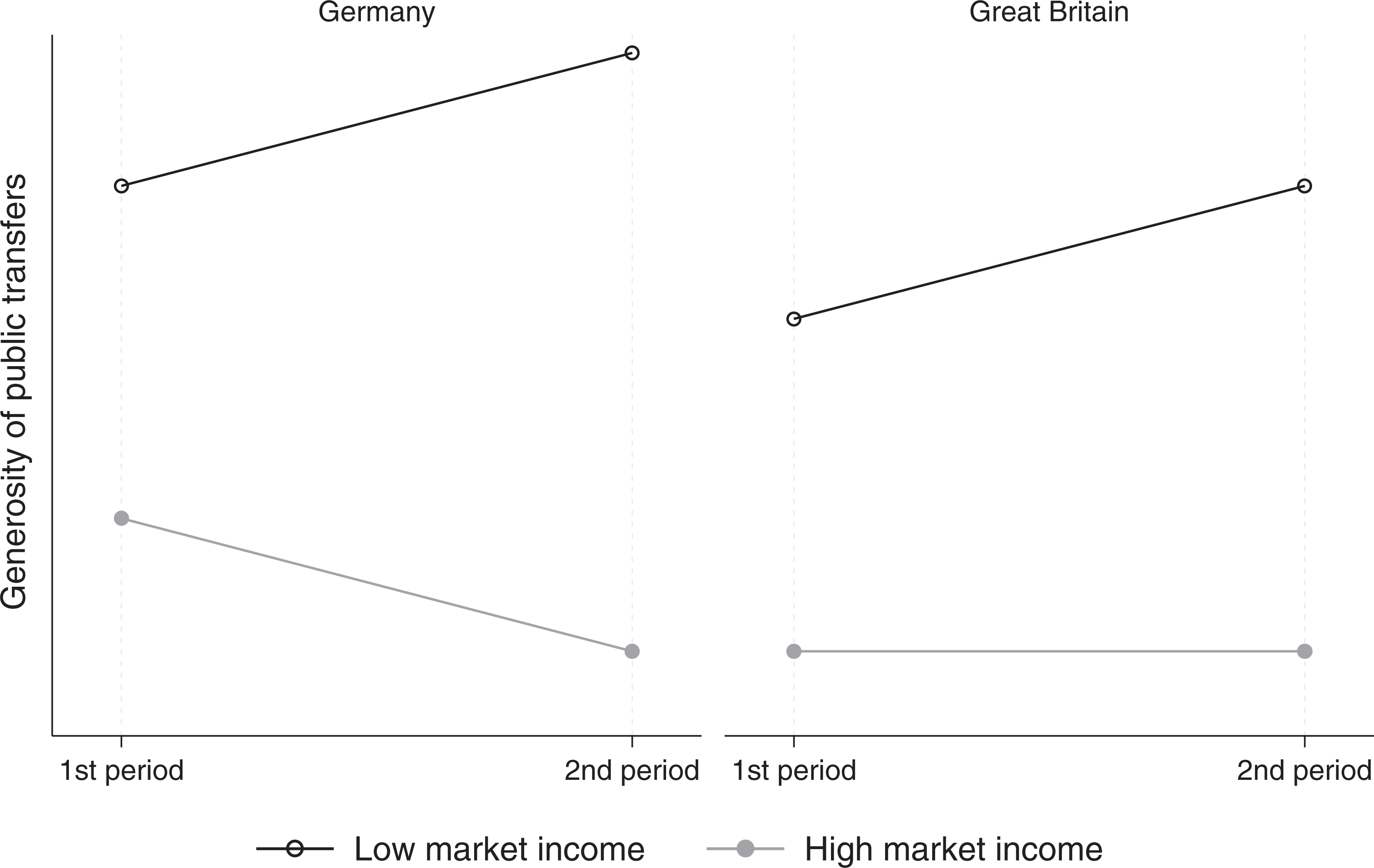
Expected changes in transfer generosity by household market income.
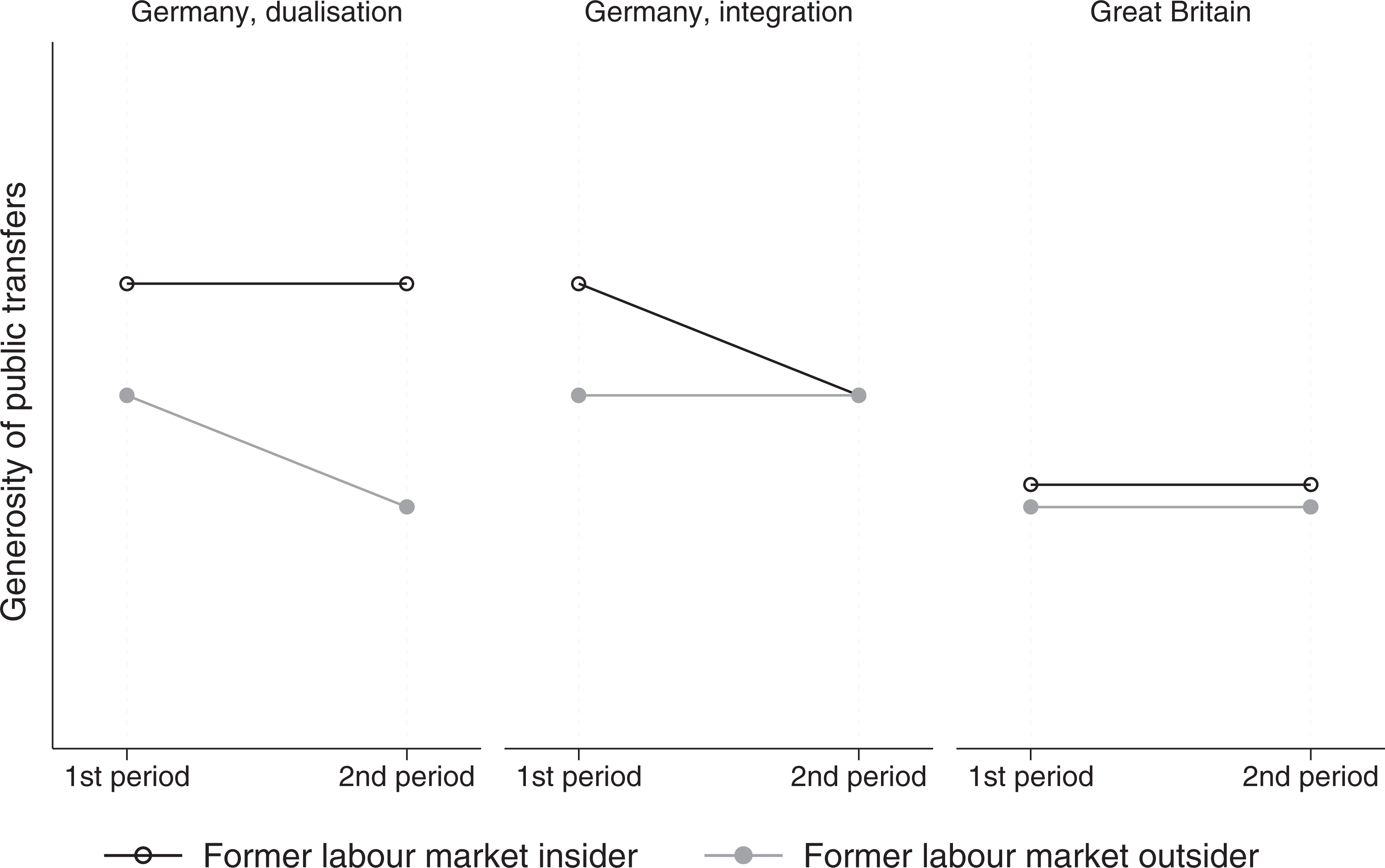
Expected changes in transfer generosity by previous labour market position.
Given the limited importance of unemployment insurance in Great Britain, I do not expect that the further reduction in benefit duration in 1996 strongly affected transfers generosity. However, the introduction and expansion of tax credit programmes should have increased benefits for households with lower household market incomes. Thus, the difference between persons in low-income versus high-income households should increase as shown in the right panel of Figure 1. Differences between former labour market insiders and outsiders should be small and not change strongly over time (see right panel of Figure 2): H1: The negative effect of household market income on the sum of public transfers received by unemployed respondents becomes stronger in Great Britain after the introduction and extension of the Working Tax Credit and Child Tax Credit. H2: Previous labour market status does not influence current transfers received by unemployed respondents in both periods in Great Britain. H3: The negative effect of household market income on the sum of public transfers received by unemployed respondents becomes stronger in Germany after the Hartz IV reforms. H4a: Respondents who have been labour market insiders before losing their job receive higher benefits than those who have been outsiders in Germany. After the reforms, outsiders face a further decrease in benefits compared to former insiders. H4b: Respondents who have been labour market insiders before losing their job receive higher benefits than those who have been outsiders in Germany. After the reforms, insiders face a decline in their benefits compared to outsiders.
Benefits to unemployed households may also prevent them from falling into poverty, given that they suffice in lifting the household above the poverty threshold, that is, they provide a state buffer against poverty. The above expectations with respect to transfer generosity carry over to their effect on poverty risks: an increase in targeting should improve the state buffer against poverty, because households whose market incomes put them at risk of poverty will receive higher transfers. Furthermore, differences between transfer generosity to former labour market insiders and outsiders should also imply differences in the effectiveness of transfers in preventing poverty for these groups.
Besides current household resources and past employment career, the receipt of transfers depends on a variety of other aspects: the duration of unemployment insurance benefits is restricted to a specific length, implying differences in transfer generosity by unemployment duration. At the same time, means-tested benefits, but also replacement rates of unemployment insurance, depend on household characteristics, especially the presence of an (employed) partner or children in the household. Obviously, these factors also influence eligibility for family benefits.
Furthermore, labour markets in both countries changed between the 1990s and the 2000s. In Germany, a remarkable increase in non-standard and low-wage employment took place and dualisation between core and peripheral jobs increased (Eichhorst and Tobsch, 2015; Möller, 2015). This implies that individuals are more frequently entering unemployment from shorter or less well-paid employment and – given the employment-centred unemployment insurance – this will decrease the generosity of benefits. At the same time, unemployment in the late 1990s was high in Germany, but decreased strongly after 2005 and even the great recession in the wake of the financial crisis only left a small dent in the unemployment figures (Möller, 2015). As unemployment was less widespread in the second period, those in unemployment could be more negatively selected with respect to individual characteristics like educational level. Similarly, unemployment also decreased in Great Britain between the 1990s and 2000s, indicating that selection into unemployment could have changed as well. At the same time, the British labour market was already highly unequal in the 1990s, but experienced further polarisation between low-skill and high-skill occupations (Goos and Manning, 2007).
To the extent that they imply different levels of benefits, changes in the distribution of household and labour market characteristics can cause changes in transfer generosity and effectiveness, even if policies remained the same. Additionally, many policy reforms have different implications for various groups and therefore conclusions on their impact depend on assumptions about recipients. Thus, results accounting for potential changes in the population with respect to individual and household characteristics reflect policy changes more closely than descriptive figures on the size and effect of transfers. Additionally, the estimates presented in this paper average over the population as observed and can therefore be meaningfully interpreted. This is an important advantage over using model families that are not necessarily a good representation of the underlying population.
Data and methods
I use the Socio-Economic Panel (SOEP) (Wagner et al., 2007) and the British Household Panel Study (BHPS) (Taylor et al., 2010). 2 I restrict the sample to persons in their core employment period – that is, older than 24 and younger than 60 – to limit potential confounding from changes in retirement behaviour and educational careers. I focus on individuals who have been unemployed for at least one month during the annual income reference year and who have not been in education or inactive during this time. Persons who are living together with a pensioner are also excluded. 3 Because the definition of the independent variables requires the observation of respondents prior to the start of the current unemployment spell, the observation window starts with the year 1994 for both countries. It ends in 2011 in Germany and 2008 in Britain, due to a break in the British database after this year.
I use the income data described in Grabka (2014) and Levy and Jenkins (2012), respectively. Both sets of income information include imputed information and derive the total sum of transfers, taxes and deductions partly from simulations. 4 All household incomes are divided by the modified OECD equivalence scale. I standardise all income measures within each country and for each year, by dividing them by the median of net household income of the whole population. This is consistent with the measurement of relative income poverty and similar to assessments of welfare benefits’ adequacy (e.g. Cantillon et al., 2014).
Analytical strategy and dependent variables
I will first assess whether the expected changes in welfare state generosity summarised in Figures 1 and 2 are borne out by the data. To give a comprehensive picture of the impact of welfare states on unemployed persons’ household incomes, I use the total amount of public transfers received by respondent households – regardless of the specific programme – as an indicator for transfer generosity. Furthermore, I will analyse the state buffer against poverty as an indicator of welfare state effectiveness. It measures whether government transfers minus taxes lift the household above the poverty line and thus prevent the household from being poor. Accordingly, this part of the analysis will be restricted to households with a market income below the poverty line for the respective year. The poverty line for each year will be defined as 60% of median net household equivalent income for the whole population. While the first part uses standard ordinary least squares (OLS) regression to predict transfer generosity, the second part uses logistic regression models to predict if state transfers prevent the household from being poor.
To assess changes in the system of unemployment protection between the 1990s and after the reforms described above, I will compare a period at the beginning of the observation window (1994–1998) with a period after the most important reform packages. As these were implemented at different points in time, the second period used in the analysis differs between both countries: for Great Britain, the results from the 1990s are compared to the period between 2004 and 2008, whereas the period 2007 to 2011 is used for Germany.
Transfer generosity and the state buffer will be measured at the household level, as this is the more adequate level to measure economic well-being and poverty. In contrast, the key independent variable of being a former labour market insider or outsider is measured for individuals. Hence, I conduct the analyses at the individual level. Of course, the overall level of transfers to a household will depend on a variety of other household-level characteristics, which will be controlled for in the multivariate analysis as comprehensively as possible (see the following section). Because the data contain repeated observations for individuals and multiple persons within households, the standard errors are corrected for the clustering of observations in original sample households. This approach ensures that standard errors will not be artificially inflated by multiple interdependent observations, while allowing for a straightforward estimation of population-average effects (Rabe-Hesketh and Skrondal, 2008). Due to the original sample being smaller, as well as a lower unemployment risk during most of the observation period, the case numbers are smaller in Britain compared to Germany (1703 and 6123 person years, respectively).
Independent variables
To assess differences in the extent of low-income targeting between both countries as well as over time, I analyse the effect of a person’s household market income being below the poverty threshold. A stronger effect of low market income shows that transfers to these households become more generous compared to others. Additionally, to control changes in market incomes in the unemployed population as thoroughly as possible, the analyses also include a linear term for market income which is centred at the mean for both low-income and high-income households. Thus, this indicator is mean-independent from the dummy variable measuring low market income. While the analyses of the state buffer will use only respondents in households with market incomes below the poverty line, I also control for market income using a linear term.
The concept of dualisation as used in the current paper aims at differences in the functioning of the welfare state depending on the previous employment position of respondents. I will differentiate between three groups of labour market outsiders: persons who were low-wage employees (defined as an hourly wage below two-thirds of median hourly wages), or part-time employed (i.e. working below 30 hours a week) in the year before the unemployment spell started; persons who have been unemployed for at least six months during the three years before the current spell of unemployment; and persons who have been inactive for at least six months during this period. Labour market insiders are all other persons, that is, individuals who have been continuously employed for three years and have not been low-wage or part-time employed in the year before unemployment. 5
The analyses also include a number of controls: household type is measured as a categorical variable, including information on the respondent’s relationship status, the number of adults and children in the household and the employment status of a potential partner living in the household. Furthermore, the generosity of unemployment insurance as well as the strictness of social assistance regulations differ by age of respondents, which is included as a categorical variable. The duration of the unemployment spell is also measured as a categorical variable. Additionally, the analysis controls the number of months a respondent has been unemployed in the income year. Finally, I control for gender, education and region to net out potential structural shifts in the composition of the unemployed population. The distribution of all variables as well as change over time is shown in Table S1 in the online supplement.
To reflect potential changes in the effects of variables, the indicators for household market incomes, previous labour market status, household type, the presence of a pensioner in the household, age group and unemployment duration are interacted with the time period. As these interaction effects make the interpretation of coefficients difficult, the results are presented graphically as marginal predictive means. These represent the mean prediction assuming that the variables of interest take the respective values for each respondent, including potential changes in interaction terms. All other variables are treated as observed. The difference between these predictions conform to the average marginal effects. For the analysis of the state buffer, the presentation of the results concentrates on the average marginal effect of the period. All regression tables can be found in the online supplement.
Results
The development of transfer generosity
Figure 3 shows the estimated average transfer generosity for persons in households with market incomes below and above the poverty line. For Germany, I expected an increase in the level of targeting as a result of the reforms between 2004 and 2006, due to a decline in generosity to higher income households, as well as an increase for lower income households. Indeed, Figure 3 shows that transfers to those with higher incomes decreased, while those for low-income households increased: the differences between both household types rose from 12% to 15% of median household income. However, the changes are small and not statistically significant (also see Table S2 for the full results). In Britain, the same pattern is more pronounced. Overall, the difference between both groups increases from 14% to 20% of median household income. Thus, the results indicate a substantial increase in the advantage in transfer generosity to low-income households for Britain (Table S3). Overall, the results provide some evidence for increased targeting in Britain (hypothesis 1), whereas changes were small for Germany (hypothesis 3).
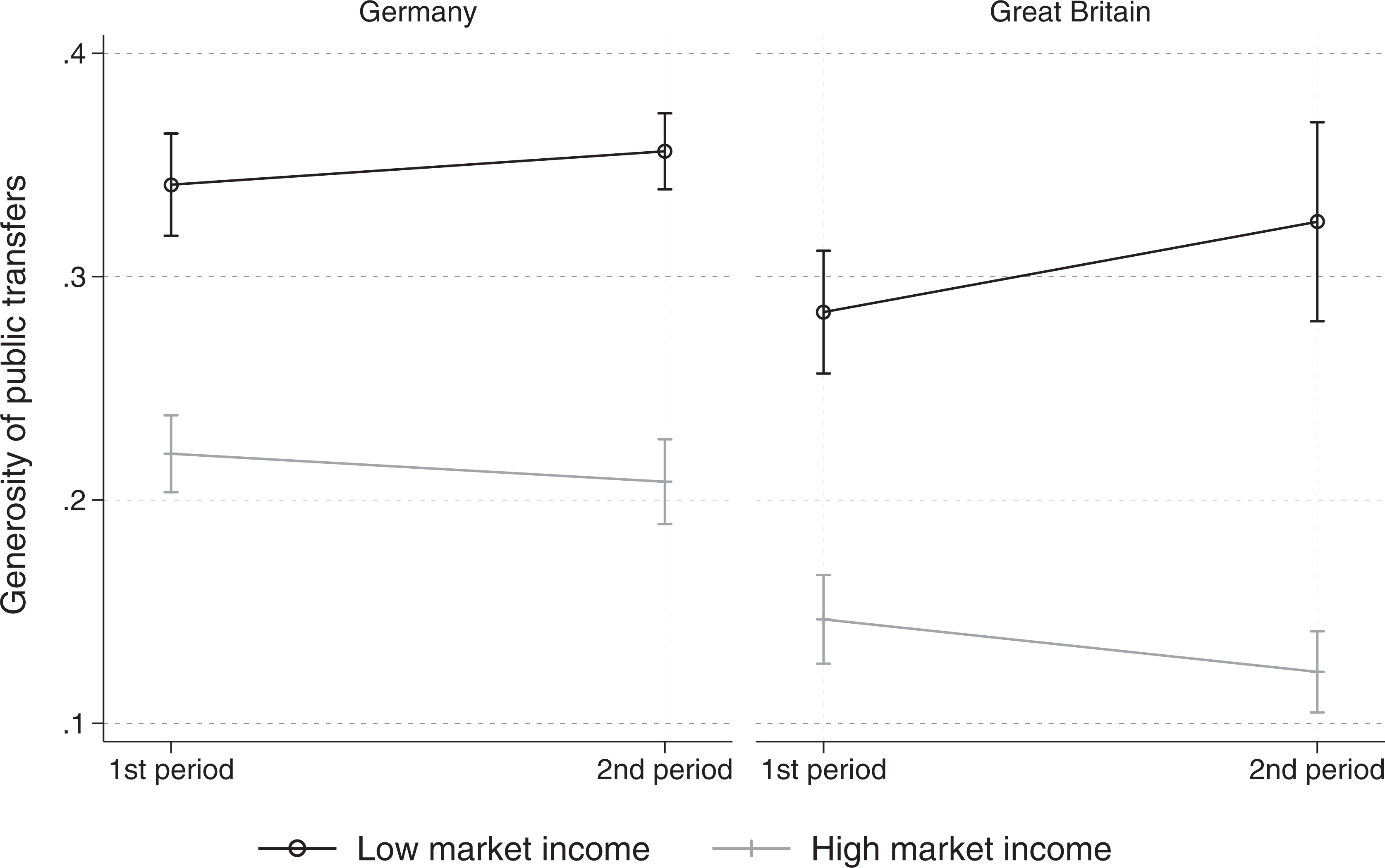
Predicted transfer generosity by household market income. Data: SOEP/BHPS. Marginal predictive means estimated from model 5 in Tables S2 and S3 in the supplementary material, controlling for region, gender, age, education, previous labour market position, unemployment duration, months of unemployment over reference year, household type and household market income (centred at group means of low market income dummy).
Figure 4 shows the estimates for transfer generosity by previous labour market position. For Germany, I distinguished a potential integration or dualisation scenario. The results in Figure 4 confirm consistent differences of 3% to 6% of median household income between former insiders and outsiders in both periods. Generosity to insiders increases, whereas it declines for recently unemployed and former low-wage or part-time employees. While this is in line with the idea of a dualisation of benefits along the lines of labour market cleavages between insiders and outsiders (hypothesis 4a), the changes are small and not statistically significant (Table S2).
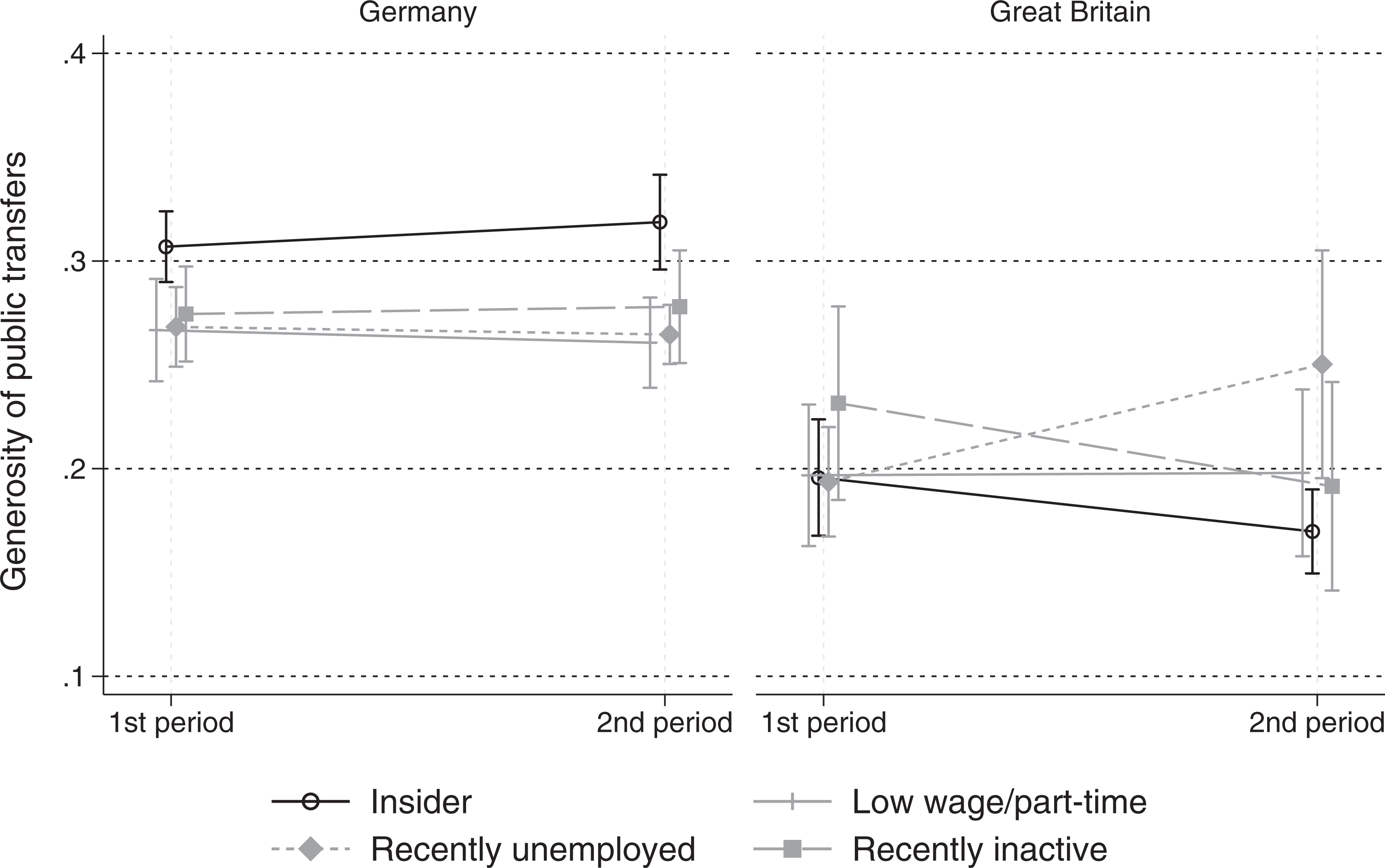
Predicted transfer generosity by previous labour market position. Data: SOEP/BHPS. Marginal predictive means estimated from model 5 in Tables S2 and S3 in the supplementary material, controlling for region, gender, age, education, unemployment duration, months of unemployment over reference year, household type, dummy for low market income and household market income (centred at group means of low market income dummy).
For Great Britain, the estimates in Figure 4 reveal no significant differences between insiders and outsiders in the first period. However, a significant decrease in generosity for insiders and an increase for persons who were recently unemployed results in a pattern where benefits are more generous to former labour market outsiders than insiders. Differences in household market incomes are already controlled for, meaning that this advantage of former outsiders should not reflect low-income targeting. This is surprising given that there is no mechanism in the British benefit system that implies higher benefits for repeatedly unemployed persons per se. Instead, the results could potentially be explained by a different take-up behaviour of persons who already have experiences with the transfer system. With this exception, the results support hypothesis 2 that there is no advantage for labour market insiders in Britain.
To summarise the results of this section, the data mainly show stability in generosity of unemployment protection for Germany. Thus, there is only limited support for a stronger targeting of benefits and an increasing level of dualisation of benefits over time. In contrast, low-income targeting increases more strongly for Britain. For the following analysis of poverty risks, I therefore expect that transfers play a more positive role over time for the British unemployed, while changes in Germany should be small.
Consequences for poverty risks among the unemployed
The relative stability of social transfers over time found in Germany seems to be at odds with the dramatic increase in poverty risks among the unemployed. The descriptive evidence in Figure 5 sheds more light on the relation of poverty and social transfers by plotting the relative poverty risk, the share of households with a market income below the poverty line, and the state buffer.
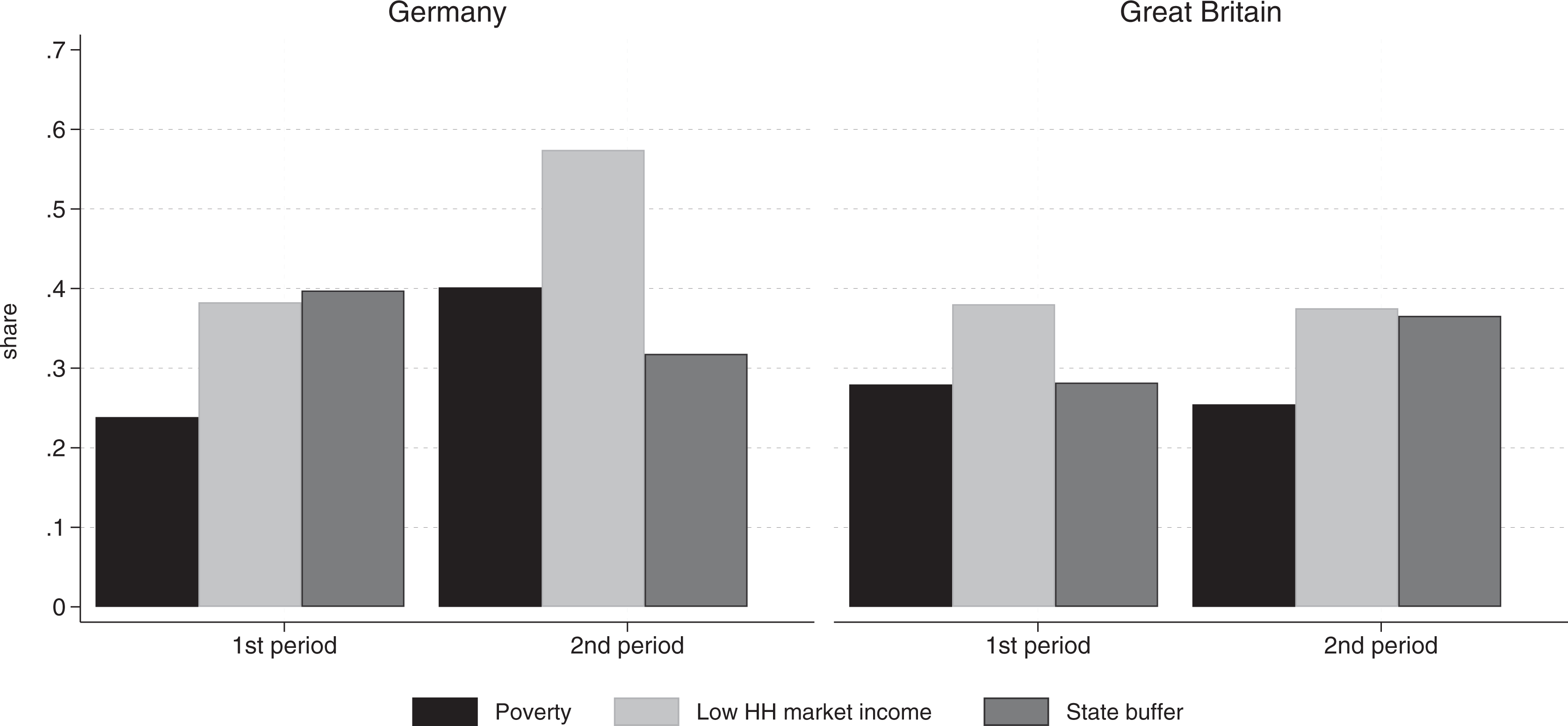
Poverty rate, low household market incomes and state buffer among the unemployed. Data: SOEP/BHPS. Poverty line: 60% of median household net equivalent income. Low HH market income: household income excluding public transfers and taxes below the poverty line. State buffer: probability of being lifted above the poverty line by public transfers minus taxes for persons in households with low market incomes.
For Germany, the graph on the left-hand side of the figure shows an increase in poverty risks among all unemployed persons in the sample from 24% to 40%. This increase is paralleled by a similar increase in the share of households with low market incomes from 38% to 57%. This suggests that the development of incomes from other sources than state transfers plays an important role in the explanation of increasing poverty risks in Germany. At the same time, the state buffer for poverty also decreased: whereas, in the first period, 40% of unemployed persons in households with low market incomes were lifted above the poverty line, this declined to 32% in the most recent period. In contrast, poverty rates among the unemployed slightly decline in Britain from 28% to 26% between the 1990s and the 2000s (Figure 5), while the share of households with low market incomes remains almost constant (38% and 37%, respectively). Consistent with the findings from the previous section, the most important change is an increase in the state buffer from 28% to 36%.
These descriptive results on the state buffer could still reflect compositional changes in the underlying population. Figure 6 shows the marginal effects of the period dummy for different model specifications, thereby controlling for changes in the population over time. I first control for basic demographic characteristics and then add the respondent’s previous labour market status, unemployment duration, household context and finally household market income. While the previous section has shown that lower market incomes imply higher transfers, they also imply a larger distance to the poverty line. Therefore, the models for the state buffer show a positive relationship of household market income and the likelihood of avoiding poverty due to public transfers.
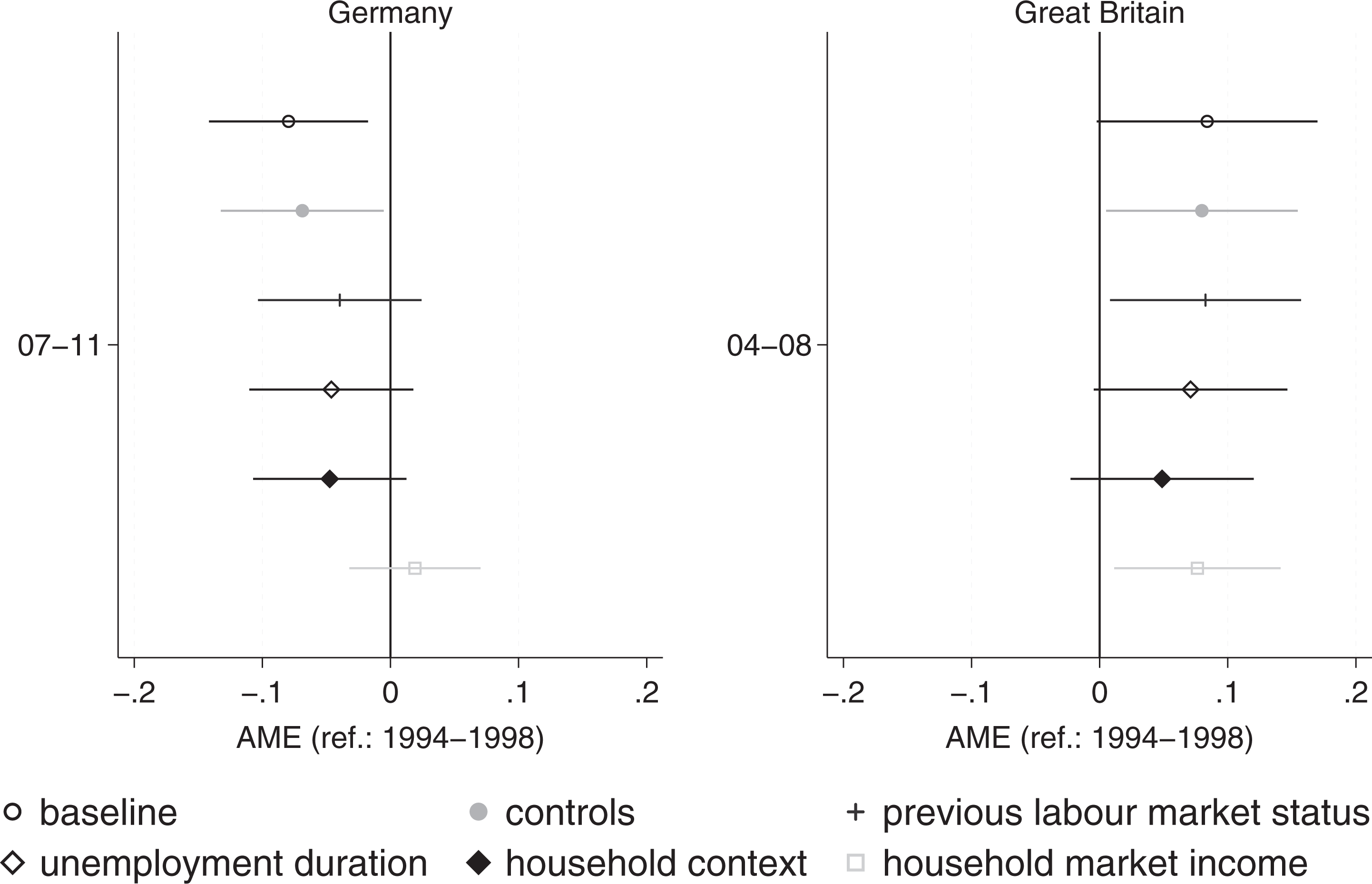
Estimated average marginal effect of period on state buffer for different models. Data: SOEP/BHPS. Full results can be found in Tables S4 and S5 in the supplementary material.
For Britain, the increase in the state buffer for the second period remains positive in all models. The small decrease in the average marginal effect after including controls for household type indicate that there was a shift towards households with a higher state buffer over time that explains part of the positive trend. However, this is offset by the fact that the distribution of market incomes became less favourable over time, as shown by the significantly positive average marginal effect of 7.6 percentage points in the final model.
For Germany the inclusion of age, education and region as well as unemployment duration and household context does not change the estimated coefficient (Figure 6). Instead, changes in the state buffer in Germany are mainly due to the growing share of former labour market outsiders and households with very low market incomes, as shown by the decline in the average marginal effect after including the respective variables. These groups have relatively low chances of being lifted above the poverty line by public transfers, either because the distance between their market incomes and the poverty line is larger, or because benefits are lower than for other groups. Thus, changes in the selection into unemployment by basic demographic characteristics seem to be less important for the results than a growing polarisation of the German labour market. Growing wage inequality has also contributed to lower market incomes among the unemployed, because their partners more likely earn a low wage (Brülle, 2016). In the full model, the estimated change in the state buffer is positive and no longer statistically different from zero. Thus, the results do not support any significant direct effect of a change in transfer generosity on the state buffer.
The results by previous employment status including additional controls can be found in Figures S1 to S4 in the online supplement: the average marginal effects show that gains in the state buffer in Britain are concentrated on former labour market outsiders (Figure S2). While insiders are better protected from poverty than recently unemployed persons in the first period in Britain, this is no longer the case in the subsequent years (Figure S4). In contrast, labour market outsiders in Germany consistently fare worse than insiders, which is in line with the continued importance of benefits maintaining the former status of unemployed individuals (Figure S3). The trend of a declining state buffer is concentrated on the repeatedly unemployed, but after controlling for household market income, this disappears as well (Figure S1). In line with the main goal of the child tax credit to combat child poverty, the results also show different time trends in the state buffer for different household types in Britain: in particular, the results indicate a less favourable development of the state buffer for single households, compared to all other household types (see Table S5).
Discussion
In this article, I analysed changes in the generosity of public transfers and their contribution to poverty risks among the unemployed. Results for Great Britain largely conform to the expectations that the introduction and expansion of tax credits increased the generosity of transfers for the unemployed in households with low market incomes and thereby contributed to a small decline in poverty risks, even if the policy changes were not targeted at this group in particular. In Germany, the results show hardly any changes to benefit generosity or the state buffer against poverty after controlling for compositional effects. While the direction of changes supports the idea of an increased targeting and dualisation of benefits, interpreting these small and not statistically significant effects as results of path-breaking reforms seems to overstretch the findings. The dualisation of public benefits for the unemployed in Germany is therefore nothing new. Even though contrary to expectations, the lack of change for Germany is not implausible: whereas the changes for specific household constellations can still be substantial, these might not represent large enough groups to cause overall trends. For example, according to a model-family approach, large losses in transfers have been experienced by former labour market insiders as a result of the Hartz reforms if they are above 45 years of age and unemployed for more than 12 months. These persons, however, only comprise 2% of the overall sample. For the majority of the unemployed, changes seem to be small.
Similarly, for the overall increase in poverty risks among the unemployed in Germany, changes in market income risks seem to be more important than changes in the transfer system: the share of households with low market incomes increases over time, indicating that more people rely on government transfers to avoid poverty. Furthermore, while I found a decrease in the effectiveness of state transfers in combating poverty descriptively, this is explained by the changing composition of the unemployed by previous employment status, as well as market incomes. The changes in poverty risks among the unemployed are mainly driven by growing market income inequalities that are a result of polarising labour markets and changes in household composition (Brülle, 2016; Brülle et al., 2019; Corneo et al., 2014). These results caution against interpreting differences in poverty risks and also descriptive indicators of redistribution across the board as effects of welfare state changes. If anything, the changes in Germany seem to be better described as a result of institutional drift (Streeck and Thelen, 2005) than the outcome of path-breaking reforms. However, the findings also emphasise that the German welfare state is not well-prepared to deal with growing labour market risks, especially for labour market outsiders (Eichhorst and Tobsch, 2015).
One important caveat of the study at hand is that it does not address potential policy effects on household market incomes. It is controversial to what extent the polarisation of the German labour market is itself driven by the reforms in unemployment protection. The growing importance of means-tested benefits and the shortening of benefit durations could have caused both employed and unemployed persons to make more concessions with respect to job quality and accept lower-paid employment (Möller, 2015). This implies that part of the increase in job polarisation and decreased market incomes among the unemployed is endogenous to the reforms under study. The same holds for the overall decrease in unemployment following the reforms in 2005. The effect on poverty risks would then either be overestimated, because the decrease in unemployment counteracted poverty, or underestimated as the increase in job polarisation increased poverty. In any case, it seems probable that wider structural changes in the German labour market, as well as other reforms of social policy – like the deregulation of employment contracts and collective bargaining – have been more important for the observed changes than the organisation of transfers (Dustmann et al., 2014). Similarly, extensions of Working Tax Credit programmes could have increased incentives for labour supply in Britain – thereby reducing unemployment and increasing market incomes (Brewer et al., 2006). These changes imply that the overall impact of the reforms in Britain was even stronger than suggested by looking at the role of public transfers alone.
The implications of the results on how welfare state context mediates how paradigmatic change in social policy and labour market polarisation influence the economic well-being among the unemployed are two-fold: first, similar to a number of recent studies (Brady and Burroway, 2012; Van Lancker and Van Mechelen, 2015), the results indicate that low-income targeting of benefits can increase the effectiveness of welfare state provision, especially if market inequalities are large. In the case of Britain, the targeted approach of new benefit schemes ensured that the unemployed with low market incomes could rely on a more effective poverty buffer. However, it also needs to be emphasised that some groups among the unemployed – single adults in particular – are largely excluded from these gains, as policy effort was more focused on the employed and families with children. Second, the results for Germany show that changes in unemployment insurance that concern only a minority, like decreasing the duration of unemployment insurance benefits for those with long contribution records, does not need to have widespread consequences for the economic well-being of the unemployed. However, these results are based solely on the monetary value of benefits, while greater conditionality and more extensive means-testing might imply other costs to individuals and societies (Korpi and Palme, 1998). Even in the absence of policy changes, however, growing labour market inequalities will also concern the unemployed, especially in a system where divides between social security insiders and outsiders follow labour market cleavages.
Supplemental material
Supplemental Material, sj-docx-1-asj-10.1177_0001699320974740 - Dualisation versus targeting? Public transfers and poverty risks among the unemployed in Germany and Great Britain
Supplemental Material, sj-docx-1-asj-10.1177_0001699320974740 for Dualisation versus targeting? Public transfers and poverty risks among the unemployed in Germany and Great Britain by Jan Brülle in Acta Sociologica
Footnotes
Acknowledgements
I thank Patrick Sachweh, Evelyn Sthamer and the anonymous reviewers for helpful comments. The German Socio-Economic Panel was kindly provided by the SOEP Group at the German Institute for Economic Research (DIW), Berlin. The British Household Panel Survey data were made available through the ESRC Data Archive and were originally collected by the ESRC Research Centre on Micro-social Change at the University of Essex (now incorporated within the Institute for Social and Economic Research). Of course, I bear sole responsibility for any potential shortcoming in the text or analysis.
Funding
The author(s) received no financial support for the research, authorship and/or publication of this article.

Supplemental material
Supplemental material for this article is available online.
Notes
References
Supplementary Material
Please find the following supplemental material available below.
For Open Access articles published under a Creative Commons License, all supplemental material carries the same license as the article it is associated with.
For non-Open Access articles published, all supplemental material carries a non-exclusive license, and permission requests for re-use of supplemental material or any part of supplemental material shall be sent directly to the copyright owner as specified in the copyright notice associated with the article.
