




Abstract
There is an ample body of research demonstrating the link between housing instability and adverse outcomes. The bulk of this research, however, largely relies on broad operationalizations, generally not considering different types of housing instability. This study extends previous research by focusing on adolescents facing a variety of residential events, including moves, imminent threats of eviction and forced relocations, while also considering the significance of distance. Adopting a counterfactual approach, and drawing on unique data on evictions in Sweden alongside a link to longitudinal registers, this study examines the association between housing instability and educational attainment, operationalized as graduation from upper secondary school. Theoretically, the study draws on the family stress model and theory on social capital, the findings providing support for both approaches. Single relocation was found to have a small impact on educational attainment, but forced relocations, repeated relocations and long-distance relocations are of particular significance for understanding the link between housing instability and educational outcomes. The study contributes to an understanding of the roles that different types of residential events play in youths’ educational attainment, and policy implications are discussed.
Keywords
Introduction
Housing and educational attainment are both salient aspects of youths’ wellbeing and development. There is an ample body of research demonstrating the link between unstable housing and mobility in childhood, and poor outcomes later in the life course (see Jelleyman and Spencer, 2008; Scanlon and Devine, 2001). The bulk of this research, however, conflates different types of residential events, largely relying on broad operationalizations of housing instability, this being likely to obscure important variation. It seems that moving is to a large extent a stressful event that compounds negative outcomes, yet we have little information about the mechanisms at play and the significance of different types of residential strain. The purpose of the present study is to further our understanding of the association between housing instability during youth and educational attainment, conceptualized as graduation from upper secondary school. Housing instability is operationalized as four types of residential events: single relocation (moving once during upper secondary school, without involvement of the Enforcement Agency), repeated relocations (moving at least twice during upper secondary school, without involvement of the Enforcement Agency), imminent threat of eviction (eviction threat was registered with the Enforcement Agency, but was not followed by a move), and forced relocation (eviction threat was registered with the Enforcement Agency, and the youth moved). In addition, based on the supposition that long-distance moves imply greater loss of social resources, the study also explores whether the distance moved is of significance.
Sweden, the context of this study, makes an interesting case for a number of reasons. The Swedish housing system has traditionally been a bearing pillar in the welfare state. With a national model of public housing, the aim has been to provide rental housing of high quality for all, rather than means-tested social housing targeted at low-income families (Grander, 2018). Over the past decades, however, Sweden has pivoted toward a deregulated, market-based system and a reduction of the rental sector (Magnusson and Turner, 2008). Moreover, inequalities in educational outcomes are rising in Sweden with an increasing gap between both the highest and the lowest performers and socioeconomically advantaged and disadvantaged students (OECD, 2017). At the same time, education is high on the agenda and the reduction of early school leaving is a primary objective in the Europe 2020 strategy (European Commission, 2020). Educational attainment is vital for future labor market attachment (Brunello and Paola, 2014) and, by extension, to the prospects of obtaining and retaining a home, highlighting its relevance as a measure of success in young adulthood.
Theoretically, the study adopts both the family stress model (FSM) and theories on social capital to understand the outcomes. Drawing on unique data from the Swedish Enforcement Agency, and linking to comprehensive longitudinal register data that allow adjustment for a multitude of covariates, the present study is the first to inform on a broad range of residential events. Furthermore, by means of inverse probability weighting with regression adjustment (IPWRA), the study adopts a counterfactual approach that reduces selection bias when randomized trials are not viable, providing a good basis for analyzing housing instability. Finally, by scrutinizing the assumptions upon which the analyses rest, the robustness of the estimates is also evaluated.
Theory and previous research
Links between housing instability and educational outcomes
While knowledge about the link between eviction and educational attainment is scarce, previous research has demonstrated that eviction is associated with a host of other adverse outcomes, demonstrating serious implications, such as decreased chances of acquiring decent and affordable housing (Desmond et al., 2015), increased economic hardship (Kahlmeter et al., 2017), elevated risks of criminal convictions (Alm, 2018), and of placement in out-of-home care for children (Berg and Brännström, 2018). Furthermore, there is an ample body of research that links housing mobility in general to reduced academic achievement (Cutuli et al., 2013; Haelermans and De Witte, 2015). Metzger et al. (2015) investigated the impact of housing instability in adolescence on the likelihood of graduating from high school. Controlling for a range of predictors of housing mobility, they found that the likelihood of graduating from high school by the age of 25 was 50% lower among mobile adolescents, regardless of whether the student moved to a poorer or less poor neighborhood. In a Swedish context, Chen (2013) investigated the impact of both housing tenure and residential mobility on adolescents’ academic performance, finding that residential mobility has a harmful effect whereas there is a positive impact for homeownership. Astone and McLanahan (1994) investigated if high levels of residential mobility account for part of the association between living in a non-intact family and early school leaving, finding that children from single-parent families and stepfamilies are highly mobile, and that 30% of the risk difference can be explained by differences in housing mobility.
Haveman et al. (1991) examined the effect of a range of family events during childhood on the likelihood of high school completion, finding a strong negative impact of residential moves on the probability of graduating from high school. Similar results were found by Hagan et al. (1996) in a study of students in Toronto. Students who moved during the three years prior to baseline were significantly less likely to graduate from high school or college. The authors also found that these effects were significantly more pronounced in families where the parents were uninvolved or unsupportive, suggesting a compensatory role of parental involvement. In contrast, South et al. (2007) found that the elevated risks of early school leaving for mobile youths could be attributed to changes in the structure and composition of adolescents’ peer networks rather than to differences in parent–child relationships. Moreover, scholars have predicted that long-distance moves are more harmful, since they are associated with greater disruptions in relationships with pro-social peers and teachers and with diminished sources of social capital, compared with short-distance moves (Haynie et al., 2006; South and Haynie, 2004).
While most research finds a negative association between residential mobility and educational achievement, there are studies suggesting that this relationship is mainly attributable to selection (Pettit and McLanahan, 2003; Pribesh and Downey, 1999), or even that mobility has a positive impact on educational attainment (Hango, 2006). It has also been suggested that the effect of residential mobility varies according to socioeconomic status (Hofferth et al., 1998) or ethnicity (Perkins, 2017).
It is well established that those at risk of eviction are an economically disadvantaged group (Tsai and Huang, 2019; von Otter et al., 2017), and low-income families have been found to be more mobile than high-income families (Metzger et al., 2015; Pribesh and Downey, 1999). There is also evidence, however, that the relationship between income and mobility is U-shaped, with those at the lower and upper ends of the income distribution moving the most, but for different reasons (Desmond et al., 2015). This demonstrates the significance of considering different types of residential event, a perspective that previous research has largely overlooked. Furthermore, the impact of residential events is likely to be context-specific (Ginsburg et al., 2011), and while there are numerous examples of research from the USA, there are few studies conducted in a Nordic welfare state context. These issues motivate further investigation.
Social capital and family stress
Housing has gained increasing attention in research, and the link between housing mobility and adverse outcomes is largely explained by a loss of social capital. The concept of social capital refers to relationships and interactions both within and outside the family (Coleman, 1988). Within the family, social capital is constituted by positive parent–child interactions, which allow for the transfer of human capital to children. Outside the family, social capital is represented by the adolescent’s peer network and by social relationships between parents, the school, and other institutions, providing the adolescent with consistent expectations and norms. Residential relocations can be expected to be harmful for youths because of diminished social capital in terms of the breakage of ties with significant adults outside the household as well as disruptions in peer relationships (Coleman, 1988; Hagan et al., 1996; Pribesh and Downey, 1999; Teachman et al., 1996).
The current study investigates a variety of residential events, including threats of eviction that were not followed by an actual relocation. These may nevertheless induce a sense of insecurity and have consequences for youths (Vásquez-Vera et al., 2017), whereby the study draws on both the concept of social capital and the FSM. The FSM takes its starting point in economic hardship, but can also be applied to other environmental stressors (Masarik and Conger, 2017). The most common reason for receiving an eviction threat is rent arrears, and within the framework of the FSM, an eviction threat is hypothesized to generate additional psychological pressure, as well as economic pressure to repay rent arrears in order to regain one’s protected tenancy. This may lead to parental distress, disrupted parenting with increased family conflicts, and reduced support for the adolescent, which may negatively affect school performance. While the threat of eviction may be a stressful life event in its own right, the act of moving may induce additional stress, especially if the relocation is forced by authorities. In addition, during stressful events when intra-family relations are strained, relationships outside the family may be particularly important. Accordingly, the two theoretical approaches are treated as complementary rather than conflicting.
With reference to the FSM, it is predicted that there is an independent impact of eviction threats on educational attainment. Based on theories of social capital, however, moving, even without involvement of the Enforcement Agency, is also expected to have an impact on educational attainment, particularly in cases of long-distance moves, since this is expected to diminish social capital resources. It is further hypothesized that the impact is greater if the relocation is forced, or in cases of repeated relocations.
The Swedish context
Housing and eviction
The Swedish rental market has historically been regarded as the role model for an integrated rental system outlined by Kemeny (1995) and characterized by an extensive public rental sector and state intervention in the market, as opposed to a dual housing system with a nonprofit sector targeted at the poor. With extensive housing policies, state subsidized construction, strong tenant protection, collectively negotiated rent levels and strong regulation of the public housing companies, housing has been an important element in the Swedish welfare state. However, during the past decades, the housing system has adjusted toward market orientation, more cooperatively owned residences, and a reduction of the rental sector (Magnusson and Turner, 2008). Moreover, Sweden witnesses a wave of renovations of the so-called Million program, which was a national housing program resulting in roughly one million housing estates being built in Sweden during the 1960s and 1970s. The renovations are associated with displacement as many tenants face a mounting burden of rental costs (Baeten et al., 2016; Boverket, 2014). At the same time, the number of evictions decreased over the past decades (Swedish Enforcement Agency [Kronofogden], 2018), the root of this development being uncertain. A prerequisite for coming under threat of eviction is, however, to have a rental agreement. At present there is a shortage of rental housing, particularly in the urban areas, and a rental agreement may be further out of reach for unemployed or low-income households.
The eviction process is similar to most other European countries, but the process is more prompt in Sweden (Djankov et al., 2003). The most vital steps in the eviction process are a notice to quit from the landlord, followed by the summary or court procedure, and then an execution of the eviction ruling. These procedures are the same whether the estate is owned by a private actor or by the municipality. In 2009, only around 6% of the cases registered with the Enforcement Agency resulted in an eviction, that is, a displacement executed by a bailiff. However, this formal definition of eviction is believed to underestimate the actual number of forced relocations, since some households are assumed to leave their homes earlier in the process, whereupon it is never registered as an eviction (Kjellbom, 2014). In the case of indebted homeowners, there is a judicial foreclosure of real estate and if the Enforcement Agency executes the displacement, it is also registered as an eviction. However, few foreclosures appear in the eviction registers as most homeowners move by own force (for an extensive description of the eviction process, see von Otter et al., 2017).
The educational system
All youths in Sweden who have completed compulsory school are entitled to enroll in education at the upper secondary level. The compulsory education is nine years and it is generally completed by the age of 16. Moving on to the upper secondary level is free of charge and accessible for youths between 16 and 20 years. However, it is still possible to undergo upper secondary adult education after the age of 20. Although not mandatory, 98% enroll in upper secondary school, which consists of national programs, either vocational or preparatory for university, and an individual program aimed at students who do not qualify for the national programmes. 1 Of those who enrolled in upper secondary school in 2009, 69% graduated within three years, the expected time of duration (Swedish National Agency for Education [Skolverket], 2020).
Method
Data and analytical sample
The study uses comprehensive data from the Dynamics of Evictions in Sweden (DEVS) database, which contains all eviction cases in Sweden for the period 2009–2012. The DEVS database is linked with several national administrative registers, such as Statistics Sweden’s (SCB, by Swedish acronym) Longitudinal Integration Database for Health Insurance and Labour Market Studies (1990–2013); SCB’s Geography and Domestic Residential Mobility Database (1990–2013); student registers from the National Agency for Education (1987–2013); the Swedish National Council for Crime Prevention’s data on criminal convictions (1990–2013); and the National Board of Health and Welfare’s patient register (1990–2013). The database also includes a 10% representative sample of the adult population (age 16+ in December 2008, excluding those found in the eviction data) as a reference population. Information about other household members was also collected for all individuals. The full database contains 3,200,000 individuals, of which youths in upper secondary school were drawn, to analyze the association between housing instability and educational attainment. The analytical sample thus consists of children in households either in the eviction data or in the reference population. The inclusion criteria was defined as youths enrolled in the first year of upper secondary school in 2009 and who had not moved away from home to start a household of their own at that time. Those who left school before they experienced housing instability were not included to ensure that there was no reversed order of events. Listwise deletion was applied to handle missing values. In total, 2084 observations (4.9%) were omitted from the analyses due to missing values, resulting in a sample of 40,622 individuals.
Information on sex, year of birth, and country of birth was retrieved from the Total Population Register. Data were linked through use of the personal ten-digit identification number assigned to all individuals at birth or upon immigration (PIN). A random reference number then replaced the PIN and all data were analyzed anonymously. 2
Exposure: Housing instability
The rationale for operationalizing housing instability as various types of exposure is that the experiences of different residential events are expected to vary in several respects, not least since moves following a ruling from the Enforcement Agency, by definition, are driven by imperative legal reasons and not by opportunity seeking. The exposed groups are mutually exclusive and consist of individuals who experienced (a) single relocation (moving once during upper secondary school, without involvement of the Enforcement Agency, n = 7,280); (b) repeated relocations (moving at least twice during upper secondary school, without involvement of the Enforcement Agency, n = 2,195); (c) imminent threat of eviction (eviction threat was registered with the Enforcement Agency, but was not followed by any relocation, n = 1,182); and (d) forced relocation (eviction threat was registered with the Enforcement Agency, and the youth moved, n = 783). The unexposed comparison group consist of the youths who did not experience any of the residential events described above (n = 29,182). For the analysis of distance, the sub-sample exposed to single relocation was used.
Relocation was measured using information on change of address between years. This implies that moves from all types of housing are considered, while the data do not, however, reveal the core reason why the relocation came about. The categories “single” and “repeated” relocation were, however, not forced in the sense that the enforcement authorities were not involved, but individuals in these categories could still have moved more or less of their own accord. As for the forced relocation category, the present study does not distinguish displacements executed by a bailiff from cases where the individual move before the eviction ruling is executed. The rationale for this is that the formal definition of eviction, in which a bailiff executes the displacement, is believed to underestimate the actual number of forced relocations. Hence, the forced relocation category could include individuals who have experienced different degrees of coercion related to the displacement. The eviction threat category, on the other hand, contains only individuals exposed to threat of eviction, but who did not experience any relocation whatsoever.
Outcome
The dependent variable is dichotomous, measuring whether or not an individual has graduated from upper secondary school within four years, thus within one year from the expected time of graduation. Graduation was coded as a noncase if the individual was either not present in the graduation data or had attained zero grades. Those still enrolled in upper secondary school in autumn 2013 were not included in the sample since data on graduation were not available after the end of 2013.
Covariates
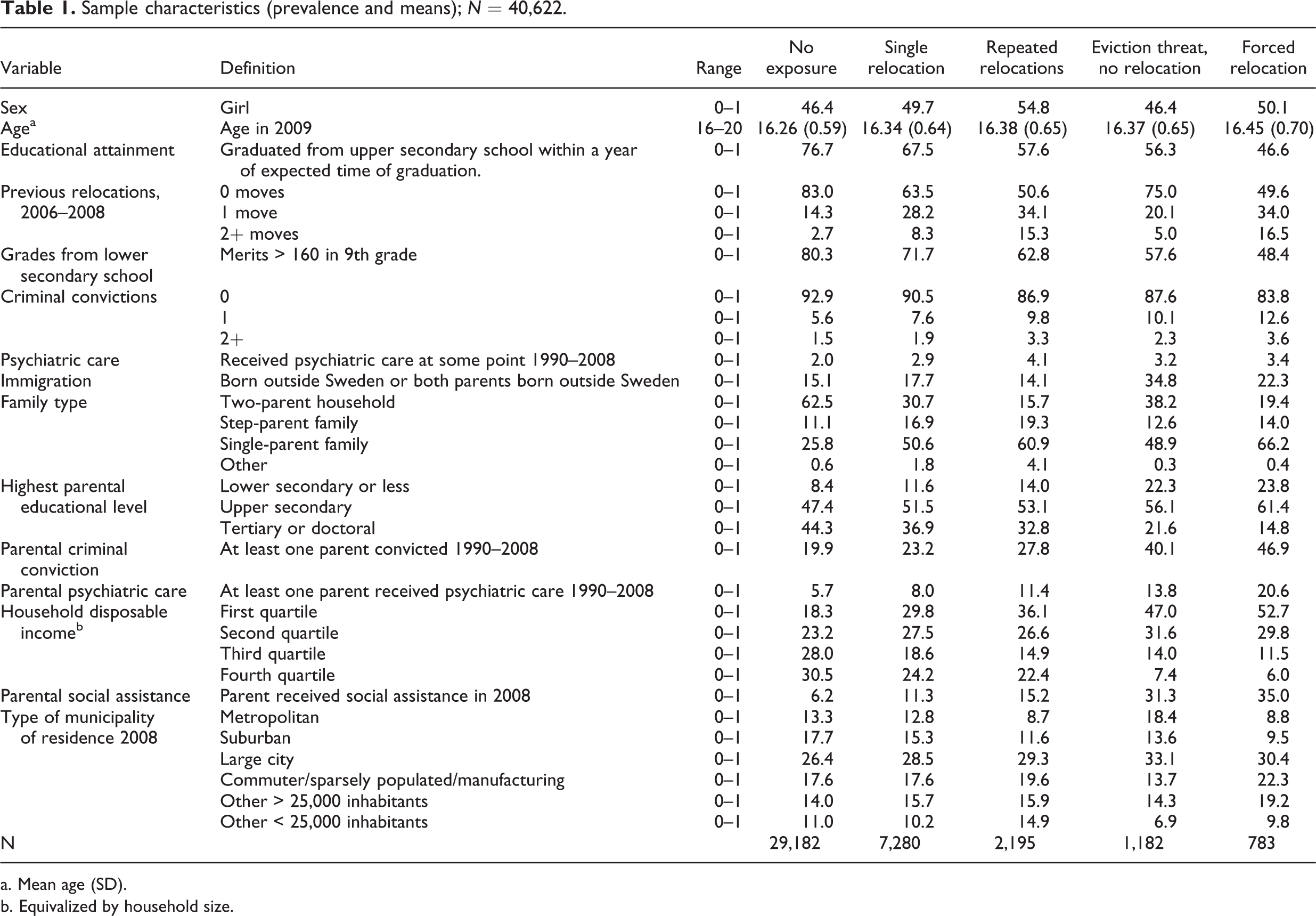
The impact of housing instability on the probability of attaining an upper secondary degree is estimated by means of IPWRA. The IPWRA estimator combines an outcome model with a selection model for predicting assignment to exposure (see below). In the selection model, the propensity of exposure to the different residential events was conditioned on a set of covariates, guided by previous research. Since eviction threats are directed toward the parent and not, in legal terms, toward the youth, and moves are likely driven by decisions made by adult members of the household, the covariates in the selection model are primarily related to parental characteristics. Those are: highest parental educational level (lower secondary, upper secondary, or tertiary/doctoral); parental psychiatric care (at least one parent received inpatient psychiatric care, including alcohol and substance abuse, 1990–2008); parental criminal conviction (at least one parent was convicted 1990–2008, comprising a wide range of convictions); parental receipt of means-tested social assistance (parents received social assistance in 2008); household disposable income (equivalized by household size); immigration (youth born outside Sweden or both parents born outside Sweden); family type (two-parent, step-parent, or single-parent household); number of moves during a three-year period prior to the youth starting upper secondary school (0, 1, 2+); and type of municipality of residence (see Table 1). The classification of municipalities was made according to the Swedish Association of Local Authorities. The smaller categories—commuter/sparsely populated/manufacturing municipalities—were merged. For parental education, the highest level of education was used in case of a two-parent family, while in the case of a single-parent family, the education of the co-residing parent was used.
Sample characteristics (prevalence and means); N = 40,622.
a. Mean age (SD).
b. Equivalized by household size.
In the outcome model, covariates more directly related to the youth and early school leaving were added: sex, age, youth’s criminal convictions (0, 1, 2+), grades from lower secondary school (> 160 merit points, indicating that the student has passed all courses) and youth’s psychiatric care (received inpatient psychiatric care, including alcohol and substance abuse, at some point 1990–2008).
Estimating the impact of housing instability
The study draws on a counterfactual approach (Rubin, 1974), in which a central aspect is what would have happened to a group of individuals who received a treatment, had they not been treated. The estimate is obtained by comparing the outcomes of the treated individuals to the potential outcomes of the same group when not treated. In the present study, treatment refers to exposure to the residential events and the terms “treatment” and “exposure” are used interchangeably.
Since, outside randomized trials, assignment to exposure is not random, the counterfactual outcome is estimated by adopting a modeling strategy that addresses the selection to exposure. The predicted probability of being exposed to the different residential events was obtained by fitting a binary logistic model for each exposure (online supplementary Table S1). The rationale for estimating binary models for each exposure respectively rather than a multinomial model is, first, that this allows the average treatment effect on the treated (ATT) to be estimated for each exposure group respectively and, second, that it produces better balance, that is, weighted samples that are more similar. 3 The probabilities from the selection models were then used to weight the observations, the weights being the inverse of the probability that an individual receives a treatment (Funk et al., 2011). Observations in the exposed groups are weighted by 1/p so that weights are large when the probability of being exposed is low. The unexposed observations are weighted by 1/(1-p) so that weights are large when the probability of not being exposed is low. The weighted samples were then used in the binary logistic outcome regressions (online supplementary Table S2) and the IPWRA estimator is thus doubly robust, since it models both the outcome and the exposure to account for the nonrandom assignment (Wooldridge, 2010). The outcome estimate is the ATT, which is the average difference between the outcome for the exposed group and the outcome for the unexposed group in the weighted samples (Austin, 2011). In the present study, this is represented by the average difference in the probability of graduating from upper secondary school.
Key assumptions when estimating treatment effects
The validity of the results rests on a set of assumptions. A key qualification is that there is balance across the weighted groups so that there are no systematic differences between the exposed and the unexposed groups in the weighted samples. This was investigated by means of over-identification tests and by comparison of standardized differences and variance ratios in the weighted samples. Another crucial premise is the conditional independence assumption (CIA), implying that no selection on unobserved covariates would bias the estimated impact of housing instability. This was assessed by estimating the correlation between the residuals of the selection model and the outcome model (Wooldridge, 2010). Finally, a central assumption is that of overlapping, implying that the predicted probabilities should have similar patterns for the exposed group and the unexposed group. When estimating ATT, the overlap assumption requires that each individual in the exposed sub-populations has a positive probability of being unexposed. This was explored by plotting the estimated densities of the propensity to be unexposed. For the sake of brevity, results from these analyses are presented in the online supplement.
Results
Descriptive results
In the unexposed group, around 77% of the individuals graduated within four years, compared with 68% in the group exposed to single relocation and 58% in the repeated relocations group. Of those exposed to eviction threat, 56% graduated, while in the forced relocation group, roughly 47% graduated. All the exposed groups were disadvantaged in several respects prior to starting upper secondary school (Table 1). For example, they were more likely to have faced criminal convictions and to have poor grades from lower secondary school, compared with the unexposed group, and their parents generally have attained lower educational levels and have more often received psychiatric care. However, the individuals exposed to forced relocation are a particularly vulnerable group. To point out some examples, they are substantially more likely to have parents who received means-tested social assistance, to have a parent who received psychiatric care and to live in a single-parent household. This underscores the importance of addressing these differences in the modeling of the selection to exposure.
Impact of housing instability
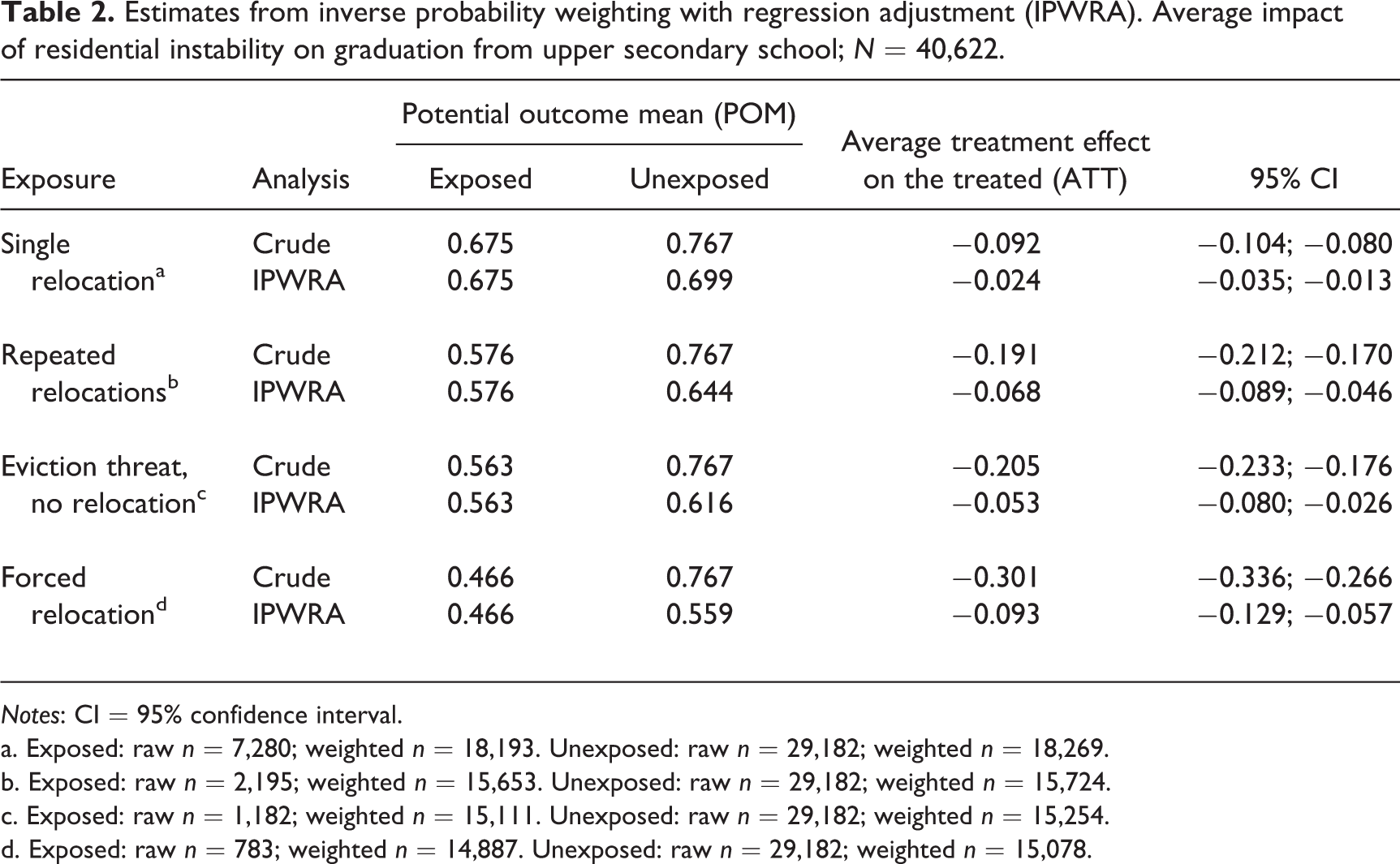
Table 2 shows the results from the IPWRA analyses. It reports both crude and adjusted differences (ATT) in the probability of having graduated from upper secondary school for each type of residential event. The crude risk differences range from roughly 9 percentage points for the group who moved once to 30 percentage points for the group exposed to forced relocation. The second row for each exposure (Table 2) shows that, when controlling for background factors, the crude risk differences are considerably reduced and the observed differences can largely be attributed to selection. 4 There remain statistically significant effects, however. Moving once during upper secondary school is associated with a small (2.4 percentage points) difference in the probability of graduating from upper secondary school. Exposure to repeated relocations is associated with a risk difference of 7 percentage points and for threat of eviction with no relocation the adjusted risk difference is 5 percentage points. Forced relocation is associated with a difference of 9 percentage points in the probability of graduating from upper secondary school, as compared with the unexposed group. This supports the hypothesis that there is an independent impact of moving, but the risk difference is larger if exposed to forced relocation or repeated relocations. There is also, as hypothesized, a negative association between threat of eviction and educational attainment, even when the threat is not followed by an actual relocation.
Estimates from inverse probability weighting with regression adjustment (IPWRA). Average impact of residential instability on graduation from upper secondary school; N = 40,622.
Notes: CI = 95% confidence interval.
a. Exposed: raw n = 7,280; weighted n = 18,193. Unexposed: raw n = 29,182; weighted n = 18,269.
b. Exposed: raw n = 2,195; weighted n = 15,653. Unexposed: raw n = 29,182; weighted n = 15,724.
c. Exposed: raw n = 1,182; weighted n = 15,111. Unexposed: raw n = 29,182; weighted n = 15,254.
d. Exposed: raw n = 783; weighted n = 14,887. Unexposed: raw n = 29,182; weighted n = 15,078.
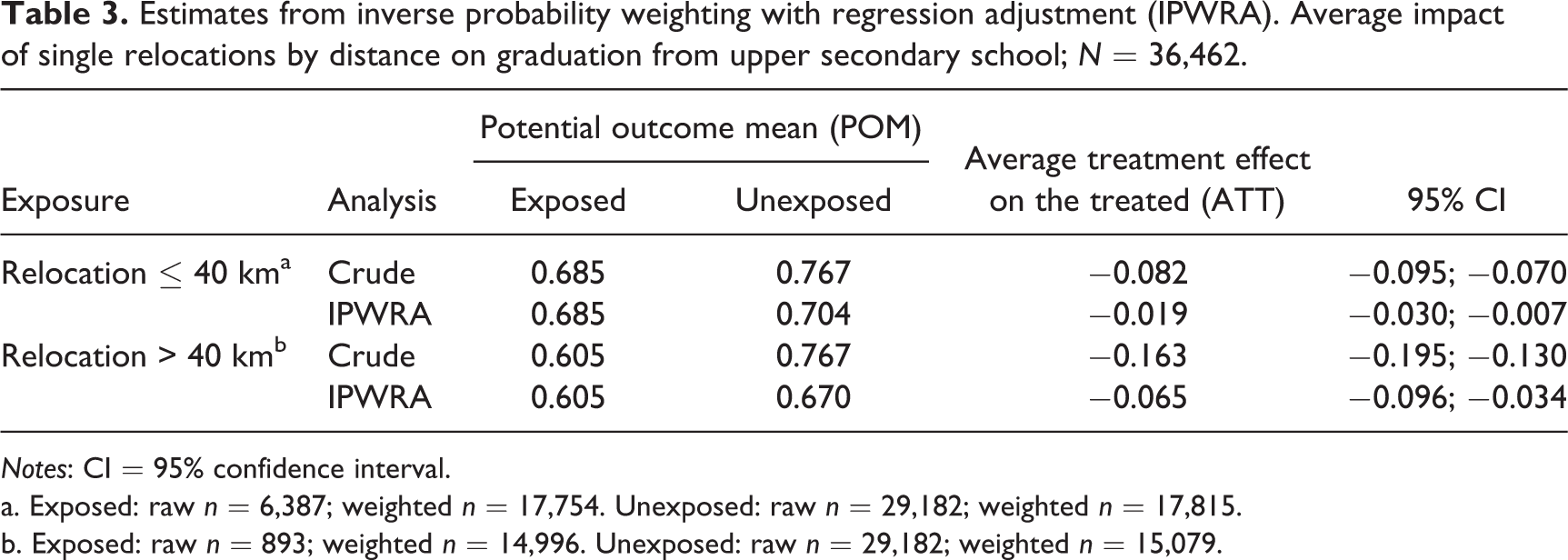
In the next step, the significance of distance was investigated. This analysis was performed separately on the sub-sample who moved once during the observed period, which was divided into two groups: short-distance relocation (≤ 40 km, n = 6,387) and long-distance relocation (> 40 km, n = 893). The rationale for restricting this analysis to the single relocation sub-sample is that the other exposed groups may have moved a short distance at one point and a longer distance at another point, making it difficult to disentangle the significance of distance, and those exposed to threat of eviction have not moved at all. The thresholds for short and long-distance moves were set so that the long-distance category represents a substantial fetch while keeping the sizes of the groups in mind, since a vast majority of individuals only move a short distance. 5 Table 3 reports both the crude and weighted differences from the IPWRA analysis. When considering distance, there is a crude risk difference of around 8 percentage points for short-distance relocation and of 16 percentage points for long-distance relocation. In the weighted analysis, when accounting for selection, the risk difference for short-distance relocation is very small and barely statistically significant. Long-distance relocation, on the other hand, is still associated with a 7 percentage point decrease in the probability of graduating from upper secondary school, suggesting that long-distance relocation poses a bigger strain on youths.
Estimates from inverse probability weighting with regression adjustment (IPWRA). Average impact of single relocations by distance on graduation from upper secondary school; N = 36,462.
Notes: CI = 95% confidence interval.
a. Exposed: raw n = 6,387; weighted n = 17,754. Unexposed: raw n = 29,182; weighted n = 17,815.
b. Exposed: raw n = 893; weighted n = 14,996. Unexposed: raw n = 29,182; weighted n = 15,079.
Validity of the estimated effects
Covariate balance was assessed through the comparison of standardized differences and variance ratios in the weighted samples and through over-identification tests. The null hypothesis posed for the over-identification test is that there is no difference in the covariate distribution between the exposed and the unexposed groups. These tests showed that the null hypothesis can be rejected (p < 0.05), indicating that the samples are not balanced on all observed covariates. However, the weighted standardized differences are all close to zero (online supplementary Table S3) and no variable has a standardized difference that exceeds the recommended level of 0.1 (Austin, 2009). Worth noting is that, in large samples, even small differences in the covariate distribution may be statistically significant.
The overlap assumption was assessed by plotting the estimated densities of the propensity to be unexposed (online supplementary Figures S1–S4). For all the exposed sub-populations, the masses of the estimated densities are in regions where they overlap, indicating that the overlap assumption is not violated.
Finally, to assess the necessary condition for CIA, the correlation between the residuals of the selection model and the outcome model was estimated, using a control-function approach of endogenous treatment-effect estimators and then running a Wald test (Wooldridge, 2010). The Wald tests were not statistically significant for the exposures single relocation, repeated relocations or forced relocation, indicating that there is no correlation between the residuals in the selection model and the outcome model (single relocation: p = 0.16, repeated relocations: p = 0.26, forced relocation: p = 0.56). For the exposure threat of eviction with no relocation, however, the Wald test showed a correlation between the residuals (p = 0.0002), indicating that the estimates for threat of eviction are less robust. A possible explanation for this is that it was not possible to control for eviction threats prior to 2009. Whereas previous relocations largely predict the assignment to the other exposures, it does so to a lesser extent for eviction threat, this being a less mobile group (see Table 1 and supplementary Table S1).
Discussion
Leaving school without qualifications in a labor market with shrinking opportunities for those without education poses a major disadvantage (e.g. Bäckman, 2017; Townsend et al., 2007), which underscores educational attainment as an indicator of success in young adulthood. Using comprehensive longitudinal Swedish register data, this study investigated if different types of housing instability matter for the probability of graduating from upper secondary school within one year of the expected time of graduation. With reference to the FSM, it was hypothesized that eviction threat, without any relocation, has a negative impact on educational attainment. With reference to social capital theory, it was further surmised that all types of moves are negatively associated with educational attainment, but that the impact will be greater if the relocation is forced by authorities or in case of repeated relocations. Finally, it was hypothesized that long-distance relocations will have a greater impact than short-distance relocations, since social capital is largely connected to the spatial context.
The groups exposed to the different residential events were all disadvantaged in several respects compared with the unexposed group. For example, the exposed groups were more likely to have faced criminal convictions, to have poor grades from lower secondary school, and to have parents with lower levels of education. This reveals that youths facing housing instability are a vulnerable population, which may motivate concern in its own right. This was further substantiated by findings indicating that all the residential events were negatively associated with educational attainment. However, when accounting for selection, the risk differences are not as pronounced as suggested in some other studies (see e.g. Metzger et al., 2015) and regarding the exposure to eviction threat, the estimates are uncertain. Moreover, the finding that single short-distance relocation has a negligible impact on educational attainment to some extent challenges much of the literature on housing mobility.
Taken together, the results of the present study suggest that the instability and stress following forced relocations, repeated relocations and long-distance relocations are of particular significance for the link between housing instability and educational outcomes. This implies that both the notion of loss of social capital and the FSM are relevant for understanding the mechanisms at play. In the cases of long-distance moves, the link to poor educational achievement can be understood as a response to greater disruptions in important relationships due to changed spatial context and difficulties in sustaining pro-social networks. The impact of repeated relocations can be linked to social capital theory, both through the loss of social resources and through reduced opportunities to establish new social ties when mobility is high. The association between forced relocations and poor educational attainment can be seen as the result of a combination of psychological and economic pressure in the family and disruptions in important relationships when changing residential context.
The present study has the advantage of national and longitudinal data, providing a good opportunity to analyze housing instability. The study is not without limitations, however. One manifest weakness is the relatively short follow-up period. The available data contain information on eviction cases between 2009 and 2012 and on graduation until 2013, with the consequence that the study focuses on residential events experienced during upper secondary school and that no conclusions on long-term effects can be drawn. In addition, data did not contain information on which school the youths attended and, accordingly, change of school could not be analyzed. Though this may be picked up to some extent in the analysis on distance, it is an interesting query for follow-up studies. Another limitation is that there is only information about moves between years and, thus, the number of moves might be underestimated in some cases.
As with most register data, generally not assembled for research purposes, the information is limited. Since a randomized controlled trial would not be viable to investigate housing instability, the IPWRA estimator was used to compensate for the nonrandom assignment to the exposure. However, as in all observational studies, it cannot be ruled out that there still exists unobserved heterogeneity. For example, the data do not hold information about the quality of parent–child relationships or about peer networks. Likewise, the data do not reveal the core reason for moving and people could move for a number of reasons and more or less of own accord. On the other hand, the data are a national sample, suffering less from nonresponse problems compared to survey data and include objective measures on a range of covariates, while also allowing more detailed operationalizations of housing instability than has been done in previous research. Finally, it was beyond the scope of the present study to analyze whether the different types of housing events were associated with upward or downward moves in terms of neighborhood quality, which could also inspire future research questions. Other suggestions for future studies are to investigate effects on educational achievement post the upper secondary education, while also exploring if resources attained in young adulthood mediates the impact of housing instability in youth.
The limitations notwithstanding, the present study provides further evidence that youths experiencing housing instability are a disadvantaged group, particularly those facing repeated relocations or when coercion is involved. The findings add to previous knowledge that having a stable home is of great importance for wellbeing and suggest that severe housing instability should be regarded as a disruptive life event associated with elevated risks of poor educational attainment, and this applies even in the context of a relatively comprehensive welfare state. Moreover, the results bring to attention the significance of considering various residential events when investigating housing instability, since we might otherwise overrate the importance of single and short-distance relocations. Key implications of the findings are the significance of a housing market where moves are not driven by economic, social, or legal imperatives, and the need for measures to decrease the incidence of repeated and involuntary relocations. This also underscores the importance of combating the underlying economic and social disadvantages faced by mobile youths. An implication is the necessity of a functioning cooperation between the social services and landlords, and established procedures to address back rent at an early stage in order to preclude forced relocations following the accumulation of rent arrears. Finally, the results call for support directed toward mobile youths, in particular to those who are highly mobile or who face residential events where coercion is involved. Teachers and other school professionals need to be attentive to the fact that these youths may be at risk of poor educational attainment.
Footnotes
Acknowledgements
The author wishes to thank Olof Bäckman, Susanne Alm and Lars Brännström for methodological advice, and Sten-Åke Stenberg for providing the opportunity to work within the DEVS project. Four anonymous reviewers are also gratefully acknowledged, for their valuable comments on an earlier version of the article.
Funding
The author disclosed receipt of the following financial support for the research, authorship, and/or publication of this article: The work was supported by Swedish Research Council for Health, Working Life and Welfare (Forte) (Grant number 2013–0452).

Notes
References
Supplementary Material
Please find the following supplemental material available below.
For Open Access articles published under a Creative Commons License, all supplemental material carries the same license as the article it is associated with.
For non-Open Access articles published, all supplemental material carries a non-exclusive license, and permission requests for re-use of supplemental material or any part of supplemental material shall be sent directly to the copyright owner as specified in the copyright notice associated with the article.
