




Abstract
The public housing program was designed as a stepping-stone into upward socioeconomic mobility when the first developments were constructed for White and Black households in the 1930s. White residents were able to save and move into private housing with greater speed than Black residents, who faced both external and internal constraints on their socioeconomic status. As a result of this decreased mobility, scholars and policymakers soon associated public housing developments with impoverished Black containment, categorizing it as the home of the underclass and those who are stuck in place. This article employs a Du Boisian approach to understand the categorical differences and political economic conditions shaping mobility rates among Atlanta’s early Black public housing families. Using historical documents and approximately 40 years of administrative data collected from the first Black public housing development in Atlanta, Georgia by housing managers, Du Bois, and a group of research assistants from Atlanta University, this article examines how internal and external constraints shaped Black tenant mobility. It demonstrates how housing administrators and their actions shaped eviction rates—and by default, public housing’s ability to advance Black tenant mobility—through elite housing managers’ moral judgments of impoverished Black families.
Public housing involves more than just building houses. For Negroes it means that opportunities for living more normal, more purposeful, and more hopeful lives must be knit into the development and operation of projects . . . The further evolutions of racial policy rest largely with the local housing authorities. (Weaver 1940:161)
Introduction
The origins of the public housing program are rooted in the ideology that it serves as a stepping-stone from poverty into the middle class (Dantzler and Rivera 2021; Friedman 1966; Rodriguez 2021; Vale et al. 2015). Public housing in the United States began as a direct response to multiple crises of industrialization and urbanization that emerged during the Great Depression: record unemployment, growing instability in the housing market, and a disproportionate amount of substandard housing stock occupied by working families (Friedman 1966). Thus, even in its earliest brick-and-mortar form, the public housing program was meant to increase the mobility of families that were underserved in the private rental housing market (Biles 2000; Friedman 1966; Madow 1975).
Yet inherent in this mobility of the program’s participants are the White supremacist, heteropatriarchal norms undergirding what constitutes a middle-class household (Cross, Fomby, and Letiecq 2022). Lee (2015) noted that the rhetoric of morality constructed a particular framing of housing needs and the maintenance of the poor through moral and behavioral norms. Ferguson (2002) noted how public housing managers made moral judgments about residents as a form of “uplift politics” based on notions of deservedness. This included constructions of the nuclear, heterosexual family as a hegemonic entity. Perceptions of a “good family” capture the oppositional categories of racial division and the legacy of racism (Fritz 2010). Notions of moral or behavioral inferiority served as the foundation of earlier academic and policy debates surrounding the presence of an “underclass” (e.g., Sharkey 2013; Wacquant 2022; W. J. Wilson 2012); however, this type of class consciousness failed to fully consider the broader political economy under which racialized households operate (Dantzler 2021). Paternalistic management practices within housing authorities reveal complex webs of institutional racism resulting in differential access among racialized households to resources and services (Biles 2000; Friedman 1966; Rodriguez 2021; Spain 1995; Williams 2004).
For White families, there were no legal, extralegal, or ideological barriers to prevent their households from achieving the mobility of private homeownership that was promised by the public housing program. However, for the first Black families that entered the prewar public housing developments, there were innumerable internal and external limits to their household mobility. As White turnover (or mobility) in segregated, White public housing developments increased—along with private housing production from local, state, and federal initiatives—Black mobility was shaped by eviction for the most vulnerable households and restrictive entrance into the private rental and homeownership market for the most privileged. As the site of the first public housing development in 1936 (the all-White Techwood Homes; Keating and Flores 2000), the City of Atlanta greatly underscores these dynamics. By 1946, White households were exiting from Atlanta’s public housing developments at an average rate of .31 units per year, and Black families were exiting at an average rate of .29 units per year (see Table 1). We posit the small difference in these turnover rates was for categorically different reasons. For White families, the public housing developments worked as intended, to provide a stepping-stone into stable, private homeownership. For Black families, closer surveillance and paternalistic standards of housing managers created higher turnover for behavioral reasons and failure to adhere to standard definitions of nuclear family structure, as well as structural external fluctuations in labor markets beyond the control of individual households.
Count of Annual Turnover Rates for Atlanta Housing Authority Public Housing Developments.
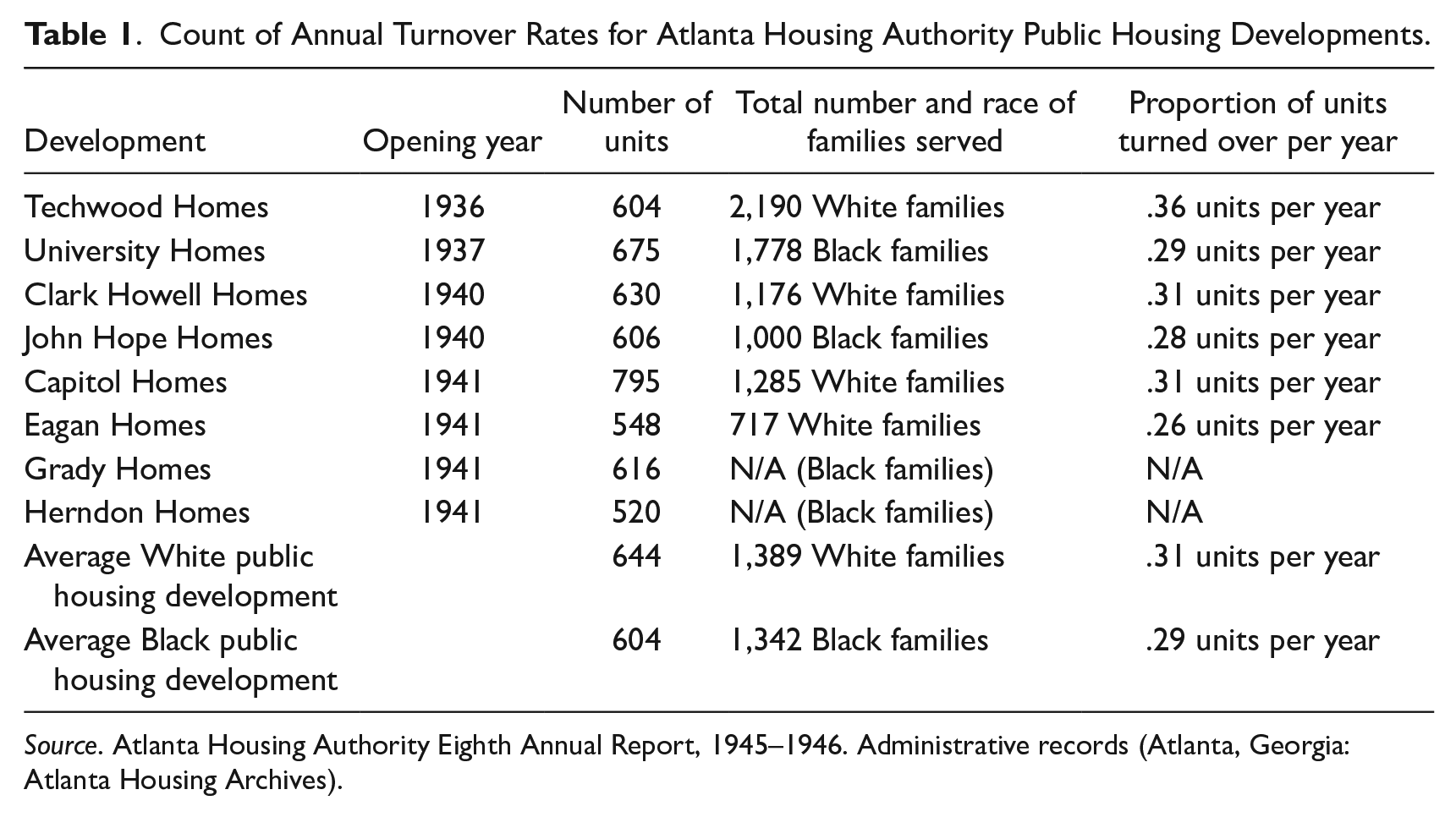
Source. Atlanta Housing Authority Eighth Annual Report, 1945–1946. Administrative records (Atlanta, Georgia: Atlanta Housing Archives).
During this period, the income-eligible waiting list for the eight developments contained 6,000 White and 8,000 Black families. These disparate mobility rates and waiting lists were shaped both by the external factors of structural racism in private housing markets and policies and by the internal factors such as household income and family size.
The purpose of this article is to challenge the conventional notions of Black public housing tenant mobility, particularly that the change in population led to the contemporary sociological phenomena of an underclass in concentrated poverty which would progressively transform into being stuck in place (Sharkey 2013; W. J. Wilson 2012). Similar to Du Bois’ ([1935] 2017) approach to unpacking the sociopolitical and material conditions of Black people in the City of Philadelphia, our aim here is to underscore how changes in the local political economy shaped Black households’ mobility, or lack thereof, in Atlanta’s public housing. Our approach draws from a long tradition within urban sociology and the sociology of race to highlight the structural dynamics shaping Black urbanity (e.g., Du Bois 1899; Freeman 2019; Hunter 2013; Hunter et al. 2016; Pattillo 2010) as well as the literature on Black (im)mobility in urban communities (e.g., Jargowsky 1997; Sharkey 2013; South and Crowder 1998; W. J. Wilson 2012) to highlight the role of the racialized political economy (Aalbers and Christophers 2014; Dantzler 2021; Du Bois [1935] 2017; Hackworth 2021).
Our main research question is: what were the conditions shaping Black residential mobility within public housing? Subsequently, we ask: how have these conditions changed over time? We hypothesize that in addition to the structural factors limiting Black tenant mobility out of public housing developments (i.e., income and housing market discrimination
Using public housing administrative data documenting the demographics and reasons for leaving Atlanta’s first Black public housing development (University Homes) from 1937 to 1975, we hope to provide more information about the contextual causes of Black (im)mobility. We also rely on data from a study Du Bois conducted in 1934 about the households living in the slum designated for clearance to site University Homes, which yielded a report that was much more nuanced about Black difference and mobility than The Philadelphia Negro. Furthermore, we will show how the phenomenon of concentrated poverty, and being stuck in such places, can be traced to the racism embedded within local land and real estate markets and the deleterious eviction and leasing requirements instituted in public housing developments. Specifically, we note the shift from admitting and evicting based on income, need, and affordable housing access to admitting and evicting based on income, need, and behavior. By socially constructing an ideal tenant (e.g., Dantzler and Rivera 2021), public housing managers shaped local admission and eviction policy to cater to racial uplift politics in the 1940s and built on these policies to address operational budget deficits by the mid-1970s. While other work has noted paternalism within the private housing market (e.g., Rosen and Garboden 2022) and through housing vouchers (e.g., McCabe 2023), we highlight the particular moral standards shaping tenancy within public housing.
We frame this article around several literatures examining the reasons for, and obstacles to, Black socioeconomic mobility. We first review Du Bois’ prior work on Black mobility in Atlanta between the 1930s and 1970s to situate our study, before discussing the literature on Black mobility in public housing more broadly. We then examine internal and external household characteristics shaping Black mobility, and finally review the literature on public housing administration and managerial discretion. These four sets of literature provide the theoretical basis for our coding and interpretation of the results from the analysis. We then explain our data and methods followed by our results. The article concludes with recommendations for eradicating behavior-based lease requirements in subsidized housing programs to improve Black mobility, to return public housing to its programmatic origins as a positive determinant of class and racial mobility.
Literature review
Du Bois’ Prior Analysis of Black Mobility in Atlanta
Prior to the construction of University Homes, John Hope, the head of the local advisory committee for the development, commissioned Du Bois of Atlanta University’s Department of Sociology to conduct a study on the existing conditions of the designated slum area (Beaver Slide) that would be cleared for the development. From May 4 to May 10, 1934, Du Bois and at least six graduate students conducted 315 door-to-door surveys of 241 families, 67 vacant units, and six businesses (Du Bois 1934). Depictions of slums in nascent public housing debates included both the condition of homes and the moral failings of their inhabitants (Moga 2020; Palmer 1940). Yet Du Bois (1934), in the opening paragraphs of the study, plainly stated (p. 1): It is a slum area because of poverty, and not by any reason of vice or crime. There is very little evidence of criminal tendencies. There is some playing of numbers and some gambling and drinking, but no evidence of commercialized sex vice, and most of the families are normal families with comparatively few lodgers. The houses are separate and have few conveniences. They are nearly all of them old and sadly in need of repairs. Nevertheless, there is much evidence of care, some flowers and shrubbery, and a normal home life.
Du Bois also observes both the economic and housing precarity of these Black households. In tabulating the income data for those surveyed, he notes that the weekly income provided is somewhat overstated: In many cases, this present income lasts only part of the year. In some cases, this income for part of the year is small. In other cases, the weekly income is large, because of the temporary nature of the service. (Du Bois 1934, p. 2)
Of the 235 families who reported income, 69 had no income and were on relief, and 41 had incomes of less than $5 per week. The suppressed and provisional wages of Black households reflect several components: the structural conditions of southern U.S. labor markets during the Great Depression, institutional racism that segregated Black workers into high-risk, low-paying, precarious day labor, and limited (and even illegal) offerings for education and job training that would increase the number of skilled Black laborers (Du Bois [1935] 2017; Trotter 2019).
These meager Black household incomes limited respondents’ housing options following their eviction and displacement from the slum clearance/public housing construction. Du Bois included questions on current inhabitants’ desire to move into the new development, the number of rooms required, and the weekly rent they could afford to pay. Overall, families were skeptical about moving into University Homes, with Du Bois noting that “the only apartment houses of which they know are a few wretchedly arranged places in the various colored sections of Atlanta, which are the abode of much vice and crime” (Du Bois 1934, p. 3). One hundred families could not determine which rent they could afford to pay “under their present precarious economic situation” (Du Bois 1934, p. 3). Over 200 of the 254 families surveyed did not know where they would move during the slum clearance activities. Du Bois (1934) wrote “moving has already begun, there being 67 vacant houses—some vacant because of their tumble-down condition and others because people have begun to move out of anticipation of being dispossessed.” (p. 4)
Graduate students who served as canvassers for the door-to-door survey also documented their observations of the community and its households. While these students also identified poverty as the chief source of the disorganization and poor living conditions of the community, they were more likely to note the moral failings they believe contributed to its slum designation. One student’s first comment was on the frequent and persistent intoxication of the residents, and the unsanitary and ill-kept state of their homes. This is in contrast with another student, who noted the homes were “well kept, clean, plenty of air, gardens and some pot flowers” (Du Bois 1934).
The second graduate student provided greater detail about the mobility tensions between individual households and structural conditions. The first is a direct quote from a resident, complaining about the condition of homes but lack of options: I sure will be glad [when University Homes is constructed]. It’s a shame to charge people for living in these old broked [sic] down places. There is [sic] holes in the floor, and it pours on the inside and rains on the outside. It’s just a shame, that’s all. (Du Bois 1934)
Another resident mentioned unjust penalties and taxes that made them suspicious of the new government-funded development: a family who said that they were taxed $5.00 recently by the City on their house furnishings. No one else in the neighborhood had been taxed in such a manner. This family does not intend returning to the new housing area because they fear that there is a trick in the deal somewhere. They express no interest in the project at all. (Du Bois 1934)
The graduate student also observed differences within the community, and how the new development can act as a sorting mechanism to minimize these disparities. They note: to the student something definite will have to be worked out to either prohibit or limit these individuals [previously identified as the gang, racket, thriftless and menacing elements of the community] in returning to the new housing settlement. If steps are not taken there is a possibility of an element, now in the area, that will take advantage of these proposed conveniences and comforts to propagate a certain amount of commercialized sex and vice. (Du Bois 1934)
Households who should return are those who are working and attending school at night: “they are the ones who will contribute greatly to the success and moral standing of the area” (Du Bois 1934). Yet that is not the case for all upwardly striving families: There are some deserving, conscientiousness families who would like to live in the new housing, and for whom it would be a move upward in the surroundings that they have longed for, but their circumstances are of such that it will be difficult to do so. They have been struck by adversity and depression. They see no hope of making a comeback. (Du Bois 1934)
Black Mobility and the Role of Public Housing
Since Du Bois’ (1899, 1934) analysis of the Seventh Ward in Philadelphia, and analysis of the Beaver Slide community in Atlanta, sociologists have long sought to understand and unpack the dynamics surrounding Black (im)mobility. Institutions, like the Chicago School, furthered this discourse through an evolutionary and ecological perspective characterizing Black people as less civilized, or as exceptional cases not adhering to their theories of urbanization (Dantzler, Korver-Glenn, and Howell 2022; Howell 2019; Morris 2015). Urban neighborhoods were thus seen as containers of social ills rather than structures with differential outcomes for racialized households. As Howell (2019) noted, studies of urban neighborhoods, particularly Black neighborhoods, have played an essential role in contrasting deeply held stereotypes, illuminating systematic injustices, and shaping urban policy.
Black mobility is part of a larger project of Black citizenship—or rather, control and autonomy of Black mobility have a direct correlation to the realization and materialization of Black citizenship (Pryor 2016; Rigueur and Beshlian 2019). Mobility takes on a variety of definitions (see Blunt 2007; Hankins et al. 2014; Ruel et al. 2013): at a base level, it is a means of moving from one place to another, preferably without harm or difficulty. For Black Americans who have been criminalized for being unattached to a White owner since the 1793 Fugitive Slave Act, mobility is a project in recognizing Black citizenship. Early mobility struggles began at the turn of the nineteenth century, when Black emancipation and transportation innovation were emerging simultaneously. As Pryor (2016) wrote of the goals of early Black activists, “access to public conveyances was an essential social and economic tool, and equality within vehicles was crucial to their sense of selves as Americans” (p. 69).
At another level, mobility describes the movement of a population over time, around established normative socioeconomic outcomes of postsecondary educational attainment, homeownership, and stable, above-average household income (Sharkey 2013). For Black populations in America, this form of mobility has also been of interest since emancipation, with political organizing taking the form of advancing Black mobility, particularly for Black elites who had long ago accumulated financial capital without the gains in political and social capital (Ferguson 2002). Political struggles around equal pay, housing access, equal school funding, and other core civil rights issues all center around increasing the overall mobility of the Black population across generations and regions (Freeman 2019). Mobility is explicitly about gains across time; how individuals and groups move between and within education, income, wealth, and other status measures between childhood and adulthood, and from one generation to the next, defines contemporary mobility studies (Blunt 2007). However, the degree to which internal and external forces shape individual, household, and population mobility differs for White and Black Americans (Hardaway and McLoyd 2009; Mouzon et al. 2019; G. Wilson and Roscigno 2010).
Public housing connects to mobility and particularly Black mobility in two major ways. First, public housing developments were one of the first federal outlays in the post-Reconstruction South that was explicitly intended to provide middle-class mobility to Black Americans (Gray 2020; Rodriguez 2021). In addition to the direct ways that public housing tenancy provided a step into middle-class private homeownership, such as the ability to pay a subsidized rent and save for a down payment on a home, public housing developments indirectly provided a normalization of private homeownership-as-citizenship through its Americanization programming (Dantzler 2018; Parson 2005). Federal outlays were one of the first steps toward full Black citizenship and had trickle-down effects, as they mandated state and local cooperation, authorization, and funding. Second, public housing allowed for Black Americans to assemble, organize, and mobilize in ways that were not always afforded to them, particularly in Southern cities such as Atlanta. University Homes had the second auditorium for Black Atlantans in the city, the second library for Black Atlantans, and was the site of the voter registration drive and polling place after the elimination of the state’s White Democratic Primary in 1946 (Rodriguez 2021). Public housing thus provided opportunities for Black social, economic, and political mobility. Internal household socioeconomic factors and external political economic factors are the greatest determinants of Black public housing mobility.
Recent work in urban sociology and housing studies has highlighted the role of intermediaries and state actors in producing housing outcomes through administrative discretionary practices (e.g., Bartram 2022; Greif 2022; Rosen 2020; Smith, Munro, and Christie 2006). Black housing managers who oversaw the first Black public housing developments not only had significant discretion in determining who was selected, transferred, or evicted from individual public housing developments, they also had great influence on setting public housing policies nationally. Housing managers in public housing pilot programs, like Alonzo Moron of University Homes, were called to testify at the early Congressional hearings for the 1937 Housing Act, corresponded with other housing managers, and gave keynotes at public housing administrator conferences (Rodriguez 2021). The confluence of the racial uplift Black political movement also known as “respectability politics” with the political opportunity of the Black public housing development meant that housing managers often used policy to root out more deviant perspectives that did not comply with racial uplift (Ferguson 2002). In rhetoric and practice, public housing became a space of deservedness for certain identities, with program advocates situating state-sponsored housing as more of a privilege, instead of a need or right, of citizenship (Dantzler and Rivera 2021). The need to exclude deviants from public housing developments and to create more mobility opportunities for respectable Black families would lead to policies that targeted deviant behaviors, family structures, and precarious attachments to the labor market.
External Political Economic Factors and Household Socioeconomic Characteristics Shaping Black Mobility
Mobility is also shaped by the internal dynamics of the household (such as changes in household income and the number of members), as well as external forces such as changes in land use policies, labor, and housing markets (Blunt 2007). Early studies on Black mobility, particularly at the onset of the Great Migration, dominated the emerging field of urban sociology. These studies highlighted the role of agricultural technology, organized legal and extralegal campaigns of state-sanctioned racial terror, and rising levels of urban industrialization resulting in several push and pull factors that shaped rural-to-urban Black migration (e.g., Derenoncourt 2022; Du Bois [1935] 2017; Freeman 2019; Robinson 2014). These rural-to-urban shifts were viewed as positive gains for Black mobility, as income, educational attainment, literacy rates, and employment were all higher for Black Atlantans than Black rural Georgians (Georgia State Advisory Committee 1968; Hopkins 1968; Rodriguez 2021). However, within cities, particularly those such as Atlanta, race relations (and racial harmony) were carefully maintained by political and business elites (e.g., Bayor 1996; Hobson 2017; Rutheiser 1996; Stone 1989). Thus, intraurban Black mobility did not necessarily translate into positive gains, as it did for other ethnic groups who spatially assimilated across industrializing cities and suburban areas. Public housing, with its stable rents and the concomitant amenities that were provided in the early developments, was a means of increasing mobility relative to the private rental market.
The literature suggests that while some household mobility is shaped by internal characteristics such as income and size, an overwhelming amount of the variance in household income is linked to external factors such as structural and spatial characteristics (Chetty et al. 2014; Jargowsky 1997; Sharkey 2013; W. J. Wilson 2012). The external factors shaping Black tenant mobility in prewar and postwar Atlanta can be sorted into three broad categories: (1) legal and extralegal forms of anti-Black racism, (2) land availability to maintain Atlanta’s postwar-segregated geographies, and (3) the shifting policy landscape for subsidized private and public housing (Keating 2001). These political economic changes shaped the number of Black tenants that entered and left public housing over the years.
The political economy of Atlanta’s housing market created and maintained highly segregated neighborhoods around an increasingly White central business district (Aalbers and Christophers 2014). The city worked with and against local, suburban, state, and federal agencies, as well as government units, to expand housing options for Black and White residents in segregated communities, privileging White middle- and working-class housing preferences over Black middle- and working-class housing needs (Lee 2015). These racial disparate household mobilities were upheld through the structures of de jure and de facto housing segregation (see Hirsch 1998).
De jure housing segregation begins with racial zoning laws and the construction of segregated public housing developments at the turn of the twentieth century, continues through the dismantling of restrictive deed covenants by the Supreme Court’s Shelley v Kraemer ruling in 1948, and formally ends with the passage of the Fair Housing Act in 1968 (Rothstein 2017). De facto segregation, which follows in the wake of de jure, is supported through the extralegal violence of home bombings, the forced desegregation of public schools and housing, an implicit and explicit code within the real estate and home mortgage industry to maintain racially homogenous neighborhoods, and structural racism in labor markets that artificially deflated Black wages, thus confining Black households to lower resourced, segregated neighborhoods (Krysan and Crowder 2017; Rothstein 2017; Trounstine 2018). Both de jure and de facto segregations have the same outcome—repressing Black mobility, by artificially confining Black households spatially and socioeconomically (Krysan and Crowder 2017; Rothstein 2017; Trounstine 2018).
Counterweights to the restrictions of Black household mobility are the annexations of Atlanta, particularly the 1951 Plan of Improvement, and expansions in federal housing policy that increased the availability, geography, and diversity of housing subsidies. The 1951 Plan of Improvement was a direct response to the 1946 Georgia Supreme Court ruling that declared the all-White Democratic Primary unconstitutional. In what would be a second enfranchisement of Black Georgians, Black voter registration increased, and this group was soon 33 percent of Atlanta’s electorate. White mayor William B. Hartsfield proposed a Plan of Improvement that would annex an additional 74 square miles and 100,000 (nearly all White) voters to the city. As part of the annexation, large sections of the west side of the city were “set aside” for Black private and public home construction (Hartsfield n.d.; Immergluck 2022).
In 1955, the Georgia Supreme Court was directly responsible for another counterweight to Black immobility—the granting of authority powers to housing authorities and local jurisdictions to implement the Urban Redevelopment and Urban Renewal programs from the 1949 and 1954 Housing Acts. The Atlanta Housing Authority was granted vast powers to reshape the geography of the city just as it was gaining more (Black) land and (White) voters. Along with the Housing Act of 1961, the city produced 7,955 units of subsidized housing between 1960 and 1970. Urban renewal and urban redevelopment had demolished approximately 22,545 units (Research Atlanta 1972). Many units were replaced with nonresidential uses, and replacement residences were not completed until the early 1970s (Department of Planning, City of Atlanta 1973). With an increasing focus on scattered-site housing for private rental or homeownership, housing subsidies in the late 1960s and 1970s funded more housing options across more neighborhoods compared to public housing developments constructed primarily in the segregated downtown and northwestern sections of the city (see Table 2).
Public, Subsidized, and Private Housing Goals and Actuals, 1966–1971.
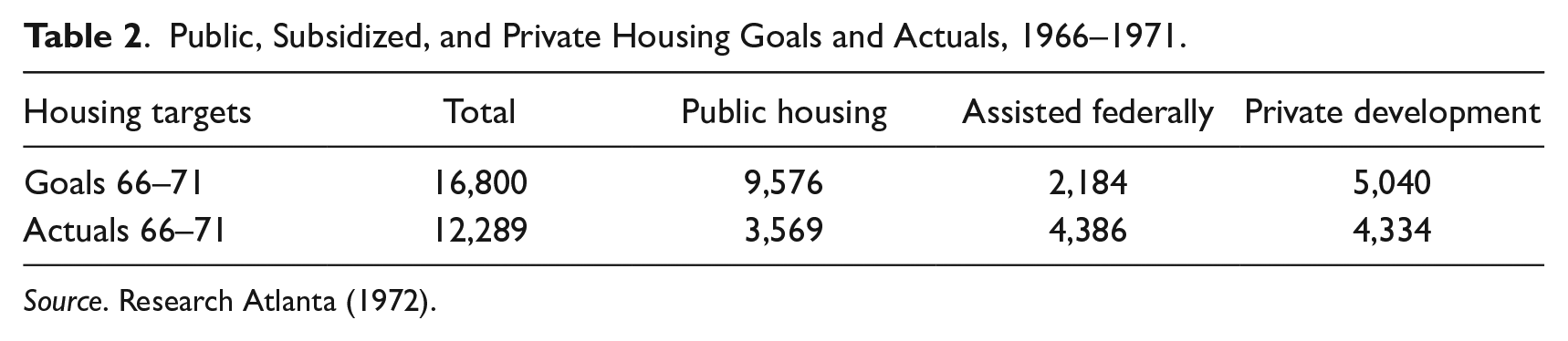
Source. Research Atlanta (1972).
Private development of new housing was prioritized in outlying, majority-White areas surrounding the city, while units in the inner city declined due to substandard housing conditions prevalent in majority-Black communities (Department of Planning, City of Atlanta 1973). By 1967, low-to-moderate income Black housing needs were estimated at 5,300, over twice the 2,100 units required for White households in the same income category (Department of Planning, City of Atlanta 1967). During community meetings and public hearings held by the Community Relations Commission formed, in part, to “support vigorously the Fair Housing Law of 1968,” Black Atlantans noted the following barriers to housing in the city: blockbusting, lack of quality affordable housing stock, lack of larger apartment sizes (number of bedrooms), and how to “integrate schools . . . without the emotional busing issue” (Community Relations Commission 1969).
Federal policies increased the number of units for Black households, but not at the same rate that the population was growing. The city and other governments in the metropolitan area, through ad hoc race relations committees, planning, and housing agencies, worked in concert to facilitate White flight from the city and Black filtering throughout it. These bureaucrats would survey White neighborhoods to gauge their preference for Black neighbors, and work with White and Black realtors and brokers to transition neighborhoods with minimal conflict (West Side Mutual Development Corporation 1954). Maps of the Black population using decennial census from 1940 and 1970 show a consolidation and rapid expansion of a segregated, majority-Black belt in the city’s Northwestern section (see Figure A1 in the Appendix). The concentration of Black Atlantans in densely, publicly subsidized, undermaintained, and overcrowded housing was made possible by the Plan of Improvement, metropolitan bureaucrats, and the federal Housing Acts of 1949, 1954, and 1961. Over time and space, these external factors limited Black tenant mobility.
Black public housing tenant mobility is also structured by White supremacist norms of family, neighborhood quality, and homogeneity, and that planning processes that privilege and assume the norms of White communities over Black ones (Friedman 1966; Fritz 2010; Goetz, Williams, and Damiano 2020). From the prewar public housing policies that only accepted heteronormative households within a certain income range to the limited neighborhoods, housing types, and tenures that were made available to Black Atlantans in the postwar era, Black tenant mobility has always been a fraught and contradictory concept. The literature demonstrates that household income and neighborhood conditions would be the greatest determinants of socioeconomic mobility (Chetty et al. 2014; Jargowsky 1997; Sharkey 2013; South and Crowder 1998; W. J. Wilson 2012), but little is known about the role of housing administrators, as facilitators of state action, in shaping intergenerational outcomes for Black households. To elucidate the material outcomes of these changes, we employ a historical approach to ascertain the effects of housing managers’ decisions upon Atlanta’s Black public housing residents from the 1930s to the 1970s. The next two sections describe and analyze the University Homes administrative data to understand qualitatively and descriptively how housing managers shaped Black public housing tenant mobility in Atlanta over time.
Data and methods
To understand the dimensions of Black public housing tenant mobility in prewar and postwar Atlanta, we conducted a content analysis and looked at measures of associations for the variable “reason for move” using the administrative records of all 660 units of University Homes from its opening in the Spring of 1937 to the Fall of 1975. 1 We further analyze the institutional context in which decisions were made by policymakers using archival documents and news articles of the development’s housing managers during that same period (Heslinga, Groote, and Vanclay 2018). We follow the call by Vargas (2022) to “rehistoricize the city” in an effort to render these historical sources into analyzable forms. This allows us to better understand the role of housing managers by examining how these associations are represented in administrative documents at the local level and how they changed over time (Heslinga et al. 2018). Figure 1a and 1b illustrates an example of a single administrative record.
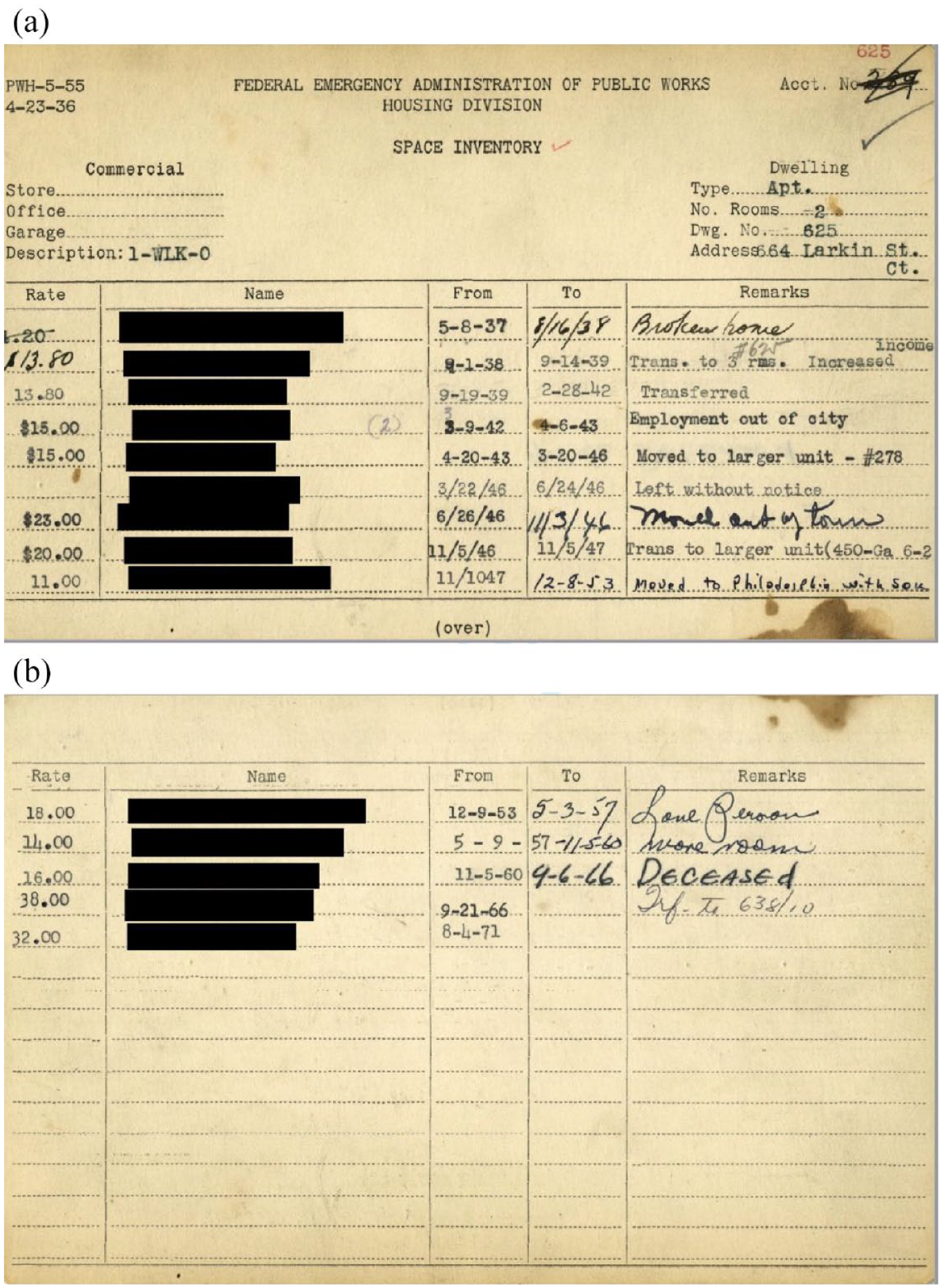
(a) University Homes space inventory for unit 625 (front). (b) University Homes space inventory for unit 625 (back).
The “Remarks” section contains categorically unique details about internal mobility (i.e., the need for more space due to changes in family composition or departures from the city altogether) as well as more subjective rationales (i.e., “Broken Home”) written by the housing manager. Table 3 provides the data’s descriptive statistics, including: the enter and exit dates of the household, average monthly rates based on the number of bedrooms, length of stay, and the most frequent reasons for leaving a unit.
Descriptive Statistics of University Homes Housing Survey, 1937–1975.
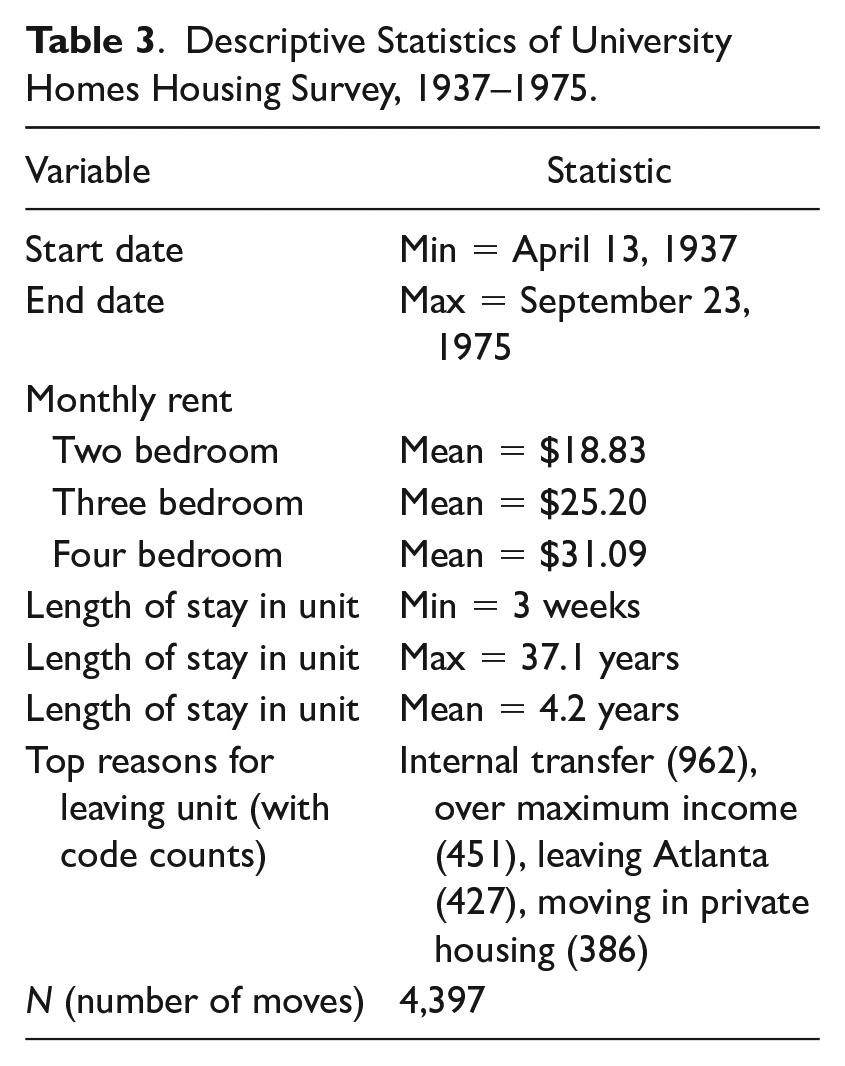
In terms of our coding strategy, we employed a two-stage iterative process: the first stage itemized each unique reason for a household’s departure from an individual unit, and the second stage grouped these reasons into 14 broader categories. Across the six housing managers, there were roughly 59 different reasons for a household to move. We then categorized those “child” codes into two “parent” codes of Black tenant mobility—involuntary and voluntary moves. Table 4 provides the frequency and proportion of voluntary and involuntary moves.
Frequency and Proportion of Voluntary and Involuntary Moves.
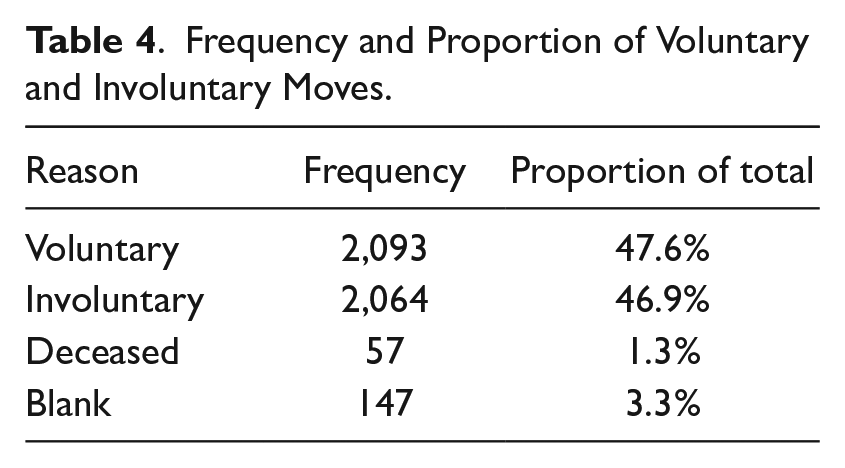
Voluntary moves include the decision to leave public housing developments for more room, the transition into private homeownership, the decision to leave Atlanta altogether (typically for employment reasons), and the decision to move in with relatives. These voluntary moves are counted as Black tenant mobility, or a choice and ability to move freely. There is a valid argument for categorizing some moves—such as the decision to move in with relatives—as involuntary actions, but the decision to create multigenerational and nontraditional households should not be (re)constructed and extrapolated as deviant in the data and results. Involuntary moves limiting or regressing Black tenant mobility include the following child codes: eviction, family structure, inability to pay, illness/deceased, and over income.
Next, based on this coding strategy, we summarized the top reasons for unit exits and summarized their relative proportions to the overall sample. We then employed a series of descriptive analyses to infer the dynamics surrounding their public housing tenancy by focusing on the particular reasons surrounding mobility. We augment this analysis with a review of additional historical documents to further contextualize the institutional context of the survey (Heslinga et al. 2018). We discuss these findings in the next section. Like Du Bois (1899), we aim to illuminate the particular sociopolitical and material conditions of Black residents by focusing on the development of policies within Atlanta public housing as well as the contextual features of the local housing authority, and the city at large, to draw upon a historical analysis of Atlanta’s local political economy. Given the temporal and expansive nature of the administrative data, we can infer changes in internal managerial practices and the external political economic factors that shaped Black mobility.
Results
We can learn much about Black tenant mobility from these records just by looking at the distinctions housing managers made in the Remarks section. The 59 distinct reasons managers wrote for each household leaving the units over our study period suggest that there were many standard reasons (e.g., left Atlanta, moved with relatives), but that there were many that required addendums, notes, or parenthetical explanations. Table 5 summarizes our code groupings and descriptions.
Code Groupings and Descriptions.
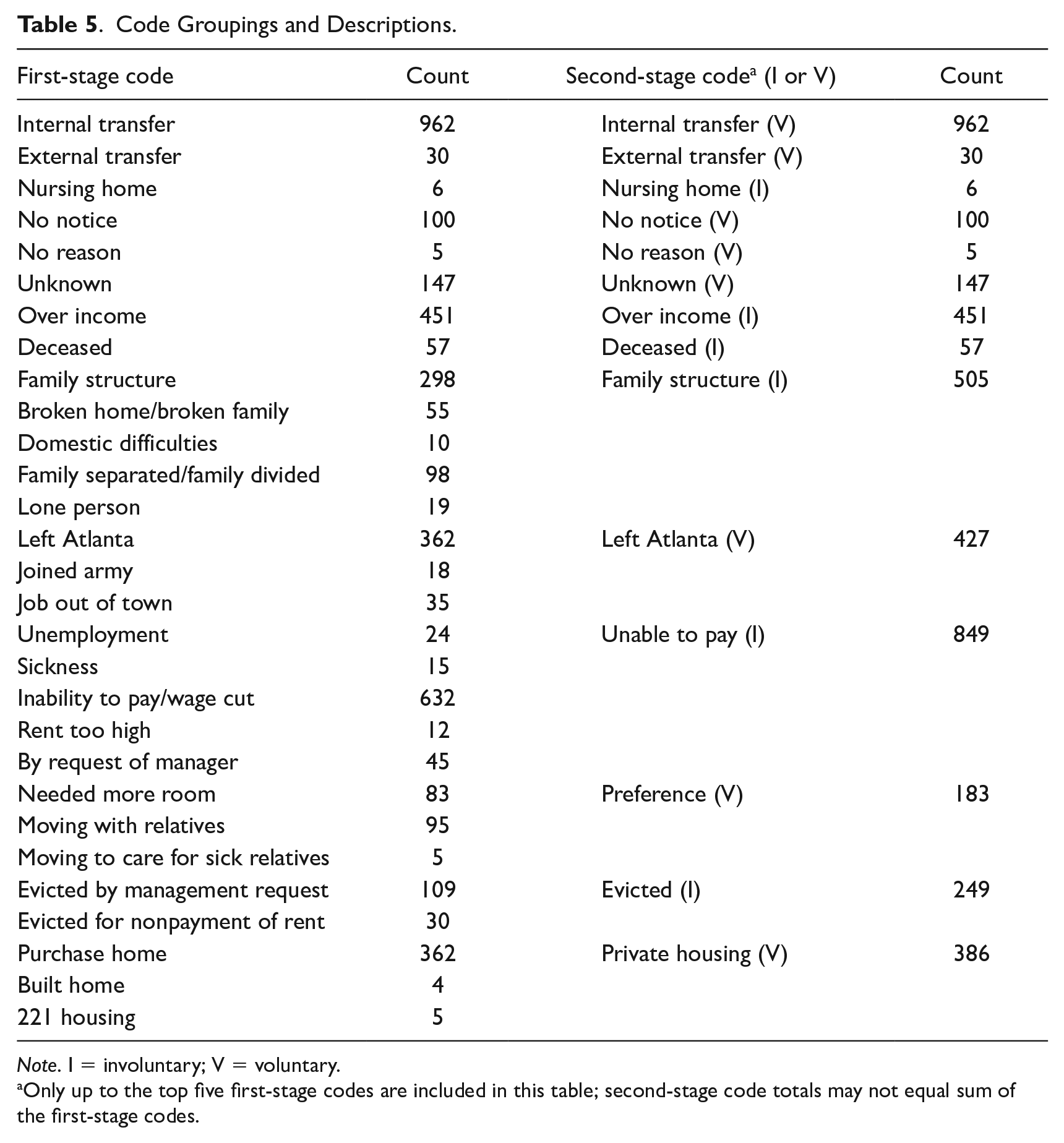
Note. I = involuntary; V = voluntary.
Only up to the top five first-stage codes are included in this table; second-stage code totals may not equal sum of the first-stage codes.
These notations suggest that housing managers had some measure of control over the categorization of tenants. In our analyses of the records, the distinctions made between individual behavioral actions versus other household dynamics infer a particular subjective perception of how public housing residents live. The case of evictions further underscores our argument.
There is a temporality to eviction—it is an official mark, perhaps triggering a series of lawsuits, court dates, warrants, and carceral contact, something reflective of a financial hardship or violation of lease terms, but something to repay, repair, and restore. Family structure, a category outside of eviction, suggests something more permanent. The remarks “broken home” and “family composition” are categorically distinct from “unable to pay rent.” A broken home and family composition are moral valuations made by paternalistic housing managers reflecting a spirit of uplift politics (Ferguson 2002) while reifying a particular notion of the nuclear family (Fritz 2010). Furthermore, they were reasons to exclude and evict someone, permanently, from the nuclear-centric public housing definition of “household” (Fritz 2010). Figure 2 shows the total counts for each second-stage move code for all households in the development, across 10 different moving periods. Each move represents a different duration of time, ranging from three weeks to 37 years. The figure not only demonstrates that involuntary moves (such as unable to pay, family structure, and over income) represented a significant proportion of all moves, but also how stable these involuntary move counts were over the duration of the available administrative data (regardless of the housing manager).
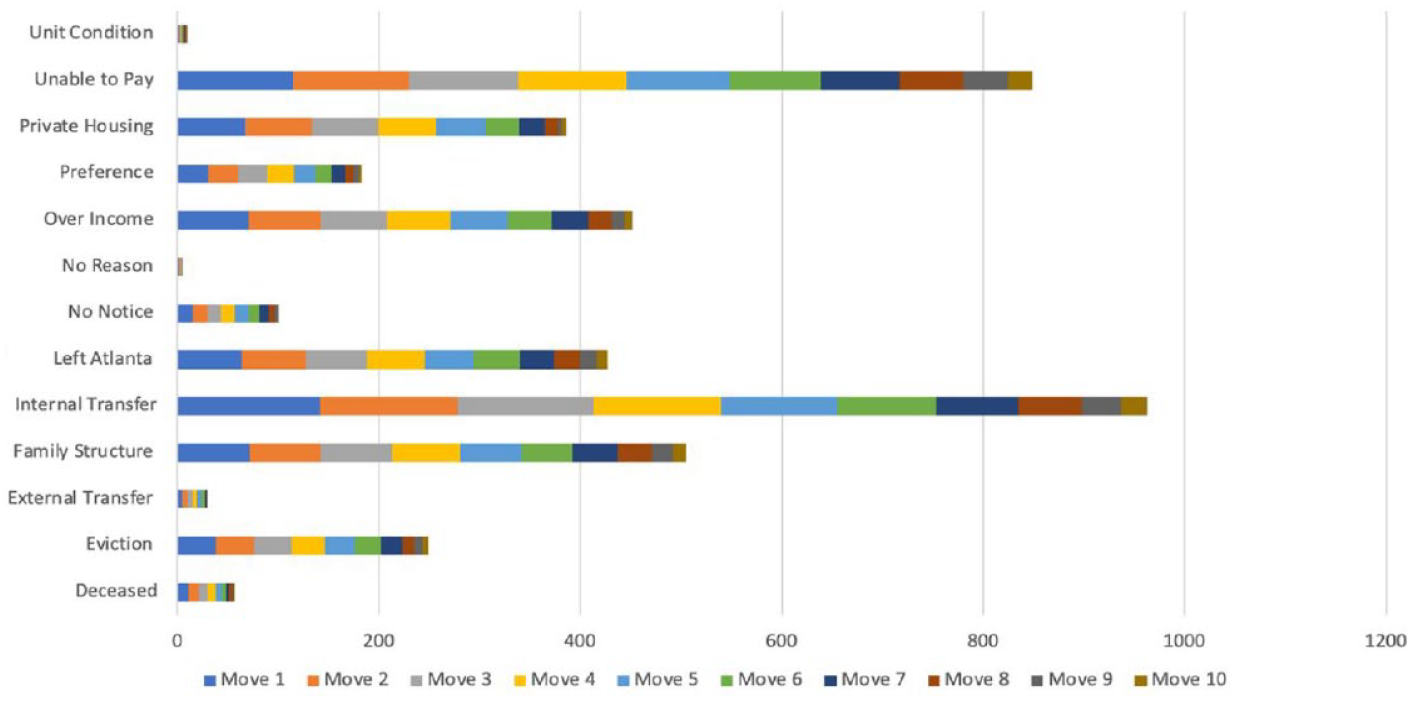
Count of reasons to move in University Homes, 1937–1975.
Through our analyses, we find that many public housing residents had many internal moves within public housing developments. Contrary to contemporary managerial practices, as families grew, housing managers offered internal transfers that allowed households to stay within their developments, and subsequently their local communities. Public housing provided housing options internally for families as they underwent changes in their family structure and economic statuses while external markets produced an exclusionary housing system.
The first-stage code “unable to pay rent” is grouped under eviction, but it is important to note here the parenthetical remark to the remark “(BMR).” BMR is an acronym for “by management request,” which suggests that an eviction occurred by management’s request perhaps after management observed the tenant’s ability to pay rent. Of all the notations of unable to pay rent, 5 percent are by management request. Not having a parenthetical addendum means the head of household—on his own volition—informed the housing manager of his inability to pay. Again, these notations transform public housing tenants into moral and political subjects through these constructed categorizations of mobility.
The second-stage code “family structure” is also categorically distinct from a change in the household membership. Internal transfers for more room (e.g., the birth of a new child) were coded as “transfer—needed more room” in the remarks. This voluntary adjustment to the family structure, an improvement, as it were, was met with categorical neutrality. “Husband died” or “Deceased (head of household)” are also changes to the family structure, and the “widow” category, constructed during the Elizabeth Poor Laws of 1601 (Katz 2013), was another neutral, if not unfortunate, change in family structure. Birth and death, it seems, are the only voluntary and acceptable means to change one’s family structure. And these trends varied across housing managers.
Table 6 compares the six housing managers of University Homes from 1937 to 1975, and the frequency with which they oversaw voluntary and involuntary moves in the development. The first housing manager, Alonzo Moron, oversaw 83 percent of the moves during his seven-year tenure, and had the highest proportion of involuntary moves across all housing managers. This speaks to not only the rapid changes of early public housing programs and developments, but also aligns with the focus on the moral judgments of family structure articulated by Du Bois’ graduate students in 1934.
Involuntary and Voluntary Reasons as Noted by Housing Manager, 1937–1975.
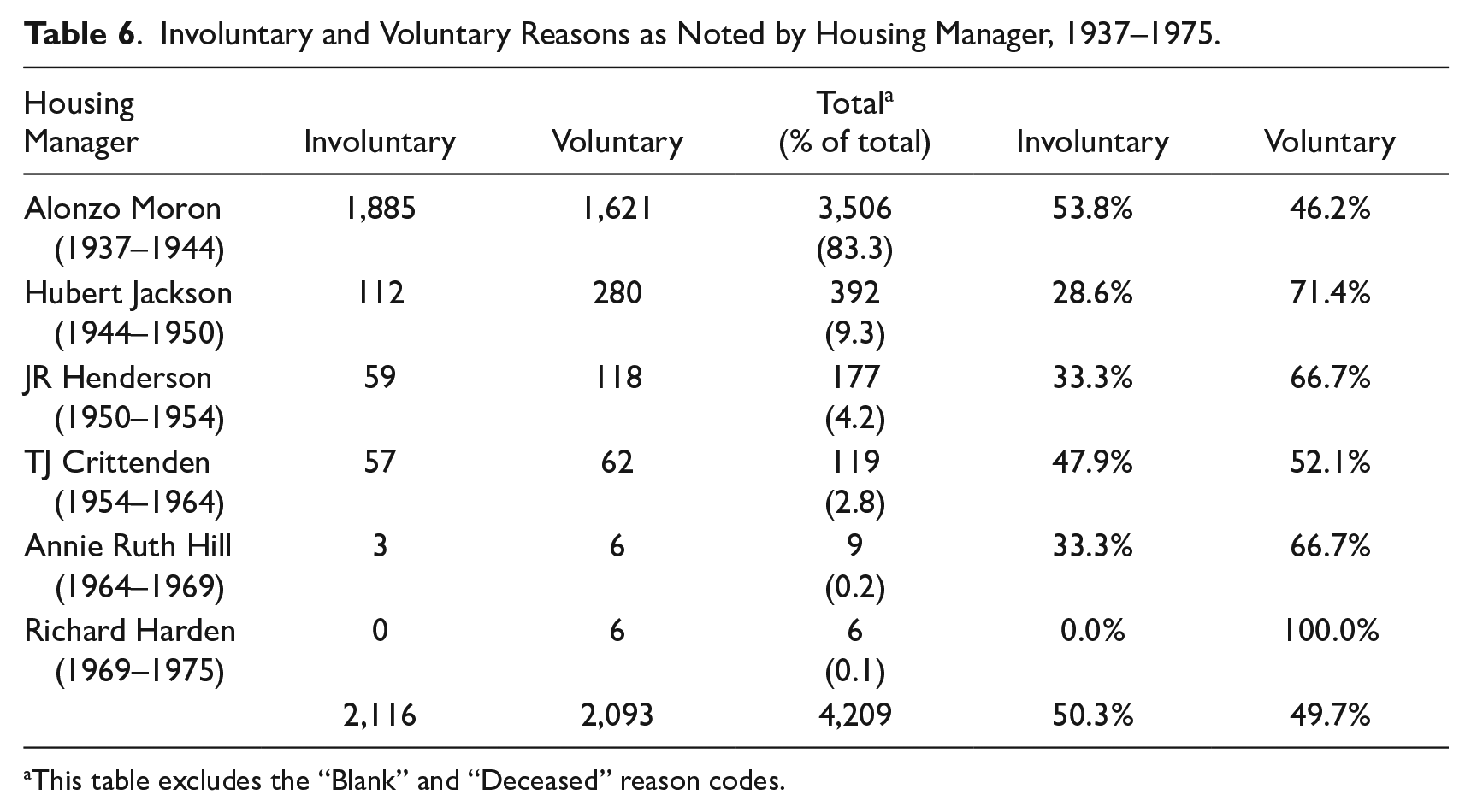
This table excludes the “Blank” and “Deceased” reason codes.
Historical documents from the Atlanta Housing archives and local newspapers provide evidence of the role of manager discretion in enforcing public housing policies that sought to push out Black households failing to conform to the moralistic standards and normative definitions of families. From a historic preservation application for University Homes submitted in 1991, one longtime resident noted the following about Moron and early tenant selection standards: A great deal of care was given to the selection of residents, and Moron undoubtedly played an important role in the process. Lula Daughtery [a resident at the time, interviewed for a documentary Living Atlanta] recounts how “when you put in your application, they screened you.” She continues: I mean, you know, they found out your reputation, how you paid your rent, and what kind of neighbor you had been, and all such as that. And then they sent somebody out to interview you and see what kind of housekeeper you are—what they don’t do now [in the 1970s]. Even you had to tell them what church you belonged to. And when they done that, then if you had a good reference, you moved in. (Horak 1991:13)
The focus on housekeeping persisted with annual home inspections that also shaped one’s ability to remain at University Homes. The application notes: It was common knowledge that if you didn’t clean your unit for the regular inspections, you risked being moved out. As one resident from the surrounding neighborhood recalled, “I don’t know how they graded you—if they found you insufficient, then you went to Perry Homes [a larger complex located in Northwest Atlanta constructed in 1955, to primarily house residents who were displaced during the city’s Urban Renewal program]. And, you could tell when that [an inspection] was about to happen because the people were out washing windows . . . going the whole nine yards.” (Horak 1991:16)
These inspections and the strong, discretionary role of the housing manager in Black public housing tenant mobility continued through the 1960s. It also suggests a hierarchy in the developments: as the quote above suggests, an external transfer to a development designated for rehousing those displaced by postwar slum clearance projects was a punishment for violating the norms established in the prewar public housing developments. From a 1968 newspaper article titled “Shall the tenant voice be heard?,” a former assistant housing manager for Atlanta Housing commented: Mr. Hines says that during his tenure as an assistant housing manager he saw tenants treated with a lack of respect, forced to wade through needless red tape . . . stripped of their privacy and dignity . . . The former assistant manager claims also to have witnessed favoritism in the placements of tenants with important connections. Managers had an “unwritten rule” that they may make surprise inspections of tenant’s apartments at any time. (Garner 1968)
Yet, by the 1970s, these policies had changed, and the threat (and frequency) of evictions and external transfers declined: Many attributed the changes to a heightened awareness of civil rights. As with most new movements, the pendulum would swing far to one side before finding an equilibrium. New laws were forcing the Atlanta Housing Authority officials to walk a thin, poorly-defined line trying to determine what were legitimate inspections and refusals of occupancy, and what were violations of an individual’s rights to privacy and to live in publicly-funded housing. At the same time, funding for public housing and maintenance projects was progressively cut back. Perhaps it was easier to open the doors of the projects [public housing developments] to all and forego the inspections rather than face potential discrimination suits. (Horak 1991:17)
Admissions policies in early public housing developments focused on selecting the most socioeconomically mobile households in the worst quality of housing to live in the new housing experiment. These admissions policies, which were often accompanied by home visits and employment checks to verify housing conditions, household management, and income, were codified into leases as standards for continued occupancy, falling broadly under the ways in which a tenant’s lease could be terminated (Atlanta Housing Authority 1940). Admission, continued occupancy, and termination were thus linked to a set of moral and socioeconomic characteristics that were often unrelated to the spirit of the Housing Acts that guided public housing policy: the provision of safe and sanitary housing for all families that meet the income minimum and maximum set by the housing authorities for their jurisdictions.
These admissions, continued occupancy, and termination policies were administered at the discretion of the housing manager, tenant selection staff, and other housing administrators. Households with income over the stated maximum were the only reason to evict according to federal policy and regulation (Toohey 1967). Although these were decisions made with individual discretions—and thus, subjectivities—the outcomes were fairly homogenous given the limited national trainings and guidance provided by housing managers in Washington, Atlanta, Cleveland, and other pilot cities for public housing. Housing managers and local public housing authorities exchanged letters, published newsletters, met at national public housing conferences, and attended classes in Atlanta (the Atlanta School of Social Work Housing Manager Program) for Black administrators and Berkeley (Catherine Bauer’s Housing Program) for Whites (Moron 1938; Palmer 1940).
Local public housing authorities hired “Tenant Selection” managers and workers who were tasked with doing the home visits and employer verifications for the individual public housing developments. The idea that tenants—both Black and White—would apply, and were then “selected” into an exclusionary, means-tested, and segregated public housing program would shift in the 1960s with the passage of the Fair Housing Act and the formation of “Tenant Application” offices. These integrated offices were tasked with managing application pools and waitlists for an increasingly Black and working-poor tenant population (Atlanta Housing Authority 1970).
The guidance for early public housing managers around tenant selection, leasing, and evictions is summarized in a 1935 memorandum to the University Homes advisory committee titled “Suggestions for a Training Course in Housing Management” (Hope 1935). One aspect of the training course to guide housing managers in tenant relations is outlined in the course goals: Selection of tenants—information needed and determining considerations; methods of rent collection, including the system developed by Octavia Hill; policy toward delinquent payments; tenants’ pride in the development as a factor in low rentals; policy toward families that do not fit into the neighborhood life; community activities, with emphasis on methods of encouraging the initiative of tenants . . . This course should emphasize the need for intelligence and variety in tenant relationships rather than attempt to lay down invariable rules.
The course description highlights not only the moral underpinnings of tenant selection, leasing, and eviction, but also the high level of discretionary power afforded to housing managers in these responsibilities. The memo also suggests readings to accompany the course, drawing from both the emerging housing policy literature (from Catherine Bauer and Edith Elmer Wood) and the Chicago School of Sociology. From the latter, course designers preferred to teach future housing managers about differences between racial and ethnic groups (“standards and habits of living of different racial and nationality groups; particular problems of racial and nationality groups”) with less emphasis on differences within these groups (Hope 1935).
The 1960s created new pressures in public housing as urban poverty rates increased and admission policies changed. The 1949 and 1954 Housing Acts required public housing authorities to prioritize rehousing the occupants of the demolished properties for urban redevelopment and renewal projects (Goetz 2013). Within a decade, the 1969 Brooke Amendment would cap public housing rents at 25 percent of tenant income, which led to increasing inequality between rents for residents with longer tenure and more stringent admission standards and more recent tenants who were displaced by urban redevelopment policies (Vale 2000). In University Homes, more affluent households would see their rents increase from $15 per month for a three-bedroom unit to almost $60 per month. Nonetheless, this measure tightened housing authority budgets, which were already facing decreasing contributions from federal and local governments, while overseeing an increasing proportion of residents with lower or unstable incomes.
The 1968 Fair Housing Act allowed many higher income residents to leave public housing, as new opportunities arose to legally obtain private homeownership or rentals. The history of homeownership, mortgage lending, and property devaluation reflects class dominance over land through racialized structures (Dantzler 2021; Goetz et al. 2020; Trounstine 2018). Homeownership served as an ideology and social practice of the reproduction of hegemony in the United States (Dantzler 2018; Ivanova 2011). As a modality of racial capitalism (Dantzler 2021), homeownership facilitated differential access to capital. To attract more affluent households (or get rid of the least profitable households), housing managers began evicting tenants at an increasing frequency for behavioral reasons instead of income, or failure to pay.
Lawsuits in response to the draconian eviction and lease policies in public housing were often originated by Black women tenants. These women frequently partnered with legal aid, community legal services, and university law clinics to pursue a new legacy of tenant activism and tenant rights. Many women activists accused housing managers and the housing authority of retaliating against their activism by creating eviction policies discouraging rent strikes, direct-action protests, and acts of civil disobedience (Landlord and Tenant. Eviction. 1969). These punitive policies continue in contemporary public housing developments; Atlanta activists who protested demolitions were often targeted with new federal policies that expanded eviction categories to include households where any member had been arrested (infamously known as the “one-strike” laws (Burke 2008; Castle 2003; Cohen 2009; Webster 2005). The language of early public housing policy demonstrates the discretion, subjectivity, and often heteronormative patriarchal norms forced down on the inaugural public housing tenant population of the 1930s and 1940s (Fritz 2010).
Discussion
How can we think about Black housing mobility more comprehensively? According to the data, most of the voluntary movements were internal—requests for more room, or an otherwise change in family composition—or the need to leave public housing to live with relatives. MWR—moving with relatives—appeared over 100 times in the data, and the interpretation varies widely. Of all moves coded as a “preference” (which were 9 percent of all voluntary moves), 60 percent gave the reason of “moving with relatives.” Several moved with relatives as caretakers—an ill mother or father. Others moved to perhaps adjust to external labor market shocks, such as depressed wages or seasonal layoffs. Others still moved to adjust to changing family structure, as one manager notes. In line with previous literature (i.e., Hardaway and McLoyd 2009; Mouzon et al. 2019; G. Wilson and Roscigno 2010), the degree to which internal and external forces shape individual, household, and population mobility differs for White and Black Americans.
What we take from these premature evictions from public housing and voluntary leaves to move with relatives is that the emphasis on a heterosexual, male-led “nuclear family,” as required by early public housing managers/policymakers, stymied Black housing mobility. As households shifted to adapt to their needs, survival strategies, and extrafamilial networks and arrangements, public housing managers used their discretion to evict families who otherwise would have qualified for this benefit. We find evidence to support our argument around the heteronormative shift within public housing management. A critical analysis of the records illustrates that not only were residents’ claims to quality being undermined, but access to affordable homes was constrained: the rationales for their departures were largely a function of the lack of internal support for their changing family needs while enduring managerial changes that shifted from admitting and evicting based on income, need, and affordable housing access to admitting and evicting based on income, need, and behavior. These premature evictions of nonheteronormative families, particularly those who would have preferred living with other wage-earning relatives, could also have contributed to the overall decline in operating revenues for individual developments, leading to their substandard conditions and budget crises in the 1970s.
The emphasis on behavior as a condition of ongoing residency has limited public housing’s ability to enhance the mobility of the program’s participants. And these shifts are reflected in the historical and contemporary politics of and programs available to public housing residents (Dantzler and Rivera 2021; Lee 2015). Early Black tenant associations created political education programs and cooperatives and advocated for improved school facilities to improve the communities surrounding the segregated developments (Rodriguez 2021). If Black tenants were precluded from gaining mobility into middle-class neighborhoods due to private and public discrimination, they would mobilize to create better neighborhoods where they were (Rodriguez 2021). Tenant organizing shifted since the opening-up of opportunities in the housing market for Black households. Rather than focusing on improving neighborhood, education, and economic conditions for residents, public housing tenant associations, policymakers, and administrators focus public resources on addressing and enforcing patriarchical behaviors, antideviance, and anticriminality policies (Ndubuizu 2021; Rodriguez 2021).
Our findings on the actions of public housing administrators provide nuance to the constraints on Black economic mobility. However, similar to Du Bois’ (1899) approach, incorporating a focus on the local political economy under which Atlanta’s Black public housing residents were living provides a more expansive picture of Black urbanity. The loss of middle-class families and the increasing precarity for the remaining households created a political opportunity to demonize and defund the brick-and-mortar public housing program. Nixon’s 1974 moratorium on public housing construction and Section 8 of the 1974 Housing and Community Development Act created a new form of subsidized housing that allowed families to take a government voucher into the private rental housing market (Goetz 2013). At the same time, the once robust and diverse coalition that initially supported public housing for White, male-led, working-class families had long disintegrated, and few new advocates for the remaining public housing population emerged (Rodriguez 2021). The public housing program, once a physical and ideological site of class mobility, transformed into a mobility program that literally lifted families out of these sites of publicly-owned concentrated poverty into privately-owned ones (DeFilippis and Wyly 2008).
Presently, public housing eviction due to family behavior such as arrests—not convictions—is a primary means of clearing out undesirable or politically active tenants who organize against demolition or privatization of public housing developments. The Atlanta Housing Authority, beginning in the 1970s, set managerial priorities to “evict undesirables,” and has since codified policy around deviant behaviors and survival strategies that can trace their origins to the respectability politics practiced by early housing managers (Bullard, n.d.). By failing to serve the most vulnerable households, or more specifically, the failure to incorporate what makes these households vulnerable into public housing policy and programming, U.S. public housing policy is objectively failing at meeting its original purpose from 1937: “the provision of safe and sanitary housing for families in need.”
Conclusion
This article sought to understand the internal and external political economic forces shaping Atlanta’s Black public housing tenants’ mobility. The public housing program was designed as a stepping-stone into upward socioeconomic mobility when the first developments were constructed for White and Black households in the 1930s. It demonstrates how housing managers and their remarks shaped eviction rates—and by default, public housing’s ability to advance Black tenant mobility—through elite housing managers’ perceptions of impoverished Black families. While the article adds a more nuanced understanding of factors shaping the trajectory of public housing and its residents, it is not without its limitations.
For example, future scholars should extend this methodological approach to other housing authorities and other contexts. The focus on the City of Atlanta, a city with a long history within urban studies, has illuminated the rise and evolution of racial politics and urban political regimes (e.g., Bayor 1996; Keating 2001; Rodriguez 2021; Stone 1989). However, Atlanta may not be emblematic of other urban areas. In addition, due to data limitations, we were only able to control for internal moves. Future research should explore the trajectories of residents under different regulatory environments across different housing tenures to fully understand the extralegal and socioeconomic nature of mobility. While our article focuses on the Atlanta Housing Authority, further research should look at particular actors and institutions in shaping external public housing policy and internal administrative practices. Such work would necessitate further engagement with local archives where additional data sources may be available in an effort to “rehistoricize the city” (Vargas 2022). This also allows for a more critical understanding of the institutional context and policy environment in which people and places are embedded (Heslinga et al. 2018).
It’s been over a century since Du Bois conducted his study of Philadelphia’s Seventh Ward and many of the needs of Black urban denizens are the same. Affordable housing, a fair living wage, public safety, good schools, and healthy environments for families and kids are common American values. However, for many Black people, these needs have carried across families for generations. While it was, and arguably continues to be, common to frame Black (im)mobility as a function of human capital arguments, such approaches further a long tradition within urban sociology to frame Black people, places, and communities as “inferior” or the result of cultural pathologies (see Dantzler et al. 2022; Korver-Glenn, Prentiss, and Howell 2021). Many policy reforms or poverty alleviation strategies (i.e., opportunity neighborhoods, housing vouchers, and mixed-income communities) thus reify earlier conceptions of racial stratification through contemporary political ideologies.
In thinking through their political position, Du Bois’ (1899) argued, “The growth of a higher political morality among Negroes is today hindered by their paradoxical position” (p. 383). A rereading of history reveals the trajectory of Atlanta’s Black public housing residents as the result of internal and external political economy shifts, not individual cultural behaviors. Housing does not exist in untethered space; rather, it is the result of political, economic, and cultural choices. As such, future studies in urban inequality and racial stratification should go beyond simply comparing individuals and neighborhoods and toward a critical focus on political economy, racialization, genderization, and other urban processes.
