




Abstract
This paper explores the contested relationship between migration and income inequality, using labour migration to Norway as a case. The enlargements of the European Union starting in 2004 were followed by an unprecedented increase in labour migration to Norway. In particular, many rural regions, previously unfamiliar with immigration, have experienced a large influx of labour migrants. In the same period, income inequality has increased. This paper uses register data on the municipality level from 2005–2016 to discuss (a) the direction of the relationship between labour migration and income inequality; (b) the degree to which labour migration affects inequality (in general and within the native population) compared to other immigrant groups; and (c) whether the effects are different in rural and urban municipalities. Findings show that labour migration from the ‘new’ European Union countries is followed by higher income inequality in Norway. No support is found for the reversed causal relationship that increasing inequality causes higher numbers of labour migrants. The effect of labour migration on overall inequality is considerable, but not as strong as the effect of refugees. However, as opposed to refugees, labour migration also affects income inequality within the native population, but this effect is only significant in rural areas.
Introduction
The European Union (EU) enlargements to the east starting in 2004 were followed by an unprecedented increase in labour migration to Norway. According to register data from Statistics Norway, 180,000 labour migrants were settled in Norway in 2016, compared to 8500 in 2000. Labour migrants have also settled in every municipality in Norway. Thus, many rural regions in Norway, previously unfamiliar with migration, have seen a large influx of migrants (Høydahl, 2013). The EU enlargement to the east, and the migration that followed, represents a shift, not only in the history of immigration to Norway, but in the Norwegian labour market as well. Employers suddenly gained access to a large reservoir of labourers who came from countries with wages that were considerably lower than the Norwegian wages. Worries regarding low-wage competition and increasing social inequality that could possibly be a threat to the Norwegian work-life regime and welfare state soon surfaced (Friberg, 2016; Norges offentlige utredninger, 2011: 7). Still, too little research exists on how this labour migrant influx has affected social inequality.
Norway, along with the other Nordic countries, has enjoyed relatively low levels of income inequality for many decades. However, income inequality is increasing in the Nordic countries (Egholt Søgaard et al., 2018). In Norway, there has been a sharp increase in recent years. Since 2009, the difference in income between the 90th and 10th percentile (P90/P10) has increased every year, from 2.6 to over 2.8 in 2015, which is the largest number ever measured with P90/P10 in Norway (Telle et al., 2017). In Norway, there is a broad political consensus that small income differences are desired and increasing income inequality is considered problematic. Not only left-wing parties, but also the current right-wing government (Finansdepartementet, 2019) claim that low inequality unites people and is important to uphold high levels of trust. Equality and high levels of social trust characterize the Nordic countries (Rothstein and Stolle, 2003), and are a key to understanding the Nordic model (Bungum et al., 2015).
The sudden influx of labour migrants and the increasing inequality make Norway a particularly interesting case for this paper’s objective, which is to study the connection between labour migration and income inequality. Income, in this case, includes employment income, capital income and taxed and tax-free transfers. Further, the availability of high-quality register data on the municipality level provides the opportunity to examine this connection in different geographical areas, particularly rural areas, which have been less explored as immigration to Western countries historically has been an urban phenomenon.
Although little previous research exists on the Norwegian case, there is a large body of literature discussing the connection between migration and income inequality. Most research in the field is carried out in the United States and might have limited transfer value to the Norwegian context. Further, there are large disagreements within this field, concerning both the direction of the causal relationship between migration and income inequality (Hyde et al., 2015) and the degree to which migration affects income inequality (Borjas, 1999; Card, 2009).
In addition to these important questions, other knowledge gaps remain. First, while there are a large number of studies on how immigrants in general (Hyde et al., 2015), low-skilled/high-skilled immigrants (Xu et al., 2016) or non-western migrants/refugees (Foged and Peri, 2016) affect wages or income inequality, the large labour migrant influx after the EU enlargement has received less attention. The fact that Norwegian register data distinguish between different reasons for migration – such as work, refuge, family and education – provides an opportunity to study particularly labour migrants and compare them with different immigrant groups. Second, little research exists on the effect of migration on inequality in different local labour markets, such as urban and rural ones (for an exception, see McLaughlin, 2002). While most studies assume that the variables affecting income inequality do so uniformly throughout different local economies, I ask whether the effect of immigration on inequality is different in (typically small) rural and (large, diverse) urban labour markets.
To address these knowledge gaps, this paper explores the connection between labour migration and income inequality in Norwegian rural and urban municipalities after the EU enlargement, using register data 2005 to 2016. First, advanced structural equation modelling is utilised to explore the direction of the relationship between labour migration and income inequality. Second, fixed effects regression is used to study the degree to which labour migration (compared to other types of migration) has led to increased income inequality (in general and within the native population) in rural and urban Norway.
The Norwegian case
Norway is an interesting case for at least two reasons. First, although migration is not a new phenomenon in Norway, the country was, at the turn of the millennium, relatively homogeneous, with an immigrant population of 5% (a third of them living in Oslo), according to data from Statistics Norway. In the following years, and especially after the EU enlargement in 2004, Norway experienced an unprecedented increase in immigration. By 2016, the immigrant population had increased to 13.4% and Poles were now the largest immigrant group. The spatial distribution of immigrants has also changed, as many immigrants, and especially labour migrants, have settled in the rural areas of Norway.
Second, Norway (which has a lot in common with the other Nordic states) has a set of structural characteristics that makes it somewhat different from other western countries. The small, open economies of the Nordic countries are characterised by a large welfare state, with universal benefits and free education and health care. The work-life regime is highly organised and is characterised by strong unions, collective agreements, strong statutory labour rights and a high degree of involvement of workers. Generally, the Nordic model is known for its ability to combine efficiency and equality (Bungum et al., 2015). However, Norway and the other Nordic countries have no national minimum wage, and wage is for most people determined through collective agreements. For this reason researchers pointed out early on that the Norwegian labour market is particularly vulnerable to low-wage competition (Friberg, 2016). To prevent social dumping and low-wage competition after the EU enlargement, many collective agreements were extended to entire industries (such as construction, agriculture, fishing and cleaning), securing a minimum wage for all workers in those industries. Bjørnstad (2015) studied the effects of extension of collective agreements and concludes that the agreements have slowed down the wage-reducing effect of labour migration, secured a minimum wage for most workers and thus (partly) worked according to their intentions. However, wage polarisation has continued to increase in the studied industries, and Bjørnstad (2015) claims that labour migration has contributed to changing the income distribution between capital and labour.
Immigration and inequality – Theoretical perspectives and previous research
According to Hyde et al. (2015), the literature discussing the relationship between inequality and immigration can roughly be divided into two camps. Supply-side perspectives argue that increasing immigration drives up income inequality (Borjas, 1999; Card, 2009), while demand-side perspectives argue that increased inequality is the result of economic restructuring, which in turn attracts higher numbers of immigrants (Piore, 1979; Sassen, 2001). The two perspectives do not necessarily stand in contrast to each other, as it is possible that structural changes in the labour market create more inequality and attract larger numbers of migrants, which in turn creates larger inequality. Hyde et al. (2015) find support for this and label it the reciprocal effect hypothesis. These theoretical contributions, and particularly demand-side perspectives, are developed in a US context, and their relevance for Norway will be discussed below.
Demand-side perspectives
This perspective argues that the US economy has gone through large changes in the last 40 years, resulting in a larger low-wage sector, the disappearing of middle-income jobs, expansion of managerial and professional jobs and overall polarisation of the wage structure (Hyde et al., 2015; Kalleberg, 2011). This creates demand for migrants to fill low-skilled, but also high-skilled, jobs.
In this perspective it is inequality (caused by economic restructuring) that causes higher numbers of migrants. Hyde et al. (2015) formulate the following chain of causation: ‘…employers first create the degraded job structures, then discover that native workers are unwilling to accept such deplorable conditions of work, and then turn to foreign-born workers as a readily available alternative’ (Hyde et al., 2015: 83).
Dual labour market theory is relevant within this perspective. The theory has been central to the sociological understanding of the causes of migration and the migrants’ role in the destination countries’ labour market. According to Piore (1979), migration is caused by structural demand for labour in industrial societies. He argues that the labour market has become increasingly divided into a primary and secondary sector. In contrast to the secure and often high-paying jobs in the primary sector, the jobs in the secondary sector are unsecure, often low-paying and require little skill. Native workers are often unwilling to accept jobs in the secondary labour market, not just because of low income, as conventional economic theory would suggest, but because they signify or confer low status. For temporary migrants, however, their social status is located in their home community. The work they perform in the receiving country is only a way to earn money to be spent in the home country (Piore, 1979). Labour migrants thus have a dual frame of reference (Waldinger and Lichter, 2003), comparing the income in the receiving country with what they would have made in their home country, also known as ‘the status paradox of migration’ (Nieswand, 2011). Labour migrants can thus be satisfied with wages and working conditions that natives never would accept and are therefore regarded in receiving countries as perfect labourers for the secondary sector.
Dual labour market theory thus argues that the changing structure of the labour market creates inequality, while migrants simply respond to increasing demand. A more recent contribution within this perspective, studying the labour markets of New York, London and Tokyo, similarly argues that it is the economy, rather than the immigrants, which is producing low-wage jobs (Sassen, 2001). However, I argue that ‘supply-side arguments’ are also found within this literature. For instance, it is argued that a large presence of migrant workers will reinforce the undesirability of the jobs in the secondary sector for the native labour force, which in turn enables employers to drive down wage and working conditions even more (King, 2012).
Findings from Norwegian research on labour migration after the EU enlargement are certainly interesting in light of segmented labour market theory. Several studies find that labour migrants are concentrated in the lower segments of the labour market (such as construction, industry, hotel, transport, agriculture and cleaning) and have limited opportunities for upward mobility and a high degree of temporary and unsecure employment (Bjørnstad, 2015; Friberg, 2016; Friberg and Eldring, 2011; Rye, 2007). Studies within these industries show that employers consider certain ethnic groups more suited for manual labour than others (Friberg and Midtbøen, 2018). Eastern European labour migrants in Norway do to a large degree fit Piore’s (1979) description of migrants in the secondary sector. However, the question of cause and effect is something different. In the Norwegian case, was the ‘degraded job structure’ created first and migrants recruited second? While Hyde et al. (2015) argue that the US for several decades has seen a hollowing of the middle-class and increasing polarisation, similar trends are perhaps not fit to describe the Nordic countries, which, according to several studies, have a lower risk of polarisation of employment structure (Gallie, 2007; Mustosmäki et al., 2017).
Supply-side perspectives
There are mainly two routes through which immigration can affect income inequality. First, the income of immigrants themselves can affect inequality, if immigrants have a different income dispersion or a different average income than natives. Card (2009) argues that because immigrants are often clustered at the high and low ends of the education distribution and tend to have higher residual inequality than natives, wage inequality over all workers in the economy is higher than it would be in the absence of immigration.
In Norway, Telle et al. (2017) finds that the immigrant population has a higher level of income inequality than the remaining population, and since the immigrant population is increasing, this can explain some of the increase in income inequality in the last years. Research on labour migrants’ income reveals large differences between labour migrants from eastern and western Europe (Epland and Kirkeberg, 2014). After seven years in Norway, Polish migrants’ median income is around 80% of natives’ income, while British migrants’ median income is 17% higher.
The second, and more debated, route through which immigration can affect income inequality has to do with how immigration can affect the level or dispersion of natives’ income (Blau and Kahn, 2012). Briefly summarised, the theoretical argument is that immigration increases the supply of labour too fast and affects competition among groups in the labour market, thereby supressing wages. Kalleberg (2011) argues that the impact of immigration on native workers is complex and partly depends on whether immigrants are substitutes for or complements to native workers. While substitution might lead to downward pressure on wages, complementation might create jobs for native workers.
Norwegian sociologist Ottar Brox (2005) argues that labour migration will ultimately lead to weakened market power for the working class and the emergence of a new lower class of ‘working poor’. Briefly summarised, his argument is that one of the most important causes of social equality in Norway after World War 2 was a lack of labour reserves, or (almost) full employment. This gave the working-class power to demand higher wages and good working conditions. The European Economic Area (EEA) agreement and the free flow of labour between member countries ensures that full employment will never be the case, as a reserve army of labour migrants is always available. The lower classes that compete with the labour migrants have therefore lost their market power. Consequently, social inequality will increase.
Results from empirical investigation vary greatly. In the US, Card (2009) argues that immigration has not had much effect on native wage inequality. Others argue that an influx of low-skilled migrants lowers earning of low-educated natives while improving earnings for college graduates (Borjas, 1990; Borjas and Katz, 2005). Similarly, Dustmann et al. (2013) find that in the UK, immigration depresses wages in the bottom 20th percentile, but leads to a small increase in wages in the upper part of the distribution. However, in a review of research from several OECD countries, Blau and Kahn (2012) conclude that while some studies do find important effects, most studies do not find important effects of immigration on native wage distribution.
In Norway, the findings are also somewhat mixed. Bratsberg and Raaum (2012) studied the construction industry and found that professions with high labour migration experience significantly lower growth in wages. They also found that labour migration increases the probability of low-skilled natives leaving the workforce. Bratsberg et al. (2014), however, found that migration from low-income countries affects the income and employment of immigrants already in Norway, but has less effect on natives. More recently, Hoen et al. (2018) found that immigration from low-income countries has steepened the social gradient in natives’ labour-market outcomes. While exposure to immigration from low-income countries lowers wages and employment for lower-class natives, it affects high-class natives by raising their expected earnings. Immigration from high-income countries has the opposite effect, and thus levels the social gradient (Hoen et al., 2018).
Spatial differences
There are several reasons to believe that the relationship between labour migration and income inequality might be different in rural and urban societies. Rural labour markets tend to be smaller and less diverse than urban labour markets. One or two industrial sectors, and perhaps only a few large employers, often dominate rural labour markets. Any large changes faced by these industries could have substantial implications for the local economy (McLaughlin, 2002).
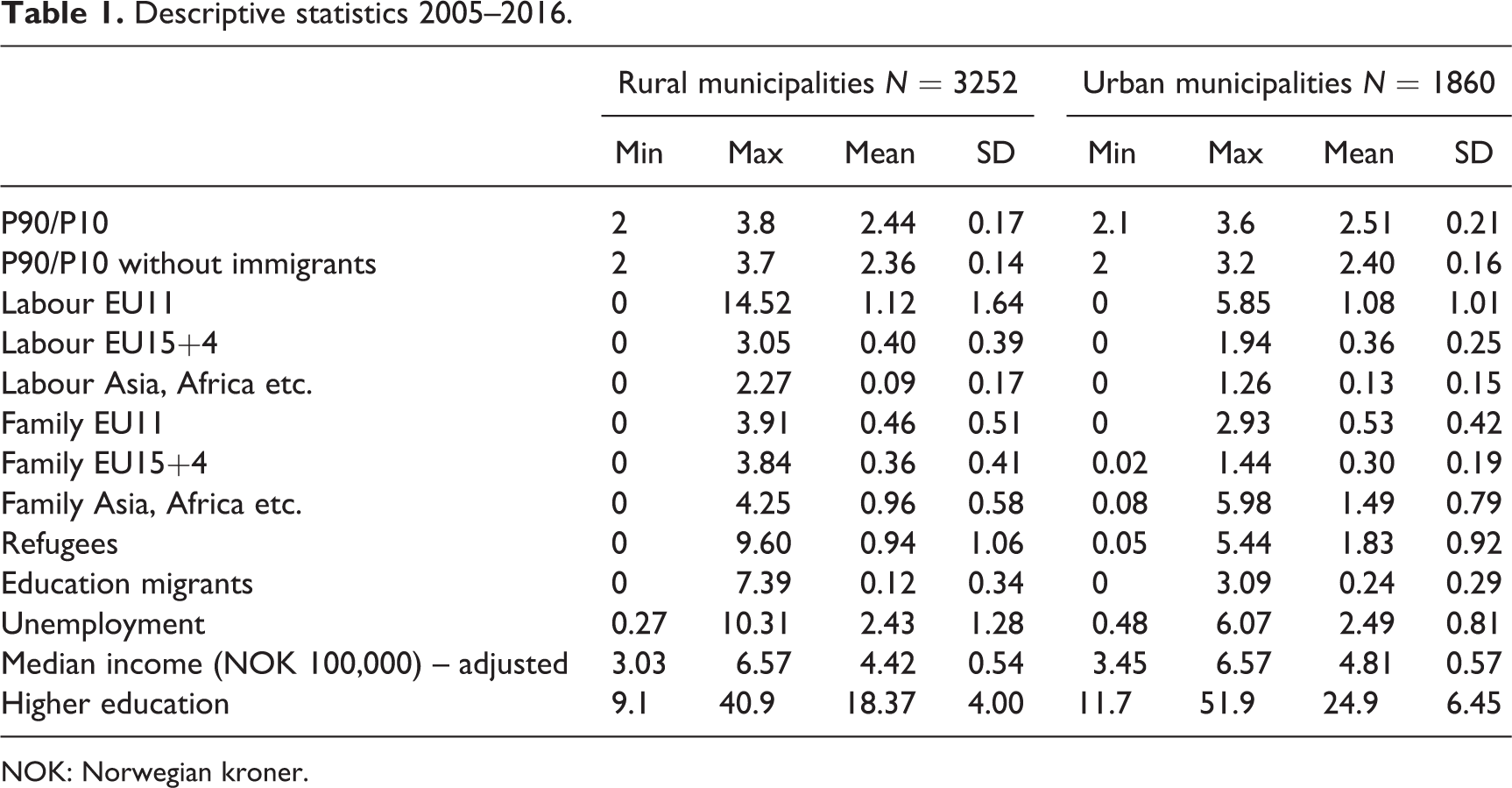
Further, Kalleberg (2011) argues that immigrants are likely to have more negative effects on natives in local labour markets with large numbers of unskilled native workers. Rural municipalities tend to have a higher proportion of unskilled or low-skilled workers than urban municipalities. The descriptive statistics presented in Table 1 below show large differences in the proportion with higher education in rural and urban municipalities. Thus, there is potentially a larger proportion of the rural workers that are competing with immigrants in low-skilled industries.
Descriptive statistics 2005–2016.
NOK: Norwegian kroner.
Methods and materials
The analysis is based on municipal-level register data from 2005–2016. All data are obtained or ordered from Statistics Norway. 1 Municipality-level data are well suited to explore the effect of migration on income inequality at the local level and with a spatial focus. The Norwegian municipalities are organised in small population units (average = 12.240, rural average = 3.467), which permits fine-grained empirical investigations on a local scale. Statistics Norway’s procedures for data production are generally considered to be of high quality, and information about definitions, measurement, quality issues etc. is easily available online at ssb.no. For the variables employed in this paper, I observe no data quality issues or significant missing values that could affect the reliability of the data. However, in the period 2005–2016, a few municipalities (five) merged. To avoid loss of data, I have calculated values for the years before the merger. For some variables, such as the number of migrants, values have simply been added together. For other variables, a weighted average is calculated. Although these calculated numbers might have small deviations from the unknown real values, I argue that this solution is preferable over losing data. Thus, the data used in the analysis constitute a perfectly balanced panel from 2005 to 2016.
When defining what constitutes a rural and urban municipality, I apply a conventional approach, building on Almås and Elden (1997) and Farstad et al. (2009), and define rural municipalities according to three criteria. First, the least central municipalities (levels 5 and 6) are defined as rural. Centrality is measured by Statistics Norway as the number of jobs and service functions that can be reached by car in 90 minutes for the average inhabitant in the municipality (scale from 1–6 where 6 is the least central, see Høydahl, 2017). Second, municipalities are defined as ‘rural’ if more than 50% of the population resides in sparsely populated areas in 2016 (settlements with more than 200 people in houses less than 50 metres apart are not sparsely populated). Third, municipalities are defined as ‘rural’ if more than 7% of the working population is in the primary sector (agriculture, fisheries, forestry) in 2016. A municipality is categorised as rural if at least one of these criteria are met, and as a result 271 of 426 municipalities in Norway are classified as rural, with 18% of the Norwegian population residing in the rural municipalities. The other remaining municipalities are neither peripheral nor characterised by dispersed settlement structure or strong primary industries and are defined as urban. Figure 1 shows a map of rural and urban municipalities.
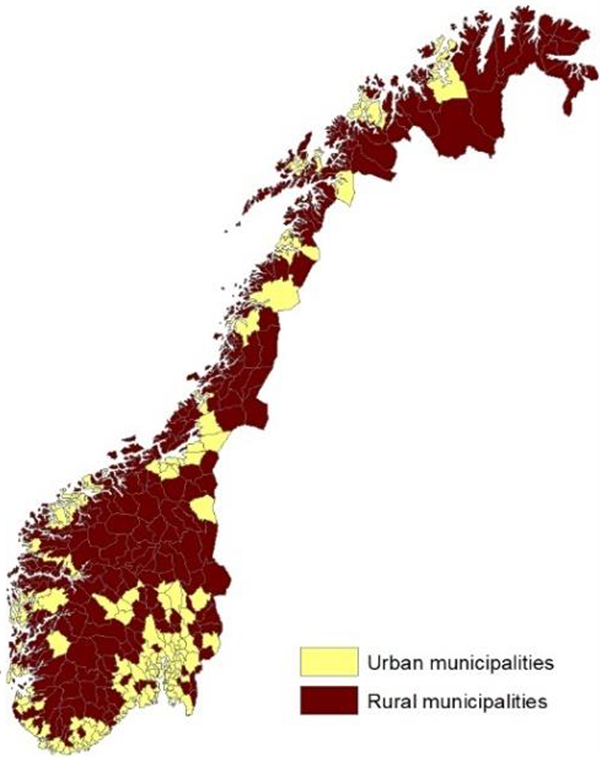
Rural and urban municipalities.
Measuring inequality
The dependent variable P90/P10 is made by Statistics Norway and measures the difference in yearly income between the 90th and 10th percentiles in a municipality. Income includes employment income, capital income and taxed and tax-free transfers during the calendar year. Income is measured as the sum of the household’s income after tax, divided by the number of consumption units in the household. Student households are excluded. The number of consumption units is calculated by using the EU-equivalence scale, where the first adult weighs 1, the next adult weighs 0.5 and every child weigh 0.3. Thus, a household of two adults and two children has 2.1 consumption units. In the dependent variable P90/P10 without immigrants, all households where the main provider was not born in Norway are excluded.
There are many ways to measure income inequality. The Gini coefficient is often labelled as the most popular (De Maio, 2007), and in addition to P90/P10, this is the measure used by Statistics Norway. I chose P90/P10 instead of the Gini coefficient, as it is more stable over time and less influenced by changes in the top of the income distribution. On the municipality level, and especially in municipalities with small populations, special events, such as the sale of a company, can have an extreme impact on the Gini coefficient. The P90/P10 measure is less sensitive to such events in the top 1%.
Measuring immigration
The immigration variables measure the proportion of different categories of immigrants in a municipality on 1 January each year. Given the timing of measurement, the variable measures immigration during the previous year. This variable therefore has a natural lag in relation to P90/P10.
In this paper, immigrants are defined as people born in a foreign country, and with two foreign-born parents. Immigrants are only registered as settled in a municipality if they are living in Norway for at least six months. Immigrants on shorter stays, for example seasonal workers only staying for the summer, are not included in the data. These immigrants’ income is not included in Statistics Norway’s calculations of P90/P10 either. Immigrants from the other Nordic countries are also not included in the analysis, as migrants from Nordic countries do not have to state a reason for immigration when entering Norway.
The categorisation of immigrants is based on information on (a) reason for in-migration; and (b) country of origin.
Reason for migration is a variable constructed by Statistics Norway and is based on the immigration authorities’ registers as well as other relevant variables (Dzamarija, 2013). All immigrants arriving after 1989 are given one of the following values: refuge, family, work, education or other. The first four categories of migrants, which make up approximately 92.6% of the immigrant population, are included in the analysis.
Work migrants, or labour migrants, include those that have been granted a work permit, as well as people that register via the EEA registration. Refugees includes all migrants who have a residence permit in Norway and where refuge has been given as the reason for residence application. This includes both asylum seekers that have been granted residence, those who have been granted residence on humanitarian grounds and quota refugees (UN refugees). Family migrants includes those that have been granted residence based on their family connection to a settled person in Norway. EEA citizens do not have to file an application, but they are subject to registration for EEA citizens. Education migrants are mainly students, but also include interns and au pairs (Dzamarija, 2013).
The categorisation of countries is based on Statistics Norway’s division of the world into two: ‘EU/EEA countries, USA, Canada, Australia and New Zealand’ and ‘Africa, Asia, Latin-America, Oceania excluding Australia and New Zealand and European countries outside EU/EEA’ (Statistics Norway, 2008). My interest in this paper is the effect of increasing labour migration after the EU enlargements to the east. The former category is therefore split in two: eastern/central Europe inside the EU 2 consisting of all the new EU members after 2004, except the Mediterranean countries Malta and Cyprus (called EU11), and western EU countries, as well as USA, Canada, Australia and New Zealand (EU15+4).
Like the labour migrants, family migrants are split into the three different country groups, as they are a very heterogeneous group. Many of the family migrants from Europe are relatives of labour migrants, while many family migrants from ‘Asia, Africa etc.’ are relatives of refugees. They could, however, also be migrating due to marriage to a Norwegian citizen. Refugees are kept as one group, since 97% of refugees in 2016 were from the ‘non-western’ countries (Asia, Africa etc.). The education migrants are also kept as one group, as I see no theoretical argument to differ between students from different countries in this context.
Unemployment, education level and median income
In addition to controlling for other immigrant categories, three other control variables are included in the analysis. Following the literature review, I control for unemployment, proportion with higher education and median income. These variables are time varying and could affect income inequality, while at the same time be correlated with migration.
Unemployment measures the proportion of the labour force (15–74 years) that is registered as unemployed. Monthly data are obtained from Statistics Norway for 2005 to 2014 and from the Norwegian Labour and Welfare administration (NAV) for 2015–2016. The variable is constructed by calculating the average for each year. Higher education measures the proportion of the population (aged 16 and older) with university or college education. Median income measures the median income for households after tax per 31 December each year. The numbers are adjusted for inflation using 2015 as the base. Finally, the numbers are divided by 100,000 to obtain larger units.
Descriptive statistics
Descriptive statistics for all variables are presented in Table 1.
Several differences can be observed between rural and urban municipalities. Income inequality is on average lower in the rural municipalities, and the proportion of EU11 labour migrants is higher. The proportion of refugees and family migrants from Asia, Africa etc. is, however, significantly higher in urban municipalities. Unemployment, median income and particularly the education level are higher in urban municipalities.
Figures 2 and 3 display the development in income inequality and proportion of EU11 labour migrants from 2005 to 2016 in rural and urban municipalities.
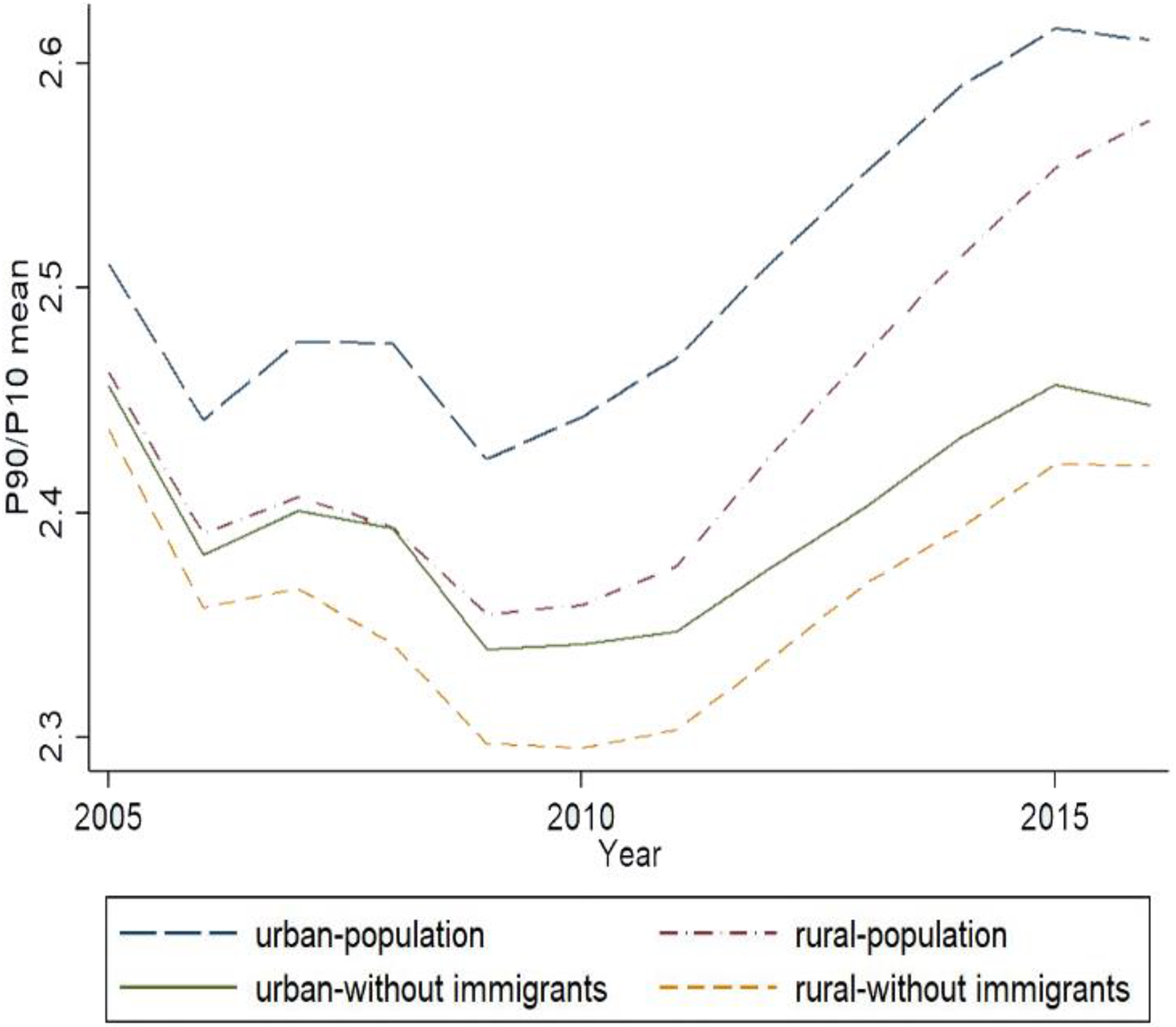
P90/P10 (mean), 2005–2016.
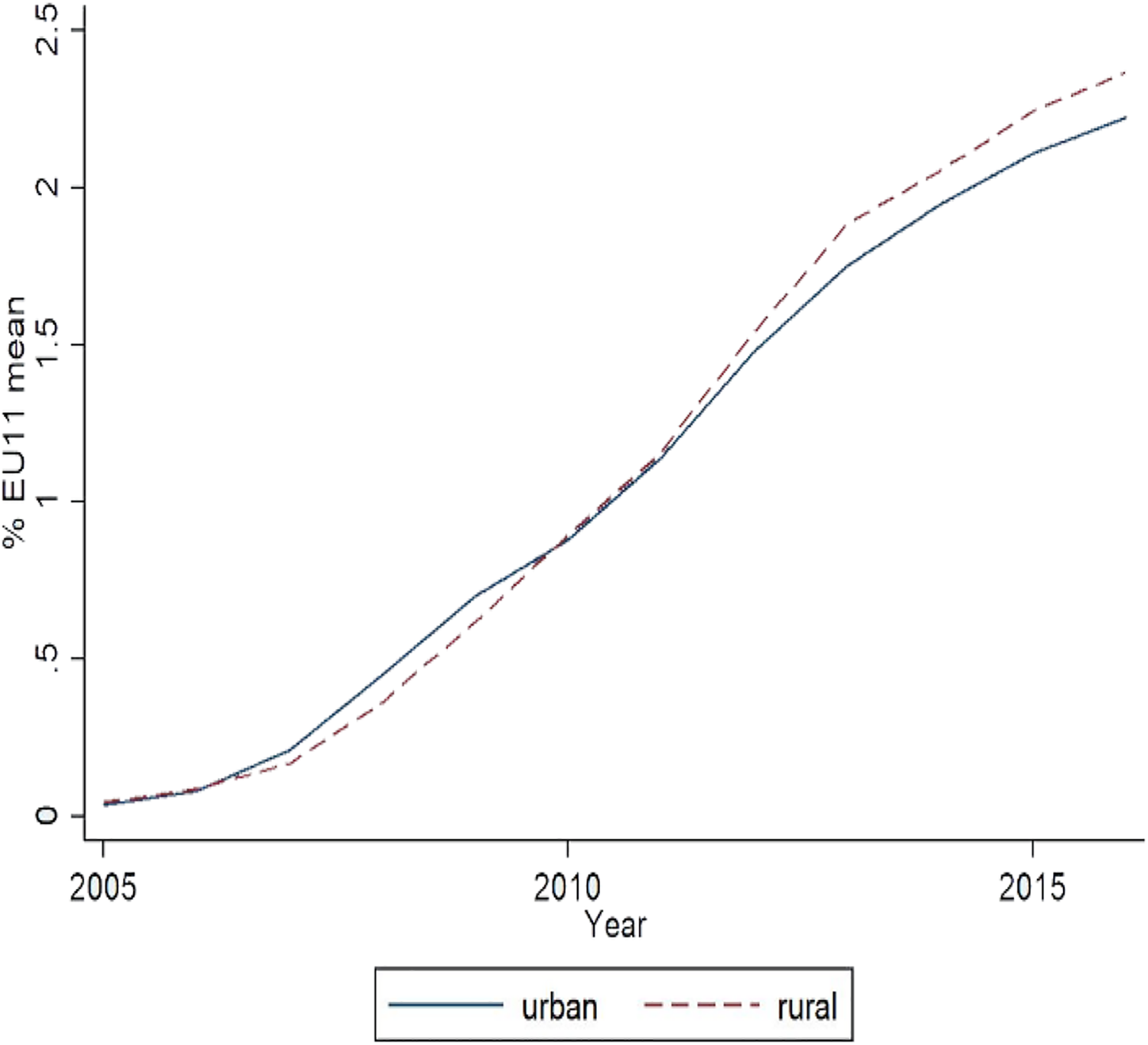
% labour migrants EU11 (mean), 2005–2016.
The graphs show clear trends in both variables. Figure 2 shows that the average P90/P10 value goes up and down from 2005 to 2009. Since 2009, however, there is a clear trend where inequality increases every year. The increase is somewhat larger in rural municipalities than in urban municipalities. Further, P90/P10 is lower when immigrants are excluded. The increase from 2009 is also significantly smaller. Figure 3 shows that the average proportion of EU11 labour migrants increases every year from 2005 to 2016 in both urban and rural municipalities.
Analysis
The analysis is structured in two parts. I first use a method published by Allison (2005) to test the direction of the relationship between labour migration and income inequality, thereby checking if there is support for the supply-side or demand-side arguments. The method uses a structural equation modelling (SEM) estimator of a linear cross-lagged panel model with fixed effects. This method protects against both unmeasured confounding variables and reverse causation. Since my analysis strongly indicates that it is labour migration that causes higher inequality, and not the other way around, I proceed with a fixed effect linear regression. This I do in order to study the degree to which the proportion of labour migrants affects income inequality, how the effect compares to that of other groups of migrants and whether the effects differ in rural and urban municipalities. A significant Hausman test supports the decision to use fixed effects instead of random effects. Fixed effects models explore the relationship between the independent and dependent variable within the entity and remove the effect of all time-invariant variables (Park, 2011).
Labour migration and income inequality – The direction of the relationship
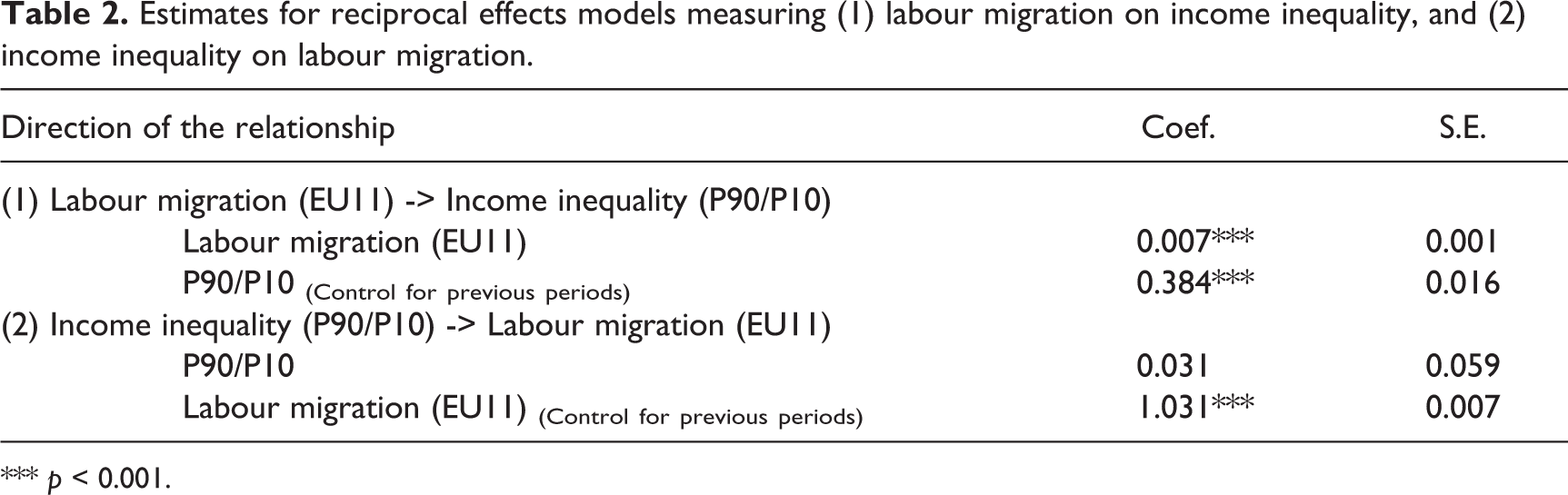
There is a widespread consensus that the best kind of data for making causal inference, apart from experimental data, are longitudinal data (Allison, 2005). Twelve strongly balanced panels (2005–2016) therefore provide the opportunity to use SEM to test if there is support for the demand-side hypothesis or supply-side hypothesis in Norway in this period. Table 2 shows the results of two models.
Estimates for reciprocal effects models measuring (1) labour migration on income inequality, and (2) income inequality on labour migration.
*** p < 0.001.
In model 1, following a lagged control for income inequality in the previous period, we can identify a statistically significant positive effect of labour migration on income inequality. There is however no statistically significant effect of income inequality on labour migration controlled for labour migration in the previous period. Estimations with P90/P10 without immigrants give almost identical coefficients and the same overall conclusion. This implies support for the supply-side hypothesis that labour migration is followed by higher income inequality. The models are estimated using a one-year lag. It is possible to argue that more time is needed before one can see the effect, perhaps especially in model 2. However, estimations of model 2 with two- and three-year lags did not yield significant results.
In order to make sure that the effect of labour migration on income inequality is not due to selection bias, I have performed an additional test, taking advantage of timing. While I do not have data from before the EU enlargement, Figure 3 shows that increases in labour migration were modest before 2007. Thus, I have tested whether the development in income inequality from 2004–2007 – before the large increase in migration began – is correlated with the development in labour migration in the years that followed (2008–2011). The correlation is positive, but weak and not significant (p = 0.295), which means that the development in income inequality followed a similar pattern – regardless of future migration – before the large increase in labour migration began.
Migration, income inequality and rural and urban labour markets
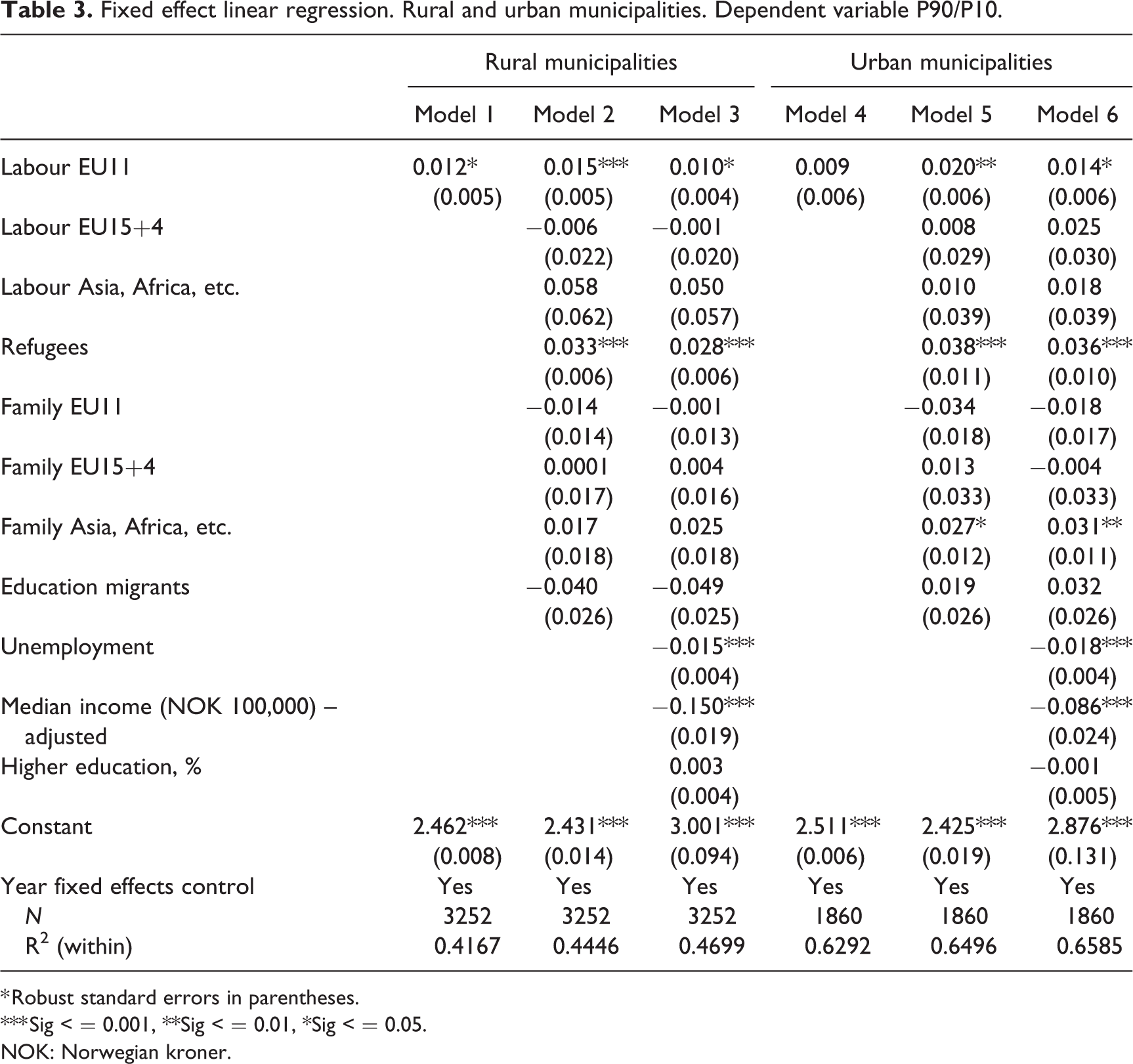
Table 3 displays the results from fixed effect linear regression. Due to the strong trends in both the dependent and independent variables all models are also controlled for year, making them time and entity fixed effects regression models. Further, due to the presence of heteroscedasticity and autocorrelation, robust standard errors, adjusting for clusters, are used.
Fixed effect linear regression. Rural and urban municipalities. Dependent variable P90/P10.
* Robust standard errors in parentheses.
*** Sig < = 0.001, **Sig < = 0.01, *Sig < = 0.05.
NOK: Norwegian kroner.
Models 1 and 4 estimate the effects of changes in the percentage of EU11 labour migrants on P90/P10 in rural and urban municipalities. In rural municipalities, a one-percentage-point increase in labour migrants from EU11 is estimated to increase P90/P10 by 0.012. The effect is somewhat weaker and not statistically significant at the 0.05 level (p = 0.125) in the urban municipalities.
In models 2 and 5, controlling for other categories of immigrants, the effect of EU11 labour migrants is stronger and statistically significant in both rural and urban municipalities. It is thus clear that the proportion of EU11 labour migrants is correlated with several of the other immigrant groups and controlling for these groups is important in order to obtain correct estimates of EU11 labour. Other than EU11 labour migrants, refugees are the only immigrant group that has a significant effect on P90/P10 in both rural and urban municipalities. The effect is also somewhat stronger than the effect of EU11 labour migrants. A one-percentage-point increase in refugees increases P90/P10 by 0.033 in rural municipalities and 0.038 in urban municipalities. Further, family migrants from Asia, Africa etc. have a significant effect on P90/P10 in urban municipalities. The remaining categories of immigrants have no significant effect on P90/P10.
In models 3 and 6, controls for unemployment, median income and education level are introduced. The coefficient for EU11 labour is reduced, but it is still significant in both rural and urban municipalities. Increasing unemployment and median income both significantly reduce inequality, while the percentage of the population with higher education does not have any effect on P90/P10 over time. These findings are robust, and they hold for several different model specifications. It is the control for median income that reduces the coefficient for EU11 labour. EU11 labour migrants are negatively correlated with median income. 3 My interpretation is thus that increasing proportions of EU11 labour migrants reduces the median income, and that this partly explains how labour migration increases P90/P10.
As a sensitivity analysis I have run the models from Table 3 with the Gini coefficient as the dependent variable (not shown). The results are very similar, particularly when excluding 2005 (which includes many extreme values), but the effect of labour migration is weaker and not significant in urban municipalities. This may suggest that labour migration has less effect on the highest and lowest incomes, at least in urban areas.
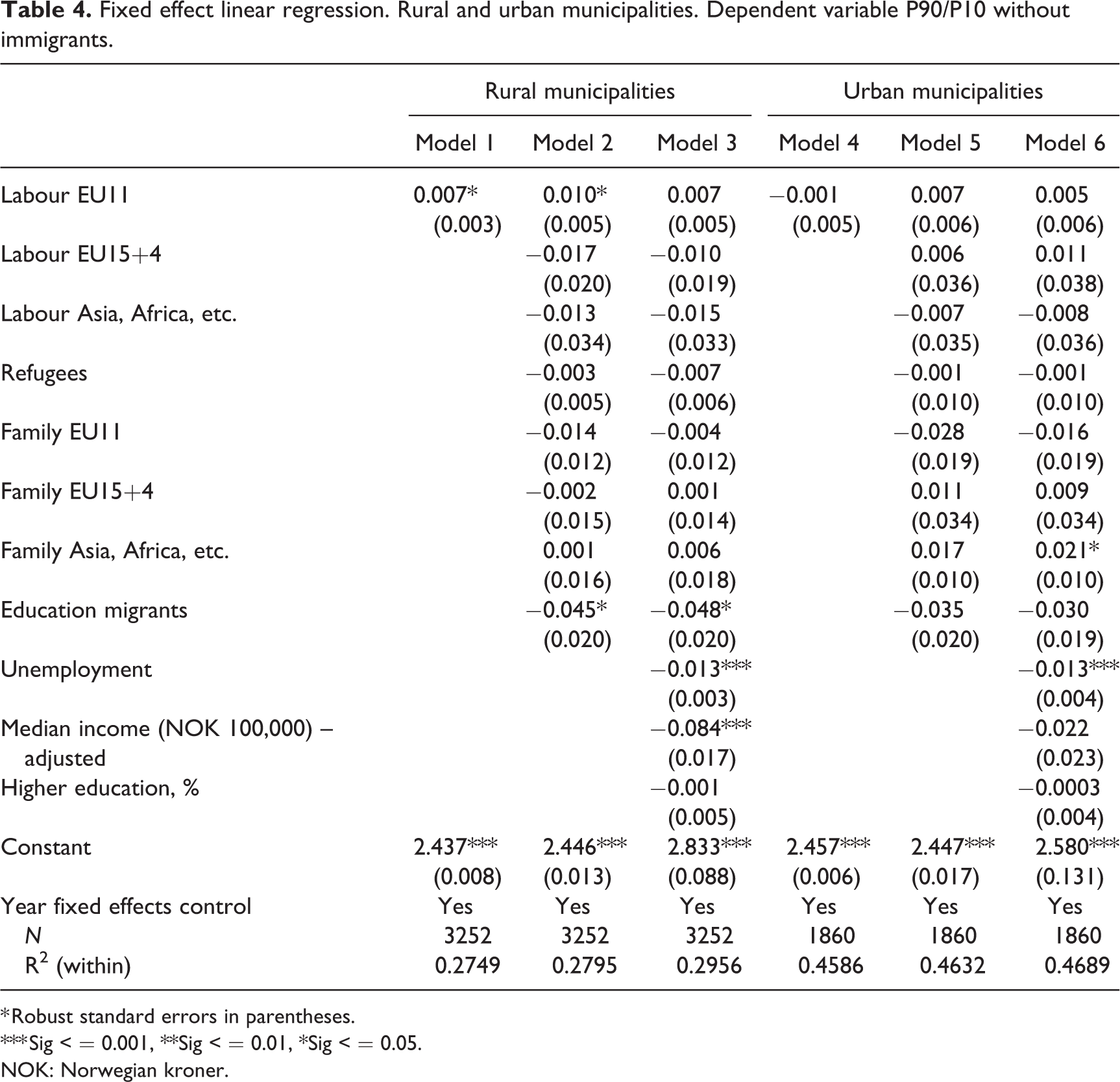
Overall, the models in Table 3 suggest that increasing proportions of EU11 labour migrants and refugees increases the overall income inequality in a municipality. However, Table 3 cannot reveal whether this effect is just the result of the immigrants’ income alone or if immigration also affects native income inequality. In Table 4, I have run the exact same models, but with a dependent variable that excludes immigrant households.
Fixed effect linear regression. Rural and urban municipalities. Dependent variable P90/P10 without immigrants.
* Robust standard errors in parentheses.
*** Sig < = 0.001, **Sig < = 0.01, *Sig < = 0.05.
NOK: Norwegian kroner.
In model 1 we see a reduced, but still significant, effect of EU11 labour, suggesting that labour migration from EU11 increases income inequality within the Norwegian-born population. In model 2 we see that refugees, which had a significant effect on P90/P10 in the population in general, have no significant effect on P90/P10 in the native population. The controls introduced in model 3 have the same effect as before – while unemployment and education level do not affect the other estimates, control for median income reduces the coefficient for EU11 labour, which suggests that reduced median income is a mechanism through which labour migration affects the income dispersion of the native population.
Discussion and conclusion
Norway has experienced increasing inequality in a period characterised by unprecedented increases in labour migration. In this paper, I have sought to explore the connection between these two phenomena.
As the literature discussing the relationship between migration and income inequality can be said to be divided between supply-side and demand-side perspectives (Hyde et al., 2015), the direction of the relationship was first explored. The findings support the supply-side argument that increasing immigration is followed by increased income inequality. I find no evidence for the opposite causal relationship – that increasing inequality is followed by higher immigration. In Hyde et al.’s (2015) view, demand-side arguments emphasise that employers first create the degraded job structure (and thus higher inequality), then discover that native workers are increasingly unwilling to accept the bad working conditions, and then turn to foreign-born workers. While this chain of events might be likely in the US – which has experienced major economic restructuring and polarisation of the wage structure for a long period and, importantly, has had access to migrant labour for a long time – this is not the case in Norway.
In the Norwegian case it seems more plausible that the EU enlargement made it possible for employers to expand the number of insecure, low-skilled and low-paying jobs. Several structural changes in the Norwegian labour market appear to be a consequence of the migrant influx after the enlargement. For instance, Bjørnstad (2015) argues that the sudden access to a reservoir of cheap labour has made the construction industry less capital intensive and more labour intensive. The use of external staffing agencies – providing low incomes and job insecurity for its employees – also exploded after the EU enlargement (Friberg, 2016). This is not to say that labour migration is not demand driven, but it seems evident that it was the actual access to the supply of migrant labour after 2004 that led to changes in the labour market – and increased income inequality.
In the second part of the analysis, fixed effects regression is used to study the degree to which labour migration, compared to other categories of immigrants, has led to increased income inequality, and whether this effect differs in rural and urban municipalities.
Previous research in this field has only to a small degree focused on how different groups of migrants might have different effects on inequality. Migrants are too often referred to as one group, when discussed in relation to inequality. The findings in this paper show that it is primarily EU11 labour migrants and refugees that contribute to increased inequality in Norway. The other categories of migrants have no significant effect on inequality. It is thus not migrants in general that can cause higher income inequality, but specific migrant groups. The fact that labour migrants and refugees on average have significantly lower incomes than the remaining population (Epland and Kirkeberg, 2014; Statistics Norway, 2017) suggests that these groups increase inequality in the lower part of the income distribution.
However, the analysis of income inequality within the Norwegian-born population provides important nuance to these findings. While both EU11 labour migrants and refugees increase income inequality in general, only EU11 labour migrants influence the native income inequality – in rural municipalities. The effect of EU11 labour migrants on overall income inequality is thus the result of two different mechanisms: the ‘mechanical’ effect of having more low-income workers in the municipality and the more debated effect on native workers’ income. The strong effect of refugees on overall income inequality is however solely the result of their own income. One of the possible explanations for the difference between these two groups is their different labour market participation. While EU11 migrants have an employment rate at the level of the general population, immigrants from Asia and Africa have significantly lower participation in the workforce (Statistics Norway, 2019).
It is particularly interesting that the effect of EU11 labour migrants on native income inequality is significant in rural municipalities, but weaker and not statistically significant in urban areas. This could be due to the small and less diverse labour markets in rural areas. While natives in urban areas might have several different ways of adapting to changes in competition, such as changing job or occupation, their rural counterparts might have fewer opportunities. Another explanation concerns the different educational level in urban and rural areas. Following Kalleberg (2011), immigration has a larger effect in areas with larger proportions of low-skilled natives. As the general education level is much lower in rural areas, there are potentially more local people competing with the labour migrants.
At the same time, high-income groups are likely benefitting from the presence of immigrants, as cheaper and more flexible labour potentially increase profits and wages (Hoen et al., 2018; Iversen et al., 2017). In future research, more detailed inequality measures, such as P90/P50 and P50/P10, are needed to explore these mechanisms and determine where the effect is strongest.
Further, a potential weakness with this analysis (which possibly also has a rural/urban dimension) is that people move over time. If the moving patterns of natives are correlated with immigration, the effect of immigration on income inequality could be spread out across the country. For instance, if the influx of low-skilled labour migrants displaces low-educated natives, they might choose to move out of the municipality, which potentially reduces the effect of migration on income inequality. In such a case, the analysis underestimates the effect of labour migration on income inequality. Whether such mechanism exists in Norway is unknown and requires research.
This paper has shown that the unprecedented increase in labour migration after the EU enlargement has led to a higher level of overall income inequality and increased the level of income inequality in the Norwegian-born population. While public discourse in Norway often focuses on inequality and poverty in relation to refugees, this analysis shows that labour migration has an independent effect and – as opposed to refugees – affects natives’ income and income inequality. Future research needs to pay attention to the mechanisms that create the relationship between labour migration and inequality. If the current trend of increasing inequality continues, it could have large implications for the Norwegian work-life regime and welfare state.
Footnotes
Funding
The authors disclosed receipt of the following financial support for the research, authorship, and/or publication of this article: The paper is result of the 2017-2022 Global Labour in Rural Societies research project financed by the Norwegian Research Council (Grant No. 261854/F10).
