




Abstract
In this paper, we examine the centrality of policy actors and moral justifications in media debates on Arctic climate change in Finland and Canada from 2011–2015. We take a network approach on the media debates by analysing relations between the actors and justifications, using discourse network analysis on a dataset of 745 statements from four newspapers. We find that in both countries, governments and universities are the most central actors, whereas business actors are the least central. Justifications that value environmental sustainability and scientific knowledge are most central and used across actor types. However, ecological justifications are sometimes in conflict with market justifications. Government actors emphasize new economic possibilities in the Arctic whereas environmental organizations demand greater protection of the vulnerable Arctic. Ecological justifications and justifications that value international cooperation are more central in the Finnish debate, whereas justifications valuing sustainability and science, as well as those valuing national sovereignty, are more central in the Canadian debate. We conclude that in addition to the centrality of specific policy actors in media debates, the use of different types of moral justifications also reflects political power in the media sphere.
Keywords
Introduction
Climate policymaking not only takes place in official policy venues, such as in ministries and parliamentary committees, and includes more than public officials and politicians. The mass media also plays an important role in climate policymaking. The role of the media can be analysed from various viewpoints, such as how the media frames climate change (Boykoff, 2011; Broadbent et al., 2016; Schäfer and Schlichting, 2014), how media representations influence public opinion (Brulle et al., 2012) and how policy actors push their climate policy preferences through media coverage (Boykoff, 2011; Hansen, 2010).
One strand of this literature has focused on policy actors’ visibility in the media. These studies have, on the one hand, shown that media is a contested arena where various policy actors, such as scientists, environmental non-governmental organizations (ENGOs) and corporations, compete over the framing of climate change to influence policymaking (Boykoff, 2011; Bulkeley, 2000; Crow and Boykoff, 2014; Hajer, 1993). These studies suggest that actors’ media visibility and political power are linked to each other and are in line with those theoretical approaches that emphasize the role of the mass media as a power resource (e.g. Castells, 2009). Other studies, in contrast, have found that influential policy actors, including business actors, are relatively invisible in environmental policy debates compared with other policy actors (Lahsen, 2017; Lester and Hutchins, 2012; Stoddart et al., 2017). These studies suggest instead that political power operates outside the media as politically influential actors use more direct means to advance their interests (cf. Culpepper, 2010; Dür and Mateo, 2013).
Our contribution to this literature is to argue that both the centrality of certain actors and the centrality of different types of moral justifications reflect power in the media sphere. This argument draws from Boltanski and Thévenot’s (2006/1991) justification theory. At the core of this theory is the idea that participants in public debates draw on a relatively limited repertoire of moral justifications to back their arguments. It has been pointed out that some justification types – such as those emphasizing the value of ecology or social justice – may resonate more strongly in some societal contexts than others (Lamont and Thévenot, 2000; Luhtakallio, 2012; Ylä-Anttila, 2016; Ylä-Anttila and Luhtakallio, 2016). Studying the centrality of different justification types in media debates, we argue, opens the way to seeing power relations within the media sphere consisting of not only the relations between actors but also the relations between justifications.
Our empirical case is the news media debate on Arctic climate change policy in Finland and Canada from 2011–2015. The Arctic has become increasingly visible in the global politics of climate change. Temperatures are rising twice as fast in the Arctic in comparison to the rest of the world, leading to melting sea ice, glaciers and permafrost. These effects have profound, often negative, impacts on local ecosystems and Indigenous communities (e.g. Trainor et al., 2009). However, a rapidly changing Arctic has also been interpreted as increasing economic opportunities for circumpolar societies, including Indigenous communities (Callison, 2014; Dodds, 2010; Shadian, 2014). From 2011–2015, media attention on the Arctic region increased due to the oil company Shell’s plans to drill oil in the Arctic. This led to the ENGO Greenpeace sending their ship to block oil rigs in the Arctic Ocean. We can thus expect to find public debate on Arctic climate policy during these years. Furthermore, Finland and Canada represent different types of social contexts in terms of institutions and political economy, so we can expect to find differences in the visibility of different policy actors and justifications in the media.
Our approach is also novel in methodological terms. We employ an innovative method called Discourse Network Analysis (Leifeld, 2010, 2017) to analyse the visibility of specific policy actors and justifications in the discourse networks formed by the media. This network methodology goes beyond measuring the individual frequency of specific policy actors and justifications to measuring their centrality in the debate. Centrality is a network property that considers the relations between nodes – in this case, between policy actors and moral justifications – in the network. It measures the support a specific node receives from other nodes in the network (Hanneman and Riddle, 2011). Therefore, the higher the centrality score of a policy actor or justification, the stronger its position in the media debate.
Theoretical framework, research questions and country cases
The mass media is one of the key arenas of political contestation in modern democracies. The media forms a discursive space where power relationships between competing social groups are manifested, negotiated and contested. Some authors, such as Castells (2009), go as far as suggesting that political networks and media communication networks have become increasingly symmetrical in the global network society, so that political power manifests in which social groups and whose interests are included in mass media communication networks.
Castells argues that media communication networks reflect other social structures as they are ‘geared toward the fulfilment of certain social interests and values’ (Castells, 2009: 52). Media communication networks are therefore characterized by structural dominance as some actors can advance their values and interests in the network more efficiently than others. In this way, media communication networks reflect existing power structures. Even for Castells, however, media presence is not completely determined by dominant power structures (Castells, 2009: 10). For example, although mass media communication networks tend to be driven by a commercial logic, social movements can act as a counter power to dominant programmes by introducing alternative values in media networks.
Others have pointed out that being visible in the media does not necessarily correlate with having much political power. Many powerful actors, such as business corporations, may prefer to exercise their power through direct contacts with decision makers (Binderkrantz et al., 2015; Culpepper, 2010; Dür and Mateo, 2013). Media presence, therefore, is far from being the only way of exercising political power. But it is one important power resource, perhaps especially to those actors who lack direct contacts with decision-makers (Binderkrantz et al., 2015). This leads to our first research question: RQ1: Which policy actors are most central in the news media debates on Arctic climate change in Finland and Canada?
Boltanski and Thévenot (2006/1991) identify six orders of worth that individuals commonly appeal to in contemporary political debates. These orders of worth serve as general, shared principles of social coordination. Their original scheme is complemented by Lafaye and Thévenot (1993), who introduce the ecological order of worth. In the case of climate change policy, four of these orders are particularly relevant. These are: (a) the civic order of worth, where equality, legality and collective decision-making are valued; (b) the industrial order of worth, where efficiency, long-term planning and technical expertise are valued; (c) the market order of worth, where market performance, competition and wealth are valued; and (d) the ecological order of worth, where environmentally sustainable and harmonious relations between humans and the natural world are valued. It should be emphasized that the industrial order of worth, despite its name, should not be confused with the market order of worth.
In each of these orders, material things and persons take on value according to different criteria (Boltanski and Thévenot, 2006: 133). This creates tensions and disagreement as individuals evaluate policy issues with different, often conflicting, criteria. For example, attempts to establish environmental sustainability as the most important principle in Arctic climate policy may be denounced from the viewpoint of the market order because it disturbs the free market and prevents taking advantage of new economic possibilities in the region. Attempts to establish scientific knowledge about the long-term impacts of climate change as the main principle in Arctic climate policy would not be desirable from the viewpoint of the market order because it would dampen economic competition and profit seeking.
Furthermore, justifications are cultural repertoires for legitimating political claims. Their use, therefore, varies across cultural contexts (e.g. Frederiksen, 2018; Lehtonen and Liukko, 2010; Luhtakallio, 2012; Thévenot et al., 2000; Autto and Törrönen, 2016). For example, market justifications are more important and linked to other justifications in the United States of America (USA), whereas in France, market justifications are often criticized and civic justifications are most commonly used (Lamont and Thévenot, 2000; Thévenot et al., 2000; Ylä-Anttila and Kukkonen, 2014). In other words, there are differences in what is considered valuable between cultural communities, such as social groups or countries. These differences stem from longer-term economic, social and political developments, so justifications are closely linked to social practices and structures (Lamont, 2012).
Even though individuals are constrained by the use of justifications, justification theory emphasizes that individuals have the critical capacity to challenge existing social structures through critiques that draw on the different orders of worth (Boltanski and Thévenot, 2006/1991). Many previous studies have examined their use in media debates (e.g. Autto and Törrönen, 2016; Frederiksen, 2018; Ylä-Anttila et al., 2018b). Our second research question is: RQ2: Which moral justifications are most central in the mass media debates on Arctic climate change in Finland and Canada?
Finland and Canada represent different types of political contexts among the circumpolar countries. This makes them interesting cases to compare in relation to our research questions, as we can expect to find differences between the two countries in the centrality of different types of policy actors (such as business actors) and justifications (such as market and environmental justifications). Two variables are important because they indicate how political power is distributed in these countries: institutions and political economy. First, Finland and Canada represent different polity types. Finland is a consensus democracy based on corporatism. In corporatism, different organized interests with specialized purposes negotiate via the state to reach a consensus on a policy issue (Lijphart, 2012). Consequently, there tends to be more cooperation between interest groups and ENGOs often have better positions in the policy process (Lijphart, 2012). Canada represents a majoritarian democracy based on liberal pluralism. In a pluralist system, interest groups form more freely and advance their particular interest, so there is typically more rivalry between interest groups. This is reflected in policymaking in pluralist systems as policies favour interest groups with better resources during the policy process (Jepperson, 2002). We therefore expect to find ENGOs and ecological justifications in more central position in the Finnish debate.
Second, fossil fuel industries have strong economic interests in the Arctic region, which is why the position of these industries in the political economy is of relevance. Canada has extensive reserves of fossil fuels and regions that are highly dependent on the oil sector. Other studies have found that fossil fuel corporations exert much influence on national climate policymaking in Canada (Adkin and Stares, 2016; MacNeil, 2014; Murphy and Murphy, 2012). We therefore expect to find fossil fuel industries and market justifications in central positions in Canada. Finland, in turn, does not have significant fossil fuel resources and lacks influential fossil fuel industries. However, heavy industries have strongly influenced climate policymaking in Finland where the government has prioritized the competitiveness of Finnish industry over ambitious greenhouse gas emission targets (Gronow and Ylä-Anttila, 2016; Teräväinen, 2012). As such, we expect to find business actors and market justifications, but with less visibility than in the Canadian debate.
Data and methods
We take a novel approach to media coverage of climate change by using discourse network analysis (Leifeld, 2010, 2017). We examine media coverage as a network where different organizations are related to one another through similar normative claims about climate policy. This allows us to examine the centrality of different actors (RQ1) and justifications (RQ2) and to compare the media discourse networks to earlier literature on climate policymaking in Finland and Canada.
We selected two newspapers from Finland and Canada based on the following criteria: first, the newspapers are among the most circulated in each country. Second, they are considered flagship media outlets in each country and have been commonly used in other studies on media coverage of climate change (e.g. Lyytimäki, 2011; Murphy, 2015; Ylä-Anttila et al., 2018b; Young and Dugas, 2010). From a methodological viewpoint, flagship newspapers are the best archived, allowing for the most accurate datasets for comparative analysis. Third, we chose newspapers that represented different sides of the centre on the political spectrum. Following these criteria, we selected Aamulehti (conservative/centre-right) and Helsingin Sanomat (liberal/centre-left) from Finland and the National Post (conservative/centre-right) and The Globe and Mail (liberal/centre-left) from Canada. The selected newspapers, thus, represent a significant part of the national media landscape, are closely followed by political elites and are targeted by those seeking political influence. They do not, however, represent the entire media landscape. Most notably, we do not have material from the business press, which may partly contribute to the result that business actors are not strongly present in our material.
We used the Factiva database to retrieve the Canadian articles and the Finnish newspapers’ own archives. The search terms were ‘climate change’ and ‘Arctic’ in the Canadian case and ‘ilmasto’ and ‘arkti’ in the Finnish case. We searched for all articles containing these words from 2011–15. We then manually checked the material and only selected those articles that dealt primarily with anthropogenic climate change. The final dataset consists of 185 articles in the Finnish case and 292 articles in the Canadian case.
We imported the final dataset into Discourse Network Analyzer (DNA) software for coding (Leifeld, 2010). We coded statements that policy actors made in the media, either direct quotes or quotes that were paraphrased by a journalist. We excluded statements made by journalists and individuals as we focused on organizations. Organizations are the principle actors in policymaking and, as such, are what policy network research most often focuses on (Ylä-Anttila et al., 2018a). We made a purposive exception to this rule in the case of individual Inuit news sources. Journalists typically identify the Inuit as a collective identity, but without any formal organizational affiliation. Although Inuit organizations, such as the Inuit Circumpolar Council, do sometimes appear in media material, including individual Inuit news sources, as representatives of the ‘collective Inuit’, our approach provides a more accurate picture of the visibility of Inuit actors in news coverage of Arctic climate change.
In interpreting the results, it should be borne in mind that, first, sometimes different individuals take turns to speak in the name of the same organization. For instance, universities consist of individual researchers who may voice different viewpoints. From the organization-centred perspective, this means such organizations are internally pluralist, as opposed to, say, advocacy organizations that tend to repeat a coherent viewpoint in public. Second, journalists also play a role in deciding which policy actors and discourses receive the most coverage. Therefore, the centrality of policy actors and justifications is also shaped by journalists’ gate-keeping power, as well as by the creative work they do to construct narratives (Berglez, 2011; Engesser and Brüggemann, 2016). How journalists select certain actors as news sources and prefer political statements that use specific justifications are topics for further studies using data, such as interviews from journalists.
A statement was coded whenever an organization presented a normative definition or a causal solution to Arctic climate change that clearly represents a moral justification. We attached three attributes to each statement: (a) the policy actor making the statement; (b) the statement category into which the statement falls; and (c) agreement or disagreement with the justification. Inductively deriving the statement categories from the dataset, we found 29 categories in Finland and 32 in Canada. The final DNA dataset was exported into Visone software for social network visualization and analysis. In the network visualizations, we grouped statement categories into four groups derived from justification theory: ecological, economic, eco-industrial (combination of an ecological and industrial justification) and civic. To give two examples, the statement ‘the Arctic should be protected from oil exploration and extraction’ is an example of the use of an ecological justification and the statement ‘climate change increases economic possibilities in the Arctic’ is an example of the use of a market justification. Table 1 describes the dataset.
Number of articles, statements, organizations and statement categories in the Canadian and Finnish media debates on Arctic climate change from 2011–15.

The advantage of discourse network analysis, compared to conventional methods of content analysis, is that it conceives of media debates as networks between actors (RQ1) and between statements (RQ2). This allows visualizing the data as a network. In the one-mode actor network nodes represent the actors, which are linked to each other through statements, that is, either both agreeing or both disagreeing on a statement. If two actors share a link in the discourse network, they use a similar justification on Arctic climate change. The network is weighted, so the more two actors agree on different statements, the stronger their link. In the one-mode statement network, nodes represent statements that are linked to each other via actors, that is, an actor makes both of the statements. If two statements representing justifications share a link in the discourse network, one actor made these two statements. The stronger the link, the more actors have made these two statements. Discourse network analysis also allows an analysis of network properties, such as centrality, instead of simply counting the frequencies of different actors and statements. As a measure of centrality, we use degree centrality, which is commonly used to assess network hierarchy. The degree centrality score shows how many ‘neighbours’ the node has, that is, how central the actor is in terms of the number of ties it has to other actors (Hanneman and Riddle, 2011). Applied to relationships between actors (RQ1), our measure considers not just the visibility of individual actors, but also the support they receive from others. The centrality of an actor in a discourse network means the actor not only makes many statements, but also presents statements that attract agreement from other actors. For example, the centrality score of the Finnish government does not rise if they make a statement that no other actor repeats. Centrality is only boosted by statements that link actors.
Applied to relationships between statements (RQ2), centrality captures not just the visibility of certain statements, but also how many actors voice the same statement. Statements and their justifications are more central if they are articulated by a larger variety of actors. A statement that is repeated 10 times by the same actor is, by our measure, less powerful than a statement that is repeated by 10 different actors and, as such, commands more widespread support in the debate. By conceiving newspaper coverage in terms of network relationships, we gain a better picture of power relationships in the debate than we would by simply counting frequencies. In addition to actor and statement networks, we also present two-mode actor-statement networks to clarify how actors are linked to the statements.
Results
We present our results through six network visualizations. The analysis is also grounded in a qualitative reading of the material. The first two networks (Figures 1(a) and 1(b)) are actor networks that visualize the centrality of different policy actors and the connections between them in Finland and Canada, respectively. Nodes represent actors, whereas edges reflect connections between actors that are created by making a statement that falls into the same statement category (both agreeing or disagreeing with the statement). For example, two actors are connected if they have both stated the Arctic should be protected from oil exploration. The next two networks (Figures 2(a) and 2(b)) are justification networks that visualize the centrality of different justifications and the connections between them. Two justifications are connected if an actor uses both of them and either agrees or disagrees with both. In about 90% of cases, the ties between justifications result from an actor agreeing with both. The final two networks (Figures 3(a) and 3(b)) visualize connections between actors and justifications. They reveal which policy actors use which justifications, either by agreeing or disagreeing with the justification. As the Finnish newspaper data contain fewer statements (N = 317) than the Canadian data (N = 428), we used different thresholds for the networks to assure comparability: three for Finland and four for Canada, which represent 1% of all the statements in each case.
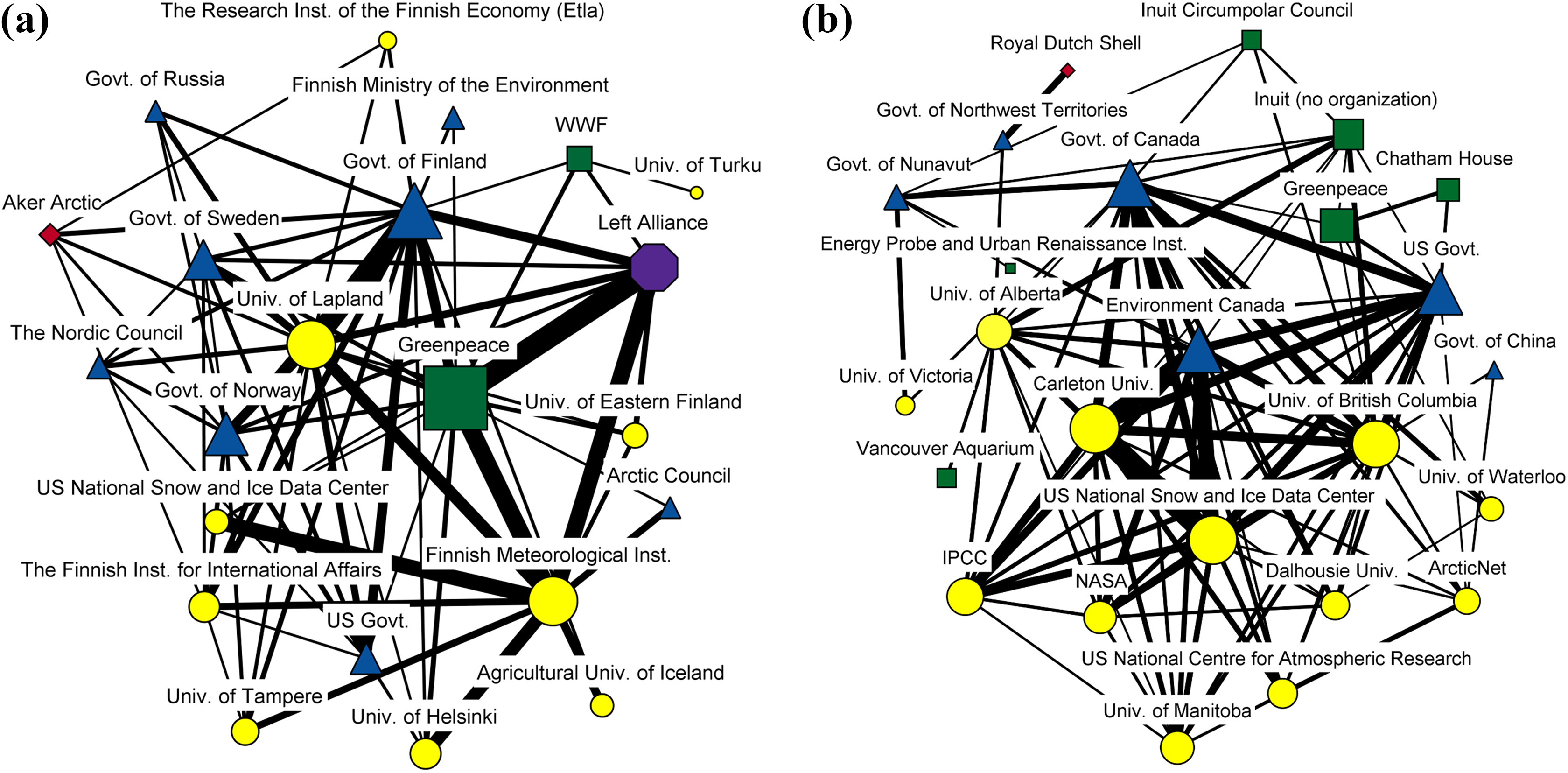
(a) Centrality of actors in the Finnish debate. Threshold three or more appearances; node size weighted for degree centrality (%); ties weighted for frequency of co-occurrence; threshold for ties is four. (Triangle: government, ellipse: research, rectangle: non-governmental organizations (NGOs), diamond: business, octagon: political party.) (b) Centrality of organizations in the Canadian debate. Threshold four or more appearances; node size weighted for degree centrality (%); ties weighted for frequency of co-occurrence; threshold for ties is five. (Triangle: government, ellipse: research, rectangle: NGOs, diamond: business.)
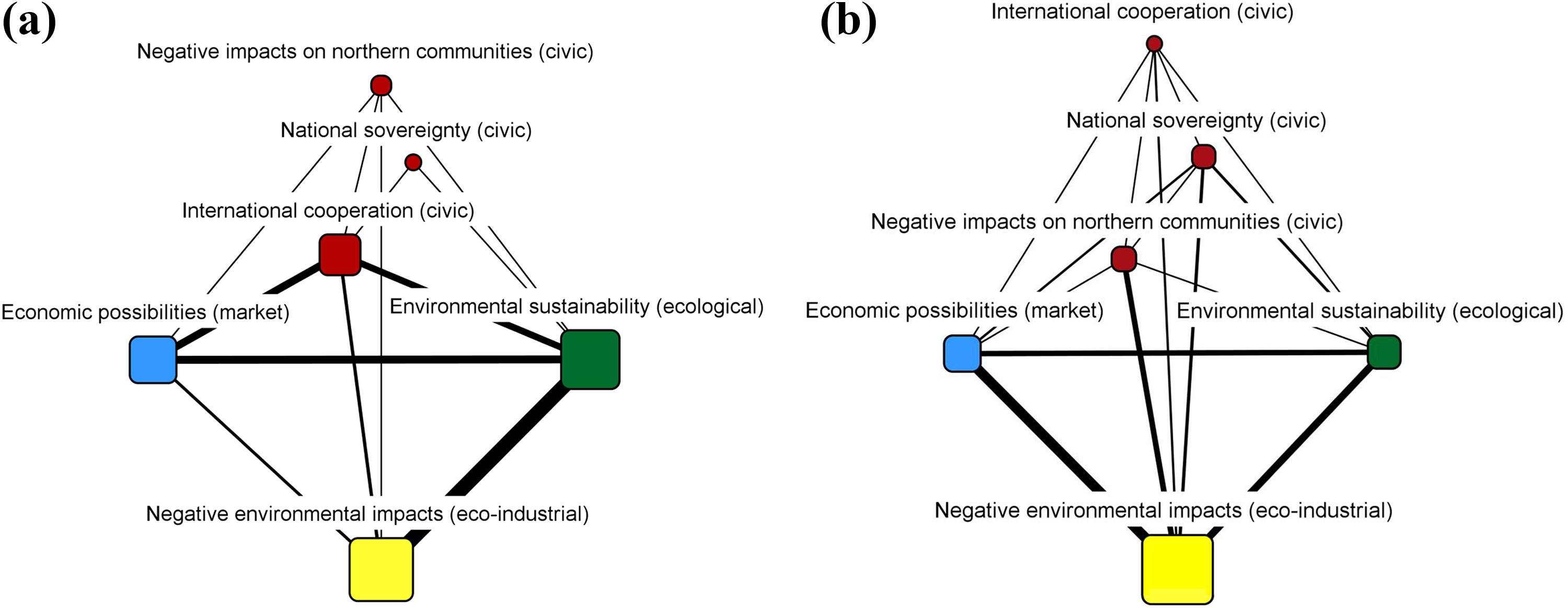
(a) Centrality of justification types in the Finnish debate. Node size weighted for degree centrality (%); ties weighted for frequency of co-occurrence. (b) Centrality of justification types in the Canadian debate. Node size weighted for degree centrality (%); ties weighted for frequency of co-occurrence.
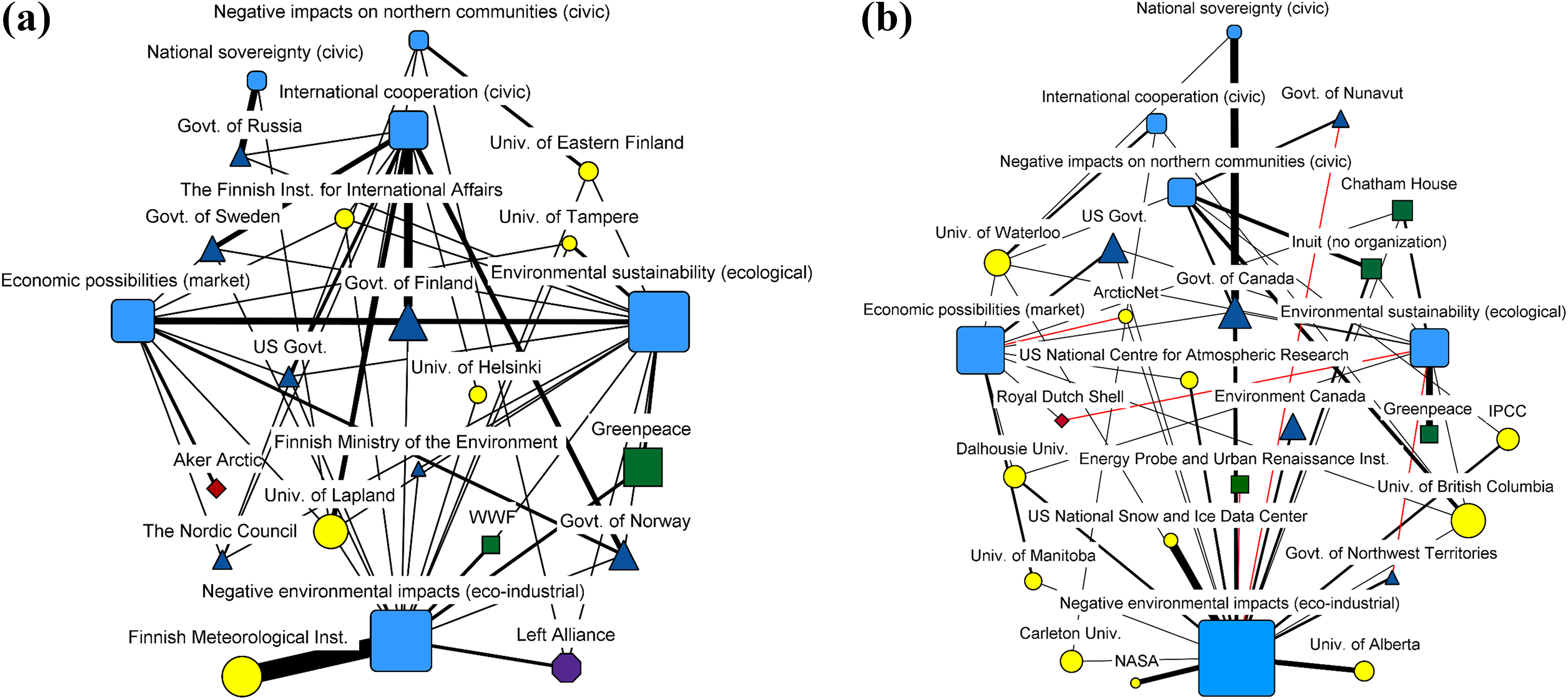
(a) Two-mode network of actors and justifications in Finland. Threshold four or more appearances (the threshold is bigger than in the previous networks to ensure the figures are readable); ties weighted for frequency of co-occurrence; all ties indicate agreement. (Triangle: government, ellipse: research, rectangle: non-governmental organizations (NGOs), diamond: business.) (b) Two-mode network of actors and justifications in Canada. Threshold five or more appearances (the threshold is bigger than in the previous networks to ensure the figures are readable); ties weighted for frequency of co-occurrence; black tie indicates agreement and red tie indicates disagreement with the justification. (Triangle: government, ellipse: research, rectangle: NGO, diamond: business.)
Actor networks
Figure 1(a) visualizes the centrality of policy actors in the Finnish discourse network. The most central actor is Greenpeace (15.033), which was one of the most visible opponents of Shell’s plans to drill oil in the Arctic during our data collection. Other central actors include the Finnish government (11.846), followed by the Finnish Meteorological Institute (9.087), the University of Lapland (8.801) and the Finnish Left Alliance (8.23). There are also many international actors in the network. The most central of these is the Norwegian government (7.088), but other circumpolar governments and intergovernmental organizations are also present. There is only one business actor in the network, Aker Arctic (1.808), which is a Finnish company that manufactures ice breakers and shipping technology.
Being central in an actor network indicates the actor, such as Greenpeace or the Finnish government, not only makes many statements but that their statements also receive support from others. These actors, therefore, have an important role in shaping the overall discourse on Arctic climate change policy.
Figure 1(b) visualizes the Canadian actor network. Research organizations and government actors are the most central actors in the Canadian network. The most central actor is Carleton University (9.174), followed by the US National Snow and Ice Data Centre (8.821), the Canadian government (8.504), Environment Canada (8.469) and the University of British Columbia (8.327). Although the ENGO Greenpeace was highly central in the Finnish network, it is marginal in the Canadian network (4.234). Other differences between Finland and Canada include the lower centrality of foreign governments and the presence of Inuit voices (through the Inuit Circumpolar Council and unaffiliated individual Inuit) in the Canadian network. Exceptions are the USA (7.869) and its scientific agencies, such as NASA (3.987). As in Finland, there is only one business actor in the network, Royal Dutch Shell, which is peripheral (0.741).
Justification networks
Figure 2(a) depicts the justification network in the Finnish debate. The most central justification type is what we term eco-industrial (33.507). This justification combines ecological and industrial justifications: environmental concerns are supported by scientific information. This type includes all the statements that use scientific knowledge and research to highlight the negative environmental impacts of Arctic climate change such as melting glaciers and melting permafrost. Below is an example of a statement that falls under eco-industrial justifications: The impact of climate change has been the biggest in the Arctic region. Covers of snow and ice have shrunk. (Finnish Meteorological Institute, Aamulehti, 28 January 2015) In order to stop climate change, we need to get rid of oil dependency. That is why oil reserves situated in the Arctic should be left alone. This demand is supported by the special fragility of the Arctic region in case of oil spills…(Greenpeace Finland, Helsingin Sanomat, 10 May 2011) The Finnish expertise on ice breakers is first-rate…Finnish people should just know better how to sell this expertise. And delay costs. If we wait too long, we will be late. Then other actors will already be there and there’s not much to share anymore. (University of Lapland, Helsingin Sanomat, 6 September 2015) We want that the [Arctic] area is operated within international organizations and according to international law. (Foreign Minister, Government of Finland, Helsingin Sanomat, 18 January 2011)
In the Canadian justification network (Figure 2(b)), eco-industrial (56.926) justifications are more pronounced compared to Finland, whereas purely ecological justifications (12.338) are less central compared to Finland. Eco-industrial justifications highlight the negative environmental impacts of climate change in the Arctic region, such as changing weather patterns and harm to animal species, such as polar bears. Below is an example of an eco-industrial justification in the Canadian debate: It’s the part of the planet which is realizing the first and the fastest response to climate change…this system that we had a poor understanding of before is now changing very, very fast. (University of Manitoba, The Globe and Mail, 16 March 2013) The focus of Canada’s two years in the chair [of the Arctic Council]…will be on creating economic growth. (Health Minister, Government of Canada, The Globe and Mail, 16 May 2013) We will not stand by and let the Harper government use the next two years to advance its destructive industrial agenda at the Arctic Council…if Harper plans to do to the Arctic what he has done to Canada, anyone who cares about the future of this fragile region should be scared. (Greenpeace Canada, The Globe and Mail, 16 May 2013) We are defending our rights to culture, our rights to land traditionally used and occupied…to our own means of subsistence…Our culture is based on the cold, the ice and snow, we are in essence defending our right to be cold. (Inuit Circumpolar Council, The Globe and Mail, 25 January 2014) Let me be absolutely clear on this: Canada’s participation in the Arctic Council is predicated on the notion that this is an association of sovereign states…that in no way, impinges upon our sovereignty, over our own territory. (Prime Minister, Government of Canada, The Globe and Mail, 17 January 2014)
Actor-justification networks
Figures 3(a) and 3(b) visualize how policy actors are connected to different justifications. In both countries, research organizations and government actors are the most connected to different justifications. At different points, these actors stress market, ecological and eco-industrial justifications. The Finnish government, in particular, makes a strong positive connection between ecological and market values. The Canadian government is strongly linked to the civic justification that emphasizes national sovereignty. In juxtaposition to research and government actors, the figures demonstrate that ENGOs predominantly use ecological and eco-industrial justifications. The two business actors in these networks, Aker Arctic and Royal Dutch Shell, use market justifications to stress the economic possibilities in a melting Arctic.
Discussion
This article examined the centrality of policy actors and moral justifications in media debates on Arctic climate change in Finland and Canada from 2011–15 using Discourse Network Analysis (Leifeld, 2017). We argued that it is not only the visibility of specific policy actors that constitute political power in the media sphere but also the use of moral justifications.
The actor networks showed that business actors who exert significant influence on climate policymaking in Finland and Canada (Adkin and Stares, 2016; Gronow and Ylä-Anttila, 2016; MacDonald, 2008; Murphy and Murphy, 2012; Teräväinen, 2010) were not central in the media debate on Arctic climate change. The marginality of fossil fuel companies was particularly surprising in the Canadian case, where they have a central role in the political economy and direct economic interests in the Arctic. Instead, government and university-affiliated actors were the most central in both countries, with the exception of the ENGO Greenpeace, which was the most central actor in the Finnish debate. The centrality of Greenpeace likely reflects the corporatist institutional setting in Finland: ENGOs have relatively better access to policymaking and Greenpeace has been able to attain a central position in the media debate. In pluralist countries, such as Canada, ENGOs find it more difficult to influence policymaking (Lijphart, 2012; MacDonald, 2008).
Comparing these findings on actors with previous literature on climate policymaking in Finland and Canada, it was evident that an actor-centric explanation that links political power to individual actors (e.g. Castells, 2009) did not entirely apply to our empirical case. Our findings support previous studies that find business actors in invisible positions in environmental policy debates in the media (Lahsen, 2017; Lester and Hutchins, 2012; Stoddart et al., 2017). Instead, business actors often adopt an approach of ‘strategic invisibility’ that avoids attracting public attention to corporate interests and activities through media coverage (Lester and Hutchins, 2012). These findings also align with literature that shows how business groups prefer using insider tactics, in other words, direct communication with policy makers (e.g. Binderkrantz et al., 2015; Culpepper, 2010; Dür and Mateo, 2013).
The analysis of justification and actor-justification networks indeed complemented our understanding of how political power manifests in media debates. Market justifications that emphasize new economic possibilities in the Arctic region due to melting sea ice were routinely used by government actors in particular, but also by university-affiliated actors. Even though business actors were largely missing from the media debate, market justifications were still articulated by other policy actors. ENGOs, in turn, used predominantly ecological justifications, arguing that the market and ecological orders of worth are not compatible in Arctic climate change policy.
The justification networks also showed that ecological and industrial justifications were repeatedly combined by policy actors. To underline the routine occurrence and importance of this combination, we formed the hybrid category of eco-industrial justifications. They support environmental concerns on the vulnerability of the Arctic using scientific knowledge. These justifications were most central in both countries. The centrality of eco-industrial justifications and their pronounced role particularly in the Canadian debate, was surprising. This may reflect the special character of Arctic climate change as a policy issue: scientific information is increasing quickly and climate change impacts are more severe in the Arctic region than in most other regions. In addition, there was less conflict between market and ecological justifications than expected, shown by their mutual links in the justification networks. Most often, excluding the statements from ENGOs, they were seen as compatible.
The actor-justification networks showed how eco-industrial justifications were used across actor types. Governments and some university-affiliated actors simultaneously used market, ecological and eco-industrial justifications, seeing them as compatible in Arctic climate change policy. The two-mode networks therefore demonstrated how policy actors oscillate between different types of justifications in their statements, attempting to negotiate between competing conceptions of common good.
In addition to the pronounced role of ENGOs and ecological justifications in the Finnish debate, another key difference marked these two political contexts. Civic justifications that highlight international cooperation and decision-making were valued in the Finnish debate, whereas the principle of national sovereignty under international law was emphasized in the Canadian debate. The Canadian focus on national sovereignty is likely shaped by having a major Arctic coastline and an influential fossil fuel industry. During 2011–15, the Harper administration had close relations to the fossil fuel industry and a largely combative stance regarding Arctic sovereignty (Dodds, 2010; Shadian, 2014). These differences demonstrate how policy actors have a different understanding of what constitutes civic worth between the two countries, namely what the common rules should be and what the boundaries of the community are – an international or a national ‘we’?
Conclusion
Political power not only manifests in the visibility of specific policy actors but also in the visibility of specific moral justifications that policy actors use. Justifications reflect what is considered valuable in the specific social context (Lamont and Thévenot, 2000) and they shape policy responses to issues, such as Arctic climate change. Cultural repertoires of justification have formed in specific, historical settings and their force is two-fold (Boltanski and Thévenot, 2006/1991). The use of justifications may, first, reinforce existing social structures. In this case, the use of market justifications reinforces the power and position of business actors in policymaking without them having to be visible in the media debate. Second, justifications may also be used to challenge and criticize the existing political and economic order. Ecological and eco-industrial justifications were largely used to challenge the planned economic activities in the vulnerable Arctic region.
In conclusion, this paper advances theoretical knowledge on the role of the mass media in environmental policymaking. The media visibility of actors may sometimes reflect actual political power and it may be utilized to increase political influence (Castells, 2009). However, in some cases, media visibility does not correlate with political power, as many powerful political actors, such as business actors in environmental policy debates, are not central in the media. Conversely, central media actors, such as ENGOs and universities, may not be politically powerful. In these cases, it is beneficial to use less actor-centric theories, such as justification theory (Boltanski and Thévenot, 2006/1991), to examine the policy debate as a negotiation between competing conceptions of the common good.
Footnotes
Acknowledgements
The data for this research were collected as a part of the International Comparing Climate Change Policy Networks research effort initiated by Jeffrey Broadbent. We would like to thank Jim Conley, Randle Hart, Markku Lonkila, Laurent Thévenot, the Acta Sociologica editorial team and the four anonymous reviewers for their valuable comments.
Funding
The author(s) disclosed receipt of the following financial support for the research, authorship, and/or publication of this article: This research was funded by the Kone Foundation (Grant Nos. 085319 and 088557), Academy of Finland (Grant No. 32078) and the Social Sciences and Humanities Research Council of Canada (Grant No. 430-2011-0093).
