




Abstract
Parental time with children is important for children’s developmental outcomes. Family type may affect the amount of time parents can and will invest in children. Using time-use panel data obtained from two waves of the Danish Time Use Survey, linked with administrative records, the study shows that parental family type had a substantial impact on the time parents spent with children. When controlling for constant unobserved individual traits, likely to affect both time-use and family type, differences in time-use increase, indicating positive selection into non-intact family types. Single parents and parents in reconstituted families spent less time on developmental activities, such as talking, reading and playing with the child, whereas parents living in reconstituted families also spent less time on non-developmental activities, such as transporting the child or performing basic childcare. Based on our findings, there are indications that cross-sectional results showing little difference in parents’ involvement in children across family types partly emanate from differential selection in family types.
Introduction
Parent-child interactions are vital for children’s development. The amount of time that parents spend playing with their child, reading to them or helping them with homework is positively associated with child behaviour, school grades and cognitive skill development (e.g. Del Bono et al., 2016) and engaged time with both parents is associated with higher math scores and a lower extent of problem behaviour in adolescents (Milkie, Nomaguchi and Denny, 2015; also see discussion in Kalil and Mayer, 2016; Nomaguchi, Milkie and Denny, 2016; Waldfogel, 2016). Time spent with children also benefits parents. Mothers and fathers exhibit increased happiness and decreased sadness, stress and fatigue when spending time with their children (Musick, Meier and Flood, 2016).
In industrialized countries, married fathers spend substantially more time in daily childcare today than in the past and mothers spend more time with their children now than they did during the housewife era (Gauthier, Smeeding and Furstenberg, 2004; Sayer, Bianchi and Robinson, 2004). Yet, not all parents are able to interact with their children to the same extent. The increase in the prevalence of non-intact family types, 1 following the wake of the Second Demographic Transition, could affect the amount of time certain parents can, or will, spend with their children. Single parents may face time constraints from the lack of a partner to help with housework and the increased need for labour market earnings (e.g. Gibson-Davis, 2008). A new partner may contribute to income and help with housework, thus making time for the biological parent to spend more time with their child(ren) than single parents. Yet, the new partner may also compete with children for the biological parent’s time and attention (Thomson, Hanson and McLanahan, 1994). Stepparents may also spend less time with stepchildren because of the non-biological ties, less permanence in their relationship with the biological parent and negative selectivity (e.g. Gibson-Davis 2008).
Previous research shows associations between family type and the amount of time that parents spend with children (e.g. Carlson and Berger, 2013; Hook and Chalasani, 2008; Kalenkoski, Ribar and Stratton, 2005; Kendig and Bianchi, 2008). Yet studies predominantly use cross-sectional data and provide no information on change in parent-child time spent together following changes in family type. Parents who are likely to experience union dissolution or parenthood outside wedlock may also be more likely to spend a different amount of time with their children than other parents, disregarding what family type the parents live in at a given point in time. Such selection could bias empirical results in an unknown direction if not addressed.
We develop a theoretical model that incorporates differential selection in preferences for time with children and in family types and use Danish longitudinal data that allow us to overcome some of the limitations of previous studies. We estimate how much time parents living in different family types spend with children weekly and distinguish between time used on developmental activities and non-developmental activities. We control for constant individual unobserved traits that both affect the amount of time spent with children and the type of families in which parents live. We show that parents living in cohabiting or married unions with joint children spend the most hours weekly with and on their children, followed by single parents, then reconstituted families. Single parents spend less time on developmental activities when controlling for selection, with parents in reconstituted families spending less time on both developmental and non-developmental activities with children. The results are in accordance with the theoretical model where single parents and parents living in reconstituted families may be positively selected on interest in spending time with children, all else being equal.
Family type and parental time-use
Different family types present parents with different opportunity structures for spending time with children, yet different types of parents may also select into different family forms. Kalenkoski, Ribar and Stratton (2005) found that for the United Kingdom, after controlling family and parent characteristics, single custodial parents spent more time with children than married and cohabiting parents. On the other hand, studies based on the American Time Use Survey showed that single mothers spent significantly less time with children than married mothers did. After controlling for several covariates, the difference disappeared (Hook and Chalasani, 2008; Kendig and Bianchi, 2008). Data for a longer period, 1965–1998, showed that single mothers consistently spend less time on childcare than married mothers did and, moreover, that the difference had increased (Sayer, Bianchi and Robinson, 2004). For United States fathers, single custodial fathers spent more time with their children than married fathers did (Hook and Chalasani, 2008). Thus, heterogeneity in time investment in children exists across family types. A series of different selection mechanisms – some observed, some unobserved – may play an important part in driving the differences in time investment. The lack of possibility to control for selection into family types may help explain why the literature finds inconclusive results.
Selection into family types
Some people choose parenthood without choosing a relationship. The self-supporting women studied by Bock (2000: 6) refer to numerous reasons for being ‘single mothers by choice’. The low-income women interviewed by Edin and Kefalas (2011: 6), who, although seeing ‘marriage as a luxury […] judged children to be a necessity’. Others choose relationships without choosing parenthood (e.g. Agrillo and Nelini, 2008; Tanturri and Mencarini, 2008). Yet the two-biological parent household (i.e. those married with children) has remained prevalent and appears to be gaining in prevalence following decades of slight decline (Esping-Andersen and Billari, 2015).
For societies with easy access to fertility control and union-dissolution opportunities, we may interpret variation in family types partly as differences in preference for partners and children. On an ideal-typical continuum, at one end we locate people who jointly decide whether to live with a partner and have children (joint preference), whereas at the other end of the continuum, we locate people who decide on having a partner and on having children independently of each other (independent preference). The strength of preferences for children and partners can differ. Both types may have a higher preference for having a partner than for having children, and vice versa. Yet joint preference people always become parents if they find a partner, which is not the case for independent preference type people – for them the preference for children must be above a certain threshold before they become parents. 2
If joint preference respondents are more likely to live in a two-parent family than independent preference respondents, then independent preference respondents will more often live as singles or in reconstituted families. We define joint preference respondents to see a partner and children as a joint decision, which is not the case for independent preference respondents. Joint preference respondents who value having a partner substantially more than having children will still always have children, but this is not the case for independent preference respondents.
When conditioning on having a biological child, as we do in this study, we limit our analytical scope to include all joint preference respondents sampled, but only those independent preference respondents that value children enough to become parents. If people express the value they place on children at least partly as time with children (‘being there’ in Edin and Kefalas’s (2011: 10) words), then the independent preference respondents included should both be more likely to form a single parent or reconstituted family, and be positively selected on the amount of time they wish to spend with their children (once opportunity cost is taken into account). Failing to account for such positive selection will lead to overestimating the amount of time parents in non-intact families spend on their children, all else equal, due to systematic differences in the preferences for spending time with children.
In conclusion, we argue for the existence of selection with opposite signs. Parents who have independent preferences are positively selected on unobservable preferences for spending time with children, but also more likely to be negatively selected on observable traits that predict living in a non-intact family setting, such as lower level of education, younger age at parenthood and lower labour market attachment. If positively selected on unobservable traits/preferences, accounting for observable differences would lead to positive bias away from zero for parents in non-intact families, because observable difference that limits the amount of time parent may spend with children are controlled away. The opposite is the case for parents with joint preferences.
Previous studies on selection
Parents who later divorce or separate spend marginally less shared time together with their children prior to the union dissolution, whereas other time-use measures did not influence the divorce and separation risk (Bonke, 2016; Carlson and Berger, 2013; Kalil and Rege, 2015). Sun and Li (2001) sought explanations for the detrimental effect of parental divorce on children’s schooling and showed that although there are large differences in economic, cultural and human capital between parents who subsequently divorced and parents who remained married, their children received equal amounts of help with homework. Divorcing parents were, however, less involved in school-related issues. These studies, then, suggested no, or moderate, support for negative selection regarding subsequent divorcing and separating parents’ time and involvement with their children.
The studies discussed above do not, however, address the possibility of underlying differences in latent preferences for spending time with children. A couple of recent studies do lend some support for a positive unobserved selection of parents who form single-parent or reconstituted families. Ressler et al. (2017) applied fixed-effects models to study maternal educational involvement, not measured by time but as taking part in different school and home-learning activities. These analyses showed that single mothers and mothers in reconstituted families reported less school involvement, with single mothers also reporting less home learning, than mothers in intact families. Similarly, Mostafa, Gambaro and Joshi (2018) showed that failing to account for unobserved family-level confounding leads to an underestimation of the negative impact of complex families on children’s wellbeing, thus indicating positive unobserved selection.
Developmental and non-developmental time-use
The way parents and children spend time together may have an impact on wellbeing and development. Scholars have distinguished between developmental activities (e.g. playing, teaching, reading and talking) and non-developmental activities (e.g. basic care and management) (see, e.g. Bianchi, Robinson and Milkie, 2006; Bonke and Esping-Andersen, 2011). Non-developmental activities address immediate childcare needs. Parents in non-intact families likely face larger time constraints than do parents in intact families. In addition, they cannot (or not to the same extent) count on a partner to assist with managing the obligatory aspects of non-developmental activities. We expect then that parents living in non-intact family forms, all else being equal, forego more time spent on developmental activities than time spent on non-developmental activities.
Indeed, the amount of developmental and non-developmental activities provided by parents in different family types differed. Kendig and Bianchi (2008) reported that American single mothers spent less time on both routine and interactive childcare than married mothers did, but also that employment status, education, income, age, race and children’s characteristics explained the differences. Yet parents likely to live in single parent or reconstituted families could be selected positively in terms of preferences for spending time with children compared to parents living in two parent families. If left unaddressed, the differential selection into family types would cause us to underestimate the impact of family type on parent’s time with children, all else being equal.
Method
Data
We use two waves of the Danish Time Use Study (DTUS), collected in 2001 and 2008. DTUS is a representative longitudinal study of Danish families’ time-use, using a randomly drawn sample of the adult Danish population. All adults, ages 18–74, residing in the household of sampled individuals were included as potential participants. The 2008 wave resampled participants from the 2001 wave, as well as included a replacement sample to account for attrition. 3 The diary questionnaire included 37 possible activities measured in 10-minute intervals. Three of the activities pertained to time spent with children: 1) time spent on transporting children; 2) time spent on basic childcare (e.g. feeding, dressing, helping); and 3) time spent on more developmental and engaging tasks, such as talking, reading and playing with the child. We categorise the last group of activities as developmental time, because they describe time spent on direct interaction beyond basic care and practical matters. We label the other time spent with children as non-developmental because development is not the key focus of these activities. The framework is consistent with previous work (e.g. Bianchi, Robinson and Milkie, 2006; Bonke and Esping-Andersen, 2011).
Our dependent variable is the hours that parents spend with children on a weekly basis. Because we have information on 1 weekday and 1 weekend day, we can calculate a measure of total weekly time-use by multiplying the weekday hours by five and the weekend day hours by two, thereby calculating an estimate of an average week. We only include time spent where the child is the primary focus. We do not capture activities where engagement with children is the secondary activity, such as cooking together as a family. Thus, that caveat should be kept in mind when interpreting our findings. 4
We linked the DTUS respondents to individual-level information from Statistics Denmark’s administrative population registers for the 2 years covered by the time-use data. For each year, we only included respondents who themselves are parents to at least one child below the age of 21 (age 20 is the oldest a Danish child can be when graduating from high school on time) and who reside in a household with at least one child. Thus, in our analytical sample, biological parents do not necessarily live in the same household as their own child, but all individuals in the sample reside in a household together with children and have a biological child. Theoretically, this means we condition on selection into parenthood as well as the presence of opportunity structure to spend time with children unhindered. Residency at apartment level is obtained from administrative registries.
We do not capture the time investment of non-residential parents who do not share their home with any child. In addition, in the period and country context we study saw high rates of non-residential parent involvement with children, so respondents living in a reconstituted family with their partner’s children could also spend time with their own biological non-residential children. Unfortunately, we are not able to identify the focal child for activities. As a robustness check, we limited our sample to only include respondents that share their residence with at least one of their biological children, but it does not change our results substantially.
Based on these data, our independent variable is the respondents’ family type, categorised as living only with child(ren), living with partner in an intact family where all children are joint (reference category), or living with partner in a reconstituted family with one or more stepchildren.
To account for differences in observed characteristics, we control for the parent’s age, gender, level of schooling (dummy variable for tertiary education), annual wage income and weekly hours at work/education, number of children in the parent’s household in four age categories (0–2, 3–5, 6–12 and 13–20) and survey wave. We obtain information on parents’ time-use on children, time spent working/studying, and survey wave from the two waves of the DTUS. For all other information, we rely on the registers.
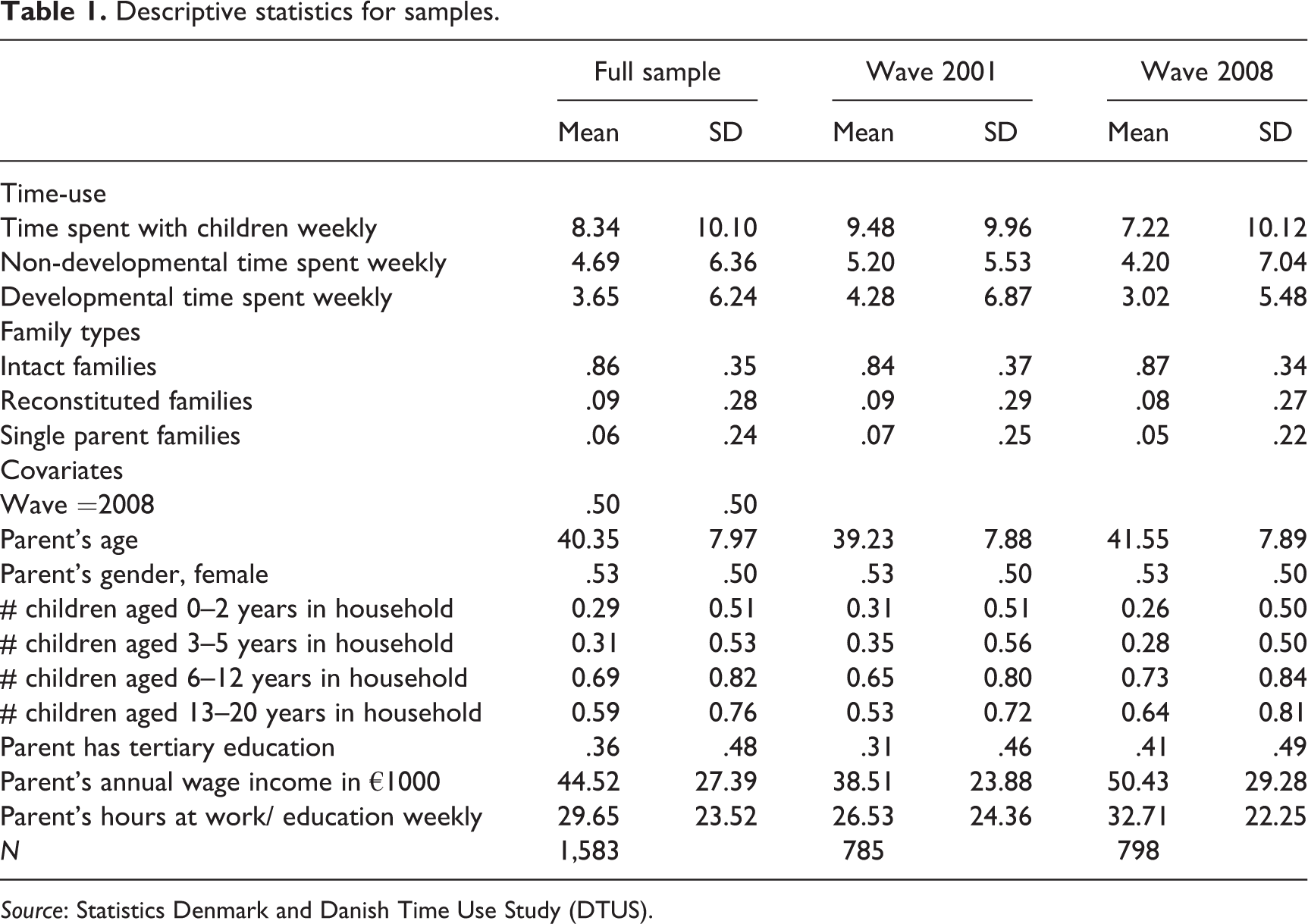
Table 1 presents descriptive statistics for the sample. On average, the parents in our sample spent 8.34 hours with children per week, with 4.69 hours dedicated to non-developmental activities and 3.65 hours dedicated to developmental activities. Respondents spent 2.3 hours more with children in 2001 than in 2008, which we expected because there was a higher number of younger children in 2001 than in 2008 (see the average number of children in the 0–2- and 3–5-year-old categories), and these children need more immediate care. The sample was divided evenly by both gender (53% female) and survey wave (50% of responses were from the 2008 wave). The average participant was 40.35 years old, a third of the parents had tertiary education and their average wage income was €44,500 in 2008 prices. The average respondent in the survey saw a wage increase of 30% between the two survey waves, reflecting two things. First, with resampling 7 years apart, individuals experienced wage growth. Second, 2008 was the apogee of wage growth in Denmark preceding the financial crisis starting late that year.
Descriptive statistics for samples.
Source: Statistics Denmark and Danish Time Use Study (DTUS).
We group together married and cohabiting unions. Although the latter tend to have a higher dissolution risk, a robustness test reported later shows no substantial difference between cohabiting and married unions in terms of time investment in children. Most respondents lived in cohabiting or married unions with joint children when they responded to the survey waves (86%), 6% were single and 9% lived with a partner but did not have joint children.
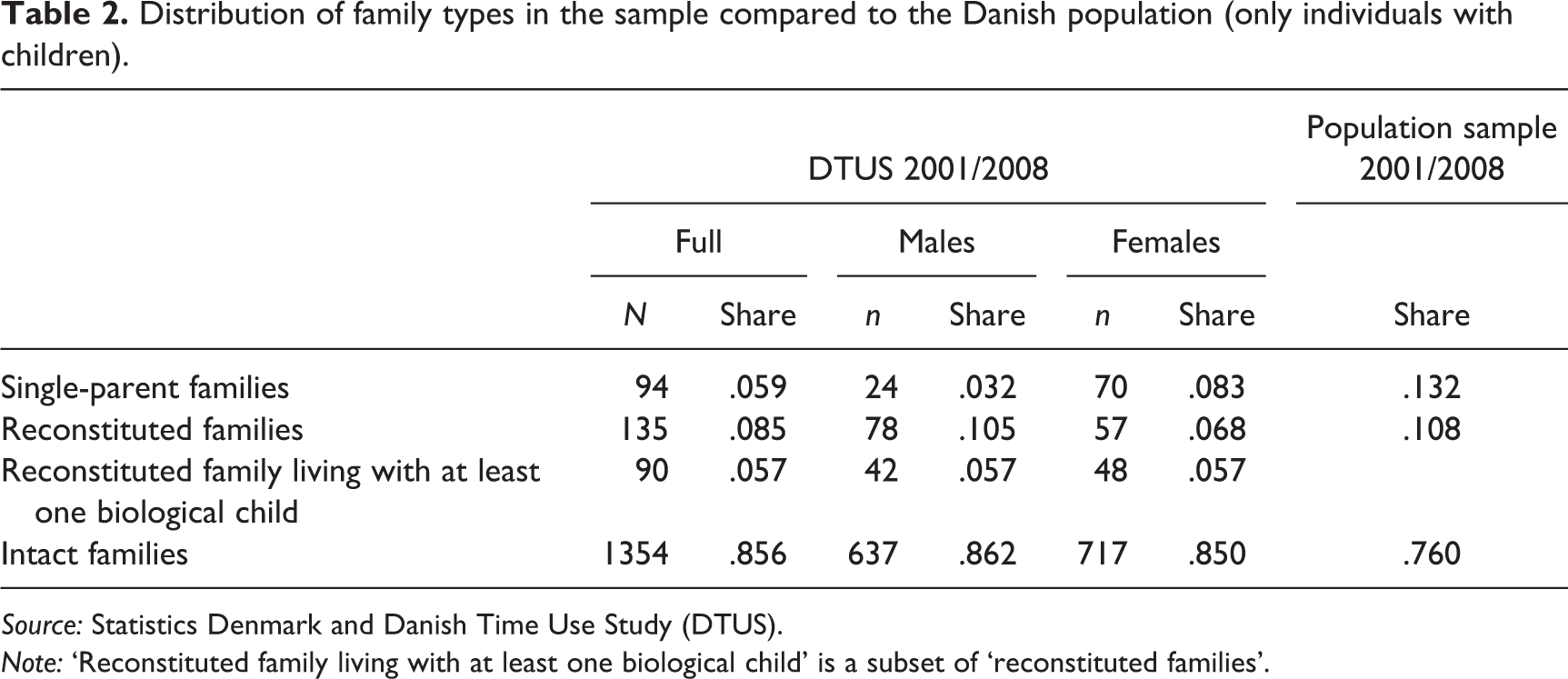
Although our data quality is high, our sample is limited in size and includes more intact families than found in the general Danish population. Table 2 shows the distribution of family types with children in the full Danish population compared to our sample. Reconstituted families and single-parent families are underrepresented in our analytical sample. Such non-intact families may, for instance, be busier, and thus less likely to participate in time-use surveys than intact families. To try to account for this, we utilise information on amount of time spent working and studying, as this may not only constrain time-use on children, but also selection into participation in the survey.
Distribution of family types in the sample compared to the Danish population (only individuals with children).
Source: Statistics Denmark and Danish Time Use Study (DTUS).
Note: ‘Reconstituted family living with at least one biological child’ is a subset of ‘reconstituted families’.
Figure 1 presents respondents’ weekly time-use on children across the three family types for each survey wave. For the 2001 wave, parents living in intact families spent each 10 hours a week on children, with developmental time accounting for roughly 4.5 hours. In the 2008 wave, they spent 7.5 hours, with developmental time accounting for 3 of those hours. Parents in reconstituted families spent on average a little more than 4.5 hours on children a week in 2001, with just below 2 hours dedicated to developmental activities. In the later wave, the total time was higher at just below 6 hours a week, with 2.5 hours spent on developmental time. Single parents have the largest difference across waves. In the first wave they spent more than 10 hours a week, with 3.75 hours on developmental time. In the second wave they spent just above 4 hours in total, with 1.5 of those spent on developmental activities.
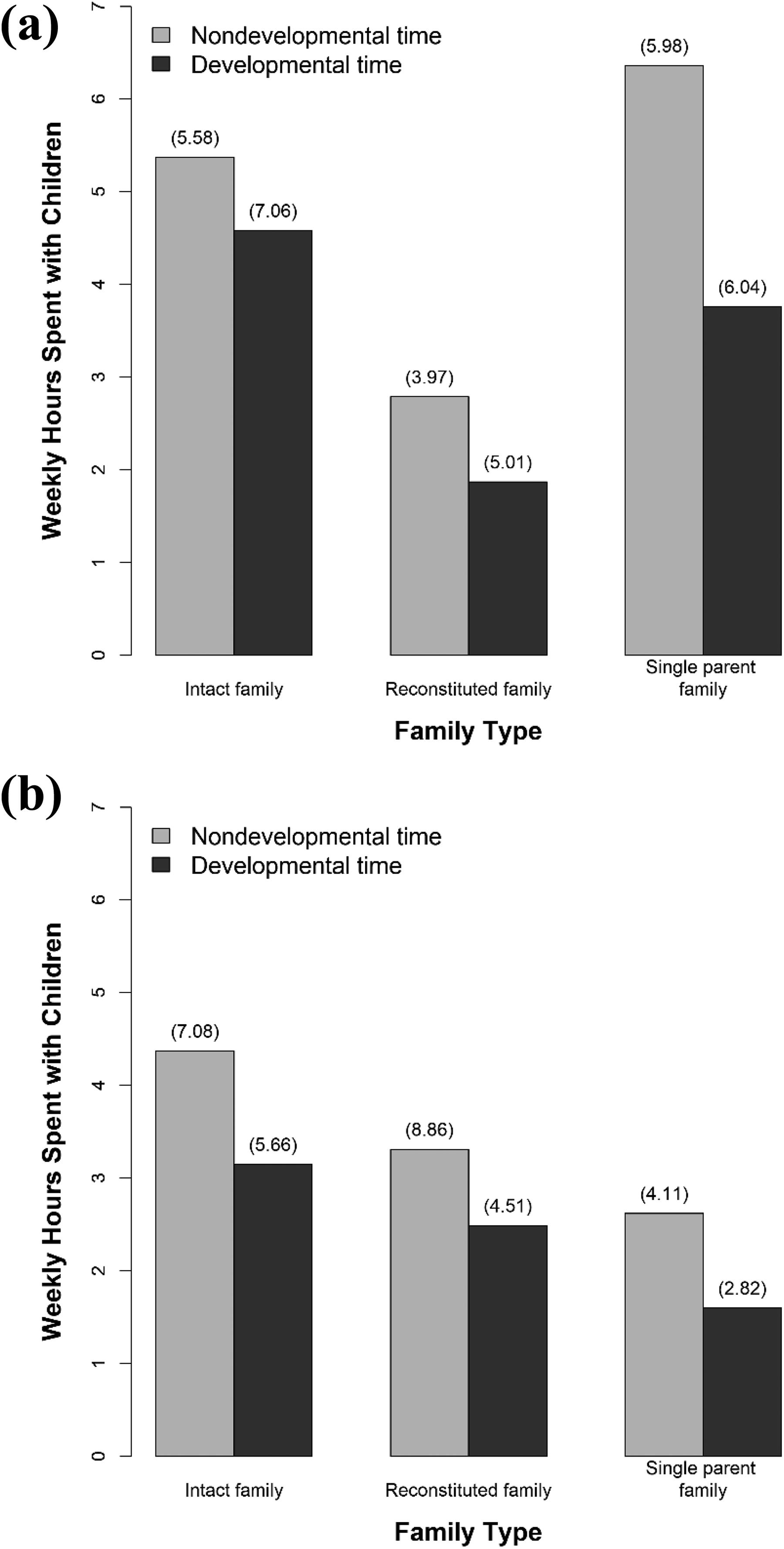
Weekly number of hours of non-developmental and developmental time parents spent with children across family types. (a) Wave 2001. (b) Wave 2008.
The differences in time-use on children presented in Figure 1 may simply reflect that certain people are more likely to enter certain types of family constellations, and that certain constellations are more likely at some parts of the life course than at others. To examine whether family type may have had an independent influence on the amount of time parents spent on children after controlling for selection of specific types of individuals into specific family types, we utilise the longitudinal nature of our sample.
Analytical strategy
As seen from Figure 1, there are clear differences across family types in the weekly time that parents spend on children. These differences may be the result of unobserved and observed characteristics acting as confounders. To account for differences in observed characteristics, we control for several covariates (see Table 1). The longitudinal nature of our sample allows us to control for unobserved constant individual characteristics (i.e. individual-level fixed effects). Previous studies of family type and parental time-use on children have predominantly used cross-sectional data. However, with cross-sectional data, it is hard to control for unobserved individual traits without having access to good proxy variables and both social desirability and recall bias can cause further problems for the interpretation of estimates. Thus, it is difficult to distinguish between the effect of living in a certain family type from the selection into family types.
Fixed-effects models utilise the repeated observations of the same individuals to control for such constant individual effects. We posit that the following model describes how individual i spends time with their children across time t:

Child Time describes the weekly hours a parent spends with children.
Fixed-effects models do, however, rely on repeated observations of the same individuals. Luckily, more than half of respondents in the sample participated in both the 2001 and 2008 waves of DTUS. Out of 988 unique respondents across the two waves, 595 are in the sample in both periods, and of these 12% change family type between the waves. There are two reasons for the unbalance in the panel data. First, the 2008 wave of DTUS consisted of resampled participants from the 2001 wave, but also new participants that had not previously participated in DTUS, to account for general attrition. Second, our analytical sample consisted of individuals who lived with, or were biological parents of, a child younger than 21 when they participated in the survey. Survey respondents that participated in both waves, but either became parents or saw their children reach adulthood between the two waves, were included only for the wave when they met the sampling criteria. Together, the two reasons also account for the fact that age between the two survey waves increases with less than seven years (as seen from Table 1). Thus, we identify the fixed-effects models through the 595 repeated respondents. For the random-effects models, we use all available observations. For robustness, we also report random-effects estimates for a restricted sample limited to those who participated in both waves of the survey.
Results
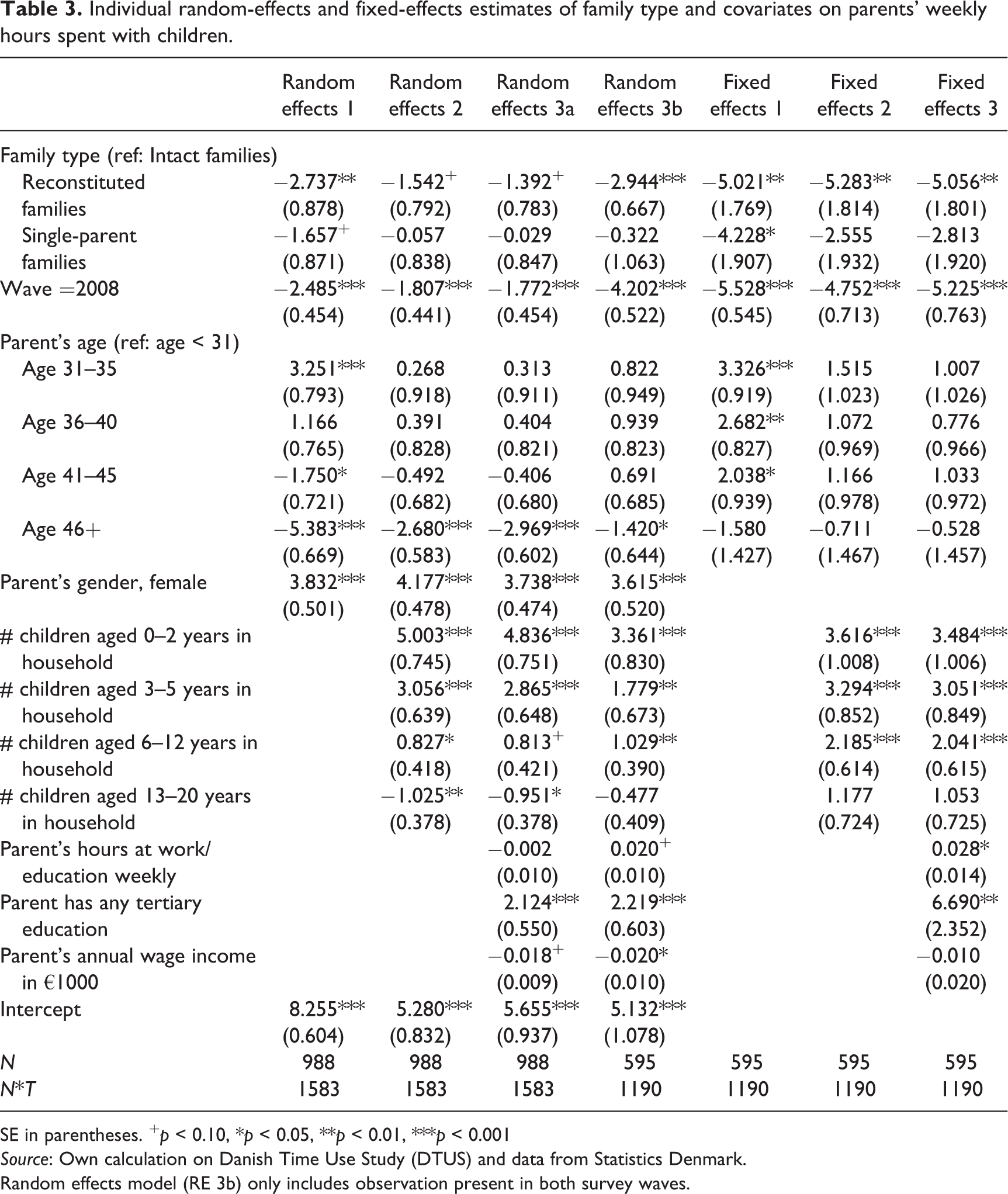
We consider the role that family types play in shaping parents’ weekly time-use with children. We present results from random-effects models to show baseline associations, and from fixed-effects models to show results where we also control for individual constant traits. Time is measured as weekly number of hours spent with children, so parameter estimates should be interpreted on that scale. Table 3 reports results from models with developmental and non-developmental time jointly as the dependent variable. To show how other factors may confound the impact of family type on time-use with children, we introduce controls for number of children in the household and their age and parent’s time constraints due to labour market work and educational activities.
Individual random-effects and fixed-effects estimates of family type and covariates on parents’ weekly hours spent with children.
SE in parentheses. + p < 0.10, *p < 0.05, **p < 0.01, ***p < 0.001
Source: Own calculation on Danish Time Use Study (DTUS) and data from Statistics Denmark.
Random effects model (RE 3b) only includes observation present in both survey waves.
The estimates in the first result column (Model RE 1) present the associations between the amount of time parents spend with children and family type, where we only control for respondent’s age, gender, survey year and a random-effects error structure. The estimates report that parents in reconstituted families spend more than 2.5 hours less a week with children than do parents living in intact families. The estimate is significant at the .01 level. For single parents, the estimate is 1.7 hours less and significant at the 10% level. When we introduce variables that account for the number of children and their age in the household (RE 2), the estimate for parents in reconstituted families decreases, but remains significant at the 10% level. The estimate for single parents becomes close to zero and insignificant. Not surprisingly, the number of children in the household below the age of 13 increases time spent with children and women spend more time with children than men do. The more children aged 13–20 in the household, the less time parents spend with children. Controlling for tertiary education, wage income and time spent on working hours and educational activities has little impact (RE 3a). Using only respondents participating in both waves (RE 3b), we see that the estimated parameter for reconstituted family are farther from zero than those reported in RE 3a, but patterns remain the same.
For the fixed-effects model without additional controls (FE 1) we see a significant negative parameter estimate for parents in reconstituted families that is close to twice the size of the random-effects result, although with substantially larger standard errors (this is to be expected given the decrease in degrees of freedom due to the fixed-effects specification), suggesting a positive selection into this family type. When we add control variables, the estimate increases slightly. In FE 3, we see that, controlling for constant effects of individual-specific selection into family types, parents in reconstituted relationships spend 5 hours less a week with children than parents in intact families. The parameter estimate is significant at the 1% level. For single parents, we see a large negative and significant parameter estimate when we do not control for children in the household. When we add the full set of controls, our results place the estimate at 2.8 hours less than parents in intact families do, but the parameter estimate is insignificant due to large standard errors. We also find that more hours spent working or on education is positively associated with time spent with children once we control for fixed effects, although only marginally significant and with a small estimate. 5
Overall, we see that both single parents and parents in reconstituted families spend less time with children, although estimates only are significant for the latter group. We now present results that distinguish between types of time with children.
Types of time-use
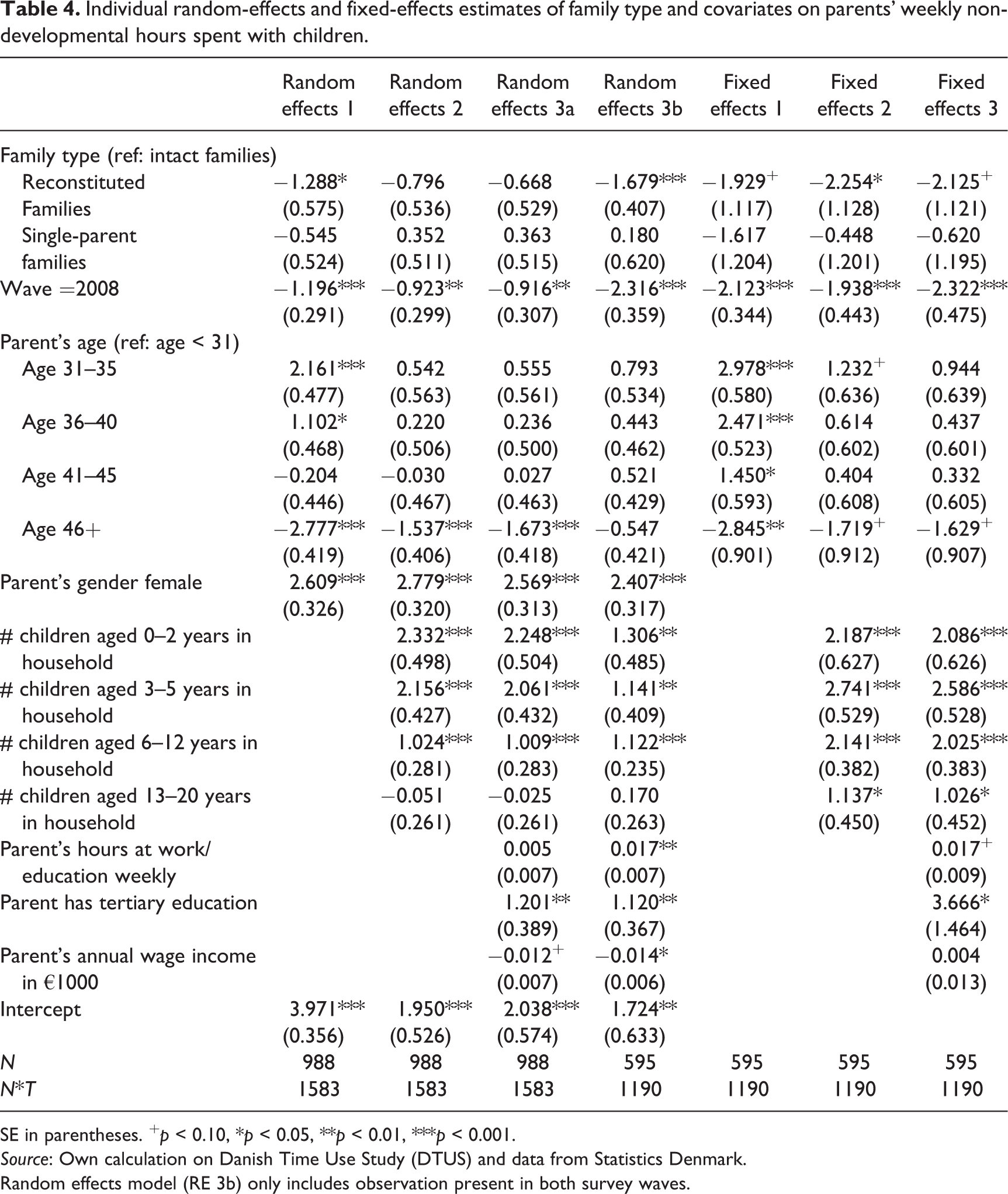
Table 4 presents results with amount of weekly non-developmental time as the dependent variable. The random effects results for non-developmental time, where we only control for age, gender and survey year (Model RE 1) show that being a parent in a reconstituted relationship is significantly associated with spending 1.3 hours less on non-developmental time per week compared to parents in intact families. For single parents, the parameter estimate is half an hour less and insignificant. Once we add controls, the parameter estimate for parents in reconstituted families moves towards zero, and in our full model (RE 3a) it is reduced to 0.7 hours. For single parents the sign becomes positive in Models RE 2 and RE 3a, but the parameter estimates remain small and insignificant.
Individual random-effects and fixed-effects estimates of family type and covariates on parents’ weekly non-developmental hours spent with children.
SE in parentheses. + p < 0.10, *p < 0.05, **p < 0.01, ***p < 0.001.
Source: Own calculation on Danish Time Use Study (DTUS) and data from Statistics Denmark.
Random effects model (RE 3b) only includes observation present in both survey waves.
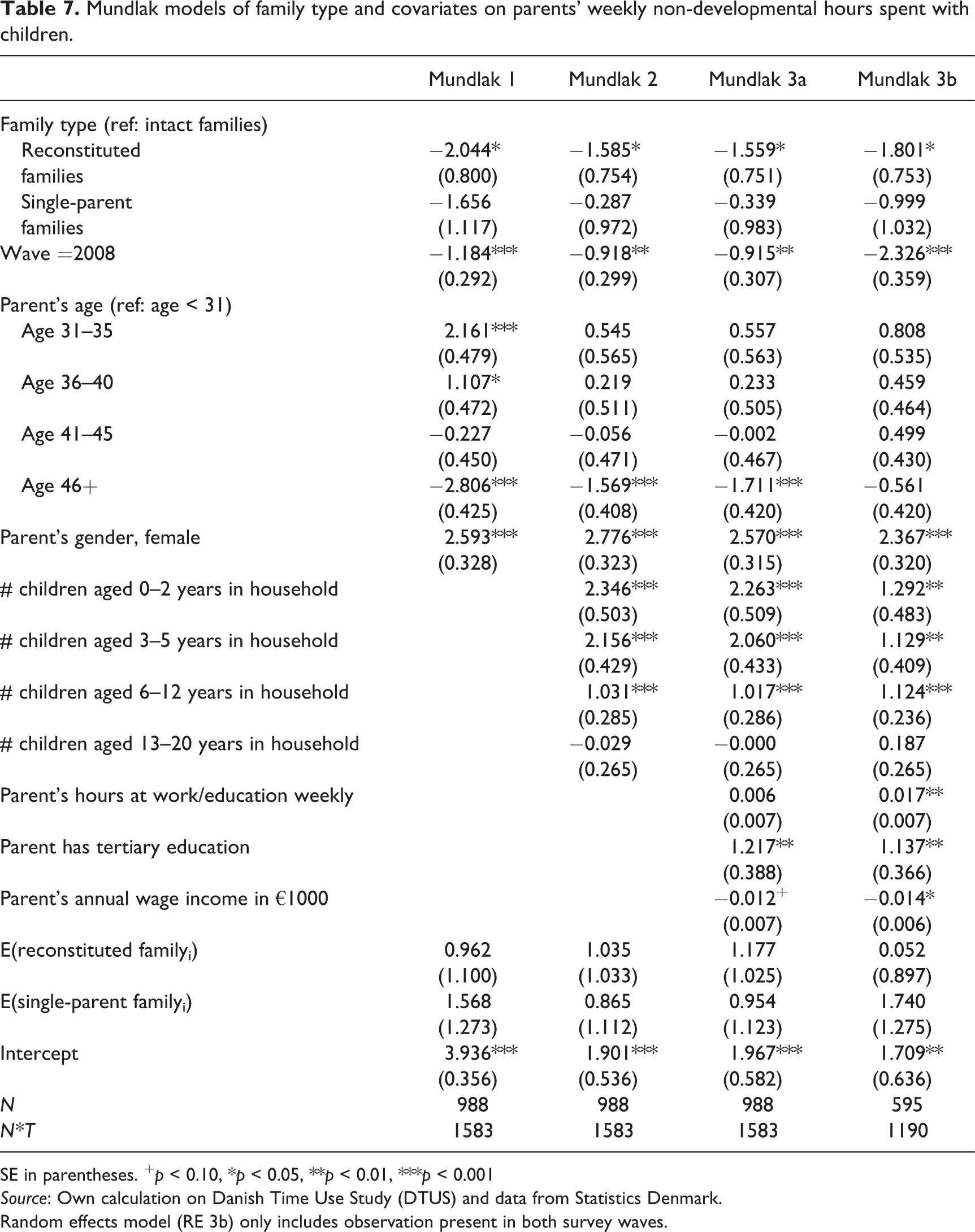
The parameters in the fixed-effects models for parents in reconstituted families are somewhat similar to the random-effects results before we add controls (FE 1), but when we control for children, education, wage income, working hours and educational activity (FE 3), the estimate increases to 2.1 hours and remains significant at the 10% level, again suggesting a positive selection into this family type. For single parents, we see that the fixed-effects estimates are larger than the random-effects estimates but adding controls for children and working and educational hours decreases the estimate size by more than 50%. The estimate is insignificant in all specifications. Thus, after controlling for individual unobserved constant traits, working hours and children, we find that single parenthood does not significantly alter the amount of non-developmental time that parents spend with children. Yet parents in reconstituted families do spend significantly less time on non-developmental activities, indicating that individuals who are prone to spend more time on non-developmental activities tend to select into reconstituted families. Again, we do see that the random-effect results from the restricted sample (RE 3b) are closer to the fixed-effect results than are the results from RE 3a. In Table 7 in the Appendix, we present results from Mundlak models for all the random effects results – once controlling for selection into family types, estimates are similar between the unrestricted and the restricted sample, indicating the fixed-effect results are not driven simply by the fact that the parameters only are identified by individuals present in both waves.
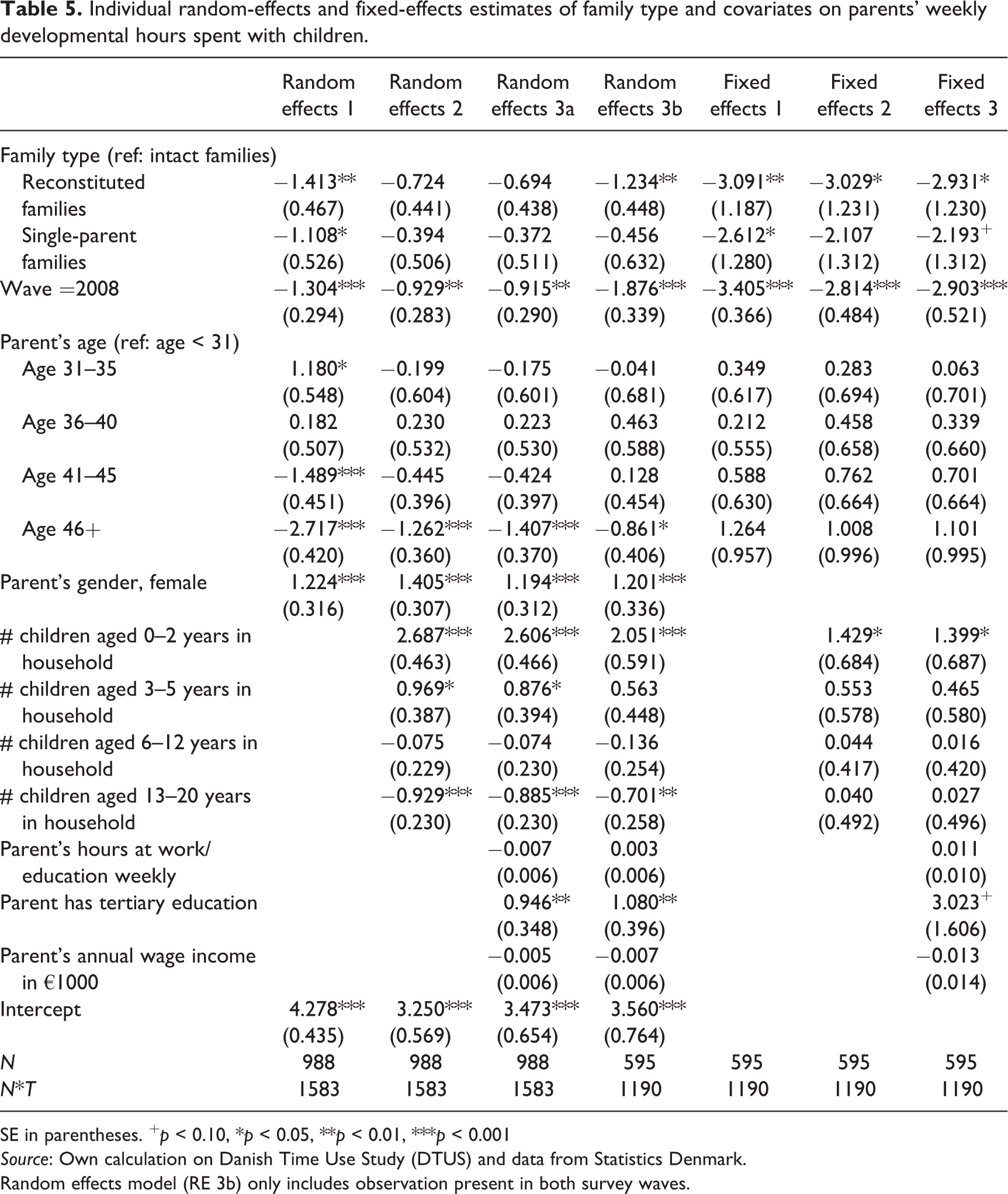
Turning to the results for developmental time presented in Table 5, we see a similar pattern as with the results from the models for non-developmental time for the random-effects models. The negative parameter estimate for RE 3a is insignificant for parents in reconstituted families and does not differ substantially from the result for non-developmental time in Table 4. Again, the estimate for single-parent families is small and insignificant once we add control variables.
Individual random-effects and fixed-effects estimates of family type and covariates on parents’ weekly developmental hours spent with children.
SE in parentheses. + p < 0.10, *p < 0.05, **p < 0.01, ***p < 0.001
Source: Own calculation on Danish Time Use Study (DTUS) and data from Statistics Denmark.
Random effects model (RE 3b) only includes observation present in both survey waves.
The fixed-effects model l (FE 1) where we only control for age, gender and survey year, report that single parents spend 2.6 hours less per week on developmental activities (significant at the 5% level) than parents in intact families do, and parents in reconstituted families spend 3.1 hours less (significant at the 1% level). Estimates decrease when we introduce controls, but we still find that parents in reconstituted families spend 2.9 hours less per week on developmental activities (significant at the 5% level) and single parents spend 2.2 hours less (significant at the 10% level) (FE 3). Thus, controlling for individual unobserved constant traits, we find that parents in reconstituted and single-parent families spend significantly less weekly developmental time with children than parents in intact families do.
Our results suggest that parents who are prone to spend more developmental and non-developmental time with their children to some extent seem to select into the reconstituted family type (and, to a lesser extent, into the single-parent family type). Figure 2 presents the marginal effects of estimated models RE 3a and FE 3 from Tables 4 and 5 of family type, estimated at the mean values of all other covariates. Given the effect of individual unobserved characteristics is constant over time, the difference between the magnitudes of the bars between the two subfigures is the impact of selection. Figure 2(b) shows that although single-parent and intact families contribute an almost equal amount of non-developmental activities, parents in reconstituted families contribute considerably (and significantly) less. However, as seen from comparing Figure 2(a) and Figure 2(b), this lack in time spend is mitigated by the type of people who live in such families. Yet this does not change the fact that parents in reconstituted two-parent families spend less time on non-developmental activities than they would have, all things constant, had they lived in an intact family. For Danish families, family type has a substantial impact on the amount of time parents spend on developmental activities, with single parents and parents in reconstituted families spending less than half the time parents in intact families do once unobserved constant traits are considered. We return to an interpretation of these results below.
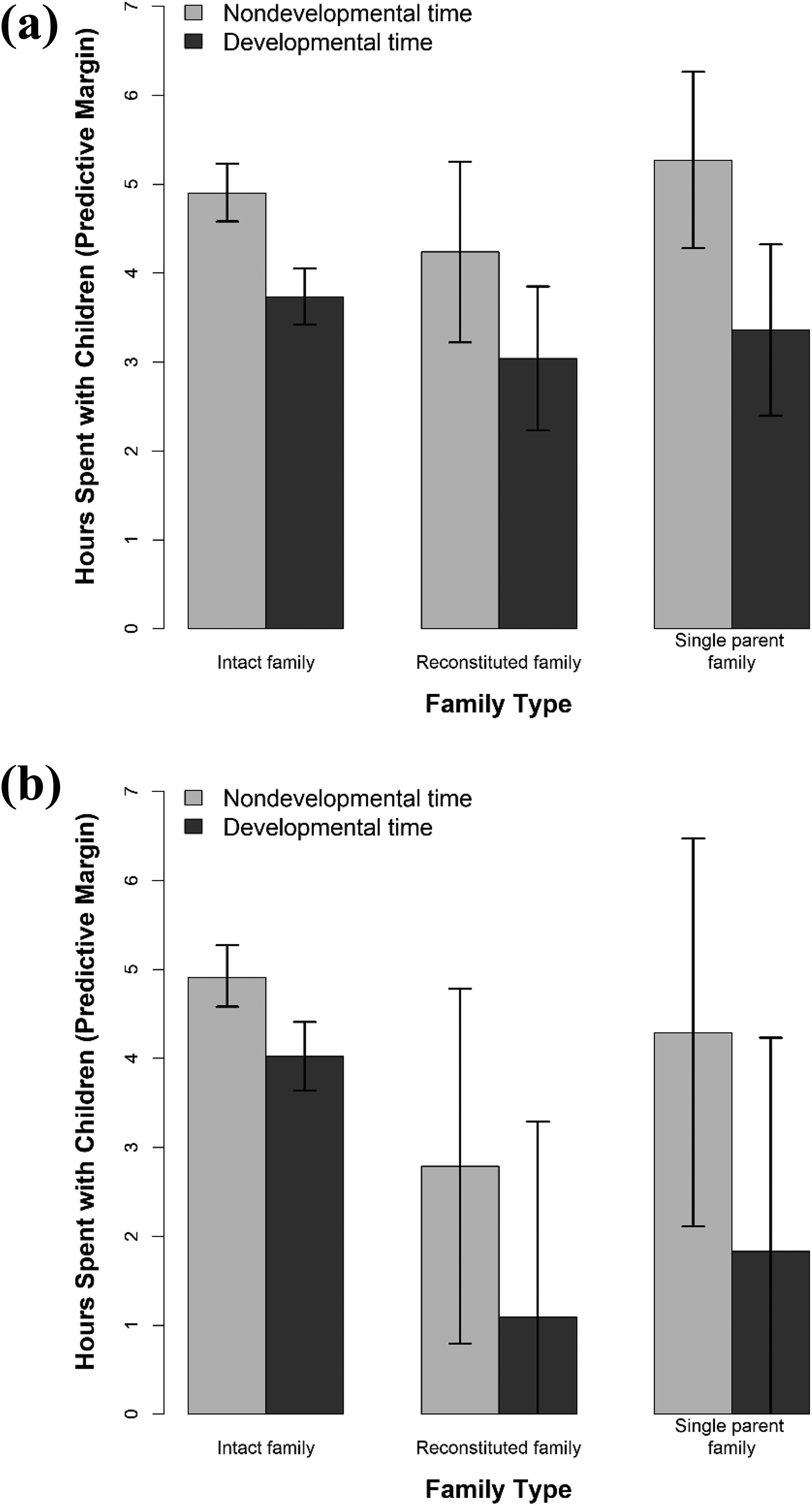
Predictive margins from random effects and fixed effects models of time spent on children across family type and type of time. (a) Individual random-effects margins. (b) Individual fixed-effects margins.
Robustness tests
To test the reliability of our results, we ran a series of robustness tests. We provide a brief summary of our alternative specifications here (full set of estimates are available on request). As we mentioned in the section on Analytical Strategy, we tested a series of hybrid models that challenged parts of assumptions underlying the fixed-effects specification. Two of these can be found in the Appendix (Table 6 and Table 7). The hybrid models did not provide substantially different results. We then addressed our sample composition. First, we investigated whether results differed across parent’s gender, one reason being that almost all men in reconstituted families did not live with their own children as noted in Table 2. Because of the substantial decrease in sample size, only the parameters for women in reconstituted families were significant for any of the fixed-effects models when we estimated models for genders separately. Still, results across gender were similar to those reported in Tables 3, 4 and 5.
Second, to test whether the higher likelihood among parents who had joint children to both participate in the survey introduced bias, we re-ran our models keeping only one focal adult in each household. The results remained the same. The same was the case when we only included respondents who had their own biological children living with them.
Third, different family types may spend time together as a family in different ways. Parents in reconstituted families could prefer spending time with their partner and children simultaneously to a higher degree than would parents in intact families. Yet when we include time together as a family in our measure of time with children (i.e. family activities such as watching television together and playing boardgames) results do not change. For the 2008 wave, we also had information on if children were present while parents performed other activities (e.g. cooking). We ran models with and without such secondary time with children and results were close to identical.
Last, we allowed marriage to differ from cohabitation and let respondents that both had shared and non-shared children also be their own category. The introduction of these new family type categories did not contribute substantial new knowledge.
Discussion
In this study, we have shown that family type affects the amount of weekly time that parents spend with children when controlling for relevant observed characteristics and unobserved time-invariant characteristics of the parents. Parents in a reconstituted family spend significantly less time on developmental and non-developmental activities with their children than parents who live in an intact family setting even when time together as a family (partner and children simultaneously) is considered. For single parents, parameter estimates indicated decreased time on developmental activities.
The type of family structure in which parents live likely both imposes constraints on and reflects preferences for time-use with children. Single parents face more restrictions on their time-use than co-residing parents because single parents do not benefit from the possibility of household labour division and substitution that co-residing parents do. It may seem odd that parents in reconstituted families spend even less time with children than single parents do. The explanation likely is found in the differences in the relations between co-residing parents that have joint children and those who do not have joint children. Parents in reconstituted relationships may wish to invest time differently than parents in intact relationships, with the former favouring more exclusive time with their significant other than the latter. Thus, for reconstituted couples, the presence of a partner may in itself be a time constraint in terms of how much time can be spent with children.
People may choose to enter and remain in relationships for different reasons, either to have a partner, to have a child, or both. In open societies such as in Denmark, the family type in which people live likely (partly) reflects variation in preferences for partners and children. The analyses conducted in this paper were solely based on individuals who have become parents and consider two ideal-typical types of people, those with joint preference for a partner and children, and those whose preferences for parent and children are independent from each other. Those with joint preferences see living in a union and having children as a joint decision whereas those with independent preferences see it as two distinct, independent decisions. When living in a union, (ideal-typical) people with joint preferences always become parents, whereas people with independent preferences only become parents if they have a strong preference for children. In other words, people with joint preferences with a weak preference for children will still become parents and show up in our data, whereas people with independent preferences with a weak preference for children will neither become parents nor be found in our data. People with joint preferences are more likely to be found in intact families as they see living with partner and child as a joint decision whereas people with independent preferences are more likely to be found in the single-parent or reconstituted family categories as they separate the decisions on having a partner and children. The theoretical model suggests, and our empirical analysis supports, parents from non-intact unions are on average positively selected on individual specific unobservable preference for spending time with their children, even if the same parents tend to be negatively selected on most classic observable traits, such as education and labour market attachment.
Limitations
The dataset used here is both rich in information and of high quality, but the sample is rather small, with 1583 person years where we only observe 595 individuals in both waves of our data. This causes high standard errors, especially on the fixed-effects estimates. Yet although we lose precision in these models, we get a substantial decrease in both measurement error originating from, for example, social desirability bias (if individuals consistently report more (less) time spend with children than performed) and respondents’ joint preferences for time-use with children and family type. The period between waves is also long (7 years), which means the effect of individually specific constant traits could vary, yet our robustness tests do not alter the results and conclusions drawn.
Secondly, our study considered the amount of time parents spend with children, not the amount of time individual children receives from parents. Further, when it comes to children living in non-intact families, our approach only captures the time investment from one of the parents because of the nature of the sample. We do find that both single parents and parents in reconstituted families spend less time with children, indicating that sibships can expect less time with parents if their parents are in a non-intact family type. However, extending the present study to incorporate a child-centric approach looking at the time individual children spend with parents would add a much-needed additional perspective.
Perspective
So, what, if any, may be the consequences of systematic differences in developmental time-use with children across family structures in Denmark? On one hand, children growing up in non-intact households often have parents with fewer resources than children growing up in intact families (Ottesen et al., 2014: 98–99). Given the importance of material and immaterial investments in children for their skill development over the early life course, children growing up in non-intact families may be disadvantaged twice in terms of developmental activities, thus underpinning the risk for diverging destinies (McLanahan, 2004). On the other hand, the presence of strong welfare institutions aimed at childcare and child development, such as low-cost, high-quality day-care and preschools, may mediate the negative impact of lower time-use if children instead spend their time in such institutions. To fully understand if, and to what extent, differences across family types in parents’ time-use with children may have developmental consequences for children, future research should study children’s time-use with parents and other significant adults.
Footnotes
Acknowledgments
The authors thank Jens Bonke, Signe Hald Andersen, Karin Halldén, Michael Tåhlin, Carina Mood, Janne Jonsson, Lonnie Berger, Anders Hjorth-Trolle, five anonymous reviewers and the Acta Sociologica editorial team for valuable comments. We also thank members of the European Network for the Sociological and Demographic Study of Divorce, the RC28, and the members of the LNU group at the Swedish Institute for Social Research.
Funding
The author(s) disclosed receipt of the following financial support for the research, authorship, and/or publication of this article: this study was funded by grants from the Swedish Research Council for Health, Working Life and Welfare (Forte Grant 2016-07099) and the ROCKWOOL Foundation (Grant 1142).

Notes
Appendix
Mundlak models of family type and covariates on parents’ weekly non-developmental hours spent with children.
| Mundlak 1 | Mundlak 2 | Mundlak 3a | Mundlak 3b | |
|---|---|---|---|---|
| Family type (ref: intact families) | ||||
| Reconstituted families |
−2.044* | −1.585* | −1.559* | −1.801* |
| (0.800) | (0.754) | (0.751) | (0.753) | |
| Single-parent families |
−1.656 | −0.287 | −0.339 | −0.999 |
| (1.117) | (0.972) | (0.983) | (1.032) | |
| Wave =2008 | −1.184*** | −0.918** | −0.915** | −2.326*** |
| (0.292) | (0.299) | (0.307) | (0.359) | |
| Parent’s age (ref: age < 31) | ||||
| Age 31–35 | 2.161*** | 0.545 | 0.557 | 0.808 |
| (0.479) | (0.565) | (0.563) | (0.535) | |
| Age 36–40 | 1.107* | 0.219 | 0.233 | 0.459 |
| (0.472) | (0.511) | (0.505) | (0.464) | |
| Age 41–45 | −0.227 | −0.056 | −0.002 | 0.499 |
| (0.450) | (0.471) | (0.467) | (0.430) | |
| Age 46+ | −2.806*** | −1.569*** | −1.711*** | −0.561 |
| (0.425) | (0.408) | (0.420) | (0.420) | |
| Parent’s gender, female | 2.593*** | 2.776*** | 2.570*** | 2.367*** |
| (0.328) | (0.323) | (0.315) | (0.320) | |
| # children aged 0–2 years in household | 2.346*** | 2.263*** | 1.292** | |
| (0.503) | (0.509) | (0.483) | ||
| # children aged 3–5 years in household | 2.156*** | 2.060*** | 1.129** | |
| (0.429) | (0.433) | (0.409) | ||
| # children aged 6–12 years in household | 1.031*** | 1.017*** | 1.124*** | |
| (0.285) | (0.286) | (0.236) | ||
| # children aged 13–20 years in household | −0.029 | −0.000 | 0.187 | |
| (0.265) | (0.265) | (0.265) | ||
| Parent’s hours at work/education weekly | 0.006 | 0.017** | ||
| (0.007) | (0.007) | |||
| Parent has tertiary education | 1.217** | 1.137** | ||
| (0.388) | (0.366) | |||
| Parent’s annual wage income in €1000 | −0.012+ | −0.014* | ||
| (0.007) | (0.006) | |||
| E(reconstituted familyi) | 0.962 | 1.035 | 1.177 | 0.052 |
| (1.100) | (1.033) | (1.025) | (0.897) | |
| E(single-parent familyi) | 1.568 | 0.865 | 0.954 | 1.740 |
| (1.273) | (1.112) | (1.123) | (1.275) | |
| Intercept | 3.936*** | 1.901*** | 1.967*** | 1.709** |
| (0.356) | (0.536) | (0.582) | (0.636) | |
| N | 988 | 988 | 988 | 595 |
| N*T | 1583 | 1583 | 1583 | 1190 |
SE in parentheses. + p < 0.10, *p < 0.05, **p < 0.01, ***p < 0.001
Source: Own calculation on Danish Time Use Study (DTUS) and data from Statistics Denmark.
Random effects model (RE 3b) only includes observation present in both survey waves.