




Abstract
Women generally have less job authority than men. Previous research has shown that human capital, family features and contextual factors cannot fully explain this gender authority gap. Another popular explanation holds that women’s career opportunities are limited because their social networks comprise less beneficial contacts and resources than men’s. Yet, the role of social networks has received little attention in empirical research seeking to explain the gender gap in job authority. This study examines to what extent gender differences in social networks exist and are related to the gender authority gap. Drawing on two strands of social network theory, we develop hypotheses about the role of network diversity and network status. We test these hypotheses using representative longitudinal data from the NEtherlands Longitudinal Lifecourse Study (2009–2013). Results reveal that women generally had less diverse occupational networks in terms of contacts’ occupations and were less likely to know managers than men, network features which are found to be significantly related to job authority. Controlling for these gender differences in networks leads to a reduction of the observed gender authority gap that is statistically significant but modest in substantive terms.
Keywords
Introduction
On average, women have considerably less job authority than men (Dämmrich and Blossfeld, 2016; Grönlund et al., 2017; Mandel and Semyonov, 2006). Generally, women are about half as likely as men to hold authority positions, but the gap is larger at higher levels of management (Abendroth et al., 2013; Yaish and Stier, 2009). Such gender differences in job authority form an important dimension of labour market gender inequality but are also a possible cause of (other) gender inequalities in the labour market. A larger share of women in (top) management positions in organisations has been shown to be associated with smaller gender wage gaps (Cardoso and Winter-Ebmer, 2010), less gender segregation (Stainback et al., 2016) and more women in middle-management (Kurtulus and Tomaskovic-Devey, 2012).
Prior studies seeking to explain gender differences in job authority mainly focused on the role of human capital (e.g. Abendroth et al., 2013), family features (e.g. Bröckel et al., 2015; Bygren and Gähler, 2012), occupational gender segregation (Grönlund et al., 2017) and contextual factors, such as labour market features or public policies (Dämmrich and Blossfeld 2016; Yaish and Stier, 2009). Together, these studies show that, although these factors play a role, they cannot fully explain the gender authority gap.
Social networks form a potential explanation for gender differences in job authority that has received much less attention in empirical research. This is remarkable, given the conventional wisdom that women’s career opportunities are limited and men’s careers opportunities enhanced by the existence of ‘old boy’s networks’ (Brass, 1985; Campbell, 1988; McDonald, 2011). Women’s social networks are assumed to consist of less beneficial contacts and resources (e.g. information, influence, social credentials) than men’s networks, which is thought to hinder women’s advancement to desirable labour market positions, including authority positions (e.g. Lin, 2000). Several researchers have drawn attention to the lack of evidence on whether and how networks affect gender gaps in career success and have called for more empirical research on this topic (see Lutter, 2015).
Heeding these calls, this study provides more insight in the linkages between gender, social networks and job authority. It contributes to existing research in several ways. Firstly, we address the aforementioned knowledge gap by empirically examining gender differences in social networks and whether (part of) the gender authority gap is associated with such differences. Secondly, the question of which types of networks, contacts and network resources improve career outcomes remains subject to lively debate in the social networks literature (e.g. Barbulescu, 2015; Kim and Fernandez, 2017). Against this backdrop, our study explores which features of networks and contacts are related to gender differences in job authority. We draw on two influential strands of social network theory, which emphasise the variety of different types of contacts in networks (e.g. Burt, 1992; Granovetter, 1983; Erickson, 2001) and the status positions of those in networks (e.g. Lin et al., 1981; Lin, 1999) respectively. Applying these two approaches to the gender gap in job authority, we derive hypotheses about the role of two aspects of social networks: network diversity and network status. Additionally, we examine the role of both core discussion networks (consisting of contacts with whom one has stronger ties) and occupational networks (comprising comparatively weaker ties). Finally, we take into account several indicators of the resources embedded in social networks: contacts’ education, occupation, job status and gender.
In sum, this study addresses the following research question: to what extent are gender differences in social networks’ and contacts’ diversity and status in terms of education, occupation, job status and gender associated with women having less job authority than men? To answer this question, data are required that contain information on both job authority and social networks and the resources embedded in them. Such data are available in the NEtherlands Longitudinal Lifecourse Study (NELLS, 2009–2013). This representative, longitudinal dataset also allows us to provide more insight in the causality of the relation between social networks and job authority. We define job authority in terms of having a job in which one supervises others and distinguish various levels of authority based on the number of subordinates. Measuring job authority is theoretically and empirically complex (Cohen et al., 2009) and researchers have operationalised it in various ways (Smith, 2002). However, in recent research on gender and job authority, supervisory authority is the most commonly used measure (Abendroth et al., 2013; Bygren and Gähler, 2012; Dämmrich and Blossfeld, 2016; Grönlund et al., 2017; Mintz and Krymkowski, 2010; Yaish and Stier, 2009).
Theory
In the social networks literature, there is continued debate about which types of networks and contacts are (most) beneficial for career outcomes (e.g. Barbulescu, 2015). Some highlight the significance of weak ties (e.g. Granovetter, 1973; Yabukovic, 2005) or contacts spanning a range of positions (e.g. Erickson, 2001; Lin, 1999), whereas others stress the importance of close contacts and strong ties (e.g. Kim and Fernandez, 2017; Obukhova, 2012).
This study draws upon two influential strands of social network theory, concentrating on the accessibility of social network resources (Lin, 1999). The first strand – comprising for example the work of Granovetter (1973; 1983), Burt (1992) and Erickson (2001) – focuses on the diversity or variety in social networks and argues that it is advantageous for someone’s career to be connected to many different types of contacts. The second strand of theory – social resources theory, comprising the work of Lin and colleagues (e.g. Lin et al., 1981) – holds that it is having contacts in higher positions that is beneficial to career success. Importantly, both strands of theory assume that the resources embedded in social networks improve career opportunities (Lin, 1999; Seibert et al., 2001).
In the following, we therefore first discuss how social network resources are argued – across different strands of social network theory – to improve career opportunities. Subsequently, we elaborate on the two aforementioned strands of network theory; we discuss how they highlight different features of social networks, how these network features are argued to relate to career opportunities and in particular people’s likelihood of having (more) job authority. By combining these ideas with assumptions about how women’s and men’s networks differ, we derive predictions about the extent to which the gender gap in job authority is associated with gender differences in social networks.
Social network resources and job authority
We apply social network theories to gender differences in individuals’ job authority at a certain time point. Individuals may have reached those positions by moving up the career ladder within an organisation, applying for a (higher-level) position in another organisation, or a combination of both. Although traditionally most vacancies (particularly for authority positions) were filled internally, outside hires have become much more important over recent decades and the prevalence of (long) tenure has declined (Capelli, 2008). Hence, we theorise how social networks may be beneficial for both individuals’ odds of advancing up internal career ladders and their chances of obtaining (higher-level) positions in other organisations.
Social networks are thought to be related to career advancement within organisations, because contacts can provide information or other resources. Specifically, network resources can improve career opportunities via several pathways. Social contacts may offer task advice or strategic information, improve one’s reputation and power, provide social support or support from those whose approval is necessary to pursue initiatives in organisations, as well as opportunities for mentoring and career sponsorship. Networks can also increase feelings of belonging and empowerment and therefore the likelihood that one will pursue opportunities for career advancement (Burt, 1992; Podonly and Baron, 1997; Seibert et al., 2001). These pathways may involve better work performance, thus improving career opportunities, but networks can also improve such opportunities independent of performance, via status beliefs or favourable treatment (Mizruchi et al., 2011; Seibert et al., 2001).
Social networks are also thought to affect one’s chances of success when searching for a job outside of one’s current organisation. Networks may improve the odds of finding and obtaining desirable positions because contacts can provide information and advice about job opportunities, what positions to apply for, job requirements or application procedures. Also, contacts can exert influence on hiring processes by supporting or vouching for candidates, or by means of referrals (Barbulescu, 2015; Castilla, 2005; Lin et al., 1981; McDonald, 2011; McDonald et al., 2009; Yakubovich, 2005).
Network diversity and network status
To assess the value of the aforementioned strands of network theory for understanding gender gaps in job authority, we develop hypotheses on the role of two aspects of social networks. The first of these is network diversity; the extent to which networks consist of different types of social contacts (e.g. the occupational heterogeneity among network members). 1 The second aspect we take into account is network status; the extent to which networks consist of contacts who hold higher status positions (e.g. contacts’ average job status level; Marsden, 1987). 2
Gender differences in network diversity and job authority
One key strand of network theory, comprising the work of Granovetter on weak and bridging ties (1973; 1983), Burt on structural holes (1992) and Erickson on network variety (2001), stresses the importance of having diverse contacts and access to unique, non-redundant social network resources. The logic here is that homogenous networks (consisting of contacts that are similar) contain redundant resources, while networks that are more heterogeneous (with more different types of contacts) provide access to resources that are new or unique (Burt, 1992; Erickson, 2001; Yabukovic, 2005). Therefore, people with more diverse networks are expected to be more likely to obtain desirable jobs (e.g. Podonly and Baron, 1997; Seibert et al., 2001) including authority positions.
Researchers have suggested that women’s social networks pose a disadvantage to their career opportunities because they are less diverse than men’s networks. Women’s networks are assumed to consist of fewer different types of contacts, containing more kin and fewer (different types of) work-related contacts. This may be due to women being excluded from certain social networks by those within these networks, women excluding themselves from these networks – for instance because of different preferences – or the structural positions that women and men hold that imply different opportunities (e.g. Campbell, 1988; Moore, 1990; Renzulli et al., 2000).
Prior research generally confirms that network diversity is positively related to better career outcomes (Lin, 1999). Moreover, while studies comparing networks of men and women remain relatively scarce (Van Emmerik, 2006) there is evidence of gender differences in network diversity (but see Renzulli et al., 2000). For instance, Campbell (1988) found that men are likely to know persons in more occupations than women (but observed no significant gender differences in diversity of occupational statuses reached through networks). Moore (1990) found that men’s networks contain more different types of non-kin ties (e.g. co-workers, advisors, friends) than women’s networks. Based on this, we expect that women on average have less job authority than men (partly) because the diversity in network members’ educational attainment (H1a), occupations (H1b) and job status (H1c) is smaller in women’s networks than in men’s networks.
Gender differences in network status and job authority
Another important strand of network theory is social resources theory, developed by Lin and colleagues (e.g. Lin, 2000; Lin et al., 1981), which emphasises the importance of contacts’ hierarchical position or status, assuming that higher-placed contacts have more (beneficial) resources at their disposal. The logic of this argument is that having access to better or more network resources leads to better career outcomes and that having higher-status social contacts provides access to such resources (Lin, 1999; Son and Lin, 2012). Hence, it is argued that having ties to social contacts who occupy higher status positions is beneficial for one’s career opportunities. Based on this, we may expect that having high-status contacts within one’s network leads to a greater likelihood of obtaining desirable labour market positions, including those with authority status.
It is often assumed that women’s networks, compared to those of men, provide less resources because they comprise of fewer high-status contacts (note that this assumption is close to popular notions about how ‘old boy’s networks’ operate). This may again be due to processes of exclusion or self-exclusion or the different positions that women and men tend to hold (e.g. McGuire, 2002; Moore, 1990).
Prior research generally confirms that having higher-status contacts is associated with better work outcomes, such as higher occupational status, earnings and authority (Lin, 1999, 2000, but see Mouw, 2003). There is also some support for the assumption that higher-status contacts have more or better social resources than lower-status contacts (Yakubovich, 2005). Furthermore, the available evidence suggests that women’s networks are composed of fewer high-status contacts than men’s networks (Brass, 1985; McDonald, 2011; McGuire, 2000). For example, Brass (1985) found that women are less well-integrated in the networks of the most powerful persons in an organisation than men and McDonald (2011) found that the average job status in men’s networks is significantly higher than in women’s networks. Hence, we hypothesise that women on average have less job authority than men (partly) because the highest level of education (H2a) and job status (H2b) among network members is lower in women’s networks than in men’s networks.
The gender composition of networks can also be expected to be related to the gender gap in authority. According to social resources theory, men’s careers benefit from social network resources because men’s networks contain more men (due, for instance, to homophilous preferences), who have access to more resources than women (due to the fact that men more often hold superior labour market positions). Male contacts are thus expected to have more information, influence and connections that could be useful when trying to get a job with authority status than female contacts (Huffman and Torres, 2002; McGuire, 2002). According to this line of reasoning, the gender composition of social networks may affect the gender gap in job authority because men are more likely to be connected to male contacts, who hold superior labour market positions and have more resources. Other theories suggest that the gender composition of networks may play a role independent of the labour market positions that contacts hold. They argue that, as a result of cultural beliefs about women’s and men’s status and competence, people may take gender into account when forming job-related networks or providing information or support to network members (Huffmann and Torres, 2002; Ridgeway and Correll, 2004; Ridgeway and Smith-Lovin, 1999). Supporting such notions, prior studies found that women receive less informal help or fewer and lower quality job leads than similar men (Huffman and Torres, 2002; McDonald et al., 2009). Both of these lines of reasoning predict that networks that consist of more women, compared to networks comprising more men, are beneficial for people’s career opportunities, including their chances of obtaining authority positions. We can thus expect that the gender composition of networks may play a role in explaining gender gaps in job authority, even after taking the average levels of education and job status in women’s and men’s networks into account.
Several prior studies found support for the assumption that women have a larger share of female (work-related) contacts and are less well integrated than men in the networks of men at the workplace (Brass, 1985; McDonald 2011; McDonald and Mair, 2010; Renzulli and Aldrich, 2005; Son and Lin, 2012). Hence, we expect that women on average have less job authority than men (partly) because the proportion of men is lower in women’s networks than in men’s networks (H3).
Higher managers or those in supervisory positions in organisations form a specific type of high-status contacts that might improve individuals’ chances of having job authority. Contacts with managers may be beneficial for several reasons. Firstly, such contacts are likely to have access to more information than others because of their brokerage position between different layers and departments of a company (Burt, 1998). Secondly, contacts high in the organisational hierarchy have more formal decision-making authority, for example regarding the allocation of resources, and potentially more informal power and influence (Mizruchi et al., 2011). Thirdly, managers are likely to be connected to other high-status contacts, including those in hiring positions, and might be able to exert influence to improve one’s chances of getting an authority position. Women’s networks are often assumed to be less likely to include contacts in powerful positions, such as in management functions. This may be due to processes of exclusion, with those who are part of networks of high-status contacts excluding others (this is again close to popular notions about ‘old boys’ networks’), but also to potential self-exclusion or the structural positions that they hold (e.g. Brass, 1985; Moore, 1990).
Prior research found support for the idea that ties to contacts who hold supervisory or management positions are beneficial for career outcomes (e.g. Mizruchi et al., 2011). Also, the available evidence shows that men are more likely than women to know someone in authority positions, such as those who occupy the highest positions in a company or managers (Brass, 1985; McGuire, 2000; Scott, 1996). We therefore hypothesise that women on average have less job authority than men (partly) because women are less likely to know managers than men (H4).
Data and methods
Data
To test our hypotheses, wave one (2009, T1) and two (2013, T2) of the NEtherlands Longitudinal Lifecourse Study (NELLS; Tolsma et al., 2014) were used. The NELLS is a large-scale, longitudinal panel survey. Its target population consists of Dutch-speaking citizens in the Netherlands between 15–45 years old. 3 In total, 5312 respondents completed the face-to-face interview and self-completion questionnaire in the first wave (net response rate: 52%). Respondents who gave permission to be contacted again, provided complete information, did not move or pass away and were available during fieldwork were sampled for wave two (N = 3769). In total, 2829 respondents participated again in wave two (net response rate: 75%). Weights were applied to make the sample more representative of the population of the Netherlands in terms of gender, age, migrant status, region and degree of urbanisation. However, we have to keep in mind when interpreting our results that, due to panel attrition, 35–45 year olds and natives are slightly overrepresented.
Job authority (T2) and gender
Job authority was measured at T2 using the questions ‘In your job, do you supervise other employees?’ and – if a respondent answered yes – ‘Approximately, how many people do you supervise?’ (answer categories: 1–2, 3–10, 11–24, 25 or more). We constructed an interval variable by assigning the answer categories their midpoint values (0 = 0 subordinates, 1-2 = 1.5 subordinates, 3-10 = 6.5 subordinates, 11-24 = 17.5 subordinates, 25 subordinates or more = 25 subordinates). Many previous studies on gender and supervisory authority used similar approaches to measuring job authority (Abendroth et al., 2013; Bygren and Gähler, 2012; Mintz and Krymkowski, 2010); others simply used dichotomous measurements (Dämmrich and Blossfeld, 2016; Yaish and Stier 2009). We opt for a more detailed measurement because we want to capture how much supervisory authority a person has rather than only whether one supervises subordinates or not (see Smith 2002 for a more elaborate discussion of dichotomous and polytomous measurements). Respondents who were not working at T2 (832) were excluded from our analyses (N = 1997). Our main independent variable is gender (0 = men, 1 = women).
Table 1 presents descriptive statistics for all variables separately for men and women. It indicates that men had significantly more job authority at T2 than women. Men less often had no subordinates than women and more often had at least one subordinate, in particular at higher levels. Men were about twice as likely as women to have larger numbers of subordinates.
Descriptive statistics (weighted).
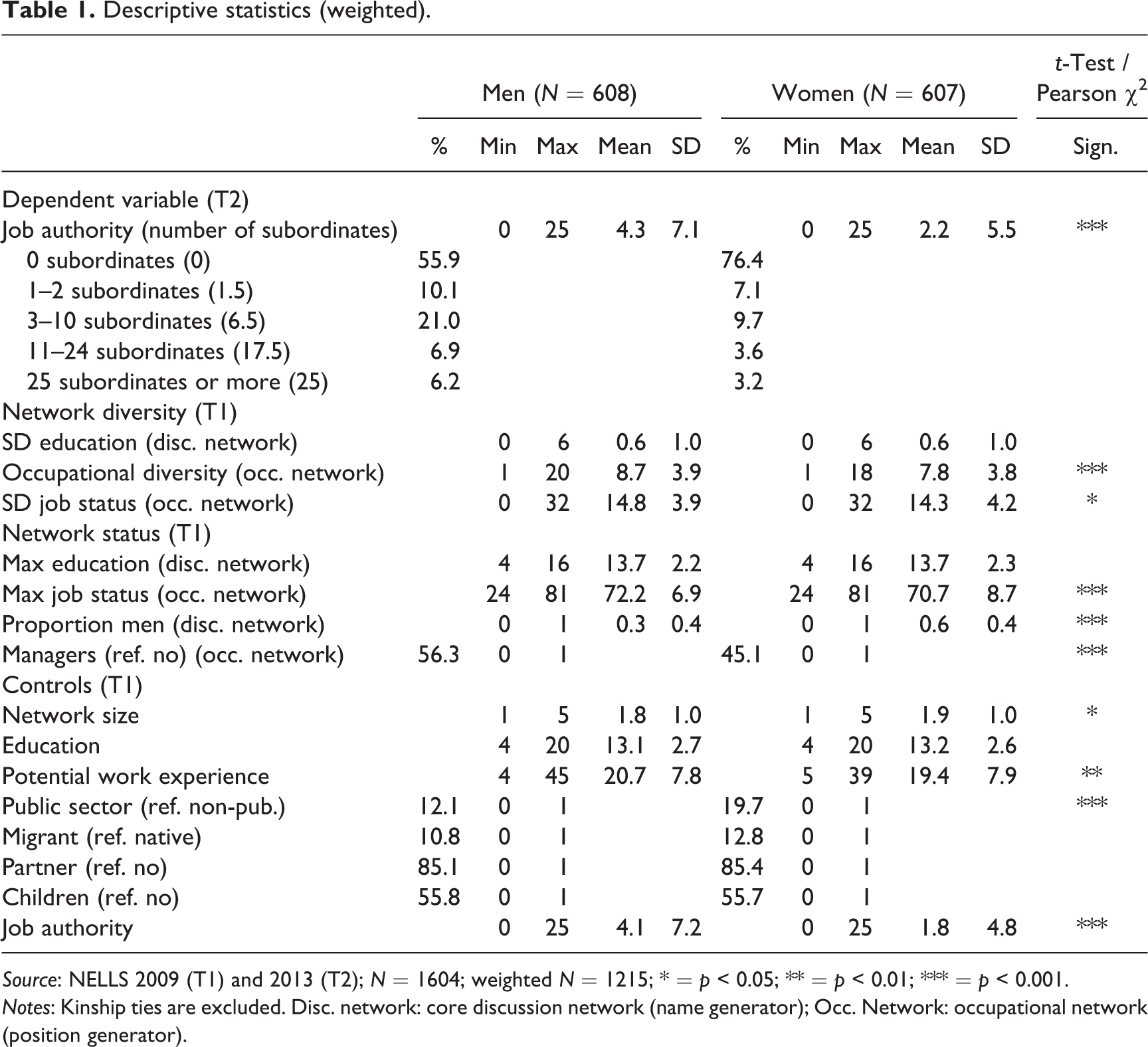
Source: NELLS 2009 (T1) and 2013 (T2); N = 1604; weighted N = 1215; * = p < 0.05; ** = p < 0.01; *** = p < 0.001.
Notes: Kinship ties are excluded. Disc. network: core discussion network (name generator); Occ. Network: occupational network (position generator).
Network diversity (T1)
Three indicators of network diversity were used: diversity in terms of network members’ educational attainment, occupation and job status. Diversity in contacts’ educational level was measured using a name generator (Marsden, 1987). The name generator provided data on networks consisting of (a maximum of five) individuals with whom respondents had discussed important matters over the six months preceding the data collection (also known as the core discussion network). If respondents provided a contact’s name, they were asked about the characteristics of this contact (e.g. their gender, education and relationship to the respondent). Respondents who did not name any network members (31) were excluded. Additionally, ties based on kinship relations were excluded (parents, children, other family members) because these may partly measure (the intergenerational transfer of) human capital rather than social network resources. Accordingly, respondents who only reported kin-ties (191) were excluded from the data (N = 1775). Additional analyses showed that including these respondents and kinship relations yielded largely similar outcomes regarding our hypotheses (see online Appendix).
To measure the educational diversity in respondents’ core discussion network, the educational level of each contact was converted into the minimum number of years needed to attain this level, ranging from 4 (incomplete primary education) to 16 (academic education). 4 Contacts with an unknown or foreign education (52) and respondents who only mentioned contacts with an unknown or foreign unidentifiable education (44) were excluded (N = 1731). Next, the standard deviation of network members’ educational years was calculated for each respondent. Respondents who only reported one network member were assigned a standard deviation of 0. Table 1 shows that men’s and women’s core discussion networks were, on average, similarly diverse in terms of contacts’ education (0.6 verses 0.6).
The other indicators of network diversity, i.e. the diversity in network members’ occupations and in their job status, were both measured using a position generator. The position generator asked respondents to indicate the positions of their contacts, if they had any (Lin, 2000). The question ‘Do you know someone who is a [job title]?’ was used to identify the positions of contacts. Twenty job titles were listed, ranging from relatively low-status jobs, such as ‘lorry driver’ and ‘secretary’, to relatively high-status jobs, such as ‘engineer’ and ‘lawyer’. 5 For each job title, the respondent could indicate whether or not they knew someone with that particular job. Thus, the position generator provided information on a more extended network in comparison to the name generator.
The occupational diversity in respondents’ occupational network was measured by counting the number of different jobs reported by respondents to be present within their occupational network. Men’s occupational networks were, on average, significantly more diverse in terms of contacts’ occupations than women’s occupational networks (8.7 versus 7.8).
The diversity in job status in respondents’ occupational network was measured by first assigning the listed occupations their value on the International Socio-Economic Index 2008 (ISEI-08, ranging from 16–90) (Ganzeboom, 2010). For example, lorry drivers were given the relatively low score of 36, whereas lawyers were assigned the relatively high score of 81. Subsequently, we calculated the standard deviation of the status scores of the occupations mentioned by the respondent in the position generator. Respondents who only reported one contact were given a standard deviation of 0, and 26 respondents were excluded based on missing values (N = 1705). Men’s occupational networks were, on average, significantly more diverse in terms of contacts’ job status than women’s occupational networks (14.8 versus 14.3).
Network status (T1)
To measure the status of social contacts, information regarding their level of education, job status, gender and managerial status was taken into account. For the maximum level of education of contacts in respondents' core discussion networks, the highest number of years of education among the contacts in respondents’ networks was calculated. The maximum educational level did not differ significantly between men’s and women’s networks (13.7 versus 13.7).
To measure the maximum level of job status of contacts in respondents' occupational networks, the highest ISEI-08 score associated with the occupations of contacts reported by the respondent was calculated. The maximum job status level was significantly higher in men’s networks than in women’s (72.2 versus 70.7).
The gender composition of contacts in respondents' core discussion networks was measured as the proportion of male contacts in respondents’ discussion network. Surprisingly, the proportion of men in men’s networks was significantly lower than the proportion of men in women’s networks (0.3 versus 0.6).
The managerial status of contacts in respondents' occupational networks was measured using one of the questions from the position generator, asking whether respondents knew a company executive or higher manager or not (the NELLS data do not allow us to measure the number of managers individuals know). Men were significantly more likely to have at least one company executive or higher manager in their occupational network (56%) than women (45%).
Control variables (T1)
We included the following controls: respondents’ core discussion network size, educational level, work experience, job sector, partner, children, migrant status and job authority at T1. Network size was measured as the number of (non-kin) core discussion network members, ranging from 1 to 5. The measurement of respondents’ education is similar to that of contacts’ education. 6 Because the NELLS data do not include information on respondents’ actual work experience, we used a proxy based on respondents’ age (c.f. Bihagen et al., 2014) from which we subtracted their years of education to calculate the number of potential working years. To approximate career interruptions, we also controlled for whether respondents had a partner and whether they had children (c.f. Grönlund et al., 2017). We acknowledge that this is a rough measure, but more information on parental leave and unemployment spells is unavailable in NELLS.
A dichotomous variable indicating whether respondents were employed in the public sector (1) or not (0) was included to account for gender segregation in the labour market. Ideally, we would have incorporated a more detailed indicator of respondents’ job sector, but such information is unavailable in NELLS. To take respondents’ migration background into account, we distinguished between those with (1) and without (0) migration background, using Statistics Netherlands’ definition that considers persons to have a migration background if they themselves or at least one of their parents were born abroad. Finally, we controlled for respondents’ job authority at T1, the measurement being the same as for job authority at T2. Men generally had significantly smaller core discussion networks, more potential work experience, were significantly less likely to work in the public sector, and had more job authority at T1 than women (Table 1). There were no significant gender differences in education, migrant status, and having a partner or children.
Status level, organisational size and urbanisation were not significantly associated with job authority and did not affect our conclusions about the role of network features. We thus excluded them from the main analyses to obtain a more parsimonious model. After respondents with missing values were excluded, 1604 respondents remained for the final analyses (N = 1604, weighted N = 1215).
Methods
To answer our research question, we estimated a series of Ordinary Least Squares (OLS) regression analyses. Because our dependent variable was originally measured on an ordinal scale and OLS regressions rely on the assumption of equidistance between steps, we checked the robustness of our findings by estimating several series of logistic regression analyses, using different cut-points for our dependent variable. The results of these models (available on request) are very similar to those presented in Table 2. Therefore and given the difficulties involved with comparing coefficients between models in logistic regression analyses (Mood, 2010) we opted for OLS regressions for our main analyses.
Linear regression on job authority (number of subordinates: 0, 1.5, 6.5, 17.5, 25 (midpoints)) (T2) (weighted).
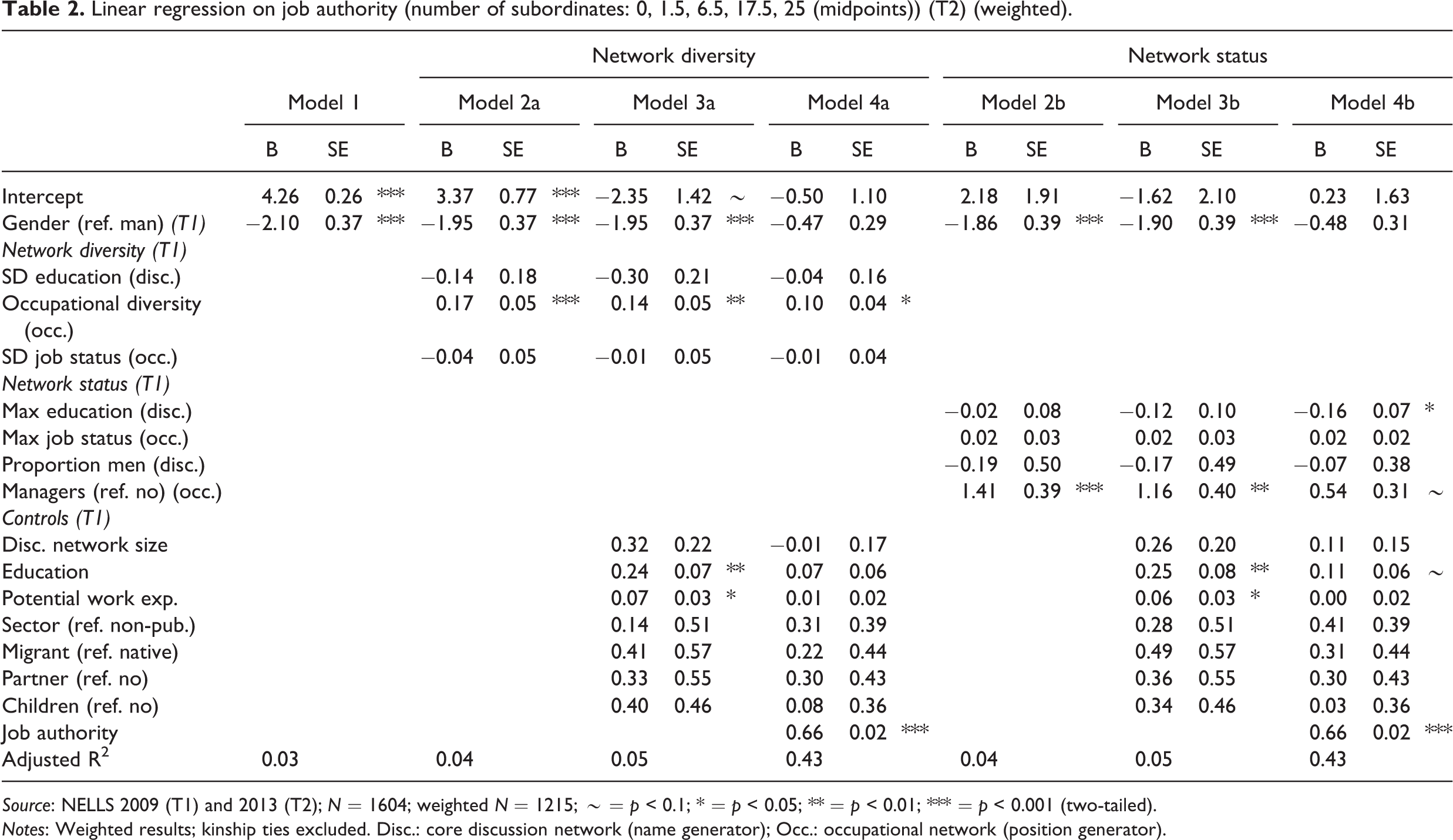
Source: NELLS 2009 (T1) and 2013 (T2); N = 1604; weighted N = 1215; ∼ = p < 0.1; * = p < 0.05; ** = p < 0.01; *** = p < 0.001 (two-tailed).
Notes: Weighted results; kinship ties excluded. Disc.: core discussion network (name generator); Occ.: occupational network (position generator).
One’s social network might not only influence one’s job authority (i.e. contacts and resources are available to and used by individuals before they attain job authority, as social network theories assume); one’s authority position might also influence the diversity and status of one’s network (i.e. people may meet (high-status) contacts after having reached an authority position). To address such causality issues, one would ideally estimate full change models, in which a change in job authority is explained by a change in network features. Although we use a panel data set, this was not possible with the NELLS data because relatively few respondents experienced changes in their level of job authority between wave 1 and wave 2, and not all network features were measured in the second wave. To control for causality issues as much as possible with these data, we estimated to what extent job authority at T2 (wave 2) was explained by network features at T1 (wave 1; c.f. Korpi, 2001; Mouw, 2003) while controlling for job authority and other respondent characteristics at T1. 7 This gives us more insight into whether or not the causal order of social network characteristics (2009) and job authority (2013) is as one would assume based on network theories.
Our modelling strategy is as follows. Firstly, the gender gap in job authority (T2) is examined (Table 2, Model 1). Secondly, we investigate to what extent network diversity (T1) (Model 2a) and network status (T1) (Model 2b) were related to respondents’ level of job authority, and to what extent adding these features to the model leads to a decrease in the observed gender gap in job authority. Finally, we control for relevant background characteristics (T1) and job authority (T1) in Models 3a/b and Models 4a/b respectively.
Results
The results presented in Model 1 of Table 2, underline those in Table 1. Men on average supervised 4.26 subordinates while women supervised 2.16 subordinates and this gender gap in job authority (i.e. a difference of 2.10 subordinates) was significant.
In Models 2a–4a, the indicators of network diversity were added. 8 In Model 2a, we see a significant gender gap in job authority (of 1.95 subordinates) after controlling for network diversity: on average, men supervised 3.37 subordinates, while women supervised 1.42. There were no significant associations between the diversity in education in discussion networks and the diversity in job status in occupational networks at T1 and individuals’ job authority at T2. Moreover, there were no significant gender differences in educational diversity in discussion networks and only marginal gender differences in diversity regarding job status in occupational networks to begin with (Table 1). Hence, we find no evidence to support the idea that the gender gap in job authority at T2 is related to gender differences in network diversity in educational level or job status at T1; H1a and H1c are not supported.
By contrast, contacts’ occupational diversity at T1 was significantly and positively related to individuals’ job authority at T2 in Model 2a. The more diverse one’s occupational network in terms of contacts’ occupations, the higher one’s authority position. Since the occupational diversity in women’s networks was significantly lower than in men’s (Table 1) and additional tests show that the gender gap in job authority was significantly mediated by networks’ occupational diversity (Sobel-test: z = −2.58, p = 0.005), our results indicate that the gender gap in job authority at T2 is related to some extent to gender differences in networks’ occupational diversity at T1. While these findings are in line with H1b, there is only a slight decrease in the gender gap in job authority (i.e. from 2.10 subordinates to 1.95 on average). Models 3a and 4a underscore this conclusion, although we see that after controlling for job authority at T1 in Model 4a, the gender gap in job authority at T2 is no longer significant. This indicates that controlling for job authority at T1 provides a very strict test, rendering the gender authority gap insignificant, even though we know from previous research that such a gap does exists (e.g. Abendroth et al., 2013; Dämmrich and Blossfeld, 2016; Grönlund et al., 2017; Mandel and Semyonov, 2006; Yaish and Stier 2009). Underscoring this conclusion, additional analyses in which the control for job authority at T1 was added before the network features (rather than the other way around) showed a marginally significant gender authority gap (see online Appendix). This indicates that both job authority at T1 and network characteristics explain part of the gender gap. Importantly, Model 4a also indicates that the relation between network diversity and job authority is in the expected causal direction (i.e. with more network diversity at T1 leading to more job authority at T2). This relationship remains significant after controlling for the reverse causal path − as much as possible with these data − by including job authority at T1 (which could influence network characteristics at T2). Overall, we thus conclude that gender differences in networks’ occupational diversity seem to be associated with the gender gap in job authority to some extent.
In Models 2b−4b, the role of network status was explored. 9 In Model 2b we see that, controlling for several indicators of network status, men on average supervised 2.18 subordinates, while women supervised 0.32. This gender gap of 1.86 subordinates is significant. Contrary to our expectations, the highest level of education in individuals’ discussion network, the maximum level of job status in respondents’ occupational networks and the proportion of male contacts in respondents’ discussion networks at T1 were not significantly related to job authority at T2. Also, there were no significant differences between men and women in the maximum level of education in their discussion network and – in contrast to the expectation – women reported significantly more (rather than fewer) male contacts than men (Table 1). Hence, we find no evidence to support the idea that the gender gap in job authority at T2 is related to gender differences in network status in terms of contacts’ maximum educational level, job status or the proportion of male contacts at T1; H2a, H2b and H3 are refuted.
By contrast, Model 2b shows that having a company executive or higher manager in one’s occupational network at T1 was significantly positively related to one’s job authority at T2. Since men were significantly more likely to know a company executive or a higher manager (56%) than women (45%) (Table 1) and additional tests show that the gender gap in job authority was significantly mediated by knowing a manager (Sobel-test: z = −2.29, p = 0.011), our results indicate that the gender gap in job authority at T2 is related to some extent to gender differences in having a higher manager in one’s network at T1. This is in line with H4. Nevertheless, the decrease the gender gap in job authority is rather small (i.e. from on average 2.10 subordinates in Model 1 to 1.86 in Model 2b). Similar results were found when controlling for several background characteristics (Model 3b) and job authority at T1 (Model 4b). In the latter model (Model 4b), we also see that the gender gap in job authority at T2 is no longer significant. As mentioned before, this indicates that controlling for job authority at T1 provides a very strict test. Again, corroborating our interpretation, additional analyses (see online Appendix) in which the control for job authority at T1 was added before the network characteristics (rather than the other way around) showed a marginally significant gender authority gap, indicating that both job authority at T1 and network features explain part of the gender gap. Notably, in line with the expected causal relation, the association between knowing a manager and job authority remains marginally significant after controlling for job authority at T1. Overall, we conclude that the fact that men are more likely than women to have a company executive or a higher manager in their networks seems to be associated to the gender gap in job authority to some extent.
Robustness checks
We performed several robustness checks. Firstly, we explored alternative measurements of network diversity (Index of Qualitative Variation, range of core network members’ educational years, range of job status in occupational network) and network status (mean educational level in core discussion network, mean level of job status in occupational network). This largely yielded the same conclusions regarding our hypotheses as our main analyses (results available on request).
Secondly, we ran a series of logistic regression analyses with dichotomous versions of our dependent variable (job authority at T2), using different cut-off points. We examined whether, for instance, social networks are mainly important for one’s chances to attain higher-level authority positions. We found that, controlling for job authority at T1, network features at T1 were generally not significantly related to one’s likelihood of supervising one or more subordinates versus none, or the likelihood of supervising three or more versus up to two subordinates at T2 (results available on request). However, people’s likelihood of supervising more than ten versus up to ten subordinates at T2 was found to be positively related to some network features. Respondents whose occupational networks were more diverse in terms of occupations or in which the maximum job status was higher and those who had a manager in their occupational network at T1 were more likely to supervise more than ten subordinates at T2 (see Table 3). Keeping in mind the minor decreases in the gender gap in job authority after controlling for network characteristics, these results support H1b, H2b and H4, and indicate that networks may be more important for gender differences at higher levels of job authority.
Logistic regression on job authority (0−10 subordinates = 0 versus 11 subordinates or more = 1) (T2) (weighted).
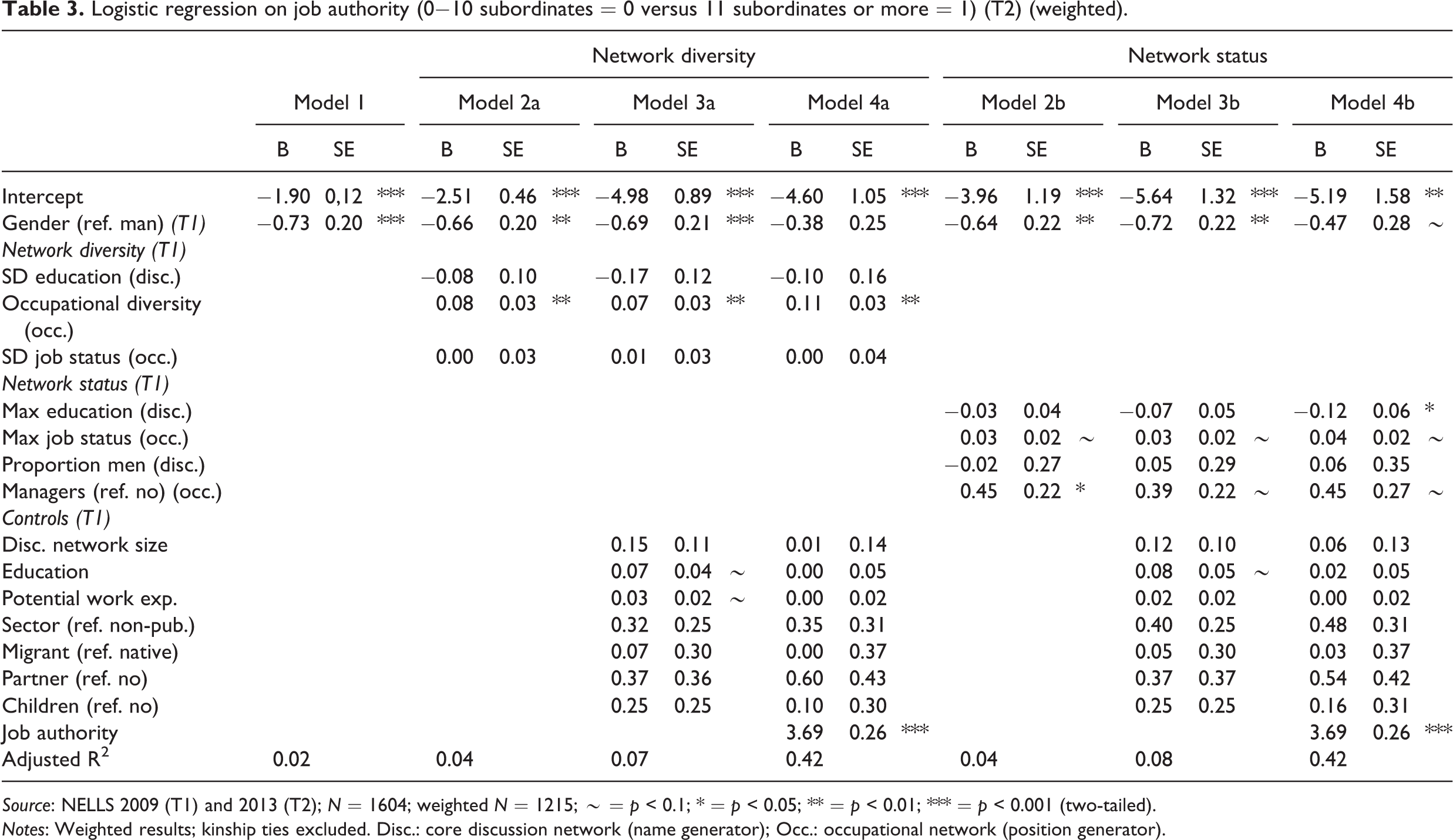
Source: NELLS 2009 (T1) and 2013 (T2); N = 1604; weighted N = 1215; ∼ = p < 0.1; * = p < 0.05; ** = p < 0.01; *** = p < 0.001 (two-tailed).
Notes: Weighted results; kinship ties excluded. Disc.: core discussion network (name generator); Occ.: occupational network (position generator).
Conclusions and discussion
This study aimed to provide more insight in the understudied relations between gender, social network features and job authority. Our outcomes showed that men supervised significantly more subordinates than women and that this gender gap in job authority was more pronounced at higher levels, confirming findings from prior research (e.g. Abendroth et al., 2013; Grönlund et al., 2017; Yaish and Stier 2009). Yet, our results provide only limited evidence to support the idea that this gender authority gap is associated with differences in the diversity or status among the contacts in women’s and men’s social networks. We did find that women’s networks were less diverse than men’s in terms of contacts’ occupations, that the highest level of job status among women’s contacts was lower, and that women were less likely to know higher managers. Moreover, greater network diversity in terms of contacts’ occupations and having a manager in one’s network were found to be positively related to individuals’ level of job authority. However, although controlling for gender differences in network diversity and network status led to a statistically significant reduction in the observed gender gap in authority, this reduction was modest in substantive terms. This suggests that existing differences between women’s and men’s social networks – at least as measured in this study – provide a limited contribution to our understanding of gender differences in job authority.
Given this pattern of results and the fact that empirical studies examining the relations between gender, social networks and job authority remain very scarce, additional research is required to draw more definitive conclusions about the extent to which gender differences in social networks can account for the gender gap in job authority. A more detailed look at our outcomes reveals several clues regarding directions for future research. Firstly, our results provide support for both strands of network theory that stress the importance of having diverse networks and those that emphasise the importance of having higher-status contacts within one’s network. Secondly, our findings showed that occupational networks of women and men differ in some respects and that some aspects of individuals’ occupational networks are related to their level of job authority, but provide no evidence that this is true for core discussion networks. Thirdly, our results indicate that contacts’ occupations play a more important role than their educational level or gender, although some caution is in order here, as the latter two measures are based on information about core discussion networks and the former on information about occupational networks. Hence, future studies exploring to what extent gender differences in social networks can account for the gender gap in job authority may focus on occupational networks especially, and may further examine which features of these networks and of the contacts in them are relevant, possibly distinguishing between different stages of processes leading to authority positions (c.f. Barbulescu, 2015; Obukhova, 2012).
Furthermore, this study has some limitations that may be addressed in future research. Firstly, this study defined authority positions as jobs that involve supervising others. Although many recent studies on gender and job authority rely on measures like this one, there may be aspects of job authority that these do not fully capture. For instance, women may more often hold authority positions in less prestigious segments of organisations or the labour market than men, even if they have similar numbers of subordinates. Women in authority positions may also have less power or status and earn lower wages than men with similar numbers of subordinates (Stainback and Tomaskovic-Devey, 2009). If so, this study underestimated gender gaps in authority and possibly also the role that networks play in this respect. Future research may therefore, if data permit it, incorporate other aspects of job authority and examine the role of labour market segregation to shed more light on the linkages between social networks and gender gaps in authority.
Secondly, reversed causality and endogeneity are potential issues in research on social networks as explanations for gender gaps in job authority. To minimise such issues as much as possible, we used panel data and estimated to what extent job authority at T2 was explained by network features at T1, while controlling for job authority and other respondent characteristics at T1. More sophisticated methodological approaches (e.g. estimating change models or fixed effects models) were unfortunately not feasible with the current data, given the limited sample size and fact that not all network features were measured in the second wave. In the future, studies based on more extensive data sets may shed more light on the nature of the associations between gender, social networks and job authority.
Finally, this study focused on the accessibility of network resources. Further research could advance our understanding of the role of social networks in explaining gender gaps in job authority by also studying resource activation. For example, researchers may investigate the amount and quality of information or support that men and women are able to mobilise or (in other words) that is shared with them by network members in relation to their authority position in the workplace. The scarce existing empirical research on gender disparities in receiving information or support generally revealed advantages for men compared to women (Huffman and Torres, 2002; McDonald, 2011; McDonald et al., 2009). Applying such approaches in studies on gender, social networks and job authority would form an important step forward.
Notwithstanding these limitations, this study contributed to the existing literature on possible explanations for the fact that women remain less likely than men to hold (higher) authority positions by empirically examining whether there are gender differences in social network diversity and status and whether these are related to the gender gap in job authority. We hope that this study will inspire further research on social network resources, gender and job authority. Rigorous empirical tests of these relations are needed to inform ongoing popular debates about the causes of the underrepresentation of women in authority positions in the labour market.
Supplemental material
Online_Appendix_The_gender_gap_in_job_authority_-_Do_social_network_resources_matter_final_(1) - The gender gap in job authority: Do social network resources matter?
Online_Appendix_The_gender_gap_in_job_authority_-_Do_social_network_resources_matter_final_(1) for The gender gap in job authority: Do social network resources matter? by Lieselotte Blommaert, Roza Meuleman, Stefan Leenheer and Anete Butkēviča in Acta Sociologica
Footnotes
Acknowledgements
Earlier versions of this paper were presented at the Dutch Demography Day 2015 in Utrecht, the Netherlands, at the RC28 Spring Meeting 2016 in Bern, Switzerland, and at the Dutch Sociology Day 2018 in Rotterdam, the Netherlands. The authors would like to thank the participants for their helpful comments and remarks.
Authors’ contribution
Funding
The authors received no financial support for the research, authorship, and/or publication of this article.

Supplemental material
Supplemental material for this article is available online.
Notes
References
Supplementary Material
Please find the following supplemental material available below.
For Open Access articles published under a Creative Commons License, all supplemental material carries the same license as the article it is associated with.
For non-Open Access articles published, all supplemental material carries a non-exclusive license, and permission requests for re-use of supplemental material or any part of supplemental material shall be sent directly to the copyright owner as specified in the copyright notice associated with the article.
