



Abstract
As an important emerging economy, Mexico is significant to China for promoting world multipolarisation as well as an important partner in jointly building a community of shared future for mankind. Educational exchanges and co-operation are an indispensable part of friendly transactions between China and Mexico. Both countries have made many advancements in the fields of personnel turnover, the establishment of overseas co-operation centres, language promotion, and vocational and technical training. Both China and Mexico regard the other as an important education partner. In future co-operation, the two countries should continue to promote vocational education, improve the degree system, and pay attention to hidden safety issues.
Introduction
In the 1970s, as the relationship between China and the United States (US) eased and the former resumed its legitimate seat at the United Nations, good opportunities emerged for both China and Mexico to establish diplomatic relations. The establishment of diplomatic relations between China and Mexico in 1972 was followed by a series of exchanges and co-operation between both countries. As we enter the 21st century, China has accelerated the pace of opening up to the outside world. Mexico, also a developing country with an emerging economy, has become an important partner in opening up new areas of co-operation. It is now an important fulcrum for China’s development of the Latin American market, an important force for China’s promotion of global multipolarity, and an important partner in building a community with a shared future for mankind. Therefore, Mexico has become a ‘South-South co-operation’ partner that China urgently needs and focuses on for a breakthrough. In 2003, China signed a strategic partnership with Mexico, which was upgraded to a comprehensive strategic partnership in 2013. In 2014, the two countries issued the Action Outline on Promoting the China-Mexico Comprehensive Strategic Partnership. In 2018, China became the second-largest trading partner of Mexico, while Mexico became China’s second-largest trading partner in Latin America. Sino-Mexican co-operation always adheres to the principle of co-operation in trade and economic advancement as well as comprehensive development. Educational exchanges and co-operation are the basis and extension of the development of China-Mexico relations. After nearly 50 years of development, although Sino-Mexican educational exchanges and co-operation have made great progress, they have developed at a significantly slower pace than bilateral political and economic relations both in scale and depth. Educational co-operation has not reached the due scale, indicating that there is a lot of room for co-operation between China and Mexico. Therefore, studying the status quo and challenges of Sino-Mexican education exchanges and co-operation has important theoretical and practical significance for future co-operation.
Identity of Internationalisation of Higher Education: China and Mexico
Identity of Internationalisation of Higher Education in China
Since the founding of the People’s Republic of China in 1949, the party and the country have focussed on cultivating talents as well as regarded education as an important tool for socialist construction. Therefore, opening up to learn from the Soviet Union was an important policy of Chinese higher education. The development of the internationalisation policy of Chinese education relied on learning from the Soviet Union and providing foreign aid to countries in the socialist camp. From 1949 to 1977, Chinese higher education focussed on its own rectification and development, and internationalisation was still in the initial stage of exploration.
Referring to the processes of reforming and opening up as a new starting point, the period from 1978 to 1992 became the initial stage of development of the internationalisation of higher education in China. Based on Comrade Deng Xiaoping’s ‘three education orientations’, China’s higher education has made great progress and international development has also officially entered the race. In June 1978, Comrade Deng Xiaoping issued an instruction to expand the process of sending Chinese students abroad to study: ‘I approve of the increase in the number of international students. This is one of the important ways to achieve quick results and improve the level of our country within five years. We should send thousands of students studying abroad, not just ten or eight. We should do everything possible to speed up the pace, and the road should be wider and wider’ (Fan & Yang, 1998, pp. 47–52). According to this instruction, in August 1978, the Ministry of Education issued a notice Concerning the Increase of Students Studying Abroad and Their Selection, increasing the number of overseas students from the planned 500 to 3,000 (Jiang, 2005, p. 25). In 1981, the Interim provisions on studying abroad at one’s own expense were issued, which allowed students to apply for studying abroad in a self-funded way and sharply increase the number of overseas students. In 1986, the China Service Centre for Scholarly Exchanges was established, and the Offices of Educational Affairs of Chinese embassies and consulates abroad were established one after another. In December of the same year, the State Council promulgated the Interim Provisions on Chinese Students Studying Abroad, together with the five administrative rules on government-sponsored overseas education issued by the State Education Commission in 1987, which can still be seen in current management systems for studying abroad.
From 1992 to 2000, under the market economy, China deepened the opening-up of education, allowing the internationalisation of higher education to enter the stage of development and expansion. On the one hand, China’s education legislation has made significant progress and the internationalisation of higher education is moving toward normative development through legal improvement and policy guidance. The Outline of China’s Education Reform and Development in 1993 emphasised the need to ‘further expand the opening-up of education to the outside world’ (Ministry of Education, 1994). The Education Law, which was promulgated in 1995, had a special chapter on ‘External Exchange and Co-operation in Education’ and made a series of specific regulations. The Higher Education Law promulgated in 1998 stipulated more detailed regulations on foreign educational exchanges at the university level. On the other hand, to further promote the process of studying abroad, the State Education Commission issued the Notice on Issues Related to Studying Abroad at Your Own Expenses to further loosen the policy of studying abroad at the student’s expense. In 1996, the China Scholarship Council was established to promote the enrolment, selection, and management of both international students in China and Chinese students abroad to embark on the track of institutionalisation, standardisation, and legalisation. At the same time, the world-class university construction project ‘985 Project’, which began at the university level in 1998, has greatly advanced the process of internationalisation and quality of higher education in China.
China joined the World Trade Organization (
After 2012, the Party Central Committee, with Comrade Xi Jinping at its core, emphasised the importance of education and talent cultivation as well as regarded education as an important force for promoting the progress of human civilisation and building a community with a shared future for mankind. In 2014, the State Council issued a decision on accelerating the development of modern vocational education, which provides a framework and a path for vocational colleges in serving the strategic layout of enterprise internationalisation and cultivating international talents. In 2015, China promulgated the Overall Plan to Promote the Construction of World-class Universities and World-class Disciplines, which called for promoting international exchanges and co-operation, strengthening substantive co-operation with world-class universities and academic institutions, enhancing international collaborative innovation, and effectively improving international competitiveness and the voice of China’s higher education. In 2016, the 13th Five-Year Plan clearly stated that international exchanges and co-operation should ‘promote the joint construction of the Belt and Road education action, implement the study abroad action plan, and continue to run Confucius Institutes well’ (Xiong, 2019, pp. 7–9). In 2016, the General Office of the Central Committee and the General Office of the State Council issued several opinions on better work on educational opening in the new period. It systematically designed and emphasised the key strategy of opening up education in co-operation with the Belt and Road Initiative (
The identity of internationalisation of higher education of China

The identity of internationalisation of higher education of China
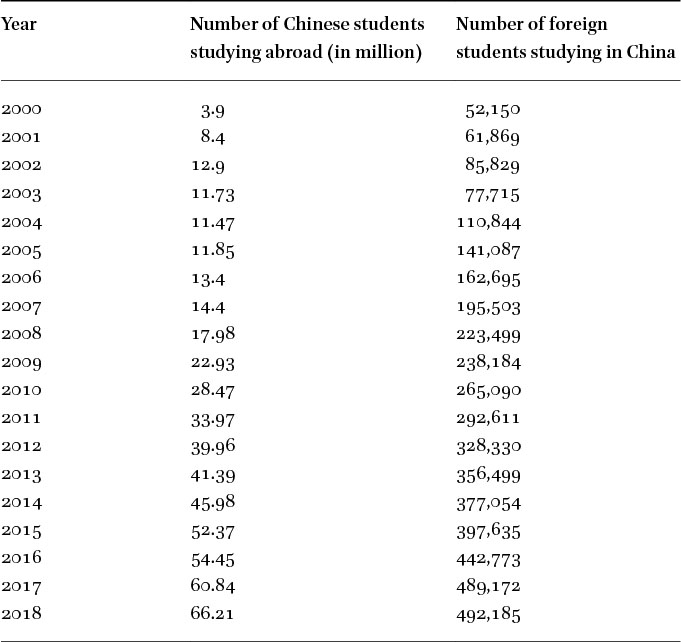
Since the reform and opening up, the scale of the Chinese market for studying abroad has shown exponential growth. In 2018, China became the world’s largest source of foreign students and the largest destination for studying abroad in Asia (see Table 2). The destination of Chinese students studying abroad is still relatively concentrated; most of them go to developed countries or regions in Europe and America. As the opening-up process of Chinese education continues to accelerate, countries along the
The number of Chinese students studying abroad and the number of foreign students studying in China from 2000 to 2018
The development of the internationalisation of Mexican higher education began after World War
The year 1994 was a milestone for the internationalisation of Mexican higher education because Mexico had signed the North American Free Trade Agreement (NAFTA) with the US and Canada. This agreement provided an external impetus for Mexico’s international education co-operation. The signing of the free trade agreement accelerated the pace of Mexico’s economic globalisation and integration. Mexico started to integrate internationalisation into the development priorities of the state and higher education institutions. In 2001, the Mexican government promulgated the National Development Strategy (2001–2006). This government document pointed out that the Mexican government, society, and individuals should work together to accelerate the lagging education policies, regard internationalisation as a development path, and establish an advanced education system as soon as possible so that Mexican education could be fully integrated into the international arena (Gobierno de México, 2001, pp. 69–71). In response to this policy, in the same year, the Mexican Ministry of Education promulgated the National Education Plan 2001–2006. This plan first incorporated international co-operation into the national medium-term and long-term education plan, proposing an international co-operation strategy that focussed on improving the quality of higher education (Secretaría de Educación Pública, 2001, p. 11). In 2002, the Science and Technology Law was promulgated, providing the legal framework and guaranteeing Mexico’s international scientific research co-operation. In 2007, the National Development Strategy 2007–2012 was published. The strategy mentioned the use of international standards to evaluate teachers, students, and higher education institutions to improve the quality of Mexican higher education as well as promote Mexican teaching, research, technology, and innovation (Gobierno de México, 2007, pp. 182–199). In the same year, the Secretariat of Public Education (Secretaría de Educación Pública) promulgated the National Education Plan 2007–2012, which pointed out that Mexican higher education institutions need to further improve internationalisation and advance the processes of teaching, research and development, and innovation (Secretaría de Educación Pública, 2007, p. 28). The 2011 International Development Co-operation Law was promulgated. In the same year, the Mexican Secretariat of Foreign Affairs established the Agency for International Co-operation and Development, which launched the Scholarship Program for Outstanding Overseas Talents, making up for Mexican shortcomings in high-tech fields. The scholarship covers more than 180 countries around the world, including bilateral, multilateral, and special agreements, respectively, between Mexico and other countries. More than 100 higher education institutions participated in the project, including the National Autonomous University of Mexico (
In 2013, the Mexican government promulgated the National Development Strategy 2013–2018 and identified five core development goals, two of which were ‘high-quality Mexican education’ and ‘Mexicans with social responsibility’. They are related to the development of international education and emphasise the cultivation of high-quality talents by improving education quality, making Mexico more competitive in the global market and promoting its economic development (Gobierno de México, 2013, 57–100). In the same year, the National Education Plan 2013–2018 was promulgated by the Secretariat of Public Education; the Plan emphasised that the new academic co-operation model supporting the internationalisation of higher education had promoted the more capable graduates who were pursuing the best postgraduate programmes in Mexico and all over the world (Secretaría de Educación Pública, 2013, p. 13). The Mexican government and higher education institutions continue to promote the internationalisation of higher education and hope to break through the ‘periphery’ of world research and knowledge dissemination as well as approach the ‘centre’.
Comparison of the Characteristics of the Internationalisation of Higher Education in China and Mexico
China and Mexico have different political systems and social cultures. However, looking at the development process of the internationalisation of higher education, the two countries share some similarities. First, the early development of the internationalisation of higher education in China and Mexico has a strong political feature. Back then, affected by diplomatic relations, China had generally launched international exchanges and co-operation programmes in the field of higher education for countries in the socialist camp; learning from the Soviet Union had become the main content of the internationalisation of higher education. As for Mexico, due to geopolitical relations, the US prevented the Soviet Union from infiltrating into Mexican ideology and threatening the security of its ‘backyard’ and the ‘Unified America’. The US began educational exchanges with Mexico and exported its ideology to Mexico.
Second, economic globalisation is a direct driving force for the accelerated development of the internationalisation of higher education in China and Mexico. For example, education falls under
Third, both China and Mexico regard ‘improving the quality of higher education’ as the primary idea in the development of the internationalisation of higher education. However, for both China and Mexico, this internationalisation is a double-edged sword. In order to improve the country’s competitiveness, the government spared no expense to provide scholarships for outstanding domestic students to study abroad. At the same time, the talent loss has weakened the country’s knowledge reserves, resulting in a more serious shortage of human resources (Holm-Nielsen, Thorn, Brunner and Balán, 2005, p. 39). Developed countries have become the ‘talent harvesters’ of developing countries like China and Mexico. Therefore, both the Chinese government and the Mexican government regard the improvement of education quality as the primary task of the internationalisation of higher education. China has successively proposed to build world-class universities through programmes such as the ‘985 Project’, ‘Building a Double First-Class’ initiative, and ‘Improving Quality and Efficiency’ task. Mexico has included ‘high-quality higher education services’ in its national education development plan.
Fourth, both China and Mexico are working hard to work with emerging markets in the field of higher education co-operation and regard each other as important partners. As the pace of China’s opening to the outside world continues to increase, economic and trade co-operation between China and Mexico is reaching the most productive period in history. Economic development will inevitably involve technological co-operation and cultural exchanges, in which talent is the key and education is the foundation (Gu, 2015, pp. 1–2). Therefore, China regards educational exchanges as an important means for the sustainable development of Sino-Mexican relations. In addition, Mexico’s long-term economic dependence on the US, its asymmetric integration into North American economies, and the influence of neoliberalism have threatened the sustainable growth of its economy (Otero, 2011, pp. 384–402). Therefore, besides maintaining the traditional educational co-operation relationship with Europe and the US, Mexico has begun to renew its educational layout and strengthened its co-operation with China and other emerging markets (Ávila, 2000, pp. 121–142).
Paths for Sino-Mexican Higher Education Exchanges and Co-operation
Mobility of People
China has always maintained a good relationship with Mexico in educational co-operation. In 1972, when China and Mexico established diplomatic relations, they signed an intergovernmental agreement on the exchange of foreign students. Subsequently, Mexico provided 20 government scholarships to China every year, which continued until the end of the 20th century. Many former Chinese diplomats in Latin America, Latin American researchers, and Spanish teachers in universities have benefited from this scholarship and studied in Mexico. It can be said that the Mexican government has trained the first batch of Spanish talent for China. In 2005, China and Mexico increased the number of scholarships. China provided 32 scholarships to Mexico each year, while Mexico provided 30 scholarships to China each year. In 2010, China and Mexico signed the Agreement between the Government of the People’s Republic of China and the United States of Mexico on the Mutual Recognition of Studies, Diplomas, and Degrees. During President Xi Jinping’s visit to Mexico in June 2013, the two sides signed the Joint Statement of the People’s Republic of China and the United States of Mexico, which provided Mexico with at least 300 government scholarships in the next three years (Xinhuanet, 2013). According to the statistics of the Department of International Co-operation and Exchanges of China’s Ministry of Education, the number of Mexican students studying in China has always topped the list of Latin American students studying in China. Taking 2018 as an example, the number of Mexican students studying in China is 1540, accounting for 15% of the total number of Latin American students in China (Department of International Co-operation and Exchanges of China’s
Number of Mexican students studying in China from 2013 to 2018

Source: Compiled from Statistical Reports on International Students in China of the Department of International Co-operation and Exchanges of MOE
Number of Mexican students studying in China from 2013 to 2018
As a co-operation partner, Mexico introduced various policies and scholarships, so the number of Mexicans studying abroad continued to grow. The number of Mexican students studying abroad in 2000 was 15,818, and in 2016, it increased to 29,401 (
At present,
In 2012,
Language Promotion
Language is a cultural resource; it is a carrier of culture and a sign of its existence. Language education has become an essential means of promoting national culture and drawing people from other countries closer. Language ability is critical for personnel working in Sino-Mexican co-operation. Therefore, language education is naturally deemed to be the foundation for Sino-Mexican exchanges and co-operation by both sides. China’s promotion of the Chinese language in Mexico and the development of Confucius Institutes are progressing rapidly. In 2006, the first Confucius Institute in Latin America was established in Mexico. By the year 2020, there are five Confucius Institutes in Mexico: the Confucius Institute in Mexico City organised by the El Instituto Cultural Chino Huaxia (
While the Chinese language is ‘going global’, China is also constantly exploring ways to ‘bring in’ the Spanish language. In addition to the Instituto Cervantes, which is led by the Spanish government and engages multiple Latin American countries, there has been an increase in the number of higher education institutions offering Spanish training programmes in China to meet the demand for Spanish-speaking talents. As of 2019, 96 educational institutions in China have included Spanish language courses, including 74 undergraduate schools, which is 8 times the number in 1999. The number of students enrolled in such programmes was around 20,000, more than 40 times the number in 1999 (Chinese National Social Science Network, 2019). In revising the General High School Curriculum Programme and Curriculum Standards for Chinese and Other Subjects (2017 edition), the Chinese Ministry of Education added Spanish as the first foreign language in the high school curriculum. It is for the first time that China has included Spanish in its secondary school curriculum (Ministry of Education of the People’s Republic of China, 2017).
Human Resources, Vocational, and Technical Training
Since 2006, China and Mexico have been providing human resources as well as vocational and technical training. The training programmes cover agriculture, mining, trade, management, and other areas, with more than 20 training courses on agricultural technology, trade and investment, economic system reform, and diplomat culture. The ‘Public Administration Workshop for Civil Servants in
In addition to human resource training, vocational and technical training is also a significant part of Sino-Mexican educational exchanges and co-operation. As more and more Chinese companies are investing in Mexico, developing infrastructure, building factories, and industrial parks, the shortage of skilled workers has become one of the main obstacles to business development. According to local regulations and long-term development needs, many Chinese companies attach great importance to the localisation of business models. For example, in Huawei’s branch in Mexico, local employees account for 90% of the total 1,400 plus employees. To meet the talent shortage, some small-scale pilot training projects have already been launched. Huawei set two training projects to cultivate key talents—‘
Trends in Sino-Mexican Co-operation and Exchanges in Higher Education
Efforts to Develop Relations with Emerging Markets
With a restructured international relations network, Mexico has been adjusting its nation-specific strategies for the internationalisation of higher education. While keeping the educationally advanced European countries and the US as its main partners, Mexico is focussing on building a higher education centre in Latin America and seeking co-operation with China and other emerging markets.
Under the influence of the traditional ‘North-South co-operation’ model, the US and European countries remain the major partners in Mexico’s internationalisation strategy. With its geographical advantage and prestige as a great power, the US has an enormous impact on Mexico’s higher education. Since the 1950s, US foundations such as the Rockefeller and the Ford Foundations have funded Mexican scientific and technological projects, facilitated the interdisciplinary integration of Mexican higher education institutions, and exchanged their knowledge, skills, and experience for scientific advancements. The
With the rapid development of emerging countries and their science and education industries, Mexico began to attach more importance to co-operation with emerging countries such as China. In 2003, Mexico established a strategic partnership with China, followed by an increase in Chinese and Mexican governmental scholarships. The
From China’s perspective, the establishment of bilateral and multilateral strategic dialogue mechanisms such as the China-
Promoting Vocational Education Co-operation
With a series of supportive policies of
Improving the Degree Certification System
There are still difficulties with degree certification and verification. The high degree of autonomy in the courses and curricula in Mexican higher education makes them inequivalent to those of foreign educational institutions. This difference greatly affects the international accreditation of Mexican university majors and degrees. Furthermore, although Mexican higher education institutions have the right to confer degrees, without uniform criteria, the credit transfer procedure is dependent on actually implementing the co-operation and is decided by both parties. For example, China has signed an agreement between the Government of the People’s Republic of China and the United States of Mexico on the Mutual Recognition of Studies, Diplomas, and Degrees and clarified the educational structures, respectively. However, when it comes to mutual degree certification, the Ministry of Education still needs to collate and investigate the higher education institutions. The process adds greater uncertainty to the still unfamiliar educational co-operation between the two countries. To conclude, China and Mexico should further improve the degree certification system to facilitate co-operation between their higher education institutions.
Security and Safety
Security in Mexico has always been a source of concern. Many countries have issued ‘travel warnings’ for Mexico due to frequent drug dealing, kidnappings, murders, and robberies. In the National Survey of Urban Public Security conducted by the National Institute of Statistics and Geography, 72.9% of the respondents feel that the city they live in is unsafe (
Conclusions
The following conclusions can be drawn from the review of Sino-Mexican higher education exchanges and co-operation:
First, in terms of the internationalisation of higher education, compared with Mexico, China has a relatively more complete system for development with a higher market share and richer experience. However, China and Mexico are suffering from ‘educational deficit’; they both have more outbound students than inbound international students.
Second, China and Mexico regard each other as important partners in higher education co-operation. While furthering co-operation with the US and the European countries, Mexico is also starting to emphasise its partnership with China. At the same time, China is gradually exploring new areas for opening up its education sector. As an important emerging market, Mexico is a key partner of China in building a community of shared future for mankind.
Third, Sino-Mexican higher education co-operation is still in its infancy with enormous prospects and potential. Both sides continue to strengthen bilateral co-operation in personnel mobility, scientific research, and vocational education and training. However, in the process of co-operation, practical problems such as the lack of institutional capacity, incomplete degree certification system, and social security should also be addressed.
Dr HU Yiyun is a lecturer at the Institute of International and Comparative Education, Beijing Normal University. She holds a bachelor’s degree in Spanish Language and Literature from Beijing International Studies University, and a master’s degree in Intercultural Education from University of Huelva, and PhD in Comparative Education from Beijing Normal University. She has worked in the Confucius Institute Headquarters (2007–2010), and has been sent to the Cultural Office of the State of Aguascalientes, Mexico, and the Hispanic-Asian Center of the University of Huelva, Spain, to teach Chinese as a foreign language. In addition, she has worked as a Spanish teacher in Beijing International Studies University (2010–2015). Dr. Hu’s research interests include international education, development education and education in Latin America. She has presided over and participated in more than 10 national, provincial and ministerial level projects. Her doctoral thesis was funded by the Gu Mingyuan Educational Research and Development Foundation (2017–2018). She has published more than ten articles in academic journals such as Comparative Education Review and Higher Education Exploration.
Footnotes
FAN Lijun is a graduate student in Comparative Education at the Institute of International and Comparative Education, Beijing Normal University. She holds a bachelor’s degree in Spanish Language and Literature from Beijing Institute of Technology. Fan’s research interests include international education, education in Latin America, and so on.