



Abstract
This study overviews policies and practice of philanthropic fundraising in Chinese universities with a focus on university foundations. It briefly reviews the theoretical dimensions of philanthropic fundraising in higher education from a global perspective and university philanthropic fundraising models as well as their applications in Chinese universities. It shows the important role of university foundations in generating philanthropic revenue in Chinese universities. By identifying challenges and the general trends, it explores strategies for sustainable philanthropic fundraising for Chinese universities, which may provide stakeholders with a helpful and relevant reference to promote philanthropic fundraising of Chinese universities. It also gives a general guidance of philanthropic fundraising strategies for Chinese universities.
Introduction
This study conducts a contextual analysis of policies, practice, challenges, strategies, and trends of philanthropic fundraising of Chinese universities. The review of literatures provides global theoretical perspectives of philanthropic fundraising in higher education including philanthropic fundraising models and their applications in Chinese universities. This study reviews philanthropic related policy in Chinese higher education, including governmental policies, regulations, and governmental incentives such as matching fund scheme. It conducts the thematic and documentary analysis to elaborate the policy discourse and policy shift of philanthropic fundraising in Chinese higher education. Data are analyzed, including official documents and archives such as annual reports, regulations from websites of universities, official websites of governments, and websites of university educational foundations. It examines philanthropic fundraising related governmental policies and national major initiatives, discusses good and distinctive practices in a variety of diverse higher education settings (e.g. USA and Europe), and identify challenges and the general trends.
Philanthropic Fundraising Models
As an important source of the third stream income of higher education institutions, philanthropic fundraising in higher education refers to “income obtained from foundations, corporate donors, or individuals acting independently from government but work towards the public benefit by supporting the university’s activities through grants or non-financial means (donation of land and buildings) or by operating their own programs. The forms of philanthropic funding can be donations including bequests (at death) or annual gifts, or donations from corporations and foundations, any of which can be designated or undesignated (i.e. left to administrative discretion) and given either for endowment or current operations.” (Johnstone, 2001; Guo, 2014:23).
Four different models of interaction for universities to prospective donors “are distinguished in terms of donor types, the university actors taking the lead in philanthropic fundraising, the degree to which specific donors are targeted, the extent to which donors specify the use of donations, and the formality of donors’ procedures and the research specificity of the fundraising activities of universities” (European Commission, 2008:76). All four models are usually applied in institutions with a philanthropic fundraising tradition.
University Philanthropic Fundraising Models (European Commission, 2008)

The Development of Philanthropic Fundraising in Chinese Higher Education
“Due to fast expansion of mass higher education in China inevitably brought problems of the insufficient financing capability, cost sharing gradually replaced Chinese government domination in financing higher education, and student tuition was introduced to Chinese universities since late 1980.” (Guo, 2014:26). With the transformation of higher education finance in China, philanthropic fundraising has become very important for public universities to generate more funding. Since the proportion of higher education revenues from the government in relation to overall budget has been decreasing, Chinese universities, especially elite universities, begin to generate revenues from philanthropic fundraising.
Since Tsinghua University Foundation as the first university education foundation in China was established in April 1994, more and more Chinese university foundations are set up. Governmental funding of “Project 211” and “Project 985”, aiming to build world-class universities, stimulated the development of philanthropic fundraising in Chinese universities. The Overall Plan for Promoting the Construction of World-Class Universities and First-Class Disciplines issued by China State Council in 2015 has further accelerated the development of philanthropic fundraising.
According to the Development Report of Chinese University Education Foundation (2018), among 527 established university foundations in China, university foundations are mainly geographically distributed in Jiangsu, Zhejiang, Guangdong, and Beijing (China Education Newspaper, 2018). Key features of Chinese university foundations are dual supervision and management system. Most university foundations focus on disciplines’ development, teachers’ development, infrastructure development, institutions development, university development, and social philanthropic projects. The development of university foundations in China has shown the strong dependence, inextricably linked with the social-economic development. The donation from corporates of alumni is increasing greatly in recent ten years. According to
Policies of Philanthropic Fundraising in Chinese Higher Education
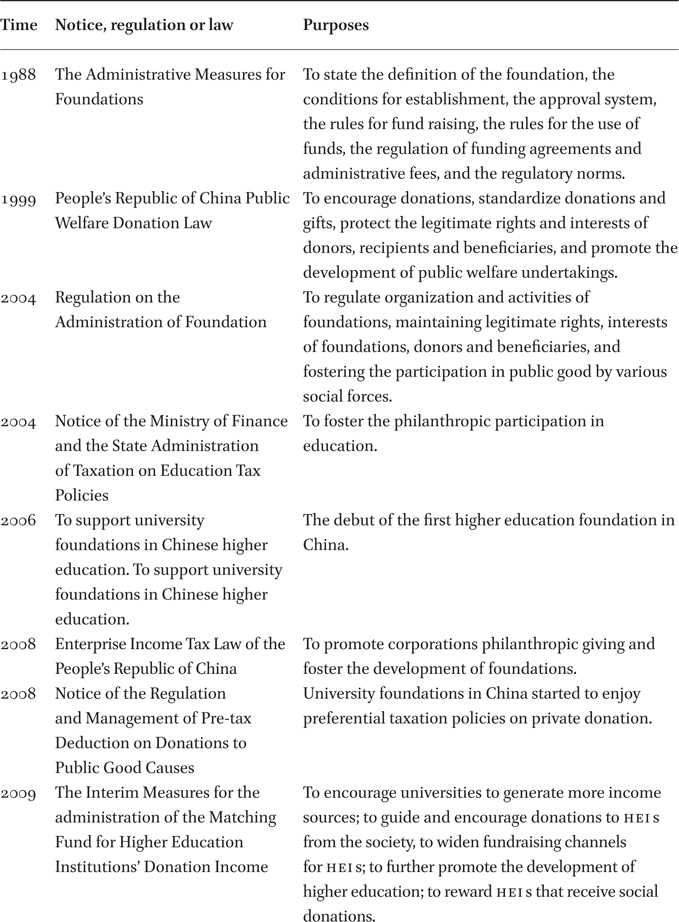
A series of influential policies, philanthropic notices, regulations, and laws (Table 2) on higher educational philanthropy are issued since 1998. For instance, the 21st Century Education Revitalization Plan (
The most important governmental incentive policy is the Interim Measures for the administration of the Matching Fund for Higher Education Institutions’ Donation Income (China State Council, 2009) to support university fundraising in 2009. Another important step is to reform the present legal framework of taxation in favor of donation in Chinese philanthropic fundraising. In 2016, the Ministry of Finance and the State Administration of Taxation issued the Notice on the Issues Concerning Income Tax Policies for Public Equity Donations (State Taxation Administration, 2016), which made the tax incentives for equity donations a breakthrough step forward. In particular, the first Chinese Charity Law (
Challenges of Philanthropic Fundraising in Chinese Universities
As Chinese university foundations and philanthropic fundraising are developed in recent 30 years, Chinese universities have narrow fundraising channels and difficulties initiating donations (Gu & Dai, 2010; Guo, 2014). China Central and local governments may streamline the administration of the schemes with more transparency for donor and charity. Two main challenges for university foundations in China are “the majority of university foundations demonstrate disadvantages in financial management and investment due to a relatively small size in expendable money they own and particularly inflexible in decision making and foundation’s operation because of a dependent relationship with universities” (Guo, 2014:227). The overlap of foundations in Chinese universities may also hinder the efficiency of fundraising and fund management, when the foundation at the faculty or unit level is operated separately from the university foundation at the institutional level. Chinese university foundations face challenges in fundraising, fund management, value-added investment, and sustainable development. Challenges of university philanthropic fundraising in China are both cultural and structural. A lack of efficient financial management (endowment and fund) and investment management of university foundations in Chinese universities can be perceived from different perspectives. Chinese universities have difficulties in managerial issues of fundraising and insufficient human resources (e.g. the lack of organizational capacity and well-trained fundraising staff). Despite challenges such as employment conditions and underdeveloped infrastructures, the investment in the professionalization of staff and support structures (well-administered
Philanthropy related Notices, Regulations or Laws (NPC , 1999 & 2016; Guo, 2014)

“From a national perspective, diversified philanthropic funding for higher education in China still has a long way to go. The proportion of expenditures from university education foundations within total university expenditures reflects the foundations’ contribution to the universities’ financial systems and the universities’ multi-channel funding capability. The optimization of the financial supply side of Chinese universities should focus on the formation of continuity of supply, and build a supply environment that is conducive to the universities’ input and use, and scientifically plan the use of funds. This requires balancing the use of donated funds and the appreciation of investments, large and small donations and the need to be prudent with investments while offsetting inflation.
Strategies of Philanthropic Fundraising in Chinese Universities
Factors influencing donors’ giving decisions should be considered in formulating institutional fundraising strategy. Fundraising is affected by many factors such as the condition of the philanthropic market, cultural factors, and personal interest. In general, educational donations are positively related to the reputation of universities, quality, and connection to alumni, and relationships with the local community. “Key success factors are the commitment of the board, university leaders and their leadership, a board structure supporting the fundraising function, a strong management team, a properly resourced philanthropic fundraising function, fundraising strategies aligned with the realities of the philanthropic market, and ability to demonstrate public good.” (O’Connor & Millar, 2012). The commitment of the university leadership to fundraising is critical to the success of philanthropic fundraising, because university leaders play a key role in leading strategies and campaigns, e.g. investing time to deal with unexpected problems and to communicate with mass media. Other important elements for fundraising success are accountability and ethics in fundraising such as ethical issues related to the provenance of philanthropic funds and transparent guidelines of donations (European Commission, 2008:81). Successful philanthropic fundraising for higher education institutions needs to enhance academic autonomy (curricula, programs, research, etc.), including financial (lump-sum budgeting), organizational (structure of the university) and staffing (responsibility for recruitment, salaries and promotion) autonomy” (European Commission, 2008:14).
“Fundraising as a professional process encompasses the entire operation from goal identification to gift solicitation.” (Drezner, 2011:5). Four fundamental aspects should be considered: “To set a philanthropic goal; To develop a fundraising plan in line with the university’s overall strategy; To identify those most likely to give, i.e. who to ask; A compelling and well-articulated case to why philanthropic donations are required.” (O’Connor & Millar, 2012). “The process of ‘donor cultivation cycle’ has four fundamental phases: Identification and research: who will you ask and what will you ask for? Cultivation: building relationships and preparing to make the ‘ask’. Solicitation: making the ‘ask’. Stewardship: recognition and continuing to engage donors.” (Snowden, 2014:20). Key mechanisms as the most important forces driving charitable giving are “awareness of need, solicitation, costs and benefit, altruism, reputation, psychological benefits, values, and efficacy.” (Bekkers & Wiepking, 2011). Successful higher educational philanthropy requires “wealth, favorable tax policies, institutional support, time, and culture of giving.” (Johnstone, 2004; Guo, 2014:170).
From the institutional perspectives, philanthropic fundraising has become an important part of institutional advancement. Chinese universities need to develop institutional fundraising strategies and institutional advancement plans including fundraising, alumni relations, and communications activities based on understanding their distinctiveness, goals and particular opportunities. “Institutional advancement is an all-encompassing term for the communications, alumni relations and fundraising strategies within an institution.” (Gallo, 2012). “Institutional advancement should focus on the improvement of the entity, primarily involved in fundraising activities such as communications (especially alumni relations), marketing, and public relations. Universities should have clear processes and governance mechanisms for acceptance of gifts as part of their normal ethical and risk management frameworks.” (
“Since the university fundraising is linked to the institutional development, it requires a generic and long-term commitment of the donor in the financial and physical growth of the institution and a broader understanding of the institution and its mission.” (Pérez-Esparrells, 2012:56). “Developing philanthropic fundraising activities should be approached as an investment in the institution itself in a long-term.” (Snowden, 2012). “Organizational structures involved in fundraising & development activities are university administration, university foundation, alumni association, college advocates board, other special alumni societies, and special donor societies. A steering committee of the campaign could be an important fundraising tool, and three main parts of development campaign (annual fund, capital fund and endowment fund) are crucial for an organization’s success.” (Karpova, 2006).
Governmental approaches such as regulatory adjustment to promote philanthropic giving to higher education may require universities to take greater responsibilities for their own finance and direct fiscal incentives such as the matched funding or endowment fund. “On capital tax relief, the government should allow significant gifts of capital with reservation such as lifetime legacies. On income tax relief, the government should continue its commitment to the gift aid and payroll giving schemes, and to the direct connection between the tax for which an individual is liable and the tax relief available on giving income away.” (Guo, 2014:262). Chinese matching fund schemes has proved successfully in promoting philanthropic giving for Chinese universities, as the major sources of revenue for most Chinese universities are fiscal appropriation and revenue undertakings. From macro perspectives, it is important to create a fiscal environment in which fiscal rules are friendly to university philanthropic fundraising and activities with a public benefit purpose are tax-exempt (European Commission, 2008:82). Governmental policies to support philanthropic fundraising may consider tax-exempt incentives, matching gift programmes, fiscal incentives and matching fund schemes as well as increasing awareness and the interest of society in fundraising. A system of ‘matching funds’ by the government for donations from private donors may increase the leverage effect of philanthropy to university research efforts by matching it with funds from public sources (European Commission, 2008:82).
Trends in Philanthropic Fundraising in Higher Education
There is a new trend towards new philanthropy, venture philanthropy, identity-based philanthropy, cross-border philanthropic fundraising, e-philanthropy, online fundraising, and crowdfunding. Online philanthropic fundraising streamlines the fundraising process and creates a new standard for fundraising easier to raise fund. “Venture philanthropy improves the management practices, growth and performance of the organizations funded.” (European Commission, 2008:101). “Identity-based philanthropy is a growing movement to democratize philanthropy from the grassroots up by activating and organizing its practice in marginalized communities” (Kellogg Foundation, 2012). “New philanthropy refers to a variety of late-twentieth-century developments, including the significant growth of individual giving in the 1990s, the creation of new foundations, the rise of such new funding mechanisms as charitable gift funds and e-philanthropy, the expansion of community foundations, and the emergence of venture philanthropy. It was characterized by three attributes: an increase in the available funds, an expansion in modes of giving, and greater democratization of philanthropy.” (Cobb, 2002:125). New philanthropy is the “direct relation of ‘giving’ to ‘outcomes’ and the direct involvement of givers in philanthropic action and policy communities” (Ball & Junemann, 2012:49). “The new philanthropy and its new donors have emerged within a larger social movement in which individuals of varying backgrounds have sought out new ways to be involved in their communities. The new philanthropy is indicative of larger social transformations and has manifested itself in several ways, including the introduction of funding mechanisms and philosophies as special and identity-based donor-advised funds, venture or high-engagement philanthropy, and giving circles.” (Eikenberry, 2008a:141). New philanthropy is driven by individual donors for unconventional, transformative, and engaged modes of giving and volunteering at the grassroots’ level. Giving circles seem to be new forms of collaborative giving within the modern philanthropic context, representing the “democratization of philanthropy” (Paulson, 2001; Eikenberry, 2008b).
“There is an increased emphasis on social return, performance metrics and scalability, and accompanying that a premium is put on transparency and accountability.” (European Commission, 2008:101). “Fundraising activities are affected by the wider environment such as the prevailing economic conditions and tax systems in a country. The large differences in tax systems and in the fiscal and legal treatment of foundations across countries, coupled with the unequal treatment between national and cross-border philanthropy limit the ability to exploit donations from abroad. A move towards the mutual recognition of ‘public benefit/qualifying organizations’, leading to tax benefits at the national level, would be an important step to facilitate cross-border giving.” (European Commission, 2008:12). Chinese elite universities have successfully raised philanthropic fund in recent years, not only focusing on national fundraising but also expanding to international fundraising. For example, Peking University and Tsinghua University have set up oversea alumni office for oversea fundraising.
Discussion
Most empirical and theoretical studies on philanthropic fundraising have focused on factors that determine giving (e.g. individual demographic and socio-economic characteristics) and donor’s motivational factors (e.g. attitudinal characteristics and external factors such as organizational characteristics and macroeconomic factors) (Rohayati et al., 2016). Literatures have extensively discussed factors that influence giving behaviors (e.g, strategies for successful higher education philanthropy and institutional advancement). Major topics in a global context are the development function, foundations, fundraising, annual giving, major gifts, campaigns, corporate and foundation support, etc. Most studies on philanthropic fundraising in Chinese universities and university foundations addressed the features of Chinese higher education philanthropy through university foundations (e.g. Guo, 2014) and looked into several sub units such as the performance of fundraising, donors’ behavior and ethics of fundraising. However, there is a gap of knowledge to draw a deep insight into challenges and strategies of university philanthropic fundraising of Chinese universities. In particular, the following missing points are critically reviewed.
The original purpose of university foundations is to help universities solve specific problems, especially to generate revenue through philanthropic donation. Revenue generated from philanthropic is an important means to enhance the efficiency and educational equity. “Donations are expected to make an appropriate supplement to tuition, bank loans, and the other third-stream incomes, and to play an important role in supporting research, student scholarship and campus construction” (Gu & Dai, 2010; Guo, 2014:62). “Philanthropic fundraising in higher education finance could be limited, and even inhabited in its development.” (Johnstone, 2004:1; Guo, 2014:167). Philanthropic fundraising can improve the quality of human lives (Salamon, 2003). Philanthropy is not a substitute for decreasing public funding, but it can buy excellence and contribute to successful fundraising. In Chinese social-cultural context, philanthropic fundraising may help minimize the disparities of higher education resources in different regions for the public good and educational equity. Philanthropic contribution for the public good and educational equity has significantly positive impacts on the development of Chinese higher education institutions. However, we should not overlook some existing problems in the social donation and the limits of philanthropic fundraising. As national educational resources are dominantly distributed to “211”, “985”, and “
The university foundation is an indispensable and important source in supporting the development of higher education because the limited funding from governments cannot meet all financial needs of universities. “Universities have to compete for students and resources (e.g. financial, physical, natural, human, information, labor) by adopting market-like ideologies or market-oriented mechanisms to stay competitive in the global marketplace.” (Chan, 2016:2). Philanthropic fundraising through the university foundation has also become one of the important goals for elite universities to enhance their institutional capitals and achieve better global rankings. The donations received by elite universities are obviously much more than non-elite universities according to the Top 100 Chinese University Social Donation Ranking 2018 (
Furthermore, public policy plays an important role in promoting philanthropy for the public good and educational equity. In order to channel philanthropic giving toward equality-enhancing organizations, additional tax advantages for programs redressing poverty might prioritize the goal of philanthropic giving, although such impacts might be limited. “The transformative potential of philanthropy—its potential to represent the need for and bring about social change—is increasingly lost in the current market-based discourse of philanthropy including consumption of products and media, and celebrities as the basis for benevolent human relations. This marketization of philanthropy depoliticizes the relationship between the market and the negative impacts it has on human well-being, thereby making philanthropy less likely to catalyze substantive social change.” (Nickel & Eikenberry, 2009:974). “Based on social-exchange theory, the mixed motive model of giving describes two levels of donor motivation raising the amount of common good and receiving some private good in return” (Kelly, 2002:46). Drezner and Huehls (2014) conceptualized public-good/ pure altruism model and private-good model/identification model, and proposed to engage non-traditional donors as new donor populations, to expand donor base in higher education as an essential resource for institutions (Drezner, 2013). “The economic principle of public good assumes that a need, or good, that is consumed by an individual does not reduce the good for others. Donors’ demographic factors are central to giving and the selected demographic characteristics typically include age, gender, marital status, number of children, race and ethnicity, religion and education.” (Drezner & Huehls, 2014). Public policy should ensure that philanthropy as ‘voluntary action for the public good’ (Payton, 1988) helps remedy existing inequities rather than reinforcing them (Reich, 2012). It needs an efficient mechanism and all stakeholders to collaborate together to promote philanthropy for the public good and educational equity in Chinese higher education.
Due to different national conditions and higher education systems, we should not blindly compare the scale of Chinese and foreign university education foundations and management systems. Most universities in the US establish an organization specialized in managing endowment funds to operate as an independent enterprise to provide long-term feedback to donors and the endowment funds’ operation. The fundraising in western universities mainly focus on traditional fundraising channels, the compensation of educational cost, issuing bonds, knowledge transfer, philanthropic fundraising, establishing university-run enterprises, mutual help and supporting partner universities, and sharing university resources (Hong, 2000). Rethinking the growing use of US-based fundraising policy and practice in Chinese higher education as well as its impacts on the development of philanthropic fundraising and university foundations in China, the USA model offers some good practices to follow, but it needs to adapt to Chinese philanthropic culture and the reality of Chinese universities to come up with proper strategies, because China has different philanthropic culture of donating in higher education. Philanthropic fundraising in Chinese universities should base on Chinese philanthropic tradition and promote Chinese philanthropic fundraising in higher education.
Conclusion
This study reveals challenges, strategies, and the general trends of the development philanthropic fundraising of Chinese universities. The development of Chinese university foundations and philanthropic fundraising is facing both opportunities and challenges. Chinese universities have established university foundations to promote philanthropic fundraising as a supplement to the existing funding system, while governmental policies and incentives have stimulated the development of Chinese university foundations and expand the funding sources. The future of philanthropic fundraising of Chinese universities is bright. The university foundation is a special foundation form created by social and economic development and combined with the inclusive social and cultural traditions. As university foundations fund academic research and form partnerships across academia and industry, university foundations should actively promote market-oriented operations and increase value-added investment. The innovation and development of university foundations is inseparable from the concept of innovation and policy environment. The development model of the Chinese university foundation should fit in the Chinese donation culture, the culture of Chinese universities, and the development stage of the endowment fund. It is necessary to seek breakthroughs and new concepts, to optimize fund management and fund operation, and to foster favorable donation culture.
Philanthropic fundraising has become a field of public policy and an important source of funding for higher education institutions. Public policies should demonstrate accountability and integrity in fundraising. It is important to have the legal system in favor of philanthropic fundraising and follow ethics of philanthropy. The mechanism of matching funds needs to be effective in incentivizing giving and in capacity-building. Chinese government matching fund schemes has great impacts on the development of Chinese university fundraising and philanthropic fundraising, which has stimulated the institutional advancement of Chinese elite universities, because matching funds provide a powerful incentive to raise the awareness of endowment to long-term institutional success. Universities can use the availability of matching funds as a reason for asking, or re-asking alumni for large endowment gifts.
Chinese university should form effective fundraising strategies such as institutional advancement strategies; To include fundraising from philanthropic sources as an important part of the overall strategy of university sustainable development and university governance to build up internal fundraising competences within universities including professional, dedicated, and competent fundraising teams as well as strategies to recruit, train and retain them; To improve university governance, to reform university governance structures to support philanthropic fundraising and diversify philanthropic fundraising channels, and to overcome institutional constraints that hinder fundraising activities; To improve fundraising performance and to develop integrated fundraising plans including alumni relations and communication activities; And to broaden their societal constituencies and implement structural changes to connect universities with businesses and social institutions.
Chinese universities need diversified strategies to generate revenue of philanthropic fundraising such as the cross-border philanthropy strategy to raise international philanthropic fund through oversea offices of Chinese universities’ foundations. Strategies of online philanthropy such as crowdfunding could be used for philanthropic fundraising of Chinese universities. Universities may cultivate freshmen with campus donation culture and instill a feedback concept of students as future donors, with this donor structure as a good foundation for future fundraising, as alumni donation rate, re-donation rate, and student donation rate are becoming important benchmarks for fundraising and investment income. Philanthropic fundraising management should ensure its sustainable development in line with the sustainable development of universities and institutional advancement, taking the scale advantage of the philanthropic fund to enhance snow-ball effects. Universities should build relationships of mutual respect with major donors to enable philanthropic fundraising strategically aligned both parties. Universities aiming at improving global rankings need to increase philanthropic income both in the short-term and the long-term of strategic plans. Chinese universities may consider developing solicitation strategies and transparent fund management, to integrate philanthropic fundraising in institutional strategies in line with their mission and the identity of the university. It is important to set up national reward schemes or public recognition schemes for donors, to promote excellence for university philanthropic fundraising, to develop fundraising programs and launch national donation campaigns, and to re-energize the tradition of Chinese philanthropy in education. As institutional leaders play an important role in successful philanthropic fundraising, university governing bodies should strengthen their competence and understanding of institutional advancement, and ensure active engagement with philanthropic fundraising and alumni relations.
Furthermore, effectives and efficient philanthropic fundraising strategies should be considered in practices, together with effective policies, an efficient fundraising mechanism, and new approaches to philanthropic giving, which fit in Chinese philanthropy traditional and culture. Chinese universities need to engage in all stakeholders in philanthropic fundraising, fostering philanthropic fundraising culture, creating a cultural environment in favor for social donations, actively promoting the long-term development of social donations by improving the incentive mechanism for donation returns and the long-term cooperation mechanism with donors in Chinese philanthropic tradition. Culture of philanthropic giving varies from one country to another, although these differences are diminishing and changing. The global philanthropic fundraising concepts need to fit in Chinese philanthropic culture. It is of most importance to the full understanding of Chinese cultural attributes, personal attitudes and motives to give in Chinese philanthropic tradition and culture, and to promote a culture of giving and asking. Chinese universities need to consider all factors in a long-term strategy and invest appropriately both in financial and human resource. It needs to promote ‘culture of asking’, ‘culture of giving’, and ‘culture of stewardship’ in Chinese social-cultural context, and integrated into the Chinese tradition of educational philanthropy. The way of ‘asking’ needs to fit in with Chinese cultural specificities, Chinese philanthropic culture, and Chinese higher education culture. Fundraising strategies of Chinese universities need to consider the Chinese philanthropic market and Chinese philanthropic culture as a key success factor to increase philanthropic donations to promote Chinese culture of giving and asking in higher education systematically, to raise Chinese awareness about the role of philanthropic fundraising in supporting university sustainable development, to publish more systematic and transparent reports, and to encourage fundraising performance.