



Abstract
The purpose of this study is to analyze Chinese doctoral students’ career expectations and determinants or factors influencing their career plans based on main findings from the national survey of doctoral students in 2017. Main findings include: firstly, the Chinese case indicates that becoming academics is still attractive to most doctoral graduates; secondly, female doctoral students are more likely to choose to work in universities than male doctoral students; thirdly, the social background of doctoral students did not have a significant impact on their academic orientation scores, but doctoral students with richer family culture capital (parents with college degrees) are even more reluctant to choose to work in the universities; finally, significant disciplinary differences and the correlation between their socialization experience and their academic orientation could be confirmed.
Introduction
Although the Chinese doctoral education system came into existence in the late 1980s, later than counterpart systems in many Western countries such as the US and the UK, it has since undergone rapid expansion throughout recent decades. According to national statistics, only 19 doctoral candidates were awarded with doctoral degrees in 1983 (Ministry of Education, 1990), but, as Figure 1 suggests, despite annual variation in the intake of new doctoral students, in general, the numbers of new entrants and doctoral graduates expanded rapidly between 1995 and 2017. The number of doctoral students had increased to 54,038 in 1999, an indication of the expansion of Chinese higher education, including doctoral education (Ministry of Education, 2010). Continuing this trend, the latest national data show that the total enrollment of doctoral students reached 361,997 in 2017, and the number of doctoral graduates was as high as 58,032 (Ministry of Education, 2018). Furthermore, alongside this rapid expansion, there has also been a growing diversification of doctoral education in China, including diverse destinations of doctoral graduates’ employment. According to Figure 2, although the largest number of doctoral graduates still transitioned to work in higher education institutions (
Despite the wealth of research into doctoral students’ career plans, their expectations of employment, and the job market for doctoral graduates being published in English, existing studies of Chinese doctoral education are quite limited in number. Among very few studies being published in international journals, Zhang (2007) presented an overview of funding issues, types of institutions where doctoral education is provided, forms of doctoral study, students and their programs of study, and supervision. Bao et al. (2016) conducted a comparative study of European and Chinese doctoral education in collaboration with international academics. Huang (2018) addressed the issue of how Chinese doctoral education has been transformed over time by the influence of the former Soviet and US models of doctoral provision. However, more efforts need to be made to research into the current situation of Chinese doctoral students’ career plans, and especially what factors affect their choice of job upon their graduation, in the quantitative perspective.
Rapid expansion of doctoral education

Source: MoE (2018)
Rapid expansion of doctoral education
Growing diversification of doctoral education

The purpose of this study is to analyze Chinese doctoral students’ career expectations and the determinants that influence their career plans based on the main findings from the national survey of doctoral students in 2018. The paper is structured as follows. The following section presents a review of relevant literature and research questions. Subsequently, the research methodology is described before the key results are presented. The study concludes by offering implications for policy and institutional practice, and finally considering the limitations of this study.
This study addresses two broad areas of interest. The first is doctoral students’ choices and expectations of their employment and career plans. The second is to identify the determinants affecting their decisions regarding employment or career plans. The default training included within PhD programs around the world aims to prepare candidates to become academic elites until a complete reform. Since doctoral education came into existence in North America and European countries, graduates have most frequently been employed in universities and research institutes, and numerous studies show that most PhD graduates prefer to work in academia. This was demonstrated in a 2010 survey of 3,000 science and technology PhD students and postdocs, which showed that academic research is still their first choice and priority (Cyranoski et al., 2011). Furthermore, Brigitte Gemme and Yves Gingras’ survey of Canadian PhD graduates also suggested that most tend to choose academic positions, and while those PhD students who participate in corporate cooperative training programs will initially show an interest in jobs in industry, they ultimately still preferred academic careers (Gemme & Gingras, 2012; Conti & Visentin, 2015). In addition, in recent years, the number of studies in Chinese doctoral students’ career aspirations by Chinese scholars has also expanded. Some of these studies are concerned with a descriptive analysis of graduate students’ career choice (Zhao & Shen, 2010; Yan, 2017), others are about discussing factors affecting their career choice (Zhao & Hong, 2014).
Concerning the determinants affecting their employment plans, the importance of a variety of factors affecting doctoral students’ choice of job and career plans cannot be overestimated. To illustrate, Haley’s team (2014) analyzed the impacts of cultural and social factors on graduate student career choice. Ostrove’s team (2011) argued the influence of social class on graduate student career expectations. While supervisors tend to strongly encourage doctoral students to pursue research careers in academia (Sauermann & Roach, 2012), graduate students’ interest in research careers decreases as their training progresses (Fuhrmann et al., 2011; Sauermann & Roach, 2012). Disciplinary differences in PhD graduates’ preference for academic positions are also evident and significant. It is reported that, in general, the supply of doctoral graduates in the sciences who are interested in faculty research positions significantly exceeds the number of available positions in these fields (Sauermann & Roach, 2012). Accordingly, doctoral recipients in the biomedical sciences and
Gender and race are also important factors affecting doctoral students’ career preferences and career plans. It appears that female graduates show a stronger preference to teach in universities compared to their male counterparts (Fox & Stephan, 2001; Van de Schoot et al., 2012; Shen et al., 2018). One survey of doctoral students in the US showed that about 41% of PhD students tend to choose to work in non-academic sectors, but women prefer to engage in teaching work in colleges and universities compared to men (Fox & Stephan, 2001). However, women may face disadvantages in the academic labor market. An employment survey on doctoral graduates from four universities in the Netherlands by Rens van de Schoot et al. (2012) showed that women are more likely to be employed outside of academia than men. Another study drawing on the US National Research Council’s (
To build on this existing research and make use of the best available data from a national survey of Chinese doctoral students, this study mainly addresses the following two research questions:
How do doctoral students’ career plans differ by gender, discipline, institutional prestige, age, and other variables?
What main determinants affect their career plans, especially their expectation of working in universities?
Methodology
This study employs a quantitative research methodology by analyzing relevant data from a national survey of doctoral students at Chinese universities. The online survey was conducted between May and August, 2018, through a collaboration between researchers from the Graduate School of Education Peking University, China, and the Research Institute for Higher Education Hiroshima University, Japan. The research team received 1,409 valid responses, and the sample included responses from doctoral students at 46 universities located in eastern, central and western parts of mainland China. As a large number of doctoral students are situated in research-intensive universities, the research team sampled the target group by primarily approaching students at these universities. To illustrate the distribution of different institutional types, 23 participating universities were included in the “985 Project” 1 and a further 14 belonged to the “211 Project”. 2 Respondents from these two types of university accounted for 71.6% and 25.5% of respondents respectively. In addition, nine local public universities participated in the survey, and valid responses from these institutions constituted the final 3% of the total sample.
Main characteristics of respondents
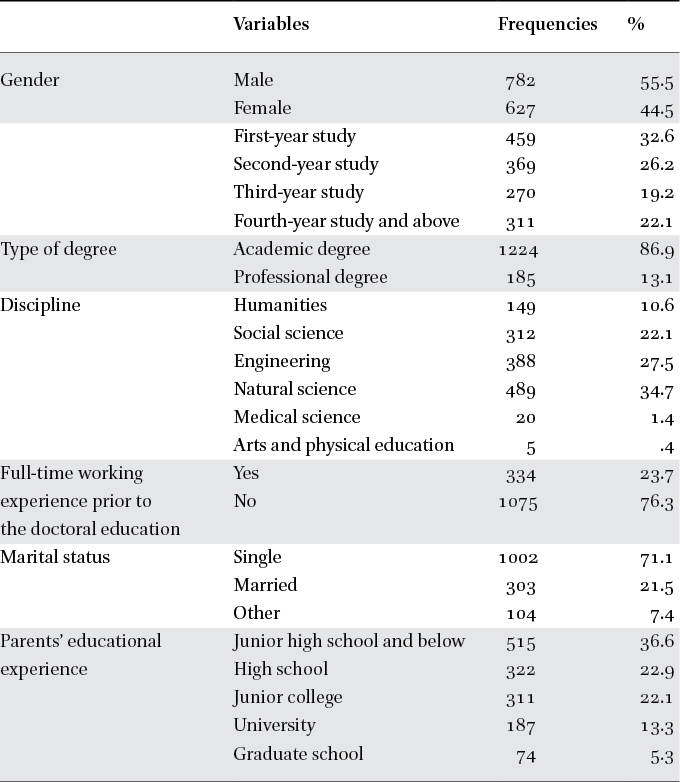
Main characteristics of respondents
Table 1 illustrates the main characteristics of respondents. In summary, 55.5% of respondents were male doctoral students, and the remaining 44.5% were female. The largest proportion of respondents were first-year doctoral students (32.6%), followed by second-year students (26.2%), fourth-year students and above (22.1%), and finally third-year students (19.2%). By type of degree, the vast majority of respondents were pursuing academic degrees (86.9%), including PhD candidates and DSc students. The number of doctoral students who wanted to receive a professional degree only accounted for 13.1% of the total respondents. By discipline, the largest proportion of respondents came from natural sciences (34.7%), followed by those from engineering (27.5%), social sciences (22.1%), humanities (10.6%), medical science (1.4%), and arts and physical education (0.45%).
The master version of the survey instrument was written in English, and the Chinese research team translated this into Chinese while also referring to its Japanese language version. The questionnaire consisted of questions divided into the following sections: “Doctoral Program Admission and Supervision Selection”, “Experiences from Doctoral Program”, “Learning and Research Activity in Doctoral Program”, “Career Plan”, “Your Preferred Ways of Learning and Working (optional)”, and “Personal Information”. The present study mainly concerns responses to the question “What is your career plan straight after receiving your doctoral degree?” in the “Career Plan” section. In response to this question, participants were asked to consider the ten choices listed below:
To be employed in a business sector of my field
To be employed in a public research institute
To be employed in a private research institute
Take a post-doctoral position
To be employed in a university as a tenured academic
To be employed in a university as a non-tenured academic
To be employed in the government sector
To be self-employed (e.g., start a spin-off)
Unsure about specific plan about my career after graduation
Others
Respondents’ were requested to rate each of the 10 choices on a 7-point Likert scale (from “not at all” to “completely agree”). Choices 1, 3, 7 and 8 were classified as non-academic careers, while choices 2, 4, 5, and 6 are categorized as academic careers for the purposes of this study. Based on these categories, the research team calculated a score for the academic orientation of each response and for each respondent, on a scale of 1–7 (1 = minimal academic orientation; 7 = maximal academic orientation). For example, if a respondent answered Choice 1 (“To be employed in a business sector of my field”) with “completely agree”, their career goal is then their academic orientation score, and their score for that item was 1. Conversely, if the respondent answered with “completely agree” in response to Choice 5 (“To be employed in university as a tenured academic”), then their academic orientation score for that item was 7. The mean score for items 1–8 therefore created an indication of the respondents’ general academic orientation. In addition, a further question, “Is working in a university to be your ultimate career goal?”, was included in the questionnaire. Based on the answers to this question, the research team divided the respondents into two broad types: those hoping to eventually work in a university (with a value of 1), and others (with a value of 0).
In order to address the research questions outlined above, the study used academic orientation score (continuous variable) and plan to eventually work in a university (dummy variable) as dependent variables that indicated the degree to which they were invested in an academic career. Independent variables included: gender; family background, including whether either parent had received a college education, and if either of them worked or had worked academia; discipline; peer interaction; curriculum experience; institutional support; and academic supervision. A special mention should be made that while parents’ prior educational experience (particularly at degree-level or above) is only one of many indicators measuring cultural capital in this study, it is one of the most important and most frequently used indicators in the literature in China. The researchers used both
In terms of participants’ academic orientation, as Table 2 reveals, no significant differences could be identified according to the gender of respondents. Second, family background did not appear to have a significant impact on doctoral students’ academic orientation either. Further, parents’ prior receipt of college-level education or work within the academic community did not significantly affect participants’ degree of determination to become an academic. However, significant differences in academic orientation could be found between students from different disciplines. The academic orientation scores of doctoral students in humanities were significantly higher than those in social sciences, natural sciences and engineering, indicating that compared to doctoral students in many other disciplines, doctoral students in humanities showed a stronger interest in pursuing an academic career. This is especially true in comparison with doctoral students in engineering, the field in which respondents indicated the lowest interest in an academic career. This finding is consistent with existing studies conducted by many Western researchers, which also indicated that doctoral students or graduates in natural sciences and engineering are more likely to take positions outside of academia. Finally, in general there is a correlation between the features of the socialization experience of doctoral students and their academic orientation scores, with the exception of their responses regarding peer interactions. Results indicated that the higher their satisfaction with academic support and academic guidance, the higher their academic orientation score became. However, interestingly, their curriculum experience only exerted a negative effect on their academic orientation.

Standard errors in parentheses: *** p < 0.01, ** p < 0.05, * p < 0.1
According to Table 3, more than half of Chinese doctoral students confirmed their preference for pursuing a career working in universities. Unlike the academic orientation dependent variable, when other independent variables of family background, discipline, and socialization experience, were controlled, significant differences could be identified between male and female doctoral students. Fewer male doctoral students (56%) were inclined to pursue an academic career than their female counterparts (71.9%), echoing earlier studies in the US and the Netherlands, and also the earlier research undertaken by Shen’s team in China (Shen et al., 2018). Significant disciplinary differences were also found. On average, over half of the respondents believed that they would prefer to work in universities, but this proportion was highest among students in humanities (89.1%), followed by those in social sciences (78.1%), natural sciences (55.7%), and engineering (51.6%). Again, this finding from the Chinese case study matches patterns identified in the many earlier studies discussed above. Regarding age, it appears that as doctoral students become older the more likely they are to choose to work in universities. For example, only 46.7% of doctoral students between the ages of 20–23 years old were targeting a career in universities. In contrast, 73.6 % of the respondents in the 30–35 age group, and 78% of those aged between 35 and 50 years old, had chosen to work in academia. In contrast, while more than 60% of participants who answered that their parents are university teachers claimed that they would choose to work in the universities, no significant differences could be confirmed. However, while no meaningful differences could be found based on participants’ fathers’ prior education, significant differences could be identified according to their mothers’ education. Interestingly, it seems that the higher level of education their mothers received, the less likely they were to choose to work in the universities.
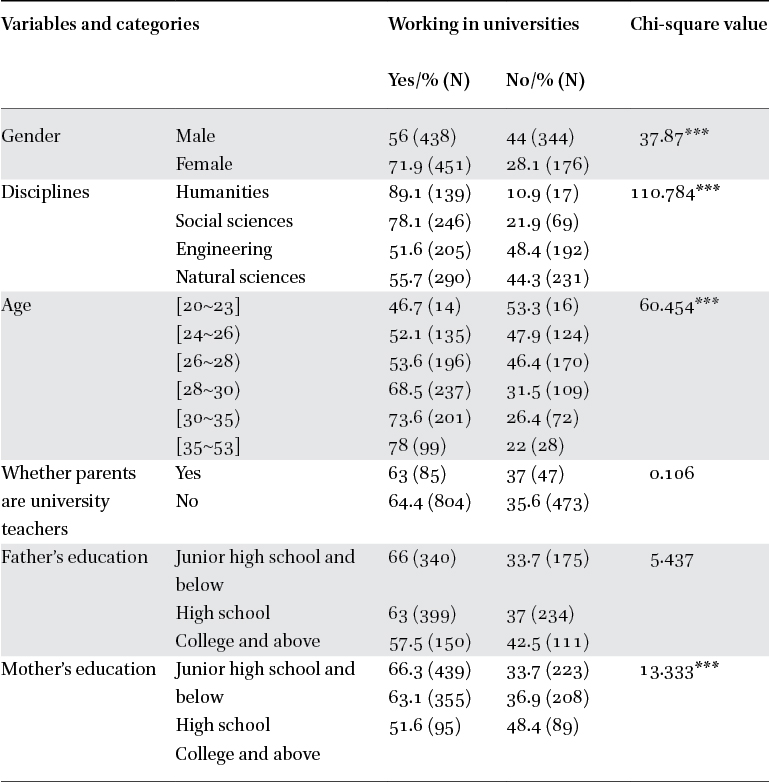
Standard errors in parentheses: *** p < 0.01, ** p < 0.05, * p < 0.1
Table 4 presents the main factors affecting doctoral students’ choice of whether or not to work in universities after their graduation. By gender, significant differences could be identified between male and female students, confirming the finding that fewer male doctoral students seek to work in universities than their female counterparts. Furthermore, participants’ parents’ educational background significantly affected their choice of career path.

Standard errors in parentheses: *** p < 0.01, ** p < 0.05, * p < 0.1
For example, the data indicated that doctoral students with richer familial cultural capital (parents have received higher education) are more inclined to work outside the university sector, and that working in the university sector is relatively unattractive to them. By discipline, the students in humanities showed the strongest willingness to work in universities, while those from both natural sciences and engineering seemed to be less interested in working in the universities. In terms of participants’ socialization experience, no significant differences could be found based on their responses to items regarding peer interaction or curriculum experience. However, it seems that doctoral students with higher satisfaction with their academic supervision preferred to choose to work in the university sector.
As previous research and national data suggest, despite the increasing diversity of employment destinations among doctoral students graduating Chinese universities, the largest number of them still choose to work in
As noted earlier, this study used independent variables of gender, family cultural capital, disciplinary culture, and socialization experience to analyze their impacts on Chinese doctoral students’ career orientation. Gender appeared to have no significant effect on academic orientation scores, but did exert a significant impact on whether they would choose to work in universities after their graduation. This finding is consistent with Shen’s existing research (2018). There are several possible reasons why Chinese female doctoral students may be more likely to choose to work in universities than male doctoral students. For example, in China, university salaries are generally lower than those available in large private companies. However, among other advantages, an academic position is a relatively stable job, and university faculty can also enjoy contributions to their welfare such as their children’s schooling, and the relatively low time demands in academia allow female academics to have more time to take care of their children than if they were to work in industry and business.
The influence of social background on the career orientation of doctoral students seems to be more complicated. The study suggests that the social background of Chinese doctoral students did not have a significant impact on their academic orientation scores. But at the same time, the study also confirms that doctoral students with richer familial cultural capital (those whose parents held a college degree or above) are more reluctant to choose to work in universities. By way of explanation, in recent years, competition in the Chinese academic labor market has become increasingly fierce. Many doctoral graduates find it extremely difficult to be hired at research-intensive universities and have to work in local or teaching-centered universities, or even the non-academic sector. An aversion to working in such non-academic roles may be one of the reasons why university jobs are less attractive to doctoral students whose parents received a college education.
Furthermore, significant differences were evident between disciplines, and the relationship between participants’ socialization experiences and their academic orientation could also be confirmed, reflecting the relationships found in many earlier studies abroad. Moreover, the study found that socialization experience may influence doctoral students’ academic orientation. Those who indicated higher satisfaction with institutional support also had higher academic orientation scores and, consistent with existing research (Curtin et al., 2016; German et al., 2019), the study suggests that supervisors have an important influence on the career orientation of doctoral students. Doctoral students who were more satisfied with their academic supervision tended to have higher academic orientation scores and be more inclined to work in universities.
However, as prior studies did not identify the impact that age may have on doctoral students’ academic orientation, the evidence from this study that older graduates may be more committed to an academic career is a novel contribution to the existing research into doctoral education.
In summary, many of the findings from the study corroborate relationships identified in prior research, such as remarkable gender and disciplinary differences in doctoral students’ likelihood to pursue academic careers in universities. However, the study also revealed some of the specific determinants affecting doctoral students’ academic orientations and their expectations of working as academics in the Chinese case, specifically. Therefore, as a case study based on the survey of Chinese doctoral students, this paper adds a new perspective to the ongoing academic discussion around the factors affecting doctoral students’ academic orientation and their choice of whether to become university faculty in different contexts.
In terms of policy implications, if universities and research institutes want to attract more of the “brightest” students to enter doctoral programs, enhancing doctoral students’ satisfaction with their academic environment and improving supervision systems might an effective strategy. As for implications for institutional practice, if individual universities want to produce more academics or researchers who would like to work at universities or research institutes after they graduate, they need to consider the impact of doctoral graduates’ age on their choice of academic career: it appears that older graduates are more likely to pursue an academic position than doctoral students aged 20–23 years old.
There are two obvious limitations in this study. First, the national survey was mainly conducted in research universities, and little information was collected from those doctoral students who study in local universities. The study also cannot provide a comprehensive portrait of Chinese doctoral students’ academic orientation and their choice of working in universities or the non-academic sector. Second, further research is required to explore why some specific factors appeared to have a different influence on Chinese doctoral students’ academic orientation and their determination of working in academia and non-academic sector, compared to earlier research from some European countries and the US.
Footnotes
Acknowledgement
The authors would like to express their deep thanks to Thomas Brotherhood from University of Oxford for proofreading this article.
1
In May 1998, the Chinese government launched the national 985 Project with the purpose of establishing several world-class universities by the mid-21st century. All the 985 Project universities are listed in the 211 Project universities.
2
The 211 Project officially started in 1995 with the intention of building around 100 well-known research universities and numbers of key disciplines with high quality in China by the twenty-first century.