



Abstract
Online education has grown exponentially over the last few decades, churning through a swarm of acronyms, ambiguities and potentialities. Substantial energy has been invested in producing technology, building academic capability, and understanding learners and markets. Though it feels pervasive, online education is comparatively new in the scheme of higher education, and key education and business models remain in formation. To spur advance, this paper argues that as online education matures increasing energy must shift from supplier-centric concerns about provision to instead ensuring learner value and success. We argue that online education presents new opportunities not just for the mechanics of higher education, but for improving each student’s experience and outcomes. Central to such advance is a clear picture of student success, cogent perspectives for understanding students, effective strategies for analysing and interpreting huge volumes of data, and more evidence-based academic leadership. The paper investigates each of these areas, provoking an agenda to guide further student and institutional achievement.
* Related sections of this paper have been published in Alternation, Education Studies Moscow, New Directions for Higher Education, and in project reports funded by the Australian Government.
Introduction
Everyone engaged in higher education wants students to succeed. Higher education transforms people’s lives, creates the professional workforce, helps people engage as citizens, and generates new knowledge and skills. A successful higher education experience yields important returns to many people and communities. Yet without careful leadership and planning, research and development in this field is vexed and at risk of stalling. Dated myths are being used to identify who students are and how they experience higher education. Entrenched rituals for garnering evidence on the student experience are yielding diminishing returns. People lack data to help plan the really meaningful experiences which flowed serendipitously in smaller and more regulated systems.
Clearly, effective leadership of the student experience is essential to the success of higher education. Such leadership must be responsive to changing contexts and technologies. To that end, this paper outlines a strategy that optimises opportunities presented by the maturation of online education. The strategy is grounded in a picture of what we’re seeking to achieve, and the paper begins by advancing a model of student success. From there, it proposes new approaches for understanding and measuring the student experience, and examines the leadership required for change.
Online education has grown exponentially over the last few decades, churning through a swarm of acronyms, practices and potentialities. The term “online education” encompasses many things, and in this paper is used to refer to formal education that involves the use of computing technologies, irrespective of where the education takes place. This plays out in varying ways, from fully online education to myriad hybrid forms of teaching and learning. Online education has been advanced as a key means for reconfiguring higher education to supply, and in certain cases create, new forms of demand. It conveys intrinsic advantages, offering people an alternative means for interacting with teaching resources, delivering myriad forms of media, and supporting a plethora of communication and decision-making options. Substantial energy has been invested in producing technology, building academic capability, and understanding learners and markets. Though it feels pervasive, online education is comparatively new in the scheme of higher education, and key education and business models are still forming.
Building on earlier research, 1 this paper argues that as online education matures, energy must shift from the quantity of inputs to the quality of outcomes—from seeing online education mostly as a means of getting more people into higher education, to focusing instead on ensuring value and impact. Just like individual learners, as systems and institutions and technologies develop, focuses should shift from “access” to “success.” This means moving beyond prevailing preoccupations with student access and retention, to instead explore a broader suite of qualitative considerations regarding student success. There is little value in using online technologies to expand education if they increase the volume of people entering tertiary study but through dropout and other problems fail to help people succeed. To achieve this, we advance a strategy that incorporates a broader conceptualisation of student success, new ways of thinking about students, and more expansive forms of evidence.
The strategy we present is underpinned by a new means for understanding students. “Going to uni” is no longer what it once was—a seminal life event or stage, a coming of age almost, for the relative few. Massive increases in the demand for higher education have disrupted traditional notions of student identity. Students today source identity-building experiences from a broad range of study, lifestyle and employment opportunities. Such change drives a need to revisit basic assumptions about who students are, what they seek from higher education, the expectations that shape their experience, and how institutions can best help each student. Most of the entrenched conceptualisations of students were formed many years ago in far-away places, and rest on crude group-level sociological generalisations. So, we assert the need to instead look through different prisms that give life to the experience of people. In essence, we need to shift from analysing the experience of groups, to instead analysing the success of people. By blending earlier work on students with more contemporary perspectives the paper asserts the need for a suite of new intersectional constructs relating to student identity, expectations, wellbeing, engagement, values, opinions, attitudes, interests, commitments and lifestyles.
Built into our proposed strategy is the realisation that the techniques we use to study students’ experience must also change. In no small part, the now well-institutionalised focus on sociological groups is an artefact of the methodological, analytical and processing limitations of the traditional student survey. Response rates for many surveys are in decline, the explained variance is low, and stakeholders seem increasingly unresponsive to results. More effective electronic footprints are available that students create through their interactions with courseware, social networking and other systems. With mobile technologies, people analytics and other techniques made possible by rapid advances in technology, we now have the tools and data required to conduct more sophisticated and individualised analyses. Hence we propose a sustainable shift in focus from student surveys towards broader kinds of education analytics.
As these remarks convey, this paper sets forth a major new line of work into the success of higher education students. Who are the individuals entering higher education, and how can institutions better manage their experiences as they progress through study? How can we move beyond the suite of popular but limiting constructs on retention and experience, to look instead in more dynamic ways at who people are and what they need to succeed? How can we get information on each and every student, not just the fifth or so who respond to surveys, and how can we explain more than a fraction of people’s experiences? How can we help institutions and academics change? These are deep and broad yet basic questions which require us to better understand how an increasing number and range of individuals approach higher education, students’ identities and expectations, and how institutions can manage and enhance people’s experience.
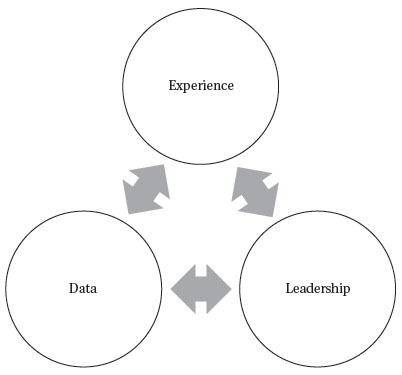
Why complicate matters with this kind of integrated analysis? In summary there is a pressing need for joined-up leadership, education, and institutional research: higher education management needs to become more evidence-based; work on the student experience needs to move beyond reliance on survey rituals that reify mythical sociodemographic groups; and institutional research (including various emerging forms of “big data analytics”) needs to become less a-theoretical. 2 Figure 1 depicts the design space in which the paper is positioned. Finding a sweet spot which unites practical, theoretical and technical angles carries valuable potential for maturing the evidence-based leadership of higher education. Making this step requires creation and adoption of a “new ethnology” for higher education.
Propelled by outcomes from a major research project, this paper conveys a strategy to provoke a modest shift in this broad direction. Substantively, we investigate who students are and what they expect from higher education—inquiry that goes beyond stereotypes, generalities and dated assumptions about demography and contexts. Technically, we explore sustainable new approaches for measuring and reporting on these new constructs and profiles. We progress the field of education analytics that can help institutions leverage under-utilised existing data for quality enhancement. Practically, we shed new light on how institutional leaders and managers could use new insights and data sources to monitor and improve the student experience. Overall, our analysis seeks to jump beyond dated myths and rituals to instead exploit the opportunities offered by the maturation of online education.
Joined-up data-driven leadership of student success.
Framing Student Success
As higher education has grown and diversified, so too has the challenge of helping each learner succeed. The reasons for participation have proliferated, as have the programs, environments and post-graduate pathways. This changed context makes it more important than ever to develop practice-relevant conceptualisations about what is sought through higher education. While clearly not a task that can be approached or accomplished in any easy or conclusive way, it is likely that a basic frame—even one which is highly contestable—carries genuine potential to inform future progress. The key question guiding this task is: “What does higher education want for students?” If the answer—presumably—is “success,” then what is a useful way of conceptualising this phenomenon? In the remainder of this section we advance a normative model of success, articulated as a basis for subsequent investigation of student identity, institutional research to inform leadership.
The model draws on insights from a study conducted in Australia in 2015-16 to investigate what engages people in a successful student experience. 3 This study began by investigating the underpinning psychological concepts of student success and identity, and looking also at the kinds of evidence and leadership required to give life to new insights. The study, which brought together researchers from eight universities and was overseen by an international advisory group, entailed systematic review of educational and psychological literatures, 4 procured extensive feedback from 31 tertiary institutions, involved six in-depth institutional site visits and case studies, interviewed a diverse group of 44 students, and interviewed and consulted with hundreds of researchers and practitioners dozens of many countries.
A core outcome of this study was the articulation of an architecture for guiding further research and development into the successful student experience. Specifically, the study defined a new model which deconstructed the successful student experience into nine qualities. 5 These intersecting qualities (see Figure 2) extend a means for developing new perspectives which advance an individualistic conception of how students should experience higher education. The qualities distilled insights from the literature, from students, from experts and from institutions. Each of the nine qualities is presented before turning to analyze the model more generally and its utility for advancing research and practice.
Nine qualities of student success.

Forming
Higher education should
Growing relevance is being placed on a
The above paragraphs sketch the nine qualities which the study identified as mapping out important pictures of future student engagement. In articulating these nine qualities it is not assumed that they are either exhaustive of the area, unconstestable, or mutually exclusive. The terrain is too complex and dynamic for any such claims to be made. Rather, it is contended that the qualities mark out a suite of worthy agendas and carry potential to create discourse that helps students and their institutions succeed.
The qualities step beyond prevailing terms used to define and operationalize student experience and related constructs. As noted above, for instance, while ‘student satisfaction’ has become somewhat entrenched, there is ample evidence that beyond stamping out woeful practice it offers substantially diminishing returns to improving higher education. Worse, it sucks energy and attention away from things that really count as articulated in the nine qualities above. Ingrained phrases such as “teaching quality” and “student support” and “student services” appear to be becoming less relevant as team-based computer-mediated teaching and facilitation are more widespread as evidenced by the near-universal adoption of learning management and other enterprise-learning systems. The nine qualities are broader than the frequently espoused though rarely measured “graduate attributes.” Rather than fixate on what are really supply-centric concepts, we instead project qualities that signal new co-created conceptualizations of higher education.
These qualities are designed to be equally meaningful to many diverse stakeholders, including people such as those who haven’t thought about higher education, prospective students, students, graduates, employers, teachers and support staff. Given the transparencies and efficiencies afforded by new technologies and knowledge it makes little sense to design ideas about education or quality for segmented or partitioned audiences, as has been the case in the past. Instead, we see that common and suitably nuanced information can be provided to myriad stakeholders. What this means in concrete terms is that the same data in aggregated form could flow through to academic leaders as is used to produce personalized reports for individuals.
It is always difficult to articulate exactly the approach used to distil new concepts. A suite of research strategies was used to create and test these qualities, as summarized above. The background research helped tease out emerging ideas and perspectives on who students are and how they are experiencing higher education. This research informed production of the institution inventory, which yielded very rich insights and commentary from dozens of reflective thinkers. Detailed review of these inventories by three analysts derived a shortlist of underpinning forward-looking ideas. These ideas were tested in several consultations with academic leaders and student affairs experts, and in student interviews. Additional reviews were gathered during several international, national and institutional consultations. Combined this work affirmed the appeal and utility of the nine qualities model as a means for structuring future educational and psychological research and development in this field.
Recreating the Student Experience
Clearly, succeeding in higher education means different things to different people. While the preceding conceptualisation of success is deliberately decontextualized to the point of theoretical generality, to be of any use it needs to be made real in particular individual contexts. In establishing settings for the future of online education it is important to improve the approach to identifying people.
The following analysis asserts the need to embrace substantially more complexity than has hitherto been the case. In essence, we discuss the need to shift from viewing students through the lens of mythical sociological groups, to instead looking through prisms that give life to each person. This is not just a linguistic slip, but a fundamentally different way of conceptualising the identity of those people who study in higher education. We believe that this shift—broadly, from treating each student as a group member, to treating each student as a person—will likely require much work, particularly in developing robust education analytics, but will ultimately be productive.
To guide each person’s success it is necessary to chart individual paths through each of the nine qualities. The model maps out facets of a successful student experience and for each of these it is helpful to identify thresholds that signal transition from one level of experience to another. This exposes our adherence to a fundamental measurement assumption that gradations of increasing success can be specified for each quality. This does not imply that every student proceeds stepwise or even necessarily through each threshold, or that each threshold is even meaningful for each student. It does imply a fundamental structure which underpins each quality and is relatively invariant across environments and people. This is uncontroversial if the thresholds are defined in sufficiently general ways than are able through the process of measurement to be particularised in relevant and helpful ways.
The process of defining such thresholds typically involves an iterative work that includes:
For each quality, conceptualising transition thresholds—that is, for instance, clarifying what characterises “low,” “medium” and “high” forms of personalisation or value or opportunity;
Identifying or creating relevant data elements that have desirable technical properties—for instance, compiling information from student surveys and related systems into reports;
Aligning data elements with each of the transition thresholds, giving consideration to appropriate assessment and reporting protocols;
Validating the alignment of data with qualities, and testing and refining the model in small-scale applications; then
Scaling the model for use in more general individual and institutional contexts.
This approach reflects the straightforward application of assessment science to build technical foundations for the nine qualities. It is important to follow such process in developing new student experience infrastructure, though this does not mean the solution must be complex. The field of higher education student experience has a history of searching for more precision in evidence than is often warranted by the quality of the data—the pervasive (mis-)use of student satisfaction data is a primary case in point. Identifying robust but parsimonious indicators of these facets of the student experience will do more to advance practice than searching for decimal place differences on current metrics will ever achieve.
As well as this growth dimension, it is important that the transition through thresholds is interpreted in an individualised manner. People do not move at the same pace, or even in the same way, through common educational experiences. 6 Hence, as flagged directly in one of the qualities, there is the need for a highly individualised interpretation of student identity as part of the proposed model of student success. This project draws on the idea of “intersectionality” 7 which forwards an approach to identity that uses intersecting vectors of relevant information to account for differences in identity criteria to build complex pictures of who people are. Such identity delineation already abounds for anyone with an online presence, yet is just starting to emerge in higher education. Taking this approach helps move beyond bundling people into simplistic groups/boxes which fails to provide the nuance necessary for helping individuals succeed. Figure 3 starts provokes a conceptual picture of how this might be done, showing a range of sample personal, environmental and situational factors. As in any general multivariate segmentation activity it would likely require dozens of factors to profile students sufficiently to create managerially and educationally useful profiles.
The ideas of profiles and journeys are useful tools for conveying this approach. Simply put, a profile can be envisaged as a complex dynamic of diverse attributes which portray an individual in relation to a successful student experience. A journey is a multiple branching pathway through a higher education process, from beginning to end. The idea of profiling “movements through journeys” steps well beyond the idea of shifting “batched groups through lifecycles.” Together these two approaches may seem on first glance to unleash infinite complexity for conceptualising and managing each student’s experience, but the history in other industries implies otherwise. After initial reworking in terms of new processes, effective digitisation has been shown to yield substantial increases in productivity and quality of people’s purposeful interactions with organisations. 8
Example hyper-intersectionality.

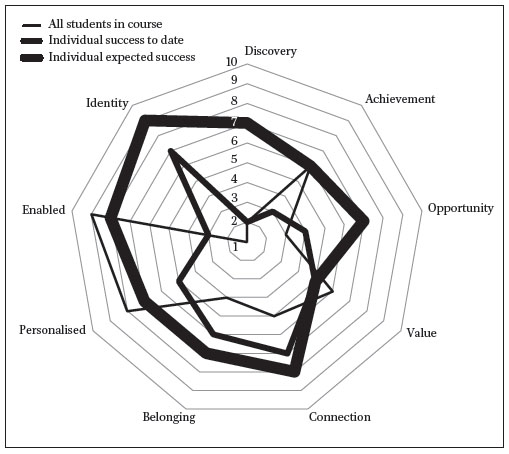
Figure 4 depicts how such information might be relayed in a sample report of student success. For each quality it presents information (scored on a scale ranging from 1 to 10) for students in a course, an individual student’s success to date, and individual expectations.
Different players will of course interface with this information in different ways. Indeed, understanding differences in perspectives and interpretation has proved to be an important part of how new forms of data are being positioned and developed in traditional/existing higher education structures (which are often changing themselves). It is important to design new approaches that take very seriously the demands of consequential validity. Technical development can then be driven by a clear sense of what should be achieved. The approach enacted in the research that underpins this paper—involving reviews and discussions about research and practice—have sought to design an approach that yields meaningful insights for key stakeholders such as students, teachers, support staff, managers, leaders and the public at large.
Sample student success report.
Creating Education Analytics
Evidence for Success
Conceptual consensus acknowledging the need to understand the diversity of today’s students is insufficient to advance development. Effective change requires shifts in institutional culture and practice. We suggest that such change should be evidence-based, underpinned by data that identifies who students are and what they need from institutions to succeed. Figure 5 visualises this data-driven shift towards student success.
As technology enables education to become an integrated element of institutional and student life, new kinds of data are being spawned that harbour the potential to personalise the education experience. Online education systems that are used to manage the student experience from admission through to graduation and beyond, have the potential to supply information for better understanding students and helping them succeed. 9 While there may be an abundance of information on students, data siloing—the lack of interoperability between systems and the non-collection of data—prevents the effective use of integrated information about the student experience, hindering progress. Hence multifaceted change is needed to facilitate the collection and analysis of experiential student artefacts for the purpose of understanding students and promoting success. Broadly, we contend, this involves a shift away from the conventional methods used to study the student experience into new territory defined in terms of various forms of “analytics.”
Data-driven approach to student success.
Higher Education Analytics
The empirical foundations of the strategy proposed in this paper rest on the notion of “education analytics.” Education analytics, most broadly, is understood as the use of data to explain and predict, allowing action on complex education issues. It is helpful to position such analytics in terms of emerging research and practice.
The use of analytics in higher education is considered to have evolved from “data-driven decision making” that defined “business intelligence” during the 1980s and 1990s. 10 With origins of practice in commerce for business management, the use of analytics in pedagogical environments has taken longer to develop 11 and is currently in an early-adoption phase. The use of analytics in higher education has developed rapidly over the last five years with the proliferation of digital systems, platforms and devices. The field of “learning analytics” has taken shape, which in a formative conceptualisation is defined by Siemens and Gašević 12 as “activities concerned with the measurement, collection, analysis, and reporting of data about learners and their contexts, for purposes of understanding and optimizing learning and the environments in which it occurs.” The use of analytics for institutional purposes is referred to as “academic analytics.” 13 As well, “social learning analytics” seek to provide information about the construction of knowledge by groups of learners. 14
Education analytics rest on the generation and storage of vast amounts of data, which in turn rests on the incorporation of large-scale systems into core facets of higher education. Such systems are now integrated in operations such as admissions, enrolment, fees and loans, curriculum, assessment, resources, student support, library, survey instruments, applications, general and official communication. Data from such official systems provides the foundations for education analytics. This includes demographic and personal information submitted by the student for enrolment, and academic information generated by students and staff. But limitations on the completeness and connectivity of data sources within and across institutions restricts use. 15 As well, teachers and students use a vast range of non-institutional systems to support learning and broader interactions, and data from such platforms can be difficult to source or access.
We argue that there is a need for greater strategic use of education analytics at a formative stage of the field’s development. While international scholarship exploring the theory and practice of analytics in higher education is surging, 16 the use of analytics in applied institutional and national settings remains muted. A study of institutional data use in the United States, for instance, found that most data collected by institutions is for credentialing or reporting requirements rather than addressing strategic questions, and that much of the data collected are not used at all. 17 While the application of analytics for strategic objectives is developing, current practices are often fragmented, opportunistic and theoretically limited. Recent approaches towards the collection of more nuanced student information and the integration of greater sources of information promise to provide greater insight into student identities, including learning behaviors, motivations and needs. The potential for the use of analytics to retrieve student data not just from official sources but from platforms and applications not technically supported by institutions reflects further opportunities. Improvements in technology and the changing economies of tertiary education are increasing the need to scale and embrace more people and educational experiences.
From Retention to Success
To date the primary use of analytics has focused on student retention. Examples of analytics designed for this purpose have been executed by different institutions through a variety of methods, and supplemented by a range of interventions both digital and physical. One of the most cited examples is “Course Signals” developed at Purdue University in the United States. 18 The analytics system uses data from the learning management system in combination with demographic and other information mined across university sources to gather prior academic history (including secondary school) and academic preparedness. The use of analytics largely for retention purposes reflects a traditional “top-down” approach to student support by harnessing information that identifies a problem for the teacher or institution to resolve, rather than advancing a more evidenced-based and success-oriented understanding of how students learn and what motivates them to succeed.
Focussing on the use of data for retention has in large part ignored the potential for personalised and adaptive systems to enhance the experience of all students in a much broader range of ways. Education analytics needs to mature to help institutions ensure each student’s success. Broadening the scope of analytics using more diversified data sources has the potential to inform a greater range of purposes suited to individual students, such as scholarship eligibility, international exchanges, internships, alternative course offerings, extra-curricular opportunities and employment. Creating more sophisticated analytics carries potential to not only steer student success along the pathways defined above, but also influence the skills and knowledge sets developed in higher education. As a young field of practice and research, the potential use for analytics has yet to be considered in full.
By way of example, rather than implement discrete student surveys and administrative data collections, institutions could map data requirements against the model of success (Figure 2) and salient intersectional facets of student identity (Figure 3). The derivation of education analytics could then underpin personalised advice to relevant stakeholders—students, teachers and support personnel—with a view to providing the individually focused support that has been shown 19 to help each student succeed (Figure 4). Coates et al. 20 provides further insight into how this can be done.
Enhanced Academic Leadership
We have argued that as each student’s use of learning technologies increases and diversifies, institutions have an obligation to understand the changing identities of students, and to steer each towards success. Students invest heavily in higher education to realise a multitude of outcomes. No longer being passive actors within higher education settings, students today are diverse learners in an increasingly diverse and evolving environment resistant to traditional descriptors based on broad demographic categories. The advent of education analytics promises to provide personalised, adaptive and real-time learning environments for each student. Yet education analytics alone are insufficient to advance higher education. As Figure 1 brings out, multidimensional leadership is required that joins-up education analytics with a more nuanced notion of who students are and how they experience higher education to enhance student success.
Indeed, effective academic leadership lies at the heart of any strategic change in this area. Such leadership must come from a variety of sources—people in formal leadership roles, teaching academics, support and advisory personnel, the environments people establish, and of course learners themselves. It is important to keep squarely in mind in any such analysis that the nature of academic work is changing, 21 and new hybrid functions and hence roles are emerging, not least in the field of analytics. As well, higher education is an essentially co-produced activity, and even the best institutions in the world will not inspire success unless students particularly and also a range of other agents engage.
What, then, are the most effective means for building capacity and impelling the strategy charted in this paper? First, there is an urgent need to ensure that online platforms support a range of education and management functions. These tools are not context neutral, and at a minimum we contend that they must furnish metrics to advance the elements of success outlined above. Second, there is a need for case study research that demonstrates the value to institutions and individuals of adopting a broader evidence-based approach to online education. Clearly, there is a need to motivate institutional leaders to shift energy beyond preoccupation on access and retention issues. Third, as online education further expands it is necessary to implement various forms of professional development to build the capabilities and competencies linked with success. Fourth, and importantly to shift these ideas beyond the concept phase, tertiary policymakers and regulators must put in place incentives and regulations which encourage and prompt institutional leaders to succeed. Distilled from numerous case studies Coates et al. (2017) 22 detail frames which chart such progress.
The paper has been guided by the important premise that there is a pressing need for joined-up research and development of student experience, data, and leadership. Pushing ahead separately on each of these frontiers will not achieve the desired change. Rather, leadership must focus more on using data for student success, data must be more aligned with student success and relevant to leaders, and student success must be grounded in data and leadership. To this end, Figure 1 can be reconfigured into a maturity model which helps institutions assess current conditions and articulate feasible and effective progress. For instance, this could define and provide exemplars of “poor” to “basic” to “excellent” forms of practice. Such a maturity model would show that building data-driven leadership of the student experience means improving in each of these three areas, and doing so in ways relevant to each of the others. Better data will not help unless it is relevant to leaders and success. Leadership will fail unless such energy is guided in ways that inspire success. Articulations of success are interesting but useless if they are not linked with data and people or systems that can shift practice. An enhancement framework would help identify how institutions can build this more evidence-based leadership of the student experience. It would show ways to create a collaborative culture of student success within a professional bureaucracy. Enhancing the student experience will only happen if the appropriate people talk to each other, share their understanding, and apply their expertise and diverse judgments to shape the institution’s environment for student endeavour. It is crucial to focus attention and effort to avoid or remedy “organisational attention deficit disorder.” It is important to shift to a student-centric perspective on the educational experience that encompasses a holistic frame familiar to students as they intersect with a broad range of processes and people, units and departments, platforms, services and requirements. Therefore, such an enhancement framework should envision a “new order” of institutional arrangements and capacities that support a more aligned focus on creating a culture for student success. It should describe pathways for realising aspects of this vision.
Though difficult to generalise across institutions and people, higher education has been slow to adopt evidence-based forms of practice. There would appear to be various reasons for this, not least the political economy of the sector, history and culture, the rapid growth of institutions and analytics, and the fact that much that matters in higher education can be very difficult or complex to measure. Nonetheless, there is a growing need for more evidence-based change. We affirm the need for academics rather than governmental or commercial stakeholders to advance the core academic strategy outlined in this paper.
Ambitiously, this paper has sought foundations for new forms of data-driven leadership of the student experience. It has aimed to prompt sustainable strategic change through improving institutional capacity to enhance the student experience by building new concepts for understanding students, identifying new data sources and approaches, and engaging institutions in leading enhancement work.
Footnotes
3 Ibid.
5 Ibid.
11 Philip J. Goldstein, and Richard N. Katz, “Academic Analytics: The Uses of Management Information and Technology in Higher Education,” EDUCAUSE Review 8 (2005), accessed January 11, 2015,  .
.
15 Phil Long and George Siemens, “Penetrating the Fog,” 31-40.
17 Jacqueline Bichsel, “Analytics in Higher Education: Benefits, Barriers, Progress, and Recommendations,” EDUCAUSE Review (August, 2012), accessed January 11, 2015, .