



Abstract
This study aims to explore internship experiences and their influence on job performance among university graduates in Korea. The research questions are as follows: 1) To what extent do university students engage in different types of internships in Korea? 2) How do internship experiences differ by academic fields and institutional types? 3) Does internship experience predict graduates’ job performance, namely their job search duration, wages, and job satisfaction? This study used the Korean Education and Employment Panel Survey (
Keywords
Introduction
Today’s labor market changes rapidly, presenting several challenges to young adults transitioning from school to the workplace. Longer periods of education do not guarantee that young people have the higher problem-solving skills necessary to respond to the complex demands of the labor market. 1 There is a prevalent social concern that higher education fails to teach useful job skills, and that it needlessly increases costs to economies, businesses, and workers. 2
Institutions of higher education are expected to teach relevant job skills before students enter the labor market. 3 They must inform students of the outside world’s expectations, preparing them for future job tasks and new employment patterns. 4 Additional training and work experience may be required to improve upon the initial competencies acquired in the classroom.
Work experience has long been a common practice for students in some professional fields, such as medicine, law, and education, and it has become increasingly popular in other areas of study in recent years. 5 It enhances not only students’ field-specific knowledge but also their generic workplace skills, such as problem-solving and communication. 6
Work experience can be structured in many ways, including internships, dual-study programs, and project learning. 7 Similar concepts exist in higher education settings, such as cooperative education, sandwich courses, practical seminars, service learning, experiential learning, apprenticeships, community service, field work, job shadowing, and school-sponsored enterprises. 8 This study particularly focus on the internship experience. The concepts and practices associated with internships vary in different parts of world; 9 this study specifically focuses on short-term, employment-related work experience programs that have been arranged through a mutual understanding between individuals, institutions of higher education, and employers in South Korea context.
Internships have become popular among employers, employees, and universities around the world. 10 For university students, internships are an opportunity to obtain work-related experience and apply their knowledge in professional work environments. 11 Employers have emphasized the importance of work experience in the recruitment process. Universities are also increasingly using internships to fill the gap between what is taught in classrooms and what is practiced by businesses. 12 On the other hand, several criticism also exist in regard to internship. For example, they are often seen as overemphasizing specialization and less efficient tool than good quality of initial training on the job. In addition, the quality of internships significantly differs by country, disciplinary, and institutions.
Although it has been discussed at length in the media and at policy debates, 13 research has failed to keep up with the increasing importance of internships to the field of higher education. 14 The current literature does leaves ambiguity about what types of internships exist. 15 There has been little research into internships’ effectiveness at improving job skills or providing a meaningful learning experience, and there is scant evidence as to how the structure of internships relates to important outcomes, such as employment. 16 While some studies have looked at monetary outcomes (such as wages), non-monetary aspects of internship programs, including job satisfaction, remain unexamined. An empirical study is needed to investigate the achievements and effectiveness of internship programs in the current system. 17
Student internships were first introduced to South Korea during the late 1980s; the nature of these internships was slightly different from those in other countries, and it has substantially changed over the past three decades. Initially, internships were primarily developed by private companies as part of a recruitment process, which allowed them to choose the best candidates after a brief period of trial employment. 18 Since the year 2000, institutions of higher education have become more involved in shaping internship programs, matching the curriculum to the practical skills needed in the labor market. 19 Currently, many institutions of higher education, including four-year universities and junior colleges, arrange internships with industry, integrating programs into the coursework. 20 Some individual students also arrange internships independently to develop a broad range of work experience. While the importance of internships has been increasing in South Korea, there has been a lack of empirical research studying this issue in a specifically South Korean context.
The aim of this study is to explore the internship experience and its influences on job performance among university graduates in South Korea. The research questions are as follows: (1) To what extent do university students engage in different types of internship programs in South Korea? (2) How do internship experiences differ by academic field and type of institution? (3) Does participating in an internship program predict graduates’ job per-formance, specifically the duration of job search, wages, and job satisfaction?
Literature Review
Internship: Definition, Nature, Benefits, and Criticism
Internships are broadly defined as “structured and career relevant work experiences obtained by students prior to graduation from an academic program.” 21 In this study, “internship” is defined as short-term employment in a public or private organization, which is arranged by individuals or institutions of higher education in a South Korean context. In particular, mandatory internship refers to the internship with course credit as a graduate requirement. Internships primarily focus on job training and can include paid or unpaid work. The duration may vary from one month to one year. Most internships in South Korea take place in a temporary or contract-based environment, and they have different payment and regulations from permanent jobs. Interns are not expected to have a long-term commitment to their employer; at the same time, employers provide few or no benefits to interns, such as insurance or paid leave. Interns have limited autonomy and decision-making authority, and receive less support from the company. These internship practices are similar to those observed in some American case studies. 22
The demand for internships is increasing because it is believed that they improve students’ employability and contribute to the community. Students deepen their understanding of theoretical knowledge and its practical applications, while learning about their community and the real world of employment; these experiences allow them to begin networking and building partnerships. 23 Maertz et al. identify the benefits of internships for students in terms of three dimensions: job-related benefits, career-related benefits, and networking/job market benefits. 24 For example, the job-related skills students learn through their internships may accelerate their careers once they find a permanent position. Internships also provide opportunities for students to explore the labor market, allowing them to discover what work they like and where they excel. They may make students more marketable by helping them to develop the critical thinking and communication skills that many employers seek from new graduates. 25 For these reasons, students are attracted to invest time, effort, and sometimes even money into these programs. 26 They do not mind accepting temporary, unpaid internships if the experience functions as an avenue to employment. 27
Student internships also have benefits for employers. Employers use intern-ships to train and recruit future employees. 28 They often use unpaid internships as a cost-effective and flexible solution to staffing needs when the demand for workers is high. 29 There are also significant cost savings when students are hired on long-term contracts after completing their internships, as the employer does not need to invest in further recruitment or training. 30 Those who have previous internship experience with a company also tend to make loyal employees and stay longer, reducing turnover costs. 31 Companies also use internships to evaluate prospective employees’ productivity. 32 For universities, internships can provide new opportunities to assess whether their curriculum is preparing students for the workplace or not. Universities can also project potential job opportunities for their students. 33
However, a number of internship critics have also added their voices to the discussion. Siebert and Wilson, in
The Korean Context
The school-to-work transition operates differently from country to country since it is closely related to the educational system and labor market conditions.
37
There are also different definitions and practices associated with internships internationally. For example, there are fundamental differences between the programs offered to students in the
Student internships in South Korea have a unique background and form of practice. Lee and Kim explore the history of internships in South Korea and describes their different operational features over time. 41 Student internship programs began in the 1980s, driven by private companies rather than universities. The economy of South Korea was growing during that period, and big companies used internships to recruit new employees. They offered students temporary contracts leading to full-time positions so that they did not lose competent employees to other companies. It was focused on graduates from prestigious universities with high grade point averages. Due to this history, internships are still regarded by many Korean university graduates as the key route into major companies.
During the
After the year 2000, institutions of higher education finally became involved in internship programs, and current operations are similar to those in many other countries. Institutions of higher education, including junior colleges and four-year universities, emphasize relevant job skills in the curriculum and arrange for internships to occur concurrently with coursework. Currently, internships are specifically promoted to match the needs of the labor market. At many institutions, students enroll in internship programs for eight to twelve weeks in their third or fourth year as a part of the curriculum, while other students do so during summer break. 42
As the competition for jobs becomes increasingly difficult, students in South Korea have sought additional credentials,
43
and internships have become one of the most popular methods to improve their labor market prospects.
44
Some students even take a study leave and focus on a voluntary internship in a specific organization. This is done with the expectation of subsequently securing a permanent job with a good reputation. As in the
As the youth unemployment rate increases and work experience becomes increasingly sought after, the South Korean government has initiated new policies to encourage students to obtain internships while providing financial incentives to companies and universities. They have also introduced the Work-Study Dual System and the Youth Internship Program to help youth adjust to the labor market and transition into full-time employment.
The quality of internships and the opportunities available significantly differ across academic disciplines in South Korea. There are some exceptional cases in the professional fields—such as medicine, nursing, and teaching—where there is a lengthy tradition of long-term mandatory fieldwork. In fields like engineering, internships have become so popular over the past two decades that many bachelor’s degree programs now require practical industrial training. 47 Internship opportunities are more limited in other areas of study, such as politics and the arts, but they are the best way to secure long-term employment. 48 The opportunities and benefits of internship programs also vary from school to school, and students at elite universities often have access to the best internships. The marketability of interns also varies according to the university’s location, curriculum support, and financial support. 49
Internships and Their Impact on Job Performance
The primary goal of internships is to improve participants’ job skills. The results of some comparative surveys provide insight into the positive impacts of work experience programs on the knowledge, behavior, and manual skill of graduates. 50 This study focuses on the secondary impacts of internships on job performance, which is evaluated according to three metrics: job search duration, wages, and job satisfaction.
First, job search duration is often seen as the prime indicator of a successful and smooth transition from school into the workplace. It is defined as the length of time between final degree attainment and the first month of employment. 51 Internships are expected to have a positive impact on job search duration, as interns gain both job-related skills and access to informal networks with employers. Employers and employees (between them and within them) share information about not only job vacancies, but also information on wages, promotions, and working conditions. 52
Second, wages are used by many employment studies as one of the most typical monetary rewards. It is generally expected that jobs with higher competency requirements are better paid. 53 Murdoch and Paul demonstrate that a strong emphasis on the acquisition of practical skills has an impact on income after graduation. 54 Gault et al. find that graduates with internship experience receive starting salaries that are 10% higher than their peers with no internship experience. 55
Third, job satisfaction is an important performance measurement in many studies. 56 Job satisfaction is complex, but it is important to understand since it incentivizes individuals to perform specific tasks better. It is affected by working conditions, the nature of tasks, and employee autonomy. It is demonstrated that working in a job that requires a high level of skill has a positive effect on job satisfaction, while over-qualification negatively affects it. 57
Methodology
Data
This study used the Korean Education and Employment Panel Survey (
Variables and Analytical Strategy
The key independent variable in this study is the internship experience of university graduates. To analyze the effects of internships on job performance, the internship experience was classified into three variables. The first variable, internship experience
The dependent variables in this study were divided into three types: job search duration, wages, and job satisfaction. Job search duration was calculated by the total number of months graduates were occupied with finding their first job (the duration from their final degree attainment to their first month of employment). Wages were originally measured by one open-ended question: “How much money does your average monthly wage amount to?” It was transformed into log-form to adjust for skewed distribution. Job satisfaction was defined as overall job satisfaction in the workplace, measured by the question, “Are you generally satisfied with current job?” Job satisfaction was measured on a five-point Likert scale ranging from “1” (not at all) through “3” (neutral) to “5” (very satisfied).
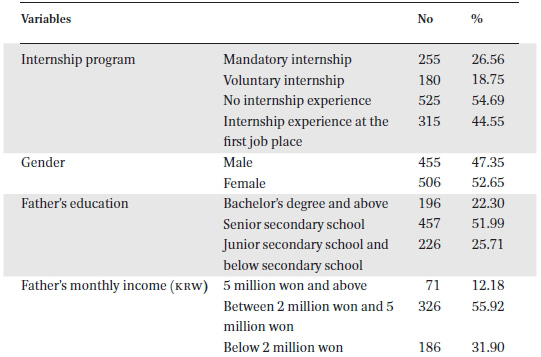
To examine the effects of internships on job performance among university graduates, the analysis controlled for individual characteristics, institutional characteristics, features of their work, and workplace. Individual characteristics such as gender, father’s education, father’s monthly income, discipline, college credits, and experience with student loans were controlled. Institutional characteristics were controlled for by different types of missions: research-university, other university, and junior colleges, and the junior college was the criterion variable in the analytical model. Work features including job status, first job, the type of workplace, and the size of the workplace were included in the model. The details of the variables and measures used in this study are reported in Table 6.1.
This study used three stages of statistical analyses. For the descriptive analysis, Pearson’s chi-squared test (Pearson χ2) was used to examine whether internship experiences differ by academic fields and types of universities. In addition, one-way analysis of variance (
Job search duration/ Wage/ Job satisfaction = f [(gender, father’s education, father’s monthly income, discipline, college credits, experience with student loans, university type, job status, status in first job, the type of workplace, size of the workplace) + internship experience
The study used three models. The first model focuses on the simple effect of internship experience itself, the second model assesses the different effects of mandatory or voluntary experience, and the third model aims to examine the effect of internship experience at graduates’ first place of employment.
Variables


Results
Descriptive Statistics
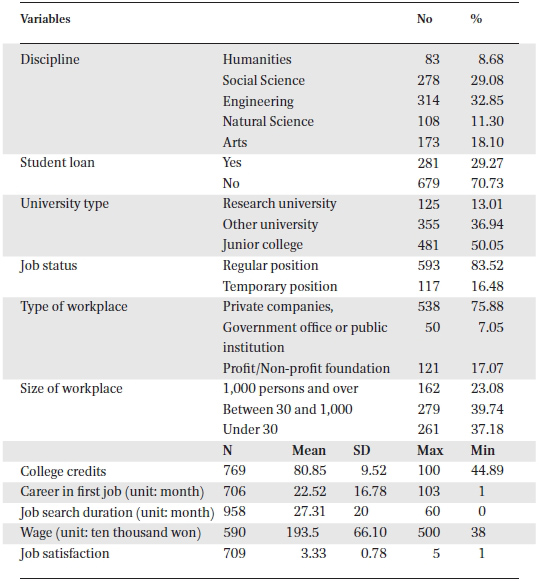
Table 6.2 presents the descriptive statistics of this study. The sample consists of 455 male and 506 female graduates. The reason more female graduates have jobs than male graduates is due to the fact that male graduates in Korea have mandatory military service during (or after) university, leading them to postpone their labor market entry compared to the same cohort of female graduates. The distribution by discipline is 8.68% in humanities, 29.08% in social science, 32.85% in engineering, 11.30% in natural science, and 18.10% in arts. In this sample, 125 respondents graduated from a research university, 355 respondents from another four-year university, and 481 respondents from a two- to three-year junior college.
Regarding their current job, 538 of the graduates are affiliated with a private company, 50 graduates are affiliated with a government office or public institution, and 131 are affiliated with a for-profit or non-profit foundation.
A total of 435 of the respondents obtained internship experience while in college, 255 among them had mandatory internship experience and 180 voluntary experience. In addition, 525 of the graduates had no experience with an internship program; 315 had found jobs after graduation in the workplace that they had participated in internship during the course (internship experience at the first job place).
Descriptive statistics
Internship Experience by Academic Fields and Institutional Types
University graduates have different internship experience according to their academic fields and institutional types. Tables 6.3 and 6.4 show the results of Pearson’s chi-squared test. As Table 6.3 presents, graduates from social science, engineering, and natural science fields are more likely to have internship programs at their institutions than those from humanities and arts. As Table 6.4 presents, graduates from junior colleges are more likely to have internship programs at their institutions, in particular, a mandatory internship (37.71%), which means that junior colleges provide more internship opportunities organized by their institution due to their vocational-oriented curriculum. Among four-year universities, graduates from research universities had relatively more opportunities to obtain voluntary internship experience than graduates from other universities (24.00%).
Internship experience by academic fields

Internship experience by institutional types

Job Performance by Internship Experience of University Graduates
Tables 6.5 to 6.7 present the results of
Job search duration by internship experience

Wage by internship experience

Job satisfaction by internship experience

We conducted an
The results of the
Table 6.9 shows the result of the
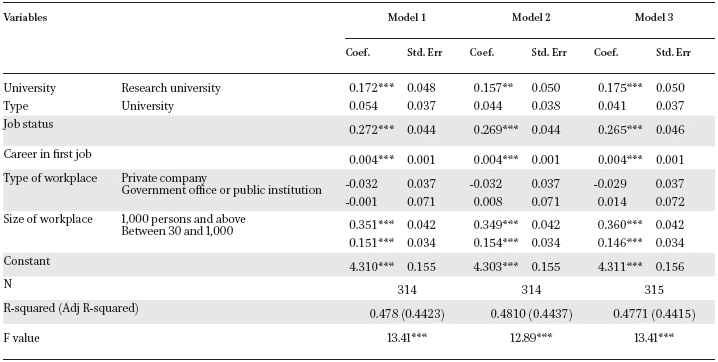
Table 6.10 presents the regression results for job satisfaction. Mandatory internship experience had a positive effect on job satisfaction. It is assumed that mandatory internships are academic field-specific and organized by institutional level; therefore they improve the match between graduates’ expectations and real job conditions. Disciplinary fields and university type had a statistically significant effect on job satisfaction, while job conditions and physical characteristics, such as the type or size of the workplace, did not have a statistically significant effect on job satisfaction. For example, graduates in arts had relatively higher job satisfaction than those in other disciplinary fields. Graduates from research universities also had higher job satisfaction than graduates from junior colleges.
Results of ols regression on job search duration


Results of ols regression on wage

Results of ols regression on job satisfaction


Discussion and Conclusion
With an emphasis on real-world work experience and a smooth transition from school to the labor market for higher education graduates, stakeholders are encouraged to be engaged in various types of internships. This study aimed to examine the internship experience of Korean college graduates and its impact for job performance. Internship experiences were classified into mandatory and voluntary, and internship experience in the same place where graduates obtained their first job was also considered. Job performance was defined according to three dimensions: the duration of job searching, wages, and overall job satisfaction. The main results showed that approximately 45% of university graduates (excluding students from Education and Medicine) had experience in some type of internship during their studies, and almost 60% of them had engaged in mandatory internships, which were organized by their own university or department. Others had been involved in voluntary types of internships. The results show how active internship experience is for university graduates in current higher education curricula. The findings generally support the notion that internship experience improves job performance; it shortens the duration to find a job and enhances wages and job satisfaction; however, the impacts were differed by type of internship, academic major, institutional characteristics, and working condition. The results have several implications for current internship practice in Korea.
Different Internship Opportunity by Academic Field and Institutional Types
Despite the efforts made by different stakeholders, the question regarding whether these experiences are really beneficial for students is still unanswered. In particular, recent studies in Korea have pointed out the limitations of internship experiences caused by different conditions according to academic discipline, institutional characteristics, company size and working environments. 60
For example, the results of this study prove that internship opportunities are more prevalent in certain fields, which is consistent with previous studies. Many internship programs have focused on engineering fields, including mechanical study, information technology, and electronics in Korea. 61 On the other hand, students in the humanities and arts are less likely to have work-related experiences. When we consider the many challenges experienced by graduates from humanities and arts to enter into the labor market in general, it is even more important to consider providing relevant work-related experiences for students in these fields. 62 In particular, some occupations are open to students from different fields of study, but current internship opportunities tend to maintain strong department boundaries. For example, it is not uncommon for university graduates with degrees in English, history, and psychology to work in business-related occupations, and they are willing to engage in internships in business. 63 Collaborative efforts across department and university levels are needed to make such arrangements that allow students to cross the faculty and find relevant internship opportunities.
On the other hand, work experience is mandatory in some fields almost world-wide. In those cases, internship is viewed as indispensable for good work performance. One hardly can measure the value of internships by differential employment features, because more or less all graduates have benefitted from this training. Differential employment benefits can only incur if a substantial proportion of students of the respective field, county, educational level do not participate in internships.
The results also show that students in junior colleges have the most opportunities to participate in internships, in particular, with mandatory types of internships. One of the reasons for this is the nature of junior colleges in Korea, as their curriculum is highly subject based and vocational oriented. In addition, the policy direction in Korea prioritizes mandatory internship opportunities for underprivileged school students, such as vocational high school and junior college rather than university graduates. 64 The initiative is good in terms of providing more opportunities and funds for students from disadvantaged schools; however, the actual learning experiences and working conditions need to be reflected. In some cases, companies simply take advantage of internships from vocational oriented school to recruit part-time workers for a low cost and to obtain incentives from the government. The quality control and monitoring systems are inevitable.
In addition, the results show that students have more mandatory internship opportunities in junior colleges and voluntary internship opportunities in prestigious universities. As previous studies have proven, institutional selectivity always helps students to have better learning experiences and outcomes, and they are able to find better voluntary internship opportunities in reputable organizations. 65 However, students from other types of four-year local universities have neither mandatory nor voluntary internships due to limited resources at the individual and institutional levels. Special attention is needed for students and their work related experiences in 2nd and 3rd tier local universities.
Impact of Internship on Job Performance
The results of this study show that mandatory and voluntary internships have different impacts on job performance. For example, voluntary internship experience is positively and significantly related to the job search duration and wages. Internships do not automatically have positive effects for all students. Interns with high motivation and sufficient job-specific knowledge are able to gain access to the actual job market and additional resources. 66 Students who participated in voluntary internships are expected to have some degree of intrinsic motivation, which might have a positive impact on their job search duration and improve their occupational opportunities. In many cases, students who are doing voluntary internships already have selection effects as well. 67 It also gives more signaling effect for employers since they give impression that students are active and dynamic being engaged in different experiences voluntarily. 68
On the other hand, mandatory internships have a positive impact on current job satisfaction in this study. We assumed that job satisfaction is related to the clarity of tasks and mandatory internships are positive in that sense because they are normally specific subject and vocational oriented. The learning experience of internship becomes meaningful when there is a strong learning goal and working experience is aligned with this learning goal. Mandatory internship participants have more opportunities to get full-time positions in the same place, which also leads to higher satisfaction. 69
The quality of mandatory internships can be impacted by collaborative efforts between universities and companies. For example, some universities have not only organized pre- and post-internship orientations, seminars, and workshops, but also regularly scheduled meetings between students, faculty members, and internship directors and make internship experiences aligning with the learning outcomes of coursework and assignments. 70
Limitations of the Study
This study explores the participation of university graduates in internships in South Korea and examines its impact empirically; however, the study has limitations. The study focuses on different types of internships, primarily concentrating on mandatory and voluntary programs, but the duration and content of internships must be further studied. A longitudinal analysis of graduates’ job performance will also be useful in examining the long-term impact of internships. In addition, the quality of internships—such as supervision, linkage with coursework, and working conditions—must be considered based on an in-depth qualitative approach. A comparison between internships and other types of work experience programs must also be examined.
This study focuses on monetary and non-monetary job performance, but the impact of internship on student learning must also be discussed, including student assessment of acquired competencies. In particular, there is a concern that gaining work experience in an internship program comes at a cost to academic learning; we must consider whether or not high-quality study programs should put emphasis on internships and how they are closely linked with one another.
Footnotes
4 Ulrich Teichler, “Higher Education Policy and the World of Work: Changing Conditions and Challenges,” Higher Education Policy 12, no. 4 (1999): 285-312.
5 Judith H. Semeijn et al., “The Role of Education in Selection and Allocation in the Labour Market: An Empirical Study in the Medical Field,” Education Economics 13 ( ): 449-77; Ulrich Teichler, “Higher Education Policy and the World of Work: Changing Conditions and Challenges,” Higher Education Policy 12, no. 4 (1999): 285-312.
7 M. Susan Taylor, “Effects of College Internships on Individual Participants,” Journal of Applied Psychology 73 (1988): 393-401; Nader Asgary and Mary Ann Robbert, “A Cost-Benefit Analysis of an International Dual Degree Programme,” Journal of Higher Education Policy and Management 32 (), 317-325; Josephine Fleming et al., “Employers’ Perceptions Regarding Graduates of Engineering Dual Degrees,” World Transactions on Engineering and Technology Education 8 (2010), 277-282; K.J. Chua, W.M. Yang, and H.L. Leo, “Enhanced and Conventional Project-Based Learning in an Engineering Design Module,” International Journal of Technology and Design Education 24 (2014), 437-458.
8 Ulrich Teichler, Higher Education and the World of Work: Conceptual Frameworks, Comparative Perspectives, Empirical Findings (Rotterdam/Taipei: Sense, 2009); Janice Tovey, “Building Connections Between Industry and University: Implementing an Internship Program at a Regional University,” Technical Communication Quarterly 10 (), 225-239.
15 Lynda Holyoak, “Are All Internships Beneficial Learning Experiences? An Exploratory Study,” Education + Training 55, no. 6 (2013): 573-583; Carl P. Maertz, Philipp A. Stoeberl, and Jill Marks, “Building Successful Internships: Lessons from the Research for Interns, Schools, and Employers,” Career Development International 19, no. 1 (): 123-42.
16 Jim Allen and Rolf van der Velden, “Transitions from Higher Education to Work,” in Careers of University Graduates: Views And Experiences in Comparative Perspectives, ed. Ulrich Teichler (Netherlands: Springer, 2007), 55-78; Ulrich Teichler, Higher Education and the World of Work: Conceptual Frameworks, Comparative Perspectives, Empirical Finding (Rotterdam/Taipei: Sense publisher, 2009); Gerard Beenen and Denise M. Rousseau, “Getting the Most from ): 3-22; Jens F. Binder et al., “The Academic Value of Internships: Benefits Across Disciplines and Student Backgrounds,” Contemporary Education Psychology 41 (2015): 73-82; Jack Gault, Evan Leach, and Marc Duey, “Effects of Business Internships on Job Marketability: The Employers’ Perspective,” Education + Training 52, no. 1 (2010): 76-88.
18 Jong-Gu Lee and Pyung-Kee Kim (이종구, 김병기). “한국기업의 인턴사원제도의 사적 전개과정과 시대별 특성 비교분석에 관한 탐색적 연구 [An Exploratory Study on the Intern Employee System of Korean Firms: Based on the Comparative Analysis of the Historical Development Process and Different Time Features].” 경영사학 [Business History] 23, no. 3 (): 261-98.
23 Jennifer M. Doran and David M. Cimbora, “Solving the Internship Imbalance: Opportunities and Obstacles,” Training and Education in Professional Psychology (Advance online publication) (2016); Michaela Hynie et al., “Student Internships Bridge Research to Real World Problems,” Education + Training 53 (), 237-248.
25 Jack Gault, Evan Leach, and Marc Duey, “Effects of Business Internships on Job Marketability: The Employers’ Perspective,” Education + Training 52, no. 1 (2010): 76-88; Sumanthi Renganathan et al., “Students’ Perception of Industrial Internship Programme,” Education + Training 54 (): 180-191.
26 Ibid.
32 Gerard Beenen and Denise M. Rousseau, “Getting the Most from ): 969-87.
37 Mark Levels and Rolf van der Velden, “From School to Fitting Work: How Education-To-Job Matching of European School Leavers is Related to Educational System Characteristics,” Acta Sociologica 57, no. 4 (2014): 341-61; Dieter Verhaest and Rolf van der Velden, “Cross-Country Differences in Graduate Overeducation,” European Sociological Review 29 (): 642-653.
41 Jong-Gu, Lee and Kim Pyung-Kee (이종구, 김병기). “한국기업의 인턴사원제도의 사적 전개과정과 시대별 특성 비교분석에 관한 탐색적 연구 [An Exploratory Study on the Intern Employee System of Korean Firms: Based on the Comparative Analysis of the Historical Development Process and Different Time Features].” 경영사학 [Business History] 23, no. 3 (): 261-98.
51 Markus Klein and Felix Weiss, “Is Forcing Them Worth the Effort? Benefits of Mandatory Internships for Graduates from Diverse Family Backgrounds at Labour Market Entry,” Studies in Higher Education 36, no. 8 (2011): 969-87; Ulrich Teichler, “Graduate Employment and Work in Europe: Diverse Situations and Common Perceptions,” Tertiary Education and Management 8 (): 199-216.
56 Jisun Jung and Soo Jeung Lee, “Influence of University Prestige on Graduate Wage and Job Satisfaction: The Case of South Korea,” Journal of Higher Education Policy and Management 38 (2016): 297-315; Harald Schomburg, “Work Orientation and Job Satisfaction” in Careers of University Graduates: Views and Experiences in Comparative Perspectives, ed. Ulrich Teichler (Netherlands: Springer, ), 247-264.
58 Jens F. Binder et al., “The Academic Value of Internships: Benefits Across Disciplines and Student Backgrounds,” Contemporary Education Psychology 41 (2015): 73-82; Jack Gault, Evan Leach, and Marc Duey, “Effects of Business Internships on Job Marketability: The Employers’ Perspective,” Education + Training 52, no. 1 (2010): 76-88; Markus Klein and Felix Weiss, “Is Forcing Them Worth the Effort? Benefits of Mandatory Internships for Graduates fom Diverse Family Backgrounds at Labour Market Entry,” Studies in Higher Education 36, no. 8 (): 969-87.
60 C.K. Chae et al., (채창균 외). 청년층의 노동시장 이행과 인적자원개발 [College to Work Transition and Human Resource Development of Youth]. Seoul, Korea: 한국직업능력개“u원 [Korea Research Institute for Vocational Education and Training ().
65 Shota Araki, Daiji Kawaguchi, and Yuki Onozuka, “University Prestige, Performance Evaluation, and Promotion: Estimating the Employer Learning Model Using Personnel Datasets,” Labour Economics 41, (2016): 135-48; Dongsook Han, Kwangbin Bae, and Hosung Sohn, “Estimating the University Prestige Effect in South Korea’s Labor Market,” Korea Educational Development Institute Journal of Education Policy 9, no. 2 (): 383-96.