Countries across the East and Southeast Asia region are experiencing a remarkable expansion of tertiary education enrollments. In this context, the strategic alignment of tertiary education institutions with rapidly changing economic environments has become increasingly necessary to meet the emerging needs of individual students, businesses, and wider economies. This paper maps the current state of alignment between tertiary education and labor markets in the region. Particular focus is given to second- and third-tier institutions, which have played a crucial role in enabling the expansion of enrollments and serving the diverse needs of societies. Policy guidelines are outlined and discussed to enhance alignment; namely the improvement of public-private partnerships, regional cooperation, external efficiency accountability, and fostering realistic expectations among graduates. Above all, it is maintained that the realization of such policy objectives will be pivotal to the future success of tertiary education institutions and can be pursued without undermining the broader educational functions of the tertiary education sector.
The long-term success of institutions and systems of tertiary education
1
hinges upon a high degree of external efficiency—best captured by a strategic alignment of colleges and universities with changing local, national, regional, and global economics environments. This is true for all tertiary education institutions (teis), but especially so for the rapidly increasing number of second- and third-tier (provincial and private) colleges and universities. Core issues in the context of second- and third-tier teis are often a local economy that is less prosperous and a need to operate with fewer financial resources, as compared with more prestigious and internationally-oriented universities in major urban centers. While the demand for all types of tertiary education continues to grow, developing countries will need to strive to diversify their economies and make them more competitive. The objective of this paper is to map the current state and direction of the alignment between tertiary education systems and economies across the East Asia and Southeast Asia region. Particular emphasis is given to discussing issues pertaining to developing countries which are facing a rapidly changing environment with regards to globalization, economic development, and massification of tertiary education. First, the paper outlines the broad context facing economies in East and Southeast Asia, which comprises of a significant diversity among countries, an expansion of tertiary education, and the growing need for qualified graduates to drive economic prosperity. Second, the role of Technical Vocational Education and Training (tvet) and community colleges are examined with reference to the various systems. This includes discussion of the labor market outcomes of tvet graduates, and how the changing workplace may present challenges to the tvet sector. Third, policy guidelines will be discussed will the aim of promoting the success of teis in the region; specifically the improvement of public-private partnerships, regional cooperation, external efficiency accountability, and fostering realistic expectations among graduates. It will be argued that such initiatives are crucial to enhance the employability of graduates and to ensure individuals, businesses, and governments are able to take full advantage of periods of economic growth, while also being able to weather unforeseen global economic instability.
Part One: Tertiary Education amid a Diversity of Economic Development
The remarkable diversity across East and Southeast Asia overlays three broad economic categories: high income developed, upper middle income developing, and lower middle income developing (see Table 3.1). For high income developed economies, which have massive amounts of capital to invest, teis have often become leaders in transforming industrial productivity. For upper middle income developing economies, teis have taken a progressively greater role in absorbing and adopting ideas from other parts of the world. For lower middle income developing economies, teis have the potential to anchor economic globalization for urbanization and strengthening industrial capacity. Despite this diversity, across all East and Southeast Asian economies there has been a rapid expansion in the proportion of young people entering tertiary education over recent decades. As Table 3.1 demonstrates, while the highest rates of tertiary education enrollments have remained in countries with the highest income levels, as determined by World Bank classifications, upper middle and lower middle income countries in the region have also experienced a substantial expansion in tertiary education enrollments.
Gross tertiary enrolment ratio (%) in East and Southeast Asia (1980 to 2014)
notes: Income levels are taken from World Bank classifications. a Data from 1992, b Data from 2013; c Data from 1981; d Data from 2001; e Data from 2011; f Data from 2012.
The expansion of tertiary education across the region over the past decade is an impressive achievement. Nevertheless, the potential benefits of this expansion to students, employers, and the wider economy is not guaranteed by merely a quantitative growth in enrollments. teis should ensure that learning environments align with specific and contextual developmental needs, and at the same time promote student engagement, personal development, and entrepreneurship. However, the capacity of tei systems and institutions to achieve this varies considerably. The high income developed economies in the region such as Japan and Republic of Korea already have a track record of producing high-quality products and services based on their superior technological prowess. That is, they continually create new products and services that are in demand around the world and maintain high export levels. This has been enabled, in large part, by their teis, many of which have been successful as incubators of research, innovation, production, and growth. The upper middle income economies have begun to innovate, and their teis are becoming better able to provide the conditions for learning and the adoption of existing technologies. For further progress, this requires support for improving science, technology, engineering, and mathematics (stem), as well as learning environments that promote divergent thinking and entrepreneurship. The developing economies in the region tend to rely more upon resource extraction, assembly, and light manufacturing. Nonetheless, their teis can foster development by providing a high-quality learning environment as well as supporting applied research that can attract investment from the private sector. To achieve this, colleges and universities should place greater emphasis on graduates that possess leadership and entrepreneurial skills, rather than only knowledge of core content. This is because to enable further development higher learning in these countries must support the applications of new technologies from other parts of the world, and create better legal frameworks that support their business environments. When implemented successfully, this has the potential to lead to the basic conditions for the growth of technological innovation.
At present, tertiary education systems in developing economies in East and Southeast Asia face the daunting tasks of making the best use of limited resources to ready more of their citizens for an increasingly knowledge-based economy. The capacity of these Asian countries to compete in a globalized world depends upon the readiness of students entering tertiary education, the availability of qualified graduates for the labor market, and the application of science and technology for creating new products. For second- and third-tier colleges and universities, strengthening external efficiency requires that they define their missions and uniqueness within the larger system, and prepare students with a relevant education for a changing workplace.
As economies move upward, tertiary education should also adapt in terms of tertiary enrollments rates and different orientation. The diversity of East and Southeast Asia economies calls for different types of tertiary education graduates. In other words, there is a need for different skills and qualities to best support the particular sectors and occupations within the particular economy. For Southeast Asia’s lower middle income developing economies, which continue to depend on low-wage labor in agriculture and manufacturing industries, an upgrade in productive capacity will eventually require that tertiary education graduates understand and adapt ideas and technologies from abroad to help diversify their economies. Upper middle-income developing economies have begun to shed some of their low-wage industrial labor in favor of more value-added production for the international consumer market. An increase in high quality science, technology, engineering, and mathematics (stem) graduates will contribute to their facilitating a steady transition to high income developed status. High income developed economies face intense global competition and can sustain their competitive advantage with high quality tertiary education graduates from within and across their borders. They increasingly will rely on graduates who are bilingual or trilingual, culturally sophisticated, and effective cross border collaborators for operating in an internationally oriented marketplace.
Part Two: The Community College and Higher tvet
A significant proportion of the growth in tertiary education enrollments in the region has been driven by an expansion in second- and third-tier (provincial and private) teis, rather than bachelor degree awarding universities. In particular, countries have adopted a community college model and grown a higher Technical Vocational Education and Training
2
(tvet) sector. While these forms of postsecondary education have largely been off the policy agenda, they are now attracting attention in the context of concerns over rising youth unemployment. Indeed, such approaches can help countries address the rising costs of tertiary education, which has being subject to a “cost disease” in many parts of the world.
3
In addition, these teis have the potential to help cater for the diversity of abilities of secondary school graduates, the increasing demands of the population for more education, the needs of a dynamic labor market for midlevel expertise across a range of technical fields, and the specific talents required in the development of local economies.
4
As a notable example, Viet Nam has a thriving tvet sector, including an established network of community colleges that provide tertiary education within a flexible structure of instructional service. An advantage of these institutions is that they tend to be resilient, especially during periodic economic ups and downs, and can respond more quickly to changing labor market needs. The establishment of a system of community colleges also helps expand opportunities to bring educational progress and jobs to poor and other disadvantaged communities.
5
This ensures social balance by providing opportunities for training that helps talented students from disadvantaged groups and in remote areas to find opportunities to access tertiary education, which may be otherwise unavailable.
Hong Kong, China and Thailand have imported and adopted the community college model from Canada and the us, while the prc and Singapore have retained their systems of postsecondary tvet. When Hong Kong, China tried to address growing demand of the labor market and from individual households for more tertiary education, it found itself handicapped by the Asian economic crisis in 1997. Unable to fund an expansion of tertiary education, the government took a bold initiative in 2000 to introduce community colleges with associate degree programs. Most of Hong Kong, China’s community colleges nested themselves within the adult and continuing education divisions of public universities. These self-financed units offering 2-year associate degree programs helped lift the postsecondary participation rate in tertiary education to 53% by December 2004, and then to 66% by August 2005—overshooting the 2010 target—largely due to the popularity of the self-funded community college.
6
While expanding its tvet colleges, the prc has also invested in a community college sector. The country’s labor market needs are guided by a human resource blueprint pointing out that by 2020, young people will average 12.8 years of education.
7
During the dramatic transformation and rapid expansion of tertiary education in the last decade, 2- to 3-year higher tvet colleges played an indispensable role in providing tertiary education opportunities for roughly half of all college students who otherwise would have been unable to access tertiary education in the prc. However, this achievement was only made possible by high tuition and fees that generated more than half of total revenue for 3-year higher vocational colleges. The level of tuition and fees charged to students can be as high as if not higher than that charged to students attending the most prestigious 4-year universities.
8
The central government in the prc launched the Model Higher Vocational Colleges Construction Project alongside financial aid policy initiatives to help make higher vocational colleges more affordable.
9
Yet, ensuring equity remains an ongoing and challenging issue. The promulgated Outline of the National Medium- and Long-Term Program for Education Reform and Development
10
has the potential for improving this situation. However, further research is needed to address the specific financial implications of the new policies regarding the development of the system of higher vocational and technical colleges in the prc. According to the Outline, a comprehensive tvet system will be established by 2020 to meet the requirements for transition in methods of development and adjustment in economic structure, to embody the idea of lifelong education, and to include coordinated content at both the secondary and advanced levels. Local governments are being told to establish and improve quality assurance in tvet and to employ enterprises for quality assessments. Moreover, the government is pushing ahead with program articulation—specifically a system wherein tvet graduates will be allowed to directly upgrade to higher education, which will broaden the channels for continuing education.
Education Premiums in the Workforce
It is not surprising that educational premiums—the relative salary levels in the workforce awarded for attaining different levels of education—are generally higher for workers with graduate degrees than those with a bachelor degree. Nor is it surprising that tertiary education graduates generally receive a premium when compared to those with only a high school diploma. However, the situation becomes more complex when comparing the difference between university and higher tvet graduates. For instance, university graduates in Indonesia and Thailand on average receive higher premiums than higher tvet graduates.
11
Premiums for service, sales, and production workers are slightly higher in the Philippines.
12
Conversely, other contexts have evidence a less clear salary premium for university graduates. In Mongolia, for example, workers with higher (postsecondary) tvet qualifications receive higher salaried positions in the labor market than do graduates of universities, including those in agricultural and professional occupations.
13
Indeed, in some cases, higher tvet graduates have lower unemployment and underemployment rates than university graduates, largely due to the relevance of their skills to tasks in required the workplace. In Thailand, about a fifth of individuals with higher vocational qualifications are in professional occupations, and about a third are employed in production/other manual labor. Only 5% of university degree holders are employed in production jobs and manual labor. For Indonesia, almost half of those with higher tvet qualifications are employed in professional occupations, and about a third of university degree holders are employed in professional occupations. Almost a third of university degree holders are in clerical jobs, and less than a fifth of higher tvet holders are in clerical jobs.
14
Across the region, the highest proportions of university graduates are employed in technical and professional occupations. For example, in Mongolia, Thailand, and Viet Nam, the figure is approximately 70% or higher, and it is 60% for graduates in the Philippines.
15
Again, in Indonesia and Philippines, where there is an oversupply of low-quality university places, and a tilt in study areas toward social sciences rather than science, technology, engineering, and mathematics (stem), a large proportion of university graduates work in clerical jobs.
16
In lower middle income developing economies such as Cambodia and Viet Nam, educational premiums are increasing over time along with the emphasis on skills for the expanding labor markets. It is still possible for the labor market to absorb the increasing number of university graduates, even though making university education more relevant to the workplace becomes an increasing challenge. In these developing economies, labor markets also continue to provide a good payoff in the growing services-related fields.
17
In Indonesia, Philippines, and Thailand market forces have long guided the reward structure for skilled occupations. That is to say, those with relevant skills continue to reap benefits, and earnings increase with greater occupational skills.
Since the prc’s rapid expansion of enrollments in tertiary education, its unemployment rate for graduates has risen. In 2001 there were approximately 250,000 graduates unemployed upon graduation, while by 2005 this figure reached one million and has continued to escalate.
18
The high level of unemployment among graduates of regular teis has led to a renewed focus on postsecondary tvet colleges, especially as more households drop the traditional emphasis on academic higher education.
19
In terms of salaries, premiums for tertiary education rose substantially in the prc until the mid-2000s but began to level off after or reverse in the years since as graduates from the expansion in enrollments began to enter the labor market.
20
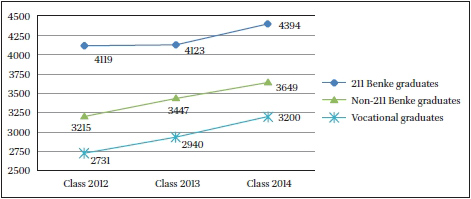
However, average salary levels hide growing disparities within tertiary education in the prc. As Figure 3.1 illustrates, on average graduates of Benke (four-year bachelor degree granting) institutions receive significantly higher salaries compared to graduates of vocational institutions in prc, with the premium especially high for Benke graduates from Project 211—those in the top tier—universities.
Moreover, a national employment report in 2009 noted a general deficiency in applied analytical ability and managerial skill among college and university graduates.
21
The main challenge for the prc does not concern employment opportunities for graduates of its top-tier universities, which are steadily approaching international standards. Rather, it is to raise the instructional quality of the country’s hundreds of second- and third-tier teis, including in the tvet sector and the growing number of private colleges.
22
The employability of graduates is the obvious test of whether the vast bulk of colleges are aligned with the workplace. Most central government funding is channeled to a minority of top institutions, which are supposed to act as models for the rest. Yet, less stellar institutions need to focus as much on fostering partnerships with industry as on emulating the academic elite. Promoting quality outside of the elite group of universities will be the key to turning the prc’s diverse tertiary education system into a driving force of economic development.
source: adapted from mycos institute, chinese 4-year college graduates’ employment annual report 2015 (beijing: social science academic press, 2015), graphs 1-3-7 and 1-3-8.
The Changing Workplace
Interesting times could be in store in countries like the prc, Indonesia, and Thailand, where the percentage of tertiary education graduates in the workforce has grown steadily over the past 15-20 years.
23
In the dynamic East and Southeast Asian region, demands of the workplace change quickly and can result in changes in unemployment rates, rates of return, and workplace opportunities for graduates. The major qualitative changes in the workplace across the region will be linked with the expanding need for innovation, ability to exploit niche industries, and a capacity to operate in an increasingly multilingual and cultural global milieu.
24
High income developed countries have learned hard lessons about the futility of relying upon human resources planning forecasts and overspecialization in tertiary education. While economies still require specific types of human resources, dynamic economies also require high-level talent that is innovative, risk taking, adaptable, and responsive to changing environments. The modern workplace is flatter and less hierarchical than before and requires a different skills set than in the past. The implications are significant for tertiary education. Colleges and universities will have to radically change the way that instruction is delivered as well as expand offerings in continuing education for workers throughout their lives who will need to readjust to rapidly changing labor markets. In addition, employers will expect their employees to be more attuned to an increasingly competitive external environment, which will require strong skills for teamwork, problem-solving ability, communication, and other so-called non-cognitive or “soft” skills.
The challenges to tertiary education could be especially acute for institutions in the higher tvet sector, which has traditionally had a narrow focus on technical skills, rather than such non-cognitive or “soft” skills. As a response, tvet institutions should appoint representatives of local business and industry to their career advisory boards, which often already contain academics from different departments of the institution. Forums on globalization, the knowledge-based economy, and graduate employment can stimulate new ideas for forging a closer alignment between teis and the workplace. All this calls for modification of aspects of the traditional elite university models to find ways for higher learning both to maintain the essence of universities and also to exploit their advantage in fostering students with a broad understanding and an entrepreneurial orientation that will improve their capacity to enter the labor market.
Part Three: Policy Guidelines
In the dynamic context of East and Southeast Asian development, tei leaders are taking a multiplicity of concerns into consideration, among which is the extent to which graduates receive an education that is relevant to the needs of the workplace.
25
tei leaders are beset with a difficult balancing act: they are accountable for the manner in which public resources are utilized and sustained so that the financial capacity of their institutions can grow and maintain high standards. This section will discuss policy guidelines for teis in East and Southeast Asia aimed at maximizing external efficiency. This includes the need for policies to enhance public-private partnerships, regional cooperation, external efficiency accountability, and to foster realistic expectations among graduates.
(1) Public-Private Partnerships
The interface between public and private tertiary education is complex but also provides opportunities for significant synergies. Private teis have an incentive to respond to competitive labor markets, since their survival often depends upon it. Aside from an increasing number of private teis, there is also growth in private sources of funding of public teis (see Figure 3.2).
Public teis often have the advantage of being proactive with experimental initiatives. However, to enhance alignment with the labor market, there is a need to assist teis in pursuing proactively experimental initiatives aimed at improving responsiveness to labor market needs.
This can include experimenting with units or centers that (a) draw staff from inside and outside of teis; and (b) are more directly focused on emerging industries such as software production, energy, and environmental protection and green economies. For example, a government initiative in the prc has created space for selected public universities to experiment with the establishment of loosely coupled academic centers for software production.
26
These centers can draw their staff from both inside and outside the university and focus more on external stakeholders. Such centers are given more autonomy than other academic units but are required to generate more of their own funding. They may select their own students and charge higher tuition fees, but their success is ultimately determined by providing students with internships that align with skills fostered as part of their degree programs and that eventually lead to eventually jobs in industry.
source: levy, daniel. east asian private higher education: reality and policy. draft for discussion, (new york: university at albany-suny, 2010), figure 6 p. 30.
(2) Regional Cooperation
The external efficiency of East and Southeast Asian tertiary education will increasingly come to depend upon the extent to which graduates can enter a workplace that is regional in scope. That is, one in which knowledge and skills are not only relevant for domestic labor markets but transferable across borders and beyond the region. Increasingly, the recruitment and utilization of talent that drives economic change will be sourced not only by teis in their own countries but also by regional centers of higher learning.
Clearly, the local context has to be considered in bridging the gap between the secondary school curriculum and entrance requirements to higher learning. However, growing economic integration across East and Southeast Asia means that it will be increasingly beneficial to capitalize on the experiences of neighboring countries and beyond. This will require measures that increase the consensus about criteria for admission to higher learning and alignment with employer needs across borders and, more broadly, regionally. While the majority of students pursue tertiary education within their country of birth, increasing numbers of students in the region are pursuing their tertiary education studies outside of their home country. This trend is likely to grow and become an invaluable asset that enriches the diversity of higher learning across the entire East and Southeast Asian region. Data from unesco Institute for Statistics
27
demonstrates that the top countries for attracting international students remain in United States, United Kingdom, Australia, accounting for 35 percent of the global total of 4.1 million students studying abroad in 2013. Nonetheless, countries in East and Southeast Asia are becoming hubs for attracting international students, especially from within the region. It is estimated in the unesco dataset that Japan hosted 135,803 international students in 2013, which was followed by prc (96,409), Republic of Korea (55,536), Singapore (48,938), and Malaysia (40,471) as the most popular destinations in East and Southeast Asia for internationally mobile students.
28
Levels of international student mobility have significant potential for further expansion in the coming years. Despite plans to internationalize, Japan, which has been conservative with respect to admitting students from other parts of Asia, will continue to increase that number, partly due to its own population demography and its surplus of tertiary education places. The Republic of Korea has the highest access rate to tertiary education in the region but may eventually find itself in a similar situation as Japan in terms of demography and surplus places, which may necessitate the further attraction of foreign students, many from Southeast and South Asia. Two of the most developed economies in Asia—Hong Kong, China and Singapore— have a high level of labor mobility among the specialized professions. Each has increased its efforts to internationalize, and the trend of universities from u.s., Canada, Europe, and Australia opening branch campuses in East and Southeast Asia is increasing. This is likely to spur the talent needed for the regional labor market, especially as students can increasingly take advantage of the opportunities to access high quality and internationally oriented tertiary education in the region.
29
(3) External Efficiency Accountability
It is important to help teis become more accountable for their external efficiency. That accountability should focus on both self-institutionalized monitoring processes and the results teis achieve. Accountability measures are more effective if they are formulated in the first instance by individual teis. In this sense, it is essential that each tei more fully come to terms with the relevance and alignment of its programs to the workplace. If the process is driven by government, institutions have an almost natural tendency to resist or strategize around what will inevitably be perceived as an outside imposition. Indeed, teis are more likely to take the initiative to improve their viability, especially as the proportion of government subvention decreases, when they place their relationship with stakeholders in high regard. Tertiary education leaders will have a greater and more positive incentive to systematically report to stakeholders when it is made voluntary within a perceived relationship of mutual benefit and trust. Such an agreed-upon relationship with stakeholders will generate a greater sense of common mission and shared responsibility. Autonomy from government and accountability for external efficiency are not mutually exclusive. The greatest benefit to teis comes as these two evolve toward a favorable balance.
(4) Realistic Expectations
Varying levels and types of employment among tertiary education graduates are an unavoidable reality in many market economies, especially in the context of a rapid expansion of in the number of graduates seeking employment. The trend that a degree does not guarantee access to lifelong employment in a professional occupation is not limited to East and Southeast Asia. The average graduate in the us will have seven jobs in the first 2 years after graduation, many in areas unrelated to their fields of study. Moreover, the Federal Reserve Bank of New York
30
reports that 44.1 percent of college graduates aged 22 to 27 in United States are under-employed or employed in a job that “typically does not require a college degree.” While this includes jobs that seemingly are unbefitting to a tertiary education graduate, it must also be recognised that such employment may offer valuable life skills and may only be for a relatively short time period following graduation.
To prepare for such a labor market, students should be provided with practical and easy-to-use online information for forging realistic expectations about their opportunities in the workplace. Many students lack information about jobs until after they graduate, and they may not fully understand what they are equipped to do after graduation, as well as their work effectiveness. Therefore, more needs to be done to provide informed guidance and advice to students in picking their major and preparing for the labor during their program of study. For example, Thailand’s colleges and universities graduate approximately 250,000 students per year. Yet 80% of Thai firms report experiencing difficulties in filling job vacancies due to graduates who lack basic and technical skills.
31
Thailand has an oversupply of social science graduates and a shortage of graduates who have specialized in science, technology, and health science—the fields that are perhaps the most essential for building Thailand’s knowledge-based economy.
Research can provide increased understanding of the outcomes of tertiary education and its linkage to the workplace. However, most developing countries do not collect systematic data on labor market outcomes and the workplace effectiveness of tei graduates. Accurate information about skill shortages and labor market outcomes is invaluable for planning curricula and course offerings. A noteworthy example of good practice is the College Scorecard administered by United States Department of Education.
32
The website provides prospective students with detailed information on graduate labor market outcomes such as employment rates, unemployment, and earnings for programs of study offered by teis in United States.
Discussion: The Crux of Employability
This paper has discussed trends, problems, and policy guidelines for tertiary education in East and Southeast Asia. Perhaps the single most important issue facing teis in the region is the employability of graduates. While teis cannot ensure a buoyant labor market for their graduates, they should strive to ensure that graduates are readily prepared to be employed. If not considered in more detail, a deficit of employability can become a major drag on the long-term development of East and Southeast Asian countries. For example, the McKinsey Institute points out that only 10% of the prc engineering graduates have the skills required to work at their nominal skill level in an international company,
33
while similar concerns have been raised about the quality of engineering graduates in the context of a rapid expansion of enrollments.
34
Thus, while the larger East and Southeast Asian region might have a supply of science, technology, engineering, and mathematics (stem) graduates, ensuring all such graduates reach international standards in terms of employability is still a work in progress.
A rapid expansion of tertiary education has the potential to complicate employability rather than address it efficiently, given that after a rapid growth of enrollments graduates will inevitably enter an increasingly diverse range of occupations and jobs.
35
There is no consensus about who has the major responsibility for employability. Many businesses continue to prefer training their employees to be effective within their own sphere. However, rapid urbanization and mobility have made many businesses less willing to provide training, especially since company loyalty cannot be taken for granted in a rapidly changing society. Moreover, the numbers of jobs in particular sectors rise and fall rapidly as industries and technologies change. Universities, in particular, are not accustomed to taking responsibility for employability and can be reluctant to take up such a role.
36
That stance is changing with universities in particular and teis more generally needing get ahead of the curve. They must elevate employability to an issue for students to consider in their first year of study, as leaving the issue to the final year can be too late to effectively prepare students for the labor market. This does not mean that employability should be the only priority of tertiary education; it is crucial that employability not assault the main purposes of tertiary education—to empower and prepare citizens for a greater role in development of society. Yet it remains important as households pay more to access tertiary education, as governments expend more on tertiary education provisions, and as businesses expect more from tertiary education graduates. Overall, it is an unavoidable reality that tertiary education is increasingly expected to address the issue of employability.
If the economy cannot provide full employment for tertiary education graduates, one might call it a market failure. Yet all three parties—businesses, teis, and individuals—have a share of the responsibility. One government role is to improve coordination among these three groups of stakeholders. The model is for broad-based growth (export, business investment, research and development innovation, small businesses, etc.) to expand existing industries and create new industries. teis can help foster growth and employment. For example, the information and communications technology (ict) industry in East and Southeast Asia has great potential for growth, but governments have to provide the framework for entrepreneurs to create new industries and employment opportunities for tertiary education graduates. The growing ict industry in East and Southeast Asia will also need cyber security, an industry currently in its infancy. In short, teis not only have to be on the cutting-edge of identifying new industries, they also have to adjust their governance in such a way as to permit sectors of the major academic units to form more new autonomous units that can partner with new industries, generate funding, have autonomy in decision making about financing and programming, and forge closer ties with external stakeholders. This can significantly improve the alignment between teis programs and the workplace opportunities of graduates.
Concluding Remarks
Families in East and Southeast Asia are making greater investments in tertiary education and have rising expectations about employment opportunities for students after graduation. Despite significant variation in tertiary systems in the region, many countries are beginning to experience rising tensions in graduate employment as enrollments have expanded rapidly in recent years. The alignment between tertiary education and the labor market can be improved without assaulting the central role of tertiary education. Most notably, the focus on jobs, labor markets, and cost structures should not make teis lose sight of their larger role of preparing citizens for an active role in society. In other words, teis are not merely training centers. Instead, teis have a broader function of fostering the development of young people who can make authentic contributions to the development of their own countries and the larger regional economy in a plethora of ways that include contributing to the labor market, civil society, and community development.
37
Nevertheless, the promotion of employability and the gainful employment of graduates remains a fundamental issue for teis. There is, therefore, a significant need for high quality provisions across a clearly differentiated system of teis, including at community colleges and in the tvet sector. Going forward, there is much to be done to enhance the strategic alignment of tertiary education systems and economies in the region. As discussed in this paper, there is an imperative to assist teis in pursuing policy initiatives aimed at improving public-private partnerships, regional cooperation, external efficiency accountability, and the fostering of realistic expectations among graduates. When implemented successfully such policies have a crucial role in ensuring that tertiary education can best serve individual students on the one hand as well as businesses and the economy on the other hand to the benefit of the wider society.
Footnotes
1 Tertiary education institutions (teis) are classified here as levels 5, 6, 7, and 8 under unesco’s International Standard Classification of Education (). This includes short-cycle tertiary, bachelor or equivalent, master or equivalent, and doctoral or equivalent programmes.
2 The tvet sector is defined by unesco as “those aspects of the educational process involving, in addition to general education, the study of technologies and related sciences and the acquisition of practical skills, attitudes, understanding and knowledge relating to occupation in various sectors of economic life.”
3 Wolff, Edward N., William J. Baumol and Anne Noyes Saini, “A Comparative Analysis of Education Costs and Outcomes: The United States vs. Other OECD Countries,” Economics of Education Review, 39 (), 1-21.
4 Elsner, Paul A., A Global Survey of Community Colleges, Technical Colleges, and Further Education in Different Regions of the World (Washington D.C.: American Association of Community Colleges Press, 2009); Raby, Latiner and Rosalind Valeau, Community College Models: Globalization and Higher Education Reform (Amsterdam: Springer, 2009); Raby, Latiner and Rosalind Valeau, Increasing Effectiveness of the Community College Financial Model: A Global Perspective for the Global Economy (Hampshire: Palgrave Macmillian, ).
5 Lam, Dang Ba and Nguyen Huy Vi, “The Development of the Community College Model in Vietnamat the Time of the Country’s Reorganization and International Integration,” in Community College Models: Globalisation and Higher Education Reform, eds. Latiner Raby and Rosalind Valeau (New York: Springer, ), 91-110.
6 Ibid.
7 Ministry of Education, Outline of the National Medium-and Long-term Program for Education Reform and Development 2010-2020 (Beijing, Ministry of Education: 2010), 9.
8 Postiglione, Gerard A., “Community Colleges in [the People’s Republic of] China’s Two Systems,” in Community College Models: Globalisation and Higher Education Reform, eds. Latiner Raby and Rosalind Valeau (New York: Springer, ), 91-110.
9 Song, Yingquan and Gerard A. Postiglione, “The Expensive Dream: Financing Higher Vocational Colleges in [People’s Republic of] China,” in Increasing Effectiveness of the Community College Financial Model: A Global Perspective for the Global Economy, ed. Latiner Raby (New York: Palgrave Macmillian Publishers, ), 251-263.
10 Ministry of Education, Outline of the National Medium- and Long-term Program for Education Reform and Development 2010-2020 (Beijing, Ministry of Education: 2010).
11 Di Gropello, Emanuela, Aurelien Kruse, and Prateek Tandon, Skills for the Labor Market in Indonesia: Trends in Demand, Gaps, and Supply (Washington d.c.: World Bank, ), 58.
12 Di Gropello, Emanuela, Hong Tan, and Prateek Tandon, Skills for the Labor Market in the Philippines, (Washington d.c.: World Bank, ), 233.
13 Di Gropello, Emanuela and Chris Sakellariou, Industry and Skill Wage Premiums in East Asia. World Bank WPS5379 (Washington, d.c.: World Bank, ).
14 Sakellariou, Chris, Labor Market Outcomes of Higher Education in East Asia (2010). Retrieved online from: .
15 Di Gropello, Emanuela, Prateek Tandon, and Shahid Yusuf, Putting Higher Education to Work: Skills and Research for Growth in East Asia (Washington d.c.: World Bank, ), 28.
16 Sakellariou, Chris, Labor Market Outcomes of Higher Education in East Asia (2010) Retrieved online from: .
17 Ibid.
18 Chan, Wing Kit, “Higher Education and Graduate Employment in China: Challenges for Sustainable Development”. Higher Education Policy, no. 1 (): 35-53.
19 Postiglione, Gerard A., “Community Colleges in [the People’s Republic of] China’s Two Systems,” in Community College Models: Globalisation and Higher Education Reform, eds. Latiner Raby and Rosalind Valeau (New York: Springer, ), 91-110.
20 Guo, Maocan, Towards a General Theory of Education-Based Inequality and Mobility: Who Wins and Loses Under China’s Educational Expansion, 1981-2010. (Doctoral dissertation, Harvard University, 2015); Meng, Xin, Kailing Shen, and Sen Xue, “Economic reform, education expansion, and earnings inequality for urban males in China, 1988-2009,” Journal of Comparative Economics, no. 1 (), 227-244.
21 Mycos Institute, The Chinese College Graduates’ Employment Annual Report 2009, (Beijing: Social Science Academic Press, 2009).
22 Postiglione, Gerard A., “Higher Education: University Challenge,” China Economic Quarterly, no. 2 (), 22-25.
23 Di Gropello, Emanuela, Aurelien Kruse and Prateek Tandon, “Skills for the Labor Market in Indonesia: Trends in Demand, Gaps, and Supply,” (Washington d.c. World Bank, ).
24 Cheng, Kai-Ming, “The Postindustrial Workplace and Challenges to Education,” in Learning in the Global Era, eds. M.M Suarez-Orosco (Berkeley: Ross Institute, ), 175-192.
25 Salmi, Jamil, “The Growing Accountability Agenda: Progress or Mixed Blessing?,” Higher Education Management and Policy, no. 1 (), 109-129.
26 Yang, Dongsheng, Decentralization, Marketization and Organization in Higher Education: A Case Study of an Academic University in [the People’s Republic of] China (Doctoral Dissertation: University of Hong Kong, ).
27 unesco, Global Flow of Tertiary-Level Students, (2016a). Retrieved online from: .
28 unesco, Total inbound internationally mobile students in 2013, (2016b). Retrieved online from: .
29 Hiratsuka, Daisuke and Fukunari Kimura, East Asia’s Economic Integration: Progress and Benefit (New York: Palgrave Macmillan/IDE-JETRO, ).
30 Federal Reserve Bank of New York, The Labor Market for Recent College Graduates (2016). Retrieved online from .
31 World Bank, Thailand Social Monitor: Towards a Competitive Higher Education System in a Global Economy (Washington d.c.: World Bank, 2011).
32
33 Farrell, Diana, Martha Laboissiere, Jaeson Rosenfeld, Sascha Stürze, and Fusayo Umezawa, The Emerging Global Labor Market: The Supply of Offshore Talent in Services. Part II. (San Francisco: McKinsey Global Institute, ).
34 Loyalka, Prashant, Martin Carnoy, Isak Froumin, Raffiq Dossani, J.B. Tilak, and Po Yang, “Factors Affecting the Quality of Engineering Education in the Four Largest Emerging Economies,” Higher Education, no. 6, (), 977-1004.
35 Trow, Martin, Problems in the Transition from Elite to Mass Higher Education (Berkeley: Carnegie Commission on Higher Education, ).
36 Collini, Stefan, What are Universities for? (Harmondsworth: Penguin, ).
37 Daniel, John, Asha Kanwar, and Stamenka Uvali-Trumbi, “The Right to Education: A Model for Making Higher Education Equally Accessible to All on the Basis of Merit,” Asian Journal of Distance Education, no. 2 (): 5-11.
References
1.
ChanWing Kit“Higher Education and Graduate Employment in China: Challenges for Sustainable Development”Higher Education Policy2015no. 13553
2.
ChengKai-MingSuarez-OroscoM.M.“The Postindustrial Workplace and Challenges to Education”Learning in the Global Era2007BerkeleyRoss Institute175192
3.
ColliniStefanWhat are Universities for?2015HarmondsworthPenguin
4.
DanielJohnKanwarAshaUvali-TrumbiStamenka“The Right to Education: A Model for Making Higher Education Equally Accessible to All on the Basis of Merit”Asian Journal of Distance Education2008no. 2511
5.
Di GropelloEmanuelaSakellariouChrisIndustry and Skill Wage Premiums in East Asia. World Bank WPS53792010Washington, D.C.World Bank
6.
Di GropelloEmanuelaKruseAurelienTandonPrateekSkills for the Labor Market in Indonesia: Trends in Demand, Gaps, and Supply2011aWashington, D.C.World Bank
7.
Di GropelloEmanuelaTanHongTandonPrateekSkills for the Labor Market in the Philippines2011bWashington, D.C.World Bank
8.
Di GropelloEmanuelaTandonPrateekYusufShahidPutting Higher Education to Work: Skills and Research for Growth in East Asia2011cWashington, D.C.World Bank
9.
ElsnerPaul A.A Global Survey of Community Colleges, Technical Colleges, and Further Education in Different Regions of the World2009Washington, D.C.American Association of Community Colleges Press
10.
Federal Reserve Bank of New YorkThe Labor Market for Recent College Graduates2016Retrieved online from https://www.newyorkfed.org/research/college-labor-market/index.html
11.
FarrellDianaLaboissiereMarthaRosenfeldJaesonStürzeSaschaUmezawaFusayoThe Emerging Global Labor Market: The Supply of Offshore Talent in Services. Part II2005San FranciscoMcKinsey Global Institute
12.
GuoMaocanTowards a General Theory of Education-Based Inequality and Mobility: Who Wins and Loses Under China’s Educational Expansion, 1981-20102015Doctoral dissertation, Harvard University
13.
HiratsukaDaisukeKimuraFukunariEast Asia’s Economic Integration: Progress and Benefit2008New YorkPalgrave Macmillan/IDE-JETRO
14.
LamDang BaViNguyen HuyRabyLatinerValeauRosalind“The Development of the Community College Model in Vietnam at the Time of the Country’s Reorganization and International Integration”Community College Models: Globalisation and Higher Education Reform2009New YorkSpringer91110
15.
LevyDanielEast Asian Private Higher Education: Reality and Policy. Draft for Discussion2010New YorkUniversity at Albany-SUNY
16.
LoyalkaPrashantCarnoyMartinFrouminIsakDossaniRaffiqTilakJ.B.YangPo“Factors Affecting the Quality of Engineering Education in the Four Largest Emerging Economies”Higher Education2014no. 69771004
17.
MengXinShenKailingXueSen“Economic reform, education expansion, and earnings. inequality for urban males in China, 1988-2009”Journal of Comparative Economics2013no. 1227244
18.
Ministry of EducationOutline of the national medium-and long-term program for education reform and development 2010-20202010BeijingMinistry of Education9
19.
Mycos InstituteThe Chinese College Graduates’ Employment Annual Report 20092009BeijingSocial Science Academic Press
PostiglioneGerard A.RabyLatinerValeauRosalind“Community Colleges in [the People’s Republic of] China’s Two Systems”Community College Models: Globalisation and Higher Education Reform2009New YorkSpringer91110
22.
PostiglioneGerard A.“Higher Education: University Challenge”China Economic Quarterly2011no. 22225
23.
RabyLatinerValeauRosalindCommunity College Models: Globalization and Higher Education Reform2009AmsterdamSpringer
24.
RabyLatinerValeauRosalindIncreasing Effectiveness of the Community College Financial Model: A Global Perspective for the Global Economy2011HampshirePalgrave Macmillian
25.
SakellariouChrisLabor Market Outcomes of Higher Education in East Asia2010Retrieved online from: http://siteresources.worldbank.org/INTEASTASIAPACIFIC/Resources/EastAsia-LaborMarketOutcomesofHE.pdf
26.
SalmiJamil“The Growing Accountability Agenda: Progress or Mixed Blessing?”Higher Education Management and Policy2009no. 1109129
27.
SongYingquanPostiglioneGerard A.RabyLatiner“The Expensive Dream: Financing Higher Vocational Colleges in [People’s Republic of] China”Increasing Effectiveness of the Community College Financial Model: A Global Perspective for the Global Economy2011New YorkPalgrave Macmillian Publishers251263
28.
TrowMartinProblems in the Transition from Elite to Mass Higher Education1973BerkeleyCarnegie Commission on Higher Education
29.
unescoGlobal Flow of Tertiary-Level Students2016bRetrieved online from: http://www.uis.unesco.org/Education/Pages/international-student-flow-viz.aspx
30.
unescoTotal inbound internationally mobile students in 20132016bRetrieved online from: http://uis.unesco.org/indicator/edu-mobility-in-total
31.
WolffEdward N.BaumolWilliam J.SainiAnne Noyes“A Comparative Analysis of Education Costs and Outcomes: The United States vs. Other OECD Countries”Economics of Education Review201439121
32.
World BankThailand Social Monitor: Towards a Competitive Higher Education System in a Global Economy2011Washington, D.C.World Bank
33.
World BankGross enrolment ratio, tertiary, both sexes (%)2016Retrieved online from: http://data.worldbank.org/indicator/SE.TER.ENRR
34.
YangDongshengDecentralization, Marketization and Organization in Higher Education: A Case Study of an Academic University in [the People’s Republic of] China2012Doctoral Dissertation: University of Hong Kong





 ).
).