



Abstract
A wide range of rationales can be used to expand participation in higher education. It is commonly believed that a highly educated workforce serves as a primary driver in elevating the productivity and efficiency of the industrial sector in general. Empirical evidence even suggests that over a lifetime, university graduates earn more than those with other educational attainments. 1 However, an emerging counter-argument states that the supply of graduates might exceed the demand as there are not many graduate-level job vacancies. Against such a broad context, this article adopts longitudinal and comparative stances to investigate the extent to which higher education expansion is related to the unemployment rate in three East Asian societies: Japan, South Korea, and Taiwan. Our empirical data show that the massification of higher education does matter, particularly beyond enrollment rates of more than 50%. Although universal access to higher education provides a more highly skilled workforce to knowledge-based economies, it might also lead to a higher unemployment rate, particularly in South Korea and Taiwan.
Introduction
When looking at global changes in higher education, a key factor in international higher education’s development is expanding participation. Various studies have sought to explore the issues of higher education expansion, including its rationales and stages of development or its developing history in the world and the prediction of its impacts on society.
2
Wang warned us that excessively rapid growth in higher education could lead to possible consequences of unemployment in the educated sector and the devaluation of qualifications.
3
Thus, it is important to use empirical data to track the impact of the growing participation in higher education on various aspects of society, not to mention the cross-country comparison studies on this issue. During the past two decades, we have seen rapid expansion in higher education across the globe. Some countries have even established targets for expanding participation. For example, the United Kingdom set 50% as its goal for expanding the participation rate by 2010,
4
and Singapore aims for a goal of 40% by 2020.
5
California in the United States developed a master plan for higher education in the 1960s, which recommended that the California state university system admit 33.3% of all public high school graduates. The report also suggested that the University of California system admit 12.5%.
6
Thus, a reasonable capacity for four-year universities in California was considered to be approximately 45%.
7
Yet when we examined data from the Organization for Economic Co-operation and Development (
Higher education systems throughout the world are expanding,
10
which means there will be increasing numbers of job seekers with higher education qualifications entering the job market. This trend affects the supply and demand of higher education degree holders and the equivalent jobs in the labor market.
11
For example, the historic development of American higher education after World War
In this research, we collect data from
Literature Review
Rationales for Further Expansion of Higher Education
The idea of expanding educational opportunities can help relate national economic development to the theory of human capital during the 1960s. Schultz argued that the acquisition of useful skills and knowledge should be seriously considered a form of capital. 17 Schultz believed this concept to be quite evident as the length and quality of people’s education can improve their earnings and employment. 18 Investment in human capital can also improve the quality of human effort and productivity, thereby enhancing macro national competitiveness.
The theoretical value of human capital theory is to highlight the importance of personal intellectual capacity as a potential capital of societal economic development. 19 The link between education and personal competence also confirms the importance of personal investment in education. 20 Although there are ongoing debates about the effects on rates of return from primary, secondary, and higher education, 21 higher education’s benefits for personal earnings are a widely accepted concept. 22 The hypothesis that completing a higher education degree can be helpful for personal economic return and employment was also a widely accepted concept, observed through the fact that governments and universities view student employability as one of the tasks of higher education. 23 In this paper, a highly massified higher education sector (more than 50% net enrollment rate) might suggest otherwise.
The second concept relating to human capital investment and educational expansion is the rate of return from receiving an education. Most studies have shown that education has a positive correlation with an individual’s future earnings. However, empirical evidence has revealed that primary education has the highest rate of return compared to secondary and higher education, although higher education still has a significant positive correlation with average earning increase rates. 24
The reasons why the three countries here studied have expanded higher education relate to the widely accepted concept of a knowledge-based economy as the next stage in future economic development. The
In the context of the global pursuit of a knowledge-based economy, it is widely accepted that higher education plays a vital role. 31 The relationship between higher education and a knowledge-based economy became a reason for governments and international organizations to promote the expansion of the higher education sector in developing countries. 32 The logic behind expanding higher education participation and forming a knowledge-based economy is that higher education institutions can help prepare skilled workers with intellectual capacities who are able to use and acquire the information and technology necessary for a knowledge-based economy.
An additional important driver of expanding higher education in Taiwan, Japan, and South Korea is the cultural aspiration of having higher education degrees in these three societies. Parents have higher expectations of their children and encourage them to pursue education. 33 Large private education industries (so-called shadow education) in these three countries aim toward helping high school graduates enter universities (Stevenson and Baker 1992). Third, the influence of the Chinese culture and Confucian tradition in the three countries cannot be ignored. An old Chinese saying states that “to be a scholar is to be the top of society (萬般皆下品唯有讀書高)” (quoted from the poet Wang Ju in the Sung Dynasty 宋代汪洙). This saying has continued to influence China and other East Asian societies that have Confucian philosophy embedded in their cultural heritage, including Taiwan, Japan, and South Korea.
All of the factors discussed above explain the intertwining of the national policies and individual needs for higher education, which has fostered its expansion. Governments in the three countries perceive such expansion to be beneficial for national competitiveness and transformation into a knowledge-based economy. Furthermore, individuals in these three countries are motivated to acquire higher education degrees; thus, governments in the three countries should ease the pressure of the public’s desire for higher education.
Human capital theory and economic reasons for the pursuit of a knowledge-based economy view expanding higher education as a positive movement for both individual and national benefits. However, studies also point out that expanding higher education could cause credential inflation or devaluation. 34 When the rate of university education expands rapidly and the labor market fails to offer enough higher education-level jobs, case credential inflation follows. 35 There is a third perspective that views expanding higher education as a tool by which governments and industries work together to produce higher education degree holders to fulfil industries’ specific skill needs. And industries can view higher education degree as a signal to screen workers with those high skills that industries need. 36
Trow’s Three Phases of Higher Education Expansion
When looking at higher education expansion and its impacts on society, Trow’s hypothesis of the three phases of higher education development must be considered. 37 The basic assumption of Trow’s hypothesis is identifying the different stages of higher education development using the net enrollment rates at the bachelor level. Here, when a country’s proportion of the relevant age to grade enrollment of bachelor level higher education is less than 15%, the higher education system is considered an elite type. When its proportion of the relevant age to grade enrollment of bachelor level higher education is between 16% and 50%, mass higher education emerges. Finally, when a country’s proportion of the relevant age to grade enrollment of bachelor level higher education is more than 50%, universal higher education emerges. An important concept in this framework is that in the mass and universal access phases, diversified higher education institutions coexist. For example, in a mass phase higher education system, elite higher education institutions also exist. In a universal access phase, elite institutions and mass institutions will still represent some proportion of higher education depending on the transformation process of that higher education system. Another important consideration is about the functions of higher education in different phases. According to Trow’s perspective, the function of higher education when it is in the universal access phase could include helping the entire population to adapt to rapid social and technological change. 38
In fact, Trow’s three stages of higher education development has provoked discussions in higher education policy research and it is necessary to examine what happens to degree holders’ employment or earnings when a higher education system enters the phase of universal access. Just within the last ten years, some countries’ net enrollment rates for bachelor level education has exceeded 50%. Taiwan, Japan, and South Korea have quality data that can be used to discuss this issue. In this paper, we argue that universal access might be related to higher unemployment rates for bachelor degree holders.
Research Hypothesis and Method
Based on the above research context and the literature review, this paper proposes two research hypotheses:
Hypothesis 1: The difference between the unemployment rate for higher education graduates and upper-secondary education leavers will be reduced due to expansion in Japan, South Korea, and Taiwan.
Hypothesis 2: Universal access (50% net enrollment rate) contributes to some extent to higher unemployment rates in Japan, South Korea, and Taiwan.
In terms of the main research method, this research applies a time series analysis, which is ‘any variable that is measured over time in sequential order.’ 39 We applied this method to observe and compare the statistical data trends of the net enrollment rates in bachelor level higher education as well as unemployment rates for bachelor and upper-secondary leavers between 1998 and 2010.
The data sources for this research include net enrollment rates for bachelor level higher education and unemployment rates for bachelor and upper-secondary leavers in Japan and South Korea, collected from Education at a Glance 2011.
40
The precise data source code is
Another data source for this research was
Findings and Discussion
Key Facts about Higher Education Expansion in Japan, South Korea, and Taiwan
Figure 2.1 presents the data for the proportion of people entering bachelor level higher education programs among the entire 18- to 21-year-old population. The data are consistent with Trow’s definition of the three phases of higher education expansion. We can observe from the data that Taiwan, Japan, and South Korea entered the phase of massified higher education before the year 2000. Based on Trow’s theoretical assumption, Taiwan entered the phase of universal access by 2004, while South Korea did so by 2005. Japan entered the phase of universal access later, by 2010. The data in Figure 2.2 show the increase in the rate of enrollment in these three countries. This figure shows the same data as in Figure 2.1, but the difference is that each dot in Figure 2.2 indicates the difference from the last year’s enrollment rate. For example, in 2001, South Korea’s number is ‘1,’ which means that compared to 2000, the net enrollment rate for bachelor level higher education in South Korea increased by ‘positive 1.’ This figure can help us differentiate the three countries’ speed of expansion in bachelor level higher education. Taiwan’s expansion speed was significantly higher than that of the other two countries between 1998 and 2005, but it slowed down between 2006 and 2010, although it still grew positively at a speed similar to that occurring in South Korea and Japan. South Korea achieved nearly universal access by 2000, but its expansion speed—despite two bursts in 2006 and 2008—was similar to that of Japan. Japan maintained a stable path in the expansion of higher education and became a universal access type of higher education by 2010.


Comparing Unemployment Rates among Different Educational Attainments in Taiwan, Japan, and South Korea
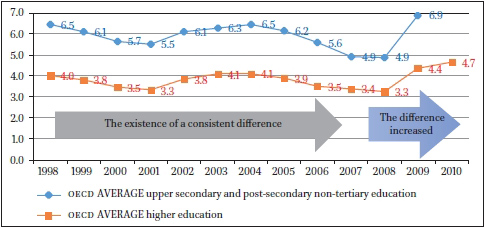
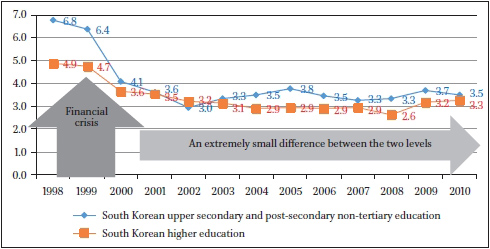
Figures 2.3, 2.4, 2.5, and 2.6 show the unemployment rates for higher education degree holders and upper-secondary and post-secondary non-tertiary education degree holders for the
Figure 2.6 is the trend in unemployment rates for higher education and upper-secondary education degree holders in Taiwan. Higher education and upper-secondary education degree holders had low unemployment rates in the late 1990s. After 2000, higher education degree holders’ unemployment rates grew rapidly, but their unemployment rates remained lower than those of upper-secondary education degree holders. However, the unemployment rate for higher education degree holders dramatically increased beyond that of the upper-secondary level by 2005, and this trend remained consistent. The year 2005 also marked the year Taiwan’s higher education entered the universal access phase.


Relationship between Higher Education Participation Rates and Degree Holders’ Unemployment Rates in Taiwan, Japan, and South Korea
The previous analysis indicated that for the
In this research, our first hypothesis is that the difference in unemployment rates between higher education graduates and upper-secondary leavers will be reduced due to greater higher education expansion in Japan, South Korea, and Taiwan. This hypothesis was confirmed for Taiwan and South Korea, but not for Japan.
Comparison of Squeeze Effects in Taiwan, Japan, and South Korea and Discussion of the Squeeze Effect with Reference to Enrollment Rates and Stages of Higher Education Expansion
In this section, we use the term squeeze effect to describe the effect of “replacement” in the job market between an upper-secondary degree holder and a higher education degree holder. In Figure 2.7, each dot of data for each year represents the difference in unemployment rates between higher education and upper-secondary education degree holders in that year. We calculated this number by subtracting the unemployment rate of higher education degree holders from the unemployment rate of upper-secondary education degree holders. When this number is positive, it means that the higher education degree holder’s unemployment rate is lower than that of the upper-secondary education degree holder. The higher the number, the lower the higher education degree holder’s possibility of unemployment. Thus, Figure 2.7 shows Japan’s trend of a positive squeeze effect in higher education, but not as positive as that trending in South Korea. Taiwan is different: the trend of changing from positive squeeze effects to negative effects is evident, and it became more negative when Taiwan’s higher education system entered the universal access phase. In Japan, completing higher education leads to a lower possibility of unemployment. In South Korea, the difference in unemployment rates between higher education and upper-secondary education degree holders is small. In Taiwan, upper-secondary education degree holders have lower unemployment rates than higher education degree holders when the higher education system is in the universal access phase.
Our second research hypothesis asserts that universal access (50% net enrollment rate) is related to some extent to the higher unemployment rate in Japan, South Korea, and Taiwan. Our statistical data showed that Japan has lower higher education enrollment rates, but the differences between higher education graduates and upper-secondary leavers are larger than those in South Korea and Taiwan. In contrast, South Korea and Taiwan consistently retained smaller differences, particularly when they reached universal access in 2004/2005. The turning point in South Korea and Taiwan was the 50% net enrollment rate in higher education. Thus, our second research hypothesis was confirmed for Taiwan and South Korea, but not for Japan.

Follow-Up Analysis: Relationship Between Macro Economic Change and the Rate of Unemployment for Higher Education Leavers in Taiwan
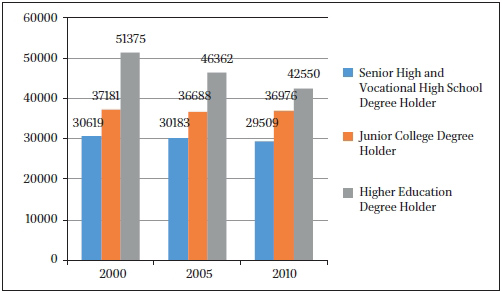
Higher education systems in these three cases all entered the universal access phase; however, unemployment rates for Taiwan’s higher education degree holders increased more than those of senior high school graduates. Thus, in this research, we focus in particular on the relationship between macro-economic change and the rate of unemployment for higher education leavers using the case of Taiwan. Taiwan was well known for its economic development in the 1980s and it continued to experience positive economic development after the 1990s. According to data from the National Statistics,
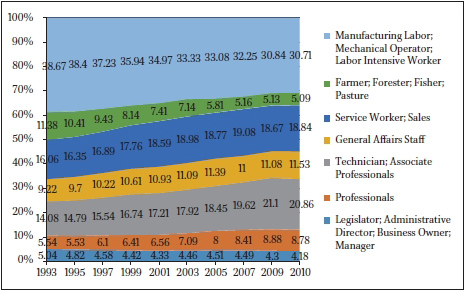
Another important factor to consider related to the relationship between higher education participation rates and unemployment of higher education leavers is the labor market structure change in Taiwan. Figures 2.9 and 2.10 provide data for employees’ occupational types in Taiwan from 1993 to 2010. As these two figures indicate, major changes occurred in the whole labor market structure in Taiwan after 17 years of development, resulting in a significant increase in technicians, associate professionals, service workers, and sales. Meanwhile, knowledge-intensive professionals only increased from 5.54% to 8.78%. Even legislators, administrative directors, business owners, and managers decreased from 5.04% to 4.18%. According to a definition by the statistical bureau of Taiwan, professionals refers to “people normally with higher education qualifications who can apply scientific knowledge to conduct professional activities and solve economic, social, industrial, agricultural, and environmental problems.” The major increase in occupational types in Taiwan in the last 17 years was in semi-professional jobs while higher education expanded rapidly in the same period. When society and the labor market do not offer or need knowledge-intensive jobs, the economy still needs time to change into one that is knowledge-based, and the overproduction of higher education graduates means that they will inevitably be unemployed.

Conclusion
One significant convergent change in higher education systems throughout the world is increasing participation rates across countries. Advanced industrial countries such as the United States have entered the phase of universal access, as have some East Asian countries such as Taiwan, Japan, and South Korea. The question arises whether a higher rate of participation in higher education will lead to higher unemployment rates among graduates. The historic development of the United States suggests that no direct relationship exists between participation in higher education and higher unemployment rates among higher education degree holders. We collected data from
As our analysis suggested, labor market transformation is an important index for governments to watch when considering ways to expand higher education. Taiwan expanded its higher education too far ahead of turning into a knowledge-based economy, based on the trend in changing numbers of knowledge-intensive professional jobs or other jobs requiring high skills. Another debate arising here was whether higher education expansion led the economy to transform or if it was necessary to wait until an economy transformation occurred in order to expand its higher education. From the development experiences in Japan, South Korea, and Taiwan, it could be suggested that the expansion speed of higher education should not exceed the transformation of the economy. The squeeze effect of the two levels of education could be an important policymaking index in this specific context.
Based on Trow’s classification, although universal access to higher education contributes to adaptation to rapid social and technological change, in these societies, it might have also led to higher rates of unemployment, particularly in South Korea and Taiwan. Completing higher education might not increase an individual’s chances of being employed in the labor market when a society reaches universal access. Any government hoping to expand its higher education sector should use the 50% enrollment rate as an important benchmark; when it has an economic structure similar to Taiwan, it should consider the 50% net enrollment rate as a point at which to watch for unemployment issues facing higher education graduates.
Taiwan’s unique problem could be the result of inconsistencies between its industrial advancement and the expansion speed of higher education. The potential causal factors of unemployment among higher education graduates, from the macro market perspective, could be wage differences and the scarcity of professional jobs. Several questions remain related to individual reasons for unemployment among higher education graduates: Are such graduates being unemployed actively or passively? One issue is related to the concept of the voluntary unemployment of higher education graduates: Are their major fields and expertise learned at universities consistent with their potential jobs? Do the lower monthly wages and inconsistency in skills learned at universities and the content of potential jobs instead discourage graduates from seeking employment in society? Countries approaching universal access should consider these important questions.
This research was limited by the availability of data on unemployment rates among graduates from diversified higher education institutions. However, the relationship between diversified higher education and (un)employment, such as tracking the difference between unemployment rates for graduates from elite and other universities, is an important issue. This study found that higher education degree holders in Taiwan had a reduced advantage when it came to employment due to inconsistencies between professional job opportunities and higher education reform.
Footnotes
2 Martin Trow, Problems in the Transition from Elite to Mass Higher Education (Berkeley: Carnegie Commission on Higher Education, 1973); Evan Schofer and John W. Meyer, “The Worldwide Expansion of Higher Education in the Twentieth Century,” American Sociological Review 70, no. 6 (2005): 898-920.
3 Ru-Jer Wang, “From Elitism to Mass Higher Education in Taiwan: The Problems Faced,” Higher Education 46, no. 3 (2003): 261-287.
5 Ministry of Education in Singapore, “Greater Diversity, More Opportunities in Singapore’s University Sector,” accessed September 3, 2016, http://www.moe.gov.sg/media/press/2012/08/greater-diversity-more-opportunities-in-singapores-university-sector.php; University World News, “Higher Education Participation Rate to Rise to 40% by 2020,” accessed September 3, 2013,  .
.
6 The Master Plan Survey Team, Sacramento, California State Department of Education, A Master Plan for Higher Education in California, 1960-1975, 1960.
7 Cheng-Cheng Yang, “The Development of Higher Education Expansion and College Access in California of the United States and its Implications to Taiwan,” Higher Education Evaluation and Development 8, no. 1 (2014): 15-58.
10 Evan Schofer and John W. Meyer, “The Worldwide Expansion of Higher Education in the Twentieth Century,” American Sociological Review 70, no. 6 (2005): 898-920.
12 John H Bishop, “Over-education,” in International Encyclopedia of Economics of Education, ed. Martin Carnoy (Oxford: Pergamon Press, 1995), 375-380, 2nd ed.
13 Paul Morris, “Asia’s Four Little Tigers: A Comparison of the Role of Education in Their Development,” Comparative Education 32, no. 1 (1996): 95-110.
14 Paul W. Kuznets, “An East Asian Model of Economic Development: Japan, Taiwan, and South Korea,” Economic Development and Cultural Change 36, no. 3 (1988): 11-43.
15 Clark W. Sorensen, “Success and Education in South Korea,” Comparative Education Review 38, no.1 (1994): 10-35; Yan Bing Zhang et al., “Harmony, Hierarchy and Conservatism: A Cross-Cultural Comparison of Confucian Values in China, Korea, Japan, and Taiwan,” Communication Research Reports 22, no. 2 (2005): 107-115.
16 Tse-Kang Leng, “Economic Globalization and it Talent Flows Across the Taiwan Strait: The Taipei/Shanghai/Silicon Valley Triangle,” Asian Survey 42, no. 2 (2002): 230-250.
17 Theodore W. Schultz, “Investment in Human Capital,” The American Economic Review 51, no. 1 (1961): 1-17.
18 Ibid.
19 Ibid.
20 Gary S. Becker, Human Capital: A Theoretical and Empirical Analysis with Special Reference to Education (Chicago,
21 George Psacharopoulos, “Returns to Education: A Further International Update and Implications,” The Journal of Human Resources 20, no. 4 (1985): 584-604.
22 Giorgio Brunello and Simona Comi, “Education and Earnings Growth: Evidence from 11 European Countries,” Economics of Education Review 23, no. 1 (2004): 75-83.
23 Stephen Fallows and Christine Steven, “Building Employability Skills into the Higher Education Curriculum: A University-Wide Initiative,” Education+Training 42, no. 2 (2000): 75-83.
24 George Psacharopoulos, “Returns to Education: A Further International Update and Implications,” The Journal of Human Resources 20, no. 4 (1985): 584-604.
25
26 Alvin Toffler, Powershift: Knowledge, Wealth and Violence at the Edge of the 21st Century (New York,
27 Walter W. Powell and Kaisa Snellman, “The Knowledge Economy,” Annual Review of Sociology 30, (2004): 199-220.
28 Tain-Jy Chen and Joseph S. Lee, eds., The New Knowledge Economy of Taiwan (London: Edward Elgar Publication, 2004).
29 Ibid.
30 Paul W. Kuznets, “An East Asian Model of Economic Development: Japan, Taiwan, and South Korea,” Economic Development and Cultural Change 36, no. 3 (1988): 11-43.
31 Elizabeth St. George, “Positioning Higher Education for the Knowledge Based Economy,” Higher Education 52, no. 4 (2006): 589-610.
32 Ibid.
33 Ruth K. Chao, “Chinese and European American Mothers’ Beliefs about the Role of Parenting in Children’s School Success,” Journal of Cross-Cultural Psychology 27, no. 4 (1996): 403-423.
34 Sheng-Ju Chan and Chi-Hua Yang, “The Employment of the College Graduate: Changing Wages in Mass Higher Education,” in Mass Higher Education Development in East Asia, eds. Jung Cheol Shin, Gerard A. Postiglione, and Futao Huang (Cham, Switzerland: Springer International Publishing, 2015), 289-306.
35 Takehiko Kariya, “Credential Inflation and Employment in Universal Higher Education: Enrolment, Expansion and (In)equity via Privatisation in Japan,” Journal of Education and Work 24, no. 1-2 (2011): 69-94.
36 Michael Spence, “Job Market Signaling,” The Quarterly Journal of Economics 87, no. 3 (1973): 355-374.
37 Martin Trow, “Reflections on the Transition from Mass to Universal Higher Education,” Daedalus 99 no. 1 (1970): 1-42.
38 Martin Trow, “Reflections on the Transition from Elite to Mass to Universal Access: Forms and Phases of Higher Education in Modern Societies since WWII,” in International Handbook of Higher Education, eds. James J.F. Forest and Philip G. Altbach (Netherlands: Springer, 2006), 243-280.
39 Gerald Keller, Managerial Statistics (South-Western Cengage Learning, 2012), 9th ed.
41 Ibid.
44 Ibid.
46 Ibid.
51 Ibid.
52 Ibid.
56 National Statistics,
59 Ibid.