



Abstract
Engineering education in Hong Kong is experiencing significant changes in response to several major forces: (1) an increasing demand for future engineers who possess technical competencies, professional skills, and knowledge of ethical awareness and responsibilities; (2) accreditation requirements; and (3) the system-wide education reform in the region. Curriculum changes have taken place in several universities in Hong Kong with engineering majors but there are few conceptual articles providing in-depth discussions about the impact of the changes. This article aims to provide insights into the engineering curriculum reform in a broader context for university management, program leaders, and coordinators who are involved in curriculum design and implementation. Using a newly revamped engineering curriculum in one of the research-intensive universities in Hong Kong as an example, this article highlights the features of the new four-year engineering curriculum and discusses how it may contribute to the nurturing of future engineers. While clear progress has been made in providing students with a broad perspective and support, the influences of the prevailing culture of teaching and learning, the local perceptions of the engineering profession, and the decision making patterns of Hong Kong Chinese students cast a complicated picture. To fully achieve the goals of the new curriculum, universities should proactively address the challenges by the following actions: acting consistently to the commitment of holistic education, supporting students’ personal and value development, establishing reward mechanisms for faculty members’ contributions in student development, and investing in pedagogical development and innovations.
Introduction
There is an increasing demand worldwide for future engineers with technical competencies, professional skills, and knowledge of ethical and social responsibilities. One important reason for this trend is that the problems facing engineers are more complex and the mode of working is more collaborative. Friedman frames the phenomenon vividly in his book The World is Flat. 1 The problems to be tackled, sometimes referred as “grand challenges”, are often multi-faceted and cut across country boundaries, situated in various interrelated social and cultural contexts. 2 Practically, this implies the competencies that should be more valued nowadays are the abilities to connect seemingly different things, to define and solve “wicked problems”, to work with people from different disciplines, and to tolerate ambiguities.
The engineering education community has shown awareness of the demand for such competencies and formulated strategies for coping with it. For example,
As a signatory member of the Washington Accord, Hong Kong follows the same criteria specified in EC2000. The Hong Kong Institute of Engineers, the local accreditation body formally recognized by
These two major forces—the requirements of the accreditation body and the system-wide education reform—have significant impacts on the engineering education in Hong Kong. While these forces appear to be very positive in responding to the changing societies, what cannot be neglected are social and economic factors in the local Hong Kong society, the prevailing culture of teaching and learning, and the perceptions of the engineering profession. Hong Kong’s economy is highly oriented towards the finance industry, and talented students often do not aspire to be engineers. As one mechanical engineering professor said during a recent press interview, “engineering as a whole was not very attractive to young people in Hong Kong.” 5
These factors and the interplay among them present both opportunities and challenges to engineering educators. This article aims to provide insights and references for university senior management, program leaders and coordinators who are involved in the process of strategy formulation, curriculum planning, and implementation. It may also be of interest to some instructors who are considering redesigning a course or a component in a similar context of curriculum changes. The following sections of this article present the key features and components of the undergraduate engineering curriculum in one of the eight publicly-funded universities in Hong Kong, discuss how these features and components may affect students’ learning and ways they may facilitate the development of future engineers, and conclude by highlighting related opportunities, challenges, and recommendations. The discussion draws mostly on policy papers, prior literature, and institutional reports. News reports are occasionally included.
Factors Affecting Engineering Education in Hong Kong
The landscape of engineering education has changed substantially over the past several decades in most developed countries. These changes are inevitable since the production structure has evolved from agriculture to industry and then to services. The time when Hong Kong reached its peak in industrialization was 1980, or about 20 years later than the
This background has deeply influenced engineering education in Hong Kong, in particular shaping its focus from strong technical competences to a broad range of professional skills that can enable its graduates to excel in the service sector. The following sub-sections outline three major factors that reflect Hong Kong’s unique financial, educational, and political position.
Engineering Identity
Concerns about the number and quality of students entering science and engineering disciplines have been raised in a number of countries. For instance, declining interest in engineering and other
According to the latest employment survey conducted by the Hong Kong University of Science and Technology (
Prior research indicates that engineering identity is a key factor in determining whether a student will persist in an engineering major or switch to another discipline. 12 While Hong Kong does not suffer from retention problems within engineering, engineering identity can influence students’ decisions in pursuing an engineering degree or career. Engineering identity has been conceptualized as consisting of two broad constructs, the academic identity and the engineering aspirations. Academic identity indicates the extent to which students perceive themselves as performing well in their academic subjects. Engineering aspirations means the extent to which they see the work of engineers as desirable. 13 Identifying oneself with engineering and perceiving one’s career in the engineering field have been found as essential components that can reflect one’s engineering aspirations. 14 Career prospect has also been known to exert a significant influence on students’ engineering identity. Other influential factors include self-efficacy in engineering, interest in studying engineering, and involvement in engineering-related activities. 15
From a survey administered to 726 secondary school students in Hong Kong, factors including exposure to engineering in secondary school, learning approaches, parental and peer influences, and non-school-based engineering experiences (for example, university engineering department visit, engineering outreach, and company visits) have been found to have significant influences on students’ intention to study engineering majors. 16 It is further notable that the limited (or too late) exposure to engineering subjects in secondary schools (i.e., starting from age 15+), in contrast to the richer and earlier exposure to science and mathematics subjects, may also reduce the possibilities for students to feel interested in engineering. It also needs to be noted that parents and family members have a significant influence on Hong Kong students’ major selection and career choices. 17 Asian students typically believe that they have an obligation to achieve high academic scores as a return to the support provided by the parents for attending colleges. 18
Teaching and Learning Approaches
A comparative study on teaching and learning approaches between Hong Kong and Mainland Chinese students found that a “transferring” teaching approach was most common in both areas. 19 Transferring is a teacher-centered approach that regards teaching as simply a one-way transferring of knowledge from the teacher to students. The second most common teaching approach in Hong Kong was found to be the “travelling” approach, which is described as a student-centered approach through which teachers act as facilitators in enabling students to learn from their experiences. In the same study, Hong Kong construction engineering students were found to favor an achieving-oriented learning motivation and a surface learning approach, which means that students wanted to obtain high scores and cared less about having a thorough understanding of the subjects. 20
While these findings reflect a significant aspect of the prevailing teaching and learning approaches, it is also important to note that all Hong Kong higher institutions, through the system-wide education reform, have taken two initiatives that exert a great impact on teaching and learning approaches. One movement is the mandatory adoption of an outcome-based framework, which requires clearly written articulation in any program of three elements of course design: intended learning outcomes, assessment tasks, and teaching and learning tasks. 21 Another relevant initiative that has gradually shown its impact involves changes in assessment practices. Examinations were traditionally the dominant form of assessment, but this has started to change under the constructive alignment principle of the outcome-based framework. There is evidence of an increasing variety of assessment modes being used in higher education institutions in Hong Kong. 22
Influences from Mainland China
Though Hong Kong is part of China under the “One country, Two systems” principle, perceptions about engineering as a career in Hong Kong and Mainland China are quite different. In Mainland China, both the demand and the supply of engineering graduates have rapidly increased. Engineering is seen as one of the most popular majors. 23 This also explains why young immigrants from Mainland China to Hong Kong show more interest in studying engineering.
Due to the geographical proximity and political reasons, Hong Kong’s development is influenced by Mainland China. The collaboration between Hong Kong and China, following the Closer Economic Partnership Arrangement (
The Revamped Undergraduate Engineering Curriculum at hkust
The revamped undergraduate engineering curriculum at the Hong Kong University of Science and Technology (
Overall Structure of the New Engineering Curriculum
One major difference between the new four-year curriculum and the previous three-year curriculum is related to student admission. Before 2012, most students (except for a small pilot group of around 100 students) entered an engineering discipline directly. Since 2012, students are enrolled into the four schools in the University (i.e., school-based admission) and then supposed to declare their preferred majors at the end of the first year after an exploration of various disciplines and the university core education.
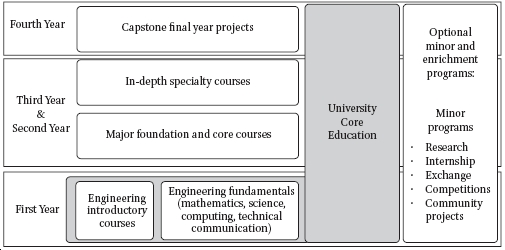
The first year in the new curriculum is exploratory with a relatively light program, which consists of engineering introductory courses, engineering fundamentals, university core education, and other co-curricular opportunities. Disciplinary core courses and specialty courses take place starting from the second year. The third year includes more in-depth specialty courses. The fourth year features final year capstone projects which aim to develop students’ abilities in integrating the knowledge and skills acquired during the preceding years while solving ill-defined problems. Figure 1 provides an overview of the curriculum.
The new four-year engineering curriculum at hkust
(adapted from seng Status Report).
28
New First Year Experiences
Under the new structure, students entering universities are in fact one year younger than their counterparts in the previous curriculum but they are expected to make more decisions about their academic and social life due to the increased flexibility and breadth of the new curriculum. To support students in making informed decisions, an academic advising system, designed as an inter-generational learning community, 29 has been introduced. The main component in the community is a peer-mentoring program, which enables senior students to design learning experiences for first-year students. 30
There are nine such local learning communities, each of which is named as a “clan” with its own features such as logos and color themes. The important roles in a clan include peer mentors, academic advisors, professional advisors, and senior academics (Figure 2). Peer mentors serve as “old timers” (i.e., a term used to describe people who have been in the community for a long time and possess a higher sense of belonging), 31 assisting the School in recruiting new students to the clan, providing guidance to them in first-year success, and offering help in adapting to university life. New students can choose one among the nine clans that suits their personalities and interests. Each new student will be assigned one senior student as a peer mentor from that clan. One special feature of these communities is that students are all called and addressed as “young engineers” rather than first-year students.
The major stakeholders in one learning community.

Individual clans have flexibility to conduct different activities. There are also a number of inter-clan activities designed to foster peer interactions as well as a sense of belonging to the School of Engineering. A typical inter-clan activity is an annual competition in which teams from each clan compete with those from the others. Students in a team of four construct a raft using specified materials and ride on the raft to perform some competitive activities (for example, to catch as many floating balls as possible). During the raft construction process, engineering professors join as advisors to provide guidance on the structure of the raft and the use of materials.
To further support community building, a physical learning space named “engineering commons” was built for students to gather for clan activities as well as self-study and group projects. It has become the “home” for engineering students. The space has flexible tables and chairs, enabling discussions for groups of different sizes. It also contains various displays, such as books, engineering products, self-learning materials, and the latest engineering inventions.
Along with the building of an engineering learning community, a compulsory course on academic orientation (one hour per week during the first year; carrying no credits) has been launched to provide introduction on learning methods suitable in the university and develop key concepts and skills for first-year success. The modules include university education, time management, communication, and basic engineering design concepts. Designed and delivered by a number of senior professorial staff in the School of Engineering and supported by teaching associates in E2i, the course is regarded as important to facilitate students’ transition to university. Some simple conversations with students at the beginning of the semester can help reveal their misunderstandings of university study and life. As one student said, “if I continue to work very hard as what I did in my secondary school, I could get high scores too.” Another one said, “I know I need to improve my time management. I just do not have time for that.” The academic orientation course hence serves the purpose of providing an initial guide to new students, including by addressing these and other common misconceptions.
Capstone Experiences
Several lecture-based courses have been revamped through university teaching development grants to encourage inquiry-based learning. One example is a capstone course in civil engineering, which provides authentic learning experiences through simulations of real-life work situations in civil engineering consulting firms. Students are required to form multi-disciplinary teams. With the assistance of a team of practicing engineers as facilitators and professional advisors, these students visit a construction site, identify site information, collect design constraints from government departments, perform impact assessments to understand associated environmental and traffic issues, and finally come up with the foundation and structural design of the infrastructure. In one seminar during 2013-14, the main task for students was a housing project located in an area of approximately 67,000 m2. This was a real civil project in the city. Students were required to visit the venue and develop their designs based on the actual constraints of the site. There were four assessment components, including attendance at the site visit, a scenario-based problem solving module, project reports, and a project presentation. External experts were invited to join the assessment panel with the instructor for grading the project presentations.
Common Core and School-Sponsored Courses
Under the university core education, there is a new common core program for all students in the university. This is also the trend of most universities in Hong Kong that are shifting from disciplinary specialization to a holistic education model. 32 Undergraduate students under the new curriculum should complete 36 credits in the common core program consisting of eight broad areas. Students must fulfill at least three credits from each of these three areas: humanities, social analysis, and science and technology. 33 A small number of courses in the area of science and technology were specially developed by the School of Engineering as pilot courses for experimenting with pedagogical innovations.
These pilot courses are broad enough for students from different disciplines and also illustrate the characteristics of science and engineering. For example, one course on engineering grand challenges adopts collaborative problem-based learning as the main pedagogy and requires students from different disciplines to work in teams to tackle one or two aspects of significant engineering challenges such as water pollution and energy crisis. Students need to identify the key issues, collect and analyze information, and finally present their solutions first to their peers and then to a panel consisting of instructors and engineering practitioners. Another course adopts project-based learning and requires students to design and construct airships using certain materials. Students form teams and enter a competition with other teams in the same class to complete a series of tasks using their airships. During the course, training is provided to students regarding teamwork skills and airship construction skills.
These two examples illustrate pedagogical innovations that aim to develop students’ competences in both technical abilities and professional skills. Professional skills such as teamwork and communication were typically perceived to be more relevant to extra-curricular activities in the previous curriculum. Embedding them in the formal curriculum such as these credit-bearing courses represents an effort to enhance holistic development among students. One important benefit for engineering students is that they get the chance to work with people from different backgrounds. The positive outcome for engineering students to collaborate with students in business, science and humanities is reported in the course described in the first example. 34 Students in focus groups after the course shared that they benefited from seeing others’ perspectives when tackling the problem together and balancing these diverse perspectives to generate feasible solutions. Since students are asked to solve real problems related to engineering in all of the school-sponsored courses, they are also able to see how engineering can apply to real-life situations.
Enhanced Community Engagement
In
Involving engineering students in community work is never an easy task. For some students, it is difficult to see the relevance and significance of community engagement, partly because of the strong belief held by many engineering students or even professors that technical competencies should be the core consideration while other skills are only supplementary. 35 In response, efforts have been made over many years to engage students in the community through a variety of initiatives: international and local competitions, community service projects, networking with professional bodies, and student enrichment grants.
In one of the service learning projects, a group of sixteen engineering students organized training workshops for students who are preparing to join robotics competitions. The challenge for these students was to design and deliver teaching materials at an appropriate level to workshop participants with various educational backgrounds. In another case, the trainees were visually impaired students in a secondary school who had traditionally been excluded from robotics competitions. The engineering students worked hard in developing a simple toolbox that could suit the needs of these students and served as mentors for them to prepare for the competition. The team of visually impaired students ultimately won second place in the competition among all other competing teams from conventional schools. 36
Focus groups were conducted with students who participated in these two activities. One key element found to promote higher levels of student engagement was students being able to apply their engineering knowledge and skills in these services. In this way, they not only saw the relevance of engineering but also had a sense about how engineering could contribute to society and help people in need. A number of students expressed that they would be willing to be more involved in the community using their engineering knowledge and skills. 37
Discussion
Great efforts have been made in the School of Engineering at
Reflecting on such changes, two fundamental questions facing engineering educators are: (1) whether graduates from the new curriculum are likely to possess the necessary competencies required for future engineering work, and (2) how the new curriculum may specifically contribute to the achievement of this objective. Though it would be too early to draw a definite answer before the graduation of the first batch of students in the new curriculum, it would still be meaningful to reflect on the changes that have been made. Challenges in implementing the new curriculum are also discussed.
Opportunities
Building Engineering Identity
More important than the competency development is actually whether students are willing to enter into the engineering profession. Typically, less than half of the engineering graduates from
From a theoretical perspective, many elements in the new curriculum are about building a community. The academic advising was designed based on the community of practice framework and operated with multiple stakeholders playing different roles. The enhanced community and global engagement is also about the community, in a much wider sense connecting the university to the society. In Lave and Wenger’s seminal work on communities of practice, learning is conceptualized as a situated activity with a process called “legitimate peripheral participation,” which implies that newcomers learn to become part of the community through talking and socializing with existing community members. 38 Learning involves the whole person, which not only means the activities that one performs, but also embeds the relation of that person and the community.
The impact of community of practices on its members described by Lave and Wenger is in fact the desirable outcomes for first-year engineering students.
Domain is the common ground and a sense of common identity. An engineering learning community should therefore inspire students to know about the engineering discipline.
Community is based on the interaction between its members. A successful community must facilitate its members to interact and share with one another meaningful topics or issues on a regular basis. An engineering learning community needs to provide a platform for students to interact regularly and work on meaningful engineering-related problems together.
Practice denotes a socially defined way of doing things. An engineering learning community should promote a set of common approaches and languages among engineering students. Calling students “young engineers” is one example of such practices.
Given the concerns over student enrollment and engineering identity in Hong Kong, an engineering community seems to be the right solution. It is expected that through this community, first-year students can be more engaged in learning and practicing engineering through socialization with senior engineering students, engineering academics, and practitioners.
Developing Problem-Solving and Other Professional Skills
The changes in the capstone experiences and the introduction of school-sponsored courses denote a shift from lecture-based teaching to inquiry-based and problem-based learning. Inquiry-based and problem-based learning have been found effective in promoting higher-order thinking skills, which are highly related to other abilities like integrating different perspectives and solving ill-defined problems. 41
In those school-sponsored courses that are open for students from different disciplines, some evidence has already been collected regarding the positive learning outcomes such as the development of collaborative problem-solving skills from interdisciplinary teamwork in a school sponsored course. According to the literature, seeing the difference between one’s own profession and those of others can also help build professional identity. Therefore, these pedagogies would be seen as aiming for multiple purposes including the development of problem solving and other essential skills as well as the enhancement of engineering identity.
A Broad and Balanced Education Model
Flexibility and broadness is added to the curriculum. Students can have a wider choice of courses and combinations of them while still satisfying the graduation requirements. Though
Literature in engineering education affirms the benefits of a broad education model. Various forms of informal learning including competitions, service learning, and research experiences have all been found to contribute to the development of engineering graduate attributes such as multidisciplinary teamwork, problem solving abilities, and knowledge of ethical responsibilities.
43
Training in arts and humanities could largely benefit engineering and science students through developing their abilities in collecting and organizing facts and opinions, analyzing them, articulating a sound argument, and communicating with other people.
44
Another local study at
Challenges and Recommendations
Tensions between the Prevailing Culture and the New Curriculum
Many features in the new curriculum promote a broader and more liberal education environment. Students are supposed to have a higher level of ownership and autonomy as the result of the changes. These ideas can be traced to theories originally found in Western societies such as self-directed learning and self-determination. However, questions about whether Chinese students will perceive and experience these new learning environments differently have been raised in the literature.
46
Although scholars point out that cultural aspects should not be over-emphasized and that Chinese students are changing under the new environment, it cannot be denied that significant differences in learning motivations and career explorations still exist between students in Hong Kong and elsewhere, including the
The intention of school-based admission is to allow students to explore different majors and thus make an informed decision. Likewise, the intention of a core university education is to provide broad perspectives. How students interpret and experience these arrangements, however, may be a completely different story. As suggested in the literature, Asian students often do not make study or career decisions based on personal interest; instead, they frequently select majors leading to the highest paying jobs or quickest completion of the degree program, which is mostly consistent with parental desires. 48 It is thus possible that some students under such pressure would find the common core program a waste of time as it to some extent delays pursuing and completing their major.
Inherent tensions may also originate from the dilemma between students’ desires to achieve high scores (i.e., Grade Point Average or
For the new curriculum to achieve a transformative effect, that is, to develop qualitatively different students, these tensions should be acknowledged. 51 Though it could take a long time for the culture to change, the university can be proactive in acknowledging the issue by acting consistently from senior management to frontline staff and by providing all stakeholders, and in particular students and their parents, with a clear rationale for why the curriculum is designed in such a way. 52 Meanwhile, the assessment practices in the university should also be consistent with the goal of holistic development so as to acknowledge and reward non-academic achievements, the competencies developed in cross-disciplinary areas, and integrative problem-solving abilities.
Readiness of Students and Faculty Members
The change in the pedagogy is also accompanied by other challenges. For instance, one survey of 1,200 engineering students in the
Even if these studies were conducted years ago, it is still reasonable to assume that inquiry-based learning is new to many students and teachers. Both students and teachers need time and effort to learn the new approaches. It cannot be denied that some faculty members may resist change because of doubts or unfamiliarity with the new approaches. Students could also be dissatisfied because their experiences may not match what they initially believe about studying at a university.
Challenges can also stem from students’ increased autonomy to choose among different courses and paths. Some students may not know what to do with the increased autonomy. They need advice for planning a meaningful learning path. The academic advising at
The Global Competence of Hong Kong Engineering Students
It is further important to note that Hong Kong is in a post-industrial phase and the industrial sector is therefore limited. As a consequence, a large proportion of engineering graduates do not take an engineering-related job. On one hand, the Hong Kong government is urged to provide more opportunities for engineers and technologists. On the other hand, engineering graduates may have to be more open to opportunities elsewhere. Engineers are already expected to perform effectively across countries and cultures. 56 It would be especially true for Hong Kong engineering graduates given the highly multicultural environment in Hong Kong. In addition, Hong Kong engineers need to possess global competencies before they can leverage the opportunities provided by the close economic collaboration with Mainland China.
In the current curriculum, students have opportunities to participate in exchange and internship in overseas or Mainland Chinese institutions as well as collaborate with non-local students in the university (at around 20% of the student body), but whether students can acquire the global competence through these opportunities remains a question. Some studies have noted that Hong Kong students often prefer to interact with local students. 57 Efforts are still needed in the international dimension of the curriculum. Residential education and cultural diversity programs are possible ways to achieve this objective.
Development and Commitment of Faculty Members
Many elements in the new curriculum have inevitably added much workload to faculty members who are already occupied with research.
Practical Implications and Future Steps
The new engineering curriculum at
The future development of the engineering curriculum in
Furthermore, there are ongoing changes in the professional development for faculty members. In a recently published guideline on the appointment of teaching track positions, the impact on student learning and faculty contributions in academic advising are both included as the criteria for evaluating faculty members on a teaching track. 63
Conclusions
Engineering education in Hong Kong is experiencing significant and unprecedented changes linked to several larger forces and trends. In response,
To conclude, this article illustrates that the new curriculum has promoted inquiry-based and problem-based pedagogies and increased support for students’ transition to university life. It also points out that the impact of the prevailing culture and other social and economic factors cannot be neglected. Given the inherent tensions and issues discussed, the university is recommended to proactively address them in order to achieve the transformative effects of the new curriculum. Particular attention needs to be given to students’ learning approaches and motivations, as well as their decision-making patterns. The support for staff members’ development of pedagogical experimentations and the reward for their contributions in student development should also be established for the sustainability of the new curriculum.
Footnotes
Acknowledgements
The author would like to express her sincere gratitude to Prof. Ben, Y. B. Chan, Associate Director of the Center for Engineering Education Innovation (E2I), and Prof. Tim K. T. Woo, Director of the Center for Global & Community Engagement (
2 Richard K. Miller, “From the Ground Up: Rethinking Engineering Education in the 21st Century” (paper presented at the Symposium on Engineering and Liberal Education, Union College,
5 Andrea Deng, “Engineering Cultural Change”, China Daily, February 28, 2014, accessed June 19, 2015,  .
.
9 Ibid., 6.
10 Peter, J. Kutnick, Y. Y. Chan, and P. Y. Lee, “Engineering Education Opportunities, Perception, and Career Choice of Secondary School Students in Hong Kong” (paper presented at the 119th
11
12 Olga Pierrakos, Thi Kay Beam, Jamie Constantz, Aditya Johri, and Anderson Robin, “On the Development of a Professional Identity: Engineering Persisters Vs Engineering Switchers” (paper presented at the 39th
15 Ibid., 12.
16 Ibid., 10.
17 Ibid., 16.
20 Ibid., 19.
24 Francis K. W. Wong, William Seabrooke, Kin Chee Wong, King Nam Hung, Wing Nam Lau, Hong Yu Liu, and Xiao Jian Ruan, Market Potential for Hong Kong Professionals in the Mainland China (Hong Kong: The Hong Kong Polytechnic University, 2014), accessed June 19, 2015, .
25 School of Engineering, “Facts & Figures,” (Hong Kong:
29 Ben Chan, Neil Mickleborough, and Tracy Chow, “Effective Multidimensional Learning and Advising Community: Design and Development” (paper presented at Research in Engineering Education Symposium (
30 Frankie Leung, Edmond Ko, and Tracy Chow, “Helping First-Year Engineering Students in Transition: Promoting Transformative Learning in Student and Faculty Development” (paper presented at
35 James L. Huff, Carla B. Zoltowski, William C. Oakes, and Brent K. Jesiek, “Investigating How Service-Learning Alumni Construct Their Engineering Selves” (paper presented at Frontiers in Education Conference, Oklahoma City,
36 Tracy Zou, Tim Woo, Winnie Yuen, and Eric Ho, “Service Learning in Engineering: Integrating Experiences in Competitions and Community Services” (paper presented at International Conference on Service-Learning, Hong Kong, November 19-21, 2014).
37 Ibid., 36.
38 Ibid., 31.
43 Daria Kotys-Schwartz, Mary Besterfield-Sacre, and Larry Shuman, “Informal Learning In Engineering Education: Where We Are—Where We Need to Go” (paper presented at 41st
45 Ibid., 36.
46 Wei-Wen Chen and Yi-Lee Wong, “Chinese Mindset: Theories of Intelligence, Goal Orientation and Academic Achievement in Hong Kong students,” Educational Psychology: An International Journal of Experimental Educational Psychology (
),
49 Ibid., 39.
50 School of Engineering, “
51 Ibid., 48.
54 Ibid., 19.
56 Brent K. Jesiek, Qin Zhu, Sang Eun Woo, Julia Thompson, and Andrea Mazzurco, “Global Engineering Competency in Context: Situations and Behaviors,” Online Journal for Global Engineering Education, 8, no. 1 (2014), accessed June 19, 2015, .
59 Lueny Morell and Jennifer DeBoer, “The Engineering Professor of 2020: The Forgotten Variable” (paper presented at
60 Ibid., 23.
63