



Abstract
Abstract
One unintended consequence of Chinese higher education expansion is an increasing socioeconomic gap in college achievement. Using 2011 College Freshmen Development Survey data, this paper engages in an empirical analysis of the association between one’s socioeconomic status, high school preparation, and college performance. This study finds that well prepared and academically engaged high school graduates achieve a significantly higher level of college development than their less prepared peers. Moreover, low-
1 Introduction
Education policymakers have long been annoyed by the socioeconomic (
China is no exception. Recent evidence demonstrates that the distribution of the higher education resources in general, the access to high quality tertiary education in particular, is extremely favoring male, middle- or high-income urban students with college educated parents. 1
For instance, a stream of literature based on newly available repeated cross-sectional data collected from multiple cohorts of undergraduate students in Beijing reveals that, the poor first-generation students have less access to selective colleges and universities even conditional on college entrance examination scores. 2 Once matriculating into college, freshmen from rural households face greater challenges in academic and social adaption. 3 Male students from metropolitan cities have much higher employment rates and starting salary than their female, rural, and low-income counterparts. 4
One cannot help asking why socioeconomic background still matters for college development, even after the strict ability sorting through college application and admission?
5
One hypothesis is that low-
The life cycle skill formation hypothesis implies a high correlation between one’s k-12 and postsecondary performance. This correlation may transfer one’s disadvantages in high school into college years.
7
Low-
To test this hypothesis, this paper engages in an empirical analysis of the association between one’s socioeconomic status, high school preparation, and college performance. Research questions that arise in this context are as follows: Is there a significant correlation between individual high school preparation and college development? How does socioeconomic status influence one’s college performance?
This paper develops its argument in the context of student engagement literature. It identifies a high correlation between high school engagement and college achievement. We find that well prepared and academically engaged high school graduates achieve a significantly higher level of college development than their less prepared peers. This is largely due to the fact that academic preparation and learning engagement in high school increase the level of college readiness, which is a critical threshold for college success. 8
Moreover, individual’s family background has direct and significant effects on one’s college performance. Low-
This study has substantial implications for institution practice. If researchers can find a significant and strong correlation between college development and high school preparation, college admission officers will be able to predict students’ college success and make justified admission decision. Furthermore, educational policymakers can infer the quality of certain high schools by observing the variation in college achievement of their graduates.
The rest of the paper is organized as follows. The next section describes the Chinese context and reviews literature about the impact of high school experience on college access and performance. The third section establishes an analytical framework, and introduces the data and the sample. The following section reports the empirical findings and the final section closes this paper by discussing the implications of its findings.
2 The Intertwined Experience in High School and College
2.1 Chinese Context
Chinese education system is characterized with continuous sorting and competition. In China, the first wave of sorting occurs after the completion of compulsory education at the age of 15, and most students continue their education in academic or vocational high schools and a small group of graduates enter the labor market. The second wave of sorting occurs after the completion of the upper secondary education at the age of 18. At that time, vocational high school graduates join the workforce and academic graduates take the college entrance examination before entering three-year colleges or four-year universities.
The competition for elite universities is fierce, because only 112 out of more than 2240 postsecondary education institutions are considered the most selective ones. Each year, these so called “Project 985” and “Project 211” institutions take fewer than 7.5% of high school graduates. 9 They are considered the first-tier institutions in China. 10
In order to outperform others in the high-stake college entrance examination (gaokao in Chinese), the better-off families invest lots of money in school choice and private tutoring as early as first grade, even though the average effect of private tutoring is not significant for most students. 11 As for the low-income students, a high proportion of them retakes the college entrance examination after unsuccessful attempts, in order to enlarge their odds of admission to better universities. 12
Irrespective of those fancy strategies, high school years are the most critical time for achieving one’s college dream. Like in many Asian countries, Chinese parents are famous for pushing their children into the gaokao race, by providing private tutoring
13
and setting high expectation for gaokao scores. High schools also compete vigorously on college-going rate and number of students admitted by first-tier institutions, leading to the born of “super high schools.”
14
Nevertheless, low-
2.2 Role of High School Preparation for College Success
In the past twenty years, higher education researchers have constructed comprehensive frameworks to capture the determinants of college success. For instance, Perna and Thomas and Perna 16 analyze the longitudinal process of college success from the sociological perspective, emphasizing the role of cultural and social capital in shaping individual college access and attainment. Paulsen and St. John 17 apply the economic theory to understand the link between financial aid and retention. Tinto & Pusser 18 develop an institutional action model for promoting college persistence. Although scholars differ in their analytical perspectives, they reach one consensus that there is a high correlation between high school performance and college development.
High school academic intensity and curriculum quality are considered the most critical predictors for college access, persistence and graduation. High school grade point average (
Parental style and support are also critical for college success. Discussing education related topics within households, parental involvements in high school volunteer programs, parents’ contacting high schools for children’s academic issues increase the probability of enrolling in 4-year college. 24 Early planning (as early as 8th grade) for higher education has a positive effect on completing baccalaureate degree on time. 25 Appropriate parental support and involvement can mitigate the negative impacts of poverty on higher education completion. 26 In addition, parents and high school peers can influence college access and persistence. 27
Similar evidences are found in Chinese context. Bao 28 indicates that attending selective high schools and having a higher class ranking increase the probability of going to the first-tier Chinese universities, but private tutoring cost in high school is negatively correlated with attending selective institutions. Using similar data, others report that high school teaching pedagogy, student-teacher interaction, and non-academic engagement influence students’ adaption to college environment.
2.3 Unresolved Issues
Although existing literature has identified the critical roles of academic intensity, curriculum quality, and parental support in high school for predicting college success, these studies have not reached agreement on the following issues. First, how to measure high school preparation? There are lots of discussions on the influence of number of credits enrolled and the level of course content, almost no one has examined the effects of students’ study effort or student-teacher interaction. These factors capture individual’s learning engagement in high school. This study explicitly introduces measures of high school learning engagement, in addition to indices of academic preparation.
Second, how to measure parental involvement and investment? Most American literature focuses on parental involvement in high school, but fails to notice the vital role of private tutoring and disciplinary competition supported by parents, which are prevalent in China. These measures are included in this paper to evaluate parental support outside high school.
figure 1

Finally, there is no consensus on how to measure college success. Existing literature predominately puts emphasis on academic achievement, retention and timely degree completion, not much focus on skills formation and moral development. We consider all three indices of college performance in this study.
3 Analytical Framework, Empirical Model, and Data
3.1 Framework
In keeping with previous literature, this paper constructs a simple model to test the association between socioeconomic status, high school preparation, and college development (see Figure 1).
This model hypothesizes that one’s socioeconomic status influences her high school experience, i.e., advantaged students tend to be better prepared in high school, be more engaged in learning, and their parents tend to provide more support. Next, high school experience is assumed to predict college achievement. Students with better high school preparation are assumed to have higher grades and accumulate more skills in college. In addition, this paper hypothesizes socioeconomic status has direct effects on college development.
In this model, individual high school experience is decomposed into three parts. Academic preparation is a composite measure based on indicators for whether students attended selective high school, participated in disciplinary competition at province or national level, and attended high schools using innovative teaching pedagogy. Learning engagement evaluates the quality of student’s study effort and teacher-student interaction, which is built on measures of daily study time, student’s interaction with teachers within and outside classroom. Parental support is a cumulative measure of parental involvement. This paper defines it as a function of household expenditure for private tutoring and parental involvement in college institution and major choice.
We also construct a socioeconomic status index based on father’s education, father’s occupation status, and household income. 29 College academic achievement is defined as the first-year college major ranking. Skills formation is reflected by college freshmen’s core competence and civic participation.
3.2 Empirical Model
In line with the economics of education literature, this study applies an education production function, which intends to identify the correlation between educational inputs and outputs, capturing the cumulative effects of family, school, and social inputs for education.
30
In this paper, we intend to estimate the effect of
At = α0 + α1SES t-1 + α2A t-1 + α3SES t-1 • A t-1 + ε (1)
Where At refers to one’s college major ranking, core competence or civic participation. At-1 stands for one’s academic preparation, learning engagement, and parental support in high school. SES
t-1 refers to student’s socioeconomic status in high school. The interaction term captures the potential intermediate effect of
This paper runs a path analysis with the Structural Equation Modeling in
figure 2

3.3 Data and Sample
The data is derived from a longitudinal survey of college students from 28 colleges and universities in Beijing, sponsored by Peking University and the Beijing Education Working Commission. The College Freshmen Development Survey surveyed 5000 freshmen in the Spring of 2011. The following up sophomore and junior surveys were conducted in the Spring of 2012 and 2013. This study is based on the freshmen survey, which collected information on students’ family background, high school experience, college application, academic and social engagement in college, evaluation of institutions’ teaching and support, and skill development.
Among 5000 surveyed students, 4244 returned complete surveys, an 85% response rate. Among them, 81% enrolled in 4-year universities and 19% from 3-year vocational colleges. 44% were male and 56% were female students. About 30% were graduated from high school in Beijing. The average years of father’s schooling are 11.34 years, and the median household annual income is 40,000
To construct the sample, we first drop 1678 students lacking household socioeconomic status information. Next, we delete another 403 observations who failed to provide high school information. Finally, we cut another 614 students who did not have accurate college information. The final sample includes 1,549 college freshmen.
4 How High School Experiences Affect College Development?
Preliminary analysis confirms the argument that high school experience matters for college development. We find strong evidence supporting the importance of high school academic preparation and learning engagement in nurturing college success, but a weaker role of parental support. Table 1 provides the standardized coefficients from the path analysis using the Structural Equation Modeling. The goodness-of-fit indices show that the model fits the data pretty well. 31
Well prepared and academically engaged high school graduates achieve a significantly higher level of college development than their less prepared peers. From the third column of Table 1, we find that one standard deviation increase in academic preparation corresponds to a 0.056 points increment in major ranking, 0.085 points increment in core competence, and 0.154 points increment in civic participation.
The same is true for learning engagement. One standard deviation increase in learning engagement is associated with 0.064 points increment in core competence, and 0.055 points increment in civic participation. After trying different specifications of the path analysis, we find that parental support only affects college major ranking, and has no significant impact on core competence and civic participation. Thus, the links between parental support and these two measures are dropped from the model.
Why well prepared high school students do better in college? This may due to the fact that academic preparation and learning engagement are good predicators of college readiness, which is critical for smooth high school to college transition and college success. 32 College readiness refers to the level of preparation a student needs in order to enroll and succeed in a credit-bearing general education course at a post-secondary institution that offers a baccalaureate degree. In order to become succeed in college, Conley 33 argued high school students should master key cognitive strategies, key content knowledge, academic behaviors, and contextual skills and awareness, which are the building stones of college readiness.
Structural equation model for college development

In our model, academic preparation measures the quality of high school teaching (being selective high school and using innovative teaching pedagogy) and the cognitive ability of individuals (participated in disciplinary competition at province or national level), while learning engagement measures the quality of student’s study effort and teacher-student interaction. When capable students attend high-quality high schools (i.e. academically prepared), if they work hard and get along with their teachers (i.e. engaged in learning), they are more likely facing academic challenges need to be solved by key cognitive strategies, acquiring more content knowledge, and obtaining self-management skills such as time management, strategic study skills, and awareness of one’s true performance, persistence and the ability to utilize study groups. With these trainings, high-
5 Does Socioeconomic Status Matters for College Development?
The path analysis reveals that individual socioeconomic status may produce direct and indirect effects on college success. Table 2 decomposes the total effects into direct and indirect effects. We report the standardized coefficient in this table and the Z score indicates the significance of coefficients.
Individual’s family background has direct and significant effects on one’s college performance. On the one hand, high-
Decomposition of total effects
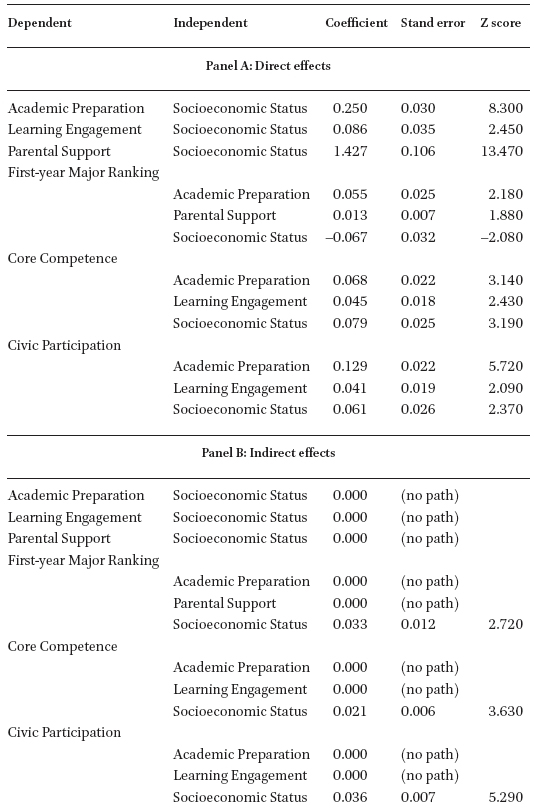

Similarly, high school experiences directly improve one’s college achievement. College freshmen with better academic preparation get higher major ranking (0.055), higher level of core competence (0.068), and higher level of civic participation (0.129). The same is true for the impacts of learning engagement on core competence (0.045), and civic participation (0.041), and the effect of parental support on freshmen major ranking (0.013).
Moreover, socioeconomic status also has indirect effect on college performance through its influence on high school preparation (Panel B of Table 2). We estimate that
figure 3

Hence, the total effect of
How to interpret the socioeconomic gap in college development? The life cycle skill formation may provide some clue. It argues that low-
For instance, our descriptive analysis shows clear socioeconomic performance gaps at both high school and college level (see Figure 3). Students from the bottom
Based on our findings, we argue that the substantial contrast in college performance by socioeconomic status may be explained by two factors—a variation in academic preparation and learning engagement within high school and a difference in parental support outside school. First, disadvantaged students were less prepared and engaged in high school as indicated by Table 1. Because academic preparation and learning engagement are key indicators for college readiness, low-
By comparison, high-
Second, parents in low-
6 Conclusion
6.1 Low-Level Development Cycle
Chinese higher education expansion in the late 1990s opens college access and drives the gross enrollment rate from 9.8 percent in 1998 to 30 percent in 2012. Many female, minority, first-generation, rural students from low-income families are thus able to receive public higher education for the first time. In 2011, 88% of the vocational college graduates were first-generation college students, 12.7% came from low-income areas, and 16.2% came from ethnic minority concentration regions. 36
Unfortunately, the increasing college access fails to level the playground at the finishing line. High-
Why students from wealthier, urban households with educated parents tend to do better in college, even after the rigorous ability sorting through college application and admission? Our study is one of the first attempts to disentangle this puzzle and provide empirical tests based on a large scale college freshmen survey.
Our findings show that, first, there is a positive and significant correlation between individual’s high school academic preparation, learning engagement, parental support and college performance. Well prepared high school graduates are more likely to be college ready, which is critical for adapting to campus life and becoming successful academically. Next, socioeconomic status has both direct and indirect effects on college achievement. Particularly, socioeconomic status indirectly influences college major ranking and skill formation through its impact on high school preparation and engagement.
In conclusion, this study provides a critical evidence for the life cycle skill formation argument, i.e., the deficit in early human capital investment can impair adolescent and adult attainment. In China, housing price reflects the quality of local public schools and low-income families cannot afford to live in communities with high quality public education.
38
Children from low-
Even though some disadvantaged students can pass the college entrance examination and are admitted to postsecondary institutions, they are not college ready. They may have a higher probability of being maladapted. These adaption issues in freshmen year may “cool out” low-
6.2 Potential Success Strategies
The most important implication of our study is that educational policymakers can help low-
Obviously, in order to improve college performance, we should level the playground in high school. Some high school interventions in China have focused on the college preparation and application stage. For instance, several researchers have conducted random experiments in rural high schools, using information intervention and counseling to leverage low-income high school graduates’ college expectation. 39 These studies find that information does not have significant effects on student outcomes. Others try to provide early college financial aid commitment to rural high school students, in order to affect the college decision making of poor students in rural China. 40 The authors conclude that if early commitments are made early enough; and they are large enough, students will make less distorting college decisions.
The other option is to help disadvantaged students enter high-quality high schools. One proposal is to reform the current high school recruitment system, by randomly assigning a proportion of slots in selective high schools to graduates from non-selective middle schools. Beijing has planned to implement similar policies in the near future.
41
Earlier policy evaluation finds such reforms may increases educational equity and efficiency, in terms of opening quality high school education to low-
In addition to high school intervention, colleges can also play important roles in helping their low-
In summary, more studies are needed to identify the effective high school and college interventions for promoting college success of disadvantaged students.
Footnotes
* Yang Po is an associate professor at the Department of Economics of Education and Administration, Graduate School of Education, Peking University, China. She can be reached at Graduate School of Education, Box 68, Peking University, China, 100871. This study is sponsored by the China National Science Foundation (Project number 71103008).
1 Yang Po, “Who gets more financial aid in China? A multilevel analysis,” International Journal of Educational Development 30, no. 6 (2010): 560-569. Li, Hongbin, et al. “Does having a cadre parent pay? Evidence from the first job offers of Chinese college graduates,” Journal of Development Economics 99, No. 2 ( ): 513-520.
5 L. Hongbin, P. Loyalka, S. Rozelle, et al. “Unequal Access to College in China: How Far Have Poor, Rural Students Been Left Behind?” SSRN Working Paper, No. 2293344, 2013. .
6 James T. Heckman, “Skill formation and the economics of investing in disadvantaged children,” Science 312, no. 5782 (2006): 1900-1902.
7 G.D. Kuh, J. Kinzie, J.A. Buckley, et al. “What matters to student success: A review of the literature,” Commissioned Report for the National Symposium on Postsecondary Student Success: Spearheading a Dialog on Student Success, 2006.
10 Less selective public 4-year institutions belong to the second tier, non-selective public or private 4-year colleges occupy the third tier and vocational 3-year private or public colleges comprise the fourth tier. Prashant Loyalka, Yingquan Song, and Jianguo Wei. “The effects of attending selective college tiers in China,” Social science research 41, no. 2 (2012): 287-305.
11 Zhang, Yu. “Does private tutoring improve students’ National College Entrance Exam performance?—A case study from Jinan, China,” Economics of Education Review 32, (2013): 1-28.
12 Prashant Loyalka, Yingquan Song, and Jianguo Wei. “Zhongguo xianxing gaoxiao xuesheng zizhu zhengce pinggu 中国现行高校学生资助政策评估 [Evaluation of Current Chinese College Financial Aid Policy]. Beijingdaxue Jiaoyu Pinglun 北京大学教育评论 [Peking University Education Review], 2011, 9(1): 68-79.
13 Mark Bray, et al. “Differentiated demand for private supplementary tutoring: Patterns and implications in Hong Kong secondary education,” Economics of Education Review 38 (2014): 24-37.
16 Laura W. Perna, “Improving College Access, Persistence, and Completion: Lessons Learned,” The State of College Access and Completion: Improving College Success for Students from Underrepresented Groups (2013): 208. L.W. Perna, S.L. Thomas, “A framework for reducing the college success gap and promoting success for all,” National Symposium on Postsecondary Student Success: Spearheading a Dialog on Student Success, 2006.
17 Michael B. Paulsen, and Edward P. St John. “Social class and college costs: Examining the financial nexus between college choice and persistence,” The Journal of Higher Education 73, no. 2 (2002): 189-236.
18 Vincent Tinto, and Brian Pusser. “Moving from theory to action: Building a model of institutional action for student success,” National Postsecondary Education Cooperative (2006): 1-51.
19 Gary P. Pike, and Joseph L. Saupe, “Does high school matter? An analysis of three methods of predicting first-year grades,” Research in higher education 43, no. 2 (2002): 187-207.
20 Clifford, Adleman, “Answers in the tool box: Academic intensity, attendance patterns, and Bachelor’s degree attainment,” Office of Educational Research and Improvement,
21 George D. Kuh, Piecing Together the Student Success Puzzle: Research, Propositions, and Recommendations:
22 Laura H. Horn, and Anne-Marie Nuñez, Mapping the road to college first-generation students’ math track, planning strategies, and context of support (
23 Edward C. Warburton, Rosio Bugarin, and Anne-Marie Nunez, “Bridging the Gap: Academic Preparation and Postsecondary Success of First-Generation Students,” Education Statistics Quarterly 3.3 (2001): 73-77.
24 Laura Walter Perna, and Marvin A. Titus, “The relationship between parental involvement as social capital and college enrollment: An examination of racial/ethnic group differences,” Journal of Higher Education 76, no. 5 (2005): 485-518.
25 Walter Scott Swail, et al., Latino students and the educational pipeline. Part III: Pathways to the bachelor’s degree for Latino students (Washington,
26 Janet H. Chrispeels, and Elvia Rivero, “Engaging Latino families for student success: How parent education can reshape parents’ sense of place in the education of their children,” Peabody Journal of Education 76.2 (2001): 119-169.
27 Barbara J. Bank, Ricky L. Slavings, and Bruce J. Biddle, “Effects of peer, faculty, and parental influences on students’ persistence,” Sociology of education 63, no. 3 (1990): 208-225.
30 D. Harris, “Education production functions: Concepts,” in Economics of Education, edited by D.J. Brewer, and P.J. McEwan (Amsterdam: Elsevier, 2010), 127-131. Jesse Rothstein, “Teacher quality in educational production: Tracking, decay, and student achievement,” The Quarterly Journal of Economics 125, no. 1 (2010): 175-214.
31 The chi-square from the likelihood ratio test indicates that we can reject at the 5% level that the model fits as well as the saturated model (P value for Chi-square is 0.00). When we look at the size of residuals, the standardized root mean squared residual (.
32 George L. Wimberly and Richard J. Noeth, “College Readiness Begins in Middle School. ACT Policy Report,” American College Testing ACT Inc. (2005).
34 James J. Heckman, “Skill formation and the economics of investing in disadvantaged children,” Science 312.5782 (2006): 1900-1902.
35 Zhang, Yu. “Does private tutoring improve students’ National College Entrance Exam performance?—A case study from Jinan, China,” Economics of Education Review 32, (2013): 1-28.
38 Wen, Haizhen, Yan Zhang, and Ling Zhang, “Do educational facilities affect housing price? An empirical study in Hangzhou, China,” Habitat International 42 (2014): 155-163.
39 Prashant Loyalka, et al., “Can information and counseling help students from poor rural areas go to high school? Evidence from China,” Journal of Comparative Economics 41, no. 4 (2013): 1012-1025.
40 Liu, Chengfang, et al., “Early commitment on financial aid and college decision making of poor students: Evidence from a randomized evaluation in China,” Economics of Education Review 30, no. 4 (2011): 575-774.
43 Yang, P. & Li, F. Program Summary Report. Working paper series, 201304, China Center for Education Demand Study, Southwestern Finance University.