



Abstract
Abstract
This study examines international research collaboration among Chinese and Korean academics. International research collaboration among academics, which is generally measured by co-authored publications, is an important part of the internationalization of higher education, not only at an individual level but also at institutional and national levels. This study uses the online Science Citation Index database from Web of Knowledge for the analysis and demonstrates descriptive results of international co-authored publication patterns. International research collaboration is defined as the share of articles published together with at least one author from another country anywhere in the world. The study examines how international research collaboration patterns have changed from 1975 to 2010 in China and South Korea. In particular, it focuses on the growth of international research collaboration, the main collaborative countries among Chinese and Korean academics, and the differences in international research collaboration patterns by academic discipline.
Keywords
Introduction
Internationalization has become a widespread phenomenon in higher education over the last few decades, and there have been a number of studies on this issue. Scholars have discussed the definition and conceptual framework of internationalization, 1 suggested different approaches to understanding this trend, 2 and published diverse case studies in various countries and individual institutions. Internationalization includes a broad range of activities in the higher education context, such as the establishment of international consortia, student and academic mobility, curriculum exchange, branch campuses, and inter-institutional cooperation in education and research (Van Vught et al. 2002). 3
What then is the scope of internationalization? Davies proposed the following question: “Do current issues cover the whole range of international activities in higher education or only focus on particular areas?” Internationalization in higher education has taken place at different levels and covers undergraduate/post-graduate teaching, continuing education, research, consultancy, technology transfer, among other activities. 4 However, when previous studies about the internationalization of higher education are considered, some limitations in scope can be identified.
First, although the internationalization of higher education should be discussed in the context of super-national, national, state, institutional, program, and individual levels, the current literature does not pay much attention to individual academics, who are some of the main actors in cross-border higher education. Therefore, this study particularly focuses on the individual level of internationalization.
Second, how do academics perceive higher education internationalization? What are the interests of cross-border partnerships among individual academics? Previous discussions have focused on strategies for introducing international students, curriculum exchanges, teaching courses in English, the expansion of student exchanges, and the establishment of credit hours. However, individual academics have also been interested in the publication of their research and co-authorship with international colleagues since many universities have emphasized the importance of international publications as performance indicators. Research activity has always been international in nature, and it has always been important for researchers. Davies described this as follows: “academics are communicant members of international networks to sustain their vitality and place at the frontiers of knowledge, through personal contacts, exchange of publications and reports and conferences.” 5 In this context, the particular focus of this study is on the research scholarship of academics.
Third, cross-border partnerships in research activities have been taking place through many different avenues including the establishment of international research clusters, research driven by international organizations, international research fund bidding, the sharing of research equipment, and co-publication between international academics. The focus of this study is on the international co-authorship of publications among academics, which is the most tangible indicator due to the nature of being quantified. 6
Particular attention is paid to academics in the People’s Republic of China and the Republic of Korea, which show the most rapid growth in research productivity worldwide. Recently, the average annual growth rates of research publications were particularly high in Asia, and the growth rates among Chinese and Korean academics were 16.8% and 10.1%. China is the world’s second-largest national producer of science and engineering articles, in 2009 accounting for 9% of the world’s total number of articles. In particular, Chinese authors increased their share of the world’s internationally co-authored science and engineering articles from 5% to 13% between 2000 and 2010. 7
Specific research questions are as follows: First, what are the main characteristics regarding research publications and research collaboration among academics in China and South Korea? Second, how have international research collaboration patterns changed between 1975 and 2010? Third, what are the differences in international research collaboration patterns according to academic discipline?
Literature Review
International Research Collaboration in Terms of Internationalization
Kehm and Teichler extracted some of the main topics of internationalization in higher education such as student and academic mobility, the mutual influence of higher education systems, the internationalization of teaching, learning and research, institutional strategies of internationalization, knowledge transfer, cooperation and competition, and the national and super-national policies regarding international dimensions. 8 Knight defined internationalization in higher education as: “the process of integrating the international dimension into the teaching, research, and service functions of institutions of higher education.” 9 Despite these broad perspectives, which combine teaching and research aspects together to define internationalization in higher education, most practical approaches to internationalization are much more focused on teaching aspects. For example, the Association of Universities and Colleges of Canada 10 (AUCC) has focused on “multiple activities aimed at providing an educational experience within an environment that truly integrates a global perspectives” to explain internationalization. 11
According to Knight and Hans, a “process approach” to the internationalization of higher education is still lacking. They categorized four types of approaches to understand internationalization, including the activity approach, the competence approach, the ethos approach, and the process approach (see Knight and Hans 1995 for details); 12 however, the focus remains on the activity approach, as it applies to curriculum development and personal mobility.
Research-related activities are one of the important dimensions of the process approach toward internationalization since the nature of research is the study of international and pre-purposes international communities and networks of scholars. This dimension includes increasing the collaboration with international partners, establishing a network of research institutes, and associating researchers by disciplines and specializations. 13
Internationalization of universities is also important in that it enables researchers to be involved with world research networks to secure the “know-how” to assist in technological transformations and attract research funds to improve their infrastructure. In particular, “the researcher has regarded himself or herself as a member of an international community of scholars, drawing on the work done by others, travelling to work with colleagues in other countries in the same field, and participating in international conferences.” 14
What is international research collaboration? The common definition of research collaboration is the “working together of individuals to achieve a common goal of producing new scientific knowledge,” 15 and international research collaboration means working with international colleagues in the same context. This is an important issue for academics, as it has been regarded as an indicator of the quality of the participating research group and as an effective way to get access to developed scientific knowledge and technology. 16
There are several reasons for academics to engage in international research collaboration. For instance, they have collaborated internationally for academic purposes such as to increase the specialization of science and inter-disciplinary fields. Academics need to engage in research collaboration beyond their national borders to gain more experience and tacit knowledge or to train apprentice researchers with international colleagues. 17 In addition, economic background is important. Academics need to think of cost-saving for expensive laboratories, access to the same dataset, and division of labor. 18 There are also social perspectives such as the efforts for academics to enter the mainstream academic community through co-authorship with seniors. 19 Recent government policies, such as the establishment of world-class universities, have also contributed to the increase of international research collaboration. In this context, a number of studies have been conducted to examine international research collaboration from a science and technology policy perspective, and many of them have identified a continual increase in international research collaboration. This is interpreted as an indication that research networks beyond national borders have been identified.
International Research Collaboration in China and South Korea
China and South Korea have shown very similar progress in terms of their growth in research productivity and government-driven higher education policies, including internationalization. They have made policy efforts to establish world-class universities since the late 1990s, driven by the government, and explained through policies such as the 211 and 985 university projects in China, 20 and the Brain Korea project in South Korea. 21 Moreover, they have tried to attract talented international academics and students to enhance their performance in a globalized context, and their efforts have led to visible results such as research performance. According to the National Science Foundation, which evaluates knowledge share ratios and research performance worldwide, research productivity has increased by 16.8% in China and 10.1% in South Korea during the last year.
In particular, articles with authors from different institutions and countries have continued to increase. This is not only the case in China or South Korea. Co-authored articles grew from 40% of the world’s total science and technology articles in 1988 to 67% in 2010, and internationally coauthored articles grew from 8% to 24% over the same period. Although, U.S.-based researchers and those of western European countries such as Germany, the U.K., and France have dominated a majority of the international co-authorship, Chinese authors increased their share of the world’s internationally coauthored science and technology articles from 5% to 13% between 2000 and 2010. 22 This is a surprising result compared with Zhang and Guo’s research conducted in 1997. They analyzed 1,218 Chinese journals in publication and found that only 1.58% of the total was from international collaborations. 23
He analyzed the Science Citation Index (SCI) for Chinese international collaboration with G7 countries and showed that Chinese publications involving international collaboration have been increasing annually. 24 For instance, physics was the subject involving most active international collaboration comprising a weight of 30.2% of the total international collaborations. Furthermore, according to the Scientific and Technical Statistics Indicators of OECD Countries, the Korean share of the world publication output rose from 0.06% from 1980–1984, to 0.29% from 1989–1993, and to 1.33% in 2000. 25 Kim examined the international research collaboration in physical science and proved that a very small number of internationally co-authored papers existed, even until the mid-1980s. 26 However, the proportion of papers co-authored by authors from three or more different countries increased substantially.
Methods
Data
For the analysis, the Web of Science database, an internet-based platform of the SCI, SSCI, and AHCI, was used. The Web of Science covers 8,300 major scientific journals across 150 disciplines, 2,697 journals across 55 social science disciplines, and 300 arts and humanities journals (http://wokinfo.com/about/whatitis/). This database includes detailed information about journal articles including when an article is published, who the author is, how many authors there are, where they came from, how many times the article was cited, who cited the article, and which funding agency supported the article.
In the first stage, the scope of the research publications was limited by institutional addresses. For international collaboration figures, the determination of the nationality of authors was based on their institutional affiliations. The only articles selected were those in which the field “institutional address” contained the terms “China” and “Korea” were selected. At this stage, Hong Kong and Macau publications were excluded from “China,” and North Korean publications were excluded from “Korea” since their international collaboration patterns are significantly different from Mainland China and South Korean patterns. At this second stage of the review, the papers in specific fields (physics, engineering, business and economics, and literature) were identified according to Web of Science classifications. Academic disciplines were categorized based on Biglan’s 27 study, and one representative discipline was selected in each category. The reason for this classification is that international research collaboration patterns are significantly different based on academic discipline. For instance, research collaboration takes place more frequently in experimental work than in theoretical work, and it takes place more frequently in applied research than in pure research. 28 This study was designed using the four academic discipline typology: hard-pure (physics), hard-applied (engineering), soft-pure (literature), and soft-applied (business and economics), and the data collection was conducted according to this classification. Third, the data were collected over a period of five years, from 1975 to 2010, to examine the longitudinal patterns of publication. Finally, 69,292 articles in four academic disciplines in China, and 30,719 articles in four academic disciplines in South Korea were collected.
Analysis
The software of the ISI.exe, which was developed to organize a set of data downloaded from the Web-of-Science for relational database management, was used to analyze international research collaboration (see www.leydesdorff.net for details). Publications were classified into two types, single-author or co-author, based on the number of authors. Papers with more than one author were classified as collaborations, and papers whose institutional addresses contain at least one country other than China or Korea were considered international collaborations. If more than one foreign author of a publication reported affiliations with different institutions in a country, the international co-authorship for that country was counted only once. A matrix was generated for each article’s co-authorship pattern based on the author’s country. At this point, it needs to be understood that the number of internationally co-authored articles and the number of partner countries of co-authors are different issues. For instance, a Chinese author had published an article with one U.S. co-author and one Japanese co-author, this article was counted as one internationally co-authored article. However, when the number of the partner countries of the co-authors was counted, they were counted as two, U.S. and Japan.
Findings
Overview of the Research Productivity by Region
Before analyzing international research collaboration patterns, the rapid increase in the research productivity of China and South Korea must be described. As Table 1 shows, it is obvious that the growth of research productivity is a common trend worldwide since 1975. In particular, although some countries, including the U.S., still show a higher number of research publications, the growth rate of publications from China and South Korea is significantly higher than that of other countries. For instance, South Korean academics published only 54 articles in 1975, while they published 36,713 articles in international journals in 2010. In China, the increase in publications is much more impressive, academics in China published 99 articles in 1975, but they published 127, 263 articles in 2010.
The total number of publications by country from 1975 to 2010.

Unit: Number of articles.
Source: Web of Science (Including SCI, SSCI, AHCI data).

Unit: Number of articles.
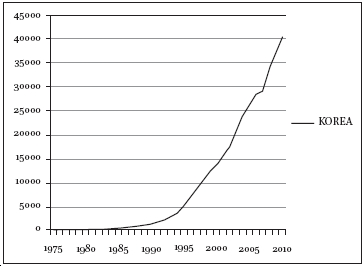
Unit: Number of articles.
In the last three decades, scientific activities of two countries have grown rapidly, at least in terms of the number of publications. In addition, we can confirm that how these two countries have shown a similar pattern regarding the increase in research productivity through Figures 1 and 2.
International Research Collaboration in China and South Korea
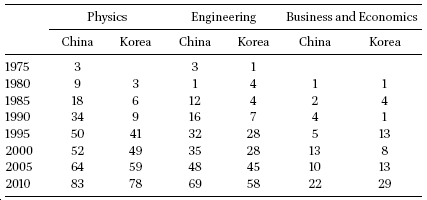
While focusing on “who is collaborating with whom,” the academic disciplines have been separated to compare the international collaboration patterns. As Table 2 shows, the number of co-authors’ countries has been increasing. In 1980, there were only five or six co-authors from other countries across academic disciplines, and the numbers were not greater than 30 until 1995, except in physics. Currently, there are international co-authors in physics from approximately 80 countries, in engineering from almost 70 countries, and in business and economics from 30 countries. This table does not include the discipline of literature since less than five countries co-authored articles related to this topic over this time period.
The increase in international co-authors means that international research collaboration has been continuously diversified across academic disciplines. In Table 3, the first column shows the total number of publications in each discipline by period, the second column describes the proportion of co-authored publications among the total publications, and the third column indicates the number of internationally co-authored publications among the total co-authored publications. While the proportion of papers by single authors declined continuously during the last thirty years, the proportion of co-authored papers increased substantially in both countries. This trend has not only been occurring in hard disciplines such as physics and engineering, but also in the soft disciplines such as business and economics.
However, despite the increase in co-authorship, the proportion of internationally co-authored papers showed no clear increase and remained stable in both countries across academic discipline. For instance, the share of internationally collaborative publications out of the total publications decreased from 25.8% in 2000 to 19.6 % in 2005 in physics in China. These results are consistent with previous findings, including those of Glänzel 29 and Kim. 30 Glänzel (2001) compared the international research collaboration patterns of 15 countries including scientifically advanced countries such as the U.S., the U.K., Japan, and Germany and showed that the international collaboration levels has decreased in only South Korea and the People’s Republic of China. 31 Kim (2007) also proved that the level of South Korea’s international collaboration decreased from 25.0% in 1990–1993 to 20.1% in 2000–2003, as well, the percentage of internationally collaborative publications in the People’s Republic of China decreased from 35.9% in 1990–1993 to 30.0% in 2000–2003. 32 This result could be partly explained in the context of the financial crisis (Korea case) and the limited budget for international research during the specific period studied. 33 On the other hand, there have been consistent increases in domestic collaboration during the same period. Kim 34 explained this opposite result as the process of scientific development in Korea. For instance, academics had largely relied upon research collaboration with scientists from academically advanced countries in the past; however, it has been increasing of academic who has high level of research capacity with advanced educational background within nation, which makes it possible to find domestic co-authors more frequently.
The number of countries with co-authorship.
Source: Web of Science (Including SCI, SSCI, AHCI data).
International research collaboration by discipline in China and Korea from 1975 to 2010.


Unit: Number of articles (%), Source: Web of Science (Including SCI, SSCI, AHCI data).
The average number of countries participating in international collaboration has changed from only two or three to a much more diverse range of countries. For example, among South Korean academics in 1980, about 80% of the internationally co-authored articles were written with only U.S. and Japanese academics; however, the origin of co-authors was clearly more diversified in 2010. Based on the most recent database, the top-ranked collaborative countries are listed among academics in China and Korea.
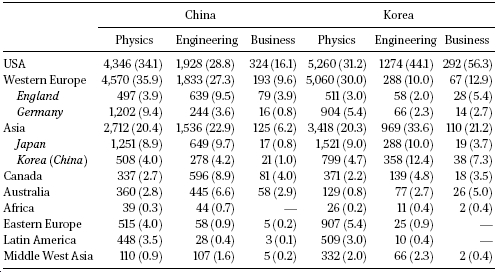
In engineering, the country with the highest number of collaborative publications with China is the U.S. (29%), followed by Japan (10%), England (10%), and Canada (9%). South Korea shows a similar pattern, and collaboration with U.S. academics is more significant. The country with the highest number of collaborative publications with South Korea is the U.S. (44%), followed by China (12%), Japan (10%), and Canada (5%). Interestingly, South Korean academics hardly ever collaborated with academics in China until 1990 for political reasons; however, their collaboration ranks as the second highest one currently. Since the formal diplomatic relations were established between China and Korea in 1992, the rapid growth of knowledge production in both countries, their geographical proximity, and their cultural similarities have contributed to the increase in research collaboration.
The most frequently internationally co-authored papers in both countries are in the business and economic disciplines. In both countries, approximately 60 to 70% of the co-authored papers are written with international co-authors, and more than 50% of them are co-authors from English-speaking countries. If the fact that most of the international journals are published in English is considered, it can be assumed that the language difference affects this result since language is a bigger issue in soft disciplines.
Despite the diversification of co-authorship, the majority of collaborative countries are similar in terms of their initial stage of international research collaboration patterns. As Table 4 shows, the most frequent co-authorship is still conducted by U.S. academics in both countries. Moreover, eight collaborative countries are shared between China and South Korea. International research collaboration is mostly conducted with authors from English-speaking countries such as the U.S., England, Canada, Australia, and some European countries such as Germany and England. In particular, the proportion of co-authorship with U.S. academics is significantly highest. Although we need to consider U.S. academics who originally emigrated from China or Korea, the main reason for this type of collaboration pattern is the educational background of academics in both countries. Significant proportions of Korean academics study for their doctorates in the U.S. then return to Korea to take up academic employment or some of them continue their academic careers in the U.S. 35 This is similar in China, as the great majority of academics completed their doctoral study in the U.S. 36 This educational background naturally affects research collaboration through their academic careers, such as through their collaboration with PhD supervisors or colleagues during their doctoral study.
Top-ranked collaborative countries among academics in China and South Korea (2010).
Unit: Number of authors (%).
Source: Web of Science (Including SCI, SSCI, AHCI data).
On the other hand, among Asian countries, international collaboration across three countries (China, Japan, and South Korea) is significantly active, and collaboration with Taiwan is also productive. Still, the proportion of international collaborations with other Asian countries, as well as with Latin America, Africa, and Eastern Europe, are very low. It can be seen clearly that international collaboration is dominated by certain countries despite the diversification of co-authors’ countries.
Discussion and Conclusion
This study was initiated with the assumption that cross-border higher education has been taking place, not only in teaching-related activities, but also in research-related activities among individual academics. In this context, this study examined international research collaboration among academics in China and South Korea, which show very similar knowledge production growth patterns. One of the main motivators for the increase in knowledge production is based on aggressive higher education policies by their respective governments (including the WCU project and diverse internationalization schemes). Based on empirical data, several interesting facts about international research collaboration can be pointed out.
First, it is clear that research collaboration among academics has increased during the last three decades, and international co-authors’ geographical distribution has diversified. The international research collaboration among academics is similar to the expansion of cross-border partnerships between universities such as student exchange programs or curriculum exchanges. As the OECD 37 pointed out, cross-border education has led to the multiplication of partnerships, both traditional academic partnerships and the new types. Although academic partnerships between institutions have always existed for research purposes, the increasing number of participating countries shows that multilateral collaboration has expanded considerably in the last two decades.
Second, in terms of the proportion of internationally co-authored publications among the total number of co-authored publications, the proportion remains stable despite expectations that it has been continuously increasing. As Kim 38 explained, the number of researchers within nations has increased during the last few decades, and the increase in the national scientific infrastructure makes possible to find more co-authors internally than from other countries. However, further investigation of this pattern is still needed to fully understand the national context.
Third, despite the variety of co-authors’ nationalities, international research collaboration is still dominated by a few countries. Although academics in China and South Korea have continually expanded their research collaborations, a high proportion of co-authorship is still based in a few of the English-speaking countries. This is consistent with the general observation of higher education internationalization made by Altbach and Knight. 39 International higher education initiatives exist in almost every country; however, the developed countries, especially the large English-speaking nations, and to a lesser extent, the larger EU countries, provide most of the services.
Fourth, although this paper does not include the following information in detail, the author pointed out one more issue based on empirical data. The limitation of diversification issue also exists in “direct” and “indirect” ways of collaboration. Even though it can be seen in international co-authorship from Eastern Europe, the Middle East, Latin America, and Africa, this collaboration tends to be indirect rather than direct. It was hard to find an article written by only Chinese academics and academics from the above countries. Most cases that include Chinese authors and African co-authors at the same time are based on “transnational” projects in which scientists from 10 or more countries are participating together and are led by first authors from English-speaking countries. More concrete results could be found from literature, for instance, the proportion of “transnational” projects” has been increased from 4.5% in 1992 to 11.5% in 2000. 40 In many cases, the diversification of co-authors from various countries is due to this type of large-scale laboratory work, not because of direct collaboration with authors from a specific country.
Fifth, a similar pattern exists in China and South Korea across academic disciplines. Research productivity has increased rapidly, and their international research collaboration has been diversified. However, their main international research network is still dominated by a small number of partners. In particular, while they have been recruiting many international students from Asian countries, the proportion of regional research collaborations within Asia is still low.
This study examined how international research collaboration patterns have changed between 1975 and 2010 in China and South Korea. In particular, this study focused on the growth of research collaboration, the main collaborative countries among Chinese and South Korean academics, and the differences in international research collaboration by academic discipline. International research collaboration is more valuable in terms of dialogue between partners for a dialogue if the main emphasis is to generate and share knowledge for future development. Special attention needs to be paid to expanding the knowledge community across disciplines and broadening networks in regional and global contexts.
Footnotes
2 Jane Knight and Hans De Wit, “Strategies for internationalization of higher education: historical and conceptual perspectives,” in Strategies for internationalization of higher education: A comparative study of Australia, Canada, Europe and the United States America, edited by Hans De Wit, 5-32. (European Association for International Education,  ): 16.
3 F. Van Vught, M.C. Van der Wende, and D. Westerheijden, “Globalisation and internation¬alization: Policy agenda compared”, in Higher education in a globalizing world: International trends and mutual observations, edited by J. Enders and O. Fulton, 103-120 (Dordrecht: Kluwer Academic Publishers. 2002): 104.
4 John L. Davies, “University strategies for internationalization in different institutional and cultural settings: A conceptual framework,” in Policy and policy implementation in internation¬alization of higher education, edited by Blok Peter, 3-18 (EAIE Occasional Paper 8. Amsterdam: European Association for International Education, 1995), 6.
5 Davies, “University strategies for internationalization in different institutional and cultural settings,” 8.
8 Barbara M. Kehm and Ulrich Teichler, “Research on internationalization in higher education,” Journal of Studies in International Education 11, no. 3-4 (2007): 263-66.
9 Knight, “Internationalization,” 6.
10 Association of Universities and Canadian Colleges (AUCC). Guide to establishing International Academic Links (Ottawa: AUCC, 1993): 16.
11 Knight and De Wit, “Strategies,” 16.
12 Knight and De Wit, “Strategies for internationalization of higher education: historical and conceptual perspectives,” in Strategies for internationalization of higher education: A comparative study of Australia, Canada, Europe and the United States America, ed. Hans De Wit, 5-32. (Amsterdam: European Association for international Education (EAIE) in cooperation with the Programme on Institutional Management in Higher Education (IMHE) of the Organization for Economic Cooperation and Development (OECD) and the Association of International Education administration (AIEA), 1995).
13 Knight and De Wit, “Strategies,” 17.
14 Davies, “University strategies for internationalization in different institutional and cultural settings,” 4.
15 Sylvan, 7.
16 Ki Wan Kim, “Measuring international research collaboration of peripheral countries: Taking the context into consideration,” Scientometrics 66, no. 2 (2006): 231.
17 Sylvan, 4; Sooho Lee and Bozeman Barry, “The impact of research collaboration on scientific productivity,” Social Studies of Science 35, no. 5 (2005).
19 Ibid. 5.
20 Rui Yang and Anthony Welch, “A World-Class University in China?,” Higher Education 63, no. 5 (2012): 645.
21 Jung Cheol Shin, “Building World-Class Research University: The Brain Korea 21 Project,” Higher Education 58, no. 5 (2009): 669.
25 OECD. Science technology and industry outlook. OECD, 2004.
26 Ki Wan, “Measuring,” 235.
27 Anthony Biglan, “The characteristics of subject matter in different academic areas,” Journal of Applied Psychology 57, no. 3 (1973): 200-201.
28 Mapheus Smith, “The trend toward multiple authorship in Psychology,” American Psychologist 13, no. 10 (1958): 597.
30 Mee Jean Kim, “A bibliometric analysis of the effectiveness of Korea’s biotechnology stimulation plans with a comparison with for other Asian nations,” Scientometrics 72, no. 3 (2007): 331.
31 Wolfgang Glänzel, “National characteristics,” 74.
32 Mee Jean Kim, “A bibliometric,” 331.
34 Ki Wan, “Measuring,” 237.
35 Terri Kim and William Locke, “Transnational academic mobility and the academic profession,” Centre for Higher Education Research and Information, London: The Open University, 2010: 28.
36 Koen Jonkers and Robert Tussen, “Chinese researchers returning home: Impacts of international mobility on research collaboration and scientific productivity,” Scientometrics 77, no. 2 (2008): 310
38 Ki Wan, “Measuring,” 237.
39 Philip G. Altbach and Jane Knight, “The internationalization of higher education: Motivators and realities,” Journal of Studies in International Education 11, no. 3-4 (2007): 294
40 Giovanni Abramo, Ciriaco Andrea D’Angelo, and Flavia Di Costa, “Research collabora-tion and productivity: is there correlation?” Higher Education 57, no. 2 (2009): 167; Ki Wan, “Measuring”, 238