






Abstract
Many on‐demand service platforms employ surge pricing policies, charging higher prices and raising provider compensation when customer demand exceeds provider supply. There is increasing evidence that service providers understand these pricing policies and strategically collude to induce artificial supply shortages by reducing the number of providers showing as available online. We study a stylized mathematical model of a setting in which an on‐demand service platform determines its pricing and provider compensation policies, anticipating their impact on customer demand and the participation of strategic providers, who might collectively decide to limit the number of providers showing online as available. We find that collusion can substantially harm the platform and customers, especially when the potential demand is large, and the supply of providers in nearby regions is limited. We explore two pricing policies that a platform could employ in the presence of (potential) provider collusion: a bonus pricing policy that offers additional provider payments on top of the regular compensation and the optimal pricing policy that maximizes the platform's expected profit while taking strategic provider behavior fully into consideration. Both policies feature a compensation structure that ensures that total provider earnings increase in the number of providers available, thereby encouraging all providers to offer their service. We show that both policies can effectively mitigate the impact of potential provider collusion, with the bonus pricing policy often performing near‐optimally. As it might be difficult for a platform to accurately estimate the propensity of providers to collude, we numerically evaluate how platform profits are affected if the pricing policy is designed based on possibly incorrect estimates of the providers' propensity to collude. Our observations suggest that a platform should design its pricing policy under the assumption that all providers are strategic and consider collusion, as the losses associated with implementing such a policy in settings with minor risk of collusion are limited, while the potential losses from failing to consider rampant collusion can be significant.
Keywords
INTRODUCTION
On‐demand service platforms, which match customers with independent service providers, have seen tremendous growth over the last decade due to advancements in mobile technologies. These on‐demand platforms have become a ubiquitous part of daily life, in areas such as personal mobility (e.g., Uber, Lyft, Didi), food delivery (e.g., Uber Eats, DoorDash, GrubHub), home services (e.g., Rover, Cinch, TaskRabbit), and talent (e.g., Upwork, Fiverr, Freelancer). It has been estimated that almost a third of the workforce in the United States operates in this sector, generating revenues amounting to 58 billion USD; in 2019, the number of companies engaged in on‐demand services increased by 270% (Hrzic, 2019).
Due to the underlying variability of demand over time, it is common for on‐demand platforms to use independent providers, who choose whether and when to join the platform. These providers get paid for each completed service (Cheng, 2020; Conger, 2020). This differentiates on‐demand service platforms from traditional business, in which employers decide the duration of work and employees are paid a fixed salary or a per‐unit‐of‐time wage. For online platforms, setting appropriate incentives for both the providers and the customers becomes a crucial operational decision that drives both supply and demand. For example, a higher price, coupled with a higher payout, might be attractive to providers but not to customers; similarly, a lower price might attract customers, but the associated lower payouts are not likely to improve provider participation. To better balance supply and demand, platforms dynamically adjust prices and provider compensation in real time, setting higher prices whenever demand exceeds supply. Such surge pricing has been widely adopted by major on‐demand platforms, including market leaders such as Uber and Lyft. Once the surge pricing algorithm is set, it automatically generates the prices charged to customers and the compensation for providers based on real‐time market information and service characteristics. Although numerous theoretical and empirical studies have shown that policies of surge pricing structure can improve social welfare (Cachon et al., 2017; Castillo, 2020), the debate about fairness is far from being resolved (Dholakia, 2015). Service providers have routinely claimed that the payouts offered by platforms are very low and that their earnings oftentimes are less than the minimum wage (Nova, 2018).
Due to the perceived low earnings and the fact that the pricing policy of the platform is set ahead of time and not frequently adjusted, a relatively new issue has emerged in which providers strategically manipulate the surge pricing algorithm to their benefit (Chapman, 2017; Solman, 2017). Keall (2017) cites a study reporting that Uber drivers play the company's algorithms; specifically, “drivers in the same area coordinate to log out of the taxi‐hailing app so their cars drop off the list of available rides—artificially inducing surge pricing.” Such collusive provider behavior occurs in many places, including London, New York, Tampa, and Washington, DC (McGoogan, 2017; Smith, 2017; Hamilton, 2019; Klein, 2019; Sweeney, 2020).
Provider collusion is most often observed at specific venues that have sustained high demand and where service providers congregate in designated areas. As an illustrative setting, consider a typical US airport, where ride‐hailing service providers congregate in designated waiting areas, following a strict first‐come‐first‐matched policy. The clearly delineated area and the limited number of drivers at such locations facilitate the coordination of driver collusion. One might envision that when colluding, only the drivers at the front of the line turn their apps on; drivers further back in the line keep their apps turned off, to induce surge pricing. Given the strict application of the first‐come‐first‐matched policy, drivers in the back of the line have no incentive to deviate and turn their apps on. Rather, there are clear financial disincentives to turning on their apps: deviation from the collusion policy increases the number of drivers that are showing as available online, triggering a decrease in pricing, and thereby lowering the expected earnings of all drivers. As the queue moves, every single provider eventually reaps the benefits from adherence to the discipline of the collusive behavior.
In settings where providers are not organized following such a strict first‐come‐first‐matched rule, maintaining the discipline and stability of collusion can be more challenging. However, there is wide evidence that providers still find the means to collude, even when not located in settings with strict queuing rules or visual proximity. Providers coordinate using blogs, chat boxes, and social networks frequented by service providers (Claburn, 2019; Siegal, 2019; Raihani, 2022). For example, Uber and Lyft drivers connect and coordinate through social forums such as UberPeople and Surge Club, social networks such as Facebook and Reddit, or group texts to jointly identify key characteristics of the prevailing pricing policy and then purposefully act so as to trigger beneficial surge pricing regimes (Keall, 2017; McGoogan, 2017). In Perth's Central Business District, drivers coordinate through Facebook groups or messages and trigger surge pricing (Styles, 2022). Many providers frequent specific locations or venues, to which they return regularly, facilitating both the establishment of closer relationships and collusion with other “regulars” (Sweeney, 2020).
Platforms are well aware that providers game their pricing algorithms, and they claim they have implemented safeguards to detect this fraudulent behavior and that fraud may result in account deactivation (Uber, 2021b). However, the platforms also confirm that it is difficult or cost‐prohibitive to distinguish between the aforementioned manipulative behavior and natural price spikes, especially in places where surge pricing is common, such as airports, making it possible for providers to game the system without being easily detected (Hamilton, 2019).
We investigate the impact of strategic provider behavior and possible mitigation policies. Specifically, we aim to examine the following questions: (1) What is the impact of provider collusion? (2) Under what conditions are the effects of provider collusion most and least pronounced? (3) What mitigation strategies could or should platforms employ to prevent such provider collusion? (4) How do these mitigation strategies affect the different stakeholders?
To answer these questions, we analyze a stylized game‐theoretic mathematical model. Specifically, we consider a specific focal location, such as, for example, an airport, stadium, or concert venue, and an on‐demand platform that chooses its price and provider payout per service, balancing the impact on demand by myopic customers and on supply by strategic providers. The platform faces an operating environment in which (1) customers are price sensitive, (2) providers are earnings sensitive, and (3) a subset of providers coordinate their actions and collectively decide the number of providers to show online as active and available. We consider the following game. First, the platform develops a surge pricing algorithm that automatically computes the price to charge to customers and the compensation to pay to providers, for given market characteristics and a given number of providers available at the focal location. Next, providers (randomly) arrive at the focal location, and a subset of these providers coordinate and consider collusion, collectively deciding how many of them will show as available online. Based on the available supply in the app and other market information, the surge pricing algorithm then generates the corresponding prices and provider compensation, customers at the focal location decide whether to request service, and providers in nearby regions decide whether to relocate and offer service at the focal location. We solve for the subgame perfect Nash equilibrium using backward induction.
We start by characterizing the impact of provider collusion when the platform does not consider the risk of such collusive behavior in determining its pricing policy. We find that while collusion always benefits providers, it can substantially harm both the platform and customers.
We then explore two mitigation policies to prevent provider collusion. First, we study a bonus pricing policy, which offers additional provider incentives on top of the regular compensation while keeping the prices charged to consumers unchanged. We show that using a bonus policy can encourage all available providers to offer service, fully eliminating the impact of provider collusion on consumers. However, bonus compensations are costly to the platform and providers still derive some benefit from their collusion option, even if they do not actively collude.
Second, we derive the optimal pricing policy, which maximizes the platform's expected profit while taking strategic provider behavior fully into consideration. We show that the structure of the optimal pricing policy is such that it eliminates collusion. Interestingly, under the platform's optimal pricing policy, the mere option to collude might leave service providers worse off than under the benchmark setting without potential collusion.
In a numerical study, we show that both the bonus pricing policy and the optimal pricing policy can effectively reduce the impact of collusion on the system, and the bonus pricing policy often performs near‐optimally. As it might be difficult for a platform to accurately estimate the propensity of providers to collude, we also evaluate how a platform's profits are affected if its pricing policy is designed based on potentially incorrect estimates of the providers' propensity to collude. Our observations suggest that a platform should design its pricing policy under the assumption that all providers are strategic and will consider collusion. While the losses associated with implementing such a policy in settings without or with little collusion are limited, the consequences of failing to consider pronounced collusion risks can be significant.
The paper is structured as follows. We review the related literature in Section 2. In Section 3, we introduce our assumptions and model framework. We derive and evaluate the platform's base pricing policy without consideration of collusion in Section 4, and two pricing policies that take potential collusion into account (bonus policy and optimal policy) in Section 5. In Section 6, we numerically evaluate the impact of collusion and the different pricing policies and we consider a setting in which a platform designs its pricing policy under potentially incorrect assumptions regarding the providers' propensity to consider collusive behavior. We conclude in Section 7. Proofs of all results, extensions to the base model, and details on the numerical study are provided in the Appendix in the Supporting Information.
LITERATURE REVIEW
Our work relates to an extensive body of literature that has studied collusion within different contexts. The seminal work by Stigler (1964) formalizes the idea of colluding firms and identifies the problem of dealing with secret deviations, implicitly raising the question of the stability of collusive activities. Numerous follow‐up studies have considered collusion between competing firms in terms of price fixing (Frass & Greer, 1977) or restricting output (Clarke, 1983; Green & Porter, 1984; Baumol, 1992). Most often, collusion has been studied within the context of auctions. Within this stream, especially relevant to our paper is the research on bidding rings in auctions (McAfee & McMillan, 1987, 1992; Caillaud & Jéhiel, 1998; Marshall & Marx, 2007). In this work, two types of cartels are considered, strong cartels and weak cartels. While the former allows transfers or side payments between members of the cartel, in the latter cartel members are unable to conduct such exchanges (Sošić, 2007; Che et al., 2018).
In our paper, we do not consider any auctions and collusion is simply an operational matter. Providers collude to trigger surge pricing, and their collusion arrangement can be viewed as a weak cartel, the stability of which is based on the rational expectations of the providers. Rather than on bidding behavior, the focus of our work lies on provider collusion in reporting their status as online or offline. In line with McAfee and McMillan (1987), Sošić (2007) states that members of a bidding ring with no side payments select a winner for each of the auctions in which they participate. The selection of the winner can be done in a number of ways–he or she may rotate among all of the ring members, or some external devices (e.g., phases of the moon) can be used. This description closely matches the operationalization of collusion in our paper.
Other research streams characterize conditions required for collusion to occur and to be stable (Davidson, 1984; Ross, 1992); identify ways to detect collusive behavior (Harrington, 1989; Porter, 2005); or study mechanisms that prevent collusion (Pavlov, 2008; Che & Kim, 2009; Che et al., 2018). We identify conditions for collusive behavior and design pricing policies that eliminate collusion, so our work relates to the themes that have been studied in the first and the last stream, albeit in different contexts.
Our work is most closely related to research that studies pricing policies in the context of on‐demand service platforms. M. K. Chen and Sheldon (2016) empirically test how surge pricing affects the participation decisions of Uber drivers, finding that surge pricing can significantly increase driver participation and hence platform capacity. Castillo (2020) focuses on the impact of surge pricing on the welfare of riders, drivers, and the platform and empirically finds that it is the riders who benefit most from surge pricing, at the expense of both the drivers and the platform. Cachon et al. (2017), on the other hand, find that surge pricing can generally benefit the platform, customers, and providers. Garg and Nazerzadeh (2022) use a dynamic stochastic ride‐hailing model in which drivers can choose to accept or reject a ride request to study the relationship between the surge‐pricing policy structure and incentive compatibility. Taylor (2018) studies how provider opportunity costs, demand uncertainty, congestion, and provider independence affect the platform's optimal pricing and provider compensation decisions. Similarly, Bai et al. (2019) investigate the impact of potential demand, potential supply, waiting‐time sensitivity, and service rate on the platform's optimal pricing; they find that both the optimal price and provider compensation increase when there is greater potential demand. Bimpikis et al. (2019) characterize the optimal pricing and compensation policy in a network of interconnected locations. Benjaafar et al. (2022) study the effects of pricing with respect to provider welfare and provider participation; their results make a case for constraining the number of providers and establishing an effective lower bound on the provider earnings. While the above‐mentioned research papers study optimal pricing policies in a setting in which both providers and customers are myopic, our work specifically examines the possibility and impact of strategic provider behavior.
Several recent papers investigate pricing policies in the presence of strategic customers or providers. Buchholz (2022) proposes a dynamic spatial model in which taxi drivers strategically anticipate the benefits and costs associated with moving to different locations. Using a dataset of New York City taxis, Buchholz conducts a counterfactual analysis and shows that search frictions harm the matching rate, whereas tariff regulation can improve the surplus. Afeche et al. (2018) study optimal pricing policies in a ride‐hailing network with myopic customers, strategic drivers, and unpredictable demand shocks. Drivers are dispersed over a geographic area near a hotspot surge region and decide whether to move to that region, considering both the surge compensation and the likelihood of being matched. The authors explore the impact of rider patience, demand surge duration, and provider travel speed on system performance. Guda and Subramanian (2019) find that on‐demand service platforms can strategically use a surge price in a zone with an excess supply of providers to move some providers to a nearby zone with high demand. Besbes et al. (2021) examine how a platform pricing policy affects provider relocation decisions, taking into consideration pricing, travel costs, and congestion in a two‐dimensional space. Jiang et al. (2021) study how regret‐averse providers relocate toward or away from zones with supply shortages. B. Hu et al. (2021) study optimal surge pricing policies in a setting in which strategic customers can decide to wait for lower prices and strategic drivers can decide whether to relocate to regions with active surge pricing. Y. Chen and Hu (2020) study a two‐sided platform with both strategic demand and strategic supply and propose efficient heuristic matching policies. In all of these papers, if providers or customers are strategic, they are so with respect to choosing the location or time of participation. Martínez‐de‐Albéniz et al. (2022) consider a setting in which a strategic supplier reveals inventory information to an online peer‐to‐peer platform, which determines the payout structure so as to incentivize truthful reporting by the supplier. Unlike this stream of research, we focus on the case in which providers collectively decide on the number of providers reporting online as being available.
To the best of our knowledge, the only other paper that examines such provider collusion behavior in the context of on‐demand service platforms is one by Tripathy et al. (2023). However, they consider a high‐level model with an exogenous pricing policy, whereas the detailed analysis and structural characterization of different platform pricing policies lie at the center of our present work.
MODEL FRAMEWORK
Consider a two‐sided platform that selects a pricing policy to match demand by customers and supply offered by providers. Similar to Guda and Subramanian (2019) and M. Hu and Zhou (2020), we focus on a specific focal location (such as an airport, conference center, or stadium) and a specific short time interval (e.g., 5–10 min per period) within an infinite time horizon. The sequence of decisions in our modeling framework is as follows.
First, the platform determines and announces a pricing policy





Given the platform's pricing policy, at the beginning of a representative period, nature then determines the supply of available providers present at the focal location, M. A fraction α of these M providers coordinate with each other and consider collusion, collectively deciding how many of them should be online on the platform; that is, they determine


In the following, we describe the behavior of the different entities in more detail.
The providers
In any given time period, providers are divided into two groups based on their locations: providers at the focal location and providers in nearby regions. For simplicity, we assume that all service requests take one period to complete, irrespective of provider location.
In any given period, the number of providers at the focal location, M, is a random variable with a continuous probability density function


Higher provider compensation might attract additional providers from nearby regions to the focal region. This assumption is consistent with observations from practice that surge pricing in certain areas triggers relocation of providers in the proximity (e.g., Diakopoulos, 2015; Luckerson, 2015). In fact, there are third‐party apps that specifically track the ongoing surge regions for Uber providers, encouraging nearby providers to reposition themselves (Surge, 2022). Consistent with the literature (e.g., M. Hu & Zhou, 2020), we assume that there are K (divisible) providers in nearby regions. These providers differ in terms of their reservation earnings, defined as the sum of the cost of relocating to the focal location and the highest possible earnings that could be obtained without traveling to the focal location. Given this definition, providers in a nearby region decide to relocate to the focal location if and only if they can expect earnings in excess of their reservation earnings, that is, if their expected earnings at the focal location exceed their earnings at the current location even after accounting for the cost of relocation. The platform offers the same compensation to all providers. Providers who relocate from nearby regions simply face additional costs (travel time) to move to the focal location. The assumption of positive relocation or repositioning cost is also standard in the related academic literature (e.g., Guda & Subramanian, 2019; Besbes et al., 2021; B. Hu et al., 2021). To model the heterogeneity among these providers, we assume that their reservation earnings, r, follow a uniform distribution from 0 to 1.
As providers in nearby regions are close to the focal location, we assume that they consider the prevailing pricing policy in making their participation decision, that is, they accept service requests at the prevailing rate. (Providers with longer travel times to the focal location would be induced to relocate more strategically because of higher expected earnings at the focal location; we consider such dynamics in Appendix B in the Supporting Information.) A provider with reservation earnings r thus will decide to move to and offer service at the focal location if and only if her compensation w is at least equal to r (i.e.,


The total supply across the two types of providers then is

Next, consider stage (2) of the problem and the decision of providers at the focal location whether or not to collude. (Providers from nearby regions that offer their services at the focal location do not participate in potential collusion.) Among the M providers at the focal location, a fraction α coordinate and jointly consider whether or not to collude; if these


Let λ denote the demand at the location. If the number of customers who request the service, λ, exceeds the number of providers who are willing to provide the service, k, all providers are assigned customers. For the alternate case in which

Consistent with research on cartel collusion (e.g., Gu et al., 2019; Heywood & Wang, 2020), we assume that the resulting earnings are shared equally across all M providers at the focal location. Note that we are not envisioning a redistribution of earnings between providers after each collusion period. Rather, this assumption approximates the average earnings that each participating provider would expect to earn under repeated participation in collusion over multiple periods or, equivalently, the earnings that each provider at the focal location could rationally expect prior to the random (equal‐probability) assignment of customer service requests.
If


Under collusion, the providers determine the number of providers to be online in order to maximize these per‐provider earnings, that is,

For notational convenience, in what follows we omit the argument and reference to M and generally use m to denote the number of providers online. We ask the reader to keep in mind that m is a function of M, that is,


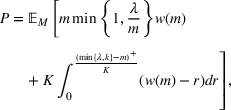
A participating provider from a nearby region earns


The customers
At the beginning of each time period, a continuum of N customers appears at the region, who attribute a value v to the service. To capture customer heterogeneity, we assume v follows a uniform distribution from 0 to 1. We normalize the value of the customers' outside options to zero, without loss of generality.
To perform the service, one unit of customers requires one unit of providers. If the number of available providers exceeds the number of customers who request service, all customers receive the service; otherwise (i.e., if


A customer of type v gains utility


The total customer surplus is

The platform
For any given M, the platform's profit is

Here the term


Given the supply function (1) and the demand function (5), the platform's expected profit under the pricing policy

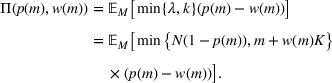
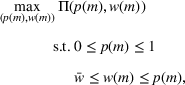
The platform determines its optimal pricing policy



The total welfare, T, is the sum of provider surplus, customer surplus, and expected platform profit, that is,

We provide a summary of our notation in Table 1.
Summary of notation.
PROVIDER COLLUSION AND ITS IMPACT
As a basis for comparison, we first consider the benchmark case without collusion (we use a superscript 0 to denote this scenario). If the platform does not take into account collusive behavior, it assumes that all providers at the location report online as present; that is, the platform sets its pricing policy under the assumption that If the platform assumes there is no provider collusion, its optimal pricing policy is given by
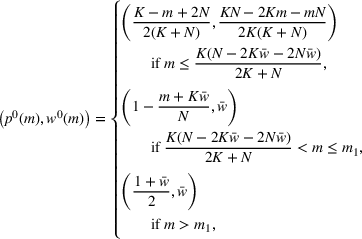

Proposition 1 reflects a surge pricing structure similar to that observable in many of the settings that serve as motivation for our research. We see that when the online supply of providers at the location is sufficient, the platform offers a constant price 

Substituting the base pricing policy from Proposition 1 into (7), we derive the platform's profit as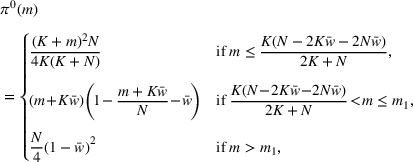


We next characterize when provider collusion occurs under this base pricing policy and how such collusion affects the different stakeholders. To better understand the providers' incentives to collude under any given pricing policy, it is useful to establish the following structural result. Providers do not collude for any realization of M if and only if 
Per Lemma 1, providers never have an incentive to collude (i.e., all providers will stay online) if the individual earnings under collusion are nondecreasing in the number of providers online. If, on the other hand, the platform's policy leads to a provider earnings function Define 






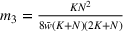


Consider how the minimum compensation, 


Effect of the minimum compensation,

If the minimum compensation is very low (




For intermediate‐level minimum compensations (i.e., 


Finally, if the minimum compensation is sufficiently high (specifically, if 
The observations gleaned from Proposition 2 thus are consistent with the notion that collusive provider behavior at least somewhat correlates with the low earnings that providers obtain when operating under the surge pricing policies regularly employed by service platforms. Given our objective of studying provider collusion, in the following, we will thus focus on scenarios with 
The following proposition characterizes the impact of the providers' option to collude in the case in which the platform uses the base pricing policy, which does not take into account this strategic provider behavior. When the platform uses the base pricing policy (cf. Proposition 1), the provider's collusion potential increases provider welfare P, but it decreases platform profit Π, customer welfare C, system welfare 
Proposition 3 captures the expectation that without adjustments in the pricing policy, providers always benefit from their option to collude. However, the remaining elements of the proposition also note that this benefit comes at the expense of all other stakeholders. Customers and the platform benefit from having more providers available, so the restricted provider supply under collusion is harmful to both of them. The proposition highlights that under the base pricing policy, collusion always introduces inefficiencies at the system level; that is, the harm done to the platform always exceeds the benefit derived by the providers. The fact that consumers are also harmed implies that collusion decreases total welfare.
The system‐wide loss due to collusion captured in Proposition 3 raises the question of whether and how the platform could adjust its pricing policy to prevent collusion or mitigate the financial impact of collusion on the platform. In the following section, we consider two pricing policies that take the providers' strategic behavior into consideration.
PLATFORM PRICING POLICIES TO COUNTERACT COLLUSIVE BEHAVIOR
In this section, we consider two pricing policies that the platform could employ to prevent provider collusion. First, in Section 5.1, we consider a bonus pricing policy, which increases provider compensation for a certain number of active providers compared to the base pricing policy but keeps consumer pricing unchanged. While clearly suboptimal, policies with such a bonus structure are easy to implement and widely used in practice. We then, in Section 5.2, consider an unrestricted optimal pricing policy.
Bonus pricing policy
In conversations with the authors, managers at different on‐demand service platforms have indicated that as it is very difficult or cost‐prohibitive to determine when providers engage in collusion, their platforms regularly use bonuses to ensure that providers remain active.
To eliminate the providers' incentive to collude, the platform could establish a bonus pricing policy, augmenting the payment established under the base pricing policy by a bonus function, 


Clearly, the bonus pricing policy is suboptimal. Compared to the optimal pricing policy, which sets both compensation and pricing without any constraints, the designing of the bonus pricing policy is restricted, as it is based on the base pricing policy (which was designed to optimize platform profits under the assumption that there is no provider collusion). The only adjustment that is made to that policy is that the compensation is increased for a certain number of active providers (m). As such, it is not only constrained in setting a compensation that exceeds the compensation under the base pricing policy but it also is constrained in that the pricing function remains at the base policy level.
However, it may be precisely this very constrained nature of the bonus pricing policy—specifically, that it can only increase provider compensation—which makes it so palatable and widely used in practice. Adjusting provider pay through such a bonus policy (on top of an existing base pricing policy) is much easier than designing and implementing an entirely new pricing policy, and platforms frequently use bonus policies for specific locations (Uber, 2021a). There is ample evidence that platforms such as Uber and Lyft offer bonuses and promotions to incentivize providers to always remain online (Davalos & Bennett, 2022; De Vynck et al., 2022). Uber and Lyft do not explicitly mention collusion, but their bonuses (or, equivalently, promotions) are designed to incentivize drivers to be online and to complete as many rides as possible in any given period. For example, Uber has two types of bonus payments: quest and consecutive trips. Of these, consecutive trips offer the clearest evidence of Uber trying to dissuade collusion, as they offer this bonus for drivers who “complete a series of trips without canceling, rejecting, or going offline” (Davalos & Bennett, 2022). Similarly, Lyft also offers “ride streak” bonuses for drivers who complete continuous rides in certain areas. By offering such bonuses only in specific areas, Lyft can attract drivers from nearby regions and provide an incentive to ensure that drivers at the focal location remain online. Bonuses in such streak zones are essentially very similar to the bonus payments offered to providers of services in the focal location in our model (Davalos & Bennett, 2022).
Anticipating providers’ collusive behavior as characterized in (3), the resulting provider supply as in (1), and customer demand as in (5), the platform determines the bonus policy to maximize its profit as in (8). The platform's optimal bonus pricing policy is presented in the next proposition. If the platform adopts the base pricing policy If 

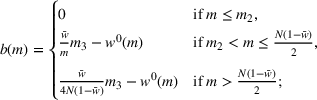

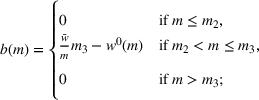
Coupling the base pricing policy from Proposition 1 with the bonus pricing policy in Proposition 4 effectively implies the pricing policy 


Since the bonus compensation avoids provider collusion and since the prices to consumers remain as under the base pricing policy, employing the bonus pricing policy effectively eliminates the impact of (potential) provider collusion on consumers, and customer welfare is returned to its (higher) level under the benchmark without provider collusion. Comparing to that same benchmark without collusion, the bonus compensation amounts to a simple transfer from the platform to the providers, so the joint welfare of platform and providers—and, hence, total welfare—are as they would be without potential provider collusion. In short, when using the bonus pricing policy on top of the base pricing policy, the platform can restore the outcomes obtained in the absence of provider collusion, with the exception that it transfers some of its own profitability to the providers (see Proposition A‐1 in Appendix A in the Supporting Information).
The following proposition summarizes the impact of the providers’ collusion option if the platform uses bonus pricing, rather than simply using the original base pricing policy. When the platform augments the base pricing policy in Proposition 1 with the bonus pricing policy in Proposition 4, platform profit Π, customer welfare C, system welfare

While the increase in compensation to providers is clearly costly, we see that it is always worthwhile for the platform to offer such bonus payments to eliminate collusion. Under the bonus pricing policy, the platform increases the providers' compensation for a certain number of providers online (m) so as to eliminate the providers' incentive to collude and the harmful effects of provider collusion on consumers, who are consequently better off. Similarly, the system‐internal transfer payments from the platform to the providers eliminate the system inefficiencies due to collusion, increasing system welfare and, hence, total welfare. While providers always derive a benefit from having the option to collude (cf. Proposition A‐1 in Appendix A in the Supporting Information), the platform can constrain this benefit by using a well‐designed bonus pricing policy that eliminates the providers' collusion incentives. Somewhat against intuition, we see that offering such additional bonus payments to providers then might leave these providers worse off.
Optimal pricing policy
In the previous section, we considered a bonus pricing policy, under which the platform offers bonus payments on top of an existing base pricing policy to discourage provider collusion. Such a bonus pricing policy is easy to implement and eliminates provider collusion. However, the platform arguably could do better by relaxing the structure assumed under bonus pricing and freely setting both service price and provider compensation. In the following, we characterize the platform's optimal pricing policy in the presence of strategic providers who will collude whenever such behavior is beneficial to them, If providers have the option to collude, the platform's optimal pricing policy is as follows2: If 


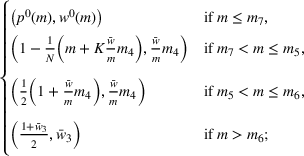
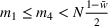

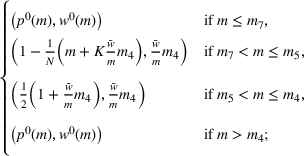


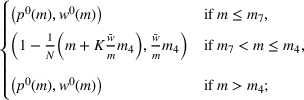

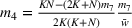



It turns out that the optimal pricing policy in Proposition 6 leads to a nondecreasing compensation function, eliminating the providers' incentive to collude, so all providers at the location report online; that is, under the optimal policy we always have 
Figures 2–4 illustrate the platform's pricing policies and provider earnings under collusion as functions of the number of providers at the location who report online (m) for the case in which 


Individual provider earnings,


Compensation,

Pricing,
While all three pricing policies offer compensations that are decreasing in the number of providers who are showing as active on the platform (see Figure 3), only the base pricing policy leads to intervals for which provider earnings decrease in m. Specifically, we see that under the base pricing policy, providers have the incentive to collude whenever the number of providers at location M lies between m
2 and m
3 (see gray‐shaded area in Figure 2). Augmenting the provider compensation over this interval with the bonus pricing policy (cf. gray‐shaded area in Figure 3), the platform establishes a nondecreasing earnings function, 
Under the optimal pricing policy, rather than simply augmenting the provider pay throughout this entire interval, the platform reduces the provider payments whenever the number of providers is small (cf. left part of the dotted area in Figure 3, 


The optimal pricing policy also uses adjustments in the pricing function to better match supply and demand. In Figure 4, we see that this policy increases pricing to reduce demand when the supply of providers at the focal location is limited (cf. left part of the dotted area in Figure 4, 

We next evaluate the performance of the optimal pricing policy when compared to the base pricing policy and the bonus pricing policy. When the platform adopts the optimal pricing policy given in Proposition 6, platform profit Π increases and provider welfare P decreases compared to when the base pricing policy (cf. Proposition 1) is used. The effects on customer welfare C, system welfare 
By definition, the optimal pricing policy from Proposition 6 yields the highest profit for the platform when providers have the option to collude. While the providers' option to collude is still harmful to the platform, this pricing policy minimizes the negative impact of strategic provider behavior on platform profits. Providers are always harmed when the platform optimally adjusts its pricing to prevent collusion.
Customer welfare C, system welfare 


Similarly, while collusion introduces system inefficiencies, system welfare (and total welfare) can still be harmed when the platform prevents such collusion using the optimal pricing policy. For 

Given the very general form of the distribution function 
Considering these scenarios individually, we observe that the benefit of eliminating provider collusion with the optimal pricing policy is most pronounced for all three outcomes when such collusion is most likely to occur—specifically when demand is high (N is large) while provider supply in nearby regions is limited (K is small); and when providers have a strong incentive to collude to increase their earnings above a low minimum compensation (
Regarding the platform's choice between the bonus pricing policy from Proposition 4 and the optimal policy from Proposition 6, it can be shown that, consistent with intuition, the platform always gains from using the optimal pricing policy, while providers are better off under bonus pricing (cf. Proposition A‐2 in Appendix A in the Supporting Information). Customers might be better off under either policy but generally are worse off under the optimal pricing policy (see Table D‐3 in Appendix D in the Supporting Information).
Interestingly, it can be shown that provider welfare under the optimal pricing policy can be lower than it would be in a world in which collusion is not an option (cf. Proposition A‐3 in Appendix A in the Supporting Information). Regarding the notion that collusive driver behavior has been at least partially motivated or justified by the perceptions of unfair and insufficient platform service provider earnings, this observation raises an important caveat for service providers who are considering such strategic behavior. Collusive behavior increases provider earnings if the platform uses a pricing policy that does not consider such collusion. Part of this provider benefit always persists if the platform augments the pricing policy through bonus payments designed to eliminate driver collusion. However, if the platform revises its pricing policy and designs it under full consideration of strategic provider behavior, these providers might actually be worse off for having considered collusion. In those cases, the value of having the option to collude is negative, as it prompts harmful preemptive adjustments in the platform's pricing policy.
NUMERICAL EVALUATION: PERFORMANCE OF PRICING POLICIES
In this section, we summarize insights from a numerical study. In Section 6.1, we study under what circumstances the effects of provider collusion are most pronounced and how these settings affect the relative performance of the different pricing policies. Because our analytical results in Proposition 7 showed that using the optimal pricing policy might benefit or harm customer welfare, system welfare, and total welfare, we also characterize when this effect is more likely positive or negative.
It might be difficult for a platform to estimate the actual proportion of providers who will consider collusion (α). It might also be risky to design a pricing policy to prevent collusion and then implement this policy across multiple regions with possibly differing provider propensities to consider collusive behavior. In Section 6.2, we therefore evaluate how platform profits would be affected if the platform designed its optimal pricing policy based on a potentially incorrect value of α.
Impact of collusion under different pricing policies
Our analytical results have established several structural observations regarding the impact of the providers' collusion option on platform profit, provider welfare, and customer welfare, and the ability of different pricing policies to mitigate the impact of such potential strategic behavior. In the following, we aim to gain insights into the magnitude of these effects and to characterize the settings in which these effects are most or least pronounced. We also characterize when the use of the optimal pricing policy is likely to be beneficial (or harmful) for consumers, and when it leads to increased (or decreased) system welfare and total welfare. For our numerical study, we assume that the number of providers at the focal location is given by 




Impact of collusion and relative performance of the different pricing policies.
The “impact of collusion” column illustrates the impact of (potential) provider collusion under the benchmark base pricing policy, in which provider collusion is not considered. Specifically, this column reports the average impact on platform profit Π, provider welfare P, customer welfare C, system welfare 

In the rightmost three columns, we compare the three pricing policies in terms of their effects on the different stakeholders in the presence of potential provider collusion. Consistent with Proposition 5, we see that the platform can use the bonus pricing policy (cf. Proposition 4) to eliminate provider collusion and reverse the negative implications on its profits and customer welfare at the expense of provider welfare. The platform profits increase by 11.2% on average. The bonus pricing policy simply introduces an additional payment from the platform to the providers (i.e., it is a system‐internal transfer), so the providers' option to collude no longer affects customers, and system welfare and total welfare are the same as without collusion. Overall, the bonus policy reestablishes the same level of customer welfare as under the benchmark without collusion, because collusion is eliminated and consumer prices are identical to those under the base pricing policy (cf. Proposition A‐1 in Appendix A in the Supporting Information). However, the bonus payments that the platform offers to eliminate collusion maintain some of the benefits that the providers derive from having the option to collude, always increasing their welfare beyond what they achieve in the base case without collusion.
The rightmost two columns of the table show that, in terms of average percentage changes, using the optimal pricing policy in the presence of potential provider collusion yields performance similar to that of the bonus pricing policy, though under the optimal pricing policy customer welfare might decrease (cf. Proposition A‐2 in Appendix A in the Supporting Information). Comparing the performance of the optimal pricing policy to that of the bonus pricing policy, we observe average percentage differences that are in line with the structural results in Proposition A‐2 in Appendix A. The average impact on customers is limited, and even the increase in platform profit is small. However, we see a more pronounced negative impact on provider welfare. When the platform uses the optimal pricing policy to counteract provider collusion, providers can be severely harmed, losing on average an additional 8.9% in welfare compared to the bonus pricing policy. It can be shown that if the platform optimally adjusts its pricing policy to account for the threat of provider collusion, providers might actually be worse off than under the benchmark scenario without collusion (cf. Proposition A‐3).
Given the very general form of the distribution 

Considering the individual scenarios, we see that while using the optimal pricing policy to counteract collusion is always beneficial to the platform, the benefit is most pronounced in settings with scarce provider supply relative to demand (i.e., when N is large and K is small), and when the minimum compensation (
While the effects on the providers are opposite in terms of sign, they are most pronounced in the same settings; that is, when the platform uses the optimal pricing policy to prevent provider collusion, the providers lose most whenever collusion would have brought them the largest benefit (large N, small K and 

Similarly, the benefit to customer welfare from eliminating provider collusion with the optimal pricing policy is most pronounced when such collusion is most likely to occur, that is, when demand is high (N is large) while provider supply in nearby regions is limited (K is small), and when providers have a strong incentive to collude to increase their earnings above a low minimum compensation (
However, we note a subtle difference with regard to how the local provider supply impacts the magnitude of these effects. While the relative increase in platform profits when using the optimal pricing policy (rather than the base pricing policy) is rather insensitive to the magnitude of 

In summary, we conclude that platforms should be especially careful to consider potential provider collusion in settings and areas with systemic supply shortages and low minimum compensation. Since the providers' earnings under the base pricing policy are often reduced to the minimum compensation level, providers in such situations will be more likely to collude, and the resulting exacerbation of supply shortages may result in substantial harm to the platform. Providers, on the other hand, should be careful not to raise the threat of collusion in settings with ample provider supply in nearby regions. While they stand little to gain from collusion in such settings, the possibility of reactive pricing policy adjustments by the platform to combat collusion might more than erase the possible gains from collusive behavior, leaving service providers worse off due to their option to collude (cf. Proposition A‐3 in Appendix A in the Supporting Information).
Counteracting collusion when the risk of collusion (α) is unknown
It might be difficult for a platform to estimate the actual proportion of providers who consider collusion (α), and it might be risky to design a pricing policy to prevent collusion and to then implement this policy across multiple regions with possibly differing provider propensities toward collusive behavior. To address this issue, we evaluate how platform profits would be affected if the platform designed its optimal pricing policy based on a potentially incorrect value of α.
Specifically, we expand the numerical study described in Section 6.1 to consider different values of α and to capture differences between the actual fraction of providers considering collusion and the fraction assumed by the platform in determining its pricing policy. In doing so, we focus on the implications that deviations between the actual and assumed values of α have on platform profitability and, thus, the value (or cost) of considering potential collusion in designing an optimal pricing policy, which may be implemented globally across different regions with potentially different provider propensities to collude (i.e., different values of α).
For 

In Table 3, we show the average differences in platform profit between the optimal pricing policy (designed for an assumed value of α, varied horizontally) and the base pricing policy, for any given (actual) value of α, varied vertically. These averages are derived based on the same design used in Section 6.1, so the given values present averages across 500 scenarios for each combination of actual α and assumed α.
Impact of using the optimal pricing policy based on a (possibly) incorrect value of α (compared to the base pricing policy).
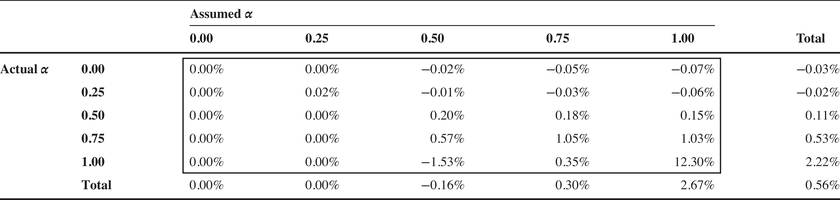
The results presented in Table 3 yield several interesting findings. First, considering the leftmost two columns of the table, we see that when the optimal pricing policy is designed under the assumption that only a small fraction of the providers consider collusion, the performance of the optimal policy is almost identical to that of the base pricing policy (of course, it is exactly the same if the assumed α is equal to zero). Specifically, if the platform designs a pricing policy under the assumption that 
Now, consider the first two rows of the table. Interestingly, we observe that when the actual fraction of providers who consider collusion is low, designing a policy to counteract collusion does not result in any significant loss in profit, even if the policy was designed under the extreme and incorrect assumption that all providers consider collusion. The maximum (average) loss in profit then is only about 0.07%, even if not a single provider actually considers colluding.
Next, consider the nine values at the lower right corner of the table, where at least half of the providers consider collusion, and where the optimal policy is also designed under the assumption of a higher proportion of strategic providers (which may or may not match the actual proportion). Among the nine cases, we see only one negative value indicating an average loss in profits when using the optimal policy rather than the base pricing policy. This occurs in the case in which the platform designs a policy assuming that half of the providers consider collusion, when in fact all providers do. In this case, the optimal pricing policy does not prevent collusion for many outcomes (in terms of possible realizations of M), resulting in a limited benefit. However, whenever the number of providers at the location lies within the interval 
Finally, while all other differences are less than 2% in absolute terms, we observe that designing an optimal pricing policy has a substantial positive impact on platform profits for the case in which this policy is designed under the correct assumption that all providers are strategic—the platform can then earn roughly 12% higher profits on average.
This observation also suggests that the impact of provider collusion on platform profit is limited unless a vast majority of the providers consider participating in collusion. The presence of a large number of providers who always remain active makes it difficult to effectively manipulate the platform's pricing algorithm. Consider the provider earnings under the base pricing policy in Figure 2. If the number of providers that would never collude exceeds the threshold m 2, their presence directly establishes a ceiling on the maximum earnings that are achievable through collusion. If the number of never‐colluding providers exceeds the minimum point on the curve (just to the right of m 8), then there is no room for collusion at all, since the earnings function is nondecreasing for all remaining values of m (eliminating interest in collusion by Lemma 1). In addition, the benefits of any collusive efforts now accrue to all providers, including those that do not participate. Since these providers always remain online, they also receive the full benefit of collusion, that is, their earnings are not shared with providers that remain offline to maintain the higher pricing regime. As a consequence, the presence of providers that do not collude dilutes the potential benefits for providers that participate in collusive efforts.
Overall, the results presented in Table 3 suggest that designing a policy based on the assumption of substantial provider collusion is preferable to ignoring such a potential for collusion, especially if there is a chance that many of the providers consider participation in collusion efforts. Next, we analyze how uncertainty regarding the fraction of providers that consider collusive behavior affects a platform that is aware of possible collusion and, hence, uses the optimal pricing policy. Specifically, we investigate the cost of determining the optimal pricing policy based on a (possibly) incorrect assumption regarding the providers' propensity to collude. Using the same experimental design as used for Table 3, in Table 4 we present the average differences in platform profit between the optimal pricing policy that is designed for an assumed value of α (varied horizontally) and the optimal pricing policy designed for the actual value of α, varied vertically.
Impact of basing the optimal pricing policy on a (possibly) incorrect value of α (compared to the optimal pricing policy for the correct α).
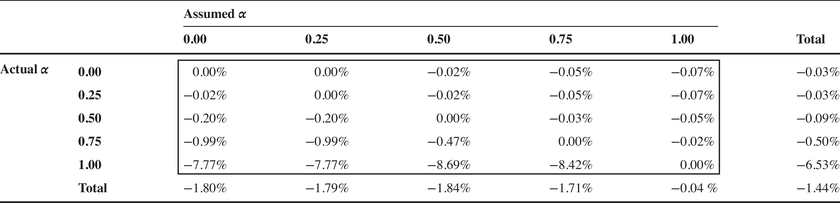
The results from Table 4 are consistent with the insights derived based on the comparison between a possibly incorrectly configured optimal pricing policy and the base pricing policy (cf. Table 3), and they lend further support for the recommendation to design a pricing policy based on the assumption that all providers might engage in collusive behavior (i.e., 
Considering the values above the diagonal, we see that, when designing the pricing policy, the impact of overestimating the fraction of the provider population that might consider collusion on platform profitability is negligible. Across all scenarios where the pricing policy is determined based on a (strictly) overestimated value of α, the average loss in platform profits is only 0.039%. The performance of a pricing policy that is designed under the assumption that all providers might engage in collusive behavior thus is very robust, performing well irrespective of the actual provider propensity to collude. Inspection of the values below the diagonal, on the other hand, clearly suggests that underestimating the providers' propensity to collude when designing the pricing policy can have meaningful negative implications on platform profits, especially when collusive behavior is considered by all providers. Across the cases where the platform (strictly) underestimates the value of α, the average loss in profits amounts to 3.55%, and it rises to 8.16% when all providers consider engaging in collusion (i.e., when 
Taking all these observations together and also considering the grand averages for each possible assumption that the platform can make regarding the providers' propensity to collude, we conclude that starting with an aggressive assumption of pervasive collusion clearly seems to be a winning strategy. The potential losses associated with designing and implementing such a pricing policy to avoid provider collusion are limited, but the potential losses from failing to consider collusion incentives can be significant. Overall, the findings presented in Tables 3 and 4 suggest that a platform should design its pricing policy under the assumption that all providers would consider collusion; that is, it should assume that 
CONCLUSION
On‐demand service platforms, and especially ride‐hailing platforms, have been growing dramatically over recent years. Many of these platforms employ surge pricing policies, increasing the price charged to customers as well as the compensation offered to providers, in order to reestablish a balance between demand and supply in times of supply shortages.
It has been widely reported that low levels of platform service provider earnings under such surge pricing policies, along with observations or perceptions of unfair pay, have been used to motivate or justify attempts by service providers to engage in collusive behavior. Specifically, there is increasing evidence that service providers strategically coordinate their actions to manipulate the algorithms used to implement these surge pricing policies in order to increase their earnings.
Service platforms can observe the number of providers active on the app, but not the actual number of providers physically present at a location; strategic providers thus have the option to induce artificial supply shortages by reducing the number of providers available on the app. Such cooperation is especially prevalent and straightforward to execute at specific high‐traffic locations, such as airports or concert venues.
In this paper, we analyze a stylized mathematical model of a setting in which an on‐demand service platform determines its pricing and provider compensation policies, anticipating the impact on both customer demand and participation of service providers (supply). The model takes into account that service providers are strategic and may collectively decide to limit the number of providers appearing as available on the service platform app.
We first consider a setting in which the platform ignores such strategic provider deliberations when setting its pricing policy. In this case, we find that collusion can substantially harm the platform and customers, especially when the potential demand is large and the supply of providers in nearby regions is limited. While providers always gain from collusion under this base pricing policy, we observe that the magnitude of their gain is smaller than the loss of platform profit; collusion thus introduces system‐level inefficiencies.
We then investigate two pricing policies that the platform could use in the presence of provider collusion. First, the platform could employ a bonus pricing policy (on top of an existing base pricing policy), increasing the provider compensation sufficiently to eliminate any incentive for providers to collude. Augmenting an established pricing policy either regionally or locally by adding such bonus payments provides the platform with a flexible and easily implementable way to address provider collusion at certain locations. Since such bonus payments constitute an internal financial transfer from the platform to the providers, and since these payments eliminate collusion, employing such a bonus policy eliminates the system inefficiencies associated with provider collusion and increases the customer welfare back to the level for the case without provider collusion. While this financial transfer clearly is costly to the platform, our results suggest that such bonus pricing policies can often perform near‐optimally; under the bonus pricing policy, the providers benefit merely from having the option to collude.
We then study the optimal pricing policy that maximizes the platform's expected profit under full consideration of potential provider collusion. As with the bonus pricing policy, this optimal policy creates a provider earnings function that is increasing in the number of providers online, thereby encouraging all available providers to offer their service. While the optimal policy by definition leads to maximum platform profit, we find that the platform is still harmed by the providers' potential to collude. Interestingly, we also observe that the adjustments that a platform makes in response to potential provider collusion might leave the providers worse off than under the benchmark without any collusion considerations, especially in settings with fairly ample provider supply both at the focal location and in nearby regions. Bringing collusive behavior to the platform's attention thus might be dangerous to providers in the longer run.
It might be difficult for a platform to accurately estimate the propensity of providers to collude. Similarly, a platform might be hesitant to implement a uniform pricing policy across multiple regions with different risks of collusive behavior. Our results suggest that if a platform is uncertain about the risk of provider collusion, it should always design its pricing policy under the assumption that all providers are strategic and will consider collusion. The losses associated with implementing such a policy in settings without collusion or with little collusion are limited, but failing to consider such collusion incentives can have significant adverse effects. Thus, starting with a rather aggressive collusion assumption seems to be a winning strategy.
To the best of our knowledge, this paper is the first to study pricing policies for an on‐demand service platform in the presence of strategic providers who have the option to collude to create artificial shortages and induce surge pricing. We assume there is an exogenous fraction of the service providers at the focal location that collectively consider and possibly engage in collusion. It is conceivable that some but not all providers in this set would find collusion attractive. Providers that are supposed to go offline under collusion could also consider relocating to a different area to yield a positive compensation. The duration of a time interval or period in our model can be thought of as very short, so it seems unlikely that providers would generally find it beneficial to relocate whenever they are not matched to a customer. Rather than relocating, it might be worthwhile for such providers to simply wait and (potentially) be matched just 5 or 10 min later, then enjoying the increased benefits derived from collusion (which the providers would have given up by relocating to a different area, in addition to incurring travel costs). Having said that, we acknowledge our model is a simplifying abstraction of reality, and a more detailed investigation of the incentives for individual providers to participate in collusion coalitions could be an interesting avenue for future research. In our model, consumers are not sensitive to waiting time. Collusion reduces the number of providers shown as available in the system, so ceteris paribus it increases the waiting time estimate that is presented to consumers. If consumers are sensitive to the estimated waiting time quoted on the app, then collusion should lead to reduced demand. While such a decline in demand reduces the providers' incentive to pursue collusion, thus making collusive behavior less likely, it also exacerbates the negative implications of such collusion, whenever it occurs. It might be interesting to consider a more detailed model of consumer preferences and decision‐making in this context.
Footnotes
1
In situations with nonrestrictive supply of providers, the platform does not benefit from additional providers online. At the same time, offering a bonus to induce providers to report as online does not add any costs to the platform, as providers are only paid when they provide a service. As a consequence, in such situations the platform is indifferent with respect to the prevention of provider collusion, and there are many alternative policies that yield the same platform profit; for ease of exposition, we assume the collusion‐preventing bonus policy for this case (i.e., when
2
As with the bonus policy given in Proposition  , when there are sufficiently many providers at the focal location, the platform is indifferent with respect to preventing collusion, and there are many optimal policies, all yielding the same profit; for expositional convenience, we assume the policy that prevents collusion for such outcomes.