






Abstract
Online retailers employ various kinds of social and marketing information cues to influence consumers’ product interest and purchases. This study focuses on the effects of two types of information cues, product popularity and time restriction on product promotions, on consumers’ product approach behavior. It takes a unique perspective by examining how such effects change as consumers’ shopping goals become more concrete. The results of a field experiment and a laboratory experiment show that product popularity and time restriction may not always have a positive influence on consumers’ product approach behavior. In particular, when consumers have not yet formed specific shopping goals, product popularity and time restriction weaken each other's effects on users’ initial product judgment, whereas these two information cues reinforce each other's effects on consumers’ final product evaluation when consumers’ shopping goals have become more specific. This study deepens our understanding of the individual and interaction effects of product popularity and time restriction at different levels of consumer goal specificity. The findings have significant implications for how retailers can leverage different information cues for promoting products.
INTRODUCTION
Online retailers employ various kinds of social and marketing information cues for product marketing. In this study, we focus on two widely used cues by today's e‐commerce retailers, namely, the
Although consumers often consider both desirability and feasibility when making decisions, the effects of these two types of information cues may change at different decision stages (e.g., Liu, 2008). Specifically, the well‐known purchase funnel model suggests that consumers move through different shopping stages, such as awareness, consideration, and purchase, and that their needs for information may vary (e.g., Huang et al., 2020; Martınez‐de‐Albeniz et al., 2020; Todri et al., 2020). A theoretical account of this process is provided in L. Lee and Ariely's (2006) shopping goals theory, which suggests that consumers’ consumption goals evolve from being abstract to more specific during the shopping process, and accordingly their preferences and processing of information on desirability and feasibility also change. For example, it has been found that when consumers start browsing various products without a concrete goal, they are more sensitive to and faster in processing desirability information. Over time, consumers become more certain about their target products, and they will focus more on the specific conditions to complete their target purchases (L. Lee & Ariely, 2006; Liu, 2008). Hence, different information cues, such as popularity and time restriction, may play distinct roles depending on consumers’ mindset at different shopping stages (Lambrecht & Tucker, 2013; Luo et al., 2019; Todri et al., 2020). Moreover, as consumers may also interpret these information cues in different ways as their shopping goals evolve (e.g., Steinhart et al., 2013), these cues may have different interaction effects on consumer behavior when they are featured together.
Many prior studies have examined the effect of popularity and time restriction. On one hand, the empirical evidence on the positive influence of popularity—known as observational learning—has been abundant (e.g., Bikhchandani et al., 1992; Cai et al., 2009; Chen et al., 2011; Li & Wu, 2018; Ma et al., 2021; Qiu & Whinston, 2017). There is also a recent interest in operations management (OM) and information systems (IS) literature in investigating how the popularity effect may be moderated by the presence of other information (e.g., Cui et al., 2019; Li & Wu, 2018; Zhang & Liu, 2012). On the other hand, there is a rich body of literature in OM about the scarcity effect, although most of this focuses on product availability caused by consumer demand rather than time restriction on product deals imposed by suppliers (e.g., Calvo et al., 2020; Cui & Shin, 2018; Ren et al., 2022). However, despite the fertile findings, scant research has examined the potential contingencies of the popularity and time restriction effect in relation to consumers’ shopping process and the interaction between these two types of information. We believe that a good understanding of how the individual and interaction effects of these information cues may change during consumers’ shopping process is essential for firms to effectively manage such information in today's market environment. For example, for online retailers, it is critical to understand what information cues and strategies can effectively facilitate different operational tasks, that is, attracting more traffic to the stores (i.e., turning awareness into consideration at the early stage of a shopping funnel) and converting traffic to sales (turning consideration into purchase at the later stage of a shopping funnel; e.g., Ba et al., 2020; Perdikaki et al., 2012; C. Sun et al., 2021; Yi et al., 2015, 2017). Simply featuring time restriction and popularity cues on any web page without a clear understanding of when and why to present one or both cues may result in a waste of marketing and promotion resources.
To address these theoretical and practical needs, this study investigates the individual and interaction effects of time restriction and popularity information on consumers’ product preferences and evaluations as their shopping goals evolve. Grounded in the shopping goals theory (L. Lee & Ariely, 2006), we theorize that the impacts of time restriction and popularity information will be contingent on the specificity of consumers’ shopping goals. In particular, consumers with different levels of goal specificity may interpret time restriction information in different ways, leading to differences in their processing of other product information and hence their decisions.
We conducted a field experiment on a well‐known e‐commerce website, which captured consumers’ click and purchase‐related behavior, and a controlled laboratory experiment, which recorded users’ product evaluation and eye‐tracking data. Our findings establish that while both time restriction and product popularity cues may play a role in transitioning consumers further down the purchase funnel, they may not always have a positive influence on consumers. Specifically, product popularity significantly increases consumers’ interest in a product when they have not yet formed concrete goals, but the presence of popularity information when consumers have formed concrete goals has a much weaker impact on their final product evaluation. Moreover, time restriction information alone does not have a significant influence on consumers’ evaluation at the final decision stage or their purchase behavior, but it likely affects how consumers process other product information when making decisions. In particular, high time restriction weakens the effect of popularity when consumers have not formed concrete goals but strengthens the popularity effect when they have.
Our research contributes to the literature in several ways. First, while the effect of popularity is well established, the potential moderating role of consumers’ shopping goal specificity remains relatively underexplored. Our study thus extends this stream of research by examining how the popularity effect differs across consumers’ shopping process. Second, the literature in OM and marketing on the scarcity effect has suggested several paths through which a time‐limit scarcity message can affect consumers (e.g., Shi et al., 2020; Steinhart et al., 2013). However, few studies have examined the differential impacts of time restrictions across consumers’ shopping process. Our study addresses this gap and further reveals the interaction effect between time restriction and popularity information as consumers’ shopping goals evolve. Finally, by applying the shopping process view, our study provides valuable insights into how consumers’ responses to different product information change along their transition in the shopping funnel. This research thus contributes to the recent OM literature that studies consumer behavior changes as consumers proceed in the shopping journey (e.g., Gallino et al., 2022; H. S. Lee et al., 2020; Martınez‐de‐Albeniz et al., 2020). Practically, our study can help online retailers better understand when to feature time restriction and product popularity information on their websites to effectively facilitate consumers’ decision making.
LITERATURE REVIEW
There are three streams of literature that are relevant to our study: research on popularity effects, research on scarcity effects, and the theoretical work on consumers’ shopping goals.
Related work on popularity
High popularity of a product, usually manifested in the form of a large number of likes from consumers or purchases of the product, may induce people to perceive the product as high quality and engender positive responses to the product. Such behavior‐based social influence is often described as observational learning (Bikhchandani et al., 1992; Cai et al., 2009; Chen et al., 2011; Li & Wu, 2018; Qiu & Whinston, 2017). Specifically, a decision‐maker observes the actions of others and can extract information about the value of the actions. When limited information is available and users are thus uncertain about the decision, these observations may outweigh their own information in shaping their beliefs on the actions. In this way, decision‐makers tend to follow what others are doing instead of using their own judgment (Banerjee, 1992; Bikhchandani et al., 1992). Many empirical studies have provided support for the popularity effect and revealed that users’ decision making is markedly influenced by the decisions of others in various contexts, such as financial investment, technology adoption, political voting, and product choices (e.g., Cai et al., 2009; Dewan et al., 2017; Heshan Sun, 2013; Zhang & Liu, 2012).
Recent literature probes further and suggests that the effect of popularity may be moderated by the presence of other information cues. For example, studies have found that price discount depth, product rating (Cui et al., 2019), and credit score (Zhang & Liu, 2012) can weaken the effect of popularity because these information cues also highlight the value of products or actions. Conversely, social media word‐of‐mouth information, which mainly serves to increase consumers’ awareness of products, may strengthen the popularity effect (Li & Wu, 2018). Our study relates closely to this stream of research but focuses on the interaction between popularity and time restriction cues and on how their interaction effect may vary along consumers’ shopping process.
Related work on time restriction
Time restriction on product deals may create a perception of scarcity. There is extensive research on scarcity in the OM literature. One rich stream of literature focuses on how consumers respond to information about low product inventory due to excessive demand (e.g., Calvo et al., 2020; Cui & Shin, 2018; Luo et al., 2019). It is generally found that low inventory (i.e., high scarcity) is associated with a stronger product preference. Another stream of literature focuses on
Time restriction in this paper can be interpreted as a type of supplier‐induced scarcity strategy. With the prevalence of group buying sites and a growing number of online deal seekers, many recent studies in OM have paid attention to time‐limited promotion strategies (e.g., Calvo et al., 2020; Gao & Chen, 2015; Li & Wu, 2018; Ovchinnikov & Milner, 2012; Park et al., 2020). While most of these studies focus on the effect of price discounts per se, our study focuses on time restriction pertaining to the discounted products, which reflects the scarcity of the deals. In this case, discounted products are associated with a salient time counter that ticks down until the remaining time for the promotion becomes zero. Earlier studies on time‐restricted coupons have provided some evidence that consumers are more likely to redeem coupons as the expiration dates draw closer due to their anticipated regret of losing the benefits (e.g., Inman & McAlister, 1994).
Based on the literature, we theorize two independent routes by which the effects of time restriction on consumers’ evaluation may occur (e.g., Shi et al., 2020; T. Song et al., 2017; Steinhart et al., 2013). On one hand, tight restrictions on product offers indicate feasibility constraints in obtaining the offers and thus create a sense of
Theoretical foundation: Shopping goals theory
Consumers’ goals often evolve during their shopping process. For example, a consumer might have an initial goal of buying a winter coat, but this goal might later translate into a more specific goal of buying a particular style of cashmere coat. The idea that goals change from being abstract to more concrete is developed in L. Lee and Ariely's (2006) shopping goals theory, which builds upon construal level theory (Trope & Liberman, 2003) to understand how consumers construe their preferences during their shopping process. Specifically, construal level theory posits that users’ mental construal of objects or events that are psychologically near tends to be concrete and at a low level, whereas their construal of objects or events that are psychologically distant is often abstract and at a high level (Trope & Liberman, 2003). Moreover, a piece of information will become more influential when it is congruent with the construal level of decision‐makers (Higgins, 2000; Higgins et al., 2003; Kankanhalli et al., 2015). For example, when people decide on a travel plan for the distant future (e.g., next summer), they will adopt a high‐level construal mindset and thus focus more on the general desirability of the trip (e.g., fun and excitement of the trip; e.g., Liberman & Trope, 1998). In contrast, when deciding on a travel plan for the near future (e.g., next week), they will adopt a low‐level construal mindset and focus more on the specific feasibility issues of the trip (e.g., physical preparation for or cost of the trip).
The shopping goals theory suggests that when consumers start browsing various products with only a broad idea of what they like, their preferences are construed at an abstract (i.e., high) level. They are thus more sensitive to general desirability information of potential alternatives and process such information faster in order to narrow down their choices. Over time, as they become more certain about making a purchase, the psychological distance to the purchase event diminishes (Trope & Liberman, 2003) and they become more likely to process information at a concrete and specific (i.e., low) level. At this goal‐directed evaluation stage, consumers tend to focus more on the specific features and conditions required to fulfill a purchase.
HYPOTHESES DEVELOPMENT
This study draws upon the shopping goals theory to explore the effects of product popularity and time restriction, as well as their potential interplay, contingent on consumers’ shopping goal specificity. We focus on the effect of these information cues on consumers’
Prior studies on observational learning have shown that product popularity (e.g., the total number of consumers who have purchased a product) may influence consumers’ interest in a product and their purchase decisions (e.g., Cai et al., 2009; Li & Wu, 2018). In particular, when a consumer with only limited information about a product observes other consumers’ product preferences or purchase decisions, they may disregard their private assessment and infer the quality of the product based on others’ behavior. A large number of other people's likes or purchases of a product sends a strong signal that the product is of high quality, hence subsequent consumers may respond positively to the focal product and even make a purchase. Therefore, we propose: Product popularity will have a positive effect on consumers’ approach behavior toward the product.
We further argue that the positive effect of popularity on consumers’ product approach behavior will diminish as consumers’ shopping goals become more concrete. As the shopping goals theory suggests, when consumers have not formed specific shopping goals, their mindset is geared toward forming a high‐level view of candidate products in order to quickly compare and narrow down the choice set (Gollwitzer, 1990). Hence, they tend to focus on the general desirability information to evaluate products, which is congruent with their mindset in this stage and can thus be easily processed. Since high product popularity directly conveys quality and desirability information, consumers with a high‐level construal mindset can quickly compare alternatives and shortlist their targets by attending to more popular products.
However, when consumers have established specific purchase targets, they tend to focus on feasibility information, which is more congruent with their mindset of achieving a specific purchase goal. Accordingly, they are more likely to scrutinize specific product attributes and focus on implementation issues such as whether it is indeed necessary to make a purchase, the cost of purchase, and how they can complete a purchase. Consumers with specific goals are less sensitive to general evaluative information unrelated to specific performance attributes or implementation issues, as they likely have already incorporated such information into their evaluation prior to the final stage of decision making (Gollwitzer, 1990; L. Lee & Ariely, 2006). Hence, we expect that the positive effect of product popularity on consumers’ product evaluation will be weakened when consumers have established specific shopping goals. Therefore, we propose: The positive effect of product popularity on consumers’ product approach behavior will be stronger when the level of consumers’ goal specificity is lower.
Time‐restricted promotions have been used on various e‐commerce platforms. As a form of scarcity strategy, time restriction can serve as a value signal and as an urgency signal. On one hand, time‐restricted promotion opportunities are usually considered to be more valuable as they become less available (Steinhart et al., 2013; Verhallen & Robben, 1994). High time restriction, which indicates that the promotions are offered only for a short period and are generally difficult to obtain, is expected to enhance consumers’ perceived desirability of the deals and hence their interest in the products (Amaldoss & Jain, 2010; Lynn, 1992). On the other hand, time restriction imposes a feasibility constraint on obtaining the product deals, as a short delay in purchase may cause consumers to miss the restricted time window of the promotion. As consumers tend to minimize their anticipated regret of losing out on their preferred deals (Inman & McAlister, 1994; Simonson, 1992), time restriction effectively elevates consumers’ feeling of action urgency and prompts consumers to immediate actions (Inman & McAlister, 1994). Consumers are thus likely to rush to purchase the products with less deliberation to avoid the potential regret (Loomes & Sugden, 1982). Due to the above two reasons, we expect that high time restriction likely leads to increased product approach behavior. Thus, we propose: A time restriction on a product deal will have a positive effect on consumers’ approach behavior toward the product.
Moreover, we expect that there will be interaction effects between time restriction and popularity information, but the interaction pattern will differ based on consumers’ different interpretations of time restriction cues as their shopping goals evolve. While product popularity is often considered a surrogate of product value (e.g., Bikhchandani et al., 1992), time restriction cues may be interpreted as either a signal of value (i.e., commodity theory) or a signal of feasibility (Steinhart et al., 2013). Research suggests that the relative salience of the two different interpretations of time restriction is determined by consumers’ goal specificity. When consumers have not formed concrete goals about what they want, they are open to various product quality cues that help them differentiate and filter numerous alternatives efficiently (Fujita et al., 2007). Hence, time restriction is more likely to be interpreted as a value signal because a value signal is more congruent with consumers’ mindset of searching for essential quality cues to form initial preferences (Cialdini, 1993; Suri et al., 2007). In contrast, when consumers have concrete purchase targets, time restriction associated with their target products is more likely perceived as a feasibility signal related to the means of buying rather than to its essential benefits (Steinhart et al., 2013). This is because consumers with specific shopping targets are closer to making final purchases and hence are sensitive to information related to the implementation of purchases, such as the time window of the purchase. Hence, time restriction as a feasibility cue is more congruent with consumers’ mindset at this stage (e.g., Gollwitzer, 1990; L. Lee & Ariely, 2006), which focuses on means and conditions to achieve their shopping goals.
Based on the above arguments, when consumers have not yet formed specific goals, they tend to interpret both time restriction and popularity information as value signals when assessing the desirability of deals. As consumers without concrete shopping goals need to screen many alternative products, they want to process information in a way that enables them to efficiently shortlist products. Prior research shows that, in this case, consumers have limited attention capacity for inspecting each individual product (e.g., Gollwitzer, 1990). Accordingly, increased attention to one value signal often leads to a decrease in attention to other competing value signals, thus diluting their impacts (Cui et al., 2019; Li & Wu, 2018; Zhang & Liu, 2012). Hence, while product popularity is generally expected to exert a strong influence on consumers’ product evaluation when they have not formed concrete shopping goals, this effect will be weakened when the time restriction of the product deal is high. Thus, we propose: When consumers’ goal specificity is low, there will be a negative interaction effect between time restriction and product popularity on consumers’ approach behavior toward the product, such that the positive effect of popularity (time restriction) will be weakened when time restriction (popularity) is high.
When consumers have formed concrete shopping goals, they tend to focus on specific feasibility information that directly affects their pursuit of target deals. In this case, time restriction, which directly imposes a constraint on getting the target product at a discount, is likely encoded as feasibility information and may attract immediate attention. In particular, a tight time restriction imposes heightened pressure on consumers when they make the target purchase decision. Such pressure often interferes with consumers’ in‐depth processing of specific product information, which is often time‐consuming. Accordingly, consumers are more likely to resort to simpler decision heuristics and high‐level information that directly conveys the meaning and benefits of the purchase when making the decision under pressure (e.g., Payne et al., 1988). Popularity information is thus more likely to be used in a quick assessment of the value of the deal and purchase decision making. Hence, when consumers have more specific shopping goals, we expect that the positive effect of popularity on consumers’ product approach behavior will be stronger when the time restriction on products being evaluated is high. Therefore, we propose: When consumers’ goal specificity is high, there will be a positive interaction effect between time restriction and product popularity, such that the positive effect of popularity will be strengthened when time restriction is high.
We conducted two studies to test the above hypotheses. Study 1 was a field experiment conducted on an e‐commerce website where consumers were exposed to different levels of time restriction and popularity information. The findings of the field experiment were corroborated by a controlled laboratory experiment. The experiment design and results are detailed in the following sections.
STUDY 1: FIELD EXPERIMENT
Design
A field experiment was conducted on an e‐commerce website 1 to test our hypotheses in a real‐life context. This e‐commerce website was founded in 2007. At the time when the study was conducted, it was one of China's leading Internet‐based retailers with over 3 billion CNY (around 400 million USD) sales revenue per year and an estimated market value of around 3 billion USD. A variety of products were sold on the website, including men's and women's apparel, shoes, and other lifestyle goods such as suitcases and home supplies. In this study, polo shirts were selected as the experimental product category.
As it was impossible to explicitly manipulate consumers’ shopping goals in the real shopping context, goal specificity in this study was inferred from consumers’ browsing behavior. We collected consumers’ clickstream data and inferred the specificity of their shopping goals based on the web address they visited. Two types of web pages on this website were of particular interest to us. One was the polo category listing page, which listed a mix of different polo products. On this page, consumers could examine a range of displayed products and click on the products they were interested in for further information. The other web page was a product information page (including product name, price, pictures, descriptions, consumer reviews, etc.), where consumers inspected detailed information about the product and could add the product to a shopping cart. In general, we considered consumers arriving at the polo listing page as potential subjects with low goal specificity (i.e., browsing diverse products) and those arriving at a particular polo product information page as potential subjects with high goal specificity (i.e., evaluating a specific product). Upon arriving at these two web pages, consumers were randomly assigned to one of the four versions of the web pages, each displaying different time restrictions and popularity information as detailed next.
Low goal specificity condition
To ensure that consumers who visited the polo listing page could indeed be considered as having only abstract goals, we traced their clicks in the session prior to their visit to the listing page. Of the consumers who visited the polo listing page, we excluded those who had already conducted keyword searches related to the polo category 2 or visited specific polo product information pages. In other words, the remaining subjects had not demonstrated any concrete shopping goals before they visited this web page. The polo listing page contained one major section with the shop's recommendations. This section listed 10 recommended polo shirts that were on sale. The information for each listed product included a picture, the product name, and the price (i.e., both the original and discounted price). We randomly selected one product from this section as our target product, and the position of the target product among other products was randomly determined for each consumer visit.
The manipulations of popularity information and time restriction were applied to the target product in this section by indicating them in the product picture. In particular, in the high time restriction condition, a label “Offer Expires Soon” was placed in the lower right corner of the target product picture (as shown in Figure A1 in Appendix A). None of the other nine products in this section had this label. In the low time restriction condition, this label was absent from all products, including the target. In the high popularity condition, a label “Bestseller” was placed in the lower right corner of the target product picture (as shown in Figure A1 in Appendix A). None of the other nine products in this section had this label. The label was absent from all products in the low popularity condition.
In this way, we created four experimental versions of the polo listing page, which only differed in the presence of time restriction and popularity cues on our target product on this page. Consumers who navigated to the polo listing page were randomly assigned to one of these four versions. We recorded consumers’ clicks on the target product on this page, which directed them to the product information page. The clicks reflect consumers’ interest in the product and a desire to learn more about it, thus serving as an indicator of product approach behavior for consumers with a low level of goal specificity. To avoid any confounding effect caused by potential multiple exposures, we only focused on a consumer's first visit to this page.
High goal specificity condition
We considered consumers visiting the target product information page to have relatively more concrete goals. Consumers could navigate to our target product information page from different sources, such as the polo listing page, product search results pages (i.e., based on a search related to polo products), other relevant product listing pages, or product recommendations. We included consumers from these different pages because they had conducted some related product search and screening, and thus had likely formed concrete product interests when they arrived at the product information page. The same manipulations of time restriction and popularity used on the polo listing page were also applied to the information page of the target product. Specifically, in the main picture of the target product on this page, we placed a label “Offer Expires Soon” for high time restriction conditions (no such label for low time restriction conditions) and a label “Bestseller” for high popularity conditions (no such label for low popularity conditions as shown in Figure A2 in Appendix A). Hence, there were four versions of the target product information page, which only differed in the presence of time restriction and popularity cues of the product. Consumers who navigated to this product page were randomly assigned to one of these four experimental versions.
To avoid multiple exposures to the popularity and time restriction cues of the target product, we excluded subjects who had previously been exposed to the experimental polo listing pages. In other words, there was no overlap between subjects visiting the experimental polo listing pages and those visiting the experimental product information pages. On the target product information page, since consumers were making purchase decisions, we recorded their action of adding the product to their shopping cart as an indicator of their product approach behavior (e.g., Cui et al., 2019).
Overall, this study adopted a 2 (goal specificity: low vs. high) × 2 (time restriction: low vs. high) × 2 (popularity: low vs. high) between‐subjects design. Refer to Table 1 (the second column) for a summary of the study design.
Independent and dependent variables in field and laboratory experiments
A small portion of the incoming traffic to the polo listing page (representing low goal specificity) was randomly allocated to one of the four experimental conditions (low and high time restriction × low and high popularity), and the number of visitors in each condition was approximately equal. Similarly, a small portion of the incoming traffic to the information page of the target product (representing high goal specificity) was randomly allocated to one of the four experimental product information pages (low and high time restriction × low and high popularity), with the number of visitors in each condition approximately the same.
Data analysis
We collected the click‐stream data over five consecutive working days (Monday to Friday). In particular, for the low goal specificity condition, there were 59,782 valid, unique user visits to the experimental polo listing pages, with approximately 14,900 visits randomly assigned to each of the four different conditions. For the high goal specificity condition, there were 1723 valid, unique user visits to the experimental target product information pages, with approximately 430 visits randomly assigned to each of the four conditions.
3
To ensure the success of the randomization process in the field experiment, we performed a sample ratio mismatch check in our data, which measured the difference between expected proportions of users among experiment conditions (i.e., equal sample size across conditions in our case) and the actual proportions of users observed at the end of the experiment (Fabijan et al., 2019; Kohavi et al., 2020). Our analysis shows that the chi‐squared test of independence result is insignificant for both the low goal specificity condition (
The summary statistics of different variables are presented in Table 2. As mentioned above, the indicators of product approach behavior for the high and low goal specificity conditions were different. Specifically, for the low goal specificity conditions, we recorded whether subjects clicked on the target product, whereas for the high goal specificity conditions, we recorded whether subjects added the target product to the shopping cart.
Summary statistics
Results
Figure 1 shows some model‐free evidence of the effects of time restriction and popularity. In particular, for low goal specificity conditions (Figure 1a), when time restriction was low, indicating high popularity of a product increased the average clicking rate of the product from 0.43% to 0.62%. This positive effect of popularity, however, disappeared when time restriction was high. For high goal specificity conditions (Figure 1b), when time restriction was high, indicating high popularity of a product increased the product's adding‐to‐cart rate from 7.46% to 12.44%. This positive popularity effect, however, did not exist when time restriction was low.
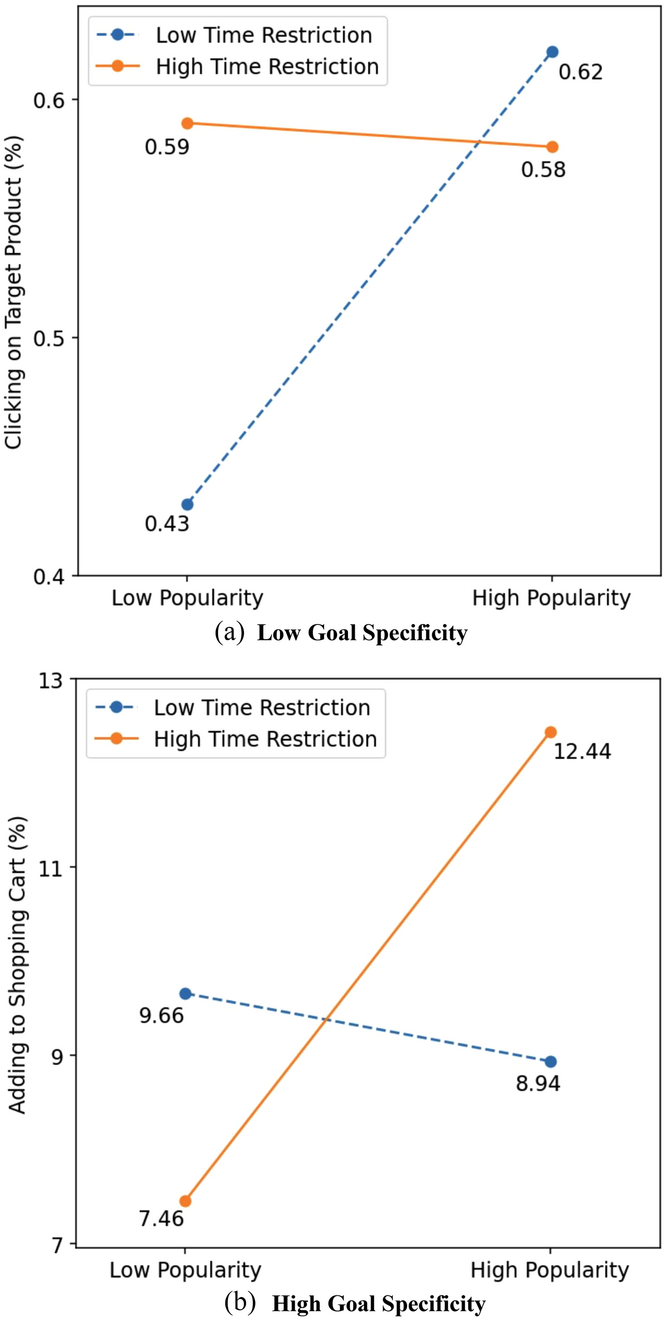
Model‐free evidence for different conditions in Study 1. (a) Low goal specificity and (b) high goal specificity.
Next, we investigated the effects of time restriction and product popularity using regression analysis. Since both dependent variables were binary, we conducted a logistic regression for the high and low goal specificity conditions separately. For both conditions, the independent variables were popularity, time restriction, and the interaction term of popularity and time restriction. Specifically, we estimate the effects of popularity and time restriction through a logit model using the following specification:


Regression results of main and interaction effects in Study 1
***
For the low goal specificity conditions, the results of logistic regression on consumers’ clicking on the target product showed a positive main effect of time restriction (coefficient = 0.32;
For the high goal specificity conditions, the results of logistic regression on consumes’ adding the target product to the shopping cart showed that neither time restriction nor popularity had a significant effect (coefficients = −0.28, −0.09 for time restriction and popularity, respectively;
Discussion
Overall, the results of the field experiment show that both time restriction and product popularity have a positive effect on consumers’ product evaluation when they have not formed specific shopping goals, although the effect of time restriction is relatively marginal. In other words, consumers without concrete shopping targets tend to be attracted by more popular products or more restricted product offers. The effects of product popularity and time restriction, however, disappear for consumers who have formed more concrete shopping goals.
Moreover, for consumers without specific goals, the positive effect of popularity disappears when the time restriction of the products is high. As we have argued earlier, the two cues may compete for consumers’ attention when they screen and compare many alternatives via relatively superficial information processing of individual products. Conversely, for consumers who are making decisions on the target product, popularity information will affect their purchase decision only when there is a high time restriction on their target product offer. This is likely because the high time restriction on the target product may prompt consumers to make quick decisions based on easy‐to‐interpret heuristics such as popularity cues. In other words, while high time restriction on the target product does not necessarily lead consumers to purchase the product, it may prompt them to speed up their decision‐making process and rely on general evaluative cues such as popularity.
In this study, consumers’ goal specificity was inferred from their page browsing behavior rather than being directly manipulated or measured. A laboratory experiment was thus conducted to further corroborate the findings of the field experiment. In the laboratory study, the specificity of consumers’ shopping goals was explicitly manipulated and measured, and time restriction and popularity information were more specifically indicated for all products. In addition, we employed eye‐tracking techniques to capture users’ attention to different information cues to further examine the underlying mechanism.
STUDY 2: LABORATORY EXPERIMENT
Design
The laboratory experiment employed a 2 (goal specificity: high vs. low) × 2 (time restriction: high vs. low) × 2 (popularity: high vs. low) between‐subjects design. In this experiment, subjects were asked to complete four steps related to planning a short trip with their friends in the next month, including (1) browsing photos of recommended travel destinations, (2) browsing recommended things to do in each destination, (3) browsing travel‐related products, and (4) planning for the trip. In the third step, that is, browsing travel‐related products, we developed an online store using the web service application programming interfaces of a third‐party e‐commerce platform. The manipulations of our independent variables (i.e., goal specificity, time restriction, and popularity) took place in this step. The purpose of designing a series of steps was to sufficiently involve subjects in the experiment scenario and make the task of product evaluation more realistic to the subjects so that they would behave naturally.
We manipulated goal specificity by giving different instructions to the subjects before their product evaluation task in the experiment (i.e., Step 3). Two different shopping tasks, characterized by different levels of shopping goal specificity were designed based on Tam and Ho (2006). In the low goal specificity condition, subjects were asked to visit an online shopping website and browse some products on sale in the category of backpacks, water bottles, and snack foods, which were all related to traveling. They were told that the listed products in each category were randomly retrieved from the pool of products on sale and they were asked to simply browse the products. The purpose of these instructions and of featuring multiple product categories was to ensure that the subjects did not have specific shopping goals during the task process. Specifically, subjects browsed 10 backpacks, followed by 10 water bottles, and finally 20 different food products. Our experiment focused on backpacks, and the manipulations of time restriction and popularity were applied to a target backpack product among the 10 products. Ten backpacks were featured on the page, all at the same price (i.e., CNY59.9, around USD10). A pretest was conducted to measure whether users had a particular preference for any of these 10 products. The results showed no significant difference in the perceived attractiveness of these backpacks. No brand name was explicitly mentioned to avoid the potential confounding effects of prior brand awareness. Information presented for each backpack on the listing page included a picture, product name, past sales of the product (i.e., popularity), and a number indicating the remaining time of the sale (i.e., time restriction). The level of time restriction and popularity of the target product was manipulated (as explained below). The position of the target product on the product listing page was randomly determined upon each user visit.
In the high goal specificity condition, subjects were asked to evaluate a backpack for the upcoming travel. They were told that backpacks were essential to travels. Subsequently, they were directed to a shopping website, which was offering a discount for a featured backpack (i.e., the same target product as in the low goal specificity condition). The subjects were asked to rate their intention to purchase the product after their product inspection. Time restriction and popularity information were manipulated on this detailed information page. Following the basic product information (e.g., name, price, pictures, and manipulated cues), an overall review rating (four stars) and 10 detailed user reviews were also featured. All the reviews were sourced from a public review platform for the same product.
In both conditions, the remaining time for the product to be sold at the discounted price was manipulated. For the target product, “14 days left” represented a low time restriction and “9 min left” represented a high time restriction. The time restriction on other backpacks on the listing page was kept at a low level (i.e., 12–14 days left). Popularity was represented by the number of purchases of the product in the previous week. For the target product, 11 purchases in the last week indicated low popularity, and 223 purchases in the last week indicated high popularity. In the low goal specificity condition, the popularity of all other backpacks on the listing page was kept at a low level (i.e., 10–14 purchases). We refer to Table 1 above (the third column) for a summary of the study design. The screenshots of the product listing page and information page, along with the manipulations of time restriction and popularity, are shown in Figure B1 and B2 in Appendix B, respectively.
Procedures
A total of 185 participants from a major public university in China were recruited. Each participant was randomly assigned to one of the eight conditions. According to Cohen (1988), such a group size (e.g., 22–24 subjects per group) assures sufficient statistical power of 0.8 for a medium effect size (
For subjects in the low goal specificity conditions, after they browsed through all the backpack products on the listing page, they were asked to complete a questionnaire. They were told to provide their evaluation of several backpacks randomly selected from the 10 backpacks featured on the web page. Our target product was among these products, and we asked the subjects to indicate their intention to purchase the products. 10 These intentions captured their interest in the products at that moment. In particular, their intention to purchase the target product was used as an indicator of their product approach behavior in the low goal specificity conditions. The reason for asking for their purchase intentions about multiple products rather than the target product alone was to avoid their suspicion about the study's purpose and prevent them from focusing too much on our target product (hence intending to overrate or underrate it). Since subjects were asked to browse products without any goal, evaluating multiple products was a natural task for them.
Subjects in the high goal specificity conditions were asked to indicate their intention to purchase the target backpack after they browsed the information page of this product. This intention was used as an indicator of their product approach behavior. Each session of the experiment lasted around 25 min. A token of appreciation (CNY40, around USD6) was provided to each subject at the end of the session.
Data analysis
The subjects were from 25 different departments, representing very diverse backgrounds. About 50% of them were female. The age of the subjects ranged from 17 to 29 (mean = 21). In general, they were very familiar with using the Internet (mean = 6.52, 7‐point scale) and with online shopping (mean = 5.84, 7‐point scale). There was no significant difference in these variables across the different conditions. The summary statistics are presented in Table 4.
Summary statistics
Manipulation check
To check the manipulation of goal specificity, we asked the subjects if they had specific shopping goals during their interactions with the website in the experiment.
11
Results showed that subjects who were asked to make a purchase decision on the presented product reported a significantly higher level of goal specificity than those who were asked to just browse multiple products (
To check the manipulation of time restriction and product popularity, we asked subjects about the perceived time restriction and popularity of the target product.
12
Results showed that the perceived restriction in the high time restriction conditions (M = 5.00,
Results
The model‐free evidence for the effects of popularity and time restriction is presented in Figure 2. Specifically, for low goal specificity conditions (Figure 2a), when time restriction was low, indicating high popularity of a product increased the average purchase intention from 3.48 to 4.67. This positive effect of popularity, however, disappeared when time restriction was high. For high goal specificity conditions (Figure 2b), when time restriction was high, indicating high popularity of a product increased the average purchase intention from 4.08 to 5.22. This positive popularity effect, however, did not exist when time restriction was low.
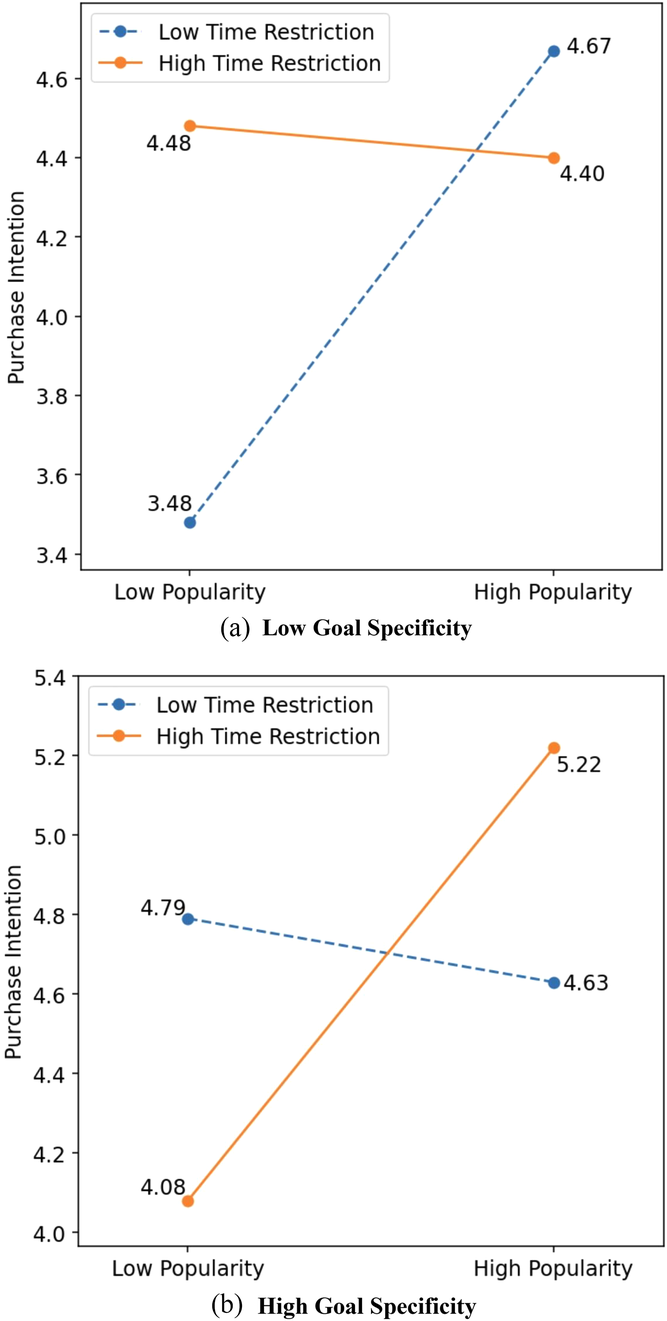
Model‐free evidence for different conditions in Study 2. (a) Low goal specificity and (b) high goal specificity.
Next, we conducted regression analyses separately for the high and low goal specificity conditions. Cronbach's alpha coefficient of purchase intention was 0.86, which showed that the measurement items had achieved high reliability. Since both dependent variables were continuous, we used ordinary least squares to estimate the effects using the following specification:


Regression results of main and interaction effects in Study 2
***
In the low goal specificity condition, the results revealed a significant positive effect of popularity on purchase intention (coefficient = 1.15;
In the high goal specificity condition, the results revealed no significant main effect of popularity or time restriction (coefficients = −0.22, −0.64 for popularity and time restriction, respectively;
Further analyses on eye‐tracking data
We argue that for consumers without specific shopping goals, time restriction and popularity information compete for attention when the consumers perform the initial screening of products, so the two cues weaken each other's effect. Conversely, consumers with specific shopping goals rely more on popularity information when time restriction is high, and hence the two cues reinforce each other's effect on consumers’ final product evaluation. In order to further examine the underlying mechanism, we employed eye‐tracking techniques and captured users’ attention to product information cues, which reflected how they incorporated this information into their decision making. Following our logic, we expect that when users’ goal specificity is low, higher time restriction of a product deal will be associated with decreased attention to its popularity cue. We also expect to see that when users’ goal specificity is high, higher time restriction may lead to more attention to the popularity information, meaning that the effect of popularity is amplified.
We performed eye‐tracking analysis using the software BeGaze. 13 Specifically, we defined the popularity cue of the target product as an area of interest (AOI) and retrieved subjects’ total fixation duration on the AOI (i.e., the total length of time subjects spent looking at the AOI, measured in milliseconds). Subjects’ fixation duration serves as a reliable indicator of their attention to the AOI (Wedel & Pieters, 2008). Of the 185 subjects, two subjects’ eye‐tracking data were not recorded fully and were hence excluded from the analysis.
First, we tested whether subjects’ attention to the target product's popularity information differed across different levels of time restriction and goal specificity. Consistent with our expectation, the results show that in the high goal specificity condition where subjects focused on the target product page, they paid significantly more attention to the popularity information in the presence of high time restriction than low time restriction (MLowTimeRestriction = 829.06 ms vs. MHighTimeRestriction = 1176.11 ms,
Next, we looked further into the high goal specificity condition in terms of subjects’ attention to other product‐related information in the presence of time restriction and popularity cues. In this study, 10 product reviews (seven positive and three negative) were displayed below the time restriction and popularity cues. We expect that in the high goal specificity condition, if the time restriction of the target product deal is high, the feeling of urgency will drive subjects to economize their time spent on scrutinizing detailed review information especially when popularity is high. This is because high popularity serves as a readily accessible signal of good product quality that may assist users’ decision making, whereas low popularity conveys limited information (Chen et al., 2011). However, when there is no tight time restriction, subjects will be less likely to rely on popularity information and will tend to process the detailed reviews before making the decision, regardless of the level of product popularity.
We thus defined each review as an AOI and investigated how time restriction and popularity cues affected subjects’ attention to these reviews. Our granular analysis revealed that subjects’ attention to the negative reviews (i.e., the sum of fixation duration on the negative reviews) differed as the level of time restriction and popularity varied. Specifically, in the presence of low time restriction, subjects’ attention to the negative reviews did not differ regardless of the popularity of the product (MLowPop = 2502.44 ms vs. MHighPop = 3142.24 ms,
GENERAL DISCUSSION
This research examines the effects of two product information cues, time restriction and popularity, on consumers’ product approach behavior, and how such effects change as consumers’ shopping goals evolve. The major findings of the two studies are discussed below.
First, both studies show that popularity has a positive effect on consumers’ product evaluation when they screen products in an early stage of their shopping process (i.e., without concrete goals), but the presence of popularity information at the final purchase stage (i.e., when consumers have formed concrete purchase targets) does not necessarily affect consumers’ purchase decisions. This implies that product popularity, which signals product quality and desirability based on others’ behavior, serves as an important cue for consumers without concrete shopping goals to narrow down their choices. However, when consumers have specific purchase goals, they will be less likely to rely on general popularity information. A plausible explanation is that consumers who have identified specific target products may assume that the shortlisted products already meet their minimum requirements in terms of overall desirability. Hence, they may focus less on the overall desirability cues such as popularity but more on the concrete and subtle information related to products and purchase such as whether the specific product attributes satisfy their needs. In fact, many prior empirical studies show that the positive effect of popularity on purchase behaviors is often evident when the popularity cues appear during consumers’ screening of multiple products (e.g., Cai et al., 2009; Cui et al., 2019). These observations are consistent with our findings in the low goal specificity case. Further, by showing the diminishing effect of popularity cues encountered at the final purchase stage, this study thus deepens the understanding of the popularity effects by revealing the moderating role of consumers’ goal specificity.
Second, both studies show that a positive effect of time restriction only occurs for consumers without concrete shopping goals. Time restriction has no direct effect on consumers’ product approach behavior when they have concrete shopping goals. A plausible reason is that, although high time restriction may create a feeling of urgency for consumers with specific targets, they may not react to it by directly purchasing the product with a time‐limited discount but by changing their decision strategy. As consumers do not have much time to scrutinize the details when time restriction is high, they tend to make more efficient use of the limited time by selectively attending to the available diagnostic information cues (i.e., overall product desirability) that allow them to make a quick decision. In fact, some studies on limited‐time scarcity have also found that higher scarcity may not always lead to higher purchase intention (e.g., Broeder & Wentink, 2022; Jang et al., 2015). Our results thus contribute to the literature on limited‐time scarcity by demonstrating the different impacts of scarcity for consumers with different levels of shopping goal specificity.
Furthermore, both studies have revealed a negative interaction effect between time restriction and popularity when consumers have not formed concrete goals, such that the positive effect of popularity on consumers’ product approach behavior is weakened when time restriction is high. In other words, if consumers are attracted by one piece of information (e.g., time restriction), they may temporarily overlook other product information (e.g., popularity). In contrast, when consumers’ goals are more concrete, the interaction between time restriction and popularity becomes positive, that is, these two cues will reinforce each other's effect. As discussed above, high time restriction may make consumers with concrete shopping goals rely more on general desirability information such as popularity for more efficient decision making. Our paper thus extends the extant literature on the popularity effect (e.g., Cui et al., 2019; Li &Wu, 2018; Zhang & Liu, 2012) and scarcity effect (e.g., Calvo et al., 2020; M. Song et al., 2021) by integrating these two types of information cues and revealing their different interaction effects across different shopping stages.
Overall, while the positive individual effects of time restriction and product popularity on consumers’ decision making have been widely acknowledged in prior literature, our paper shows that they may not always have direct impacts on consumers’ purchase decisions, and their joint impacts will also vary depending on consumers’ goal specificity.
Implications
This research has several theoretical and practical implications. Extant studies have theorized and demonstrated the positive impact of time restriction (e.g., Coulter & Roggeveen, 2012; Inman et al., 1997) and popularity information (e.g., Banerjee, 1992; Cai et al., 2009; Dewan et al., 2017) on consumers’ purchase behavior. Our study contributes to the literature by exploring a novel perspective, that is, how the effects of time restriction and popularity differ for consumers with different levels of goal specificity. We also provide a theoretical understanding of these effects based on consumers’ mindset change during their shopping process. The results confirm our predictions and reveal that product popularity may effectively influence consumers’ product evaluation when they are screening various alternatives without a concrete shopping goal, but consumers are less sensitive to such information when they focus on evaluating target products with a concrete goal in mind. In addition, consumers may be attracted to scarce deals at an early stage of their shopping process, but time restriction information at the final purchase stage has a much weaker influence on consumers. Overall, time restriction and popularity cues may not have a direct “call‐for‐action” influence when consumers are making specific purchase decisions. Our findings thus contribute to the literature by decomposing the effects of time restriction and popularity along consumers’ shopping process and identifying the situations where these cues may have different impacts on consumers.
Furthermore, while prior studies have mainly focused on the independent effects of popularity and time restriction information, we uncover the interplay between the two. In particular, based on theories and studies related to the scarcity effect and consumer shopping goals, we find that the interplay between time restriction and popularity may differ as consumers’ mindset changes at different levels of goal specificity. When consumers are screening a large assortment of products, they may not scrutinize each product carefully. As both time restriction and popularity cues convey similar information (i.e., the desirability of a product), they tend to attenuate each other's effect. When concrete shopping goals are formed, consumers focus on evaluating their target products in depth, but high time restriction imposes pressure on their decision‐making process. They are hence prompted to rely more on general evaluative cues, such as popularity, to speed up their decision making. Our findings also enrich the literature on scarcity effects by suggesting that although time restriction information may not directly shape users’ decisions, it may facilitate decision making (i.e., as a value indicator) or urge it (i.e., by imposing a time constraint), depending on consumers’ goal specificity. Accordingly, time restriction information may lead to different decision strategies and outcomes.
In fact, some recent research in OM and IS has shown the importance of integrating the shopping process view when studying consumer behavior. For example, Gallino et al. (2022) explore the effect of in‐process delay (waiting time due to website slowdowns) on consumers’ abandonment at different stages of their shopping journey and show that consumers are more sensitive to slowdowns at a later (i.e., checkout) stage. Martınez‐de‐Albeniz et al. (2020) seek to improve the effectiveness of time‐limited promotions by forecasting how consumers advance through the different stages of the shopping funnel. Huang et al. (2020) investigate the effect of user registration at different stages of the shopping process and demonstrate the advantage of adding registration requests at the beginning of the shopping funnel. Luo et al. (2019) adopt a shopping stage perspective to explore how to effectively influence shoppers who have shortlisted products in their shopping carts. Our study strengthens this stream of literature and highlights the need to consider consumers’ shopping stages when disclosing product information. Future studies are recommended to follow this path when exploring the role of information in improving e‐commerce platforms’ operational performance.
The results of this study also have practical implications. A product is often associated with various information cues that may affect consumers’ decision‐making processes. Our findings suggest that it is not always beneficial to present all this information on a web page because different types of information may strengthen or weaken each other's effect depending on consumers’ mindset during their shopping process. In particular, our findings provide valuable suggestions to online businesses in terms of when to deploy product promotion strategies with time restrictions and when to present popularity information on web pages. On one hand, when online vendors want to attract consumers who are browsing without a concrete shopping goal, they may want to highlight product popularity information since consumers are generally attracted to popular products. Deploying product promotions with a tight time restriction in addition to displaying high popularity cues may not be a more effective strategy than highlighting high popularity alone. However, when the popularity cue is not displayed, highlighting the tight time restriction of a deal can arouse consumers’ interest. On the other hand, if vendors aim to induce more purchases from consumers with concrete shopping goals, the best strategy is to present both the tight time restriction of a deal and the high popularity of the product. Overall, retailers should be mindful and ensure that they implement the most appropriate strategies and information designs for consumers at different stages of their shopping process.
Limitations and future research
This research has some limitations that may give rise to interesting future research directions. First, while our two experiments examine two different types of products (polo shirts and backpacks), more work needs to be done to explore whether our findings can be generalized to other product categories. For instance, Tucker and Zhang (2011) have pointed out that popularity information may exert greater influence on narrow‐appeal (niche) products than on broad‐appeal products. Future studies can thus explore whether the individual and interaction effects of popularity and time restriction information might differ for different types of products.
Second, this study examines the role of consumers’ goal specificity and seeks to understand how the effects of popularity and time restriction information change as consumers’ goals become more concrete. In our field study, consumers’ goal specificity is inferred from the web pages they were browsing, as well as their past web page visits. Future studies may employ advanced prediction methods to infer consumers’ shopping goals more accurately (e.g., Martınez‐de‐Albeniz et al., 2020; Sun et al., 2021). In addition, in both field and laboratory studies, we separated groups of subjects based on goal specificity but did not trace a subject's goal evolvement and hence the entire shopping process. Future studies can try to trace and model a consumer's sequential shopping process to further investigate the temporal impacts of various types of product information in different settings.
Third, this study captured consumers’ product clicking and cart‐adding behaviors, but consumers’ actual purchase would be a better behavioral metric in the final decision‐making stage. However, in our field experiment, we did not have access to consumers’ purchase records due to the company's policy constraint. We were not able to collect consumers’ demographic attributes either. We acknowledge this as a data limitation. Future researchers may extend our research to further examine the effects of product popularity and time restriction on consumers’ actual purchase outcome as well as the potential heterogeneous effects among different consumers.
Footnotes
ACKNOWLEDGMENTS
This study was funded by the National Natural Science Foundation of China (72022008), Tsinghua University Initiative Scientific Research Program (20205080019), the Research Grants Council of Hong Kong (HKU 17502921), the University Research Committee of the University of Hong Kong (201905159007), and the Social Sciences and Humanities Research Council of Canada (SSHRC) Insight Development Grant (430‐2022‐00297). The authors thank the department editor, the senior editor, and the three reviewers for their insightful comments. Zhenhui (Jack) Jiang is the corresponding author.
1
We mask the real name of the company for confidentiality purposes.
2
Whether consumers had conducted keyword searches or selected filtering criteria can be determined based on the web addresses that they visited.
3
We note that the sample size is much larger in the low goal specificity condition than in the high goal specificity condition. This is plausibly because (1) generally fewer consumers move into the later stages of the purchase funnel, and (2) many specific product information pages are provided toward the bottom of the funnel as compared to the top where a few general listing pages allow consumers to browse a large variety of products.
4
5
6
7
8
9
BeGaze is the analysis software associated with the SMI eye tracker used in this study.
10

11
Questions used in the manipulation check of goal specificity before browsing the shopping website were: (1) I am certain about what I want to buy, (2) I have a specific shopping goal in mind, and (3) I know clearly what product I am going to search for on the website.
12
In the low goal specificity condition, since multiple products were presented on the page, subjects were asked to answer questions about several randomly selected products (which included our target product) so that they would not guess the study's purpose.
13
BeGaze is the analysis software associated with the SMI eye tracker used in this study.
References
Supplementary Material
Please find the following supplemental material available below.
For Open Access articles published under a Creative Commons License, all supplemental material carries the same license as the article it is associated with.
For non-Open Access articles published, all supplemental material carries a non-exclusive license, and permission requests for re-use of supplemental material or any part of supplemental material shall be sent directly to the copyright owner as specified in the copyright notice associated with the article.
