






Abstract
Network literature has widely documented that the managerial ties between corporate leaders in two firms can promote their economic exchanges in supply chains, that is, social embeddedness. In this study, we strive to advance this line of inquiry by exploring the dynamics of such socially embedded supply chains, examining whether and when the dissolution of managerial ties between two firms would cause the subsequent termination of their supplier–buyer exchanges. We address this question by distinguishing two types of socially embedded supply chains based on their different relational origins: business‐with‐friend links in which the managerial ties precede the supply chains, and friend‐in‐business links in which the supplier–buyer exchanges precede the managerial ties. We posit that the managerial tie dissolution has a negligible effect on the subsequent termination of supply chains in business‐with‐friend links. In contrast, in friend‐in‐business links, the dissolution of managerial ties between two firms is associated with a significantly higher likelihood for their supplier–buyer exchanges to dissolve afterward. We find strong empirical evidence for the above propositions using a nuanced data set that integrates the managerial tie information and the supply chain data. In sum, we show that socially embedded supply chains with different origins (“doing business with friends” vs. “making friends in business”) would have distinct patterns of evolution and dissolution.
INTRODUCTION
It has been widely noted that the success of supply chains is fundamentally hinged on the effective coordination and joint planning between suppliers and customers (Lee et al., 2000; Osadchiy et al., 2021; Xia et al., 2008). However, such coordination and joint planning are often majorly threatened by the potential ex ante and ex post opportunistic behaviors arising from the conflicts of interest and information asymmetry between suppliers and customers (Su & Zhang, 2008). Given such coopetitive nature of supply chains (Jung & Kouvelis, 2022), successful supply chain relationship management is among the most prominent and challenging tasks in modern business management.
The collaboration of Yelp and Apple has been widely deemed a representative example of successful supply chain relationships. On September 19, 2012, Apple released its mapping service on iOS as the default one for Apple products. Lacking competence in local search, Apple uses Yelp as a major supplier of business content services on local points of interest, such as restaurants, parks, gas stations, and hotels. The valuable crowd‐verified location and review data from Yelp have helped the growth of Apple Maps tremendously. On iPhones, it is used three times more than its main competing product, that is, Google Maps. This partnership, in return, makes Yelp a strong competitor as a data amplifier in point‐of‐interest reviews. In sum, Yelp and Apple managed to develop and maintain their supply chains in ways that strategically coordinate their resources and activities and mutually benefit each other.
Notably, the successful supply chain between Apple and Yelp is not merely the economic transactions between the two firms but rather accompanied by the deep personal connections between Fred Anderson, the lead independent director of Yelp, and Tim Cook, the sitting CEO of Apple. When Cook joined Apple as the senior vice president for worldwide operations, Anderson was Apple's executive vice president and Chief Financial Officer. In this regard, Apple and Yelp simultaneously maintain supply chain relationships and managerial ties. Scholars have widely noted the value of such interpersonal connections in successful supply chain management (Dai et al., 2020). For example, Zhang et al. (2020) proposes firms should develop “connectivity” as a capability to connect people and resources for better communication, coordination, and collaboration. In this study, we define such supply chains coexisting with managerial ties—personal associations and contacts (e.g., board interlocks, alumni, former colleagues) across corporate leaders (i.e., executives and directors)—between the partner firms as socially embedded supply chains.
Prior network research has widely documented the benefits of such social embeddedness in interfirm relationships. Specifically, the social norms of mutual support and reciprocity attached to managerial ties steer two firms to act more cooperatively, generously, and trustworthily toward each other in their economic exchanges and collaboration (Keppler et al., 2021). As a result, such arrangements can closely bind two firms together, facilitating their coordination and communication, fostering mutual trust, mitigating conflicts, and advancing the value the two firms can jointly create (Dasgupta et al., 2021; Gulati & Sytch, 2007). Echoing these insights, it is widely noted that firms are commonly motivated to govern their supply chains with managerial ties, thus making socially embedded supply chains prevailing in modern business operations (Uzzi, 1999). However, contrary to the thorough inquiry on the formation and implications of social embeddedness, the extant literature has devoted little effort to explore when and how socially embedded interfirm relationships would dissolve over time. In particular, we are curious about the following question: Would the dissolution of the managerial tie between two partner firms cause their supply chains to terminate consequently?
This study addresses the above question by highlighting an important, yet understudied, issue—the origin of a socially embedded supply chain, that is, whether the partners in the socially embedded supply chain start their relationships with managerial ties or supplier–buyer exchanges. Prior studies have noted that interactive patterns between partner firms in an interfirm relationship are largely determined by how they interact with each other at the very beginning of this relationship (Molm et al., 2012). That is, such an origin of the interfirm relationship can define the ascribed culture that determines how the partner firms view and act toward each other, thus largely steering the subsequent operations of this relationship (Uzzi, 1997). Following this logic, it stands to reason that socially embedded supply chains originating from managerial ties and those starting with supplier–buyer exchanges would be largely characterized by different relational cultures and operational patterns. We thus classify socially embedded supply chains into two types based on the temporal sequence of the managerial ties and supplier–buyer exchanges in a given relationship: On the one hand, two firms with preexisting managerial ties can leverage these social links to foster their supply chains (“doing business with friends”). The aforementioned relationships between Apple and Yelp offers a great example of such a case. On the other hand, two firms with preexisting supplier–buyer exchanges can develop personal connections between their corporate leaders over time (“making friends in business”). For example, Apple and Silicon Labs Incorporation, a technology company that designs and manufactures semiconductors, started a sourcing relationship in 2007. Later on, these two companies developed personal ties between their senior leaders by developing board interlocks with each other in 2010 to further enhance their collaboration and coordination. We label the former as business‐with‐friend links, and the latter as friend‐in‐business links.
Drawing on the insights of the extant research on interfirm relationships and supply chains, we propose that in business‐with‐friend links and friend‐in‐business links, managerial ties would play distinct roles; therefore, the dissolution of managerial ties will have distinct implications for the subsequent termination of supply chain exchanges in these two types of socially embedded supply chains. Specifically, when two firms are originally connected through managerial ties and then develop supplier–buyer exchanges, this interfirm relationship, from the beginning, is imprinted with the social exchange codes of mutual commitment and mutual support (Molm et al., 2012; Zhang et al., 2019). Such ascribed collaborative culture can stipulate the two firms to act toward each other in supportive and trustworthy ways even if the managerial ties are no longer directly chaperoning the supply chains. In line with this view, we posit that in business‐with‐friend links, the dissolution of these managerial ties will not significantly boost the termination of the supply chain relationships.
In contrast, when two firms start their relationships with arm's‐length economic exchanges as buyer and supplier and then develop managerial ties across their corporate leaders, this interfirm relationship is inherently imprinted with the transactional principles of self‐interested calculations and competitive negotiations (McNeil, 1978). As such, without the stipulation and governance of managerial ties, such ascribed competitive culture would dominate the operations of the two firms' supply chains, causing conflicts and jeopardizing coordination (Molm et al., 2012). In this regard, we posit that in friend‐in‐business links, the dissolution of managerial ties will significantly intensify the likelihood of consequent supply chain termination.
We test the above propositions by drawing evidence from the supply chains across U.S. publicly listed firms. In order to do so, we construct a nuanced data set to comprehensively capture the socially embedded supply chains across U.S. public firms by compiling and synthesizing the field information from multiple sources. First, following prior network studies (e.g., Cohen et al., 2008), we capture managerial ties between corporate leaders using an affiliation‐based approach, defining two corporate leaders as personally connected if they share common affiliations or experiences throughout their personal and professional history. Information about corporate leaders' personal and professional backgrounds is extracted from BoardEx, the leading database for executives and directors in U.S. public firms. Moreover, we extract supply chain information from FactSet Revere, a database covering publicly disclosed supplier–customer relationships across U.S. public firms. Then, we apply rigorous fuzzy matching to merge the managerial tie data from BoardEx with the supply chain data from FactSet Revere.
We adopt the time‐varying difference‐in‐differences (DID) approach to test the impacts of managerial tie dissolution on the subsequent termination of supply chains. Specifically, we focus on the managerial tie dissolution caused by corporate leaders' deaths or retirements who maintain managerial ties across suppliers and customers. Prior studies have widely deemed the managerial tie dissolution caused by the deaths and retirements of corporate leaders as exogenous variations in firms' social networks (Cohen et al., 2008). First, it is widely noted that retirements are primarily determined by corporate leaders' personal choices and concerns. Such personal decisions, along with the death of corporate leaders, are generally less likely to be correlated with firms' decisions and activities. Moreover, Falato et al. (2014) show that after the departure of deceased or retired corporate leaders, firms are unlikely to replace them with new leaders immediately. Such succession gaps would intrinsically shift the connectedness of the focal firms in the managerial networks. Taken together, it is plausible to reason that the dissolution of managerial ties due to the deaths or retirements of corporate leaders is largely exogenous to firms' preferences and choices, including the termination of supply chains. We identify 263 cases of corporate leader deaths and 4219 cases of retirements in all U.S. public firms over our observation window. These cases together caused 3354 managerial tie dissolution events in our sample relationships. Results of the time‐varying DID analysis provide strong evidence for our theoretical predictions. That is, in business‐with‐friend links in which the managerial ties predate the supply chains, managerial tie dissolution caused by corporate leader deaths or retirements only has a negligible effect on the subsequent termination of supply chains. In contrast, in friend‐in‐business links in which the supply chains predate the managerial ties, the dissolution of managerial ties caused by corporate leader deaths or retirements significantly increases the likelihood of subsequent supply chain termination.
Building on the baseline propositions above, we further explore prominent heterogeneities across socially embedded supply chains that can moderate the impacts of managerial tie dissolution on the subsequent dissolution of supply chain exchanges. In particular, we highlight the contingency effects of three sets of heterogeneities that are widely documented as being able to majorly influence the survival and termination of supply chains: (1) the value and importance of a given supply chain relationship, (2) the relational history between partners, and (3) the direction of supply chains. Results of these heterogeneity analyses largely echo and extend the insights of prior interfirm network literature and supply chain research. First, we find that in both business‐with‐friend links and friend‐in‐business links, the positive impacts of managerial tie dissolution on the subsequent dissolution of supply chain exchanges will be weaker if a supply chain involves a principal customer that comprises more than 10% of the given supplier's consolidated revenue. These results indicate that as supply chains become more important and valuable, partners would be more motivated to maintain their exchanges despite the shocks of managerial tie dissolution.
Second, we find that the relational history can significantly weaken the positive effect of managerial tie dissolution on consequent supply chain dissolution. These results indicate that as highlighted in prior studies (e.g., Taylor & Plambeck, 2007), longer relational history allows supply chain partners to develop more relationship‐specific investments (RSIs) and informal commitments, thus reducing their reliance on managerial ties to govern and stabilize their exchange. Therefore, it stands to reason that supply chains with longer histories are generally less susceptible to the shock caused by disruptions in managerial ties.
Lastly, we show that in business‐with‐friend links, managerial tie dissolution caused by either side of a supply chain would have negligible impacts on supply chain dissolution. In contrast, managerial tie dissolution caused by upper echelon shocks on the supplier side will significantly increase the dissolution risk of friend‐in‐business links, but not such dissolution caused by customer‐side shocks. It is noted that compared with customers, suppliers are more inclined to make RSIs (Raman & Shahrur, 2008; Wagner & Bode, 2014). As such, it stands to reason that managerial tie dissolution shocks occurred at the supplier side would be more likely to lead to the disruption or loss of such RSI investments, thus posting more direct threats to the stability of the supply chains.
In addition, we also examine the consequences of the dissolution of socially embedded supply chains. We first demonstrate that the dissolution of managerial ties in a friend‐in‐business link will significantly reduce the return on asset (ROA) and sales of both the supplier and the customer. In contrast, managerial tie dissolution does not cause diminished performance in business‐with‐friend links. Moreover, after their managerial ties dissolve, firms may strive to refill the dissolved managerial ties by introducing new managerial ties (primarily through bringing new corporate leaders with personal connections with sitting executives or directors in their supply chain partners). Following this logic, we then explore whether supply chain partners would strive to compensate for the dissolved managerial ties with newly added ones. Results show that in both business‐with‐friend links and friend‐in‐business links, the stronger the managerial ties maintained by the partner firms, the less motivated the partners to refill the dissolved ties. However, in business‐with‐friend links, firms will be more likely to refill the dissolved managerial tie if it was the only managerial tie remaining, while such an effect does not exist in friend‐in‐business links.
Our study makes several major theoretical and empirical contributions to the extant literature. First, we contribute to supply chain research by drawing on the nuanced perspective of social embeddedness to study supply chains, highlighting the interplay between two major relational factors between firms, that is, managerial ties and supply chains. We show that the dissolution of managerial ties can serve as the potential cause of the termination of supply chains. In such a manner, our theoretical framework and empirical findings largely extend the extant literature on supply chains and interfirm relationships by highlighting an intriguing yet understudied fact—not only can firms' supply chains and other interfirm ties and networks mutually foster one another, but these relational factors may also disrupt each other's sustainability over time. As such, our study depicts valuable directions for future research on supply chain disruption and dynamics. Our empirical analyses also extend previous studies using FactSet Revere data set to study supply chain issues, such as supply chain restructuring (Charoenwong et al., 2022), risk propagation (Agca et al., 2022; Wang et al., 2021), credit rating (Wu et al., 2022), and bullwhip effect (Osadchiy et al., 2021).
Moreover, we contribute to network literature by advancing our understanding of social embeddedness in the context of supply chains, one of the most important formal business relationships. As discussed above, network scholars have devoted abundant research effort to highlighting the coexistence and interplay between economic exchanges and managerial ties between two firms, as well as the beneficial implications of such social embeddedness (Uzzi, 1997). However, much less attention has been paid to exploring the dissolution of these socially embedded interfirm relationships—after two firms are bound together by both economic exchanges and managerial ties, can they still maintain one relationship if the other relationship dissolves? We draw on a novel perspective to address this prominent theoretical gap in the network literature. That is, we highlight the distinct implications of different origins of social embeddedness (i.e., “business with friends” vs. “friends in business”), differentiating two types of socially embedded relationships based on their distinct origins and highlighting the different dynamics of these two types of supply chains.
The rest of this paper unfolds as follows: In Section 2, we develop our hypotheses based on the insights of extant research on social embeddedness and supply chain relationship management. Section 3 presents the empirical methodologies with which we construct our data set and measure the variables in our analyses. Section 4 discusses our primary empirical results on the dissolution of socially embedded supply chains. In Section 5, we discuss the heterogeneity on supply chain attributes, followed by Section 6, which reports the results of the outcome analyses on the implications of managerial tie dissolution, as well as the refill of dissolved managerial ties. We conclude in Section 7 by summarizing our major findings and their theoretical and managerial implications.
LITERATURE AND HYPOTHESES
Social network research has long recognized the fact that two firms can simultaneously participate in multiple types of relationships with each other (Uzzi, 1999). Particularly, a prevalent case is the coexistence of supply chain transactions and managerial ties between two firms, that is, social embeddedness (Uzzi, 1997). In a socially embedded supply chain, the managerial ties between the senior leaders of the partner firms are bound by social exchange codes of mutual support, mutual trust, and mutual commitment (Gulati & Sytch, 2007). These social exchange codes will informally stipulate the economic exchanges between the supply chain partners and drive them to be more generous and supportive toward each other (Keppler et al., 2021). In such a manner, compared with arm's‐length transactions that are solely grounded on two firms' reliance on each other's resources and their calculation and competition to secure needed resources (Corbett et al., 2004; Lee et al., 2000), partner firms in socially embedded supply chains can more effectively coordinate their operations, resolve conflicts, and create joint value.
Notably, there are two ways in which two firms can develop a socially embedded supply chain in terms of which type of relationship precedes the other in the relational history of these two partner firms: On the one hand, this socially embedded supply chain could be a result of “doing business with friends”—two firms whose executives or directors share preexisting personal ties start economic transactions with each other. In such a business‐with‐friend link, the social exchanges of managerial ties between the two firms precede their economic exchanges on the supply chain. On the other hand, this socially embedded supply chain can emerge from “making friends in business”—a supplier and a buyer can gradually develop managerial ties through economic transactions. In such a friend‐in‐business link, the arm's length economic exchanges between partner firms precede the social exchanges grounded on their managerial ties. However, as the extant research generally studies social embeddedness as a status quo of the coexistence of economic exchanges and managerial ties (Uzzi, 1997), such differences in the temporal sequence of the two relationships are fundamentally overlooked in prior studies.
This is a significant omission, as the different ways in which two partners initiate their socially embedded supply chain signify an important yet understudied theoretical issue—the origin of interfirm relationships (Carpenter et al., 2012). It is noted that the origin of an interfirm relationship, or the ways in which the partner firms initiate this relationship in the first place, will largely shape how these partner firms interact and exchange with each other as the relationship continues (Molm et al., 2012). Specifically, when two firms start their relationship with each other, they would establish the initial formal and informal contracts that steer the basic styles of their interactions and exchanges with each other (Saxenian, 1991). Depending on the nature of the original interactions and exchanges between the partner firms (e.g., social exchanges or arm's‐length economic exchanges), such initial contracts would vary significantly in terms of their coordination and governance mechanisms. These initial contracts largely determine the effectiveness of cooperation and coordination, as well as the intensity of competition and conflicts in this relationship, thus shaping the partner firms' fundamental assessments and assumptions regarding each other's goodwill and trustworthiness, as well as the willingness of sharing and coordination in pursuit of “win‐win” solutions (Cousins et al., 2006). Consequently, the partner firms will gradually form the basic relational cultures in their relationship, such as to what extent they should be generous or calculative, trusting or alert, collaborative or defensive, and long‐term or short‐term oriented toward each other (Molm et al., 2012). Notably, once ascribed at the beginning of an interfirm relationship, such relational culture will be inherently imprinted into the subsequent interactions and exchanges between the partner firms, thus exerting long‐lasting impacts on this relationship (Marquis & Tilcsik, 2013). In such a manner, it stands to reason that business‐with‐friend links and friend‐in‐business links, which, respectively, originate from managerial ties and supplier–buyer exchanges, would be intrinsically ascribed to different relational cultures and thus characterized by distinct operational patterns.
Specifically, a business‐with‐friend link originating from managerial ties is inherently imprinted with social exchange norms. In such a relationship emerging from “doing business with friends,” the two partner firms are originally connected through the interpersonal affinities and mutual commitments between their corporate leaders. As such, the relational culture between the two firms is inherently stipulated by the social exchange codes of reciprocity, mutual trust, and mutual support (Uzzi, 1997). These social exchange codes will intrinsically drive the firms and their organizational members to be more generous and supportive and less calculative and competitive toward each other (Molm et al., 2012; Zhang et al., 2019). Commensurately, when the two firms then engage in economic exchanges as supplier and buyer, such economic exchanges will be inherently branded with a collaborative culture, thus steering the operations of this supply chain in ways that can honor and advance the ascribed mutual commitment and mutual trust between the partner firms.
In contrast, a friend‐in‐business link originating from supplier–buyer exchanges would be inherently imprinted with economic exchange rationales. At its beginning, this interfirm relationship is a pure arm's‐length transaction, the basic principles and rationales of which are essentially characterized by exchange partners' self‐interested calculations, competitive negotiations, and conflictual profit‐seeking (McNeil, 1978). Such economic exchange rationales and transactional principles will be ascribed to the two partner firms' relational culture, intrinsically steering the two firms and their organizational members to view each other as adversaries and motivating them to be more competitive toward each other (Molm et al., 2007).
Given such distinct relational cultures of business‐with‐friend links and friend‐in‐business links, it stands to reason that managerial ties would play fundamentally distinct roles in these two types of socially embedded supply chains. Consequently, the dissolution of managerial ties would have distinct implications for the subsequent termination of supply chain exchanges in business‐with‐friend links and friend‐in‐business links. Specifically, in business‐with‐friend links, the original managerial ties mainly play the role of imprinting the social exchange codes of benevolence, reciprocity, and commitment into the relational culture between the partner firms, which will inherently stipulate the firms' subsequent economic exchanges. In this regard, even if the managerial ties break and can no longer directly chaperon the supply chains between the partner firms, the imprinted principles of trustworthiness and generosity will still help promote and stabilize the firms' supplier–buyer exchanges with each other (Molm et al., 2012). In such a manner, it stands to reason that in business‐with‐friend links, the supply chain between the partner firms would not be majorly disrupted and threatened by the dissolution of their managerial ties.
On the contrary, in friend‐in‐business links, the partner firms primarily develop subsequent managerial ties (i.e., “making friends in business”) as relational governance mechanisms to help resolve potential conflicts and value‐destructing competitions in their supplier–buyer exchanges (Uzzi, 1997). In such a manner, the primary function of these subsequent managerial ties in these friend‐in‐business links is to chaperon and compensate the partner firms' arm's‐length transactions with the personal commitments and affinities between their personally connected corporate leaders. However, as strategic solutions developed under the ascribed transactional culture in these friend‐in‐business links, these subsequent managerial ties generally would not redefine the competitive and conflictual schema imprinted in the gene of these relationships from their beginning (Molm et al., 2012). As a result, when the managerial ties dissolve and no longer chaperon and safeguard the operations of the supply chains, the competitive and conflictual self‐interest seeking, as inherently incited by the ascribed transactional culture between the partner firms, would prevail again in their exchanges and severely threaten the continuity of their supply chains. Therefore, it is plausible that in friend‐in‐business links, the supply chains between the partner firms would face higher termination risks after their managerial ties dissolve.
Drawing on the insights above, we submit the following hypotheses regarding the distinct consequences of managerial tie dissolution in socially embedded supply chains with different origins: In a business‐with‐friend link in which managerial ties between the two partners precede their supply chains, the dissolution of managerial ties has negligible effects on the likelihood for the supply chain relationships to terminate subsequently. In a friend‐in‐business link in which the arm's‐length supply chains between the two partners precede their managerial ties, the dissolution of managerial ties will increase the likelihood for the supply chain relationships to terminate subsequently.
DATA AND EMPIRICAL STRATEGY
Data construction
We compile and synthesize information from multiple sources to construct a novel field data set to capture the supply chains and managerial ties across U.S. public firms.
First, we extract information about corporate leaders' personal and professional records (e.g., work histories, educational backgrounds, and current participation in social organizations) from the BoardEx, the leading database covering the personal background information of senior executives and directors in over 10,000 U.S. public firms. In the United States, the SEC mandates public firms to disclose the biographical information and professional experience of their corporate leaders in financial reports. BoardEx obtains data from a variety of public sources including regulatory filings, annual reports, proxy statements, company websites, press, and regulatory news wires. In BoardEx, they hire skilled and experienced analysts to verify the data and compile such publicly disclosed corporate leader personal information, thus serving as the primary data source adopted by prior studies on top management teams and boards (Cohen et al., 2008; Fracassi & Tate, 2012).
In our study, we use “board summary” and “director network” files in the BoardEx database. The “board summary” files provide the biographical information of board members, C‐suite executives, senior leaders, and professional advisors of each firm each year. The biographical information includes the corporate leader's current position, time in the company, education and achievements, age and gender, and so on. The “director network” files provide dyad‐level connection status between two corporate leaders with an affiliation‐based approach. Two corporate leaders are defined as connected if they share common affiliations. Representative examples of such shared affiliations include graduating from the same institutes (alumni ties), working for the same firms (former colleague ties), serving on the same boards (interlock ties), belonging to the same charitable organizations and clubs (shared membership ties), and so on. In each connecting dyad observation, BoardEx provides the name and the type of connecting organization, as well as the start and the end year of this connection. By matching the personal background records of each corporate leader in the “board summary” files and dyad‐level connection information in the “director network” files, we define the managerial tie connection between two corporate leaders if they were previously connected with or are currently connecting with the same organization. This affiliation‐based approach is adopted by prior studies on managerial ties (e.g., Cohen et al., 2008; Davis & Greve, 1997).
Second, we extract information about supply chains from FactSet Revere, an established data set used in a series of recent supply chain studies. FactSet Revere systematically monitors and collects the information publicly disclosed by U.S. public firms. The information source includes annual and quarterly filings (SEC forms 10‐K, 8‐K, and 10‐Q), investor presentations, company websites, and press releases. Using this publicly disclosed information, FactSet Revere identifies around 25,000 supply chains across over 2500 U.S. publicly listed firms each year. Each supply chain covered by FactSet Revere has specific start and end dates, and is tracked periodically. In addition, we also draw information from Compustat, the leading database on U.S. public firms' financial and operational information, to capture specific firm‐level features of our sample firms.
We then strive to merge the information extracted from these three databases (BoardEx, FactSet Revere, and Compustat) to compile our data set. We apply a fuzzy matching algorithm in the merging process. First, by matching the data from BoardEx to Compustat directly using CIK, CUSIP, and ticker, we identify 5013 companies of which the information is covered in both databases. We further identify another 185 companies by using a string match based on the Levenshtein distances between company names. Then, we match the information of these 5198 companies with FactSet Revere using CUSIP. This matching process identifies a sample of 4081 public firms, the information of which is covered in all three databases. We then manually verify each matched record to ensure the accuracy of this fuzzy matching process. As per our definition, we deem a dyadic link between two firms as a socially embedded supply chain if the two firms simultaneously maintain managerial ties (as indicated by the BoardEx data) and supply chain relationships (as indicated by the FactSet Revere data) in a given year.
Based on this working definition, we identify 14,735 cases of socially embedded supply chains across the 4081 sample firms. Furthermore, as prescribed by our theoretical framework, these socially embedded supply chains can either originate from managerial ties (i.e., business‐with‐friend links) or started as arm's‐length supply chains (i.e., friend‐in‐business links). 1 In this regard, we track the historical records of the managerial ties and supplier–buyer relationships in each of the 14,735 socially embedded supply chains. This procedure identifies 5284 observations of business‐with‐friend links in which the managerial ties predate the supply chains and 9451 observations of friend‐in‐business links in which the supply chains predate the managerial ties.
Identification strategy
Our theoretical framework strives to unveil the dissolution patterns of socially embedded supply chains, which, in essence, concerns the issue of network dynamics. Notably, as highlighted by prior network research (e.g., Carpenter et al., 2012), a key challenge faced by empirical field studies on network dynamics is the potential endogeneities. In particular, regarding our theoretical predictions, such endogeneities can manifest in two ways: First, there might be potential reverse causalities, such that the dissolution of supply chains, the predicted effect in our theoretical framework, may cause the dissolution of managerial ties, our main predictor. Second, it is also possible that certain statuses, decisions, and activities launched by a sample firm may simultaneously cause the dissolution of both managerial ties and supply chains.
In order to rule out such endogeneities and enhance the causal identification in our analyses, we follow the identification strategy widely adopted by prior studies on managerial ties (e.g., Falato et al., 2014), specifically focusing on the impacts of managerial tie dissolution caused by the deaths or voluntary retirements of corporate leaders who had maintained managerial ties across suppliers and customers. Such corporate leader deaths or voluntary retirements, and the consequent managerial tie dissolution, are less likely to be determined by firms' choices and decisions. First, as corporate leaders' personal decisions to end their career and exit from the business society, voluntary retirements are primarily determined by the corporate leaders' personal concerns and features (e.g., age, health, personal life quality, family concerns) and thus less likely to be subjected to the influences of their firms' decisions and activities (Fracassi & Tate, 2012). Moreover, it is also noted that after a corporate leader passes away or voluntarily decides to retire, it would commonly take over 2 years for the firm to hire or promote new corporate leaders to refill the managerial ties maintained by the focal corporate leader (Falato et al., 2014), thus rendering the variations of managerial ties caused by corporate leader deaths and retirements rather persistent. In such a manner, the managerial tie dissolution caused by the deaths or voluntary retirements of corporate leaders is commonly deemed exogenous variations in firms' managerial connectedness, thus allowing us to more effectively test for the causal links between managerial tie dissolution and subsequent supply chain termination.
Using the information from BoardEx, we identify 263 cases of corporate leader deaths and 4219 cases of voluntary retirements. These numbers are consistent with prior studies using the same data source to identify corporate leader deaths and retirements. Notably, following the practice of prior studies, we define a corporate leader as voluntarily retiring from a firm if (s)he (1) leaves the firm at or above the age of 65 and (2) never assumes a new executive or director position in any firms after leaving the focal firm. Together, these cases of corporate leader deaths and voluntary retirements caused 3354 managerial tie dissolution events in our sample. Notably, a sample supply chain may have experienced multiple managerial tie dissolution events in a given year.
Building on these managerial tie dissolution events caused by the exogenous shocks of corporate leader deaths or voluntary retirements, we employ the time‐varying DID design to analyze our data. This design is different from the traditional fixed‐time DID design in which all subjects are exclusively assigned to either the treatment group or the control group, and all treatment subjects receive the treatment at the same time point. Instead, in the time‐varying DID design, each subject appears in multiple subject–time observations, and the treatment strikes each subject at different time points. As a result, each subject–time observation may appear in the treatment group or the control group at different time points, depending on whether the subject receives the treatment at a given time point.
In our study, each sample supply chain has observations for multiple years (i.e., link‐year observations). The time‐varying shocks in our design, that is, managerial tie dissolution events, occurred at different time points for different sample supply chains. Such time‐varying shocks intrinsically set apart the treatment group and control group in each year: The treated samples in year t consist of all link‐year observations that experienced managerial tie dissolution events in the given year (i.e.,


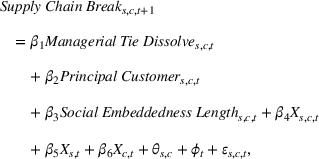



Notably, we adopt a 1‐year lag between our predictors and predicted effect based on the following considerations. Specifically, the voluntary retirement cases were coded with the information disclosed by public firms in their annual reports extracted from BoardEx. Due to the natural limit of the archival data on BoardEx, for the majority of retirement cases, we can only accurately identify the years in which these cases occurred, but not the specific months and dates. As a result, in our study, managerial tie dissolution cases are measured on annual bases. This practice is also adopted by most prior studies on upper echelon retirements. Besides, as noted by the extant research, the prolonged impacts of the deaths or retirements of senior leaders on firms' strategic decisions and operations would commonly last for a year or even longer (Falato et al., 2014). In this regard, using the annual panel and the 1‐year lag between our predictor and predicted effect aligns both with the theoretical findings of prior studies and the nature of our data source.
Following the standard practice of time‐varying DID regressions in prior studies, we control for both the supplier–customer dyad fixed effects


Taken together, the above time‐varying DID design allows us to effectively compare the likelihood of supply chain termination of supply chains that experienced managerial tie dissolution in a given year and that of the supply chains without such shock in this year, thus attributing any difference in the likelihood of supply chain termination between these two groups to the treatment effect of managerial tie dissolution. Notably, the robustness of this identification strategy is hinged on an important underlying parallel trend assumption: The likelihood of termination in supply chains experiencing the treatment of managerial tie dissolution in a given year is not previously different from such likelihood in those supply chains without such treatment in this year. In this regard, along with our DID estimation, we also test for such parallel trend assumptions.
Measurements of key variables
Our predicted effect,


Our main predictor,

Along with the main predictor, we also draw on the insights of prior research on interfirm relationships and supply chains and account for a series of critical features of dyadic supply chains that may potentially affect supply chain termination. First, it has been widely noted that firms are more inclined to strive to maintain supply chains of higher value and importance (Cen et al., 2017). In order to account for the potential impacts of supply chain value on supply chain termination, we control for a dichotomous variable, that is,


Along with the two key relational features above, we also control for a vector of other supplier–customer dyadic features,







Moreover, the managerial ties maintained by partner firms' CEOs and COOs, the corporate leaders that often directly control and manage their firms' supply chain relationships, would have particularly prominent impacts on the operations and survival of the supply chains. We thus control for a variable

Following prior studies on supply chains and managerial ties, we also control for a vector of supplier characteristics,




DISSOLUTION OF MANAGERIAL TIESo
Benchmark DID results
Table 1 presents the benchmark DID regression results. The first three columns conduct the regressions in the group of business‐with‐friend links, whereas the last three conduct the regressions in the group of friend‐in‐business links. Columns (1) and (4) do not include control variables, whereas columns (2), (3), (5), and (6) contain the full set of controls. In addition to the benchmark DID specification, we also consider an alternative model specification. We estimate the equation controlling for both supplier and customer fixed effects instead of the supplier–customer dyad fixed effects, and the results are presented in columns (3) and (6) of Table 1.
Benchmark result.
Note: Standard errors that are clustered at the supplier–customer industry pair level are reported in parentheses.
*


The benchmark regression results are in favor of our theoretical framework predictions. In the subsample in which the managerial ties predate the supply chain, the dissolution of managerial ties caused by corporate leader deaths or retirements only has a negligible and insignificant effect on the likelihood of subsequent supply chain termination. While in the group in which the supply chains predate the managerial ties, the estimation coefficient of managerial tie dissolution is positive and significant at the 1% level, indicating that the dissolution of managerial ties significantly increases the possibility for the supply chains to terminate afterward. We give a quantitative explanation for the column (4) regression result. Socially embedded supply chains with death/retirement shocks have a 6.0 percentage points higher possibility of supply chain termination in the subsequent year than those without such shocks. The economic scale is quantitatively sizable. Given that the average possibility of supply chain dissolution in the subsample of friend‐in‐business links is 30.3%, the effect brought by retirement is equivalent to a 6.0/30.3 = 19.80% decrease of the sample mean.
The coefficients on the control variables all have expected signs. In the findings above, regardless of the origin of ties, the social embeddedness length is positively linked to supply chain break in both subsamples. The strength of managerial ties across top leaders of partner firms (CEOs and COOs) does not contribute to the probability of subsequent supply chain dissolution.
We hence find evidence consistent with our theoretical predictions, which posit that the dissolution of managerial ties plays fundamentally distinct roles in the dynamics of socially embedded supply chains with different origins—when the managerial ties in business‐with‐friend links dissolve, the supply chain relationships do not significantly dissolve along with the managerial ties. On the contrary, the dissolution of managerial ties in friend‐in‐business links generally renders the economic exchanges dissolve along with the dissolved managerial ties.
Validity of identification
As discussed above, an underlying assumption of the time‐varying DID design is that the likelihood of termination in supply chains experiencing the treatment of managerial tie dissolution in a given year is not previously different from such likelihood in those supply chains without such treatment in this year. In order to test for such parallel trend assumption, we follow the practices of prior studies using similar specifications of time‐varying DID estimations (e.g., Bertrand & Mullainathan, 2003), and conduct a parallel trend test for our time‐varying treatments, that is, managerial tie dissolution. This parallel trend test is represented by the following regression equation: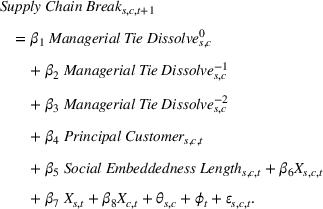







Table 2 reports the results of this parallel trend test for business‐with‐friend links and friend‐in‐business links, respectively. As can be seen, in both subsamples, the two pretrend dummies have no significant impacts on the likelihood of supply chain dissolution. Moreover, our main findings still stand in the presence of the two pretrend dummies: Managerial tie dissolution significantly increases the likelihood of supply chain dissolution in friend‐in‐business links but not in business‐with‐friend links. These findings show no violation of the parallel trend assumption.
Parallel trend test.
Note: Standard errors that are clustered at the supplier–customer industry pair level are reported in parentheses.
*


On top of the above equal trend test, we also follow the practices of prior studies and use the propensity score matching method to match each treated dyad with a control dyad with a comparable propensity of supply chain dissolution. Using this method, we construct a matched business‐with‐friend link sample and a matched friend‐in‐business link sample. We then use these two matched samples to replicate our baseline DID analyses, respectively. As shown in Table 3, the results of our baseline DID analyses hold in these two matched samples: Managerial tie dissolution significantly increases the likelihood of supply chain dissolution in friend‐in‐business links but not in business‐with‐friend links.
Regression in the propensity score matched sample.
Note: Standard errors that are clustered at the supplier–customer industry pair level are reported in parentheses.
*


In sum, these supplemental analyses above together demonstrate the appropriateness and validity of our time‐varying DID design, thus indicating the robustness of our findings. In addition, we present some sensitivity analyses in the Supporting Information, which offer further evidence for the robustness of our findings. 3
HETEROGENEITY ANALYSES ON SUPPLY CHAIN ATTRIBUTES
Supply chains with principal customers
Prior research on interfirm relationships and supply chains has widely documented that the survival and continuity of a supply chain are largely hinged on the value and performance of this supply chain (Cen et al., 2017). That is, firms tend to be more motivated to maintain supply chain relationships that are more valuable in their operations. In this regard, when the continuity of a socially embedded supply chain is threatened by the shocks of managerial tie dissolution, the supplier and the customer would make a more active effort to stabilize this relationship and keep their exchanges from terminating as this supply chain is of higher value and importance. Drawing on this insight, it would stand to reason that supply chain value and importance can serve as an important contingency for our theorized effects, such that the impacts of managerial tie dissolution on consequent supply chain termination would be weakened by the value and importance of a given socially embedded supply chain. In order to further explore such moderating effects of supply chain value and importance, we conduct a heterogeneity analysis based on the following equation: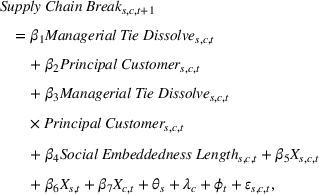

Heterogeneity analysis: Principal customer.
Note: Standard errors that are clustered at the supplier–customer industry pair level are reported in parentheses.
*


Relational history
Along with the value and importance of supply chains, another critical factor that can majorly affect the survival and continuity of interfirm relationships and supply chains is the relational history between the partner firms (Taylor & Plambeck, 2007). In particular, it has been widely noted that longer relational history allows partner firms to engage in repeating interactions and exchanges and thus foster various interfirm routines and norms to promote trust, communicate tacit information, and accumulate mutual commitments. These interfirm routines and norms and managerial ties can both function as governance mechanisms that can stabilize the exchanges between partner firms. In such a manner, it thus stands to reason that as partner firms have worked with each other over an extended history in a socially embedded supply chain, the shocks posted by the dissolution of their managerial ties on their supply chain exchanges would be mitigated. Put differently, in a socially embedded supply chain with longer relational history, the impacts of managerial tie dissolution on subsequent supply chain termination will become weaker.
Notably, a socially embedded supply chain, by definition, consists of two types of relationships between the partner firms—the managerial ties and the supply chain exchanges. In this regard, the relational history of this socially embedded supply chain can be captured with three indicators: the length of the partner firms' supply chain, the length of their managerial ties, and the length for the partners to maintain both types of relationships. In this regard, we, respectively, explore the moderating effects of the three forms of relational history on the relationship between managerial tie dissolution and subsequent supply chain termination using the following equation: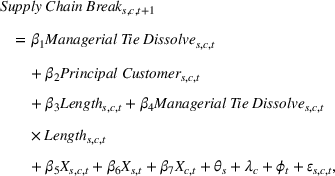




Table 5 depicts the moderating effects of the three types of relational history on the influence of managerial tie dissolution on the termination of supply chains in the business‐with‐friend link sample and the friend‐in‐business link sample, respectively. As can be seen, in both types of socially embedded supply chains, the interaction terms between all three types of relational history and managerial tie dissolution are significantly and negatively related to the subsequent termination of supply chain exchanges. These results indicate that as we predicted above, relational history can mitigate the adverse shocks caused by managerial tie dissolution on supply chain exchanges.
Heterogeneity analysis: Relational history.
Note: 

*


Direction of supply chains: Shocks on which side?
Notably, in a socially embedded supply chain, the dissolution of a managerial tie can be resulted from the deaths or voluntary retirements of corporate leaders in either the supplier or the customer. As suppliers and customers generally play distinct roles in maintaining supply chain exchanges, managerial tie dissolution caused by shocks on the two ends of a supply chain may have different implications for subsequent supply chain termination. In this regard, we conduct additional analysis to account for such differences in the direction of supply chains on our theoretical predictions.
Specifically, we decompose the main predictor in our baseline analysis, 


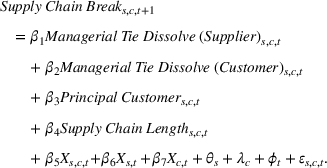
Results in Table 6 show that in business‐with‐friend links, the likelihood of supply chain dissolution would not significantly increase, no matter if the managerial tie dissolution shocks occurred on the supplier side or the customer side. More interestingly, results also show that in friend‐in‐business links, if the managerial tie dissolution events occur on the supplier side, such a shock will significantly increase the likelihood of subsequent supply chain termination. In contrast, if the managerial tie dissolution events were caused by the deaths or retirements of senior leaders in the customer firms, such a shock would not significantly increase the likelihood of subsequent supply chain dissolution.
Heterogeneity analysis: Direction of the connection.
Note: Standard errors that are clustered at the supplier–customer industry pair level are reported in parentheses.
*


This finding largely aligns with the insights achieved in prior supply chain research: As compared with customers, suppliers are more inclined to make RSI, such as capacity, research, and skilled labor, to cater to the need of their strategic customers. As such, managerial tie dissolution shocks that occurred on the supplier side would be more likely to lead to the disruption or loss of such RSI investments, thus posting more direct threats on the stability of the supply chains, intensifying ex post hold‐up problems, and creating severer risks of consequent supply chain dissolution.
OUTCOME ANALYSES: PERFORMANCE AND REFILL
Ex post performance
In the main result of Section 4, we have shown that the dissolution of managerial ties would significantly increase the likelihood of subsequent dissolution of the supply chain in the subsample of business‐with‐friend links. Then, the next interesting question is how would this dissolution of managerial ties affect the firm's ex post performance. We explore this question with the following equation.
We use two variables to measure a firm's performance, ROA and sales divided by total assets. We conduct the regressions for supplier firms and customer firms separately and show the results in Table 7. We find the coefficient of managerial tie dissolution significantly negative in the friend‐in‐business links subsample (columns (2) and (4)) and statistically insignificant in the business‐with‐friend links subsample (columns (1) and (3)). These results show that the dissolution of managerial ties in friend‐in‐business links would not only jeopardize the economic exchanges between the two firms but is also associated with lower ROA and sales for both the suppliers and the customers subsequently.
Ex post performance.
Note: Standard errors that are clustered at the supplier–customer industry pair level are reported in parentheses.
*


Would firms refill the dissolved managerial ties?
As demonstrated above, in the subsample of friend‐in‐business links, the dissolution of managerial ties between two firms would significantly jeopardize their economic exchanges and cause subsequent dissolution of the supply chain. In particular, in friend‐in‐business links, the managerial ties are built purposefully to align the incentives and facilitate the exchanges between supply chain partners and thus serve as a critical component to stabilize and promote healthy sourcing relationships. In this regard, it is plausible to suspect that expecting such disruptions in their supply chain system caused by the deaths or retirements of personally connected corporate leaders, firms might be motivated to refill or compensate for the dissolved managerial ties by introducing new managerial ties. In practice, such a refill could occur by hiring or promoting new corporate leaders with personal connections with sitting executives or directors in their supply chain partners.
Following this logic, we explore whether supply chain partners would strive to refill and compensate for the dissolved managerial ties with newly added ones. Specifically, for each socially embedded supply chain shocked by managerial tie dissolution caused by corporate leader deaths or retirements, we define a dummy variable, 






As shown in Table 8, in both subsamples, 
Managerial tie refill.
Note: Standard errors that are clustered at the supplier–customer industry pair level are reported in parentheses.
*


Notably, as we highlighted in our theoretical development, the dissolution of managerial ties has distinct implications for business‐with‐friend links and friend‐in‐business links. In this regard, although both business‐with‐friend link partners and friend‐in‐business partners would be comparably inclined to refill the dissolved managerial ties, such refill efforts could be driven by different considerations and motivations in these two types of socially embedded supply chains. On the one hand, in friend‐in‐business links in which managerial ties play critical roles in stabilizing and coordinating partners' transactions, the refill of dissolved managerial ties would be primarily driven by partners' economic needs to maintain and promote their supply chain exchanges. On the other hand, while the survival and performance of business‐with‐friend links are not necessarily hinged on the existence of managerial ties, the deeply embedded social exchange norms and code in these supply chains would also encourage the partner firms to resume the dissolved managerial ties so as to continue their long‐lasting history of social exchange and interaction.
Moreover, the two subsamples demonstrate distinct patterns of managerial tie refill when all managerial ties were severed by the deaths or retirements of corporate leaders. In columns (3) and (4) of Table 8, we add an additional regressor, 

DISCUSSION AND CONCLUSION
The extant network literature has widely documented the issue of social embeddedness, highlighting that the coexistence of managerial ties and economic exchanges between two firms can effectively stabilize and promote this interfirm relationship, closely binding the two firms together. Extending this line of inquiry, this study explores the understudied issue about the dissolution of socially embedded interfirm relationships. More specifically, we examine whether the dissolution of managerial ties in a socially embedded supply chain would make the supply chains between the partner firms terminate subsequently. We address this question by highlighting the implications of the relational origins of socially embedded supply chains (“doing business with friends” vs. “making friends in business”), classifying these supply chains into two basic types, that is, business‐with‐friend links in which the managerial ties precede the supplier–buyer relationships, and friend‐in‐business links in which the supply chains precede the managerial ties. We posit that as these two types of socially embedded supply chains are inherently imprinted with distinct relational cultures by their different origins, managerial ties in business‐with‐friend links and friend‐in‐business links would play distinct roles. Correspondingly, our core proposition is that the dissolution of managerial ties would have distinct implications in the two types of socially embedded supply chains, only causing the subsequent dissolution of economic exchanges in friend‐in‐business links, but not in business‐with‐friend links.
We test the above theoretical proposition using a nuanced field data set that synthesizes the information from multiple data sources (BoardEx, FactSet Revere, and Compustat) to comprehensively capture the socially embedded supply chains between U.S. public firms. We adopt the time‐varying DID approach by identifying the managerial tie dissolution cases caused by the deaths or retirements of corporate leaders who had maintained managerial ties across supply chain partner firms. Results of this DID analysis, along with a series of sensitivity analyses, offer strong support to our proposition: In business‐with‐friend links, the managerial tie dissolution has only a negligible effect on the subsequent dissolution of supply chains. In contrast, in friend‐in‐business links, the dissolution of managerial ties between two firms would significantly increase the likelihood for their supply chains to dissolve afterward. Taken together, our findings show that as compared with friend‐in‐business links, business‐with‐friend links can more closely bind firms together based on interpersonal affinities and mutual commitments.
Our theoretical framework and empirical findings have important implications for both scholars and practitioners. As discussed above, our study contributes to both network literature and supply chain research. First, we contribute to the extant supply chain research by examining the dynamics and disruption of supply chains through the perspective of social embeddedness. Second, we extend the extant network research by highlighting the important implications of different origins of social embeddedness. In addition, the novel field data set we construct can also help enrich the empirical contexts of supply chain studies. Our study also offers valuable insights into the practices of supply chain management. First, the different implications of “doing business with friends” and “making friends in business” indicate that firms and managers need to distinguish the supply chains with different types of partner firms. On the one hand, in the supply chains between firms with deep history of managerial ties (i.e., business‐with‐friend links), the close social exchange codes of trust and mutual support branded in these relationships can effectively guarantee the stability of these supply chains, even if the managerial ties in the future no longer chaperone these supply chains. As such, business‐with‐friend links tend to be “low‐maintenance” and less likely to dissolve, and thus can be managed and stipulated in more flexible and adaptive ways. On the other hand, for firms striving to effectively maintain and facilitate their arm's‐length supply chains built with partners that were not previously connected by corporate leader personal ties, building managerial ties with each other would offer an effective relational governance mechanism. However, such “achieved” managerial ties in those friend‐in‐business links would not stick permanently—once those managerial ties dissolve, the supply chains would often fall apart. As such, firms in friend‐in‐business links would need to more diligently and carefully maintain their managerial ties with each other so as to stabilize their supply chains.
Meanwhile, the insights above offer useful prescriptions for firms' supply chain partner selection. That is, it would stand to reason that business‐with‐friend links would be more suitable for long‐term–oriented, high‐value transactions that require more mutual adaptations and flexibility. In contrast, for short‐term–oriented transactions with low complexities and ambiguities, friend‐in‐business links would be a better‐off choice. In addition, the dissolution patterns of business‐with‐friend links detected in our study also provide useful insights for practitioners to anticipate the possible disruptions in the supply chain system, especially the ones caused by corporate leader deaths or retirements.
Value and contributions aside, our study also has some limitations that suggest future research avenues. In particular, our archival‐based panel data are fundamentally grounded on the information publicly disclosed by public firms. As a result, such data sets are subjected to inherent limits, such as rigidity and lack of sufficient mechanism details. For example, as the archival data do not contain detailed information for us to directly observe the process of managerial tie dissolution, we had to specifically focus on managerial tie dissolution cases caused by rather exogenous reasons (i.e., voluntary retirements or deaths of senior leaders) in order to avoid potential endogeneities and enhance the robustness of our identification. In such a manner, a natural direction for future research to extend our study is to adopt other empirical designs and data sources to complement our findings derived from archival‐based panel data. For instance, future research can extend our study by drawing evidence from other data sources (e.g., primary data collection) to capture the impact of managerial tie dissolution on subsequent supply chain termination over other temporal windows to complement and extend our study.
Footnotes
1
In the Supporting Information, we present force‐directed graphs of the two networks in our data set.
2
All variable definitions and summary statistics are provided in the Supporting Information due to page limit.
3
Notably, an important assumption underlying the perspective of social embeddedness is that the development of socially embedded relationships often witnesses the “relational reproduction effect,” that is, firms connected through one type of relationships are more likely to develop other forms of connections. We also conduct a supplemental analysis to this theoretical assumption. Results of this analysis, which are provided in the Supporting Information, offer strong support to this relational reproduction assumption.

References
Supplementary Material
Please find the following supplemental material available below.
For Open Access articles published under a Creative Commons License, all supplemental material carries the same license as the article it is associated with.
For non-Open Access articles published, all supplemental material carries a non-exclusive license, and permission requests for re-use of supplemental material or any part of supplemental material shall be sent directly to the copyright owner as specified in the copyright notice associated with the article.
