






Abstract
Driven by climate change and overuse, water stress is a worsening sustainability concern that threatens businesses and communities across the globe. Leading global organizations such as the United Nations have expressed an urgent need for sustainable water management strategies across nations and economies. Yet, the field of supply chain management does not have a substantial research stream related to water. A key challenge is the lack of a persuasive organizing framework within this setting. This study presents a systematic literature review of water stress from a supply chain perspective. Literature spanning over two decades across an array of journals is synthesized into an overarching framework that organizes topics related to water. Challenges firms face due to operational and contextual water risks are presented. Based on the proposed framework, research gaps for further exploration of the relationship between supply chains and water stress are suggested.
Introduction
Water Stress, A Global Challenge
“
The United Nations estimates that 78% of the world's global workforce is employed in heavily or moderately water‐dependent industries (United Nations, 2016). Whether for direct use such as raw materials (Hussain and Wahab, 2018), indirectly for uses such as lubrication or cooling (Pervaiz et al., 2018), or even externally in the production of electricity (Li et al., 2018), water impacts the entire supply chain. For example, the city of Flint, Michigan, switched water sources in 2014. General Motors (GM), which relied on the Flint public utility for water, found that the switch was causing corrosion in engine blocks, which impacted product quality (Colias, 2016). In other cases where water use is hidden, supply chain design can become a key challenge impacting costs and sustainability. For example, a pair of jeans requires roughly 10,000 L of water to produce across the entire supply chain (English, 2020). Water can thus create multiple risks for firms (Giannakis and Papadopoulos, 2016; United Nations, 2020). Firms’ responses to water stress are varied and can be influenced by many factors, both at the firm level and along the supply chain. This paper aims to understand these responses both internally and across the supply chain.
To understand these responses, however, one must first understand the key challenges that firms face within the context of water stress. The United Nations (2020) report on water and climate change provides an assessment of such risks that can be broadly categorized into two groups. One group is
Operational Risks
Operational risks manifest as increased costs and disruption across firm and supply chain operations. Greater demand and lower supply of water can increase firm costs. Between 2010 and 2019, the average price of water in the United States increased 60%, with California water futures increasing by roughly 300% (Meredith, 2021). Such water price increases are a response by municipalities to growing scarcity (Pesic et al., 2013; Sahin et al., 2015) that in turn increase firm input costs. These cost increases can tangibly shape the operational trajectory of firms and the strategic choices they make. For example, when discussing water costs, South Africa's Tiger Brands stated: “
These cost risks can be complicated by the interconnected nature of environmental issues. Water is perhaps the least prominent member of the food‐energy‐water nexus but potentially the most fundamental (Usubiaga‐Liaño et al., 2020). Both food and electricity production rely upon water (Hua et al., 2020). However, trade‐offs can occur when firms try to improve across multiple metrics such as energy reductions and water use reductions (Nguyen et al., 2014; Procter et al., 2016). As a result, decisions made at the firm level in response to one environmental concern can have a substantial and often antagonistic relationship with other sustainability initiatives. For example, while trying to reduce their water usage, Bemis Company found that the “
Even if firms can absorb such costs, the overall operations of the firm can be disrupted (Giannakis and Papadopoulos, 2016). For example, Coca Cola Amatil found that while “
In addition to internal operations, risks from water stress can extend to transportation and logistics (Ghadge et al., 2020). For example, Unilever noted, “
Contextual Risks
Contextual risks emanate from changes in a firm's operating environment. Specifically, contextual risks arise in the form of pressure from government or society to enforce equitable distribution of water to different users, as overuse by some users means scarcity for others due to water as a shared resource. Water use by upstream users in a water system can leave users downstream with insufficient quantities for basic needs (Cho, 2018), which can turn into a chronic water stress if left unaddressed (Phan et al., 2018). If water usage affects underground water reserves, it can affect the entire region by depleting reserves that supply an entire basin. For example, high value but water intensive products such as almonds in California, USA have contributed to severe groundwater depletion affecting drinking water availability throughout the state (Smith and Vanek Smith, 2020). Similar examples can be found in the state of Punjab, India where groundwater depletion is causing both agricultural and health concerns primarily owing to rice cultivation (Gupta, 2022). These challenges can also adversely affect public health and create additional costs for society (Guo and Bartram, 2019), necessitating a societal response. Formally, governments can use regulations to require that firms better manage their water use (Meza Solana and Juárez Nájera, 2016) or even place restrictions on firm water access (Leonard et al., 2015). Informally, a firm's negative reputation around water mismanagement can lead to punitive actions by consumers (Sodhi and Tang, 2019). For example, protests in southern Peru disrupted operations of the Tia Maria mines due to water pollution caused by the mines and its consequent impact on water availability (Zarsky, 2015). These contextual pressures would exacerbate existing water cost and disruption concerns for firms.
Supply chains and trade then link regions together, which can worsen water inequities across regional borders. Trade often flows from low income exporting regions to higher income importing regions in large volumes (Han et al., 2018). Many regions that export water‐intensive goods do so even in the face of severe local water stress. For example, South Africa is facing a severe water shortage but exports a substantial amount of citrus fruits, a high water footprint crop (Leahy, 2018). Similarly, India is the largest exporter of cotton—a crop that consumes 22,500 L of water per kilogram per day—even while many of the country's cotton‐growing regions are deeply water stressed (Leahy, 2015). Trade can also increase water pollution in the supplying region (Liu et al., 2020), leaving low income regions trapped in a cycle of water deficits (Jiang et al., 2015). Firms are thus exposed to direct and contextual risks not only within their own region, but also from those of their suppliers. Water related geo‐political conflicts, such as disputes between Ethiopia and Egypt over water along the Nile (Lufkin, 2017), have the potential to threaten supply chains (Maki, 2020).
Both operational and contextual risks are complex and interconnected. Water use at the firm level, with supply chains tying firms together, can motivate action at the societal level that in turn alters the environment in which the firm operates, and affects its supply chain partners. Responses to water stress thus occur at multiple levels that impact one another: the firm, the supply chain, and the broader community. This creates a need to understand how responses at one level fit within and interact with responses at other levels.
Research Gaps and Opportunities to Understand How Firms Respond to Water Risks
Despite the spectrum of operational and contextual risks outlined above, water stress related research has not been prominently featured in major operations and supply chain journals. This is evident from an almost complete absence of discussion around water from recent literature reviews of environmental sustainability on operations, logistics, and supply chain management (Koberg and Longoni, 2019; Thies et al., 2019; Vega‐Mejía et al., 2019). This leaves a critical research gap in developing an understanding of supply chain sustainability as the entire supply chain is vulnerable to operational and contextual risks arising from water stress. The regional and heterogenous nature of water resources (Dou et al., 2020; Dong, 2021; Sunar and Swaminathan, 2022) means that firms in different regions may experience different levels of risk, but the connected nature of a supply chain exposes all interlinked firms to those risks. For example, Ford Motor Company noted how “
Nestlé experienced a similar effect of water stress risks throughout its supply chain: “
Water stress research also opens the door for the use of new datasets to explore research questions as well as analytical methods to approach water‐related problems within firms and supply chains. This paper illustrates how firms manage water stress both internally and in the supply chain, as well as highlights the impact of the broader community being intertwined with firm water usage concerns. In examining these nested issues, a broad overview of the topic with opportunities for research are provided. It is in both the business and ethical interest of firms to address water risk to secure their own supply and ensure water is available for the communities on which they and their suppliers rely, irrespective of the geographic location of the firms and their suppliers. New and novel research can help create innovative solutions for this critical, but often underappreciated challenge.
This paper contributes to the body of sustainability research on water resources in four ways. First, to the best of the authors’ knowledge, this study is a first attempt to provide a comprehensive narrative literature review of water stress as it relates to supply chains and operations. Although there is a substantial and growing body of work in reducing carbon emissions, water‐related sustainability research is comparatively limited. Second, this study highlights specific ways in which water stress impacts firms to create risk and the need to respond to such challenges. Third, this study builds a conceptual framework to organize water‐related research and show how responses to water stress interrelate across the firm, supply chain and community levels. The foundation of this framework is the various firm‐level responses across water as an input, within processes, and the discharge of water as a process output. This foundation is expanded to examine responses that cross firm boundaries into the supply chain, encapsulating considerations of the communities in which firms operate. Finally, several gaps in the current literature for greater exploration by researchers in supply chain and operations that could help future research and practice are highlighted. Available datasets found in the reviewed literature that may be helpful for future research are also summarized.
The rest of this paper is organized as follows. Section 2 presents the methodology used for the literature review. Section 3 introduces a framework to organize the literature. Next, Section 4 presents an overview of current responses to water stress organized around the framework. Section 5 presents research questions that integrate the operational and contextual challenges within the framework and present potential datasets that researchers may explore in the supply chain domain. Finally, Section 6 concludes the paper.
Literature Review Methodology
This study used a combination of systematic and narrative literature review. A systematic literature review was used to identify the papers in line with Okoli (2015) and Xiao and Watson (2019). Specifically, Figure 1 from each paper was used as a guide for identifying studies for the systematic review. Further, upon reading the papers, a narrative synthesis was conducted to extract insights from the identified papers (Coster et al., 2017; Xiao and Watson, 2019) to make the review useful for OSCM research.
Formulation of the problem: This literature review focuses on how firms and supply chains are affected by and respond to water stress within the communities in which they operate. Development of a review protocol: Major supply chain and operations journals were searched for the keywords “Water Stress,” “Water Scarcity,” “Water Security,” and “Water Reduction” to identify relevant literature. These keywords are commonly used phrases in relation to water stress. The terms “Water Stress,” “Water Scarcity,” and “Water Security” appear frequently in the United Nations annual water report (United Nations, 2020). The term “Water Reduction” was added as reductions of water usage are a primary focus of businesses when they engage on water related issues. We did not use the word “water” by itself as it returned an innumerable number of papers unrelated to water stress due to common phrases found in humanitarian operations (“food, water and shelter”) and general sustainability (“air and water pollution”). The review included journals that commonly publish articles related to operations and supply chain management (OSCM): Literature search: Google Scholar was used to perform the search. It returned more articles than other databases that were searched. No other databases returned articles not found on Google Scholar. Further, it also facilitated forward and backward searches (Okoli, 2015). Screening for inclusion: Each article returned through the keyword search described in stage 2 was searched for the word “water.” Articles were removed at this stage if the article (a) only mentioned water outside of the main exposition in areas like the reference section and (b) if the article only mentioned water as a concept within general sustainability, humanitarian operations or other topics but did not have any discussion of water itself. Assessment of relevance: The full text of the remaining articles was read, and the focus of the literature review was narrowed to concepts related to OSCM of manufacturing and service firms. Articles were further classified for exclusion if they were: (c) specific to agriculture and forestry, (d) about specific technologies, (e) specific to household level considerations, such as the attitudes of citizens toward water or labeling of products to encourage consumers toward more sustainable products, (f) specific to urban planning and topography, (g) specific to utilities or generation of electricity, (h) water accounting or direct measurement of the amount of water used in a product or process, (i) methodology papers such as those discussing the proper means of performing life cycle assessment, or (j) topics about water that did not relate to a firm's operations or the supply chain and did not fit into any of the above broader categories. An example of this last category is a paper that discusses the leadership role women have taken in the Upper Tana‐Nairobi Water Fund (Plambeck and Ramdas, 2020). Given that the purpose of this study was to gain a broad understanding of the domain, articles that did not fall into one of the exclusion criteria were logged even if the relevant portion was only a small part of the overall text, so as not to lose sight of critical issues relating to water stress faced by firms, and to increase reporting transparency. During this, each paper was classified as either being specifically about water or about another topic with some discussion of water that was relevant to the literature review. For example, Seidl and Werle (2018) focus on how firms do sensemaking when facing strategic meta‐problems across organizations. The study discusses water as a meta‐problem and presents how firms grapple with issues across organizations. Accordingly, such a study is classified as partly focused on water. To help ensure inclusivity of water stress‐related studies, a forward and backward search of the literature was performed in line with Okoli (2015) and Xiao and Watson (2019). In a backward search, the reference section of “landmark” studies are searched for additional papers that could be relevant. A forward search is a similar process, only for papers that cite such “landmark” studies. As there were no defined landmark studies, we performed a search on the top 10% of papers in terms of citations per year, for papers fully focused on water. In the initial review there were 138 papers specifically about water, so these searches were performed for the 14 papers with the most citations per year fully about water
3
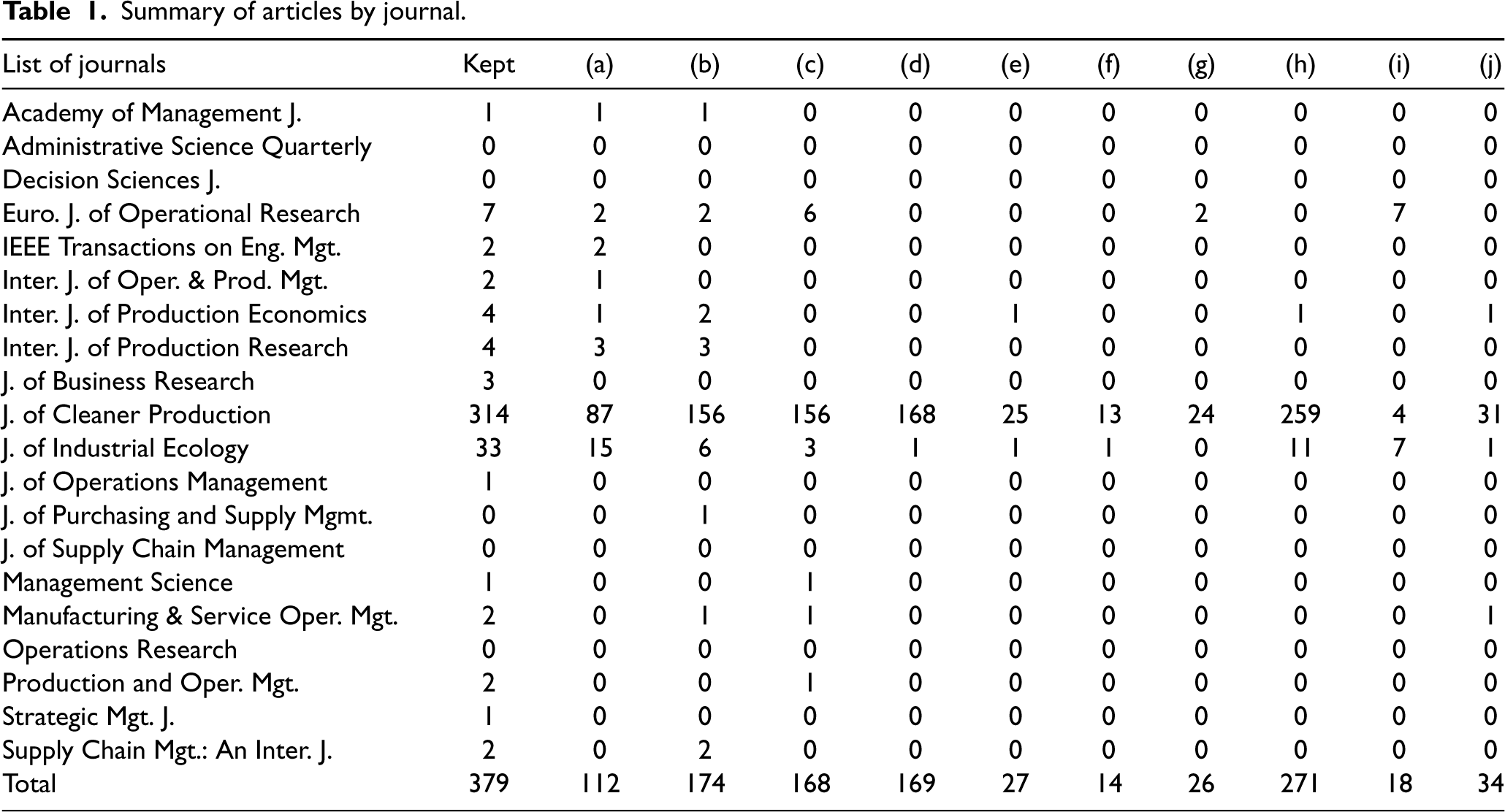
. All papers found during this additional search from the focal journals were screened based on the criteria used for the initial search, if they had not already been screened during the initial search. Collectively, between the initial search, backward and forward search, a total of 1,392 articles were reviewed by the author team. Of these, 379 were included for the literature review; 152 (138 from the initial search and an additional 14 from the backward and forward searches) of those articles fully focused on water. The remaining articles discussed water as a smaller topic within the broader study. A full accounting of how many papers were kept or excluded by each category described in this section for each journal can be found in Table 1. Data extraction: The 152 articles fully focused on water were used to develop an organizing framework for the literature review as part of data extraction. This was a four‐stage process. First, the authors read through each article. During this activity, topics emerged which the authors discussed iteratively to develop a parsimonious organizing framework based around decision‐making that is discussed in detail in Section 3. The papers often discussed topics that were not specific to firms and supply chains, instead focusing on a variety of issues such as infrastructure and international trade, among other topics. Given the need to organize these varied topics around themes that would benefit researchers in OSCM, a narrative review was performed to organize the literature (Coster et al., 2017; Xiao and Watson, 2019). In such a review, relevant information is synthesized into themes to provide substance and context around a topic of interest as interpreted through a review of the text. Second, at least two authors re‐read all 152 papers and classified them based on the definitions created for each theme within the framework. This process was used to develop agreement on the structure of the organizing framework. The two authors agreed on 128 (82.4%) of the papers. A third author read through 50 of these 128 papers to assess if they also agreed with the classification of the initial reviewers. The third reader agreed in all instances. Third, in the 24 cases of disagreement an additional author read through the papers and the disagreement was discussed until consensus was reached. The authors were able to reach consensus on 23 of the 24 papers. Fourth, for the one paper that a consensus could not be reached, Subtil et al. (2017), the paper and definitions used for classification were provided to two unaffiliated academic readers to classify without knowledge of the author team's classifications. Between the five reviewers a majority opinion was reached on classifying the paper. The additional 227 papers partially focused on water were not classified. Given the broader scope of these papers, they did not fit well within our classification scheme for water. Accordingly, the concepts related to water from these papers were logged and used for additional context, but the papers themselves were not classified. For clarity and transparency, a full list of articles that were deemed relevant for the literature review is presented in Tables 2 and 3 of the Appendix in the Supporting Information with a short summary of the relevant concepts from each paper. Synthesis of data: The organizing framework used for our narrative synthesis of the literature is discussed in Section 3. This organizing framework was developed through a review of existing frameworks in the literature, particularly the “three cycles” model (Liu et al., 2010; Hundertmark et al., 2020) that was adapted to focus on firm and supply chain considerations. To assess face validity of the framework, feedback was sought from practice experts at the United States Geological Survey (USGS). Practice case studies from public sources were also used to illustrate the paper's findings and applications that were uniquely related to supply chains to enrich the review. Reporting of findings: A narrative synthesis (Coster et al., 2017; Xiao and Watson, 2019) of the literature with additional practice case studies was undertaken to make the study relevant to the audience in OSCM. The remainder of this paper beyond Section 3 reports the findings as they relate to the organizing framework that is proposed.
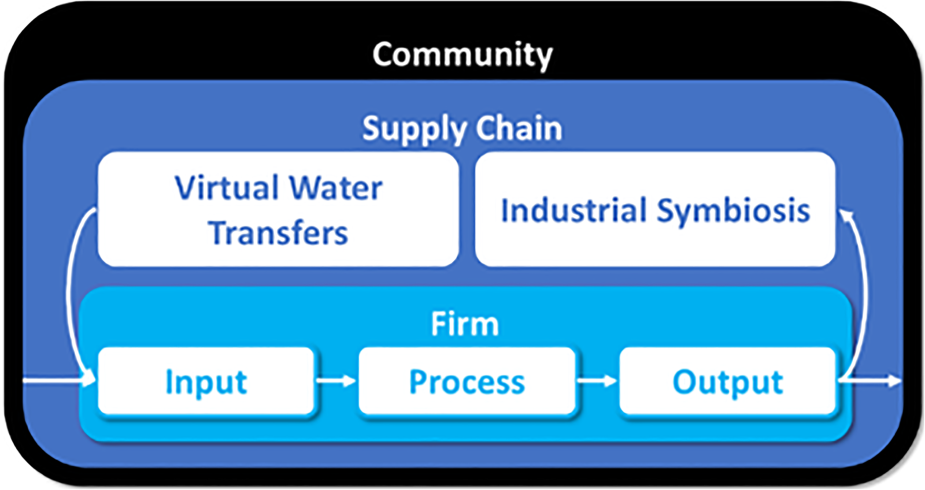
Organizing framework.
Summary of articles by journal.
There are three distinct levels at which decision‐making related to water occurs in relation to business activities: the firm, the supply chain and the broader community. The lowest level of decision‐making occurs within a firm. These are activities that a firm can control independent of other organizations and are defined as:
The next level of decision‐making requires coordination across firms, and consequently is inter‐organizational or supply chain focused. Such activities relate to transfers of water or the pollutants contained within the water between firms. Decisions at this level are defined as:
The highest level of decision‐making takes place at the level of the broader community. Decision‐making at this level goes beyond the boundaries of the business environment to consider societal issues and policy, influencing the environment in which supply chains and firms operate. These are the processes in which society exerts influence to alter water usage by the firm. Community level concepts within the proposed framework are defined as:
The framework, summarized in Figure 1, builds upon past concepts in the water literature to show how decisions related to water are made at different, interconnected levels. Liu et al. (2010) discuss water use in the Hai Hua Ecological Industry Pilot Zone (HHEIPZ) of China and how usage occurs within small (firm), medium (supply chain), and large (community) cycles. Similarly, McKinsey & Company also discusses three similar spheres of influence with regard to water: direct operations, the supply chain, and the health of the water basin (Hundertmark et al., 2020). This study builds upon the existing structuring by connecting concepts at these three levels of aggregation to decisions at the firm (input, process, output) and supply chain (virtual water transfers, industrial symbiosis) levels where different managerial actions are needed. The following sections present our findings about response to water stress at these levels.
Responses to Water Stress
This section describes responses to water stress that have a tangible impact on businesses. The themes in this section are organized around the framework in Figure 1, which highlights different strategies at the firm and supply chain level, which are in turn influenced by the broader community. The drivers and consequences of all three levels affect one another in significant and interconnected ways, with certain activities feeding directly into others, such as firm level water outputs leading to industrial symbiosis. Accordingly, in building the discussion of water responses within a particular level, the focus is on decision‐making within a category and can draw from concepts in studies that are classified in other categories to clarify and provide context for a concept. This maintains the spirit of a narrative synthesis of the literature while organizing insights relevant to the OSCM audience.
Firm Level
Input
Firms can access water for production purposes from a limited number of sources. Each water source varies by cost, ease of access, and water quality. In general, water sources are treated and distributed by a central entity such as a municipal utility or decentralized and acquired at the point of use. Decentralized supplies are the primary means by which firms augment their supply independently. One primary mode of decentralized supply is rainwater harvesting. This mode is less expensive than purchasing municipal water (Faragò et al., 2019) but is less economical as building size and required water volumes increase due to pumping needs (Siems and Sahin, 2016). Wastewater is another option (Hyde, 2013), though supply can be inconsistent (Leong et al., 2018) and is more expensive to treat than rainwater harvesting (Stec et al., 2017). Water used for cooling can also be used in process (Alkaya and Demirer, 2014). Water quality concerns may make firms hesitant to use harvested or recycled water, however (Takagi et al., 2019). Another potential source of water is desalination, though it is an expensive option given its capital and energy intensity (Abdulbaki et al., 2017; Stec et al., 2017).
From a managerial standpoint, these diverse sources of water offer opportunities to consider prescriptive analytics to optimize water costs across multiple sources with varied quality. For example, Abdulbaki et al. (2017) construct a decision support system that optimizes trade‐offs between various supply, demand, and treatment scenarios. Their analysis suggests that even if freshwater has a low cost, supply is a constraint. Thus, it may be optimal to blend higher cost sources like wastewater treatment and desalination plants to meet overall water requirements. Other options that could be considered are alternative carrying mediums to replace water (Sathish et al., 2016) and the recovery of economically valuable materials from filtered water (Mbaya et al., 2017) to off‐set costs. Some firms may also opt to store wastewater for future re‐use (Song et al., 2020).
Process
Managing Water use Through Process Technology
Firms have implemented various technologies to reduce process related water use. These include improved monitoring systems (de Oliveira Neto et al., 2019), automatic shut offs, high pressure water nozzles, filtering systems that allow for more flexible water reuse (Caspersen and Sørensen, 1998), opting for equipment that can use lower quality water (Jia et al., 2016) and using mechanical instead of water conveyor systems (Adams and Ghaly, 2007). Technological improvements are not limited to the equipment used. They can also take the form of substitute raw materials (Roos et al., 2016), alternative carrying mediums (Sathish et al., 2016), and waterless chemicals (Hussain and Wahab, 2018) that reduce the need of water as an input. For example, DyeCoo, has developed a process of textile dyeing that not only eliminates water use, but also substantially cuts the toxic emissions of dyeing units (Thornton, 2019).
Water Reuse, Recycling, and Loss Prevention in Process
Water demand within firms can be reduced by loss prevention measures (Peña and Huijbregts, 2014). Firms can use several Lean approaches to reduce water use in process and identify waste (Sodhi, 2015). These include minimizing leakages with proper maintenance (Hengst et al., 2020), removal of redundant processes (Gunson et al., 2012), optimizing process sequences based on water quality needs, reuse of cooling and process water, and improving manufacturing processes through changing or avoiding chemicals that make water harder to filter for future use (Hussain and Wahab, 2018). There are numerous examples of Lean processes improving water use efficiency. Pacific Gas and Electric (PG&E) and its key supplier Southwire used value stream mapping to implement a water‐looping process in Southwire's Georgia plant that saved over 9 million gallons of water, over 90% of which had been used in process (EPA, 2011). Similarly, McNeil PPC and J&J identified that 450 gallons of water were wasted in changing lines during the manufacturing process of Listerine. They reduced water discharges 25%–30% by implementing processes that reused boiler water, used flavors to clean equipment, sequenced the flavors from light to dark, used closed‐loop cooling, and changed to waterless conveyer belts (EPA, 2011).
Packaging is another important contributor to water use (Caspersen and Sørensen, 1998). The wastewater footprints of the plastics and paper industries are large, estimated at 330 billion cubic meters per year (Briggs and Bradshaw, 2017). Dupont reduced wastewater by 30% in Japan by changing to wooden reusable pallets (DuPont, n.d.). It is noteworthy that bio‐degradable packaging is more water intensive than conventional options (Dilkes‐Hoffman et al., 2018), presenting firms with tradeoffs to weigh before making decisions.
Finally, water consumption may be improved by more effective monitoring. Cooling systems benefit from real‐time monitoring and predictive analytics to optimize water usage (Schulze et al., 2019). Optimizing water pumping schedules through real‐time monitoring can facilitate responses that can reduce energy and water use (Luna et al., 2019). Big data and analytics can play a substantial role in such optimization efforts. Water management company Apana deploys analytics, machine learning, and Internet of Things technology to help firms monitor the inventory of their water. Apana services and technologies helped Costco to reduce water consumption by 22% across its North American operations (Business Wire, 2018).
Managing Employee Behavior to Reduce Water Waste
Water awareness training can reduce water use (Puplampu and Siebel, 2005). Real‐time distribution of data to employees can provide opportunities for additional water use reduction decisions (Chen et al., 2017) as operators on the line can react to compensate for abnormal usage (King, 1999) or shut down unnecessary processes (Chaturvedi and Bandyopadhyay, 2014). Data gathering is also important for identifying potential problems as they arise (Hengst et al., 2020). Frito Lay is an example of this. The firm established the “Gallon per Pound Challenge” that set a goal of 95% water use efficiency across its facilities. This required the creation of extensive awareness training, data collection, and monitoring. The firm set up a water efficiency scorecard that was emailed monthly to all stakeholders, distributed best practices periodically, and held cross‐functional meetings of technicians and workers who compared actual water consumption to target rates to assess root cause. These efforts saved the firm one billion gallons of water in 2007 (EPA, 2011).
Output
How firms discharge water, both in terms of quantity and quality poses multiple challenges for firms and the business environment. Water pollutants can impact local firms by increasing the cost of treating water for use (Abdulbaki et al., 2017), so firms should be aware of the impact of their own water discharges. This is especially important in industries where incidental pollution discharges (Gao et al., 2017) or nutrients in wastewater are common as they can have a substantial negative impact on local water quality (Puplampu and Siebel, 2005). Beyond direct costs, water pollution can also create substantial legal risks. For example, 3M recently settled a lawsuit with Minnesota for $850 million over “forever chemicals” pollutants (Bjorhus, 2021). Polluting water discharges can also impact other regions beyond the focal region. For example, nitrogen runoff from farming operations in Iowa has impacted marine life in the Gulf of Mexico (Jensen, 2018).
Supply Chain Level
Virtual Water Transfers
Water inputs are embedded in products and transferred through supply chains, often crossing regional boundaries. Virtual water transfers vary by industry and are especially prominent in the food, beverages, chemicals, and paper products sectors (Cai et al., 2019; Ma et al., 2019). Virtual water use can be substantially higher when spoilage is considered, especially in the food industry. For example, the virtual water content of mangoes produced in Australia at the distribution stage was almost twice the amount at the production stage, owing to spoilage across the supply chain (Ridoutt et al., 2010). As water conservation efforts take root, reducing spoilage can minimize product inventories and reduce virtual water waste.
Some firms initiate audits and stewardship programs to manage water waste across their supply chains. For example, PepsiCo and Hormel foods have participated in Agwater Stewardship commitments by developing supplier water stewardship policies (Ceres, 2016). PepsiCo aims to improve supplier water efficiency 15% by 2025 (PepsiCo, 2021). In recent years, Hormel Foods completed its first water risk questionnaire to help suppliers implement watershed programs (Hormel Foods, 2020). Similarly, the Water < Less program of Levi Strauss and Company leverages the Aqueduct Water Risk Atlas to identify suppliers that use excessive water and take proactive measures to influence suppliers to reduce water consumption (Garden, 2021). These policies can provide suppliers incentives to implement water reduction programs, helping to reduce water use across the supply chain and the degree of virtual transfers. Yet, these initiatives are also challenging to implement. Sehnem and Oliveira (2017) analyzed agribusiness relationships with suppliers and found that only one of six suppliers implemented water stewardship programs despite the buying firm having them. Firms could help increase supplier acceptance through water accounting in sourcing decisions (Manzardo et al., 2014) that would allow them to focus their spend on more water efficient suppliers (Sherafati et al., 2019).
Supply chains shift water from one firm to another and thus can facilitate the recovery of water (Ünal and Shao, 2019). For example, recycled steel requires 76% less water than first‐use steel (Kumar and Putnam, 2008). Closed loop supply chains can also achieve substantial water savings through “Product‐as‐Service” agreements, where recovery is built into the system by selling a service instead of a product. An example of this model are diaper service companies that sell the use of diapers and then collect them to wash for reuse. The industrial washing of cloth diapers can lead to a reduction of both water and energy use (Hoffmann et al., 2020). New technology developed by companies such as AquaFresco, which recycles 95% of water and detergent used in washing machines (Khalamayzer, 2017), can be extended to water intensive activities in many domains.
Industrial Symbiosis
Water can travel between regions through supply chains, as can water pollution. Industrial and agricultural processes often generate water pollution in producing regions while the value derived from the processes benefit other regions. This is especially problematic when production occurs in low‐income countries and the final demand and consumption occurs in wealthier countries (Liao et al., 2019). The practice of industrial symbiosis can reduce the environmental and economic damage of water pollution to an extent, especially because water only needs to travel short distances for reuse (Park et al., 2019). For example, effluent from food and beverage production (Cano Londoño et al., 2017) and some manufactured goods like latex (Martinez‐Hernandez and Hernandez, 2018) can be used as nutrients for agriculture (Mañas et al., 2014). Biofuels can also be produced from effluent (Cano Londoño et al., 2017). A challenge with such practices is identifying and matching demand with supply. Government agencies (Liu et al., 2015) and industrial parks (Yu et al., 2014) can facilitate such information sharing through a water commons.
The Community Level
Firms and supply chains do not operate in isolation. Decision makers at the community level balance the competing interests of many constituents. Their decisions impact and often constrain a firm's options relating to water use. Communities can influence behavior across firms and supply chains through regulation (Sahin et al., 2017) such as restrictions on freshwater use (Leonard et al., 2015) and requirements for water reuse technology (Meza Solana and Juárez Nájera, 2016). Output related restrictions can also be used to improve water quality (Xu et al., 2020). Water use restrictions can create strong financial incentives for firms to become more water efficient without taxes or subsidies. If restrictions reduce the firm's capacity, it will result in lost sales that will create a financial incentive in and of itself (Siskos and Van Wassenhove, 2017). Pollution release restrictions can have a similar impact (Meza Solana and Juárez Nájera, 2016).
Government regulations may also focus on water reuse. Some states in the United States, such as California and Nevada, have well‐established water reuse laws (PPC Land Consultants, 2017), with country‐level regulations in water‐scarce regions such as Saudi Arabia (GE, 2015) and Israel (Siegel, 2019). Such regulations may include: (a) tax relief: for example, Washington State exempts 75% of income from reclaimed water services from taxation; (b) investment tax credits: for example, New Jersey provides a sales tax refund for water treatment and/or conveyance equipment purchased and operated; (c) government funding: for example, water reuse and reclamation projects can be financed by federal grants available under the Title XVI of the reclamation wastewater and groundwater study and facilities act (available in 17 states); and (d) public‐private partnerships: for example, tax‐exempt private activity bonds to incentivize private investment (Water Finance and Management, 2012). Overall, these will impact the economics of water consumption and discharge across different types of uses.
Pricing is another tool that communities use to reduce water consumption. An example is drought pricing, where the price of water rises in periods of drought (Sahin et al., 2015). A more sophisticated scheme is seasonal pricing where prices are increased in real time when predetermined criteria are met (Pesic et al., 2013). Using pricing to encourage conservation can be problematic. Price increases can be seen as punitive by those that have already invested capital to reduce water use (Mu et al., 2019). Instead of raising the cost of potable water, subsidies can make the use of less pure water sources more attractive (Yu et al., 2015), incentivize sharing (Dawande et al., 2013), or compelling the use of water‐efficient technologies (Dong et al., 2012).
Summary of suggested research opportunities for future studies: Major themes.
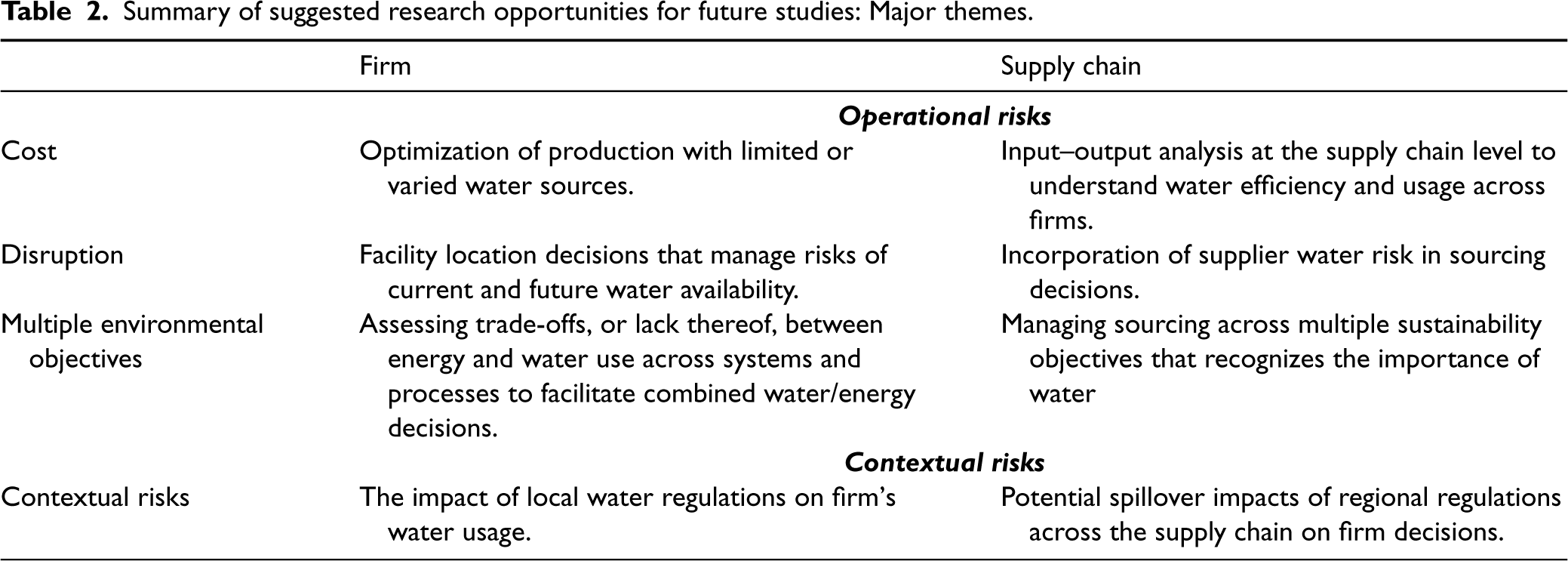
Summary of suggested research opportunities for future studies: Major themes.
Finally, there are initiatives at the intersection of firms, supply chains and communities. Initiatives such as Water in Circular Economy and Resilience (WICER) led by the World Bank focus on integrating firm, supply chain, and community level challenges in urban settings. WICER aims to establish a common understanding of water, using circular economy ideals to increase resilience to water shortages. The Netherlands has embraced such ideas related to reuse and recycling at the household, firm, and community levels. For example, Amsterdam works with utilities to recycle water, and Rotterdam filters medicine residues from wastewater to create biogas for energy generation (Delgado et al., 2021). Such regulations and community initiatives can thus spur collective action and innovation.
Several research opportunities related to water stress across OSCM arise from this literature review. These research opportunities focus on gaps in understanding how firms and supply chains should respond to the operational and contextual risks they face. The major research opportunity themes are summarized in Table 2. With regard to Table 2, an important aspect to be recognized is that both contextual and operating risks are intertwined. To aid researchers in investigating these issues, datasets used in prior literature, in addition to other datasets identified over the course of this research not seen in prior literature, are summarized in Table 1 in the Supporting Information. This table provides information on prior use, a general description of the data as well as examples of papers that have previously used the data. The intention of summarizing the datasets is not to claim an exhaustive list of all possible sources of water data but to provide a reasonably comprehensive survey of datasets that can be used by researchers.
One challenge in applying the current water literature to OSCM is that existing research is not focused on OSCM issues. It is instead focused on topics within public policy, engineering, infrastructure and other related areas. Accordingly, a narrative review of research was used, which weaves existing literature into research topics that are relevant to the OSCM literature. This is a key contribution of this paper in that it takes the varied water topics from across disciplines and connects the insights from the papers back to supply chain settings. This process revealed many research opportunities specific to firm and supply chain level decision‐making that require attention. The opportunities presented also embed community level issues that firms and supply chains face in their decision‐making. Subsections 5.1 and 5.2 present the opportunities, next.
Operational Risks
Firm Level
Given the regional nature of water resources, most facility‐level decisions are directly affected by the firm's location decision. More developed regions offer greater access to labor, infrastructure and local suppliers but may also face localized water stress. McKinsey & Company notes that a majority of freshwater resources in the world are situated in about 410 hydrological basins. A quarter of these are now high stress and account for about 51% of withdrawals with more than half located in high economic activity regions such as India, China, and the United States (Hundertmark et al., 2020). Increasing water stress means that facilities can be subject to unexpected challenges once the location decision is committed. For example, Western Digital noted “
Another challenge is that the impact of water consumption can be a function of water stress in a location. The Availability WAter REmaining (AWARE) database from Argonne National Labs provides scaling factors to express water use at the river basin/country level of remaining freshwater reserves after accounting for human and aquatic demands. Similarly, new firms such as Waterfund LLC have developed indices for tracking the cost of water production per cubic meter of drinking water (Burne, 2013). These databases are a step toward providing firms the ability to construct scenario‐based analysis on costs and investments related to managing water stress and to assess long‐term viability of situating manufacturing plants within particular regions.
Within an existing facility, planning models that consider water reuse and recycling which balance a portfolio of centralized and decentralized water sources are an important analytical tool for firms. Such approaches could also consider energy‐water trade‐offs within processes that may occur due to changes in water availability and quality (e.g., Abdulbaki et al., 2017). A key element here is to plan these models in a dynamic fashion considering changing weather patterns that may drive changes in water availability and merging them with other externally available information on water and consumption data (e.g., Leroux and Martin, 2016). Such large‐scale applications may also be merged with data on costs of the varying water resource inputs.
There are several available data sources covering the United States that can be the basis for innovative work and may provide templates for other regions. The US Drought Monitor offers a simple metric to characterize water scarcity, while the USGS and NOAA networks of stream gages, monitoring wells, and weather stations offer richer data with which to estimate water flows and availability. These can be merged with production information at the firm level. Further, the NWQMC (National Water Quality Monitoring Council) Water Quality Portal offers access to water quality samples taken by more than 400 organizations. Combined with facility‐level locations and their points of withdrawal, researchers can examine how water availability and quality may affect managerial decision‐making in facilities.
Several big data examples exist on predictive maintenance and effluent quality control within the context of wastewater plants. These models assume that changes in process level water quality may drive the quality of effluent. Operationalizing these models would require real‐time responses from organizations and involves deploying approaches such as machine learning (e.g., Wang et al., 2021). At the same time, new start‐ups such as Ketos (https://ketos.co) provide integrated information based on the Internet of Things platform and machine learning approaches to monitor water quality and use efficiency.
With climate change becoming an urgent concern, simultaneous attention to water and carbon has also become important (United Nations, 2020). As discussed in Subsection 1.2, efforts to address carbon emissions and water usage can have an antagonistic effect on each other. This conundrum provides research opportunities to understand the consequences of actions to address both sustainability concerns simultaneously. TruCost and the CDP Project both offer data on water usage and carbon emissions at the firm level that could be used to examine tradeoffs using analytical approaches such as data envelopment analysis. CDP could be especially fruitful for such analysis because some firm reports discuss the trade‐offs that are occurring between carbon emissions and water usage. Such metadata can help develop new comparative metrics across firms.
What cannot be measured cannot be improved. Although creating such metrics is challenging, they are needed. Measurement of water footprint in products for firms is especially challenging. For example, the water footprint of a commodity can vary across regions and means of production. Further mechanisms to assess water intensity of a product, the extent of water depletion caused by the product, and extent of pollution are extremely challenging (Hoekstra, 2010). This would require firms to collect and assess information starting from across all tiers of the supply chain—requiring a high level of transparency. Further, detailed accounting of such information can facilitate governments to alter their trade policies to reduce the water impact of consumption as well (Hoekstra, 2010). Overall, establishing effective mechanisms would require a more intensive collaboration between firms and governments as well.
Supply Chain Level
Water transfers introduce uncertainty and water‐specific risks within supply chains. Companies such as Unilever, Mars, and PepsiCo are among the leaders in actively pursuing supply chain governance policies to protect the watersheds of their agricultural suppliers (Siegner, 2019). Research addressing effective water governance across supply chains to minimize risks of disruption are still in a nascent stage. For example, SABMiller company undertook water footprint analysis and found that 98.3% of its water footprint came from South African crop growth. The firm used this information to minimize risks of water as a shared resource with the community in its hop supply chain by entering into partnerships in the Gouritz Water Management area (Chapagain and Tickner, 2012). Similarly, AMD has identified Taiwan as a potential disruption point in its supply chain: “
Although numerous examples of research that involve input–output analysis or life cycle assessment at the regional or product level were found in the literature review, the decision‐making process behind make or buy decisions, or production decisions for water intensive products, if any, have not been sufficiently explored (Leroux and Martin, 2016). Likewise, there is plentiful research examining water transfers from the product and region level, but explorations of how these transfers affect decisions at the supply chain level are limited. Firms in water scarce regions must decide on outsourcing production of water intensive products (Mekonnen and Hoekstra, 2011), necessitating sustainability planning in collaboration with other firms. In many cases, outsourcing could push water use risk on to suppliers in developing regions that are less well equipped to handle the challenges and are exposed to water stress themselves. For example, 49% of total blue water (water withdrawn directly from water sources) exports occur in Australia, China, India, Pakistan, Turkey, and Uzbekistan—all water stressed regions (Mekonnen and Hoekstra, 2011). Water related challenges must then form a component of supplier audits. The importance of supplier audits and water policy compliance could be integrated into a firm's sustainability policies in addition to traditional carbon‐related compliance policies.
Using network data such as Compustat or FactSet that link buying and supplying firms together along with supplier locations could offer opportunities to examine water stress across the supplier network and the risks of water‐related disruption. Better understanding water risks may also drive supplier selection choices that are based on the regional water characteristics of the supplier and their location. Specific regional water characteristics can be obtained from global hydrography datasets such as MERIT‐Hydro (Yamazaki et al., 2019) or HydroSHEDS (Lehner et al., 2008). These can be combined with global hydrometeorology data or derived data products such as WRI Aqueduct to situate production processes that require substantial water within specific watersheds. A key challenge in undertaking such analysis at the firm level is obtaining facility level location data. In addition, there are opportunities to understand how firms and industries with water intensive processes can work with communities to collectively approach planning in a water commons that integrates pricing and usage data across stakeholders within a region. At the supply chain level, better understanding of water pricing and usage at specific facility locations can also identify challenges relating to water transfer across regions.
Contextual Risks
The impact of water regulations on firms should be explored in terms of its efficacy as well as potential for disruptions. Kumbai Iron Ore company, for example, when discussing water risks in the value chain noted: “
There is also a need to understand the impact of firm initiatives to be water independent. Firms often rely on community infrastructure for water supplies. Relying on local infrastructure means that firms do not need to build their own, but they are then at the mercy of the water utility. The example of GM in the introduction section is a case in which the public utility switched water sources and GM was forced to invest in costly reverse osmosis processes to fix water quality problems that had disrupted production (Colias, 2016). Ultimately, GM switched to a different public water system. There can be greater freedom and lower costs when firms directly abstract water, but direct abstraction can also drive negative community sentiment and potential legal challenges (Ellison, 2020), adding to costs. How firms approach this question is important given that water pricing often does not reflect true economic or social value. TruCost offers data on directly abstracted and purchased water at the firm level that could be used to examine which factors lead firms to purchase or directly abstract water, and whether these decisions have wider ranging ramifications for firm costs or processes.
Equity‐related issues at the community level focus on examining water as a shared resource facilitated by a central agency—a water commons (Giordano et al., 2014). This is because water use in supply chains is situated in the context of hydrology or the structure of regional water flows. Understanding how water flows in the environment is crucial to understanding how supply chains interact with water systems, requiring a holistic examination of how firms and supply chains interact with communities. Freshwater is withdrawn from a system in which a hydrologic cycle is active, where water from precipitation may eventually run off, with any pollutants contained in it, into surface water bodies and groundwater stores. An overview of hydrologic cycle can be found in Evenson et al. (2013). Any user's water withdrawals in a given watershed is informed by this cycle. Simultaneously, withdrawal and discharge decisions affect the water cycle and thus the quantity and quality of water available to other users. The state of the water cycle in a region can shape and be shaped by collective actions such as regulatory frameworks that influence water use decisions. Thus, both water accounting, and water budgeting across uses need careful attention. Such information can be useful for firms in planning their water inputs. These tools can be critical to water cost estimation and the optimization of operations in tandem with the hydrology of supply chains. It is thus important to consider the hydrologic context of supply chains, including watersheds from which water is withdrawn for production, watersheds to which effluent is discharged, and watersheds to which virtual water is imported, forgoing withdrawals in the local area. These considerations allow firms and public entities to estimate a fuller impact of water use and flow that require new data intensive approaches using water budgets.
Indeed, in economies situated in hydrologic regions characterized by water stress, it is becoming increasingly common for water budgets to be calculated by water infrastructure planners and allocating authorities to help influence water policies that then influence water use decisions by firms. A water budget is analogous to a financial budget, quantifying inflows, outflows, and transfers between different stocks of water such as streams, lakes, groundwater, the atmosphere, and artificial storage reservoirs within a region of interest (Healy et al., 2007). For example, water budgets are calculated at a regional scale in Australia by the Federal Bureau of Meteorology to provide a consistent source of information about water availability that can be used by public agencies and firms to make decisions about water supply development, water trading, and water use (Green et al., 2018).
In California, the Department of Water Resources has published a water budgeting handbook with detailed recommendations for methodology and data sources for constructing water budgets for water management and planning. An overview of this process can be found in the Handbook for Water Budget Development detailed by the California Department of Water Resources (2020). A particularly important flow of water calculated in water budgets is “consumptive use,” which is water that is withdrawn from surface or ground water, but not returned. Water withdrawn for cooling during industrial or energy generation processes is an example of nonconsumptive use. Quantifying evapotranspiration for a given water user is important for inferring the impact on water availability for downstream users.
Estimating water budgets for watersheds relevant to a particular supply chain may be fruitful when analyzing the causes and consequences of water use decisions. Doing so requires marshalling data about locations and quantity of withdrawal, water quality at those locations, how water is used and consumed, and the quantity and quality of water discharged back into water bodies. These data are most useful when indexed to a hydrography dataset. Such datasets are a representation of stream segments and their relevant watersheds and/or aquifers, so a location's position up or downstream of other users can be incorporated into analyses. In addition, information about regulatory regimes in place, including any policies and their triggers related to hydrologic conditions may be useful. Such an assembly of data would allow decisions by water users to be modeled as functions of economically, politically, or hydrologically upstream users and any relevant institutions around water management. This information can also be useful in formulation of industrial symbiosis networks (see, for example, Neves et al., 2020) including assessment of water reuse patterns and regulation of water use across commons (Frijns et al., 2016). As countries increasingly impose on firm water withdrawals and use, these issues become important for production planning and will require approaches and analytics to parse cost, risk, and equity implications.
Addressing water consumption can also create financial hardships in communities as the price of water per unit increases when demand decreases due to the majority of the cost being fixed expenses such as infrastructure (Sedlak, 2014). Analytics to better understand those consuming the most water will allow target pricing to ensure the most consumptive users carry this cost burden (University of California Davis, n.d.). This creates an opportunity for analytics to help tackle the problem of equity at the community level by allocating a scarce and vital resource in ways that both maintain the resource's value while still providing access to those that require it but cannot necessarily afford it.
On the consumer side, several data‐based startups are focusing on machine learning based methods to help local water utilities and households conserve water. The startup, Neer, based in Missouri, has created a real‐time water management platform. The platform is powered by machine learning to assess leakages in drinking water distribution mains, and in assessing the risk of leakage in stormwater systems. Even social media has been found to be useful in understanding water challenges. For example, Smith et al. (2017) use Twitter data in parallel with real‐time hydrodynamic modeling to assess flooding risks. Surprisingly, the authors found substantial congruence between crowdsourced social media data and hydrodynamic models, even if the tweet data were of small sample size. These studies may also offer novel approaches to using social media data for water research and account for community level risks that firms may see in managing their supply chains.
Conclusion
This paper contributes to the current sustainability literature in supply chain and operations in four important ways. First, this study provides a first of its kind literature review of water stress as it relates to firms and supply chains to help spur new thinking in this nascent, but critically important area. Given that the bulk of existing literature is not specifically targeted to the OSCM audience, this task involved taking concepts from different fields and weaving them together into themes of direct relevance to firms and their supply chains. This required a narrative synthesis that integrated topics in other disciplines that have not focused on OSCM into topics relevant to OSCM. Thus, the study suffers from typical limitations of narrative review. Specifically, issues are identified based on authors' judgment. Yet, the study goes past traditional reviews in identifying datasets, and taking concepts from a large body of literature to give an in‐depth view of water stress as it relates to firms and supply chains. Second, it builds a framework to organize water related research, specifically for the production and operations management audience that is organized around the different levels at which decisions related to water occur. Third, the study highlights key challenges of water stress and firm responses. These challenges are organized into operational and contextual risks. Finally, several gaps in the current literature are highlighted which would benefit from greater exploration with a supply chains and operations focus and available datasets that may be helpful to researchers and practitioners are identified and presented in the Appendix in the Supporting Information.
Supplemental Material
sj-pdf-1-pao-10.1177_10591478231225881 - Supplemental material for Water Stress: Opportunities for Supply Chain Research
Supplemental material, sj-pdf-1-pao-10.1177_10591478231225881 for Water Stress: Opportunities for Supply Chain Research by Dustin Cole, Sriram Narayanan, Elizabeth Connors, Meenu Tewari and Kyle Onda in Production and Operations Management
Footnotes
Acknowledgments
We wish to thank individuals from both the United States Geologic Survey and Michigan's department of Environment, Great Lakes and Energy for feedback on the paper during the writing process. We also acknowledge constructive feedback from three anonymous reviewers and the anonymous senior editor who offered constructive inputs.
Declaration of Conflicting Interests
The authors declared no potential conflicts of interest with respect to the research, authorship, and/or publication of this article.
Funding
The authors received no financial support for the research, authorship, and/or publication of this article.

Notes
How to cite this article
Cole D, Narayanan, S, Connors, E, Tewari, M and Onda K (2024). Water Stress: Opportunities for Supply Chain Research.