






Abstract
Ride‐hailing platforms such as Uber and Lyft promise to reduce the negative externalities of driving and improve access to transportation. However, recent empirical evidence has been mixed about the impact of ride‐hailing on US cities, often resulting in a net increase in traffic congestion and greenhouse gas (GHG) emissions, largely due to increased travel demand and competition with public transit. Pooled rides, in which multiple passengers share a single vehicle, are an effective solution to improve the sustainability of ride‐hailing, reducing GHG emissions and traffic congestion and appealing to price‐sensitive population segments by offering relatively cheaper rides. Yet, most ride‐hailing trips are unprofitable currently, resulting from ride‐hailing rides being subsidized (especially pooled) to compete with cheaper transportation alternatives such as public transit. In this paper, we consider whether price optimization can be used to improve ride‐hailing revenues while also reducing the environmental impacts of ride‐hailing, particularly as the cost of ride‐hailing is expected to fall into the future with the introduction of automated vehicles. Using a discrete choice experiment and multinomial logit choice model with a representative sample of the US population, we estimate consumer preferences for the attributes of ride‐hailing services and use them to explore how ride prices affect the revenue of ride‐hailing platforms and the total vehicle miles traveled (VMT) by the ride‐hailing fleet. We show that as the costs of driving fall, continuously increasing the difference between the prices of individual and pooled rides is financially optimal for ride‐hailing platforms. Importantly, this pricing strategy also significantly reduces total VMT, resulting in a win–win for ride‐hailing platforms and cities. We perform extensive sensitivity analyses and show that our results are qualitatively robust under a wide range of consumer preferences and market conditions but that the optimal trajectory of prices and realized gains vary, highlighting opportunities for ride‐hailing services to influence the future of urban transportation.
INTRODUCTION
Improving the sustainability of urban transportation is one of the top priorities for cities increasingly concerned about externalities including air pollution (US EPA, 2019) and traffic congestion (Pishue, 2020; Reed & Kidd, 2019). While much emphasis has been placed on the introduction of low and zero‐emission vehicles, the speed with which the benefits of these technologies are realized is slow, governed by factors including consumer acceptance, the maturing of key technologies such as batteries and sensors, and the slow rate of turnover of the on‐road vehicle fleet (Keith et al., 2019; Naumov et al., 2022). While this technological transition unfolds, immediate opportunities to improve the sustainability of transportation lie in making effective operational decisions to maximize the efficiency of our existing transportation systems. Several such opportunities exist, including regulations that impose time windows on freight delivery (Quak & de Koster, 2007) and support crowdsourced delivery systems (Qi et al., 2018; Ta et al., 2018), managing overall passenger demand for driving relative to other transportation modes to reduce the total number of miles driven (Sumantran et al., 2017), supporting existing public transportation infrastructure to prevent its collapse in the wake of increasing popularity of ride‐hailing services (Naumov et al., 2020), and smoothing transportation flow to ensure those miles driven are as energy‐efficient as possible (Jabali et al., 2012; Van Woensel et al., 2009).
Potentially, the most impactful of these opportunities is to increase the current low occupancy of automobiles, providing the same amount of economic and social mobility with fewer vehicle miles (Clewlow & Mishra, 2017; Fulton et al., 2017; Henao & Marshall, 2019b; Ke, Yang, & Zheng, 2020; Schaller, 2018; Shaheen & Cohen, 2019), and improving the throughput of our existing road infrastructure. Carpooling (hereafter referred to in this paper as pooling)—the act of sharing trips to increase the number of passengers per vehicle—has enjoyed renewed interest in recent years with the emergence of on‐demand ride‐hailing platforms such as Uber and Lyft. By automating the process of matching passengers with drivers (Taylor, 2018), ride‐hailing platforms have dramatically reduced the cost of finding passengers taking similar trips, making it no harder to book a pooled ride than a regular individual ride, with the potential for “triple bottom line” benefits for profit, people, and the planet (Kleindorfer et al., 2009). While a pooled ride has the potential to be less convenient than a private trip, requiring passengers to share the vehicle cabin and to take a longer route to one's destination to accommodate the other passenger(s), pooling has the benefit of substantially reducing travel costs, in turn making automotive transportation more accessible. The market potential of ride‐hailing could be further substantially unlocked by the emergence of automated vehicles (AVs), which may obviate the need to pay a person to drive the vehicle (Fulton et al., 2017). In the most optimistic assessments, it is anticipated that the cost of driving in ride‐sharing fleets could fall from about $1–2/mile today to $0.40/mile or less by 2030 with the introduction of AVs (Burns et al., 2012; Fulton et al., 2017).
Ride‐hailing has been promoted by platform operators as being good for cities, putting an end to personal vehicle ownership and traffic congestion induced by drivers looking for parking spaces and providing first‐ and last‐mile connections that facilitate greater use of public transit. The reality, however, has been mixed. While the impact of ride‐hailing on congestion might depend on traffic patterns and contextual factors such as weekdays, population density, and consumer travel mode preferences (see, e.g., Dhanorkar & Burtch, 2021; Yap et al., 2016), many studies (e.g., Clewlow & Mishra, 2017; Diao et al., 2021; Graehler & Mucci, 2019; Rodier, 2018) and reports (APTA, 2018; Fitzsimmons, 2018; Hughes, 2019; MTA, 2018; NYCEDC, 2017; SFCTA, 2018) have found that ride‐hailing has had a significantly negative impact on urban transportation systems, attracting riders away from public transit and causing an increase in vehicle miles traveled (VMT) and traffic congestion. Ride‐hailing services have been estimated to add 2.6 new vehicle miles driven for each mile of personal vehicle driving taken off the road (Schaller, 2018), and the introduction of ride‐hailing services has been associated with a 40% increase in weekday vehicle hours of traffic congestion (Erhardt et al., 2019). In addition, it has been conservatively estimated that deadheading (miles driven without any passengers) accounts for at least 41% of total ride‐hailing miles driven (Henao & Marshall, 2019b). These outcomes have been attributed in no small part to aggressive pricing by ride‐hailing platforms seeking to rapidly grow market share at the expense of profits, including offering various ride‐hailing services such as pooled rides at unsustainably low prices. It is reasonable then to ask whether the interests of ride‐hailing platforms and cities can now be reconciled. Can ride‐hailing companies price individual and pooled rides in a way that maximizes revenue while also encouraging riders to choose pooling to reduce VMT and hence the environmental footprint of urban transportation? How should prices for individual and pooled rides be updated if AVs and other automotive technologies reduce the cost of providing ride‐hailing trips in the coming years?
In this paper, we quantify preferences for the attributes of ride‐hailing services and then use results to develop optimal pricing for individual and pooled rides. We asked a nationally representative sample of over 1000 respondents to choose between an individual ride in a private vehicle (similar to UberX or Lyft) and a pooled ride in a shared vehicle (similar to Uber Pool or Lyft Shared). We then use the resulting data to estimate the coefficients of the attributes of consumer utility using a multinomial logit (MNL) model. Quantifying the relative strength of consumer preferences for attributes such as price and the inconvenience of pooling is critical to know how consumers will respond to ride‐hailing as a whole and the choice between individual and pooled rides at different price points. Applying these preferences in an optimization framework allows us to explore how ride‐hailing operators may price their services to both maximize revenue and maintain their social license to operate by reducing traffic congestion by increasing the use of pooled rides (e.g., Lunden, 2016). While it has been speculated that reduced prices (e.g., with the introduction of AVs) will increase the incentive for consumers to choose pooling (e.g., Fulton et al., 2017), our results imply that if the cost of driving falls, and firms simply reduce prices for both individual and pooled rides proportionally, then the incentive to pool will be reduced because the cost savings from choosing a pooled ride over an individual ride will be diminished. We show that to maximize revenues and realize the full potential of pooling, ride‐hailing operators must choose a pricing strategy that maintains a substantial difference between pooled and private rides, reducing prices for pooled rides but not individual rides once the cost of driving falls.
We perform extensive sensitivity analyses and show that our results are robust under a wide range of consumer preferences and market conditions but that the optimal trajectory of prices (i.e., the difference between individual and pooled rides) and realized gains (both financial and environmental) vary, characterizing a window of strategic opportunities for ride‐hailing companies to maximize financial gains while improving sustainability and accessibility of one of the most popular urban transportation modes. Importantly, our results demonstrate the environmental benefits for the ride‐hailing sector only, where we observe a greater market share of pooled rides and the reduced market share of individual rides. However, we do not make any assumptions about the environmental footprint of the alternative transportation options. Thus, a complete environmental profile would require an understanding of where new pooling consumers come from and where consumers who stop using individual rides go, for example, whether the alternative modes are more sustainable (e.g., public transit, walking, etc.) or less sustainable (e.g., privately owned cars) than ride‐hailing.
This paper makes important contributions to our understanding of whether ride‐hailing and pooling can provide triple bottom line benefits for urban mobility, identifying pricing strategies that increase revenues for ride‐hailing operators; provide more and better options for users; and reduce greenhouse gas emissions to the benefit of all. For the literature on sustainable operations and transportation policy (Angell & Klassen, 1999; Drake & Spinler, 2013; Naumov et al., 2020; Sterman et al., 2015), our findings highlight the attributes of ride‐hailing services that influence consumers’ decision to choose pooled rides (or not), providing necessary connection between individual‐level decisions and operational issues at the organizational level (Venkatesh, 2013). For the literature on service operations and sharing economy, we illustrate how the design and management of service systems, including pricing can be informed through a proper understanding of customer needs, expectations, and behavior (Bellos et al., 2017; Cohen, 2018; Goldstein et al., 2002; Guda & Subramanian, 2019).
For practitioners, our analysis informs the development of effective pricing strategies for on‐demand mobility services. We show that the relative pricing of ride‐hailing services is a critical lever for managing the private and societal impacts of ride‐hailing, with the potential to both maximize revenue and achieve a net reduction in driving demand if ride‐hailing services are priced to maintain both profit margins and financial incentive for consumers to choose pooling.
POOLING AND RIDE‐HAILING IN URBAN TRANSPORTATION
Pooling has been available to commuters as long as people have been traveling by vehicle. From a societal perspective, the appeal of pooling is the opportunity to increase vehicle utilization to use resources more efficiently, reducing negative externalities of driving such as air pollution and traffic congestion (Clewlow & Mishra, 2017; Fulton et al., 2017; Henao & Marshall, 2019b; Ke, Yang, & Zheng, 2020; Schaller, 2018; Shaheen & Cohen, 2019). However, the main appeal of pooling for consumers has always been the lower cost of travel. While pooling necessarily entails some degree of inconvenience since passengers face the likelihood of multiple stops along the route and must share the vehicle cabin, it allows multiple passengers to share the cost of the vehicle trip, reducing the per‐passenger cost significantly.
While the use of carpooling in the United States has fallen from about 20% of commuter trips in 1980 to just 9% in 2018 (AASHTO, 2015; US Census Bureau, 2018a), pooling has enjoyed a renewed interest in recent years with the emergence of app‐based ride‐hailing platforms such as Uber and Lyft. These platforms create value by matching passengers wanting to take a trip with drivers willing to provide those trips, and in turn, have dramatically reduced the cost of matching multiple passengers taking similar trips. Pooled ride options now appear alongside individual rides in many ride‐hailing apps, at prices often half to two‐thirds of the price of an individual ride, making pooling much more attractive, especially for price‐sensitive individuals. Prior to the COVID‐19 pandemic that saw ride‐hailing platforms suspend pooled rides to minimize social contacts, the popularity of pooling had been steadily increasing in the ride‐hailing context, with more than 20% of all Uber rides globally being pooled in 2016 (Lunden, 2016).
While ride‐hailing accounts for only a small fraction of VMT in the United States today (BTS, 2018; FHWA, 2018), its popularity is expected to grow in the coming years as ride‐hailing becomes an increasingly attractive alternative to vehicle ownership, particularly with the emergence of AVs. The development of AVs that use sensors and advanced algorithms to control the vehicle without the need for a human driver has progressed rapidly in recent years, and while AVs are not yet sufficiently mature for commercial use, some analysts have predicted that fully autonomous vehicles will be available commercially as soon as 2025 (ABI, 2018; Gustafson, 2018). Although AVs are likely to cost considerably more to build than conventional vehicles initially, owing to the cost of expensive sensor and computing hardware, many believe that the introduction of AVs will lead to a significant drop in the cost of ride‐hailing, given that the human driver accounts for almost 50% of the vehicle operating cost today (Chen et al., 2016; Cortright, 2017; Fulton et al., 2017). Without the cost of a human driver, and with additional cost savings that might be realized as a result of learning curves and scale economies for sensors and software, some analysts anticipate that the cost of driving in pooled vehicles may fall from about $1–2 per person‐mile today to less than $0.40 per person‐mile by 2030 with driverless AVs fleets (Fulton et al., 2017). We note that analyst forecasts about when fully automated (or Level 5 as per the Society of Automotive Engineers (SAE) taxonomy) AVs (SAE, 2021) will be available differ widely, driven mostly by discussions of technological feasibility. We are less interested in exactly when AVs become available, so much as in analyzing the opportunities to improve the financial and environmental performance of urban ride‐hailing services if the costs of driving go down, for example, when safe and reliable AVs are widely available. To be clear, we are not assessing the full impact of AVs on either urban transportation or ride‐hailing services; instead, we refer to the emergence of AVs as the most plausible and widely anticipated opportunity to substantially reduce ride‐hailing travel costs.
Since ride‐hailing has already made pooling easier, and the emergence of AVs is expected to make ride‐hailing cheaper and more convenient, it seems plausible that pooling could play an increasingly prominent role in the future of urban transportation. At the same time, the falling cost of driving could have the adverse consequence of reducing the financial advantage of pooling, making pooling less rather than more attractive (e.g., Fulton et al., 2017; Litman, 2018). Quantifying what motivates consumers to pool, and how the incentive to pool is influenced by falling driving costs, is essential to understand the realistic potential for pooling to address the negative externalities of driving.
Literature review
The general focus of our analysis is the system‐wide response of urban transportation to a change in prices of the two main types of ride‐hailing services—individual and pooled rides. We are interested in assessing the combined financial impact of such a change simultaneously on ride‐hailing companies, the environment, and consumer behavior. In this section, we summarize the two main streams of prior work directly relevant to our research: (i) how ride‐hailing platforms can optimize prices to manage the supply and demand of drivers and riders and the associated societal and welfare implications (a large research area in the operations management (OM) space), and (ii) how pooling affects ride‐hailing services and the society (arguably, a more recent and very important, but somewhat less voluminous research).
Ride‐hailing and car‐sharing services have drawn significant attention from scholars in the OM and transportation policy community in recent years (see Agatz et al., 2012). The availability of big data has allowed an unprecedented level of precision in explaining (sometimes conflicting) insights (Cohen, 2018). Ride‐hailing services are two‐sided platforms, and the most important operational decisions are related to managing the demand of riders and the supply of drivers. A mismatch between supply and demand can lead to user frustration with the service (the lack of drivers leaves unmatched riders unsatisfied, and the lack of riders reduces drivers’ earnings), so they need to be properly compensated by the ride‐hailing platform (Cohen et al., 2022). Service price is an effective lever for the control of both demand and supply in two‐sided service platforms, which is why dynamic pricing has already been used by ride‐hailing companies (Battifarano & Qian, 2019). In addition to balancing supply and demand, surge pricing (increasing ride price during periods of high demand) helps to increase capacity utilization, fleet throughput, and social welfare by reducing congestion and travel costs (C. Yan et al., 2020). Coupled with congestion charges, surge pricing has been found to not only reduce traffic but also reduce travel costs outside of congestion areas (S. Li et al., 2021; Ma et al., 2020). Surge pricing under reward policies that subsidize non‐peak hour travel can also increase passenger utility, driver income, and platform revenue and profit (Yang et al., 2020).
Matching drivers and riders is crucial to achieve system‐wide optimality (P. Yan et al., 2021), and joint driver–rider matching and price optimization lead to the best performance of ride‐sharing firms (Özkan, 2020). Profit‐maximizing strategies for monopolistic platforms that match rider demand and driver supply can improve consumer surplus and social welfare, depending on competition, prices, and the number of customers (Zhong et al., 2019). The efficiency of matching can be improved through various operational levers, such as trips distance limits (Feng et al., 2021) and surge prices that directly affect drivers’ behavior and strategies to maximize earnings (Garg & Nazerzadeh, 2021; Henao & Marshall, 2019a; H. Sun et al., 2019). Besides pricing, the capacity of a ride‐hailing platform can be managed by blending full‐time drivers and independent contractors (Chakravarty, 2021). However, heterogeneity in independent drivers’ multi‐homing tendencies (registering on multiple competing platforms at the same time) should also be considered when designing the platform's policy. Specifically, the price and wait time of orders are critical concerns of low‐income drivers (J. Yu et al., 2021).
In the broader context, Zha et al. (2016) find that the profit‐maximizing strategy of a ride‐hailing firm might not be sustainable under certain conditions and that regulating drivers’ earnings is important to improve social welfare. While the authors suggest that competition might not lower prices or improve social welfare, Cohen and Zhang (2022) propose that coopetition between two‐sided ride‐hailing platforms where former competitors offer a joint service with profit‐sharing contracts can benefit platforms, riders, and drivers. Ride‐hailing platforms compete directly with taxi services, but a hybrid solution where a taxi combines app‐based bookings and curbside hailing can improve platform profits and social welfare (X. Wang et al., 2016). However, without government intervention, the on‐demand ride‐service platform may drive the traditional taxi industry out of the market (J. J. Yu et al., 2020), so policies should encourage competition between ride‐hailing and taxis to lower ride‐hailing prices and maximize social welfare (Zhong et al., 2022).
The question of optimal prices has been extensively studied in the context of ride‐hailing platforms. In a two‐ride service setting, fossil‐powered vehicles, and EVs, Hong and Liu (2022) find an optimal pricing mechanism of a profit‐maximizing ride‐sharing platform to regulate demand and supply. L. Sun et al. (2019) identify an optimal pricing strategy when both ride details and driver location are considered and assume monopoly. Ke, Yang, Li, et al. (2020) prove that socially optimal equilibrium prices in a ride‐hailing market with pooling should be lower than in a non‐pooling market. The idea of differentiating services of a ride‐hailing platform was further studied by Zhong et al. (2020), who considered the heterogeneity of congestion sensitivity of riders, claiming that offering different services might not always serve the maximum number of customers but always lead to more profit, consumer surplus, and social welfare.
To summarize, this stream of literature explores how pricing can affect service performance, consumer surplus, and social welfare but focuses on short‐ or medium‐term operational decisions, oftentimes in static equilibrium. We are interested in how pricing can be used to maximize the financial and environmental benefits of ride‐hailing services, looking at long‐term system‐wide implications.
The effect of pooling on congestion undoubtedly has important societal implications. If its price is low enough, it might attract riders away from private car ownership (Y. Wang et al., 2021), reducing congestion. At the same time, it might entice price‐sensitive riders to switch away from public transit, leading to more congestion and pollution (Clewlow & Mishra, 2017; Diao et al., 2021). Similarly, the impact of shared AVs offering even more substantial cost savings is ambiguous. On one hand, reduced costs and comfort of travel can increase congestion, compromising social welfare. On the other hand, AVs have higher driving efficiency, reducing congestion (Baron et al., 2022). Since the cost reductions expected in the case of shared AVs are more pronounced relative to pooling offered with conventional cars (Fulton et al., 2017), pooled AVs can appeal to even more price‐sensitive consumers, driving riders away from public transit, resulting in its collapse, higher road utilization, and longer travel time (Naumov et al., 2020). Recent research suggests that the passenger service rate is always better with pooling than without, but there is an optimal fleet size for ride‐hailing platforms that minimizes the trip duration of both ride‐hailing passengers and private car users (Ke, Yang, & Zheng, 2020). Similarly, considering peer‐to‐peer carpooling (slugging), Cui et al. (2021) found that if such service is priced, rather than offered for free, consumer welfare can increase, but it can induce more cars on the road, leading to more congestion and carbon pollution. Despite all the potential promises, pooling remains largely unpopular, and in the context of ride‐hailing services, it requires additional nudges, such as showing information about time savings at the time of booking a ride (Cohen et al., 2021).
This stream of literature contrasts many societal benefits of pooling with potential limitations and side effects but is largely based on theoretical considerations and assumptions about rider preferences. We seek to quantify the impact of pooled rides on the sustainability of urban transportation and the financial performance of ride‐hailing companies using stated preference data about consumer behavior. To the best of our knowledge, our study is the first to combine direct estimations of stated preferences of potential and existing ride‐hailing users in the United States with a system‐wide exploration of pricing policies on both the revenue of ride‐hailing companies and environmental sustainability.
MODELING CONSUMER PREFERENCES FOR RIDE‐HAILING TRIPS
The choice between individual and pooled rides is one that is frequently made by users of ride‐hailing services. In this section, we formalize this choice in a discrete choice framework. Numerous prior studies have estimated the attributes of consumer mode choice, such as the value of driving time, price, and so forth (e.g., Correia et al., 2019; Kolarova et al., 2018; Steck et al., 2018; for a review of existing choice studies, also see Gkartzonikas & Gkritza, 2019). Frequently, however, these studies do not consider pooling as a mode choice, or consider pooling as part of a larger choice set, alongside walking, biking, public transit, and driving (e.g., Asgari et al., 2018; Krueger et al., 2016; Yap et al., 2015), which does not allow to estimate the exact trade‐off commuters face when choosing between pooled and individual rides. Here, we concentrate on the choice between individual and pooled rides in the ride‐hailing context, a choice that is frequently made by ride‐hailing users in real life, contingent on choosing the ride‐hailing services first. In doing so, we isolate the effects of pooling specifically from more complex patterns of mode substitution.
Attributes of ride‐hailing services
In transitioning from mobility‐as‐a‐product (vehicle ownership) to mobility‐as‐a‐service, a critical shift occurs in the attributes that influence consumer choice. Whereas, car buyers have traditionally valued product attributes such as purchase price, operating cost, acceleration, and range, the attributes that users value in the ride‐hailing context are primarily service attributes (Venkatesh et al., 2012). Whereas, few people remember the make and model of vehicle they traveled in the last time they used a ride‐hailing service, they do remember whether they got from A to B safely, cost‐efficiently, and on time.
The attributes we include in this ride‐hailing choice mimic the attributes that users actually consider when using prominent ride‐hailing services such as Uber and Lyft. As we show in the app interfaces for these services (Figure 1), riders are commonly shown for each service: a price (in dollars), a pickup time (in minutes), and an estimated travel time to the destination (in minutes). Because of the dynamic nature of pooled rides, which can be matched even after a rider's trip has started, uncertainty exists in how long a pooled ride will take to get to the destination, over and above natural variation resulting from factors such as traffic. We, therefore, represent the travel time of the pooled ride as a time range as is observed in both the Uber and Lyft interfaces. For simplicity, we represent the pickup time for the pooled ride as a deterministic estimate, acknowledging that Lyft provides a time range estimate for pickup time also.
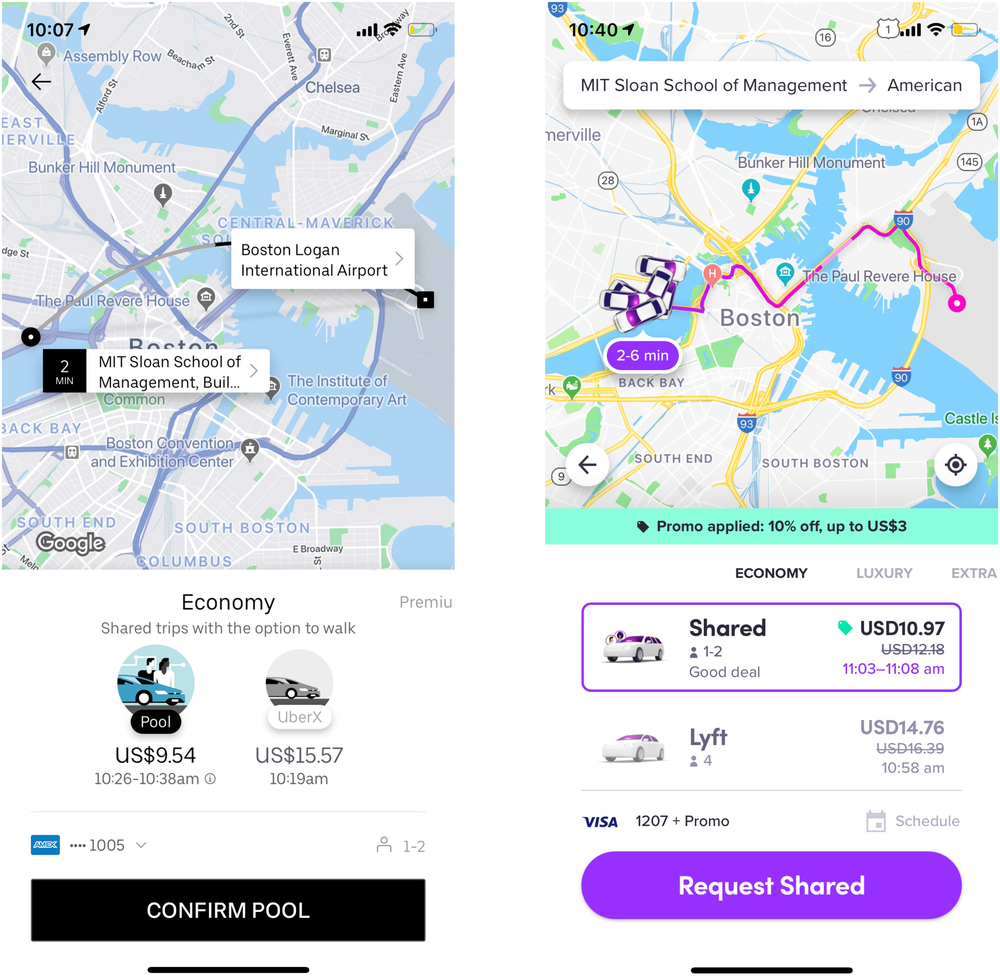
Interface of Uber and Lyft Ride‐hailing Apps (shown as of January 2019)
Model of consumer ride‐hailing choice
We model consumers’ choice between an individual ride and a pooled ride using a discrete choice model based on the random utility MNL framework (Ben‐Akiva & Lerman, 1985; Hensher et al., 2005). The MNL has been widely used in transportation and travel demand applications to estimate probabilities of a transportation mode choice (Aloulou, 2018; Brownstone et al., 2000; de Bok et al., 2018; Keith, Naumov, & Sterman, 2017; Keith, Sterman, & Struben, 2017; Keith et al., 2020; Naumov et al., 2020).
We assume, as is common in discrete choice models, that consumer utility can be decomposed into an observable, linear‐in‐parameters part, and a stochastic and unobservable part that is independent and identically distributed (i.i.d.) over alternatives and respondents in our sample (Brownstone et al., 2000; Pullman et al., 2001; Train, 2009; Verma et al., 2006). In particular, the utility from alternative i for individual n is a function of observable utility, represented by an intercept



The MNL framework assumes heterogeneity in unobserved consumer preferences and decisions such that some commuters will choose to take a pooled ride even if it has a lower observable utility than an individual ride (Hensher et al., 2005; McFadden, 1973; Train, 2009). Under the MNL, the probability of choosing alternative i is given by:

Next, building on solid foundation from marketing and transportation literature (Chandukala et al., 2007; Helveston et al., 2015), we run a conjoint choice experiment to collect data on stated preferences toward ride‐hailing and use MNL models to estimate attributes of consumer utility.
DATA COLLECTION
The data we use for this study were collected using an online survey of a representative sample of the US population obtained from Qualtrics, a market research company. We purchased a sample of 1014 respondents, representative with respect to gender, income, and political affiliation, which we included as a proxy for the respondent's inclination toward environmental sustainability. We further requested that 36% of these respondents have experienced using ride‐hailing services such as Uber and Lyft, and 64% not, consistent with the most recent estimates of the current fraction of the US population that has experience using these ride‐hailing platforms (Jiang, 2019). Exploring the effect of on‐demand mobility as a large‐scale transportation solution requires understanding consumer preferences across the US population. Today, about 45% of urban residents have used ride‐hailing, but only 19% of rural residents have done so (Jiang, 2019), which could be a reflection of (i) the limited availability of ride‐hailing services, and (ii) differing consumer preferences, but we do not yet know which. Using a sample that comprises the current distribution of prior ride‐hailing experiences allows us to capture both, and we also do a split sample analysis to compare the preferences of prior users and non‐users of ride‐hailing services.
Before running the full survey using the Qualtrics sample, we performed a pilot test of the survey on Amazon MTurk, obtaining a convenience sample from 310 US respondents. We used the MTurk pilot to refine our questions and fine‐tune the attribute levels, especially in relation to capturing the effect of uncertainty in travel time. MTurk samples have been shown to be equal or better quality than student samples (Goodman & Paolacci, 2017; Hauser & Schwarz, 2016; Steelman et al., 2014) and are frequently recruited to study service operations (e.g., Abbey & Meloy, 2017; Abbey et al., 2019; Modi et al., 2015; Ta et al., 2018; Tokar et al., 2016). Both MTurk and Qualtrics platforms have the lowest difference with residential attributes of the US population (Heen et al., 2014). The results we obtained in the MTurk pilot do not differ meaningfully from the results we present below obtained through Qualtrics.
Respondent characteristics
Our sample is closely representative of the US population with respect to age, gender, political affiliation, and prior experience with ride‐hailing services (Table 1). To obtain the representative sample of 1014 respondents, Qualtrics had to screen more than 15,000 prospective respondents. The sample has slightly fewer 18–25‐year‐old people, more 65+ respondents, and relatively fewer people with $150K+ income, which is not uncommon in a sample from an online survey pool.
Respondent's Demographic Information (N = 1014)
Numbers might not add up to 100% due to rounding.
Requested to match the U.S. population.
Sources: 1(U.S. Census Bureau, 2019b), 2(Gallup, 2019), 3(U.S. Census Bureau, 2020a), 4(U.S. Bureau of Labor Statistics, 2020), 5 (U.S. Census Bureau, 2018b), 6(U.S. Department of Housing and Urban Development, 2020), 7(U.S. Census Bureau, 2019c), 8(U.S. Census Bureau, 2020b), 9(Statista, 2020), 10(U.S. Census Bureau, 2019a), 11(Jiang, 2019)
For those respondents who indicated that they had used ride‐hailing services before, we asked about their frequency of use of ride‐hailing services, individual and pooled, and their level of satisfaction with these services (Table 2). Consistent with the ride‐hailing mode shares observed today, we see fewer people who request pooled rides on a regular basis. Respondents’ satisfaction with pooled rides is observed to be lower than for individual rides (the share of respondents who were extremely satisfied was 8% lower, and the share of respondents who were neither satisfied nor dissatisfied was 10% higher for pooling; 
Experience with Ride‐hailing Services
Examining respondents’ qualitative responses for explanations of why satisfaction with pooled rides, we see two key explanations: that pooled rides are slower (“Some pooled rides go WAY out of the way and end up taking longer than they should”), and that pooled rides are less convenient (“I really am not thrilled, you never know whom you will ride with”).
Survey structure
Each respondent was administered a survey comprising three parts, implemented using Qualtrics’ survey software, and Conjoint.ly, an online conjoint analysis platform (Conjoint.ly, 2021). In the first part of the survey, administered in Qualtrics, all respondents were asked basic questions about demographics and vehicle usage, including their age, gender, political affiliation, household composition, vehicle ownership, and previous experience with ride‐hailing services.
The second part of the survey was a discrete choice experiment (often referred to as choice‐based conjoint), administered in Conjoint.ly, in which they were asked in eight scenarios to choose between an individual ride in a private car, a service that we call MyRider (similar to UberX or Lyft), and a pooled ride in a shared car, a service that we call RiderPool (similar to Uber Pool or Lyft Shared), where the choices varied with respect to the trip price, pickup time, and travel time. Respondents were randomly assigned to one of two experimental conditions when completing this task. One group was choosing between private and pooled rides assuming they were traveling to the airport to catch a flight, a nudge toward a time‐constrained trip. The other group was choosing assuming they were traveling to go shopping, a less time‐constrained trip. We intentionally described these conditions using neutral language (avoiding directly referencing time, duration, or urgency), augmenting the description with a picture of a plane (more time‐constrained) or a picture of a person carrying shopping bags. We confirmed during the pilot study that respondents’ answers were affected by this treatment, deciding to keep it in the main study.
The levels used for each ride attribute in this experiment are shown in Table 3. As is standard when choosing between these services in real‐world apps, the estimated travel time for an individual ride is shown as a discrete‐time (e.g., 15 min), while the estimated travel time for a pooled ride is shown as a time range (e.g., 12–18 min), reflecting uncertainty in how long the pooled ride will take for any individual, taking the need to also serve the trips of other passenger(s) in the vehicle into account. Importantly, we allow for the possibility that pooled rides could be slower (e.g., taking a longer route to accommodate another passenger) or faster (e.g., if high‐occupancy vehicle lanes allow pooled rides to move through cities more rapidly). Allowing pooled rides to be faster enables the possibility that pooling can be more attractive to respondents in our experiment. We systematically vary the amount of uncertainty in the time estimate so that the effect of time uncertainty can be identified separately from the main time effect. We select levels for each attribute that were representative of the average characteristics of ride‐hailing trips in the United States (Iqbal, 2018; SherpaShare, 2016; Vaccaro, 2018) and fare estimates from leading US ride‐hailing companies (Lyft, 2018; Uber, 2018).
Attributes and Levels in Discrete Choice Experiment
We use a fractional factorial design (Hair et al., 2014, p. 371) where not all possible profiles are used due to unacceptable combinations. We chose to have eight choice sets in each survey to reduce the number of evaluations while retaining the attention of respondents. One hundred and sixty‐eight blocks of eight choice sets (pairs) were prepared for each experimental condition that were shown to respondents at random. The response profiles were created by Conjoint.ly using principles of optimal design (balance and overlap; Conjoint.ly, 2021). To avoid “unacceptable” or unbelievable profiles due to the interattribute correlation (Hair et al., 2014, p. 372) we eliminated lowest price/individual ride and highest price/pool ride combinations (Table 3) using “prohibited pairs.” We exported the design from Conjoint.ly to JMP and used the design evaluation option to confirm that the design has achieved a D‐efficiency of 75.2. The “no‐choice” option was excluded from the design given that the choice between individual and pooled ride options is conditional in our study on having already chosen to use ride‐hailing.
We relied on Conjoint.ly to perform a quality assessment of the responses in an attempt to eliminate automatic clicking, using a proprietary algorithm to analyze response time and patterns, mouse movement, and other variables that measure the behavior of respondents to perform attention checks (Abbey & Meloy, 2017). We also introduced a 5 s threshold on each question so that respondents could not answer too quickly.
Upon successful completion of the discrete choice block, respondents finished the third part of the survey in Qualtrics. Respondents disqualified by Conjoint.ly were thanked for their participation, and their responses were excluded from our analysis. Qualified respondents were asked to complete a post‐survey questionnaire, including, for those who indicated in the first part of the survey that they had used ride‐hailing services previously, questions about the frequency of their use of individual and pooled ride‐hailing services, and their satisfaction with each of these services. The three parts of the survey were then merged, and additional quality checks were performed, including ensuring that the respondent's country of residence was the United States and that the overall sample was representative of the US population.
RESULTS
We estimate the utility coefficients in Equation (1) from our stated preference data (Table 4) using the mlogit package in R (Croissant, 2020).
Multinomial logit (MNL) results
Abbreviation: TT, travel time.
* p < 0.1; ** p < 0.05; *** p < 0.01.
Table 4 shows results for the estimation of β coefficients in Equation (1) including covariates Pickup Time, Price, Travel Time Mean, and Travel Time (TT) Uncertainty, and alternative specific coefficients γ in Equation (1) for the RiderPool option for the other individual specific covariates (with the “reference” alternative being MyRider for which coefficients of respective covariates are set to 0). Beginning with our most aggregated Model 1, we see first that pooling has a negative and statistically significant intercept, meaning that, all else being equal, pooling has an inherent disutility for consumers. This reflects that many people would prefer not to share the cabin of the vehicle with other passengers and that the need to take a circuitous route to accommodate other passengers is a time‐consuming inconvenience. This result is consistent with prior findings that freedom of driving alone, and unwillingness to carpool with people outside their own family, are the most important factors that influence commuters’ choice not to carpool (Hwang & Giuliano, 1990).
The coefficients of the estimated logit model are marginal utilities, which do not have a direct interpretation. However, we can calculate the marginal rate of substitution as the ratio of estimated coefficients (Croissant, 2020). The marginal rate of substitution measures how much one attribute can be reduced in exchange for an increase in another attribute, without changing utility. For example, the marginal rate of substitution of pickup time t in terms of ride price p is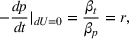
Based on the relative magnitude of our pooling intercept and price coefficients, we can value the inconvenience of taking a pooled ride, all else being equal, at (−0.607/−0.168) = $3.61 per ride in our experiment. As expected, we see that the coefficients of the key ride‐hailing service attributes are all negative and highly statistically significant. The negative price coefficient explains why a significant number of ride‐sharing users would be willing to choose cheaper pooled rides even though pooling has other inconveniences. The magnitude of the pickup time coefficient is greater (an implied value of time (−0.058/−0.168) = $0.345 per min or $20.71 per h) than the magnitude of the travel time coefficient (an implied value of time of (−0.040/−0.168) = $0.238 per min or $14.29 per h), suggesting that time spent waiting to be picked up is relatively more important than time spent in the vehicle, reflecting that the uncertainty of waiting can be particularly frustrating (Maister, 1985).
In Model 2, we include several pooling‐demographics variables to test how our sample's preference for pooling variables varies with respondent demographics. Most of these are not statistically significant, with the exception of the dummy variable we include for low‐income respondents (below $50,000 per household per year). The coefficient of our dummy for low‐income respondents is strongly positive, suggesting that people with low incomes are more likely to choose pooling, which is likely because they are more willing to tolerate the inconvenience of a pooled ride to save money. The offset for the inconvenience of pooling is (0.296/−0.172) = −$1.72, meaning that people with low incomes value the inconvenience of pooling to be much less than people with higher incomes. We also include a variable for car ownership, finding that respondents who own more cars in the household per person are less likely to choose pooling, conditional on having already chosen to use ride‐hailing. We speculate that this finding may be explained by car owners being more socialized to having their own private space in their vehicle, compared with public transit users, making them more likely to choose an individual rather than pooled ride.
In Model 3, we add a time pressure variable that captures the experimental condition in which we nudged half our sample into thinking they were taking a trip to the airport, a time‐constrained trip. Here, we see that, as expected, people who are in a rush are less likely to choose pooling, which we attribute to the stress involved in taking a trip that both takes longer and has more time uncertainty.
In Model 4, we estimate a mixed logit model, allowing us to account for heterogeneity in respondents that may bias their repeated choices (i.e., the possibility that some respondents are just inherently more likely than others to choose a pooled ride, all else being equal). The mixed logit assumes that the intercept and alternative specific covariates 


We assume uniform distributions for the intercept and zero‐bounded triangular distributions for the coefficients of Price, Pickup Time, Mean Travel Time, and Travel Time Uncertainty. The use of truncated distributions is justified because these parameters can only take negative values (meaning that more time‐consuming and more expensive trips are less favorable). In addition, the use of unbounded distributions (such as log‐normal, e.g., for price) would lead to distorted estimations of mean values because of its heavy left tail, which is why the triangular distribution is preferred (Croissant, 2020).
Here, the significance of all coefficients is consistent with Model 3. The inconvenience of pooling is estimated as (−0.513/−0.216) = $2.38 per trip. The magnitude of the pickup time coefficient is again greater (with an implied value of time of (−0.065/−0.216) = $18.06 per h) than the magnitude of the travel time coefficient (what has an implied value of time of (−0.045/−0.216) = $12.50 per h. We find that the uncertainty in the travel time of pooled rides is also influential, with each minute of uncertainty in time estimate equivalent to (−0.045/−0.018) = 2.5 min of additional travel time. The offset for the inconvenience of pooling in this model is (0.330/−0.216) = −$1.53 for the low‐income segment.
We now compare the results of the most parsimonious model, Model 1 in Table 4, with the same model estimated for subsamples split by prior ride‐hailing experience (Table 5). Here, we see that the coefficients are directionally consistent across all three models. However, whereas the full population inconvenience of pooling is valued at $3.61, prior users value it at $4.00 (−0.544/−0.136) and prior non‐users at $3.45 (−0.639/−0.185). In other words, people who have used ride‐hailing services are even less likely to choose pooling than prospective customers. This suggests that the results and the analysis we report in Section 6 serve as an upper bound on the desire of consumers to choose pooling versus an individual ride, emphasizing the need to keep pooling relatively attractive through the use of pricing.
Comparing MNL models by prior ride‐hailing experience
Abbreviation: TT, travel time.
* p < 0.1; ** p < 0.05; *** p < 0.01.
IMPLICATIONS FOR RIDE‐HAILING REVENUE AND TRAFFIC
To understand the financial and environmental implications of these consumer preferences on the performance of the ride‐hailing system, we consider how consumers would respond to a future in which the cost of driving per vehicle‐mile falls significantly over time due to the introduction of AVs as projected by Fulton et al. (2017). We use a model of consumer choice in which commuters choose between an individual ride, a pooled ride, and an outside option with constant utility (e.g., driving by privately owned vehicle or using public transit). Our focus is on using the estimated parameters from Section 5 to construct an optimal pricing policy for a ride‐hailing service that ideally benefits both companies and society.
In this analysis, we use revenue as a metric of ride‐hailing service financial performance and the market share of pooled rides as a measure of societal benefit. While focusing on revenue might appear myopic because it ignores the costs of achieving these revenues, we believe it to be a quite realistic portrayal of the ride‐hailing market today, where firms are competing aggressively to “get big fast” (Sterman et al., 2007), backed by large amounts of venture capital. Our focus on revenue maximization is further driven by the fact that revenue is the most important evaluation criterion for young firms and industries, where increasing the customer base is the main driver of investment decisions and market valuations. We use the market share of pooled rides as a proxy for societal benefits as pooling increases vehicle utilization and reduces negative externalities of driving such as air pollution and traffic congestion (Fulton et al., 2017; Y. Wang et al., 2021). We analyze what the optimal pricing policy is for ride‐hailing services when seeking to maximize the composite utility comprising both revenue and share of pooled rides, in equal proportion. Because our focus is on understanding how the strategy of ride‐hailing providers can be adjusted to support consumer choice that benefits both companies and society, we consider the entire market as our unit of analysis, not a single firm (the optimal behavior of individual firms within this segment being beyond the scope of the paper). Next, we consider the environmental consequences of this pricing are by looking at the total number of VMT in the city. Last, we perform a sensitivity analysis by varying key variables representing market and consumer preferences to define boundary conditions for our results. Note in the explanation of the model below that while most of the variables are changing over time, we leave out the time subscript t for clarity of exposition.
Commuter choice model
We denote the set of commuting modes offered by a ride‐hailing operator (individual and pooled) as 



As is common in discrete choice models, we assume the utility of the outside option is equal to 0, giving the following equation for the individual choice probability of the ride type j: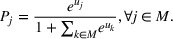
The market share of the total population choosing the ride type j is then the expectation of individual choice probabilities at the population level:
We model personal travel demand in units of passenger miles traveled (PMT) as the reference level of PMT, d
0, modified by the elasticity of demand for driving as a function of ride price for travel mode j: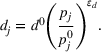
Demand for ride‐hailing trips today has been estimated as being relatively inelastic to prices, with the elasticity of the driving demand to ride price 

The contribution of pooled rides to the total fleet VMT depends not only on the length of the trip but also on the average occupancy of pooled vehicles and the additional miles driven to match passengers taking similar trips. We assume that an average pooled trip is shared by 


Each passenger of a pooled trip is only “using” a fraction of the total miles driven by the vehicle since the ride is shared among multiple passengers:
The price of a pooled ride per mile per passenger is calculated from the cost of the ride per mile 


We calculate the price of trips for each ride type 


We simulate changes in the cost of driving over time as a result of improvements in new automotive technologies (e.g., AVs) due to research and development (R&D) investment and learning‐by‐doing (Argote & Epple, 1990; Argote et al., 1990; Arrow, 1962). Cost reductions are represented using a standard power‐law learning curve cumulative in experience E, which is assumed to increase linearly over time:


The travel time of a pooled ride is calculated from the travel time of an individual ride adjusted for additional miles driven to pick up and drop off passengers and pickup/drop off time per additional passenger:
Given a commuting population n within the city's catchment area, the revenue of a ride‐hailing operator is then given by:
The cost of the ride‐hailing operator is the product of the number of miles traveled by vehicles in the ride‐hailing fleet (in VMT) and the cost of travel per vehicle mile.
The contribution of pooled rides to total VMT depends not only on the length of the trip, but the occupancy of the vehicle and the additional miles driven to match passengers taking similar trips. The number of miles traveled by vehicles in the ride‐hailing fleet is then given by:
The profit π of the ride‐hailing operator is then:
We calibrate the model to represent a typical urban environment where the majority of the ride‐hailing trips are taking place today and where empirical estimates of the market share of pooled rides today vary from 15% to 45% and even 70% at peak times of all daily VMT (e.g., City of Chicago, 2019; Schaller, 2019; SFCTA, 2017). In our model, we assume that initially on average, 35% of all the trips are pooled, reflecting the numbers reported above, as well as taking into account the increasing popularity of pooling in urban areas as a result of aggressive price reductions by ride‐hailing companies. We also assume the net margin μ of the ride‐hailing platform to be 5%, based on the data from the Uber balance sheet (Bensinger & Winkler, 2018) and the average net margin of the transportation sector in the US economy (Damodaran, 2020) and the pooled‐ride dispatching overhead 
Key model parameters
Ride‐hailing system performance
To analyze this model, we explore how the ride‐hailing platform should optimally price individual and pooled rides as the cost of driving falls over time. We simulate travel cost reductions using a power‐law learning curve as improvements in automotive technologies such as AVs accumulate with learning‐by‐doing and R&D investment (Equation 14). The accumulation of the experience E is modeled as an exogenous parameter, with the initial experience, change over time, and the learning curve strength calibrated to provide the expected price decrease from $1.80 to $0.55 in 10 years, based on previous estimates (Burns et al., 2012; Fulton et al., 2017). With our parameterization (Table 6), the cost of driving begins at $1.80 per vehicle mile at time zero and stays constant until year 1, and then falls to $0.55 per vehicle mile in year 10 of the simulation, following the learning curve in Equation (14). This leads to a reduction in the prices of both ride‐hailing option in proportion to travel costs as outlined in Equations (11) and (12) (Figure 2).
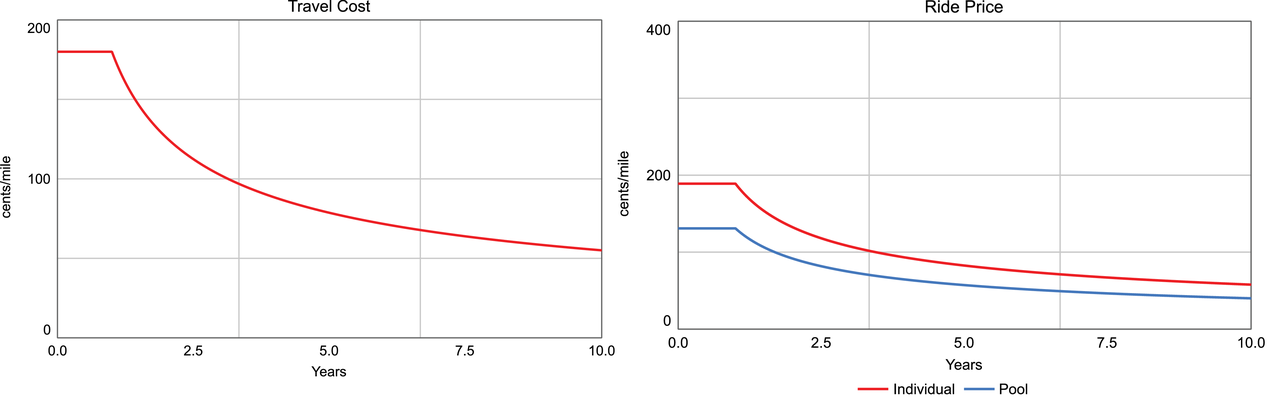
Ride‐hailing costs and trip prices per vehicle mile
We begin by introducing the baseline scenario in which we simulate consumer choice of individual and pooled rides over time using the default parameters from Table 6 (Figure 3).
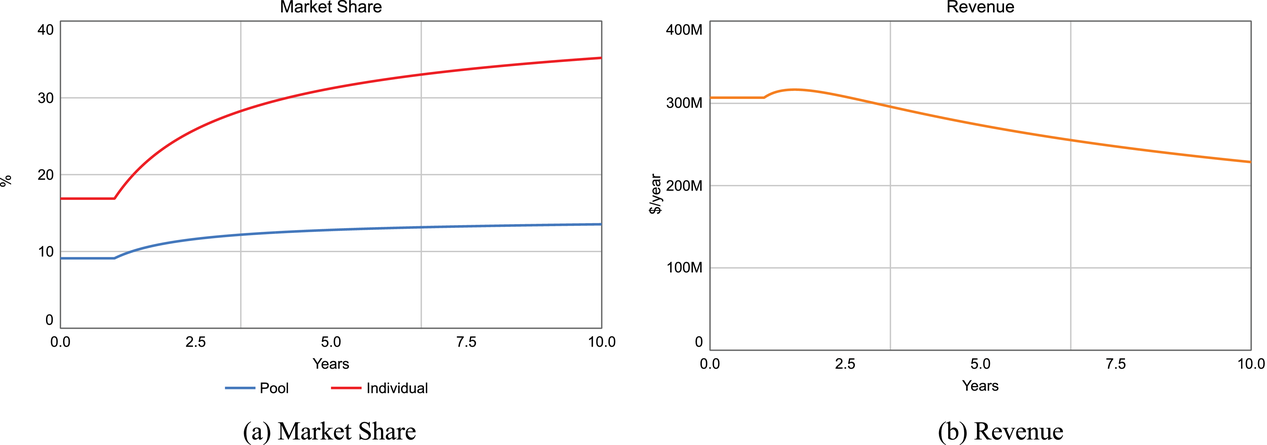
System performance (baseline)
In this baseline scenario, we see that the falling cost of driving leads to a substantial increase in the individual ride market share in year 10 (from 16.9% to 35.2%) and a much more moderate increase in the pooled ride market share (from 9.1% to 13.5%). This is because lower trip prices make ride‐hailing more attractive but reduce the financial incentive to choose pooled rides over individual rides. While the ride‐hailing market increases its total combined market share by year 10 from 26.0% up to 48.7%, the total revenue falls 25.5% because even with increased market share, the firms cannot compensate for the substantial reduction in prices that follow costs.
Maximization of platform revenue
Next, we consider the optimal pricing strategies that maximize revenues of the ride‐hailing platform, assuming that the price of pooled rides will follow the trajectory of travel costs as described above (Figure 2). This assumption allows us to reduce the number of degrees of freedom of the model and focus on the analysis of the difference between pooled and individual rides as the main determinant of the pricing strategy. Most importantly, assuming that pool prices are going to fall along with the decreasing costs allows us to realistically model one of the key parts of the social contract that exists between ride‐hailing operators and urban policymakers who want to reduce traffic congestion and provide convenient transportation options for low‐income communities. Pooled ride‐hailing services serve the same number of passenger miles with fewer vehicle miles, effectively taking cars off the roads and reducing congestion, and provide an opportunity to share travel costs among many riders, offering price‐sensitive customers a better alternative to existing transportation modes. Thus, increasing the share of pooled rides becomes an essential part of the social license to operate in cities. Our analysis shows that the acceptance of pooled rides hinges on their low prices (see discussion in Section 5), so passing to pooled riders all savings resulting from reduced travel costs is necessary. We also perform an additional robustness check of our assumption by performing a multi‐objective optimization that simultaneously maximizes both pooled ride market share and revenue where we allow both individual and pooled ride prices to vary. The results confirm that at optimality, pooled ride prices should follow falling travel costs (see the Supporting Information for more details).
To ensure that our optimization yields a unique global optimum, we need to consider whether revenue and profit are concave in our setting. The concavity of profit under multinomial choice for a monopolistic firm has been proven previously (H. Li & Huh, 2011; Song, Xue, & Shen 2021). However, revenue and profit are different functions in our case since travel demand, which is an input to revenue and profit, is also dependent on price. We establish the concavity of both revenue and profit in our model in Proposition 1 (see the Supporting Information). Next, we proceed to find unique optimum pricing policies. While no closed‐form solution exists, we use numeric methods to compute these optima. In the analysis that follows, we use a dynamic optimization to maximize the revenue of the ride‐hailing platform at each point in time as costs go down. We optimize at 41 discrete points (quarterly intervals) over our simulated time horizon of 10 years, determining at each point the optimal price for an individual ride and interpolating between points for the purpose of visualization. At each point, the price per mile of a pooled ride is determined from Equation (11), and we modify Equation (12) to find the vector of optimal prices per mile of an individual ride as a function of the vector of travel costs as follows:
While revenue‐maximization might initially appear myopic, ignoring the costs of achieving these revenues, we believe it to be a quite realistic portrayal of the ride‐hailing market today, where firms are competing aggressively to “get big fast” (Sterman et al., 2007), backed by large amounts of venture capital. Our focus on revenue maximization is further driven by the fact that revenue is the most important evaluation criterion for young firms and industries, where increasing the customer base is the main driver of investing decisions and market valuations. We believe there is merit in framing our analysis in this way since revenue generates opportunities, and focusing on profit requires careful consideration of not only direct costs but also expenses related to business development. The results of this optimization are shown in Figure 4.
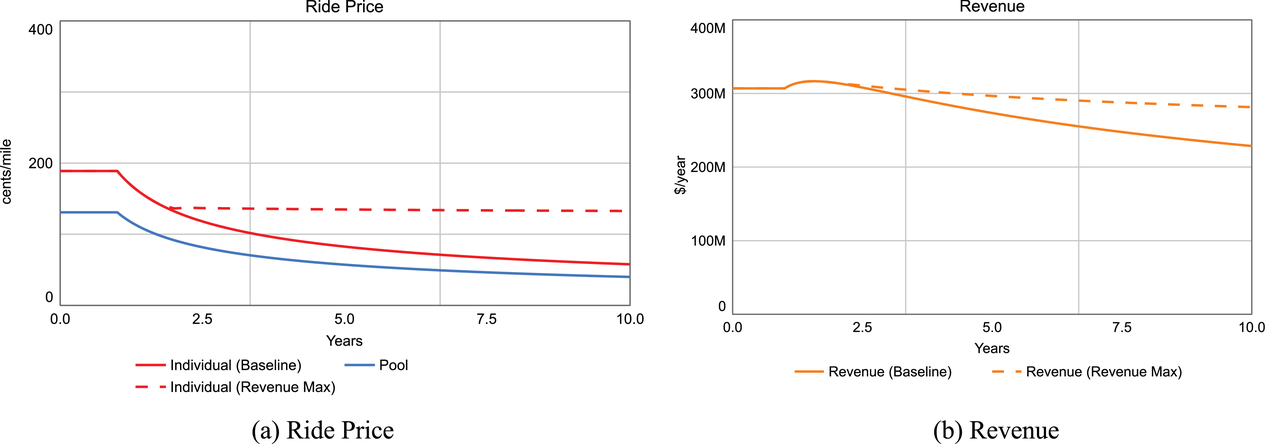
Financial performance (maximization of revenue)
Our results show that the current practice of ride‐hailing companies to subsidize rides in order to capture a larger market share can be improved from a revenue perspective through the optimal policy that, while slowing down the market share growth, maximizes revenue if the travel demand is inelastic (see Proposition 1 in the Supporting Information). Here, we see that it is optimal for revenue maximization to keep current prices for both individual and pooled rides and reduce them proportionally to falling travel costs for the first year after the cost decline starts after year 1 (

Sustainability implications (VMT and roadway utilization)
We next analyze the impact of the optimal revenue‐maximizing pricing strategy on the total number of VMT and the average fleet impact on roads as defined by the ratio of VMT to PMT (
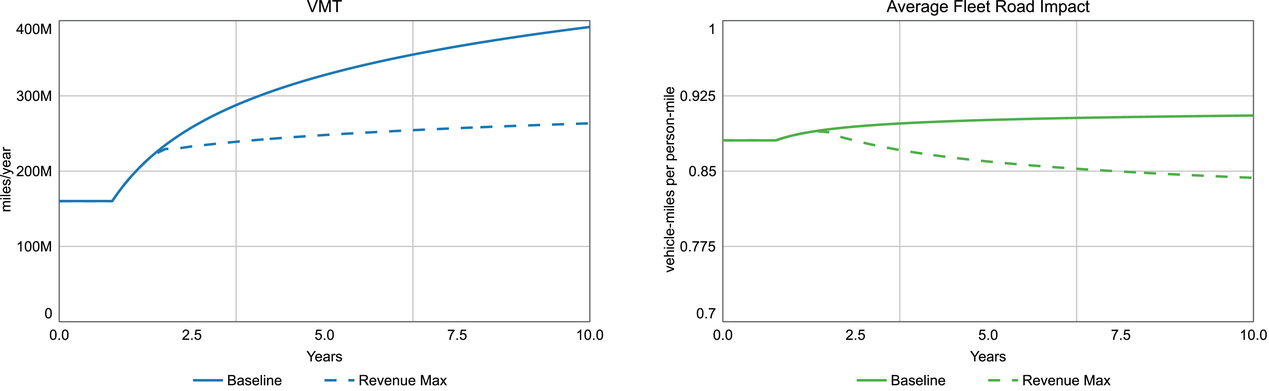
Vehicle miles traveled (VMT) and roadway utilization
Here, we see that the revenue‐maximizing scenario leads to a reduction in ride‐hailing VMT relative to the baseline scenario, even though VMT still increases over time as the cost of driving falls. Considering the net impact of ride‐hailing on roads, we see that the average fleet road impact is lower than the baseline in revenue‐maximizing scenario (Figure 5). The reason for the higher road utilization is not only a lower PMT demand (27% lower than the baseline in the revenue‐maximizing scenario) but also a higher market share of pooled rides (16.2% vs. 13.5% in the base case) and an increased share of pooled rides among all ride‐hailing trips (Figure 6). The higher share of pooled rides and reduced PMT demand makes the revenue‐maximizing scenario more sustainable from the environmental and social perspective, as the total VMT across ride‐hailing vehicles is 32% lower than in the baseline scenario (Figure 5).
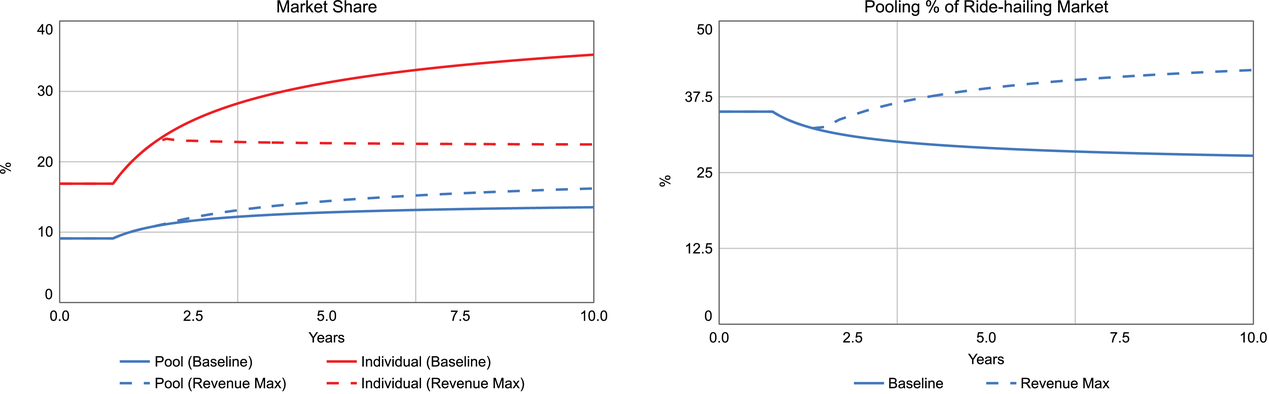
Market share and pooling % of the ride‐hailing market
To be clear, our results reflect the environmental impact of the policy for the ride‐hailing sector only, not making any assumptions about the environmental impact of the outside option. Since the pooling market share is greater, but the overall market share of ride‐hailing is smaller than in the baseline, the net environmental impact of transportation depends on two factors: where new consumers who decide to pool come from, and where consumers who stop using individual rides go. If new consumers are switching away from public transit and start pooling, and if former individual ride‐hailing customers switch to privately owned car trips and drive more as a result, the net environmental impact of the policy might be reversed. However, if new consumers are switching to pooling from private cars and individual rides, and former individual rude‐hailing customers switch to public transportation, the environmental impact might be amplified.
Comparing multi‐objective and revenue‐maximizing optimization results
As mentioned at the beginning of Section 6.2.1, we also performed an additional analysis where we simultaneously maximize the market share of pooled rides and also total revenue (combined in a single firm utility function) to represent two main objectives of ride‐hailing operators—maintaining financial viability and fulfilling social license to operate in cities by helping to reduce congestion and providing affordable transportation options for low‐income areas (see the Supporting Information for more details). We find similar qualitative results, with a few notable differences. The multi‐objective optimization confirms our key result that pooled ride prices should follow the falling cost trajectory, while individual ride prices need to be increased at optimality. At the same time, the new analysis suggests that unlike in the revenue‐maximizing scenario, the market share of pooled rides can become larger than that of individual rides, highlighting the possibility for an increasing role of pooling in the future of transportation without compromising the financial performance of ride‐hailing companies. We also find that when travel cost reduction occurs more slowly, and in the case of a higher elasticity of travel demand, the multi‐objective optimization can lead to a marginally lower revenue, compared to the baseline. However, we also show the existence of the set of solutions 
Conditions required for co‐benefits
Our analysis has shown that revenue‐maximizing pricing can also achieve substantial environmental benefits for the ride‐hailing sector, reducing negative externalities of driving on a per‐passenger basis. However, this result might be contingent on the specific parameterization of the model (Table 6) or the results of the estimation of consumer preferences (Section 5). Next, we explore the boundary conditions to understand how robust this “win–win” result is under different market and consumer preferences.
Speed of cost reduction
In the paper, we assume that the cost of driving exogenously declines over time due to the availability of new AV technologies. The speed of this decline, however, is highly uncertain and depends on factors such as technological advances, R&D spending, and consumer acceptance, represented collectively by the learning curve strength 


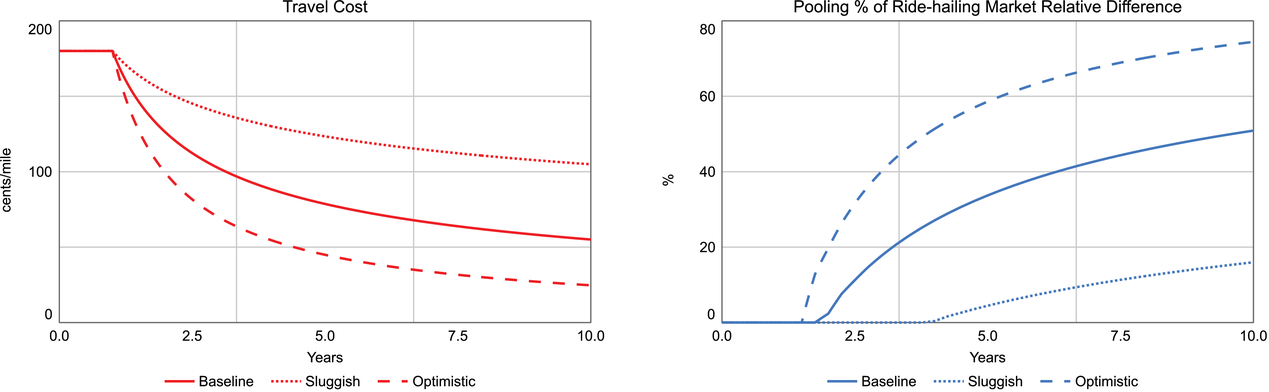
Speed of cost reduction–impact on travel cost and pooling share
Under all scenarios, we see a possibility for the optimal pricing policy to both increase revenue and reduce road impacts relative to the baseline non‐optimized pricing (Figure 8) by increasing the share of pooled rides (Figure 7). However, the largest opportunities for improvement are presented when the cost drops faster (optimistic scenario). This illustrates why maintaining an increasing price difference between individual and pooled rides is especially important if the cost of rides drops substantially, an outcome expected by many in the ride‐hailing industry.
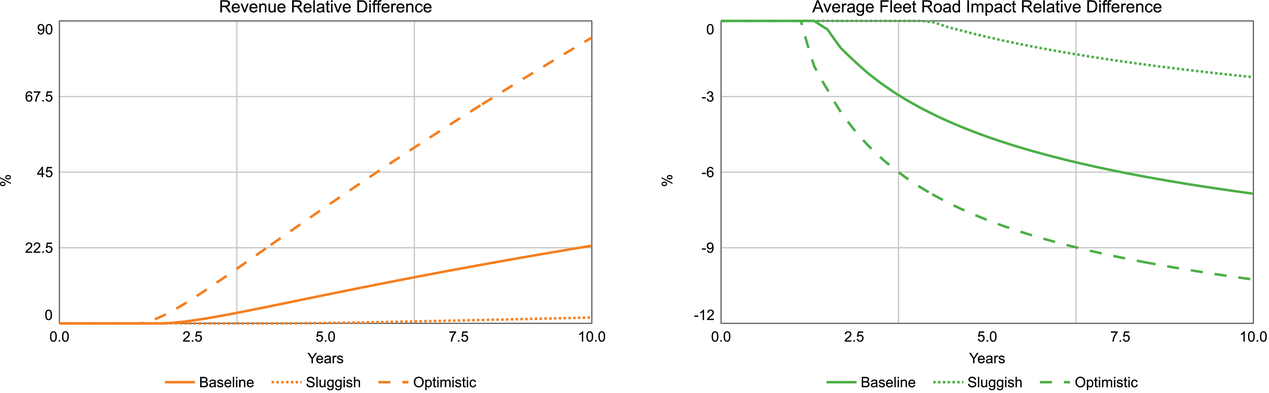
Speed of cost reduction–impact on financial performance and roads
Elasticity of travel demand
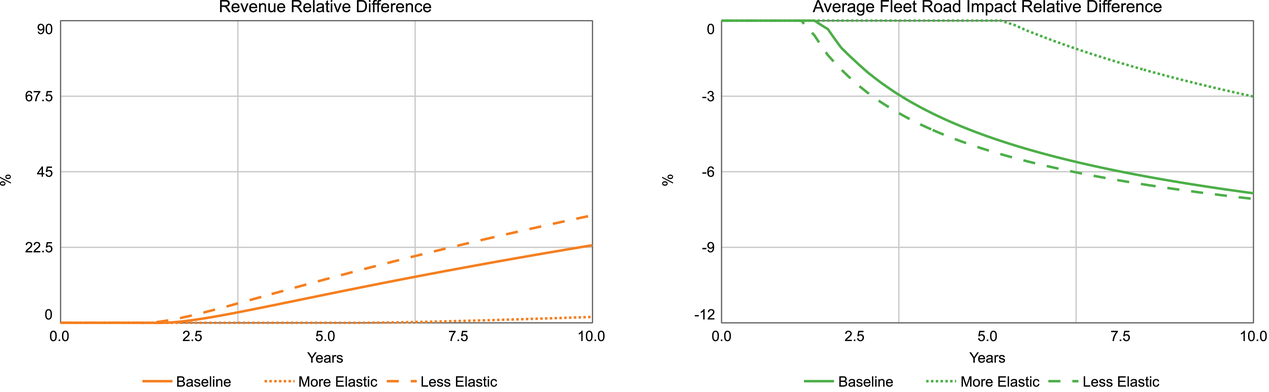
An essential parameter that controls personal travel demand is the price elasticity of PMT 


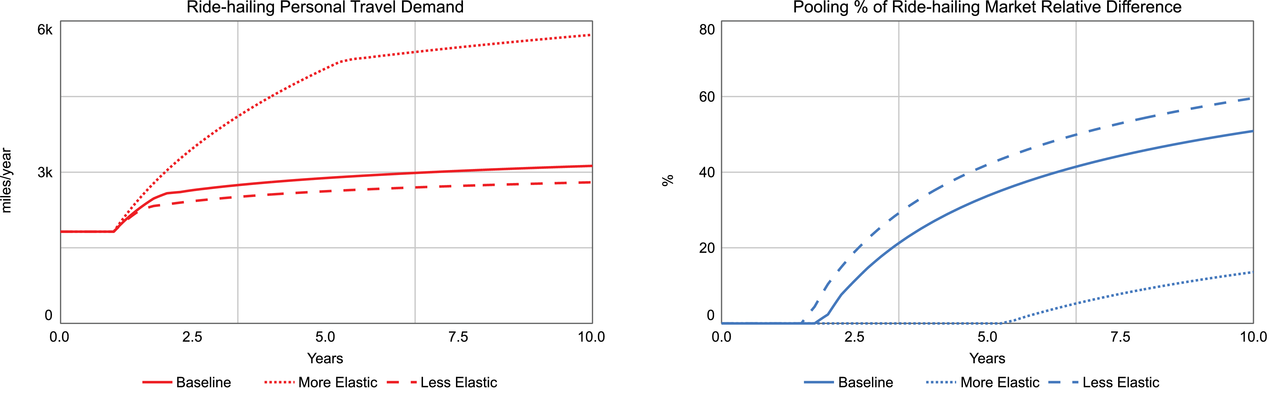
Travel demand elasticity–impact on travel demand and pooling share
As in Section 6.3.1, we see that in all scenarios, the optimal pricing policy can increase the share of pooled rides, providing opportunities to increase revenue and reduce road impacts. With relatively more elastic demand, the optimal pricing policy suggests that prices for individual and pooled rides should decrease proportionally to costs for much longer. The reason for this is the potential to generate more travel demand (because of higher elasticity) and therefore higher revenue if ride prices are reduced. As demand becomes less elastic, optimal pricing policy provides opportunities to generate increasingly higher revenue and reduce road impact by controlling individual ride prices (Figure 10). We also see a saturation effect of optimal pricing as travel demand becomes less elastic, highlighting the non‐linear effect of demand elasticity.
Travel demand elasticity–impact on financial performance and roads
Consumer utility attributes
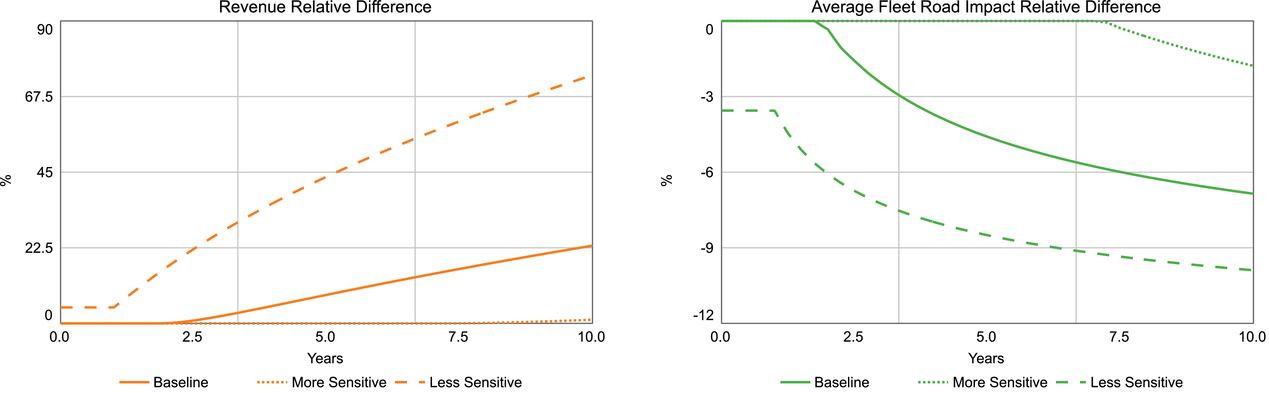
We next turn to exploring the consumer attributes we have estimated in Section 5. While the estimation results are highly statistically significant, they are stated preferences, and preferences that may evolve over time as consumers gain more experience with ride‐hailing and the market matures. First, we consider the sensitivity of consumers to ride prices. In Figure 11, we vary the price coefficient of the consumer utility 


Sensitivity to ride price—financial performance and road impacts
When consumers are more price‐sensitive, there is little room to improve revenue, and the opportunity to reduce road impact is also limited. When consumers are less price‐sensitive, revenues can increase substantially, with the opportunity to substantially reduce road impact. This again speaks to the importance of estimating consumer preferences as they determine the degree of alignment of policy results between financial performance and environmental impact.
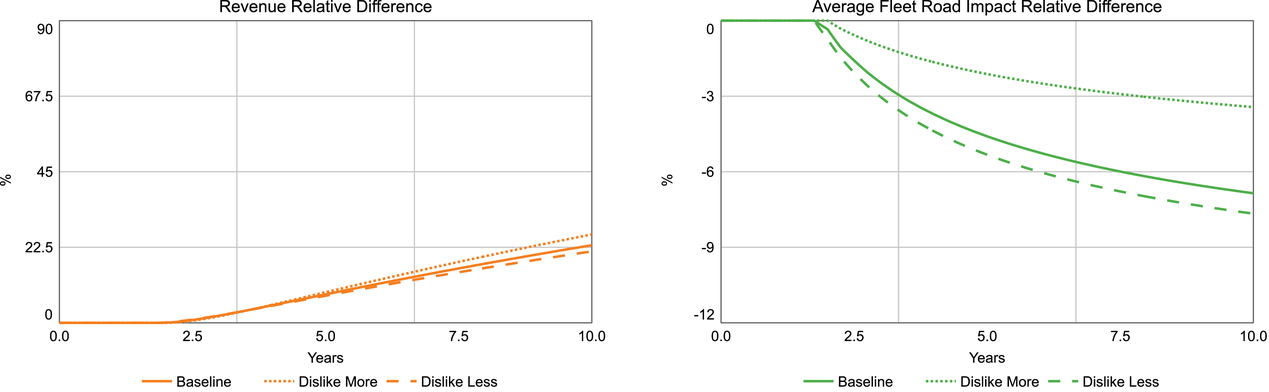
Next, in Figure 12, we explore the effect of changes in the perceived inconvenience of pooling 


Sensitivity to the inconvenience of pooling—financial performance and road impacts
Here, we see that the marginal effect of the inconvenience of pooling on the revenue‐maximizing pricing policy is the opposite for revenue versus road impacts. The more consumers dislike pooling, the more revenue improvement can be generated by the optimal policy, but the less potential there is to reduce the road impact of the ride‐hailing fleet and vice versa. This is due to the fact that an increased inconvenience of pooling results in a lower share of pooled rides, which is the main driver of the reduced road impact.
Comparing these consumer utility attributes, we see that a 3x change in the perceived inconvenience of pooling has a lesser impact on revenue and road impact than a 2x change in the price coefficient. Overall, the individual parameters sensitivity analyses above show that the results of the optimal policy are robust in a variety of settings, with the opportunity to improve revenue and reduce road impacts by keeping individual rides relatively more expensive.
Correlated market and consumer preferences
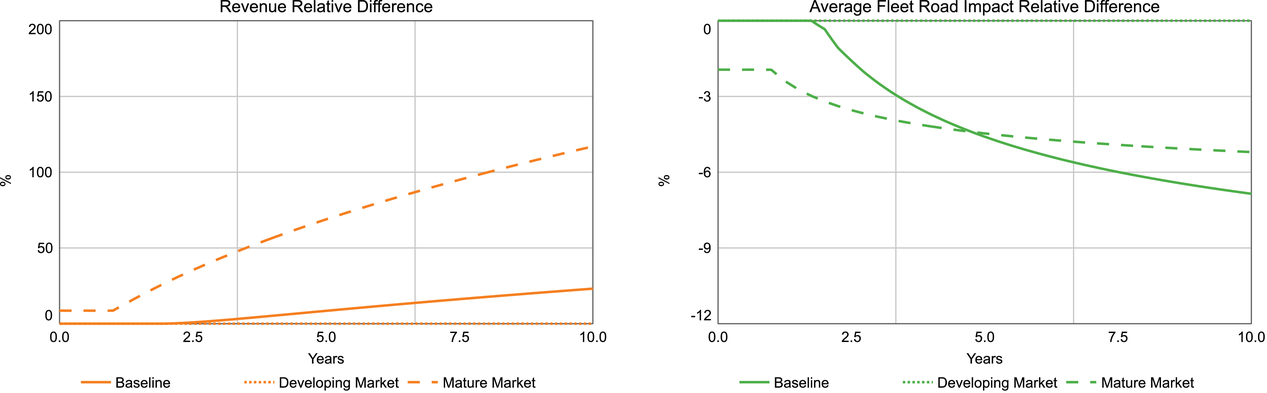
While so far, we have varied the market parameters and consumer utility attributes individually, in reality, they could be correlated, reflecting local market features. We now consider two different markets: one “mature,” with established travel demand and more affluent consumers, who are less inclined to use pooling, and the other “developing” with growing travel demand and less affluent consumers, who are more receptive to the idea of pooled rides and are more sensitive to price.
For the mature market, we use values from the individual sensitivity analyses above and set the elasticity of travel demand 


Figure 13 shows the simulation results. For the developing market scenario (dotted lines), the revenue‐maximizing pricing policy is to reduce prices for both individual and pooled rides proportionally to costs. In other words, there is no advantage in increasing individual prices as seen in the baseline (solid lines). This is because in the price‐sensitive market with relatively elastic travel demand, reducing ride prices for both types of rides generates more travel demand and therefore higher revenue. The consequence of this is the fact that we do not have any opportunity to use pricing to reduce road impact (right panel). For the mature market with inelastic travel demand and a low attractiveness of pooling (dashed lines), however, holding individual ride prices at a relatively higher level, compared to pooled rides allows operators to realize the full potential of the optimal pricing strategy by generating more revenue (left panel), which further allows to reduce road impact by making pooling relatively more popular (Figure 14).
Correlated market and consumer preferences—financial performance and road impacts
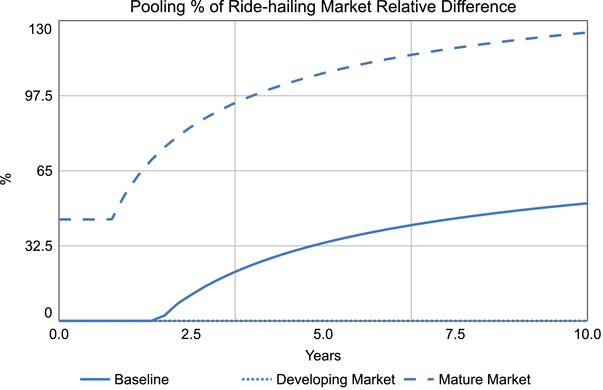
Correlated market and consumer preferences. Pooling % of ride‐hailing market relative difference
While we do not model changes in consumer preferences over time explicitly, the two scenarios above can be considered as a temporal evolution of ride‐hailing in the same market, where the cost of the rides goes down due to technological advances, while ride‐hailing consumers mature and change their preferences. Our results suggest that initially, it makes sense to allow ride prices to drop to be able to capture an increasing market share and travel demand, responding to price‐sensitive consumers who have not yet experienced pooling personally and who are therefore willing to use it more. However, as the market matures, the travel demand stabilizes and the preferences of consumers might reflect the diminishing popularity of pooling due to its inherent inconvenience relative to individual rides, and it becomes optimal to keep individual prices at a high level to sustain pooling popularity and reduce the environmental impact of ride‐hailing.
DISCUSSION
Pooling is gaining increasing attention (e.g., Clewlow & Mishra, 2017; Fulton et al., 2017; Henao & Marshall, 2019b; Ke, Yang, & Zheng, 2020; Schaller, 2018; Shaheen & Cohen, 2019) as a potential countermeasure to urban transportation externalities including air pollution, greenhouse emissions, and traffic congestions, promising to serve the same number of passenger miles with fewer vehicle miles. While consumer use of pooling is modest today, the growth of on‐demand mobility platforms such as Uber and Lyft has renewed interest in pooling because these platforms effectively automate the task of rider‐matching. Understanding what motivates consumers to choose pooling, how those incentives may change over time, and how pricing can be used to maximize the private and social benefits of ride‐hailing are critical if pooling is to play a significant role in the transition to sustainable mobility.
Our analysis quantifies the factors that affect consumers’ choice of pooled rides and the ways in which pricing may be used to ensure that pooling remains attractive to consumers even if the cost of driving falls. Today, pooled rides take at least as long as individual rides and are perceived to be inconvenient, but they are cheaper. Our estimation of consumer preferences explains that it is these cost savings that are incentivizing pooling today, including low‐income segments of the population for whom pooling is increasingly competitive with conventional public transit. It could, therefore, be problematic for both ride‐hailing platforms and cities if the cost of driving fell in the future, as some people expect, because the financial incentive to pool will diminish—why would a rider choose pooling when it is inconvenient and when an individual ride is only marginally more expensive?
Pricing, then, provides a critical managerial lever that can influence consumers’ choices between individual ride‐hailing trips, pooled rides, and other transportation modes. Our analysis shows that the opportunity exists for a ride‐hailing platform to price their services in a way that both maximizes revenues and leads to a new reduction in road impacts, resulting in a win–win for firms and cities. Critically, this requires the platform operator to price their services in a way that might slow down the market share growth, instead of focusing on faster market share acquisition through subsidizing rides, a practice that is widespread today. Doing so, however, could be critical for ride‐hailing platforms to secure and maintain the permits they require to operate in cities, particularly when concern is growing about the impacts of ride‐hailing on traffic congestion. The results are robust under a wide range of consumer preferences and market conditions, recognizing that the optimal pricing trajectories of individual and pooled rides and realized financial and environmental gains vary. We show that pricing strategies should be continuously adjusted as the ride‐hailing market and consumer preferences evolve, necessitating proper coordination between ride‐hailing services and urban planners to maximize financial gains and improve the sustainability and accessibility of urban transportation.
Our results generalize to other industries and firms provided two conditions are satisfied. The first condition is that the revenue of the firm is the product of the number of adopters (determined by utility) and the rate of usage post‐purchase, where usage is relatively inelastic with respect to prices. The second condition is the availability of a “greener” service or product option in a firm's portfolio that is slightly inferior to the traditional option from consumers’ perspective, but which has significant potential to reduce negative externalities. Under these conditions, increasing the price of the traditional product or service relative to the “greener” option can maximize the firm's revenue and environmental sustainability at the same time. One such example is the implementation of a gasoline tax to accelerate the transition to electric vehicles. By making fossil fuels more expensive, the government can incentivize consumers to purchase electric cars, which have a lower environmental impact (zero tailpipe emissions and lower displaced emissions if renewable electricity is used).
Our study inevitably has limitations that place boundary conditions on how our findings can be applied. First, while we deliberately focus on consumer choice between individual and pooled rides, it is increasingly clear that pooling also interacts with public transit systems and other local transportation modes (e.g., micro‐mobility), with potentially wide‐reaching implications. Ride‐hailing can have negative environmental consequences even with high levels of pooling if consumers are switching to ride‐hailing from lower‐carbon transportation modes. This competition could be further exacerbated if the decline in public transit ridership reduces service quality that makes public transit even less attractive.
Second, although we analyze in detail the role of price in moderating the choice between individual and pooled rides from the perspective of consumers, we do not consider the response of drivers to those same price signals (to the extent that human drivers continue to provide ride‐hailing services). Whereas, higher prices reduce consumer demand for a given service, the effect of those same higher prices might be to attract more drivers and put downward pressure on prices, all else being equal. Thus, while our model considers the long‐run implications of structural changes in the ride‐hailing market, it does not fully capture the short‐term dynamics that might exist between market sides.
Third, while our study is unique in that it builds on empirical estimation of consumer preferences for pooling, we recognize that this was done in a nascent market where most of our respondents were not personally familiar with pooled ride‐hailing rides. This context is likely to remain relevant in many cities for the foreseeable future. However, the introduction of AVs, if successful, may materially change consumer preferences for pooling, particularly if new vehicle form factors and self‐driving features provide a superior and individualized rider experience.
Fourth, our unit of analysis is the entire ride‐hailing market, which allows us to abstract away from competitive forces and the optimal behavior of individual firms within this segment. While many ride‐hailing markets are dominated by a single firm, making monopolistic assumptions plausible, there is strong evidence of at least a duopoly either with two ride‐hailing operators or with one ride‐hailing operator and a similar service (e.g., taxi) in many large cities, where the ride‐hailing service has the strongest potential to reduce traffic congestion and carbon footprint. Introducing competitive dynamics might create additional pressure for companies to reevaluate their priorities and engage in different pricing strategies aimed at gaining higher market share. In addition, the competitive behavior between two ride‐hailing companies might reveal opportunities for policymakers to regulate the market more effectively, aligning financial and societal goals.
Finally, several other sources of heterogeneity in pooling use exist that deserve to be investigated, including spatial determinants such as trip length and whether the trip is being paid for by the individual rider or by their employer. Also, pricing strategies and consumer use of pooling have implications for ride‐hailing fleet management and capacity planning, particularly taking surge pricing and roadway traffic congestion into account. While a surge in pricing should make pooling more attractive, traffic congestion that increases travel times could make pooling less attractive, suggesting that interesting spatial and temporal challenges could exist. Considering such feedbacks in a dynamic model of ride‐hailing services with our consumer utility attributes and real‐world patterns of travel demand could yield additional insights about ride‐hailing platform management strategies. While we consider the ride‐hailing market in aggregate, future research should investigate the effect of competition among individual firms on optimal pricing strategies for both pooled and individual rides.
Pooling offers enormous potential as a countermeasure to the increasing gridlock in cities around the world, offering lower travel costs for consumers, the more efficient utilization of energy and infrastructure resources, and the reduction of environmental externalities. Growth in the use of ride‐hailing has reinvigorated the possibility that the benefits of pooling may be realized at a large scale. Our analysis highlights that pooling can be influential in the future of mobility, but only if the alignment of urban mobility policies and operational and design decisions exists so that ride‐hailing platforms price their services in a way that makes ride‐hailing attractive for customers now and into the future.

References
Supplementary Material
Please find the following supplemental material available below.
For Open Access articles published under a Creative Commons License, all supplemental material carries the same license as the article it is associated with.
For non-Open Access articles published, all supplemental material carries a non-exclusive license, and permission requests for re-use of supplemental material or any part of supplemental material shall be sent directly to the copyright owner as specified in the copyright notice associated with the article.
