






Abstract
Our research question is motivated by a real problem faced by an existing demand aggregator. The aggregator represents multiple advertisers, each of whom signs one of two types of contracts with the aggregator for bidding on an RTB (real‐time bidding) platform. A quality contract occurs on a cost‐per‐impression (CPM, i.e., cost per thousand impressions) basis. The advertiser is promised a minimum number of impressions and pays a CPM that is a function of the targeting quality as measured by the realized click‐through rate (CTR). In a performance contract the advertiser pays on a CPC (cost‐per‐click) basis constrained by a budget. We develop and solve a generalized profit maximization problem that jointly optimizes the aggregator's bidding and allocation decisions. The allocation policy optimally assigns each arriving bidding opportunity to a specific advertiser. The bidding policy then computes a bid amount for that allocation based on the estimated click probability of the opportunity. Our solution has nice theoretical properties. First, neither policy depends on the memory carried in the system, that is, the sequence of previous states and decisions, making the solution easy to implement. Second, the allocation policy is shown to have a threshold structure. This enables the assignment of arriving opportunities into one of two distinct sets, each corresponding to a specific advertising contract type. The assessment of the impact of the change in various parameters on the solution is used to derive several interesting and important implications for the management of advertising contracts.
INTRODUCTION
The usage of mobile devices has increased exponentially during the past decade, contributing to 70% of all Internet traffic (Aleksandar, 2022). Not surprisingly, this has led to a shift in the digital advertising landscape with mobile advertising predicted to comprise 81% of the online advertising market in the United States by 2023 (Marketingcharts, 2019). The ability to target advertisements (henceforth ads) based on the location of mobile device users has further enhanced interest in mobile advertising. There exist multiple channels for advertising on mobile devices (mobile web, social media, etc.). We are interested in in‐app advertising where advertisements in the form of banner ads, videos, and so forth, are displayed when a user opens a mobile application (henceforth apps). This form of advertising is prevalent and comprises the largest fraction of mobile promotions. Planning the allocation of advertisement opportunities under advertiser‐enforced constraints is a growing stream of literature; for instance, Shen et al. (2021) propose a plan for displaying ads when advertisers have budget constraints. Similarly, Rui et al. (2017) develop an algorithm for the allocation of online display advertisements based on advertisers' ad valuations with respect to potential viewers. Our research adds to this current and important topic by considering similar concerns from the aggregator's perspective.
Background and problem description
We begin by describing the business background that is the backdrop for our study. The main entities involved are the advertisers, publishers, and intermediaries as shown in Figure 1. The advertisers constitute the demand side of this equation and wish to advertise their products and services on mobile devices. The publishers (the supply side) are mobile app owners that provide the real estate on which the ads are served. The presence of a large number of firms on either side of this relationship paves the way for intermediaries on both sides. Demand aggregators are the representatives on the demand side (for the advertisers), with supply‐side aggregators working on behalf of publishers (app‐owners). Contracts between the demand aggregator and the advertiser are primarily based on either the CPM (cost‐per‐impression) model or the CPC (cost‐per‐click) model. 1 In mobile advertising the former model is preferred when the advertiser's interest lies in increasing brand awareness, whereas the CPC model is favored when the advertiser is interested in selling specific products and services via special promotions. Our focus is maximizing profits for the demand aggregator when both contracts are offered simultaneously.
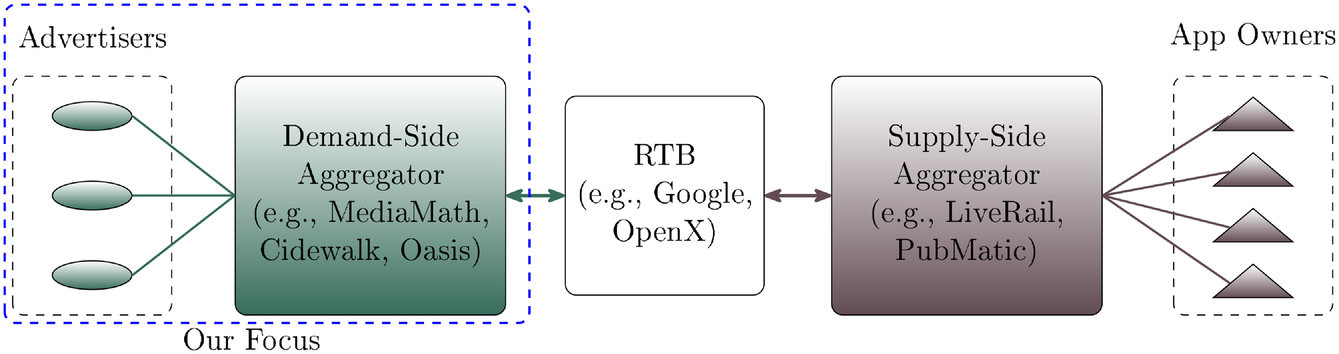
Mobile advertisement ecosystem
A growing trend for such trading is via real‐time auctions (more commonly referred to as real‐time bidding or RTB). The RTB platform is a digital marketplace through which competing demand aggregators evaluate and bid in real time for ad‐spaces, buying them on behalf of their customers (advertisers). By recent estimates, RTB‐based ads comprise 90% of all digital advertising (Mitchell, 2022). The increasing use of RTB, together with the ability to target smaller geographical areas, has led to the growth of small business advertisers within this market. Our focus in this paper is on the demand side, that is, from the perspective of a demand aggregator who simultaneously contracts with one or more ad exchanges (using RTB platforms) and buys ad space on behalf of multiple small advertisers. This side of the market is highlighted in Figure 1 with a blue (left) outline.
An opportunity for an ad to be displayed arises each time a user opens an app on her mobile device. This opportunity results in the start of an auction on the RTB platform by the supply aggregator. Demand aggregators like Cidewalk 2 are responsible for deciding the bid amount, placing the bid, and displaying the ad upon winning the bid. We use the term impression for an opportunity that has been won. Small business advertisers launch ad campaigns by displaying ads to customers within specific geographical areas over a short time horizon. The advertiser contracts with a demand aggregator for each ad campaign by opting either a CPM or CPC contract. In the CPM contract, the demand aggregator is paid per impression subject to the delivery of a minimum number of impressions. For the CPC contract, the demand aggregator is paid per click delivered while not exceeding the advertiser's budget constraint. For example, a CPM campaign might be designed to deliver 10,000 impressions within a specific zip code over a week with the demand aggregator receiving $50.00. On the other hand, under a CPC contract an aggregator might be paid $1.00 for every click delivered over the same time horizon with the total revenue not exceeding $100.00.
In recent times aggregators have begun considering a new kind of CPM‐based contract. In such a contract, the click‐through rate (CTR)

In an RTB environment ad space is marketed on a CPM basis. Regardless of the contract type, the cost to the aggregator is dependent on the acquisition cost of the impressions purchased. It should be clear that the bidding strategy employed by the aggregator plays a crucial role in the acquisition cost. Bidding too high will increase costs and thereby reduce profits. On the other hand, bidding too low could mean lost impressions, potentially resulting in the aggregator either violating the terms of the quality contract or missing revenue opportunities under the performance contract. It should also be noted that the number of available opportunities (the supply) is an exogenous and fixed value over which the aggregator has no control.
Contributions
Our objective in this paper is to determine optimal bidding and allocation strategies in order to maximize profits for a demand aggregator who simultaneously contracts with multiple advertisers where each advertiser opts for one of the two contract types. We contribute to the extant literature on advertising by being the first to (i) present and solve the quality contract problem where the pricing mechanism is a function of the “quality” of the impressions displayed; (ii) simultaneously consider two different contract types, each chosen by multiple advertisers; and (iii) study this profit maximization problem from the perspective of the demand aggregator as intermediary. Note that while we use the context of mobile advertising to showcase our results, they are applicable to the field of digital advertising as a whole.
We develop and solve a generalized profit maximization problem that jointly optimizes the aggregator's bidding and allocation policies. The bidding policy computes an optimal bid amount based on each arriving opportunity, and the allocation policy optimally assigns each opportunity to a specific advertiser. The optimal policies have nice theoretical properties. First, neither of these policies depend on the memory (the sequence of previous states and decisions) carried in the system. Thus, these policies are easy to implement in practice. Second, the allocation policy is shown to have a threshold structure. This implies that the space of arriving click probabilities can be partitioned into two sets, each corresponding to a specific type of advertising contract.
We have several interesting insights. We find that, independent of the optimal bidding strategy employed for the quality advertiser, it is infeasible or suboptimal in some cases to utilize all of the performance advertiser's budget. Similarly, it may be suboptimal to purchase exactly the minimum number of impressions required by the quality advertiser; again, this is independent of the bidding decision for the performance advertiser. Our solution furnishes clear recommendations regarding actions the aggregator can take in order to achieve a desired position in the market; for example, the aggregator may prefer to be in a state where exactly the number of impressions contracted for by the quality advertisers are purchased.
The problem we solve is inherently difficult due to the dynamic and stochastic nature of the state of the system, described by the number of impressions that have been displayed at any point in time and the number of clicks generated. This state likely changes with each arriving opportunity, and a priori we would expect this state to play a significant role in the bid decision for every new opportunity. We employ an elegant approach to solving this complex problem. We first solve a problem with one quality and one performance advertiser. Then, we demonstrate that the problem with multiple advertisers of each of these two types can be condensed to a problem with two virtual advertisers, one of each type. We use Lagrangian relaxation in order to find the optimal solution, and demonstrate that the optimal bidding and allocation policies are both independent of the previous sequence of states and decisions. This independence and the closed‐form nature of our solutions have important ramifications for the aggregator since they enable implementation of optimal RTB and allocation decisions.
After presenting a brief survey of existing literature in Section 2, we provide a detailed description of the aggregator's problem in Section 3. Section 4 details the solution process and the comprehensive sensitivity analysis conducted in order to further enhance and validate our results. Managerial implications are discussed in Section 5. We conclude the paper with a summary of results and a discussion on future directions.
LITERATURE REVIEW
There is a vast amount of literature in the space of digital advertising. In this section, we provide a summary of the extant research that is closely related to our problem. We categorize this research into the following streams: (1) optimizing digital advertising campaigns, (2) optimal ad auction bidding strategies, (3) digital advertising pricing mechanisms, and (4) advertising economics.
The first stream of literature focuses on displaying ads on different platforms (e.g., websites, smart‐phones, tablets, and Internet‐enabled game consoles) while optimizing a given objective (e.g., revenue and clicks) over a planning horizon. Apart from the characteristics of the ads to be shown (e.g., size and location) and the issues associated with fitting a set of ads into the available display space, advertiser constraints based on ad saturation and competition are also considered (e.g., Dawande et al., 2005; Kumar et al., 2007). In order to maximize a publisher's (owner of the website where the ads are displayed) benefit, Najafi‐Asadolahi and Fridgeirsdottir (2014) study how to optimize the pricing of display ads under the CPC model. Balseiro et al. (2014) study the revenue optimization problem faced by a publisher who simultaneously sells impressions through two channels: via an RTB exchange and also directly to the advertisers. Mookerjee et al. (2017) study an optimization problem that jointly considers both the publisher as well as the ad network. The goal of the ad network is to maximize revenue while also meeting a CTR constraint specified by the publisher. Aseri et al. (2018) offer near‐optimal policies for mobile‐promotion platforms purchasing mobile app impressions for advertisers to meet their location and volume requirements. Additionally, several patents exist for methods measuring the effectiveness of an Internet ad campaign (Gerken, 2008; Harvey et al., 2010; Lindsay et al., 2010; Srinivasan & Shamos, 2010). Shen et al. (2021) propose a planning approach that is different from the event‐based auction mechanism for a publisher to optimize its digital advertising. In this planning approach, the publisher first applies an arbitrary‐point–inflated Poisson regression model to forecast the number of clicks, and then solves a mixed‐integer nonlinear optimization problem that maximizes its ad revenue. Lejeune and Turner (2019) study an advertisement allocation problem under resource constraints when advertisers want ads spread out across various market segments. Our paper contributes to this stream by studying a profit optimization problem faced by an aggregator who purchases impressions through RTB for multiple advertisers with different contract types. We study a new type of allocation problem where these advertisers are one of two types (performance or quality). This type of allocation problem among heterogeneous advertisers has not been addressed in the past.
Our paper is also related to the literature on optimal bidding strategies in online ad auctions from the perspective of advertisers (see Choi et al., 2020, for a comprehensive review). Given the auction mechanisms, different constraints faced by the advertisers, such as the available budget and the number of impressions required, are considered in the bid calculations in previous studies. For instance, Ghosh et al. (2009) propose a bidding agent to purchase a given number of impressions with respect to a budget constraint, while Balseiro and Gur (2019) study advertisers' bidding strategies in repeated auctions with budgets. This literature is related to the topic of attracting potential buyers to the website. In this space, Liu and Mookerjee (2018) study how advertisers compete with two decision processes under the CPC pricing model in a duopoly setting. These two decision processes are spending based (beginning with the spending budget and determining the traffic accordingly) versus traffic based (beginning with a target level of traffic and then determining the appropriate spending budget). They show that traffic‐based competition generates higher profits for both firms. When the decision process itself is a choice, then spending‐based advertising is chosen by both firms in equilibrium. We contribute to the literature by developing an optimal bidding and allocation policy from the perspective of an aggregator who assigns impressions to its advertisers in order to meet their corresponding CPM or CPC contracts.
Additionally, our paper is related to the studies on pricing mechanisms in online advertising. Asdemir et al. (2012) apply the principal–agent setting in order to study factors that affect the preference of the CPM model versus the CPC model. Hu et al. (2016) study the incentive issues of the advertiser and publisher for performance advertising pricing models, that is, CPC and cost‐per‐action (CPA) models. Liu and Viswanathan (2012) identify conditions when a publisher should apply the strategy of pay‐per‐impression, pay‐for‐performance, or a combination of both. Balseiro and Candogan (2017) explore a contract design problem for delivering a fixed number of impressions when advertisers' budgets and targeting criteria are private and provide an optimal bidding policy, which is stationary. In our study, we extend the CPM model studied previously to a pricing mechanism in which the CPM is a function of the “quality” of the impressions delivered. Such a pricing system has not yet been studied in previous research in this domain.
Finally, there are several papers in the domain of two‐sided markets that consider the issue of advertising for mobile apps. Ji et al. (2019) study the problem of joint advertising investment and in‐app advertising adoption decisions by platform owners and app developers on a mobile platform using a differential game theoretical model. They show that a platform owner may delay or even not offer an in‐app advertising program when revenue is low. Guo et al. (2019) conduct an economic analysis of reward advertising. Reward advertising is a monetization mechanism for app developers in which consumers choose to view ads in exchange for premium app content. Their study shows that it is often optimal to offer reward ads jointly with the direct selling of premium content. Hao et al. (2017) develop a two‐sided market model of in‐app advertising, with advertisers and app users as the two sides of the market, to study a mobile platform owner's optimal advertising revenue‐sharing contract. On the mobile platform, app developers set the price for the apps while the platform owner sets the price for the ads. Their study identifies a between‐agent subsidization strategy for the platform owner in which it is optimal for the owner to subsidize the developer via the advertising channel, leading to greater profits for both. These papers are different from our research context in which we consider the problem of a demand aggregator; none of the studies cited above have examined that side of the advertising economy.
THE AGGREGATOR'S PROBLEM
We begin this section by highlighting aspects of the problem common to the two contracts that we study. We then introduce the model notation and present the complete problem faced by the demand aggregator.
Model preliminaries
There are two critical and important components that are common to the two contracts; the first is the prediction of the click probability associated with an opportunity, and the second is the bid function. We briefly describe both components.
Click‐probability prediction
The ad‐delivery process is illustrated in Figure 2. When a user opens an app, this event is relayed to an RTB platform where an auction ensues to win the right to show an ad for the resultant opportunity. The exchange provides data pertaining to the opportunity, such as the app opened, time, user location, user device type, to all demand aggregators who have contracted with this ad exchange. 3 Each demand aggregator then uses these data to independently evaluate its interest in this opportunity and decide an appropriate bid amount.
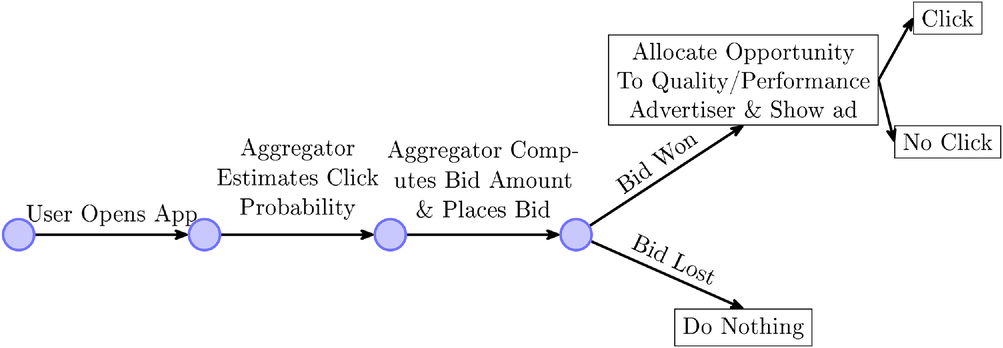
Advertisement delivery process
We assume that a demand aggregator (henceforth, referred to as aggregator for conciseness) can predict the click probability,


The bid function
The other aspect requiring elaboration is the bid function faced by the aggregator at the ad exchange. The bid function


The decisions
The goal of the problem is to simultaneously arrive at two optimal decisions: (1) the allocation policy and (2) the bidding policy. The allocation policy determines which type of advertiser should be assigned the opportunity, depending on the click probability,

Problem formulation
We now present the aggregator's problem. Table 1 contains all model notation and facilitates easier understanding of the discussion that follows. Recall that small business advertisers launch campaigns in order to advertise to customers within specific geographical areas over short time horizons (usually a week). The aggregator simultaneously contracts with N such advertisers in order to manage their campaigns. Some of these are quality advertisers that opt for the quality contracts—we represent this set of advertisers as


The aggregator is paid


Model notation (parameters, decision variables, and functions)
Given multiple simultaneously operating contracts, the aggregator evaluates each arriving opportunity and decides the appropriate bid amount. Upon winning, the bid is allocated to one of the 
It should be clear that the choice of bid amount is a crucial decision for the aggregator. Bidding too low could result in lost impressions, lowering revenue, while bidding too high could lead to lower profits due to the higher cost of acquiring impressions. The arriving opportunities are heterogeneous in terms of the characteristics discussed in Section 3.1.1. This heterogeneity is condensed and captured (through the predictive model) by the click‐probability, total number of bidding opportunities in a campaign, number of impressions won before the i
th arrival, number of clicks generated before the i
th arrival, predicted click probability and its associated distribution,
the policy π defines two rules that constitute the optimal decision for each arriving opportunity: (i) the allocation policy regarding which advertiser should be allocated a particular opportunity, and (ii) a bidding policy that determines the corresponding target probability, 

The event of winning a bid and that of clicking an advertisement are each random processes and we model them accordingly. In the absence of any specific priors of the probability distributions of these events we model them as random draws from a uniform distribution. If the randomly drawn value is less than a threshold, we consider the event to have occurred and to have not occurred otherwise. For a given opportunity, the threshold for winning an impression is the win probability, and the predicted click probability provides the threshold for clicking on an impression.
In the case of bidding, let 




Similarly, let 


Although in general the win probability x does not have to depend upon anything, but in a dynamic process such as ours, the win probability, which is a decision, should ideally incorporate the history of winning and clicking. We accordingly set the win probability x to be a function of the numbers of wins (









For ease of exposition, we define: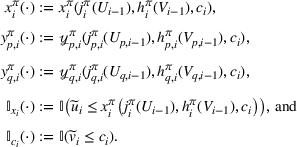
In order to illustrate the evolution of the states we use a simple example with 


Illustrative example demonstrating state evolution


The constrained optimization problem, Multiple Advertisers‐Quality Contract‐Performance Contract (
MA‐QC‐PC
) faced by the aggregator can then be formally expressed as follows: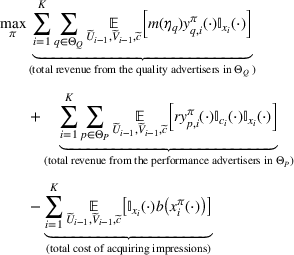






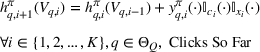

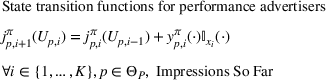



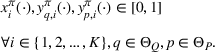
Since each quality advertiser requires a minimum number of impressions to be purchased and displayed on its behalf, the set of impression constraints for every quality advertisers in 

In the above formulation, we do not enforce a budget constraint for the quality advertiser. Since quality advertisers are interested in spreading brand awareness, having more consumers see (and potentially click on) their ads is not harmful. This is unlike the case of performance advertisers who require a budget constraint because generating too many clicks could exceed their capacity to serve demand. In practice since the impressions won by the aggregator are distributed across many advertisers, a particular quality advertiser will not receive too many impressions in excess of her desired number. Next, we present the solution to the aggregator's problem MA‐QC‐PC in the following section.
MODEL SETUP AND SOLUTION
Two heterogeneous advertisers
We first solve this problem with just two heterogeneous advertisers. The formulation (QC‐PC) of maximizing the aggregator's profit with one or more quality advertisers and one or more performance advertisers is provided in Section E of the Supporting Information. The decision variable substitute the revenue function for substitute substitute the expression for substitute replace replace 





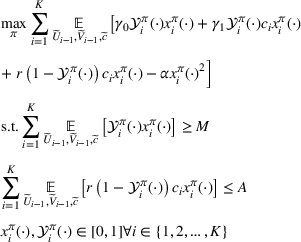
We solve this constrained optimization problem by applying Lagragian relaxation and obtain the optimal target win probabilities for both advertiser types. A noteworthy aspect of the solution is that the optimal target probabilities (

Solution structure
Before analyzing the solution, we briefly discuss the solution structure under our optimal policy 


We begin by demonstrating that the optimal allocation decision is a threshold policy; the proof is provided in Supporting Information in the discussion following (A14). Our solution provides an optimum threshold value 


Let 




Suppose 


In effect, the Problem QC‐PC is a combination of two problems: one of the quality advertiser alone and the other of the performance advertiser alone. The resultant solution consists of four scenarios with both (budget and impression) constraints being tight, both constraints being slack, or just one being tight. The fulfillment or violation of each of the following two conditions
7
determines which specific scenario is applicable for the current pair of advertisers: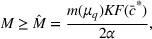

Given two contracts with two heterogeneous advertisers, it is first necessary to identify the applicable scenario by evaluating the two conditions listed above. However, the two conditions are dependent on the optimal threshold 


We are now in a position to answer the first of the two questions posed at the beginning of this subsection, that is, how much to bid. We first determine the optimal target probability based on which advertiser will be allocated the impression. The conditions (16) and (17) presented below ensure that the target probability remains less than 1, which is the case in practice as well. We therefore assume that they always hold:



Four scenarios based on boundary conditions


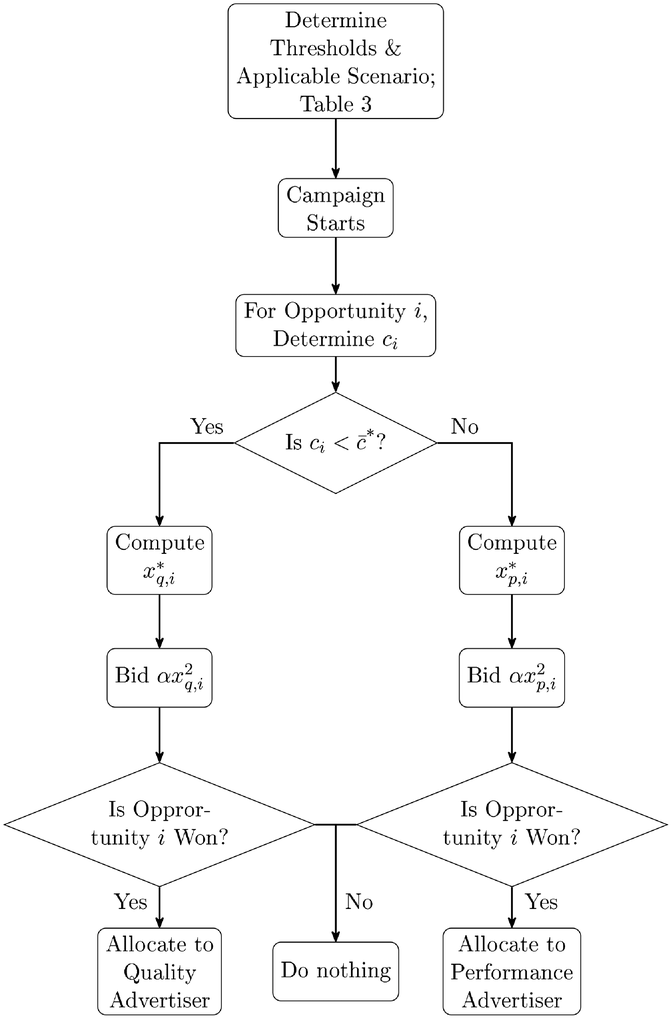
Allocating and bidding process
Solution
We now present the solution together with a detailed analysis. Our problem comprises of input parameters, which can be grouped into three different categories: (i) market‐determined parameters: K and α; (ii) aggregator‐determined revenue parameters: γ0, γ1, and r; and (iii) advertiser‐determined parameters: M and A. We have four outcome variables: the optimal target probability for the quality advertiser (


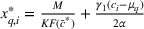
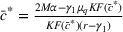
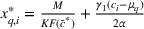
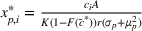
The optimal bidding and allocation policy under each of these four scenarios are given in Propositions 1 to 4. In the discussion that follows each proposition, we analyze the impact of changing these values for each of the input parameters on the outcome variables. We substitute Scenario I: The following conditions hold:


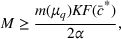
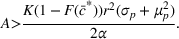



Summary of comparative statics results—Scenario I


ℵ: numerically determined.
In Table 4 we provide the comparative statics results for Scenario I associated with an increase in the input parameters. An increase in the output variable is denoted by a ↑, a decrease is denoted by a ↓, and a ⟷ denotes no change in the outcome variable. The trends determined numerically are marked with ℵ.
We will first study the impact of changes to the advertiser‐determined parameters, starting with M. In order to meet contractual requirements the aggregator is already purchasing more than the number of unconstrained optimal impressions 


The number of opportunities (K) is the first of the market‐determined parameters that we next discuss. The extra opportunities from an increase in K are distributed between the two advertisers by increasing 


Finally, we discuss the impact of aggregator‐determined revenue parameters on our outcome variables. Obviously, the profit increases with an increase in any of these parameters (r, γ0, and γ1). When r increases, the target win probabilities increase; however, Scenario II: the following conditions hold:


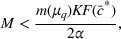
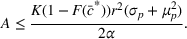

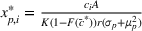

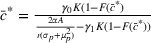

The comparative statics results for Scenario II are provided in Table 5. Since the impression constraint is slack, M does not affect any of the decision variables and outcomes. When A increases, the aggregator allocates a portion of the surplus impressions from the quality advertiser to the performance advertise by decreasing 

Summary of comparative statics results—Scenario II


ℵ: numerically determined.
When K increases, 
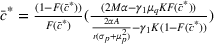
When α increases, the loss is minimized by decreasing the threshold Scenario III: the following conditions hold:


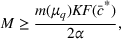
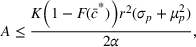


Summary of comparative statics results—Scenario III


ℵ: numerically determined.
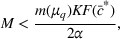
The comparative statics results are provided in Table 6. In this scenario, both the impression and budget constraints are tight. When M (A, respectively) increases trends are similar to those explained in Proposition 1 (2, respectively). When K increases, although Scenario IV: the following conditions hold:


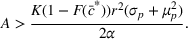



Summary of comparative statics results—Scenario IV


ℵ: numerically determined.
The comparative statics results are provided in Table 7. In this scenario the parameter M and A clearly do not affect any of the outcome variables of interest. An increase in K increases profit but does not affect either the win probabilities or the threshold. The effects of α, γ0, γ1, and r are obvious for the reasons explained earlier.
Multiple heterogeneous advertisers
We are finally ready to provide a solution for the aggregator's profit maximization problem (Problem MA‐QC‐PC) when faced with The solution of a campaign with N advertisers of whom





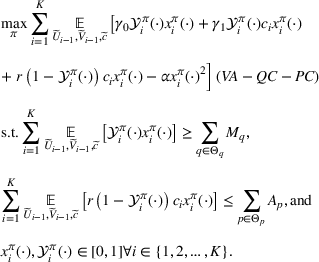
The intuition of the above result lies in the structure of the problem. Specifically, all quality advertisers can be grouped into one virtual quality advertiser, and similarly all performance advertisers can be aggregated into one virtual performance advertiser. From the aggregator's perspective, all quality advertisers differ from each other only in their impression requirements. In other words, the demand for impressions is additive across all quality advertisers. They can therefore be combined into a single (virtual) advertiser for whom the aggregator develops an optimal bidding strategy. Once an impression is won, it can then be randomly assigned to one of the 
In Figures 4, 5, and 6, we show the trends of the optimal decision variables 


Plots of optimal target win probabilities and profits against budget (A). (a)


Plots of optimal target win probabilities and profits against impression (M). (a)


Plots of optimal target win probabilities and profits against opportunities (K). (a)


Trajectory across scenarios
We now move to the situations where changes in parameters may change the scenario itself. Note that while each solution is optimal given the boundary conditions, the change in scenario happens when an exogenous parameter value changes, which drives a shift from one optimal decision (based on the previously applicable boundary conditions) to another (corresponding to the new applicable boundary conditions). In Figure 7 we show the different applicable scenarios based on the various values of M and A. These scenarios are bounded by the blue lines and the regions are labeled accordingly. The scenario changes are represented by the numbered paths shown with red lines. Figures 8 and 9 individually show the changes in scenarios with increases in M and A, respectively. In these figures the red node denotes the starting scenario for a path, the green node denotes the ending scenario, and the violet node(s) denote the intermediate scenarios. An important characteristic of all paths is that the movement from one scenario to the next is independent of any scenarios that were previously applicable. In other words, the shift from one scenario to the next is memory‐less.

Possible scenarios for different values of A and M when


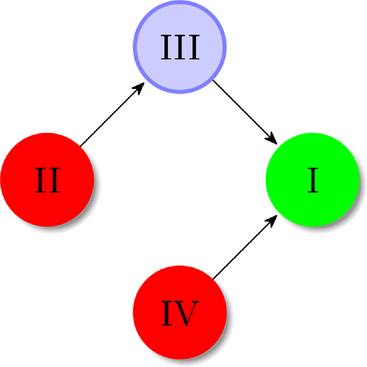
Trajectory for changes in M
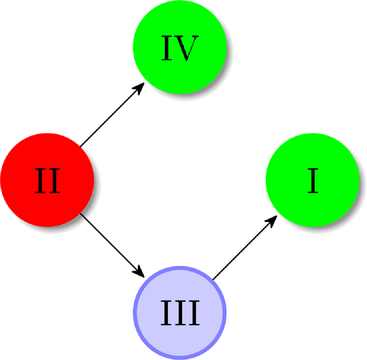
Trajectory for changes in A
Changes in M: As shown in Figure 8, with an increase in M the solution follows one of two trajectories. The trajectory {II, III, I} is shown in Path # 1 of Figure 7. Initially in Scenario II the aggregator buys a surplus (
Changes in A: As shown in Figure 9, with an increase in A the solution follows one of two trajectories, which both begin at Scenario 


Changes in K: We now discuss the scenario paths that apply when K changes (Figure 10). There are two possibilities: {I, IV, II} and {I, III, II}. In each case for low values of K the relevant scenario is always I since the foremost responsibility for the aggregator is to meet the requirements of the quality advertiser. From here the solution can shift to either Scenario IV or Scenario III based on the relative profitability of these two advertisers. In both cases with a further increase in K the solution will shift to II and stay there. This scenario is an interesting one and is related to the results from Liu and Mookerjee (2018). With an increase in opportunities (K), the aggregator is capable of sending more traffic to the performance advertisers. Now the budget constraint avoids the situation of too many allocations to the performance advertisers who care about the ability to serve arriving customers satisfactorily (controlling traffic through the budget).
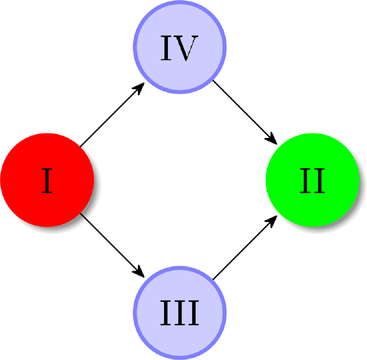
Trajectory for changes in K
MANAGERIAL IMPLICATIONS
We are now in a position to discuss the managerial implications of the solution to the aggregator's profit maximization problem and provide recommendations.
Since the aggregator has the flexibility of allocating zero impressions to the performance advertiser, the aggregator should always offer both contracts together instead of offering the quality contract alone. This holds even when the quality contract appears to be the more attractive option. On the other hand, if the performance contract is found to be better one, then the aggregator should offer the performance contact alone. Our recommendation derives from the trade‐off between marginal profits from these two contract types.
The aggregator should bid a nonzero amount for every arriving opportunity allocated to the quality advertiser. This is true even if the click probability is zero. Two reasons drive this result. First, the aggregator must meet the impression constraint. Second, the aggregator will be paid for displaying an impression even if its click probability is zero. However, for any arriving opportunity allocated to the performance advertiser, the optimal bid amount will be nonzero only when the click probability is strictly positive.
Our final recommendation is related to the “best” scenario that the aggregator would like to operate within. While our solution is optimal for a given set of parameters and the applicable scenario, there could be other (albeit subjective) business factors driving the aggregator to prefer a particular scenario. To the extent possible the aggregator would like to stay in Scenario III where all of the performance advertisers' budget is utilized and the quality advertisers are given exactly the number of impressions they contracted for. Although the quality advertisers' contract allows for the aggregator providing more impressions than required by the advertisers, the advertisers may not want large deviations from the required quantity. Likewise, the performance advertisers may feel short‐changed should their budget be underutilized. Therefore, if the active contracts result in one of the other scenarios being applicable, then the aggregator may desire to take actions that will ensure the pertinence of Scenario III. In such cases, the aggregator should find a way to either utilize the unused budget or allocate the impressions purchased in excess to new advertisers. The aggregator can employ one or more of three actions depending on the current scenario: if the aggregator is in Scenario I: the optimal action is to increase the number of available opportunities (K) in order to utilize the excess budget; if the aggregator is in Scenario II: the aggregator should either sign up more quality advertisers or more performance advertisers depending on which of the two advertiser types is more profitable; if the aggregator is in Scenario IV: the aggregator will need to both acquire more opportunities and also sign up with either more performance or more quality advertisers based on their respective profitabilities.
Changing the revenue or cost parameters is not a viable option in a competitive environment, such as the one in our context.
Acquiring more performance or quality advertisers will serve to eliminate (or reduce to the extent possible) the gap between the optimal unconstrained impressions or budget, and the corresponding constraint boundary. The decision to increase the number of available opportunities requires more thought and care. As described in the introduction in Section 1, the aggregator can simultaneously contract with multiple RTB exchanges in order to gain access to opportunities. In the event the aggregator desires to increase the K available to her, she will need to sign up with additional RTBs. Contracts with each RTB comes at an additional cost to the aggregator. Furthermore, each new contract means a step increase in the opportunities that will now become available to the aggregator. Therefore, before signing up with a new RTB, the aggregator should first weigh the additional cost of such a contract versus the potential benefits. The benefits are twofold. First, it will move the aggregator toward the direction of Scenario III as desired, and second, increasing K will increase profit.
Finally, we highlight important operational aspects of our approach that are of managerial relevance. The RTB environment requires that aggregators respond with bids within 50 to 100 ms of an opportunity becoming available. In order to compute the bid amount an aggregator needs to: (1) predict the click probability, (2) evaluate the allocation of the bid, and (3) compute both the target bid probability and corresponding bid amount. Since the predictive model is predetermined and we have closed‐form expressions for each of allocation decisions, the win probability and the bid amount, the aggregator can respond with the optimal bid amount within the time limit imposed by the RTB environment.
SUMMARY AND CONCLUSIONS
In this paper, we develop and solve a generalized profit maximization problem that jointly optimizes a bidding policy and an allocation policy. This problem is solved from the perspective of a demand aggregator who simultaneously contracts with multiple advertisers where each advertiser opts for one of two contract types. By using Lagrangian relaxation techniques we provide a solution to this complex problem.
Despite dynamic features in the problem setting (e.g., the click probability of an arriving opportunity, as well as the uncertainty associated with the outcome of a bid), we show that the optimal bidding policy is independent of the memory carried in the system (the sequence of previous system states and decisions). This property of the optimal bidding policy provides significant practical benefits. In practice, demand aggregators use a distributed algorithmic bidding architecture; that is, bidding is performed by many slave bidders that report to a master bidder. Since the optimal bidding policy does not depend on the sequence of past events (states and decisions), the slave bidders do not need to coordinate with each other. This makes the communication between the master bidder and a slave bidder relatively simple. The memory‐free property of the optimal bidding policy also holds for the optimal allocation policy. That is, the allocation decision (assigning an advertiser to an arriving opportunity) depends only on the current state (the click probability of the arriving opportunity). Similar to the bidding policy, the memory‐free property of the allocation policy allows the slave bidders to operate independent of one another.
We conclude with highlighting the limitations of this research and thoughts regarding future research possibilities. The pricing model we have employed assumes that all impressions displayed or clicks achieved are equally valuable to the advertisers. However, if there are significant differences in the valuation by advertisers of different impressions or clicks, then these results may not be optimal. For instance, location plays an important role in decision making within the context of mobile advertising. An advertiser finds more value from a click by a user closer to its establishment than a click obtained at a farther distance. One extension would be to introduce a pricing scheme where the revenue per click is a function of the distance from a given focal point. That is, clicks achieved within a smaller radius would be worth more than clicks outside this radius. Another limitation of our work is the exclusion of other types of contract being offered, for example, a CPA contract. An extension could be to include other contracts in addition to those already in the model. Finally, the aggregator is usually not alone in bidding for ad spaces. Not considering a game between bidding aggregators is also a limitation of this study. An interesting direction to pursue would be studying such a bidding game between competing aggregators.
Footnotes
ACKNOWLEDGMENT
The authors are grateful to Venkat Kolluri (CEO) and Chris Caswell (optimization specialist) of Cidewalk for providing us with the problem framework and for their availability for multiple discussions and guidance.
1
2
Cidewalk is a demand aggregator we conferred with when defining and developing this analysis.
3
A list of the main data variables used in the model estimation is provided in the Supporting Information in Section B.
4
We also test other bin sizes and find the results to be consistent.
5
The delivery constraint is expressed in terms of an expectation. The realized number of impressions could therefore violate the minimum required number of impressions. Despite this we express our problem in terms of an expectation constraint for two reasons. First, it is easy to show that for a large number of opportunities (K) the probability of violating this constraint is negligible. Second, the probability of violating the constraint can be easily controlled by padding or increasing the value of the right side by a certain amount.
6
Analysis of cases when only one type of advertiser is present during a campaign is instructive and facilitates the solution of the more complex two‐advertiser type problem, which is the focus of our paper. Such analyses for each advertiser type are provided in Section E of the Supporting Information.
7
Note that since the means (
References
Supplementary Material
Please find the following supplemental material available below.
For Open Access articles published under a Creative Commons License, all supplemental material carries the same license as the article it is associated with.
For non-Open Access articles published, all supplemental material carries a non-exclusive license, and permission requests for re-use of supplemental material or any part of supplemental material shall be sent directly to the copyright owner as specified in the copyright notice associated with the article.
