






Abstract
This paper studies the interaction between two key quality management decisions—input conformance quality and inspection policy—and related wholesale and retail prices in a two echelon supply chain. Market demand depends on the retail price as well as the end‐product conformance quality, which itself depends on the input quality and the inspection scheme. Consistent with previous empirical findings in the literature, we show that an increase in quality does not always result in higher prices for consumers due to the cost‐lowering effect of better quality. We also show that a lower input quality may still result in higher end‐product quality because of how it might incentivize more and/or better inspection. Any interaction between input quality and inspection policy becomes more pronounced in the decentralized system due to incentive asymmetry between the channel partners. This makes the adoption of a full‐inspection policy more likely there compared to an integrated system. Indeed, while vertical competition due to decentralization results in higher prices for customers, it can also result in better quality of end products. Another interesting finding in the decentralized setting is that, somewhat counterintuitively, a player may indeed opt to bear a higher share of the penalty for defective products sold to consumers resulting in higher profits for the player.
INTRODUCTION
In today's competitive market environment, product quality and price are two critical factors that shape the market demand for a product. In a survey on the automobile industry, consumers rated price and product quality as the two most important factors influencing over 60% of consumers' purchase decision (Deloitte, 2014). Quality's impact becomes even more consequential when we take into account that it also affects prices. For example, higher levels of quality, in addition to enhancing demand and potentially lowering costs, may also allow firms to charge higher prices (Dawar & Sarvary, 1997). In this paper, we focus on conformance quality, which refers to a product's ability to deliver on its stated specifications.
The conformance quality of the end product is affected by a number of factors. We focus on two of them—input conformance quality of suppliers and inspection technology and policy of buyers. A higher level of each of these two factors, independently, results in higher levels of end‐product quality. Typically, costs associated with input conformance quality and inspection are reflected in pricing by suppliers and/or buyers. More importantly, in a market where demand is driven by both price and quality, the interplay between these three factors is complex and unpredictable. The relation is further compounded in a decentralized supply chain due to the lack of alignment between decision makers. For example, the supplier's investment in improving the conformance quality may result in better input quality, but higher wholesale prices, for the buyer. As for the buyer's investment decision in inspection technology, while better inspection has its advantages (e.g., lower consumer return costs), it also increases the buyer's costs. It might also reduce the incentive for the supplier to invest in quality. The interaction among supplier's investment in input quality, wholesale pricing and the buyer's inspection policy, and how they impact the end‐item quality and price in the context of a decentralized supply chain has not been explored before in the literature. In this paper, we address this gap. Indeed, the interaction is of interest even in an integrated system; but, as there is a single decision maker making both quality management decisions and no wholesale prices are involved, the precise nature of the interaction might be different in this context. So, we also analyze the centralized system and compare how the interaction is affected by the structure of the supply chain—decentralized or integrated.
To do so, we consider a framework that is an abstraction of reality faced by companies in sectors such as aerospace, automobile, and electronics. Specifically, our bilateral monopoly model consists of a single buyer (e.g., an aerospace engine manufacturer or an electronics retailer) buying from a single supplier and selling to end consumers. Given the nature of the industry, consumer demand depends on the quality as well as the price. Information about end products not conforming to specifications (e.g., overheating for engines or electronics) is publicly available to the end customers (e.g., from National Transportation Safety Board for engines and
The main role that the buyer plays in our setting is inspecting the product and deciding on the retail price. The overall end‐product conformance quality is clearly dependent on the supplier's input quality in the key component and the buyer's inspection policy. In the context of inspection, the buyer needs to make two decisions—the choice of the inspection accuracy technology (along with its associated cost), and what fraction of the supply to inspect— given the input quality of the supplier. In line with reality, we assume that the supplier has to replace any item found defective during the buyer's inspection process, and also bears the associated cost. Subsequently, the buyer decides on the resale price to charge to the customers. As the inspection process may not be fully accurate and/or the buyer does not necessarily perform full inspection, defective items, that is, items not conforming to specifications, can still end up in the market. We assume that all such defective items will be returned by customers. Defective items on the field may result in significant costs due to service/replacement (aerospace, automobile), and loss of customer goodwill (electronics). These external failure costs are typically shared by both channel partners (see Reyniers & Tapiero, 1995b; Wan & Xu, 2008). One example of external failure cost sharing in the electronics industry is when Sanyo (supplier) and Lenovo (buyer) shared the $17 million cost of recalling 205,000 Sanyo made laptop battery packs that could overheat due to a flaw in product design in 2007 (Nystedt, 2007). Similarly, Ford and Firestone shared the cost associated with recall of tires made by Firestone and installed in Ford vehicles (Chao et al., 2009). Most recently, LG agree to reimburse GM $1.9 billion for costs from battery‐related fires in Chevy Bolt EVs (Yang, 2021). The basic framework remains the same in an integrated system except that there are no wholesale prices or cost sharing involved and all quality investment decisions are made by tone entity.
We build on the above framework to study the joint effect of quality, inspection, and pricing decisions in both decentralized and integrated systems. As end customers are quality and price sensitive, the relative strength of these factors determines the outcomes in both systems. Consequently, we note the possibility of two interesting outcomes. First, higher quality for end consumers does not necessarily result in higher prices for them providing analytical support to the empirical finding that quality–price relationship is not necessarily positive (Dawar & Sarvary, 1997). We provide explanation for this by examining the opposing cost‐reducing and revenue‐enhancing effects of higher quality. Second, higher quality cost does not necessarily result in low‐quality product for end consumers due to the moderating effect of better and/or more inspection. We are able to demonstrate under what conditions the above phenomenon is likely to happen so that the supply chain offers a better quality end product even when input quality is more expensive, and vice versa. In the comparison between the integrated and decentralized systems, we show that inspection is more likely in the decentralized system, as input quality is lower due to the double marginalization effect. This leads to the buyer being more likely to use inspection. As such, vertical competition in a decentralized system can indeed lead to higher quality end products, even though consumers might have to pay higher prices for them. Finally, we study the effect of sharing of external failure costs between decentralized supply chain partners, and show that the supplier (respectively, buyer) may be willing to share a higher fraction, that is, absorb higher risk, due to the resulting impact on the buyer's (respectively, supplier's) inspection (respectively, input quality) policy.
LITERATURE REVIEW
In one of the earlier papers, Mussa and Rosen (1978) studied the joint impact of quality and price in a monopolistic setting. Later, their model was extended to settings with horizontal and vertical competitions by Moorthy (1988). The extant literature has analyzed the impact of price and nonprice factors such as quality on demand (Bernstein & Federgruen, 2004; Desai, 1997; Gurnani et al., 2007; Iyer, 1998). In recent years, contracting mechanisms such as revenue‐sharing contracts (Ouardighi & Kim, 2010; Liu et al., 2016), recall cost‐sharing contracts (Chao et al., 2009), and return strategies (Li et al., 2019) have been introduced to coordinate supply chains in the context of quality decisions. However, the above papers do not include the buyer's inspection decision that critically affects quality and pricing decisions, as is evident from our paper. The quality–price relationship has also been studied empirically in the marketing literature with results suggesting it to be product‐specific (Morris & Bronson, 1969), weak (Gardner, 1971) and can be positive or negative depending on the circumstances (Dawar & Sarvary, 1997).
The interaction of inspection policy with input quality investment has attracted the attention of quite a few researchers. In this context, inspection policy typically involves deciding on the fraction of inbound products to be inspected and in few cases, on inspection accuracy decision. The related work vary in terms of their assumptions about the order in which inspection policy and input quality are committed. These include cases where they are decided simultaneously (Reyniers & Tapiero, 1995b, 1995a), or the inspection policy is determined before the input quality (Babich & Tang, 2015; Balachandran & Radhakrishnan, 2005; Chen et al., 2022; Hwang et al., 2006; Lim, 2001; Starbird, 2001; Wan & Xu, 2008), or the input quality is committed before the inspection policy is set (Baiman et al., 2000; Hsieh & Liu, 2010; Lee & Rosenblatt, 1985). Although some papers assume exogenous inspection accuracy that may be perfect (Babich & Tang, 2015; Lee & Rosenblatt, 1985; Lim, 2001; Reyniers & Tapiero, 1995a, 1995b; Starbird, 2001) or imperfect (Babich & Tang, 2015; Balachandran & Radhakrishnan, 2005; Hsieh & Liu, 2010; Hwang et al., 2006; Wan & Xu, 2008), some others, like us, incorporate inspection accuracy as a decision variable (Baiman et al., 2000; Lee & Li, 2018).
Assuming all‐or‐nothing inspection options, Reyniers and Tapiero (1995b, 1995a) identify pure and mixed strategy equilibria based on the internal failure penalties and how channel partners share the external failure costs, and propose channel‐coordinating contracts. In a buyer‐leading setting, Lim (2001) considers a contract that is offered by the buyer in presence of information asymmetry regarding supplier's product quality, which is exogenous. The contract specifies the probability that the buyer will inspect the product, rebate amount for defective items, and penalties for returns from the end customer. The supplier responds by simply accepting or rejecting the contract. Starbird (2001) investigates the impact of a buyer's penalty and reward terms on the supplier's input quality under three inspection regimes; no inspection, full inspection and sampling. Wan and Xu (2008) consider a Stackelberg setting where the buyer moves first and commits to the number of items to inspect and the supplier responds with his input quality decision. Any defective item identified by the inspection process is reworked by the supplier and the external failure cost is shared by both parties. The authors show that a fractional inspection policy or an all‐or‐nothing inspection policy can be the equilibrium outcome, depending on the supplier's share of the failure cost. In our work, in contrast to the above papers, the buyer's decision about the proportion of items to inspect follows the supplier's input quality decision.
In an early paper, Lee and Rosenblatt (1985) studied the buyer's optimal inspection policy given the supplier's input quality. Their analysis shows that full inspection is optimal when the input quality is neither too high nor too low. Otherwise, inspection is not a preferable option for the buyer. More recently, Hsieh and Liu (2010) consider the case where both the supplier and the buyer invest in quality and inspection. They study the interaction of the supplier and the buyer under this setting for given market prices, penalties, and post‐sale costs. In these papers, the inspection accuracy is assumed to be exogenous, whereas we include accuracy as an endogenous variable. Baiman et al. (2000) consider endogenous inspection accuracy in their work where they analyze the relation between product quality, the cost of quality, and the information that can be contracted upon. In their setting, the supplier moves first and chooses a quality level for the product that is equivalent to the probability that the product is good. In response, the buyer invests in inspection accuracy to appraise the quality of the product. Lee and Li (2018) also consider inspection accuracy as an endogenous decision made by the buyer. In contrast to Baiman et al. (2000), they study a setting where the buyer moves first and offers a contract to the supplier that stipulates a wholesale price and an internal failure penalty for the supplier. If the supplier accepts the contract, both parties simultaneously decide on their efforts on quality and in addition, buyer sets her inspection accuracy level. In their model, the resale price is assumed to be exogenous. The authors observe that with efforts exerted by both parties, when the external failure can be contracted by the buyer, the equilibrium results in first‐best outcome.
Although the above‐mentioned papers study the relation between input quality and inspection, in contrast to us, resale prices and demand are assumed exogenous. More importantly, inspection accuracy in the majority of the above literature is also exogenous. Balachandran and Radhakrishnan (2005) consider inspection accuracy as an investment decision in their model. However, they consider a setting where the wholesale price is determined by the buyer subject to the supplier's participation constraint. In a following study, Hwang et al. (2006) consider a problem where the supplier's quality is unobservable and both parties can perform inspection. They analyze two strategies in the paper—the appraisal regime with traditional inspection option, and the certification regime to induce the supplier's high quality. But, their focus is different as demand is exogenous. Babich and Tang (2015) study the role of using deferred payments and compare it to using inspection to manage product adulteration. They find four factors affecting the choice of the dominating strategy: inspection cost and accuracy, buyer's liability, difference in financing rates for the two parties, and the difference in production costs for adulterated and unadulterated product. Finally, Chen et al. (2022) compare two strategies to manage product quality: inspection‐based prevention and insurance‐based mitigation. They conclude that when the buyer's working capital is low, the benefit of inspection outstrips the benefit of insurance. The reverse is true beyond a threshold.
In summary, the extant literature either focuses on the interaction between the buyer's inspection policy and the supplier's input conformance quality decision, or on the impact of the quality investment decisions on the pricing policies. Therefore, studying the joint interaction across the three types of decisions (quality investment, inspection policy, and pricing) as well as understanding how this interaction is affected by the supply chain structure (integrated vs. decentralized) distinguishes our work and makes a novel contribution to the literature.
MODEL SETTING
Our basic model setting is a decentralized supply chain consisting of a supplier selling a product to a buyer who then sells it to customers. The end customer's demand function D is decreasing in the selling price, p, and increasing in the quality of the end product, θ. Specifically, θ represents the overall probability that a product received by the end consumer conforms to its stated specifications. As we assume an ergodic process, θ also represents the proportion of finished products that are nondefective. Therefore,




We represent the supplier's input conformance quality by q denoting the fraction of the conforming products. This is in line with related operations management literature (e.g., Anupindi & Akella, 1993; Tomlin, 2006). The buyer can observe q through samples provided in advance of the actual transaction. We reiterate that, in our context, the supplier's component plays a crucial role in the performance of the end product with the buyer's role primarily being inspection. Moreover, q also depends on supplier's quality related investments (e.g., in material, manpower, process, equipment) where the investment cost is given by


As pointed out earlier, the end‐item conformance probability is determined by the supplier's input quality and the buyer's inspection strategy. Without inspection, the end‐item no‐defect probability will be directly equal to the supplier's input conformance quality (i.e.,



Any defective item sold in the market is returned by the end customers. They are then reworked and delivered back to the customer. We assume that every reworked item is nondefective. This assumption is consistent with the extant operations management literature. Examples include Lim (2001), Wan and Xu (2008), Lu et al. (2009), Chao et al. (2009), and Xiao et al. (2011). Any returned item prompts an external failure cost caused by customer's loss of goodwill. This cost, denoted by g, is additional to the internal failure cost incurred by the supplier, who is responsible to rework the product. As such, the cost of selling a defect item to the end consumer amounts to



We study the above general setting in two stages. In the first stage, the supplier sets her input conformance quality (q) and the wholesale price (w). In the second stage, the buyer responds by choosing her inspection accuracy level (ϕ), inspection policy (U), and resale price (p). In the basic setting, the external failure cost share (γ) is treated as an exogenous parameter. Later, in Subsection 5.3, we examine the impact of the γ as a decision variable on the strategies of the supply chain partners.
To understand how the investments in quality management decisions are affected by supply chain structures, we also study this problem under the integrated supply chain structure. In this case, there is a single decision maker for the chain and because there is no vertical competition, transfer payments (i.e., w) and the cost‐sharing parameter (i.e., γ) are not relevant. Moreover, the internal failure cost v is now incurred by the chain, rather than charged to the supplier. To establish the benchmark, we begin our analysis with the integrated system in the next section (Section 4). In Section 5, we analyze the decentralized setting and derive the equilibrium outcomes. Section 6 compares the results obtained for the integrated system and the decentralized supply chain, and discuss managerial insights obtained from this comparison. Finally, we conclude with Section 7.
ANALYSIS OF THE INTEGRATED SYSTEM
We first study the interaction between quality investment, inspection, and pricing strategy in the integrated system to establish a benchmark for our analysis of the decentralized supply chain in the subsequent sections. Recall that, in our setting, inspection policy and pricing decisions follow the input quality decision. The profit function for the integrated firm is given by:

The profit for the integrated firm is calculated by subtracting the following cost components from the sales revenue: production cost, inspection cost, rework/repair cost, and the customer dissatisfaction cost. We note that the internal failure cost is independent of the inspection policy because all defective items are eventually reworked. As part of the overall optimal solution for the integrated system, we first make a couple of key observations.
1
For a given inspection technology, that is, ( If Otherwise, that is, if
The optimal profit for the integrated firm is deduced by substituting the optimal U and p pairs in (2).

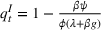






The above result indicates that the best response to a given input quality is the all‐or‐nothing inspection policy. This is consistent with previous work that report similar conclusions for settings where inspection policy selection does not precede commitment to input quality (Deming, 2000; Lee & Rosenblatt, 1985). The threshold value given in the above proposition implies that the integrated firm is more likely to inspect when the demand is more sensitive to conformance quality (i.e., high λ), and less likely to inspect when the customers are highly price sensitive (high β). We observe that the optimal inspection policy choice is independent of the internal failure cost, v. This is expected because this cost is incurred regardless of whether inspection is employed or not. We note that the threshold quality level is between 0 and 1 only if

Substituting optimal inspection policy and price, the profit function for the integrated system becomes:
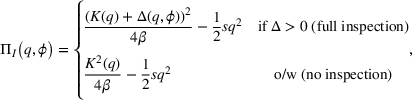
where


It is easy to observe that no‐inspection profit function is strictly concave in q if and only if




Under this condition, as the input quality is perfect, there will be no need for inspection and the integrated firm does not incur any internal or external failure costs. We note that the bang–bang solution due to Lemma 1 pertaining to the inspection policy depends on whether the input quality of the product is above or below a threshold, which is a function of the inspection accuracy and the unit inspection cost. As such, each inspection technology option may result in a unique and different quality threshold. Let



The proof is straightforward from the comparison of For given inspection technology choices ( if if if
Based on the optimal inspection strategy, the optimal quality investment and price strategy can be deduced from Lemma 1 and shown in Table 1.
















Optimal input quality, price, and profit for the integrated system

The above result suggests that when the unit inspection cost for the high‐accuracy mode is relatively cheap, it is the only preferable option when inspection is needed. At the other extreme, if the unit inspection cost for the high‐accuracy mode is quite expensive, it is dominated by the low‐accuracy option. When the cost is neither low nor high, the optimal strategy switches from low‐accuracy inspection to high‐accuracy inspection as the cost of quality increases (Figure 1). We note that beyond the cost thresholds end‐item quality depends on the inspection accuracy. With sufficiently high accuracy, end‐item quality may increase when the inspection regime switches from one inspection regime to the other as exemplified in Figure 1b. Because of this, indeed it is possible that end‐item quality is not strictly decreasing in the cost of input quality and might be nonmonotone. In general, threshold cost decreases as the inspection accuracy increases.
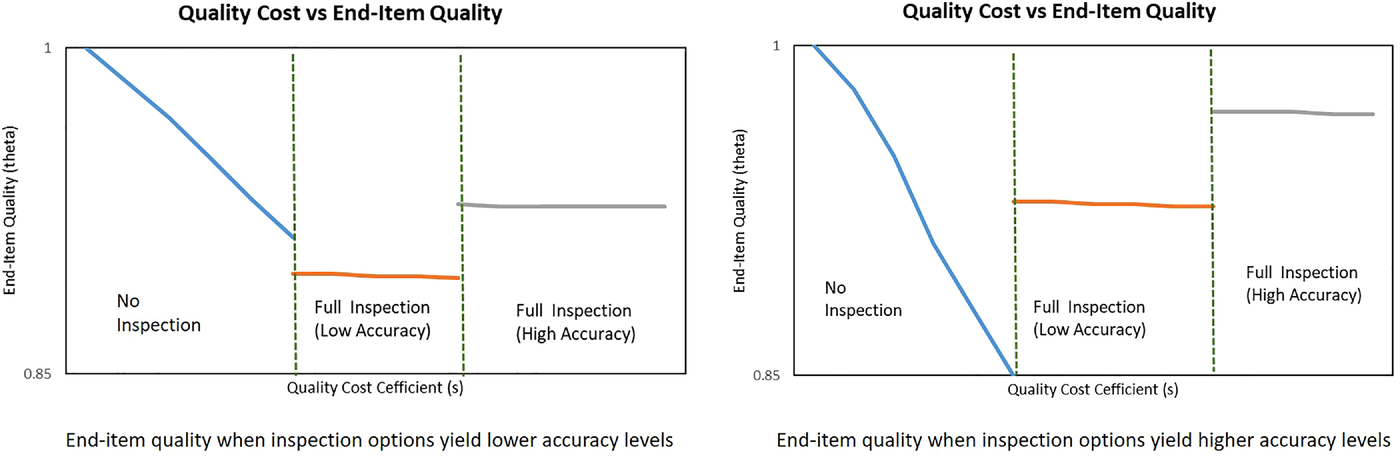
Input quality cost and end‐item quality
The optimal outcomes for the integrated system are summarized in Table 1. Although the mathematical expressions are cumbersome, closed‐form equations pertaining to threshold values for input quality cost can be derived from the optimal profit functions given in the table.
ANALYSIS OF THE DECENTRALIZED SUPPLY CHAIN
Clearly, the equilibrium outcome in the competitive decentralized supply chain will not be aligned with the optimal outcome obtained under the integrated system. In addition to double marginalization, the players' best strategy choices will be influenced by the internal failure cost (v), wholesale price (w), and how the external failure cost, γ, is shared between the two players, where γ represents the supplier's share of the external failure cost. Employing backward induction, we begin our analysis with the decision problem of the buyer, who responds to the supplier's input quality and wholesale price decisions. Later, we solve the supplier's decision problem based on the best response mapping of the buyer.
The Buyer's inspection policy and pricing
The buyer's decisions include her inspection accuracy level (ϕ), inspection policy (U), and resale price (p). Her profit function is given by the following equation:
The profit for the buyer is calculated by subtracting the following cost components from the sales revenue: procurement cost, inspection cost, and the buyer's portion of the external failure cost. We note that rework/repair cost is incurred by the supplier and as such not included in the buyer's profit function. To facilitate the analysis and presentation, we first derive the buyer's inspection policy and pricing decision for a given inspection accuracy level. The buyer's optimal strategy can be summarized as follows. There is a unique threshold quality level if otherwise, that is, if 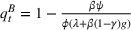






Similar to the integrated system, inspection policy selection is a bang–bang solution that is based on the input quality level. The intuition behind the all‐or‐nothing outcome is explained by the fact that the input defect rate is known, and as such, there is no need for learning or updating the conditional defect rates through sampling (Yao & Zheng, 2002). Different from the integrated system, the buyer's input quality threshold depends on her share of the external cost. Under the special case, where 
It is straightforward to see that 
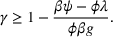
In this case, the cost of inspection outstrips its benefits on gains in external failure costs and enhancement in demand volume. To avoid such cases, we assume that the supplier's cost share is below the threshold given above for both inspection accuracy options. Finally, it is interesting to observe that the buyer's inspection policy choice is independent of the supplier's wholesale price, w. The intuition is that the same wholesale price is incurred by the buyer regardless of the input and output quality of the product.
The above results clearly indicate that the threshold quality level is a function of both the inspection accuracy option and the cost of inspection. Therefore, in the rest of the analysis we denote this threshold value by For given inspection technology choices ( if if if if 













Similar to the integrated system, the choice of inspection accuracy depends on the trade‐off between inspection costs and accuracy levels. The inspection option with lower marginal cost with respect to its accuracy is preferable to the buyer, as expected. In general, either one of the inspection accuracy options dominates the other or the buyer switches from low accuracy to high accuracy as the input quality decreases. Specifically, the high‐accuracy option always dominates the low‐accuracy option when the former one has lower cost to accuracy ratio. In this case, the buyer has no incentive to switch to the latter option due to inferior return on investment. In the opposite case, the comparison between high‐ and low‐accuracy options depends on another threshold given in (14), which is a function of price sensitivity of demand (β), impact of quality on demand (λ), external failure cost (g), and buyer's share on external failure cost (

As an interesting final note for this stage, we observe that the impact of input quality on the resale price can be nonmonotone depending on whether the market demand is driven primarily by price or quality. It is straightforward to observe from (10) and (11) that the resale price decreases as input quality increases under both inspection regimes when 
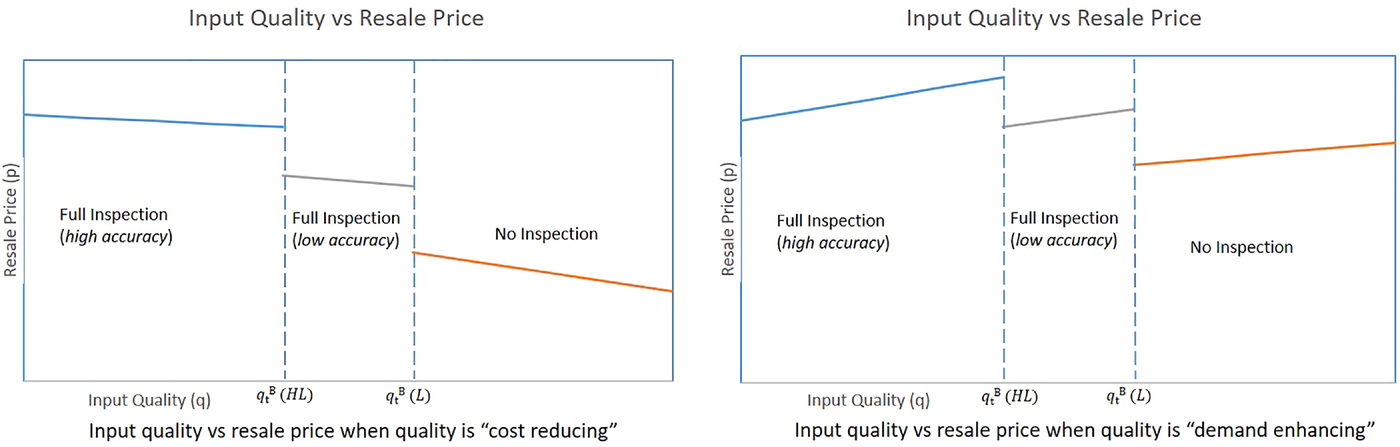
Input quality versus resale price
The supplier's input quality and wholesale price decisions
After incorporating the buyer's best response derived in the previous subsection, we can write the supplier's profit function under no inspection (
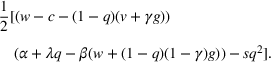


In this stage, inferring on the buyer's best response strategies on inspection and pricing, the supplier decides on her input quality followed by the wholesale price. To facilitate the analysis and follow the intuitive sequence of decisions, we first investigate the supplier's optimal wholesale price decisions for a given input quality level. It is straightforward to observe from the second derivatives, both functions given in (16) and (17) are concave in w and the first‐order optimality conditions yield the following optimal wholesale prices under no inspection (



Once we incorporate these values into the supplier profit functions, we can make the following first observation regarding input quality. For 

The above lemma indicates that when the impact of quality on demand (demand enhancing impact) or the external failure cost (cost reducing impact) is sufficiently high, the supplier has an incentive to build perfect quality, making inspection redundant. Noting that the supplier's quality decision is constrained by the buyer's threshold given in Proposition 2, we can generalize the above result and provide the following sufficient conditions on quality cost coefficient leading to the no‐inspection policy at equilibrium. For a given inspection option with 




The above result indicates that when the cost of quality is sufficiently low, the supplier will have incentive to build her input quality level above the buyer's threshold, 

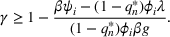
We let 




The above equation can be easily derived from the first‐order optimality condition applied to the supplier's profit function (17) evaluated at For a given inspection option with 




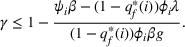
We let 


The cases given in Lemmas 4 and 5 capture the supplier's preference between no‐inspection and full‐inspection regimes. In addition to these cases, the supplier may need to choose between two available full‐inspection options signified by their costs and accuracy levels. It can be deduced from Proposition 3 that the switch between two full‐inspection options may occur only if When If if if if if if 




If 




Moreover, 








We know from Proposition 3 that when 





Whether the inspection regime moves from no inspection to low‐accuracy inspection before switching to high‐accuracy inspection depends on how the parties share the external failure cost. In general, 



Proposition 2 and Lemma 6 together imply that the unconstrained input quality under full inspection with high accuracy (i.e., 


Finally, Lemmas 4–6 together lead to the following generalization for the supplier's equilibrium investment strategy on input quality. For given inspection technology choices (

Input quality at equilibrium
Cases I and II follow from Proposition 3 and Lemmas 4 and 5. Case III is a result of Proposition 3 and Lemma 6. Cases I–III are driven by the buyer's best response on inspection policy preferences, which are determined by the trade‐off between costs and accuracy levels of the inspection technology options. These cases are significant for the supplier in that they shape the quality threshold constraints in the decision model. In the first two cases, one of the inspection technology options dominates the other for the buyer (high accuracy in Case I and low accuracy in Case II). Consequently, the supplier cannot include the dominated option in her decision. In these cases, the equilibrium inspection policy depends only on the cost threshold corresponding to the dominating option.
The equilibrium outcome is relatively more ambiguous in Case III, where no‐inspection accuracy option dominates the other, and as such, both options can be adopted by the buyer depending on the input quality. As both options are potentially viable for the buyer, the supplier's cost thresholds are different under this case as detailed in Lemma 6. The change in input quality as a function of s depends on the relation between these thresholds. The equilibrium values for prices, quality levels, demand, and profits are summarized in Table A1 in Appendix A.
Interestingly, we observe that both input and end‐item quality, the resale price, demand, and player profits are independent of the supplier's external failure cost share (i.e., γ) when the quality threshold constraints in the supplier's decision model are nonbinding. This can be explained by the fact that in these cases, the buyer offsets external failure costs with her pricing decision. However, when γ is sufficiently small or sufficiently large, the buyer's quality threshold constraint on the supplier's decision model is activated. In such cases, as the quality thresholds are functions of γ, all outcomes are directly affected by its exact value of γ. Specifically, the supplier's input quality is nonincreasing with γ. At first glance, this is a counterintuitive result because one would expect that the supplier invests more if her cost share increases for the defect items. However, with the supplier's higher cost share, the buyer will be less inclined toward full inspection. Consequently, the buyer's quality threshold, and hence the supplier's input quality, decreases with γ when the quality threshold constraint is binding in the supplier's decision model.
As expected, the input quality and players' profits strictly decrease in the cost of quality. Although end‐item quality decreases in cost of quality under a given inspection regime, it may increase when the inspection regime switches from no inspection to full inspection (or from low‐accuracy inspection to high‐accuracy inspection). This is especially true when inspection accuracy is high, which would eliminate a significant portion of the nonconforming items. The impact of s on prices is relatively more ambiguous and depends on the trade‐off between the quality's impact on demand (i.e., λ) and failure costs (i.e., v and g). When λ is sufficiently small (i.e., the cost‐reducing impact of quality is more dominant), resale price increases in the cost of quality under a given inspection regime. Basically, the buyer is compelled to increase the price to counter balance the increasing external failure cost. On the other hand, when λ is large (i.e., the demand‐enhancing impact of quality is more dominant), the resale price decreases in cost of quality in order. In this case, the buyer is compelled to lower the price to balance the drop in demand due to lower quality.
In general, impact of quality on demand (λ) is an important factor for the inspection policy outcome. When λ is sufficiently large, the supplier's input quality choice will also be sufficiently high so that inspection is not needed. On the other hand, when λ is very small, inspection is not an equilibrium outcome as well. In this case, even if the input quality is low, inspection is not justified due to the high cost of inspection. Higher quality attained from inspection does not bring about higher sales volume because λ is small. The small increase in sales volume then does not justify the cost of inspection. When λ is neither too small nor too large, full inspection will be the equilibrium outcome. Consequently, we conclude that impact of λ on 
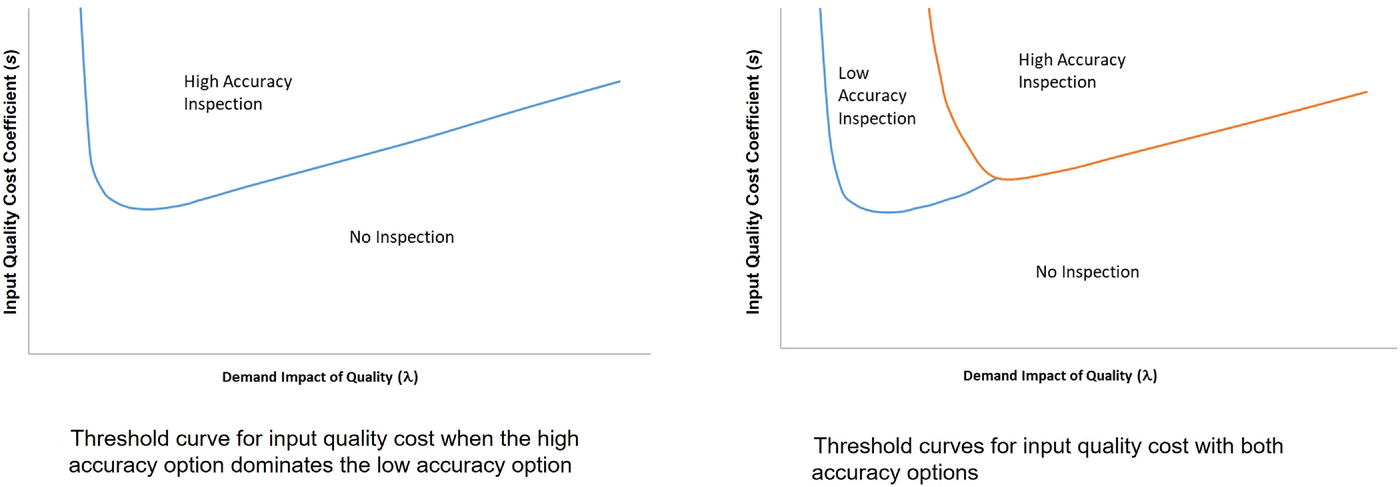
Threshold curves for input quality cost as function of λ
External failure cost share selection
In our discussion so far, the external failure cost share is assumed to be exogenous. The obtained results reveal that although equilibrium decisions and players' profits may be independent of γ (when the threshold quality constraint is nonbinding), the choice of inspection regime at equilibrium is driven by it because the buyer's threshold quality is a function of γ. As such, the value region for γ, more than its exact value, is critical for both players. In this subsection, we investigate the strategies of the players about the selection of γ. First, we focus on the case where the supplier makes this decision and later we discuss the buyer's best strategy. In all cases, the decision of the respective player on γ precedes all other decisions in the sequence of events.
It is straightforward to deduce from the analysis in the previous subsection that if the supplier decides on γ, she will prefer values that lead to unconstrained solutions for the input quality. Consequently, the quality cost thresholds would depend on the comparison of the unconstrained equilibrium profits. We can deduce from Lemma 4 that when cost of quality is sufficiently low (i.e., s is below the no‐inspection threshold), the supplier's selection for γ will be above 


The case where the buyer decides on γ is more involved. A comparison of equilibrium profits reveals that the quality cost thresholds for inspection are higher for the buyer than that of the supplier. This indicates that the buyer is less inclined toward full inspection in comparison to the supplier. This is intuitive as the buyer avoids the cost of inspection while the supplier prefers to free ride on full inspection performed by the buyer. This observation implies that when the supplier is better off with no inspection, so is the buyer. On the other hand, when full inspection leads to higher equilibrium profits for the buyer, it does so for the supplier as well. Consequently, when the cost of quality is sufficiently low, the buyer's choice of γ would be greater than 


COMPARISON BETWEEN INTEGRATED AND DECENTRALIZED CHANNELS
In general, under both the integrated and decentralized settings, if the cost of quality is sufficiently low, investment in input quality will be high and inspection will not be employed, But, when quality cost is sufficiently high, both settings result in full inspection. However, the inspection policy choice is ambiguous when the quality cost is in between. Before investigating these choices across two structures in detail, we first compare the outcomes under a shared inspection policy. Ceteris paribus (for a given inspection policy—full or no), the comparison of the two supply chain structures yields the following. The integrated system chooses a higher input quality level than the supplier in the decentralized supply chain. That is, Consequently, the end‐item quality of the integrated system is better than the decentralized supply chain, that is, The integrated system charges a lower price to the end consumers implying that


The proof for the Proposition follows from the direct comparison of solutions provided in Tables 1 and A1. The above result implies that the integrated system can take advantage of its efficiency (no double marginalization) to provide a higher quality product at a lower price for customers, as long as the inspection choices are aligned in both settings. The extent to which the cost advantage is used to provide higher input quality and accuracy depends on how much the demand is sensitive to price and quality. Specifically, if demand is very sensitive to quality (i.e., large λ), the integrated system invests more in improving end‐item quality; if the demand is very sensitive to price, the investment is relatively less and investments are used primarily to reduce quality‐related costs. Obviously, the immediate question that arises then is whether the inspection choices are always aligned for the two supply chain structures. The following result shows that this is actually not the case. Given any inspection technology option i, 
The above lemma implies that when 


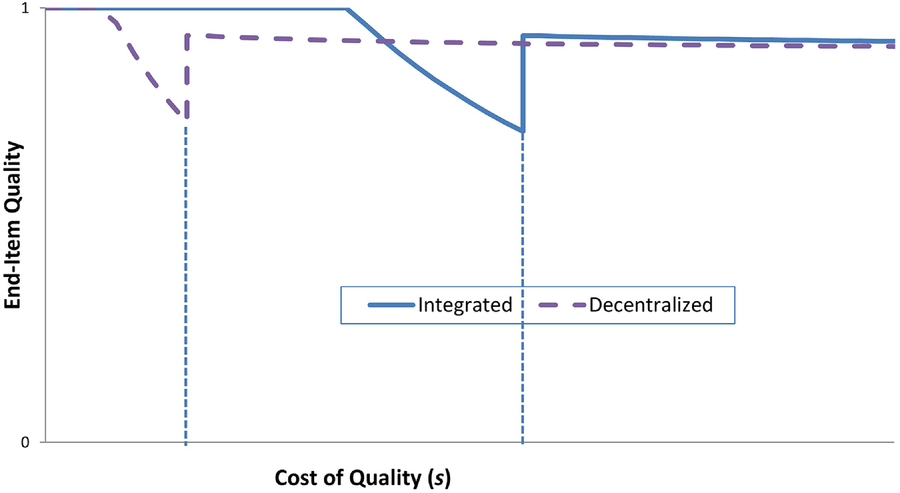
End‐item quality as function of quality cost under the integrated system and the decentralized supply chain
Under both channel structures, the low‐accuracy inspection option is always dominated by the high‐accuracy inspection option if the cost‐accuracy ratio for the former one is greater than that of the latter. Conversely, the preferences of the channels between inspection accuracy options may differ depending on γ. It can be deduced from Propositions 1 and 4 that when γ is lower than the ratio between internal and external failure costs, that is, 
CONCLUDING DISCUSSION
Quality and price are perhaps two of the most important factors in purchasing decisions of customers in a wide variety of sectors. Quality is especially interesting because it has both a revenue‐generating aspect as well as a cost‐reducing facet. The quality of the end product in many sectors is shaped by two elements—the quality of the input from the supplier and the inspection technology/policy of the buyer. Investments in input quality and inspection influence prices and hence, demand, through their impact on costs and quality. There is an interesting interaction between input quality, inspection policy and prices, and this interaction is also affected by the structure of the supply chain. In this paper, we study this interplay under two supply chain structures, namely, integrated and decentralized.
Our analysis first verifies that the preferred inspection policy is either no inspection or full inspection depending on the input quality for both supply chain structures and how they share the external failure cost for the decentralized supply chain. In our study, we observe two intriguing aspects of quality management for both types of chain structures. First, due to the cost reducing effect associated with higher conformance quality, end consumer prices do not necessarily increase with better quality. Second, higher cost of input quality does not necessarily result in lower end‐item quality due to the moderating effect of the inspection policy. Consequently, managers need to be careful about whether to focus on the cost‐reduction or the revenue‐enhancement feature of conformance quality. If the end customers are more sensitive to price, the cost‐reduction effect should be dominant; if they are more quality‐sensitive, the revenue‐enhancing feature should be the driver. Our analysis also partially explains why prices alone are not a good indicator of quality in consumer markets as has already been established empirically.
As expected, our analysis reveals that the impact of quality on demand and how the supply chain partners share the external failure cost are critical in shaping the inspection regime. However, the extent of their influence on the equilibrium is not entirely intuitive. Our results indicate that the relation between the impact of quality on demand and the inspection policy choice is not monotonic. Inspection is not a preferred option when the impact is either too small or too large. In the former case, additional investment on inspection does not justify the growth in demand and hence the revenues. In the latter case, the input quality is sufficiently high (i.e., close to perfect) and as such, inspection will not be needed. Interestingly, we observe that the impact of the external failure cost share is also somewhat ambiguous in that a channel partner might be better off with a higher external failure cost share in the decentralized supply chain. In general, the buyer is inclined toward employing inspection as her cost share increases. When cost of quality is below a threshold, the supplier is better off with a no‐inspection equilibrium. However, when the cost is not significantly below this threshold, the supplier's quality choice may still be below the buyer's quality threshold and thus, leading to full inspection if the cost share of the latter one is high. In such cases, the supplier would be better off with a lower share in cost for the buyer (respectively, higher share for herself), which ensures no inspection. On the other hand, when the cost of quality is sufficiently high, both parties are better off with full‐inspection equilibrium, which can be attained when the buyer's cost share is high. Moreover, when there are two competing inspection accuracy options, the buyer may be better off with a higher cost share to ensure the higher inspection accuracy outcome, if the cost of quality is prohibitive. We also observe that introducing an inspection technology option does not necessarily make full inspection more likely as an equilibrium strategy. In fact, introducing a new inspection option may create incentive for the supplier to revert back to choosing an input quality level resulting in no inspection. This is particularly the case when an inspection option with higher accuracy and moderate inspection cost is introduced. Basically, with the new option, the buyer's preference deviates from low‐accuracy to high‐accuracy option imposing additional constraint for the supplier's decision model under full inspection. This constraint degrades her profits under full inspection to the point that she is better off choosing an input quality level resulting in no inspection from the buyer.
Our comparison between the integrated and decentralized channels reveals that the decentralized supply chain is more likely to adopt the full‐inspection strategy compared to the integrated system. Specifically, when the investment cost for input quality is relatively low, both channels invest significantly in input quality and opts for no inspection, and when the investment cost is high, then they invest less and opt for full inspection. Due to the inefficiency created by the double marginalization effect in the decentralized supply channel, the supplier actually invests less in input quality. Interestingly, the low level of investment in input quality by the supplier means that the buyer is forced to go for full inspection in regions where the integrated system can afford no inspection. For low and high levels of investment cost for input quality, the integrated system delivers a better quality product because it has higher levels of input quality. It also charges a lower price, although the extent of benefits in terms of quality and price depends on how sensitive is the end customer demand on those two factors. But, for regions where the buyer in the decentralized channel opts for full inspection while the integrated system opts for no inspection, competition actually results in higher end‐item quality (although the price might still be higher). We also demonstrate that this is likely to happen when the input quality is more expensive and inspection accuracy is cheaper. The rationale is that in those cases the supplier invests less in input quality forcing the buyer to select full inspection even earlier as the cost of quality increases compared to the integrated system. Moreover, if this inspection is highly accurate, then the decentralized system ends up with a better quality end product. So, indeed, in the decentralized setting, the interaction between input quality and inspection policy is actually exacerbated by incentive asymmetry.
The paper can be extended in the following three directions. First, we assumed a perfect information setting. An interesting extension concerns the case of unobservable supplier's quality by the buyer. A second extension is to study the case where the two parties in a decentralized system enter into an alliance and determine their quality investment decisions simultaneously. Finally, while we focus on vertical competition, it would also be worthwhile to study the impact of horizontal competition (i.e., in an oligopolistic market) on equilibrium quality management decisions.
